Green Party leader pretends to be a target
With the NDP already pledged to oppose legislation to grant additional Parliamentary seats to Canada's fastest-growing provinces -- namely, Alberta, BC and Ontario -- it was only a matter of time before the rest of the opposition found a way to justify opposing the bill as well.
Green Party leader Elizabeth May seems to have found her pretext: as with so many things, the self-absorbed May considers the bill to be an attack on her, directly.
Waving around a Conservative Party newsletter in which Saanich-Gulf Islands Tory Bruce Hallsor notes that the re-distrubtion may make it easier for them to beat May in the next election.
May seems to think the newsletter is incriminating, but all she's offered is what is currently just idle speculation.
Of course, the detail that the Globe and Mail's projections are not based on any proposed re-districting -- no such proposals exist until independent commissions have done their work -- but only on votes cast in the past election will almost certainly be ignored by May.
In the end, it's purely intuitive: the party with the largest share of the vote in each of these provinces will reap the biggest reward. The Tories dominate in Alberta, are strong in BC, and swept Ontario in the 2011 election.
When one considers where the additional ridings need to be added to account for population growth -- in Northern Alberta, central BC, and suburban GTA -- it's not at all surprising that the strength of the Conservative vote in these areas would yield victories for Conservatives.
It's the just the way things are right now. If the work of these independent commissions concludes that the boundaries of Saanich-Gulf Islands should be redrawn, it's just the way it will be. To tailor the process just to suit May would be a dereliction of the commission's responsibilities: namely, to produce a re-distribution that is fair to all constituents, not just to May.
If Elizabeth May and the Green Party don't like it, perhaps they should campaign harder in those areas, and propose policy that will appeal to, as opposed to repulse, those voters.

Showing posts with label Democracy. Show all posts
Showing posts with label Democracy. Show all posts
Thursday, October 20, 2011


Sunday, October 09, 2011
The NDP Gives Democracy a A Great Big Orange Middle Finger
NDP's stance on extra seats for growing provinces anti-democratic
The NDP must think that Canadians in Alberta, Ontario and BC aren't just aren't paying attention.
That's the only explanation for their position opposing the addition of new Parliamentary seats for Alberta, BC and Ontario. These provinces have long been underrepresented in Parliament, and the rapid growth of the population of these provinces only ensures that it will get worse if it isn't addressed.
Fortunately, Democratic Reform Minister Tim Uppal is prepared to move to alleviate this issue.
"Currently, Canadians in the fastest-growing provinces are severely underrepresented," Uppal explained. "We believe that every Canadian vote, to the greatest extent possible, should carry equal weight."
David Christopherson, the NDP's Democratic Renewal critic, has vowed that the NDP will fight the re-distribution tooth and nail. And therein lies the evidence that the NDP thinks Canadians aren't paying attention.
In August, NDP interim leader Nycole Turmel even had the nerve to describe the proposed new seats as "divisive".
"The approach of the Harper government is really divisive right now. It's not constructive, it's not nation-building," Turmel insisted.
Of course any Canadian with even the remotest grip on reality know precisely what this statement is:
A lie.
It's the NDP who are trying to divide Canadians over the addition of more seats to Parliament, and it's unfortunate they don't respect Canadians enough to tell the truth about it.
It's the NDP who are looking to voters in BC, Alberta and Ontario and telling them they aren't good enough to have the same electoral weight as voters in Quebec. It's the NDP who are looking to these voters and telling them they must remain second-class citizens in Canada.
Fortunately, voters in Alberta, BC and Ontario are paying attention to this issue. And what do they see? They see the Conservative Party sanding up for their right to equal representation, and they see the NDP opposing it.
It's not a hard conclusion to reach: if you live in Ontario, BC or Alberta, the NDP is not on your side. They are against you.
The NDP must think that Canadians in Alberta, Ontario and BC aren't just aren't paying attention.
That's the only explanation for their position opposing the addition of new Parliamentary seats for Alberta, BC and Ontario. These provinces have long been underrepresented in Parliament, and the rapid growth of the population of these provinces only ensures that it will get worse if it isn't addressed.
Fortunately, Democratic Reform Minister Tim Uppal is prepared to move to alleviate this issue.
"Currently, Canadians in the fastest-growing provinces are severely underrepresented," Uppal explained. "We believe that every Canadian vote, to the greatest extent possible, should carry equal weight."
David Christopherson, the NDP's Democratic Renewal critic, has vowed that the NDP will fight the re-distribution tooth and nail. And therein lies the evidence that the NDP thinks Canadians aren't paying attention.
In August, NDP interim leader Nycole Turmel even had the nerve to describe the proposed new seats as "divisive".
"The approach of the Harper government is really divisive right now. It's not constructive, it's not nation-building," Turmel insisted.
Of course any Canadian with even the remotest grip on reality know precisely what this statement is:
A lie.
It's the NDP who are trying to divide Canadians over the addition of more seats to Parliament, and it's unfortunate they don't respect Canadians enough to tell the truth about it.
It's the NDP who are looking to voters in BC, Alberta and Ontario and telling them they aren't good enough to have the same electoral weight as voters in Quebec. It's the NDP who are looking to these voters and telling them they must remain second-class citizens in Canada.
Fortunately, voters in Alberta, BC and Ontario are paying attention to this issue. And what do they see? They see the Conservative Party sanding up for their right to equal representation, and they see the NDP opposing it.
It's not a hard conclusion to reach: if you live in Ontario, BC or Alberta, the NDP is not on your side. They are against you.
Friday, September 16, 2011
Brian Topp & the NDP: Not On Your Side
Topp-led NDP would do what's good for them, not what's good for Canada
Anyone who pays even passing attention to the NDP has noticed it: their penchant for divisive politics.
They delight in drawing sides among Canadians, then telliing as many as possible that the NDP is on their side, and that their political opponents are not.
Yet if you live in the provinces of BC, Alberta or Ontario, the NDP is unequivocally not on your side... or at least they won't be, if Brian Topp -- so far the only declared candidate for the NDP leadership -- gets his way.
Topp has already declared that the NDP will staunchly oppose any additional seats in Parliament for Alberta, BC or Ontario unless Quebec recieves a proportionate increase of its own. This despite the fact that Quebec is already disproportionately represented on a scale greater than anywhere else in the world.
Topp's justification for sticking the 61% of Canadians that are underrepresented in Parliament is rather bizarre: because Parliament recognized Quebec as a distinct society within Canada, it's entitled to be overrepresented.
“The national legislature … has recognized the province of Quebec as a nation within the country, a resolution that was supported by all parties, and this is an occasion where it’s time to think about what that resolution means,” Topp declared.
It isn't hard to figure out what that motion means. It doesn't require extensive reflection. It may mean that Quebec is distinct within Canada, but it doesn't mean that it's above the rest of Canada.
Sadly, many of the NDP's hardcore supporters will back Topp's opposition to equitable democracy in Canada even thought it's vastly democratic. They even manage to offer some supremely dumb reasons: some will even declare that in opposing the addition of more seats in Parliament, they're fighting in favour of small government (not realizing that there's a difference between Parliament and the government).
Some oppose the addition of these seats believing that too many of them -- particularly in Alberta -- will fall to the Tories. For these people, their motivation is crassly partisan.
In Brian Topp's case, he's merely shamelessly pandering to Quebec at the expense of the rest of Canada. After all, it wasn't BC, Alberta or Ontario that delivered a mass of new seats to the NDP in the last election. It was Quebec.
In pandering to Quebec, the NDP is only doing what's good for itself. The NDP's merely doing what the NDP does best: putting itself first, and Canada second.
Anyone who pays even passing attention to the NDP has noticed it: their penchant for divisive politics.
They delight in drawing sides among Canadians, then telliing as many as possible that the NDP is on their side, and that their political opponents are not.
Yet if you live in the provinces of BC, Alberta or Ontario, the NDP is unequivocally not on your side... or at least they won't be, if Brian Topp -- so far the only declared candidate for the NDP leadership -- gets his way.
Topp has already declared that the NDP will staunchly oppose any additional seats in Parliament for Alberta, BC or Ontario unless Quebec recieves a proportionate increase of its own. This despite the fact that Quebec is already disproportionately represented on a scale greater than anywhere else in the world.
Topp's justification for sticking the 61% of Canadians that are underrepresented in Parliament is rather bizarre: because Parliament recognized Quebec as a distinct society within Canada, it's entitled to be overrepresented.
“The national legislature … has recognized the province of Quebec as a nation within the country, a resolution that was supported by all parties, and this is an occasion where it’s time to think about what that resolution means,” Topp declared.
It isn't hard to figure out what that motion means. It doesn't require extensive reflection. It may mean that Quebec is distinct within Canada, but it doesn't mean that it's above the rest of Canada.
Sadly, many of the NDP's hardcore supporters will back Topp's opposition to equitable democracy in Canada even thought it's vastly democratic. They even manage to offer some supremely dumb reasons: some will even declare that in opposing the addition of more seats in Parliament, they're fighting in favour of small government (not realizing that there's a difference between Parliament and the government).
Some oppose the addition of these seats believing that too many of them -- particularly in Alberta -- will fall to the Tories. For these people, their motivation is crassly partisan.
In Brian Topp's case, he's merely shamelessly pandering to Quebec at the expense of the rest of Canada. After all, it wasn't BC, Alberta or Ontario that delivered a mass of new seats to the NDP in the last election. It was Quebec.
In pandering to Quebec, the NDP is only doing what's good for itself. The NDP's merely doing what the NDP does best: putting itself first, and Canada second.
Saturday, June 26, 2010
Who Is The Tank Man?
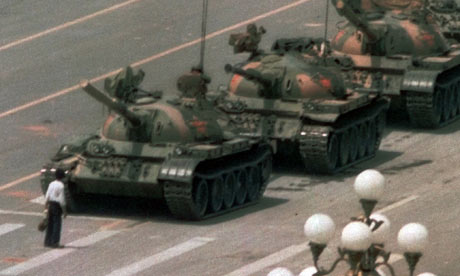
British journalist Alfred Lee identified the man as Wang Weilin -- an account that no other journalist has ever been able to verify.
To many, it's frustrating that we cannot identify the man who provided one of the most iconic images of not only the 20th century, but in time of all time.
The Chinese government has certainly expended a great deal of time and effort in destroying this image. No sooner had the photo been taken then Chinese security services attempted to sieze the film, Fortunately, the photographer was enterprising enough to successfully hide it.
Today, just as many Chinese students never been told about the Tienanmen Square massacre (the further within China's borders one lives from Beijing the less likely one is to know about it), they don't know the Tank Man image.
The Chinese state has built an elaborate infrastructure to the suppression of such information. In such, they have successfully stunted the growth of the democracy movement.
It may not be inconceivable to think that the rest of the world will not see democracy and freedom in China until as many Chinese people as possible know the iconic image of the Tank Man, even if they may never know his name.
Sunday, June 06, 2010
This is What They Think of the Majority of Canadians
The time when it was fun to pick on the perrenially-deranged CK of Sister Sage's Musings has long passed. If it weren't for her insistence on a state of war, your not-so-humble-scribe wouldn't bother any longer.
But CK has a gift for sometimes producing blogposts that are so outrageously and feverishly insane that it just can't be ignored. Such is the case with a recent post in which CK denigrates the majority of Canadians as sheep, merely because they are mostly centrists who don't share her extreme views:
 So CK clearly recognizes that the Canadian centre is shifting toward conservative ideas and conservative values. But instead of considering the possibility that Canadians have recognized that this is because conservative ideas and conservative values are actually applicable to the real lives of the majority of Canadians than progressive values are, CK simply insists it's because the majority of Canadians allegedly don't think for themselves.
CK, like so many progessives, won't take responsibility for the lack of appeal of their inferior ideas. Rather, they simply insist that Canadians are cattle, and move on unabated.
Yet progressives likely will not stop attempting to impliment their ideas. They simply recognize that they'll have to do so in one of two ways: either by sneaking them under the civic radar -- as they did for so many years via appealing to courts in place of citizens, and by corrupting institutions such as Canada's Human Rights Commissions -- or by forcing them on Canadians through a coalition government.
CK seems to reject the notion of a Coalition, but not because she recognizes it as un-democratic. Rather, she continues to labour under the delusion that the coalition was democratic:
 What CK clearly fails to understand about democracy is that it is not merely the rules that determine what is democratic. Nor do MPs decide what is democratic. Rather, citizens decide what is and is not democratic -- the Canadian people (those unthinking, Kool-Aid drinking cattle, in CK's opinion) decide what is democratic.
The Canadian people decided that the coalition was undemocratic.
The majority of the Canadian people also decided that Stephen Harper's 2010 proroguement of Parliament was undemocratic. The proroguement was well within the rules established by the Constitution -- both by written and unwritten portions of the Constitution -- while the 2008 coalition was arguably at odds with constitutional convention.
Therefore we know that the rules alone are not enough to establish a particular practice as democratic.
Yet in CK's mind, when the so-called progressive political parties get together to engineer a blatant power-grab against the will of the Canadian people, that's entirely democratic despite the aforementiojned will of the Canadian people.
It's certainly fair to wonder what else CK would like to push into place against the will of the Canadian people.
That's the insidious implications of CK's self-serving rhetorical trick. When the majority of Canadians are deemed to be unthinking and uncritical, their will loses any and all meaning. Once the will of the Canadian citizenry loses meaning, progressives could justify ramming anything they like through, regardless of the objections of others.
That's the irony of CK -- clearly not being able to recognize totalitarianism -- insisting that Stephen Harper is a totalitarian who would abolish elections if he ever won a majority government. CK's own vision for the country is a vision of totalitarian tyranny -- with her and her cohorts as the tyrants.
This is why people like CK can never be allowed anywhere near the levers of power, and must be isolated from them at every opportunity. After all, she belongs to an ideological cabal to whom human life only has value so long as it helps them advance their extrene ideological agenda.
We can already see the contempt CK holds for the will of the majority of Canadian citizens if that will won't help her advance her aforementioned extreme ideological agenda.
But CK has a gift for sometimes producing blogposts that are so outrageously and feverishly insane that it just can't be ignored. Such is the case with a recent post in which CK denigrates the majority of Canadians as sheep, merely because they are mostly centrists who don't share her extreme views:

CK, like so many progessives, won't take responsibility for the lack of appeal of their inferior ideas. Rather, they simply insist that Canadians are cattle, and move on unabated.
Yet progressives likely will not stop attempting to impliment their ideas. They simply recognize that they'll have to do so in one of two ways: either by sneaking them under the civic radar -- as they did for so many years via appealing to courts in place of citizens, and by corrupting institutions such as Canada's Human Rights Commissions -- or by forcing them on Canadians through a coalition government.
CK seems to reject the notion of a Coalition, but not because she recognizes it as un-democratic. Rather, she continues to labour under the delusion that the coalition was democratic:

The Canadian people decided that the coalition was undemocratic.
The majority of the Canadian people also decided that Stephen Harper's 2010 proroguement of Parliament was undemocratic. The proroguement was well within the rules established by the Constitution -- both by written and unwritten portions of the Constitution -- while the 2008 coalition was arguably at odds with constitutional convention.
Therefore we know that the rules alone are not enough to establish a particular practice as democratic.
Yet in CK's mind, when the so-called progressive political parties get together to engineer a blatant power-grab against the will of the Canadian people, that's entirely democratic despite the aforementiojned will of the Canadian people.
It's certainly fair to wonder what else CK would like to push into place against the will of the Canadian people.
That's the insidious implications of CK's self-serving rhetorical trick. When the majority of Canadians are deemed to be unthinking and uncritical, their will loses any and all meaning. Once the will of the Canadian citizenry loses meaning, progressives could justify ramming anything they like through, regardless of the objections of others.
That's the irony of CK -- clearly not being able to recognize totalitarianism -- insisting that Stephen Harper is a totalitarian who would abolish elections if he ever won a majority government. CK's own vision for the country is a vision of totalitarian tyranny -- with her and her cohorts as the tyrants.
This is why people like CK can never be allowed anywhere near the levers of power, and must be isolated from them at every opportunity. After all, she belongs to an ideological cabal to whom human life only has value so long as it helps them advance their extrene ideological agenda.
We can already see the contempt CK holds for the will of the majority of Canadian citizens if that will won't help her advance her aforementioned extreme ideological agenda.
Monday, May 10, 2010
Alex Salmond and the Puzzle of Measuring a Mandate
Alex Salmond, SNP claim mandate for "progressive alliance"
In the wake of a Kevin Maguire insisting that David Cameron and the Conservative Party have no mandate for austerity following Britain's 2010 general election comes a predictable turn in the post-election wrangling over who will be Prime Minister.
Scottish National Party leader Alex Salmond has called upon Liberal Democrat leader Nick Clegg and Labour Party leader Gordon Brown to join the SNP and Plaid Cymru in a "progressive alliance" as an alternative to the David Cameron Conservatives.
"There are alternative and more progressive options available if politicians have the will to seize the moment," Salmond announced. "The SNP and Plaid are indicating that we do."
The overture carries a clear resemblence to the ill-fated attempt to establish a coalition government in Canada -- although the separatist Bloc Quebecois was a more powerful element within that coalition than the Welsh separatist Plaid Cymru (who have only three Parliamentary seats).
The SNP and Plaid Cymru could put Labour and the Lib Dems over the top for a narrow overall majority -- something that Britons clearly expect that any government must have -- of 330 seats.
Altogether, Labour, the Lib Dems, the SNP and Plaid Cymru received the votes of 54% of Britons. Culmulatively, that could very well be interpreted as a mandate to govern.
But as discussed previously, interpreting a mandate can be extremely tricky.
In an arrangement such as the one that Salmond is recommending, Gordon Brown would clearly be the Prime Minister. Without Labour's 258 seats there is not even the foundation of a government.
But one must ask the question of whether or not Labour can realistically be a partner in such a coalition, or if Labour would be the kind of partner that Salmond imagines.
As previously noted, Labour has promised to cut the public budget more deeply than Margaret Thatcher did.
As Nick Robinson points out, this poses a challenge for the very notion of a progressive coalition.
"An arrangement between Labour, the Lib Dems, the SNP and Plaid could command a majority in the House of Commons (see the figures below)," Robinson writes. "The nationalist parties would, of course, extract financial and political concessions from Westminster."
But considering that Labour, holding the largest portion of seats in such a coalition, actually has an individual mandate for austerity, it quickly becomes apparent that these four parties would not possess a monolithic overall mandate.
Rather, such a progressive alliance would possess a diffuse overall mandate that would pit themselves at odds over key issues. The public chequebook is the most important of these issues, but only one.
Plaid Cymru, for example, has won an individual mandate to lead Wales out of the United Kingdom.
Just as Labour's austerity mandate is at odds with the individual mandates of the other three parties in the proposed coalition, so would Plaid Cymru's individual mandate be at odds with the others.
As Robinson notes, this renders such a progressive alliance inherently unstable. Clegg's push for electoral and political reform would be threatened by this instability.
"The key question Liberal Democrats have to consider is how stable such an arrangement would prove to be. Legislating for a referendum on electoral reform, staging it and implementing the necessary boundary changes could take over two years." Robinson continues. "So, if PR is the main goal for many Lib Dems they'd have to be sure that 'the progressive alliance' would last that long."
Moreover, Robinson notes that the electoral reform issue will bring some regional divides within Britain to the forefront.
"If it does come about it would highlight one little talked about but significant development in this election - the growing gulf between England and the rest of the UK," he explains. "In England the Tories secured almost 40% of the vote and 297 seats whilst Labour got just 28% and 191 seats."
Under such conditions, electoral reform could inflame regional tensions within Britain. Inflaming regional tensions while a separatist party sits within the government could not even begin to be a good or responsible idea.
It's on this note that Plaid Cymru's separatist mandate would challenge the Liberal Democrats' electoral reform mandate.
Whether or not Nick Clegg will opt for a "progressive alliance" will remain up to him. Whether or not he should is up to Britons to decide.
But whatever happens, such a progressive alliance could not claim to share a single mandate to govern. It's crystal clear that, within a Westminster Parliament, mandates aren't nearly that simple.
In the wake of a Kevin Maguire insisting that David Cameron and the Conservative Party have no mandate for austerity following Britain's 2010 general election comes a predictable turn in the post-election wrangling over who will be Prime Minister.
Scottish National Party leader Alex Salmond has called upon Liberal Democrat leader Nick Clegg and Labour Party leader Gordon Brown to join the SNP and Plaid Cymru in a "progressive alliance" as an alternative to the David Cameron Conservatives.
"There are alternative and more progressive options available if politicians have the will to seize the moment," Salmond announced. "The SNP and Plaid are indicating that we do."
The overture carries a clear resemblence to the ill-fated attempt to establish a coalition government in Canada -- although the separatist Bloc Quebecois was a more powerful element within that coalition than the Welsh separatist Plaid Cymru (who have only three Parliamentary seats).
The SNP and Plaid Cymru could put Labour and the Lib Dems over the top for a narrow overall majority -- something that Britons clearly expect that any government must have -- of 330 seats.
Altogether, Labour, the Lib Dems, the SNP and Plaid Cymru received the votes of 54% of Britons. Culmulatively, that could very well be interpreted as a mandate to govern.
But as discussed previously, interpreting a mandate can be extremely tricky.
In an arrangement such as the one that Salmond is recommending, Gordon Brown would clearly be the Prime Minister. Without Labour's 258 seats there is not even the foundation of a government.
But one must ask the question of whether or not Labour can realistically be a partner in such a coalition, or if Labour would be the kind of partner that Salmond imagines.
As previously noted, Labour has promised to cut the public budget more deeply than Margaret Thatcher did.
As Nick Robinson points out, this poses a challenge for the very notion of a progressive coalition.
"An arrangement between Labour, the Lib Dems, the SNP and Plaid could command a majority in the House of Commons (see the figures below)," Robinson writes. "The nationalist parties would, of course, extract financial and political concessions from Westminster."
But considering that Labour, holding the largest portion of seats in such a coalition, actually has an individual mandate for austerity, it quickly becomes apparent that these four parties would not possess a monolithic overall mandate.
Rather, such a progressive alliance would possess a diffuse overall mandate that would pit themselves at odds over key issues. The public chequebook is the most important of these issues, but only one.
Plaid Cymru, for example, has won an individual mandate to lead Wales out of the United Kingdom.
Just as Labour's austerity mandate is at odds with the individual mandates of the other three parties in the proposed coalition, so would Plaid Cymru's individual mandate be at odds with the others.
As Robinson notes, this renders such a progressive alliance inherently unstable. Clegg's push for electoral and political reform would be threatened by this instability.
"The key question Liberal Democrats have to consider is how stable such an arrangement would prove to be. Legislating for a referendum on electoral reform, staging it and implementing the necessary boundary changes could take over two years." Robinson continues. "So, if PR is the main goal for many Lib Dems they'd have to be sure that 'the progressive alliance' would last that long."
Moreover, Robinson notes that the electoral reform issue will bring some regional divides within Britain to the forefront.
"If it does come about it would highlight one little talked about but significant development in this election - the growing gulf between England and the rest of the UK," he explains. "In England the Tories secured almost 40% of the vote and 297 seats whilst Labour got just 28% and 191 seats."
Under such conditions, electoral reform could inflame regional tensions within Britain. Inflaming regional tensions while a separatist party sits within the government could not even begin to be a good or responsible idea.
It's on this note that Plaid Cymru's separatist mandate would challenge the Liberal Democrats' electoral reform mandate.
Whether or not Nick Clegg will opt for a "progressive alliance" will remain up to him. Whether or not he should is up to Britons to decide.
But whatever happens, such a progressive alliance could not claim to share a single mandate to govern. It's crystal clear that, within a Westminster Parliament, mandates aren't nearly that simple.
Saturday, May 08, 2010
David Cameron and the Puzzle of Measuring a Mandate
Pooled authority must mean a shared mandate
As Britons wait expectantly to find out who will form the government following May 6's election, the Mirror's Kevin Maguire has a message for British Conservative leader David Cameron:
You have no mandate for austerity. He writes:
Maguire makes a logical error when he treats each vote for Labour and the Liberal Democrats as a vote against the Tories, as opposed to a vote for the political programs offered by Labour and the Lib Dems. It's a logical error frequently replicated in Canada.
Maquire assumes that neither Labour nor the Lib Dems would be prepared to tolerate austerity measures, despite the state of the British chequebook. Ergo, no austerity at all has been mandated by the 2010 election.
But the nature of the British and Canadian pstliamentary systems tends to cast doubts over such simplistic interpretations. The function of the Westminster system in both design and actual social function complicates such matters severely.
In the Westminster system, governance is assumed by the coalition that can best hold the confidence of Parliament. Such coalitions normally emerge from party caucuses -- in cases where no party holds a majority of seats, a coalition that can hold the support of other parties and individual MPs is called upon to govern.
In the most official sense, voters in a Westminster system directly elect a Member of Parliament. Their votes are also accompanied by an indirect function imposed by the institutionalization of political parties. Their votes count toward the accumulation of caucuses that will ultimately decide the government.
Voters cast their ballots diectly for individual Members of Parliament, and indirectly for the government and Prime Minister. Numerous dynamics can be at work within the kinds of decisions voters can make. (Citizens can vote in favour of a government by voting for, or in some cases even against that particular party.)
But the need for a government to be able to hold the confidence of the House of Commons means that the authority to hold government accountable is pooled amongst all the members of Parliament.
But in a system wherein the authority to hold government shared amongst all the Members of Parliament, then the mandate of government must, in turn, be shared by all the members of Parliament.
The adversarial nature of the Westminster system makes exercising this mandate cooperatively very difficult. Governments are elected to exercise their program as their mandate to govern -- opposition parties are elected to exercise their program as their mandate to oppose.
But under a hung Parliament/minority government scenario, government must become a collaborative and cooperative process. If the government's mandate were decided by popular vote, none of the parties in a hung Parliament would have a mandate at all -- unless it was understood that each party has a mandate of its own, as defined by the number of citizens who vote in favour of each party's program.
So for Kevin Maguire to assume that no mandate exists for any austerity whatsoever would be fallacious. In fact, 36% of British voters voted in favour of the Conservative political platform, featuring vigorous austerity measures.
Maguire's argument is further tattered by Labour Chancellor of the Exchequer Alastair Darling's promise to cut the British budget more deeply than Margaret Thatcher.
29% of British voters voted for the Labour Party. So it could in fact be said that at least 65% of Britons voted for austerity measures.
Regardless of which way Nick Clegg and the Liberal Democrats cast their lot in terms of supporting a government, one of the parties that promised austerity will sit on the government benches. Another will sit on the opposition benches.
Part of the government will have an individual mandate to cut the budget. The opposition will have an individual mandate to push for those cuts as well.
Only the Lib Dems will have an individual mandate to oppose austerity.
So how will the austerity question be settled?
Educated speculation from Britain is that Nick Clegg and the Lib Dems will have to accept some austerity measures in the course of an agreement to annoint a government.
The Tories wouldn't have an overall mandate to cut 6 billion Pounds Sterling from British budget. But nor would the Lib Dems have an overall mandate to cut zero, or increase expenditures.
In a responsible Parliament, responsive to the dynamics at work within the voting choices of Britons, a figure somewhere in between zero and 6 billion pounds should be trimmed from the budget, regardless of the protests of Kevin Maguire and the entrenched adversarial left.
Of course, negotiating a shared mandate amongst the various parties in a Westminster Parliament is, due to the adversarial nature of the system, not an easy task. It relies on a government and opposition that are willing to collaborate and cooperate.
Historical experience demonstrates that parties -- particularly ones from differing ideological camps -- are all too frequently unwilling to cooperate at all.
As Britons wait expectantly to find out who will form the government following May 6's election, the Mirror's Kevin Maguire has a message for British Conservative leader David Cameron:
You have no mandate for austerity. He writes:
"The progressive political parties – Labour and the Liberal Democrats, two parties united by much – easily polled more votes between them.It's the kind of knee-jerk reaction that one should expect from the relentlessly adversarial left. One can see it right now in Greece: even as the state of their fiscal ship threatens to drag the bulk of Europe down with it, the Greek left rioted against austerity.
Cameron secured no mandate to unleash an age of austerity on those without cash to buy private education or health."
Maguire makes a logical error when he treats each vote for Labour and the Liberal Democrats as a vote against the Tories, as opposed to a vote for the political programs offered by Labour and the Lib Dems. It's a logical error frequently replicated in Canada.
Maquire assumes that neither Labour nor the Lib Dems would be prepared to tolerate austerity measures, despite the state of the British chequebook. Ergo, no austerity at all has been mandated by the 2010 election.
But the nature of the British and Canadian pstliamentary systems tends to cast doubts over such simplistic interpretations. The function of the Westminster system in both design and actual social function complicates such matters severely.
In the Westminster system, governance is assumed by the coalition that can best hold the confidence of Parliament. Such coalitions normally emerge from party caucuses -- in cases where no party holds a majority of seats, a coalition that can hold the support of other parties and individual MPs is called upon to govern.
In the most official sense, voters in a Westminster system directly elect a Member of Parliament. Their votes are also accompanied by an indirect function imposed by the institutionalization of political parties. Their votes count toward the accumulation of caucuses that will ultimately decide the government.
Voters cast their ballots diectly for individual Members of Parliament, and indirectly for the government and Prime Minister. Numerous dynamics can be at work within the kinds of decisions voters can make. (Citizens can vote in favour of a government by voting for, or in some cases even against that particular party.)
But the need for a government to be able to hold the confidence of the House of Commons means that the authority to hold government accountable is pooled amongst all the members of Parliament.
But in a system wherein the authority to hold government shared amongst all the Members of Parliament, then the mandate of government must, in turn, be shared by all the members of Parliament.
The adversarial nature of the Westminster system makes exercising this mandate cooperatively very difficult. Governments are elected to exercise their program as their mandate to govern -- opposition parties are elected to exercise their program as their mandate to oppose.
But under a hung Parliament/minority government scenario, government must become a collaborative and cooperative process. If the government's mandate were decided by popular vote, none of the parties in a hung Parliament would have a mandate at all -- unless it was understood that each party has a mandate of its own, as defined by the number of citizens who vote in favour of each party's program.
So for Kevin Maguire to assume that no mandate exists for any austerity whatsoever would be fallacious. In fact, 36% of British voters voted in favour of the Conservative political platform, featuring vigorous austerity measures.
Maguire's argument is further tattered by Labour Chancellor of the Exchequer Alastair Darling's promise to cut the British budget more deeply than Margaret Thatcher.
29% of British voters voted for the Labour Party. So it could in fact be said that at least 65% of Britons voted for austerity measures.
Regardless of which way Nick Clegg and the Liberal Democrats cast their lot in terms of supporting a government, one of the parties that promised austerity will sit on the government benches. Another will sit on the opposition benches.
Part of the government will have an individual mandate to cut the budget. The opposition will have an individual mandate to push for those cuts as well.
Only the Lib Dems will have an individual mandate to oppose austerity.
So how will the austerity question be settled?
Educated speculation from Britain is that Nick Clegg and the Lib Dems will have to accept some austerity measures in the course of an agreement to annoint a government.
The Tories wouldn't have an overall mandate to cut 6 billion Pounds Sterling from British budget. But nor would the Lib Dems have an overall mandate to cut zero, or increase expenditures.
In a responsible Parliament, responsive to the dynamics at work within the voting choices of Britons, a figure somewhere in between zero and 6 billion pounds should be trimmed from the budget, regardless of the protests of Kevin Maguire and the entrenched adversarial left.
Of course, negotiating a shared mandate amongst the various parties in a Westminster Parliament is, due to the adversarial nature of the system, not an easy task. It relies on a government and opposition that are willing to collaborate and cooperate.
Historical experience demonstrates that parties -- particularly ones from differing ideological camps -- are all too frequently unwilling to cooperate at all.
Monday, May 03, 2010
Murray Dobbin: Not Good With Numbers
Dobbin continues to peddle his coalition fantasies
The everlasting so-sad-it-isn't-even-funny-anymore reign of Murray Dobbin has produced far more than its fair share of ideological-at-all-costs stink.
Yet those observing Dobbin's mediocre flailings can rest assured of one thing -- so long as Dobbin remains good at winding up his extreme left-wing fellow travellers, the publishers of Rabble.ca will keep him around.
In his most recent discharge, Dobbin leads off by drastically mis-reading the most recent polling numbers, even according to his typically self-serving choice of which polls to recognize:
But his other claim -- that "probably 75% of Canadians" oppose the Conservative Party agenda is a little more peculiar. After all, he declines to produce polling numbers to support it.
This is likely for good reason. When one considers the most recent results provided by Canada's various pollsters, it becomes clear that the magic number is not "probably 75%":
 A later passage in Dobbin's screed indicates which polls he wants his readers to pay attention to:
Which, if one were to argue according to Dobbin's line of thinking, would mean that 65% opposed the Conservative Party's agenda. (That, is if one agued according to Dobbin's line of thinking. It's a big "if".)
There are, of course, other polls that have the Conservatives closer to Harris-Decima's numbers. But they are EKOS polls that, based on the expressed bias of EKOS President/cultural warrior Frank Graves -- who, to the best knowledge of this author, has not yet been asked to resign from EKOS -- can immediately be deemed discredited.
Beyond that, Angus Reid and Nanos research have produced similar results.
Moreover, polling data does not indicate that the Harper government is out of touch with the expectations of Canadians regarding the Jaffer/Geurgis affair. Rather, Canadians seem largely indifferent to it, as they should -- Harper has sone the right thing by Canadians, if not what would be politically beneficial for the opposition.
Likewise, polling data does not indicate that Harper is out-of-touch with Canadians in not funding abortions in the developing world. Rather, polling data indicates that Canadians don't favour funding abortions in foreign countries.
Dobbin also complains that:
In BC in 2009, 61% of voters rejected the idea. In Ontario in 2007 63% of voters rejected such a reform.
Dobbin apparently attributes this to:
Canadians don't support hare-brained reforms that would (allegedly) make their votes count because the villainous right doesn't want their votes to count. Brilliant!
Moreoever, it's amusing to see Dobbin accuse conservatives of wanting this out of relentless partisanship, considering that the kind of electoral reforms Dobbin has advocated would erase any non-partisan space within Canadian politics. If Dobbin were to successfully secure the kind of reforms he favours, partisanship would be all that exists in Canadian politics.
But in the end, it all comes directly back to the old fantasy that Dobbin relentlessly peddles to the sheep that make up his readership:
So many, in fact, that Michael Ignatieff, Stephane Dion and the Liberal Party were forced to abandon it or face certain anhiliation in a swiftly-coming federal election.
46% of Canadians were prepared to vote Conservative in such an election had the coalition come to power. Fully 60% of Canadians opposed the coalition. Only 37% of Canadians supported it.
If the government was to be replaced, 56% of Canadians insisted it should be through an election.
Many Canadians have likely forgotten that the idea of a coalition government was Dobbin's brainchild in the first place -- advocated very quickly in the days after a Conservative election victory that Dobbin very evidently cannot countenance.
It's very clear that in Dobbin's mind democratic legitimacy is imparted not by Canadians who vote, but by Dobbin himself, and Dobbin alone. And Dobbin only imparts democratic legitimacy to parties that share his extreme left-wing agenda, or are at least willing to pander to it.
So much so Murray Dobbin continues to peddle this idea that Canadians so soundly rejected. And he has the utter temerity to insist that it was the Conservatives who are contemptuous of democracy.
The everlasting so-sad-it-isn't-even-funny-anymore reign of Murray Dobbin has produced far more than its fair share of ideological-at-all-costs stink.
Yet those observing Dobbin's mediocre flailings can rest assured of one thing -- so long as Dobbin remains good at winding up his extreme left-wing fellow travellers, the publishers of Rabble.ca will keep him around.
In his most recent discharge, Dobbin leads off by drastically mis-reading the most recent polling numbers, even according to his typically self-serving choice of which polls to recognize:
"We have a government so contemptuous of democracy that it is utterly unapologetic in trying to impose on the country an agenda opposed by probably 75 per cent of the population -- treating its minority status not as a mandate to work with other parties but as an irritating impediment to re-engineering the country along the lines defined by the U.S. Christian right."Whenever Dobbin accuses Harper of advancing an agenda akin to the American religious right, he should just be ignored. It's an accusation that he has gleefully created out of whole cloth.
But his other claim -- that "probably 75% of Canadians" oppose the Conservative Party agenda is a little more peculiar. After all, he declines to produce polling numbers to support it.
This is likely for good reason. When one considers the most recent results provided by Canada's various pollsters, it becomes clear that the magic number is not "probably 75%":

"No matter how out of synch with Canadians the Harper government becomes on a range of issues -- the Jaffer/Guergis fiasco; the shameful exclusion of abortion from Ottawa's maternal health program for developing nations; the contempt for Parliament; the chronic lying -- the Liberals cannot gain any traction. While it is just one poll, a recent Harris-Decima survey showed the Liberals at just 27 per cent and the Conservatives at 29."He wants his readers to ignore any and all other polls -- including the Ipsos-Reid poll released a mere three days before the Harris-Decima poll that indicates that the Conservatves are actually holding down the support of 35% of decided voters.
Which, if one were to argue according to Dobbin's line of thinking, would mean that 65% opposed the Conservative Party's agenda. (That, is if one agued according to Dobbin's line of thinking. It's a big "if".)
There are, of course, other polls that have the Conservatives closer to Harris-Decima's numbers. But they are EKOS polls that, based on the expressed bias of EKOS President/cultural warrior Frank Graves -- who, to the best knowledge of this author, has not yet been asked to resign from EKOS -- can immediately be deemed discredited.
Beyond that, Angus Reid and Nanos research have produced similar results.
Moreover, polling data does not indicate that the Harper government is out of touch with the expectations of Canadians regarding the Jaffer/Geurgis affair. Rather, Canadians seem largely indifferent to it, as they should -- Harper has sone the right thing by Canadians, if not what would be politically beneficial for the opposition.
Likewise, polling data does not indicate that Harper is out-of-touch with Canadians in not funding abortions in the developing world. Rather, polling data indicates that Canadians don't favour funding abortions in foreign countries.
Dobbin also complains that:
"We are amongst a tiny handful of countries still saddled with the absurdly anachronistic voting system that allows for government by executive dictatorship by any party that can get 40 per cent of the vote."Later on in his screed, Dobbin further complains:
"Most important for the future of the country would be a commitment to proportional representation (PR) or at a minimum, a national referendum on the issue. This will be the toughest to achieve but the NDP, which officially supports PR, should make this the core of any agreement - and the core plank in its next election platform.Yet if proportional representation were truly so well supported, Dobbin may want to explain to his readers why it is, on the two occasions that a provincial government has held a referendum on the matter, the proposition lost.
An Environics poll commissioned by the Council of Canadians and carried out in February, revealed that fully 62 per cent of Canadians support a change in the voting system to one using PR. Young voters were the strongest supporters, with 71 per cent favouring such a change. Given that only 20 per cent of eligible first-time voters actually cast a ballot, PR might help address that crisis, too.
"
In BC in 2009, 61% of voters rejected the idea. In Ontario in 2007 63% of voters rejected such a reform.
Dobbin apparently attributes this to:
"A deliberate plan by the political right to downsize democracy through relentless partisanship and people's frustration at seeing their votes count for nothing."So, apparently, Canadians have repeatedly and soundly rejected the kind of reforms that Dobbin favours because it would give his ideological camp a near-permanent advantage -- a reform that would allagedly make Canadians votes count (apparently they don't at this time) -- because of a plan by the right to make sure Canadians votes don't count.
Canadians don't support hare-brained reforms that would (allegedly) make their votes count because the villainous right doesn't want their votes to count. Brilliant!
Moreoever, it's amusing to see Dobbin accuse conservatives of wanting this out of relentless partisanship, considering that the kind of electoral reforms Dobbin has advocated would erase any non-partisan space within Canadian politics. If Dobbin were to successfully secure the kind of reforms he favours, partisanship would be all that exists in Canadian politics.
But in the end, it all comes directly back to the old fantasy that Dobbin relentlessly peddles to the sheep that make up his readership:
"The only way out of this impasse -- for the Liberals and the country -- is clear to everyone except the one person and party critical to making it happen. The solution to all of these elements of the democratic crisis is the implementation of proportional representation, preceded by a formal commitment by the opposition parties to form a coalition government after the next election. A coalition of Liberals and the NDP, based on a signed accord committing both to a minimum but substantive legislative agenda, and supported informally by the Bloc is not just one possible strategy to rid the country of Stephen Harper and his wrecking crew. It is the only strategy.Apparently, Dobbin is continually in need of reminders of how many Canadians rejected the coalition.
...
The Liberals are still, inexplicably in my view, blocking a coalition. Ignatieff's rejection of the coalition in 2009 was the biggest mistake the party could have made. Partly out of hubris, partly toadying to the Bay Street bankers, Ignatieff killed the best chance for reviving his moribund party. Had Ignatieff gone along, the progressive policies that the NDP had secured from the Liberals would have put the party back on track. There is nothing like exercising power to give you back your confidence. It is the Liberals who would have received most of the credit and they could have been on the road to recovery.
A coalition is still possible but it will take a concerted effort on the part of ordinary Canadians, social and labour movements, and Liberal Party members to force the party to start negotiations. It should not be that difficult: The Liberals should be in panic mode if they are not and short of dumping Ignatieff and taking a risk with another leader their prospects are grim."
So many, in fact, that Michael Ignatieff, Stephane Dion and the Liberal Party were forced to abandon it or face certain anhiliation in a swiftly-coming federal election.
46% of Canadians were prepared to vote Conservative in such an election had the coalition come to power. Fully 60% of Canadians opposed the coalition. Only 37% of Canadians supported it.
If the government was to be replaced, 56% of Canadians insisted it should be through an election.
Many Canadians have likely forgotten that the idea of a coalition government was Dobbin's brainchild in the first place -- advocated very quickly in the days after a Conservative election victory that Dobbin very evidently cannot countenance.
It's very clear that in Dobbin's mind democratic legitimacy is imparted not by Canadians who vote, but by Dobbin himself, and Dobbin alone. And Dobbin only imparts democratic legitimacy to parties that share his extreme left-wing agenda, or are at least willing to pander to it.
So much so Murray Dobbin continues to peddle this idea that Canadians so soundly rejected. And he has the utter temerity to insist that it was the Conservatives who are contemptuous of democracy.
Thursday, April 29, 2010
Elitism, As It Were
In an amusing dispatch from the far side of the Blogging Iron Curtain that's actually been festering for a few days, Enormous Thriving Plants' Audrey wants to offer a lecture on elitism:
 Envoking Plato in order to critique conservative attitudes toward elitism actually reveals a rather dark element to Audrey's attitude toward the same topic.
Plato argued that direct democracy would facilitate tyranny in a case where the majority could not recognize an unjust tyrant, or simply didn't care. He argued that direct democracy in a society where a majority were themselves criminals would produce a government that is similarly corrupt, and would lead the country in the wrong direction.
Plato's thoughts on elitism were fundamentally based on the notion that the people may not know what is best for them, and so needed people with the wisdom to make good judgements on their behalf.
While those with a cynical attitude toward democracy may hold deep appreciation for Plato's thoughts on the matter, many others would likely prefer Socrates, and prefer the notion that a critically-thinking citizenry, taught to deliberate on and question those who aspire to leadership can hold the would-be elites accountable by requiring them to demonstrate their wisdom.
This would include questioning and challenging the wisdom of the elite Audrey seems to yearn for, and requiring them to prove they are qualified to lead "John Q Public".
This is, of course, all before one even addresses the approach individuals like Audrey and the demented narcissists she imitates adopt toward elitism.
From reading Enormous Thriving Plants, it becomes clear that Audrey considers herself part of the group that she believes should be considered the elite. Yet, just as Plato and Socrates both warned, her path to that place amongst the elite is not one of merit earned on the basis of the strength of her ideas.
Rather, reading ETP, it becomes clear that Audrey doesn't have any.
Resultingly, she's content to simply attack the ideas of others. The logical implication of this is that Audrey believes that by discrediting others, she earns credit for herself.
Audrey and the lunatic she emulates both demonstrate that there is a dark side to the philosophy of Socrates: one that emerges when Socratic methods are turned toward the ends of sophism. Particularly, a vicious brand of sophism that reocgnizes no limits to what it can do to anyone it deems to be an enemy.
But they've forgotten the most important lesson posed by history. Simply discrediting others isn't enough. At a certain point, what emerges amidst that questioning of others needs to be a package of ideas fit to serve as an alternative to the ideas one seeks to challenge or, more fickly, single-mindedly discredit.
If one can't produce any ideas as the basis of their purported wisdom, they aren't fit to be considered part of any elite. In a healthy democracy, citizens will be able to recognize that.
Perhaps that's what Audrey fears the most: a healthy democracy. It's very clear she holds the notion itself in disdain.

Plato argued that direct democracy would facilitate tyranny in a case where the majority could not recognize an unjust tyrant, or simply didn't care. He argued that direct democracy in a society where a majority were themselves criminals would produce a government that is similarly corrupt, and would lead the country in the wrong direction.
Plato's thoughts on elitism were fundamentally based on the notion that the people may not know what is best for them, and so needed people with the wisdom to make good judgements on their behalf.
While those with a cynical attitude toward democracy may hold deep appreciation for Plato's thoughts on the matter, many others would likely prefer Socrates, and prefer the notion that a critically-thinking citizenry, taught to deliberate on and question those who aspire to leadership can hold the would-be elites accountable by requiring them to demonstrate their wisdom.
This would include questioning and challenging the wisdom of the elite Audrey seems to yearn for, and requiring them to prove they are qualified to lead "John Q Public".
This is, of course, all before one even addresses the approach individuals like Audrey and the demented narcissists she imitates adopt toward elitism.
From reading Enormous Thriving Plants, it becomes clear that Audrey considers herself part of the group that she believes should be considered the elite. Yet, just as Plato and Socrates both warned, her path to that place amongst the elite is not one of merit earned on the basis of the strength of her ideas.
Rather, reading ETP, it becomes clear that Audrey doesn't have any.
Resultingly, she's content to simply attack the ideas of others. The logical implication of this is that Audrey believes that by discrediting others, she earns credit for herself.
Audrey and the lunatic she emulates both demonstrate that there is a dark side to the philosophy of Socrates: one that emerges when Socratic methods are turned toward the ends of sophism. Particularly, a vicious brand of sophism that reocgnizes no limits to what it can do to anyone it deems to be an enemy.
But they've forgotten the most important lesson posed by history. Simply discrediting others isn't enough. At a certain point, what emerges amidst that questioning of others needs to be a package of ideas fit to serve as an alternative to the ideas one seeks to challenge or, more fickly, single-mindedly discredit.
If one can't produce any ideas as the basis of their purported wisdom, they aren't fit to be considered part of any elite. In a healthy democracy, citizens will be able to recognize that.
Perhaps that's what Audrey fears the most: a healthy democracy. It's very clear she holds the notion itself in disdain.
Saturday, January 23, 2010
Canadians Have Spoken
And they are in favour of democracy
Today, thousands of Canadians spoke out across Canada.
It's impossible to disapprove of their verdict: they are in favour of democracy.
Certainly, not all Canadians agree about the recent Proroguement of Parliament. In particular, not all Canadians believe that it was undemocratic. This author, for example, does not agree that the proroguement was undemocratic.
The proroguement of Parliament is entirely constitutional, and has been routine throughout Canada's history -- particularly when a government is preparing a significant policy shift, as Prime Minister Stephen Harper currently is.
Many Canadians don't agree that this is sufficient reason to prorogue Parliament. That is their opinion, and they are entitled to it.
Some Canadians argue that the Conservatives are attempting to avoid questions about the torture of Afghan detainees. Many of them are partisan Liberals avoding addressing their own party's direct responsibility in that matter.
But those who attended the rallies out of a sincere belief that the proroguement was undemocratic have delivered a verdict that deserves respect, even if one doesn't agree with it.
In particular, 3,000 people attended a rally on Parliament Hill to protest the proroguement.
Which reminds one that just over a year previous, Canadians spoke out. It was impossible to disapprove of their verdict: they were in favour of democracy then, and are in favour of it still.
In particular, 3,000 people attended a rally on Parliament Hill to protest the Liberal-NDP-Bloc Quebecois Coalition, proponents of which wanted to implemented without an election, and almost immediately following an election in which Stephane Dion, the leader of the Coalition, had rejected it.
Many Canadians argued that the Coalition was entirely constitutional, and thus democratic.
It seems that regardless of who perpetrates a perceived affront to democracy, Canadians will come out and protest against it. Regardless of whether or not one agrees with either assessment of either controversy, this is a very encouraging fact.
Canadians are very much in favour of democracy -- we're merely in disagreement regarding what threatens it.
Few things could be more democratically healthy than that.
Other bloggers writing about this topic:
Scott Tribe - "My Call: The Anti-Prorogue Rallies Are a Success
John Steins - "When Will We Prorogue Harper?"
Steven Whitworth - "The Regina Anti-Prorogue Rally"
Today, thousands of Canadians spoke out across Canada.
It's impossible to disapprove of their verdict: they are in favour of democracy.
Certainly, not all Canadians agree about the recent Proroguement of Parliament. In particular, not all Canadians believe that it was undemocratic. This author, for example, does not agree that the proroguement was undemocratic.
The proroguement of Parliament is entirely constitutional, and has been routine throughout Canada's history -- particularly when a government is preparing a significant policy shift, as Prime Minister Stephen Harper currently is.
Many Canadians don't agree that this is sufficient reason to prorogue Parliament. That is their opinion, and they are entitled to it.
Some Canadians argue that the Conservatives are attempting to avoid questions about the torture of Afghan detainees. Many of them are partisan Liberals avoding addressing their own party's direct responsibility in that matter.
But those who attended the rallies out of a sincere belief that the proroguement was undemocratic have delivered a verdict that deserves respect, even if one doesn't agree with it.
In particular, 3,000 people attended a rally on Parliament Hill to protest the proroguement.
Which reminds one that just over a year previous, Canadians spoke out. It was impossible to disapprove of their verdict: they were in favour of democracy then, and are in favour of it still.
In particular, 3,000 people attended a rally on Parliament Hill to protest the Liberal-NDP-Bloc Quebecois Coalition, proponents of which wanted to implemented without an election, and almost immediately following an election in which Stephane Dion, the leader of the Coalition, had rejected it.
Many Canadians argued that the Coalition was entirely constitutional, and thus democratic.
It seems that regardless of who perpetrates a perceived affront to democracy, Canadians will come out and protest against it. Regardless of whether or not one agrees with either assessment of either controversy, this is a very encouraging fact.
Canadians are very much in favour of democracy -- we're merely in disagreement regarding what threatens it.
Few things could be more democratically healthy than that.
Other bloggers writing about this topic:
Scott Tribe - "My Call: The Anti-Prorogue Rallies Are a Success
John Steins - "When Will We Prorogue Harper?"
Steven Whitworth - "The Regina Anti-Prorogue Rally"
Monday, August 31, 2009
Time to Turn Back the Tide of Afghan Defeatism
Murray Dobbin crows about "failure" of democracy in Afghanistan
In the "Saving Private Brian" episode of Family Guy, Brian and Stewie are trying to get out of enlisted service in Iraq -- an enlistment that is actually illegal, as Stewie is a baby and Brian is a dog -- by intentionally shooting each other in the foot and calling it an accident.
Even after Stewie and Brian are told that they're out of luck, as being wounded isn't enough to be sent home, their fortune drastically turns. Democracy kicks in.
Suddenly, a human pyramid of Iraqi prisoners collapses into a laughing pile of identical fratboys. Terrorists filming the beheading an American prisoner become barbers instead administering a shave. Burka wearing women transform into trampy women working a bikini carwash, spraying each others' chests while they make out.
Seth MacFarlane's message is a simple one: the notion that democracy will magically and automatically heal all the ills of Iraq is a silly notion.
Meanwhile, in an op/ed column appearing in both The Tyee and the ideologically parochial Rabble.ca, Murray Dobbin insists that the outcome of the Afghan election is actually meaningless. He insists that American aid provided to the Mujahideen during the Soviet occupation of the country rendered democracy impossible, and that the United States has undermined Afghan democracy because an independant and secular democracy in Afghanistan would surely thwart American imperialist ambitions.
In a particularly revelatory turn, Dobbin even goes so far as to open his column with a quote from Karl Marx.
The complaints of people like Dobbin -- that a perfect democracy has, as yet, failed to emerge in Afghanistan -- are every bit as silly as the rosy visions of a post-democratic Iraqi miracle that MacFarlane critiques.
Dobbin trots out numerous polls -- suggesting that, among other things, Americans don't agree that they're winning the war in Afghanistan, that Americans want a troop decrease, and that Americans do not believe that the Afghan election will produce an "effective government" -- to support his argument that introducing democracy in Afghanistan is a lost cause.
But for someone who clearly fancies himself a historian, Dobbin is uniquely ignorant to history.
Nowhere in the world, in all of history, has a functional and vibrant democracy popped up overnight. Ever.
Even in the United States -- if one were to take that to be a rough model for democracy -- the early years of the union were marred by an ineffective federal government. At one point in early American history, the state of Maryland threatened to secede from the Union because the other states refused to help them quell various militia uprisings.
Even the establishment of British democracy was marked by civil war between King Charles I and Oliver Cromwell. History speaks for itself -- even Cromwell's victory, on behalf of Parliament and at the head of the new model army resulted in what was actually a military dictatorship under Cromwell. A fully-developed British democracy was still centuries of incremental change away.
Likewise, a fully-developed, fully-functioning democracy in the western model is a long way -- likely a very long way -- away in Afghanistan. That there is not yet such a democracy in Afghanistan is not a failure, and it doesn't mean we should abandon Afghans to their own devices and to the tender mercies of the Taliban.
Rather, it means that the western world needs to afford Afghan democracy time and space in which to grow.
In Fear's Empire, Benjamin Barber reminds us that a democracy imposed by an outside power -- at least, as this author would add, without domestic support for it -- is not truly a democracy. The same goes for a democracy in which the form of that democracy is imposed.
The democracy in Afghanistan may not resemble a western democracy as closely as we would like. But nearly every western democracy in existence today has grown and taken form over a matter of literally centuries. The slow development of the Afghan state is not sufficient excuse to abandon it.
One should recall that Americans once wrote off Iraq as a lost cause as well. But improvements over the past two years in Iraqi stability show that insurgencies -- even insurgencies as determined as the Taliban and their allies -- can be fought, contained and, given the right mixture of time and determination, defeated.
As Hugh Segal would remind us, the costs of abandoning Afghanistan are great, and would expand beyond Afghanistan into Pakistan and even India. It cannot be allowed to happen, no matter how utterly indifferent individuals like Dobbin seem to be in regards to whether or not it does.
The defeatism of Dobbin and his contemporaries requires that we ignore successes and pay attention only to the challenges and setbacks in Afghanistan. But considering that they don't have a credible frame of reference from the very beginning of their critique, there is very little reason to give their criticisms any more credit than their thinly-veiled conspiracy theories are due.
Democracy is not a magical panacea that will solve every problem Afghanistan faces. Nor should defeatists like Murray Dobbin be allowed to denigrate efforts there on the basis that it hasn't sprung up overnight.
Monday, July 13, 2009
Democratized Foreign Aid Plan Not Everything It's Cracked Up To Be
British Tory policy could founder on lack of public awareness
As countries around the world continue to search for newer, more innovative solutions to the puzzle posed by poverty in the developing world, David Cameron and Britain's Conservative party have come up with what seems like a novel solution:
Let the people decide.
The British people, that is.
In the proposed project, British citizens would be granted the opportunity to vote on foreign aid projects. 40 million Pounds Sterling would be placed into a "My Aid" fund, which may or may not be increased to match the amounts raised by private donors.
The plan would then establish a website and outline the projects being considered, their history, and their successes. British citizens would then receive the opportunity to vote on those projects and be continually updated on their choice via email.
War on Want director John Hilary has denounced the proposal as pandering to "popular gimmickry".
"It is important to recognise that these are serious and complex issues and what may seem like a good thing to the public may be completely hopeless in reality," Hilary added.
John Hilary seems to be an acolyte of Jeffrey Sachs' aid model, wherein aid decisions are decided and administered through a collection of centrally-planned intergovernmental agencies. IGOs have relied to an unfortunate extent on the participation and cooperation of corrupt local governmental agencies that have led to the squandering or outright theft of billions of dollars in foreign aid.
This general state of affairs has led to what economist William Easterly has termed the "second tragedy of poverty" -- that those living in impoverished countries continue to suffer despite the trillions of dollars spent to alleviate their suffering.
While Hilary's subscription to this failed perspective on aid policy is rather unfortunate, his point in regard to aid policy is actually spot-on.
Foreign aid is actually an extremely difficult topic that requires a great deal of expertise to make good decisions. To give ordinary citizens -- a term that shouldn't be seen as derisive, but merely descriptive -- decisive say over aid projects may be sadly overestimating their ability to unravel the complex issues surrounding aid policy.
What should one honestly expect the man on the street to know about police reform in Jamaica? The Ethiopian social security system? Post-civil war diplomacy in Sierra Leone?
The answer, more often than not, will be "not much". Most voters would likely be able to find a project they like the sound of, but do they know whether or not some of these projects can be successful? Do they know enough about the political or social climate in the country in question? Do they know enough about the agencies involved?
The move to democratize decisions regarding the projects selected for foreign aid is a novel one. But it may be democratizing the wrong side of the aid decision -- or at least not significantly democratizing the business end of the decision.
As Dambisa Moyo points out, many African countries hold elections and purport to be democracies, but don't fully fit the bill of a developed multi-party democracy.
William Easterly would add that most African countries lack the basic democratic institutions that manage and regulate an economy -- such institutions such as banks, courts, or offices to register the ownership of property. He would further add that the decisions made by central aid planners have seldom met the specific needs of those at whom the aid in question is actually directed.
To put decision-making power in the hands of British citizens only further removes that decision-making power from the hands who need it most -- at least so far as British aid policy is concerned. Naturally, one could argue that British citizens should have the right to make decisions regarding where their tax dollars are spent, and this argument does have merit.
But as Moyo would argue, the continual casting of western aid agencies strips local democracies -- as they were -- of their legitimacy in the eyes of their own citizens.
Giving ordinary Africans more power to control the aid programs administered in Africa through micro-economic techniques would actually strengthen their sense of democracy, and in time could strengthen their individual democracies.
If British citizens were to agree that it's in their best interests to deal with mature democracies in Africa, they may also agree that it's in their best interests to allow experts to control British aid policy in such a way that fosters such democratic growth.
Naturally, those experts should be obligated to administer these policies in a way that isn't out of touch with the expectations of British citizens and with the needs of African citizens.
But David Cameron's plan actually guarantees neither of these things. His plan really isn't everything it's cracked up to be.
As countries around the world continue to search for newer, more innovative solutions to the puzzle posed by poverty in the developing world, David Cameron and Britain's Conservative party have come up with what seems like a novel solution:
Let the people decide.
The British people, that is.
In the proposed project, British citizens would be granted the opportunity to vote on foreign aid projects. 40 million Pounds Sterling would be placed into a "My Aid" fund, which may or may not be increased to match the amounts raised by private donors.
The plan would then establish a website and outline the projects being considered, their history, and their successes. British citizens would then receive the opportunity to vote on those projects and be continually updated on their choice via email.
War on Want director John Hilary has denounced the proposal as pandering to "popular gimmickry".
"It is important to recognise that these are serious and complex issues and what may seem like a good thing to the public may be completely hopeless in reality," Hilary added.
John Hilary seems to be an acolyte of Jeffrey Sachs' aid model, wherein aid decisions are decided and administered through a collection of centrally-planned intergovernmental agencies. IGOs have relied to an unfortunate extent on the participation and cooperation of corrupt local governmental agencies that have led to the squandering or outright theft of billions of dollars in foreign aid.
This general state of affairs has led to what economist William Easterly has termed the "second tragedy of poverty" -- that those living in impoverished countries continue to suffer despite the trillions of dollars spent to alleviate their suffering.
While Hilary's subscription to this failed perspective on aid policy is rather unfortunate, his point in regard to aid policy is actually spot-on.
Foreign aid is actually an extremely difficult topic that requires a great deal of expertise to make good decisions. To give ordinary citizens -- a term that shouldn't be seen as derisive, but merely descriptive -- decisive say over aid projects may be sadly overestimating their ability to unravel the complex issues surrounding aid policy.
What should one honestly expect the man on the street to know about police reform in Jamaica? The Ethiopian social security system? Post-civil war diplomacy in Sierra Leone?
The answer, more often than not, will be "not much". Most voters would likely be able to find a project they like the sound of, but do they know whether or not some of these projects can be successful? Do they know enough about the political or social climate in the country in question? Do they know enough about the agencies involved?
The move to democratize decisions regarding the projects selected for foreign aid is a novel one. But it may be democratizing the wrong side of the aid decision -- or at least not significantly democratizing the business end of the decision.
As Dambisa Moyo points out, many African countries hold elections and purport to be democracies, but don't fully fit the bill of a developed multi-party democracy.
William Easterly would add that most African countries lack the basic democratic institutions that manage and regulate an economy -- such institutions such as banks, courts, or offices to register the ownership of property. He would further add that the decisions made by central aid planners have seldom met the specific needs of those at whom the aid in question is actually directed.
To put decision-making power in the hands of British citizens only further removes that decision-making power from the hands who need it most -- at least so far as British aid policy is concerned. Naturally, one could argue that British citizens should have the right to make decisions regarding where their tax dollars are spent, and this argument does have merit.
But as Moyo would argue, the continual casting of western aid agencies strips local democracies -- as they were -- of their legitimacy in the eyes of their own citizens.
Giving ordinary Africans more power to control the aid programs administered in Africa through micro-economic techniques would actually strengthen their sense of democracy, and in time could strengthen their individual democracies.
If British citizens were to agree that it's in their best interests to deal with mature democracies in Africa, they may also agree that it's in their best interests to allow experts to control British aid policy in such a way that fosters such democratic growth.
Naturally, those experts should be obligated to administer these policies in a way that isn't out of touch with the expectations of British citizens and with the needs of African citizens.
But David Cameron's plan actually guarantees neither of these things. His plan really isn't everything it's cracked up to be.
Friday, July 10, 2009
Is Foreign Aid Undermining African Democracy?
Coming via ForaTV, Dambisa Moyo presents an intriguing critique of current foreign aid programs.
According to Moyo, successes enjoyed under programs such as the AIDs program -- in which AIDs drugs are provided to HIV sufferers -- lead Africans to doubt their elected leaders, as they watch foreign organizations provide services their governments should be responsible for.
Paradoxically, aid programs that seek to by-pass Africa's entrenched system of government kelptocrats may be stifling the single best antidote to this kleptocracy: a strong, vibrant democracy in which oversight is ultimately wielded by a citizenry that has confidence in their system.
According to Economist William Easterly, the most effective aid programs are those that will democratize the process of prioritizing the areas by focusing on allowing the citizens of impoverished countries to build their own economies from the ground up by utilizing the principles micro-economics.
Aid planners, still under the thrall of Jeffrey Sachs and his mostly-failed policies, continue to favour the principles of macro-economics and a top-down method of building national economies.
But as Easterly has often pointed out, this risks the creation of aid programs that are dangerously out-of-touch with the needs of locals.
An interesting case in point is a $15 billion agricultural aid program being pushed by Barack Obama. Investing in things such as seed, fertilizer, produce storage and research, the plan seems to be aimed at jump-starting a new green revolution in Africa.
While this satisfies an obvious need that impoverished countries have, locals may prefer to continue utilizing traditional agricultural methods as opposed to high-tech agricultural methods that will remain expensive -- likely prohibitively expensive -- long after aid dollars run out.
Easterly points out that, mixed in with successes, similar plans have been tried unsuccessfully before.
“The curse of aid is that they never learn from history,” Easterly said. “They need to go back and realize a lot of things promised today have been promised before.”
But even when the things that are promised are delivered, as Moyo points out, foreign aid is actually posing unforeseen problems for African democracies, as it undermines elected leaders who lack the resources to deliver on their own responsibilities.
If the western world truly expects democracy to flourish in Africa, it may be for the best to start to design foreign aid programs that allow it to function properly.
Monday, June 15, 2009
Hope For Iran
The desire for democracy is Iran's best-kept secret
If one were to believe the tone of some of the coverage of the protests against Iranian President Mahmould Ahmadinejad's disputed re-election, one may think that a second Iranian revolution is underway.
Today hundreds of thousands of Iranians protested against what they insist was a corrupted election, one fixed so that Ahmadinejad could win.
Challenger Mir Hossein Mousavi promised to "pay any cost" today, even though he fully expects that his challenge to the results of the election will fail.
When compared to the number killed when Chinese troops crushed a student pro-democracy rally in Tiananmen Square, the single protester killed doesn't seem inconsequential. Many critics of the Iranian theocratic regime will still seize upon it as proof that the regime there is horribly repressive.
And it is.
But when critics of Ahmadinejad and his regime focus on events such as the killing of this protester, or on the censorship of music, or on beating of women's rights activists one can quickly overlook the true significance of these events.
It's incredibly significant that Iran has such a powerful pro-democracy movement that it can mobilize hundreds of thousands in opposition to what Mousavi rightly describes as the "selection" of Ahmadinejad as President. It's incredibly significant that there is a heavy metal scene in Iran for the government to ban. It's incredibly significant that Iran has a women's rights movement that is perceived as threatening enough that Iranian police would beat them.
In focusing on these images -- as deplorable as they are -- we overlook the signs of hope in Iran. And as dark as things may seem in Iran, those clouds have a democratic silver lining.
One way or the other, democracy is coming to Iran. The Iranian people's thirst for it may not be quenched by anything less.
If one were to believe the tone of some of the coverage of the protests against Iranian President Mahmould Ahmadinejad's disputed re-election, one may think that a second Iranian revolution is underway.
Today hundreds of thousands of Iranians protested against what they insist was a corrupted election, one fixed so that Ahmadinejad could win.
Challenger Mir Hossein Mousavi promised to "pay any cost" today, even though he fully expects that his challenge to the results of the election will fail.
When compared to the number killed when Chinese troops crushed a student pro-democracy rally in Tiananmen Square, the single protester killed doesn't seem inconsequential. Many critics of the Iranian theocratic regime will still seize upon it as proof that the regime there is horribly repressive.
And it is.
But when critics of Ahmadinejad and his regime focus on events such as the killing of this protester, or on the censorship of music, or on beating of women's rights activists one can quickly overlook the true significance of these events.
It's incredibly significant that Iran has such a powerful pro-democracy movement that it can mobilize hundreds of thousands in opposition to what Mousavi rightly describes as the "selection" of Ahmadinejad as President. It's incredibly significant that there is a heavy metal scene in Iran for the government to ban. It's incredibly significant that Iran has a women's rights movement that is perceived as threatening enough that Iranian police would beat them.
In focusing on these images -- as deplorable as they are -- we overlook the signs of hope in Iran. And as dark as things may seem in Iran, those clouds have a democratic silver lining.
One way or the other, democracy is coming to Iran. The Iranian people's thirst for it may not be quenched by anything less.
Monday, May 25, 2009
Loners, Losers and Canadian Multiculturalism
Speaking via ForaTv, former US President Bill Clinton explains how the adoption of the principle of majority rules in more and more countries around the world has a potential dark side -- the oppression of those who may not readily be considered part of that majority.
Clinton describes them bascially as "losers" and "loners", and says that the litmus test for any true democracy is whether or not a citizen has enough individual rights that they can potentially lose -- politically, economically, socially, culturally or otherwise -- and still be safe from oppression.
At its basest level, there does seem to be a key dilemma between majority rule and respect for the rights of minorities. As we see in many countries less enlightened than our own, in systems wherein majority rule is considered absolute minorities tend to not have many rights.
Multicultural societies should likely be considered less prone to this kind of absolutism. As Satya Das notes, because of the broad cultural variety of Canadian society Canadians have had to set aside our differences and respect the rights of groups that, if judged by a standard of ethnic -- as opposed to civil -- nationalism would themselves be minorities.
If Canadians continued to discriminate against groups such as Icelandic, Ukrainian or Irish Canadians there would be no shortage of people for those prone to such behaviour to discriminate against. What there would end up being a shortage of is Canadians among the so-called "majority".
This is one of the best reasons for Canadians who may not yet have come around to the idea of multiculturalism to acclimate themselves to it. Within the next thirty years caucasian Canadians will be a numeric minority in Canada. Those accustomed to enjoying a privileged position within Canada on account of being part of this so-called majority will find themselves in a rather uncomfortable position at that point.
But one also has to remember that there can also be a dark side to the group rights promoted by multiculturalism as well. As Benjamin Barber points out group rights -- particularly within minority groups -- can lead to a communitarian ethos in which minority groups demand absolute solidarity from its members, to the extent that members are forced to surrender individual rights in order to remain part of their community what eventually emerges is not a society that is more democratic, but in fact less.
Mixing the notions of majority rule with an overwhelmingly communitarian ethos leads to situations were people are not free, to the extent to which they are very literally enslaved by their communities.
Canada has, for the most part, passed the test of protecting minorities from the tyranny of the majority. Whether Canada has succeeded in protecting the majority from what Preston Manning termed "the tyranny of the minority" is another matter entirely.
Some would argue that legalizing same-sex marriage over what they deemed to be the opposition of the majority -- which was actually the agreement of a minority coupled with the comparable indifference of the majority of Canadians -- empowered same-sex couples at the expense of the majority of Canadians. Many Canadians -- including this author -- would disagree with them, but this case is nonetheless argued.
The case that individuals are subjected to the tyranny of community is much stronger. Consider the case of aboriginal women denied rights granted by the Charter of Rights and Freedoms -- and, through it, Canada's Constitution -- because political elites within the aboriginal community oppose it.
These are merely two examples in which Canadian democracy has either failed, or is argued to fail, to amply balance the rights of majorities and minorities, and communities and individuals.
Although Canada has performed this balancing act better than many other countries, it's certainly been far from perfect, and there are many improvements that could be made.
Saturday, May 09, 2009
Harbinger of Democracy?
In Metal: A Headbanger's Journey, Canadian anthropoligist Sam Dunn traces the history of heavy metal music and compares its historical cultural overtones to the outrage expressed against it by those who consider themselves a cultural elite.
In Global Metal Dunn takes his studies to the rest of the world and uncovers a startling and intriguing motif: heavy metal as a force for democracy.
In Brazil, Carlos Lopes of Dorsal Atlantica provides an intriguing thesis -- of heavy metal as a sound of Brazilian democracy. He relates the tale of how Brazil emerged from under the dictatorship of Marshal Emilio Garrastazu Médici and embraced heavy metal as a symbol that Brazil had finally become a free country. He and others treat the staging of a massive heavy metal festival in Rio Di Janeiro featuring Iron Maiden helped symbolize the arrival of freedom and democracy there.
Like democracy, heavy metal can be a potent vehicle for mobilizing nationalisms. In Brazil, Sepultura has become "the flag of Brazilian heavy metal". They accomplished this partially by embracing tradition Brazilian culture within their music. On Roots, Sepultura incorporated tribal Brazilian drumming into their music, coagulating specifically Brazilian cultural passions within their fan base.
Just as politicians can endear themselves to voters by embracing tenets of traditionalized culture -- or, in the case of multicultural Canada, cultures -- musicians can endear themselves to their fans by embracing their traditional culture.
Few things are as democratic as an icon. By nature of the mass embrace of the populace, individuals can become larger than life, and begin to represent more than even their music may symbolize.
In Jamaica, Bob Marley is precisely such an icon. Marley was already beloved by the Jamaican populace before 1976 due to his strict adherence to Rastafarian culture. However, Marley ascended to icon status when he appeared at the Smile Jamaica concert even after having been shot by extremists who opposed an end to the violence between factions from Edward Seaga's Jamaican Labour Party and Michael Manley's People's National Party.
By agreeing to play the concert, factions from the JLP believed Marley was siding with the PNP in a forthcoming election Manley and the PNP would win. (However, in 1980 Seaga and the JLP would win government.)
Two days before the concert PNP gunmen attacked Marley at his home. Legend has it that Marley was shot in the chest and survived, giving rise to his iconic status. In actuality, a bullet grazed his chest, coming within inches of his heart. While Marley never in his life formally declared support for the PNP or any other political party -- he rejected politics as not part of Rastafarian culture -- many credit the Smile Jamaica concert with helping the PNP win the 1976 election.
Marley's true purpose in playing the Smile Jamaica concert was in uniting the Jamaican people. Marley succeeded in bringing Jamaica together, but the concert did not overhwelmingly unite the country under one political flag. The margin of victory for the PNP in the 1976 election was 13% -- far from a political single-mindedness.
The character of Marley's music certainly helps account for its power as a force of unity.
Sepultura has rarely addressed politics as part of its music, but one particular song - "Refuse/Resist" speaks distinctly about Brazil under the military regime, and cements it as a voice for democracy in Brazil.
In China, meanwhile, heavy metal represents an intriguing break toward broader democratization. In the film, the proprietors of a shop in China that sells heavy metal music and T-shirts explains that traditionally, Chinese people have a tendency to listen to what they are told. But heavy metal provides those who feel so inclined with an opportunity to actually speak.
Considering the central importance of freedom of speech to democracy, the democratic significance of heavy metal in China cannot be overlooked.
In Indonesia, a country formally governed by an Islamic theocracy, heavy metal serves to highlight many of the injustices of their society.
Former Sepultura lead singer Max Cavalera (now of Soulfly) remarks about the brutality of the Indonesian regime, and about how seeing it first-hand surprised even him -- someone who had lived under a military dictatorship.
At a Metallica concert in Jakarta, a riot broke out when police confronted heavy metal listeners, whom they denounced as "communists". The government would respond to the riot by banning all heavy metal concerts in Indonesia, judging them to be far too much like political rallies for their liking.
The denial of freedom of assembly -- even for something as mundane as a rock concert -- seems to underscore precisely how threatening the theocracy finds the music. Indonesian heavy metal bands sing about political and social issues.
Not all bands are explicitly critical of the theocracy.
One band, Tengkorak, criticizes capitalism and Indonesia's treatment by the rest of the world. They even play a song entitled "Destroy Zionism", in which they insist that the goal of the Jewish people is to destroy Islam, and so Zionism must be destroyed. Many Indonesian metalheads interviewed seem reluctant to embrace Tengkorak's message.
While this may seem to be at odds with the argued democratizing motifs of heavy metal, one has to also remember that the right to agree with the government -- even undemocratic governments -- is actually a democratic right.
In Israel, some heavy metal bands fuse traditional Jewish instruments with Muslim vocal stylings. According to one metal musician interviewed, this is intended to represent Israel -- and Jarusalem -- in terms of cultural harmony, even as the ongoing conflict between Israelis and Palestinians continues to rage around them.
Many Israeli metal musicians play their music as a refusal to conform to, and participate in, this ongoing conflict. They demand a peaceful resolution to the conflict -- the peaceful resolution of conflicts (wherever possible) is the ultimate democratic demand.
They can also challenge perceptions of what is and is not acceptable speech. Salem, an Israeli metal band, drew criticisms from a member of the Knesset because they played a song about the Holocaust, which that individual argued is "sacred", and so cannot be played about in a heavy metal song. Fortunately, a Knesset colleague disagreed, and appreciated heavy metal as a vehicle for teaching about the Holocaust.
The same band nearly received a mail bomb from Vark Vikernes -- the famed murderer and church burner in Norway -- took issue with Salem for playing a song about the Holocaust. Sadly, heavy metal can become a vehicle for undemocratic political violence as well as democracy. As Vikernes demonstrates, heavy metal can become a vehicle for bigotry as well.
Iran is another country where the democratic motifs of heavy metal has found itself at odds with a theocracy. The Iranian regime will not allow heavy metal CDs or T-shirts to be sold in the country. Even merely having long hair can attract the attention of police. In many cases, fans have to travel to places like Dubai and Turkey in order to listen to the music they enjoy.
As one listener notes, the Iranian regime considers heavy metal to be anti-moralistic -- the same charge levelled against the music by Tipper Gore and the PMRC.
Heavy metal isn't the only genre of music oppressed in Iran. All forms of western music are outlawed in Iran. Dubai, marketing itself as one of the world's top tourist destinations, has embraced heavy metal as a tourist industry. Through concerts in places like Dubai -- one place to which many Iranians are allowed to travel freely -- heavy metal is slowly seeping into Iran.
When considering that downloading is the only method of receiving heavy metal music in places like Iran, Metallica drummer Lars Ulrich actually becomes quite supportive. Downloading heavy metal in a country where it's forbidden is certainly an act of political resistance. Iranian fans find in metal an opportunity to speak out in a country that offers very few opportunities for them to do so.
One has to wonder how Iranian President Mahmoud Ahmadinejad would react to an Iranian metalhead listening to Salem.
Heavy music has brought together millions of people -- not just within countries, but internationally as well. Iron Maiden's Bruce Dickenson notes that he shouldn't be surprised at this, but admits to often being astonished at the ability of his music to unite diverse groups of people.
In an increasingly globalized work, using tools such as the internet and export music catalogues, heavy metal can disseminate its democratizing message across the world and across varying cultures.
Heavy metal may only be one sound of democracy, but it is rapidly becoming part of a global rumble toward this noble ideal. This, in defiance of the music's reputation of being "unsophisticated" and "stupid".
Saturday, April 11, 2009
Markets or Voters?
In part one of The Trap, Adam Curtis argued that the libertarian shift against bureaucratic authority led to society placing a premium on the elimination of human decision making.
The push to remove human judgement and decision making from important societal institutions -- including psychiatry -- have instead led to a society in which many decisions better left to human judgement have been turned entirely over to bureaucratic stringentness and, often, computers.
In part two, entitled "The Lonely Robot", Curtis addresses the manner in which this has been applied to democratic politics on a broader scale.
In Britain, it was John Major who embraced game theory in order to further prod along what eventually became known as the "bureaucracy bashing revolution". This revolution was intended to free government agencies to pursue their performance targets however they saw fit. Instead, what was eventually thrust upon them was a market-driven model that framed decision making within the so-called invisible hand of the market.
Yet the invisible hand of the market is known to be far from invisible. The market is very visible in the operations of banks, stock traders, and regulatory agencies. All of these organizations are guided by human agency, and are often riddled with bureaucratic structures.
When Bill Clinton arrived in office with a laundry list of promises to fulfil, he was quickly dissuaded by individuals such as Robert Rubin to instead follow the free market consensus that had emerged during the Ronald Reagan Presidency, and been sustained during the administration of George HW Bush.
Clinton had promised to use the power of the President's office to pull the country out of an economic resession.
The market, it was argued, was better able to predict and fulfill the needs and desires of citizens. The free market was regarded by these individuals as superior to democracy.
Yet these particular individuals overlooked -- or, likely, simply omitted -- the fact that the market does not function on a one person, one vote basis. Instead, the market treats citizens unequally based on the resources they have at their disposal -- in other words, what they can buy.
An individual who has no resources has no vote in the market. Likewise, those who don't want to partake in what the market has placed on offer have been given no choice.
Likewise, those who are very weathy, under the Rubin model of democracy, were granted extremely disproportionate influence. Likewise, those who want -- or are even indifferent to -- the choices they are offered enjoy an advantageous position. It doesn't help that any public preference for certain government policies is actually exaggerated by the influence of the wealthiest citizens.
It was, ironically, Irving Kristol -- considered to be one of the god fathers of neoconservatism -- who insisted that, if the market wants to be the primary force in any society, it must accept responsibility for eliminating poverty.
Yet in the absence of democracy -- wherein it is purported and, optimally, demanded that all citizens be treated as equal -- there is no real impetus for the market to tackle poverty. Certainly, the incentive is sorely lacking.
Freedom, as Curtis notes, was cast narrowly in the form of positive freedoms. Citizens had the freedom to consume whatever they wanted. The libertarian focus on negative freedoms -- in this case, freedom from the market -- seemed to have been forgotten.
Game theory meshed with theories such as Richard Dawkins' "selfish gene" to undermine notions of human agency. Within this conceptual frame, human beings were reduced to calculating creatures, constantly seeking personal advantage at the behest of one's genes.
Society, in the musings of such individuals, was reduced to the level of sophistification of the most primitive tribal societies -- societies wherein little coherent social order seems to exist.
What was absent from this model was the notion of human choice -- that humans didn't choose to support their friends and families, and that they only did so in return for help surviving. What people would otherwise regard as a complex societal order built on the notion of a collection of social contracts was reduced to base survivalism.
This cynicism is a stark contrast to the optimism on which democracies are ideally based. Democracy teaches us that diverse groups of people, with diverse interests, can forge a mutual societal order based on consensus, even if agreement is never universal.
It's cynicism that leads to a government-by-numbers model that casts aspersions upon human judgement and demand that it be removed from public administration as much as possible.
This kind of mentality, naturally, fell right into the hands of bureaucrats. The "bureaucrat bashing revolution" had instead made bureaucrats more powerful than they ever were.
The medicalization of human emotional states and the introduction of anti-depressent drugs cast a sinister shadow across the issue. Important questions linger about the extent to which modern psychiatry treats ordinary emotional distress as a mental illness best addressed with medication rather than the result of ordinary problems.
Taking the judgement of psychiatrists out of the decision-making process has only made this more distinct. If symptoms were examined to determine their root cause, as opposed to examined based on the mere existence of the symptom, it's extremely likely that many people diagnosed as clinically depressed may be treated otherwise.
Once again, the efforts to detect misdiagnoses within psychiatry instead intensified the problem, and has led to as many misdiagnoses as ever.
By setting performance targets, Tony Blair's Labour Government had subordinated government to this emerging tyranny of numbers. In many cases, indices were designed to measure things that, in many cases, defy numerical measurement.
Bureaucrats aren't given the option of refusing a target. And in cases where targets may have been unattainable by ordinary means, perverse methods of artificually meeting them were used.
Societies that tolerate artificial solutions to their problems are certainly not headed in a positive or progressive direction. Because it relies on numbers, a market number can be fooled with numbers, especially when the ordinary citizens' methods of demanding that societal problems be substantively addressed are being undermined.
The market also gives the wealthiest the opportunity to go outside of the public system to meet their needs. Wealthy people who find it difficult to receive medical aid through public systems artificially meeting their performance targets can receive treatement in private clinics. Wealthy people who are being victimized by crime because their police departments are artificially lowering crime rates can build gated communities and hire their own security.
Instead of brining people together in a manner superior to that democracy can accomplish, these models instead drive people further apart, usually at society's own expense.
When people are driven apart, they are never driven apart at random. They're driven together as they're driven apart -- herded into groups based on ethnicity, religion, language and any number of other tratis, but moreover than any of them, wealth.
The marketization of democracy not only empowers the wealthy at the expense of everyone else, it also separates them from everyone else. They cease to live in the same social reality as their fellow citizens, and instead live in a social reality all their own.
The trap that has emerged out of the removal of human judgement from public management can be overcome, but it requires a more hopeful, more democratic, view of society and the way it should operate.
Saturday, February 28, 2009
Ask Not What Your Country Can Do For You
But what you can do for your democracy
One of the under-covered stories of the past week was Justin Trudeau's first bill in Parliament -- a private member's bill calling for a national policy on volunteerism.
 "Young people get a bad rap, often, for being apathetic, disconnected and cynical about the world," Trudeau said after tabling his bill. "It's not because they don't care about the world. On the contrary; it's because they care so much that they're deeply frustrated that they don't have ways to make the world a better place. They don't have a voice that gets heard to shape the world that will be theirs someday, they keep getting told."
The bill would call for public hearings on the topic of volunteerism as well as a study of how governments support volunteerism in other countries.
Although his lineage makes Justin Trudeau a natural target for conservatives, Trudeau's private member's bill is actually a dream for almost any small-c conservative who is truly faithful to the philosophy.
One of the key tenets of former Progressive Conservative premier of Ontario Mike Harris' Common Sense Revolution was the idea that volunteer efforts were going to replace state activism in many key areas. This never took place because Harris' government never made any real effort to help foster a stronger infrastructure of Civil Society Organizations.
Such an effort, by its very nature, relies on citizens to stand up, determine their own interests, then contribute their efforts toward the service of those interests. Trudeau's bill exemplifies Benjamin Barber's vision of strong democracy -- one wherein citizenship is treated more like a public office than as a passive relationship with the state.
Trudeau's bill fits snugly into Barber's blueprint of a do-it-yourself democracy, one wherein individual autonomy and citizenship is enhanced by diminishing reliance on the state.
Successfully building a volunteer infrastructure in Canada could allow conservative governments to reduce and refocus spending like never before.
While the idyllic days of church-operated hospitals funded by private donations and private fundraising efforts are likely to never return -- the cost of modern healthcare is prohibitive to a pure volunteer approach and government involvement will always remain necessary -- Trudeau's bill, if properly implemented, could lead to a much healthier and stronger democracy in Canada, predicated on a model of strong citizenship.
Unfortunately there are some who don't share Trudeau's wisdom. Bloc Quebecois MP Nicolas Dufor accused Trudeau's bill of fostering "federalist propaganda".
It's unsurprising that the Bloc would oppose Trudeau's bill. Any government policy that helped the development of volunteer organizations could very easily be used by citizens who oppose separatism to organize their own, federalist organizations.
One can only wonder if separatists would enjoy similar good fortune.
If the Liberal party were wise it would adopt Trudeau's private member's bill as an opposition bill. Likewise, if the governing Conservatives were wise they would adopt Trudeau's bill as governmental policy.
Private member's bills don't often make the full transition fron introduction to being implemented, but the base wisdom of Justin Trudeau's bill is impossible to overlook.
Justin Trudeau may yet turn out to be a stronger democrat than his father ever pretended to be.
One of the under-covered stories of the past week was Justin Trudeau's first bill in Parliament -- a private member's bill calling for a national policy on volunteerism.
 "Young people get a bad rap, often, for being apathetic, disconnected and cynical about the world," Trudeau said after tabling his bill. "It's not because they don't care about the world. On the contrary; it's because they care so much that they're deeply frustrated that they don't have ways to make the world a better place. They don't have a voice that gets heard to shape the world that will be theirs someday, they keep getting told."
The bill would call for public hearings on the topic of volunteerism as well as a study of how governments support volunteerism in other countries.
Although his lineage makes Justin Trudeau a natural target for conservatives, Trudeau's private member's bill is actually a dream for almost any small-c conservative who is truly faithful to the philosophy.
One of the key tenets of former Progressive Conservative premier of Ontario Mike Harris' Common Sense Revolution was the idea that volunteer efforts were going to replace state activism in many key areas. This never took place because Harris' government never made any real effort to help foster a stronger infrastructure of Civil Society Organizations.
Such an effort, by its very nature, relies on citizens to stand up, determine their own interests, then contribute their efforts toward the service of those interests. Trudeau's bill exemplifies Benjamin Barber's vision of strong democracy -- one wherein citizenship is treated more like a public office than as a passive relationship with the state.
Trudeau's bill fits snugly into Barber's blueprint of a do-it-yourself democracy, one wherein individual autonomy and citizenship is enhanced by diminishing reliance on the state.
Successfully building a volunteer infrastructure in Canada could allow conservative governments to reduce and refocus spending like never before.
While the idyllic days of church-operated hospitals funded by private donations and private fundraising efforts are likely to never return -- the cost of modern healthcare is prohibitive to a pure volunteer approach and government involvement will always remain necessary -- Trudeau's bill, if properly implemented, could lead to a much healthier and stronger democracy in Canada, predicated on a model of strong citizenship.
Unfortunately there are some who don't share Trudeau's wisdom. Bloc Quebecois MP Nicolas Dufor accused Trudeau's bill of fostering "federalist propaganda".
It's unsurprising that the Bloc would oppose Trudeau's bill. Any government policy that helped the development of volunteer organizations could very easily be used by citizens who oppose separatism to organize their own, federalist organizations.
One can only wonder if separatists would enjoy similar good fortune.
If the Liberal party were wise it would adopt Trudeau's private member's bill as an opposition bill. Likewise, if the governing Conservatives were wise they would adopt Trudeau's bill as governmental policy.
Private member's bills don't often make the full transition fron introduction to being implemented, but the base wisdom of Justin Trudeau's bill is impossible to overlook.
Justin Trudeau may yet turn out to be a stronger democrat than his father ever pretended to be.
Friday, February 13, 2009
Tell Us All About Democracy, Joyce
Opposition to abortion anti-democratic according to Joyce Aurthur
Joyce Aurthur, the national coordinator of the Abortion Rights Coalition of Canada has come out with an interesting response to the University of Calgary Students' Union's decision to strip the campus pro-life (better described as anti-abortion) group of its student group status:
Serves the anti-democratic bastards right.
"The pro-choice view is more legitimate because it’s democratic," Arthur announced. "[The anti-abortion] view is fundamentally anti-democratic and anti-human rights."
Apparently, in Aurthur's mind, opposition to abortion isn't merely undemocratic. It's anti-democratic.
Unfortunately for Aurthur, nothing could be further from the truth.
To suggest that opposition to abortion is anti-human rights to overlook the nature of one of the key elements of the abortion debate: namely, whether or not the unborn child is human.
Some, such as Suzanne Fortin, believe that the unborn child is human and should be afforded human rights. Others, such as Rational Reasons' Mike, insist that it isn't.
So long as any debate over the extent to which an unborn child should be considered human and thus should enjoy the protection of some of human rights is ongoing there's nothing undemocratic about debating the concept of reproductive rights. Especially when the question regarding the extent to which that concept potentially preempts someone else's human rights is still very much in question.
It would, in fact, be undemocratic to suggest that no debate should take place on an issue that very much does deal with the termination of human life. What is very anti-democratic is the pro-abortion lobby's expressed desire to shut the abortion debate down altogether.
Consider this particular polemic, published in the University of Alberta Gateway, in which Bobbie Briggs suggests that the U of A Pro-Life (better described as anti-abortion) club should be shut down merely for existing:
To demand that any groups that would debate the topic should be summarily shut down is truly and distinctly anti-democratic.
Briggs' ill-conceived notion of how to foment a liberal atmosphere on a University campus isn't the only distinctly anti-democratic idea in play, either. Joyce Aurthur's own ARCC insists that it should be entitled to public funding while their opponents should not.
Their rational is, essentially, that anti-abortion groups seek to rally public support on a political issue, distort the issue, use propaganda and appeal to emotion.
Yet when debating Bill C-484, the ARCC and its supporters did all of these things. They insisted that the unborn victims of crime bill wasn't about crime, but about abortion -- even though the bill expressly prohibited it being applied to cases dealing with abortion. They ignored the fact that similar bills in the United States have failed to produce the criminalization of abortion that they insisted would occur. (Ironically, they distort the issue within their very own position paper when they insist that the pro-abortion cause is "not political".)
Joyce Aurthur insists that it's "ironic" that anti-abortion activists would complain about their freedoms of expression being curtailed.
What's really ironic that Aurthur would be so quick to denounce the anti-abortion lobby as anti-democratic when she and her ARCC are themselves knee-deep in undemocratic and anti-democratic practices.
But there's absolutely no question that the irony is entirely lost on them.
Joyce Aurthur, the national coordinator of the Abortion Rights Coalition of Canada has come out with an interesting response to the University of Calgary Students' Union's decision to strip the campus pro-life (better described as anti-abortion) group of its student group status:
Serves the anti-democratic bastards right.
"The pro-choice view is more legitimate because it’s democratic," Arthur announced. "[The anti-abortion] view is fundamentally anti-democratic and anti-human rights."
Apparently, in Aurthur's mind, opposition to abortion isn't merely undemocratic. It's anti-democratic.
Unfortunately for Aurthur, nothing could be further from the truth.
To suggest that opposition to abortion is anti-human rights to overlook the nature of one of the key elements of the abortion debate: namely, whether or not the unborn child is human.
Some, such as Suzanne Fortin, believe that the unborn child is human and should be afforded human rights. Others, such as Rational Reasons' Mike, insist that it isn't.
So long as any debate over the extent to which an unborn child should be considered human and thus should enjoy the protection of some of human rights is ongoing there's nothing undemocratic about debating the concept of reproductive rights. Especially when the question regarding the extent to which that concept potentially preempts someone else's human rights is still very much in question.
It would, in fact, be undemocratic to suggest that no debate should take place on an issue that very much does deal with the termination of human life. What is very anti-democratic is the pro-abortion lobby's expressed desire to shut the abortion debate down altogether.
Consider this particular polemic, published in the University of Alberta Gateway, in which Bobbie Briggs suggests that the U of A Pro-Life (better described as anti-abortion) club should be shut down merely for existing:
"Open debate over this issue is shocking to me not due to the subject matter of abortion itself, but because it’s a total disregard of women’s rights.It's been said that dissent and debate are the languages of democracy.
For a liberal atmosphere such as a university to be so saturated with images and arguments that retract the woman’s right to reproductive freedom is unbelievable, especially when one considers that it’s now 2009. It’s hard to believe that the Students’ Union would allow any organization that embody and promote the refusal of homosexual or aboriginal rights, and it’s equally unacceptable for the SU to authorize a group which exists only to overtly deny women’s reproductive freedom."
To demand that any groups that would debate the topic should be summarily shut down is truly and distinctly anti-democratic.
Briggs' ill-conceived notion of how to foment a liberal atmosphere on a University campus isn't the only distinctly anti-democratic idea in play, either. Joyce Aurthur's own ARCC insists that it should be entitled to public funding while their opponents should not.
Their rational is, essentially, that anti-abortion groups seek to rally public support on a political issue, distort the issue, use propaganda and appeal to emotion.
Yet when debating Bill C-484, the ARCC and its supporters did all of these things. They insisted that the unborn victims of crime bill wasn't about crime, but about abortion -- even though the bill expressly prohibited it being applied to cases dealing with abortion. They ignored the fact that similar bills in the United States have failed to produce the criminalization of abortion that they insisted would occur. (Ironically, they distort the issue within their very own position paper when they insist that the pro-abortion cause is "not political".)
Joyce Aurthur insists that it's "ironic" that anti-abortion activists would complain about their freedoms of expression being curtailed.
What's really ironic that Aurthur would be so quick to denounce the anti-abortion lobby as anti-democratic when she and her ARCC are themselves knee-deep in undemocratic and anti-democratic practices.
But there's absolutely no question that the irony is entirely lost on them.
Tuesday, December 09, 2008
Intent For a Democracy
Byers misunderstands democracy
Nanaimo, BC bore witness to an interesting protest today, as a group of pro-coalition protesters declared Democracy in Canada to be dead.
In an organized stunt, a flag-draped box -- apparently it was supposed to be a coffin -- was carried to the office of Conservative Nanaimo-Alberni MP James Lunney where a eulogy for Canadian democracy was read.
Michael Byers then addressed the crowd.
"Democracy is not yet dead, this is a kind of funeral we could in all seriousness be having in a couple of months unless we do something serious to stop it," Byers announced. "Everyone in Canada needs to be educated on how our constitution works. They need to be educated that coalitions have happened before in Canada and that it happens in other countries - it happens every election in Israel, so there is nothing to be afraid of."
Except that, once again, Byers is putting ideology before reality. And this time, he's putting ideology before national unity.
To begin with, there is no Constitutional precedent for handing the reigns of government over to a coalition after a duly elected government has been defeated. There is, in the King-Byng affair, a precedent for handing the reigns of power over to a single-party government after a coalition was defeated.
However, those familiar with history will remember that William Lyon Mackenzie King -- defeated after his allies in the Progressive party abandoned his coalition government -- had preferred an election to the ascension of the Aurthur Meighen Conservative party. When Governor General Julian Byng refused to call the election, King denounced the affair as British interference in Canadian affairs. He moved quickly to help defeat the Meighen Conservatives, and used the issue to win the ensuing election.
It is certain that the Constitution allows for the ascension of a coalition government to power under such conditions. However, it emphatically does not demand it.
Whether Byers cares to admit it or not, the choice between the coalition and an election right now very much is up to the Governor General. But there's one key, undemocratic hitch in this particular matter: no one elected the Governor General, but they did elect a government.
In asking for a prorogation of Parliament, Harper bought time for the elected officials of this country to sort this mess out instead of simply relying on a decision rendered by an appointed governmental figurehead. Granting this prorogation was the only responsible option on the table for the Governor General.
Handing the reigns of government over to a government with a separatist party as a coalition partner simply cannot be regarded as an option, no matter what the ideologically blindfolded Byers may demand. No government with a separatist party as a coalition partner could even possibly be legitimate. No government with a separatist party as a coalition partner could be expected to meet its national unity obligations.
But this, by far, is not the only dilemma that Byers has overlooked. The second one is far more basic, far more important, and it is far more to Byers' discredit that he's chosen to ignore it.
The idea in a democracy is that power over the affairs of the nation is to be wielded by elected officials, not appointed officials. Even if the Constitution allows the Governor General to appoint a coalition government, there is no guarantee that even if such a government could command the confidence of the house that it could command the confidence of the people.
The most recent polls confirm that, even with the more popular Michael Ignatieff at the helm, this Coalition does not enjoy the confidence of Canadians.
In Intent for a Nation, Byers lays out his vision for Canada. Unfortunately, he seems to have no comprehension, whatsoever of the intent of Canadian democracy -- that Canadians, not appointed officials, will choose their government.
A plurality of Canadians voted for Stephen Harper as their Prime Minister. The plurality did not vote for Stephane Dion, Jack Layton, or Gilles Duceppe. The plurality did not even vote for a coalition government. Evidently, they wouldn't have voted for it even if they had the option. Canadians certainly don't plan to vote for it now.
Apparently Byers doesn't understand this. For Byers, democracy dies when appointed (yet oddly powerful) officials make the only responsible decision available. For Byers, democracy dies when elected officials are called upon to resolve a crisis before unprecedented actions are taken. For Byers, democracy dies when he doesn't get the government he wants.
Democracy in Canada is not dead. It isn't even dying. While it could certainly stand to undergo some elective surgery -- an elected senate and an elected Governor General, just for starters -- democracy is alive and well in Canada.
Even if people such as Michael Byers don't understand the intent.
Nanaimo, BC bore witness to an interesting protest today, as a group of pro-coalition protesters declared Democracy in Canada to be dead.
In an organized stunt, a flag-draped box -- apparently it was supposed to be a coffin -- was carried to the office of Conservative Nanaimo-Alberni MP James Lunney where a eulogy for Canadian democracy was read.
Michael Byers then addressed the crowd.
"Democracy is not yet dead, this is a kind of funeral we could in all seriousness be having in a couple of months unless we do something serious to stop it," Byers announced. "Everyone in Canada needs to be educated on how our constitution works. They need to be educated that coalitions have happened before in Canada and that it happens in other countries - it happens every election in Israel, so there is nothing to be afraid of."
Except that, once again, Byers is putting ideology before reality. And this time, he's putting ideology before national unity.
To begin with, there is no Constitutional precedent for handing the reigns of government over to a coalition after a duly elected government has been defeated. There is, in the King-Byng affair, a precedent for handing the reigns of power over to a single-party government after a coalition was defeated.
However, those familiar with history will remember that William Lyon Mackenzie King -- defeated after his allies in the Progressive party abandoned his coalition government -- had preferred an election to the ascension of the Aurthur Meighen Conservative party. When Governor General Julian Byng refused to call the election, King denounced the affair as British interference in Canadian affairs. He moved quickly to help defeat the Meighen Conservatives, and used the issue to win the ensuing election.
It is certain that the Constitution allows for the ascension of a coalition government to power under such conditions. However, it emphatically does not demand it.
Whether Byers cares to admit it or not, the choice between the coalition and an election right now very much is up to the Governor General. But there's one key, undemocratic hitch in this particular matter: no one elected the Governor General, but they did elect a government.
In asking for a prorogation of Parliament, Harper bought time for the elected officials of this country to sort this mess out instead of simply relying on a decision rendered by an appointed governmental figurehead. Granting this prorogation was the only responsible option on the table for the Governor General.
Handing the reigns of government over to a government with a separatist party as a coalition partner simply cannot be regarded as an option, no matter what the ideologically blindfolded Byers may demand. No government with a separatist party as a coalition partner could even possibly be legitimate. No government with a separatist party as a coalition partner could be expected to meet its national unity obligations.
But this, by far, is not the only dilemma that Byers has overlooked. The second one is far more basic, far more important, and it is far more to Byers' discredit that he's chosen to ignore it.
The idea in a democracy is that power over the affairs of the nation is to be wielded by elected officials, not appointed officials. Even if the Constitution allows the Governor General to appoint a coalition government, there is no guarantee that even if such a government could command the confidence of the house that it could command the confidence of the people.
The most recent polls confirm that, even with the more popular Michael Ignatieff at the helm, this Coalition does not enjoy the confidence of Canadians.
In Intent for a Nation, Byers lays out his vision for Canada. Unfortunately, he seems to have no comprehension, whatsoever of the intent of Canadian democracy -- that Canadians, not appointed officials, will choose their government.
A plurality of Canadians voted for Stephen Harper as their Prime Minister. The plurality did not vote for Stephane Dion, Jack Layton, or Gilles Duceppe. The plurality did not even vote for a coalition government. Evidently, they wouldn't have voted for it even if they had the option. Canadians certainly don't plan to vote for it now.
Apparently Byers doesn't understand this. For Byers, democracy dies when appointed (yet oddly powerful) officials make the only responsible decision available. For Byers, democracy dies when elected officials are called upon to resolve a crisis before unprecedented actions are taken. For Byers, democracy dies when he doesn't get the government he wants.
Democracy in Canada is not dead. It isn't even dying. While it could certainly stand to undergo some elective surgery -- an elected senate and an elected Governor General, just for starters -- democracy is alive and well in Canada.
Even if people such as Michael Byers don't understand the intent.
Subscribe to:
Posts (Atom)