
Showing posts with label Benjamin Barber. Show all posts
Showing posts with label Benjamin Barber. Show all posts
Saturday, October 02, 2010
The Rationality of Irrationality
In part one of Adam Curtis' The Century of the Self, Adam Curtis investigates how the psychological theories of Sigmund Freud were exploited in by Edward Burnays -- a nephew of Freud's -- to develop marketing techniques that exploited people's emotions to make them believe that emotionally-driven decisions were being made rationally.
What Burnays kick-started has over decades grown into marketing techniques whereby products are no longer sold, but rather the idea of a lifestyle.
As Benjamin Barber points out, sometimes the lifestyles being marketed are at odds with the products themselves. During the average sports telecast, for example, one will encounter ads for sporting goods such as Nike and Reebok. The idea is that one will buy the idea that by buying these goods they'll be able to emulate their sporting heroes.
During the same telecast, however, one will also encounter ads for fastfood restaurants and alcohol. This lifestyle message is at direct odds with those offered by the producers of sporting goods.
After all, few professional athletes are frequent visitors to McDonald's restaurants. Those who over-indulge in Budweiser and Smirnoff vodka will certainly not enjoy long-term success.
The fast food and alcohol advertisements are much more in tune with the lifestyle choices of the average sports spectator. As Barber notes, the lifestyle promoted through these telecasts is not one of actually playing hockey, football or basketball, but rather of being a spectator.
A lifestyle of watching, not one of doing.
Without the work of people like Edward Burnays, such things would never have been possible.


Saturday, January 02, 2010
The Nightmare Scenario of Jihad vs McWorld
What Adam Curtis applies in part one of The Power of Nightmares is an extremely intricate application of Benjamin Barber's Jihad vs McWorld hypothesis.
First in Jihad vs McWorld, and later in Consumed, Barber presented a theory of globalization that suggested that there were two fundamental cultural forces at work in the world today: Jihad and McWorld.
Jihad, as Barber defines it, is the realm of identity politics. The tendency of Jihad is to argue that external influences are polluting and perverting the cultural identity and integrity of the group in question. Moreover, it tends to overwhelmingly be the realm of cultural conservativism.
This spirit of cultural conservatism permeated not only the theories of Sayyid Qutb -- who, as the film notes, actually found the United States of the 1950s to be too hedonistic for his liking -- as well as those of the identified neoconservative elements that emerged within the United States itself.
(Curtis' claims actually rely on an oversimplification of neoconservatism, but there's a distinct shortage of space to discuss that here.)
The other side of Barber's theory revolves around McWorld: the forces of consumerism. While Jihad is inherently collectivist in nature, McWorld tends to favour individualism, at -- at least on the surface -- seems to favour a libertarian worldview.
This isn't to say that the two forces aren't inter-foldable. In fact, Jihad and McWorld tend to fold into one another remarkably effectively. For example, religious conservatives -- certainly the agents of Barber's concept of Jihad -- have effectively harnessed the tools of McWorld, marketing their message through television, movies, music, and constructing MegaChurches the size of sports arenas.
Moreover, the merging of conservative Christianity with organized politics drug them even further into the realm of McWorld, by way of the advanced marketing tactics used by such politicians.
Barber defines these kinds of phenomenae quite clearly in his book: it's the phenomenon of Jihad via McWorld. The irony of these culturally conservative elements using the very tools with which McWorld promotes itself points to the instability within each force. As much as either would seek to insulate itself from its opposite, neither can ever actually accomplish that goal.
Sunday, November 01, 2009
Polluting the Separation of Church and State
 Difference between separation of Church and State and the exclusion of religion
In what is quickly being described as the first shot in the "annual war against Christmas", a man in Michigan is suing the Road Commission of his county for what he describes as the "right" to erect an eight foot by eight foot nativity scene on the median of a local highway.
John Satawa's family has erected the scene every year for 63 years. But this year Satawa was ordered to remove the scene because he had not applied for a permit.
Fair enough.
But when Satawa applied for the permit, it was rejected because it "clearly displays a religious message". It turns out that the Warren County Road Commission had received a complaint from the Freedom From Religion Foundation about the display.
The Freedom From Religion Foundation is based out of Wisconsin.
Robert Hoefner, the Road Commission employee who rejected the application, insisted that to allow the display would represent the state taking sides on a religious issue.
What Hoefner apparently failed to discern was that by bowing to a complaint by a non-constituent, they already had. And it was on that note that they actually violated their own interpretation of the First Amendment of the US Contstitution.
The reason why this is so is best explained by Benjamin Barber. In A Place for Us, Barber argues that the separation of church and state does not entail banshing religion entirely from the public sphere. Rather, Barber posits, religious displays in the public square should be fully allowed, so long as it isn't the state organizing the display.
Barber posits that these displays are of benefit to civil society as they essentially represent a form of cultural exchange and promote understanding between otherwise separate groups.
John Satawa has every right to the opportunity to make use of the public commons as any other individual, including the FFRF, who are now effectively occupying that space by refusing to allow anything they oppose to occupy it.
Most importantly, allowing Satawa to display his nativity scene on public land doesn't violate the separation of church and state, as it is not the state's display. The display is Satawa's, and he remains responsible for it. The state could -- and should -- allow displays from any other religious group (including the FFRF) and still never have taken a position on a religious issue.
Facilitating public debate and cultural exchange through the authorization of the use of the public commons is not taking a side.
Banishing religion from the public commons, however, is taking a side. It's taking the side of the fundamentalist atheists (or, as the FFRF describes themselves, "nontheists").
The issue is now, once again, a matter for the courts. It's hard to say if John Satawa will win his case and the privlege (not a right, per se, any more than anyone has the right to never have to look upon a religious display) to erect his nativity scene.
But he should. And if he doesn't, it will only be another sign of how successfuly atheist groups like the Freedom From Religion Foundation have managed to pollute the notion of separation of church and state with their own religious values.
Sunday, October 04, 2009
A Delightfully Blasphemous Idea Whose Time Has Come
 International Blasphemy Day strikes blows for free speech
Various atheist groups came together this past week in what emerged as an interesting -- and somewhat valuable -- exercise of free speech.
On September 30, the fourth anniversary of the controversy over the Jyllands-Posten Mohammad cartoons, atheist, agnostic and skeptic groups across the world gathered to facilitate discussion about blasphemy and censorship by, well... blaspheming.
"We're not seeking to offend, but if in the course of dialogue and debate, people become offended, that's not an issue for us," explained Ontario Centre for Inquiry Director Justin Trottier. "There is no human right not to be offended."
"We live in a democratic society, which means you get offended and you better get used to that," he added.
In a cultural era in which religious believers can get upset about something so silly as a fictional novel that treats Jesus Christ as a mortal human and not divine -- or will riot over the drop of a hat upon the publishing of the wrong cartoon -- blasphemy has become a new staple of comedy. TV shows such as Family Guy and South Park have plied their trade on pushing people's religious buttons (among other things).
There can be great value in determining what offends people. Offense signifies the values that people -- or a society -- holds dearest, and of the patterns of belief that underly them.
Offending people can be a good way to encourage people to challenge these values and beliefs.
But the act of offending someone also subverts the value of dialogue: the greatest value of dialogue is to help achieve a mutual understanding. The act of offending someone -- particularly deliberately offending them, as some of the participants in International Blasphemy Day almost certainly set out to do -- is not an action that promotes mutual understanding. A contemplative person may understand someone better after they have offended them, but the person offended will hold little interest in understanding their offender.
When the very purpose of an expression seems custom-designed for the purpose of offending someone -- such as is clearly the case with "Jesus Does His Nails" (a painting pictured above) -- its value to the public good of dialogue (and, as Benjamin Barber would note, dialogue very much is a private guood) is severely limited.
Even so, limited public dialogue is better than no public dialogue at all. For this reason alone, blasphemous expression unequivocally should not be censored, and International Blasphemy Day should become an annual event.
Monday, August 31, 2009
Time to Turn Back the Tide of Afghan Defeatism
Murray Dobbin crows about "failure" of democracy in Afghanistan
In the "Saving Private Brian" episode of Family Guy, Brian and Stewie are trying to get out of enlisted service in Iraq -- an enlistment that is actually illegal, as Stewie is a baby and Brian is a dog -- by intentionally shooting each other in the foot and calling it an accident.
Even after Stewie and Brian are told that they're out of luck, as being wounded isn't enough to be sent home, their fortune drastically turns. Democracy kicks in.
Suddenly, a human pyramid of Iraqi prisoners collapses into a laughing pile of identical fratboys. Terrorists filming the beheading an American prisoner become barbers instead administering a shave. Burka wearing women transform into trampy women working a bikini carwash, spraying each others' chests while they make out.
Seth MacFarlane's message is a simple one: the notion that democracy will magically and automatically heal all the ills of Iraq is a silly notion.
Meanwhile, in an op/ed column appearing in both The Tyee and the ideologically parochial Rabble.ca, Murray Dobbin insists that the outcome of the Afghan election is actually meaningless. He insists that American aid provided to the Mujahideen during the Soviet occupation of the country rendered democracy impossible, and that the United States has undermined Afghan democracy because an independant and secular democracy in Afghanistan would surely thwart American imperialist ambitions.
In a particularly revelatory turn, Dobbin even goes so far as to open his column with a quote from Karl Marx.
The complaints of people like Dobbin -- that a perfect democracy has, as yet, failed to emerge in Afghanistan -- are every bit as silly as the rosy visions of a post-democratic Iraqi miracle that MacFarlane critiques.
Dobbin trots out numerous polls -- suggesting that, among other things, Americans don't agree that they're winning the war in Afghanistan, that Americans want a troop decrease, and that Americans do not believe that the Afghan election will produce an "effective government" -- to support his argument that introducing democracy in Afghanistan is a lost cause.
But for someone who clearly fancies himself a historian, Dobbin is uniquely ignorant to history.
Nowhere in the world, in all of history, has a functional and vibrant democracy popped up overnight. Ever.
Even in the United States -- if one were to take that to be a rough model for democracy -- the early years of the union were marred by an ineffective federal government. At one point in early American history, the state of Maryland threatened to secede from the Union because the other states refused to help them quell various militia uprisings.
Even the establishment of British democracy was marked by civil war between King Charles I and Oliver Cromwell. History speaks for itself -- even Cromwell's victory, on behalf of Parliament and at the head of the new model army resulted in what was actually a military dictatorship under Cromwell. A fully-developed British democracy was still centuries of incremental change away.
Likewise, a fully-developed, fully-functioning democracy in the western model is a long way -- likely a very long way -- away in Afghanistan. That there is not yet such a democracy in Afghanistan is not a failure, and it doesn't mean we should abandon Afghans to their own devices and to the tender mercies of the Taliban.
Rather, it means that the western world needs to afford Afghan democracy time and space in which to grow.
In Fear's Empire, Benjamin Barber reminds us that a democracy imposed by an outside power -- at least, as this author would add, without domestic support for it -- is not truly a democracy. The same goes for a democracy in which the form of that democracy is imposed.
The democracy in Afghanistan may not resemble a western democracy as closely as we would like. But nearly every western democracy in existence today has grown and taken form over a matter of literally centuries. The slow development of the Afghan state is not sufficient excuse to abandon it.
One should recall that Americans once wrote off Iraq as a lost cause as well. But improvements over the past two years in Iraqi stability show that insurgencies -- even insurgencies as determined as the Taliban and their allies -- can be fought, contained and, given the right mixture of time and determination, defeated.
As Hugh Segal would remind us, the costs of abandoning Afghanistan are great, and would expand beyond Afghanistan into Pakistan and even India. It cannot be allowed to happen, no matter how utterly indifferent individuals like Dobbin seem to be in regards to whether or not it does.
The defeatism of Dobbin and his contemporaries requires that we ignore successes and pay attention only to the challenges and setbacks in Afghanistan. But considering that they don't have a credible frame of reference from the very beginning of their critique, there is very little reason to give their criticisms any more credit than their thinly-veiled conspiracy theories are due.
Democracy is not a magical panacea that will solve every problem Afghanistan faces. Nor should defeatists like Murray Dobbin be allowed to denigrate efforts there on the basis that it hasn't sprung up overnight.
Monday, July 20, 2009
Tuesday, June 30, 2009
Richard Dawkins Says It's Wrong to Indoctrinate Children...
...Unless he's the one doing the indoctrination
One of the interesting things about fundamentalist atheism is their tendency to accept the pontifications of hypocritical people at face value.
Richard Dawkins is a brilliant example of this. His vaunted "lying for Jesus" argument has become a central weapon in the rhetorical aresenals of many fundamentalist atheists despite the fact that he's been caught being dishonest using it.
Likewise, Dawkins' argument that children shouldn't be indoctrinated into religion has gained some evident traction amongst fundamentalist atheists. Why, even ABBA member Bjorn Ulvaes thinks so.
So indoctrinating children into religion is bad.
...Oh, unless it's Dawkins' and Ulvaes' religion. Then it's A-OK.
Aside from starting work on a children's book, Dawkins has sponsored a summer camp for atheists.
Dawkins says that the camps are intended to "encourage children to think for themselves sceptically and rationally."
But interestingly enough, Dawkins has made it plainly evident that, to him, thinking for oneself "sceptically and rationally" entails thinking exactly what Dawkins wants them to.
Naturally, Dawkins and company are going to pretend that the camps in question aren't about atheism, but rather merely about secularism.
"There is very little that attacks religion, we are not a rival to religious camps," says camp organizer Samantha Stein. "We exist as a secular alternative open to children from parents of all faiths and none."
So says "atheist rock star" Samantha Stein.
One wonders if Dawkins and Stein realize the extent to which the entire matter defies credulity. An "atheist rock star" accepting funds from Richard Dawkins attacking religion? Apparently we're supposed to perish the thought.
Of course, all of this is aside from the point. There's nothing wrong with parents sending their children to Dawkins' and Stein's camp if they are intent upon raising their children as atheists -- or perhaps even legitimate free-thinkers.
There's nothing wrong with teaching children about evolution or leading them in sing-alongs of "Imagine". In fact both of these -- teaching kids about science and about great music -- can be very good things.
But the least Richard Dawkins could do is stop pretending that he isn't indoctrinating these children in his religion -- atheism, which people like himself have very much transformed to a religion.
Just imagine that kind of honesty from someone who so enjoys vacuously accusing his opponents of "lying for Jesus".
One of the interesting things about fundamentalist atheism is their tendency to accept the pontifications of hypocritical people at face value.
Richard Dawkins is a brilliant example of this. His vaunted "lying for Jesus" argument has become a central weapon in the rhetorical aresenals of many fundamentalist atheists despite the fact that he's been caught being dishonest using it.
Likewise, Dawkins' argument that children shouldn't be indoctrinated into religion has gained some evident traction amongst fundamentalist atheists. Why, even ABBA member Bjorn Ulvaes thinks so.
So indoctrinating children into religion is bad.
...Oh, unless it's Dawkins' and Ulvaes' religion. Then it's A-OK.
Aside from starting work on a children's book, Dawkins has sponsored a summer camp for atheists.
Dawkins says that the camps are intended to "encourage children to think for themselves sceptically and rationally."
But interestingly enough, Dawkins has made it plainly evident that, to him, thinking for oneself "sceptically and rationally" entails thinking exactly what Dawkins wants them to.
Naturally, Dawkins and company are going to pretend that the camps in question aren't about atheism, but rather merely about secularism.
"There is very little that attacks religion, we are not a rival to religious camps," says camp organizer Samantha Stein. "We exist as a secular alternative open to children from parents of all faiths and none."
So says "atheist rock star" Samantha Stein.
One wonders if Dawkins and Stein realize the extent to which the entire matter defies credulity. An "atheist rock star" accepting funds from Richard Dawkins attacking religion? Apparently we're supposed to perish the thought.
Of course, all of this is aside from the point. There's nothing wrong with parents sending their children to Dawkins' and Stein's camp if they are intent upon raising their children as atheists -- or perhaps even legitimate free-thinkers.
There's nothing wrong with teaching children about evolution or leading them in sing-alongs of "Imagine". In fact both of these -- teaching kids about science and about great music -- can be very good things.
But the least Richard Dawkins could do is stop pretending that he isn't indoctrinating these children in his religion -- atheism, which people like himself have very much transformed to a religion.
Just imagine that kind of honesty from someone who so enjoys vacuously accusing his opponents of "lying for Jesus".
Sunday, June 28, 2009
Sizing Up Conservatism's Challenges
Conservatives in Canada, US and UK face very different challenges
In a blog post on the National Post's Full Comment blog, Hugh Segal makes the case that the challenges to conservative parties being posed by elections are largely immaterial compared to the challenges being posed by the current economic times.
At a time when even conservative administrations are instituting lavish Kenyesian economic policies, it's easy for fiscal conservatives to wonder precisely what this means for conservatism and the free market:
While the election of Barak Obama as US President is being viewed by many as the nadir of conservatism, perhaps not even merely in the United States, it's important to note that other left-of-centre parties are not enjoying the same level of success.
In Britain, David Cameron isn't expected to have to fight an election against Gordon Brown and the Labour party until 2010, but the expectation is that he may win a Tony Blair-style majority government.
What remains to be seen for Harper is whether or not he can keep is majority government alive at all, let alone manage to win a majority. For Davoid Cameron, the test will be whether or not he can successfully defeat the Labour party during what is expected to be a time of economic recovery.
In the United States, meanwhile, Republicans are facing an althogether different challenge -- the challenge of not shooting themselves in the foot:
If one subscribes to a far more nuanced definition of conservatism, one still has to realize the scope of the challenge that government ownership of financial and industrial industry poses.
One way or the other, conservatives will have to address the issue of this ownership. Privatization of these industries would be a simple solution for conservatives to pursue.
Yet when government privatizes public assets or enterprises one thing that is undeniably part of the transaction is a depreciated return on the public's investment. Privatized government assets have proven to be a bargain for many private buyers for this very reason.
But considering the scope of the public investment in ownership of these industries, government has the responsibility to recover the maximum value of that investment. As Benjamin Barber pointed out to Tim Geithner, the public has absorbed a great deal of risk in helping these companies effectively "start over" (something that has made GMs batch of PR ads on this very topic very much insufferable). The public has the right to expect a return on that risky investment.
For some conservatives, this may seem far too much like government reaping profits better left for private investors. This is market conservatism ad extremis -- one that denies the reality of this particular matter to the extent of being nearly self-destructive.
Conservatives the world over, meanwhile, should be as lucky as the British Conservative party's David Cameron:
For one thing, the Canadian Liberal party hasn't managed to burn nearly as many bridges as the British Labour party. And, as Barry Cooper points out, the Conservative party isn't nearly as adept at exploiting bureaucratic survival instincts for its own political advantage as the Liberals have been.
Even beyond this particular disadvantage, that the Canadian Conservative party has embraced stimulus economics with a fervour that seems to put the lie to fiscal conservatism, many of the challenges the Tories will face will be a result of their own emergency economic policy:
What the party has not produced is a solid roadmap for its own return to the fiscal conservative principles its expected to embody. This is certainly a problem, as it leads to a glut of policy deficiencies on numerous issues:
It's easy for conservative political parties to be at their best during times of economic prosperity. They can move ahead on fiscally conservative programs without seeming callous or careless.
When times are bad, however, is when left-of-centre political parties tend to shine brightest. Canada's Conservative party hasn't led the country on any kind of a national project since sir John A MacDonald's ambitious railroad building project. This is a real problem for the party, as it leaves these opportunities to its left-of-centre opponents, who have led Canadians on national projects such as public health care.
Sadly, something in the conservative imagination tells conservatives that national projects are, in and of themselves, left-wing social engineering projects that undermine conservative values.
Yet an ambitious national project conceptualized and completed under the public-private partnership model embraces the principles of conservatives such as Segal. Such a project could be nation and enterprise at its best -- if only Canadian conservatives can muster the courage to attempt it.
There could even be opportunities to attempt such projects on an international scale:
Jeffrey Sachs will certainly be first in line to attempt to re-start his (mostly) failed policies in the developing world. But conservative governments in countries such as Canada and (by then) Britain could -- and should -- quite easily bypass individuals such as Sachs and employ the wisdom of economists such as William Easterly, whose proposed policies vis a vis foreign aid call simply scream out for the P3 model.
The various industrial and financial firms that governments now find themselves owning significant portions of could even be offered the opportunity to work off their debt to the state by investing in these kinds of programs, allowing people in developing countries to shape aid programs through market forces and helping themselves out of poverty, as opposed to waiting to be saved.
It's on this note that one must remember something that Hugh Segal would certainly want Canadian conservatives to recognize: the current political and economic climate poses serious challenges to conservatives. But with difficult challenges come fantastic opportunities.
Conservatives, in Canada and elsewhere, can benefit greatly from these challenges if they can only prove able to grow into them.
In a blog post on the National Post's Full Comment blog, Hugh Segal makes the case that the challenges to conservative parties being posed by elections are largely immaterial compared to the challenges being posed by the current economic times.
At a time when even conservative administrations are instituting lavish Kenyesian economic policies, it's easy for fiscal conservatives to wonder precisely what this means for conservatism and the free market:
"Imminent elections focus the mind. But the global intellectual challenge to those of us who consider belief in free markets an integral part of our conservatism is larger than the next or last election.Segal is making an important point by noting this.
The fact that parties of the left and centre left did not do well in recent European elections is a hint that voters do not see either an ideological culprit for the collapse of over-engineered credit structures or an ideological saviour from anti-free market apostles. What is apparent is that balance and fairness do matter and are not outside the conservative political realm."
While the election of Barak Obama as US President is being viewed by many as the nadir of conservatism, perhaps not even merely in the United States, it's important to note that other left-of-centre parties are not enjoying the same level of success.
"The political geography of each of the UK, US and Canada is vastly different. Americans have just come off two terms of Republican prominence. The UK is at the point where a Labour Finance Minister who managed during good times finds special challenges managing in different times. In Canada, what is still a fledgling Tory minority faces a more competitive Liberal opposition. So the short-term challenges for conservatives are genuine but not insurmountable. The American Republicans must be credible and engaged by the mid-terms in less than two years. Both David Cameron in the UK and Prime Minister Harper here face more pressing moments of truth."In Canada, Stephen Harper may be facing a fall election opposing a strengthened and (at least temporarily) re-engergized Liberal party led by Michael Ignatieff.
In Britain, David Cameron isn't expected to have to fight an election against Gordon Brown and the Labour party until 2010, but the expectation is that he may win a Tony Blair-style majority government.
What remains to be seen for Harper is whether or not he can keep is majority government alive at all, let alone manage to win a majority. For Davoid Cameron, the test will be whether or not he can successfully defeat the Labour party during what is expected to be a time of economic recovery.
In the United States, meanwhile, Republicans are facing an althogether different challenge -- the challenge of not shooting themselves in the foot:
"In the United States, the Obama presidency, while not flawless, is sophisticated in ways the United States has not seen before. Some conservatives, doing themselves and the Republican Party's mid-term election prospects absolutely no good, have chosen an arch ideological scream over reasoned and thoughtful engagement. With the US government now owning large chunks of the financial and industrial United States, the intellectual challenge for Republican conservatives is defining the new balance between social and economic opportunity, necessary stability and the market freedom vital to rebuild the US economy."If one reduces conservatism to the preservation of the status quo, one has to realize that government ownership of formerly private enterprise -- General Motors clearly being the most prominent example -- will have become part of that status quo.
If one subscribes to a far more nuanced definition of conservatism, one still has to realize the scope of the challenge that government ownership of financial and industrial industry poses.
One way or the other, conservatives will have to address the issue of this ownership. Privatization of these industries would be a simple solution for conservatives to pursue.
Yet when government privatizes public assets or enterprises one thing that is undeniably part of the transaction is a depreciated return on the public's investment. Privatized government assets have proven to be a bargain for many private buyers for this very reason.
But considering the scope of the public investment in ownership of these industries, government has the responsibility to recover the maximum value of that investment. As Benjamin Barber pointed out to Tim Geithner, the public has absorbed a great deal of risk in helping these companies effectively "start over" (something that has made GMs batch of PR ads on this very topic very much insufferable). The public has the right to expect a return on that risky investment.
For some conservatives, this may seem far too much like government reaping profits better left for private investors. This is market conservatism ad extremis -- one that denies the reality of this particular matter to the extent of being nearly self-destructive.
Conservatives the world over, meanwhile, should be as lucky as the British Conservative party's David Cameron:
"In the UK, Tory leader David Cameron, in embracing decentralization and more popular restraint on government excess, is true to both the Thatcherite and 'wet' side of Britain's Tory spectrum and the core centralizing myopia of 'big Government' Labour party approaches. The fact that this is done with a strong tilt to 'compassionate conservatism' provides both a spectrum-broadening base and intellectual frame for an eventual victory. But the intellectual challenge for British conservatism is being embraced head on.In facing the strengthening federal Liberal party, Stephen Harper will face a very different challenge than Cameron's.
At home, the universal kudos among critical international bodies like the OECD and World Bank for Canada's handling of the credit meltdown and US prime mortgage collapse speaking well of how Stephen Harper has managed to date. But the conservative intellectual challenge will also have to be met during the next election."
For one thing, the Canadian Liberal party hasn't managed to burn nearly as many bridges as the British Labour party. And, as Barry Cooper points out, the Conservative party isn't nearly as adept at exploiting bureaucratic survival instincts for its own political advantage as the Liberals have been.
Even beyond this particular disadvantage, that the Canadian Conservative party has embraced stimulus economics with a fervour that seems to put the lie to fiscal conservatism, many of the challenges the Tories will face will be a result of their own emergency economic policy:
"That challenge might best be described this way. If stimulus and corporate stability investments have, along with economic downturn and tax cuts, produced a short-term deficit, what are the values Tories want to sustain through this for which they seek a mandate? This is not about what any government is doing or seeks to do in the future. This is about why we want to do it."The Conservative party has provided a solid roadmap out of the current economic crisis for the country at large.
What the party has not produced is a solid roadmap for its own return to the fiscal conservative principles its expected to embody. This is certainly a problem, as it leads to a glut of policy deficiencies on numerous issues:
"National security is about domestic social and economic opportunity as well as a robust foreign and highly deployable defence capacity. It is about market freedom as an instrument of economic expansion and environmental competence. Ceding any of this ground to other parties weakens the Tory claim to a new mandate. Embracing it with clarity and intellectual integrity is what Canadians have the right to expect; it is what Conservatives under Prime Minister Harper have done when at their best. The argument to do it again has never been more compelling."Of course, therein lies the rub.
It's easy for conservative political parties to be at their best during times of economic prosperity. They can move ahead on fiscally conservative programs without seeming callous or careless.
When times are bad, however, is when left-of-centre political parties tend to shine brightest. Canada's Conservative party hasn't led the country on any kind of a national project since sir John A MacDonald's ambitious railroad building project. This is a real problem for the party, as it leaves these opportunities to its left-of-centre opponents, who have led Canadians on national projects such as public health care.
Sadly, something in the conservative imagination tells conservatives that national projects are, in and of themselves, left-wing social engineering projects that undermine conservative values.
Yet an ambitious national project conceptualized and completed under the public-private partnership model embraces the principles of conservatives such as Segal. Such a project could be nation and enterprise at its best -- if only Canadian conservatives can muster the courage to attempt it.
There could even be opportunities to attempt such projects on an international scale:
"Kamalesh Sharma, the Commonwealth Secretary-General, recently called for an economic and social contract to ensure that the recovery does not make things worse for developing countries. In every country, the way out of the recession will be bracketed by concerns about market freedom and social justice. The challenge for Tories in the anglosphere is the same--a coherent plan for the way ahead that embraces both pillars underlying successful societies, market freedom and genuine equality of opportunity. Deserting either of these is not a rational way ahead in any industrialized country, and certainly not appropriate for conservatives of any variety."As the world navigates its course out of the current economic crisis and its accompanying recession, we will also be confronted with opportunities to change the way we have approached policy issues such as foreign aid.
Jeffrey Sachs will certainly be first in line to attempt to re-start his (mostly) failed policies in the developing world. But conservative governments in countries such as Canada and (by then) Britain could -- and should -- quite easily bypass individuals such as Sachs and employ the wisdom of economists such as William Easterly, whose proposed policies vis a vis foreign aid call simply scream out for the P3 model.
The various industrial and financial firms that governments now find themselves owning significant portions of could even be offered the opportunity to work off their debt to the state by investing in these kinds of programs, allowing people in developing countries to shape aid programs through market forces and helping themselves out of poverty, as opposed to waiting to be saved.
It's on this note that one must remember something that Hugh Segal would certainly want Canadian conservatives to recognize: the current political and economic climate poses serious challenges to conservatives. But with difficult challenges come fantastic opportunities.
Conservatives, in Canada and elsewhere, can benefit greatly from these challenges if they can only prove able to grow into them.
Monday, May 25, 2009
Loners, Losers and Canadian Multiculturalism
Speaking via ForaTv, former US President Bill Clinton explains how the adoption of the principle of majority rules in more and more countries around the world has a potential dark side -- the oppression of those who may not readily be considered part of that majority.
Clinton describes them bascially as "losers" and "loners", and says that the litmus test for any true democracy is whether or not a citizen has enough individual rights that they can potentially lose -- politically, economically, socially, culturally or otherwise -- and still be safe from oppression.
At its basest level, there does seem to be a key dilemma between majority rule and respect for the rights of minorities. As we see in many countries less enlightened than our own, in systems wherein majority rule is considered absolute minorities tend to not have many rights.
Multicultural societies should likely be considered less prone to this kind of absolutism. As Satya Das notes, because of the broad cultural variety of Canadian society Canadians have had to set aside our differences and respect the rights of groups that, if judged by a standard of ethnic -- as opposed to civil -- nationalism would themselves be minorities.
If Canadians continued to discriminate against groups such as Icelandic, Ukrainian or Irish Canadians there would be no shortage of people for those prone to such behaviour to discriminate against. What there would end up being a shortage of is Canadians among the so-called "majority".
This is one of the best reasons for Canadians who may not yet have come around to the idea of multiculturalism to acclimate themselves to it. Within the next thirty years caucasian Canadians will be a numeric minority in Canada. Those accustomed to enjoying a privileged position within Canada on account of being part of this so-called majority will find themselves in a rather uncomfortable position at that point.
But one also has to remember that there can also be a dark side to the group rights promoted by multiculturalism as well. As Benjamin Barber points out group rights -- particularly within minority groups -- can lead to a communitarian ethos in which minority groups demand absolute solidarity from its members, to the extent that members are forced to surrender individual rights in order to remain part of their community what eventually emerges is not a society that is more democratic, but in fact less.
Mixing the notions of majority rule with an overwhelmingly communitarian ethos leads to situations were people are not free, to the extent to which they are very literally enslaved by their communities.
Canada has, for the most part, passed the test of protecting minorities from the tyranny of the majority. Whether Canada has succeeded in protecting the majority from what Preston Manning termed "the tyranny of the minority" is another matter entirely.
Some would argue that legalizing same-sex marriage over what they deemed to be the opposition of the majority -- which was actually the agreement of a minority coupled with the comparable indifference of the majority of Canadians -- empowered same-sex couples at the expense of the majority of Canadians. Many Canadians -- including this author -- would disagree with them, but this case is nonetheless argued.
The case that individuals are subjected to the tyranny of community is much stronger. Consider the case of aboriginal women denied rights granted by the Charter of Rights and Freedoms -- and, through it, Canada's Constitution -- because political elites within the aboriginal community oppose it.
These are merely two examples in which Canadian democracy has either failed, or is argued to fail, to amply balance the rights of majorities and minorities, and communities and individuals.
Although Canada has performed this balancing act better than many other countries, it's certainly been far from perfect, and there are many improvements that could be made.
Monday, March 30, 2009
The Dilemma of Public Risk, Public Reward
Normally, it would be considered an honour to be asked a question by one of the world's top academics.
That is, unless the question isn't really a question at all, but rather a thinly-veiled criticism. That was the case at a recent Council of Foreign Relations conference in New York, as Benjamin Barber addressed a question to US Secretary of the Treasury Tim Geithner regarding who will profit from the publicly-funded bailouts being assembled for various large companies.
The controversy surrounding this has reached a fever pitch lately in the wake of revelations that AIG was poised to use bail out funds to pay bonuses to their executives.
At a time when public funds are so clearly being misappropriated for private profit, one can count on Barber -- one of the world's top democratic thinkers, who has offered cogent criticisms on capitalism's effect on democracy -- to take a stand on the issue.
"I'm a political theorist, not an economist," Barber begins. "When I teach the theory of capitalism it suggests that profit is the reward for risk."
"What seems to have happened recently is that whenever someone talks about nationalizing the banks people scream 'socialism' but the current administration seems to be wanting to socialize risk but keep profits private," Barber explains. "That seems to be the new capitalism in the United States, where the taxpayers take a lot of the risk but the market continues to enjoy profit should there be any. The real question is whether there are mechanisms to allow, if taxpayers are going to take the risk, for them to enjoy all, not some of, the profits rather than a system in which you're trying to revive the markets on the taxpayer's back."
Geithner explains that, whenever markets are unwilling to take risks, the government is obligated to do so in order to help repair the damage.
Geithner also rejects the idea that the government should accept all the risks, and suffer all the losses, forthcoming from such an effort. But to Geithner, it seems that the reward for accepting these risks is what he describes as a "firmer foundation for repair".
It's easy to fall into the trap of thinking of profit merely in monetary terms. There are important other ways in which the public could profit from these bailouts, particularly in terms of economic and job security.
One would expect that, in a capitalist economy, the government wouldn't have to use a potential bailout as leverage in order to prevent business executives from making stupid decisions. One of the most important conditions for a bailout of any industry -- particularly the automotive industry -- is that the continuing exodus of jobs overseas has to be halted.
For the average business executive, this shouldn't be a difficult concept to understand. Certainly, an automotive company that ships its jobs to markets in the developing world reduces its cost of production.
But it does leave behind, on a continuing basis, thousands upon thousands of people who can no longer afford to purchase their product. When one slowly decimates their own market in the quest for lower and lower production costs -- and higher and higher profits -- the business model has clearly committed itself to a self-destructive cycle.
Stopping that exodus of jobs overseas may require autoworkers' unions to renegotiate the extremely generous collective agreements they've negotiated with carmakers over the past several years. Some concessions have been made already, but the restructuring effort hasn't gone far enough.
It's important to remember that the automakers themselves aren't the only private interest involved in bailing out automakers. Unions often disguise themselves as public interests very effectively, but at the end of the day each and every individual union represents a comparatively small and limited group of people.
Unions must also share in the risk that, if they make concessions, conditions may never improve to the point where those concessions can be profitably reciprocated.
By the same token, however, the government must ensure that it legally obligates carmakers to reciprocate any concessions made by unions should their companies ever return to profitable status.
Episodes in which unions make concessions to companies who later unilaterally refuse to reciprocate them cannot be tolerated. An undeniable role of any government is to ensure that they cannot do such things with impunity.
Once again, such behaviour becomes a problem for companies that, in the future, may have to go back to their unions in search of further concessions. With the memory of past screwjobs firmly in memory, such companies shouldn't expect concessions.
As before, no one should expect that the government would have to legislate in order to prevent such companies from shooting themselves in the foot. Then again, there is too often a massive difference in life between what should be and what actually is.
As it regards the potential nationalization of banks, those in favour of such a move must recognize the fact that if the government nationalizes significant portions of the financial sector it will have to accept all the risk related to those sectors.
While the public should be able to reap all the rewards, it would also have to absorb all the losses.
This is one of the best reasons to keep government and commerce as far apart as efficiently regulated markets and industries will allow.
Sunday, March 29, 2009
Mos Def Old Schools Bill Maher
Mos Def comes correct, Bill Maher not so much
One of Real Time host Bill Maher's greatest talents is consistently getting the last word on any particular topic.
Like comedians, rappers also thrive on getting the last word. Appearing on a recent installment of Real Time, renowned and revered battle rapper Mos Def managed to walk away with the last word on the topic of education.
Mos Def can often seem more than a little radical. On the topic of Osama Bin Laden he suggested that Bin Laden has become a mythical character, and while the deeper implications of his comments -- that Bin Laden isn't worth pursuing -- should be firmly rejected, he may nonetheless be right about Bin Laden's new-found mythological qualities. He approaches many topics with a wisdom that exceeds that generally credited to rappers.
At one point of the discussion, Mos Def notes the number of school teachers who are currently being fired in the United States, and suggests -- again, quite rightly -- that this is a much bigger problem than Osama Bin Laden.
Maher responds by insisting that "sometimes the way to fix the educational system is to fire bad teachers."
As Jean Scheid notes, Maher couldn't be expected to know which teachers have been fired and how good they were at their jobs. It's likely that many good teachers have been laid off under current economic conditions, and because most school systems are unionized it's likely that many bad teachers have kept their jobs based on seniority.
Even under ideal conditions Maher only has it half right. Bad teachers shouldn't merely be fired, as he insists. Rather, they should be replaced with good teachers.
Benjamin Barber has often insisted that education is one of the most important tasks of any democratic state, as education is one of the most important tools of any fully-engaged citizen.
Good education makes for good citizens. Likewise, poor education makes for poor citizens -- in more ways than one.
For any country wishing to maintain a high quality of life, as well as a high quality of democracy, education has to be priority number one. As one looks further down the list of things the United States should consider a priority, capturing Osama Bin Laden appears further away from the top of that list as it's ever been.
This doesn't mean that the United States shouldn't pursue Osama Bin Laden or fight terrorism. It must continue to do both.
But it must also keep its priorities in order. The United States cannot afford to pursue Osama Bin Laden or right terrorism if it's at the direct expense of its most important functions.
Mos Def seems to get this. Unfortunately for the Real Time host, Bill Maher doesn't seem to.
Saturday, February 28, 2009
Ask Not What Your Country Can Do For You
But what you can do for your democracy
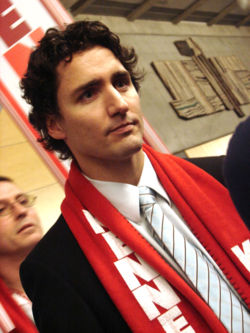
One of the under-covered stories of the past week was Justin Trudeau's first bill in Parliament -- a private member's bill calling for a national policy on volunteerism.
 "Young people get a bad rap, often, for being apathetic, disconnected and cynical about the world," Trudeau said after tabling his bill. "It's not because they don't care about the world. On the contrary; it's because they care so much that they're deeply frustrated that they don't have ways to make the world a better place. They don't have a voice that gets heard to shape the world that will be theirs someday, they keep getting told."
The bill would call for public hearings on the topic of volunteerism as well as a study of how governments support volunteerism in other countries.
Although his lineage makes Justin Trudeau a natural target for conservatives, Trudeau's private member's bill is actually a dream for almost any small-c conservative who is truly faithful to the philosophy.
One of the key tenets of former Progressive Conservative premier of Ontario Mike Harris' Common Sense Revolution was the idea that volunteer efforts were going to replace state activism in many key areas. This never took place because Harris' government never made any real effort to help foster a stronger infrastructure of Civil Society Organizations.
Such an effort, by its very nature, relies on citizens to stand up, determine their own interests, then contribute their efforts toward the service of those interests. Trudeau's bill exemplifies Benjamin Barber's vision of strong democracy -- one wherein citizenship is treated more like a public office than as a passive relationship with the state.
Trudeau's bill fits snugly into Barber's blueprint of a do-it-yourself democracy, one wherein individual autonomy and citizenship is enhanced by diminishing reliance on the state.
Successfully building a volunteer infrastructure in Canada could allow conservative governments to reduce and refocus spending like never before.
While the idyllic days of church-operated hospitals funded by private donations and private fundraising efforts are likely to never return -- the cost of modern healthcare is prohibitive to a pure volunteer approach and government involvement will always remain necessary -- Trudeau's bill, if properly implemented, could lead to a much healthier and stronger democracy in Canada, predicated on a model of strong citizenship.
Unfortunately there are some who don't share Trudeau's wisdom. Bloc Quebecois MP Nicolas Dufor accused Trudeau's bill of fostering "federalist propaganda".
It's unsurprising that the Bloc would oppose Trudeau's bill. Any government policy that helped the development of volunteer organizations could very easily be used by citizens who oppose separatism to organize their own, federalist organizations.
One can only wonder if separatists would enjoy similar good fortune.
If the Liberal party were wise it would adopt Trudeau's private member's bill as an opposition bill. Likewise, if the governing Conservatives were wise they would adopt Trudeau's bill as governmental policy.
Private member's bills don't often make the full transition fron introduction to being implemented, but the base wisdom of Justin Trudeau's bill is impossible to overlook.
Justin Trudeau may yet turn out to be a stronger democrat than his father ever pretended to be.
One of the under-covered stories of the past week was Justin Trudeau's first bill in Parliament -- a private member's bill calling for a national policy on volunteerism.
 "Young people get a bad rap, often, for being apathetic, disconnected and cynical about the world," Trudeau said after tabling his bill. "It's not because they don't care about the world. On the contrary; it's because they care so much that they're deeply frustrated that they don't have ways to make the world a better place. They don't have a voice that gets heard to shape the world that will be theirs someday, they keep getting told."
The bill would call for public hearings on the topic of volunteerism as well as a study of how governments support volunteerism in other countries.
Although his lineage makes Justin Trudeau a natural target for conservatives, Trudeau's private member's bill is actually a dream for almost any small-c conservative who is truly faithful to the philosophy.
One of the key tenets of former Progressive Conservative premier of Ontario Mike Harris' Common Sense Revolution was the idea that volunteer efforts were going to replace state activism in many key areas. This never took place because Harris' government never made any real effort to help foster a stronger infrastructure of Civil Society Organizations.
Such an effort, by its very nature, relies on citizens to stand up, determine their own interests, then contribute their efforts toward the service of those interests. Trudeau's bill exemplifies Benjamin Barber's vision of strong democracy -- one wherein citizenship is treated more like a public office than as a passive relationship with the state.
Trudeau's bill fits snugly into Barber's blueprint of a do-it-yourself democracy, one wherein individual autonomy and citizenship is enhanced by diminishing reliance on the state.
Successfully building a volunteer infrastructure in Canada could allow conservative governments to reduce and refocus spending like never before.
While the idyllic days of church-operated hospitals funded by private donations and private fundraising efforts are likely to never return -- the cost of modern healthcare is prohibitive to a pure volunteer approach and government involvement will always remain necessary -- Trudeau's bill, if properly implemented, could lead to a much healthier and stronger democracy in Canada, predicated on a model of strong citizenship.
Unfortunately there are some who don't share Trudeau's wisdom. Bloc Quebecois MP Nicolas Dufor accused Trudeau's bill of fostering "federalist propaganda".
It's unsurprising that the Bloc would oppose Trudeau's bill. Any government policy that helped the development of volunteer organizations could very easily be used by citizens who oppose separatism to organize their own, federalist organizations.
One can only wonder if separatists would enjoy similar good fortune.
If the Liberal party were wise it would adopt Trudeau's private member's bill as an opposition bill. Likewise, if the governing Conservatives were wise they would adopt Trudeau's bill as governmental policy.
Private member's bills don't often make the full transition fron introduction to being implemented, but the base wisdom of Justin Trudeau's bill is impossible to overlook.
Justin Trudeau may yet turn out to be a stronger democrat than his father ever pretended to be.
Thursday, January 01, 2009
It's Time to Demand Economic Democracy
In the previous two segments of The Commanding Heights, the shortcomings of the two dominant economic orthodoxies of our time -- market economics and Keynesianism -- were explored at length.
In the third installment, "The New Rules of the Game", The Commanading Heights explores the current nature of the global economy, and examines its underlying conflicts.
Some of the points in the film seem facetious knowing what one knows now. For example, Robert Rubin, the co-chairman of Goldman Sachs during the 1992 Presidential election, talks about a meeting with then-Presidential candidate Bill Clinton, wherein he and several other corporate executives impressed upon him the need for renewed fiscal discipline in the United States.
Yet Rubin, as the current director of Citigroup Incorporated, collected more than $17 million in salary and bonuses from that company over the last year.
Especially at a time of economic crisis, that in itself is an awfully curious definition of "fiscal discipline".
While Clinton himself would prove to be a rather undisciplined individual, Clinton did manage to impress some fiscal discipline on the United States. With a then-debt of $4 trillion, it was badly needed.
But what Clinton -- what political leaders in general, in most of the countries in the world -- have failed to do is impress upon multinational corporations the need for fiscal discipline within their own organizations.
Corporate executives paying themselves multi-million dollar compensation packages while those funds could be used preparing for -- or preventing -- economic disasters is comparatively unconscionable.
However, there are answers to many of the the serious problems with the global economy. The most important of them is a democratization of the global economy.
In Jihad vs McWorld, Benjamin Barber writes about two global forces emerging as a result of globalization: "McWorld", representing market-driven consumerism and its accompanying cultural nihilism, and "Jihad", representing reactionary identity politics and its accompanying moral nihilism.
The corporations that control the lion's share of the global economy conduct their business in a disctinctly undemocratic manner. Their decisions are typically made by a very small group of people who certainly do not adequately represent the various stakeholders in their companies.
"Jihad", on the other hand, is democratic -- but only to a certain extent. The forces of "Jihad" are organized around communitarian principles. While each individual "jihadist" movement represents a broad group of people, there is little room for individual freedom within those particular groups. They demand significant personal concessions and unconditional personal loyalties as a condition of group membership.
There is often significant overlap between the forces of "Jihad" and "McWorld". Each often organize themselves and operate according to very similar principles.
But on their own, neither "Jihad" nor "McWorld" offer a tenable alternative to the other, just as the economic history of the past forty years has shown that neither market economics nor Keynesianism are truly tenable alternatives to each other.
What is needed is a "third way". In order for that third way to be created, people need to be able to exert democratic influence on both the corporations that account for so much of the global economy and the various regulatory agencies that operate them.
At least at national scale, the latter is relatively simple. Democratic countries allow for periodic referendums on the policies of these agencies -- at least so much that citizens can throw out the politicians we choose to operate them.
At the international level the matter is much more complex. Organizations such as the World Bank and the World Trade Organization function in distinctly undemocratic manners. Furthermore, there is actually only one method that can reform such institutions: it requires significant international cooperation.
Such organizations can be brought to heel, as was done in 1999 at the famed Battle of Seattle. While the organizers of trade summits have made use of methods to manage political protest and insulate themselves from it -- often banishing political protest from within miles of the meetings themselves -- civil society organizations have increasingly found themselves a seat at the table.
In a process political scientist Nicanor Perlas defines as "threefolding", government, business and civil society can more firmly establish their particular realms of interest. Each can be empowered to defend their particular areas of interest, and cooperate with others when areas of interest overlap.
At first, Perlas notes, such interaction has to be forced. In Seattle, protesters did so by creating an unprecedented ruckus and making themselves unignorable. Other individuals, such as Ralph Nader, have done so using courts of law.
In time, the expectation is that such processes will occur increasingly naturally, and on an increasingly formal basis.
Still, it cannot happen overnight. The prominence that global civil society won at the Battle of Seattle has been at constant risk of evaporation -- let alone decline -- ever since. It requires time and diligence on behalf of those who have concerns about how the global economy is developing. In democratic countries, they have the right to voice such concerns, no matter how hard the task of being heard is becoming.
Democratizing the operations of multinational corporations seems like a daunting task as well. Fortunately, there remains an important back door into the board rooms of the corporate world.
As the film notes, millions of people around the world invest in the market through RRSPs and mutual funds. As such, there are millions of people who, according to Steven Davis, Jon Lukomnik, David Pitt-Watson, control one of the largest pools of mobile capital in the world.
After the repeated stock market crashes of the past months, there is little question that this pool of capital isn't worth nearly as much as it so recently did.
But the economy's reliance on these pools of capital -- and once the economy recovers, it will be as reliant on this capital as it ever was -- makes those who control it very powerful indeed.
If those investing in various pension funds were to start democratically exercising their power, the corporate world would have no choice but to listen. This requires that the "citizen investors" that Davis, Lukomnik and Pitt-Watson learn to use this power.
Just as Ralph Nader took up numerous lawsuits in the name of consumer advocacy, the current economic crisis has shown that it's just as important that dedicated individuals take up the mantle of investor advocacy. Just as our economic elites are concerning themselves with consumer confidence, they must certainly concern themselves with investor confidence as well.
Naturally, the power held by citizen investors will favour those comparative few who enjoy the wealth to invest in the first place.
For those not blessed with such wealth, civil society -- activists, advocacy groups, and labour unions (among others) -- will be an important outlet to democratically exert their influence on the economy. Perlas' three-folding model must be applied as it has never been applied before.
For those imagining, however, that they will cordon off their individual countries or communities, there is little ahead but disappointment.
Telecommunications technology, the media, and trade have rendered globalization a foregone conclusion. It's becoming increasingly difficult to pretend that globalization -- and its accompanying free trade policies -- has forever been inevitable.
The answer now is not to turn back the clock to a time past, and old economic realities that are now unattainable. The answer is to look ahead, and democratize the global economy.
And the time to do it is now, before the world's alternating bands of revolutionaries concoct the next global crisis.
In the third installment, "The New Rules of the Game", The Commanading Heights explores the current nature of the global economy, and examines its underlying conflicts.
Some of the points in the film seem facetious knowing what one knows now. For example, Robert Rubin, the co-chairman of Goldman Sachs during the 1992 Presidential election, talks about a meeting with then-Presidential candidate Bill Clinton, wherein he and several other corporate executives impressed upon him the need for renewed fiscal discipline in the United States.
Yet Rubin, as the current director of Citigroup Incorporated, collected more than $17 million in salary and bonuses from that company over the last year.
Especially at a time of economic crisis, that in itself is an awfully curious definition of "fiscal discipline".
While Clinton himself would prove to be a rather undisciplined individual, Clinton did manage to impress some fiscal discipline on the United States. With a then-debt of $4 trillion, it was badly needed.
But what Clinton -- what political leaders in general, in most of the countries in the world -- have failed to do is impress upon multinational corporations the need for fiscal discipline within their own organizations.
Corporate executives paying themselves multi-million dollar compensation packages while those funds could be used preparing for -- or preventing -- economic disasters is comparatively unconscionable.
However, there are answers to many of the the serious problems with the global economy. The most important of them is a democratization of the global economy.
In Jihad vs McWorld, Benjamin Barber writes about two global forces emerging as a result of globalization: "McWorld", representing market-driven consumerism and its accompanying cultural nihilism, and "Jihad", representing reactionary identity politics and its accompanying moral nihilism.
The corporations that control the lion's share of the global economy conduct their business in a disctinctly undemocratic manner. Their decisions are typically made by a very small group of people who certainly do not adequately represent the various stakeholders in their companies.
"Jihad", on the other hand, is democratic -- but only to a certain extent. The forces of "Jihad" are organized around communitarian principles. While each individual "jihadist" movement represents a broad group of people, there is little room for individual freedom within those particular groups. They demand significant personal concessions and unconditional personal loyalties as a condition of group membership.
There is often significant overlap between the forces of "Jihad" and "McWorld". Each often organize themselves and operate according to very similar principles.
But on their own, neither "Jihad" nor "McWorld" offer a tenable alternative to the other, just as the economic history of the past forty years has shown that neither market economics nor Keynesianism are truly tenable alternatives to each other.
What is needed is a "third way". In order for that third way to be created, people need to be able to exert democratic influence on both the corporations that account for so much of the global economy and the various regulatory agencies that operate them.
At least at national scale, the latter is relatively simple. Democratic countries allow for periodic referendums on the policies of these agencies -- at least so much that citizens can throw out the politicians we choose to operate them.
At the international level the matter is much more complex. Organizations such as the World Bank and the World Trade Organization function in distinctly undemocratic manners. Furthermore, there is actually only one method that can reform such institutions: it requires significant international cooperation.
Such organizations can be brought to heel, as was done in 1999 at the famed Battle of Seattle. While the organizers of trade summits have made use of methods to manage political protest and insulate themselves from it -- often banishing political protest from within miles of the meetings themselves -- civil society organizations have increasingly found themselves a seat at the table.
In a process political scientist Nicanor Perlas defines as "threefolding", government, business and civil society can more firmly establish their particular realms of interest. Each can be empowered to defend their particular areas of interest, and cooperate with others when areas of interest overlap.
At first, Perlas notes, such interaction has to be forced. In Seattle, protesters did so by creating an unprecedented ruckus and making themselves unignorable. Other individuals, such as Ralph Nader, have done so using courts of law.
In time, the expectation is that such processes will occur increasingly naturally, and on an increasingly formal basis.
Still, it cannot happen overnight. The prominence that global civil society won at the Battle of Seattle has been at constant risk of evaporation -- let alone decline -- ever since. It requires time and diligence on behalf of those who have concerns about how the global economy is developing. In democratic countries, they have the right to voice such concerns, no matter how hard the task of being heard is becoming.
Democratizing the operations of multinational corporations seems like a daunting task as well. Fortunately, there remains an important back door into the board rooms of the corporate world.
As the film notes, millions of people around the world invest in the market through RRSPs and mutual funds. As such, there are millions of people who, according to Steven Davis, Jon Lukomnik, David Pitt-Watson, control one of the largest pools of mobile capital in the world.
After the repeated stock market crashes of the past months, there is little question that this pool of capital isn't worth nearly as much as it so recently did.
But the economy's reliance on these pools of capital -- and once the economy recovers, it will be as reliant on this capital as it ever was -- makes those who control it very powerful indeed.
If those investing in various pension funds were to start democratically exercising their power, the corporate world would have no choice but to listen. This requires that the "citizen investors" that Davis, Lukomnik and Pitt-Watson learn to use this power.
Just as Ralph Nader took up numerous lawsuits in the name of consumer advocacy, the current economic crisis has shown that it's just as important that dedicated individuals take up the mantle of investor advocacy. Just as our economic elites are concerning themselves with consumer confidence, they must certainly concern themselves with investor confidence as well.
Naturally, the power held by citizen investors will favour those comparative few who enjoy the wealth to invest in the first place.
For those not blessed with such wealth, civil society -- activists, advocacy groups, and labour unions (among others) -- will be an important outlet to democratically exert their influence on the economy. Perlas' three-folding model must be applied as it has never been applied before.
For those imagining, however, that they will cordon off their individual countries or communities, there is little ahead but disappointment.
Telecommunications technology, the media, and trade have rendered globalization a foregone conclusion. It's becoming increasingly difficult to pretend that globalization -- and its accompanying free trade policies -- has forever been inevitable.
The answer now is not to turn back the clock to a time past, and old economic realities that are now unattainable. The answer is to look ahead, and democratize the global economy.
And the time to do it is now, before the world's alternating bands of revolutionaries concoct the next global crisis.
Wednesday, October 22, 2008
If "Ifs" and "Buts" Were Candy And Nuts...
...Will Wilkinson would still be fucking clueless
In the wake of the 2008 federal election, many Canadians are concerned about the lowest rate of voter turnout in the history of Canadian confederation.
For the first time in Canadian history, voter turnout dropped below 60&. 13.8 million out of 23.4 million voters reported to cast ballots in the election, which returned Stephen Harper's Conservative government for a second term. Sadly, this is down a full million from the 2006 election.
Sad, that is, unless you're Will Wilkinson. Writing in the Ottawa Citizen, Wilkinson muses "no voters, no problem!"
But those who pay attention know quite different: that a failure to participate in what is actually the easiest way to participate in the political process is a failure to care.
Those who don't plan to vote certainly aren't attending political rallies or candidate debates. And if they read about the election at all, it's more likely than not that it's simply en rote to the Sunshine Girl.
The notion that voter non-participation reflects higher rates of civic trust seems to rest on the notion that voters cannot find a preference amongst the various offered alternatives. But this would suggest a significant portion of the Canadian electorate -- 40% + -- that would need to be utterly devoid of personal values.
No one is devoid of personal values.
A more likely alternative yet is that voters aren't finding candidates who embody their values. Even this underlies a deeply-rooted problem within the political system: a lack of options in the Canadian political system.
Furthermore, Wilkinson actually suggests that a refusal to vote is a vote for the status quo. Simply not so. After all, the notion that declining to vote is a vote for the status quo would depend on the status quo being assured.
In the 2008 federal election, the status quo was far from assured. In fact, the status quo is never assured.
The numerous recounts ordered after the election show how close this election was in many ridings -- some in which the incumbent was defeated.
In such cases, only a few more ballots in favour of the incumbent -- in favour of the status quo -- could have made the difference.
Not voting is not a vote for the status quo. Not voting is a vote for nothing.
But it's hard to imagine who, in this country, could not have the time or opportunity to inform themselves during election time. Election news dominates television, radio and newsprint during a campaign. The internet is inevitably abound with news about virtually any candidate or party one could wish to inform themselves about.
In order to not have the opportunity to inform oneself on an election, one would have to either be blind and deaf, or living in a uni-bomber style shack.
Frankly, Wilkinson may be right about one thing: any voter unwilling to turn off the new Metallica CD long enough to listen to news radio on the way to or from work may be doing their country a service by not voting. But that individual would still do their country a greater service by casting an informed vote on election day.
But one need not know the ins-and-outs of running a Parliamentary committee in order to judge a candidate's ideas and qualifications.
Even if non-voters have no opinion regarding the public good, it would be remiss to pretend that, in itself, is not a problem.
This isn't a bad idea. After all, as Benjamin Barber would remind us, if disagreement is the language of democracy, education provides us with the syntax. Each reasonable excuse for voter non-participation offered by Wilkinson could easily be remedied by better education in various subjects, including history and basic civics.
Twelve million voters declining to cast ballots could, in a sense, almost be argued to be a sign that more and more Canadians are embracing the most basic element of Barber's model of strong democracy -- increased self-government in the public realm.
Yet in order for this to be the case, one would expect to have witnessed a dramatic surge in membership in Civil Society Organizations -- the realm in which self-government most often occurs. Yet membership in most CSOs continues to remain restricted mostly to those most committed to their causes -- ranging from organizations like Amnesty International to the Salvation Army Church.
Many of these people are already amongst any country's most politically active citizens.
Self-government via civil society offers no remedy to non-voter anxiety.
But only the most fervent libertarian could look at declining voter turnout and see a victory for conservatism or the public good.
After all, declining to participate in the "ritual symbolic warfare" Wilkinson envisions essentially abandons the field of such battle to those with ideas that may prove anathema to the average libertarian.
All it would take for a few seats that would otherwise be won by pro-small government candidates to go to their statist adversaries would be for just a few too many voters accepting Wilkinson's invitation to theoretically vote for the status quo by not voting at all.
Under such circumstances, the non-vote for the status quo was actually a vote for bigger government, and -- in the wrong hands -- less of the individual freedom that the Cato Institute favours.
One wonders if Wilkinson would be willing to stand by this column if that actually turned out to be the case.
In the wake of the 2008 federal election, many Canadians are concerned about the lowest rate of voter turnout in the history of Canadian confederation.
For the first time in Canadian history, voter turnout dropped below 60&. 13.8 million out of 23.4 million voters reported to cast ballots in the election, which returned Stephen Harper's Conservative government for a second term. Sadly, this is down a full million from the 2006 election.
Sad, that is, unless you're Will Wilkinson. Writing in the Ottawa Citizen, Wilkinson muses "no voters, no problem!"
"Last week's federal election was decided with the lowest levels of voter turnout in Canadian history -- about 59 per cent. But public-spirited citizens should not therefore wring their hands about the sorry state of Canadian democracy. Contrary to the folklore of democratic health, low turnout can signal social solidarity, reflect real civic virtue, and even make democracy work better."This is, of course, nonsense. Wilkinson's justification for this absurd statement relies heavily on "if" and "but" reasoning.
"We humans are adversarial beings, easily riled by us-versus-them conflict. (Even Canadians!) Democratic politics is a wonderful way to peacefully channel social antagonism into ritual symbolic warfare. High voter turnout is as likely to reflect angry social division as it is to augur the reign of Kumbaya social cohesion.Wilkinson actually suggests that lower voter turnout reflects higher rates of social trust. If one is actively seeking a means by which they can alleviate anxiety over low voter participation, this would almost seem adequate.
Indeed, lower levels of turnout may suggest that voters actually trust each other more -- that fewer feel an urgent need to vote defensively, to guard against competing interests or ideologies. Is it really all that bad if a broad swath of voters, relatively happy with the status quo, sit it out from a decided lack of pique?"
But those who pay attention know quite different: that a failure to participate in what is actually the easiest way to participate in the political process is a failure to care.
Those who don't plan to vote certainly aren't attending political rallies or candidate debates. And if they read about the election at all, it's more likely than not that it's simply en rote to the Sunshine Girl.
The notion that voter non-participation reflects higher rates of civic trust seems to rest on the notion that voters cannot find a preference amongst the various offered alternatives. But this would suggest a significant portion of the Canadian electorate -- 40% + -- that would need to be utterly devoid of personal values.
No one is devoid of personal values.
A more likely alternative yet is that voters aren't finding candidates who embody their values. Even this underlies a deeply-rooted problem within the political system: a lack of options in the Canadian political system.
Furthermore, Wilkinson actually suggests that a refusal to vote is a vote for the status quo. Simply not so. After all, the notion that declining to vote is a vote for the status quo would depend on the status quo being assured.
In the 2008 federal election, the status quo was far from assured. In fact, the status quo is never assured.
The numerous recounts ordered after the election show how close this election was in many ridings -- some in which the incumbent was defeated.
In such cases, only a few more ballots in favour of the incumbent -- in favour of the status quo -- could have made the difference.
Not voting is not a vote for the status quo. Not voting is a vote for nothing.
"Moreover, if you want to be civic-minded, your duty isn't to fill in ballots just to fill in ballots. You shouldn't do it in ignorance, out of emotion, or to win approval from your political friends. Your duty is to vote well -- to participate in a way that, at the very least, makes the outcome no worse.Certainly, an informed voter is much better than an uninformed voter. An informed voter will make a wiser decision ten times out of ten.
Everybody has an incontestable and absolute right to his or her vote, but that doesn't mean it's always right to vote. Abstaining can be a way of looking after the public good, too. Not all of us have the energy, inclination, or opportunity to learn what we need to know in order to vote well. And that's OK. There's more to public-spiritedness than showing up at the polls. You can run a small business or coach a kids' hockey team with the common good in mind. That's an expression of civic virtue, too.
The virtue of opting out is especially clear once you grasp that more voting isn't necessarily better voting. Specialists in public opinion have exhaustively documented the average voter's shocking ignorance about the main issues of the day, the names of their local candidates for office, or the policies the candidates support."
But it's hard to imagine who, in this country, could not have the time or opportunity to inform themselves during election time. Election news dominates television, radio and newsprint during a campaign. The internet is inevitably abound with news about virtually any candidate or party one could wish to inform themselves about.
In order to not have the opportunity to inform oneself on an election, one would have to either be blind and deaf, or living in a uni-bomber style shack.
Frankly, Wilkinson may be right about one thing: any voter unwilling to turn off the new Metallica CD long enough to listen to news radio on the way to or from work may be doing their country a service by not voting. But that individual would still do their country a greater service by casting an informed vote on election day.
"The flakiest voters -- the ones least motivated to show up at the polls year in and year out -- also tend to be most poorly informed. So when turnout drops, it tends to leave the pool of remaining voters with an improved average level of political knowledge and policy know-how. If well-informed voters have a better picture of the candidate or party most likely to promote the general welfare, then especially high turnout can actually tilt an election away from the better choice, leaving everyone a bit worse off. And that's not very civic-minded."This is an argument that also leads directly into the realm of elite rule. The argument raised is that, in order to make a valid political decision, one should know how government works.
But one need not know the ins-and-outs of running a Parliamentary committee in order to judge a candidate's ideas and qualifications.
"At this point in the argument, some readers will have become pretty upset. The "best informed" voters tend to be the best-educated, and therefore tend to be relatively wealthy. Doesn't this line of thinking suggest that relatively disadvantaged citizens would do us all a favour -- would do themselves a favour -- by staying home on election day? But then who will stand up for them? Who will promote their interests?True enough. But not voting doesn't support any notion of the public good. Once again, a ballot not cast is a ballot for nothing.
It's an excellent question, but it's based on one disproven and one unlikely assumption. The disproven assumption is that economic self-interest predicts voter behaviour. The consensus finding of political scientists is that voters -- lettered and unlettered, rich and poor -- tend to vote in good faith to promote what they see as the public good. That's good news. The unlikely assumption is that the voters who know least about politics and public policy have the means to make good decisions about which candidates and policies will best promote their interests. That doesn't compute."
Even if non-voters have no opinion regarding the public good, it would be remiss to pretend that, in itself, is not a problem.
"But everyone should have the means to make informed and effective democratic decisions. And that's really the issue, isn't it? It would be ideal were each and every citizen to have the income and education typical of well-informed, motivated voters. But to get there, we need policies that will actually work to promote broader prosperity and a fuller realization of basic human capacities. A better-informed pool of voters is more likely to deliver those policies."In other words, in order to increase voter turnout, Wilkinson argues, we would need to increase the level of education.
This isn't a bad idea. After all, as Benjamin Barber would remind us, if disagreement is the language of democracy, education provides us with the syntax. Each reasonable excuse for voter non-participation offered by Wilkinson could easily be remedied by better education in various subjects, including history and basic civics.
Twelve million voters declining to cast ballots could, in a sense, almost be argued to be a sign that more and more Canadians are embracing the most basic element of Barber's model of strong democracy -- increased self-government in the public realm.
Yet in order for this to be the case, one would expect to have witnessed a dramatic surge in membership in Civil Society Organizations -- the realm in which self-government most often occurs. Yet membership in most CSOs continues to remain restricted mostly to those most committed to their causes -- ranging from organizations like Amnesty International to the Salvation Army Church.
Many of these people are already amongst any country's most politically active citizens.
Self-government via civil society offers no remedy to non-voter anxiety.
"And so we are left with the Zen riddle of democracy: the closer a non-ideal democracy comes to maximum democratic participation, the less likely it is to adopt the means to ideal democratic participation. Lower voter turnout sets the stage for better democracy.Wilkinson is a researcher for the Cato Institute in Washington, DC. The Cato Institute is think tank that favours individual liberty, free markets and small government.
So, on behalf of our cherished ideals of democratic equality, let me be the first to say: well done, Canadian abstainers."
But only the most fervent libertarian could look at declining voter turnout and see a victory for conservatism or the public good.
After all, declining to participate in the "ritual symbolic warfare" Wilkinson envisions essentially abandons the field of such battle to those with ideas that may prove anathema to the average libertarian.
All it would take for a few seats that would otherwise be won by pro-small government candidates to go to their statist adversaries would be for just a few too many voters accepting Wilkinson's invitation to theoretically vote for the status quo by not voting at all.
Under such circumstances, the non-vote for the status quo was actually a vote for bigger government, and -- in the wrong hands -- less of the individual freedom that the Cato Institute favours.
One wonders if Wilkinson would be willing to stand by this column if that actually turned out to be the case.
Sunday, September 07, 2008
John McCain's Speech to the RNC
McCain performs well with "workman" like speech
As John McCain took to the stage at the Xcel Energy Center in St Paul, Minnesota, he certainly had an uphill battle to fight.
Barack Obama's speech at the Pepsi Centre in Denver, Colorado a week before had been masterful. The Republican faithful were counting on McCain to deliver a speech, if not quite the equal of Obama's, at least one fairly competitive.
In his own way, McCain did precisely that. Although he didn't perform quite as spectacularly as many Republicans must have hoped for, he may have done even better in a way few would have expected.
McCain had many questions to answer at this, the acceptance of his nomination for President. One way or another, he answered them all.
McCain continued his perplexing strategy of moving closer to George W Bush by thanking him for his leadership during "dark times".
McCain promised Obama not only a contest, but also his respect and admiration, insisting that being American has imbued them with more similarities to unite them than differences to divide them.
McCain continued to promise reform in Washington, and introduced Palin as the Vice President who would help him control special interest groups. He also promised to wrangle corrupt politicians and pork blatant barrellers, promising to "make them famous."
"You will know their names. You will know their names."
McCain's list of political enemies is one that may not necessarily endear him to either extreme of the political divide in the United States: Tobacco companies, trial lawyers and union bosses, only to name a few. But at least the American people can say with some degree of certainty exactly who the "special interests" he plans to corral really are.
McCain pledged to take "the party of Lincoln, Roosevelt and Reagan back to the basics." In the name of this, he played to some typical Republican cards, promising to cut taxes, cut spending, and warning against socialized health care.
Some of McCain's promises seemed vaguely contradictory. He noted that while Obama wants to bring back lost jobs by "wishing away the global market", McCain's government would help workers who have lost jobs that won't return by helping them find new jobs "that won't go away".
Of course, in guarantee to ensure those jobs "won't go away", McCain would essentially have to "wish away the global market."
Most strikingly, McCain promised a national project that would stop the Americans from "sending $700 billion annually overseas to countries that don't like [them] very much" with an ambitious new energy plan. New oil developments (presumably including drilling in currently protected Alaskan fields), nuclear energy and clean coal would be coupled with electric and hybrid vehicles to make the United States more self-sufficient in terms of energy.
On the foreign policy front, McCain spoke of Iran as the top state sponsor of terrorism and the reemerging Russian colossus. While promising to maintain good relations with Russia, he promised to stand up to Russian aggression and expansionism, such as that recently seen in their invasion of Georgia.
For the good or ill of his candidacy, McCain once again reiterated his commitment to the war in Iraq. But dismissed by many as a hawk, McCain established solid credentials as what Fear's Empire author Benjamin Barber would instead describe as an "owl" -- an individual not predisposed against the use of force, but wary of the potential consequences.
"What matters is not that you can fight, but what you fight for is the real test," McCain insisted.
McCain only reiterated his awareness of the consequences of armed conflict when he spoke of his childhood years spent being raised by his mother while his father fought in WWII, of the death of his grandfather (of exhaustion) during the war, and of lost friends in Vietnam.
McCain also spoke of his own time as a Prisoner of War in Vietnam. He spoke of how mistakes made as a fighter pilot led to his capture in Hanoi, and spoke of the strength and solidarity he found in his fellow POWs.
In the end, he said, he emerged not as his own man wrought with "selfish indepenence", but rather as his country's man.
For a man with a war record as pronounced as McCain's (as well as that of his family) it may be fitting that fighting was so thematic of McCain's speech -- fighting corruption, fighting irresponsibility, fighting America's enemies.
Fighting to regain America's trust.
McCain's speech provided a remarkable contrast between himself and his Democrat opponent: Obama's speech was filled with passion, enthusiasm and emotion. McCain's, by contrast, was calm, collected and confident. Obama came across more as a man who has yet to make his case for the Presidency of the United States. Meanwhile, McCain came across as a man who is confident that his case has already been made.
Certainly, McCain's speech was less than spectacular. But that very well may be the point: McCain's candidacy isn't about grand spectacle -- it's about doing the business of the United States of America. Part of McCain's plan for doing that business involves change -- or reform, if you will -- but McCain is the businesslike candidate in the race.
Unsurprisingly, McCain promised a bi-partisan administration, reaching out to both Democrats and Republicans.
Which is precisely what he'll have to do if he wants to be President.
Tuesday, September 02, 2008
Who's Really "On Your Side"?
Since its release last week, a lot has been made about the most recent Conservative party advertisements.
First off, with Stephen Harper rushing to trample his own fixed election date legislation, they are clearly pre-election campaigning. There is no question about that.
But the theme of the ad bears some obvious consideration.
In the ad, numerous "main street Canadians" lavish praise on Stephen Harper and his government. This enthusiasm-themed ad -- a stark contrast to the various negative ads the party has released over the past 18 months -- features various people in rather ordinary settings -- a blue-collar worker at his shop, a man leaned against his pickup truck in what appears to be his driveway, a woman at the park with her kids.
But for an ad that goes to such lengths to appear to portray ordinary Canadians in ordinary settings, there's something very off-putting about the obviously-scripted nature of their comments.
Certainly, this is an election spot. And while one certainly expects this sort of thing from election advertising, they at least expect the producers of the ad to at least try to be a little less obvious about it.
Aside from that, there has always been something unsettling about politicians who insist they're "on your side".
For some Canadians, it may seem comfortable to know there's someone "on your side" -- or at least insisting they're on your side. But it begs an inevitable question:
If this particular candidate, this particular party, is "on my side", who isn't?
Has partisanship really become so deeply engrained in our politics that we're literally choosing sides?
Sadly, when followed through to its logical conclusion, the taking sides mentality goes far, far beyond political partisanship. After all, anyone who isn't hopelessly naive understands that there are some people who simply will not agree with them on any number of topics, if not at deep, fundamental levels.
Theoretically, we choose our political affiliations based on who best empathizes with our particular concerns and beliefs. Of course some people do choose their political affiliations based on a much more fickle basis, as evidenced by those who vote for a particular party because it's "cooler" to do so, or refuse to vote for a particular party because they "won't win". But for the most part, we expect individuals to support particular political movements because they believe in them.
Ergo those who hold different beliefs, concerns and priorities than ourselves will inevitably choose political movements that differ with our embody beliefs, concerns and priorities. But our movement -- be it a party, protest organization, or community foundation -- is "on our side". And the others, well, aren't.
In the minds of those most prone to such thinking, those who aren't with us are against us. And that's where half the problem lies.
This "on your side" mentality only breeds parochialism into our politics and, ultimately, into our communities.
In Strong Democracy Benjamin Barber reminds us that proper democracy is a cooperative effort -- something that citizens work together on, not fight against one another over. Unfortunately, there are some individuals who will never understand this, even those for whom the beliefs they claim to hold suggest they should.
The "with us or against us"-"on our side/not on our side" mentality only divides citizens who should otherwise be working together in an effort to build a better country for all Canadians, not merely the country preferred by those who are "on our side".
Perhaps some day our politicians will come to understand this. But in order for this to happen, voters have to stop rewarding politicians for sewing the seeds of partisan parochialism in our country and in our very communities.
A good citizen is on everyone's "side". A healthy democracy depends on it.
Thursday, July 31, 2008
Potential Light Blogging Ahead...
...As I will be moving into a pimpin' new crib.
In the meantime, enjoy this:
And in the meantime, maybe psychopathic cyberstalker Canadian Cynic can go obsess over someone else.
In the meantime, enjoy this:
And in the meantime, maybe psychopathic cyberstalker Canadian Cynic can go obsess over someone else.
Sunday, July 27, 2008
Zig Heil, herr Stein
Ben Stein's unusual osbsession with Nazis spills the boundaries of Expelled
Ben Stein provoked a great deal of outrage when, in the course of his film Expelled, he attributed the horrors of eugenics to Darwinism.
Even though he took great lengths to add the caveat that Darwinism alone isn't sufficient to lead to full-out Nazism, Stein's envokation of this led some viewers of the film to promptly walk out.
Many people invoked Godwin's Law -- the tenet suggesting that invoking Nazism in the course of debate should be treated as a consession of defeat -- to suggest that Stein had immediately conceded the argument.
In the case of Expelled and the Darwinist principles (even if they are misread and misinterpreted Darwinist principles) at the very heart of eugenics programs -- including the protracted ethnic cleansing undertaken by the Nazis -- these people are wrong. Whether they like it or not, Stein is stating simple historical fact.
Not so much in the course of a recent controversy the now-perpetually-controversial figure has provoked with his comments regarding Barack Obama's planned speech to the Democrat National Convention at Invesco Field in Denver.
"I don't like the idea of Senator Obama giving his acceptance speech in front of 75,000 wildly screaming people. That is not the way we do things in political parties in the United States of America. We have a contained number of people in an arena.Never one to quite be undone, Glenn Beck pitched in with some equally ill-concieved remarks:
75,000 people in an outdoor sports palace -- well, that's something the Fuhrer would have done.
And I think whoever is advising Senator Obama to do this is bringing up all kinds of very unfortunate images from the past."
"I've been saying that we're headed towards a Mussolini-style presidency forever. ...I mean, it's crazy!"Of course, for anyone who's bothered paying the slightest bit of attention to the 2008 Presidential Elections -- even for those who haven't -- the differences between Barack Obama and Hitler and Mussolini are so far beyond obvious that they render Stein and Beck's comments nothing short of befuddling.
Some minor similarities are undeniable. Hitler and Mussolini both marketed themselves as visionaries with the courage and intention to drastically transform their countries. Many of Barack Obama's supporters insist the same thing about him.
But the inherent malevolence of Hitler and Mussolini's messages were apparent from the very get-go. Hitler and Mussolini both succeeded because they appealed to the darkest psychological elements of their respective societies. In Hitler's case this was the bitterness provoked by the First World War-ending Versailles treaty coupled with the desperation resulting from severe economic depression.
In Mussolini's case, he appealed to a disturbing lack of confidence in the national character of the Italian state, and a belief that Italians were being left behind in the rush for international prestige.
Obama, meanwhile, has campaigned on a message of hope from the very beginning -- an idea that has slipped by even some of the most astute American conservative commentators. Consider the remarks of National Review editor Jonah Goldberg, again invoking fascism:
"I think one of the things that is decidedly fascistic, or at least just a bad idea, is looking for silver bullets. You know, when Barack Obama campaigns, he's basically saying, 'I'm a silver bullet. I'm going to solve all your problems just by electing me.' FDR, Hitler, all these guys, they basically said, 'All your problems can be solved.'"Of course, this is an implicitly inaccurate comment. There's little question Goldberg legitimately believes it, but it's still untrue.
Obama's campaign slogan -- "Yes we can" -- emphasizes the Barberian Strong Democratic principle of communal democratic action -- the idea that democracy is built from the citizenry up, not from the government down.
Certainly, Obama argues that electing him would be the first step. But Obama has never really argued that he could single-handedly solve the United States' problems. Rather, he's campaigned on the notion that, with himself as president, Americans could solve many of their problems by working together.
That's a far cry from the authoritarianism that Ben Stein decries in his Glenn Beck comments. He does, however, make on valid point:
"I think he has to recognize some bounds on his own ego. I understand politicians are politicians because they have ego deficit problems and they try to cure them by having lots of worship and adulation and adoration."Which is certainly fair comment. Certainly, many politicians are drawn to politics in order to resolve their own sense of inadequacy. Indeed, Barack Obama may be one of those individuals.
But in the end, Stein just can't clear that hump of authoritarianism:
"But 75,000 people screaming in an outdoor arena, that's just too much. It's just -- it's scarily authoritarian."Authoritarian like Hitler and Mussolini. And never mind the fact that Hitler and Mussolini both literally campaigned on a platform of authoritarianism, while Barack Obama has done the exact opposite.
Stein and Beck's Hitler/Mussolini comparisons may be the most resolute invokations of Godwin's law seen in quite a while.
Friday, July 25, 2008
Friday, April 11, 2008
More Dress-Up Fun With Marty Rayner
His mouth is writing even more cheques his brain can't cash
Martin Rayner's bizarre behaviour of late may turn out to have a more rational explanation than it would seem.
He may be experiencing something of an identity crisis.
Rayner recently took time out of his... eh, busy... schedule to respond to this particular comment, found on a post at Return of the Trusty Tory:
He's said nothing to suggest to anyone that he hates Canada.
The nonsense about Muslim Imams and the Communist party clearly indicates that the commenter is more than a little unbalanced.
But Rayner's own response indicates that the commenter has managed to strike a nerve:
Beneath the inane rantings, the commenter raises an important point: how is it that Mr Rayner can justify blogging under the pseudonym "Red Tory" when so much of his behaviour strongly indicates that he has little idea what a Red Tory actually is?
In order to understand why, one needs to direct their attention to an excellent definition of Red Toryism offered by the seemingly now-defunct Deep Red Tory:
To put it most simply, Red Tories prefer strong democracy -- built around a participatory model -- to thin democracy -- built around a corporatist, negotiatory model.
Building community is at the very heart of strong democracy. But one has to keep in mind precisely what is necessary to build a community in the first place, then make it strong enough for participatory democracy.
At the very core of participatory (strong) democracy is a social compact that acknowledges that all citizens have a stake in their community. As such, all the citizens of a community have a right -- and an obligation -- to participate in the political life of their community.
But one also has to consider what kind of conditions need to exist in order for all of a community's citizens to participate in that community's political life.
Recently a farce was intentionally made of the concept of civility, a farce that Rayner himself was obnoxiously dismissive of.
Certainly, the exercise was, as Rayner himself notes, "facetious". It was less an attempt to refine the conduct of the Canadian political blogosphere and more a slap in the face to the very concept of civility.
Now, in all fairness, it's important to note that the importance of civility should be imposed to nearly all of Canada's bloggers (myself here at the Nexus included).
But civility is necessary to build the kind of environment in which a participatory (strong) democracy can prosper. Strong democracy is built on the principle that all of a community's citizens are equal citizens.
It's safe to say that someone who believes he can dismiss 30% of his country's population as "retards" is not prepared to engage in a participatory democracy on the pretenses that those so-called "retards" are his equal. Equally so for someone like Rayner who consistently condones that kind of conduct.
In fact, it's safer to say that individual will do everything he can to avoid having to "dirty his hands" engaging with such people under the pretenses of equality, and will probably avoid that by making his community's political environment as toxic, discouraging and unwelcoming as possible.
A legitimate Red Tory would stand up and oppose the behaviour of individuals like this -- not act as an apologist (or, as he himself insists, "intemperate") for them.
A legitimate Red Tory may not like the ideas espoused by their fellow citizens, but is more interested in consensus building -- Barber's metaphor of building a communal menu that reflects community tastes -- rather than fostering corporatist factionalism between "interest groups" -- Barber's metaphor of fighting over whose individual tastes the communal menu will reflect.
A legitimate Red Tory should recognize that even those with whom they disagree can serve the purposes of Red Toryism. For an example we can turn to Deep Red Tory's four interrelated principles of Red Toryism:
The idea is to create a society wherein the bonds of citizenship and mutual obligation are so strong that efforts at accommodation are actually unnecessary.
This dissent can come from the left (typically, the engine although sometimes the brake) or the right (typically vice versa).
Of course, others argue that only the state can manage all of a community's needs, and that the unencumbered free market rarely provides for the needs of the underprivileged. This, more often than not, has turned out to be true.
The role of a Red Tory should be to build a consensus between the two -- not overwhelmingly side with one against the other, as many people seem to think Rayner has done.
The fact that Rayner would take time out of his day to respond to a half-baked admonition from a largely anonymous individual suggests in itself that he is a little conflicted about his professed beliefs.
Either he never really knew what a Red Tory is in the first place, or has simply lost his way.
One way or the other, he should actually find it harder to justify his insistence that he's a Red Tory than simply "well, Google says so". Whether or not he's capable of being honest enough with himself to realize it has yet to be seen.
Martin Rayner's bizarre behaviour of late may turn out to have a more rational explanation than it would seem.
He may be experiencing something of an identity crisis.
Rayner recently took time out of his... eh, busy... schedule to respond to this particular comment, found on a post at Return of the Trusty Tory:
"Red Tory, please, for the sake of clarity, remove Tory or any other symbol of Canada or Conservative from your name as you are nothing but a Canada hating, America bashing apologist. You would be best served in the mosque of a radical imam or the Communist party of Canada, which, it appears the Liberals have become."For the sake of fairness, it's necessary to point out that the commenter is a bit of a nut. Mr Rayner is perfectly entitled to take issue with being accused of hating Canada.
He's said nothing to suggest to anyone that he hates Canada.
The nonsense about Muslim Imams and the Communist party clearly indicates that the commenter is more than a little unbalanced.
But Rayner's own response indicates that the commenter has managed to strike a nerve:
"Look, as long as I have preeminent ranking on Google for the term “Red Tory” and in the absence of any truly compelling argument that I am in some respect unworthy of that estimable term, I’m keeping the name. In the meantime, allow me to draw your attention to what was said by many about one of my fondest personal heroes Oscar Wilde way back when…"Rayner's response seems to be best embodied in the insistence that "if Google says so, then it must be true". (The sad state of western society when allegedly educated individuals look to Google as the absolute arbiter of truth will remain uncommented on here -- for now.)
Beneath the inane rantings, the commenter raises an important point: how is it that Mr Rayner can justify blogging under the pseudonym "Red Tory" when so much of his behaviour strongly indicates that he has little idea what a Red Tory actually is?
In order to understand why, one needs to direct their attention to an excellent definition of Red Toryism offered by the seemingly now-defunct Deep Red Tory:
"A red tory is a compassionate conservative, driven by a concern for community over individualism, the collective well-being over personal self-interest, Burke over Mill, social responsibility over token rights, societal responsibility over state responsibility, fiscal responsibility over socialism, and responsible government over mob rule."In particular, attention needs to be paid to the concern for community over individualism -- it's become thematic for various commentators over the last twenty years in particular, from Benjamin Barber to John Ralston Saul.
To put it most simply, Red Tories prefer strong democracy -- built around a participatory model -- to thin democracy -- built around a corporatist, negotiatory model.
Building community is at the very heart of strong democracy. But one has to keep in mind precisely what is necessary to build a community in the first place, then make it strong enough for participatory democracy.
At the very core of participatory (strong) democracy is a social compact that acknowledges that all citizens have a stake in their community. As such, all the citizens of a community have a right -- and an obligation -- to participate in the political life of their community.
But one also has to consider what kind of conditions need to exist in order for all of a community's citizens to participate in that community's political life.
Recently a farce was intentionally made of the concept of civility, a farce that Rayner himself was obnoxiously dismissive of.
Certainly, the exercise was, as Rayner himself notes, "facetious". It was less an attempt to refine the conduct of the Canadian political blogosphere and more a slap in the face to the very concept of civility.
Now, in all fairness, it's important to note that the importance of civility should be imposed to nearly all of Canada's bloggers (myself here at the Nexus included).
But civility is necessary to build the kind of environment in which a participatory (strong) democracy can prosper. Strong democracy is built on the principle that all of a community's citizens are equal citizens.
It's safe to say that someone who believes he can dismiss 30% of his country's population as "retards" is not prepared to engage in a participatory democracy on the pretenses that those so-called "retards" are his equal. Equally so for someone like Rayner who consistently condones that kind of conduct.
In fact, it's safer to say that individual will do everything he can to avoid having to "dirty his hands" engaging with such people under the pretenses of equality, and will probably avoid that by making his community's political environment as toxic, discouraging and unwelcoming as possible.
A legitimate Red Tory would stand up and oppose the behaviour of individuals like this -- not act as an apologist (or, as he himself insists, "intemperate") for them.
A legitimate Red Tory may not like the ideas espoused by their fellow citizens, but is more interested in consensus building -- Barber's metaphor of building a communal menu that reflects community tastes -- rather than fostering corporatist factionalism between "interest groups" -- Barber's metaphor of fighting over whose individual tastes the communal menu will reflect.
A legitimate Red Tory should recognize that even those with whom they disagree can serve the purposes of Red Toryism. For an example we can turn to Deep Red Tory's four interrelated principles of Red Toryism:
"1. Tradition & Incrementalism: The tory philosophy is one in which society evolves gradually, remains stable but not static, and relies on tradition as a guide for the future."Most Red Tories don't favour social conservatism. But a committed Red Tory should recognize that, even as they personally favour progressive political values, social conservatives who would otherwise be viewed as political opponents can instead serve as a "brake" on those progressive values, preventing fast-and-hard Utopian societal upheaval, and all the instability that inevitably comes with it.
"2. Organicism & the Social Fabric: Core to the red tory ideology is the belief that society is more than a sum of its parts. It was Burke who invoked the term "social fabric" as a metaphor to describe society as a collection of individuals who, when woven together like threads, produce a much stronger and grander entity."But in order for such a "stronger and grander entity" to be created, one has to work with the parts that are available. A strong social fabric cannot be woven without all of its members. As such, even the political beliefs and ideologies with which one disagrees or one disapproves of must have a place -- most importantly, an equal place -- in that social fabric.
The idea is to create a society wherein the bonds of citizenship and mutual obligation are so strong that efforts at accommodation are actually unnecessary.
3. Ascription & Imperfection: The very essence of toryism is rooted in the Protestant belief in human imperfection, and the existence of a ‘natural hierarchy’ in society such that only the most capable should assume positions of authority. For red tories, while the social ladder exists, it is still accessible to those with lower social status, who may climb it gradually through their lifetimes and initiative, or over the course of several generations."Even the dissent of those who disagree with the direction in which a community serves a purpose. It reminds citizens of the imperfections in their society, and serves as the impetus for the continual -- incremental -- progressive improvement of that community.
This dissent can come from the left (typically, the engine although sometimes the brake) or the right (typically vice versa).
"4. Paternalism & Noblesse Oblige: In essence, then, toryism is a belief system that combines paternalism and collectivism through the concept of ‘noblesse oblige’. In the tory view of community, one discovers a sense of mutual obligation – of duties and privileges, rights and responsibilities – such that those in positions of privilege owe concern to those of lower social and political status, while the latter owe a certain degree of deference to elites. Labeled "tory democracy", this set of values may help to explain the ebbing of red toryism in an age of declining social and political deference."Of course, this fourth principle is a matter of some debate. There are those that argue that low taxes allow for more money left in the hands of those who earn it, allowing for more charity (although they themselves have to remember Irving Kristol's insistence that if the market wants to be predominant, then it must accept responsibility for eliminating poverty).
Of course, others argue that only the state can manage all of a community's needs, and that the unencumbered free market rarely provides for the needs of the underprivileged. This, more often than not, has turned out to be true.
The role of a Red Tory should be to build a consensus between the two -- not overwhelmingly side with one against the other, as many people seem to think Rayner has done.
The fact that Rayner would take time out of his day to respond to a half-baked admonition from a largely anonymous individual suggests in itself that he is a little conflicted about his professed beliefs.
Either he never really knew what a Red Tory is in the first place, or has simply lost his way.
One way or the other, he should actually find it harder to justify his insistence that he's a Red Tory than simply "well, Google says so". Whether or not he's capable of being honest enough with himself to realize it has yet to be seen.
Subscribe to:
Posts (Atom)