Ignatieff fails to account for Chinese human rights record
Posting on the National Post's Full Comment blog, Ezra Levant has some choice words for Liberal leader Michaelf Ignatieff.
Ignatieff, Levant insists, has spoken "false praise to power".
In a speech delivered at China's Tsinghua University, Ignatieff embraced Jean Chretien's craven approach to China; all he needed to do to make it complete was swap the phrase "good governance and rule of law" for "human rights".
In fact, despite China's human rights record -- the Chinese Communist Party's legacy written in blood -- Ignatieff's greatest human rights-related barbs were reserved for Canada.
"I am a proud Canadian, proud of our Charter of Rights and Freedoms, the rights we accord religious and linguistic minorities, and the constitutional acknowledgement of our Aboriginal peoples," Ignatieff said. "I will defend these achievements everywhere, but I am not blind to the gap that exists between our ideals and reality for some of my fellow citizens. Indeed, I am in politics to narrow that gap."
Canada certainly hasn't always been perfect. But it's drawn the line at harvesting the organs of religious minorities to sell internationally, as China has done to practitioners of Falun Gong -- an abuse revealled internationally by Liberal Party icon Irwin Cotler.
In fact, Ignatieff spoke very softly about China's human rights record.
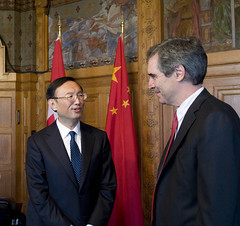
"In my classroom at Harvard, there were vigorous debates about China," Ignatieff continued. "My Chinese students did not always see eye to eye with other students on such issues as the death penalty, the rights of religious and ethnic minorities, access to the Internet and the largest issue of all, to what degree, to what extent, and at what level, economic liberalization should be followed by increased democratic rights."
"But I made it clear that the ultimate decision about these questions will be made, not by foreigners, but by the Chinese people themselves," he naively added.
Of course, the world remembers what happened the last time too many Chinese citizens tried to campaign for democratic freedoms in China. The state ran them down with tanks.
Many Chinese citizens today still do not know about the Tiananmen Square massacre. They are generally not taught that it took place, nor was it covered by the Chinese media of the day.
The farther away within China one lives from Beijing, the more unlikely one is to know about the events of June 4, 1989. Ignatieff, speaking just one month removed from the 20th anniversary of that atrocity, has no such excuse.
Perhaps some would see it as fitting that Michael Ignatieff, the grandson of a Russian diplomat who, by Ignatieff's own admission, once effectively bilked China out of some border provinces would try to make amends by so blatantly caving in to the Chinese phenomenon of "shame diplomacy" -- attempting to shame foreigners out of criticizing China's human rights policies.
An honest Canadian leader would broke no such pressure. Canadians who believe in human rights were rightly embarrassed by Jean Chretien's cowardly approach to this topic.
Michael Ignatieff has embarrassed us again -- but at least he hasn't embarrassed us as Prime Minister.
Showing posts with label Tiananmen Square. Show all posts
Tuesday, July 06, 2010
Saturday, June 26, 2010
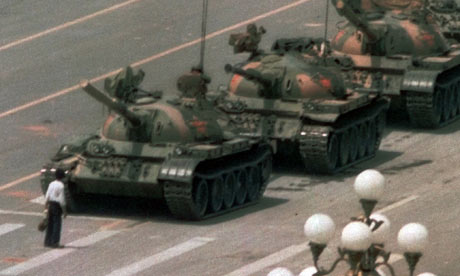
Who Is The Tank Man?
When the western world thinks about the Tienanmen Square massacre of 1989, one image springs to mind: it is one of the the most iconic images of the 20th century.
British journalist Alfred Lee identified the man as Wang Weilin -- an account that no other journalist has ever been able to verify.
To many, it's frustrating that we cannot identify the man who provided one of the most iconic images of not only the 20th century, but in time of all time.
The Chinese government has certainly expended a great deal of time and effort in destroying this image. No sooner had the photo been taken then Chinese security services attempted to sieze the film, Fortunately, the photographer was enterprising enough to successfully hide it.
Today, just as many Chinese students never been told about the Tienanmen Square massacre (the further within China's borders one lives from Beijing the less likely one is to know about it), they don't know the Tank Man image.
The Chinese state has built an elaborate infrastructure to the suppression of such information. In such, they have successfully stunted the growth of the democracy movement.
It may not be inconceivable to think that the rest of the world will not see democracy and freedom in China until as many Chinese people as possible know the iconic image of the Tank Man, even if they may never know his name.
Labels:
China,
Democracy,
Saturday Cinema,
The Tank Man,
Tiananmen Square
Wednesday, April 14, 2010
The Limits of the Myth of Photographic Truth
Speaking via TED Talks, Jonathon Klein addresses the notion of the myth of photographic truth.
Put most simply, the myth of photographic truth infers that photographs -- noted to be worth a thousand words, and to provide an objective depication of reality -- are created through a variety of subjective processes, and thus do not really infer unquestionable truth.
Those who argue against this mytho of photographic truth note that the photographer makes myriad decisions in the course of taking -- or, as Klein notes, making -- a photograph. They choose the angle from which they will take the photograph, the lens with which they will take it, the time at which they will take it, and most importantly when they will take it.
Moreover, they argue that photographs have very specific meanings to people, and not everyone shares those meanings.
But, as Klein points out, there are some cases in which photographs capture an undeniable truth, and thus can be key to changing the world in crucial ways.
Consider, for example, the following photograph:
This photo should require no introduction. It's a picture of the protester who, at Tiananmen Square in 1989, stopped a column of tanks sent to quash the student protests there.
As the tanks rolled toward the Square, this brave man -- whose fate is ultimately unknown -- stops the column of tanks by standing in their path, and refusing to move. As video shows, when the tanks moved to roll around him, the man moves in front of them -- again stopping them in their tracks.
This photo serves as an undeniable reminder to anyone who views it of how the Chinese state handles political dissent: by deploying army tanks against unarmed students.
Photographic truth is indeed rarer than we give it credit for. But contrary to what those who dispute its existence insist, it does indeed exist.
Friday, June 05, 2009
World Shouldn't Hold Its Breath Over Tiananmen Square
Lawrence Cannon calls for "public accounting"
In a statement on the eve of today's 20th anniversary of the Tiananmen Square massacre, Canadian Foreign Affairs Minister Lawrence Cannon joined the chorus of voices calling for a public accounting of the massacre.
"The 20th anniversary of the Tiananmen Square tragedy provides an opportunity for China to remember those who lost their lives at that time while calling for political and economic reforms in China," Cannon said. "Twenty years later, we hope that they will be able to examine these events in an open and transparent fashion -- including the public accounting of those killed, detained or missing."
Cannon shouldn't hold his breath -- nor should anyone else in the world.
The Communist Party regime in China will certainly not hold any kind of public accounting into Tiananmen Square unless they need to do so in order to hold on to power. As sad as it may be to realize this, they simply don't.
In Mediapolitik, Lee Edwards outlined how the Chinese government micro-managed coverage of the massacre. In 1989 China was a very different country than it is today. While today the amount of coverage that the massacre received in the international media -- partially through the efforts of Canada's own Jan Wong, who witnessed the massacre from the relative safety of her nearby hotel room -- would almost assure that Tiananmen Square would be common knowledge throughout China, the average Chinese citizen didn't have satellite television or the internet in 1989.
Instead, the Chinese government repressed coverage of Tiananmen Square within China's borders. Even today when many Chinese citizens learn about the massacre it's in the history books published in other countries.
Even when the Chinese government acknowledged -- on a very limited basis -- the occurrence of the massacre, they played it off as necessary to contain "violent militant anti-revolutionaries".
Yet Wong's own reflection of the event, as told in Red China Blues, tells a different story. Rather, much of the Chinese student movement's fervour was staged for international cameras. Wong recounts witnessing one student in particular furiously waving a pro-democracy banner when television cameras were on him, then slumping over and smoking a cigarette when they had moved on.
Whatever the Chinese student movement had planned to accomplish at Tiananmen Square, taking up arms against the communist government wasn't one of their goals.
To make matters worse, comparatively few foreign leaders are willing to hold the Chinese government responsible for what occurred at Tiananmen Square on June 5, 1989. When former Prime Minister Jean Chretien toured China in the 1990s he refused to so much as utter the words "human rights" and instead referred to "good governance and the rule of law".
When the rule of law allows the government to run over its citizens with tanks, there's little question that whatever governance exists in that country is not "good".
Yet even Cannon is willing to to echo similar statements when he refers to China's economic development -- achieved at the direct expense of more than 100 million Chinese citizens who were dislocated from their homes in order to serve as a mobile labour force -- as an advance for human rights.
Anyone expecting the Chinese government to suddenly be forthcoming about the events of June 5, 1989 shouldn't hold their breath.
In a statement on the eve of today's 20th anniversary of the Tiananmen Square massacre, Canadian Foreign Affairs Minister Lawrence Cannon joined the chorus of voices calling for a public accounting of the massacre.
"The 20th anniversary of the Tiananmen Square tragedy provides an opportunity for China to remember those who lost their lives at that time while calling for political and economic reforms in China," Cannon said. "Twenty years later, we hope that they will be able to examine these events in an open and transparent fashion -- including the public accounting of those killed, detained or missing."
Cannon shouldn't hold his breath -- nor should anyone else in the world.
The Communist Party regime in China will certainly not hold any kind of public accounting into Tiananmen Square unless they need to do so in order to hold on to power. As sad as it may be to realize this, they simply don't.
In Mediapolitik, Lee Edwards outlined how the Chinese government micro-managed coverage of the massacre. In 1989 China was a very different country than it is today. While today the amount of coverage that the massacre received in the international media -- partially through the efforts of Canada's own Jan Wong, who witnessed the massacre from the relative safety of her nearby hotel room -- would almost assure that Tiananmen Square would be common knowledge throughout China, the average Chinese citizen didn't have satellite television or the internet in 1989.
Instead, the Chinese government repressed coverage of Tiananmen Square within China's borders. Even today when many Chinese citizens learn about the massacre it's in the history books published in other countries.
Even when the Chinese government acknowledged -- on a very limited basis -- the occurrence of the massacre, they played it off as necessary to contain "violent militant anti-revolutionaries".
Yet Wong's own reflection of the event, as told in Red China Blues, tells a different story. Rather, much of the Chinese student movement's fervour was staged for international cameras. Wong recounts witnessing one student in particular furiously waving a pro-democracy banner when television cameras were on him, then slumping over and smoking a cigarette when they had moved on.
Whatever the Chinese student movement had planned to accomplish at Tiananmen Square, taking up arms against the communist government wasn't one of their goals.
To make matters worse, comparatively few foreign leaders are willing to hold the Chinese government responsible for what occurred at Tiananmen Square on June 5, 1989. When former Prime Minister Jean Chretien toured China in the 1990s he refused to so much as utter the words "human rights" and instead referred to "good governance and the rule of law".
When the rule of law allows the government to run over its citizens with tanks, there's little question that whatever governance exists in that country is not "good".
Yet even Cannon is willing to to echo similar statements when he refers to China's economic development -- achieved at the direct expense of more than 100 million Chinese citizens who were dislocated from their homes in order to serve as a mobile labour force -- as an advance for human rights.
Anyone expecting the Chinese government to suddenly be forthcoming about the events of June 5, 1989 shouldn't hold their breath.
Labels:
China,
Human Rights,
Jan Wong,
Jean Chretien,
Lawrence Cannon,
Lee Edwards,
Tiananmen Square
Wednesday, December 10, 2008
China Settles Old Scores on Human Rights Day
Tienanmen Square activist arrested over Charter 08
60 years ago today, the Universal Declaration of Human Rights was adopted by the United Nations.
In the 60 years since, it's amazing how far some countries in the world haven't come.
In China today, Liu Xiaobo, a press freedom activist and a participant in the Tiananmen Square demonstration, was arrest for signing Charter 08, a pro-democracy manifesto. The charter reads:
Chinese prison is nothing new to Xiaobo. In 1996, Xiaobo's criticisms of the Chinese Communist Party resulted in him being sentenced to three years in a forced-labour camp.
Charter 08 is based on six important principles: freedom, human rights, equality, republicanism, democracy and constitutional rule.
Since its establishment in 1949, the People's Republic of China has been indistinguishable from its Communist Party government. For all intensive purposes, the party is the state.
The party has gone to certain lengths to ensure this remains to be the case. Its very legal system has been operated under these very pretenses, and has for the past few years been engaging in an exhaustive rejection of western legal principles, and oppression of Chinese lawyers who subscribe to these principles.
The arrests of Xiabo, Xi, and Youlian demonstrate that they have no intention of stopping any time soon.
Other bloggers writing on this topic:
Muchacho Enfermo's Politicophobia - "Human Rights Day"
CA Yeung - "Liu Xiaobo Detained on Suspicion of 'Inciting Subversion of State Power'">
60 years ago today, the Universal Declaration of Human Rights was adopted by the United Nations.
In the 60 years since, it's amazing how far some countries in the world haven't come.
In China today, Liu Xiaobo, a press freedom activist and a participant in the Tiananmen Square demonstration, was arrest for signing Charter 08, a pro-democracy manifesto. The charter reads:
"A hundred years have passed since the writing of China‘s first constitution. 2008 also marks the sixtieth anniversary of the promulgation of the Universal Declaration of Human Rights, the thirtieth anniversary of the appearance of Democracy Wall in Beijing, and the tenth of China’s signing of the International Covenant on Civil and Political Rights. We are approaching the twentieth anniversary of the 1989 Tiananmen massacre of pro-democracy student protesters. The Chinese people, who have endured human rights disasters and uncountable struggles across these same years, now include many who see clearly that freedom, equality, and human rights are universal values of humankind and that democracy and constitutional government are the fundamental framework for protecting these values.For signing this Charter Xiaobo, Chen Xi, and Shen Youlian have been arrested.
By departing from these values, the Chinese government's approach to“modernization” has proven disastrous. It has stripped people of their rights, destroyed their dignity, and corrupted normal human intercourse. So we ask: Where is China headed in the twenty-first century? Will it continue with “modernization” under authoritarian rule, or will it embrace universal human values, join the mainstream of civilized nations, and build a democratic system? There can be no avoiding these questions."
Chinese prison is nothing new to Xiaobo. In 1996, Xiaobo's criticisms of the Chinese Communist Party resulted in him being sentenced to three years in a forced-labour camp.
Charter 08 is based on six important principles: freedom, human rights, equality, republicanism, democracy and constitutional rule.
"Freedom. Freedom is at the core of universal human values. Freedom of speech, freedom of the press, freedom of assembly, freedom of association, freedom in where to live, and the freedoms to strike, to demonstrate, and to protest, among others, are the forms that freedom takes. Without freedom, China will always remain far from civilized ideals.The policies advocated by Charter 08 are a laundry list of the failures of the Chinese state:
Human rights. Human rights are not bestowed by a state. Every person is born with inherent rights to dignity and freedom. The government exists for the protection of the human rights of its citizens. The exercise of state power must be authorized by the people. The succession of political disasters in China‘s recent history is a direct consequence of the ruling regime’s disregard for human rights.
Equality. The integrity, dignity, and freedom of every person—regardless of social station, occupation, sex, economic condition, ethnicity, skin color, religion, or political belief—are the same as those of any other. Principles of equality before the law and equality of social, economic, cultural, civil, and political rights must be upheld.
Republicanism. Republicanism, which holds that power should be balanced among different branches of government and competing interests should be served, resembles the traditional Chinese political ideal of“fairness in all under heaven.”It allows different interest groups and social assemblies, and people with a variety of cultures and beliefs, to exercise democratic self-government and to deliberate in order to reach peaceful resolution of public questions on a basis of equal access to government and free and fair competition.
Democracy. The most fundamental principles of democracy are that the people are sovereign and the people select their government. Democracy has these characteristics: (1) Political power begins with the people and the legitimacy of a regime derives from the people. (2) Political power is exercised through choices that the people make. (3) The holders of major official posts in government at all levels are determined through periodic competitive elections. (4) While honoring the will of the majority, the fundamental dignity, freedom, and human rights of minorities are protected. In short, democracy is a modern means for achieving government truly“of the people, by the people, and for the people.”
Constitutional rule. Constitutional rule is rule through a legal system and legal regulations to implement principles that are spelled out in a constitution. It means protecting the freedom and the rights of citizens, limiting and defining the scope of legitimate government power, and providing the administrative apparatus necessary to serve these ends."
"1. A New Constitution. We should recast our present constitution, rescinding its provisions that contradict the principle that sovereignty resides with the people and turning it into a document that genuinely guarantees human rights, authorizes the exercise of public power, and serves as the legal underpinning of China‘s democratization. The constitution must be the highest law in the land, beyond violation by any individual, group, or political party.Of course, the world should not hold its breath waiting for these reforms to be implemented.
2. Separation of powers. We should construct a modern government in which the separation of legislative, judicial, and executive power is guaranteed. We need an Administrative Law that defines the scope of government responsibility and prevents abuse of administrative power. Government should be responsible to taxpayers. Division of power between provincial governments and the central government should adhere to the principle that central powers are only those specifically granted by the constitution and all other powers belong to the local governments.
3. Legislative democracy. Members of legislative bodies at all levels should be chosen by direct election, and legislative democracy should observe just and impartial principles.
4. An Independent Judiciary. The rule of law must be above the interests of any particular political party and judges must be independent. We need to establish a constitutional supreme court and institute procedures for constitutional review. As soon as possible, we should abolish all of the Committees on Political and Legal Affairs that now allow Communist Party officials at every level to decide politically-sensitive cases in advance and out of court. We should strictly forbid the use of public offices for private purposes.
5. Public Control of Public Servants. The military should be made answerable to the national government, not to a political party, and should be made more professional. Military personnel should swear allegiance to the constitution and remain nonpartisan. Political party organizations shall be prohibited in the military. All public officials including police should serve as nonpartisans, and the current practice of favoring one political party in the hiring of public servants must end.
6. Guarantee of Human Rights. There shall be strict guarantees of human rights and respect for human dignity. There should be a Human Rights Committee, responsible to the highest legislative body, that will prevent the government from abusing public power in violation of human rights. A democratic and constitutional China especially must guarantee the personal freedom of citizens. No one shall suffer illegal arrest, detention, arraignment, interrogation, or punishment. The system of“Reeducation through Labor”must be abolished.
7. Election of Public Officials. There shall be a comprehensive system of democratic elections based on“one person, one vote.”The direct election of administrative heads at the levels of county, city, province, and nation should be systematically implemented. The rights to hold periodic free elections and to participate in them as a citizen are inalienable.
8. Rural–Urban Equality. The two-tier household registry system must be abolished. This system favors urban residents and harms rural residents. We should establish instead a system that gives every citizen the same constitutional rights and the same freedom to choose where to live.
9. Freedom to Form Groups. The right of citizens to form groups must be guaranteed. The current system for registering nongovernment groups, which requires a group to be“approved,”should be replaced by a system in which a group simply registers itself. The formation of political parties should be governed by the constitution and the laws, which means that we must abolish the special privilege of one party to monopolize power and must guarantee principles of free and fair competition among political parties.
10. Freedom to Assemble. The constitution provides that peaceful assembly, demonstration, protest, and freedom of expression are fundamental rights of a citizen. The ruling party and the government must not be permitted to subject these to illegal interference or unconstitutional obstruction.
11. Freedom of Expression. We should make freedom of speech, freedom of the press, and academic freedom universal, thereby guaranteeing that citizens can be informed and can exercise their right of political supervision. These freedoms should be upheld by a Press Law that abolishes political restrictions on the press. The provision in the current Criminal Law that refers to“the crime of incitement to subvert state power”must be abolished. We should end the practice of viewing words as crimes.
12. Freedom of Religion. We must guarantee freedom of religion and belief and institute a separation of religion and state. There must be no governmental interference in peaceful religious activities. We should abolish any laws, regulations, or local rules that limit or suppress the religious freedom of citizens. We should abolish the current system that requires religious groups (and their places of worship) to get official approval in advance and substitute for it a system in which registry is optional and, for those who choose to register, automatic.
13. Civic Education. In our schools we should abolish political curriculums and examinations that are designed to indoctrinate students in state ideology and to instill support for the rule of one party. We should replace them with civic education that advances universal values and citizens‘rights, fosters civic consciousness, and promotes civic virtues that serve society.
14. Protection of Private Property. We should establish and protect the right to private property and promote an economic system of free and fair markets. We should do away with government monopolies in commerce and industry and guarantee the freedom to start new enterprises. We should establish a Committee on State-Owned Property, reporting to the national legislature, that will monitor the transfer of state-owned enterprises to private ownership in a fair, competitive, and orderly manner. We should institute a land reform that promotes private ownership of land, guarantees the right to buy and sell land, and allows the true value of private property to be adequately reflected in the market.
15. Financial and Tax Reform. We should establish a democratically regulated and accountable system of public finance that ensures the protection of taxpayer rights and that operates through legal procedures. We need a system by which public revenues that belong to a certain level of government—central, provincial, county or local—are controlled at that level. We need major tax reform that will abolish any unfair taxes, simplify the tax system, and spread the tax burden fairly. Government officials should not be able to raise taxes, or institute new ones, without public deliberation and the approval of a democratic assembly. We should reform the ownership system in order to encourage competition among a wider variety of market participants.
16. Social Security. We should establish a fair and adequate social security system that covers all citizens and ensures basic access to education, health care, retirement security, and employment.
17. Protection of the Environment. We need to protect the natural environment and to promote development in a way that is sustainable and responsible to our descendents and to the rest of humanity. This means insisting that the state and its officials at all levels not only do what they must do to achieve these goals, but also accept the supervision and participation of non-governmental organizations.
18. A Federated Republic. A democratic China should seek to act as a responsible major power contributing toward peace and development in the Asian Pacific region by approaching others in a spirit of equality and fairness. In Hong Kong and Macao, we should support the freedoms that already exist. With respect to Taiwan, we should declare our commitment to the principles of freedom and democracy and then, negotiating as equals, and ready to compromise, seek a formula for peaceful unification. We should approach disputes in the national-minority areas of China with an open mind, seeking ways to find a workable framework within which all ethnic and religious groups can flourish. We should aim ultimately at a federation of democratic communities of China.
19. Truth in Reconciliation. We should restore the reputations of all people, including their family members, who suffered political stigma in the political campaigns of the past or who have been labeled as criminals because of their thought, speech, or faith. The state should pay reparations to these people. All political prisoners and prisoners of conscience must be released. There should be a Truth Investigation Commission charged with finding the facts about past injustices and atrocities, determining responsibility for them, upholding justice, and, on these bases, seeking social reconciliation."
Since its establishment in 1949, the People's Republic of China has been indistinguishable from its Communist Party government. For all intensive purposes, the party is the state.
The party has gone to certain lengths to ensure this remains to be the case. Its very legal system has been operated under these very pretenses, and has for the past few years been engaging in an exhaustive rejection of western legal principles, and oppression of Chinese lawyers who subscribe to these principles.
The arrests of Xiabo, Xi, and Youlian demonstrate that they have no intention of stopping any time soon.
Other bloggers writing on this topic:
Muchacho Enfermo's Politicophobia - "Human Rights Day"
CA Yeung - "Liu Xiaobo Detained on Suspicion of 'Inciting Subversion of State Power'">
Labels:
Chen Xi,
China,
Human Rights,
Liu Xiaobo,
Shen Youlian,
Tiananmen Square
Sunday, April 10, 2005
Freedom of Speech vs. Holocaust Denial
Freedom of Speech Doesn't Excuse Ignorance of Speech
Recently, I wrote an article for The Gateway about the Canadian government's expulsion of Holocaust denier Ernst Zundel. Zundel -- who had previously been convicted for hate speech and spreading false teachings about the Holocaust -- had been held for two years under the CSIS security certificate program.
Although a number of people consider this to be an unjust act and a contravention of Zundel's rights, I still vehemently argue that few -- if any -- of Zundel's rights were violated. Those few violations of his rights were, in my view, entirely acceptable due to Zundel's activities in support of and complicity with violent neo-Nazi and white supremacist groups. These groups are domestic terrorist cells, and must be treated the same as any Al Qaida cell.
One of the rights that some have argued that have been violated is Zundel's right to freedom of speech. They are wrong.
Some argue that due to freedom of speech sometimes we have to listen to things that we don't want to hear, on account of those saying them have the right to say it. Often, this is true.
However, in Canada, we have a number of laws that (under the authority of the Notwithstanding clause of the consitution) place certain limits on freedom of speech within Canada. These are reasonable limits. These laws cover topics such as libel, slander, and that most magical of speech crimes... hate speech. These laws extend necessary protections to both individuals and society as a whole. These laws protect us from having our characters defamed, or racial hatred encouraged against ethnic groups.
Recently, this article has become a topic of discussion on www.majorityrights.com, which, since examining the site's content a little closer, is obviously a bastion for far/Christian/racist rightists, which has spurned me to address the issue of Holocaust denial.
History has many dark chapters, of which the Holocaust is only one. Apartheid in South Africa is a fairly dark chapter, as is the more recent events in the Sudan. Tienanmen Square is a fairly nasty bit of historical business, as is 9/11. What do all of these events have in common? These are events of enormous atrocity commited in the spirit of evil.
Pascal wrote "Evil is infinite, and has many forms". Forgetting the memories of past evil is all that is necessary for evil to rise again.
Which brings us specifically to the subject of Holocaust denial. I am now reminded of the tale of Red Deer College professor Jim Keegstra, who eventually lost his job because he assigned a Holocaust denial book for reading, and (allegedly) taught hatred of Jews in his history class.
Holocaust denial represents not only a challenge to the ideals under which freedom of speech were established, but also a challenge to history. The Holocaust occurred. This is a fact, and the protest of even a billion neo-Nazis could never change this.
Yet, there is a portion of society that wants to erase the chapter of the Holocaust from the history books. Many of these people also want to destroy what they decry as "the Jewish base of power" from which they control the "Zionist Occupied Government". Their goal, according to these people, is to (in the name of Satan, of course) destroy the white race. Which is actually pretty funny, because a significant portion of Jews have white skin. Which only demonstrates something I have suspected about this people for years: they are a bunch of retarded fucknuts.
Regardless, paranoid/hateful/ludicrous beliefs aside, there is a reason why these people want to erase the Holocaust from the history books: so they can fucking do it again.
Sadly, freedom of speech has given these people a weapon by which they can fight their cause. The founding fathers of the United States who wrote the American constitution which was instrumental in establishing freedom of speech as a worldwide principle of just democratic governance probably never saw this coming. It is a challenge to the ideal of freedom of speech in that it allows those who lack the ability, desire, or will to use their freedom of speech responsibly to harm others.
Freedom of speech, as with all freedoms, is a power. And, as the great Stan Lee wrote: "with great power comes great responsiblity". Those, such as Ernnst Zundel or Jim Keegstra, who are unable to use their freedom of speech responsibly, must always be held accountable for what they say. And when they violate the sanctity of speech by using it to spew hatred, they must be punished.
This has been done. Jim Keegstra has justly faced the end of his teaching career. Ernst Zundel faces the next five years in a German prison, and he will likely serve that time. However, this is only part of this battle.
The punishment of those who use speech to promote the hatred of anyone, anywhere, must continue. We must not allow those who would do this to use freedom of speech as a shield behind which they can hide their acts of cowardice.
Call me a Zionist conspirator if you will. If fighting to preserve the memory of what may be history's single greatest injustice is collusion, then I am proudly a conspirator.
Recently, I wrote an article for The Gateway about the Canadian government's expulsion of Holocaust denier Ernst Zundel. Zundel -- who had previously been convicted for hate speech and spreading false teachings about the Holocaust -- had been held for two years under the CSIS security certificate program.
Although a number of people consider this to be an unjust act and a contravention of Zundel's rights, I still vehemently argue that few -- if any -- of Zundel's rights were violated. Those few violations of his rights were, in my view, entirely acceptable due to Zundel's activities in support of and complicity with violent neo-Nazi and white supremacist groups. These groups are domestic terrorist cells, and must be treated the same as any Al Qaida cell.
One of the rights that some have argued that have been violated is Zundel's right to freedom of speech. They are wrong.
Some argue that due to freedom of speech sometimes we have to listen to things that we don't want to hear, on account of those saying them have the right to say it. Often, this is true.
However, in Canada, we have a number of laws that (under the authority of the Notwithstanding clause of the consitution) place certain limits on freedom of speech within Canada. These are reasonable limits. These laws cover topics such as libel, slander, and that most magical of speech crimes... hate speech. These laws extend necessary protections to both individuals and society as a whole. These laws protect us from having our characters defamed, or racial hatred encouraged against ethnic groups.
Recently, this article has become a topic of discussion on www.majorityrights.com, which, since examining the site's content a little closer, is obviously a bastion for far/Christian/racist rightists, which has spurned me to address the issue of Holocaust denial.
History has many dark chapters, of which the Holocaust is only one. Apartheid in South Africa is a fairly dark chapter, as is the more recent events in the Sudan. Tienanmen Square is a fairly nasty bit of historical business, as is 9/11. What do all of these events have in common? These are events of enormous atrocity commited in the spirit of evil.
Pascal wrote "Evil is infinite, and has many forms". Forgetting the memories of past evil is all that is necessary for evil to rise again.
Which brings us specifically to the subject of Holocaust denial. I am now reminded of the tale of Red Deer College professor Jim Keegstra, who eventually lost his job because he assigned a Holocaust denial book for reading, and (allegedly) taught hatred of Jews in his history class.
Holocaust denial represents not only a challenge to the ideals under which freedom of speech were established, but also a challenge to history. The Holocaust occurred. This is a fact, and the protest of even a billion neo-Nazis could never change this.
Yet, there is a portion of society that wants to erase the chapter of the Holocaust from the history books. Many of these people also want to destroy what they decry as "the Jewish base of power" from which they control the "Zionist Occupied Government". Their goal, according to these people, is to (in the name of Satan, of course) destroy the white race. Which is actually pretty funny, because a significant portion of Jews have white skin. Which only demonstrates something I have suspected about this people for years: they are a bunch of retarded fucknuts.
Regardless, paranoid/hateful/ludicrous beliefs aside, there is a reason why these people want to erase the Holocaust from the history books: so they can fucking do it again.
Sadly, freedom of speech has given these people a weapon by which they can fight their cause. The founding fathers of the United States who wrote the American constitution which was instrumental in establishing freedom of speech as a worldwide principle of just democratic governance probably never saw this coming. It is a challenge to the ideal of freedom of speech in that it allows those who lack the ability, desire, or will to use their freedom of speech responsibly to harm others.
Freedom of speech, as with all freedoms, is a power. And, as the great Stan Lee wrote: "with great power comes great responsiblity". Those, such as Ernnst Zundel or Jim Keegstra, who are unable to use their freedom of speech responsibly, must always be held accountable for what they say. And when they violate the sanctity of speech by using it to spew hatred, they must be punished.
This has been done. Jim Keegstra has justly faced the end of his teaching career. Ernst Zundel faces the next five years in a German prison, and he will likely serve that time. However, this is only part of this battle.
The punishment of those who use speech to promote the hatred of anyone, anywhere, must continue. We must not allow those who would do this to use freedom of speech as a shield behind which they can hide their acts of cowardice.
Call me a Zionist conspirator if you will. If fighting to preserve the memory of what may be history's single greatest injustice is collusion, then I am proudly a conspirator.
Subscribe to:
Posts (Atom)