
Showing posts with label Foreign Aid. Show all posts

Friday, April 15, 2011

Gordon Brown Seeking Posh New Job

Former UK PM interested in role as top international financier

When Gordon Brown was defeated as Prime Minister, then promptly replaced as leader of the Labour Party, many naturally wondered what would come next.

Now we seem to know. A year after moving out of No 10 Downing Street, Brown is poised to take on an advisory role at the World Economic Forum. Speculation holds that he intends to spin this into leadership of the International Monetary Fund.

At the WEM, Brown would be responsible for overseeing 72 Econcomic Councils. As former Prime Minister of Britain, he is uniquely prepared for such a responsibility.

But he should by no means considered a shoo-in for the job.

After all, some had pegged Tony Blair to be a favourite to assume the office of President of the European Union. Instead, backlash against Blair's involvement in the Iraq War held Blair back.

Brown could face some obstacles of his own. One of them is related to the Iraq War. The other is due to Gordon's handling of Britain's finances as Chancellor of the Exchequer. Brown has frequently been publicly savaged for his failure to manage the British public debt.

In fact, as it turned out Brown's government excelled at concealing its mounting public debt. Essentially, Brown's government, under Brown's fiscal leadership, ran up billions of Pounds Sterling in deferred debt by financing projects as Private Finance Initiatives.

This allowed the Labour government to spend today, committing each British government for the next 30 years to make fixed payments on these projects.

In essence, the Blair/Brown government uploaded billions of Pounds Sterling in debt to future generations of Britons. It enabled the Blair/Brown government to inflate its short-run political popularity at the long-run expense of the British citizenry.

They did what they wanted to do, and left the hard decisions to future British governments.

It isn't as if Labour only organized one or two projects under the PFI structure. It isn't as if they only organized five or six. They ran 630 projects under this structure. That's the cost of 630 projects spread out over a 30-year period.

It gets even worse when one considers the scope of the cost spread out over that period: 110 billion Pounds Sterling. In Canadian dollars, the PFI debt load added by Brown was $172 billion.

It's difficult to believe that a leader as casual about assuming debt on the behalf of future generations could become the managing director of the IMF. But Brown may have yet one more advantage at his disposal.

In the United States, the Barack Obama administration has shared Brown's irresponsible approach to public debt. Moreover, the Obama administration has some diplomatic bridges to mend with Britain, and may choose to mend them by helping Brown ascend the IMF mountain.

By all rights, Gordon Brown probably shouldn't become the director of the International Monetary Fund. But for good or ill -- very likely for ill -- he just may.


Wednesday, May 26, 2010

There Are Some Problems Profit-Driven Aid Won't Solve

Free condoms in Africa key to halting the spread of HIV

Though the George W Bush administration of the United States offered remarkably few accomplishments that the global conservative movement can be legitimately proud of, one of the successes Bush can very much boast about is his administration's success in fighting HIV/AIDs in Africa.

Bush's Afrian HIV/AIDs initiative offered free medical treatment and HIV medications to HIV sufferers. His program gave hope to HIV patients and to their children.

However valuable Bush's initiative was, it did suffer from notable weakness: it cut funding to condom-distribution programs.

Cameron's government has produced as its first foreign aid initiative a plan to spend nearly three million Pounds Sterling to distribute condoms in Uganda.

Writing in the Daily Telegraph, however, Alex Singleton casts his barbs at the HIV/AIDs initiative being prepared by British Prime Minister David Cameron's government. His criticism casts it as a hippie-esque solution to a looming epidemic, and suggests that the distribution of 45 million condoms in Uganada should instead be be profit-driven.

Singleton writes:
"No one wants HIV/AIDS to spread, but free distribution will never work. As Professor William Easterly, the eminent development economist, has argued, there’s no shortage of Coca-Cola in Africa, and condoms should be treated in the same, for-profit way."
William Easterly has been on the right track about a great many things in Africa. But on the topic of condoms, he is very clearly wrong.

There's a good reason for this: Condoms are nothing at all like Coca-Cola. Nor are they like mosquito nets. In White Man's Burden, Easterly remarks on the failure of programs to deliver free pesticide-treated mosquito nets to Africans at risk of contracting malaria from nocturnal mosquito bites.

Easterly documented cases of many of these nets simply being wasted -- in some cases being used as veils at the marriages of young African women. Easterly's argument was that programs to deliver these nets were ill-conceived, and resulted in many areas being over-supplied with mosquito nets.

In come cases, they would up in the hands of corrupt local officials who instead merely hoarded them, despite having no means to ever use them on their own.

Provided that the Tory condom plan is better designed than the mosquito net programs, one would expect that these condoms would actually reach their destination. Considering that Uganda's population is more than 31.5 million people, 45 million condoms is unlikely to over-supply Ugandan demand.

It's more likely to under supply it.

Singleton astoundingly suggests that the success many roadside vendors have had selling Coca-Cola products demonstrates that for-profit distribution of condoms will better ensure their distribution.
"Coke and other soft drinks are vital way of getting something drinkable in rural africa, and tens of thousands of entrepreneurial Africans sell them out of wooden shacks and by the side of roads. The drinks are affordable, but by charging, Africans are able to make a living distributing them."
The dubious merits of substituting Coca-Cola for fresh drinking water aside, Singleton has seemingly forgotten one of the cardinal rules of market economics: profit-seeking capital will go where there is profit to be earned.

Simply put, if there were profit in selling condoms in Africa, Sheik or Trojan would have set up shop there a long time ago. There would be no need to even consider a state-funded condom initiative in Uganda.

Singleton could certainly argue that the state could subsidize the for-profit distribution of condoms in Africa -- an option that the Conservatives may well want to explore before forging ahead with their current plan.

Moreover, as oral contraceptives do nothing to protect against the spread of HIV, a profit-driven distribution method may be more appropriate for those.

But this doesn't seem to be Singleton's option of favour. Rather, what he recommends is almost guaranteed to fail:
"The Department For International Development opposes abstinence-only AIDS-awareness programmes. Instead, it is supposed to support the ABC technique of preventing HIV – abstinence, be faithful, use a condom. But, in practice, DFID-funded projects are surprisingly quiet on the A and the B – staffed, as they are, by politically correct workers who think telling poor people to stop having sex with prostitutes and other peoples’ wives is racist."
While Singleton insists there is evidence that the acceptance of birth control by African women leads to domestic abuse (he doesn't actually site any), he conveniently ignores all the evidence that abstinence-only programs simply do not work.

People won't abstain from sex just because you tell them to. That holds no less in Africa than it does anywhere else in the world.

Former US President George W Bush laid the groundwork for significant success fighting HIV in Africa. Now, David Cameron's coalition government is prepared to fill in the missing link -- Alex Singleton's objections be damned.


Monday, July 13, 2009

Democratized Foreign Aid Plan Not Everything It's Cracked Up To Be

British Tory policy could founder on lack of public awareness

As countries around the world continue to search for newer, more innovative solutions to the puzzle posed by poverty in the developing world, David Cameron and Britain's Conservative party have come up with what seems like a novel solution:

Let the people decide.

The British people, that is.

In the proposed project, British citizens would be granted the opportunity to vote on foreign aid projects. 40 million Pounds Sterling would be placed into a "My Aid" fund, which may or may not be increased to match the amounts raised by private donors.

The plan would then establish a website and outline the projects being considered, their history, and their successes. British citizens would then receive the opportunity to vote on those projects and be continually updated on their choice via email.

War on Want director John Hilary has denounced the proposal as pandering to "popular gimmickry".

"It is important to recognise that these are serious and complex issues and what may seem like a good thing to the public may be completely hopeless in reality," Hilary added.

John Hilary seems to be an acolyte of Jeffrey Sachs' aid model, wherein aid decisions are decided and administered through a collection of centrally-planned intergovernmental agencies. IGOs have relied to an unfortunate extent on the participation and cooperation of corrupt local governmental agencies that have led to the squandering or outright theft of billions of dollars in foreign aid.

This general state of affairs has led to what economist William Easterly has termed the "second tragedy of poverty" -- that those living in impoverished countries continue to suffer despite the trillions of dollars spent to alleviate their suffering.

While Hilary's subscription to this failed perspective on aid policy is rather unfortunate, his point in regard to aid policy is actually spot-on.

Foreign aid is actually an extremely difficult topic that requires a great deal of expertise to make good decisions. To give ordinary citizens -- a term that shouldn't be seen as derisive, but merely descriptive -- decisive say over aid projects may be sadly overestimating their ability to unravel the complex issues surrounding aid policy.

What should one honestly expect the man on the street to know about police reform in Jamaica? The Ethiopian social security system? Post-civil war diplomacy in Sierra Leone?

The answer, more often than not, will be "not much". Most voters would likely be able to find a project they like the sound of, but do they know whether or not some of these projects can be successful? Do they know enough about the political or social climate in the country in question? Do they know enough about the agencies involved?

The move to democratize decisions regarding the projects selected for foreign aid is a novel one. But it may be democratizing the wrong side of the aid decision -- or at least not significantly democratizing the business end of the decision.

As Dambisa Moyo points out, many African countries hold elections and purport to be democracies, but don't fully fit the bill of a developed multi-party democracy.

William Easterly would add that most African countries lack the basic democratic institutions that manage and regulate an economy -- such institutions such as banks, courts, or offices to register the ownership of property. He would further add that the decisions made by central aid planners have seldom met the specific needs of those at whom the aid in question is actually directed.

To put decision-making power in the hands of British citizens only further removes that decision-making power from the hands who need it most -- at least so far as British aid policy is concerned. Naturally, one could argue that British citizens should have the right to make decisions regarding where their tax dollars are spent, and this argument does have merit.

But as Moyo would argue, the continual casting of western aid agencies strips local democracies -- as they were -- of their legitimacy in the eyes of their own citizens.

Giving ordinary Africans more power to control the aid programs administered in Africa through micro-economic techniques would actually strengthen their sense of democracy, and in time could strengthen their individual democracies.

If British citizens were to agree that it's in their best interests to deal with mature democracies in Africa, they may also agree that it's in their best interests to allow experts to control British aid policy in such a way that fosters such democratic growth.

Naturally, those experts should be obligated to administer these policies in a way that isn't out of touch with the expectations of British citizens and with the needs of African citizens.

But David Cameron's plan actually guarantees neither of these things. His plan really isn't everything it's cracked up to be.

Friday, July 10, 2009

Is Foreign Aid Undermining African Democracy?


Coming via ForaTV, Dambisa Moyo presents an intriguing critique of current foreign aid programs.

According to Moyo, successes enjoyed under programs such as the AIDs program -- in which AIDs drugs are provided to HIV sufferers -- lead Africans to doubt their elected leaders, as they watch foreign organizations provide services their governments should be responsible for.

Paradoxically, aid programs that seek to by-pass Africa's entrenched system of government kelptocrats may be stifling the single best antidote to this kleptocracy: a strong, vibrant democracy in which oversight is ultimately wielded by a citizenry that has confidence in their system.

According to Economist William Easterly, the most effective aid programs are those that will democratize the process of prioritizing the areas by focusing on allowing the citizens of impoverished countries to build their own economies from the ground up by utilizing the principles micro-economics.

Aid planners, still under the thrall of Jeffrey Sachs and his mostly-failed policies, continue to favour the principles of macro-economics and a top-down method of building national economies.

But as Easterly has often pointed out, this risks the creation of aid programs that are dangerously out-of-touch with the needs of locals.

An interesting case in point is a $15 billion agricultural aid program being pushed by Barack Obama. Investing in things such as seed, fertilizer, produce storage and research, the plan seems to be aimed at jump-starting a new green revolution in Africa.

While this satisfies an obvious need that impoverished countries have, locals may prefer to continue utilizing traditional agricultural methods as opposed to high-tech agricultural methods that will remain expensive -- likely prohibitively expensive -- long after aid dollars run out.

Easterly points out that, mixed in with successes, similar plans have been tried unsuccessfully before.

“The curse of aid is that they never learn from history,” Easterly said. “They need to go back and realize a lot of things promised today have been promised before.”

But even when the things that are promised are delivered, as Moyo points out, foreign aid is actually posing unforeseen problems for African democracies, as it undermines elected leaders who lack the resources to deliver on their own responsibilities.

If the western world truly expects democracy to flourish in Africa, it may be for the best to start to design foreign aid programs that allow it to function properly.

Tuesday, January 06, 2009

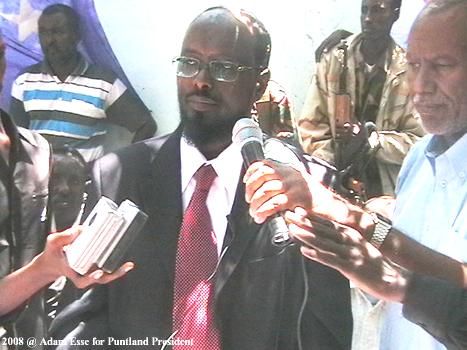
Michael Ignatieff's Man in Somalia

Adam Esse wants to be President of Puntland

With Somali pirates continuing to grab headlines in the international media, one could have expected it would only be a matter of time until the issue was raised in Somalia.

Interestingly enough, it's become an issue in the Puntland Presidential election. Even more interestingly, it's being raised by a Canadian candidate, who is contesting the Presidency against yet another Canadian.

Puntland is a semi-autonomous region within Somalia.

Adam Esse, who also holds a Canadian citizenship, believes that the piracy issue in Somalia can be solved by creating more jobs there.

"I want to become president to change the bad situation that we have over here in terms of security, stability, the economy, education and equality between the genders," Esse recently announced.

Spoken like a true Liberal. And interestingly enough, it just so happens that Adam Esse is a member of the Liberal Party of Canada. He was a delegate for Michael Ignatieff during the 2006 Liberal leadership campaign.

Some may have considered Esse to be something of an oddity at the leadership convention, as he had arranged a meeting in which Aly Hindy accused Liberal deputy Prime Minister and Minister of Public Safety Anne McLellan of "terrorizing" Canadian Muslims.

"If you try to cross the line I can't guarantee what is going to happen. Our young people, we can't control," Hindy said at the time. "The police came to me and said, 'This is a kind of threat', and I said yes. But it's for the good of this country."


"We believe CSIS should stop terrorizing us," Hindy wrote in a pamphlet in which he encouraged Muslims not to cooperate with terrorism-related investigations. "CSIS is powerless. CSIS has no authority over you. If CSIS agents come to your door, do not open it for them."

Less than a year later, as many Canadians may recall, 18 suspects were arrested for a terrorist plot against the Prime Minister, Parliament and the CBC. While Hindy almost certainly was not involved in this, his encouragement to Canadian Muslims to not cooperate with terrorism-related investigates could have made this plot more difficult to detect than it had to be.

At the time, however, Adam Esse offered excuses for Hindy's behaviour. "Some people, when they talk, they get a little heated," Esse mused. "If you talk, you remove a lot of misconceptions, a lot of misunderstandings."

Of course, what Esse forgets to mention is that there are some things that talk is insufficient to address.

For example, Hindy noted to the media that six or seven young Muslim men had asked him about joining insurgent forces in Iraq or Afghanistan. Hindy wisely told them "people fighting in Iraq, they don't need more people," and told them to wage a non-violent struggle at home.

However, when asked by the RCMP if he knew the identities of any individuals who may engage in violent actions, Hindy told them "you just open the telephone directory" despite clearly knowing the identities of up to seven potential terrorists. In this particular case, these individuals had discussed travelling to Afghanistan in order to fight against Canadian soldiers.

Considering Michael Ignatieff's fairly vigilant stance toward Afghanistan in particular, it seems fairly surprising that Adam Esse would be a delegate for him while seemingly associating with individuals such as Aly Hindy.

The other Canadian in the race for the Putland Presidency is Mohamud Muse Hersi, the incumbent.

Hersi has faced international criticism for his inability to get the piracy situation in Puntland under control. Hersi has even been accused of collusion with pirates. More specifically, Hersi has been accused of allowing Somali pirates to operate out of Puntland's ports and hold hijacked ships for ransom.

Hersi has also been accused of personally profiting from oil contracts.

The wealth appropriated through piracy in Puntland -- an estimated $60 million annually -- is three times the government's annual budget of $20 million. Many blame the lack of a central Somali government, and its accompanying poverty, for the prevalence of piracy there.

It would be interesting to see how the Canadian government -- whether headed by Michael Ignatieff or not -- would interact with either Hersi or Esse as the President of Puntland. With the President of Puntland holding a Canadian citizenship, Puntland -- and perhaps Somalia in general -- could become a logical focal point for Canadian foreign aid.

With Canada already involved in the fight to prevent UN aid shipments from pirates, close cooperation with a regional President who is also a Canadian citizen only makes sense.

However, judging from some of the characters Adam Esse associates with while on this side of the Atlantic Ocean, some Canadians could find cause for concern should be become the President of Puntland, just as the accusations of corruption against Mohamud Hersi are very troubling.

Friday, January 02, 2009

Full Metal Shock Doctrine

For the sadly unitiated, Full Metal Panic is an anime series about Sagara Sousuke, a 17-year-old mercenary serving in an organization called Mithril.

Born in Afghanistan and rescued from a civil war there, Sousuke operates an AS unit -- basically a common mech as imagined in various anime series, but perhaps most notably in the Mech Warrior series of video games.

In the opening episode of the third season of the show, Sousuke and his unit are sent to intervene in an ethnic conflict in the Republic of Balic, an ambiguously Eastern European country in which militia led by Colonel Maress are slaughtering civilians.


When Kurtz Weber -- another teenaged mercenary, a sniper -- wonders aloud about the purpose of the conflict, Melissa Mao, the commanding officer of the unit, offers an explanation that is rather reminiscent of Naomi Klein's Shock Doctrine.

"They probably use actions that violate international peace treaties to give major countries suitable provocation and then look at the results to decide who to approach for backroom deals regarding the rights to their mineral resources or whatever," Mao explains, before admitting, "our involvement here is part of that, too."


In other words, Mao is suggesting that the beligerents in many civil and ethnic conflicts engineer the conflict in order to provoke an international outcry. While the media and general public focus on the atrocities being committed, the country in question quietly sells its natural resources to the highest bidder -- regardless of whether or not such countries may or may not be under a trade embargo of some sort.

Quite often, such arrangements could be augmented -- or obfuscated -- by foreign aid arrangements.


An interesting case is that of Myanmar -- also known as Burma -- where the government refused foreign aid after a cyclone devestated a local "undesirable" population.

Eventually, the government of Myanmar allowed foreign aid from members of the Association of South East Asian Nations. Less than one year prior, however, a proposed free trade agreement between Australia, New Zealand and ASEAN provoked international outcry because of Myanmar's poor human rights record.

Despite such outrage -- which only became worse as it became evident that the governmeny of Myanmar was allowing victims of the cyclone to die of starvation and disease following the cyclone -- the ASEAN-New Zealand-Australia free trade agreement was signed on August 28, 2008.

With their eyes glued to the situation in Myanmar, many international observers failed to notice until it was too late.

While Naomi Klein clearly intended her shock doctrine to only be applied to market capitalist regimes, it's clear that the doctrine has fascinating implications anywhere a catastrophe is exploited to further an economic agenda.

Scenarios such as that portrayed in Full Metal Panic may turn out to be far more plausible than one may prefer to imagine.

Tuesday, February 26, 2008

Dallaire to Canadian Youth: Become Activists Again

Retired Lieutenant General and sitting Senator impresses need for Canadians to get involved in foreign policy

By almost any regard, Romeo Dallaire is a hero.

Moreover, Dallaire is one of the few examples of individuals hoisted up to this hallowed status by virtue of having tried but failed to prevent an inhuman massacre.

Of course, it helps that his failing was not of his own making. In 1994, severely undermanned and underequipped, Dallaire led a United Nations peacekeeping mission into war-torn Rwanda. When Rwandan president Juvenal Habyarimana was assassinated. (Sitting president Paul Kagame -- a Tutsi, and former leader of the Rwandan Patriotic Front that effectively ended the genocide in Rwanda -- was fingered as responsible for the assassination by a recent French report, but that is a story for another time.)

While Dallaire pleaded for a UN intervention force, various countries central to the UN refused to intervene for a variety of -- largely domestic -- political reasons.

Against nearly impossible odds, Dallaire struggled to keep his troops and Tutsi civilians alive in the midst of a country that very much had declared war against them. When the genocide was finally over, Dallaire returned to Canada suffering from a severe case of Post Traumatic Stress Disorder.

In time, Dallaire managed to conquer his demons -- although he himself notes they'll always remain with him -- and in 2005 was appointed by then-Prime Minister Paul Martin to the Canadian Senate.

On Thursday, February 21, Dallaire addressed an audience at the University of the Alberta as a keynote speaker for the Global Voices conference. This is what he had to say.

"Today, we're going to be talking about you and about the environment we're in, but not necessarily the environment of the planet and how the planet and human beings are attempting to keep a communion going between them and not the friction that can lead to catastrophic failures for both in the future. We're going to talk about the environment in which humanity is now, we hope, evolving, and where humanity is in need of support and assistance.

Particularly, the large portion of humanity that are, in fact, living in inhuman conditions. My target audience, if I will be permitted, tonight, will be those that are called "youths".

If we are talking in UN parlance, a youth is under the age of 25. I tend to think of the youth of a nation as up to 30. In the '60s, we never trusted anyone above 30.I talk to youths up to 30, and in particular, anyone of the age of 18 and beyond.

I want to talk to you because you hold the balance of power in the country. You literally hold the power of the politics and the orientation in this country.

It's a numbers game.

After you (of course) decide to vote, the voting population between the ages of 18 and 30 in Canada represent about 35% of the total volume of population. However, to start I speak mostly of the federal situation, although at the provincial level it's quite similar, but at the federal level, only about 15% of that startling number vote.

Imagine if all of you decided to vote. Imagine if you, all of you youths of this nation, who's future is not something 25 years down the road. When I was 22 or 23, some older individuals said to me "well, what do you want to do with your future?", well to me, that was something like 45 years old. Something like that.

Today, because nothing is constant, because we are continuously in flux, because we're not in a state of change, we're approaching a state of
revolution; by technology, by globalism, by grander designs, and so on.

Your future is five, six, seven years down the road. It's shifting that fast.

What you do now, while you're still a youth, is going to significantly influence your life while you're still a very young person.

So you can go out, and actually start a new party. Say "we want a party that's going to do
this. It's going to do this inside the country, it's going to do this outside the country."

"We're going to create a party that's going to answer the question: what will we do with Canada?". Or "What is Canada for?".

Is it because we have citizens and we are taking care of ourselves and we are responding to our own ambitions? Or is there something else that has happened to Canada in this era? That all of a sudden has it stumbling beyond its borders? And is stumbling into areas that are uncertain? Sometimes uncharted, and what has happened?

Technology today is being mastered. There is no seemingly fear of going to those other borders or other areas, but we're not sure exactly what to do.

Churchill said "when great nations acquire power they also acquire a responsibility beyond their borders."

And so, ladies and gentlemen, you could create a party that does what you want it to. Or you could shift some of the parties that exist now to what you want it to do, if you massively coalesced to vote.

That is the raw, real power that you have that is not being exercised.

In this country, you are having all kinds of opportunity to exercise it. Just watch the numerous federal elections, one after another. And you're allowed to sort of ponder one party or another because what happened is the political parties really responded regarding you youths.

You've shown them! We've been well managed over the last years. We have been able to continue to stabilize our own internal capabilities and we're working on the outside on the economics and so on, and we're working on the outside. We're working in different realms of internationalism.

But we've been well managed. And so it's okay. And when you look at the campaigns of the last while, at the federal level, how many politicians have come out and said "what do you think we should be doing on the planet? Where do you think we should be going?"

"What grand focus, what grand design should we have, or do we need one?"

Or let's go on, let's do what we've been doing so much, working on our regionalism. On our parochialism. On our taxations, and so on, meeting our needs.

That being of a great needing middle power in the world?

We are not the 160th country out of 194 in the UN. We are part of the nine most powerful nations in the world. This province is participating in that power base. Even if only by the energy capability.

Our north has been touched. What happens when we open up the third big canal in the world? Suez canal, Panama canal, and the Northwest Passage? What happens then?

There is seemingly no limit to the potential here, intellectually and as far as its recourse base and its ability to sustain it, through the technology and application of knowledge.

You can't belong inside this incredibly powerful nation with its belief in human rights, it's vast technology, it's worth ethic -- its strong work ethic -- and without this desire to subsume anyone else, to be an imperial country -- we, messed up how we've handled the first nations and the aboriginals, but we have no grand design anywhere else in the world to take over any place.

The fundamental law of the nation is a Charter of Human Rights. And it says all humans, no just those who have the cash, are human. No one is more human than the other.

And so, this nation is this era of the post-Cold War, in this complex era has stumbled upon the responsibility beyond its borders which it hasn't risen to, necessarily. It hasn't articulated its grand design into this global, and at times volatile, environment.

It hasn't come to you, the youth of the nation, and said "how are we going to maximize the incredible potential that you and this nation have to do significant changes in the world?".

I'm not talking to couch potatoes tonight. In the end I hope to give a little more energy to that finer point that you have in regards to your perception of what you should be doing in this world.

I hope to be able to create activists.

Imagine if Canadian campuses suddenly became activists. Like in the '60s. That doesn't mean you take over the President's office every week. But every now and then you could give them a little scare. You could say "hey! We don't agree with this, and we want to do something about it."

And so, ladies and gentlemen, I'm talking to you not as people who are aloof, it's not in the nature of the beast in this country. I'm not talking to people who are void of any potential. I'm talking to you as individuals who have not yet maximized the synergy of our collective capabilities by your individual commitment, and have not even come close to maximizing what this nation has as a responsibility in the world.

We're talking here not here in past tense. We're not seeking to study history, we're seeking to grasp history, and it's a little farther than CNN -- further than last week, but not
that far back.

We want to project ourselves into the future. One thing's certain about the future: it's all uncertain. [Yogi Berra] really had it. There's no small reference anymore. And yet he said ["the future ain't what it used to be"] sixty years ago. So you could imagine if he were around today and trying to figure out what was going on today.

That's what we're trying to work with. Now, you can either bounce around in the future that somebody else is making for you or you can participate. You can mold it. You could actually become leaders in that future.

For somebody to do the implicit thing -- to try to vision, to try and get a feel for something, to get proactive -- that's what they do. And so, they don't survive the future, they maneuver. They take the advantage to advance what they hope they believe is right.

And so, this era in which we find ourselves is not an easy era. It is not easy like the old days when we were all eurocentric and all we had to worry about were millions of Warsaw Pact troops and nuclear weapons on the other side. We had a whole bunch of people and we just balanced that out, and that's over there in Europe and we can just keep on doing our thing and every now and again we just invest a little bit more in the military and the diplomats and conferences but essentially it was out there -- way out there.

However, that all shattered when the Cold War ended. When it shattered, it created a whole new era. Not what George Bush senior said -- an era of order -- a world order I would contend is
disorder.

We have become more and more conscious that 80% of humanity are living in inhuman conditions. We're conscious of that when we realized we believe in and were established under the law of human rights, humanitarian law, and 80% are in inhuman conditions.

And they keep doing this. Even some pretentiously say "hey, look at that, we're off into space, we're out to Mars".

The only reason why the Americans are off to Mars is because the Chinese are going to the Moon, and they want to stay one step ahead.

Because we're mastering technology, we're actually saying that humanity's advancing? How is that, when 80% are in inhuman conditions? How is it that the 20% are so pretentious that they say humanity is advancing? And ignoring the fact that they're not looking at all this, they're just looking to be treated as human beings.

We've not only seen and become aware of that suffering, but we've also seen how it's been destroying itself. Massively. And we've even participated or watched it these catastrophes that we thought had gone away.

Like the Holocaust! Certainly we aren't going to go into these massive catastrophic failures.

We've also seen the introduction of a new weapon they call terrorism, and how that has created an incredible paranoia in the developed world. It has created a massive paranoia in our neighbours to the south.

Which is not easily comprehended, particularly, by the Europeans. We're figuring it out.

In 2004 when George Bush was being reelected I was at the Kennedy School at Harvard, and I was amazed that even that sort of liberal environment how little America's population really questioned the very right-wing position that was being taken by the Bush administration. There was no debate because the Americans had been found vulnerable. They feel, in their soul, a vulnerability that had never existed there before.

That vulnerability has created a paranoia which ultimately has created a panic with all kinds of things like the Patriot Act, and Guantanamo Bay, and civil rights being thrown left, right, and center, and so on.

This paranoia has advanced. If a world power is in paranoia, of course it's going to influence the rest of the world, including the developed countries, including us. They've found themselves vulnerable.

I've gone to speak in American military colleges, or war colleges. I like to go there. They have these huge stages, and there 1000 to 1500 students in these big institutions. When I go there, I like to imitate Patton. Not pretentiously, but really George C Scott in the movie
Patton. If you remember that, he comes on the stage with this humongous American flag behind him and he's got all of his bells and whistles on and he stands there and he says "the aim, gentlemen, is to make the other poor bastard die for his country."

And that's what it was. The old, classic war, up to the end of the Cold War, which was attrition warfare. The side that was left standing won.

So when I go there I used to have my bells and whistles, but now I've retired so I go and I walk up to center stage but as I'm coming on stage I've got a huge Canadian flag behind me. And I go up there and I say "I come from a country that beat you guys twice." Now, you could actually hear the gears turning. "What? When was that?" So I say "1775 and the war of 1812".

However, some of them will say there was a time some would say that both sides won the war of 1812. I say "no, no. We won." I said "because you guys came up to Canada and burned down this place called York, you know, Toronto -- I'm from Montreal, I don't really bother too much about that -- we went to Washington, burned the place down, it was built on a swamp and you guys rebuilt again! I mean, you guys don't learn."

The Americans are vulnerable. In their soul. And that vulnerability is creating panic, still, today.

Global terrorism is part of that instrument of panic that's out there, and with that we are seeing all kinds of responses, even legalizing mercenaries. I mean, we actually hire people to do jobs that should essentially be done by soldiers under the normal law of conflict, but no, we hire these guns out there and they'll do whatever is required under the contract. The use of force without the same rules of engagement. Not the same liabilities, nor the same responsibilities.

Governments use them because its cheaper and its less political. If a mercenaries dead, hey. If a soldier's dead, that's a different story.

And so we've sort of skitted aside some main and fundamental laws that we've created over centuries and tried to establish and now we're fiddling with them because we're worried about this era and how we're going to handle it.

Well, ladies and gentlemen, we're in an era where we've sorted out massive war. Nations at war, massive armies and so on. And we're in an era where we're not too sure about all these imploding nations left, right and center, and all these humanitarian catastrophes.

But there's another one that has snuck in there, is still in there, and is rarely raised today. If I asked you "do you believe there are still nuclear weapons out there?", I suspect the answer would be "yes".

What if I told you there were 27,000 nuclear weapons out there today? What if I told you that nearly 3000 of them are on 30 minutes notice to be launched? And they're not aimed at big military targets because they don't exist anymore. They're aimed at civilian cities. What if I told you that if we launched four to five of the humongous ones we can forget about environment, because there won't be any atmosphere left.

And yet, not only are countries massively investing in improving them, into the trillions, but they are preventing other countries from acquiring it for their own defense on the argument that there should be no proliferation.

However, when you turn to them and say "maybe leadership by example would be you disarming a bit. Maybe if you start disarming they won't feel that they have to acquire nuclear weapons."

And so we've seen the big powers, still today, with this incredible arsenal, which is absolutely and totally obsolete, modernize obsolescence, out there, asserting all kinds of funds, keeping a lot of technology busy, but putting the whole exercise of our existence under constant threat.

I think that's an abuse of my human right to security, the fact that all of that stuff still exists.

And so, ladies and gentlemen, how many have been out there saying that Canada -- yes, we could build nuclear weapons, we had the technology in the '50s, we decided not to -- but we're very beaten path in this country. We know how to maneuver. We say "no, we're not going to get nuclear weapons", but we'll stay in the alliance that uses them in the fundamental defense of their organization, NATO.

Now, either we're very smart or we're hypocritical. I'm not sure yet, I'm working that out.

But how is it that is there, but no one's talking about it? No one's talking about it.

Everything worth debating in environment is for not if a couple of these idiots, like Dr Strangelove, launches a few missiles.

And so, an incredible vulnerability that is in the backdrop, and we're just letting it go. Well, why don't we try to look at some of these complexities and see whether or not we have room to maneuver.

Well, we've got peacekeepers! Maybe that's an instrument that can still be used. This is the one good mission: Chapter Six. Good guys in two groups and we stand there as a referee, but no red card, no penalty box, but we can stand there between them if they want to do it right. We're there to observe, and so on. And what happened in the '90s is that met with catastrophic failure.

There is no more peacekeeping. We in uniform were amazed at their reaction when Canada sent troops into nations in conflict or nations imploding, and they're using force, and Canadians are like, "hey! We changed our army. We've changed our philosophy. We are into international involvement."

During the Cold War, when peacekeeping started, in the '50s, Pearson and so on, peacekeeping was only 3% of our activity. 97% was preparing to fight World War Three in central Europe and northern Norway.

We were training to fight World War Three and doing this peacekeeping on the side. Except that in Canada, it acquired 97% of our publicity.

And then when Chapter Six peacekeeping disappeared, all these nations going at each other, imploding nations, where people from the same country are into civil wars inside a country. The Rwandan genocide was done by Rwandans. These nations are imploding and the old methodologies of a time to keep a separation between the combatants and separating the combatants from the civilians is done because the civilian population is one of the principal weapons of conflict now.

Massive abuse of human beings, moving them massively, creating scenarios that make it impossible for resolutions to come to. And so we don't have peacekeeping anymore. It's not there.

So we don't have these big wars we have these new situations behind us, and all of a sudden we don't have peacekeeping. People are not negotiating, they're going at each other by ethnicity, by tribalism, by power-sharing. And so we find ourselves studying and acknowledging, "what are these catastrophic failures of our era?"

"I mean, we've been working at it for the last 10, nearly 15 years, we've seen what creates these reasons for why people go at each other. We could actually watch it. We've studied it. We've actually created genocide and prevention structures."

We've looked at it. But how are we doing so far? In Darfur?

And so we've not only found the tools that don't seem to be working, but we also see tools out there that are, in fact, creating massive disruptions, catastrophic failures within humanity.

There are two and a half million people in Darfur with nothing. I've been there twice. It's been over four years and they still have nothing, and the women are being raped and being slaughtered and the men are being killed, and the kids are dying of malnutrition. The humanitarians can't get in and we aren't even close to solving it through the normal processes.

It's not because we're insensitive. Do you remember the Tsunami? Tusnami. Boxing day. This natural disaster, there's a certain vulnerability, so we poured millions of dollars for all kinds of people there. The media went nuts on it. It was incredible.

Did you know there were more people killed and injured, internally displaced and raped in Darfur than all of those countries [affected by the] Tsunami and not a plug nickel went to Darfur.

Not only that, a year later the media went back to see how things were a year later. And during that whole day that they reported back on that Tsunami there wasn't one mention of Darfur.

Is it because it's man-made, we don't seem to be able to respond. If it's man-made, we should be able to control it! If it's a natural disaster, we're all vulnerable to that.

So we've seen massive problems. But we see in particular the youths, the children. In the UN parlance, a child is up to 18. How is it that children seem to be one of the most obvious targets of this era -- of the last 15 to 16 years? They are massively destroyed, orphaned.

In Rwanda they don't even understand the concept of an orphan. There was always somebody taking care of them. Between HIV/AIDS and the genocide, they ended up with over 500,000 orphans. They have no concept of how to sort this out.

The refugee scenario -- I was in my office working with CIDA on orphans and children. The door smashes open and these three guys come in and they have big red noses on them. And I wasn't too sure about this, so I said "what's all this about?"

They said "we're here because we need your support."

I said "well, what are you?"

He said "we are Clowns Without Borders."

And I said, "you're serious?"

And he said "yes."

What they do is they go into refugee camps and they teach children how to laugh. They actually teach them games. They teach them how to be able to forget the environment. How to build walls. And this is my intro to the NGO [(Non Government Organizations)] world, ladies and gentlemen.

Not that they're clowns. I'd get enough critique about that.

The NGO world: I hope that by the end of this evening I will convince you that the NGO world will become the super capability that will in the future influence, massively, public opinion and policies of governments. If it matures, and if it coaleseces. And those are big gifts.

The NGO world is a new part that is exploding out there and looking for recruits and capabilities.

And so we've got not only victims, but in a direct way, participants. We've actually created, in this era, child soldiers. We've always had young boys in these environments, but not being a principal weapon of war.

There are about 300,000 children that are always out there fighting in over 30 countries either for the government or for other organizations or for rebellious structures and they are principal weapon because the machine gun is so easy to carry and shoot and maintain. And it is the most sophisticated low-technology weapons system available today. There's all kinds of light weapons, and hundreds of millions of them. And ammunition.

There's all kinds of children. You just go and swipe them from their school and so on. And you take them and you drill them and you incorporate them and they eat less and they're less problem if you have to get rid of them, there's lots of them.

And in response to everything, it's up front, shooting and aiming, boys and girls. In some of these male-dominated societies where they don't want the midwives in the camps, they're also the sex slaves and the bush wives. You can't find a weapon system that complete.

It's out there. They've been in massive existence since the late '80s. Not only that, but they're being used in Sri Lanka and in a number of countries in armed conflict. Kids: 8, 9.

Some are being used in the drug wars. I was in Rio and thousands of kids are being maimed and killed in the drug wars. They're 8, 9, 10, 12. Boys and girls.

And so, a new weapon, and not much reaction. They're just letting it continue. And so what happened with all the great work we did? I mean all the rules are there.

All the rules are there. There's just one small problem. We've entered an era in which one side is not playing by the rules at all.

During the Cold War we knew who was going to push that button on that nuclear weapon on the other side. We knew what their doctrine was. We knew what their ethos was. We knew that their training was. We knew what their ambitions were.

We have no real grasp of what's out there today that that is creating all this havoc, coming to this rage in the developing world. We've seen it in the Muslim world. There's absolutely nothing that prevents the African world from doing exactly the same. We've been raping them for over 200 years.

The big change in this era is that one of these two sides is not playing by any of these rules and they're dragging us down the same road.

How do you control torture? You're allowed to pull out their toenails but not fingernails? How do you actually control torture? And how far do you push the abuse of civil rights? And how many conventions do you throw out the window because they aren't suiting the requirements? Because we don't have the response to that threat that they've created.

And so they're winning, massively, because we're starting to move down the same road in the panic that has been created in this era. It is not an easy era.

It is not an easy era just looking at what's happening, but also, how we're responding.

We have actually created, in this era, a pecking order in humanity. We actually created a pecking order in humanity. We actually, with all the great concepts and applications of all our laws, the protocols, the humanitarian law, we've said "no, everyone is equal," except sometimes some aren't just as equal. Maybe, sometimes, some human beings on this planet are not as human as us. Maybe we count more.

During the genocide, the extremists used to use very young children to stop the convoys. And if the kids didn't stay on the road to block the convoy, they'd kill them. And then when the convoy arrives, the kids were there and they'd stop and were ambushed. They'd kill everyone, steal everything.

So one day I'm negotiating with people and moving between the lines. I'm in the no man's land between the two warring factions. And up ahead, about two or three hundred meters, is a little boy, a local. So I think maybe it's an ambush. We slow down, nobody should be here. We stop, jump out, no ambush.

So we hunt around and go looking for somebody to take care of the child, and all we find are bodies decaying from being massacred weeks before. While we're looking for somebody to take care of the child, we lose the child. So we go back and find him in a hut where two adults and and kids are all decaying and he's just sitting there.

So I took him and I brought him to the road and my vehicle and I look at him. His stomach is bloated and he's scarred and he's dirty, mangy, there are flies all over. However, I looked into his eyes. And what I saw in that child's eyes, that three or four year-old boy, was exactly what I saw in my four year-old son when I took off for Africa.

They were the eyes of a human child.

They were the eyes of a human child. That is the overriding factor. And so we find ourselves discussing whether or not we should actually consider these people who are killing each other as equals to us. Should we risk? What's in it for us? Why would we want to go and involve ourselves, particularly in an era where we know that rage is fomenting in enormous amounts of frictions in the international community?

And it's got the world leader -- I mean you can't live without them, but sometimes you can't live with them -- "hey! They're our neighours. We have to sort that out."

We've got to stop crapping on them and figure out a way to influence our American neighbours. Because if we don't, no one else is going to do it.

We've got to be proactive in trying to get in there in the entrails of them and influencing them, particularly in this era where there's power flowing, all those components of what we've created over these centuries are scattering to the wind.

And so we find ourselves in an era where we're debating the humanity, these human rights, our commitment and what is in fact influencing the decisions.

What is the political will out there? Were we going to Darfur to fight? To save two and a half million people? What's in it for us? And so the big powers, the ones who have capability the more self-interested companies -- Americans going into Iraq, not sanctioned by the UN. And so why are they there? "Well, they're there because of oil. It's a strategic resource. Oh, they're making democracy. I think maybe they're building bases to surround China. We did it with the Russians in the Cold War." Maybe they've got a perspective out there that they're moving on.

But we're not sure right now. It's not clear why they're there in that operation.

Where's the self-interest? There wasn't the transparency and impartiality of the UN. It was a single-nation-led coalition. So what's our self-interest? Are we dominated by self-interest? Are our politicians guided by self-interest?

Well, Bill Clinton pulled out of Mogadishu in 1993, (those who've seen the movie
Black Hawk Down) when he lost 18 professional soldiers in a mission, out of millions in uniform, turned tail because he felt that people would not support his government going into a country where there's no self-interest, the only reason was humanitarian.

Like in Rwanda -- they didn't come in because there was no strategic value, and practically no resources. The only thing that was there were human beings and there's too many of them. It's overpopulated. That's why we're not going. Self-interest.

How do we get them to look beyond that? How do we get them above casualties? How is it the debate around Afghanistan surrounds our casualties versus the real goal? How much are we capable of handling? Are we willing to pay not just the blood the sweat and the tears and the cash and the part of our youth not for self-interest but because of humanitarianism?

And so, ladies and gentlemen, we are in an era of enormous legal and moral and ethical dilemmas. There's no more good guy/bad guy. It's not simple anymore. It's complex. It's ambiguous.

So how do you deal with ambiguity? How do you work with ambiguity?

One of the things is you don't sit there and wait for that to happen to you. You have to find solutions. You can sit there and hope that nobody will come, and you can isolate yourself. That's what a lot of Canadians believe.

When I was commanding the province of Quebec, and visiting all the infrastructure in Quebec, a platoon of not-very-capable individuals could go and destroy all the electrical transmission lines going from all those power dams, some to New England states, to Montreal, and so on. We built the infrastructure of this nation with no sense of security.

Real security, we have no sense of it.

Nobody's going to attack us, so we can sit back and say "we're not engaged, we're not involved." All we can do after 9/11, which was a big movement then, we'll build a wall around North America and we won't let anybody in. If you have a black mustache, you're not in. We'll build a police state.

That's really sorting out the problem.

Or we could go for resources. And try to resolve the problem. Go to the source of that rage, and attempt to support a solution in there.

We could go and maybe, one day, prevent conflicts. Because if we don't become experts at crisis response, that's all we've been doing for the last 15 years since the end of the Cold War.

We've also become pretty good at picking up the pieces and investing. I couldn't get 200 million dollars for two years for my UN mission. Within three months of the end of the genocide we had invested over two billion in humanitarian aid. That is not a good business plan. Plus the destruction that it did.

The ultimate aim is preventing conflict, not trying to respond to a crisis. Not picking up the pieces afterwards. But the highest risk is in prevention. Because if you go in and it doesn't go well you could be accused of having instilled it, and if it does go well, you'll get accused of wasting valuable resources.

Well, we're not near prevention. We're not even close to that. We're still fiddling at crisis response. We're still debating it.

We're in an era where we absolutely need reforms. We need multi-disciplinary people. We don't need diplomats who just do a lot of tough diplomatic work. We don't need generals who only know how to fight. We need people who are multi-disciplined, who can bring that stuff together.

We need a whole new set of commitments to the UN. We need to give up a bit of our sovereignty to the UN -- make it an effective capability.

We need to mature the NGOs. They have a new concept of their independence and their neutrality and their employment.

We might want to create a coalition of little powers to offer the UN other options than just the big boys who trip over each other, make a mess of it all, or little guys who, when we give them tough jobs, absolutely can't accomplish it, like in Darfur right now.

Justice and the elimination of intruders: the International Criminal Court is designed to go after those who commit crimes. And so we need a whole new way to get in there and solve these problems. We need ways to help them, bring to justice and eliminate impunity.

We can do that, if we pursue it.

For example, the Americans have not signed up to the International Criminal Court. However, as the case with Rwanda, or number three of the genocide, no one could find him. When the Americans put five million bucks on the table, three weeks later the Angolans turned him in to the tribunal.

So maybe they're not in it. But they're not totally out of it.

And so we must build that capability of responding, of paying that price. And ladies and gentlemen, we invented the new tool. I'm talking specifically about the NGOs.

We invented the Responsibility to Protect. We invented it in 2001, it was approved by the General Assembly in 2005, as the fundamental principle of commitment from nations when people are massively abused of human rights.

There is no such thing as absolute sovereignty anymore. You can't hide behind your borders. We'll go after you to attempt to help suffering people.

So how do we move down the road of prevention? Of trying to, possibly, stop these frictions amongst the different components of nations that degenerate into conflict?

I believe that first and foremost, is that in many of these male-dominated societies, we absolutely have to put power in the hands of women. But that just won't sort it out. They're just too tired of their existence in their culture in the background, even with the child soldiers.

When we demobilize child soldiers, the boys are demobilized and they're integrated easily because they did that warrior thing.

And the girls have been raped and abused and they're shunned. They're totally shunned. And so there's a difference of how to reintegrate them. Their societies are struggling to evolve with the power bases they have and so I absolutely believe that we've got to deal with male-dominated societies by empowering women.

The second thing we've gotta do is we've got to educate, educate, educate.

A few years ago they had the Conference of the Americas in Quebec City. I was delighted at the end of the week to speak to the youth who had come. And so they presented to me their resolutions. The first one, by far ahead of anything else, was education.

"Give us the power to discipline our minds. To be able to master our destiny." That's what they want.

They'll sort it out. Give them that ability to maximize their intellectual potential. So educate them.

I totally disagree with the concept of tolerance. I think it's pretentious. I think respect is the basis and we have to use the term throughout and base much of our arguments on that. And, finally, we have to be prepared to go beyond our borders to prevent, I hope, the massive abuse of human rights. That's absolutely critical. And so this gang ([the NGOs]) is now the new weapon.

When I say that to NGOs, they go nuts. "We are not weapons." You're right, you're not a weapon. But I speak in military parlance. You're an essential instrument of bringing about, ultimately, the prevention of conflict, by a whole series of capabilities. Now, please, cover the whole spectrum of humanity and its needs.

And so, what do you do? Support the NGOs. Don't just throw cash at them. Throw a bit of your brain power at them.

Get involved. Get these movements going. Get them going making peace. Get them into the schools where they can link up internationally.

Harass the politicians. We don't do that. We let the media harass them, and we bounce around with whatever they cover in a day. We don't harass them. How many of your have written your MP day an email? Just say "what are you doing about Darfur? What are you doing about Iraq?"

Every day. Every one of you. Blow apart their servers. You tell them what you want them to do. And not just the little political structures.

In a county, you may have 100,000 people. You probably have about 600 or 700 people who are card-carrying members. They're the ones who are going to decide who's going to represent you and who has the power to change our lives. They have it.

You just pick and choose. And we don't even do that. And so, ladies and gentlemen, you harass the politicians. You get out and tell them we need to have the capability to have a responsibility towards humanity. And in so doing you can bring that humanitarian face to them.

Get involved in the field. Go out there and get your boots dirty. Smell it. Taste it. Feel it. See it. Sense it. You don't have to be there four years. I'm not talking about missionary work. I'm saying you need to go see what 80% of humanity is.

One of the problem we have when we come back from our missions is we have trouble discerning what is reality. Is reality the opulence here or is reality the abject destruction of human life out there?

What is the true reality of humanity?

You go touch it, get your hands and boots dirty, come back. You will never be able to forget it. It will influence you and that influence is absolutely essential.

Our role is leading this middle power into its role in the advancement of humanity and human rights. It is essential. And so, become an activist. Become part of the process.

This is us, ladies and gentlemen. And 50 years from now, historians will say "what a great country. But what did they do? How much did they really put behind the great theories and concepts? Did they suffer to bring about for the other human beings the opportunity to be treated equally?"

We can't hide from it. Because, ladies and gentlemen, we have as the fundamental premise of this nation the belief in human rights. And it says all humans are human. Not one of us is more human than the other.
Senator Dallaire's speech was followed by an hour-long question-and-answer period which will follow in later days.

In the meantime, Dallaire's words give Canadians much to think about. History has long ago come to the point where simply saying we believe in human rights simply isn't enough any more. It's time to start going out and, as Michael Ignatieff put it "put our money where our mouth is".

Opportunities to do this like Rwanda have long since passed us by. Afghanistan demands the same attention, but meanwhile, a similar opportunity in the Sudan is also passing us by.

Canada has to learn to meet the challenges of this new era. Our professed belief in human rights demands it.

Monday, June 04, 2007

Sir Bob Gives Prime Minister Static Over Foreign Aid

Sir Geldof makes big noise about Canada's aid contributions

Always an outspoken advocate on behalf of impoverished developing countries, sir Bob Geldof recently made a big noise by complaining about Canada's alleged (and seeming) failure to boost its aid budget to what he feels is an appropriate level.

Claiming that Canada has served as a key "blocker" of the aid agenda at the G8, sir Geldof said "it's a bizarre circumstance. Especially today when Prime Minster Harper, in Berlin, was boasting about in a speech that Canada was the most successful of G8 countries in terms of economy for the tenth year running."

In sir Geldof's mind, the matter seems very simple: the prosperity of wealthy countries obligates them to deliver aid to impoverished countries, particularly in the developing world.

He's actually right about that. Unfortunately, sir Geldof, like many of his contemporaries, have been worshipping at the alter of an aid philopsophy that is ultimately a failed god -- that is, the idea that contributing more money toward aid policies automatically ensures high quality aid policies.

While sir Geldof is clearly well versed in what William Easterly calls the "first tragedy" of poverty in developing countries -- the fact that such extreme poverty, and the suffering that accompanies it, should exist in the first place. However, sir Geldof is clearly not acquainted with Easterly's "second tragedy" of this poverty -- that the billions upon billions of dollars spent over decades to try to alleviate this poverty has not improved the lives of these people.

In White Man's Burden: Why the West's Efforts to Aid the Rest Have Done So Much Ill and So Little Good, Easterly outlines the principle failures of aid policy -- which isn't that not enough money has been contributed to push developing countries out of an ill-concieved and non-existent poverty trap, but rather that the policies have been focused upon large, overarching goals without sufficient attention to the tasks necessary to achieve these goals.

To Easterly, aid policies have lacked the bottom-up accountability that market forces provide. Policy Planners (as Easterly explicitly describes them) attempt to diagnose the needs of the population of these countries without responding to the market signals that denote what these needs actually are.

Easterly argues that more Searchers (market entrepeneurs) are needed in developing countries to determine the needs of the population, and meet them. However, incentive is necessary in order to attract such forces, which implicitly suggests offering a profit for those willing to actually do the job.

While sir Geldof has done wonderous things to alert people's attention to the pivotal issue of poverty in the developing world, he has contented himself to living in a glass house, espousing a "more money, no problems" philosophy for solving the problems of poor countries that, to date, has not worked. Now, he's throwing rocks at governments he believes should be bound by the promises made by their predecessors.

While sir Geldof's criticisms -- conveniently echoed by rock star-cum-world hero Bono -- are misplaced and guided by outdated and immediately discreditable presumptions (largely centered around the policy trap that is the "poverty trap"), the fact is that Canada can fill an important leadership role in the fight against poverty in the developing world by focusing its aid policies away from reckless and often destructive macroeconomic policies (such as structural adjustment and "shock therapies"), and toward more productive microeconomic policies that would help citizens of poor countries grow their anemic economies by creating their own wealth, while also helping the governments of these countries develop the political, judicial and economic institutions necessary to run an orderly society.

Poverty in the developing world is indeed a pivotal issue. However, sir Geldof does not have a miracle solution. While action is necessary, Canada would do better to reject sir Geldof's prescribed discredited methodology in favour of a new approach -- one that could actually succeed.