Richard Dawkins wants to reach out to the Muslim world. The question is: how will he do it?
While copies of his books like The God Delusion and The Greatest Show on Earth (the former about atheism and the latter about evolution) routinely come off book store shelves in the western world, Richard Dawkins acknowledges that there is one place where his books don't sell nearl as well:
The Muslim world.
“To be a bestseller in a Muslim country would be a personal triumph,” he muses.
“I would like to see my books translated into Arabic," Dawkins insists. "They haven’t been. They are all translated into Hebrew. Persian, I’m not sure. My books are translated into Turkish and they regularly get censored and suppressed.
“The experience of my Turkish publisher of The God Delusion was that he was threatened with arrest for blasphemy," Dawkins continues. "He may even have been arrested, and my website has been banned in Turkey. I feel amused really. There’s something to be said for being suppressed, it makes people want to read you.”
Dawkins doesn't merely blame Islamic thought for hostility to the teaching of evolution in the Muslim world -- he also blames it for increasing hostility to the teaching of evolution in Britain.
“I hear that from colleagues at the coalface of teaching," Dawkins insists. "There has been a sharp upturn in hostility to teaching of evolution in the classroom and it’s mostly coming from Islamic students."
“It is nothing like as serious as it is in America, where the hostility comes from Christians, but the consequence can be very poor scientific education," he continues. "When I go to schools, as I occasionally do, I do get depressed when I see children coming out as evolution deniers. I don’t think they would have 30 years ago.”
Yet if Christianity has truly rendered the United States hostile to Dawkins' work, one may wonder how it is that his book spent three weeks as a New York Times bestseller. Compare this to Turkey, where Dawkins' website is banned and his publishers have been intimidated.
If Richard Dawkins intends to reach out to the Muslim world, an important question presents itself.
How, precisely, will he reach out? Will he reach out in good faith -- as he has failed to do with Christianity -- or will he reach out in hostility?
By his own rhetoric, Dawkins' choices seem to be firmly limited to "clash of civilizations" or "cultural jihad".
While Samuel Huntington's Clash of Civilizations thesis has often been used to justify hostility to the Muslim world, this is not necessarily anything that is inherent in its text. Rather, it's been a choice made by those who have interpreted his work and put it to its most popular use.
Meanwhile, there is a deeply-inherent hostility in provoking a cultural jihad. As noted from Dawkins' approach to Christianity, this seems like it would more likely be Dawkins' choice -- one that will be every bit as damaging to his actually-laudable goal of promoting the theory of evolution in a portion of the world where it seems sorely misunderstood.
As the creators (and re-publishers) of the infamous Prophet Mohammad cartoons can attest, perceived hostility to the Muslim world draws quite the reaction from it. It isn't an approach that will win Richard Dawkins many converts.


Showing posts with label Richard Dawkins. Show all posts
Showing posts with label Richard Dawkins. Show all posts
Sunday, April 11, 2010


Sunday, October 25, 2009
Poisoning the Well
Fundamentalist atheists pose a challenge for atheism
Some Nexus readers may recall a recent post referencing a painting called "Jesus Does his Nails", a painting that became more popular surrounding the Blasphemy Day organized earlier this October.
As it turns out, at least one prominent atheist has a bone to pick witht his particular painting.
 "I wouldn't want this on my wall," Stuart Jordan, an advisor for the Centre For Inquiry, which exhibits the painting in one of their offices.
Some atheists have sought to distance themselves not only from this painting, but also from the attitude behind it -- one which insists that ridicule is the best way to approach the debate surrounding atheism and religion, as opposed to open, honest and (shudder to say) gracious debate.
"It's really a national debate among people with a secular orientation about how far do we want to go in promoting a secular society through emphasizing the 'new atheism,'" Jordan mused. "And some are very much for it, and some are opposed to it on the grounds that they feel this is largely a religious country, and if it's pushed the wrong way, this is going to insult many of the religious people who should be shown respect even if we don't agree with them on all issues."
"What we wanted were thoughtful, incisive and concise critiques of religion," CFI CEO Robert Lindsay added. "We were not trying to insult believers."
Yet many prominent atheists don't seem to agree with Linday and Jordan on the matter of the proper approach.
The most famous atheists -- Richard Dawkins, PZ Myers and Christopher Hitchens -- are diametrically opposed to having a respectful debate with religious people, and are unabashedly proud of it.
"If I said to a Protestant or Quaker or Muslim, 'Hey, at least I respect your belief,' I would be telling a lie," Hitchens said. "I believe it's more honest, more brave, more courageous simply to state your own position."
Often, these particular atheists will simply feign ignorance. For example, PZ Myers got a very strong reaction when he posted a picture of a communion wafer penetrated by a nail, driven to a wall.
"People got very angry," he grumbled. "I don't know why. I mean, it's just a cracker, right?"
And therein may lie the true issue regarding this methodological divide between atheists. Individuals like Stuart Joran and Robert Lindsay seem to get it. PZ Myers and Christopher Hitchens unequivocally do not.
If Myers understood the significance of communion wafers to Catholics and Lutherans, he would understand that symbolically, they are not just crackers. Catholics and Lutherans accept communion wafers as symbolic of their messiah. In extreme cases, some Catholics and Lutherans may even still believe that, upon consecration, communion wafers transubstantiate into the very flesh of Jesus Christ.
When Myers treats that symbol contemtuously, he treats Catholics and Lutherans contemptuously.
Certainly, a great number of people have learned the hard way how little headway can be made with a debating opponent whom you seem bound and determined to treat with contempt.
The tactics Myers used in this particular case don't advance greater understanding of atheism, they simply satisfy the contempt that he and his (many, many) followers feel for religious believers.
These kinds of tactics will win few converts. As one of Richard Dawkins' "four horsemen" of atheism, one would expect that Myers would be a little more deliberate about the kind of tactics he's using.
Stuart Jordan and Robert Lindsay clearly understand this. A more moderate approach to the debate between atheism and religion earns more space for engagement between atheists and religious believers, and makes it far more likely that they can potentially win converts from religious believers.
Even Paul Kurtz, the founder of the Centre For Inquiry, apparently deeply takes issue with Dawkins, Myers, Hitchens and company.
"I consider them atheist fundamentalists," said Paul Kurtz. "They're anti-religious, and they're mean-spirited, unfortunately. Now, they're very good atheists and very dedicated people who do not believe in God. But you have this aggressive and militant phase of atheism, and that does more damage than good."
What PZ Myers, Richard Dawkins and Christopher Hitchens accomplish is nothing more or less than poisoning the well of religious debate.
Sadly, there are numerous fools who are more than happy to help them do it.
Some Nexus readers may recall a recent post referencing a painting called "Jesus Does his Nails", a painting that became more popular surrounding the Blasphemy Day organized earlier this October.
As it turns out, at least one prominent atheist has a bone to pick witht his particular painting.
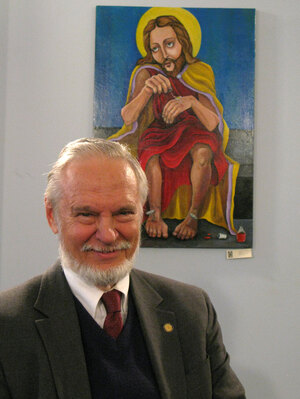 "I wouldn't want this on my wall," Stuart Jordan, an advisor for the Centre For Inquiry, which exhibits the painting in one of their offices.
Some atheists have sought to distance themselves not only from this painting, but also from the attitude behind it -- one which insists that ridicule is the best way to approach the debate surrounding atheism and religion, as opposed to open, honest and (shudder to say) gracious debate.
"It's really a national debate among people with a secular orientation about how far do we want to go in promoting a secular society through emphasizing the 'new atheism,'" Jordan mused. "And some are very much for it, and some are opposed to it on the grounds that they feel this is largely a religious country, and if it's pushed the wrong way, this is going to insult many of the religious people who should be shown respect even if we don't agree with them on all issues."
"What we wanted were thoughtful, incisive and concise critiques of religion," CFI CEO Robert Lindsay added. "We were not trying to insult believers."
Yet many prominent atheists don't seem to agree with Linday and Jordan on the matter of the proper approach.
The most famous atheists -- Richard Dawkins, PZ Myers and Christopher Hitchens -- are diametrically opposed to having a respectful debate with religious people, and are unabashedly proud of it.
"If I said to a Protestant or Quaker or Muslim, 'Hey, at least I respect your belief,' I would be telling a lie," Hitchens said. "I believe it's more honest, more brave, more courageous simply to state your own position."
Often, these particular atheists will simply feign ignorance. For example, PZ Myers got a very strong reaction when he posted a picture of a communion wafer penetrated by a nail, driven to a wall.
"People got very angry," he grumbled. "I don't know why. I mean, it's just a cracker, right?"
And therein may lie the true issue regarding this methodological divide between atheists. Individuals like Stuart Joran and Robert Lindsay seem to get it. PZ Myers and Christopher Hitchens unequivocally do not.
If Myers understood the significance of communion wafers to Catholics and Lutherans, he would understand that symbolically, they are not just crackers. Catholics and Lutherans accept communion wafers as symbolic of their messiah. In extreme cases, some Catholics and Lutherans may even still believe that, upon consecration, communion wafers transubstantiate into the very flesh of Jesus Christ.
When Myers treats that symbol contemtuously, he treats Catholics and Lutherans contemptuously.
Certainly, a great number of people have learned the hard way how little headway can be made with a debating opponent whom you seem bound and determined to treat with contempt.
The tactics Myers used in this particular case don't advance greater understanding of atheism, they simply satisfy the contempt that he and his (many, many) followers feel for religious believers.
These kinds of tactics will win few converts. As one of Richard Dawkins' "four horsemen" of atheism, one would expect that Myers would be a little more deliberate about the kind of tactics he's using.
Stuart Jordan and Robert Lindsay clearly understand this. A more moderate approach to the debate between atheism and religion earns more space for engagement between atheists and religious believers, and makes it far more likely that they can potentially win converts from religious believers.
Even Paul Kurtz, the founder of the Centre For Inquiry, apparently deeply takes issue with Dawkins, Myers, Hitchens and company.
"I consider them atheist fundamentalists," said Paul Kurtz. "They're anti-religious, and they're mean-spirited, unfortunately. Now, they're very good atheists and very dedicated people who do not believe in God. But you have this aggressive and militant phase of atheism, and that does more damage than good."
What PZ Myers, Richard Dawkins and Christopher Hitchens accomplish is nothing more or less than poisoning the well of religious debate.
Sadly, there are numerous fools who are more than happy to help them do it.
Sunday, September 27, 2009
Quantifying Cold Souls Is a Bad Idea
The absurdity of Cold Souls is absolutely palpable, and intentionally so.
In the film, Paul Giamatti plays himsself: an actor so troubled by the production of Uncle Vanya that he's currently starring in that the only solution he can seem to reach is to hastily unburden himself of his soul.
So Giamatti seeks out the aid of a company called Soul Storage. Run by Dr Finstein (David Stratham), Soul Storage is a company that has developed technology that can remove the soul from the human body, store it, and even replace it with other souls.
Giamatti decides to remove his soul and rent the soul of a Russian poet for the duration of his play. However, this turns out to be a very bad decision when a Russian soul mule named Nina (Dina Korzun) steals his soul so an aspiring Russian actress (Katheryn Winnick) can improve her acting by replacing her soul with that of a famous actor.
Giamatti's dilemma is obvious: recover his soul from the self-centred wife of a ruthless and powerful Russian criminal while trying to decide what to do with the soul of a Russian poet who has since committed suicide.
Cold Souls also presents a dilemma to individuals such as Richard Dawkins -- one that they honestly may not care to answer.
Many people, such as Dawkins, look down upon religion because its central tenets -- the existence of a God or gods, the soul, etc -- cannot be quantified and supported with evidence.
Yet, as Cold Souls seems to suggest, Dawkins et al wouldn't want to live in a world in which the soul could be quantified.
For evidence is why, one need only consider recent arguments raised by Kirk Cameron.
Cameron, admittedly, is a nitwit. In a recently-produced video Cameron insists that there's an "undeniable connection" between Adolph Hitler and the theories of Charles Darwin. Cameron, like many of Darwin's detractors, credit Darwinism with providing Hitler for the justification to commit the Holocaust, as well as Nazi Germany's infamous Eugenics program.
Cameron is actually right to note that there is a historical link between Darwin's theories and Hitler's slaughter. But to attribute responsibility to Darwin's theories, considering the limitedness of Hitler's reading of the theories and subsequent abuse of them, is an irresponsible argument.
Just as Darwin's theories were able to be abused for the purposes of eugenics once people attempted to attach value to human life, so could a spiritualist elaboration on Darwin's theories be applied to the human soul. Spiritual eugenics -- if it were at all possible -- would be every bit as dangerous.
There is already a surplus of religious intolerance in the world. It is directed by people of faith against people of other faiths, by people of no faith against people of faith, and by people of faith against people of no faith. If it were possible to actually quantify the content and value of the soul, it would be nothing short of one of the greatest human disasters in history.
Just as cultural anthropology briefly gave credence to the theories of racial and genetic superiority that provided justification (no matter how illegitimate) for eugenics, the quantifying of the soul would give justification (no matter how illegitimate) for religious intolerance.
Dawkins et al would insist that they want to live in a world devoid of religious intolerance (even as they themselves indulge in it).
A world without religious intolerance is a great and noble goal. But as humanity (hopefully) begins to work together to establish such a world, the least we can collectively do is be thankful that religious interolance can't be materially justified.
Monday, September 14, 2009
Teabing's (And Dawkins') Folly
Dan Brown's novel The Da Vinci Code has been controversial to many Christians, for a wide variety of reasons.
At the heart of most Christian objections to The Da Vinci Code is the treatment of Jesus Christ not as divine, but essentially as an ordinary mortal man with a powerful message who left a family behind him.
The film, quite naturally, has been just as controversial as the novel.
In each, Dr Robert Langdon (Tom Hanks) is a Harvard anthropologist who gets caught up in intrigue when he's summoned to the crime scene where Jacques Saunière lay murdered.
Dr Langdon is a suspect in the case, and eventually runs to an older friend, sir Leigh Teabing (sir Ian McKellen) for help.
With the help of Teabing and Sophie Neveau (Audrey Tautou), Dr Langdon outmaneuvers French Police Captain Bezu Fache (Jean Reno) and Bishop Manuel Aringarosa (Alfred Molina) in order to discover the secret of the Priory: nothing less than the Holy Grail.
At the heart of Dr Langdon's quest is actually the intent of one man -- Teabing -- to destroy at the very least the Catholic Church.
In many ways Teabing seems to closely resemble Richard Dawkins, the avowed leader of the global fundamentalist atheist movement. Among the various complaints Dawkins registers against religion is that it is a force of oppression. Not only does Dawkins insist that religion oppresses women and minorities, but Dawkins insists that religion oppresses rational intellect.
He describes faith as a "virus", and clearly yearns for the same fate humankind wishes on any viral infection -- its outright destruction.
In these sentiments Dawkins is closely echoed by many of his fellow atheists -- individuals like Michel Onfray, and by the intellectually-crippled members of the Rational Response Squad.
Teabing belives that the revelation that Christ had left a lineage behind him would invalidate the power of the Catholic Church and destroy it.
But with the Catholic Church remaining quite central to the lives of nearly one billion people only a madman would want to see that institution destroyed considering the kind of social and political unrest that would follow.
But people like the fictional sir Leigh Teabing and the real-life Richard Dawkins tend to be individuals of miniscule imagination. They cannot comprehend the possible consequences of their actions becuase they cannot see beyond their own dogmatic beliefs.
That is the ultimate folly of those who believe they know so well what is best for all humankind that they are willing to destroy millenia-old institutions.
Sunday, September 06, 2009
Does Paul Erland Build a Case?
Erland's case against CS Lewis is weakness incarnate
One of the more amusing things about the fundamentalist atheism movement that has emerged behind individuals like Richard Dawkins is the very real sense that every fundamentalist atheist seems to believe they're a master philosopher.
Often, however, their arguments are every bit as weak as the religious arguments they seek to counter. For example, their ojbection to Pascal's Wager -- the argument that one is better off believing in God in order to essentially "hedge their bets" for the afterlife -- is usually expressed by positing the ever-insipid (although admittedly otherwise hilarious) Flying Spaghetti Monster.
Of course no one actually believes in the Flying Spaghetti Monster. But many people actually do believe in a sentient and interventionalist god. Thus, God is what philosophers would refer to as a live hypothesis, where as the FSM is not.
A much better argument against Pascal's Wager is a much simpler one -- Pascal's Wager is actually an extremely cynical argument. No believe based on solely on Pascal's Wager could ever be genuine. An all-knowing god would very much know the difference.
Many fundamentalist atheists can't seem to settle for these kinds of simple arguments. Instead, they seem to feel a need to concoct drawn-out arguments that they seem to believe implies a sophistication which rarely turns out to be present.
An interesting case in point are the objections recently raised to CS Lewis' religious thought voiced by The Examiner's Paul Erland, a Nashville Agnostic Examiner:
Erland seems to think that he isn't required to attempt any kind of serious attempt to debunk Lewis' thought -- and that the fact that Lewis is a religious thinker has already done the lion's share of the work of invalidating his thought.
Noting that architects often employ "signature features and flourishes", Erland insists that these would be irrefutable evidence of the architect's existence, and that this notion somehow counters Lewis' ideas.
But in order to make this claim, Erland has to overlook the cornerstone of Lewis' religious thought: namely, that religion is much an enterprise of the rational mind as of the spiritual self.
As with many kinds of evidence, the "signature features and flourishes" example employed by Erland is only as meaningful as a human actor's ability to properly perceive, analyze and interpret them. To the unknowing mind or the untrained eye, such "signature features and flourishes" would seem like any other feature of the house.
Even beyond that, the "signature features and flourishes" are not, themselves, the architect, but rather identifying characteristics left ehind by the architect.
Much like the "moral law" that Lewis has often posited, both through his philosophical works and through his literary works.
Erland posits that this "moral law" would "be more plausibly explained as a biological imperative" vis a vis natural selection. But his argument could quickly be countered by anyone who argued, even if only for argument's sake, that such a biological imperative could have been included by the creator's design.
What CS Lewis would actually argue in regard to his moral law argument is that the "moral law" in question is actually the message of Jesus Christ, and the blueprint for a moral life that his teachings provide. Lewis argues that those who do not follow this blueprint essentially debase themselves.
Lewis would go so far as to argue that the benevolence of Christ's message essentially gives it a monopoly on moral behaviour. He would more explicitly argue that no evil could ever truly be done in Christ's name -- although some certainly attempt to invoke Christ to justify their own immoral actions.
Moreover, Lewis argues that those who live in a moral manner are doing the work of Jesus Christ regardless of whatever religion they purportedly follow. (Admittedly, this argument has been interpreted as offensive -- perhaps quite rightly -- by a great number of people who subscribe to non-Christian religious beliefs.)
Perhaps Lewis would even argue that human conscience -- that voice within us that tells us when we've done something wrong -- could be interpreted as God's moral fingerprint on humanity.
These are interesting ideas, and admittedly are no more decisive than Erland's.
But there's very likely a good reason why Erland targeted Lewis in such a brazen manner in the first place. Richard Dawkins -- whose "faith as a virus" epithet Erland invokes in the conclusion of his article -- has advanced a perception of religion as adverse to rational thought.
Yet it was CS Lewis who said that being a Christian is hard intellectual work. He argued for spiritual faith mediated by the rational and intelligent mind. As a result, Lewis is clearly a thinker very threatening to Erland, Dawkins, and their fundamentalist atheist worldview.
CS Lewis certainly doesn't build a decisive case for "moral law", but he never truly meant to, either. What Lewis does do is build a compelling and inclusivist case for God's moral influence on the world.
Paul Erland, on the other hand, fails spectacularly in his attempt to build a decisive case against CS Lewis. Not only does he not seem to understand Lewis' thinking in the first place, but his scornful starting point nearly precludes any kind of rational criticism of Lewis' ideas.
One of the more amusing things about the fundamentalist atheism movement that has emerged behind individuals like Richard Dawkins is the very real sense that every fundamentalist atheist seems to believe they're a master philosopher.
Often, however, their arguments are every bit as weak as the religious arguments they seek to counter. For example, their ojbection to Pascal's Wager -- the argument that one is better off believing in God in order to essentially "hedge their bets" for the afterlife -- is usually expressed by positing the ever-insipid (although admittedly otherwise hilarious) Flying Spaghetti Monster.
Of course no one actually believes in the Flying Spaghetti Monster. But many people actually do believe in a sentient and interventionalist god. Thus, God is what philosophers would refer to as a live hypothesis, where as the FSM is not.
A much better argument against Pascal's Wager is a much simpler one -- Pascal's Wager is actually an extremely cynical argument. No believe based on solely on Pascal's Wager could ever be genuine. An all-knowing god would very much know the difference.
Many fundamentalist atheists can't seem to settle for these kinds of simple arguments. Instead, they seem to feel a need to concoct drawn-out arguments that they seem to believe implies a sophistication which rarely turns out to be present.
An interesting case in point are the objections recently raised to CS Lewis' religious thought voiced by The Examiner's Paul Erland, a Nashville Agnostic Examiner:
"CS Lewis, the defender of the faith so beloved by all Christ-ininnies for lending elegance to their untenable beliefs, wrote:Erland actually tips his hand awfully early in his article -- he flagrantly disrespects the religious views of Christians (referring to them as "Christi-ninnies", and labeling the post with "Christ-inanity"). That disrespect informs his argument against Lewis, as is, in fact, his argument's undoing.'If there was a controlling power outside the universe, it could not show itself to us as one of the facts inside the universe -- no more than an architect of a house could actually be a wall or staircase or fireplace in that house. The only way in which we could expect it to show itself would be inside ourselves as an influence or command trying to get us to behave in a certain way. And that is just what we do find inside ourselves.'First of all, if we’re likening God to an architect, why couldn’t he leave traces of himself inside his work? Architects often employ signature features and flourishes.
Blithely assuming, however, as he frequently does (Lewis is a master of the false syllogism), that we’re all agreed so far that God can’t be expected to reveal himself, Lewis then proceeds to tell us what we should expect -- for him to show himself 'inside ourselves.' So, in light of the architect analogy, should we expect the builder of our house to show himself inside us? And in any event, how does his conclusion follow from his premise? OK -- God is outside the universe and can’t blatantly interfere. So, obviously, he has installed that little voice inside us that says, 'You’re being watched, so behave yourself.'
Lewis is trying to account for the 'Moral Law' that may or may not be universal (he says it is). But wouldn’t such a 'law' be more plausibly explained as a biological imperative—a check on murderous impulses that grew out of natural selection—than as the finger of God perpetually tapping us on the shoulder?
Richard Dawkins says that the God delusion is a virus. If that’s the case, then Lewis was struck by a particularly virulent strain."
Erland seems to think that he isn't required to attempt any kind of serious attempt to debunk Lewis' thought -- and that the fact that Lewis is a religious thinker has already done the lion's share of the work of invalidating his thought.
Noting that architects often employ "signature features and flourishes", Erland insists that these would be irrefutable evidence of the architect's existence, and that this notion somehow counters Lewis' ideas.
But in order to make this claim, Erland has to overlook the cornerstone of Lewis' religious thought: namely, that religion is much an enterprise of the rational mind as of the spiritual self.
As with many kinds of evidence, the "signature features and flourishes" example employed by Erland is only as meaningful as a human actor's ability to properly perceive, analyze and interpret them. To the unknowing mind or the untrained eye, such "signature features and flourishes" would seem like any other feature of the house.
Even beyond that, the "signature features and flourishes" are not, themselves, the architect, but rather identifying characteristics left ehind by the architect.
Much like the "moral law" that Lewis has often posited, both through his philosophical works and through his literary works.
Erland posits that this "moral law" would "be more plausibly explained as a biological imperative" vis a vis natural selection. But his argument could quickly be countered by anyone who argued, even if only for argument's sake, that such a biological imperative could have been included by the creator's design.
What CS Lewis would actually argue in regard to his moral law argument is that the "moral law" in question is actually the message of Jesus Christ, and the blueprint for a moral life that his teachings provide. Lewis argues that those who do not follow this blueprint essentially debase themselves.
Lewis would go so far as to argue that the benevolence of Christ's message essentially gives it a monopoly on moral behaviour. He would more explicitly argue that no evil could ever truly be done in Christ's name -- although some certainly attempt to invoke Christ to justify their own immoral actions.
Moreover, Lewis argues that those who live in a moral manner are doing the work of Jesus Christ regardless of whatever religion they purportedly follow. (Admittedly, this argument has been interpreted as offensive -- perhaps quite rightly -- by a great number of people who subscribe to non-Christian religious beliefs.)
Perhaps Lewis would even argue that human conscience -- that voice within us that tells us when we've done something wrong -- could be interpreted as God's moral fingerprint on humanity.
These are interesting ideas, and admittedly are no more decisive than Erland's.
But there's very likely a good reason why Erland targeted Lewis in such a brazen manner in the first place. Richard Dawkins -- whose "faith as a virus" epithet Erland invokes in the conclusion of his article -- has advanced a perception of religion as adverse to rational thought.
Yet it was CS Lewis who said that being a Christian is hard intellectual work. He argued for spiritual faith mediated by the rational and intelligent mind. As a result, Lewis is clearly a thinker very threatening to Erland, Dawkins, and their fundamentalist atheist worldview.
CS Lewis certainly doesn't build a decisive case for "moral law", but he never truly meant to, either. What Lewis does do is build a compelling and inclusivist case for God's moral influence on the world.
Paul Erland, on the other hand, fails spectacularly in his attempt to build a decisive case against CS Lewis. Not only does he not seem to understand Lewis' thinking in the first place, but his scornful starting point nearly precludes any kind of rational criticism of Lewis' ideas.
Sunday, August 30, 2009
The Idolatry of Anti-Blasphemy
Criticism is essential to religion
A prominent global controversy recently has been the proposal of various anti-blasphemy laws, including a proposed anti-blasphemy resolution at the United Nations.
One of the western states farthest along in the introduction of an anti-blasphemy law is Ireland, where an anti-blasphemy law is set to take effect in October.
The law will impose hefty fines on anyone who "publishes or utters matter that is (intentionally meant to be) grossly abusive or insulting in relation to matters held sacred by any religion, thereby causing outrage among a substantial number of the adherents of that religion."
Unsurprisingly, the law has a vociferous critic in Richard Dawkins.
"It is a wretched, backward, uncivilized regression to the Middle Ages," Dawkins said.
And while Dawkins -- who himself in the name of his quest to "enlighten" humanity by helping to wipe out religion would lead humanity back into the Dark Ages -- is so often so wrong about matters entailing religion, this is one time he is right about it.
Anti-blasphemy laws -- even in places like Ireland, where violence has traditionally surrounded religious conflicts between Catholics and Protestants -- place the intellectual and philosophical development of religious thought in peril by threatening to outlaw criticism.
In Ireland, the anti-blasphemy law -- which Justice Minister Dermot Ahern insists merely clarifies anti-blasphemy provisions in the Irish Constitution -- is quite clearly aimed at attempting to quell tensions between Catholics and Protestants by giving the government a means to punish those who stir up tensions between the two.
But as a club with which critics of either religions -- or Christianity in general -- could be threatened with, this law not only clearly plays to the hypothetical and often-imagined "right not to be offended", but also to an imagined right to not have to think about their religion.
Few things could be more devastating to any religion, especially Christianity. CS Lewis once wrote that being a Christian is hard intellectual work. One has to continually be able to reconcile their religious beliefs against real-world realities, or risk falling into dogmatism.
Ireland's anti-blasphemy law imperils the hard intellectual work of the proper-thinking Christian, and serves to encourage the kind of intellectual sloth that gives rise to dogmatism in the first place.
This is the peril of the idolatry of anti-blasphemy.
A prominent global controversy recently has been the proposal of various anti-blasphemy laws, including a proposed anti-blasphemy resolution at the United Nations.
One of the western states farthest along in the introduction of an anti-blasphemy law is Ireland, where an anti-blasphemy law is set to take effect in October.
The law will impose hefty fines on anyone who "publishes or utters matter that is (intentionally meant to be) grossly abusive or insulting in relation to matters held sacred by any religion, thereby causing outrage among a substantial number of the adherents of that religion."
Unsurprisingly, the law has a vociferous critic in Richard Dawkins.
"It is a wretched, backward, uncivilized regression to the Middle Ages," Dawkins said.
And while Dawkins -- who himself in the name of his quest to "enlighten" humanity by helping to wipe out religion would lead humanity back into the Dark Ages -- is so often so wrong about matters entailing religion, this is one time he is right about it.
Anti-blasphemy laws -- even in places like Ireland, where violence has traditionally surrounded religious conflicts between Catholics and Protestants -- place the intellectual and philosophical development of religious thought in peril by threatening to outlaw criticism.
In Ireland, the anti-blasphemy law -- which Justice Minister Dermot Ahern insists merely clarifies anti-blasphemy provisions in the Irish Constitution -- is quite clearly aimed at attempting to quell tensions between Catholics and Protestants by giving the government a means to punish those who stir up tensions between the two.
But as a club with which critics of either religions -- or Christianity in general -- could be threatened with, this law not only clearly plays to the hypothetical and often-imagined "right not to be offended", but also to an imagined right to not have to think about their religion.
Few things could be more devastating to any religion, especially Christianity. CS Lewis once wrote that being a Christian is hard intellectual work. One has to continually be able to reconcile their religious beliefs against real-world realities, or risk falling into dogmatism.
Ireland's anti-blasphemy law imperils the hard intellectual work of the proper-thinking Christian, and serves to encourage the kind of intellectual sloth that gives rise to dogmatism in the first place.
This is the peril of the idolatry of anti-blasphemy.
Friday, August 14, 2009
That's a Long Wait for That Whine
And sadly it hasn't cellared very well
Those paying attention to the (somehow) swirling controversy over the (somehow infamous) atheist Bus Ads may recall Canadian philosopher Charles Taylor's recent response to them.
"Putting things on buses, as though that's going to make people somehow change their view about God, the universe, the meaning of life and so on," Taylor chucked in an interview with Philosophy Now magazine. "A bus slogan! It's not likely to trigger something very fundamental in anybody."
Nearly three weeks after Taylor's comments, Justin Trottier and Michael Payton of the Centre for Inquiry have finally seen fit to respond to Taylor's comments, in an op/ed appearing in the religion section of the National Post:
What Trottier and Payton are neglecting to mention is that these ads have been supported, on both a philosophical level and monetarily (in Britain), by Richard Dawkins. Dawkins has provided the so-called "new atheists" with not only the clarion call to be a good deal more public with their beliefs -- not in and of itself such a bad thing, necessarily -- but has also provided them with an intellectual template for the promotion of fundamentalist atheism.
But Trottier and Payton's argument falls flat when one points out that, as far as "edgy sloganeering" goes, "There's probably no god" isn't all that edgy at all. This, of course is one of the details that has made complaints over the ads being offensive all the more pointless.
Taylor is under no obligation to criticize the edgy sloganeering (actual edgy sloganeering) of feminist or gay rights groups. Furthermore, these groups can often show the (usually) positive results this sloganeering has accumulated.
Atheists cannot say the same. As Taylor remarked, a bus ad telling people that there probably is no God isn't likely to win many converts.
What would the purpose of a "there's probably no God" ad be, other than to attempt to convince people that there is (probably) no God? An ad that was merely intending to "signal the skeptic and doubter to not be afraid" would likely be an ad that tells people "we don't believe in God. Deal with it," or even "Don't believe in God? You're not alone."
Even a skeptic or doubter who is prodded down the road to rejection of religion becomes a convert if they were religious to begin with.
While Trottier and Payton are right when they note that participation by atheists in religious debate is, overall, a positive thing, they sorely overestimate their ability to sell an argumentive bill of bad goods to Canadians.
Most Canadians aren't terribly offended by the bus ads -- as unoriginal as they are for groups that pride themselves on being "free thinkers" -- nor should they be. Judging from his criticism of the ads themselves, it seems that Charles Taylor isn't terribly threatened by them himself.
But if Justin Trottier and Michael Payton are going to wait three weeks to respond to Taylor's comments, one would have thought they would have done better for themselves -- after all, every modern atheist or even skeptic seems to fancy themselves an expert philosopher.
Apparently not.
Those paying attention to the (somehow) swirling controversy over the (somehow infamous) atheist Bus Ads may recall Canadian philosopher Charles Taylor's recent response to them.
"Putting things on buses, as though that's going to make people somehow change their view about God, the universe, the meaning of life and so on," Taylor chucked in an interview with Philosophy Now magazine. "A bus slogan! It's not likely to trigger something very fundamental in anybody."
Nearly three weeks after Taylor's comments, Justin Trottier and Michael Payton of the Centre for Inquiry have finally seen fit to respond to Taylor's comments, in an op/ed appearing in the religion section of the National Post:
"In a recent interview with Philosophy Now magazine, the Canadian philosopher Charles Taylor, author of A Secular Age, commented on the atheist bus-ad campaign, calling it 'odd' and 'pathetic' for atheists to use such tactics to promote their worldview. In the same interview, Taylor, who is a practising Roman Catholic, compared the backlash of atheists and secularists to the reactions of disgruntled English bishops after the publication of Charles Darwin's On the Origin of Species in the 19th Century.A great many people would rightly disagree.
What Taylor failed to understand is that the bus campaign neither signals the emergence of a new reactionary movement nor is it catalyzed by a 'secularizing intelligentsia' that has woken up to realize the world isn't what it thought it would be. As Canada undergoes secularization, atheist and secularist organizations, which have long existed alongside religious ones as a quiet part of the fabric of this diverse country, have grown steadily in a process. The atheist bus campaign may be a symbolic coming of age, but the movement that spawned it is certainly not new or reactionary."
What Trottier and Payton are neglecting to mention is that these ads have been supported, on both a philosophical level and monetarily (in Britain), by Richard Dawkins. Dawkins has provided the so-called "new atheists" with not only the clarion call to be a good deal more public with their beliefs -- not in and of itself such a bad thing, necessarily -- but has also provided them with an intellectual template for the promotion of fundamentalist atheism.
"To the best of my knowledge, Taylor has never criticized edgy sloganeering from feminist or gay rights groups, nor the often offensive religious ads that have been on buses since buses first started operating in this country. Indeed, the ubiquitous religious ads are worth comparing to the bus campaign: Such advertising hardly adds to the diversity of Canada (given that religious organizations are already an acknowledged and welcome part of the public discourse). Atheist ads, on the other hand, have successfully added a major new dimension to the public debate."Certainly, certain individuals would insist that it's unfair to criticize Charles Taylor for failing to criticize the "edgy sloganeering" of feminist or gay rights movements. Or not.
But Trottier and Payton's argument falls flat when one points out that, as far as "edgy sloganeering" goes, "There's probably no god" isn't all that edgy at all. This, of course is one of the details that has made complaints over the ads being offensive all the more pointless.
Taylor is under no obligation to criticize the edgy sloganeering (actual edgy sloganeering) of feminist or gay rights groups. Furthermore, these groups can often show the (usually) positive results this sloganeering has accumulated.
Atheists cannot say the same. As Taylor remarked, a bus ad telling people that there probably is no God isn't likely to win many converts.
"Thanks to such assertive advertising and other controversial and edgy manoeuvres, atheists have now emerged alongside the religious in the media — they are regular involved in radio and TV debates, public discussion on campuses and are even invited to contribute to newspaper projects like Holy Post.Trottier and Payton should know fully that this argument simply doesn't hold water.
Who would object to this trend in a country like Canada?
Finally, Taylor's comment that atheist ads are unlikely 'to make people somehow change their view about God, the universe, the meaning of life and so on' signals that he has been overly focusing on religious communities and their emphasis on conversion, rather than speaking with those involved in atheist or secularist associations.
Had he engaged the latter group, he might have understood that the atheist ads are not about crass conversion. They are a signal to the skeptic and the doubter to not be afraid to take the road toward rejection of religion. They are a challenge to everyone to engage in critical reflection of their deepest beliefs."
What would the purpose of a "there's probably no God" ad be, other than to attempt to convince people that there is (probably) no God? An ad that was merely intending to "signal the skeptic and doubter to not be afraid" would likely be an ad that tells people "we don't believe in God. Deal with it," or even "Don't believe in God? You're not alone."
Even a skeptic or doubter who is prodded down the road to rejection of religion becomes a convert if they were religious to begin with.
While Trottier and Payton are right when they note that participation by atheists in religious debate is, overall, a positive thing, they sorely overestimate their ability to sell an argumentive bill of bad goods to Canadians.
Most Canadians aren't terribly offended by the bus ads -- as unoriginal as they are for groups that pride themselves on being "free thinkers" -- nor should they be. Judging from his criticism of the ads themselves, it seems that Charles Taylor isn't terribly threatened by them himself.
But if Justin Trottier and Michael Payton are going to wait three weeks to respond to Taylor's comments, one would have thought they would have done better for themselves -- after all, every modern atheist or even skeptic seems to fancy themselves an expert philosopher.
Apparently not.
Saturday, August 01, 2009
Continuing the Assault on the Enemies of Reason
In part one of Richard Dawkins' documentary mini-series Enemies of Reason, Dawkins uses things such as astrology and water dousing to show how such superstitions lead people into irrational beliefs -- something that he seems to hope will cast a shadow over theistic religion.
In part two, Dawkins takes aim at alternative medicine and attempts to demonstrate that the medical field has become a "battleground between reason and superstition".
Dawkins notes that up to one third of British citizens subscribe to some sort of alternative medicine -- ranging from faith healers to homeopathic medicines. Apparently, the threat to reason posed by its enemies are very grave, indeed.
Dawkins equates rising rates of people using alternative medicine as a challenge to scientific medicine.
In some cases, the alleged attacks on science are coming from within the scientific community by way of poorly-conducted studies. Dawkins notes a 1998 study that incorrectly linked MMR vaccine with autism. After this study was released, 100s of thousands of parents refused to inoculate their children leading to new outbreaks of childhood diseases such as measles and the mumps.
Dawkins insists that this episode demonstrates that evidence has been devalued. But he is wrong.
What this evidence shows is that "facts" forwarded under the guise of science are all too often accepted without any vestige of critical thinking. The conclusions of bad science are all too often accepted right alongside the conclusions offered by good science.
It isn't that evidence has been de-valued. It's that poor evidence is being granted greater credence than it's due.
Dawkins complains that media coverage of alternative medicines aren't subjected to the same scrutiny that other news topics, such as politics, are subjected to. And he may well be right about this.
But one would wonder if the MMR autism study would have had the effect it did if the news media had asked those who conducted that particular study -- a survey of only 12 children -- hard questions about its methodology, or had corroborated the results of that study against the findings of other scientists.
Basically, the study was accepted by the news media according to a faith-based credulity granted to those who conducted the study. They are, after all, scientists.
What Dawkins eventually concludes is that the Placebo Effect must explain the seeming successes of homeopathic medicines.
The Skeptic's Dictionary defines the Placebo Effect as "the measurable, observable, or felt improvement in health or behavior not attributable to a medication or invasive treatment that has been administered".
Certainly, the scientific evidence, as recorded through scientific study, that alternative medicines can accomplish what they purport to accomplish is rather meager. Homeopathy is almost certainly clear example of this.
For its own part, the Utah Behavioral Healthcare Network would object to this statement. "To claim that homeopathic remedies are simply a creation brought on by the placebo effect is closed minded at best," it writes on its website.
Even the UBHN cannot define what it is they believe makes homeopathic medicines work:
"Homeopathic remedies work. It has been seen in many people all over the world that homeopathic remedies work. The placebo effect is the brain taking control of the body and helping it to heal itself. Isn't that what homeopathic remedies try to do? So, it would be obvious that the results would look similar to the placebo effect.Certainly people "swearing by" homeopathic medicines doesn't amount to evidence that they work. People who swear by homeopathic medicines clearly believe resolutely that they will work -- it's this resolute belief that is necessary for the Placebo Effect to take place.
The AMA and allopathic doctors have been trying to prove homeopathic remedies to be the placebo effect for 200 years. However, people still use and swear by homeopathic remedies. Some homeopathic remedies work simply. They replace what the body needs. They take the symptoms that are meant to heal the body and enhance their effects. The placebo effect may be real in some cases but it isn't true for the entirety of homeopathic remedies."
In a double-blind scientific study, as Richard Dawkins calls for, many participants would likely not have that belief. This is what makes the placebo effect so hard to scientifically test for, and what makes it so difficult to prove that homeopathic medicines work.
Considering that many homeopaths admit that all they sell is pure, undiluted water -- or at least as close to pure, undiluted water as one can find -- there are few explanations for homeopathic medicine's successes (as they are) but the placebo effect.
Michael Baum, a professor of surgery at London's University College, offers a different explanation: the successes of homeopathic medicines may simply be due to the effect of human care. Baum and Dawkins both note that homeopathic practitioners -- as well as practicioners of other alternative medicines -- spend much more time with their patients than conventional general practicioners.
Baum suggests that homeopaths would make fantastic GPs -- although he wonders who would then help -- via the placebo effect -- those who believe in homeopathy.
To grant alternative medicines such as homeopathy more credence than they are due would certainly be irrational. But to overlook the potential for homeopathic medicine to use the placebo effect to complement conventional medicine is no more rational.
In the end, Dawkins may show more of himself than he shows of homeopathic medicine. In the end, Dawkins tells a homeopath that if he wanted to exploit the placebo effect he would dress it up in the appearance of respectability, just as homeopaths do.
According to the principle of charity, one attributes what their own intentions would be in any given situation to their subject.
If Dawkins would happily exploit homeopathy by dressing it up in the appearance of respectability, one may wonder if perhaps Dawkins isn't exploiting atheism by stirring up notions of being an oppressed minority.
It's far from a reasonable thing to believe. But, then again, Dawkins has so often proven to be less than entirely reasonable that it certainly isn't outside the realm of feasibility.
Tuesday, July 28, 2009
Another One (Does Not) Ride the Bus
Charles Taylor derides Atheist Bus ads
Charles Taylor has something to say about the bus ad campaign currently being conducted by Canadian atheists.
He isn't impressed by them.
In Britain's Philosophy Now magazine, Taylor weighed in on the Richard Dawkins-promoted campaign, describing them as "hilariously funny" (certainly about as monotonous a statement as has ever been uttered).
 "Putting things on buses, as though that's going to make people somehow change their view about God, the universe, the meaning of life and so on," Taylor chuckled. "A bus slogan! It's not likely to trigger something very fundamental in anybody."
Taylor is only the most recent -- and certainly one of the more prominent -- thinkers to recognize the common vestiges of religion in modern atheism.
"This new phenomena is puzzling — atheists that want to spread the 'gospel,' and are sometimes very angry," Taylor mused.
"I think it may be rather like the response of certain bishops to Darwin in the 19th century," he continued. "The bishops had a sense that the world was going in a certain direction — more and more conversion, and so on — and then they find they're suddenly upset in their expectation and they get very rattled and very angry."
"Similarly, we're seeing this now among the secularizing intelligentsia — liberals who felt that the world was going in a certain direction, that it was all going according to plan — and then when it seems not to be, they get rattled. So you get these rather pathetic phenomena."
 "I'm kind of flattered that he would comment on our bus campaign — though he's not terribly sympathetic," mused Center for Inquiry Executive Director Justin Trottier. "But I think he misses the point on a number of fronts. The point of the campaign was not a response to rising religiosity, it's an affirmation of the rising number of unbelievers. Unbelievers have never been organized to the extent that they are now -- whether they call themselves atheists or humanists or freethinkers ... The movement for science, reason and secularism has never had these numbers."
Of course, if the campaign were really solely directed at announcing the emergence of increasing numbers of atheists one would think a slogan like "We don't believe in God. Deal with it," would be a much better way of doing this.
As opposed to "There's probably no God, so stop worrying and enjoy your life" -- a message that, as Charles McVety complained (but all too hysterically) clearly intends to attribute a sort of perpetual anxiety to religion that the ads suggested people should reject.
That isn't a mere affirmation of these beliefs, as Trottier insists -- it's a promotion of the beliefs espoused in the ad.
Of course, if Canadian society is prepared to tolerate the ongoing proselytizing from mainstream, theistic religions, there is no reason in the world why fundamentalist atheists shouldn't be allowed to proselytize as well.
One merely wishes they would be honest about it.
Other bloggers writing about this topic:
DeFaithed - "The atheist bus: Menticide on wheels"
Jeff Olson - "Atheist bus ads 'pathetic:' Philosopher"
Walker Morrow - "What is the role of criticism in religion?">
Charles Taylor has something to say about the bus ad campaign currently being conducted by Canadian atheists.
He isn't impressed by them.
In Britain's Philosophy Now magazine, Taylor weighed in on the Richard Dawkins-promoted campaign, describing them as "hilariously funny" (certainly about as monotonous a statement as has ever been uttered).
 "Putting things on buses, as though that's going to make people somehow change their view about God, the universe, the meaning of life and so on," Taylor chuckled. "A bus slogan! It's not likely to trigger something very fundamental in anybody."
Taylor is only the most recent -- and certainly one of the more prominent -- thinkers to recognize the common vestiges of religion in modern atheism.
"This new phenomena is puzzling — atheists that want to spread the 'gospel,' and are sometimes very angry," Taylor mused.
"I think it may be rather like the response of certain bishops to Darwin in the 19th century," he continued. "The bishops had a sense that the world was going in a certain direction — more and more conversion, and so on — and then they find they're suddenly upset in their expectation and they get very rattled and very angry."
"Similarly, we're seeing this now among the secularizing intelligentsia — liberals who felt that the world was going in a certain direction, that it was all going according to plan — and then when it seems not to be, they get rattled. So you get these rather pathetic phenomena."
 "I'm kind of flattered that he would comment on our bus campaign — though he's not terribly sympathetic," mused Center for Inquiry Executive Director Justin Trottier. "But I think he misses the point on a number of fronts. The point of the campaign was not a response to rising religiosity, it's an affirmation of the rising number of unbelievers. Unbelievers have never been organized to the extent that they are now -- whether they call themselves atheists or humanists or freethinkers ... The movement for science, reason and secularism has never had these numbers."
Of course, if the campaign were really solely directed at announcing the emergence of increasing numbers of atheists one would think a slogan like "We don't believe in God. Deal with it," would be a much better way of doing this.
As opposed to "There's probably no God, so stop worrying and enjoy your life" -- a message that, as Charles McVety complained (but all too hysterically) clearly intends to attribute a sort of perpetual anxiety to religion that the ads suggested people should reject.
That isn't a mere affirmation of these beliefs, as Trottier insists -- it's a promotion of the beliefs espoused in the ad.
Of course, if Canadian society is prepared to tolerate the ongoing proselytizing from mainstream, theistic religions, there is no reason in the world why fundamentalist atheists shouldn't be allowed to proselytize as well.
One merely wishes they would be honest about it.
Other bloggers writing about this topic:
DeFaithed - "The atheist bus: Menticide on wheels"
Jeff Olson - "Atheist bus ads 'pathetic:' Philosopher"
Walker Morrow - "What is the role of criticism in religion?">
Tuesday, June 30, 2009
Richard Dawkins Says It's Wrong to Indoctrinate Children...
...Unless he's the one doing the indoctrination
One of the interesting things about fundamentalist atheism is their tendency to accept the pontifications of hypocritical people at face value.
Richard Dawkins is a brilliant example of this. His vaunted "lying for Jesus" argument has become a central weapon in the rhetorical aresenals of many fundamentalist atheists despite the fact that he's been caught being dishonest using it.
Likewise, Dawkins' argument that children shouldn't be indoctrinated into religion has gained some evident traction amongst fundamentalist atheists. Why, even ABBA member Bjorn Ulvaes thinks so.
So indoctrinating children into religion is bad.
...Oh, unless it's Dawkins' and Ulvaes' religion. Then it's A-OK.
Aside from starting work on a children's book, Dawkins has sponsored a summer camp for atheists.
Dawkins says that the camps are intended to "encourage children to think for themselves sceptically and rationally."
But interestingly enough, Dawkins has made it plainly evident that, to him, thinking for oneself "sceptically and rationally" entails thinking exactly what Dawkins wants them to.
Naturally, Dawkins and company are going to pretend that the camps in question aren't about atheism, but rather merely about secularism.
"There is very little that attacks religion, we are not a rival to religious camps," says camp organizer Samantha Stein. "We exist as a secular alternative open to children from parents of all faiths and none."
So says "atheist rock star" Samantha Stein.
One wonders if Dawkins and Stein realize the extent to which the entire matter defies credulity. An "atheist rock star" accepting funds from Richard Dawkins attacking religion? Apparently we're supposed to perish the thought.
Of course, all of this is aside from the point. There's nothing wrong with parents sending their children to Dawkins' and Stein's camp if they are intent upon raising their children as atheists -- or perhaps even legitimate free-thinkers.
There's nothing wrong with teaching children about evolution or leading them in sing-alongs of "Imagine". In fact both of these -- teaching kids about science and about great music -- can be very good things.
But the least Richard Dawkins could do is stop pretending that he isn't indoctrinating these children in his religion -- atheism, which people like himself have very much transformed to a religion.
Just imagine that kind of honesty from someone who so enjoys vacuously accusing his opponents of "lying for Jesus".
One of the interesting things about fundamentalist atheism is their tendency to accept the pontifications of hypocritical people at face value.
Richard Dawkins is a brilliant example of this. His vaunted "lying for Jesus" argument has become a central weapon in the rhetorical aresenals of many fundamentalist atheists despite the fact that he's been caught being dishonest using it.
Likewise, Dawkins' argument that children shouldn't be indoctrinated into religion has gained some evident traction amongst fundamentalist atheists. Why, even ABBA member Bjorn Ulvaes thinks so.
So indoctrinating children into religion is bad.
...Oh, unless it's Dawkins' and Ulvaes' religion. Then it's A-OK.
Aside from starting work on a children's book, Dawkins has sponsored a summer camp for atheists.
Dawkins says that the camps are intended to "encourage children to think for themselves sceptically and rationally."
But interestingly enough, Dawkins has made it plainly evident that, to him, thinking for oneself "sceptically and rationally" entails thinking exactly what Dawkins wants them to.
Naturally, Dawkins and company are going to pretend that the camps in question aren't about atheism, but rather merely about secularism.
"There is very little that attacks religion, we are not a rival to religious camps," says camp organizer Samantha Stein. "We exist as a secular alternative open to children from parents of all faiths and none."
So says "atheist rock star" Samantha Stein.
One wonders if Dawkins and Stein realize the extent to which the entire matter defies credulity. An "atheist rock star" accepting funds from Richard Dawkins attacking religion? Apparently we're supposed to perish the thought.
Of course, all of this is aside from the point. There's nothing wrong with parents sending their children to Dawkins' and Stein's camp if they are intent upon raising their children as atheists -- or perhaps even legitimate free-thinkers.
There's nothing wrong with teaching children about evolution or leading them in sing-alongs of "Imagine". In fact both of these -- teaching kids about science and about great music -- can be very good things.
But the least Richard Dawkins could do is stop pretending that he isn't indoctrinating these children in his religion -- atheism, which people like himself have very much transformed to a religion.
Just imagine that kind of honesty from someone who so enjoys vacuously accusing his opponents of "lying for Jesus".
Thursday, April 30, 2009
Picking an Atheist Battle in Hip Hop
Greydon Square gains traction among atheist crowd on strength of Dawkins endorsement
Seasoned Richard Dawkins watchers may remember "Beware the Believers", a rap video parodying Richard Dawkins.
They may even remember a briefer follow-up to the video in which its creators revealed it as a mutual mockery of both Dawkins and some of his most diligent detractors -- notably Expelled creator Ben Stein.
The video was particularly hilarious due to the hysterical notion of Dawkins being bothered to even look at a rap CD, let alone actually listen to one.
That stodgy impression of Dawkins may not have been entirely accurate. Dawkins has recently taken to promoting a rapper by the name of Greydon Square.
Greydon Square admits freely to having a confrontational style. That naturally has to be a given, considering the aggressive and confrontational nature of hip hop.
"I'm confrontational with people who are, by nature, confrontational with their ideology," he says. "You can't run around and tell people that they're going to hell because they don't believe in the same sky God as you. Are you serious? I will confront you over that."
Greydon Square wants to approach hip hop in a way that's rarely been attempted before. He wants to approach hip hop as a debate -- an interesting take on battle rap, one that's rarely been embraced.
"See, what I did was I looked at hip hop beefs and noticed that it deteriorated when people started calling each other bitches and ho's and basically stopped formulating arguments," he continues. "They stopped showing the ability, the skill, and just started talking shit. I brought it back to presenting a position. Now you can call me whatever you want, but until you argue a position, you're wack."
But Greydon Square's approach has one singular fatal flaw: in hip hop, winners and losers are normally decided not based on who produces the best argument, but based on who is lyrically superior.
Rappers are starkly divided between two main religious camps -- Christianity, and Islam. Louis Farrakhan and the Nation of Islam has often sought to establish leadership over the hip hop community. In fact Farrakhan has called hip hop summits and has convened personal meetings between rappers in order to squash potentially violent beefs.
Greydon Square would have a difficult time competing lyrically with many rappers of religious faith. DMX, Kanye West and Reverend Run are not only deeply spiritual Christians, but are also dominant battle rappers.
KRS-One, Common and Mos Def are dominant battle rappers who are Muslim.
Any rapper would have difficulty standing against any of these performers in a battle rap. But even so far as dogmatism goes, Greydon Square is unlikely to find suitable targets among the hip hop community.
Many deeply faithful rappers have come from a background that doesn't grant them the luxury of being self-righteous or dogmatic. Due to the very nature of the lives they've lived, these people are sinners who have sought, and continue to seek, redemption -- the most powerful promise of religion.
As a result, the religious beliefs of rappers by their very nature have to be considerably flexible.
If Greydon Square is itching for an opportunity to promote atheism by beefing with other rappers not only is he not terribly likely to win, but he's unlikely to find a target that suits him.
Whether or not Greydon Square will embrace the atheist tactic of inventing a dogmatic opponent where one may not actually exist remains yet to be seen.
Tuesday, April 28, 2009
The Death of an Argument
Key rhetorical flub reveals fatuity of Richard Dawkins' "lying for Jesus" argument
Ever since its inception as an argument in the religion/atheism debate, "lying for Jesus" has become a favoured accusation lobbed by the most zealous atheists.
In fact, accusations of general dishonesty have often been central to the arguments of militant fundamentalist atheists. But in a column appearing on the Spectator website Melanie Phillips chronicles the tale of Dawkins flubbing this argument so badly he may never be able to use it again -- at least not with any trace of credibility.
The tale begins with a debate between Dawkins and Irish mathematician John Lennox in which Dawkins reportedly admitted that belief in God is a defensible belief.
"You can make a respectable case for deism," Dawkins admits. "Not a case that I would accept but I think it is a serious discussion that you could have."
Dawkins would insist that he hadn't really meant his comments as an admission that belief in a god could be respectably defended -- insisting that he was merely being sarcastic. As Lennox and Phillips would both note, Dawkins certainly said nothing at the time to indicate that he was being sarcastic, and had reportedly seemed sincere at the time that he said it.
But Dawkins was not yet finished.
Dawkins would go on to accuse Phillips of misrepresenting him in a column published on the Spectator site. He would even go so far as quoting her in a slide shown at a subsequent debate with Lennox:
Those words were actually penned by Culture Watch's Bill Muehlenberg. Oops.
Dawkins would go on to accuse Phillips of "lying for Jesus" based on quotes that he was misrepresenting as hers. But his folly in doing so actually ran deeper than this simple fact.
As it turns out, Phillips is actually Jewish. One clearly pertinent detail is that Jews don't believe in Jesus -- or at least don't believe he was the prophesized Messiah.
Oops.
At the very least, Dawkins most recent flub has demonstrated precisely how eager he is to deploy his vaunted "lying for Jesus" argument, to the extent that he will rush to use it without even stopping to make sure that the words he's quoted were ever written or spoken by the person he's attributed them to.
Considering the high level at which Dawkins has conducted his scientific work it would be hard to believe -- nearly impossible -- that he was unable to tell Bill Muehlenberg' words from Melanie Phillips'.
Then again, considering Dawkins' history of weakly razor-thin arguments -- such as suggesting that astrology is akin to racism -- perhaps there is ample cause for doubt. It's of little surprise that Dawkins isn't nearly as bright as he and his supporters would like to have people believe.
One thing is for certain: Dawkins' "lying for Jesus" argument is now officially dead in the water. That certainly won't stop Dawkins or any of his supporters from using it -- they thrive on the ignorance of those they would convince, and on the alleged ignorance of anyone who believes in religion.
All that can be done is for those who oppose Dawkins and his virulent brand of atheism to remind people that he isn't nearly as bright -- or honest -- as he pretends to be.
Ever since its inception as an argument in the religion/atheism debate, "lying for Jesus" has become a favoured accusation lobbed by the most zealous atheists.
In fact, accusations of general dishonesty have often been central to the arguments of militant fundamentalist atheists. But in a column appearing on the Spectator website Melanie Phillips chronicles the tale of Dawkins flubbing this argument so badly he may never be able to use it again -- at least not with any trace of credibility.
The tale begins with a debate between Dawkins and Irish mathematician John Lennox in which Dawkins reportedly admitted that belief in God is a defensible belief.
"You can make a respectable case for deism," Dawkins admits. "Not a case that I would accept but I think it is a serious discussion that you could have."
Dawkins would insist that he hadn't really meant his comments as an admission that belief in a god could be respectably defended -- insisting that he was merely being sarcastic. As Lennox and Phillips would both note, Dawkins certainly said nothing at the time to indicate that he was being sarcastic, and had reportedly seemed sincere at the time that he said it.
But Dawkins was not yet finished.
Dawkins would go on to accuse Phillips of misrepresenting him in a column published on the Spectator site. He would even go so far as quoting her in a slide shown at a subsequent debate with Lennox:
"Arch-atheist Richard Dawkins is an evolutionist. But many are now asking whether the dyed-in-the-wool critic of religion may be, well, evolving in his views about God. You see, in a recent debate with theist and Christian John Lennox, he let slip what many would regard as a major blooper: he actually admitted that there might be a case for theism of sorts. This was a worldview change of seismic proportions. It was a most remarkable turnaround. For someone who had spent over five decades championing the atheist cause to all of a sudden renounce it was an incredible achievement."The problem, as it turns out, is that Phillips never wrote those words.
Those words were actually penned by Culture Watch's Bill Muehlenberg. Oops.
Dawkins would go on to accuse Phillips of "lying for Jesus" based on quotes that he was misrepresenting as hers. But his folly in doing so actually ran deeper than this simple fact.
As it turns out, Phillips is actually Jewish. One clearly pertinent detail is that Jews don't believe in Jesus -- or at least don't believe he was the prophesized Messiah.
Oops.
"Lying for Jesus! Oh dear oh dear. Not only did Dawkins falsely accuse me of distorting his position, but he accused me of doing so because he assumed I was a Christian. Five minutes’ research maximum would have told him that I am a Jew. Either he thought that all the stuff written on Culture Watch by Bill Muehlenberg, who appears to be a devout Christian, was written by me; or he assumed that, since John Lennox is a Christian, anyone who supports John Lennox must also be a Christian. Either way, the man who has made a global reputation out of scorning anyone who makes an assumption not grounded in empirical evidence has assumed to be true something that can easily be ascertained to be totally false – thus suggesting that the mind that is so addled by prejudice it cannot deal with demonstrable reality is none other than his own."Those words at least actually were written by Phillips.
At the very least, Dawkins most recent flub has demonstrated precisely how eager he is to deploy his vaunted "lying for Jesus" argument, to the extent that he will rush to use it without even stopping to make sure that the words he's quoted were ever written or spoken by the person he's attributed them to.
Considering the high level at which Dawkins has conducted his scientific work it would be hard to believe -- nearly impossible -- that he was unable to tell Bill Muehlenberg' words from Melanie Phillips'.
Then again, considering Dawkins' history of weakly razor-thin arguments -- such as suggesting that astrology is akin to racism -- perhaps there is ample cause for doubt. It's of little surprise that Dawkins isn't nearly as bright as he and his supporters would like to have people believe.
One thing is for certain: Dawkins' "lying for Jesus" argument is now officially dead in the water. That certainly won't stop Dawkins or any of his supporters from using it -- they thrive on the ignorance of those they would convince, and on the alleged ignorance of anyone who believes in religion.
All that can be done is for those who oppose Dawkins and his virulent brand of atheism to remind people that he isn't nearly as bright -- or honest -- as he pretends to be.
Tuesday, April 14, 2009
Don't Fall for the Big Con of Religion, Atheism
Intellectual folly, profit motive at the heart of modern religious-atheist intolerance
In an Easter Sunday op/ed article published in Britain's Daily Mail, AN Wilson offers a scathing denunciation of atheism, hyperbolically entitled "The Religion of Hatred".
In the article Wilson complains that most of the public intellectuals in Britain are allegedly atheists, the result of a secular society which has branded religious belief as "uncool" and "unsexy".
Wilson's greatest criticisms are reserved for Polly Toynbee, a columnist for The Guardian and President of the British Humanist Association.
"Of all the elements of Christianity, the most repugnant is the notion of the Christ who took our sins upon himself and sacrificed his body in agony to save our souls. Did we ask him to?" Toynbee once wrote, as Wilson quotes.
"When absolute God-given righteousness beckons, blood flows and women are in chains," Toynbee is again quoted.
Individuals like Hitchens, Dawkins and Toynbee are treated as evidence that atheists are smug, hateful and intolerant.
It's little secret that this smugness and arrogance is largely the design of these atheists. Many of them enjoy irritating religious believers into passionate denunciations of them, feeling this confirms the allegedly irrational basis on which religious belief is established and held.
When religious believers lash out at atheists in this particular fashion, they tumble into the same pitfall that these most fervent atheists fall into -- the pitfall of being threatened by other peoples' beliefs.
This inevitably leads to all kinds of folly -- including the folly of taking an individual like Christopher Hitchens, who is as committed an atheist as there ever was, on the radio to try to convince him that he should believe in God.
Just as atheists need to accept that there are reasons why the religious believe, religious believers need to accept that there are reasons why atheists do not believe. To fault them for that fails to address the simple fact that religion has evidently not met the spiritual needs of these individuals -- if indeed these individuals feel they have any spiritual needs at all.
There are plenty of atheists who are more than willing to go about their lives, believing as they believe (or rather, don't believe) relatively quietly without demanding that everyone else believe as they do.
While individuals like Hitchens and Richard Dawkins often promote themselves as spokespeople for atheism, many atheists have made public their discomfort with having such individuals represent them.
To hold up individuals such as Hitchens, Dawkins, or the Rational Response Squad as atheism's leading examples is to risk overlooking the vast majority of atheists who are content to mind their own spiritual business -- just as holding up religion's most vigorous proselytizers as leading examples risks to overlook the vast majority of believers who are content to mind theirs.
Of course such moderate views -- by either atheists or the religious -- are far from marketable. Inherent in these broad denunciations of opposing camps is the big con of a self-promoting ideologue out to enrich themselves through the sale of their next book or their next movie.
Many of these people are perfectly content to lead their masses of followers into folly if it will earn them a few extra dollars annually.
In an Easter Sunday op/ed article published in Britain's Daily Mail, AN Wilson offers a scathing denunciation of atheism, hyperbolically entitled "The Religion of Hatred".
In the article Wilson complains that most of the public intellectuals in Britain are allegedly atheists, the result of a secular society which has branded religious belief as "uncool" and "unsexy".
Wilson's greatest criticisms are reserved for Polly Toynbee, a columnist for The Guardian and President of the British Humanist Association.
"Of all the elements of Christianity, the most repugnant is the notion of the Christ who took our sins upon himself and sacrificed his body in agony to save our souls. Did we ask him to?" Toynbee once wrote, as Wilson quotes.
"When absolute God-given righteousness beckons, blood flows and women are in chains," Toynbee is again quoted.
Individuals like Hitchens, Dawkins and Toynbee are treated as evidence that atheists are smug, hateful and intolerant.
It's little secret that this smugness and arrogance is largely the design of these atheists. Many of them enjoy irritating religious believers into passionate denunciations of them, feeling this confirms the allegedly irrational basis on which religious belief is established and held.
When religious believers lash out at atheists in this particular fashion, they tumble into the same pitfall that these most fervent atheists fall into -- the pitfall of being threatened by other peoples' beliefs.
This inevitably leads to all kinds of folly -- including the folly of taking an individual like Christopher Hitchens, who is as committed an atheist as there ever was, on the radio to try to convince him that he should believe in God.
Just as atheists need to accept that there are reasons why the religious believe, religious believers need to accept that there are reasons why atheists do not believe. To fault them for that fails to address the simple fact that religion has evidently not met the spiritual needs of these individuals -- if indeed these individuals feel they have any spiritual needs at all.
There are plenty of atheists who are more than willing to go about their lives, believing as they believe (or rather, don't believe) relatively quietly without demanding that everyone else believe as they do.
While individuals like Hitchens and Richard Dawkins often promote themselves as spokespeople for atheism, many atheists have made public their discomfort with having such individuals represent them.
To hold up individuals such as Hitchens, Dawkins, or the Rational Response Squad as atheism's leading examples is to risk overlooking the vast majority of atheists who are content to mind their own spiritual business -- just as holding up religion's most vigorous proselytizers as leading examples risks to overlook the vast majority of believers who are content to mind theirs.
Of course such moderate views -- by either atheists or the religious -- are far from marketable. Inherent in these broad denunciations of opposing camps is the big con of a self-promoting ideologue out to enrich themselves through the sale of their next book or their next movie.
Many of these people are perfectly content to lead their masses of followers into folly if it will earn them a few extra dollars annually.
Saturday, April 11, 2009
Markets or Voters?
In part one of The Trap, Adam Curtis argued that the libertarian shift against bureaucratic authority led to society placing a premium on the elimination of human decision making.
The push to remove human judgement and decision making from important societal institutions -- including psychiatry -- have instead led to a society in which many decisions better left to human judgement have been turned entirely over to bureaucratic stringentness and, often, computers.
In part two, entitled "The Lonely Robot", Curtis addresses the manner in which this has been applied to democratic politics on a broader scale.
In Britain, it was John Major who embraced game theory in order to further prod along what eventually became known as the "bureaucracy bashing revolution". This revolution was intended to free government agencies to pursue their performance targets however they saw fit. Instead, what was eventually thrust upon them was a market-driven model that framed decision making within the so-called invisible hand of the market.
Yet the invisible hand of the market is known to be far from invisible. The market is very visible in the operations of banks, stock traders, and regulatory agencies. All of these organizations are guided by human agency, and are often riddled with bureaucratic structures.
When Bill Clinton arrived in office with a laundry list of promises to fulfil, he was quickly dissuaded by individuals such as Robert Rubin to instead follow the free market consensus that had emerged during the Ronald Reagan Presidency, and been sustained during the administration of George HW Bush.
Clinton had promised to use the power of the President's office to pull the country out of an economic resession.
The market, it was argued, was better able to predict and fulfill the needs and desires of citizens. The free market was regarded by these individuals as superior to democracy.
Yet these particular individuals overlooked -- or, likely, simply omitted -- the fact that the market does not function on a one person, one vote basis. Instead, the market treats citizens unequally based on the resources they have at their disposal -- in other words, what they can buy.
An individual who has no resources has no vote in the market. Likewise, those who don't want to partake in what the market has placed on offer have been given no choice.
Likewise, those who are very weathy, under the Rubin model of democracy, were granted extremely disproportionate influence. Likewise, those who want -- or are even indifferent to -- the choices they are offered enjoy an advantageous position. It doesn't help that any public preference for certain government policies is actually exaggerated by the influence of the wealthiest citizens.
It was, ironically, Irving Kristol -- considered to be one of the god fathers of neoconservatism -- who insisted that, if the market wants to be the primary force in any society, it must accept responsibility for eliminating poverty.
Yet in the absence of democracy -- wherein it is purported and, optimally, demanded that all citizens be treated as equal -- there is no real impetus for the market to tackle poverty. Certainly, the incentive is sorely lacking.
Freedom, as Curtis notes, was cast narrowly in the form of positive freedoms. Citizens had the freedom to consume whatever they wanted. The libertarian focus on negative freedoms -- in this case, freedom from the market -- seemed to have been forgotten.
Game theory meshed with theories such as Richard Dawkins' "selfish gene" to undermine notions of human agency. Within this conceptual frame, human beings were reduced to calculating creatures, constantly seeking personal advantage at the behest of one's genes.
Society, in the musings of such individuals, was reduced to the level of sophistification of the most primitive tribal societies -- societies wherein little coherent social order seems to exist.
What was absent from this model was the notion of human choice -- that humans didn't choose to support their friends and families, and that they only did so in return for help surviving. What people would otherwise regard as a complex societal order built on the notion of a collection of social contracts was reduced to base survivalism.
This cynicism is a stark contrast to the optimism on which democracies are ideally based. Democracy teaches us that diverse groups of people, with diverse interests, can forge a mutual societal order based on consensus, even if agreement is never universal.
It's cynicism that leads to a government-by-numbers model that casts aspersions upon human judgement and demand that it be removed from public administration as much as possible.
This kind of mentality, naturally, fell right into the hands of bureaucrats. The "bureaucrat bashing revolution" had instead made bureaucrats more powerful than they ever were.
The medicalization of human emotional states and the introduction of anti-depressent drugs cast a sinister shadow across the issue. Important questions linger about the extent to which modern psychiatry treats ordinary emotional distress as a mental illness best addressed with medication rather than the result of ordinary problems.
Taking the judgement of psychiatrists out of the decision-making process has only made this more distinct. If symptoms were examined to determine their root cause, as opposed to examined based on the mere existence of the symptom, it's extremely likely that many people diagnosed as clinically depressed may be treated otherwise.
Once again, the efforts to detect misdiagnoses within psychiatry instead intensified the problem, and has led to as many misdiagnoses as ever.
By setting performance targets, Tony Blair's Labour Government had subordinated government to this emerging tyranny of numbers. In many cases, indices were designed to measure things that, in many cases, defy numerical measurement.
Bureaucrats aren't given the option of refusing a target. And in cases where targets may have been unattainable by ordinary means, perverse methods of artificually meeting them were used.
Societies that tolerate artificial solutions to their problems are certainly not headed in a positive or progressive direction. Because it relies on numbers, a market number can be fooled with numbers, especially when the ordinary citizens' methods of demanding that societal problems be substantively addressed are being undermined.
The market also gives the wealthiest the opportunity to go outside of the public system to meet their needs. Wealthy people who find it difficult to receive medical aid through public systems artificially meeting their performance targets can receive treatement in private clinics. Wealthy people who are being victimized by crime because their police departments are artificially lowering crime rates can build gated communities and hire their own security.
Instead of brining people together in a manner superior to that democracy can accomplish, these models instead drive people further apart, usually at society's own expense.
When people are driven apart, they are never driven apart at random. They're driven together as they're driven apart -- herded into groups based on ethnicity, religion, language and any number of other tratis, but moreover than any of them, wealth.
The marketization of democracy not only empowers the wealthy at the expense of everyone else, it also separates them from everyone else. They cease to live in the same social reality as their fellow citizens, and instead live in a social reality all their own.
The trap that has emerged out of the removal of human judgement from public management can be overcome, but it requires a more hopeful, more democratic, view of society and the way it should operate.
Monday, March 09, 2009
The Quest to De-Canonize Science
Vatican concerns that science is for everyone, not just atheists
When someone who uses science and rationality as the backbone of his cause is found to be far more out of touch with science and rationalism than his allegedly irrational and superstitious opposition, one simply knows that individual is in trouble.
This is the dilemma that crusading Atheist Richard Dawkins finds himself in recently, as the Catholic Church, of all places, has cast some serious doubt on some of the conclusions Dawkins has reached and the obvious absence of the scientific method therein.
Richard Dawkins has been known to insist that the theory of evolution decisively proves that "God almost certainly does not exist".
At a five-day conference commemorating the 150th anniversary of On the Origin of the Species, Vatican theologians discussed the theory of evolution with biologists, molecular geneticists, paleontologists and philosophers. They noted that while Christians still accept God as the divine creative force behind they universe, the Catholic Church "does not stand in the way of scientific realities".
Pontifical Council for Culture head Monsignor Gianfranco Ravasi noted that there is no a priori incompatibility between the Bible and evolutionary theory.
Of course, Darwinian evolution and the creation account in Genesis may not be entirely compatible... if you take the word of the Bible literally. Such views are more generally described as fundamentalism.
Oddly enough, Cardinal William Levada offered his criticism of "those who have a fundamentalist interpretation of the Bible which they want to see taught to their children in the schools alongside evolution or instead of it."
Yet interestingly enough Richard Dawkins has to insist on a fundamentalist interpretation of the creation story as related in Genesis in order to argue that the theory of evolution decisively disproves the existence of God. If one acquiesces to the more widely-held view that the Bible is written predominantly in allegory and metaphor, Dawkins' claim becomes much harder to justify.
If Dawkins' claim that evolution proves "god almost certainly doesn't exist" relies so heavily on a fundamentalist interpretation of the Bible, it becomes very difficult to regard Dawkins himself as anything other than a fundamentalist.
Dawkins and his ilk have far too long been allowed to canonize science and hold it up to be the scripture which disproves religious scripture.
But if those who are allegedly most predisposed toward the fundamentalism that would validate such an argument instead reject fundamentalism, this is an argument without any kind of a future.
The best way to de-canonize science was for religious authority to accept it. Now that this has been done individuals like Richard Dawkins are going to need to find themselves a new scripture for atheism.
When someone who uses science and rationality as the backbone of his cause is found to be far more out of touch with science and rationalism than his allegedly irrational and superstitious opposition, one simply knows that individual is in trouble.
This is the dilemma that crusading Atheist Richard Dawkins finds himself in recently, as the Catholic Church, of all places, has cast some serious doubt on some of the conclusions Dawkins has reached and the obvious absence of the scientific method therein.
Richard Dawkins has been known to insist that the theory of evolution decisively proves that "God almost certainly does not exist".
At a five-day conference commemorating the 150th anniversary of On the Origin of the Species, Vatican theologians discussed the theory of evolution with biologists, molecular geneticists, paleontologists and philosophers. They noted that while Christians still accept God as the divine creative force behind they universe, the Catholic Church "does not stand in the way of scientific realities".
Pontifical Council for Culture head Monsignor Gianfranco Ravasi noted that there is no a priori incompatibility between the Bible and evolutionary theory.
Of course, Darwinian evolution and the creation account in Genesis may not be entirely compatible... if you take the word of the Bible literally. Such views are more generally described as fundamentalism.
Oddly enough, Cardinal William Levada offered his criticism of "those who have a fundamentalist interpretation of the Bible which they want to see taught to their children in the schools alongside evolution or instead of it."
Yet interestingly enough Richard Dawkins has to insist on a fundamentalist interpretation of the creation story as related in Genesis in order to argue that the theory of evolution decisively disproves the existence of God. If one acquiesces to the more widely-held view that the Bible is written predominantly in allegory and metaphor, Dawkins' claim becomes much harder to justify.
If Dawkins' claim that evolution proves "god almost certainly doesn't exist" relies so heavily on a fundamentalist interpretation of the Bible, it becomes very difficult to regard Dawkins himself as anything other than a fundamentalist.
Dawkins and his ilk have far too long been allowed to canonize science and hold it up to be the scripture which disproves religious scripture.
But if those who are allegedly most predisposed toward the fundamentalism that would validate such an argument instead reject fundamentalism, this is an argument without any kind of a future.
The best way to de-canonize science was for religious authority to accept it. Now that this has been done individuals like Richard Dawkins are going to need to find themselves a new scripture for atheism.
Saturday, February 21, 2009
Finally, Richard Dawkins Can Be Good For Something
Dawkins should trounce Ray Comfort and get paid for it
Most of thsoe truly rational-minded people who've paid any passing amount of attention to Richard Dawkins have long realized that he isn't good for much of anything.
Once upon a time Dawkins was an educator. However, since retiring from Oxford Dawkins has dedicated himself to single-mindedly promoting atheism. Which would make him about as useful as Canadian Cynic on Valentine's Day.
However, some use for Dawkins may have just come up.
Eager to test the arguments from his most recent book, You Can Lead An Atheist to Evidence But You Can't Make Him Think, Ray Comfort has offered Dawkins $10,000 to participate in a debate.
Comfort's intentions are very simple -- he wants to convert Dawkins.
"Richard Dawkins is arguably the most famous living atheist, now that Anthony Flew doubted his doubts and backslid as an atheist," Comfort said. "Flew said that he simply followed the evidence. I would like to see Richard Dawkins follow his example."
"One of Dawkins' major gripes is against religion," Comfort explained. "I am in total agreement on that one. I abhor religion. It is the opiate of the masses. It has left a bloody trail of destruction and human misery throughout history. Hitler even used it for his own ends. His other big beef is that he believes that the God of the Old Testament is a tyrant. If I had the image of God Dawkins has created in his mind, I, too, would be an atheist. The problem is that the god Mr Dawkins doesn't believe in, doesn't exist."
"I will donate $10,000 to him, or give it to any children's charity he names," Comfort announced. "All I ask is that he goes into a studio and gives me 20 minutes on why there is no God and why evolution is scientific. Then I will give 20 minutes on how we can know God exists and why evolution is nothing more than an unsubstantiated and unscientific fairy tale for grownups. Then we both will have 10 minutes to respond."
Comfort doesn't expect Dawkins to accept, however. He believes that Dawkins may be too afraid to debate him.
"Sadly, I have found that even evolution's most staunch believers are afraid to debate, because they know that their case for atheism and evolution is less than extremely weak," Comfort insisted. "I would be delighted (and honored) if Mr. Dawkins has the courage to debate me, but I'm not holding my breath."
Of course, Comfort couldn't be more wrong about this. If anything, scientists are avoiding debating Comfort on the topic because they don't believe there legitimately is a debate.
But while Dawkins really couldn't debate his way out of a paper bag in regards to religion -- he's well known for making numerous dead-end arguments and his book The God Delusion is really just a rehashed collection of other people's arguments -- Dawkins can win a debate with Comfort over evolution hands down. That is the best reason to take Comfort on.
Comfort has seemingly grown cocky since his 2007 encounter with the Rational Response Squad when he and Kirk Cameron managed to wipe the floor with them using some extremely unconvincing arguments.
Comfort's famously debunked banana argument, in which he suggests the shape of a banana is evidence of it being intelligently designed, is an example of the kind of argument Comfort is prone to. And while the Rational Response Squad may be so intellectually helpless as to be unable to counter such an argument, Dawkins is much smarter than them.
Comfort's classicly weak arguments against evolution have left him extremely vulnerable and just begging to be mowed down.
That is the best reason of all for Dawkins to crush Comfort on the topic of evolution, and actually have Comfort pay him to do it.
Most of thsoe truly rational-minded people who've paid any passing amount of attention to Richard Dawkins have long realized that he isn't good for much of anything.
Once upon a time Dawkins was an educator. However, since retiring from Oxford Dawkins has dedicated himself to single-mindedly promoting atheism. Which would make him about as useful as Canadian Cynic on Valentine's Day.
However, some use for Dawkins may have just come up.
Eager to test the arguments from his most recent book, You Can Lead An Atheist to Evidence But You Can't Make Him Think, Ray Comfort has offered Dawkins $10,000 to participate in a debate.
Comfort's intentions are very simple -- he wants to convert Dawkins.
"Richard Dawkins is arguably the most famous living atheist, now that Anthony Flew doubted his doubts and backslid as an atheist," Comfort said. "Flew said that he simply followed the evidence. I would like to see Richard Dawkins follow his example."
"One of Dawkins' major gripes is against religion," Comfort explained. "I am in total agreement on that one. I abhor religion. It is the opiate of the masses. It has left a bloody trail of destruction and human misery throughout history. Hitler even used it for his own ends. His other big beef is that he believes that the God of the Old Testament is a tyrant. If I had the image of God Dawkins has created in his mind, I, too, would be an atheist. The problem is that the god Mr Dawkins doesn't believe in, doesn't exist."
"I will donate $10,000 to him, or give it to any children's charity he names," Comfort announced. "All I ask is that he goes into a studio and gives me 20 minutes on why there is no God and why evolution is scientific. Then I will give 20 minutes on how we can know God exists and why evolution is nothing more than an unsubstantiated and unscientific fairy tale for grownups. Then we both will have 10 minutes to respond."
Comfort doesn't expect Dawkins to accept, however. He believes that Dawkins may be too afraid to debate him.
"Sadly, I have found that even evolution's most staunch believers are afraid to debate, because they know that their case for atheism and evolution is less than extremely weak," Comfort insisted. "I would be delighted (and honored) if Mr. Dawkins has the courage to debate me, but I'm not holding my breath."
Of course, Comfort couldn't be more wrong about this. If anything, scientists are avoiding debating Comfort on the topic because they don't believe there legitimately is a debate.
But while Dawkins really couldn't debate his way out of a paper bag in regards to religion -- he's well known for making numerous dead-end arguments and his book The God Delusion is really just a rehashed collection of other people's arguments -- Dawkins can win a debate with Comfort over evolution hands down. That is the best reason to take Comfort on.
Comfort has seemingly grown cocky since his 2007 encounter with the Rational Response Squad when he and Kirk Cameron managed to wipe the floor with them using some extremely unconvincing arguments.
Comfort's famously debunked banana argument, in which he suggests the shape of a banana is evidence of it being intelligently designed, is an example of the kind of argument Comfort is prone to. And while the Rational Response Squad may be so intellectually helpless as to be unable to counter such an argument, Dawkins is much smarter than them.
Comfort's classicly weak arguments against evolution have left him extremely vulnerable and just begging to be mowed down.
That is the best reason of all for Dawkins to crush Comfort on the topic of evolution, and actually have Comfort pay him to do it.
Friday, January 09, 2009
Definitely Not The Advertising Standards They Want
Christian organization notes that Richard Dawkins can't prove nonexistence of god
As 800 buses carrying a Richard Dawkins-backed advertising campaign prepare to roll out across Britain, Stephen Green, the national director of Christian Voice, has submitted a complaint about the ads to the British Adverstising Standards Authority.
 Green is complaining that the ads, which read “There’s probably no God. Now stop worrying and enjoy your life”, cannot be effectively proven.
“It is given as a statement of fact and that means it must be capable of substantiation if it is not to break the rules," Green complains. "There is plenty of evidence for God, from people’s personal experience, to the complexity, interdependence, beauty and design of the natural world.”
While many of those who oppose the anti-religious zealotry of Dawkins and his supporters may be tempted to back Green on his bid to have the atheist ads declared in violation of advertising standards. But they need to think twice before they do.
It doesn't take genius to recognize that "there's probably no god" isn't really a statement of fact. It's a statement of probability, which when applied to issues such as religion can only help but be a matter of opinion.
And while Green could argue that "people's personal experience" is evidence of God's existence, atheists could just as easily argue that their personal experiences prove God's non-existence.
Furthermore, to suggest that the complexity, interdependence, beauty and design of the natural world” is evidence of God's existence is a specious argument. It suffers from the same integral weakness as those that argue that seeming evidence of engineering principles in biological cells is proof of God's existence.
After all, many of the principles used in engineering are based on phenomenae originally observed in nature. To claim that the existence in nature of principles discovered only because they were observed in nature to begin with is proof that an intelligent designer (in this case, God) exists is to try to lean on only one half of a circular argument.
Green -- and many religious believers, both Christian and otherwise -- need to admit that there is no physical, objective evidence for the existence of God. As such, God's existence can't realistically be considered any more probable than God's non-existence.
That's why a belief in God requires so much faith.
To top it all off, Green's complaint would have very serious implications for the ability of Christian organizations -- both Churches and otherwise -- to advertise based on their belief that God exists, which generally isn't called into question in Christian advertisements.
But more important is this: what makes individuals such as Dawkins and his cohorts so objectionable to begin with is that they begrudge the religious for their beliefs.
For individuals such as Stephen Green to in turn begrudge atheists for what they believe is, frankly, hypocritical.
To entrench that hypocrisy into advertising standards is absolutely not what Green should want to do.
As 800 buses carrying a Richard Dawkins-backed advertising campaign prepare to roll out across Britain, Stephen Green, the national director of Christian Voice, has submitted a complaint about the ads to the British Adverstising Standards Authority.
 Green is complaining that the ads, which read “There’s probably no God. Now stop worrying and enjoy your life”, cannot be effectively proven.
“It is given as a statement of fact and that means it must be capable of substantiation if it is not to break the rules," Green complains. "There is plenty of evidence for God, from people’s personal experience, to the complexity, interdependence, beauty and design of the natural world.”
While many of those who oppose the anti-religious zealotry of Dawkins and his supporters may be tempted to back Green on his bid to have the atheist ads declared in violation of advertising standards. But they need to think twice before they do.
It doesn't take genius to recognize that "there's probably no god" isn't really a statement of fact. It's a statement of probability, which when applied to issues such as religion can only help but be a matter of opinion.
And while Green could argue that "people's personal experience" is evidence of God's existence, atheists could just as easily argue that their personal experiences prove God's non-existence.
Furthermore, to suggest that the complexity, interdependence, beauty and design of the natural world” is evidence of God's existence is a specious argument. It suffers from the same integral weakness as those that argue that seeming evidence of engineering principles in biological cells is proof of God's existence.
After all, many of the principles used in engineering are based on phenomenae originally observed in nature. To claim that the existence in nature of principles discovered only because they were observed in nature to begin with is proof that an intelligent designer (in this case, God) exists is to try to lean on only one half of a circular argument.
Green -- and many religious believers, both Christian and otherwise -- need to admit that there is no physical, objective evidence for the existence of God. As such, God's existence can't realistically be considered any more probable than God's non-existence.
That's why a belief in God requires so much faith.
To top it all off, Green's complaint would have very serious implications for the ability of Christian organizations -- both Churches and otherwise -- to advertise based on their belief that God exists, which generally isn't called into question in Christian advertisements.
But more important is this: what makes individuals such as Dawkins and his cohorts so objectionable to begin with is that they begrudge the religious for their beliefs.
For individuals such as Stephen Green to in turn begrudge atheists for what they believe is, frankly, hypocritical.
To entrench that hypocrisy into advertising standards is absolutely not what Green should want to do.
Wednesday, December 24, 2008
Stealing Richard Dawkins' Christmas
Dawkin's Christmas alternative not quite what it's cracked up to be
'Twas the night before Christmas, and all through the house,
Not a creature was stirring -- except for Richard Dawkins. Fortunately, that guy is a bloody idiot.
In an amusing article appearing in the New York Times, Olivia Johnson recounts a story about Richard Dawkins telling her that Sir Isaac Newton was born on Christmas Day. Thus the 25th of December could be treated as an alternative atheist holiday -- celebrating the coming on the man who invented modern physics and mathematics.
Unfortunately, there turn out to be more than a few problems with Dawkins' suggestion.
First off, as Johnson notes, Newton wasn't really born on Christmas Day. When Newton was born England was still using the Julian Calendar. According to the Gregorian calendar, Newton wasn't actually born until January 4, 1643.
But this isn't the greatest difficulty with Dawkins' proposal.
After all, Newton was known to be a committed Christian. One popular story recounts Isaac's dealings with an atheist:
It's rather ironic that Dawkins -- as committed atheist as Newton was a Christian -- would seek to supplant a holiday celebrating the arrival of the Christian messiah with a holiday celebrating an individual who many consider to be the atheist messiah.
An atheist messiah who himself was a Christian, interred in Westminster Abbey upon his death.
Only an individual whose thought tends to be as empty as Richard Dawkins' -- after all, this is an individual who can't seem to tell astrology and racism apart -- could dream up something quite like that.
'Twas the night before Christmas, and all through the house,
Not a creature was stirring -- except for Richard Dawkins. Fortunately, that guy is a bloody idiot.
In an amusing article appearing in the New York Times, Olivia Johnson recounts a story about Richard Dawkins telling her that Sir Isaac Newton was born on Christmas Day. Thus the 25th of December could be treated as an alternative atheist holiday -- celebrating the coming on the man who invented modern physics and mathematics.
Unfortunately, there turn out to be more than a few problems with Dawkins' suggestion.
First off, as Johnson notes, Newton wasn't really born on Christmas Day. When Newton was born England was still using the Julian Calendar. According to the Gregorian calendar, Newton wasn't actually born until January 4, 1643.
But this isn't the greatest difficulty with Dawkins' proposal.
After all, Newton was known to be a committed Christian. One popular story recounts Isaac's dealings with an atheist:
"The story is told of an atheist scientist, a friend of Sir Isaac Newton, who knocked on the door and came in after he had just finished making his solar system machine.The story concludes that the encounter with Newton converted the man from atheism to Christianity -- although whether this is true or not is a detail that has been lost to the pages of unwritten history.
The man saw the machine and said 'how wonderful' and went over to it and started cranking the handle and the planets went round. As he was doing this he asked, 'Who made this?'
Sir Isaac stopped writing and said 'nobody did'. Then he carried on writing.
The man said, 'you didn't hear me. Who made the machine?' Newton replied, 'I told you. Nobody did.' He stopped cranking and turned to Isaac 'Now listen Isaac, this marvelous machine must have been made by somebody - don't keep saying that nobody made it.'
At which point Isaac Newton stopped writing and got up. He looked at him and said 'Now isn't it amazing. I tell you that nobody made a simple toy like that and you don't believe me. Yet you gaze out into the solar System - the intricate marvelous machine that is around you - and you dare say to me that no one made that. I don't believe it'."
It's rather ironic that Dawkins -- as committed atheist as Newton was a Christian -- would seek to supplant a holiday celebrating the arrival of the Christian messiah with a holiday celebrating an individual who many consider to be the atheist messiah.
An atheist messiah who himself was a Christian, interred in Westminster Abbey upon his death.
Only an individual whose thought tends to be as empty as Richard Dawkins' -- after all, this is an individual who can't seem to tell astrology and racism apart -- could dream up something quite like that.
Saturday, November 22, 2008
Thanks For Calling, Guys
Bill Maher, Michael Moore, Ben Stein sent packing by Academy Awards
When the Best Documentary Film Oscar is handed out at the 2009 Academy Awards, the producers of Expelled, Religulous and Slacker Uprising will not be accepting the award.
The omission of Ben Stein, Bill Maher and Michael Moore off the 15-film roll call of Oscar nominees, probably represents one of two things: either the less-than-spectacular stature of each of these films, or a rejection of a growing scourge in the genre of documentary film: the documentary style often referred to as Michael Moore-ism.
Films made in the Michael Mooreist style tend to be sensational and ultimately self-promoting; long on rhetoric and short on actual facts. The editing is usually cartoonish, relying on inter-cut clips of cartoon shows or amusing archive footage, often inserted into the film on a random cue -- what Richard Dawkins describes as a "lord privy seal" in his less-than-sparkling criticism of the film.
(Interestingly, Bill Maher's pro-atheist Expelled contained a great many such "lord privy seals" -- something that Dawkins declined to criticize. Commentators on Dawkins blog even went to great lengths to defend Maher's indulgences, which really only reinforces the known hypocrisy of many Dawkinites.)
Sometimes, the questions asked by such films are, in and of themselves, quite valid: Expelled, for example, calls into question the level of academic freedom at many institutions of higher learning, and Religulous questions many of the excesses of the religious faithful. Bowling for Columbine raised important questions about American gun culture, and about the effect organizations such as the NRA have on American society.
In the end, however, each film is ultimately self-promoting. Ben Stein clearly intends to elevate to heroic status among the community of religious believers -- or at least amongst those who believe in Intelligent Design theory. Bill Maher clearly wants to ascend to Dawkins-like status in terms of being a religion fighter. Slacker Uprising turned out to be nothing more than shameless self-promotion on Michael Moore's part, offering little more than a showcase of Moore speaking to large anti-Bush rallies and hobnobbing with like-minded celebrity buddies during the 2004 election.
Rarely has anyone gone to the lengths Moore has gone to in order to promote himself as a hero of the American left -- or, some would say, the global left, as the distinction between the two so often proves to be rather slim.
Films made in the Michael Mooreist style often feature one highly unethical feature: that of the late-film ambush, where an unsuspecting subject is lured into a compromising interview with a surprise interviewer.
Bill Maher lied to many subjects of Religulous in order to get them to appear, and later shamelessly admitted it. Richard Dawkins accused Ben Stein of lying in order to get him to appear in Expelled (but remained oddly silent when Maher admitted to lying in order to lure many of Religulous' subjects into interviews).
In each case, however, it could be argued that lying was the only way to draw these individuals into the richly-deserved limelight of ridicule. Few have parlayed outright arrogance into star status as effectively as Dawkins. And, quite frankly, anybody who has the audacity to claim to be the second coming of Jesus Christ deserves to be forced to defend that assertion in the public eye.
At base level, Moore's ambush of Charlton Heston in Bowling for Columbine seems to fit the same bill. Yet, as it turned out, Heston was suffering from the early stages of Alzheimer's disease during the time of the interview. While Heston certainly deserved to be called to account for his callous response to several shooting incidents, what eventually emerged was a failure of human compassion: the badgering of a man at the beginning of a slow, agonizing process of dying.
Perhaps moreso than Farenheit 9/11, Bowling for Columbine provided the model for the explosion of Michael Mooreist films in the succeeding years. That it won an Oscar and provided its maker with a nearly unprecedented stage from which to pronounce his political views only encouraged the proliferation of such films.
Which makes it perhaps fitting that the pale imitations of this film -- including Moore's own pale imitation -- will likely continue to be snubbed by the Academy.
But one way or the other, so long as self-promoting unethical hacks continue to look at documentary film as a venue through which they can lionize themselves, the Michael Mooreist style isn't going away.
At least now the Academy is set to stop pretending it represents any form of excellence -- technical or otherwise.
When the Best Documentary Film Oscar is handed out at the 2009 Academy Awards, the producers of Expelled, Religulous and Slacker Uprising will not be accepting the award.
The omission of Ben Stein, Bill Maher and Michael Moore off the 15-film roll call of Oscar nominees, probably represents one of two things: either the less-than-spectacular stature of each of these films, or a rejection of a growing scourge in the genre of documentary film: the documentary style often referred to as Michael Moore-ism.
Films made in the Michael Mooreist style tend to be sensational and ultimately self-promoting; long on rhetoric and short on actual facts. The editing is usually cartoonish, relying on inter-cut clips of cartoon shows or amusing archive footage, often inserted into the film on a random cue -- what Richard Dawkins describes as a "lord privy seal" in his less-than-sparkling criticism of the film.
(Interestingly, Bill Maher's pro-atheist Expelled contained a great many such "lord privy seals" -- something that Dawkins declined to criticize. Commentators on Dawkins blog even went to great lengths to defend Maher's indulgences, which really only reinforces the known hypocrisy of many Dawkinites.)
Sometimes, the questions asked by such films are, in and of themselves, quite valid: Expelled, for example, calls into question the level of academic freedom at many institutions of higher learning, and Religulous questions many of the excesses of the religious faithful. Bowling for Columbine raised important questions about American gun culture, and about the effect organizations such as the NRA have on American society.
In the end, however, each film is ultimately self-promoting. Ben Stein clearly intends to elevate to heroic status among the community of religious believers -- or at least amongst those who believe in Intelligent Design theory. Bill Maher clearly wants to ascend to Dawkins-like status in terms of being a religion fighter. Slacker Uprising turned out to be nothing more than shameless self-promotion on Michael Moore's part, offering little more than a showcase of Moore speaking to large anti-Bush rallies and hobnobbing with like-minded celebrity buddies during the 2004 election.
Rarely has anyone gone to the lengths Moore has gone to in order to promote himself as a hero of the American left -- or, some would say, the global left, as the distinction between the two so often proves to be rather slim.
Films made in the Michael Mooreist style often feature one highly unethical feature: that of the late-film ambush, where an unsuspecting subject is lured into a compromising interview with a surprise interviewer.
Bill Maher lied to many subjects of Religulous in order to get them to appear, and later shamelessly admitted it. Richard Dawkins accused Ben Stein of lying in order to get him to appear in Expelled (but remained oddly silent when Maher admitted to lying in order to lure many of Religulous' subjects into interviews).
In each case, however, it could be argued that lying was the only way to draw these individuals into the richly-deserved limelight of ridicule. Few have parlayed outright arrogance into star status as effectively as Dawkins. And, quite frankly, anybody who has the audacity to claim to be the second coming of Jesus Christ deserves to be forced to defend that assertion in the public eye.
At base level, Moore's ambush of Charlton Heston in Bowling for Columbine seems to fit the same bill. Yet, as it turned out, Heston was suffering from the early stages of Alzheimer's disease during the time of the interview. While Heston certainly deserved to be called to account for his callous response to several shooting incidents, what eventually emerged was a failure of human compassion: the badgering of a man at the beginning of a slow, agonizing process of dying.
Perhaps moreso than Farenheit 9/11, Bowling for Columbine provided the model for the explosion of Michael Mooreist films in the succeeding years. That it won an Oscar and provided its maker with a nearly unprecedented stage from which to pronounce his political views only encouraged the proliferation of such films.
Which makes it perhaps fitting that the pale imitations of this film -- including Moore's own pale imitation -- will likely continue to be snubbed by the Academy.
But one way or the other, so long as self-promoting unethical hacks continue to look at documentary film as a venue through which they can lionize themselves, the Michael Mooreist style isn't going away.
At least now the Academy is set to stop pretending it represents any form of excellence -- technical or otherwise.
Monday, October 27, 2008
Richard Dawkins Needs a (Real) Hobby
Dick Dawkins set to start a moral panic over Harry Potter
As Richard Dawkins continues to make a very profitable public intellectual spectacle of himself, it's actually quite amusing to watch him transverse the very narrow divide between skeptic and outright curmudgeon.
As it turns out, he's also learned the golden law of religious proselytizing - "hook 'em while they're young" (at least as George Carlin says in Dogma).
Dawkins, the author of the best selling book The God Delusion, has apparently decided to take a crack at the world of children's literature. His inspiration? Is none other than Harry Potter.
Not that he's actually read any of Potter creator JK Rowling's books.
 "I haven't read Harry Potter," Dawkins confessed. "I have read Pullman who is the other leading children's author that one might mention and I love his books. I don't know what to think about magic and fairy tales."
"I think it is anti-scientific – whether that has a pernicious effect, I don't know," he added.
"I think looking back to my own childhood, the fact that so many of the stories I read allowed the possibility of frogs turning into princes, whether that has a sort of insidious affect on rationality, I'm not sure," Dawkins continued. "Perhaps it's something for research."
So Richard Dawkins is concerned about potentially harmful effects of fairy tales on children. So, in his never-ending quest to "demolish the Judeo-Christian myth", he's taking aim at children's literature.
The moral panic Dawkins is on the verge of fostering here is nothing unfamiliar to comic book readers, in particular.
In the immediate post-war years comic books -- in particular, crime comics -- were accused of contributing to the rise of juvenile delinquency. Despite having served as useful propaganda tools during the war -- Captain America, Namor, The Invaders and Superman all fought the Nazis in their periodical titles -- comics had long been judged as non-contributory to a war effort that demanded contributions from all members of society.
Throughout the remaining years of the 1940s and 50s -- which had been marked by a rise of concern over juvenile delinquency, partially due to families being disrupted by the war -- comic books were viewed with continuing suspicion. The apex of the moral panic arrived in 1954 when Dr Fredric Wertham published Seduction of the Innocent, a book postulating that comic books were:
Which sounds an awful lot like Richard Dawkins and his atheist cabal's take on religion: anything that can be wrong with religion is wrong with religion, and they're out to make you believe it by wrapping their prejudices around a protracted adaption of the Batman-Superman argument, wherein Batman (religion) is judged to be inferior to Superman (atheism) not because of any particular virtue of Superman, but because Batman doesn't possess any of Superman's powers.
Religion is irrational, insists Dawkins. Ergo religious people are inherently irrational. Religion can't be proven through the scientific method, and so is inherently inferior to rationalism. Religion inhibits rational thought, they insist.
Of course, all of this is rather shallow rhetoric, and does nothing to demonstrate any superiority of atheism over religion. Being religious certainly doesn't mean that a person cannot think rationally. After all, the number of great scientists who were religious largely speaks for itself. And while religion certainly cannot be proven through the scientific method, neither can atheism.
Furthermore, just because the questions that religion asks may not be entirely rational, they deal with issues central to human consciousness. It may not be rational to wonder what happens to human consciousness after death, but the question is central to the human condition. Humans are afraid of death at a deeply primal level, not merely because it embodies the prospect of a definitive end but because most people cannot imagine what it's like to simply not exist.
To refuse to ask such questions because the questions themselves are judged irrational isn't in and of itself an answer to the question. Unanswered, the question remains.
Fairy tales represent somewhat childish answers to these same questions about the human condition. While Richard Dawkins may begrudge children for having many questions about a world that so often seems beyond the understanding of grown adults, let alone children, it doesn't change anything. Attempting to dispel the questions at the root of most fairy tales doesn't answer them. Unanswered, these questions remain.
Dawkins seems to suspect that he'll dispel these questions by dispelling the myths built to offer an answer for them.
"I plan to look at mythical accounts of various things and also the scientific account of the same thing," Dawkins said. "And the mythical account that I look at will be several different myths, of which the Judeo-Christian one will just be one of many."
"And the scientific one will be substantiated, but appeal to children to think for themselves; to look at the evidence," he added. "Always look at the evidence."
How many six-, seven- or even ten- or eleven-year-olds will choose to accept Dawkins' invitation, only he can imagine.
On some level, it seems that Dawkins would like to frame his book as educational. But that ignores the underlying motive behind everything that Dawkins has done over the past several years -- the promotion of atheism.
"It is evil to describe a child as a Muslim child or a Christian child," Dawkins insists. "I think labelling children is child abuse and I think there is a very heavy issue, for example, about teaching about hell and torturing their minds with hell. It's a form of child abuse, even worse than physical child abuse. I wouldn't want to teach a young child, a terrifyingly young child, about hell when he dies, as it's as bad as many forms of physical abuse."
On this note, it's quite ironic that Dawkins would want so badly to proselytize rationalism to children, considering that he fervently believes it will lead them to atheism -- his religion.
In order to write his children's book, Dawkins is quitting his job at Oxford University. Atheism was once a nice little hobby for Dawkins. His job was science -- researching ambiogenesis, a scientific hypothesis that would have to be accepted on purely faith-based terms, as it could never be proven through scientific observation.
Now atheism is Richard Dawkins' job, and he needs a new hobby. Maybe he'll take up knitting or something.
As Richard Dawkins continues to make a very profitable public intellectual spectacle of himself, it's actually quite amusing to watch him transverse the very narrow divide between skeptic and outright curmudgeon.
As it turns out, he's also learned the golden law of religious proselytizing - "hook 'em while they're young" (at least as George Carlin says in Dogma).
Dawkins, the author of the best selling book The God Delusion, has apparently decided to take a crack at the world of children's literature. His inspiration? Is none other than Harry Potter.
Not that he's actually read any of Potter creator JK Rowling's books.
 "I haven't read Harry Potter," Dawkins confessed. "I have read Pullman who is the other leading children's author that one might mention and I love his books. I don't know what to think about magic and fairy tales."
"I think it is anti-scientific – whether that has a pernicious effect, I don't know," he added.
"I think looking back to my own childhood, the fact that so many of the stories I read allowed the possibility of frogs turning into princes, whether that has a sort of insidious affect on rationality, I'm not sure," Dawkins continued. "Perhaps it's something for research."
So Richard Dawkins is concerned about potentially harmful effects of fairy tales on children. So, in his never-ending quest to "demolish the Judeo-Christian myth", he's taking aim at children's literature.
The moral panic Dawkins is on the verge of fostering here is nothing unfamiliar to comic book readers, in particular.
In the immediate post-war years comic books -- in particular, crime comics -- were accused of contributing to the rise of juvenile delinquency. Despite having served as useful propaganda tools during the war -- Captain America, Namor, The Invaders and Superman all fought the Nazis in their periodical titles -- comics had long been judged as non-contributory to a war effort that demanded contributions from all members of society.
Throughout the remaining years of the 1940s and 50s -- which had been marked by a rise of concern over juvenile delinquency, partially due to families being disrupted by the war -- comic books were viewed with continuing suspicion. The apex of the moral panic arrived in 1954 when Dr Fredric Wertham published Seduction of the Innocent, a book postulating that comic books were:
"Badly drawn, badly written, and badly printed - a strain on the young eyes and young nervous systems - the effects of these pulp-paper nightmares is that of a violent stimulant. Their crude blacks and reds spoils a child's natural sense of colour; their hypodermic injection of sex and murder make the child impatient with better, though quieter, stories. Unless we want a coming generation even more ferocious than the present one, parents and teachers throughout America must band together to break the `comic' magazine."In short, Wertham insisted that anything that could be wrong with comic books was wrong with comic books.
Which sounds an awful lot like Richard Dawkins and his atheist cabal's take on religion: anything that can be wrong with religion is wrong with religion, and they're out to make you believe it by wrapping their prejudices around a protracted adaption of the Batman-Superman argument, wherein Batman (religion) is judged to be inferior to Superman (atheism) not because of any particular virtue of Superman, but because Batman doesn't possess any of Superman's powers.
Religion is irrational, insists Dawkins. Ergo religious people are inherently irrational. Religion can't be proven through the scientific method, and so is inherently inferior to rationalism. Religion inhibits rational thought, they insist.
Of course, all of this is rather shallow rhetoric, and does nothing to demonstrate any superiority of atheism over religion. Being religious certainly doesn't mean that a person cannot think rationally. After all, the number of great scientists who were religious largely speaks for itself. And while religion certainly cannot be proven through the scientific method, neither can atheism.
Furthermore, just because the questions that religion asks may not be entirely rational, they deal with issues central to human consciousness. It may not be rational to wonder what happens to human consciousness after death, but the question is central to the human condition. Humans are afraid of death at a deeply primal level, not merely because it embodies the prospect of a definitive end but because most people cannot imagine what it's like to simply not exist.
To refuse to ask such questions because the questions themselves are judged irrational isn't in and of itself an answer to the question. Unanswered, the question remains.
Fairy tales represent somewhat childish answers to these same questions about the human condition. While Richard Dawkins may begrudge children for having many questions about a world that so often seems beyond the understanding of grown adults, let alone children, it doesn't change anything. Attempting to dispel the questions at the root of most fairy tales doesn't answer them. Unanswered, these questions remain.
Dawkins seems to suspect that he'll dispel these questions by dispelling the myths built to offer an answer for them.
"I plan to look at mythical accounts of various things and also the scientific account of the same thing," Dawkins said. "And the mythical account that I look at will be several different myths, of which the Judeo-Christian one will just be one of many."
"And the scientific one will be substantiated, but appeal to children to think for themselves; to look at the evidence," he added. "Always look at the evidence."
How many six-, seven- or even ten- or eleven-year-olds will choose to accept Dawkins' invitation, only he can imagine.
On some level, it seems that Dawkins would like to frame his book as educational. But that ignores the underlying motive behind everything that Dawkins has done over the past several years -- the promotion of atheism.
"It is evil to describe a child as a Muslim child or a Christian child," Dawkins insists. "I think labelling children is child abuse and I think there is a very heavy issue, for example, about teaching about hell and torturing their minds with hell. It's a form of child abuse, even worse than physical child abuse. I wouldn't want to teach a young child, a terrifyingly young child, about hell when he dies, as it's as bad as many forms of physical abuse."
On this note, it's quite ironic that Dawkins would want so badly to proselytize rationalism to children, considering that he fervently believes it will lead them to atheism -- his religion.
In order to write his children's book, Dawkins is quitting his job at Oxford University. Atheism was once a nice little hobby for Dawkins. His job was science -- researching ambiogenesis, a scientific hypothesis that would have to be accepted on purely faith-based terms, as it could never be proven through scientific observation.
Now atheism is Richard Dawkins' job, and he needs a new hobby. Maybe he'll take up knitting or something.
Subscribe to:
Posts (Atom)