Trudeau looking for light at the end of the tunnel
According to the most recent polls, if the 2011 election were held today, the Liberal Party would narrowly come in third behind the Conservatives and the NDP.
This should be a deep existential moment for many Liberal Party partisans, who have, even in their numerous defeats over the past few years, never managed to disabuse themselves of the delusion they are the natural governing party of Canada.
But according to Justin Trudeau, that may be changing.
According to Trudeau, the idea of the Liberal Party as the "natural governing party" is dead, especially among Liberals.
"The idea of a natural governing party was one tossed around more by our opponents than by any Liberals themselves, but perhaps there were a few Liberals who started to believe it and sat back and rested easy," Trudeau suggested. "Honestly, we're having a little bit of trouble connecting with voters."
Anyone who has spent more than a few minutes talking with a Liberal partisan would be surprised to hear that the "natural governing party" is more of a preoccupation of their opponents.
"What I see right now, especially here in Quebec, is good news that an awful lot of Canadians, an awful lot of Quebecers, have decided to put aside their allegiance to the Bloc Quebecois and are open to voting for someone else," Trudeau declared.
Trudeau naturally omits a very notable detail: that the decline of the Bloc Quebecois in Quebec has coincided with the decline of the Liberal Party federally. The Liberal Party has never quite been the same in Quebec since Trudeau's father, Pierre Trudeau, re-patriated the Constitution without Quebec's consent. Even when the Quebec Liberal party governs, their federal counterpart continues to struggle.
"People are turning towards anti-parties," Trudeau suggested. "I'm hoping and expecting that on May 2, Canadians will turn and say it's not enough to just protest against Mr Harper because Mr Harper will remain prime minister, we're better off replacing him by choosing a party that actually wields the confidence of Canadians in government."
What Trudeau doesn't seem to understand is that, at face value, the emerging figures in Quebec seem to suggest that the anti- vote in Quebec is the anti-Liberal vote.
This is probably one of the reasons why it took a split in conservative voting for the Liberals to be successful in the 1990s (although, to be fair, the small-c conservative vote has always split between the Liberal Party and the Tories). Without a leading stake in Quebec, and against united conservative opponents, the Liberals find it exceedingly difficult to govern.
It's led to the ultimate death of the Liberal Party as the "natural governing party". But this is actually for the best. For Canadian democracy to remain strong, the last thing Canada needs is a "natural governing party".

Showing posts with label Justin Trudeau. Show all posts
Showing posts with label Justin Trudeau. Show all posts
Wednesday, April 27, 2011


Friday, April 15, 2011
Patrick Brazeau 2, Liberal Party 0
Justin Trudeau has nothing better to criticize Patrick Brazeau for than his Twitter avatar
It's no secret why Liberal MP Justin Trudeau has declined an opportunity to debate Conservative Senator Patrick Brazeau about Aboriginal policy: Trudeau's too busy complaining about Brazeau's Twitter handle.
“How any Senator who chooses to, you know, an honourable Senator in a Canadian Parliament chose to further himself as TheBrazman perhaps lacks a little bit of gravitas one would expect from the house of sober second thought,” Trudeau complained.
In the end, Trudeau portrayed himself as a victim of his social netowrking success.
“I have a little over 60,000 followers and I try to interact with everyone who sends me Twitter notes but if every time I got to an argument with someone on Twitter I ended up debating I will spend all my time debating and not any time working her in the riding where I need to,” Trudeau insisted.
But perhaps there's another reason why Trudeau is reluctant to debate Brazeau on the topic: most of the Liberal Party's policies on Aboriginal issues entail undoing their own mistakes.
According to Trudeau, the Liberals are pledging $300 million for kindergarten-grade 12 education in Aboriginal communities, the elimination of the 2% funding cap on Aboriginal Education, and establishing a task force to deal with the issue of murdered and missing Aboriginal women.
Brazeau pointed out that it was the Liberal Party who imposed the 2% cap in the first place, and noted that the Tories have devoted $10 million to dealing with the murdered/missing women issue, including the establishment of a permanent RCMP missing persons division. There was also money made available to fight domestic violence in Aboriginal communities.
It's no wonder Justin Trudeau has nothing better to complain about than Patrick Brazeau's "Brazman" Twitter handle.
It's no secret why Liberal MP Justin Trudeau has declined an opportunity to debate Conservative Senator Patrick Brazeau about Aboriginal policy: Trudeau's too busy complaining about Brazeau's Twitter handle.
“How any Senator who chooses to, you know, an honourable Senator in a Canadian Parliament chose to further himself as TheBrazman perhaps lacks a little bit of gravitas one would expect from the house of sober second thought,” Trudeau complained.
In the end, Trudeau portrayed himself as a victim of his social netowrking success.
“I have a little over 60,000 followers and I try to interact with everyone who sends me Twitter notes but if every time I got to an argument with someone on Twitter I ended up debating I will spend all my time debating and not any time working her in the riding where I need to,” Trudeau insisted.
But perhaps there's another reason why Trudeau is reluctant to debate Brazeau on the topic: most of the Liberal Party's policies on Aboriginal issues entail undoing their own mistakes.
According to Trudeau, the Liberals are pledging $300 million for kindergarten-grade 12 education in Aboriginal communities, the elimination of the 2% funding cap on Aboriginal Education, and establishing a task force to deal with the issue of murdered and missing Aboriginal women.
Brazeau pointed out that it was the Liberal Party who imposed the 2% cap in the first place, and noted that the Tories have devoted $10 million to dealing with the murdered/missing women issue, including the establishment of a permanent RCMP missing persons division. There was also money made available to fight domestic violence in Aboriginal communities.
It's no wonder Justin Trudeau has nothing better to complain about than Patrick Brazeau's "Brazman" Twitter handle.
Wednesday, March 30, 2011
Hook, Line & Sinker
Justin Trudeau falls for clearly-fake Craigslist posting
When Papineau MP Justin Trudeau turned in his teachers' books for an order paper as an elected Member of Parliament, it may have been for the best.
As an MP, he's demonstrated a distinct lack of critical thinking skills.
Recently, Trudeau has seemingly made a point of demonstrating precisely how shallow his comprehension of a lot of issues are. He stirred up a hornets nets recently, when he objected to the government referring to honour killings as a barbaric practice in a new citizenship guide.
 "It’s meant to be pejorative," Trudeau complained. "There's nothing that the word 'barbaric' achieves that the words 'absolutely unacceptable' would not have achieved."
It was a clear sign from a politician with a coveted lineage simply doesn't get so many issues. Canadians judge honour killings perjoratively, and with good cause. Canadians simply don't accept cultural relativism related this issue, in any way, shape or form.
Trudeau's tendency to leap without looking bit him again this week, as he took to his Twitter profile to comment on a Craig's List ad calling for "right wing paid commenters".
"I think this is worth repeating, in case anyone actually thought social media trolls were genuine believers," Trudeau mused.
He made this comment despite the fact that the posting in question has been flagged and removed. And there's good reason for that, too.
The posting is very clearly fake, posted by someone who didn't bother to so much as run the ad through the spellcheck on Microsoft Word before publishing it, something no self-respecting public relations firm would do.
It's basically a case of "crash the Tea Party" tactics brought to Canada.
That an allegedly-serious MP seeking reelection would bother giving this kind of fakery the time of day sends a message about Trudeau's judgement: that he's too busy chasing non-issues around the Twitterverse and decrying suitable uses of the word "barbaric" to keep appraised of what the real issues are.
It should have some voters in Papineau thinking twice about casting their ballot for Justin Trudeau.
When Papineau MP Justin Trudeau turned in his teachers' books for an order paper as an elected Member of Parliament, it may have been for the best.
As an MP, he's demonstrated a distinct lack of critical thinking skills.
Recently, Trudeau has seemingly made a point of demonstrating precisely how shallow his comprehension of a lot of issues are. He stirred up a hornets nets recently, when he objected to the government referring to honour killings as a barbaric practice in a new citizenship guide.
It was a clear sign from a politician with a coveted lineage simply doesn't get so many issues. Canadians judge honour killings perjoratively, and with good cause. Canadians simply don't accept cultural relativism related this issue, in any way, shape or form.
Trudeau's tendency to leap without looking bit him again this week, as he took to his Twitter profile to comment on a Craig's List ad calling for "right wing paid commenters".
"I think this is worth repeating, in case anyone actually thought social media trolls were genuine believers," Trudeau mused.
He made this comment despite the fact that the posting in question has been flagged and removed. And there's good reason for that, too.
The posting is very clearly fake, posted by someone who didn't bother to so much as run the ad through the spellcheck on Microsoft Word before publishing it, something no self-respecting public relations firm would do.
It's basically a case of "crash the Tea Party" tactics brought to Canada.
That an allegedly-serious MP seeking reelection would bother giving this kind of fakery the time of day sends a message about Trudeau's judgement: that he's too busy chasing non-issues around the Twitterverse and decrying suitable uses of the word "barbaric" to keep appraised of what the real issues are.
It should have some voters in Papineau thinking twice about casting their ballot for Justin Trudeau.
Friday, September 24, 2010
Like Father, Like Son -- The Disingenuous Justin Trudeau
Considering the depths the Liberal Party sunk to in order to divide Canadians over the long-gun registry -- invoking support for the registry in urban regions over opposition in rural regions -- one should find it utterly comical to hear Liberal MP Justin Trudeau lecturing protesters about the Liberal Party's desires to "bring Canada together instead of allowing us to be driven apart".
The extent to which Trudeau -- like so many proponents of the long-gun registry -- chooses to argue in absence of fact is truly remarkable. When his "uniting Canadians" rhetoric falls flat and Trudeau is called upon to name a single Canadian saved by the long-gun registry, Trudeau insists that the registry has saved "many" Canadians, and refers to suicide statistics.
Trudeau is clearly ignorant of the statistics regarding suicide in Canada, and perhaps wilfully so.
As Dr Gary Mauser points out, the reduction in suicide with firearms -- actually the result of licensing and screening processes, rather than the registry -- has been accompanied by increasing rates of suicide by other means.
"Suicide rates have slowly declined over two decades. Firearm suicides have declined as well, but suicides by hanging have soared," Dr Mauser notes. "Some call this a success. In 1991, 3,500 people took their own life; in 2005, 3,700. The long-gun registry has not saved any lives."
Not only can Trudeau not present one single fact supporting maintaining the long-gun registry, but he refuses to acknowledge any fact that challenges his views.
For example, Trudeau mentions the support of the long-gun registry by the Canadian Association of Chiefss of Police. When asked about the CACP accepting a $115,000 donation from the CGI Group, the company that produces the software for the long-gun registry.
Trudeau suggests that "you're giving me facts that may or may not be true".
Not only is this fact true, but one of CACP's chief ethicists, Dr John Jones, resigned from the group's ethics committee over this and other matters.
With his brief attempt to divert into arguing based on facts falling flat, Trudeau instead reverts back to his disingenuous "dividing Canadians" tripe. What he didn't account for was that he was speaking to a group of urban long-gun registry opponents.
Oops.
Upon being confronted with this fact, Trudeau then attempts to fall back on arguments related to domestic violence. When asked why resources used to fund the long-gun registry aren't used to fund women's shelters instead, Trudeau simply retreats altogether.
Fortunately, the issue of the long-gun registry isn't going to go away, no matter how badly Trudeau and his fellow Liberals would like it to. Justin Trudeau will have plenty of opportunities to use this issue to demonstrate that he is every bit as disingenuous as his father was.
Friday, July 23, 2010
A Little Something For the Douchebags to Remember
Liberals are the ones with the record of brutalizing protestors
 Pictured left is a scene from 1996, when then-Prime Minister Jean Chretien assaulted anti-poverty activist Bill Clennett.
Chretien recently reprised his famed "Shawinigan handshake" with both Michael Ignatieff and Justin Trudeau.
Yet this couldn't have come at a less opportune time for the Liberal Party, as some of its douchier members and supporters still try in vain to paint now-Prime Minister Stephen Harper with responsibility for the treatment of protesters at the G20 summit -- and, more comically, for the Black Bloc riots themselves.
But in reprising his famed assault on Clennett, Chretien has sent a stark reminder to Canadians:
If any governing party in Canada has a history of brutalizing protestors, it's actually the Liberal Party, not the Conservatives. That Chretien regards his unprovoked assault on Clennett as funny simply underscores how very little they care.
For his own part, Clennett is not amused.
"He's a buffoon," Clennett remarked. "It was just outrageous and it was something that never happened before."
"He plays this persona," Clennett continued. "He's not an idiot, but he doesn't act always intelligently from my perspective. And he thinks this is something funny."
 Judging from their reactions, Ignatieff and Trudeau thought the joke was rather amusing as well.
If only the Clennett affair was an isolated incident, that could be written off to jitters following Chretien's experience with a violent home invasion.
But during the following year, in 1997, Chretien would be complicit in the unjustified pepper-spraying of protesters at the APEC summit in Vancouver. Through the Prime Minister's Office, Chretien ordered the RCMP to get rid of protestors.
And for whom did he do this? None other than then-Indonesian President Muhammad Suharto -- under whom Indonesia was a mass-human rights violator.
While Canadians have not taken the aforementioned partisan Liberal douchebags seriously in their desperate efforts to blame Stephen Harper for the unacceptable behaviour of police officers at the G20 summit, the time is ripe to recognize the Liberal Party's history of brutalizing protestors while in government.
The aforementioned douchebags won't like it. But fuck 'em.
By the way, speaking of douchebags -- Nice one, John. But the last thing the internet needed was another reminder that John "Dr Dawg" Baglow has absolutely no credibility.

Chretien recently reprised his famed "Shawinigan handshake" with both Michael Ignatieff and Justin Trudeau.
Yet this couldn't have come at a less opportune time for the Liberal Party, as some of its douchier members and supporters still try in vain to paint now-Prime Minister Stephen Harper with responsibility for the treatment of protesters at the G20 summit -- and, more comically, for the Black Bloc riots themselves.
But in reprising his famed assault on Clennett, Chretien has sent a stark reminder to Canadians:
If any governing party in Canada has a history of brutalizing protestors, it's actually the Liberal Party, not the Conservatives. That Chretien regards his unprovoked assault on Clennett as funny simply underscores how very little they care.
For his own part, Clennett is not amused.
"He's a buffoon," Clennett remarked. "It was just outrageous and it was something that never happened before."
"He plays this persona," Clennett continued. "He's not an idiot, but he doesn't act always intelligently from my perspective. And he thinks this is something funny."

If only the Clennett affair was an isolated incident, that could be written off to jitters following Chretien's experience with a violent home invasion.
But during the following year, in 1997, Chretien would be complicit in the unjustified pepper-spraying of protesters at the APEC summit in Vancouver. Through the Prime Minister's Office, Chretien ordered the RCMP to get rid of protestors.
And for whom did he do this? None other than then-Indonesian President Muhammad Suharto -- under whom Indonesia was a mass-human rights violator.
While Canadians have not taken the aforementioned partisan Liberal douchebags seriously in their desperate efforts to blame Stephen Harper for the unacceptable behaviour of police officers at the G20 summit, the time is ripe to recognize the Liberal Party's history of brutalizing protestors while in government.
The aforementioned douchebags won't like it. But fuck 'em.
By the way, speaking of douchebags -- Nice one, John. But the last thing the internet needed was another reminder that John "Dr Dawg" Baglow has absolutely no credibility.
Wednesday, March 03, 2010
Justin Trudeau to Stephen Harper: Don't Govern the Way My Dad Did
Trudeau family avoiding a painful inward journey
Writing in an op/ed published in The Mark, Justin Trudeau offers some advice to Prime Minister Stephen Harper that partisan Liberals would likely delight in reading:
Trudeau campaigned on the promise of "participatory democracy", only to backtrack and insist that "participatory democracy" simply entailed the privilege of Liberal Party members to advance knowledge of the government's plans. He campaigned on the promise of a "just society", only to backtrack and insist that Jesus Christ had promised it first (which, indeed he had; the trouble being that Jesus Christ didn't make that promise while campaigning to become the Prime Minister of Canada).
Trudeau also mercilessly trampled the jurisdiction of the provinces at every opportunity, and centralized power within the Prime Minister's office at every opportunity that presented itself. To top it all off, when Trudeau finally delivered on his promise to patriate Canada's constitution, he insisted on doing so at a time when a separatist government -- that would have never agreed to sign the Constitution -- was in power, opening the door to decades of endless separatist wranglings.
So, whatever else one may make of Justin Trudeau's advice to Stephen Harper, it ultimately boils down to this:
Don't govern the way Pierre Trudeau did.
Done and done.
Writing in an op/ed published in The Mark, Justin Trudeau offers some advice to Prime Minister Stephen Harper that partisan Liberals would likely delight in reading:
"Even though it makes my job as a member of the Official Opposition a little easier, I am genuinely disappointed that this Conservative government didn’t hold true to the principles that brought it to power.Which is all rather amusing coming from the son of a man who alienated Canadians so much that his party actually hid him away during elections -- he had so inspired the disdain of enough Canadians that his party was better off campaigning without him.
And I’m not even talking about their abject failure to be fiscally responsible or their enthusiasm for patronage and pork. I’m referring to the basic premise of the old Reform Party, the call for a government that is open, accountable, and respectful of democratic values and the rights of its citizens.
Instead, over the past four years, Stephen Harper has carefully nurtured and encouraged a level of cynicism about politics and politicians heretofore unseen in Canada. Instead of championing the conservative principle of less government, he made people believe less in government.
He started by selling us policies that were simple and catchy, but had little real impact (think GST cuts instead of income-tax cuts, or $100 child-care cheques instead of actual child-care spaces). Add to that his propensity to launch vicious personal attacks on anyone – politician or citizen – with the temerity to disagree with them, and his tried and true Bush-era tactic of loudly repeating semi-truths and falsehoods often enough for them to take hold, and it’s no wonder that a weary populace has been turning away from the goings-on in Ottawa.
The fact that Stephen Harper didn't anticipate the strength of the prorogation outrage is proof that he overestimated the effectiveness of his campaign of induced cynicism. And, yet again, underestimated Canadians' faith in our democracy. Because for all the undeniable short-term partisan advantages of wedge issues, attack ads, and the politics of division, Canadians resist because we know that we deserve better.
We are a people of differences, in languages, religions, backgrounds, histories, cultures, and colours, but we are a people bound together by values that run deeper. We are open, compassionate, and generous. We seek justice, liberty, and opportunities for all. But above everything, we respect each other, and demand that respect in return.
And that’s why Stephen Harper’s strategies of secrecy, small-mindedness, and cynicism will ultimately fail, because simply put: Canadians will never trust a government that does not trust Canadians."
Trudeau campaigned on the promise of "participatory democracy", only to backtrack and insist that "participatory democracy" simply entailed the privilege of Liberal Party members to advance knowledge of the government's plans. He campaigned on the promise of a "just society", only to backtrack and insist that Jesus Christ had promised it first (which, indeed he had; the trouble being that Jesus Christ didn't make that promise while campaigning to become the Prime Minister of Canada).
Trudeau also mercilessly trampled the jurisdiction of the provinces at every opportunity, and centralized power within the Prime Minister's office at every opportunity that presented itself. To top it all off, when Trudeau finally delivered on his promise to patriate Canada's constitution, he insisted on doing so at a time when a separatist government -- that would have never agreed to sign the Constitution -- was in power, opening the door to decades of endless separatist wranglings.
So, whatever else one may make of Justin Trudeau's advice to Stephen Harper, it ultimately boils down to this:
Don't govern the way Pierre Trudeau did.
Done and done.
Wednesday, December 30, 2009
Oh, But So Much Has Changed Already!

Writing in an op/ed column in Metro News, Lawrence Martin decries the current state of Canadian politics, and blames it all on the leaders.
Canada's political leaders, it seems, just aren't young, vibrant, hip, or inspiring enough. And the only way that Canadians will ever see any kind of meaningful change in Canadian politics is for Canada's youngest politicos -- individuals like Justin Trudeau and, uh... Justin Trudeau... -- to take over the reins of leadership.
But Martin seems to be overlooking the myriad of ways that things have changed already. And it didn't take the young, vibrant, hip and inspiring Trudeau to change things.
In fact, many of the most significant -- and constructive -- changes in Canadian politics have been effected by a fifty-year-old man "about as cool as a Toyota Corolla". Stephen Harper.
Of course, if one were to listen to individuals like Murray Dobbin, Judy Rebick, Michael Byers, Heather Mallick, Antonia Zerbisias or any number of other commentators, one would hear them insisting precisely the opposite. They would insist that Harper has been nothing but poison, not only for Canadian politics, but for Canada itself.
Each of them, in turn, would have their own complaints -- complaining Harper dismantled the court challenges program, hamstrung the Status of Women, is dismantling gun control, and has declined to fight climate change in any meaningful way. This isn't the full extent of their complaints, but it does effectively scratch the surface.
This is their view of reality, but many Canadians don't share it. Many Canadians see some of these actions as taking the government out of the business of taking sides in matters related to social activism, setting the Status of Women on a better course, dismantling cosmetic legislation disguised as gun control, and reevaluating a "crisis" for which the scientific evidence is erroding, and increasingly looks as if it were trumped-up in the first place.
And while many Canadian conservatives would argue that Harper hasn't gone nearly far enough -- and many Canadian progressives are insisting that Harper would go further if he won his dreaded majority -- it's difficult to overlook the specific character of this change, notably that Canadian government has finally gotten back into the business of good governance.
In doing so, the Canadian government is slowly moving away from an era in which its chief order of business was not good governance, but its own particular method of social engineering.
The government is moving away from an old era in which the politics of public virtue dictated that the government use its power to mold society according to the designs of a select group of architects, and back to an era in which the politics of public good simply entails managing the country's affairs.
Whether one credits Jean Lesage for this old concept of the politics of public virtue (as Brian Lee Crowley does), or John Diefenbaker (as Barry Cooper does) is actually largely immaterial.
What is important is that many Canadians are waking up to the notion that it isn't the government's job to promote any one particular ideological view of Canadian society. Rather, it's the role of government to stay out of the affairs of others as much as it can, and simply focus on providing people with the opportunities to build the kind of society they wish to see, without government picking sides.
Many left-wing ideologues look at the Harper government and they decry what they call the "death of Canada". In its own small way, perhaps it really is -- at least for them.
Grown accustomed to the state favouring their particular conception of the politics of public virtue, these ideologues have come to think of Canada as an ideological construct. So long as that ideology was theirs, they were entirely comfortable with it.
In many of his actions, Stephen Harper has begun -- not yet finished -- to rebuild Canada as a non-ideological construct. As a country in which the citizens will decide the character of its society.
That, in itself, has been a wonderful change over the previous state of affairs.
It didn't take Justin Trudeau to change Canada after all. And if Trudeau ever does get his opportunity to change Canada, many more Canadians may, in time, come to wonder if it actually would be for the better.
Monday, November 09, 2009
Less = More
Less activist government expects more of citizens, not less
If Canadians were beginning to wonder precisely how Justin Trudeau intended to follow in his father's footsteps, few would blame them.
While Trudeau has enjoyed a middling profile in the Liberal party, he has yet to truly establish himself as a heavyweight in Canadian politics. To date, he hasn't offered much more than the typical partisanship Canadians have come to expect.
During a recent speech in Brantford, Ontario, Trudeau didn't divert much from this trend.
Speaking to a partisan audience, Trudeau insisted that Stephen Harper's Conservative Party won its minority government by utilizing wedge politics and divisive attack ads.
(What he chooses to omit is that it was his own Liberal Party that lost two consecutive elections with ill-conceived wedge politics, and that their 05/06 campaign featured the most divisive attack ads in Canadian political history.)
Trudeau accused Harper's government of disempowering Canadians.
 "For the past four years, a government has been convincing us to expect less," Trudeau told his audience, "and worst of all, to expect less of ourselves."
But what Trudeau doesn't seem to understand is that a government that is less active in attempting to mould the country's social order to its own ideology isn't a government that is teaching Canadians to expect less of themselves.
It's a government that is teaching Canadians to expect more of themselves.
One of the great achievements of the Harper government has been to significantly pare back the programs the Liberal party has traditionally used to advance its own ideological agenda.
By cancelling the court challenges program (although the Conservative government has yet to propose a badly-needed alternative) and shifting the mandate of the National Committee on the Status of Women, Stephen Harper eliminated programs that weren't only being used as tools of what Barry Cooper describes as the embedded state, he also eliminated programs that were being used as tools to embed the ideology at the core of the embedded state.
In doing so, Harper replaced a notion of public virtue wherein the basis of public virtue was the government's funding of often-narrow ideological advocacy with a politics of public virtue wherein the basis of public virtue is the government's ability to actually help its citizens when and where needed.
This isn't to say that there isn't a place in Canadian policy for portions of Justin Trudeau's vision of public virtue. In particular, his youth initiative would be of incredible benefit to Canada.
But Trudeau even seems to misunderstand his bill's place within a political order in which citizens have begun to expect less of their government.
"They want to make a difference in the world," Trudeau continued. "But they're not entirely sure that politics will make a difference. Young people have gotten a lot more empowered with information. The problems they want addressed are very big but the capacity of the politicians has not been there."
Trudeau seems to misunderstand that this reflects a growing trend -- one encouraged by Trudeau's colleague Romeo Dallaire -- in which youths are beginning to expect less of their government, and more from themselves.
It isn't a trend exclusive to Canada, either. As Adam Curtis notes in The Power of Nightmares, people in numerous countries have lost faith in ideologies and grand visions such as the ones that the Liberal party has continually sought to offer Canadians (and just as often declined to deliver on).
This has led to the rapid proliferation of Non-Governmental Organizations, wherein citizens take direct and personal responsibility regarding the state of the world, and their ability to effect it.
That isn't Canadians expecting less of themselves. It's Canadians expecting less of their government, and more from themselves.
In any healthy, strong (in the Barberian sense) democracy, that is what citizens do.
If Canadians were beginning to wonder precisely how Justin Trudeau intended to follow in his father's footsteps, few would blame them.
While Trudeau has enjoyed a middling profile in the Liberal party, he has yet to truly establish himself as a heavyweight in Canadian politics. To date, he hasn't offered much more than the typical partisanship Canadians have come to expect.
During a recent speech in Brantford, Ontario, Trudeau didn't divert much from this trend.
Speaking to a partisan audience, Trudeau insisted that Stephen Harper's Conservative Party won its minority government by utilizing wedge politics and divisive attack ads.
(What he chooses to omit is that it was his own Liberal Party that lost two consecutive elections with ill-conceived wedge politics, and that their 05/06 campaign featured the most divisive attack ads in Canadian political history.)
Trudeau accused Harper's government of disempowering Canadians.
"For the past four years, a government has been convincing us to expect less," Trudeau told his audience, "and worst of all, to expect less of ourselves."But what Trudeau doesn't seem to understand is that a government that is less active in attempting to mould the country's social order to its own ideology isn't a government that is teaching Canadians to expect less of themselves.
It's a government that is teaching Canadians to expect more of themselves.
One of the great achievements of the Harper government has been to significantly pare back the programs the Liberal party has traditionally used to advance its own ideological agenda.
By cancelling the court challenges program (although the Conservative government has yet to propose a badly-needed alternative) and shifting the mandate of the National Committee on the Status of Women, Stephen Harper eliminated programs that weren't only being used as tools of what Barry Cooper describes as the embedded state, he also eliminated programs that were being used as tools to embed the ideology at the core of the embedded state.
In doing so, Harper replaced a notion of public virtue wherein the basis of public virtue was the government's funding of often-narrow ideological advocacy with a politics of public virtue wherein the basis of public virtue is the government's ability to actually help its citizens when and where needed.
This isn't to say that there isn't a place in Canadian policy for portions of Justin Trudeau's vision of public virtue. In particular, his youth initiative would be of incredible benefit to Canada.
But Trudeau even seems to misunderstand his bill's place within a political order in which citizens have begun to expect less of their government.
"They want to make a difference in the world," Trudeau continued. "But they're not entirely sure that politics will make a difference. Young people have gotten a lot more empowered with information. The problems they want addressed are very big but the capacity of the politicians has not been there."
Trudeau seems to misunderstand that this reflects a growing trend -- one encouraged by Trudeau's colleague Romeo Dallaire -- in which youths are beginning to expect less of their government, and more from themselves.
It isn't a trend exclusive to Canada, either. As Adam Curtis notes in The Power of Nightmares, people in numerous countries have lost faith in ideologies and grand visions such as the ones that the Liberal party has continually sought to offer Canadians (and just as often declined to deliver on).
This has led to the rapid proliferation of Non-Governmental Organizations, wherein citizens take direct and personal responsibility regarding the state of the world, and their ability to effect it.
That isn't Canadians expecting less of themselves. It's Canadians expecting less of their government, and more from themselves.
In any healthy, strong (in the Barberian sense) democracy, that is what citizens do.
Thursday, October 01, 2009
Who Is It That Wants An Election, Again?
Justin Trudeau simply must be confused
Speaking to a Liberal party fundraiser in Kitchener, Liberal MP Justin Trudeau seemed to be confused over who, precisely, is jockeying for an election in Canada and who isn't.
Trudeau said that he believes there will be an election very soon.
 “My suspicion is [the election] will be before Christmas,” Trudeau predicted.
“Mr Harper wants one desperately and he is going to try and bring this House down,” Trudeau insisted.
Many Canadians would be surprised to hear that. After all, it's the Liberal party that has filed a non-confidence motion in the House of Commons. It's Liberal leader Michael Ignatieff who has been telling any Canadian who'll listen how serious he is about bringing down the government this time.
Trudeau must certainly be looking to Stephen Harper's increasing margin of advantage of in various polls, and talk that the Conservatives believe they are on the cusp of a majority government.
If the Conservatives do want an election, one thing is for certain -- they aren't talking about it.
In fact, the Conservatives have consistently denounced an election as "irresponsible". If the Tories had to justify themselves before a cynical electorate -- and Canadians very much know a poison pill when they see one -- they know full well that they would be the ones to look irresponsible.
Justin Trudeau must understand this -- or he must be confused. After all, Canadians know full well who it is that really wants an election right now.
Speaking to a Liberal party fundraiser in Kitchener, Liberal MP Justin Trudeau seemed to be confused over who, precisely, is jockeying for an election in Canada and who isn't.
Trudeau said that he believes there will be an election very soon.
 “My suspicion is [the election] will be before Christmas,” Trudeau predicted.
“Mr Harper wants one desperately and he is going to try and bring this House down,” Trudeau insisted.
Many Canadians would be surprised to hear that. After all, it's the Liberal party that has filed a non-confidence motion in the House of Commons. It's Liberal leader Michael Ignatieff who has been telling any Canadian who'll listen how serious he is about bringing down the government this time.
Trudeau must certainly be looking to Stephen Harper's increasing margin of advantage of in various polls, and talk that the Conservatives believe they are on the cusp of a majority government.
If the Conservatives do want an election, one thing is for certain -- they aren't talking about it.
In fact, the Conservatives have consistently denounced an election as "irresponsible". If the Tories had to justify themselves before a cynical electorate -- and Canadians very much know a poison pill when they see one -- they know full well that they would be the ones to look irresponsible.
Justin Trudeau must understand this -- or he must be confused. After all, Canadians know full well who it is that really wants an election right now.
Saturday, February 28, 2009
Ask Not What Your Country Can Do For You
But what you can do for your democracy
One of the under-covered stories of the past week was Justin Trudeau's first bill in Parliament -- a private member's bill calling for a national policy on volunteerism.
 "Young people get a bad rap, often, for being apathetic, disconnected and cynical about the world," Trudeau said after tabling his bill. "It's not because they don't care about the world. On the contrary; it's because they care so much that they're deeply frustrated that they don't have ways to make the world a better place. They don't have a voice that gets heard to shape the world that will be theirs someday, they keep getting told."
The bill would call for public hearings on the topic of volunteerism as well as a study of how governments support volunteerism in other countries.
Although his lineage makes Justin Trudeau a natural target for conservatives, Trudeau's private member's bill is actually a dream for almost any small-c conservative who is truly faithful to the philosophy.
One of the key tenets of former Progressive Conservative premier of Ontario Mike Harris' Common Sense Revolution was the idea that volunteer efforts were going to replace state activism in many key areas. This never took place because Harris' government never made any real effort to help foster a stronger infrastructure of Civil Society Organizations.
Such an effort, by its very nature, relies on citizens to stand up, determine their own interests, then contribute their efforts toward the service of those interests. Trudeau's bill exemplifies Benjamin Barber's vision of strong democracy -- one wherein citizenship is treated more like a public office than as a passive relationship with the state.
Trudeau's bill fits snugly into Barber's blueprint of a do-it-yourself democracy, one wherein individual autonomy and citizenship is enhanced by diminishing reliance on the state.
Successfully building a volunteer infrastructure in Canada could allow conservative governments to reduce and refocus spending like never before.
While the idyllic days of church-operated hospitals funded by private donations and private fundraising efforts are likely to never return -- the cost of modern healthcare is prohibitive to a pure volunteer approach and government involvement will always remain necessary -- Trudeau's bill, if properly implemented, could lead to a much healthier and stronger democracy in Canada, predicated on a model of strong citizenship.
Unfortunately there are some who don't share Trudeau's wisdom. Bloc Quebecois MP Nicolas Dufor accused Trudeau's bill of fostering "federalist propaganda".
It's unsurprising that the Bloc would oppose Trudeau's bill. Any government policy that helped the development of volunteer organizations could very easily be used by citizens who oppose separatism to organize their own, federalist organizations.
One can only wonder if separatists would enjoy similar good fortune.
If the Liberal party were wise it would adopt Trudeau's private member's bill as an opposition bill. Likewise, if the governing Conservatives were wise they would adopt Trudeau's bill as governmental policy.
Private member's bills don't often make the full transition fron introduction to being implemented, but the base wisdom of Justin Trudeau's bill is impossible to overlook.
Justin Trudeau may yet turn out to be a stronger democrat than his father ever pretended to be.
One of the under-covered stories of the past week was Justin Trudeau's first bill in Parliament -- a private member's bill calling for a national policy on volunteerism.
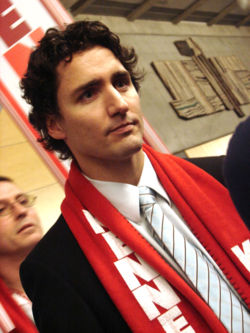 "Young people get a bad rap, often, for being apathetic, disconnected and cynical about the world," Trudeau said after tabling his bill. "It's not because they don't care about the world. On the contrary; it's because they care so much that they're deeply frustrated that they don't have ways to make the world a better place. They don't have a voice that gets heard to shape the world that will be theirs someday, they keep getting told."
The bill would call for public hearings on the topic of volunteerism as well as a study of how governments support volunteerism in other countries.
Although his lineage makes Justin Trudeau a natural target for conservatives, Trudeau's private member's bill is actually a dream for almost any small-c conservative who is truly faithful to the philosophy.
One of the key tenets of former Progressive Conservative premier of Ontario Mike Harris' Common Sense Revolution was the idea that volunteer efforts were going to replace state activism in many key areas. This never took place because Harris' government never made any real effort to help foster a stronger infrastructure of Civil Society Organizations.
Such an effort, by its very nature, relies on citizens to stand up, determine their own interests, then contribute their efforts toward the service of those interests. Trudeau's bill exemplifies Benjamin Barber's vision of strong democracy -- one wherein citizenship is treated more like a public office than as a passive relationship with the state.
Trudeau's bill fits snugly into Barber's blueprint of a do-it-yourself democracy, one wherein individual autonomy and citizenship is enhanced by diminishing reliance on the state.
Successfully building a volunteer infrastructure in Canada could allow conservative governments to reduce and refocus spending like never before.
While the idyllic days of church-operated hospitals funded by private donations and private fundraising efforts are likely to never return -- the cost of modern healthcare is prohibitive to a pure volunteer approach and government involvement will always remain necessary -- Trudeau's bill, if properly implemented, could lead to a much healthier and stronger democracy in Canada, predicated on a model of strong citizenship.
Unfortunately there are some who don't share Trudeau's wisdom. Bloc Quebecois MP Nicolas Dufor accused Trudeau's bill of fostering "federalist propaganda".
It's unsurprising that the Bloc would oppose Trudeau's bill. Any government policy that helped the development of volunteer organizations could very easily be used by citizens who oppose separatism to organize their own, federalist organizations.
One can only wonder if separatists would enjoy similar good fortune.
If the Liberal party were wise it would adopt Trudeau's private member's bill as an opposition bill. Likewise, if the governing Conservatives were wise they would adopt Trudeau's bill as governmental policy.
Private member's bills don't often make the full transition fron introduction to being implemented, but the base wisdom of Justin Trudeau's bill is impossible to overlook.
Justin Trudeau may yet turn out to be a stronger democrat than his father ever pretended to be.
Tuesday, December 02, 2008
Trudeau Feigns Ignorance
Justin Trudeau seems to have forgotten how his father dealt with separatists
There is one thing about being ignorant of your country's history. Some believe that in Canada we've refined this down to an art.
Apparently, Justin Trudeau has done likewise. But for a man like Trudeau to be ignorant of his family's history -- that is something else altogether.
In a Full Comment blog post, Graeme Hamilton insists that Pierre Trudeau would have been A-OK with the deal that the Liberal party has hatched with the Bloc Quebecois. And he isn't alone.
Justin Trudeau also insists that Trudeau's father would have welcomed the deal.
 “My father for years got along with [former Parti Québécois leader] René Lévesque before they were both in politics. My father had separatist friends. My father understood that the important thing for this country was to keep the country strong,” Trudeau insists.
And certainly, this is true. Trudeau, Levesque and Jean Marchand and Gerard Pelletier were all active within Quebec's labour movement during the Maurice Duplessis era.
When the four formally entered politics, it was as Liberals. Trudeau, Marchand and Pelletier joined the federal party. Rene Levesque found himself recruited into the provincial Liberals, where he served as Minister of Labour under Jean Lesage.
 Levesque was always a nationalist. But his turn to separatism became public when he left the Liberal party in 1967. The party had refused to discuss Quebec sovereigntism at its convention. He formed the Mouvement Souveraineté-Association. In 1968 the MSA merged with Gilles Gregoire's Ralliement National to create the modern Parti Quebecois.
Levesque's ascension to the Office of Premier of Quebec in 1976 naturally brought tensions between the two to a head. These tensions would reach a pinnacle in 1980 during Levesque's referendum on Quebec sovereignty.
During the sovereignty campaign Trudeau promised to negotiate the repatriation of the Canadian Constitution. This promise helped the non side win the referendum with a decisive margin, and would set the table for Trudeau's most famous dealing with Levesque.
Dealings which Justin Trudeau seems to be ignorant of.
“What we got in this case was an assurance by Gilles Duceppe that he was going to keep all national-unity measures, confidence measures, off the table until June, 2010. That’s a better deal than anybody has gotten in years of working with the Bloc Québécois in the House,” Justin insists.
But he should know better. First off, Duceppe should not be trusted to keep promises he can't afford to keep.
Beyond this, Canadians remember how Pierre Trudeau dealt with separatists. During the negotiation of the 1982 Constitution, Trudeau, along with then-Minister of Justice Jean Chretien masterminded a deft end-run around Levesque in order to dismantle his "Gang of Eight" coalition of Provincial Premiers opposed to the Constitution.
In what has become known as "the night of the long knives", Chretien negotiated a "notwithstanding clause" into the Charter of Rights and Freedoms.
 The Gang of Eight acquiesced and the Constitution was settled.
For his own part, Levesque was infuriated. "We had been betrayed, in secret, by men who hadn’t hesitated to tear up their own signatures, and without their even taking the trouble to warn us," Levesque complained. On the flight back to Quebec City, Levesque is said to have said it rather differently.
"[Trudeau] fucked me," Levesque is said to have fumed.
For his own part, Justin Trudeau doesn't seem to be worried about the demands that Duceppe should be expected to make of this coalition government.
“We have a provincial election going on in Quebec and separatism is not one of the issues," Justin continued. "The fact that the Conservatives are spending so much time talking about national unity and bringing up all those old divisions, it’s just out of their playbook of divide, divide, divide.”
But Trudeau couldn't be further from the truth.
So long as the Bloc Quebecois and Parti Quebecois exist, separatism will always be an issue in Canadian politics -- unless, that is, both of these parties formally and finally renounce it.
In the absence of such a complete renunciation, the Libereal-led coalition is just another page out of the Liberal playbook of doing whatever it takes to get power, no matter what the consequences.
As for Trudeau, it's hard to believe that he would be this ignorant of his vaunted family history. It's significantly easier to believe that he would be disingenuous in the name of claiming political power.
Some other bloggers writing on this topic:
"The" Scott Ross - "The Liberal-NDP Coalition is Undemocratic
Sit, Think, Good Blog - "Marriage of Convenience"
Propter Hoc - "Of Separatists and Socialists (or, 'It's Very Simple Stupid')"
There is one thing about being ignorant of your country's history. Some believe that in Canada we've refined this down to an art.
Apparently, Justin Trudeau has done likewise. But for a man like Trudeau to be ignorant of his family's history -- that is something else altogether.
In a Full Comment blog post, Graeme Hamilton insists that Pierre Trudeau would have been A-OK with the deal that the Liberal party has hatched with the Bloc Quebecois. And he isn't alone.
Justin Trudeau also insists that Trudeau's father would have welcomed the deal.
 “My father for years got along with [former Parti Québécois leader] René Lévesque before they were both in politics. My father had separatist friends. My father understood that the important thing for this country was to keep the country strong,” Trudeau insists.
And certainly, this is true. Trudeau, Levesque and Jean Marchand and Gerard Pelletier were all active within Quebec's labour movement during the Maurice Duplessis era.
When the four formally entered politics, it was as Liberals. Trudeau, Marchand and Pelletier joined the federal party. Rene Levesque found himself recruited into the provincial Liberals, where he served as Minister of Labour under Jean Lesage.
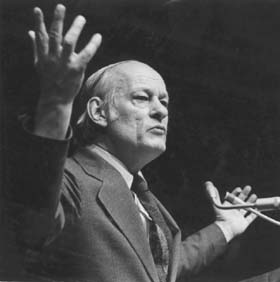 Levesque was always a nationalist. But his turn to separatism became public when he left the Liberal party in 1967. The party had refused to discuss Quebec sovereigntism at its convention. He formed the Mouvement Souveraineté-Association. In 1968 the MSA merged with Gilles Gregoire's Ralliement National to create the modern Parti Quebecois.
Levesque's ascension to the Office of Premier of Quebec in 1976 naturally brought tensions between the two to a head. These tensions would reach a pinnacle in 1980 during Levesque's referendum on Quebec sovereignty.
During the sovereignty campaign Trudeau promised to negotiate the repatriation of the Canadian Constitution. This promise helped the non side win the referendum with a decisive margin, and would set the table for Trudeau's most famous dealing with Levesque.
Dealings which Justin Trudeau seems to be ignorant of.
“What we got in this case was an assurance by Gilles Duceppe that he was going to keep all national-unity measures, confidence measures, off the table until June, 2010. That’s a better deal than anybody has gotten in years of working with the Bloc Québécois in the House,” Justin insists.
But he should know better. First off, Duceppe should not be trusted to keep promises he can't afford to keep.
Beyond this, Canadians remember how Pierre Trudeau dealt with separatists. During the negotiation of the 1982 Constitution, Trudeau, along with then-Minister of Justice Jean Chretien masterminded a deft end-run around Levesque in order to dismantle his "Gang of Eight" coalition of Provincial Premiers opposed to the Constitution.
In what has become known as "the night of the long knives", Chretien negotiated a "notwithstanding clause" into the Charter of Rights and Freedoms.
 The Gang of Eight acquiesced and the Constitution was settled.
For his own part, Levesque was infuriated. "We had been betrayed, in secret, by men who hadn’t hesitated to tear up their own signatures, and without their even taking the trouble to warn us," Levesque complained. On the flight back to Quebec City, Levesque is said to have said it rather differently.
"[Trudeau] fucked me," Levesque is said to have fumed.
For his own part, Justin Trudeau doesn't seem to be worried about the demands that Duceppe should be expected to make of this coalition government.
“We have a provincial election going on in Quebec and separatism is not one of the issues," Justin continued. "The fact that the Conservatives are spending so much time talking about national unity and bringing up all those old divisions, it’s just out of their playbook of divide, divide, divide.”
But Trudeau couldn't be further from the truth.
So long as the Bloc Quebecois and Parti Quebecois exist, separatism will always be an issue in Canadian politics -- unless, that is, both of these parties formally and finally renounce it.
In the absence of such a complete renunciation, the Libereal-led coalition is just another page out of the Liberal playbook of doing whatever it takes to get power, no matter what the consequences.
As for Trudeau, it's hard to believe that he would be this ignorant of his vaunted family history. It's significantly easier to believe that he would be disingenuous in the name of claiming political power.
Some other bloggers writing on this topic:
"The" Scott Ross - "The Liberal-NDP Coalition is Undemocratic
Sit, Think, Good Blog - "Marriage of Convenience"
Propter Hoc - "Of Separatists and Socialists (or, 'It's Very Simple Stupid')"
Monday, November 17, 2008
Justin Trudeau Calls for a Generational Shift in Canadian Politics
Son of Trudeau calls for more youth involvement in politics
If Justin Trudeau was unaware of one particular fact about Canadian politics, he's likely to learn it very quickly.
When your name is Trudeau, it isn't hard to get someone to come out to hear you speak.
In Charlottetown, Prince Edward Island, Trudeau drew a crowd of 1,000 people to a party fundraiser where he talked about the need to get Canada's youth involved in politics -- or at least in the Liberal party.
 “The challenge that we face as a political organization at all levels, both federal and provincial, is the idea of mobilizing our young people,” Trudeau announced. “We need to reach out to young people as more than just campaign volunteers who lick envelopes and put up posters, but as those who actually have input and are valued for their idealism, their energy and the way of thinking they bring in, which is a lot more long-term.”
Trudeau noted that too many Canadians are being drawn into one-issue political movements. Youth especially so.
Trudeau's musings seem to closely resemble leadership candidate Dominic LeBlanc's recent calls for a generational shift within the Liberal party.
And by that he doesn't simply mean selecting himself -- at 41, the youngest of the officially declared candidates -- for the leadership.
"It's not enough to change the head, you have to renew the whole and that's done with a new generation of leadership that springs the party forward," LeBlanc insists.
Some may have to wonder if Trudeau embracing LeBlanc's "generational shift" idea is a prelude to an endorsement of LeBlanc. But if "like father, like son" can be considered a rule of Canadian politics, one may also question the extent of Trudeau's commitment to any such generational shift.
Trudeau's father, Pierre Elliott Trudeau, first got himself elected Prime Minister using two broad promises: that of the "Just Society" and that of making Canadian politics more participatory.
In the end, the vague Just Society promised was abandoned entirely. And Trudeau's "participatory democracy" was ultimately meant only for those who were members of the Liberal party -- regardless of whether they had voted for the Liberals or not.
For the most part, Justin Trudeau, like his father, is making a positive impression on the Canadian political scene. But sometimes these impressions are hard to keep up, and Trudeau would be wise to remember that the polish can wear off a politician quickly if he's found to be too flexible in regard to his promises.
Trudeau should remember one other lesson his father's example teaches: always back a winner. Most analysts consider the prospects for an "up the middle" victory for the Liberal leadership to be rather faint.
He would be much better off backing either of the two main contenders.
If Justin Trudeau was unaware of one particular fact about Canadian politics, he's likely to learn it very quickly.
When your name is Trudeau, it isn't hard to get someone to come out to hear you speak.
In Charlottetown, Prince Edward Island, Trudeau drew a crowd of 1,000 people to a party fundraiser where he talked about the need to get Canada's youth involved in politics -- or at least in the Liberal party.
 “The challenge that we face as a political organization at all levels, both federal and provincial, is the idea of mobilizing our young people,” Trudeau announced. “We need to reach out to young people as more than just campaign volunteers who lick envelopes and put up posters, but as those who actually have input and are valued for their idealism, their energy and the way of thinking they bring in, which is a lot more long-term.”
Trudeau noted that too many Canadians are being drawn into one-issue political movements. Youth especially so.
Trudeau's musings seem to closely resemble leadership candidate Dominic LeBlanc's recent calls for a generational shift within the Liberal party.
And by that he doesn't simply mean selecting himself -- at 41, the youngest of the officially declared candidates -- for the leadership.
"It's not enough to change the head, you have to renew the whole and that's done with a new generation of leadership that springs the party forward," LeBlanc insists.
Some may have to wonder if Trudeau embracing LeBlanc's "generational shift" idea is a prelude to an endorsement of LeBlanc. But if "like father, like son" can be considered a rule of Canadian politics, one may also question the extent of Trudeau's commitment to any such generational shift.
Trudeau's father, Pierre Elliott Trudeau, first got himself elected Prime Minister using two broad promises: that of the "Just Society" and that of making Canadian politics more participatory.
In the end, the vague Just Society promised was abandoned entirely. And Trudeau's "participatory democracy" was ultimately meant only for those who were members of the Liberal party -- regardless of whether they had voted for the Liberals or not.
For the most part, Justin Trudeau, like his father, is making a positive impression on the Canadian political scene. But sometimes these impressions are hard to keep up, and Trudeau would be wise to remember that the polish can wear off a politician quickly if he's found to be too flexible in regard to his promises.
Trudeau should remember one other lesson his father's example teaches: always back a winner. Most analysts consider the prospects for an "up the middle" victory for the Liberal leadership to be rather faint.
He would be much better off backing either of the two main contenders.
Friday, November 14, 2008
Michael Ignatieff Formally Joins the Fray
Liberal leadership campaign shaping up to be Ignatieff/Rae rematch
After nearly three weeks of waiting, it seems that the Liberal party finally has a leadership contest on its hands.
Michael Ignatieff -- long expected to join the leadership fray -- finally formally declared his candidacy yesterday. Now, the real business of choosing a Liberal leader can begin.
Ignatieff has an interesting strategy for becoming Liberal leader: instead of running against his opponents, he'll simply run against Stephen Harper.
 "Now I'm going to be in competition with some fine fellow Liberals but I'm not running against any of them, I'm running against Stephen Harper and the Conservative government," Ignatieff insisted. "My target is not my friends and my Liberal colleagues, it is the disappointing record of the Harper government."
Of course, Harper won't actually be running for the leadership of the Liberal party, but one digresses.
Not to mention that when Ignatieff last had the opportunity to run against Harper and the Conservatives, he instead spent the better part of the 2008 federal election being largely invisible.
Ignatieff has his vision for the renewal of the Liberal party. Namely, "throwing open the doors of this party to the next generation, to the best and brightest our society has to offer."
Not that Ignatieff, 61, is feeling his age. "The youngest ideas aren't always from the youngest candidates. I think age is not a biological fact. It's a habit of spirit and mind."
This comes in response to Dominic LeBlanc's insistence that the party needs a generational shift. Which it very well might, but LeBlanc, 41, may not be the best individual to rally the youth wing of the party. Justin Trudeau (who, once again, isn't running for the Liberal leadership) would be much better.
Ignatiefff's candidacy certainly must relieve some deep worries at Liberal HQ, as they finally have two solid leadership candidates for Liberals to choose between.
The Liberal leadership campaign is finally on.
After nearly three weeks of waiting, it seems that the Liberal party finally has a leadership contest on its hands.
Michael Ignatieff -- long expected to join the leadership fray -- finally formally declared his candidacy yesterday. Now, the real business of choosing a Liberal leader can begin.
Ignatieff has an interesting strategy for becoming Liberal leader: instead of running against his opponents, he'll simply run against Stephen Harper.
 "Now I'm going to be in competition with some fine fellow Liberals but I'm not running against any of them, I'm running against Stephen Harper and the Conservative government," Ignatieff insisted. "My target is not my friends and my Liberal colleagues, it is the disappointing record of the Harper government."
Of course, Harper won't actually be running for the leadership of the Liberal party, but one digresses.
Not to mention that when Ignatieff last had the opportunity to run against Harper and the Conservatives, he instead spent the better part of the 2008 federal election being largely invisible.
Ignatieff has his vision for the renewal of the Liberal party. Namely, "throwing open the doors of this party to the next generation, to the best and brightest our society has to offer."
Not that Ignatieff, 61, is feeling his age. "The youngest ideas aren't always from the youngest candidates. I think age is not a biological fact. It's a habit of spirit and mind."
This comes in response to Dominic LeBlanc's insistence that the party needs a generational shift. Which it very well might, but LeBlanc, 41, may not be the best individual to rally the youth wing of the party. Justin Trudeau (who, once again, isn't running for the Liberal leadership) would be much better.
Ignatiefff's candidacy certainly must relieve some deep worries at Liberal HQ, as they finally have two solid leadership candidates for Liberals to choose between.
The Liberal leadership campaign is finally on.
Thursday, September 25, 2008
One Good Reason to Vote for Justin Trudeau
These douchebags don't like him
There are plenty of good reasons not to vote for Justin Trudeau.
His party leader's policies are clearly one. The real (read: not mythical) legacy of his father is another. The risk of passing the Trudeau political mythology along to another generation is another still.
But in the course of a move clearly meant to embarrass Trudeau, running for the first time in the riding of Papineau, Les Jeunes Patriotes du Quebec gave voters a good reason to vote for him -- he really pisses off separatists.
"[Justin Trudeau] long refused to recognize Quebec as a nation," Francois Gendron, a spokesman for the group, announced. "We are a people and we are a nation."
"If he's going to play rock star he has to deal with the consequences. We're giving his campaign a little colour."
There's little question that, as the 2008 federal election progresses, Justin Trudeau very much has been cast into the role of the rock star. The news that he and his wife are expecting a second child garnered considerable attention on Canada's celebrity talk show circuit.
As the natural heir to the aforementioned Pierre Trudeau political mythology -- one that casts him into the role of national saviour, yet somehow overlooks that Trudeau made the at best boneheaded decision to negotiate the patriation of the constitution while a separatist government was in power in Quebec (just think about that) -- Trudeau has already inherited the mantle of unofficial leadership in the Liberal party. If Stephane Dion is the brains of the party and Bob Rae (who attented Trudeau's campaign launch) is the heart, then Trudeau is certainly the spirit of the party.
His father's role in the decisive defeat of separatist forces in the 1980 referendum made Trudeau a natural target for the separatists.
Normally, it should be considered fickle to support a political candidate simply because one particular group of people doesn't like him. But in Trudeau's case, the contempt separatists hold for him is actually quite the boon for federalist forces in Quebec.
When individuals like Gendron denounce Trudeau for his support of bilingualism -- apparently insisting that Quebec should be unilingually French and the Anglo-Quebeckers who've lived in the province for generations should go to hell -- it really underscores separatists for the bigots so many of them really are.
This is separatism at its worst, and a reminder to Quebeckers who may flirt with their organizations for other reasons to think twice about doing so.
There are plenty of good reasons not to vote for Justin Trudeau.
His party leader's policies are clearly one. The real (read: not mythical) legacy of his father is another. The risk of passing the Trudeau political mythology along to another generation is another still.
But in the course of a move clearly meant to embarrass Trudeau, running for the first time in the riding of Papineau, Les Jeunes Patriotes du Quebec gave voters a good reason to vote for him -- he really pisses off separatists."[Justin Trudeau] long refused to recognize Quebec as a nation," Francois Gendron, a spokesman for the group, announced. "We are a people and we are a nation."
"If he's going to play rock star he has to deal with the consequences. We're giving his campaign a little colour."
There's little question that, as the 2008 federal election progresses, Justin Trudeau very much has been cast into the role of the rock star. The news that he and his wife are expecting a second child garnered considerable attention on Canada's celebrity talk show circuit.
As the natural heir to the aforementioned Pierre Trudeau political mythology -- one that casts him into the role of national saviour, yet somehow overlooks that Trudeau made the at best boneheaded decision to negotiate the patriation of the constitution while a separatist government was in power in Quebec (just think about that) -- Trudeau has already inherited the mantle of unofficial leadership in the Liberal party. If Stephane Dion is the brains of the party and Bob Rae (who attented Trudeau's campaign launch) is the heart, then Trudeau is certainly the spirit of the party.
His father's role in the decisive defeat of separatist forces in the 1980 referendum made Trudeau a natural target for the separatists.
Normally, it should be considered fickle to support a political candidate simply because one particular group of people doesn't like him. But in Trudeau's case, the contempt separatists hold for him is actually quite the boon for federalist forces in Quebec.
When individuals like Gendron denounce Trudeau for his support of bilingualism -- apparently insisting that Quebec should be unilingually French and the Anglo-Quebeckers who've lived in the province for generations should go to hell -- it really underscores separatists for the bigots so many of them really are.
This is separatism at its worst, and a reminder to Quebeckers who may flirt with their organizations for other reasons to think twice about doing so.
Wednesday, November 15, 2006
Video Never Lies
Amateur Attack Ads Tell Interesting story
It’s official. YouTube has become a cultural phenomenon.
Like many recent cultural phenomena, perhaps the greatest strength of YouTube is that it offers its users a do-it-yourself online media outlet (not much unlike blogs – hello!).
Like any do-it-yourself media outlet, YouTube was quickly harnessed for political means. Various people have used YouTube – as well as similar sites such as Google Video – for various political purposes. Those with a stake in the current Liberal leadership campaign are no different.
Often, the way the grassroots uses the do-it-yourself online media tells an interesting story.
Once again, the current Liberal leadership contest is no different.
A number of amateur attack ads have been uploaded to these sites. They convey an interesting image of the Liberal party at this turning point in its history – and it may not be a very pretty picture at that.
The bulk of the videos take aim at one of two targets (if, of course, one ignores the mass of attention paid to George Bush and Stephen Harper): frontrunners Bob Rae and Michael Ignatieff.
”Once a Dipper, Always a Dipper” takes aim at Rae, predictably highlighting Rae’s career as the disastrous NDP premier of Ontario, and listing several inflammatory quotes made about the Liberals during that time. “Keep leadership in the family,” becomes the theme of the piece.
”Timmy” portrays a couple of pop-art Ontarians, NDP supporters turned Liberals, shocked to learn of Rae’s candidacy for the Liberal leadership. While the mother is driven to drinking, the father tells his son Timmy the story of “Rae days” in scant detail. Rae Days are also the subject of ”Potholes”. In ”NDP Orange” it is actually suggested that Rae’s candidacy for the Liberal leadership metaphorically pisses on the “great” image and legacy of the Liberal party.
George Bush and the Republicans also become an omnipresent spectre. In ”Michael Ignatieff Outakes”, a South Park-style animated Ignatieff needs to be corrected after announcing his candidacy for the Republican party. He is later on seen ogling a map of Iraq. ”Fit to Be President” makes use of Hulk Hogan’s famous “Real American” entry music, and makes reference to some of Ignatieff’s contentious writings on imperialism and torture, as well as a photoshopped image of Iggy with an Eagle perched on his outstretched ”Presidential Finger”. A video of this title tries to turn a hand gesture into a political issue (yet curiously makes few references to Pierre Trudeau’s Prime Ministerial finger).
Speaking of Pierre Trudeau, no Liberal campaign of any sort could possibly be complete without someone exhuming his ideological grave, and this campaign is no exception to this rule. ”Quebec as a Nation: A New Perspective” quotes Pierre Trudeau at length on the issue of Quebec nationalism, painting Michael Ignatieff – whose recent Quebec as a nation appeal reopened the issue – as an outsider, out of touch with Liberal values. Video can also be found of Justin Trudeau responding to Ignatieff’s suggestion.
Even nutbars such as Alex Jones have weighed in, spreading their typical paranoid nonsense, and insinuating that Bob Rae could be used as a sacrificial lamb to allow the Conservative party to help institute a North American Union of Canada, Mexico and the United States.
To be fair, there are some bright spots. In particular, Gerard Kennedy’s supporters have posted some positive ads, highlighting their candidate’s strengths.
Frankly, these ads do not paint a flattering picture of the Liberal party.
Not only do they paint a start picture of a party divided against itself, they also reinforce the (arguably) popular public image of the Liberals as a party running headlong into a dead end – of a party so committed to living in the past that they cannot possibly lay claim to the bold vision for the future they often lay claim to. Between rampant anti-Americanism, and political xenophobia, these ads show a side of the Liberal party they would likely much rather remain private.
But nothing remains private when it is posted to online video, for the entire world to see.
It’s official. YouTube has become a cultural phenomenon.
Like many recent cultural phenomena, perhaps the greatest strength of YouTube is that it offers its users a do-it-yourself online media outlet (not much unlike blogs – hello!).
Like any do-it-yourself media outlet, YouTube was quickly harnessed for political means. Various people have used YouTube – as well as similar sites such as Google Video – for various political purposes. Those with a stake in the current Liberal leadership campaign are no different.
Often, the way the grassroots uses the do-it-yourself online media tells an interesting story.
Once again, the current Liberal leadership contest is no different.
A number of amateur attack ads have been uploaded to these sites. They convey an interesting image of the Liberal party at this turning point in its history – and it may not be a very pretty picture at that.
The bulk of the videos take aim at one of two targets (if, of course, one ignores the mass of attention paid to George Bush and Stephen Harper): frontrunners Bob Rae and Michael Ignatieff.
”Once a Dipper, Always a Dipper” takes aim at Rae, predictably highlighting Rae’s career as the disastrous NDP premier of Ontario, and listing several inflammatory quotes made about the Liberals during that time. “Keep leadership in the family,” becomes the theme of the piece.
”Timmy” portrays a couple of pop-art Ontarians, NDP supporters turned Liberals, shocked to learn of Rae’s candidacy for the Liberal leadership. While the mother is driven to drinking, the father tells his son Timmy the story of “Rae days” in scant detail. Rae Days are also the subject of ”Potholes”. In ”NDP Orange” it is actually suggested that Rae’s candidacy for the Liberal leadership metaphorically pisses on the “great” image and legacy of the Liberal party.
George Bush and the Republicans also become an omnipresent spectre. In ”Michael Ignatieff Outakes”, a South Park-style animated Ignatieff needs to be corrected after announcing his candidacy for the Republican party. He is later on seen ogling a map of Iraq. ”Fit to Be President” makes use of Hulk Hogan’s famous “Real American” entry music, and makes reference to some of Ignatieff’s contentious writings on imperialism and torture, as well as a photoshopped image of Iggy with an Eagle perched on his outstretched ”Presidential Finger”. A video of this title tries to turn a hand gesture into a political issue (yet curiously makes few references to Pierre Trudeau’s Prime Ministerial finger).
Speaking of Pierre Trudeau, no Liberal campaign of any sort could possibly be complete without someone exhuming his ideological grave, and this campaign is no exception to this rule. ”Quebec as a Nation: A New Perspective” quotes Pierre Trudeau at length on the issue of Quebec nationalism, painting Michael Ignatieff – whose recent Quebec as a nation appeal reopened the issue – as an outsider, out of touch with Liberal values. Video can also be found of Justin Trudeau responding to Ignatieff’s suggestion.
Even nutbars such as Alex Jones have weighed in, spreading their typical paranoid nonsense, and insinuating that Bob Rae could be used as a sacrificial lamb to allow the Conservative party to help institute a North American Union of Canada, Mexico and the United States.
To be fair, there are some bright spots. In particular, Gerard Kennedy’s supporters have posted some positive ads, highlighting their candidate’s strengths.
Frankly, these ads do not paint a flattering picture of the Liberal party.
Not only do they paint a start picture of a party divided against itself, they also reinforce the (arguably) popular public image of the Liberals as a party running headlong into a dead end – of a party so committed to living in the past that they cannot possibly lay claim to the bold vision for the future they often lay claim to. Between rampant anti-Americanism, and political xenophobia, these ads show a side of the Liberal party they would likely much rather remain private.
But nothing remains private when it is posted to online video, for the entire world to see.
Subscribe to:
Posts (Atom)