In a presidential campaign in which -- depending upon whom you ask -- the Democrats appear poised to seize the presidency (that is, if they can maintain their momentum of the past four years), it was only a matter of time before the North American Free Trade Agreement came up.
"I have put forth a very specific plan about what I would do. And it does include telling Canada and Mexico that we will opt out unless we renegotiate the core labour and environmental standards," Clinton announced.
"I think actually Senator Clinton's answer on this one is right," Obama agreed. "I think we should use the hammer of a potential opt-out as leverage to ensure that we actually get labour and environmental standards that are enforced."
As noted previously, Obama and Clinton actually have a pretty good point there. NAFTA is in definite need of labour and environmental standards. To this end, it isn't alone: most free trade agreements do.
Solid environmental standards implimented via, and enforced by, NAFTA, could be infinitely more effective in curbing such issues as climate change than dead-end treaties like Kyoto could ever dream of.
And any changes to NAFTA that would make it more difficult for short term profit-seeking corporations from shipping manufacturing jobs abroad into the world's cheapest labour markets would be a boon not only to the American and Canadian middle class, but ironically to those companies themselves (although shortsighted profit-seeking motives blind them to it).
There is, of course, one other excellent reason to renegotiate NAFTA -- one that no American president should be altogether comfortable with. That reason is that the Americans themselves have rarely fully abided by it.
American economic protectionism -- particularly under Democrats -- has long been established. And while such protectionism generally springs from mercantilist modes of economic thought that are actually incompatible with the concept of free trade, that hasn't stopped the allegedly pro-free trade Americans from refusing to abide by their own agreements.
Various trade commissions ruled in favour of Canada, all while the United States continued to defy virtually every ruling, ocassionally deferring back to their own trade commissions for rulings that -- quelle suprise! -- tended to be in their favour.
Thus, the position that the Americans would find themselves in under the conditions of a renegotiating of NAFTA: their economy desperately needing imports of Canadian resources (lumber, steel, oil and water, amongst a myriad of other items) and simply having not engendered the good will with their trading partners to wrestle any disproportionately favourable conditions out of them.
Of course to pretend that Canada or Mexico should be eager to put a squeeze on the Americans in a NAFTA renegotiation overlooks the undeniable interdependence of our three economies. After all, having resources is one thing -- you have to be able to trade them, and it's a looooooooong (and expensive) boat ride to China.
Which is precisely why we as Canadians -- as well as Barack Obama and Hillary Clinton -- should accept Finance Minister Jim Flaherty's words of caution.
"[They] should recognize that NAFTA benefits the U.S. tremendously," Flaherty warned. "Those who speak of it as helpful to [just the] Canadian or Mexican economies are missing the point."
As are we if we view NAFTA as only benefiting the American economy (and it certainly has).
The idea of renegotiating NAFTA need not necessarily be a non-starter. But both Obama and Clinton need to keep in mind what they need to bring to the table -- greater compliance, not economic protectionism -- in order to get what they want (which just so happens to be what we should want).
If they don't they may find themselves in a very uncomfortable position, even if that discomfort won't be theirs alone.
In a recent post at his blog, Jason Cherniak seems to think he's stumbled upon the scoop of the year.
In hindsight, however (such things being 20/20) it would seem otherwise.
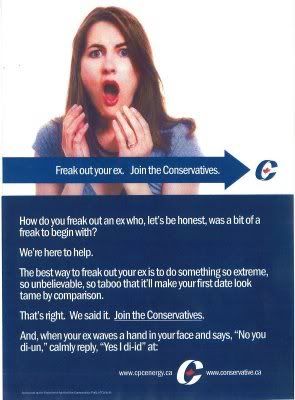
In a specious little post entitled "Conservative Pornography", Cherniak alleges that the Conservative party stole an image featured in a "Freak out your ex" ad from Stolen Porn Videos, an online pornography website.
As his evidence, he offers a couple of screen caps that feature the same shocked-looking young woman.
From the (notably hillarious) Conservative party ad:
From the porn site itself:
And finally (and allegedly most damning) from the CPC website itself:
So, Cherniak alleges (although not clearly explaining what he was doing at that site) the Conservatives simply must have stolen the image for the ad from a porn website! Those fiends!
Of course, one then suspects that Bored With Ironing is stealing their images from porn websites as well. After all, the expression on her face may be slightly different but by god that's the same young woman!
So, it would seem the image in question is nothing more than a stock image purchased by both the Conservative party and the porn site in question.
Of course, one may wonder what Cherniak (or his alleged anonymous source) was doing at that site to begin with? Pornography being such a bad thing, apparently.
At least now we know what Cherniak's favourite porn site is.
Anyone who reads the Nexus on a regular basis has probably noticed that I try to keep this blog largely impersonal. But when you've been tagged, you've been tagged.
So apparently I'm supposed to share six unimportant things about myself, courtesy of Raphael Alexander. So, here goes:
1. I own an obsene number of hockey jerseys - More than 30, in fact. It started off during my first year of College (right before I transferred to University) when I discovered I could actually make an equally obsene amount of money delivering pizzas part-time (before gasoline was expensive as all hell). Let's just say that when I go with a group of people to a hockey game, I can outfit a small army of fans.
2. I'm an in-person type of person - I hate discussing important things over the phone, and I refuse to do my banking over the internet. Some day in the near future when human bank tellers are finally rendered obsolete, my bills will probably remain unpaid for months and months as I avoid paying them by internet.
3. I'm something of a book worm - I typically have to spend at least an hour-and-a-half per day busing to and from the University. So in a good week I tend to read at least one extra book aside from my studies. This is actually helpful, though -- it basically keeps a person one step ahead of their classes.
4. I feel no shame in shopping at thrift stores - But I won't buy just anything. More or less, I relegate myself to buying used books and neckties (provided that they aren't butt-ugly). Say what you will, but I find it to be a slightly more selfish method of supporting charity (in that I get something tangible out of it), and I don't plan to stop.
5. My patience can run thin - I can't stand it when people have clearly run out of things to talk about, but keep talking. I tend to force myself to be polite and stick it out with them, but I'm probably already looking for an escape route. Unless you happen to be an attractive young lady. Then I'm probably staring at your breasts (at this point, I think I'm entitled. No, it's okay. Just keep on talking about your cats. I'm listening...)
6. I still watch cartoons - And not just The Simpsons or Family Guy, either. I'm also an anime enthusiast (although I draw the line short of being otaku), and am perfectly content to watch Teletoon for hours on end. My guilty pleasure in this regard? Kim Possible. If anyone can figure out what the hell Rufus (pictured left) is, feel free to let me know. I want one. Also, my very own the Cheat.
Now, all this being said, it's my turn to some tagging, it would seem. As such, I tag:
Moreover, Dallaire is one of the few examples of individuals hoisted up to this hallowed status by virtue of having tried but failed to prevent an inhuman massacre.
Of course, it helps that his failing was not of his own making. In 1994, severely undermanned and underequipped, Dallaire led a United Nations peacekeeping mission into war-torn Rwanda. When Rwandan president Juvenal Habyarimana was assassinated. (Sitting president Paul Kagame -- a Tutsi, and former leader of the Rwandan Patriotic Front that effectively ended the genocide in Rwanda -- was fingered as responsible for the assassination by a recent French report, but that is a story for another time.)
While Dallaire pleaded for a UN intervention force, various countries central to the UN refused to intervene for a variety of -- largely domestic -- political reasons.
Against nearly impossible odds, Dallaire struggled to keep his troops and Tutsi civilians alive in the midst of a country that very much had declared war against them. When the genocide was finally over, Dallaire returned to Canada suffering from a severe case of Post Traumatic Stress Disorder.
In time, Dallaire managed to conquer his demons -- although he himself notes they'll always remain with him -- and in 2005 was appointed by then-Prime Minister Paul Martin to the Canadian Senate.
On Thursday, February 21, Dallaire addressed an audience at the University of the Alberta as a keynote speaker for the Global Voices conference. This is what he had to say.
"Today, we're going to be talking about you and about the environment we're in, but not necessarily the environment of the planet and how the planet and human beings are attempting to keep a communion going between them and not the friction that can lead to catastrophic failures for both in the future. We're going to talk about the environment in which humanity is now, we hope, evolving, and where humanity is in need of support and assistance.
Particularly, the large portion of humanity that are, in fact, living in inhuman conditions. My target audience, if I will be permitted, tonight, will be those that are called "youths".
If we are talking in UN parlance, a youth is under the age of 25. I tend to think of the youth of a nation as up to 30. In the '60s, we never trusted anyone above 30.I talk to youths up to 30, and in particular, anyone of the age of 18 and beyond.
I want to talk to you because you hold the balance of power in the country. You literally hold the power of the politics and the orientation in this country.
It's a numbers game.
After you (of course) decide to vote, the voting population between the ages of 18 and 30 in Canada represent about 35% of the total volume of population. However, to start I speak mostly of the federal situation, although at the provincial level it's quite similar, but at the federal level, only about 15% of that startling number vote.
Imagine if all of you decided to vote. Imagine if you, all of you youths of this nation, who's future is not something 25 years down the road. When I was 22 or 23, some older individuals said to me "well, what do you want to do with your future?", well to me, that was something like 45 years old. Something like that.
Today, because nothing is constant, because we are continuously in flux, because we're not in a state of change, we're approaching a state of revolution; by technology, by globalism, by grander designs, and so on.
Your future is five, six, seven years down the road. It's shifting that fast.
What you do now, while you're still a youth, is going to significantly influence your life while you're still a very young person.
So you can go out, and actually start a new party. Say "we want a party that's going to do this. It's going to do this inside the country, it's going to do this outside the country."
"We're going to create a party that's going to answer the question: what will we do with Canada?". Or "What is Canada for?".
Is it because we have citizens and we are taking care of ourselves and we are responding to our own ambitions? Or is there something else that has happened to Canada in this era? That all of a sudden has it stumbling beyond its borders? And is stumbling into areas that are uncertain? Sometimes uncharted, and what has happened?
Technology today is being mastered. There is no seemingly fear of going to those other borders or other areas, but we're not sure exactly what to do.
Churchill said "when great nations acquire power they also acquire a responsibility beyond their borders."
And so, ladies and gentlemen, you could create a party that does what you want it to. Or you could shift some of the parties that exist now to what you want it to do, if you massively coalesced to vote.
That is the raw, real power that you have that is not being exercised.
In this country, you are having all kinds of opportunity to exercise it. Just watch the numerous federal elections, one after another. And you're allowed to sort of ponder one party or another because what happened is the political parties really responded regarding you youths.
You've shown them! We've been well managed over the last years. We have been able to continue to stabilize our own internal capabilities and we're working on the outside on the economics and so on, and we're working on the outside. We're working in different realms of internationalism.
But we've been well managed. And so it's okay. And when you look at the campaigns of the last while, at the federal level, how many politicians have come out and said "what do you think we should be doing on the planet? Where do you think we should be going?"
"What grand focus, what grand design should we have, or do we need one?"
Or let's go on, let's do what we've been doing so much, working on our regionalism. On our parochialism. On our taxations, and so on, meeting our needs.
That being of a great needing middle power in the world?
We are not the 160th country out of 194 in the UN. We are part of the nine most powerful nations in the world. This province is participating in that power base. Even if only by the energy capability.
Our north has been touched. What happens when we open up the third big canal in the world? Suez canal, Panama canal, and the Northwest Passage? What happens then?
There is seemingly no limit to the potential here, intellectually and as far as its recourse base and its ability to sustain it, through the technology and application of knowledge.
You can't belong inside this incredibly powerful nation with its belief in human rights, it's vast technology, it's worth ethic -- its strong work ethic -- and without this desire to subsume anyone else, to be an imperial country -- we, messed up how we've handled the first nations and the aboriginals, but we have no grand design anywhere else in the world to take over any place.
The fundamental law of the nation is a Charter of Human Rights. And it says all humans, no just those who have the cash, are human. No one is more human than the other.
And so, this nation is this era of the post-Cold War, in this complex era has stumbled upon the responsibility beyond its borders which it hasn't risen to, necessarily. It hasn't articulated its grand design into this global, and at times volatile, environment.
It hasn't come to you, the youth of the nation, and said "how are we going to maximize the incredible potential that you and this nation have to do significant changes in the world?".
I'm not talking to couch potatoes tonight. In the end I hope to give a little more energy to that finer point that you have in regards to your perception of what you should be doing in this world.
I hope to be able to create activists.
Imagine if Canadian campuses suddenly became activists. Like in the '60s. That doesn't mean you take over the President's office every week. But every now and then you could give them a little scare. You could say "hey! We don't agree with this, and we want to do something about it."
And so, ladies and gentlemen, I'm talking to you not as people who are aloof, it's not in the nature of the beast in this country. I'm not talking to people who are void of any potential. I'm talking to you as individuals who have not yet maximized the synergy of our collective capabilities by your individual commitment, and have not even come close to maximizing what this nation has as a responsibility in the world.
We're talking here not here in past tense. We're not seeking to study history, we're seeking to grasp history, and it's a little farther than CNN -- further than last week, but not that far back.
We want to project ourselves into the future. One thing's certain about the future: it's all uncertain. [Yogi Berra] really had it. There's no small reference anymore. And yet he said ["the future ain't what it used to be"] sixty years ago. So you could imagine if he were around today and trying to figure out what was going on today.
That's what we're trying to work with. Now, you can either bounce around in the future that somebody else is making for you or you can participate. You can mold it. You could actually become leaders in that future.
For somebody to do the implicit thing -- to try to vision, to try and get a feel for something, to get proactive -- that's what they do. And so, they don't survive the future, they maneuver. They take the advantage to advance what they hope they believe is right.
And so, this era in which we find ourselves is not an easy era. It is not easy like the old days when we were all eurocentric and all we had to worry about were millions of Warsaw Pact troops and nuclear weapons on the other side. We had a whole bunch of people and we just balanced that out, and that's over there in Europe and we can just keep on doing our thing and every now and again we just invest a little bit more in the military and the diplomats and conferences but essentially it was out there -- way out there.
However, that all shattered when the Cold War ended. When it shattered, it created a whole new era. Not what George Bush senior said -- an era of order -- a world order I would contend is disorder.
We have become more and more conscious that 80% of humanity are living in inhuman conditions. We're conscious of that when we realized we believe in and were established under the law of human rights, humanitarian law, and 80% are in inhuman conditions.
And they keep doing this. Even some pretentiously say "hey, look at that, we're off into space, we're out to Mars".
The only reason why the Americans are off to Mars is because the Chinese are going to the Moon, and they want to stay one step ahead.
Because we're mastering technology, we're actually saying that humanity's advancing? How is that, when 80% are in inhuman conditions? How is it that the 20% are so pretentious that they say humanity is advancing? And ignoring the fact that they're not looking at all this, they're just looking to be treated as human beings.
We've not only seen and become aware of that suffering, but we've also seen how it's been destroying itself. Massively. And we've even participated or watched it these catastrophes that we thought had gone away.
Like the Holocaust! Certainly we aren't going to go into these massive catastrophic failures.
We've also seen the introduction of a new weapon they call terrorism, and how that has created an incredible paranoia in the developed world. It has created a massive paranoia in our neighbours to the south.
Which is not easily comprehended, particularly, by the Europeans. We're figuring it out.
In 2004 when George Bush was being reelected I was at the Kennedy School at Harvard, and I was amazed that even that sort of liberal environment how little America's population really questioned the very right-wing position that was being taken by the Bush administration. There was no debate because the Americans had been found vulnerable. They feel, in their soul, a vulnerability that had never existed there before.
That vulnerability has created a paranoia which ultimately has created a panic with all kinds of things like the Patriot Act, and Guantanamo Bay, and civil rights being thrown left, right, and center, and so on.
This paranoia has advanced. If a world power is in paranoia, of course it's going to influence the rest of the world, including the developed countries, including us. They've found themselves vulnerable.
I've gone to speak in American military colleges, or war colleges. I like to go there. They have these huge stages, and there 1000 to 1500 students in these big institutions. When I go there, I like to imitate Patton. Not pretentiously, but really George C Scott in the movie Patton. If you remember that, he comes on the stage with this humongous American flag behind him and he's got all of his bells and whistles on and he stands there and he says "the aim, gentlemen, is to make the other poor bastard die for his country."
And that's what it was. The old, classic war, up to the end of the Cold War, which was attrition warfare. The side that was left standing won.
So when I go there I used to have my bells and whistles, but now I've retired so I go and I walk up to center stage but as I'm coming on stage I've got a huge Canadian flag behind me. And I go up there and I say "I come from a country that beat you guys twice." Now, you could actually hear the gears turning. "What? When was that?" So I say "1775 and the war of 1812".
However, some of them will say there was a time some would say that both sides won the war of 1812. I say "no, no. We won." I said "because you guys came up to Canada and burned down this place called York, you know, Toronto -- I'm from Montreal, I don't really bother too much about that -- we went to Washington, burned the place down, it was built on a swamp and you guys rebuilt again! I mean, you guys don't learn."
The Americans are vulnerable. In their soul. And that vulnerability is creating panic, still, today.
Global terrorism is part of that instrument of panic that's out there, and with that we are seeing all kinds of responses, even legalizing mercenaries. I mean, we actually hire people to do jobs that should essentially be done by soldiers under the normal law of conflict, but no, we hire these guns out there and they'll do whatever is required under the contract. The use of force without the same rules of engagement. Not the same liabilities, nor the same responsibilities.
Governments use them because its cheaper and its less political. If a mercenaries dead, hey. If a soldier's dead, that's a different story.
And so we've sort of skitted aside some main and fundamental laws that we've created over centuries and tried to establish and now we're fiddling with them because we're worried about this era and how we're going to handle it.
Well, ladies and gentlemen, we're in an era where we've sorted out massive war. Nations at war, massive armies and so on. And we're in an era where we're not too sure about all these imploding nations left, right and center, and all these humanitarian catastrophes.
But there's another one that has snuck in there, is still in there, and is rarely raised today. If I asked you "do you believe there are still nuclear weapons out there?", I suspect the answer would be "yes".
What if I told you there were 27,000 nuclear weapons out there today? What if I told you that nearly 3000 of them are on 30 minutes notice to be launched? And they're not aimed at big military targets because they don't exist anymore. They're aimed at civilian cities. What if I told you that if we launched four to five of the humongous ones we can forget about environment, because there won't be any atmosphere left.
And yet, not only are countries massively investing in improving them, into the trillions, but they are preventing other countries from acquiring it for their own defense on the argument that there should be no proliferation.
However, when you turn to them and say "maybe leadership by example would be you disarming a bit. Maybe if you start disarming they won't feel that they have to acquire nuclear weapons."
And so we've seen the big powers, still today, with this incredible arsenal, which is absolutely and totally obsolete, modernize obsolescence, out there, asserting all kinds of funds, keeping a lot of technology busy, but putting the whole exercise of our existence under constant threat.
I think that's an abuse of my human right to security, the fact that all of that stuff still exists.
And so, ladies and gentlemen, how many have been out there saying that Canada -- yes, we could build nuclear weapons, we had the technology in the '50s, we decided not to -- but we're very beaten path in this country. We know how to maneuver. We say "no, we're not going to get nuclear weapons", but we'll stay in the alliance that uses them in the fundamental defense of their organization, NATO.
Now, either we're very smart or we're hypocritical. I'm not sure yet, I'm working that out.
But how is it that is there, but no one's talking about it? No one's talking about it.
Everything worth debating in environment is for not if a couple of these idiots, like Dr Strangelove, launches a few missiles.
And so, an incredible vulnerability that is in the backdrop, and we're just letting it go. Well, why don't we try to look at some of these complexities and see whether or not we have room to maneuver.
Well, we've got peacekeepers! Maybe that's an instrument that can still be used. This is the one good mission: Chapter Six. Good guys in two groups and we stand there as a referee, but no red card, no penalty box, but we can stand there between them if they want to do it right. We're there to observe, and so on. And what happened in the '90s is that met with catastrophic failure.
There is no more peacekeeping. We in uniform were amazed at their reaction when Canada sent troops into nations in conflict or nations imploding, and they're using force, and Canadians are like, "hey! We changed our army. We've changed our philosophy. We are into international involvement."
During the Cold War, when peacekeeping started, in the '50s, Pearson and so on, peacekeeping was only 3% of our activity. 97% was preparing to fight World War Three in central Europe and northern Norway.
We were training to fight World War Three and doing this peacekeeping on the side. Except that in Canada, it acquired 97% of our publicity.
And then when Chapter Six peacekeeping disappeared, all these nations going at each other, imploding nations, where people from the same country are into civil wars inside a country. The Rwandan genocide was done by Rwandans. These nations are imploding and the old methodologies of a time to keep a separation between the combatants and separating the combatants from the civilians is done because the civilian population is one of the principal weapons of conflict now.
Massive abuse of human beings, moving them massively, creating scenarios that make it impossible for resolutions to come to. And so we don't have peacekeeping anymore. It's not there.
So we don't have these big wars we have these new situations behind us, and all of a sudden we don't have peacekeeping. People are not negotiating, they're going at each other by ethnicity, by tribalism, by power-sharing. And so we find ourselves studying and acknowledging, "what are these catastrophic failures of our era?"
"I mean, we've been working at it for the last 10, nearly 15 years, we've seen what creates these reasons for why people go at each other. We could actually watch it. We've studied it. We've actually created genocide and prevention structures."
We've looked at it. But how are we doing so far? In Darfur?
And so we've not only found the tools that don't seem to be working, but we also see tools out there that are, in fact, creating massive disruptions, catastrophic failures within humanity.
There are two and a half million people in Darfur with nothing. I've been there twice. It's been over four years and they still have nothing, and the women are being raped and being slaughtered and the men are being killed, and the kids are dying of malnutrition. The humanitarians can't get in and we aren't even close to solving it through the normal processes.
It's not because we're insensitive. Do you remember the Tsunami? Tusnami. Boxing day. This natural disaster, there's a certain vulnerability, so we poured millions of dollars for all kinds of people there. The media went nuts on it. It was incredible.
Did you know there were more people killed and injured, internally displaced and raped in Darfur than all of those countries [affected by the] Tsunami and not a plug nickel went to Darfur.
Not only that, a year later the media went back to see how things were a year later. And during that whole day that they reported back on that Tsunami there wasn't one mention of Darfur.
Is it because it's man-made, we don't seem to be able to respond. If it's man-made, we should be able to control it! If it's a natural disaster, we're all vulnerable to that.
So we've seen massive problems. But we see in particular the youths, the children. In the UN parlance, a child is up to 18. How is it that children seem to be one of the most obvious targets of this era -- of the last 15 to 16 years? They are massively destroyed, orphaned.
In Rwanda they don't even understand the concept of an orphan. There was always somebody taking care of them. Between HIV/AIDS and the genocide, they ended up with over 500,000 orphans. They have no concept of how to sort this out.
The refugee scenario -- I was in my office working with CIDA on orphans and children. The door smashes open and these three guys come in and they have big red noses on them. And I wasn't too sure about this, so I said "what's all this about?"
They said "we're here because we need your support."
I said "well, what are you?"
He said "we are Clowns Without Borders."
And I said, "you're serious?"
And he said "yes."
What they do is they go into refugee camps and they teach children how to laugh. They actually teach them games. They teach them how to be able to forget the environment. How to build walls. And this is my intro to the NGO [(Non Government Organizations)] world, ladies and gentlemen.
Not that they're clowns. I'd get enough critique about that.
The NGO world: I hope that by the end of this evening I will convince you that the NGO world will become the super capability that will in the future influence, massively, public opinion and policies of governments. If it matures, and if it coaleseces. And those are big gifts.
The NGO world is a new part that is exploding out there and looking for recruits and capabilities.
And so we've got not only victims, but in a direct way, participants. We've actually created, in this era, child soldiers. We've always had young boys in these environments, but not being a principal weapon of war.
There are about 300,000 children that are always out there fighting in over 30 countries either for the government or for other organizations or for rebellious structures and they are principal weapon because the machine gun is so easy to carry and shoot and maintain. And it is the most sophisticated low-technology weapons system available today. There's all kinds of light weapons, and hundreds of millions of them. And ammunition.
There's all kinds of children. You just go and swipe them from their school and so on. And you take them and you drill them and you incorporate them and they eat less and they're less problem if you have to get rid of them, there's lots of them.
And in response to everything, it's up front, shooting and aiming, boys and girls. In some of these male-dominated societies where they don't want the midwives in the camps, they're also the sex slaves and the bush wives. You can't find a weapon system that complete.
It's out there. They've been in massive existence since the late '80s. Not only that, but they're being used in Sri Lanka and in a number of countries in armed conflict. Kids: 8, 9.
Some are being used in the drug wars. I was in Rio and thousands of kids are being maimed and killed in the drug wars. They're 8, 9, 10, 12. Boys and girls.
And so, a new weapon, and not much reaction. They're just letting it continue. And so what happened with all the great work we did? I mean all the rules are there.
All the rules are there. There's just one small problem. We've entered an era in which one side is not playing by the rules at all.
During the Cold War we knew who was going to push that button on that nuclear weapon on the other side. We knew what their doctrine was. We knew what their ethos was. We knew that their training was. We knew what their ambitions were.
We have no real grasp of what's out there today that that is creating all this havoc, coming to this rage in the developing world. We've seen it in the Muslim world. There's absolutely nothing that prevents the African world from doing exactly the same. We've been raping them for over 200 years.
The big change in this era is that one of these two sides is not playing by any of these rules and they're dragging us down the same road.
How do you control torture? You're allowed to pull out their toenails but not fingernails? How do you actually control torture? And how far do you push the abuse of civil rights? And how many conventions do you throw out the window because they aren't suiting the requirements? Because we don't have the response to that threat that they've created.
And so they're winning, massively, because we're starting to move down the same road in the panic that has been created in this era. It is not an easy era.
It is not an easy era just looking at what's happening, but also, how we're responding.
We have actually created, in this era, a pecking order in humanity. We actually created a pecking order in humanity. We actually, with all the great concepts and applications of all our laws, the protocols, the humanitarian law, we've said "no, everyone is equal," except sometimes some aren't just as equal. Maybe, sometimes, some human beings on this planet are not as human as us. Maybe we count more.
During the genocide, the extremists used to use very young children to stop the convoys. And if the kids didn't stay on the road to block the convoy, they'd kill them. And then when the convoy arrives, the kids were there and they'd stop and were ambushed. They'd kill everyone, steal everything.
So one day I'm negotiating with people and moving between the lines. I'm in the no man's land between the two warring factions. And up ahead, about two or three hundred meters, is a little boy, a local. So I think maybe it's an ambush. We slow down, nobody should be here. We stop, jump out, no ambush.
So we hunt around and go looking for somebody to take care of the child, and all we find are bodies decaying from being massacred weeks before. While we're looking for somebody to take care of the child, we lose the child. So we go back and find him in a hut where two adults and and kids are all decaying and he's just sitting there.
So I took him and I brought him to the road and my vehicle and I look at him. His stomach is bloated and he's scarred and he's dirty, mangy, there are flies all over. However, I looked into his eyes. And what I saw in that child's eyes, that three or four year-old boy, was exactly what I saw in my four year-old son when I took off for Africa.
They were the eyes of a human child.
They were the eyes of a human child. That is the overriding factor. And so we find ourselves discussing whether or not we should actually consider these people who are killing each other as equals to us. Should we risk? What's in it for us? Why would we want to go and involve ourselves, particularly in an era where we know that rage is fomenting in enormous amounts of frictions in the international community?
And it's got the world leader -- I mean you can't live without them, but sometimes you can't live with them -- "hey! They're our neighours. We have to sort that out."
We've got to stop crapping on them and figure out a way to influence our American neighbours. Because if we don't, no one else is going to do it.
We've got to be proactive in trying to get in there in the entrails of them and influencing them, particularly in this era where there's power flowing, all those components of what we've created over these centuries are scattering to the wind.
And so we find ourselves in an era where we're debating the humanity, these human rights, our commitment and what is in fact influencing the decisions.
What is the political will out there? Were we going to Darfur to fight? To save two and a half million people? What's in it for us? And so the big powers, the ones who have capability the more self-interested companies -- Americans going into Iraq, not sanctioned by the UN. And so why are they there? "Well, they're there because of oil. It's a strategic resource. Oh, they're making democracy. I think maybe they're building bases to surround China. We did it with the Russians in the Cold War." Maybe they've got a perspective out there that they're moving on.
But we're not sure right now. It's not clear why they're there in that operation.
Where's the self-interest? There wasn't the transparency and impartiality of the UN. It was a single-nation-led coalition. So what's our self-interest? Are we dominated by self-interest? Are our politicians guided by self-interest?
Well, Bill Clinton pulled out of Mogadishu in 1993, (those who've seen the movie Black Hawk Down) when he lost 18 professional soldiers in a mission, out of millions in uniform, turned tail because he felt that people would not support his government going into a country where there's no self-interest, the only reason was humanitarian.
Like in Rwanda -- they didn't come in because there was no strategic value, and practically no resources. The only thing that was there were human beings and there's too many of them. It's overpopulated. That's why we're not going. Self-interest.
How do we get them to look beyond that? How do we get them above casualties? How is it the debate around Afghanistan surrounds our casualties versus the real goal? How much are we capable of handling? Are we willing to pay not just the blood the sweat and the tears and the cash and the part of our youth not for self-interest but because of humanitarianism?
And so, ladies and gentlemen, we are in an era of enormous legal and moral and ethical dilemmas. There's no more good guy/bad guy. It's not simple anymore. It's complex. It's ambiguous.
So how do you deal with ambiguity? How do you work with ambiguity?
One of the things is you don't sit there and wait for that to happen to you. You have to find solutions. You can sit there and hope that nobody will come, and you can isolate yourself. That's what a lot of Canadians believe.
When I was commanding the province of Quebec, and visiting all the infrastructure in Quebec, a platoon of not-very-capable individuals could go and destroy all the electrical transmission lines going from all those power dams, some to New England states, to Montreal, and so on. We built the infrastructure of this nation with no sense of security.
Real security, we have no sense of it.
Nobody's going to attack us, so we can sit back and say "we're not engaged, we're not involved." All we can do after 9/11, which was a big movement then, we'll build a wall around North America and we won't let anybody in. If you have a black mustache, you're not in. We'll build a police state.
That's really sorting out the problem.
Or we could go for resources. And try to resolve the problem. Go to the source of that rage, and attempt to support a solution in there.
We could go and maybe, one day, prevent conflicts. Because if we don't become experts at crisis response, that's all we've been doing for the last 15 years since the end of the Cold War.
We've also become pretty good at picking up the pieces and investing. I couldn't get 200 million dollars for two years for my UN mission. Within three months of the end of the genocide we had invested over two billion in humanitarian aid. That is not a good business plan. Plus the destruction that it did.
The ultimate aim is preventing conflict, not trying to respond to a crisis. Not picking up the pieces afterwards. But the highest risk is in prevention. Because if you go in and it doesn't go well you could be accused of having instilled it, and if it does go well, you'll get accused of wasting valuable resources.
Well, we're not near prevention. We're not even close to that. We're still fiddling at crisis response. We're still debating it.
We're in an era where we absolutely need reforms. We need multi-disciplinary people. We don't need diplomats who just do a lot of tough diplomatic work. We don't need generals who only know how to fight. We need people who are multi-disciplined, who can bring that stuff together.
We need a whole new set of commitments to the UN. We need to give up a bit of our sovereignty to the UN -- make it an effective capability.
We need to mature the NGOs. They have a new concept of their independence and their neutrality and their employment.
We might want to create a coalition of little powers to offer the UN other options than just the big boys who trip over each other, make a mess of it all, or little guys who, when we give them tough jobs, absolutely can't accomplish it, like in Darfur right now.
Justice and the elimination of intruders: the International Criminal Court is designed to go after those who commit crimes. And so we need a whole new way to get in there and solve these problems. We need ways to help them, bring to justice and eliminate impunity.
We can do that, if we pursue it.
For example, the Americans have not signed up to the International Criminal Court. However, as the case with Rwanda, or number three of the genocide, no one could find him. When the Americans put five million bucks on the table, three weeks later the Angolans turned him in to the tribunal.
So maybe they're not in it. But they're not totally out of it.
And so we must build that capability of responding, of paying that price. And ladies and gentlemen, we invented the new tool. I'm talking specifically about the NGOs.
We invented the Responsibility to Protect. We invented it in 2001, it was approved by the General Assembly in 2005, as the fundamental principle of commitment from nations when people are massively abused of human rights.
There is no such thing as absolute sovereignty anymore. You can't hide behind your borders. We'll go after you to attempt to help suffering people.
So how do we move down the road of prevention? Of trying to, possibly, stop these frictions amongst the different components of nations that degenerate into conflict?
I believe that first and foremost, is that in many of these male-dominated societies, we absolutely have to put power in the hands of women. But that just won't sort it out. They're just too tired of their existence in their culture in the background, even with the child soldiers.
When we demobilize child soldiers, the boys are demobilized and they're integrated easily because they did that warrior thing.
And the girls have been raped and abused and they're shunned. They're totally shunned. And so there's a difference of how to reintegrate them. Their societies are struggling to evolve with the power bases they have and so I absolutely believe that we've got to deal with male-dominated societies by empowering women.
The second thing we've gotta do is we've got to educate, educate, educate.
A few years ago they had the Conference of the Americas in Quebec City. I was delighted at the end of the week to speak to the youth who had come. And so they presented to me their resolutions. The first one, by far ahead of anything else, was education.
"Give us the power to discipline our minds. To be able to master our destiny." That's what they want.
They'll sort it out. Give them that ability to maximize their intellectual potential. So educate them.
I totally disagree with the concept of tolerance. I think it's pretentious. I think respect is the basis and we have to use the term throughout and base much of our arguments on that. And, finally, we have to be prepared to go beyond our borders to prevent, I hope, the massive abuse of human rights. That's absolutely critical. And so this gang ([the NGOs]) is now the new weapon.
When I say that to NGOs, they go nuts. "We are not weapons." You're right, you're not a weapon. But I speak in military parlance. You're an essential instrument of bringing about, ultimately, the prevention of conflict, by a whole series of capabilities. Now, please, cover the whole spectrum of humanity and its needs.
And so, what do you do? Support the NGOs. Don't just throw cash at them. Throw a bit of your brain power at them.
Get involved. Get these movements going. Get them going making peace. Get them into the schools where they can link up internationally.
Harass the politicians. We don't do that. We let the media harass them, and we bounce around with whatever they cover in a day. We don't harass them. How many of your have written your MP day an email? Just say "what are you doing about Darfur? What are you doing about Iraq?"
Every day. Every one of you. Blow apart their servers. You tell them what you want them to do. And not just the little political structures.
In a county, you may have 100,000 people. You probably have about 600 or 700 people who are card-carrying members. They're the ones who are going to decide who's going to represent you and who has the power to change our lives. They have it.
You just pick and choose. And we don't even do that. And so, ladies and gentlemen, you harass the politicians. You get out and tell them we need to have the capability to have a responsibility towards humanity. And in so doing you can bring that humanitarian face to them.
Get involved in the field. Go out there and get your boots dirty. Smell it. Taste it. Feel it. See it. Sense it. You don't have to be there four years. I'm not talking about missionary work. I'm saying you need to go see what 80% of humanity is.
One of the problem we have when we come back from our missions is we have trouble discerning what is reality. Is reality the opulence here or is reality the abject destruction of human life out there?
What is the true reality of humanity?
You go touch it, get your hands and boots dirty, come back. You will never be able to forget it. It will influence you and that influence is absolutely essential.
Our role is leading this middle power into its role in the advancement of humanity and human rights. It is essential. And so, become an activist. Become part of the process.
This is us, ladies and gentlemen. And 50 years from now, historians will say "what a great country. But what did they do? How much did they really put behind the great theories and concepts? Did they suffer to bring about for the other human beings the opportunity to be treated equally?"
We can't hide from it. Because, ladies and gentlemen, we have as the fundamental premise of this nation the belief in human rights. And it says all humans are human. Not one of us is more human than the other.
Senator Dallaire's speech was followed by an hour-long question-and-answer period which will follow in later days.
In the meantime, Dallaire's words give Canadians much to think about. History has long ago come to the point where simply saying we believe in human rights simply isn't enough any more. It's time to start going out and, as Michael Ignatieff put it "put our money where our mouth is".
Opportunities to do this like Rwanda have long since passed us by. Afghanistan demands the same attention, but meanwhile, a similar opportunity in the Sudan is also passing us by.
Canada has to learn to meet the challenges of this new era. Our professed belief in human rights demands it.
It could be said that nothing is more infuriating to unreasonable people than reasonable ideas.
That very thought has become thematic today as a number of pro-abortion bloggers have staged a blogburst in order to denounce Bill C-484, the Unborn Victims of Crime Bill, which will be up for debate -- and a vote -- in the House of Commons this week.
The arguments have been somewhat predictable. They argue that the bill won't protect women or unborn children. First off, they argue that this is merely a "back door" attempt to recriminalize abortion, and is thus an attack on women's rights.
But is it really so?
Well, first off, these people have clearly forgotten the law's role as a deterrent. Certainly, no law will deter all crimes, but so long as it deters even one, it has served this role.
As it pertains to abortion, the bill explicitly states that it only applies in situations where a crime has been committed. Abortion is not a crime in Canada. It's been legal for decades. So on this count alone, this particular talking point is simply counter-factual.
So clearly, the objection to the bill really can't be about abortion. It may be an excuse to push abortion as an issue to the forefront for political gain, but it's really about something else.
This seems to be revealed by the argument that the bill is an attack on women's rights. This particular point seems to intersect directly with their objection to granting "legal personhood" -- or any form of rights whatsoever -- to unborn children, or "fetuses", as the pro-abortion lobby prefers.
But is it really so? Can rights for unborn children really only come at the direct expense of their mothers, or is this merely frantic demagoguery from the pro-abortion lobby?
Well, first off, never before in history has it truly been the case that granting rights to one particular group of people has come at the expense of another group's rights.
For Canada to suddenly take this particular stance would actually have negative global implications for the advancement of human rights.
If one were to take Michael Ignatieff's word for it, Canada is a global innovator in the language of human rights. The United Nations Universal Declaration of Human Rights was based largely on the kind of human rights language predominating in Canada.
Canada's human rights language has always been largely progressive in nature. But it's largely progressive in nature because it concedes that human and civil rights are not a zero-sum game. In other words, it was recognized that advancing the rights of particular groups did not come at the expense of other groups.
While agitation in favour of rights has been necessary from time to time, the advancement in the rights of women, aboriginals, homosexuals and other minority groups has not come at the expense of others.
Perhaps that is the greatest perversity of the insistence on behalf of pro-abortion activists: that unborn children (or fetuses, as they prefer in the language of dehumanization) cannot have any rights without damaging women's rights.
Women's suffragists never insisted their right to vote had to come at the expense of men's rights. Nor did Dr Martin Luther King and those who fought with him in the civil rights movement suggest that their rights had to come at the expense of white Americans' rights. Those agitating in favour of gay and lesbian rights ever would have dreamed that their rights would come at the expense of other Canadians' rights.
Furthermore, these groups have been granted equal (and in some cases, more than equal, but still appropriate) rights, which have never come at the expense of another group. History itself bears out the fact that human rights are not a zero-sum commodity.
So why is it that the pro-abortion lobby insists that the rights of unborn children (or fetal rights, as they would insist) can only come at the expense of women's rights, even to the point where they suggest that crimes of violence perpetrated against them should go unaddressed by law?
Never in human history have human rights (or any other progressive cause) been advanced by refusing to prosecute criminals for the crimes they commit. Never in human history have human rights been advanced by failing to seek justice against a criminal because their victim allegedly had no rights.
Truth Commissions in Rwanda, for example, did not decline to pursue charges against Hutu militants because their victims were Tutsis (or "cockroaches" in the parlance of the day). It was recognized that all human beings were human, and all were entitled to justice.
The inverse way of thinking has already written its shameful chapters of history. To allow it to do so once again under the guise of allegedly "progressive" thinking is an offense to progressivism.
But such has become the perversity of the most extreme pro-abortion activists in Canada: apparently their crusade to dehumanize unborn children so that they may do as they wish with them at any stage of their development up until birth has become so single-mindedly dogmatic that they have managed to conjure the audacity to insist that unborn children shouldn't be protected from violence. Moreover, they've managed to conjure the audacity to insist and that those who perpetrate violence upon them (vis a vis perpetrating violence upon the mother) shouldn't be brought to justice.
They've forgotten what it means to be truly progressive, to the extent that they embrace regressive means to advance what have truly become regressive causes.
Even so far as this issue could be argued to have anything at all to do with abortion reveals the increasingly regressive nature of their cause.
What they fail to understand is that law-of-the-jungle abortion (whereby no restrictions are put on abortion in terms of time or method) is no more progressive than the criminalization of all abortion was. Both are regressive in largely the same fashion. As is the opposition to the Unborn Victims of Crime act.
Would reasonable limits on abortion, that fairly balance the rights of both unborn children and their mothers be easy to establish? Certainly not. Would the legal status of abortion be easy to balance against the fact that fetuses very much are human beings? Absolutely not.
Clearly criminalizing abortion is not the answer: it's a demonstrable, historical fact that there will be abortions regardless of whether or not it's legal to have them. The only way to keep abortions "safe and rare" is to keep them legal.
Unfortunately, all too many pro-abortion activists refuse to recognize the need for reasonable constraints on abortion. And just because it won't be easy to determine what constraints would be reasonable doesn't mean it isn't worth the effort.
But "reasonable" has to be the operative word.
Whether the pro-abortion lobby is willing to admit it or not, Bill C-484 is a perfectly reasonable response to the recent rash of attacks on pregnant women and their unborn children.
It really all comes down to the simple, fundamental role of the law: deter crime and, failing that, punish and rehabilitate the offender.
There is absolutely nothing that is unreasonable about that, even if the pro-abortion lobby isn't willing to be reasonable about it.
"They see the Iranian nation making progress -- just reaching the same scientific level -- and this is very difficult for them," Ahmadinejad announced in the course of a recent interview.
"The nuclear technology is ...the sort of technology that has been monopolized by a few countries," he added. "And they want to maintain such a monopoly, and they want to use it as an instrument of domination over the whole world."
Ahmadinejad, or course, views all of this as politically motivated. "We realized that as we give them more concessions, they come up with more expectations," he complained. "We acted in an honest matter."
But, of course we should trust Ahmadinejad, right? Right?
Not to mention the fact that Iran has researchers tinkering with rocket technology in a Kennedy-esque mission to conquer the moon -- the results of which could quite easily be weaponized (this becomes apparent when one considers how many NASA researchers were also instrumental in the development of ballistic missile technology.
So, despite the lingering doubts over whether or not Iran has really discontinued its weapons program, apparent efforts to contravene the very same organizations investigating Iran's alleged nuke program and efforts to develop weaponizable rocket technology (not hat they weren't already on their way to developing such technology well before their recent test launch), one has to wonder: what's to worry about Iran developing nuclear weapons and the capability to deliver them to targets abroad?
Parents of small children will probably never look at Sesame Street's cuddly and playful Elmo character quite the same way again.
In an apparent glitch in the toy, a Florida family discovered that changing the batteries in an Elmo doll that learns its owner's name can turn rather sinister.
"It's not something that really you would think would ever come out of a toy," said Melissa Bowman. "But once I heard, I was just kind of distraught."
It seems like the kind of glitch that would slip through the testing process at Fischer Price -- probably the last one anyone could ever expect. Really, the kind of thing that just makes one scratch their head and say "what the fuck!?"
"For two decades, pundits have argued that Canada has lost its way in the world, that it no longer articulates a clear role for itself. But, in our search for answers, perhaps we've asked the wrong question. Rather than "what is our role," maybe we need to reaffirm "what is our goal?"
To this question, the answer is remarkably consistent. Canada's foreign policy has sought to model and advance the ideals of our national experiment: peace, order and good government. In a world too often governed by realpolitik, Canadians have worked tirelessly to preserve and promote an international system that, grounded in international law, allows peaceful people everywhere — including in Canada — to select their governments, to trade and to move about safely."
Of course, Canada's government hasn't always done the same. During his first encounter with then-Chinese premier Jiang Zemin then-Prime Minister Jean Chretien gently tried to drill him about "good governance and the rule of law". He couldn't even bring himself to say the words "human rights".
When now-Prime Minister Stephen Harper conjured the "audacity" to address human rights with China and Iran Michael Byers -- one of Canada's self-styled "top foreign policy 'experts'" -- indulged himself in a temper tantrum.
Canadians do believe in human rights -- intensively and passionately. Unfortunately, not all of those who claim to speak for us legitimately share those beliefs.
"For almost two centuries, we've pursued this objective. And yet, we've repeatedly redefined our role. In our efforts to improve and defend this system Canadians have, among other things: served as allies and fierce warriors, fighting in two world wars and one Cold one; operated as diplomatic honest brokers, inventing peacekeeping and preventing war between superpowers; and organized as human rights and human security activists, extending the benefits of stability and justice to those who've known little of either.
And yet the pundits and politicians want us to choose just one — we may yet have an election over this. But Canadians know better. We've been all these things, and are proud of them not for what they were, but for what they were in service of."
To this end, Eaves is certainly right. To pretend that we can either engage in peacekeeping or fight in wars is a false choice.
In fact, at this very moment, Canada has soldiers battling the Taliban in Afghanistan and peacekeepers in Haiti, Kosovo, and several other areas around the world. And when one considers the intensifying nature of foreign conflicts -- such as in Darfur and Kenya -- the ideal separation of peacekeeping from combat has faded more and more into the idyllic days of the Pearsonian era.
Canada can -- and should -- act as all of these things, as often as circumstance allows.
"More importantly, this diversity, and continuity, has never been more important. The challenges of the 21st century — international terrorism, global warming, ethnic conflict, weapons of mass destruction and collapsing eco-systems — are markedly different from those of the 20th century. Their dispersed and complex nature means no single actor — not even governments — can address them alone."
These very issues have made internationalism a vital issue. Global issues require global solutions. It's as simple as that.
But Eaves makes his greatest point when he considers the increasing role of Canadian citizens abroad.
"In the face of these challenges, Canada has, quietly, carved out a new role. As a country we may appear adrift, but, as individuals, Canadians are more effectively and successfully engaged than ever. Quietly, we've transitioned from a middle power — a plucky country whose government prevented conflicts and ensured stability — to a model power — a country whose plucky citizens innovate solutions to new global challenges.
In an era where technology enables individuals to self-organize, deploy resources, or simply get involved, Canadians have jumped at the opportunity. New groups such as Engineers Without Borders, Peace Dividend Trust, Journalists for Human Rights, help people channel their energy and focus on results. Broader still, the recent Canada's World poll suggests that Canadians gave $7.3-billion to internationally focused non-profits over the past year. This is more than twice CIDA's budget of $3-billion, and equivalent to 0.6 per cent of our GDP. And this doesn't even include the $20-billion in remittances sent abroad annually or the hundreds of thousands of hours in international volunteer work donated by everyday citizens."
This should serve as food for thought for individuals like Jeffrey Sachs who decry the Canadian government's failure to meet the 0.7% of GDP figure outlined by Lester Pearson.
In fact, Canadians far more than pull their weight in terms of foreign aid -- at least in terms of raw cash. 0.7% of GDP seems all and good. Canadians, between government and citizenry, have contributed 0.9% of our GDP to the cause of foreign aid -- effectively doing Mike Pearson one better.
Furthermore, the citizens who donate their money directly toward NGOs (Non Government Organizations) are certainly getting far more bang for their buck than under Sachs' model, which advocates heavily for direct transfers between governments.
All too often, dollars transferred between governments have had a tendency to disappear. At least when someone writes a check to the Foster Parents Plan or the International Red Cross they can expect that there will be some services remitted on the ground. It's proven to be a far safer investment than depositing cash that far too often has wound up lining the pockets of military dictators.
We are truly leading the world in terms of meeting our obligation to help the poorest and most destitute people in the world -- Romeo Dallaire's "80% living in the mud and blood of human indignity".
"As a model power, Canadians enjoy their ability to strike out and serve as global citizens. Those I speak with are looking for — but not willing to wait for — leaders who will draw on our multiple identities."
Indeed. And one wonders what Canadians could accomplish using a peace corps-styled approach to conflicts such as Darfur -- although we would still expect the Canadian government to account for the safety of such a peace corps.
"Canadians want leaders who will be warriors when confronting those who would use violence to remake our world, diplomats when addressing the threats and opportunities in our global commons, and activists against anyone — even our allies — who would use their power to impinge on the rights and opportunities of others."
Certainly true. Canadians do want these things.
But to simply wait for such a leader to emerge from the fog will be too long a time coming. More Canadians need to step up and be these leaders. Canada is disturbingly short of Kennedyesque foreign policy leaders with the courage of their convictions.
"Most of all, Canadians are looking for leaders who will empower each of us. As employees, consumers, business owners, investors, aid workers and, above all, citizens, the decisions we each make increasingly shape Canada's reputation and impact. The modern world is one in which the capacity to affect international affairs is shared among organizations and, indeed, among all citizens. A foreign policy that enables each of us to make better choices in pursuit of our common goal will create a role in which Canada and Canadians will thrive."
Eaves makes a solid point with all of this, but there is still more that needs to be said.
First off, more Canadians need to get involved with the debate over what Canada's role in the world should be. It's one thing to insist that Canadians become more engaged abroad. We also need to become more engaged at home.
Canadians need to become more active in influencing Canada's foreign policy. In a recent speech at the University of Alberta, Senator and retired Lieutenant General Romeo Dallaire went so far as to suggest the audience "harass" their MPs into supporting the kind of foreign policy they want. You want Canada to become more involved in Darfur? Email your MP every day, and get your friends and neighbours to email your MP every day -- make your voices so loud they cannot be ignored.
While allowing politicians the freedom to decide how they would implement such an agenda is all part of the political game, Dallaire's -- and Eaves' -- message is clear: Canadians need to start setting Canada's foreign policy agenda.
If we don't, we'll have little leeway to complain if our politicians promote foreign policy that we don't like.
We, as Canadians, hold the answer to the question of "what is Canada's role in the world?"
In an apparent bid to help avoid an election that the Liberal party likely doesn't want any way, the Conservative party has apparently decided to take clues from the oddly clueless Liberal party in regards to Afghanistan.
In an amendment to the Tory bill to extend the Afghan mission into 2011, the Conservatives have seemingly embraced a Liberal party amendment that would see Canadian troops withdraw from Kandahar in 2011 (albeit six months later than in the Liberal proposal) and focus on reconstruction on training instead of combat.
This right in the middle of a region that is, by all practical accounts, a combat mission.
Apparently, politics has come to trump practicality in regards to the war in Afghanistan, and Canadians should be very concerned about that.
One can only imagine the effect a shift of Canadian efforts to reconstruction and training in the midst of a mission in which the Taliban will not decline to attack them will have on the number of casualties suffered in Afghanistan, but one thing is for certain: it will not be positive.
Liberal Defense Critic Denis Coderre, in particular, appreciates the apparent agreement on an approximate end date for the mission. "There's progress that there's an end date," he said. "It seems that if they're taking our own wording it sends a clear message that we've been doing our homework and now there's room."
Well, not so much. Not really. The problem with time-oriented exit strategies is that they rigidly enforce a time frame on the mission in which it may not be possible to accomplish it. A task-oriented exit strategy could still include a time frame in which goals are expected to be accomplished, but at least would still allow Canadians to stay until the job is done.
Not to mention the critical questions of who will take over Canada's role on the front lines in Kandahar. The Manley report called for an additional 1,000 combat troops in Kandahar. If the Liberal party plan is put in motion, NATO will also need to replace Canada's 2,500 troops just to maintain its front line.
In a mission in which getting certain NATO members to contribute combat troops has been like pulling teeth (and heightened tensions in the Balkans certainly won't help in this regard), this could prove to be the straw that broke the proverbial camel's back.
The adoption of the Liberal party's unfeasible Afghanistan plan could lead not only to the end of the Afghanistan mission, but also to the end of NATO.
As with the Liberal plan, the devil will be in the details. If Prime Minister Stephen Harper can manage to make this plan work, Canada may yet still manage to succeed in Afghanistan.
If not, Harper will have to learn with the reality that he and his party have effectively thrown away the mission in Afghanistan in exchange for another year in power.
That's an awfully high price for Canada -- and the world -- to pay.
Consider this: Stephen Harper kicks Garth Turner out of caucus for airing what is said in caucus on his blog. Henceforth, what is said in caucus remains in caucus.
Garth Turner joins the Liberals. Henceforth, what is said in caucus is aired in the media.
Sometimes determining what those interests are can be contentious, even murky. But some of Canada's most basic interests are obvious.
"All Canadians want Canada to play a useful, credible role in the world. We all want us to be as independent as we can be in an increasingly globalized world. And we all understand that we must protect and advance Canadian national interests, even if we tend not to talk very much about them.
What are Canada's national interests? The first, the basic one common to every state, is obvious: We must protect our people, territory, and sovereignty. We must see that we remain united and independent. Then we must advance the economic well-being of Canadians. We must help protect North America and, as we are not now and never will be a great power, we must work with like-minded states to advance freedom and democracy around the world."
Of course, one supposes this relies heavily on how one defines "great powers". If we define "great powers" strictly in terms of their military capabilities then one supposes that Granatastein is spot-on in his analysis.
If, however, we define "great powers" according to the amount of influence they can exert on a global scale -- be it through military means or otherwise -- then Canada certainly has the potential to be a great power.
Canadians have always been at the forefront of leadership in the United Nations. Canadians were at the forefront of the Landmine Ban Treaty. As we speak, Canadians are preparing to lead the charge in negotiating an international agreement (be it a ban or otherwise) on the use of cluster munitions.
While significant (although not necessarily overwhelming, as is the case with the United States) amounts of "hard power" are necessary to back it up, one cannot afford to underestimate the potential of "soft power" to build the foundation of global influence that lies at the heart of great power status.
Simply by exercising leadership on a global scale Canada very much has become a "great power", although there is little reason why it cannot become greater still.
"None of those national interests should be controversial, though the last one may sound so. It's not. In fact, the spread of democracy and freedom has been Canada's basic goal abroad for more than a century and that is the reason we have gone to war against autocrats and dictators in the past. That is why we offer development aid to nations around the world today. Our values, our humanitarianism, our multiculturalism, and our belief in justice at home and abroad, spring directly from our national interests and our long history as a democracy.
To realize our national interests, we need an interested and involved population, strong political leadership, a capable foreign service, and a small but robust military that can operate effectively in benign blue beret peacekeeping, in counter-insurgency campaigns such as that in Afghanistan, and in wars fought by coalitions of our friends and allies."
Granatstein is entirely right about this. While many Canadians wold insist that fighting in wars is purely antithetical to peacekeeping, sometimes they are necessary.
Afghanistan stands out as one example. The Persian Gulf war of 1990-91 stands out as another example. Possessing the necessary hard power capabilities to contribute to these efforts is entirely necessary.
While soft power holds its obvious advantages, it's all too often proven to be ineffectual against those countries who aggress against their neighbours or oppress their own people.
We need the appropriate hard power capabilities to address these situations.
"These aims are hard to achieve, and some might believe that we have failed totally here. Curiously, for an unmilitary nation, we have likely come closest to achieving a small, capable Canadian Forces. Going to war, however, just as sending peacekeepers abroad, must serve our national interests."
And it must always be treated as a last resort, and resorted to only when necessary.
Thankfully, Canadian foreign policy has, to date, passed this test with flying colours. Not all countries can say the same.
"Above all, given our geographic location, we must have close relations with the United States. The U.S. is our best friend, as a now-forgotten politician said 45 years ago, "whether we like it or not." Strong in their anti-Americanism, Canadians took a long time to learn this, and some never have. But unless we can learn to eat grass to survive, we must have access to the American market, the largest, richest in the world. We need Americans' investment, and access to their brainpower and culture. We will need their military support in extremis. And the Yanks aren't going away — Canada is not an island, nor can we hide behind psychological or trade barriers.
Some Canadians foresee the Americans being surpassed in the coming years by others such as China, India, Brazil, or the European Union. If that occurs, and it may, then Canadians must realize that we will inevitably be forced even closer to the U.S. in our own economic and defence interests. The bulk of our trade will almost certainly continue to flow in a north-south direction, and we will only prosper if it does. Who dares to contemplate a future in which Beijing, say, occupies the economic role that the U.S. now plays for us? Could anyone, even the most fervent anti-American, believe that would be better for Canada?"
Former British Prime Minister Lord Palmerston once remarked "Britain has no permanent friends, she only has permanent interests."
It was once suggested that Canada consider precisely the opposite: Canada has no permanent interests, only permanent friends.
The truth of matter is that Canada has both.
Canada has a permanent relationship -- geographical, economic and defense-oriented -- with the United States. Unless Canada does somehow become an island, we will always have this relationship. It's important to maintain a healthy one, and not allow empty anti-Americanism to spoil it, even if principled anti-Americanism can serve as a guide to what we want from our principle ally.
Likewise, Canada has a permanent relationship -- historical and, again, defense-oriented -- with Britain. And France. And with all the varying members of the Commonwealth and the Francophonie via a shared colonial heritage. These relationships, likewise, must be maintained.
Canada also has important relationships with countless other countries around the world through its membership in other organizations such as the UN, NATO and the World Trade Organization. We should strive to make these relationships as permanent as we possibly can, but we cannot afford to do so at the expense of our own interests.
"We can be as independent as we want to be, as interdependent as we must be. But too much independence or interdependence can carry a high price, and Canadians must weigh their nation's interests — and their own — in making choices about where we go.
Realizing what our national interests truly are may help."
Clearly the most pertinent question emerging out of Granatstein's analysis is: whar are Canada's national interests?
Clearly, promoting international peace and stability is one of them. When the world is at peace, everyone enjoys a so-called peace dividend -- especially prolific global traders like Canada.
The best war is the one you never have to fight. The most effective peacekeeping mission is the one you never have to deploy to begin with.
Advancing international trade policy can help advance this global ideal. Trade, as many economists note, provides an incentive for countries to maintain peaceful relationships with one another: obviously going to war with your neighbour precludes the possibility of trading openly with them.
One of Canada's permanent interests is clearly in advancing free (but fair) trade policies between states.
Canada would also be well-served to reclaim its "honest broker" role in the world, one that certainly hasn't been adequately served since the end of the Cold War. The world is in need of an honest broker in a few problem spots in the world -- between India and Pakistan, between Israel and the Palestinians, between the Sudan and the United Nations, as just a few examples -- and Canada can still fill that role, although that role cannot preclude acting in support and defense of our own interests, even aggressively wherever necessary.
Most of all, Canada needs to divest itself of entrenched dogmas in order to determine what its interests really are and pursue them. This will be a much stickier debate.
Lloyd Axworthy doesn't like the United States very much.
Need proof? Just read his February 16th op/ed article in the Globe and Mail. In it, Axworthy caricatures the Americans as imperialists, and suggests that Canada withdraw from Afghanistan in order to chase a dreamland foreign policy in some other corner of the world.
All this being said, the overall theme of his article actually stands true: this is the idea that a multi-polar world is emerging, and that Canadian foreign policy needs to begin considering the importance of emerging powers.
"The most important thing Canadians must do to respond to a changing world landscape is: Get a new map.
Our present international policy is guided by an outdated set of co-ordinates arising from a slavish adherence to the Bush administration's misguided efforts at empire building, military adventurism, continental border security and bilateral trade deals, while avoiding international collaboration on environmental and disarmament initiatives.
Ottawa has been so preoccupied with keeping in sync with these Washington missteps that we have lost sight of the global-sized tectonic changes that are altering power relationships. We have ignored the looming risks of nuclear proliferation and climate change, and abandoned the multilateral diplomacy that gave us a voice and influence on a wide range of significant issues."
Well, actually, no. We haven't.
In fact, this time last year Canada imposed economic sanctions on Iran in line with a UN Security Council resolution for defying UN resolutions that Iran discontinue its nuclear weapons program.
(While a recent report claimed there is no evidence that Iran is attempting to develop nuclear weapons, it's based largely on spurious evidence, including telephone conversations between Iranian generals which could easily have been faked.)
And the very same "evil empire" that Axworthy denounces has been in the forefront of wrangling North Korea's nuclear weapons program to the ground -- even if they've relied a little too heavily on the so-called "soft power" that Axworthy himself espouses so freely.
Perhaps nuclear proliferation (which remains largely yesterday's issue) hasn't occupied the dominant position in global foreign policy thinking that Axworthy would like it to. But to claim it's been ignored is more than a little bit of a stretch.
"Americans are eagerly anticipating the departure of their hapless President by engaging in a broad democratic debate on future directions. Emerging powers in Asia, Africa and Latin America are challenging Western-based notions of political hegemony and economic market practices. Europe is soon to change its political structures to provide more concerted and coherent leadership. Russia is flexing new muscles in security and energy arenas. Global-minded civil societies are mobilizing around new efforts to reduce poverty and contain violence against civilians, and multinationals are forming new practices to better fit the demand for corporate responsibility. As the charismatic Barack Obama says "change is on a roll." Everywhere it seems, except in the corridors of power that sit astride the Rideau Canal."
Of course, in order to believe this, one would have to forget that a new (well, OK, maybe not so new) government is in power in Ottawa. A government that has found the courage and moral wherewithal to couple a solid commitment to a vital mission in Afghanistan with "soft power" initiatives that Liberal foreign policy -- under Axworthy or otherwise -- never would have dreamed of.
Things such as confronting China over human rights issues (Jean Chretien could scarcely be bothered to even speak those words to Chinese Premier Zemin Jiang) and confronting Iran over the treatment of Canadian citizens (in particular Zara Kazemi) within its borders.
That would represent change. Even if it didn't, whom but himself -- who served as Mister of Foreign Affairs between 1996 and 2000 -- and individuals like himself would Axworthy have to blame?
For Axworthy, the issue clearly isn't a lack of change -- merely change that he isn't personally comfortable with.
"Well, the starting point for Canadians is right now. The place is Parliament. And the issue that serves as the catalyst is Afghanistan. Successive governments have allowed themselves to be pushed into making this faraway, disputatious land the centre point of our foreign, defence and development policy, chewing up vast resources ($7.8-billion and counting), endangering our Armed Forces, and constricting our abilities to play a useful role on any number of other global files. And, for what purpose? To support a government that is corrupt, run by warlords harbouring the world's largest heroin trade, and increasingly hostile to a mission that is seen as an occupying force."
Of course, Axworthy may want to take into account the fact that democracy doesn't emerge overnight. Democratic institutions can't simply be transplanted into countries where they don't already exist -- they need time to work out the institutional kinks, so to speak.
Sadly, corruption can be part of the pact -- provided that we are willing to provide the kind of guidance necessary for the Afghan government to eliminate it.
As for heroin and opiates, Axworthy's former colleague Keith Martin has some very good ideas about how to tackle that issue. Too bad Axworthy would rather simply wave the white flag.
"Parliamentarians must use the debate on Afghanistan to liberate ourselves from a one-note, obsessive military combat role that is not working; to redefine our actions in the region in realistic ways that fit the security needs of the Afghan people, not the failed strategy of the generals."
Of course, Canadian troops in Afganistan -- who've witnessed first-hand all the progress being made there -- might disagree with him.
"Doing so would free up the precious resources we need to chart our new course.
And what might be some guideposts to place on that map? Let's begin by rejoining international efforts to rehabilitate UN peacekeeping efforts using the Responsibility to Protect principle endorsed by the world summit in 2005. This involves rewriting the rules of engagement for the protection of people, primarily by setting up international means of prevention to support fragile states before they fall into turmoil, equipping regional and UN peacekeepers with appropriate equipment to suffocate conflicts before they grow, and providing major aid quickly to post-conflict regions as recommended by British Prime Minister Gordon Brown just a few weeks ago."
Of course, Axworthy may be forgetting that the war in Afghanistan is actually well in line with the R2P doctrine. The Taliban's recent attacks on Afghan civilians have demonstrated the complete lack of concern they have for their own people, and certainly demonstrate the lengths (virtually none) they are willing to go to in order to protect them.
Then, there's the oppression suffered by most Afghans under the Taliban.
R2P practically demands we remain in Afghanistan. Axworthy helped write R2P, and he should know this as well as anyone.
"Charting a new course means becoming a major participant in the initiative recently launched by a distinguished group of former American secretaries of state and defence to reinvigorate the search for complete nuclear disarmament."
Of course, perhaps it's only fitting that a man who served as Foreign Affairs Minister under yesterday's man be apparently so concerned with yesterday's issue, even while he advocates the abandonment of today's dominant security issue.
"It means searching for effective global governance to meet the challenge on climate change. The place we should show leadership is in the forging of treaties to govern the protective use of Arctic waters and to support the rights of indigenous people in the region, jettisoning the present pitiful and dangerous flag-waving sovereignty approach being followed by circumpolar countries, including our own."
Of course, Canada's sitting government has done more to deal with climate change in two years than the preceding Liberals did in thirteen years, and that the Stephen Harper Conservatives have been better for Arctic Sovereignty (and the subsequent protection of arctic waterways) than any previous government -- even according to arch-leftist Michael Byers.
"It means shaking up the dormant debate on how to shrink the poverty gap. We will all be greatly embarrassed when the UN's Millennium Development Goals are soon shown to have been only partially met."
Entirely wrong, Lloyd. We were embarrassed when the UN's Millennium Development Goals were shown to have barely been partially met years ago -- largely due to the same discredited foreign aid policy practiced by Axworthy himself, and promoted so vigorously by Jeffrey Sachs.
"It means getting on board a new rights-based legal empowerment approach being developed by a UN commission.
Finally, it means revamping our own tools for delivering global policy, putting Parliament as the central forum through which Canadians can learn about what is going on in the world and what our options can be, giving CIDA the resources it needs and freeing it up from bureaucratic sclerosis, restoring the Department of Foreign Affairs to a central role in policy-making and making it the central hub of a Web-based interactive, information system for tuning into global public opinion and citizen-based public diplomacy."
Yet at some point Canadians might want Parliament to maybe take some time to deal with the nation's business, instead of merely acting as an outlet for Axworthy's failed foreign policy philosophy.
"And ultimately, and most obviously, a new map certainly requires new map-makers."
Of course, this is something that Axworthy is actually right about -- but ironically, he doesn't really seem to understand why.
As Michael Ignatieff alluded in a recent speech at the University of Alberta, China and India are quickly emerging as global superpowers, and Canada's foreign policy may not be entirely cognizant of this.
"Canada is now faced the wrong way," Ignatieff intoned. "We're faced south. We need to face west. We need to face east. We'll always have a close relationship with the United States."
Of course, he's right about this. Canada needs to focus on building its relationship with China and India -- but cannot afford to sacrifice its commitment to human rights (as it regards China) in order to do so.
"I'm not talking policy, I'm talking what's in our helmet here," he insisted. "Until we realize that we're in a multi-polar world, in which all the action isn't in Washington, London, Paris, New York, but Delhi, Beijing, I don't think we're going to get a truly global foreign policy."
But a lack of knowledge about China and India among Canada's general population may emerge as an issue.
"I know nothing about Indian culture, to be frank," he admitted. "I know nothing about Chinese civilization. We've got whole elites in Canada that have the wrong helmet on. It's not just a matter of boosting the percentage of our economic activity, it's not a matter of recognizing their software industry dwarfs ours, it's a matter of taking off the old helmet and putting on a new one."
"A global helmet," Ignatieff concludes. "A truly international one."
And therein lies the rub. If we move away from the United States, as Axworthy seems to so desire, we may certainly manage to produce the kind of foreign policy he imagines.
But for Axworthy to pretend we can wipe our immediate neighbour -- with whom we share the world's longest undefended border -- effectively off of our radar screens and somehow parlay that into a more global foreign policy is a logical fallacy.
While embracing the increasingly multi-polar nature of the world would certainly work wonders for Canadian foreign policy, Axworthy needs to remember that most people's global maps still include the United States.
Perhaps one of his ideological contemporaries could find it in themselves to remind him of that.
When Russians go to the polls on 2 March, 2008, Other Russia party leader and former Chess World Champion Gary Kasparov won't be on the ballot.
Neither will current Russian president Vladimir Putin, although (depending upon whom you ask) he will have a proxy on the ballot.
Yet, in the course of his Playboy interview, Kasparov raises a number of serious concerns about Putin, and hints that US President George W Bush just might be ignoring the next major threat to global security, just as he initially ignored Al Qaida.
Among the failures of Bush's foreign policy toward Putin's Russia, in Kasparov's view, is the failure to support Russian democracy. Furthermore, Kasparov surmises that Bush's undermining of democracy in his own country has helped to further the undermining of democracy abroad, and advanced the spread of cynicism.
"[Bush's] arrogant actions in the past few years convinced [Putin] that... the war on terror, the war in Iraq, the Halliburton story, torture -- they prove all these [democratic] values are a cover-up," Kasparov says. "They prove to Putin and his people that the West doesn't really care about them, either. It's a big joke."
"Bush talks about promoting democracy in Iraq, but in Russia we see he doesn't really care about democracy," Kasparov declares. "He undermines it, betrays it. So it's easy for people in Russia to be cynical. 'Yes, we're as democratic as you are' -- Russians say it with a wink."
"I'm not a big fan of President Bush, as you can guess," Kasparov admits. "But it's not only him. Look at Gerhard Schroeder, Jacques Chirac, Silvio Berlusconi -- unlike Bush and Tony Blair, they were Putin's business partners. They all supported him. But Bush and the others turn a blind eye, and meanwhile this strongman has thrived."
"[Bush] says nothing about most of the assaults on democracy in Russia. He says nothing to Putin and continues to do business with him," Kasparov adds. "Putin is allowed to come to the G8. It should be renamed the G7+1. Again and again no one says anything against Putin."
"Putin is immune unless he hears a firm reaction from the top man," Kasparov insists. "He doesn't care about clerks, even Condoleezza Rice. Only a message from the top counts. Everything else is a game. When Putin made some of the statements that implied he could stay in office for a third term, he didn't hear anything from Bush. President Bush, you stuck up for him; you looked into his eyes. Why are you silent now? Instead, what does Putin hear? Condoleezza Rice says, "we'd rather have him inside than outside the tent."
"This philosophy has never worked before," he continues. "Churchill said 'no matter how beautiful the strategy, occasionally you must check the results.' For seven years, with engagement by the West and with the influx of capitalism, Putin destroyed all democratic institutions in Russia. So we all remember that Bush said he looked into Putin's eyes. Putin looked into Bush's eyes as well. He saw he could push Bush's limits. Every time he pushes he tests the waters. He pushes and Bush does nothing."
"Putin is a psychologist," Kasparov -- a man himself familiar with psychology -- notes.
Of course, a foreign policy realist would note that the state of democratic health within Russia is actually of little consequence to American (or Canadian) foreign policy.
"[Putin] is on all sides," Kasparov says, "The West and Iran and Hezbollah."
Kasparov goes so far as to suggest that Putin is willfully sowing tension in the Middle East, and is doing so by supporting regimes and organizations that have declared themselves to be implacable enemies of the west.
"This past year Putin seemed to increase his ties to the US and the West," Kasparov notes, then continues with an unspoken "but", "He has bee supplying Hamas in Palestine and selling military equipment to Sudan, Myanmar and Venezuala, and missile technology to North Korea. Why?"
Kasparov answers his own question.
"It's two ways of making profit," he continues. "One is cash. These industries are all controlled by his guys, so there's lots of cash."
"But he also backs these regimes to create tension in oil-rich regions," Kasparov adds. "The more tension, the higher the oil prices. He needs tension because it muddies the waters, and he thrives in muddy waters."
"If you look at the places of instability around the world, you'll always find Putin's traces," Kasparov insists. "Hamas, Hezbollah, Iran, Hugo Chavez -- they keep the Middle East boiling. It's a very rational policy if you need high oil prices."
"Putin is a KGB guy," Kasparov says. "He looks at your eyes and smells whether he can move further or if he should go back. Now, he thinks, we have so much money, we can dictate our terms. For his attacks on the values of the West and democracy, he has been rewarded with polite commitments and now the Sochi Olympics. It's the triumph of Russian corruption over international institutions."
Kasparov notes that particularly problematic, in his view, is the difference between the two men. "See, Putin is a psychologist," Kasparov reiterates, "and much smarter than Bush. Putin realized all these big guys were not as strong, not as smart -- he could easily outplay them. Basically he does what he wants, manipulates them and does more of what he wants. He keeps oil prices high, keeps tension in the Middle East, becomes a necessary ally but on his own terms."
But, as Kasparov notes, Putin is particularly vulnerable to rebukes from world leaders.
"Putin's biggest disappointments were in October of last year, a day or two after [Anna] Politkovskaya was murdered. He was in Germany and offered a big deal to German Chancellor Angela Merkel: Russia has gas, and Germany would be the distributor," Kasparov says. "Responding to the murder, Merkel said no. Putin was devastated. Next there was a meeting in Finland, and the European countries turned down a similar proposal. He was stunned because he believes that everything and everyone has a price. The EU's Organization for Security and Cooperation refused to come to Russia to monitor this past December's parliamentary elections because Putin was not cooperation with visas and they would have been restricted. This shocked Putin."
"These are very good signs," Putin declares. "Finally some of the Western leadership is showing they have reached their limits and won't play his game."
Putin's supply of weapons to some of the most turbulent regions in the world has clear implications for foreign policy -- even among those who consider themselves realists. And given that Putin is using the proceeds of these funds, both directly and indirectly, to fund his continuing stranglehold on Russian democracy, the state of Russian democracy is an issue that should be addressed in the foreign policy of all Western states.
Putin may well be pliable to the influence of world leaders. But the limits of this pliability have yet to be tested. If we in the West are truly interested in pacifying the Middle East, the Sudan, Myanmar and other global trouble spots, it's clearly time for western leaders to turn the tables on Vladimir Putin, and see how far he can be pushed until he mends his ways -- both domestically and internationally.
The war on terror is largely about winning the hearts and minds of people in terrorist hot spots around the world.
But as Raphael Alexander points out, the Taliban in Afghanistan need to win hearts and minds too -- although they're going about it in an entirely different manner.
Today, the Taliban targeted a convoy of Canadian soldiers in Afghanistan with a car bomb. While wounding several Canadian soldiers, they killed 38 Afghan civilians.
This attack comes one day after a Taliban suicide bomber killed 80 when he detonated himself at a dog fight just outside of Kandahar city.
While today's attack seems to uncover a lack of cooperation between NATO forces and Afghan security operating in the area -- Kandahar Governor Asadullah Khalid claims that he warned NATO about the known suicide bomb plot and asked them to steer clear of the area -- one thing becomes immediately apparent.
The Taliban doesn't give a flying fuck about the people of Afghanistan. The startling regularity with which they attack their own people is only one more reason to remain in Afghanistan and ensure they don't return to power.
An Islamic extremist's belief that cavorting with Westerners is spiritual pain worse than death is one thing entirely: but if the Taliban cared about the people of Afghanistan, they wouldn't put them at risk unnecessarily, and sure as hell wouldn't attack them directly.
The two attacks -- claiming 118 civilian lives between the two of them -- does underscore a key difference in the battle for hearts and minds in Afghanistan: our NATO forces have to win their respect and loyalty. The Taliban will settle for fear.
The Taliban don't merely harbour terrorists when they're in power -- they are terrorists when they aren't. It's one of the most important reasons why they must be defeated.
In a recent post on his blog, Warren Kinsella outlines his "top ten jerks in the known universe". It turned out to be a very predictably partisan list.
Well, we at the Nexus (of Assholery) would probably be remiss if we didn't compile our own list of the top ten jerks in the universe. After all, considering the blog's name, we should know a thing or two about that topic.
Unsurprisingly, Kinsella makes the list (he's number five). More interestingly, positions one through three proved to be very closely packed. Who managed to take #1? Read on and find out.
10. John Rocker - Just when you thought this washed-up former Major League Baseball pitcher had disappeared off the face of the earth, he drags his racist, homophobic, sexist carcass out of the grave just long enough to savour some sour grapes by helping to bring down Major League Baseball as we know it.
Well, OK. So maybe that wouldn't be such a bad idea. And maybe Bud Selig himself only barely dodged making this particular list himself. But Rocker apparently isn't content to have ruined his own career with his public embarrassment of his sport and mediocre play. He just might bring his sport down with him.
9. Gordon Laird - So far as Canadian political analysis goes, Gordon Laird tends to writes really good fiction.
Laird actually makes this list almost exclusively for his 1998 book Slumming It At the Rodeo, in which he takes various swings at former Alberta Premier Ralph Klein, former Ontario Premier Mike Harris, and former Leader of the Opposition Preston Manning, and the rather astounding lengths which he goes to invest practically any issue with undertones of racism.
In perhaps the most amusing section of his book, Laird relates the story of a Reform party barbecue held during the Calgary Stampede. While himself clearly being an individual who would not be in attendance at the event, Laird suggests that Rahim Jaffer was the subject of various racial jokes which suddenly stopped when he showed up.
Except that Laird wasn't there. And that's a story that would be considered unlikely to be told by those in attendance at that event even if it did happen in the first place. So how is one to treat this alleged episode other than as complete fiction?
The idea that Laird would try to pass it off as fact, despite the episode remaining largely unsubstantiated, speaks volumes about him.
Alberta Politics Uncovered author Marc Lisac would duplicate that very same feat in what basically amounted to an ad hominem attack on former Alberta premier Ralph Klein in the course of his book. Not only is Laird easily dismissed as a jerk for perpetuating that fiction in the first place, but he clearly set a very bad example for other would-be authors.
8. Scott Reid - Mr "beer and popcorn" himself. When he isn't demonstrating his complete contempt for the Canadian electorate or musing about nefarious Conservative party conspiracies while sparring with Tim Powers on Mike Duffy Live, one can imagine he's hunkering somewhere in the basement of the Toronto Star trying to figure out how to do these things even better.
Perhaps what really solidifies his status as one of the top ten jerks in the known universe is the fact that Reid represents everything that is wrong with the federal Liberal party -- he's obnoxious enough to say absolutely anything he thinks his party will get a quick political charge out of, and arrogant enough to think he can do so and be entitled to a free pass.
Why the Liberal party continues to put this guy on TV is anyone's guess, but this guy's more a boon to the Conservative party than an asset to the Liberals.
7. Robert Spencer - Robert Spencer's website, Jihad Watch, has one overwhelming theme: "be afraid of Islam. Very afraid. Oh, and by the way, buy my book."
Of course, Spencer isn't alone in the post-9/11-booming industry of Islamophobia profiteering. But he is the industry leader in cherry-picked examples of the violence he alleges to be inherent in Islam, and in offhandedly dismissing any evidence that suggests otherwise.
He promotes himself as one of the world's top experts on Islam, and that certainly must help to inflate his book sales. However, he's never studied Islam -- his Master's Degree is in the study of early Christianity.
Last but certainly not least, Spencer's work is parroted by thousands of those leading the Islamophobic post-9/11 charge. Not only is he a massive jerk in his own right, but he also enables other jerks to be even jerkier.
Just what the world needs.
6. Sean Avery - Considered by many in the hockey world to be a synonym for "creep", Sean Avery has refined being a jerk to a fine art.
Whether it's cracking racial slurs at Georges Laraque, mocking Jason Blake for his leukemia, or generally running his mouth while refusing to drop the gloves -- unless he holds a serious advantage over his opponent -- Avery is a hockey pest that gives all hockey pests a bad name.
5. Warren Kinsella - It should be far from surprising that the man who inspired this list should make it. While he's been at the forefront of one particular very important social battle -- the fight against racism -- he's also proven to be one of the anti-racist movement's biggest liabilities, as he constantly bends over backward to find any excuse to label his political opponents as racist.
Kinsella is a leading factor in the ficklization of racism as a social issue. While his book Web of Hate reminds us all who the enemy is in terms of the battle against racial extremists, he's proven to be extremely content to undermine that entire battle whenever it might benefit him politically.
But where Kinsella really takes a turn for the irredeemably obnoxious is in the closing pages of Kicking Ass in Canadian Politics wherein he grades the Canadian media of the day -- and indulges his inner political warhorse by giving passing grades to those who support his beloved Liberal party, and failing grades to those who oppose them.
When Alan Fotheringham -- the "wicked wit of the west" and a political journalist whose boots Kinsella is unfit to so much as lick -- rates a mere "is he still alive?", it becomes immediately apparent that Kinsella is barking up the wrong tree.
4. Anonymous - If you were to believe Anonymous in its recently-declared War on Scientology, they're merely a band of would-be online superheroes trying to balance the scales in the name of justice and truth.
But Anonymous has been on the proverbial radar screen far before their recent crusade against Scientology. One particular news story proved to be particularly damning:
Long before Anonymous turned its online sights against Scientology, at the very least, various members were making asses of themselves harassing people who were more or less innocent, and doing it just for kicks.
Meanwhile, their war on Scientology has, even not purposefully, stirred up some predictable religious bigotry against the church. While some members of Anonymous probably legitimately feel very strongly about some of the church's practices, sometimes even the most well-intentioned campaigns can gather some flies.
3. Rush Limbaugh - Rush Limbaugh is only barely not #1 on this list. Limbaugh is an individual who has proven to be so despicable that even those who had decided that they maybe -- just maybe -- like him enough to marry him have changed their minds and thought "hmmmm. Maybe I don't like this guy very much."
His most recent episode suggesting that Michael J Fox was exaggerating his Parkinson's symptoms has provided more than enough impetus to write this guy off as one of the most reprehensible people on the planet today.
He's an individual who will do or say almost anything to benefit his political allies. Unlike Canadian blowhard Scott Reid, however, Limbaugh has never been blessed with the good sense to apologize when he crosses the line -- or even admit he was wrong.
2. Canadian Cynic - By all accounts, this guy could also very well have been number one. He's only barely number two. Like the Nexus' #1 biggest jerk in the known universe, he's a hateful demagogue propped up by an equally vicious and hateful flock of sheep (but more on this later).
Cynic has, under the guise of being "progressive", plied his trade as a blogger by viciously attacking his political opponents, often resorting to ad hominem attacks in order to do so. His blogmates, Lulu and Lindsay Stewart (aka Pretty Shaved Ape) are disturbing in their own right in that they share his hatred of anyone who disagrees with them and his inability to contribute anything of any value to any kind of debate. But they're really just small potatoes.
The seemingly endless ability of Cynic's coterie of fellow hateful demagogues to defend him no mater how many lines he crosses only serves to underscore precisely how powerful a gospel hate can be -- and, sadly, Canadian Cynic preaches it well.
1. Fred Phelps and the Westboro Baptist Church - There really is only one person in all existence who could justify pulling down number one on this list. While Canadian Cynic may find himself a little disappointed that he didn't manage to pull in that ignominious honour, at least he can take comfort that it was claimed by someone with whom he shares a lot in common.
Like Cynic, Fred Phelps hates virtually anyone and everyone. And like Cynic, Phelps does absolutely everything he can to convince anyone he can reach out and touch (so to speak) to hate them as well.
In particular, there's each individuals' stance on dead soldiers. Cynic's Wanda Watkins episode has been well-documented across the blogosphere (and within this very post). Phelps, on the other hand, protests at the funerals of dead soldiers. Both encourage hatred of soldiers and their families, but Cynic settles for doing it for political reasons. Sadly, this is what we've come to expect from the most hateful political actors. Phelps, meanwhile, does it for religious reasons, and perverts the meaning of his very own religion in order to do it.
For that, he edges Cynic out (if only slightly).
Then, there's Phelps' congregation. Like Cynic's merry band of sycophants, these are some of the sickest people one could ever encounter. At least Phelps' congregation has a decent excuse should they ever decide to make use of it: most of them are related to Phelps, and as such, their hatefulness and craziness could at least be argued to be genetic.
They're the group of people responsible for this particular artistic "masterpiece":
(On a personal note, I much prefer this:)
Of course, giving Phelps and his flock any attention whatsoever is almost certainly affording them more credibility than they deserve. By the same token, it is important to remind people that: yes, there are people in the world who are so hateful that virtually everyone should be more than a little bit concerned.
With the Manley report reenergizing debate over Canada's foreign policy (particular as it regards the war in Afghanistan), the time for another book club selection dealing with foreign policy seems to be ripe.
In Dreamland, Roy Rempel dismantles the foreign policy of previous Liberal and Progressive Conservative governments, noting how realism has consistently taken a back seat to ideology. In particular, a public addiction to the concept of Pearsonian peacekeeping has led to a military under equipped for key missions when they arise.
Rempels work comes directly out of the national interest (realist) perspective on foreign policy, and his book reflects that.
He essentially argues that Canada's inability to pursue its interests abroad has not only undermined Canadian credibility in the international community, but also Canadian sovereignty as a whole.
While Rempel's analysis could be seen to recommend an over-emphasis on developing our relationship with the United States -- this is important, but other writers would remind us that other global actors are important, too -- Rempel is right where it really matters: Canadian needs to be more active in pursuing its interests in the international community.
The "bulked-up capabilities" as recommended by Michael Ignatieff are a key part of that -- Rempel reminds us why.
Ever since the 2004 US presidential election, the politics of fear has been a hot topic in North American politics.
Progressives from both sides of the 49th parallel decried the blatant fear mongering of the Bush reelection campaign. At one point it was even suggested that terrorists had pledged themselves to attack any US state that voted for Kerry.
Meanwhile, that same year, a similar fear campaign was being waged north of the 49th parallel, as the Liberal party, beset by scandle, scrambled to make Canadians afraid of the Conservative party.
The campaign culminated with this infamous ad:
It all more or less revolves around the rhetorical bomb that was the hidden agenda -- the idea that, while putting on a benign face for the purpose of courting voters, the Conservative party actually carried a much more malignant plan which was essentially to dismantle Canada "as we know it".
Despite this so-called hidden agenda remaining nowhere to be seen during the past two years of Conservative party government, politically-motivated faux-Progressives are getting ready to launch another fear-based assault on Canadian democracy.
This time the attack revolves around Lloydminster-Battleford MP and Minister of Agriculture Gerry Ritz, whose frustration in trying to implement the government's democratically-approved agenda for the Canadian Wheat Board has apparently begun to bubble over.
"To say that I'm extremely disappointed to hear that the Canadian Wheat Board is unwilling to discuss change for western Canadian producers would be an understatement," Ritz announced.
The government will be introducing legislation into the House of Commons -- expected to be opposed by the Liberals and NDP -- to end the single-desk marketing system for Barley and move to an open market. This, in one way or another, is favoured by 62.2% of prairie grain farmers.
But the Wheat Board isn't playing ball with the farmers whose interests they're supposed to represent -- or with the government whose wheat board agenda certainly was a factor in helping them sweep Canada's prairie breadbasket during the most recent federal election.
"The board has sufficiently stalled things long enough that they'll survive until after the election," he added. "When we come back with a majority, then all bets are off."
Various faux-progressives have essentially been jumping for joy since Ritz went so far as to suggest that, if (or, in his view, when) the Conservative party is reelected with a majority that they might... you know, implement their agenda. You know... the not-so-hidden one.
One can almost sense the glee in the faux-progressive corner of the blogosphere as they anticipate maybe... just maybe... being able to peddle fear to the Canadian electorate again.
Of course, that is what makes them faux-progressives as opposed to legitimate progressives. Legitimate progressives recognize that fear-mongering is inherently regressive, no matter what kind of left-wing agenda it's used to implement. Fear undermines the crucial bonds of trust that make democracy truly work, and lead to a more cynical, less democratic, society.
Of course, to Lindsay Stewart and her ilk, this isn't an issue about "progress" or "democracy". It's simply an issue about getting their way, on every issue, regardless of whether or not they have a stake in a particular issue (it's intriguing to see how many Ontario farmers -- who voted to abolish their Wheat Board long ago -- seem to be opposed to the same thing happening on the prairies).
Legitimate progressives, meanwhile, swore off fear mongering long, long ago. They did this in the name of fostering healthy democracies, not unhealthy demagogracies.
That's what makes them progressives. Now, if only demagogues like Lindsay Stewart knew the difference.
According to CTV, the governing Conservative party has turned the ignition key on their campaign machinery as Liberal leader prepares to defeat the government over the upcoming budget, whether party brass wants to go to the polls or not.
"All the senior people, including the people who run the campaign ... they don't want an election right now. They do not want an election because they do not believe the party is ready to go into an election," said CTV Ottawa bureau chief Robert Fife.
The Conservatives, meanwhile, are already in the process of staffing their election headquarters. "They're getting their planes booked," says Fife. "The campaign workers have been told to get ready for an election campaign."
Among those who don't want an election? Reportedly, Michael Ignatieff, Bob Rae and Ralph Goodale.
Dion should probably be listening to them. When Ralph Goodale, in particular, isn't ready to ride off on a glorious crusade against the dark spectre of neoconservatism one knows the time isn't right for an election -- at least not for the Liberal party.
In the long and short of things, it seems like the Liberal party could use an election as an opportunity to reevaluate its leadership, and perhaps replace Dion as leader. "One senior member of parliament said to me, either we're going to get [Dion] to change his mind or maybe we're going to have to push him off the ledge," Fife said.
One thing is for certain: for the Conservative party, taking to threatening elections lately in order to help push their agenda through, this may turn out to be a case of wanting something badly enough that they just might get it.
Prospects for their reelection as the government may not be all that different now than in two more years.
An election now may be just as good as an election in the future. Now, it's only a matter of whether the election clock strikes midnight or not.
There's been a lot of talk in Canada over the past few weeks about Afghanistan.
In particular, the governing Conservative party and opposition Liberal party have both been touting their plans for Afghanistan. The Conservatives have recently announced that they're willing to extend the combat mission to 2011 -- and put their government on the line doing it -- if NATO can drum up an additional 1,000 troops for Kandahar.
NATO has already proven quite amicable to this idea -- France has already pledged an additional 700 paratroopers for the volatile region.
The Liberal position, meanwhile, has been less than clear. It's basically been outlined as "remain in Afghanistan, but shift away from combat".
"Our position is very clear and we're very united around this position. I'm just saying that maybe we weren't clear enough in communicating it, so we should be clear," Liberal MP Pablo Rodriguez admitted.
Lo and behold, it turns out that the Liberal alternative to the mission they themselves initiated is almost entirely unfeasible.
Basically, the Liberals' alternative plan works out into three basic points:
"• NATO must secure troops to rotate into Kandahar to allow Canadian troops to be deployed pursuant to the mission priorities training and reconstruction;
• The government must secure medium helicopter lift and high performance Unmanned Aerial Vehicles; and
• The Government of Canada must immediately notify NATO that Canada will end its military presence in Kandahar as of February 1, 2011 and as of that date, the deployment of the Canadian Forces troops out of Kandahar will start as soon as possible, so that it will have been completed by July 1, 2011."
"The Liberal amendment also stipulates that after February 2009, Canada’s mission in Afghanistan should consist of training the Afghan National Security Forces, providing security for reconstruction and development projects in Kandahar, and continuing Canada’s responsibility for the Kandahar Provincial Reconstruction Team," the Liberal party press release continues.
It's in regards to this last particular passage that the Liberal plan -- at least the third and seemingly most important principle of it -- falls entirely to pieces.
Helicopters and Unmanned Aerial Vehicles would actually be extremely valuable resources for Canadian troops in Afghanistan to have -- the Liberals should be applauded for recognizing this. Also, a Canadian shift away from combat toward reconstruction and training the Afghan army would require NATO produce troops to replace them.
This being said, the Liberal party plan falls apart as soon as one takes into consideration that the Canadian mission in Kandahar, so long as it continues, will be a combat mission.
The plan is also entirely unfeasible in setting 2011 as an end date for the Kandahar mission. While Canada certainly needs an exit strategy in Kandahar in particular and Afghanistan as a whole, the simple fact of the matter is that a time-oriented exit strategy is a recipe for failure.
What is needed is a task-oriented exit strategy. And while a time frame should certainly be set outlining the period of time in which we plan to achieve these goals, we cannot allow that time frame to dictate the rest of the mission to us.
Most of all, the Liberals are trying to sell Canadians a choice that simply doesn't exist. We can either choose a non-combat mission, or we can choose to continue the vital mission in Kandahar. We cannot have it both ways, and this all comes back to a point of fact that the Liberals simply don't seem to comprehend:
The Talibian is active in Kandahar, and they won't lay down their arms simply because we're training the Afghan army and building civil infrastructure. If we go on the defensive, the Taliban will simply go on the offensive. And they will not relent.
As such, so long as Canadian troops are in Kandahar, neither should we.
The Liberals need to go back to the drawing board, and we as Canadians need to keep sending them back to the drawing board until they understand the realities on the ground in Afghanistan.
For decades, Canadians have been proud of the peacekeeping tradition Lester Person has been credited with innovating -- and rightfully so.
Yet recent revelations by a Canadian soldier returning from Afghanistan dropped a bombshell yesterday by noting that the equipment being provided to Canadian troops in Afghanistan are better suited to peacekeeping than combat missions.
According to Corporal Beaulieu, troops in Afghanistan aren't being issued enough extra ammunition for their sidearms (pistols), or proper boots for the conditions.
"We have to field 2,500 soldiers, so the equipment, by default, is generic a bit. It's not entirely specific to one soldier. Is it perfect? No. Does it satisfy the vast majority of soldiers? Yes," insisted Colonel Jean-Marc Lanthier, the Canadian Forces' director of land requirements.
Poor choice of equipment for the mission has long been identified as a cause of Canadian casualties in Afghanistan. In particular, armored personnel carriers equipped to detect and disarm roadside bombs are only being deployed by Canadians in Afghanistan this year.
And while we have both the sitting Conservative government and preceding Liberal government to hold to task for this unacceptable failure, there is one other culprit to finger: that is a decades-long institutional preference for peacekeeping missions, and a lack of preparation for combat missions.
In a recent speech at the University of Alberta, Liberal party deputy leader Michael Ignatieff spoke, in particular, to some of the shortcomings of the Pearsonian model of peacekeeping, and how it's effected our preparation for the unfortunate eventualities that we may -- as we find ourselves now -- have to fight a war. Sometimes, it's even affected our ability to peacekeep effectively:
"One of the things I have learned in 15 years out there in the killing fields of Africa and the Balkans, is that you can't protect human beings with blue berets and a sidearm," Ignatieff said. "I'm fiercely proud of our peacekeeping tradition. Where peacekeeping of the traditional Pearsonian sort can be practiced we must practice it. But in a lot of cases now, in situations where you want to protect human beings, you want to prevent them from being ethnically cleansed or massacred because of their race, religion or ethnicity, you've got to have bulked up capabilities. You gotta go in there with flak jackets, you've got to have armour, you've gotta protect them."
When we examine the current situation on the ground in Afghanistan -- wherein Canadians seem ill-equipped to do the job they've been trained for in the first place, we clearly need to reevaluate our priorities in terms of our military.
As JL Granatstein notes in Who Killed the Canadian Military?, Canada's peacekeeping tradition -- while a proud tradition, and rightfully so -- has led to a devaluation of our military's ability to fight a war if need be. Apparently, the Canadian Forces have become so bogged down in peacekeeping-related institutional enthropy that we're sending troops out on combat missions equipped as if they're going to be peacekeeping.
In fact, if anything, the opposite should be true: we should be sending troops out on peacekeeping missions as if they were combat missions.
Especially since so many peacekeeping missions in the future will be combat missions (just as Somalia actually was and Rwanda should have been).
The denials of Colonel Lanthier aside, so long as our troops remain engaged in combat in Afghanistan, it's the duty of every single Canadian to pressure the government to ensure that our troops on the ground are properly equipped for the job.
Whether or not a historical military culture of peacekeeping has impeded this is immaterial. We owe our fighting men and women this solemn responsibility.
Conservative Toronto Star watchers were probably positively dumbfounded by this op/ed piece, written by Tony Gizzie, which appeared in the flagrantly anti-conservative paper yesterday:
"In the current U.S. presidential race, Canadians overwhelmingly support the Democratic party over the Republicans by a ratio of four to one.
It is no surprise that Canadians feel this way. One reason may be the negative perception of the Bush administration. Another may be that for the first time the Democratic candidate will be either a woman or an African-American.
But look at one Democrat-versus-Republican issue that relates to Canada – trade. The Democrats are protectionist and anti-free trade. The Republicans tend to be free traders.
Based on their comments, both Hillary Clinton and Barack Obama would love to renegotiate the current Free Trade Agreement to get a better deal for their country. They know it's about jobs, American jobs. So obviously a Democratic administration backed by a Democratic Congress would be bad news for Canadian exporters.
But beyond any specific issue, support for Democrats or Republicans is more than a choice between political parties; it is a choice of political inclinations.
In Canada, as in the States, the divide between left and right continues to grow. I find this fascinating. Why are those on the left so sensitive when their support for politically correct, humanistic, big government is questioned?
If I tell someone I respect George W. Bush's actions in Iraq, I must be prepared to be called a redneck, bigoted, fundamentalist Christian. Now, I'm a Christian, but I'm far from a redneck bigot.
Why are Canadians so fearful of the right? Since when are fiscal responsibility, lower taxes and less government in our lives bad things? One could argue that the times when government stepped in to control the economy, such as Pierre Trudeau's wage and price controls of the mid-1970s, the results were disastrous.
If I had a choice between tax-and-spend policies that tend to run up deficits, versus greater accountability on how our tax dollars are spent and a balanced budget, I would gladly take the latter.
The current opposition parties also are to blame for this negative perception of the right. They continue to demonize our Prime Minister because he is a real small-c "conservative."
No doubt, the next federal election campaign will see the opposition rise up to rant about Stephen Harper's fanaticism, his hidden agenda and his contempt for the parliamentary process. Harper may be a lot of things but a reactionary fundamentalist he is not.
I don't believe the Toronto electorate gives the right a fair shake. This is short-sighted and unfortunate. Toronto proudly votes for the Grits in every federal election and the citizens then wonder why a former card-carrying NDP member, Mayor David Miller, can't get his 1 per cent of the GST.
We in the GTA should begin to see conservative politicians in a positive light. To have the federal Liberals run the show indefinitely is not healthy for the state of democracy.
Yes, Paul Martin did a great job as finance minister, but he served in a period of economic boom and prosperity, and he enacted fiscally responsible and, dare I say, conservative measures, which were to reduce the debt and ease our tax burden. He would have been a good fit in Stephen Harper's cabinet.
Conservatives believe that Canadians are intelligent enough to do the right thing for themselves. They do not need to be taxed at a punitive level. They should ask themselves who can better spend their hard-earned money, an Ottawa bureaucrat, or themselves?
Socialist policies are expensive and they restrict the economy. Besides, the only Marx that was ever worth paying attention to was Groucho."
Some may have thought the column in question was was essentially a light at the end of the tunnel, a ray of hope that the Conservative party just might find some positive press coverage in Canada's alleged centre of the universe outside of the Toronto Sun.
"Tony Gizzie's defence of right-wing governments made this astonishing statement: "If I had a choice between tax-and-spend policies that tend to run up deficits, versus greater accountability on how our tax dollars are spent and a balanced budget, I would gladly take the latter." By that reasoning, he should oppose the Conservatives and Republicans and support the Liberals and Democrats.
The great myth of the right is that it is prudent with public finances, but the right is as profligate as any other ideology, and less likely than parties of the left to actually try and control public finances."
It's a cute theory, and in regards to the Republicans, certainly true.
Yet he seems to overlook the fact that then-Liberal Finance Minister Paul Martin only moved to decisively eliminate the deficit after a number of scathing op/ed articles by writers such as Andrew Coyne about that very same subject. Furthermore, mr Quinan seems to be forgetting the extreme wastefulness of Liberal expenditure of Canadian tax funds following this decisive wrangling of the deficit, particularly Jane Stewart's billion dollar HRDC boondoggle.
If Canadian conservatives proved any less responsible with taxpayer funds, one would be willing to grant Quinan a point.
Up next, Daniel Heisler has a rather predictable bone to pick:
"Brian Mulroney ran up the biggest debt in Canadian history. Ronald Reagan spent billions on Star Wars, while cutting the taxes he needed to pay for it. Ditto George W. Bush. The war in Iraq has cost Americans billions of dollars and, along with cuts in taxes, run up the biggest debt and deficit in U.S. history.
Bush lied to get his war in Iraq. Remember weapons of mass destruction and the link to Osama bin Laden? And Reagan either knew about Iran-Contra or was too dumb to read his own briefing papers.
Mike Harris sold valuable assets to get his tax cuts. Highway 407 could be offsetting Ontario's debt today. He was also less than candid about Ipperwash. Stephen Harper has given us a GST cut that we barely notice, with no measurable economic value, and has cost the treasury billions when the country's infrastructure is falling apart.
And, oh yeah, there's Watergate.
Why fear the right? Intelligent self-interest."
Funny that in response to an article that doesn't even mention Iraq -- or even George W Bush -- that Heilser would find it so necessary to beat that particular dead horse.
And certainly, Brian Mulroney did double the national debt. But he did that by continuing to expend Trudeau-level funding on public services during a time of economic recession and (if you ask the NDP) high interest rates.
And if Heisler wants to parade out the tired old litany of Republican abuses of American politics, John Diefenbaker, if he were still alive, could probably educate him all about the "indiscretions" of Liberal James Gardiner who, during prohibition, was known to plant whiskey bottles on his opponents then call the Mounties.
Then, there's John Gulland:
"I'll tell Tony Gizzie what's so scary about the right. Its policies don't work in the long run and it uses poisonous tactics to dupe a gullible public into supporting them. Gizzie asks, "Since when are fiscal responsibility, lower taxes and less government in our lives bad things?" They are bad when these oft-repeated phrases are code for the starvation of public services, tax cuts for the wealthy and support of creeping corporate dominance.
Right-wing politicians lack any awareness of how to build a healthy society, much less a great nation. They base success entirely on the rate of economic growth, which is a faulty measure of progress and virtually assures the continued destruction of the environment.
Yes, the right is scary, but what is more scary is its success in convincing voters that a couple of hundred dollars in tax cuts that can be spent at the local big-box store is the way to achieve a better life."
One wonders if mr Gulland understand that, a scant 10 years ago, many global observers were wondering if Canada would survive the '90s on account of the debt accrued building the "great nation" that individuals like Gulland envisioned.
One wonders if mr Gulland remembers that, consistently over the past several decades, the Liberal party has continually opposed any efforts to end corporate welfare in Canada while ratcheting individual income tax rates to a level that rivals nearly anywhere in the world?
Probably not. Neither, apparently, does Steve Andrews:
"Simply stated, those on the right put profits ahead of people. The "lower taxes and less government" that Tony Gizzie attributes to the right disproportionately benefit corporations and well-off individuals, while the cost of tax cuts is the reduction of services that benefit and protect everyone – services like food inspection, education, health care and policing. And, as the Walkerton tragedy so clearly illustrated, service cuts can kill.
Why do we fear the right? Because the society it envisions would be less equal, less just and less safe."
Of course, this all depends upon how one defines things such as "just" and (most importantly) "safe".
The fact is that Liberal criminal justice policies undermined justice in Canada for decades, particularly in the decades following Pierre Trudeau's reign. Furthermore, the most recent omnibus bill introduced by the Conservatives would actually make Canadians safer by putting dangerous offenders behind bars -- where they belong.
Too bad the Liberal-dominated senate has yet to vote on it.
Perhaps most disturbing thing about today's burst of letters is the seeming lack of tolerance for any other view point within the pages of the "hallowed" Toronto Star.
One thing that we can be certain of is that the letters printed were likely only the least vitriolic of those recieved, even if they are laden with the same old predictable rhetoric as always.
Conservatives in Toronto may be waiting a long time yet for that light at the end of the tunnel. Even so, that the Star would print the column at all suggests that things there are at least moving in a better direction.
Apparently, what Cynic really takes issue with his Saskboy's comparison of him to Kate McMillan, who recently staged an extremely ill-considered Holocaust-related prank on Warren Kinsella.
Apparently, Cynic thinks there's a world of difference between that (making light of the Holocaust) and himself (who, most famously, told the grieving mother of a dead soldier to fuck herself).
He's actually right about that. Kate McMillan at least has the guts to attach her name to her comments, and recieves respect for that. Cynic, on the other hand, is nothing more than a pure coward.
On Feburary 21, 2008, Lieutenant-General and current Senator Romeo Dallaire will be delivering a keynote address to the University of Alberta's Global Voices conference.
-Do you agree that the nature of peacekeeping has changed over the past decade, and do you think the Pearsonian model of peacekeeping remains one that Canada should remain committed to?
-What kind of commitment should Canada make to halting the atrocities currently occuring in Darfur?
-Do you believe the War on Terror can be altered to enhance peacekeeping initiatives, or do you believe it is detrimental to such efforts?
Once again, I fully expect that General Dallaire will have some interesting -- and enlightening -- things to say.
He also tends to be one of the most divisive figures in America when it comes down to fickle politics.
Limbaugh insists he's a mouthpiece for American conservatism, so many American conservatives feel obligated to defend him even if he says things that any proper-thinking individual can clearly tell crosses the line. (Of course, we have our own equivalents north of the border, from both the right and left.)
So, if one were to find oneself in the position of being a Republican presidential candidate who needs to woo significant numbers of soft Democrat voters, an endorsement from Rush Limbaugh may well be the last thing one would want.
At least, Limbaugh himself seems to think so.
"If I really wanted to torpedo [John] McCain, I would endorse him," Limbaugh recently announced on his radio show. "Because that would send the independents and liberals who are going to vote for him running away faster than anything."
And with good reason.
Whether this is Limbaugh being unusually sincere or merely trying to justify raging against the best chance the Republican machine has to win the 2008 presidential election is entirely uncertain. The one thing that is certain is that Limbaugh -- shudder to say -- just may be right.
"What people don't realize is that I am doing McCain the biggest favor that can be done for him by staying out of this," he continued. "If I endorsed him thoroughly and with passion, that would end the independents and moderates, because they so despise me and they so hate me."
"Couldn't it be said, if somebody wanted to…that I am secretly supporting McCain, because I secretly do want him to win, but I know full well that if I come out and endorse him, he's cooked?" Limbaugh asked. "Who may be in this whole kit and caboodle, this who shebang, the most valuable asset McCain has?"
"Me."
Well, maybe. Maybe not. Maybe McCain's most valuable asset is Limbaugh's silence. If not McCain's most valuable asset, then it is certainly so for the rest of us.
Presumably, it was of a numbered tattoo on the arm of a Holocaust survivor. Instead, it turned out to be the serial number off the engine block of McMillan's motorcycle photoshopped onto a photo of someone's arm.
At first glimpse, it almost seems like an amusing prank.
But the Holocaust isn't something people should be making light of. Six million human lives snuffed out in the name of mere hatred: it's not a laughing matter.
Kinsella asked for permission to post the photo on his blog, as it would encourage others to "fight the good fight".
Well, as someone who has fought the good fight, I find it necessary to take exception.
McMillan's prank is juvenile, and at first glance, seems like it should be written off as such. Then one remembers what is at stake.
When the historical memory of travesties such as the Holocaust begin to fade, we put ourselves at risk of allowing such atrocities to reoccur. It all relates to one of western society's most basic proverbs: history, forgotten, repeats itself.
Ridiculing such episodes has the precise same effect. McMillan really ought to be ashamed of herself. Whether this was meant as a joke or not, it simply isn't funny. As a matter of fact, it's the exact polar opposite from funny.
The Liberal party's unelected foreign policy critic sounded off on Afghanistan today, demonsrating that even when it comes down to basic concepts of foreign policy, he simply doesn't get it.
"What we want to do is change the focus so the focus is really on training, so the focus is really on the reconstruction of the country, and it has to be on realism," Rae said.
"I think our position has been very consistent and that is to say we believe Canada's overall engagement in Afghanistan has to stay," Rae insisted. "We have to remain committed to the Afghan compact which goes to 2011, but we think the focus on counterinsurgency for Canada as the focus to stay there, is wrong."
While the Liberal party's suggestion that a set rotation be established for who assumes front-line duties and when actually remains perfectly reasonable, the idea that a shift toward the northern regions of the country will forego any combat during that time is, frankly, a fantasy.
Most of all, however, Rae's analysis of the mission fails to embody one key word: realism.
Realism requires that foreign policy creators recognize the harsh realities at work in various areas, and formulate a policy that measures and balances the various competing interests at play.
In Afghanistan's case -- and one wonders if Rae is entirely clear on this -- it's in Canada's best interests to ensure the Taliban does not return to power. It's in the Kabul government's best interests to ensure that the Taliban does not maintain a foothold in Kandahar and Helmand provinces.
Of course, it's in the Taliban's interests to gain control of the southern region of the country so they have a secure foothold from which they can launch attacks on the rest of the country, and eventually gain control of it. Considering that this is entirely adverse to the interests of Canada and our allies in Afghanistan, realism demands that Canada do everything it can to prevent that.
While Bob Rae spreads the fantasy that Canadian troops wouldn't face risks or have to occasionally engage the enemy while serving in the northern region of the country -- or even send reinforcements into the south in emergency situations, or for major offensives -- the sad fact of the matter is that all too many Canadians may not know any better.
As Michael Ignatieff (ironically, the top foreign policy expert in today's Liberal party somehow is not the foreign affairs critic) himself notes, Canadians still cling to the Pearsonian model of peacekeeping -- a model that has never been applied successfully in a failed state (or, in Afghanistan's case, non-state) scenario. As Ignatieff himself recently noted, modern peacekeeping missions are combat missions.
The idea that Canada can somehow practice traditional peacekeeping if we can somehow just get out of Kandahar is, sadly, an utter farce. While the Pearsonian peacekeeping model is proud Canadian tradition, the rest of the world rarely goes out of its way to adhere to Canadian traditions. We must be able to adapt, or watch our foreign policy flounder.
Rae clearly is not adaptable enough to recognize this reality.
As Defense Minister Peter MacKay notes, it is indeed irresponsible for Bob Rae to disseminate this fantasy policy, especially under the guise of "realism". And while some of the key concepts of the Liberal Afghanistan policy are indeed sound (once again, the aforementioned "rotation" policy), the lack of solid details (for example, when would Canada return to front-line duty? If ever?) make it less a coherent, realistic policy, and more a series of platitudes thrown together in the name of idealism.
In other words, typical Liberal foreign policy.
Which, as anyone who's paid attention over the past 13 years knows, is far from realistic.
According to US Secretary of Defense Robert Gates, NATO's viability as an alliance is very much at stake in Afghansitan.
"We must not -- we cannot -- become a two-tiered alliance of those willing to fight and those who are not," he said at the Munich Conference on Security Policy. "Such a development, with all its implications for collective security, would effectively destroy the alliance."
These remarks come as NATO scrambles to meet Canada's demands for increased support in Kandahar, as outlined in the Manley report. Even France has offered to step up to the plate, offering up to 700 additional paratroopers (in addition to Mirage fighter jets currently stationed in the region).
"We believe the French responded quite positively and we're awaiting a further decision," announced MacKay, who recently has been discussing logistics with French defense staff.
Prime Minister Stephen Harper has already announced Canada will not extend its Kandahar mission beyond 2009 unless 1,000 additional troops are committed. Clearly, the French commitment would go a long way toward meeting that demand, even if they arrive shortly after April 2009.
But there is still much more to do, and still more members of NATO who haven't done enough of it.
"In NATO, some allies ought not have the luxury of opting only for stability and civilian operations, forcing other allies to bear a disproportionate share of the fighting and the dying," Gates insisted.
"The threat posed by violent Islamic extremism is real -- and it is not going to go away," he added, reiterating the stakes of the mission. "It raises the question: What would happen if the false success they proclaim became real success? If they triumphed in Iraq or Afghanistan, or managed to topple the government of Pakistan? Or a major Middle Eastern government?"
"Aside from the chaos that would instantly be sown in the region, success there would beget success on many other fronts as the cancer metastasized further and more rapidly than it already has," Gates added.
Gates' remarks are really indicative of some of Michael Ignatieff's comments last week: "We don't know what success looks like in Afghanistan but we sure know what failure looks like."
"Victory is not clear. But losing this is pretty clear to me, and I don't think we want to lose."
Certainly not. Because if NATO is defeated in Afghanistan, it simply may not survive -- at least not in its present form. If Canada, the United States, Britain (and now France) are left alone in the lurch, there's no question that NATO's usefulness as an alliance will be called into question. If NATO is defeated in Afghanistan, there simply may be no reason for it to continue to exist.
Certainly, politicians like NDP leader Jack Layton -- whose party has repeatedly, throughout history, advocated for the dismantling of NATO -- certainly must be rubbing their hands in anticipation at this very thought.
NATO's credibility -- and future -- is very much at stake in Afghanistan. A success will prove the model works. A failure will be used by those who want to split the alliance apart as evidence that keeping it alive is simply a waste of effort.
If NATO's resident social loafers (hello, Germany) want to continue to enjoy the enhanced security they benefit from as a virtue of their NATO membership, they need to step up to the plate, accept their share of the burden, and make NATO work -- and they need to do it now.
Otherwise, NATO may become a thing of the past -- and that very enhanced security right along with it.
It's been said that old communists don't die, they just fantasize about a communist future.
Such was the case with the Communist Party of Canada this past week, as they met on the University of Alberta campus "to discuss a communist future".
Apparently, the fact that communism has no future has been entirely lost on them.
"[The Alberta election] will be an important testing ground," said Communist party leader Miguel Figeuroa. "Defeating the Tories in Alberta would go a long way to defeating them across the country, which would be in the best interest of the vast majority."
It seems that the historical tradition of the leaders of parties supported by the vast minority claiming to represent the vast majority remain intact.
He declined to comment on whether or not he'll be holding his breath until such a defeat occurs (although one can certainly hope he will).
"The re-election of the Harper Tories, especially if they get a majority, would be extremely detrimental to the future of our country, for our sovereignty, for preservation of the environment," Figueroa announced. "They’re representing the interests of Big Oil and Big Capital, not the long term interests of our country or our globe."
Figueroa also failed to comment on the Communist Party's links to big hammer and big sickle.
It all turns out to be fairly heady stuff. Just listening to Figueroa, one would think that communism wasn't a momentous disaster in virtually every country in which it was imposed, and that some of the most egregious violations of human rights weren't perpetrated by communist regimes.
Then, one remembers that they were.
Of course, old communists like Figueroa like to try and soften their message by speaking about their brand of "social democracy". Then, they say things like this: "You can’t have genuine political democracy when the economy is profoundly undemocratic. Capitalism runs rampant; globalization is increasing disparities between the rich and poor. ... Rights working people had fought for decades to win—trade union rights, social programs like healthcare and education—are all coming under attack."
"The idea of counter-posing the individual to the needs of the community as a whole has been brought to its zenith under capitalism," he continued. "You get ahead at the expense of others; it’s a cutthroat society, law of the jungle. Is humanity doomed always to have such attitudes? We don’t think so. But of course, it’s not going to happen overnight."
At the end of the day, individuals like Figueroa are still talking about communism, while pretending that a miraculous transformation of human nature will somehow make this glorious wonderland possible, and indulging in the fantasy that, by golly, if only they could get Mixed Member Plurality voting in place, maybe they could even get their foot in the political door.
Meanwhile, Figueroa, elected as Communist Party glorious leader in 1992, has continually been reelected to the position. Whether one should consider this a statement on the health of the communist movement in Canada, or a lack of aforementioned democracy within the Communist Party (gee, who'd've thunk that?), one may judge for oneself.
When people like Figueroa simply refuse to accept their irrelevance (although it's hardly as if their acceptance of this fact matters), one thing is for certain: at least they keep things interesting -- even if it's only by making amusing spectacles of themselves.
Then again, considering that Figueroa and his so-called "round table" discussion barely managed to warrant mention in a University newspaper, it seems the Canadian Communist Party isn't even relevant enough to do that properly.
With Liberal Leader of the Opposition rattling the election sabre consistently over the past year-and-a-half and the Conservative government now forging into unknown territory as the longest-serving Conservative minority government in the nation's history, it seems Stephen Harper is taking some pages out of "Dirty" Harry Callahan's play book.
Today, Justice Minister Rob Nicholson announced that if Bill C-2 -- the government's omnibus bill dealing with violent crime, dangerous offenders and the age of sexual consent -- is not passed promptly, the government will move the bill as a confidence motion.
The latter motion could come before the house as early as next week.
With an election expected at any time during the coming year, it seems that Harper may have given up on trying to eke a few extra months out of this parliament and instead is perfectly content to play chicken with the opposition leaders.
For Stephane Dion, only one question remains to ask himself: "Do I feel lucky?"
Well? Do ya, punk?
(Okay, that last one may have been a little much. Just have fun with it.)
After all, on which issue would Dion like to defeat the government? A crime bill containing measures that will actually help protect Canadians from violent and dangerous offenders? Or the Afghanistan mission that his own party initiated -- while he himself was in cabinet, no less?
"You need to be prepared to fight but the combat role is when you are proactively seeking the engagement with the enemy. It's something I have said that we will interrupt in February 2009," Dion has announced. (Apparently, Dion would prefer an "easy" mission despite recent admission by his own deputy leader that there are no "easy" missions in the 21st century).
As far as Afghanistan goes, it may just be the perfect issue for Harper to challenge Dion. Liberal MP David Cullen is rumored to be prepared to vote in favour of the mission on a whipped vote. At least three more Liberal MPs are apparently prepared to do the same. With Michael Ignatieff possibly very eager to make another run at the Liberal leadership, one can't rule out the very real possibility that he, himself, may vote in favour of the mission again.
On violent crime and dangerous offenders, it's unlikely that Dion would win that particular battle in the public eye. Considering that the issues that defeat a minority government tend to frame the coming election, this really is a no-brainer.
Then one considers what other issues the Liberals may want to defeat the government on? Climate change? Their prior abysmal performance -- with Dion as minister of the environment, no less -- would make them easy pickings. Nuclear safety? Nuh-uh. The Liberals ignored the mess for the better part of a decade-and-a-half.
With his prospects of finding an issue on which he can defeat the government and find an advantage, Dion will need to feel very lucky to force the election that he so desperately wants.
With the Conservatives still nursing a lead in the polls, that just may make Stephen Harper's day.
Victor Vargas is a compatriot and close friend of mine who attended Michael Ignatieff's speech with me. Here's what he had to say about Ignatieff's comments regarding China, as published in the University of Alberta Gateway:
"It seems that Michael Ignatieff, deputy leader of the federal Liberal party, believes that Canadians don’t know much about India or China. During his address last Friday, he implied that Canadians are still stuck in the Cold War and are too Eurocentric, but in fact, Mr Ignatieff would be surprised to know that Canadians are smarter then he thinks.
As Canadians, we above all others pride ourselves on our vast knowledge of the world around us—Rick Mercer proves this on a weekly basis. Granted, defeating the United States in world trivia is about as great a triumph as beating a blind man at Pictionary, but at least we go out of our way to demonstrate our superiority—after all, I don’t see anybody putting out a Talking to Canadians show.
And while Mr Ignatieff may believe that it’s important for Canadians to know about the emerging Asian Tigers, I believe that Canadians not only know enough about these rising powers but have no need to fear China and India’s place in the world.
All Canadians know that everything, from our flags to our pencils, is manufactured in China. This is because ever since the Chinese accepted the teachings of Communism, the world saw them transform from kung-fu-fighting wise men to business-suit-wearing buddhas that are completely consumed in the quest for the holy dollar.
Some people would argue that such economic power in the hands of leaders who, in many cases, have shown little regard for business ethics might be a bit worrisome. But fortunately, Canadians are smart enough to judge nations by their actions, and through action, China has demonstrated its understanding of international needs. Just this past weekend, in fact, the Chinese showed their generosity by starting up a campaign to divert water from drought-stricken areas just to make sure the world will have a splendid time at the Olympics in Beijing this summer. Clearly any nation willing to do that is a place Canadians should be doing business with.
As for India, great movies, like Indiana Jones and the Temple of Doom have taught us a great deal about Indian culture and history. For example, I learned that a long time ago India was part of the immense and evil British Empire, but one day, a man named Gandhi rose up and freed India from Imperialism after Lord Irwin tossed the Emperor into the CANDU reactor.
And while some would worry that India is a nuclear power currently in a cold war with an unstable Pakistan, they clearly don’t understand Indian politics. Since India is a democratic nation, it surley will have the sense not to start anything, say over Kashmir, which could lead to a major nuclear war. If something were to happen in Pakistan, India would take things in stride and make calm, rational decisions—after all, every Canadian knows that democracies always do the right thing.
So take ease, Canada, despite what Ignatieff may think, because you already know everything there is to know about those pesky international issues concerning China and India. And other things like arctic sovereignty and Darfur are issues that will simply resolve themselves. I mean, we live in a world where all free nations are governed well and their leaders make logical and rational decisions. Anyone that would say differently is paranoid and should be tuned out."
If there's one thing all Nexus readers should have grasped by now, it's the overall predictability of Canadian Cynic. It usually works out as follows:
1. Canadian Cynic, or one of his blogmates, writes something either astoundingly stupid or astoundingly vicious, and gets taken to ask for it.
1a. Canadian Cynic tries to cover up by flinging vapid insults while insisting that his opponents are either intellectually incapable or simply unworthy of proper debate, while himself cowering from anything that even resembles debate.
1b. Canadian Cynic's generally equally-hateful cronies echo his bile, making him feel somehow vindicated despite having offered an obvious surrender.
Repeat as desired.
All too often, Cynic's insistence that his opponents are incapable of debate rests upon the premise that they've changed the subject. Consider his comments following his most recent defeat:
"In Patsy's world, it's now an established truism that he laid a smackdown on me regarding that earlier challenge, despite his having avoided the topic entirely."
...One almost has to feel sorry for him.
Because, as one recalls, what was the subject in the first place?
In a recent comment posted on his blog, Cynic wants to take issue with the fact that I've never taken it upon myself to address anti-abortion violence. This may be true.
By the same token, I've never rushed to excuse it. However, his blogmate Lindsay Stewart did precisely this when she suggested that Snell simply must have wandered over the edge of his platform and "sucked pavement" (her actual words). Those eyewitnesses at the scene? Anti-abortion activists, so they're automatically so morally deficient (by simple virtue of disagreeing with CC and his coterie) as to simply make the entire thing up.
While some may argue that pushing a 69-year-old man off the roof of a car -- an act that anyone with the mental faculties of a ten-year-old can expect to injure the individual -- does indeed demonstrate "extreme indifference to human life", it seems Pennsylvanian assault laws left Richardson with enough wiggle room to wriggle through a loop hole and instead face misdemeanor charges of simple assault and reckless endangerment.
But I digress: why is it that violence perpetrated against anti-abortion activists seems so acceptable to Cynic?
Not that his answer matters much. At the end of the day, anyone who's even so much as glanced at the online toilet he refers to as his blog knows the answer:
This sociopath simply likes hurting people. And if he can't hurt them himself (it would help if the coward could muster the courage in the first place), he absolutely loves to see other people do it for him.
Mike Huckabee gave John McCain a little help today, wooing an additional 79 delegates to the Republican National Convention to his side.
McCain helped himself a lot by winning 364 in the 2008 Super Tuesday primary. American voters didn't help Mitt Romney at all, as he claimed only 57 delegates, good for a distant (475-151) second place.
McCain's victory was doubly padded by winning California, good for a whopping 170 delegates. This, added to victories in Connecticut, Illinois, Missouri, New Jersey, New York, Oklahoma, Delaware and (predictably) Arizona, made for a very, very good day for McCain, who now finds himself in the driver's seat.
For McCain, the test from here on out will be in winning over conservative elites. With James Dobson and chronic blowhard Rush Limbaugh aligned firmly against him, McCain will have his work cut out for him. It's said that as goes talk radio so go American conservatives, and Mitt Romney certainly holds the loyalty of talk radio.
Then there's Mike Huckabee. He's back in third place, but not far enough back to justify dropping out of the race. If he decides to stop playing nice with the McCain campaign and start playing to win, Romney may have a lot to gain from that.
Then again, with McCain already having claimed more than a third of the delegates necessary to win, he may simply be too difficult to catch.
The coming days will give us a better picture of where the Republican nomination truly stands. In the meantime, however, McCain is certainly entitled to bask in the glow of the huge victory he's won today.
Months of nail-biting speculation may finally come to a close tonight as 24 American states vote in the 2008 Presidential primaries -- at least for Republicans.
1,191 will be necessary to win the Republican nomination. McCain currently has 111 delegates, while Romney has won 94. A sweeping victory for either man today (although the polls clearly favour McCain, even if conservative Republicans don't) could easily put him within jogging distance of victory.
Following a huge victory in Florida and a landslide of endorsements -- including the most recent one from former Republican nominee Bob Dole -- McCain clearly holds the momentum in this race, and recently announced that he expects to close out the Republican contest tonight -- or at least position himself with a stranglehold on it -- tonight.
However, we won't know if that's happened or not until the polls close tonight.
In the meantime, Romney's knives have come out, as they predictably do after high-profile endorsements. While needling McCain over Dole's support, announcing "Well, it's probably the last person I would have wanted to have write a letter for me," Romney has also released a new attack ad:
Appealing to self-declared conservatives could actually turn out to be a very potent tactic for Romney, according to David Frum. "He is at his strongest in the states where the rules allow independents to vote in the party primary of their choice," said Frum. "Where the primaries are closed, he doesn't do so well."
McCain's unwillingness to pander to the Republican party's conservative base could still prove his undoing. But with Democrat and independent swing votes being absolutely crucial to winning come November, McCain may still win based on the compulsive Republican desire for victory alone.
Super Tuesday, for Republicans, at least, will certainly clarify the picture.
Meanwhile, the Democratic race is expected to be anything but clear. With 1,681 deligates up for grabs, with 2,025 necessary to win, most Democrats expect Hillary Clinton and Barack Obama to be contesting the Democratic nomination right up to the Democratic National Convention.
Obama, for one, is expecting a split decision today, which could actually turn out to play into the Democrat's corner, as the captivating Clinton/Obama duel continues to hog the headlines, even away from a largely-decided Republican candidate.
With Democrats claiming the lion's share of attention, the Republican nominee -- even if it is every Democrat's favourite Republican, John McCain -- could find himself fighting an uphill battle.
One way or the other, Super Tuesday could dictate the course of the presidential election, even if it doesn't produce a pair of acclaimable candidates.
It's now been three days since I responded to that challenge. Cynic still has yet to explain how it is he can so callously blame the individual who, in the discussed situation, is clearly the victim.
Then again, the thing about losers is that they're so experienced at losing that they tend to know when they've lost. Certainly, Cynic could try to bring the snark, but honestly: why bother?
The alarm may finally have rung on Alberta's election watch, as the Edmonton Journal has reported that Premier Ed "Stalemate" Stelmach is planning to call an election for 3 March 2008.
Although facing these particular challenges, the overall position of the governing Progressive Conservatives remains strong. So long as the NDP and Liberals duel it out with one another, they'll make little way winning over enough rural and urban Calgary seats to defeat the Tories. Perhaps the most legitimate threat to Stelmach and his team, the Wildrose Alliance, also took a hit today as Rob James, the party president, quit, citing concerns over the merger that recently created the party.
Historically, when a government in Alberta is defeated, it has been by an entirely new party, as the electorate begins to view older parties (such as the Liberals and NDP) as unable to govern.
The media campaign by Albertans for Change, self-described as "a coalition of the Alberta Building Trades Council and the Alberta Federation of Labour, which together represent nearly 200,000 working Albertans", will certainly appeal to many of those who want to see the kinds of policies the ads seem to advocate (rent control, for one).
But those people weren't likely to vote for the PCs in the first place.
However the first post-Ralph Klein election in Alberta shapes up, there's little question that Ed Stelmach is taking a tremendous risk. He could have waited as late as November 2009 to call an election. In the meantime, the cash-strapped Liberals and NDP could have exhausted their modest war chests on a false-start election.
Instead, they'll go into the election with the advantage of having spent a solid couple of weeks messaging in advance of an election.
Of course, to be fair, this is an advantage that Liberal leader Kevin Taft and NDP leader Brian Mason both desperately need.
It also would have given Stelmach -- with a commanding majority in the Legislature -- an opportunity to build a record he can sell to Albertans. To date, his list of accomplishments as Premier of Alberta has been less than stellar.
On this note, however, this may all be for the better. While it's unlikely that Albertans will be looking forward to a new government after all the polls are closed and votes counted, it's very safe to say they could be looking forward to a stronger opposition. This, naturally, is a start.
But, then again, one has to consider the increasingly real possibility that Stelmach may lose.
For better or worse, Stelmach is gambling with the future of his government, and considering the closest governing alternatives -- the permanently irrelevant Brian Mason or Kevin "if you can't beat 'em write mean things about 'em" Taft -- he may be gambling with the province's future as well.
As promised yesterday, a full transcription of the lengthy (40 minutes +) question and answer period from Friday's Michael Ignatieff speech at the University of Alberta:
Q: "Mr Ignatieff, do you condone waterboarding, or any other forms of torture, allegedly used in Canada?"
Anne McLelland: "Is that a question or a statement?"
Q: "It's a question."
Ignatieff: "I not only don't condone it, everything I've ever written has been a strong conservative critique of waterboarding. If you don't know what waterboarding is, it's giving people the experience of drowning. It's a practice that has been used by some of our allies, and should have absolutely no part under any circumstances in Canadian practice and we should denounce it internationally. I hope that's clear."
Q: I really appreciate what you said in regards to saying that Canada needs to start strengthening and not be ashamed of our military. How to you suggest we get our NATO partners in Afghanistan to step up and take on more of the dangerous role Canada has been disproportionately been filling. How do we get NATO to step up?
Ignatieff: "That's a great question. I think that, let's be blunt, for many Canadians it's been a wake-up call to discover that we've got an alliance of... Oh dear, I'm going to do one of those things that old professors should never do -- I'm about to cite as fact something I don't know... I think there are 25 members of NATO? Can somebody tell me if that fact is accurate. It's a lot of countries? 25? Something like that.
Anyway, I've just given you the government health warning: some of the facts that come out of my mouth are not accurate.
The point is, relating to your question, of those 25, only about five or six are ready for the full range of activities that NATO may be commanded to engage in i Afghanistan. We're one of them. I think that there's no question that we have to have a very tough eyeball-to-eyeball conversation with some of our allies. I think that we're entitled to do that. We're entitled to say "listen, come on guys, is this an Alliance or is this the kind of club where people head to the exit when the bill comes in?"
There is that. Let's not... you use the word "disproportionate". I think we have to be careful about using that word. Many other countries have paid a very heavy price in Afghanistan. I think strategically it's not wise to say our burden has been disproportionate. We've paid a terrible price, and I'm not wishing to minimize it for a second. Let's be careful about the word "disproportionate". Other countries have lost soldiers, brave men and women.
The right way to go with allies is not to talk as if we're the only ones who pay a price, but say "we've paid a price, so let's get some help here". I think we certainly support doing that."
Q: Mr Ignatieff, what is your opinion on banning nuclear weapons? What should Canada do in relation to foreign aid?
Ignatieff: "I've said something about what we should do about foreign aid so I think I'll focus on the nuclear question. It's interesting that that question is less salient now than it was in the '70s and '80s and yet there's still a huge number of nuclear weapons out in the world.
Canada has played a role in deactivating excess nuclear weapons. We need to reduce stockpiles. We need to talk to our American allies about a knee-roll on stuff. Can we get it right down, right down, right down, set us on a track to reduce risks.
One of the concerns we had at the end of the cold war were loose nukes scattered through the former Soviet Union. All of them just behind a chain-link fence. Canada's been part of the process to get that under control.
We've taken a lead against nuclear non-proliferation and on the issue one of the pressing issues is Iran. I just don't think anybody thinks that it is in the interests of global security for an Iranian regime to possess a nuclear weapon. We have worked within the International Atomic Energy Agency to make sure that if they proceed to peaceful nuclear energy that it stays peaceful.
I regard the prospect of the Iranian regime having a nuclear weapon with enormous concern, partly because of the statements that come out of the mouth of its president."
Q: "Do you think Canada should, under any conditions accept a partition of Afghanistan and, if so, under what conditions?"
It seems one should, in hindsight, provide a caveat before Ignatieff's answer to this particular question (as some may recall, it's a question that I announced before hand I would be asking Mr Ignatieff). In hindsight, this turns out to be the wrong question to ask a sitting politician -- one who will, presumably, be seeking reelection in the near future.
While there was significant room for a more nuanced answer, in hindsight it became apparent that the question potentially carried undertones of separatism or outright imperialism (not the intent of the question, but this all can be explained in detail later.
As such, it's entirely understandable that Ignatieff would want to provide a brief "form" answer to the question -- even though this is an important question to consider (once again, this will be explained later).
Ignatieff: "Should Canada under any circumstances accept a partition of Afghanistan? I think the answer is "it's not our country". They have a democratically elected government. Canada takes a very particular view of partitions because of our history. We've taken a very firm stance everywhere in the world against secession, breaking up the unity of countries, and we're right to do so.
And so that question, if it's a question at all, is a question entirely for the Afghan government."
Although disappointing (even if understandably so), Ignatieff's answer touches on a number of important points: certainly, the Afghan people have the right to make such decisions unhindered (even if not necessarily uninfluenced -- we have earned influence via the commitment of blood and treasure to the stabilization of the Afghan state).
However, we must also keep in mind that when we speak about Afghanistan, we aren't talking about a fully-functioning state, and certainly not by the means by which we define the modern state.
Afghanistan is a country without enforcable borders, without the ability to fully exert its own sovereignty within those unenforcable borders, and with no overriding sense of nationalism to unite the various ethnic groups within its borders. The Pashtun 40% of its population has never submitted to centralized government by the remaining 60% (mostly Uzbeks, Tajiks and Hazaras), and vice versa. Afghanistan, as it currently exists on the world map, has never been stabilized without billions of dollars in annual foreign aid.
In short, Afghanistan is less a failed state, and more a non-state. Under the means by which we define the modern state, it simply does not exist, and never really has.
We as Canadians should decide whether or not we wish to exert our efforts toward preserving an artificial geographical construct that was established more or less arbitrarily under the British Empire, or if we're prepared to condone a partitioning of Afghanistan along ethnic lines so long as that occurs peacefully (whether or not we hold any faith that this can be accomplished is another matter), and under natural conditions.
Of course, Ignatieff may agree with this entire assessment, and he would certainly be the one to do so -- he's been to Afghanistan, interacted with the Taliban, and possesses a unique perspective on Afghanistan and its prospects for reformation, particularly vis a vis human rights.
While a more nuanced answer to this question certainly would have been appreciated, it's far from fair to demand that Ignatieff pay the political price for an answer that, under any conditions, could be construed or misconstrued as a tacit approval of separatism. While I consider his answer disappointing, I would actually agree with him that he did the right thing.
Q: "I'm from a generation that welcomed American draft dodgers. What do you think Canada should be doing now with Iraqi draft dodgers?"
Ignatieff: "This is a very painful issue for me. Because we're the same, without making reference to your age, madam, making reference to mine.
Many, many very deep and and close friends of mine when I was an undergraduate at the University of Toronto came up to Canada to resist the draft. A Prime Minister that I very much admire made that a principle for Canada to give refuge to people who, for reasons of conscience, could not serve.
But I think that without pronouncing finally on the issue, I think there are some substantive differences between the situation in the '60s and the situation now. The individuals concerned volunteered for military service. The draft is not involved. Compulsion was not involved in the Iraqi case. I've met some of them personally. They volunteered for service and then came to have moral difficulties which they have every right to have. Now they want to stay.
The difficulty I have is that we are allies of the United States. Being an ally doesn't necessarily mean we approve of their policies in Iraq, but we're shoulder-to-shoulder in Afghanistan.
I'm uncomfortable about saying that people who volunteer for military service for a NATO ally should be given refuge in a country that is also an ally actively involved in combat. I'm not pronouncing finally on this, I'm just trying to be open and honest about my actual difficulty. This is an actual difficulty for me.
I don't want us to sacrifice our tradition of being a country that is a haven for people who have problems of conscience with military service, but I don't see that there is a perfect fit between what we did in the 1960s and what we're being asked for in 2007."
...
Ignatieff: "This is a question, for those who can't hear, about our relations with India.
I'm very struck by the lag time in my own consciousness about this, it's a story told against myself. I remember the Indian consul in Toronto -- by the way, we were at a Canada/India foundation meeting -- he said "do you have any idea what the value of the software industry in India is? Just the portion of the industry devoted to writing code?" I said, "I have no idea".
$28 billion. These are giants now. Their software industry, just in the code-writing side dwarfs Canada's. We have been, I think, very very slow to wake up to the realities of the multi-polar world. It's not just India.
When Laurier said "the 20th century belongs to Canada" what actually happened is we tied ourselves to the rocket of the American rise to power. We had a very good century tied to that rocket, and a lot of our foreign policy was driven, essentially, by our relationship to the Americans, our relationship with NATO and our preoccupation with European security.
But that created consequences. We neglected India. We neglected China. We were very slow to wake up to the fact that the world was changing very fast.
Canada is now faced the wrong way. We're faced south. We need to face west. We need to face east. We'll always have a close relationship with the United States.
I'm not talking policy, I'm talking what's in our helmet here. Until we realize that we're in a multi-polar world, in which all the action isn't in Washington, London, Paris, New York, but Delhi, Beijing, I don't think we're going to get a truly global foreign policy.
It's a generational change. I know everything there is to know by an educated person about Sienna and Florence and my education is Euro-centric.
I know nothing about Indian culture, to be frank. That's a second toll against myself. I know nothing about Chinese civilization. We've got whole elites in Canada that have the wrong helmet on. It's not just a matter of boosting the percentage of our economic activity, it's not a matter of recognizing their software industry dwarfs ours, it's a matter of taking off the old helmet and putting on a new one.
A global helmet. A truly international one.
I'm not going to be drawn into "should it be China, should it be India?". It should be both."
...
Ignatieff: "The question was about the Manley report on Afghanistan and the questioner made the very important point that changing the configuration of our military presence should be results-determined rather than time-determined. This is a very elegant way to express the kinds of decisions we have to make.
Mr Manley, as I understand it, is in the results-determined business. That is, people when they read the Manley report are a little concerned as it doesn't say when we're out of there. Manley's saying, "well, we're out of there when the job is done". That makes people legitimately concerned in Canada that you're opening up a never-ending can.
In a democracy we can't have never-ending commitments.
Solidarity is not endless. It's not unending. Duties have to be finite for them to be duties at all.
But where I would go is to say "let's define a role for Canada". That is, results-oriented, that defines very specific targets. Let me give you an example.
Canada should say, "we're willing to keep some troops in Afghanistan after 2009. But what we're going to do is we're going to train up 5,000 Afghan army for you. That's our target, and that's what we'll deliver. When we've done that, you get someone else to do this. That's a results-oriented approach to our military commitment. That training function is a potential role for our country. Similarly with the police but I think the army may be the priority.
The point here is that it relates to a value. Afghanistan belongs to the Afghans. It doesn't belong to NATO. It doesn't belong to the people who intervene. The only mandate we have to be there at all is that we have the permission of the Afghan government.
Our job here as Canadians is to work ourselves out of a job. To take the security burden that we have shouldered and transfer it slowly, in a results-oriented process to those who have to bear the burden. To the Afghan people themselves.
That's where I see a reflection of what Canada ought to do. It's on that track."
...
Ignatieff: "The questioner used the phrase I used about us being a middle power to suggest we were kind of a mild-mannered interlocutor, we're kind of a butler shuffling back and forth between the two. That's not what I mean by middle power.
I think it's very important to understand that Canada is not neutral about certain things in the Middle East. We are not neutral between a democratic state and terrorist organizations. We are not neutral between suicide bombers and democratic states defending themselves. It doesn't mean that we necessarily approve of every action taken by a democratic state.
We aren't neutral between those two parties. We can't be. This isn't about Israel. This is everywhere. When a democratic state is attacked by anyone we are on the side of the democratic state because we're a democratic state.
Israel is just a sub-case of a much larger thing, in which we cannot be partial. Canada has known terrorism in our country. Between the terrorist and democratic state, we can't be neutral.
Can we do something? To get to the second part of your question. I think we can. I think not a lot of Canadians realize that we have some very, very capable Canadians, some in the military, some in the police, who are working with international authorities to improve the capabilities of the Palestinian security forces. That's very important. It's very important for the Palestinians to have a capable, legitimate and honest security force. It's also very important for the security of Israel that the Palestinians have a capable and legitimate security force.
That's one place where I think we can provide technical expertise of an important kind.
We also have a historical mandate, on a more technical point, going back to the Madrid conference of 1991, about refugees. We were tasked to put together groups who could work on the problem of the refugees. We aren't neutral on that issue, but we can be helpful and facilitative on that issue. Again, it depends on if Abbas and Olmert, Palestinians and Israelis do a deal in 2007. If they do, then I think it would be a great thing for Canada to say that it's a good subsequent deal between the two parties, "how can we help?"."
...
Ignatieff: "This is a question about Canada's role in Darfur. Because I was involved so heavily in the drafting of the Responsibility to Protect doctrine, it will be easy to see what my answer is.
I think that I've talked a lot to Romeo Dallaire and others and also to those involved in the Darfur campaign about what we could do.
There's a whole bunch of stuff.
One of them is to use diplomatic efforts to try and get the Darfurian rebel groups to together. The Darfurian resistance is splintering. They need to be brought together so there's a diplomatic peace. We can also provide command and control facilities for a combined UN-African Union peace force. We can also provide, or help to rent, some helicopters.
I think, for a variety of reasons, that the deployment of Canadian ground troops to Darfur is not called for at the moment because the African Union has not asked for them and the Sudanese don't want them.
Well, the Sudanese objections in my view, I don't have much time for the Sudanese government.
But there's a lot that Canada can do because this is where peacekeeping experience is so useful. We can provide the command and control units, the people who figure out what the strategy is. What the logistics ought to be in that unit. The telecommunications aspects of that. That would be an important contribution to this. It would make a real difference.
The problems in Darfur, however, are extremely serious. Sometimes people can say that "if I can just go there. Why Afghanistan? Why not Darfur?". The only thing to bear in mind when you say that is just think about what a deployment of Canadians in Darfur would look like.
It's 55 degrees centigrade. There's no cover anywhere. Do you think the Janjaweed are going to get off their camels and walk up when they see a Canadian flag and our hand? No. It's a combat mission.
I mention this simply because there are no soft options for Canada in the 21st century. There are no easy roles. They're all tough. You have to pick which role you think you can do, then do it as well as you can. That's the challenge for us.
One of the things I believe is most fundamental about our country, it's not just that we matter it's that we are serious people. We don't fool around. You ask a Canadian to do something and he'll do it to the best of his ability for as long as he or she is asked to do it. That is a thing about our country about which I'm fiercely proud.
We have to have a foreign policy in which we understand that the choices out there are tough and most of the things that we'll be asked to do are difficult.
Because we're a serious country if you ask a Canadian to do something we just get on and do it. That's how we should do our foreign policy."
...
Ignatieff: "The question is about why doesn't Canada take leadership on a mission where we're the leader like in the Congo or possibly some other nation, instead of in Afghanistan, appearing to follow on with the Americans.
I think there is some anxiety in Canada bout that question: are we just doing the American's business in Afghanistan? I've always taken the view about Afghanistan that that's not the case. That while the Americans are present in Afghanistan, it would not be true to say that it has become an American mission.
It's a NATO mission, with UN approval, with the explicit authorization of the Karzai government. We're not following anybody's precepts.
Of all the places in the world right now where Canada matters, Canada matters most in Afghanistan.
I'm an opposition politician, and not a very important one in a foreign government. The president of Afghanistan doesn't give an opposition politician an hour of his time unless Canada matters, and we had an hour of his time in Afghanistan.
You've got to understand that.
The capabilities that Canada has put on the ground in Afghanistan gives clout. Many Canadians are even a little anxious about when I use words like clout, or matter, or that kind of stuff. This isn't macho talk, I don't like macho talk.
I'm just saying we count. And if we count, we should use our influence to the maximum. We don't count simply because we're allies of the Americans. We count because we've done hard work there. Crucially, our work has won the confidence of Afghan authorities and the Afghan people. For that reason I think we should stay the course.
Then the issue is whether staying the course in Afghanistan precludes other activities. I think it certainly does limit our options. I cannot believe it precludes other international engagement, including participation in the same scale in the Congo."
...
Ignatieff: "Peacekeeping is where you have two combatants who reach an agreement to stop fighting and then you have a nice Canadian from Chicoutimi or Edmonton and he walks up and down until they're all cooled down and everybody goes home. That's Cypress and we've done that and that's peacekeeping. We're proud of that. We invented it, and I hope we have further examples where we can do that.
But in the modern world conflict is not between belligerent states but within the states. There are states of civil war. The Afghan insurgency is partly a civil war that comes out of Pakistan, but involves the Pashtun tribes against the central government.
In these situations, we're in what could be called peacemaking. Let me tell you what peacemaking I saw us do in Afghanistan.
We're in the Argendav valley, Panjwai -- this may begin to trigger stuff from the news bulletins. They fly you in in a Linx helicopter, very low. What you see as you sweep along the valley is farms on either side of the river bed, 175-200,000 people living there and Canada provides the security there.
Now, what are we trying to do there? We're trying to train the Afghan army and the Afghan police to provide security for that region. If we succeed in doing this, and that's peacemaking of a kind, that is we're creating security where it didn't exist before, the second thing we'd like to do is, flowing down the Argendav river, at the top of it is a dam. The entire irrigation system for the Argendav valley starts from that dam and runs down to the bottom. If we can establish security and put a command post of Canadian soldiers at the top, near the dam, we can restart the irrigation, right down the valley. We transform the agriculture in the Argendav valley and provide not only security, but economic development for 200,000 people.
Now that strikes me as peacemaking and peacebuilding. It creates security and it creates the conditions of economic development. We've never done this kind of stuff before using military force. And so it's new and unfamiliar for Canadians. We don't even know if it will work. One thing I do not want to do is oversell it to you. It's a work in progress and it might fail.
But I think this is the kind of thing, the difficult work, that Canada should be doing. It will combine something we've not put together: a combat soldier, a trainer of police, and an irrigation engineer. It's a combination we've never tried to do.
I think we should persevere and get that done. Get it done right. Thank you for your attention."
Further analysis of Mr Ignatieff's comments will follow in later days. Stay tuned.
On February 1, 2008, Michael Ignatieff visited the University of Alberta.
Wrapping up the U of A's annual International Week, Ignatieff addressed a packed lecture theater about the challenges Canada will face in the 21st century, and how to best meet them.
Here is what he had to say:
"Thank you so much for coming in such huge numbers. I'm almost as nervous standing up here as I am in the House of Commons.
I do want to make it clear that although I am capable of bare-knuckled partisanship, in most occasions, this is not a partisan political occasion. This is an actual academic lecture.
It's wonderful to be back in the classroom, but I do want to make a point of welcoming everybody regardless of your political affiliation and extend a particular welcome to a couple of Conservative Members of Parliament and candidates in the audience: welcome, welcome, welcome.
My subject is Canada in the world. I have a very simple thing to say to you on the basis of a lifetime's experience outside the country: Canada matters.
We matter intensely.
We matter more than ever before, so let's shed the kind of "who cares? Who's listening?". Canada counts. It's important for your generation to sieze the opportunity to assert leadership for Canada outside our borders.
I think we as a country need to focus on a few simple fundamentals.
Defend, maintain and enhance our sovereignty as a people.
Defend, maintain and enhance our union as a people. We can't do anything outside unless we're united at home. Unless our unity is an example to the world outside.
The third thing is we have to back our values, Canadian values with capabilities. We can't be a country that gives people little lectures. We have to be a country that says, "here's where we stand, and here are the capabilities. Here are the investments we're going to make to make those values real in the world."
Sovereignty, unity and this third idea of basically putting our money where our mouth is are the things that orient my thinking about Canadian foreign policy.
I want to start with Canada/US relations because it's so much the centre of any foreign policy. I want to talk to you about security, economic issues, military issues, diplomatic issues and finally some political issues.
Let me start with the US/Canada relationship. I had a funny thing happen to me in politics. I sat down with a very wealthy Canadian who shall remain nameless (you can probably guess who he might have been). I said to him, "sir," in my earnest way, "what is the biggest issue you confront as a billionaire businessman?"
He looked at me in the way that businessmen sometimes do to politicians, like "where do I start with this guy?", with this look in his eyes and said, "It's the border, stupid."
He has businesses that cross the border. Maintaining a strong border, defending our border, investing in the capabilities to defend our border, equally to defending our sovereignty.
We have to enhance our border infrastructure. You can't go to Windsor, you can't go to many of our border crossings without being concerned that the border's going to become a choke chain.
We don't want a choke chain.
We're just to be proud of having the longest undefended border in the world. It's become stickier, and stickier and stickier since 9/11. But the thing we have to do is be a competent, capable, credible security partner with the United States while maintaining an absolute control over our sovereignty and our border. That's a very, very difficult trick and important that we have to get right.
But our border is not just on the 49th. We now have an enormous sense of the salience of the arctic frontier. Our arctic border, and the immense importance of protecting and investing in our sovereignty as climate change literally changes the geographical dimensions of our country.
I'm a strong defender of investment in sovereignty and our border. But I'll make another point: we have to invest in international law here. There is a lot that is unclear and obscure in who owns what and who does what there. You can't fix this stuff just with icebreakers and overflights and patrols, although they're enhancements I support. You have to sit down with our partners and work out a stable long-term legal framework for the development of the north for those who live there and for developing those resources. The last thing we want is a sovereignty complex up there.
I want you all to go out and study arctic law, the law of the sea, and who owns the undershelf stuff and all of that. That's a challenge for you. Someone needs to become Canada's expert on arctic international law.
It's crucial to our future as a country. So those are a few thoughts about our security relationship across the border with the United States.
Let me say a little bit about our economic relations.
One of the things that I see happening is that NAFTA has been very good for our country. But I see it creating an Atlantic Canadian economy, a central Canadian economy and a western economy.
One of the questions we've not been asking, I think, as clearly as we should, is whether we're still maintaining a national economy, from coast to coast to coast.
The north-south linkages in our economic system, I think, are now stronger than our east-west ones. When I was in Edmonton recently someone showed me a map of the pipelines and the natural gas pipelines. Much stronger north-south than east-west. No problem with north-south, that's our chief market.
My concern is to strengthen the east-west spine of our country. Energy cooridors. Pipelines. The national economic space is not as unified as it should be. BC and Alberta have set a good model for the rest of the country by sitting down and working to reduce the friction in the labour markets between Alberta and British Columbia. This is good.
We need federal leadership to strengthen the ties that bind. What's what the federal government of Canada for? It's to maintain common economic space and common citizenship.
The north-south pull fostered by the post-NAFTA world is great, provided that we don't splinter and fragment into increasingly separate economic spaces. That, it seems to me, to be the challenge that is at the center of Canadian economic policy.
It's also one of the biggest puzzles in our relationship with the Americans. I'm not an economist. What is the nature of the linkage between our economy and theirs?
In the old days we used to say "they get a cold, we get pneumonia." Right now, they've got a cold. They've got a nice, big bronchial infection right now. And nobody rejoices over their unhappiness, least of all me. One of the themes of our economy, we're unclear about that. We need to have much better economic analysis right now, but all I know that we can do is keep our fiscal fundamentals sound.
Sound fiscal discipline. No deficits. Management of our economy. Those fundamentals are thing we can do do maintain our economic sovereignty.
But the other thing we have to do in this context is understand the tremendous importance of investing in you. The future of our country is in this room. We have to bet the store in investing in training in education in science and technology. If we continue to be an economy based on hewers of wood and drawers of water, exporters of untreated natural resources, increasingly integrated into the American economy, I don't like what I see for you in 25-30 years, because I don't think our economy the gets the value out of the high-end of the economy. We get the untreated, raw end of the economy, not the high-value end.
So invest, invest, invest and invest in what? Invest in you.
The other thing I feel very strongly about and I know we've been saying it for 30 years: diversify, diversify, diversify. 86% of our economy is integrated with the Americans. That's a good thing. It's natural. It's the market, it's close. We're the largest investor in the United States by a considerable margin.
But I would hope in the next generation, it's China, it's India. We start putting our eggs in a bunch of baskets. My instinct tells me that builds a stronger and safer economic foundation for your future.
A few thoughts there about our economy.
A little thought about the role of the military in our foreign policy and international profile:
I've always thought one thought. I remember where I started: Canada matters. Canada has mattered because in the First War, for example, we were in combat three years before the Americans. In the Second War, three years before the Americans. Canadians forget that we have always stood and fought for what we believe even when our neighbour to the south was not there. It's part of our DNA as a people.
Our use of military force is fundamentally different from any other country's. We cannot use military force for aggression, or conquest or occupation. The decision by the Liberal government, and I'm not about to launch into partisanship here, to keep us out of Iraq was the right decision for Canada. One of the reasons it was the right decision for Canada is that use of military force did not have UN Security Council authorization.
So, in general, I think that we have to maintain a military capability. It's not to use for aggression, conquest or occupation, but is to use with the authorization of the United Nations wherever possible, and then is used to protect human beings.
Anne [McLelland] very kindly referred to the fact that I was part of the commission that drafted the doctrine of Responsibility to Protect. That doctrine says that when people in country A are being chopped into small pieces or driven from their homes en masse, or if a genocidal massacre and ethnic cleansing are occuring in another country, and that state is either unable or unwilling to stop it, other states have an obligation under the UN Charter to do what they can to stop it.
That doctrine is, in my view, a core Canadian value and interest. It's a value because human right is indivisible. My right is not worth any more than Ali Johnston's.
Human indivisibility is the driving force of the sense of international obligation and international citizenship. But it can't just be talk. Responsibility to protect moves us from talk about human indivisibility to the protection of human indivisibility, which that seems to me in turn requires from Canada a military capability.
One of the things I have learned in 15 years out there in the killing fields of Africa and the Balkans, is that you can't protect human beings with blue berets and a sidearm. I'm fiercely proud of our peacekeeping tradition. Where peacekeeping of the traditional Pearsonian sort can be practiced we must practice it. But in a lot of cases now, in situations where you want to protect human beings, you want to prevent them from being ethnically cleansed or massacred because of their race, religion or ethnicity, you've got to have bulked up capabilities. You gotta go in there with flak jackets, you've got to have armour, you've gotta protect them.
This is a very tough issue for Canadians, because they feel fiercely attached to that Pearsonian model, with the sidearm and the blue beret.
But don't forget Rwanda. Don't forget what happened to Romeo Dallaire. Don't forget the situation when we had troops watching people being chopped into little pieces. You don't ever want to put a Canadian in that position ever again.
I feel a fierce conviction that when we make a promise to protect civilians we do it right or we don't go at all.
That has to be the basis on which we act in the international arena. It's just fundamental. I work with Romeo every day and I just don't like to see what that experience did to a proud Canadian soldier.
So we have to pledge ourselves: do it right or don't do it at all.
We can't do it everywhere. We have limited capabilities. This is not a charter to intervene in every place. But when it's really bad, when it really offends the conscience, Canada matters.
And Canada can only matter if we have a capability -- a military capability -- appropriate to that role. And that comes down to decisions that we as Canadians have to have the guts to make. Which is, we have to pay for it.
Everybody wants to spend it on your education or on hospitals or on schools much more than they want to spend it on the military and I fully understand that, and even respect it.
But if we believe in human indivisiility, we have to stump up. That's how I see this issue.
We've got difficult issues in Afghanistan right now. I don't want to be drawn into the whole debate, but understand what I believe, and I think what most Canadians believe.
Canadians are intensely troubled by this mission. Are we making progress? Are we really helping? Is our security better now than it was when we started? Those are real questions, and I don't have some heartening, tub-thumping, bang-the-table kind of answer. I'm not going to spin you. It's tough. It's difficult. The Manley report is to be praised simply because it says how difficult it is.
It's saying, we could lose. We could lose.
We don't know what success looks like in Afghanistan but we sure know what failure looks like. The Taliban take over, civil war restarts. The girls who are going to school don't go to school. The women who get health care as they deliver their children don't get health care. We slide back. I speak with feeling on this matter because I happened to be in Kabul in September 1997 when the Taliban took the city. I've spoken with the Taliban, I've worked with the Taliban, I've talked with the Taliban, and I know what they think about women.
This isn't propaganda.
Victory is not clear. But losing this is pretty clear to me, and I don't think we want to lose.
What Canada should do here is an urgent matter of Parliamentary debate. Canadians need to think. As a politician, I sit and listen to Canadians all day on this issue. They are troubled, not sure that we are making progress, but they are fiercely proud of the men and women -- it's a fact, it's a political fact. You may be against the mission, you may be for the mission, I respect both opinions -- but there isn't a Canadian who isn't proud of what we're trying to do. That's a political fact. There are very few Canadians who don't think Canada should persevere in Afghanistan in some form.
Because the thing about international engagement, like domestic engagement, with any issue is that it amounts to a bunch of promises to particular people. We have made promises to the Afghans. Canada has to decide what those promises are worth. What solidarity with Afghan men and women means to us. That's the issue. That's the difficult moral issue. And what form should that solidarity take? The Parliament of Canada is debating that issue right now.
I hope we will come to the right decision. I hope we won't polarize this on political lines. I hope we will do the nation's business. I hope we will serve your interests.
Let me talk a little bit more about a couple of other issues. I've talked about security, I've talked about the economy, I've talked about the military side of our international presence. Let me talk a little bit about the diplomatic and the international assistance side.
One of the other things that is fundamental to Canadian foreign policy and has been since my father worked for Mr Pearson. It goes back a long time. Canada likes to join any club that is going. And we're great members of every club we join: the UN, NATO, the Law of the Sea Conference, you name it. And we do that because it's in our interest.
We're a medium power. How do medium powers expand their influence? They get into the key clubs, and they run the club. That's how we do it.
We don't like to talk about Canada's power but we have power through our participation in multilateral institutions. One of the things we must not do is wait for the United States to build the multilateral world we want.
One of the things we got right in the 1990s is that we didn't sit there waiting for the great powers to act. On landmines, we acted. On supporting the International Criminal Court, we were a key player. On Responsibility to Protect we didn't sit there waiting, we took leadership. We pushed that doctrine in international bodies.
We've got an issue coming up on cluster munitions. It's a terrible, terrible weapon. Because when it's out there, you fire cluster munitions, they have a military purpose, but when they're left around, all they do is kill little kids. When they're left around a battlefield, you can tell cluster munitions have been used by the number of amputations you see in hospitals and most of it is some poor kid kicking a soccer ball around and blowing his leg off.
So we don't like cluster munitions. That's a place where Canada can say "let's work to get the scourge of cluster munitions out of the international system." It'll be difficult. It'll be hard. You can only do it multilaterally, but we can do it.
We mustn't hesitate in the international scene to use our leverage. We're in Afghanistan. 78 of our brave men and women have died. It entitles us to go to the Pakistani government and say "turn off the water for the Taliban. Stop this stuff".
Canada is unaccustomed to banging the table. It's unaccustomed to using leverage. But we have to use leverage. We have to be much tougher in the international arena. We need to get NATO to go talk to Musharrif and say "your security apparatus has enduring ties to the Taliban. Let's work together. It's not in your interest, it's not in our interest for those links to continue. How can we work together to ensure that the Taliban don't basically have a secure base in Pakistan?".
Because if we don't get that under control then I don't know quite how we get the Taliban insurgency under control and I really don't see how the Afghan government makes progress toward peace and stability.
Let me say a few other things about international assistance. This will be controversial and difficult, but I don't think CIDA is working the way it should. Too many people in Ottawa, not enough people in the field. Too bureaucratic, too bulked up.
What are the better models? It's another question for you to ask. Jeffrey Simpson had a good column in the Globe and Mail today saying we're too parochial. Canada's got to look up over the parapet of political debate and say, "okay, what country in the world does international assistance right? Is it Denmark? Is it Great Britain?" Because we sure aren't doing a terrific job.
How do we learn from other than countries that get it right? Find a model that works, then let's do it.
My sense is that we have to focus. We're still offering assistance to China and India. That doesn't make any sense to me.
Let's focus on the poorest countries, the most desperate countries. Let's adopt a country, let's have Canada say, next five years, it's Mozambique. Everything we do, every high school visit, every university exchange, every university connection, it is with Mozambique. Every bit of aid we do is to Mozambique. That would be a way to focus. Why Mozambique? Because it's a good country. We can get some return. We can get a partnership going that they'll never forget and we'll never forget.
So focus, focus, focus. Find models that work.
And be tough enough to say CIDA isn't doing its job.
Another think I think we need to do in our international presence is understand why Canada matters to the world. I've always believed that the kinds of things we're good at are absolutely crucial to peace and stability in the world.
We're a bilingual country. It's incredibly important that we help other countries divided by linguistic tensions to figure out how to do that. The world needs that specific expertise.
We're relatively well governed.
We've got things to teach the world about governance. About good governance. Sometimes I would hesitate to export Canadian federalism to my worst enemy. But I also think that Canadian federalism is a model to many countries to accomodate regional, linguistic, social and national difference.
The key problem in the 20th century is not climate change. It's providing political systems with the legitimacy capable of meeting the challenge of climate change, and poverty, and everything else.
The challenge of the 21st century is political stability. Making sure that countries are well enough governed that they don't blow themselves up. If they can maintain political legitimacy and stability they can do anything, and this is where Canada, I think, can help.
One of the things where I think government is behind the Canadian public, and I see it in a room like this, is you are the most international generation in human history. Many of you come from 190 countries. In this room there might be 30 or 40 languages that you speak.
Canada has never really seized the opportunity to represent a multicultural society. We have this untold wealth and strength of expertise on other countries. Our foreign service doesn't fully reflect that diversity. Our political system doesn't fully reflect that diversity. Our board rooms, the exporters, don't fully use that quality that we have.
That is an extraordinarily valuable asset. For those Canadians who don't have that automatic internationalism created by their origins, I can't see why the federal government, working with the provinces, exempting the fact that education is a provincial jurisdiction, why we can't make a year overseas a standard feature of every single Canadian's education.
Many of you are already doing that, but can't we do more of it? It's the best way for Canada to make friends. It's the best for Canada to get smart. It's the best way for Canada to pass on the values that make us the exceptional country we are."
Ignatieff's speech was followed by a 40-minute question and answer period, which will be transcribed here tomorrow.
In the meantime, here is Mr Ignatieff's speech for all Canadians to consider and enjoy. Far from the cariacture that predominates among Canadians on either side of the political spectrum, Ignatieff's vision for Canada is valuable and respectable, even if not quite perfected.
And so continues the age-old deathmatch between myself and Canadian Cynic.
'Twould seem that finally, Cynic has mustered either the petulance or the courage to reach down between his legs and see if he can find anything down there. As such, it's time to respond in the way that I traditionally have to Canadian Cynic: by administering another public spanking.
Cynic basically starts off with the same old shit, sinking to whatever common denominators (usually the lowest) to try and make some sort of joke. Fortunately, as a conservative (even as a progressive conservative), I've had my sense of humour surgically removed (at least according to our favourite fuckwit's assertions):
"'m sure LuLu would have wanted to remove Patsy's jewels and hand them to him in a (very) small box but, what the hell, I might as well have the pleasure. Witness one of Patsy's recent offenses against literacy:"
"Consider this latest episode over the alleged brutality of the anti-abortion movement (actually only the brutality of a small number of anti-abortion activists, but brutality nonetheless).
So, I told Lulu I'd see her fundamentalist terrorism, and raise her blogmate's own amusement over the injuries inflicted on one Ed Snell."
OK, let's go there. First, let's check in on the batshit-crazy-o-sphere and how they report on it:
"Here is a case from Harrisburg, Pennsylvania in which a 69-year old sidewalk counselor was viciously attacked by an abortion client, resulting in the victim's multiple trauma, internal bleeding, and compression fractures of four vertebrae and two ribs. Before doctors were able to stop the bleeding in his head, the man was very near death."
Holy crap, that is some kind of unhinged savagery, isn't it? Which, naturally, gives Patsy the freedom to crow about the vicious, murderous tendencies of the pro-choice crowd. And -- let's be clear -- assaulting a 69-year-old is not acceptable behaviour."
Hmmmmm. My thoughts entirely. But guess who didn't share those thoughts?
"We'll have to wait and see what shakes out. I wouldn't be surprised to find that Ed Snell got a little too bellicose for his own good and in his insane fervor to interfere with other people's private lives, the stupid fuck wandered off the edge of his platform and sucked pavement. Given that the foetus fetish movement is very keen on recording their heroic, personal intrusions and the offended reactions of those whose business they meddle in, I hope the police subpoena any and all video tapes and recordings made at the protest that morning. If indeed Mr. Snell did not suffer an assault as described, then I'll second the alleged statement of the receptionist from the clinic, he got what he deserved and he earned what he got."
One shouldn't be too terribly surprised. In the very same blog post, Lindsay proves herself quite adept at picking and choosing which acts of violence she'll feign outrage over, and which ones she'll simply dismiss out-of-hand:
"this blog is chock full of the adventures of gravity stricken Ed Snell and that whacky cult of foetal fanatics. Here are some highlights of the terrible injuries that seem to befall these crazy kids."
"Another pro-life advocate, Ed Snell, was charged with disorderly conduct after attempting to hand tracts to pregnant women who were entering the clinic. The charges were later dropped.
"Ed was injured during the arrest," McTernan said. "They ratcheted the cuffs on him real tight. He took pictures after the arrest and you could see the marks and swelling where they had cuffed him. He told them they were tight and they refused to do anything.""
and then...
"McTernan told WND another protester was attacked and hit over the head with a board by a pro-choice protestor. "She suffered injury to her neck as a result of this blow that she received, but yet, they trump up charges against us," he said."
with no help from the eeevil polices...
""They watched one woman get beaten. She had to be put in the hospital," McTernan said. "High speed cars have attempted to run us over. We have videos of most of it. They won't do anything."
"Last I spoke with her, the doctor said she was going to have to have an operation on her left arm because she suffered nerve damage from the arrest," McTernan said."
shocking I tells ya, but it ain't no picture without high speed chase scenes...
"In one incident, McTernan said an 18-wheeler tried to run over John Holman, one of his fellow pro-life advocates. Holman jumped out of the way to avoid the truck and was arrested for criminal trespass after he landed on a strip of property the clinic claims to own, according to McTernan."
>Now I'm kind of curious if maybe Pastor McTernan might have mistook the name of the 18 wheel dodging Holman. I couldn't find anything about a John Holman but just hit the Google with the name Dan Holman and it is a whole other kettle of shite. Just saying."
So it really comes down to the original argument: as I've said, the amount of violence directed at abortion clinics and abortion doctors is entirely unacceptable. I'm even willing to denounce it for what it is -- terrorism.
Why should Cynic be so reluctant to do so when anti-abortion activists are attacked so brazenly, and why the disingenuity he finally does?
We've seen what his blogmate has to say about the matter. Instead of trying excuse these comments by counterfactually minimalizing Snell's injuries (we'll come to this shortly), why doesn't Cynic denounce Stewart for her shameful comments?
Mostly because, no matter how he may insist differently when it may benefit him to do so, he shares those sentiments.
Frankly, the reason why is actually quite simple. As Michael Ignatieff notes in The Warrior's Honor, we have a tendency to expect victims to be pure and innocent. Upon the first indication that victims may not be so innocent (and who really is?) properly-motivated people can manage to muster a significant amount of contempt for them.
Ed Snell and John (or possibly Dan) McTernan, in the eyes of Canadian Cynic and their cohorts, are tainted by the violence of their most extreme contemporaries, as well as by their own run-ins with the law, and are somehow entitled to neither the protection from violence that we are expected to enjoy in a western liberal society nor any form of sympathy typically accorded to victims of violence and crime.
There is, however, a deeper undercurrent of contempt running just under the surface of Cynic, Lulu and Lindsay (Canada's own hateful version of the Three Amigos): their concept of ideological purity. They've already demonstrated the depth of their contempt for anyone who doesn't share their views, and the Canadian Cynic blog stands exclusively as an example of it.
Is Ed Snell a "pure" victim by any means? No. However, he is, in this case, the victim of a very vicious assault. If Cynic and his cronies want to denounce the violence perpetrated against abortion clinics and abortion doctors by anti-abortion activists, they should be equally willing to denounce violence perpetrated against anti-abortion activists.
To do any less is hypocrisy.
"(By the way, Patsy, you have to love how the Right describes Snell as a "sidewalk counselor," as opposed to a raging, drooling protestor screaming at women. But let's not digress. Onward.)"
(Well, Cynic, a lot of people like to aggrandize themselves. For example, you describe yourself as a "reality-based Canadian" whose views should be shared by everyone.
Instead, you turn out to be as hateful a bigot as any you care to denounce. Ed Snell may prove to be just as hurt by the truth (that he's a bit of an asshole) as you certainly should be. But let's not digress. Onward.)
"Now let's dig a bit deeper to figure out what really happened, shall we? Like here:
"In 20 years of protesting at abortion clinics in central Pennsylvania, Ed Snell has had his share of confrontations."
OK, then -- what we first learn is that Snell has been doing this for 20 years, and he's been having run-ins for 20 years. That still doesn't excuse the assault but, at the very least, we can safely say that Snell, given his history, no longer has any right to be surprised when someone gets fed up with him. In short, when he shows up to harass pregnant women, he already has a good idea of what might happen, but he chooses to show up, anyway. That alone is enough to lose him just a wee bit of sympathy but, don't go away, it gets better.
"People have screamed at him, spit in his face and knocked his cap off. About 10 years ago, Snell said, a man grabbed him by the throat and choked him outside a now-closed clinic in downtown Harrisburg."
Whoa -- our Mr. Snell really has no right to be surprised about people getting major pissed with him. He's been assaulted for this sort of thing before, and yet he persists. And the sympathy dial drops another small notch. Onward."
Certainly, it must. After all, victims always call such things upon themselves, don't they, Cynic?
Onward.
"In the past, he's brushed off the confrontations."
"He has? He's been assaulted before, and he's done nothing about it? How ... amusing. One might even conclude that Mr. Snell is a major glutton for punishment, and doesn't even bother to press charges. *Click*. Sympathy dial. Let's read on.
"But after a recent incident in which he cracked his head on the pavement and was hospitalized, Snell, 69, of Penbrook, said he's rethinking his approach."
Ah, so he "cracked his head on the pavement?" But ... but ... but ... the "multiple trauma," the "internal bleeding," the "compression fractures of four vertebrae and two ribs" ... whatever happened to all of that? And being "near death" at the hospital? My God, but that must have been a savage beating he took."
Now, I'm not going to suggest that Canadian Cynic run an experiment wherein he pushes 69 year-olds off the roofs of cars and see how many he doesn't significantly injure, because let's face it:
He would do it.
"Oh, wait ...
Snell was taken to Penn State Milton S. Hershey Medical Center, where he was treated for head trauma before being released a few days later, police said.
When asked why Richardson was not arrested at the scene, Harrisburg Police Chief Charles Kellar said officers did not at first realize how serious Snell's injuries were."
Yes, yes, our Mr. Snell was viciously attacked and almost murdered, and yet, miraculously, that wasn't even immediately obvious and there he is being released after only a few days and being treated allegedly only for head trauma. What a marvelous healer our Mr. Snell is."
Certainly, Cynic makes an awfully compelling case.
The thing about head trauma is that it takes place in the brain. (That's located inside the head, by the way, and thus isn't visible to the naked eye.) If the officers responding to the call aren't medical doctors, there's a very good chance they'll underestimate his injuries.
Yet, the officers in question did have him sent to the hospital. Perhaps they didn't understand the extent of his injuries, but they did understand that he was injured.
If Cynic's case were really as compelling as he would like to believe, one would have to imagine that he wouldn't have to work quite so hard to try and minimalize Snell's suffering.
And while Snell may have been released from hospital after "only a few days", doctors also noted that his injuries will take up to eight weeks to heal. Yet Cynic tries so hard to make it sound that Snell is out and about right now, good as new.
Far from it. Cynic's suggestion, whether made implicitly or explicitly, is counter-factual.
While I don't fully give Cynic credit for being smart enough to understand that being released from a hospital does not in and of itself constitute a clean bill of health, I certainly don't give him credit for being honest enough to admit it even if he does understand this (this is one of the handicaps of being a serial liar).
Snell was treated for head trauma. This has been confirmed by a mainstream media source. At eight weeks, his recovery from minor head trauma (if there is indeed such a thing) alone would be long enough to warrant a little sympathy. It should certainly be enough to warrant acknowledgment of his injuries.
"In short, Patsy, put a fucking sock in it. While you'd dearly love to portray this as an example of the murderous rage of the pro-choice crowd, what it is is an offensive, mouthy, Bible-whomping fuckwit who has, for some 20 years, screamed at pregnant women at abortion clinics, to the point where he even builds a platform for his car so he can keep doing it over a privacy wall, at which point someone finally snaps and has enough of him and pushes him off his car, and he whomps his head on the street and needs a few days to heal, and even he's now thinking that maybe he should find another hobby, like sodomizing altar boys or setting cats on fire or something.
You keep riding that Ed Snell horse, Patsy. It just gives the rest of us a chance to snicker at what kind of deluded, desperate wingnut you are."
My, my, Cynic. Such anger in you.
Now, if only it were all that simple.
The simple fact of the matter is this: one of us needs to minimalize and dismiss the violence perpetrated upon a group of people with which we disagree, and the other doesn't.
Guess who that is?
If Cynic really believes the assault on Ed Snell is unacceptable, why so much need to counterfactually minimalize Snell's injuries? Why the overwhelming effort to justify simply blaming the victim?
The folly of blaming the victim has long been discussed in any number of forums, on any number of topics. I don't need to go any further into it here.
I suppose I simply don't understand how one imagines Cynic saying exactly the kind of things I've denounced him for proves me wrong. In fact, the last time I checked, that would actually prove me right.