
Showing posts with label Conservative party. Show all posts
Tuesday, November 08, 2011
Dan Gardner, the Media Party, and the Disintegration of Modern Journalism
Some Nexus readers may recall a Byline segment from early October wherein Brian Lilley commented on a segment of Canadian journalism he refers to as "the media party".
In the segment, Lilley actually names a few journalists he considers to be members of the media party. Chief among them is "author, journalist and lecturer" Dan Gardner.
Last night, Gardner witnessed Minister of Citizenship, Immigration and Multiculturalism Jason Kenney refer to unreported crime in explaining and defending the Conservative government's omnibus crime bill. Garner couldn't hold back his objection -- nor, necessarily, should he -- and took to Twitter to voice his objection.
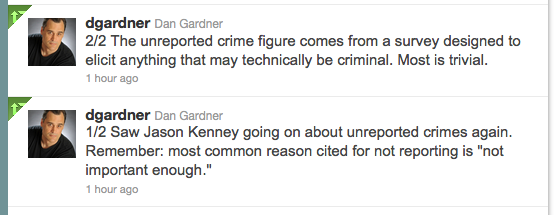
Gardner, who Tweets under @DGardner decided to respond to Kenney's comments by first selectively citing data from the study, then by dismissing unreported crime as "trivial":
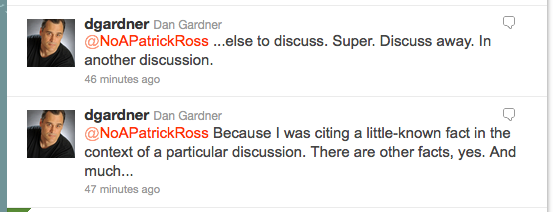
Your not-so-humble scribe couldn't resist the opportunity to ask Gardner a few questions about the assumptions he was making. Gardner's ultimate response was that he ultimately would not consider any other data points:
In other words, Gardner refused to talk about any weaknesses in the assumptions he was offering, or even any other information. If it was going to be discussed, it would have to be discussed with other people, because he won't.
There's good reason for this. The survey as a whole says far more than Gardner says it does, and the data points he himself is offering don't necessarily support his claims about it.
There are obvious problems with a response that begins and ends with "not important enough", and it has to do with the respondent's perception of the meaning of that phrase. The question of who the incident in question is perceived to be "not important enough to" is a very real question.
To blithely assume that this means that the victim of the crime in general didn't consider it important enough to report is to also assume that all respondents perceived the meaning of that phrase in a uniform manner. This would be a mistake.
When a response begins and ends with "not important enough", it's every bit as likely that the respondent could conclude that the crime in question was not important enough to the police as not important enough to them personally. In lieu of a better-defined response, either conclusion is equally likely, and it's much more reasonable -- and responsible -- to allow for the probability that those who submitted that response had either of these in mind. Some likely concluded the former, and some likely concluded the latter.
Yet to ask Dan Gardner if the conclusion he reached -- that this response indicates that most of Canada's unreported crime is trivial -- is reasonable considering the ambiguous nature of this data is apparently to precipitate a meltdown on his behalf. If last night's events are any indication, he simply can't cope with that idea.
To ask him about the second-ranked response -- "police could not do anything about it" -- is apparently to make it worse. Gardner's response was that this was a worthy point to be discussed, but that he personally wouldn't. (That the second-ranked response trailed the first-ranked response by less than ten percentage points apparently did nothing to boost the worthiness of this data point in Gardner's eyes.)
It becomes difficult to avoid reaching the conclusion that, in the canon of the far-left media, these are forbidden questions. "Does the data actually indicate what you're saying it does?" That question is forbidden. "Isn't the second-ranked response also worthy of consideration?" That question is also forbidden.
What seems to emerge, in Dan Gardner's case, is that of a man who has not embraced journalism as a means with which to provide people with information or even ideas. Rather, he's embraced the journalistic enterprise purely as a means of political advocacy. Nothing else.
It's hard to escape the conclusion that Gardner is simply a card-carrying member of the media party. The media party has an agenda, and in this case it's in preserving the soft-on-crime, hug-a-thug policies that they claim have reduced crime in Canada, but in reality have not. The Stats Can study itself states that in no uncertain terms -- victimization in Canada has remained stable.
In support of that agenda, Gardner sets out to turn public attention away from specific data points that do not support that agenda, and toward data points that seem to support it only if they go unexamined.
It's one thing to insist that Canadians aren't reporting specific crimes because they're "not important enough", whatever that might mean to the individuals who offered that response.
To insist that the unreported crimes are trivial is remarkably obtuse when one considers what those unreported crimes are:
Of the crimes unreported in Canada, the number one is break and enter. That is not a trivial crime. The second is motor vehicle or parts theft. That is not a trivial crime. The third is robbery. That is not a trivial crime. The fifth is physical assault. That is not a trivial crime.
The fourth was vandalism. That could be a trivial crime, but not necessarily. The sixth and seventh were theft, or personal property and household property respectively. That, too, could be a trivial crime, but not necessarily.
It's not up to Dan Gardner to decide if the unreported victimization of Canadians is trivial. It's up to each individual victim to decide that for themselves and admittedly, many of them might reach that conclusion. Many might not.
But this is how the media party operates: they assume that they speak for Canadians as a whole, then they pretend to.
In the end, Dan Gardner's impotent response to the questions he was asked was to label your not-so-humble scribe a "troll". Basically it amounts to an accusation that the questions over whether or not Gardner has given ample consideration to the meaning of the data points he offers is "inflammatory, extraneous, or off-topic", as Wikipedia would have it.
The questions over whether or not Gardner is accurately interpreting the data offered by this survey are very clearly on-topic. It's simply a question that he considers forbidden: it's entirely reasonable to ask in the face of ambiguous data with a wide berth of potential meanings, but it seems to be Gardner's belief that no one is allowed to ask that question.
To this end, Dan Gardner is wrong. People have the right to ask these questions, and if Gardner, demanding merit in the public eye, refuses to discuss them, then it's he who has abandoned the lofty aspirations of journalism.
It's not what one would expect from a journalist. But it's precisely what one would expect from a member of the media party.
Labels:
Brian Lilley,
Conservative party,
Crime,
Dan Gardner,
Jason Kenney,
Twitter
Thursday, November 03, 2011
LGR Advocates, You Have Some 'Splainin' To Do
Long gun registry not the life-saver they claim it is
With Canada's far-left scrambling to save the long gun registry by any means necessary, it seems the facts just aren't lining up to support their arguments.
When the Globe and Mail put crime data recently released by Stats Canada into a chart, the conclusions became unavoidable. Those who claim the long gun registry saves lives -- as former Liberal MP Mark Holland used to delight in doing -- have some serious explaining to do.
The chart reveals that the last time more long guns than hand guns were used in homicides was waaaaaay back in 1990. (The L'Ecole Polytechnique massacre happened the previous year.) The bill authorizing the long gun registry was passed in Parliament in 1995, and the registry itself was established in 1996.
There's good reason for this. As the numbers have it, murders involving long guns have been steadily declining in Canada since 1984 -- twelve years before the LGR ever existed. There were occasional spikes in homicides involving long guns, but the general trend has been a decline since 1984.
During the same period of time, murders involving handguns -- which the law has required to be registered since World War Two -- have remained stable.
This is very clearly a difficult question the champions of the LGR desperately need to answer. They have relentlessly attributed the reduction in homicides involving long guns to the registry. Yet not only does the decline pre-date the registry, the handgun registry has no noticeable effect.
It's clear that registration has not had the magical properties LGR advocates have attributed to it. They have some serious questions to answer, some serious explaining to do -- although previous experience with these individuals suggests they will simply decline.
With Canada's far-left scrambling to save the long gun registry by any means necessary, it seems the facts just aren't lining up to support their arguments.
When the Globe and Mail put crime data recently released by Stats Canada into a chart, the conclusions became unavoidable. Those who claim the long gun registry saves lives -- as former Liberal MP Mark Holland used to delight in doing -- have some serious explaining to do.
The chart reveals that the last time more long guns than hand guns were used in homicides was waaaaaay back in 1990. (The L'Ecole Polytechnique massacre happened the previous year.) The bill authorizing the long gun registry was passed in Parliament in 1995, and the registry itself was established in 1996.
There's good reason for this. As the numbers have it, murders involving long guns have been steadily declining in Canada since 1984 -- twelve years before the LGR ever existed. There were occasional spikes in homicides involving long guns, but the general trend has been a decline since 1984.
During the same period of time, murders involving handguns -- which the law has required to be registered since World War Two -- have remained stable.
This is very clearly a difficult question the champions of the LGR desperately need to answer. They have relentlessly attributed the reduction in homicides involving long guns to the registry. Yet not only does the decline pre-date the registry, the handgun registry has no noticeable effect.
It's clear that registration has not had the magical properties LGR advocates have attributed to it. They have some serious questions to answer, some serious explaining to do -- although previous experience with these individuals suggests they will simply decline.
Labels:
Conservative party,
Crime,
Gun Control,
Gun Registry,
Liberal party,
Mark Holland
Sunday, October 30, 2011
No Explanation Required... Unless You've Confused the Issue
Religious belief that homosexuality is sinful not at odds with notion homosexuals shouldn't be bullied
The Toronto Star is reporting that Ancaster-Dundas-Flamborough-Westdale MP David Sweet is refusing to explain his participation in a recent "it gets better" YouTube video produced by John Baird.
This is as it should be. No explanation is required.
But for those obsessed with headhunting for Conservative MPs, Sweet's participation is as infuriating as Baird's. For a time, Baird was criticized for making the video while not being publicly fabulous enough. Baird refused to take the bait, so now the headhunters are on to their next target: David Sweet.
“For them to stand up and say, ‘It gets better, just hang in there kids,’ is so disrespectful and disingenuous and shows they’re out of touch with the community,” complained EGALE Canada executive director Helen Kennedy, who also complained the Tories aren't doing enough to satisfy the legislative demands of the LGBT community. “They actually have the power and authority and the responsibility to make it better. We’re talking about politicians who enact legislation, who bring in bills to the legislature, into the House of Commons to make a difference in everyone’s life and in particular in the case of our LGBT youth and the community in general and they’re not doing that.”
Of particular complaint has been Sweet's 2002 remarks that he believed homosexuality is a sin.
“Yes, absolutely,” Sweet agreed at the time. “We take the Scriptures as the word of God. We look at homosexual behaviour and say that’s not what’s prescribed in the Scripture.”
Some look at these comments, then look at Sweet's participation in an anti-bullying video, and suggest he has something to explain. They're absolutely wrong, on the most fundamental of logical pretenses.
Simply put, a religious belief that homosexuality is sinful -- a notion with which this author actually vociferously disagrees -- is not tantamount to a belief that homosexuals should be bullied. Nor is it at odds with a belief that homosexuals should not be bullied, because no one should be bullied.
The attitude adopted by those who believe Sweet has anything to explain seem to presume that Christians have some kind of moral duty to condemn anyone who sins on an existential basis. While some extreme religious sects seem to believe this to be the case, for the average Christian it isn't so.
Rather, Jesus Christ mandated that sinners are to be treated with compassion. So if one believes that homosexuality is sinful -- again, this author vehemently does not -- one's moral duty as a Christian is to offer them compassion and guidance.
Your not-so-humble scribe would posit that David Sweet is wrong about homosexuality. It doesn't disqualify him from speaking out against homophobic bullying, just as John Baird isn't disqualified for not being "out" enough.
If Helen Kennedy and her compatriots can't wrap their heads around that idea, that's their problem, not David Sweet's. Vis a vis his participation in the "it gets better" video, Sweet has nothing to explain, and so should explain nothing.
The Toronto Star is reporting that Ancaster-Dundas-Flamborough-Westdale MP David Sweet is refusing to explain his participation in a recent "it gets better" YouTube video produced by John Baird.
This is as it should be. No explanation is required.
But for those obsessed with headhunting for Conservative MPs, Sweet's participation is as infuriating as Baird's. For a time, Baird was criticized for making the video while not being publicly fabulous enough. Baird refused to take the bait, so now the headhunters are on to their next target: David Sweet.
“For them to stand up and say, ‘It gets better, just hang in there kids,’ is so disrespectful and disingenuous and shows they’re out of touch with the community,” complained EGALE Canada executive director Helen Kennedy, who also complained the Tories aren't doing enough to satisfy the legislative demands of the LGBT community. “They actually have the power and authority and the responsibility to make it better. We’re talking about politicians who enact legislation, who bring in bills to the legislature, into the House of Commons to make a difference in everyone’s life and in particular in the case of our LGBT youth and the community in general and they’re not doing that.”
Of particular complaint has been Sweet's 2002 remarks that he believed homosexuality is a sin.
“Yes, absolutely,” Sweet agreed at the time. “We take the Scriptures as the word of God. We look at homosexual behaviour and say that’s not what’s prescribed in the Scripture.”
Some look at these comments, then look at Sweet's participation in an anti-bullying video, and suggest he has something to explain. They're absolutely wrong, on the most fundamental of logical pretenses.
Simply put, a religious belief that homosexuality is sinful -- a notion with which this author actually vociferously disagrees -- is not tantamount to a belief that homosexuals should be bullied. Nor is it at odds with a belief that homosexuals should not be bullied, because no one should be bullied.
The attitude adopted by those who believe Sweet has anything to explain seem to presume that Christians have some kind of moral duty to condemn anyone who sins on an existential basis. While some extreme religious sects seem to believe this to be the case, for the average Christian it isn't so.
Rather, Jesus Christ mandated that sinners are to be treated with compassion. So if one believes that homosexuality is sinful -- again, this author vehemently does not -- one's moral duty as a Christian is to offer them compassion and guidance.
Your not-so-humble scribe would posit that David Sweet is wrong about homosexuality. It doesn't disqualify him from speaking out against homophobic bullying, just as John Baird isn't disqualified for not being "out" enough.
If Helen Kennedy and her compatriots can't wrap their heads around that idea, that's their problem, not David Sweet's. Vis a vis his participation in the "it gets better" video, Sweet has nothing to explain, and so should explain nothing.
Labels:
Conservative party,
David Sweet,
EGALE,
Helen Kennedy,
John Baird,
LGBT,
Religion
Thursday, October 27, 2011
Canadian White Board: Still Making Up the Rules As They Go Along
CWB determined to maintain its own power, no matter what
The farce perpetually surrounding the Canadian Wheat Board has reached an impressive new high in
"This Harper government has acted illegally and unethically in its attacks on the Canadian Wheat Board and it must be stopped," declared Canadian Wheat Board chairman Allen Oberg. "We have no choice but to take this stand on behalf of farmers. We will not be intimidated by bullying tactics."
A Wheat Board chairman lecturing anyone on bullying is itself a spectacle in unintentional comedy. It was, after all, the Wheat Board that had farmers jailed for daring to demand the right to market their own grain. But what's most remarkable about this most recent episode is the extent to which the CWB is willing to go in order to make up the rules as it goes along.
In 2007, the Wheat Board won a challenge against an attempt by the federal government to remove the Board's monopoly on barley marketing by claiming that any change to the board had to made through an act of Parliament.
Now, the board is claiming that the changes can only be made following a plebiscite among grain farmers. A plebiscite not unlike, say, the one held in 2007 when farmers voted to eliminate the CWB's barley monopoly.
The CWB itself has already shown that it's opinion is that the results of any plebiscite don't matter, and that it could act however it pleased. Now that the government is poised to ignore the results of a plebiscite the CWB set up to support the maintenance its own tyrannical powers, it suddenly insists that the will of farmers must be respected.
In order to do this, they're willing to go back on the legal arguments they've already offered, and insist that it really should be left up to farmers. Unless farmers want something the board doesn't want. In which case, the will of farmers should be ignored.
The Wheat Board has already cast its die on this matter: they cast it in 2007. It's time for a Canadian court to stand up and finally make the CWB play by the rules as they are, not the rules it desperately wants to make up as it goes along.
The farce perpetually surrounding the Canadian Wheat Board has reached an impressive new high in
"This Harper government has acted illegally and unethically in its attacks on the Canadian Wheat Board and it must be stopped," declared Canadian Wheat Board chairman Allen Oberg. "We have no choice but to take this stand on behalf of farmers. We will not be intimidated by bullying tactics."
A Wheat Board chairman lecturing anyone on bullying is itself a spectacle in unintentional comedy. It was, after all, the Wheat Board that had farmers jailed for daring to demand the right to market their own grain. But what's most remarkable about this most recent episode is the extent to which the CWB is willing to go in order to make up the rules as it goes along.
In 2007, the Wheat Board won a challenge against an attempt by the federal government to remove the Board's monopoly on barley marketing by claiming that any change to the board had to made through an act of Parliament.
Now, the board is claiming that the changes can only be made following a plebiscite among grain farmers. A plebiscite not unlike, say, the one held in 2007 when farmers voted to eliminate the CWB's barley monopoly.
The CWB itself has already shown that it's opinion is that the results of any plebiscite don't matter, and that it could act however it pleased. Now that the government is poised to ignore the results of a plebiscite the CWB set up to support the maintenance its own tyrannical powers, it suddenly insists that the will of farmers must be respected.
In order to do this, they're willing to go back on the legal arguments they've already offered, and insist that it really should be left up to farmers. Unless farmers want something the board doesn't want. In which case, the will of farmers should be ignored.
The Wheat Board has already cast its die on this matter: they cast it in 2007. It's time for a Canadian court to stand up and finally make the CWB play by the rules as they are, not the rules it desperately wants to make up as it goes along.
Labels:
Allen Oberg,
Conservative party,
CWB,
Gerry Ritz
Friday, October 21, 2011
Does It Get Better?
Maybe not... if you're John Baird
Following the suicide of yet another bullied gay teen -- it's been happening with heartbreaking frequency lately -- one would expect that LGBT activists in Canada would welcome Foreign Affairs Minister John Baird taking a stand to stop homophobic bullying.
Think again.
Baird responded to the suicide of Jamie Hubley in both a statement in the House of Commons and in a YouTube video produced as part of the "It Gets Better" campaign. In both cases, speaking out against homophobic bullying.
Many hardline LGBT activists haven't welcomed Baird's stand against this scourge of the LGBT community. Instead, they're angry that Baird would dare denounce homophobic bullying.
To various LGBT activists, Baird has a dirty little secret.
Except that it's not really dirty, and not really a secret. Really, they're just determined to denounce him no matter what. No matter what.
So in the wake of Baird's statement and video, self-described LGBT activists took to Twitter to denounce him as allegedly hypocritical for being an allegedly closeted gay man.
"Okay, I'm still livid," fumed Ariel Troster. "John Baird isn't even brave enough to come out and he's telling youth #itgetsbetter?"
"If it gets better then GET OUT OF THE F*CKING CLOSET JOHN BAIRD, YOU HYPOCRITICAL COWARD," raged @Kyle_A.
"If Min John Baird really wants to set a good example for Gay teens he should finally come out of the closet himself," declared @RustyBoyRobot.
It's a confusing response to such a laudable act by Baird, one that belies an odd autocratic attitude by some LGBT activists towards their own: simply, that they demand the right to dictate to John Baird how he will live his life.
To claim that Baird is "closeted" would overlook the fact that Baird's sexuality is common knowledge to many of those who follow Canadian politics. But although Baird has never been secretive about his sexuality, he has been quiet about it. There's a difference.
Baird prefers to live his private life in dignity as he sees it. That's not enough for some militant LGBT activists, who demand that he live his life as they see fit: as some kind of human billboard for the Canadian LGBT community.
Not only is it shameful, but it threatens the simple moral principle that motivates any conservative who supports equal rights -- equal meaning precisely that: equal -- that people have the right to live their lives in any law-abiding manner they choose.
Homosexuality, as serious-minded Canadians know, is not a choice. But how someone chooses to live as a homosexual is. Not every Canadian LGBT should be herded onto a gay pride float once a year if that isn't how they want to live their life.
If John Baird prefers to live his private life, well... privately, that's his right. It isn't for militant LGBT activists -- or anyone else -- to dictate to him that he should do otherwise.
The numerous individuals trying to politicize this issue and deny John Baird the credit he has earned for his laudable stand against homophobic bullying should all be absolutely ashamed of themselves.
Following the suicide of yet another bullied gay teen -- it's been happening with heartbreaking frequency lately -- one would expect that LGBT activists in Canada would welcome Foreign Affairs Minister John Baird taking a stand to stop homophobic bullying.
Think again.
Baird responded to the suicide of Jamie Hubley in both a statement in the House of Commons and in a YouTube video produced as part of the "It Gets Better" campaign. In both cases, speaking out against homophobic bullying.
Many hardline LGBT activists haven't welcomed Baird's stand against this scourge of the LGBT community. Instead, they're angry that Baird would dare denounce homophobic bullying.
To various LGBT activists, Baird has a dirty little secret.
Except that it's not really dirty, and not really a secret. Really, they're just determined to denounce him no matter what. No matter what.
So in the wake of Baird's statement and video, self-described LGBT activists took to Twitter to denounce him as allegedly hypocritical for being an allegedly closeted gay man.
"Okay, I'm still livid," fumed Ariel Troster. "John Baird isn't even brave enough to come out and he's telling youth #itgetsbetter?"
"If it gets better then GET OUT OF THE F*CKING CLOSET JOHN BAIRD, YOU HYPOCRITICAL COWARD," raged @Kyle_A.
"If Min John Baird really wants to set a good example for Gay teens he should finally come out of the closet himself," declared @RustyBoyRobot.
It's a confusing response to such a laudable act by Baird, one that belies an odd autocratic attitude by some LGBT activists towards their own: simply, that they demand the right to dictate to John Baird how he will live his life.
To claim that Baird is "closeted" would overlook the fact that Baird's sexuality is common knowledge to many of those who follow Canadian politics. But although Baird has never been secretive about his sexuality, he has been quiet about it. There's a difference.
Baird prefers to live his private life in dignity as he sees it. That's not enough for some militant LGBT activists, who demand that he live his life as they see fit: as some kind of human billboard for the Canadian LGBT community.
Not only is it shameful, but it threatens the simple moral principle that motivates any conservative who supports equal rights -- equal meaning precisely that: equal -- that people have the right to live their lives in any law-abiding manner they choose.
Homosexuality, as serious-minded Canadians know, is not a choice. But how someone chooses to live as a homosexual is. Not every Canadian LGBT should be herded onto a gay pride float once a year if that isn't how they want to live their life.
If John Baird prefers to live his private life, well... privately, that's his right. It isn't for militant LGBT activists -- or anyone else -- to dictate to him that he should do otherwise.
The numerous individuals trying to politicize this issue and deny John Baird the credit he has earned for his laudable stand against homophobic bullying should all be absolutely ashamed of themselves.
Thursday, October 20, 2011
Lizzie May: Not in Favour of a Fair Distribution?
Green Party leader pretends to be a target
With the NDP already pledged to oppose legislation to grant additional Parliamentary seats to Canada's fastest-growing provinces -- namely, Alberta, BC and Ontario -- it was only a matter of time before the rest of the opposition found a way to justify opposing the bill as well.
Green Party leader Elizabeth May seems to have found her pretext: as with so many things, the self-absorbed May considers the bill to be an attack on her, directly.
Waving around a Conservative Party newsletter in which Saanich-Gulf Islands Tory Bruce Hallsor notes that the re-distrubtion may make it easier for them to beat May in the next election.
May seems to think the newsletter is incriminating, but all she's offered is what is currently just idle speculation.
Of course, the detail that the Globe and Mail's projections are not based on any proposed re-districting -- no such proposals exist until independent commissions have done their work -- but only on votes cast in the past election will almost certainly be ignored by May.
In the end, it's purely intuitive: the party with the largest share of the vote in each of these provinces will reap the biggest reward. The Tories dominate in Alberta, are strong in BC, and swept Ontario in the 2011 election.
When one considers where the additional ridings need to be added to account for population growth -- in Northern Alberta, central BC, and suburban GTA -- it's not at all surprising that the strength of the Conservative vote in these areas would yield victories for Conservatives.
It's the just the way things are right now. If the work of these independent commissions concludes that the boundaries of Saanich-Gulf Islands should be redrawn, it's just the way it will be. To tailor the process just to suit May would be a dereliction of the commission's responsibilities: namely, to produce a re-distribution that is fair to all constituents, not just to May.
If Elizabeth May and the Green Party don't like it, perhaps they should campaign harder in those areas, and propose policy that will appeal to, as opposed to repulse, those voters.
With the NDP already pledged to oppose legislation to grant additional Parliamentary seats to Canada's fastest-growing provinces -- namely, Alberta, BC and Ontario -- it was only a matter of time before the rest of the opposition found a way to justify opposing the bill as well.
Green Party leader Elizabeth May seems to have found her pretext: as with so many things, the self-absorbed May considers the bill to be an attack on her, directly.
Waving around a Conservative Party newsletter in which Saanich-Gulf Islands Tory Bruce Hallsor notes that the re-distrubtion may make it easier for them to beat May in the next election.
May seems to think the newsletter is incriminating, but all she's offered is what is currently just idle speculation.
Of course, the detail that the Globe and Mail's projections are not based on any proposed re-districting -- no such proposals exist until independent commissions have done their work -- but only on votes cast in the past election will almost certainly be ignored by May.
In the end, it's purely intuitive: the party with the largest share of the vote in each of these provinces will reap the biggest reward. The Tories dominate in Alberta, are strong in BC, and swept Ontario in the 2011 election.
When one considers where the additional ridings need to be added to account for population growth -- in Northern Alberta, central BC, and suburban GTA -- it's not at all surprising that the strength of the Conservative vote in these areas would yield victories for Conservatives.
It's the just the way things are right now. If the work of these independent commissions concludes that the boundaries of Saanich-Gulf Islands should be redrawn, it's just the way it will be. To tailor the process just to suit May would be a dereliction of the commission's responsibilities: namely, to produce a re-distribution that is fair to all constituents, not just to May.
If Elizabeth May and the Green Party don't like it, perhaps they should campaign harder in those areas, and propose policy that will appeal to, as opposed to repulse, those voters.
Thursday, October 13, 2011
Right On CUPW, Fight On
CUPW right to challenge Tories over back-to-work law
Having a majority government shouldn't mean the right to always have your way, even when you're wrong.
It's something that the Jean Chretien government never learned -- especially with its Hepatitis C shenanigans -- but it's something that the Harper government clearly needs to learn.
Many conservatives would likely be shocked to be told that they should actually support the Canadian Union of Postal Workers in their bid to challenge the Tories' back-to-work legislation in court. They should take it as far as the Supreme Court if they have to.
"This back-to-work legislation was unjust," declared CUPW President Denis Lemelin. "It was the democratic rights of workers that were attacked. There is a fundamental principle here -- the freedom of association."
CUPW isn't right about many things, and certainly not very often. The political activities of the union executive and far-left hardliners -- so often taken in the name of the entire union -- are certainly a big problem for the responsible governance of that union. But that isn't what was at stake with the back-to-work legislation, and anyone who thinks it is has confused the issue entirely.
Many conservatives have mistaken labour unions for their natural enemy. This isn't actually the case.
The labour rights that have made it possible for blue-collar, working-class people in Canada to succeed on their own terms were the result of agitation by labour unions.
Admittedly this was a long time ago, when labour unions were focused entirely on improving the workplace conditions of their workers. Now, many labour unions -- including CUPW -- are more focused on advancing the personal political agendas of their leaders.
Perhaps some Conservatives have concluded that the solution to this is to simply crush the unions outright. This is a mistake.
In cases such as the CUPW back-to-work legislation, it's difficult to escape the conclusion that this is precisely what the Tories have set out to do. It's important to remember that CUPW was not under a general strike when the legislation was introduced, they were locked out by Canada Post.
There is something very wrong with a government that has the power to direct the executives of a crown corporation to end the lockout they imposed instead imposing back-to-work legislation to send postal workers back to the job.
When union leaders note that the government's actions undermine the position of all labour unions in Canada to bargain collectively, they are entirely right. That the government seems so eager to intervene in the Air Canada flight attendants' strike is even more alarming. Air Canada may have been founded as a crown corporation, but it was privatized in 1988.
It seems that there's no limit to how itchy the Harper government's trigger finger has become, and no limit on when and where it's prepared to legislate workers back to work.
CUPW needs to win this court challenge for the benefit of all Canadian workers who have reaped the benefit of responsible collective bargaining. And frankly, this is one time that the Harper government needs to be taught a lesson.
Having a majority government shouldn't mean the right to always have your way, even when you're wrong.
It's something that the Jean Chretien government never learned -- especially with its Hepatitis C shenanigans -- but it's something that the Harper government clearly needs to learn.
Many conservatives would likely be shocked to be told that they should actually support the Canadian Union of Postal Workers in their bid to challenge the Tories' back-to-work legislation in court. They should take it as far as the Supreme Court if they have to.
"This back-to-work legislation was unjust," declared CUPW President Denis Lemelin. "It was the democratic rights of workers that were attacked. There is a fundamental principle here -- the freedom of association."
CUPW isn't right about many things, and certainly not very often. The political activities of the union executive and far-left hardliners -- so often taken in the name of the entire union -- are certainly a big problem for the responsible governance of that union. But that isn't what was at stake with the back-to-work legislation, and anyone who thinks it is has confused the issue entirely.
Many conservatives have mistaken labour unions for their natural enemy. This isn't actually the case.
The labour rights that have made it possible for blue-collar, working-class people in Canada to succeed on their own terms were the result of agitation by labour unions.
Admittedly this was a long time ago, when labour unions were focused entirely on improving the workplace conditions of their workers. Now, many labour unions -- including CUPW -- are more focused on advancing the personal political agendas of their leaders.
Perhaps some Conservatives have concluded that the solution to this is to simply crush the unions outright. This is a mistake.
In cases such as the CUPW back-to-work legislation, it's difficult to escape the conclusion that this is precisely what the Tories have set out to do. It's important to remember that CUPW was not under a general strike when the legislation was introduced, they were locked out by Canada Post.
There is something very wrong with a government that has the power to direct the executives of a crown corporation to end the lockout they imposed instead imposing back-to-work legislation to send postal workers back to the job.
When union leaders note that the government's actions undermine the position of all labour unions in Canada to bargain collectively, they are entirely right. That the government seems so eager to intervene in the Air Canada flight attendants' strike is even more alarming. Air Canada may have been founded as a crown corporation, but it was privatized in 1988.
It seems that there's no limit to how itchy the Harper government's trigger finger has become, and no limit on when and where it's prepared to legislate workers back to work.
CUPW needs to win this court challenge for the benefit of all Canadian workers who have reaped the benefit of responsible collective bargaining. And frankly, this is one time that the Harper government needs to be taught a lesson.
Labels:
Conservative party,
CUPW,
Labour Unions,
Lisa Raitt
Sunday, October 09, 2011
The NDP Gives Democracy a A Great Big Orange Middle Finger
NDP's stance on extra seats for growing provinces anti-democratic
The NDP must think that Canadians in Alberta, Ontario and BC aren't just aren't paying attention.
That's the only explanation for their position opposing the addition of new Parliamentary seats for Alberta, BC and Ontario. These provinces have long been underrepresented in Parliament, and the rapid growth of the population of these provinces only ensures that it will get worse if it isn't addressed.
Fortunately, Democratic Reform Minister Tim Uppal is prepared to move to alleviate this issue.
"Currently, Canadians in the fastest-growing provinces are severely underrepresented," Uppal explained. "We believe that every Canadian vote, to the greatest extent possible, should carry equal weight."
David Christopherson, the NDP's Democratic Renewal critic, has vowed that the NDP will fight the re-distribution tooth and nail. And therein lies the evidence that the NDP thinks Canadians aren't paying attention.
In August, NDP interim leader Nycole Turmel even had the nerve to describe the proposed new seats as "divisive".
"The approach of the Harper government is really divisive right now. It's not constructive, it's not nation-building," Turmel insisted.
Of course any Canadian with even the remotest grip on reality know precisely what this statement is:
A lie.
It's the NDP who are trying to divide Canadians over the addition of more seats to Parliament, and it's unfortunate they don't respect Canadians enough to tell the truth about it.
It's the NDP who are looking to voters in BC, Alberta and Ontario and telling them they aren't good enough to have the same electoral weight as voters in Quebec. It's the NDP who are looking to these voters and telling them they must remain second-class citizens in Canada.
Fortunately, voters in Alberta, BC and Ontario are paying attention to this issue. And what do they see? They see the Conservative Party sanding up for their right to equal representation, and they see the NDP opposing it.
It's not a hard conclusion to reach: if you live in Ontario, BC or Alberta, the NDP is not on your side. They are against you.
The NDP must think that Canadians in Alberta, Ontario and BC aren't just aren't paying attention.
That's the only explanation for their position opposing the addition of new Parliamentary seats for Alberta, BC and Ontario. These provinces have long been underrepresented in Parliament, and the rapid growth of the population of these provinces only ensures that it will get worse if it isn't addressed.
Fortunately, Democratic Reform Minister Tim Uppal is prepared to move to alleviate this issue.
"Currently, Canadians in the fastest-growing provinces are severely underrepresented," Uppal explained. "We believe that every Canadian vote, to the greatest extent possible, should carry equal weight."
David Christopherson, the NDP's Democratic Renewal critic, has vowed that the NDP will fight the re-distribution tooth and nail. And therein lies the evidence that the NDP thinks Canadians aren't paying attention.
In August, NDP interim leader Nycole Turmel even had the nerve to describe the proposed new seats as "divisive".
"The approach of the Harper government is really divisive right now. It's not constructive, it's not nation-building," Turmel insisted.
Of course any Canadian with even the remotest grip on reality know precisely what this statement is:
A lie.
It's the NDP who are trying to divide Canadians over the addition of more seats to Parliament, and it's unfortunate they don't respect Canadians enough to tell the truth about it.
It's the NDP who are looking to voters in BC, Alberta and Ontario and telling them they aren't good enough to have the same electoral weight as voters in Quebec. It's the NDP who are looking to these voters and telling them they must remain second-class citizens in Canada.
Fortunately, voters in Alberta, BC and Ontario are paying attention to this issue. And what do they see? They see the Conservative Party sanding up for their right to equal representation, and they see the NDP opposing it.
It's not a hard conclusion to reach: if you live in Ontario, BC or Alberta, the NDP is not on your side. They are against you.
Labels:
Conservative party,
David Christopherson,
Democracy,
NDP,
Nycole Turmel,
Tim Uppal
Tuesday, October 04, 2011
TDSB on Parents: Screw You. Does the Ontario Liberal Party Agree?
TDSB refuses to hear concerns of parents on anti-discrimination curriculum
As the Ontario election showly plods toward its conclusion, it seems that the Liberal Party has become increasingly frustrated with its inability to take a lead and put this election away.
Now, they're resorting to their typical tactic of last resort: accusing their opponents of bigotry.
The Ontario Progressive Conservative Party has taken up the issue of the Toronto District School Board's anti-discrimination curriculum, placing it at the centre of the election. And rightfully so.
The Liberal Party and various far-left groups have predictably declared a new flier being distributed by the Tories to be "homophobic". It's typical far-left bully language, trying to intimidate their opponents into silence.
It was tried once before. When a controversial sex education program was proposed by the McGuinty government, any who objected to the education of Grade 6 students in matters such as anal sex were declared to be homophobic. Contrary to the intention of activist groups to intimidate religious groups, and ordinary parents, out of the debate, public pressure instead built until McGuinty's government was forced to postpone the changes for further consideration.
The TDSB apparently had no appetite for "further consideration", or even for public consideration at all. As reported by Michael Coren, the Equity Advisory Committee of the TDSB decided that public consultation was unnecessary.
One member of the committee who attempted to raise objections to the curriculum was shouted down and declared a homophobe by other members of the committee. The committee, when contacted by producers of Coren's show, were told that this woman was "only a parent." They also accused her of being "singularly destructive."
Nothing could make the attitude of these people toward parents any more clear: the concerns of parents are not to be heard, are not to be considered, are not even to be taken seriously.
They believe they have all the power, and it's their clear intention to deny any modicum of power to parents; at least to those who don't blindly support their extreme agenda.
It isn't that fighting bullying in schools through education is an extreme agenda. However, subjecting children to demagogic (not pedagogic) far-left reeducation programs over the objections of parents very clearly is.
Not everything within the TDSB anti-discrimination curriculum is extreme and outrageous. For example, teaching kids about different family structures is entirely reasonable; many of these children are already growing up in non-conventional family units, so this is very much a live issue for them.
The question of whether or not they're a boy or a girl, however, and the curriculum's teachings on transgendered persons, is not a live issue for these kids. And the recent case of Thomas Lobel, a California child who has apparently decided, on a whim, that he would rather be a girl than a boy.
His adoptive parents have decided to indulge this whim by putting him on hormone blockers, hoping that he can decide by puberty whether or not he wants to be a boy or a girl.
Anyone who imagines a child, even at age 14, is psychologically qualified to make that kind of life-defining decision, is simply out of their minds.
This case underscores precisely what is so irresponsible and reckless about what the TDSB wants to teach young children; planting the question in their heads about whether they are a boy or a girl long before they can be expected to make such a decision while understanding the gravity of the choice.
Contrary to claims by the Ontario Liberal Party, there is nothing inaccurate about the flier. It accurately reflects how eager the TDSB is to trample parental rights in their well-intentioned desire to stop the bullying of gay, lesbian and transgendered people in society.
It's not their intentions that are misguided; it's their actions.
The Toronto District School Board is apparently more than content to thumb its nose at the rights of parents. In jumping all over this issue, the Liberal Party seems to be sending a message to the parents of Ontario that it's willing to do the same.
They should not be rewarded at the polls for this. Quite the contrary: they should be punished with the loss of their government until such a time that they are willing to approach these issues responsibly.
Labels:
Conservative party,
Education,
InDecisiON '11,
Michael Coren,
Ontario,
TDSB,
Tim Hudak
Wednesday, September 28, 2011
So, What's the Deal With Canada's Reputation? Redux
Apparently, the revelation that Canada has the best reputation in the world really bothers the far-left.
Really bothers them.
In an etching at Dr Dawg's kennel, John Cross has evidently taken umbrage at your not-so-humble author taking some time out to acknowledge the fact.
As it turns out, Cross expected that Canada would fare poorly in any attempt to measure and compare the global reputations of the world's countries. He was -- and still is -- one of the very Canada-bashers now absorbing a healthy dosage of crow.
Not that they aren't doing whatever they can to try to wriggle free of the ultimate implications of the results of the survey. Cross complains that, of all things, human rights was not featured as a subject of the survey. Apparently, in the mind of John Cross, that is some kind of game breaker.
As in so many things, Cross has apparently declined to acknowledge which way the global wind is blowing. In a world where the United Nations human rights council is populated by the worst human rights abusers in the world, it seems that human rights has become devalued as the currency of global morality.
This is very unfortunate, particularly for Canada. If the UN and its apologists had any sense of moral probity in relation to these important principles, Canada would be one of a couple dozen countries in the world considered eligible to chair that particular committee.
Unless one considers the myth of Omar Khard's torture -- for which there is no evidence -- or the myth of Canadian involvement in torture in Afghanistan -- again, for which there is no evidence.
Cross also commits a genetic fallacy in attempting to attack the source of the information used to compile the Reputation Institute's report. He claims that the survey used only respondents from G8 countries, but this is false. The report was compiled from responses from 42,000 respondents worldwide.
It's not at all unfair to keep in mind that John Cross is an individual who does exceedingly poorly with any facts that refute whatever popular far-leftist narrative he may be pushing at any given time.
His favourite seems to be that of man-made climate change, and it behooves a responsible thinker to remember that Cross has been an apologist for climategate, and invested considerable energy in propping up the long-disproven hockey stick model of climate change; a model long shown to have absolutely zero scientific merit, and was reached through omitting an entire time period.
So, yeah. John Cross and evidence. Not really bosom buddies.
Which is the amusing thing about it all. Cross and his cohorts in Canada's far-left have obsessively insisted that Prime Minister Stephen Harper has been allegedly-disastrous for Canada's global reputation.
What they've never offered is the evidence. Never offered any evidence that Canada's global reputation is suffering; never offered any evidence that it's because of Stephen Harper.
And now that it's been shown that Canada's reputation has suffered no less than each and every country governed by the kind of welfare state government they want Canada's to emulate, they're all-too eager to simply dispense with the evidence, even if they know deep down that they can't.
Deep down, John Cross simply must know that he can't sweep this one under the rug, although it is amusing watching him try.
Really bothers them.
In an etching at Dr Dawg's kennel, John Cross has evidently taken umbrage at your not-so-humble author taking some time out to acknowledge the fact.
As it turns out, Cross expected that Canada would fare poorly in any attempt to measure and compare the global reputations of the world's countries. He was -- and still is -- one of the very Canada-bashers now absorbing a healthy dosage of crow.
Not that they aren't doing whatever they can to try to wriggle free of the ultimate implications of the results of the survey. Cross complains that, of all things, human rights was not featured as a subject of the survey. Apparently, in the mind of John Cross, that is some kind of game breaker.
As in so many things, Cross has apparently declined to acknowledge which way the global wind is blowing. In a world where the United Nations human rights council is populated by the worst human rights abusers in the world, it seems that human rights has become devalued as the currency of global morality.
This is very unfortunate, particularly for Canada. If the UN and its apologists had any sense of moral probity in relation to these important principles, Canada would be one of a couple dozen countries in the world considered eligible to chair that particular committee.
Unless one considers the myth of Omar Khard's torture -- for which there is no evidence -- or the myth of Canadian involvement in torture in Afghanistan -- again, for which there is no evidence.
Cross also commits a genetic fallacy in attempting to attack the source of the information used to compile the Reputation Institute's report. He claims that the survey used only respondents from G8 countries, but this is false. The report was compiled from responses from 42,000 respondents worldwide.
It's not at all unfair to keep in mind that John Cross is an individual who does exceedingly poorly with any facts that refute whatever popular far-leftist narrative he may be pushing at any given time.
His favourite seems to be that of man-made climate change, and it behooves a responsible thinker to remember that Cross has been an apologist for climategate, and invested considerable energy in propping up the long-disproven hockey stick model of climate change; a model long shown to have absolutely zero scientific merit, and was reached through omitting an entire time period.
So, yeah. John Cross and evidence. Not really bosom buddies.
Which is the amusing thing about it all. Cross and his cohorts in Canada's far-left have obsessively insisted that Prime Minister Stephen Harper has been allegedly-disastrous for Canada's global reputation.
What they've never offered is the evidence. Never offered any evidence that Canada's global reputation is suffering; never offered any evidence that it's because of Stephen Harper.
And now that it's been shown that Canada's reputation has suffered no less than each and every country governed by the kind of welfare state government they want Canada's to emulate, they're all-too eager to simply dispense with the evidence, even if they know deep down that they can't.
Deep down, John Cross simply must know that he can't sweep this one under the rug, although it is amusing watching him try.
Labels:
Conservative party,
John Cross,
Stephen Harper
Tuesday, September 27, 2011
So What's the Deal with Canada's Reputation?
Canada most reputable country in the world according to global poll
Since 2006, it's been a familiar siren song from the left to Canadians, trying to lure voters away from Prime Minister Stephen Harper and the Conservative Party:
"Harper is destroying Canada's global reputation. And we -- the Liberal Party, NDP, or whomever else -- are the ones to restore it. Please vote for us."
Harper has now been in power for more than five years. And these complaints about the effect Stephen Harper's tenure in 24 Sussex Drive have turned out to be nothing more than pure, unmitigated bullshit.
In a study that measured the public esteem, trust, admiration and good feelings toward 50 countries, Canada came out on top. Number one. The best country in the world in terms of its global reputation. The survey was run by the Reputation Institute.
Canada is regarded better than Sweden, Australia, Switzerland, or New Zealand. Most of these countries have had leaders far more of the sort preferred by those citing imaginary harm done by Harper to Canada's reputation.
No one should expect many of these people to wake up and smell the global rejection of this narrative. Some of them just don't get it at all.
No one should be surprised. These are people who prefer to smirk about a preachy lecture delivered to Harper regarding the Kyoto protocols by countries who stood to be fiscal beneficiaries of the treaty at the World Economic Forum in Davos to the standing ovation he received at the same event.
These are people who focus on the handful of far-left whackos protesting the oilsands over the countries and businesses lining up to be oilsands' customers, and the millions of people who consume oilsands oil.
What's the deal with Canada's reputation? Canada's reputation is excellent. Five years of Stephen Harper hasn't done the kind of harm the far-left has bemoaned at every opportunity.
This revelation actually changes nothing: the far-left will still continue to make this claim, and Canadians will continue to do the appropriate thing: and ignore them.
Since 2006, it's been a familiar siren song from the left to Canadians, trying to lure voters away from Prime Minister Stephen Harper and the Conservative Party:
"Harper is destroying Canada's global reputation. And we -- the Liberal Party, NDP, or whomever else -- are the ones to restore it. Please vote for us."
Harper has now been in power for more than five years. And these complaints about the effect Stephen Harper's tenure in 24 Sussex Drive have turned out to be nothing more than pure, unmitigated bullshit.
In a study that measured the public esteem, trust, admiration and good feelings toward 50 countries, Canada came out on top. Number one. The best country in the world in terms of its global reputation. The survey was run by the Reputation Institute.
Canada is regarded better than Sweden, Australia, Switzerland, or New Zealand. Most of these countries have had leaders far more of the sort preferred by those citing imaginary harm done by Harper to Canada's reputation.
No one should expect many of these people to wake up and smell the global rejection of this narrative. Some of them just don't get it at all.
No one should be surprised. These are people who prefer to smirk about a preachy lecture delivered to Harper regarding the Kyoto protocols by countries who stood to be fiscal beneficiaries of the treaty at the World Economic Forum in Davos to the standing ovation he received at the same event.
These are people who focus on the handful of far-left whackos protesting the oilsands over the countries and businesses lining up to be oilsands' customers, and the millions of people who consume oilsands oil.
What's the deal with Canada's reputation? Canada's reputation is excellent. Five years of Stephen Harper hasn't done the kind of harm the far-left has bemoaned at every opportunity.
This revelation actually changes nothing: the far-left will still continue to make this claim, and Canadians will continue to do the appropriate thing: and ignore them.
Monday, September 19, 2011
Warren Kinsella & His Desperate Dog Whistle Politics
As the Ontario provincial election seemingly tightens at the midway point of the election, Warren Kinsella is becoming more and more desperate.
It's actually rather ironic. Earlier in the campaign, "desperate" was his favourite word. He took to Twitter to declare the deseperation of the Tim Hudak-led Progressive Conservative Party.
Now, it's Kinsella and Premier Dalton McGuinty who are becoming desperate. But mostly Kinsella.
In a posting on his blog, Kinsella wails about the federal Conservative Party's treatment of a video taken at a barbecue Toronto Mayor Rob Ford held in July.
The guest of honour at the barbecue was Prime Minister Stephen Harper, who spoke about the upcoming Ontario election, and rallied guests to support Tim Hudak in defeating the Liberal government of Ontario.
Harper spoke of the need for a conservative hat trick in Ontario.
Kinsella's desperation in raising this video becomes clear when one considers that this non-story first came up in early August and it is now late September.
Frankly, it is precisely that: a non-story. There is nothing reasonably controversial about this video. Unless, of course, one is a Liberal voter or war room worker.
It's reminiscent of a past story in which a left-wing partisan snuck a video camera into a Conservative Party event in which Prime Minister Stephen Harper revealed that -- *gasp!* -- he and his party were working toward winning a majority goverment.
The story was not only a non-story, it was non-news. Everyone knew that Harper and the Tories had been working toward a majority government. Harper coming out and saying so was threatening only to left-wing partisans. Treating a video in which he said what everyone already knew as if it were remarkable or scandalous was nothing more than blowing the left-wing dog whistle.
Harper's words simply alert Kinsella and the left-wing partisans he's counting on to something only they will perceive as dangerous.
Now, in the middle of an election campaign, Kinsella is offering up video of Harper saying he'd like to see a conservative government in Queen's Park. In other words, video in which Harper simply says what everyone already knows. Kinsella is simply blowing the left-wing dog whistle, and in his desperation he's blowing it hard.
It's certainly Kinsella's hope that Harper's "conservative hat trick" comment will scare NDP voters into the Liberal fold. Looking at the poll numbers, looking at the embarrassing incidents his party has fallen victim to, Kinsella knows, as many other people know, that this is his party's best hopes of holding onto even a minority government, let alone holding on to their majority.
As for the federal Tories' efforts to shut the video down, chalk that up to an effort to discourage left-wing activists from resorting to the creepy means of hidden cameras in search of "gotcha" non-stories.
For Warren Kinsella, desperate times seem to call for desperate measures.
It's actually rather ironic. Earlier in the campaign, "desperate" was his favourite word. He took to Twitter to declare the deseperation of the Tim Hudak-led Progressive Conservative Party.
Now, it's Kinsella and Premier Dalton McGuinty who are becoming desperate. But mostly Kinsella.
In a posting on his blog, Kinsella wails about the federal Conservative Party's treatment of a video taken at a barbecue Toronto Mayor Rob Ford held in July.
The guest of honour at the barbecue was Prime Minister Stephen Harper, who spoke about the upcoming Ontario election, and rallied guests to support Tim Hudak in defeating the Liberal government of Ontario.
Harper spoke of the need for a conservative hat trick in Ontario.
Kinsella's desperation in raising this video becomes clear when one considers that this non-story first came up in early August and it is now late September.
Frankly, it is precisely that: a non-story. There is nothing reasonably controversial about this video. Unless, of course, one is a Liberal voter or war room worker.
It's reminiscent of a past story in which a left-wing partisan snuck a video camera into a Conservative Party event in which Prime Minister Stephen Harper revealed that -- *gasp!* -- he and his party were working toward winning a majority goverment.
The story was not only a non-story, it was non-news. Everyone knew that Harper and the Tories had been working toward a majority government. Harper coming out and saying so was threatening only to left-wing partisans. Treating a video in which he said what everyone already knew as if it were remarkable or scandalous was nothing more than blowing the left-wing dog whistle.
Harper's words simply alert Kinsella and the left-wing partisans he's counting on to something only they will perceive as dangerous.
Now, in the middle of an election campaign, Kinsella is offering up video of Harper saying he'd like to see a conservative government in Queen's Park. In other words, video in which Harper simply says what everyone already knows. Kinsella is simply blowing the left-wing dog whistle, and in his desperation he's blowing it hard.
It's certainly Kinsella's hope that Harper's "conservative hat trick" comment will scare NDP voters into the Liberal fold. Looking at the poll numbers, looking at the embarrassing incidents his party has fallen victim to, Kinsella knows, as many other people know, that this is his party's best hopes of holding onto even a minority government, let alone holding on to their majority.
As for the federal Tories' efforts to shut the video down, chalk that up to an effort to discourage left-wing activists from resorting to the creepy means of hidden cameras in search of "gotcha" non-stories.
For Warren Kinsella, desperate times seem to call for desperate measures.
Monday, September 12, 2011
It's ON
CAW President sounding the alarm of a blue scare
There's a provincial election, and it's getting serious.
How do you know an election is getting serious in Canada? When union leaders start sounding the alarm and calling for strategic voting. There's a blue scare afoot, and Canadian Auto Workers President Ken Lewenza intends to make it as scary as he possibly can.
"We're asking our members to get politically involved," Lewenza announced. "Look at the campaign and ask yourself... who represents your community and your household the best. I think (people will see) the alternatives are clear. We can't waste our vote on a third party candidate that could split the vote and allow a Tory to win."
Like Buzz Hargrove before him -- Hargrove was kicked out of the NDP for encouraging strategic voting during the 2005-06 federal election -- Lewenza has chosen to back away from being an NDP stalwart, and instead encourage members of his unions to blindly vote againt Tim Hudak and the Conservative Party.
"We marched the New Democrat line," he continued. "We thought, ‘this is our party,' but today we have to be more proactive. You have to think strategically to avoid a disaster... If I had it my way, I would try and convince the New Democrats and Liberals to form an electoral coalition so they're not knocking each other off."
Apparently, the prospect of a Conservative government in Ontario is so scary that Lewenza would, if he could, beat his head against the wall trying to convince the Liberals and NDP to work together to defeat them. He chooses to ignore the correlation between banging your head against the wall and headaches by blaming his headache on the Conservatives.
The Conservatives, it seems, aren't prepared to blindly commit themselves to further economic stimulus, even in the wake of a slowly-recovering Ontario economy. Lewenza would really like it if someone would.
"Even though some would suggest Ontario has recovered on a per capita basis... the fact of the matter is that most jobs being created are part-time and precarious in nature," he declared. "Government intervention in jobs is important."
The detail that the billions of dollars already doled out by the federal and Ontario governments has led to jobs that Lewenza considers "precarious" seems to have little impact on his assessment of it. He somehow thinks more of the same would somehow turn out differently.
Perhaps there's even more to it than that. Lewenza would clearly prefer a government that would bow to the demands of unions over the demands of the rest of Ontarians.
"Even though [labour unions] represent 30 per cent of the Ontario population, we influence 100 per cent of some of the public policy issues on things like minimum wage, pensions and health care," Lewenza added. "People are going to have to be reminded that if there's an aggressive challenge against the labour movement, it normally results in more lost time off work."
Hudak, it seems, is not that leader. He's willing to consider the views of people other than labour union leaders.
"We know the history of Mr Hudak in cabinet with [former Premier Mike] Harris," Lewenza recalled. "I remember it like it was yesterday. The first act Mike Harris introduced in the legislature was to dismantle legislation to allow workers to join a union harassment-free. They disbanded the wage protection program for workers."
In fact, Hudak voted with Harris for legislation that required secret ballot votes before a workplace could unionize, stripping unions of the ability to harass and intimidate workers who voted against unionization. It's no surprise that union leadership opposed such legislation.
The election in Ontario is getting serious. For Ken Lewenza, it's as serious as a heart attack. The prospects of a Progressive Conservative government threaten to undermine the disproportionate political influence of labour unions.
It's something that Ontarians should actually welcome. But Lewenza is too busy trying to make them afraid.
There's a provincial election, and it's getting serious.
How do you know an election is getting serious in Canada? When union leaders start sounding the alarm and calling for strategic voting. There's a blue scare afoot, and Canadian Auto Workers President Ken Lewenza intends to make it as scary as he possibly can.
"We're asking our members to get politically involved," Lewenza announced. "Look at the campaign and ask yourself... who represents your community and your household the best. I think (people will see) the alternatives are clear. We can't waste our vote on a third party candidate that could split the vote and allow a Tory to win."
Like Buzz Hargrove before him -- Hargrove was kicked out of the NDP for encouraging strategic voting during the 2005-06 federal election -- Lewenza has chosen to back away from being an NDP stalwart, and instead encourage members of his unions to blindly vote againt Tim Hudak and the Conservative Party.
"We marched the New Democrat line," he continued. "We thought, ‘this is our party,' but today we have to be more proactive. You have to think strategically to avoid a disaster... If I had it my way, I would try and convince the New Democrats and Liberals to form an electoral coalition so they're not knocking each other off."
Apparently, the prospect of a Conservative government in Ontario is so scary that Lewenza would, if he could, beat his head against the wall trying to convince the Liberals and NDP to work together to defeat them. He chooses to ignore the correlation between banging your head against the wall and headaches by blaming his headache on the Conservatives.
The Conservatives, it seems, aren't prepared to blindly commit themselves to further economic stimulus, even in the wake of a slowly-recovering Ontario economy. Lewenza would really like it if someone would.
"Even though some would suggest Ontario has recovered on a per capita basis... the fact of the matter is that most jobs being created are part-time and precarious in nature," he declared. "Government intervention in jobs is important."
The detail that the billions of dollars already doled out by the federal and Ontario governments has led to jobs that Lewenza considers "precarious" seems to have little impact on his assessment of it. He somehow thinks more of the same would somehow turn out differently.
Perhaps there's even more to it than that. Lewenza would clearly prefer a government that would bow to the demands of unions over the demands of the rest of Ontarians.
"Even though [labour unions] represent 30 per cent of the Ontario population, we influence 100 per cent of some of the public policy issues on things like minimum wage, pensions and health care," Lewenza added. "People are going to have to be reminded that if there's an aggressive challenge against the labour movement, it normally results in more lost time off work."
Hudak, it seems, is not that leader. He's willing to consider the views of people other than labour union leaders.
"We know the history of Mr Hudak in cabinet with [former Premier Mike] Harris," Lewenza recalled. "I remember it like it was yesterday. The first act Mike Harris introduced in the legislature was to dismantle legislation to allow workers to join a union harassment-free. They disbanded the wage protection program for workers."
In fact, Hudak voted with Harris for legislation that required secret ballot votes before a workplace could unionize, stripping unions of the ability to harass and intimidate workers who voted against unionization. It's no surprise that union leadership opposed such legislation.
The election in Ontario is getting serious. For Ken Lewenza, it's as serious as a heart attack. The prospects of a Progressive Conservative government threaten to undermine the disproportionate political influence of labour unions.
It's something that Ontarians should actually welcome. But Lewenza is too busy trying to make them afraid.
Labels:
CAW,
Conservative party,
Fearmongering,
InDecisiON '11,
Ken Lewenza,
Labour Unions,
Ontario
Monday, June 27, 2011
Conservatives Should Not Mistake This For Victory
Back-to-work legislation for locked out workers signals a lawless attitude toward labour
When Prime Minister Stephen Harper and the Conservative Party won a majority government in the May 2 election, many Canadians were wondering what to expect out of a government that could basically do as it wishes.
The mission for the Conservatives needed to be to do the right thing. To govern conservatively, but not to use the power of the government to conduct ideological warfare against the political opposition.
Ever since 2006 there have been accusations against the Conservatives that they have done the latter, and not the former. The cutting of funding to various far-left groups that had no business receiving public funds in the first place was treated as an outrage by the far-left. It wasn't.
The passage of back-to-work legislation sending Canada Post workers back to work is another matter entirely. It would be one thing if CUPW had ever gone on a full-scale strike. A comparatively small-scale rotating strike had been underway by members of the Canadian Union of Postal Workers.
But in reality, postal workers in Canada have not been working because they were locked out.
The NDP attempted to filibuster the legislation vigorously. They were actually right to do so on this occasion. In introducing back-to-work legislation, the government is forcing postal workers Canada Post itself locked out to return back to work without satisfying their right to bargain.
Canadian law allows workers the right to organize, if they choose, and bargain collectively. The government's actions in frustrating the bargaining rights of CUPW signals an adversarial attitude toward labour unions -- not a good idea -- and a generally lawless attitude toward collective bargaining rights.
Some have tried to argue that the government is not responsible for the actions of Canada Post management. Considering that the operations of Canada Post fall under the authority of the Minister of Transport, Infrastructure and Communities (currently Denis Lebel), the government had the authority to order Canada Post to end the lockout and allow negotiations to proceed.
They declined, and proceeded with back-to-work legislation nonetheless.
Perhaps a relentlessly-adversarial attitude toward labour unions has fooled some conservatives into believing that anything that frustrates a union's ability to function is a good thing.
There may be a litany of political activities -- coercively funded by union membership, and directed toward the pet causes of union leaders -- to object to. But that doesn't justify attacking the basest rights unions possess, and that union leaders were attempting to exercise in this case.
This may be a victory for the Conservatives -- who very much seem to have gone looking for this fight -- but it is not a victory for conservatives.
Anyone who thinks differently is fooling themselves.
When Prime Minister Stephen Harper and the Conservative Party won a majority government in the May 2 election, many Canadians were wondering what to expect out of a government that could basically do as it wishes.
The mission for the Conservatives needed to be to do the right thing. To govern conservatively, but not to use the power of the government to conduct ideological warfare against the political opposition.
Ever since 2006 there have been accusations against the Conservatives that they have done the latter, and not the former. The cutting of funding to various far-left groups that had no business receiving public funds in the first place was treated as an outrage by the far-left. It wasn't.
The passage of back-to-work legislation sending Canada Post workers back to work is another matter entirely. It would be one thing if CUPW had ever gone on a full-scale strike. A comparatively small-scale rotating strike had been underway by members of the Canadian Union of Postal Workers.
But in reality, postal workers in Canada have not been working because they were locked out.
The NDP attempted to filibuster the legislation vigorously. They were actually right to do so on this occasion. In introducing back-to-work legislation, the government is forcing postal workers Canada Post itself locked out to return back to work without satisfying their right to bargain.
Canadian law allows workers the right to organize, if they choose, and bargain collectively. The government's actions in frustrating the bargaining rights of CUPW signals an adversarial attitude toward labour unions -- not a good idea -- and a generally lawless attitude toward collective bargaining rights.
Some have tried to argue that the government is not responsible for the actions of Canada Post management. Considering that the operations of Canada Post fall under the authority of the Minister of Transport, Infrastructure and Communities (currently Denis Lebel), the government had the authority to order Canada Post to end the lockout and allow negotiations to proceed.
They declined, and proceeded with back-to-work legislation nonetheless.
Perhaps a relentlessly-adversarial attitude toward labour unions has fooled some conservatives into believing that anything that frustrates a union's ability to function is a good thing.
There may be a litany of political activities -- coercively funded by union membership, and directed toward the pet causes of union leaders -- to object to. But that doesn't justify attacking the basest rights unions possess, and that union leaders were attempting to exercise in this case.
This may be a victory for the Conservatives -- who very much seem to have gone looking for this fight -- but it is not a victory for conservatives.
Anyone who thinks differently is fooling themselves.
Wednesday, June 15, 2011
"Stone Cold" Steve Harper Makes His Own Rules:
The collective role of the Canadian left is played by Michael Cole. The role of the Canadian public is played by Jerry "The King" Lawler and Booker T.
(This happened more than a year ago, but recent goings-on inspired this video re-cut.)
Tuesday, June 14, 2011
Who Was Really Harassed At the Tory Convention? And By Whom?
Mohan Mishra of No One is Illegal claims police were harassing participants in the "Beat Back the Tory Attack" rally.
But judging from Dan Sawyer's behaviour at the convention site, who was actually harassing people? And who was being harassed? You be the judge. For his own part, Sawyer seems to feel no regret for his behaviour.
Monday, June 13, 2011
Did Dan Sawyer Verbally Harrass Tory Convention Attendees?
You be the judge:
Labels:
Conservative party,
Dan Sawyer,
Derangement Syndrome
Hands Off Canadian Pensions
Government had no right to seize pension surplus, must return it
Unbeknownst to many Canadians, there's a pivotally-important question at the centre of the ongoing -- and escalating -- postal workers' strike.
That question is: to whom do the pensions of Canadians belong? To themselves? Or to someone else?
In 1999, the Liberal government of Jean Chretien had an answer that should outrage all Canadians. They essentially decided that the pensions of public service employees belonged to them, to do with as they please.
They took it upon themselves to seize a $6 billion surplus in pension funds belonging to public service employees, the RCMP and the military and use it to eliminate the federal deficit.
"It was a money grab," fumed Public Service Assiance of Canada Executive Vice President Patty Ducharme. "The federal government has a responsibility to its employees, to the plan members; but they just took that money out of the plan ... and stole it."
"Stole" is a strong word. But it's bloody well close.
As the faceoff between Canada Post and the Canadian Union of Postal Workers draws on, it pays to remember that one of the issues at play in the strike is the state of the CUPW pension fund. The union wants to use funds from a profit-sharing program to restore solvency to the fund.
But they shouldn't have to. The funds snatched from the pension fund should have been returned long ago. They should have been returned, at the latest, five years ago.
It's largely Jean Chretien and Paul Martin who are responsible for this scandalous outrage. (It's one of many underhanded means they used to balance the deficit, including cutting transfers to provinces, raiding EI premiums, and cutting funding to health care and education.) But they don't carry it alone.
It's an absolute outrage that the Conservative Party has bothered fighting this at all. Prime Minister Stephen Harper and Finance Minister Jim Flaherty should have smiled and obligingly introduced a program to restore the pilfered pension funds in 2006. They didn't, and the government is fighting it still.
The figure under discussion? $30 billion. That's $30 billion being withheld from hardworking public servants, including the woman who brings you your mail (and in this author's neighbourhood, doesn't at all mind when a well-behaved dog accompanies her on her rounds), the RCMP officer you call when you need help (even if he occasionally writes you a traffic ticket), the military personell who risk their lives for us, and countless others.
It's absolutely mind-boggling that the Ontario Superior Court of Justice could decree that public service unions are not entitled to those surplus funds, and sign of a deep rot in that institution.
It's a simple idea: in Canada, our pension funds belong to us. It should be not a whit different for public employees. If their pension managers do such a splendid job that they have a $30 billion surplus, that surplus belongs to the fund, not to the government.
This doesn't mean CUPW is right about everything in this strike. But they are right about this.
Fair is fair. And it's beyond the time for the government of Canada to do the right thing, and restore that $30 billion surplus to these pension funds.
Unbeknownst to many Canadians, there's a pivotally-important question at the centre of the ongoing -- and escalating -- postal workers' strike.
That question is: to whom do the pensions of Canadians belong? To themselves? Or to someone else?
In 1999, the Liberal government of Jean Chretien had an answer that should outrage all Canadians. They essentially decided that the pensions of public service employees belonged to them, to do with as they please.
They took it upon themselves to seize a $6 billion surplus in pension funds belonging to public service employees, the RCMP and the military and use it to eliminate the federal deficit.
"It was a money grab," fumed Public Service Assiance of Canada Executive Vice President Patty Ducharme. "The federal government has a responsibility to its employees, to the plan members; but they just took that money out of the plan ... and stole it."
"Stole" is a strong word. But it's bloody well close.
As the faceoff between Canada Post and the Canadian Union of Postal Workers draws on, it pays to remember that one of the issues at play in the strike is the state of the CUPW pension fund. The union wants to use funds from a profit-sharing program to restore solvency to the fund.
But they shouldn't have to. The funds snatched from the pension fund should have been returned long ago. They should have been returned, at the latest, five years ago.
It's largely Jean Chretien and Paul Martin who are responsible for this scandalous outrage. (It's one of many underhanded means they used to balance the deficit, including cutting transfers to provinces, raiding EI premiums, and cutting funding to health care and education.) But they don't carry it alone.
It's an absolute outrage that the Conservative Party has bothered fighting this at all. Prime Minister Stephen Harper and Finance Minister Jim Flaherty should have smiled and obligingly introduced a program to restore the pilfered pension funds in 2006. They didn't, and the government is fighting it still.
The figure under discussion? $30 billion. That's $30 billion being withheld from hardworking public servants, including the woman who brings you your mail (and in this author's neighbourhood, doesn't at all mind when a well-behaved dog accompanies her on her rounds), the RCMP officer you call when you need help (even if he occasionally writes you a traffic ticket), the military personell who risk their lives for us, and countless others.
It's absolutely mind-boggling that the Ontario Superior Court of Justice could decree that public service unions are not entitled to those surplus funds, and sign of a deep rot in that institution.
It's a simple idea: in Canada, our pension funds belong to us. It should be not a whit different for public employees. If their pension managers do such a splendid job that they have a $30 billion surplus, that surplus belongs to the fund, not to the government.
This doesn't mean CUPW is right about everything in this strike. But they are right about this.
Fair is fair. And it's beyond the time for the government of Canada to do the right thing, and restore that $30 billion surplus to these pension funds.
Labels:
Conservative party,
CUPW,
Jean Chretien,
Labour Unions,
Liberal party,
Paul Martin
Sunday, June 12, 2011
Lunatics Behaving... Like Lunatics
With amusing regularity, one of the far-left's favourite political tactics is to set out to capture footage of conservatives behaving badly.
Courtesy of Jeff Jedras we get a vision of how the 200 far-lefties who turned out in Ottawa to fawn over Brigette DePape behaved. It was not, by any means, a positive picture.
Clearly visible in the video, which Jedras (himself not a Conservative) filmed while walking to the convention to cover it as an accredited blogger, are basically the standard far-left sore losers.
"Fuck you, shame on you, go to hell," one man shouts at Tories as they peacefully walk to their convention.
"I hope you choke on your money!" an unseen woman can be heard shouting.
At one point what sounds like a faint "you are Godless" can even be heard.
Each individual Conservative who peacefully passes by their fuming throng is serenaded with shouts of "shame!". (Apparently, Conservatives should be ashamed to win elections, fair and square.)
It's a comical reminder of the extreme double-standard deliberately promoted by the far-left. If conservative protesters were to appear at the upcoming NDP convention, they would instantly declare it to be an act of bullying and intimidation. When far-left protesters present at the Conservative Party convention are subjected to actual bullying and actual acts of verbal intimidation, it's simply brushed off as inconsequential.
Jedras, to his own exemplary credit, doesn't shy away from the aggressive protesters, nor did he hide the evidence of the far-left's typical behaviour, as Rabble does.
In viewing Rabble's own video of the protest, it becomes clear that mr "fuck you, shame on you, go to hell" was not by any means a random protester. Rather, it was Dan Sawyer of Take Back the Capital, who was given a stage to speak on.
Jeff Jedras may be solidly on the left, but he hasn't descended into the depths of hatred those further left than he have resorted to. Nor does he hide it, as many would.
(After all, Rabble did.)
Friday, June 03, 2011
Contempt
Brigitte DePape could be charged with contempt of Parliament
When (now former) Senate Page Brigitte DePape seized the national spotlight today by holding up a "Stop Harper" sign on the Senate floor during the speech from the throne, Canada's far left should have been hoping that DePape would have something truly unique and worthwhile to say.
Instead, during an appearance on CBC's Power & Politics, DePape spouted the same exhausted demagogic rhetoric that failed to win the 2011 election, running through the same "Stephen Harper disrespects Canada" rhetoric back-to-back while tacitly refusing to answer any questions.
"Harper's agenda is disastrous for this country and for my generation," DePape declared in a press release. "We have to stop him from wasting billions on fighter jets, military bases, and corporate tax cuts while cutting social programs and destroying the climate. Most people in this country know what we need are green jobs, better medicare, and a healthy environment for future generations."
To anyone who doesn't actually follow Canadian politics, these charges would seem alarming indeed. Cutting social programs is a tough political sell for any government.
To anyone who has paid attention to Canadian politics, these charges seem comically alien to anything resembling fact. The brutal social program cuts forecasted when Prime Minister Stephen Harper first took office have never materialized. No such cuts were called for in the throne speech.
As it turns out, DePape just doesn't have what the far-left despeartely wishes she has to offer: just some disjointed ramblings about the need for an "Arab spring" in Canada. (We just had what those rising up in Egypt, Tunisia and Libya want: an election. No "Arab spring" required.)
All she has to offer the far-left -- and they will gleefully accept it -- is selfish demagogic glory-hounding and genuine contempt for Parliament.
In fact, in disrupting the speech from the throne could be construed as impeding Parliament in its role. After all, Parliament must pass a motion adopting the speech from the throne, and if they're distracted from it, they've been impeded.
Considering the far-left's disingenuous penchant for declaring the Conservative government to have been in contempt of Parliament, it seems like a good opportunity to educate them on a genuine case of contempt of Parliament. Call it a teachable moment for Canada's far-left.
Quite naturally, they won't be happy about it.
They won't clue into the fact that it isn't about DePape's politics: she's entitled to them. It's about her actions. It isn't her job as a Parliamentary Page to use her job to oppose the Conservative agenda. It's her job to help Parliament function, not impede it.
It's very different from the opposition approach, wherein contempt was based largely on the government's politics, not on its actions. (When you can't convince Ned Franks -- one of the top advocates of Parliamentary privilege in the Commonwealth -- of the virtue of the complaints, you haven't got a prayer.)
This doesn't necessarily mean that DePape should be charged with contempt of Parliament. Frankly, it does seem petty. Then again, so is running up some truly candy-ass "contempt" complaints, then ramming them through a Partisan committee out of sheer political desperation.
It is a stark reminder of the far-left's approach to Parliamentary contempt. If it's from their side it's to be applauded. If it's from conservatives, it's to be fictionalized.
Which is also a remidner of who really has contempt for Canadians.
When (now former) Senate Page Brigitte DePape seized the national spotlight today by holding up a "Stop Harper" sign on the Senate floor during the speech from the throne, Canada's far left should have been hoping that DePape would have something truly unique and worthwhile to say.
Instead, during an appearance on CBC's Power & Politics, DePape spouted the same exhausted demagogic rhetoric that failed to win the 2011 election, running through the same "Stephen Harper disrespects Canada" rhetoric back-to-back while tacitly refusing to answer any questions.
"Harper's agenda is disastrous for this country and for my generation," DePape declared in a press release. "We have to stop him from wasting billions on fighter jets, military bases, and corporate tax cuts while cutting social programs and destroying the climate. Most people in this country know what we need are green jobs, better medicare, and a healthy environment for future generations."
To anyone who doesn't actually follow Canadian politics, these charges would seem alarming indeed. Cutting social programs is a tough political sell for any government.
To anyone who has paid attention to Canadian politics, these charges seem comically alien to anything resembling fact. The brutal social program cuts forecasted when Prime Minister Stephen Harper first took office have never materialized. No such cuts were called for in the throne speech.
As it turns out, DePape just doesn't have what the far-left despeartely wishes she has to offer: just some disjointed ramblings about the need for an "Arab spring" in Canada. (We just had what those rising up in Egypt, Tunisia and Libya want: an election. No "Arab spring" required.)
All she has to offer the far-left -- and they will gleefully accept it -- is selfish demagogic glory-hounding and genuine contempt for Parliament.
In fact, in disrupting the speech from the throne could be construed as impeding Parliament in its role. After all, Parliament must pass a motion adopting the speech from the throne, and if they're distracted from it, they've been impeded.
Considering the far-left's disingenuous penchant for declaring the Conservative government to have been in contempt of Parliament, it seems like a good opportunity to educate them on a genuine case of contempt of Parliament. Call it a teachable moment for Canada's far-left.
Quite naturally, they won't be happy about it.
They won't clue into the fact that it isn't about DePape's politics: she's entitled to them. It's about her actions. It isn't her job as a Parliamentary Page to use her job to oppose the Conservative agenda. It's her job to help Parliament function, not impede it.
It's very different from the opposition approach, wherein contempt was based largely on the government's politics, not on its actions. (When you can't convince Ned Franks -- one of the top advocates of Parliamentary privilege in the Commonwealth -- of the virtue of the complaints, you haven't got a prayer.)
This doesn't necessarily mean that DePape should be charged with contempt of Parliament. Frankly, it does seem petty. Then again, so is running up some truly candy-ass "contempt" complaints, then ramming them through a Partisan committee out of sheer political desperation.
It is a stark reminder of the far-left's approach to Parliamentary contempt. If it's from their side it's to be applauded. If it's from conservatives, it's to be fictionalized.
Which is also a remidner of who really has contempt for Canadians.
Labels:
Brigitte DePape,
Conservative party,
Stephen Harper
Subscribe to:
Posts (Atom)