
Some Nexus readers may recall a recent post referencing a painting called "Jesus Does his Nails", a painting that became more popular surrounding the Blasphemy Day organized earlier this October.
As it turns out, at least one prominent atheist has a bone to pick witht his particular painting.
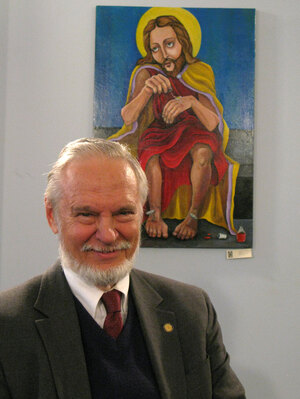 "I wouldn't want this on my wall," Stuart Jordan, an advisor for the Centre For Inquiry, which exhibits the painting in one of their offices.
Some atheists have sought to distance themselves not only from this painting, but also from the attitude behind it -- one which insists that ridicule is the best way to approach the debate surrounding atheism and religion, as opposed to open, honest and (shudder to say) gracious debate.
"It's really a national debate among people with a secular orientation about how far do we want to go in promoting a secular society through emphasizing the 'new atheism,'" Jordan mused. "And some are very much for it, and some are opposed to it on the grounds that they feel this is largely a religious country, and if it's pushed the wrong way, this is going to insult many of the religious people who should be shown respect even if we don't agree with them on all issues."
"What we wanted were thoughtful, incisive and concise critiques of religion," CFI CEO Robert Lindsay added. "We were not trying to insult believers."
Yet many prominent atheists don't seem to agree with Linday and Jordan on the matter of the proper approach.
The most famous atheists -- Richard Dawkins, PZ Myers and Christopher Hitchens -- are diametrically opposed to having a respectful debate with religious people, and are unabashedly proud of it.
"If I said to a Protestant or Quaker or Muslim, 'Hey, at least I respect your belief,' I would be telling a lie," Hitchens said. "I believe it's more honest, more brave, more courageous simply to state your own position."
Often, these particular atheists will simply feign ignorance. For example, PZ Myers got a very strong reaction when he posted a picture of a communion wafer penetrated by a nail, driven to a wall.
"People got very angry," he grumbled. "I don't know why. I mean, it's just a cracker, right?"
And therein may lie the true issue regarding this methodological divide between atheists. Individuals like Stuart Joran and Robert Lindsay seem to get it. PZ Myers and Christopher Hitchens unequivocally do not.
If Myers understood the significance of communion wafers to Catholics and Lutherans, he would understand that symbolically, they are not just crackers. Catholics and Lutherans accept communion wafers as symbolic of their messiah. In extreme cases, some Catholics and Lutherans may even still believe that, upon consecration, communion wafers transubstantiate into the very flesh of Jesus Christ.
When Myers treats that symbol contemtuously, he treats Catholics and Lutherans contemptuously.
Certainly, a great number of people have learned the hard way how little headway can be made with a debating opponent whom you seem bound and determined to treat with contempt.
The tactics Myers used in this particular case don't advance greater understanding of atheism, they simply satisfy the contempt that he and his (many, many) followers feel for religious believers.
These kinds of tactics will win few converts. As one of Richard Dawkins' "four horsemen" of atheism, one would expect that Myers would be a little more deliberate about the kind of tactics he's using.
Stuart Jordan and Robert Lindsay clearly understand this. A more moderate approach to the debate between atheism and religion earns more space for engagement between atheists and religious believers, and makes it far more likely that they can potentially win converts from religious believers.
Even Paul Kurtz, the founder of the Centre For Inquiry, apparently deeply takes issue with Dawkins, Myers, Hitchens and company.
"I consider them atheist fundamentalists," said Paul Kurtz. "They're anti-religious, and they're mean-spirited, unfortunately. Now, they're very good atheists and very dedicated people who do not believe in God. But you have this aggressive and militant phase of atheism, and that does more damage than good."
What PZ Myers, Richard Dawkins and Christopher Hitchens accomplish is nothing more or less than poisoning the well of religious debate.
Sadly, there are numerous fools who are more than happy to help them do it.