Showing posts with label Christopher Hitchens. Show all posts

Sunday, October 25, 2009

Poisoning the Well

Fundamentalist atheists pose a challenge for atheism

Some Nexus readers may recall a recent post referencing a painting called "Jesus Does his Nails", a painting that became more popular surrounding the Blasphemy Day organized earlier this October.

As it turns out, at least one prominent atheist has a bone to pick witht his particular painting.
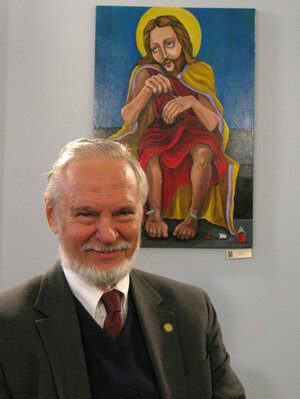
"I wouldn't want this on my wall," Stuart Jordan, an advisor for the Centre For Inquiry, which exhibits the painting in one of their offices.

Some atheists have sought to distance themselves not only from this painting, but also from the attitude behind it -- one which insists that ridicule is the best way to approach the debate surrounding atheism and religion, as opposed to open, honest and (shudder to say) gracious debate.

"It's really a national debate among people with a secular orientation about how far do we want to go in promoting a secular society through emphasizing the 'new atheism,'" Jordan mused. "And some are very much for it, and some are opposed to it on the grounds that they feel this is largely a religious country, and if it's pushed the wrong way, this is going to insult many of the religious people who should be shown respect even if we don't agree with them on all issues."

"What we wanted were thoughtful, incisive and concise critiques of religion," CFI CEO Robert Lindsay added. "We were not trying to insult believers."

Yet many prominent atheists don't seem to agree with Linday and Jordan on the matter of the proper approach.

The most famous atheists -- Richard Dawkins, PZ Myers and Christopher Hitchens -- are diametrically opposed to having a respectful debate with religious people, and are unabashedly proud of it.

"If I said to a Protestant or Quaker or Muslim, 'Hey, at least I respect your belief,' I would be telling a lie," Hitchens said. "I believe it's more honest, more brave, more courageous simply to state your own position."

Often, these particular atheists will simply feign ignorance. For example, PZ Myers got a very strong reaction when he posted a picture of a communion wafer penetrated by a nail, driven to a wall.

"People got very angry," he grumbled. "I don't know why. I mean, it's just a cracker, right?"

And therein may lie the true issue regarding this methodological divide between atheists. Individuals like Stuart Joran and Robert Lindsay seem to get it. PZ Myers and Christopher Hitchens unequivocally do not.

If Myers understood the significance of communion wafers to Catholics and Lutherans, he would understand that symbolically, they are not just crackers. Catholics and Lutherans accept communion wafers as symbolic of their messiah. In extreme cases, some Catholics and Lutherans may even still believe that, upon consecration, communion wafers transubstantiate into the very flesh of Jesus Christ.

When Myers treats that symbol contemtuously, he treats Catholics and Lutherans contemptuously.

Certainly, a great number of people have learned the hard way how little headway can be made with a debating opponent whom you seem bound and determined to treat with contempt.

The tactics Myers used in this particular case don't advance greater understanding of atheism, they simply satisfy the contempt that he and his (many, many) followers feel for religious believers.

These kinds of tactics will win few converts. As one of Richard Dawkins' "four horsemen" of atheism, one would expect that Myers would be a little more deliberate about the kind of tactics he's using.

Stuart Jordan and Robert Lindsay clearly understand this. A more moderate approach to the debate between atheism and religion earns more space for engagement between atheists and religious believers, and makes it far more likely that they can potentially win converts from religious believers.

Even Paul Kurtz, the founder of the Centre For Inquiry, apparently deeply takes issue with Dawkins, Myers, Hitchens and company.

"I consider them atheist fundamentalists," said Paul Kurtz. "They're anti-religious, and they're mean-spirited, unfortunately. Now, they're very good atheists and very dedicated people who do not believe in God. But you have this aggressive and militant phase of atheism, and that does more damage than good."

What PZ Myers, Richard Dawkins and Christopher Hitchens accomplish is nothing more or less than poisoning the well of religious debate.

Sadly, there are numerous fools who are more than happy to help them do it.


Tuesday, April 14, 2009

Don't Fall for the Big Con of Religion, Atheism

Intellectual folly, profit motive at the heart of modern religious-atheist intolerance

In an Easter Sunday op/ed article published in Britain's Daily Mail, AN Wilson offers a scathing denunciation of atheism, hyperbolically entitled "The Religion of Hatred".

In the article Wilson complains that most of the public intellectuals in Britain are allegedly atheists, the result of a secular society which has branded religious belief as "uncool" and "unsexy".

Wilson's greatest criticisms are reserved for Polly Toynbee, a columnist for The Guardian and President of the British Humanist Association.

"Of all the elements of Christianity, the most repugnant is the notion of the Christ who took our sins upon himself and sacrificed his body in agony to save our souls. Did we ask him to?" Toynbee once wrote, as Wilson quotes.

"When absolute God-given righteousness beckons, blood flows and women are in chains," Toynbee is again quoted.

Individuals like Hitchens, Dawkins and Toynbee are treated as evidence that atheists are smug, hateful and intolerant.

It's little secret that this smugness and arrogance is largely the design of these atheists. Many of them enjoy irritating religious believers into passionate denunciations of them, feeling this confirms the allegedly irrational basis on which religious belief is established and held.

When religious believers lash out at atheists in this particular fashion, they tumble into the same pitfall that these most fervent atheists fall into -- the pitfall of being threatened by other peoples' beliefs.

This inevitably leads to all kinds of folly -- including the folly of taking an individual like Christopher Hitchens, who is as committed an atheist as there ever was, on the radio to try to convince him that he should believe in God.

Just as atheists need to accept that there are reasons why the religious believe, religious believers need to accept that there are reasons why atheists do not believe. To fault them for that fails to address the simple fact that religion has evidently not met the spiritual needs of these individuals -- if indeed these individuals feel they have any spiritual needs at all.

There are plenty of atheists who are more than willing to go about their lives, believing as they believe (or rather, don't believe) relatively quietly without demanding that everyone else believe as they do.

While individuals like Hitchens and Richard Dawkins often promote themselves as spokespeople for atheism, many atheists have made public their discomfort with having such individuals represent them.

To hold up individuals such as Hitchens, Dawkins, or the Rational Response Squad as atheism's leading examples is to risk overlooking the vast majority of atheists who are content to mind their own spiritual business -- just as holding up religion's most vigorous proselytizers as leading examples risks to overlook the vast majority of believers who are content to mind theirs.

Of course such moderate views -- by either atheists or the religious -- are far from marketable. Inherent in these broad denunciations of opposing camps is the big con of a self-promoting ideologue out to enrich themselves through the sale of their next book or their next movie.

Many of these people are perfectly content to lead their masses of followers into folly if it will earn them a few extra dollars annually.

Tuesday, March 03, 2009

The World Doesn't Need a Global Gag Order


Anti-Blasphemy Resolution could silence criticism of religion

If anything is certain in the international community, it's that oppressive regimes don't appreciate criticism.

Their resentment of criticism ranges from substantive criticisms of the conduct of those states to fictional portrayals.

Iran, in particular, has complained several times over the past couple of years about (fictional) films such as 300 and The Wrestler.

Now, the Organization of Islam Congress, a 57-member coalition of states, seems to think they've found the solution to their problems. They want to push an Anti-Blasphemy Resolution through the United Nations in order to blind member states to pass anti-blasphemy laws in their countries.

They're coming uncomfortably close after passing their resolution in an important committee in the General Assembly.

Atheist activist Christopher Hitchens blamed lack of criticism by religious figures for the Anti-Blasphemy resolution.

"When Salman Rushdie was sentenced to death by a senile theocrat in Iran for writing a novel the Archbishop of Canterbury, his holiness the Pope, the Sepharddic chief Rabbi of Israel and many other religious figures joined with [Ayatollah] Khomeni not in endorsing the fatwah, but saying the problem was blasphemy," Hitchens noted. "They agreed with the Ayotollah to this extent, that the problem was not the destruction of free speech and free expression, but the hurt feelings of the religious."

Those who suspect that a formal adoption of the anti-blasphemy resolution could pose significant challenges to secular democracy may not be as paranoid as one would otherwise like to think. A law regulating what can and cannot be said about any religion would essentially obliterate the separation of church and state. The anti-blasphemy resolution may well be a precursor for such a law.

"It provides international cover for domestic anti-blasphemy laws, and there are a number of people who are in prison today because they have been accused of committing blasphemy," says the Beckett Fund's Bennett Graham. “Those arrests are made legitimate by the UN body’s [effective] stamp of approval.”

It's an obvious point. Considered the arbiter of what is and is not considered a human right, UN acceptance of arrests for "blasphemy" (however one may define it) would undermine the ability of human rights-oriented organiations to denounce them.

Even more troublesome is the fact that the Anti-Blasphemy resolution was pushed hard by the Organization of the Islamic Conference. The OIC includes among its membership countries like Iran, Syria and Saudi Arabia -- countries with some of the worst human rights records in the world.

The Anti-Blasphemy Resolution could be used to silence criticism of human rights abuses perpetrated in the name of Islam, however improper such an act may actually be.

This is especially sobering when one consdiers that, as Hitchens himself notes, OIC member Saudi Arabia has refused to sign the International Declaration of Human Rights. Not only has this country definitively rejected the notion of human rights but it's also taking part in a movement that would serve to roll back many of the freedoms contained in the Declaration.

The Anti-Blasphemy Resolution could also be used to silence critism of human rights abuses perpetrated in the name of any other religion.

The best way to make anything oppressive is to raise it above scrutiny or criticism. History has shown countless examples of what happens when political power is considered unassailable, and has also shown countless examples of what happens when the same feat is applied to religion.

The Anti-Blasphemy Resolution must not be allowed to progress any further.