Barack Obama has an opportunity to support democracy in Russia
At the end of his first visit to Russia, Barack Obama must certainly understand the opportunity that lays before him.
Perhaps more than anything else, Obama has the opportunity to not make the same mistake that George W Bush did.
Bush made the mistake of failing to make the same pro-democracy stand in Russia as he claimed he was making in Iraq. In his extremely soft approach to then-President (and now Prime Minister) Vladimir Putin, Bush played directly into Putin's hands.
"Putin is immune unless he hears a firm reaction from the top man," former World Chess champion and Soldarinost leader Gary Kasparov told Playboy Magazine in 2008. "He doesn't care about clerks, even Condoleezza Rice. Only a message from the top counts. Everything else is a game. When Putin made some of the statements that implied he could stay in office for a third term, he didn't hear anything from Bush. President Bush, you stuck up for him; you looked into his eyes. Why are you silent now? Instead, what does Putin hear? Condoleezza Rice says, 'we'd rather have him inside than outside the tent.'"
"This philosophy has never worked before," Kasparov continued. "Churchill said 'no matter how beautiful the strategy, occasionally you must check the results.' For seven years, with engagement by the West and with the influx of capitalism, Putin destroyed all democratic institutions in Russia. So we all remember that Bush said he looked into Putin's eyes. Putin looked into Bush's eyes as well. He saw he could push Bush's limits. Every time he pushes he tests the waters. He pushes and Bush does nothing."
The challenge for Obama is evident: he must not allow Putin to push his limits.
Obama has the advantage of having to deal not directly with Putin, but rather through Dmitri Medvedev.
But even amidst some seeming efforts by Medvedev to wield Presidential power himself, as opposed to merely being a lackey for the former President, Putin will remain a factor in dealings between the two leaders.
But Obama seemed to be alluding to Putin in many of his reflective comments after his visit. The allusions were far less than flattering.
"I think that Americans and Russians share an interest in strengthening the rule of law, democracy and human rights," Obama explained. "To quote my inaugural speech: ‘To those who cling to power through corruption and deceit and the silencing of dissent, know that you are on the wrong side of history; but that we will extend a hand if you are willing to unclench your fist.’ Later, speaking in Cairo, I said: ‘I have an unyielding belief that all people yearn for certain things: the ability to speak your mind and have a say in how you are governed; confidence in the rule of law and the equal administration of justice; government that is transparent and doesn’t steal from the people; the freedom to live as you choose. Those are not just American ideas, they are human rights.’"
Obama may, however, be underestimating the Russian leadership's commitment to these values.
"These ideas are shared by your President and your people," Obama continued. "I agree with President Medvedev when he says that ’some freedom is better than no freedom.’ I therefore see no reason why the ‘reset’ in relations cannot include the common desire to strengthen democracy, human rights and the rule of law."
For his own part Gary Kasparov is unimpressed by Obama's sentiments.
"Abandon the policy of double standards and call a spade a spade," Kasparov said. "Stop pretending that the current regime under Putin is democratic and thus give it a carte blanche for further abuses."
Obama's stance on Russia is a definitive improvement over George W Bush's, but some improvements clearly need to be made. Obama cannot afford to repeat the mistakes of his predecessor.

Tuesday, July 07, 2009


Setting the Record Straight is Only the First Step...
...The second is to see what the record actually tells us
With the public health care debate heating up in the United States, Republican Senate leader Mitch McConnell is continuing to peddle horror stories about the Canadian health care system.
The horror story most frequently being peddled right now is the sad story of Shona Holmes, who was unable to procure treatment by Canadian cancer specialists and was forced to borrow $100,000 in order to obtain treatment at the United States' Mayo clinic for a brain tumour.
Aside from the fact that this case is fairly similar to thousands of cases in the United States, where individuals without health insurance are forced to burden themselves with gargantuan debts in order to receive treatment -- and in some cases, shady insurance companies simply refuse to abide by the terms of their contracts with their customers.
McConnell's peddling of this story -- and others -- has raised the ire of Conservative Senator Hugh Segal, who has publicly defended Canada's health care system south of the border.
"The notion that we have some bureaucrat standing next to every doctor between the patient and that doctor is a complete creation, there is no truth to that at all," Hugh Segal told CNN. "What you have is a longer life span, better outcomes and about one-third less costs. That's what you have."
A Canadian also has superior access to health care. Once again, this is something that McConnell has failed to mention.
McConnell's comments, however, have sparked a vital debate on the role of the bureaucracy within health care.
The first thing that should be noted is that the United States wastes more money on health care bureaucracy than Canada does. this has been known since at least 2004.
But this doesn't mean that Canada's priorities regarding health care are actually in order.
When presented with the priority between providing front-line medical service -- the kind that Shona Holmes didn't receive -- and maintaining a bureaucracy to oversee the system, the priority is obvious: provision of front-line service is the purpose of the system, and it thus the priority.
Yet Canada's health care system provides no incentives for the reduction of overhead costs. Bureaucrats have no incentive to control the growth of a bureaucracy, and reduce the amount to which that bureaucracy eats away at overall funding.
Just because the Canadian health care system does a better job of controlling these costs than the American system doesn't mean that these costs aren't an obstacle to superior care.
Canadian conservatives should embrace the opportunity to defend Canadian health care against the attacks from south of the 49th parallel as an opportunity to have a debate about this topic, and the kind of reforms that could redirect vital funds from maintaining a bureaucracy toward proving front-end service.
That would go a long way toward preventing the Shona Holmses and the horror stories of tomorrow.
July 2009 Book Club Selection: Home Game, Ken Dryden & Roy MacGregor
 In a month in which Canadians across the country and the world are celebrating our wonderful country, it's only appropriate to select a book that delves deeply into the Canadian cultural imagination.
Home Game was written as something of a sequel to The Game, in which Dryden followed his final season as a professional hockey player.
Home Game, written with Roy MacGregor, follows the central theme of The Game -- a life in hockey -- and applies it to the country as a whole, and chronicles the extent to which this magnificent sport may be the greatest unifying factor in Canada.
Regardless of wherever in Canada one comes from, one thing that nearly all of us agree on is our love of the sport of hockey.
Certainly, hockey isn't all there is to Canada. But Dryden and MacGregor make the case that it's a big part of it. The millions of us who tune in to Hockey Night in Canada on a wintry Saturday evening can attest to this.
Saturday, July 04, 2009
Paul Zachary Myers: Cultural Warrior
PZ Myers decries "anti-science, anti-intellectual" culture
Speaking regarding a reported shortage of American post-graduate science students, University of Minnesota biologist accuses a rather vague culprit for the problem.
"The problem is we have a strong sub-cultural thread that is simply anti-intellectual, anti-science," says Myers.
"...In Germany, that kind of debate is considered trivial," Myers compared. "In the U.S., anti-intellectualism is not a trivial problem. We have a culture war that isn't happening in Europe."
Of course, it's extremely convenient for PZ Myers to note the existence of an alleged culture war. He, after all, is a dedicated cultural warrior.
Myers, as anyone knows, is a fierce advocate of atheism, and is among an extreme cabal of fundamentalist atheists who often attempts to argue that religion and science are incompatible.
He seems to overlook the fact that scientists as distinquished as sir Isaac Newton and sir Francis Bacon -- among many others -- considered their religious faith to be perfectly compatible with science.
(Although, to be fair, the Catholic Church didn't seem to consider science to be compatible with the religious faith of Copernicus.)
The United States, meanwhile, remains one of the countries in the western world with the highest per capita rates of religious observation -- although this has been shifted in recent years.
One would wonder what Mr Myers would have to say about this alleged "anti-science, anti-intellectual sub-cultural thread" if one were to ask him how he thought his attempts to decisively separate religion and intellectualism were questioned to his face.
That is, if he bothered to answer such a question. All too often he tends not to.
But the logical answer to this question is obvious: if tension between religion and science has really led to this alleged anti-science trend that Myers alludes to, one would have to consider Myers' efforts to stir up tension between religion and science to be at least partially responsible.
If there really is such a trend at all.
But PZ Myers would know full well if there's a cultural war happening in the United States. He's busy enough instigating and then fighting it that we can take his word for it.
The Sound of Dissent in Dixie
When leader singer Natalie Maines of the Dixie Chicks spoke out against the Iraq war on March 10, 2003, she provoked a firestorm from the American right wing.
Speaking out against the war in Iraq, Maines told an audience in London that she was ashamed the President was from Texas.
Various right-wing activists, bloggers and media figures targetted the Dixie Chicks for nothing less than complete professional destruction.
Shut Up and Sing documents how, in a period of weeks, the Dixie Chicks went from being lucrative corporate shills to being branded as un-American or anti-American.
American country music radio stations fed the fire by caving under the pressure being exerted by far-right groups like Free Republic. By complying with the boycott -- refusing to play the Dixie Chicks' music and in some cases even organizing mass destructions of their CDs -- these radio stations emboldened these activists.
Had those radio stations not been as compliant with the de facto mass censorship it's likely that the campaign against the Dixie Chicks would have failed.
What all too often escapes scrutiny in the affair is the role of then-President George W Bush in the affair. As President of the United States Bush was obligated to defend the freedoms of American citizens regardless of whether they agreed with his war or not.
A conscientious leader would have defended the Dixie Chicks despite their criticism of him. A concientious leader understands the value of freedom of speech, and understands the value of dissent.
This being said, to describe Bush as a conscientious leader would be a mistake. This is an individual who strictly adhered to a specific ideological programme even after it became evident that this programme was failing. In his approach to policy Bush proved to be far too rigid to ever be described as conscientious. Not only Americans, but countless others, continue to suffer the consequences of his failed economic policies, in particular.
Bush may not have explicitly encouraged the sustained attack on the Dixie Chicks, but in failing to speak out against it, and speak supportively of their freedom of expression, he failed to live up to his responsibility as President of the United States of America.
Unsurprisingly, John McCain -- the man who very well could have been elected President in 2000 if not for Karl Rove's infamous "secret black baby" push-polling stunt -- seemed very Presidential when grilling radio executives over whether or not they were "networks" and whether or not politically-motivated programming decisions were being made.
The contrast with Bush's "they shouldn't have their feelings hurt" comments is both obvious and profound.
On a day when Americans are celebrating their hard-earned freedoms, it's important for people all over the world to remember precisely how tenuous and how costly exercising those rights can be, and remember that political leaders have a responsibility to uphold those rights.
Thursday, July 02, 2009
Why Che Guevara Matters
When Che Guevara was executed in Bolivia in 1967, he left behind him a communist regime in Cuba, a revolutionary legacy and a bodycount in the hundreds.
Guevara's revolutionary legacy is what he's remembered best for. All too often, this legacy overshadows his historical misdeeds. The muderous and oppressive nature of the Cuban regime can be attributed as much to Guevara's influence as to Fidel Castro himself.
Yet since his death it's become apparent that Guevara's efforts have ultimately ended in failure. Communism never really took root in Bolivia. The Cuban regime has continually declined since taking power, but especially since the severing of its clintelist relationship with the now-defunct Soviet Union.
Yet, 42 years after his capture and death, Che Guevara still matters. The important question is: why?
Those who casually observed the (actually decreasing) prevalence of Che Guevara T-shirts on university campuses and counter-cultural venues would think that Guevara is merely a fashion icon.
To a certain extent, they're right.
Many of those who can be seen wearing these garments likely don't even know who Guevara was, let alone do they know about the things he did or what he stood for.
But for those who are aware of these facts, Che Guevara continues to matter, and continues to matter for extremely important reasons.
The fact is that Che Guevara is something of a political flashpoint. The debate over his iconography is fierce and combustive.
Progressives all too often embrace his image and legacy without informing themselves about what Guevara did, what he really stood for, and using their critical thinking skills to decide that perhaps Guevara isn't a figure they'd like to be associated with. Many progressives embrace his image without ever realizing that he actually stands for everything that a legitimate progressive should stand against.
Likewise, many conservatives fail to recognize the number of progressives who recognize Guevera for precisely what he was and reject him for it. As such, many conservatives use Guevara's iconography as an opportunity to denounce the progressive movement as a whole, as many did when they point to Barack Obama's campaign team's naive display of a Che poster in their office.
The debate over Guevara also provides a coherent link between the War on Terror era old the Cold War-era contentions between conservatives and progressives. Guevera can safely be villified in either era -- during the Cold War era as a communist, and during the ongoing War on Terror era as a terrorist.
It certainly helps that Guevara's actions have spoken for themselves. For those familiar with the real Che Guevara, his own actions have accomplished the act of villifying him.
But until each sides of the ideological divide acquaint themselves with the real Guevara, and recognize what Guevera truly means to each side of this divide, Guevara matters, and will continue to matter.
With any amount of good fortune, someday soon he'll matter no longer.
Wednesday, July 01, 2009
Five More Reasons to Be Proud This Canada Day
On every July 1st since 1867, Canadians have paused to reflect upon our glorious country, appreciate its position in the world, and prepare to chart the way forward.
Every good Canadian should have countless reasons why they are proud to be Canadian. Today I offer just five of the innumerable reasons why every Canadian should be proud of their country.
 1. Newfoundland - Of all Canada's provinces, Newfoundland may have been the most reluctant.
It took two referendums for Joey Smallwood to lead Newfoundland into joining Canadian Confederation in 1949. His success in doing so has enriched both Canada and Newfoundland to a magnificent degree.
Within Canada, Newfoundland has enjoyed a more prominent place in the world. Just as with Canada's other provinces, Newfoundland has been stronger with the rest of Canada than facing the world alone.
Nearly any Canadian who has ever met a Newfoundlander can attest to the tremendous generosity and wonder of their character. The heart and soul of Canada can be found in Newfoundland: a fiercely self-reliant spirit grounded in family and community.
2. The Snowbirds - Since their founding in 1954, the Snowbirds -- Canadian Forces Flying Training School Formation Team -- have consistently been judged as the best in the world.
Flying CT-114 Tutor aircraft in an era in which other teams, such as the United States' Thunderbirds fly far-more glamorous aircraft (the Thunderbirds fly F-16s), the Snowbirds have dazzled audiences across Canada and the world over with eye-popping performances of precision flying that have set the global standard of excellence.
 3. Michaelle Jean - Since becoming Canada's Governor General, Michaelle Jean has come to dazzle international leaders.
Both French President Nikolas Sarkozay and US President Barack Obama have fallen under the spell of Canada's own marvelous Michaelle.
Jean and her family fled Haiti together in 1968, leaving the oppressive regime of "Papa Doc" Francois Duvalier behind them. Jean would eventually study at the University of Montreal before departing on an international regimen of study that included the University of Florence and the Catholic University of Milan.
She would eventually marry Jean-Daniel Lafront, a separatist, and would even be spied on camera toasting a sovereign Quebec with him.
Despite the initial outrage voiced by many Canadians that such a woman would be appointed Governor General, Jean proved her loyalty and commitment to Canada.
She has also proven to be incredibly resilient under controversy. She managed to escape not only the controversy over her alleged separatist sympathies and her decision to prorogue parliament rather than hand the seat of government over to a hastily- and ill-conceived Liberal/NDP coalition.
Michaelle Jean is a shining example of modern Canada: an immigrant, highly educated, highly accomplished, and graceful under fire. Michaelle Jean is proof that there is still hope for the noble experiment that is Canadian multiculturalism.
4. The Inuit - It may be odd that in a country like Canada, which is so often associated with ice and snow, even by its own citizens, that the arctic can so often be so distant in our imaginations.
According to political scientist Michael Byers, the Inuit people represent Canada's claim to sovereignty in the arctic region. Even more than this, however, there is something distinctly Canadian about the character of these rugged and honourable people. Their resiliency and generosity of spirit reflect the best things about Canada.
Canadians should be proud to share our great land with such wonderful people, but should also remember to temper that pride with the knowledge that the Inuit have often been neglected, and often been flat-out mistreated.
 5. CFL Football - The constant speculation about the National Football League coming north has led to musing about the demise of the Canadian Football League.
One shouldn't count on it. Canadians have proven to have an apetite for football during the summer months, and many appreciate the unique nature of the Canadian game.
The rules of the CFL are designed to optimize the competitiveness of the game, not protect the NFL's highly-paid player assets. By comparison, the average CFL player is a blue collar player, working a job for the remainder of the year.
Highly-paid stars like Ricky Ray and Kerry Joseph are fewer and further between in the Canadian league.
Many University football stars who don't make it into the NFL and opt not to play arena football come north to play in the Canadian game. Some of the notable players who have come north include Mike "Pinball" Clemons, Warren Moon (who would later go on to star with the Green Bay Packers) and Doug Flutie.
Some star players return to the United States after leaving the Canadian game. Many American players, however, fall in love with Canada and decide to stay.
Each player who stays stands as a testament to the lure of our wonderful country.
As with last year's list, this is only part of what Canada means to me.
No number of items on any number of lists could ever encompass everything this country means to me.
Once again, have a happy and safe Canada Day.
Every good Canadian should have countless reasons why they are proud to be Canadian. Today I offer just five of the innumerable reasons why every Canadian should be proud of their country.
1. Newfoundland - Of all Canada's provinces, Newfoundland may have been the most reluctant.It took two referendums for Joey Smallwood to lead Newfoundland into joining Canadian Confederation in 1949. His success in doing so has enriched both Canada and Newfoundland to a magnificent degree.
Within Canada, Newfoundland has enjoyed a more prominent place in the world. Just as with Canada's other provinces, Newfoundland has been stronger with the rest of Canada than facing the world alone.
Nearly any Canadian who has ever met a Newfoundlander can attest to the tremendous generosity and wonder of their character. The heart and soul of Canada can be found in Newfoundland: a fiercely self-reliant spirit grounded in family and community.
2. The Snowbirds - Since their founding in 1954, the Snowbirds -- Canadian Forces Flying Training School Formation Team -- have consistently been judged as the best in the world.
Flying CT-114 Tutor aircraft in an era in which other teams, such as the United States' Thunderbirds fly far-more glamorous aircraft (the Thunderbirds fly F-16s), the Snowbirds have dazzled audiences across Canada and the world over with eye-popping performances of precision flying that have set the global standard of excellence.
3. Michaelle Jean - Since becoming Canada's Governor General, Michaelle Jean has come to dazzle international leaders.Both French President Nikolas Sarkozay and US President Barack Obama have fallen under the spell of Canada's own marvelous Michaelle.
Jean and her family fled Haiti together in 1968, leaving the oppressive regime of "Papa Doc" Francois Duvalier behind them. Jean would eventually study at the University of Montreal before departing on an international regimen of study that included the University of Florence and the Catholic University of Milan.
She would eventually marry Jean-Daniel Lafront, a separatist, and would even be spied on camera toasting a sovereign Quebec with him.
Despite the initial outrage voiced by many Canadians that such a woman would be appointed Governor General, Jean proved her loyalty and commitment to Canada.
She has also proven to be incredibly resilient under controversy. She managed to escape not only the controversy over her alleged separatist sympathies and her decision to prorogue parliament rather than hand the seat of government over to a hastily- and ill-conceived Liberal/NDP coalition.
Michaelle Jean is a shining example of modern Canada: an immigrant, highly educated, highly accomplished, and graceful under fire. Michaelle Jean is proof that there is still hope for the noble experiment that is Canadian multiculturalism.
4. The Inuit - It may be odd that in a country like Canada, which is so often associated with ice and snow, even by its own citizens, that the arctic can so often be so distant in our imaginations.
According to political scientist Michael Byers, the Inuit people represent Canada's claim to sovereignty in the arctic region. Even more than this, however, there is something distinctly Canadian about the character of these rugged and honourable people. Their resiliency and generosity of spirit reflect the best things about Canada.
Canadians should be proud to share our great land with such wonderful people, but should also remember to temper that pride with the knowledge that the Inuit have often been neglected, and often been flat-out mistreated.
5. CFL Football - The constant speculation about the National Football League coming north has led to musing about the demise of the Canadian Football League.One shouldn't count on it. Canadians have proven to have an apetite for football during the summer months, and many appreciate the unique nature of the Canadian game.
The rules of the CFL are designed to optimize the competitiveness of the game, not protect the NFL's highly-paid player assets. By comparison, the average CFL player is a blue collar player, working a job for the remainder of the year.
Highly-paid stars like Ricky Ray and Kerry Joseph are fewer and further between in the Canadian league.
Many University football stars who don't make it into the NFL and opt not to play arena football come north to play in the Canadian game. Some of the notable players who have come north include Mike "Pinball" Clemons, Warren Moon (who would later go on to star with the Green Bay Packers) and Doug Flutie.
Some star players return to the United States after leaving the Canadian game. Many American players, however, fall in love with Canada and decide to stay.
Each player who stays stands as a testament to the lure of our wonderful country.
As with last year's list, this is only part of what Canada means to me.
No number of items on any number of lists could ever encompass everything this country means to me.
Once again, have a happy and safe Canada Day.
Tuesday, June 30, 2009
Richard Dawkins Says It's Wrong to Indoctrinate Children...
...Unless he's the one doing the indoctrination
One of the interesting things about fundamentalist atheism is their tendency to accept the pontifications of hypocritical people at face value.
Richard Dawkins is a brilliant example of this. His vaunted "lying for Jesus" argument has become a central weapon in the rhetorical aresenals of many fundamentalist atheists despite the fact that he's been caught being dishonest using it.
Likewise, Dawkins' argument that children shouldn't be indoctrinated into religion has gained some evident traction amongst fundamentalist atheists. Why, even ABBA member Bjorn Ulvaes thinks so.
So indoctrinating children into religion is bad.
...Oh, unless it's Dawkins' and Ulvaes' religion. Then it's A-OK.
Aside from starting work on a children's book, Dawkins has sponsored a summer camp for atheists.
Dawkins says that the camps are intended to "encourage children to think for themselves sceptically and rationally."
But interestingly enough, Dawkins has made it plainly evident that, to him, thinking for oneself "sceptically and rationally" entails thinking exactly what Dawkins wants them to.
Naturally, Dawkins and company are going to pretend that the camps in question aren't about atheism, but rather merely about secularism.
"There is very little that attacks religion, we are not a rival to religious camps," says camp organizer Samantha Stein. "We exist as a secular alternative open to children from parents of all faiths and none."
So says "atheist rock star" Samantha Stein.
One wonders if Dawkins and Stein realize the extent to which the entire matter defies credulity. An "atheist rock star" accepting funds from Richard Dawkins attacking religion? Apparently we're supposed to perish the thought.
Of course, all of this is aside from the point. There's nothing wrong with parents sending their children to Dawkins' and Stein's camp if they are intent upon raising their children as atheists -- or perhaps even legitimate free-thinkers.
There's nothing wrong with teaching children about evolution or leading them in sing-alongs of "Imagine". In fact both of these -- teaching kids about science and about great music -- can be very good things.
But the least Richard Dawkins could do is stop pretending that he isn't indoctrinating these children in his religion -- atheism, which people like himself have very much transformed to a religion.
Just imagine that kind of honesty from someone who so enjoys vacuously accusing his opponents of "lying for Jesus".
The Pipe Dream is (Almost) Over for Lizzie May
Green leader concedes she can't win in Central Nova
In competing with former Liberal party leader Stephane Dion for the title of Canadian politics' greatest flip-flopper, Elizabeth May might finally have found the edge.
The leader of Canada's Green party has recently advised that she probably won't run against Conservative party deputy leader Peter MacKay in the next election. Despite previously stating she'd never run anywhere but Central Nova, May seems ready to move on to what she imagines may be greener pastures (pun intended).
It isn't as if it's any great shock. Not only has May already long been looking for another riding to run in, she had previously run in a by-election in London, Ontario.
It makes her insistence that she'd never, ever, eeeeeeever run anywhere other than Central Nova seem rather meaningless.
"I’m never running anywhere but Central Nova," May had insisted. "This is where I live and where I will always run."
Of course, this general meaninglessness is nothing new for Elizabeth May. The famed Red-Green coalition that May hatched with then-Liberal leader Stephane Dion wasn't based on any great principle. It was based on meaningless partisanship.
Certainly, May publicly espoused a desire to run against MacKay based on his party's environmental record. But considering that she was forming an alliance with a party and a leader with a worse environmental record than the Conservative party, it was impossible to take her seriously.
Even her claims to pretext were utterly meaningless.
Even May's decision to finally get (somewhat) realistic and look for a more potentially-fruitful riding to run in reflects her previous meaningless insistence that she's her party's greatest asset.
"The decision has been made that, for the next campaign, electing the leader is the top priority," May wrote to supporters. "I have agreed to run where the party decides the potential Green support is the strongest."
Even that May, as Green party leader, would decide that getting her elected is her party's top priority, is in itself utterly meaningless.
In the end, it isn't likely to manage much. Elizabeth May's dream of finding a riding in Canada where she can be elected is little more than a pipe dream. Nowhere in Canada is May likely to find a plurality of citizens willing to vote for a fringe political leader who so often insults the intelligence of Canadians.
It's simply a shame that the Green party -- an organization that very well could find a place of value within Canadian politics -- remains, and seemingly will remain, stuck with such a valueless and meaningless leader.
Other bloggers writing about this topic:
Calgary Grit - You May Be Seated
Mark Taylor - "There is Only One True Option"
Monday, June 29, 2009
The Not-So-Fine Art of Keeping Your Fucking Story Straight, For Fuck's Sake
Pro-abortion zealots can't seem to stick to one reason to try to label all anti-abortion activists as terrorists
The sad, sad story to emerge out of the assassination of Dr George Tiller only continues to unfold. Perhaps this man's martyrdom will continue into perpetuity.
In the immediate aftermath of Dr Tiller's assassination, various pro-abortion bloggers tried to pin it as squarely on the anti-abortion movement as a whole as they possibly could.
Their argument at the time was that the "abortion is murder" rhetoric employed by so many members of the anti-abortion lobby was responsible for encouraging -- perhaps even mandating -- Dr Tiller's murder.
Consider this particular passage from Mike from (ir)Rational Reasons:
But for Mike, it didn't matter. Suzanne Fortin had, in the past, argued in the "abortion is murder" vein, and so was responsible for Dr Tiller's murder.
JJ from Unrepentant Old Hippie, at the time, echoed those sentiments.
Yet when one considers a post from Unrepentant Old Hippie today, one has to recognize the extent to which their story has changed. Now, the anti-abortion lobby isn't responsible for Dr Tiller's murder as a result of "abortion is murder" rhetoric. Now, they're being held responsible because not enough anti-abortion activists have denounced the act:
As with prior incidents of violence perpetrated against anti-abortion activists, JJ herself has failed to condemn this act.
In fact, it's much, much worse than that. Compare what actually happened:
So herein lies the problem with JJ's particular line of argument: if the anti-abortion movement is responsible for the murder of Dr Tiller because too few of its members denounced the violence, how can it be that JJ and her cohorts would expect to argue that they aren't at least partially responsible for the violence against James Canfield?
They've not only failed, but refused to denounce that kind of violence in the past. They attempt to minimize it terms that are nothing less than absolutely shameful -- imagine their outrage if some anti-abortion dingus had suggested that the bullet that killed Dr Tiller had just "passed too close to his general vicinity".
But therein lies the rub. The outrage over abortion-centred violence seems extremely selective to this particular crowd. If the violence is being perpetrated against them, they milk it for maximum rhetorical advantage.
If the violence is being perpetrated against their opponents, they cheer it.
The saddest part of all is that they can't even keep their fucking story straight while they're doing it.
The sad, sad story to emerge out of the assassination of Dr George Tiller only continues to unfold. Perhaps this man's martyrdom will continue into perpetuity.
In the immediate aftermath of Dr Tiller's assassination, various pro-abortion bloggers tried to pin it as squarely on the anti-abortion movement as a whole as they possibly could.
Their argument at the time was that the "abortion is murder" rhetoric employed by so many members of the anti-abortion lobby was responsible for encouraging -- perhaps even mandating -- Dr Tiller's murder.
Consider this particular passage from Mike from (ir)Rational Reasons:
"I cannot express in words the rage I am feeling right now.Interestingly enough at least one of the individuals Mike points his spiteful finger at denounced Dr Tiller's murder in no uncertain terms.
Not just at the fact that Dr. George Tiller, an abortion provider specializing in medically-necessary late-term abortions, was murdered today. No, I am enraged by those who whipped the hatred against this man, who did everything to encourage his murder, are suddenly pretending they had nothing to do with it.
Damn them all. All of them.
Randall Terry. SUZANNE. The Catholic Church. The Army of God.
All of them. They are the same. They purposely espouse violent rhetoric, celebrate past perpetrators of violence and murderers as 'martyrs' and try to create false moral equivalence with a medial procedure and a planned premeditated murder of a 67-year-old professional, father and grandfather."
But for Mike, it didn't matter. Suzanne Fortin had, in the past, argued in the "abortion is murder" vein, and so was responsible for Dr Tiller's murder.
JJ from Unrepentant Old Hippie, at the time, echoed those sentiments.
Yet when one considers a post from Unrepentant Old Hippie today, one has to recognize the extent to which their story has changed. Now, the anti-abortion lobby isn't responsible for Dr Tiller's murder as a result of "abortion is murder" rhetoric. Now, they're being held responsible because not enough anti-abortion activists have denounced the act:
"While it would be oversimplification to suggest they’re all terrorists, there’s no doubt that the anti-abortion movement harbours a disproportionately high number of them, and too few who unequivocally condemn the violence and actively work to marginalize such people. Some call that 'giving safe haven'. I call it 'being onside'."Naturally, that brings one to the recent case of the vehicular assault on James Canfield.
As with prior incidents of violence perpetrated against anti-abortion activists, JJ herself has failed to condemn this act.
In fact, it's much, much worse than that. Compare what actually happened:
"According to witness statements gathered by police, Haver allegedly tried to strike 60-year-old protestor James Canfield with a 1991 GMC sports utility vehicle at the Planned Parenthood office on Vallombrosa Avenue. "With JJ's description of it:
"Following in the footsteps of the infamous Ed Snell, a couple of days ago in Chico California yet another old fetus fetishizing fart, writhing in the throes of an indignance high in front of the local Planned Parenthood he was harassing, was uninjured but shaken after an SUV passed in his general vicinity."Apparently, not only will JJ not condemn the violence against Canfield, but she won't even discuss the incident honestly for what it was.
So herein lies the problem with JJ's particular line of argument: if the anti-abortion movement is responsible for the murder of Dr Tiller because too few of its members denounced the violence, how can it be that JJ and her cohorts would expect to argue that they aren't at least partially responsible for the violence against James Canfield?
They've not only failed, but refused to denounce that kind of violence in the past. They attempt to minimize it terms that are nothing less than absolutely shameful -- imagine their outrage if some anti-abortion dingus had suggested that the bullet that killed Dr Tiller had just "passed too close to his general vicinity".
But therein lies the rub. The outrage over abortion-centred violence seems extremely selective to this particular crowd. If the violence is being perpetrated against them, they milk it for maximum rhetorical advantage.
If the violence is being perpetrated against their opponents, they cheer it.
The saddest part of all is that they can't even keep their fucking story straight while they're doing it.
Sunday, June 28, 2009
Christine Elliott and the (Alleged) Nadir of Red Toryism
Despite Elliott's leadership setback, red toryism will survive
If politics were merely about being nice, Christine Elliott probably would have won the Ontario Progressive Conservative leadership hands-down.
Conservative Senator Hugh Segal's endorsement of Elliott reinforces this. Segal has often focused on praising the humanity and civility of political leaders. To Seal, these are important values.
Of course, politics is not merely about being nice. Few Canadians, inside or outside of Ontario, would pretend that former Premier Mike Harris is an implicitly nice individual. Yet his endorsement of now-PC leader Tim Hudak certainly went a long way toward establishing his credentials as a "common sense conservative".
Mike Harris won two majority governments in Ontario. Hugh Segal wound up runner-up to former Prime Minister Joe Clark in the 1998 federal Progressive Conservative leadership contest.
Perhaps the lesson is that perhaps, in politics, nice guys really do finish last -- or at least that in politics, as in life, people who are too nice invariably finish last.
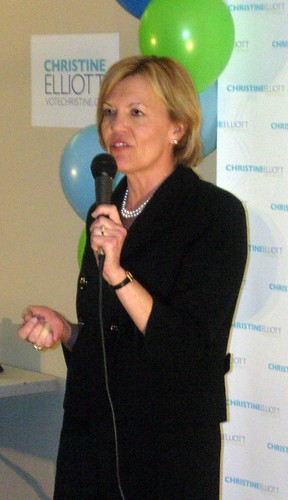 In the wake of Elliott's defeat in the Progressive Conservative leadership contest, many people -- like the Globe and Mail's Adam Radwanski --- are wondering if conservatism in Ontario, formerly a bastion of Canadian red toryism, has irrevocably taken what Brooke Jeffrey once referred to as a hard right turn.
(Jeffrey, for her own part, actually seemed perplexed by her inability to win election by labelling all of her would-be constituents in a riding she was parachuted into as racists, so maybe one should carefully consider the source.)
Hudak's ascension to the leadership of the Ontario Conservative party has many people wondering if perhaps speculation that harder forms of conservatism are needed to prevail in Ontario.
In recent years, the failures of leaders such as John Tory have largely spoken for themselves. There's a real question regarding whether or not red toryism can flourish in Ontario -- or Canada -- any longer, or if it's simply become too "Liberal-lite" to be palatable to conservative voters.
Yet those reputed to be red tories who have gotten closest to the Liberal party have shown their true political colours. In the case of Garth Turner, those colours turned out to be red. In the end however, it turned out that he wasn't a Tory.
When the former Halton MP joined the Liberal party in 2007, then-Liberal leader Stephane Dion crowed that "Tories were becoming Liberals".
Yet, as it turned out, Turner was far from a proper red tory. He lacked that key combination of fiscal conservatism and social principle that has forever properly characterized the red tory. When he finally got his first opportunity to campaign against the Harper Conservatives he chose to embrace divisive fear-based campaigning.
Prior to that, Turner attempted to divide Canadians by attempting to invent a separatist threat in Alberta.
Red toryism has forever held at its core an organic conceptualization of society -- one wherein social tradition is balanced against the public good.
Fear mongering and the creation of artificial -- and largely non-existent -- enemies is as great an insult to the principles of red toryism as one can possibly manage.
Turner had been preceded in joining the Liberal ranks by David Orchard, who had his nomination in a Saskatchewan riding overturned by Dion in favour of a hand-picked candidate who subsequently lost to Conservative Rob Clarke. When Orchard finally got his own turn in 2008, he lost as well -- and lost amidst his own fear-based attempts to campaign against the RCMP.
David Orchard, as many may recall, conceded the federal PC leadership to Peter MacKay only under the condition that MacKay wouldn't discuss unification of that party with the then-Canadian Alliance.
Orchard, for his own part, failed to recognize the value in allowing an organic political bond to develop between Canada's conservatives, and would have rather allowed the Liberal party to govern Canada in perpetuity than be caught dead dealing with the "wrong" conservatives.
If Canadian red toryism has truly reached its nadir it isn't in the defeat of Christine Elliott. Rather, it reached that nadir when those who consider themselves red tories failed to put their political principles ahead of their political vanity.
Whether or not Elliott will turn the tide of this unfortunate trend by working together with her party's new leader, and whether the hard conservatism of Tim Hudak and Mike Harris can lead the Ontario Progressive Conservative party to victory in the next election has yet to be seen.
If Hudak possesses the wisdom to make Elliott a part of his leadership plans for the party, and if Elliott can, in turn, soften the hard conservatism of Hudak and company also has yet to be seen. But it will be interesting to see.
Politics may not necessarily be merely about being nice. But it couldn't hurt to have a nice guy -- or gal -- on side, either.
If politics were merely about being nice, Christine Elliott probably would have won the Ontario Progressive Conservative leadership hands-down.
Conservative Senator Hugh Segal's endorsement of Elliott reinforces this. Segal has often focused on praising the humanity and civility of political leaders. To Seal, these are important values.
Of course, politics is not merely about being nice. Few Canadians, inside or outside of Ontario, would pretend that former Premier Mike Harris is an implicitly nice individual. Yet his endorsement of now-PC leader Tim Hudak certainly went a long way toward establishing his credentials as a "common sense conservative".
Mike Harris won two majority governments in Ontario. Hugh Segal wound up runner-up to former Prime Minister Joe Clark in the 1998 federal Progressive Conservative leadership contest.
Perhaps the lesson is that perhaps, in politics, nice guys really do finish last -- or at least that in politics, as in life, people who are too nice invariably finish last.
In the wake of Elliott's defeat in the Progressive Conservative leadership contest, many people -- like the Globe and Mail's Adam Radwanski --- are wondering if conservatism in Ontario, formerly a bastion of Canadian red toryism, has irrevocably taken what Brooke Jeffrey once referred to as a hard right turn.(Jeffrey, for her own part, actually seemed perplexed by her inability to win election by labelling all of her would-be constituents in a riding she was parachuted into as racists, so maybe one should carefully consider the source.)
Hudak's ascension to the leadership of the Ontario Conservative party has many people wondering if perhaps speculation that harder forms of conservatism are needed to prevail in Ontario.
In recent years, the failures of leaders such as John Tory have largely spoken for themselves. There's a real question regarding whether or not red toryism can flourish in Ontario -- or Canada -- any longer, or if it's simply become too "Liberal-lite" to be palatable to conservative voters.
Yet those reputed to be red tories who have gotten closest to the Liberal party have shown their true political colours. In the case of Garth Turner, those colours turned out to be red. In the end however, it turned out that he wasn't a Tory.
When the former Halton MP joined the Liberal party in 2007, then-Liberal leader Stephane Dion crowed that "Tories were becoming Liberals".
Yet, as it turned out, Turner was far from a proper red tory. He lacked that key combination of fiscal conservatism and social principle that has forever properly characterized the red tory. When he finally got his first opportunity to campaign against the Harper Conservatives he chose to embrace divisive fear-based campaigning.
Prior to that, Turner attempted to divide Canadians by attempting to invent a separatist threat in Alberta.
Red toryism has forever held at its core an organic conceptualization of society -- one wherein social tradition is balanced against the public good.
Fear mongering and the creation of artificial -- and largely non-existent -- enemies is as great an insult to the principles of red toryism as one can possibly manage.
Turner had been preceded in joining the Liberal ranks by David Orchard, who had his nomination in a Saskatchewan riding overturned by Dion in favour of a hand-picked candidate who subsequently lost to Conservative Rob Clarke. When Orchard finally got his own turn in 2008, he lost as well -- and lost amidst his own fear-based attempts to campaign against the RCMP.
David Orchard, as many may recall, conceded the federal PC leadership to Peter MacKay only under the condition that MacKay wouldn't discuss unification of that party with the then-Canadian Alliance.
Orchard, for his own part, failed to recognize the value in allowing an organic political bond to develop between Canada's conservatives, and would have rather allowed the Liberal party to govern Canada in perpetuity than be caught dead dealing with the "wrong" conservatives.
If Canadian red toryism has truly reached its nadir it isn't in the defeat of Christine Elliott. Rather, it reached that nadir when those who consider themselves red tories failed to put their political principles ahead of their political vanity.
Whether or not Elliott will turn the tide of this unfortunate trend by working together with her party's new leader, and whether the hard conservatism of Tim Hudak and Mike Harris can lead the Ontario Progressive Conservative party to victory in the next election has yet to be seen.
If Hudak possesses the wisdom to make Elliott a part of his leadership plans for the party, and if Elliott can, in turn, soften the hard conservatism of Hudak and company also has yet to be seen. But it will be interesting to see.
Politics may not necessarily be merely about being nice. But it couldn't hurt to have a nice guy -- or gal -- on side, either.
Sizing Up Conservatism's Challenges
Conservatives in Canada, US and UK face very different challenges
In a blog post on the National Post's Full Comment blog, Hugh Segal makes the case that the challenges to conservative parties being posed by elections are largely immaterial compared to the challenges being posed by the current economic times.
At a time when even conservative administrations are instituting lavish Kenyesian economic policies, it's easy for fiscal conservatives to wonder precisely what this means for conservatism and the free market:
While the election of Barak Obama as US President is being viewed by many as the nadir of conservatism, perhaps not even merely in the United States, it's important to note that other left-of-centre parties are not enjoying the same level of success.
In Britain, David Cameron isn't expected to have to fight an election against Gordon Brown and the Labour party until 2010, but the expectation is that he may win a Tony Blair-style majority government.
What remains to be seen for Harper is whether or not he can keep is majority government alive at all, let alone manage to win a majority. For Davoid Cameron, the test will be whether or not he can successfully defeat the Labour party during what is expected to be a time of economic recovery.
In the United States, meanwhile, Republicans are facing an althogether different challenge -- the challenge of not shooting themselves in the foot:
If one subscribes to a far more nuanced definition of conservatism, one still has to realize the scope of the challenge that government ownership of financial and industrial industry poses.
One way or the other, conservatives will have to address the issue of this ownership. Privatization of these industries would be a simple solution for conservatives to pursue.
Yet when government privatizes public assets or enterprises one thing that is undeniably part of the transaction is a depreciated return on the public's investment. Privatized government assets have proven to be a bargain for many private buyers for this very reason.
But considering the scope of the public investment in ownership of these industries, government has the responsibility to recover the maximum value of that investment. As Benjamin Barber pointed out to Tim Geithner, the public has absorbed a great deal of risk in helping these companies effectively "start over" (something that has made GMs batch of PR ads on this very topic very much insufferable). The public has the right to expect a return on that risky investment.
For some conservatives, this may seem far too much like government reaping profits better left for private investors. This is market conservatism ad extremis -- one that denies the reality of this particular matter to the extent of being nearly self-destructive.
Conservatives the world over, meanwhile, should be as lucky as the British Conservative party's David Cameron:
For one thing, the Canadian Liberal party hasn't managed to burn nearly as many bridges as the British Labour party. And, as Barry Cooper points out, the Conservative party isn't nearly as adept at exploiting bureaucratic survival instincts for its own political advantage as the Liberals have been.
Even beyond this particular disadvantage, that the Canadian Conservative party has embraced stimulus economics with a fervour that seems to put the lie to fiscal conservatism, many of the challenges the Tories will face will be a result of their own emergency economic policy:
What the party has not produced is a solid roadmap for its own return to the fiscal conservative principles its expected to embody. This is certainly a problem, as it leads to a glut of policy deficiencies on numerous issues:
It's easy for conservative political parties to be at their best during times of economic prosperity. They can move ahead on fiscally conservative programs without seeming callous or careless.
When times are bad, however, is when left-of-centre political parties tend to shine brightest. Canada's Conservative party hasn't led the country on any kind of a national project since sir John A MacDonald's ambitious railroad building project. This is a real problem for the party, as it leaves these opportunities to its left-of-centre opponents, who have led Canadians on national projects such as public health care.
Sadly, something in the conservative imagination tells conservatives that national projects are, in and of themselves, left-wing social engineering projects that undermine conservative values.
Yet an ambitious national project conceptualized and completed under the public-private partnership model embraces the principles of conservatives such as Segal. Such a project could be nation and enterprise at its best -- if only Canadian conservatives can muster the courage to attempt it.
There could even be opportunities to attempt such projects on an international scale:
Jeffrey Sachs will certainly be first in line to attempt to re-start his (mostly) failed policies in the developing world. But conservative governments in countries such as Canada and (by then) Britain could -- and should -- quite easily bypass individuals such as Sachs and employ the wisdom of economists such as William Easterly, whose proposed policies vis a vis foreign aid call simply scream out for the P3 model.
The various industrial and financial firms that governments now find themselves owning significant portions of could even be offered the opportunity to work off their debt to the state by investing in these kinds of programs, allowing people in developing countries to shape aid programs through market forces and helping themselves out of poverty, as opposed to waiting to be saved.
It's on this note that one must remember something that Hugh Segal would certainly want Canadian conservatives to recognize: the current political and economic climate poses serious challenges to conservatives. But with difficult challenges come fantastic opportunities.
Conservatives, in Canada and elsewhere, can benefit greatly from these challenges if they can only prove able to grow into them.
In a blog post on the National Post's Full Comment blog, Hugh Segal makes the case that the challenges to conservative parties being posed by elections are largely immaterial compared to the challenges being posed by the current economic times.
At a time when even conservative administrations are instituting lavish Kenyesian economic policies, it's easy for fiscal conservatives to wonder precisely what this means for conservatism and the free market:
"Imminent elections focus the mind. But the global intellectual challenge to those of us who consider belief in free markets an integral part of our conservatism is larger than the next or last election.Segal is making an important point by noting this.
The fact that parties of the left and centre left did not do well in recent European elections is a hint that voters do not see either an ideological culprit for the collapse of over-engineered credit structures or an ideological saviour from anti-free market apostles. What is apparent is that balance and fairness do matter and are not outside the conservative political realm."
While the election of Barak Obama as US President is being viewed by many as the nadir of conservatism, perhaps not even merely in the United States, it's important to note that other left-of-centre parties are not enjoying the same level of success.
"The political geography of each of the UK, US and Canada is vastly different. Americans have just come off two terms of Republican prominence. The UK is at the point where a Labour Finance Minister who managed during good times finds special challenges managing in different times. In Canada, what is still a fledgling Tory minority faces a more competitive Liberal opposition. So the short-term challenges for conservatives are genuine but not insurmountable. The American Republicans must be credible and engaged by the mid-terms in less than two years. Both David Cameron in the UK and Prime Minister Harper here face more pressing moments of truth."In Canada, Stephen Harper may be facing a fall election opposing a strengthened and (at least temporarily) re-engergized Liberal party led by Michael Ignatieff.
In Britain, David Cameron isn't expected to have to fight an election against Gordon Brown and the Labour party until 2010, but the expectation is that he may win a Tony Blair-style majority government.
What remains to be seen for Harper is whether or not he can keep is majority government alive at all, let alone manage to win a majority. For Davoid Cameron, the test will be whether or not he can successfully defeat the Labour party during what is expected to be a time of economic recovery.
In the United States, meanwhile, Republicans are facing an althogether different challenge -- the challenge of not shooting themselves in the foot:
"In the United States, the Obama presidency, while not flawless, is sophisticated in ways the United States has not seen before. Some conservatives, doing themselves and the Republican Party's mid-term election prospects absolutely no good, have chosen an arch ideological scream over reasoned and thoughtful engagement. With the US government now owning large chunks of the financial and industrial United States, the intellectual challenge for Republican conservatives is defining the new balance between social and economic opportunity, necessary stability and the market freedom vital to rebuild the US economy."If one reduces conservatism to the preservation of the status quo, one has to realize that government ownership of formerly private enterprise -- General Motors clearly being the most prominent example -- will have become part of that status quo.
If one subscribes to a far more nuanced definition of conservatism, one still has to realize the scope of the challenge that government ownership of financial and industrial industry poses.
One way or the other, conservatives will have to address the issue of this ownership. Privatization of these industries would be a simple solution for conservatives to pursue.
Yet when government privatizes public assets or enterprises one thing that is undeniably part of the transaction is a depreciated return on the public's investment. Privatized government assets have proven to be a bargain for many private buyers for this very reason.
But considering the scope of the public investment in ownership of these industries, government has the responsibility to recover the maximum value of that investment. As Benjamin Barber pointed out to Tim Geithner, the public has absorbed a great deal of risk in helping these companies effectively "start over" (something that has made GMs batch of PR ads on this very topic very much insufferable). The public has the right to expect a return on that risky investment.
For some conservatives, this may seem far too much like government reaping profits better left for private investors. This is market conservatism ad extremis -- one that denies the reality of this particular matter to the extent of being nearly self-destructive.
Conservatives the world over, meanwhile, should be as lucky as the British Conservative party's David Cameron:
"In the UK, Tory leader David Cameron, in embracing decentralization and more popular restraint on government excess, is true to both the Thatcherite and 'wet' side of Britain's Tory spectrum and the core centralizing myopia of 'big Government' Labour party approaches. The fact that this is done with a strong tilt to 'compassionate conservatism' provides both a spectrum-broadening base and intellectual frame for an eventual victory. But the intellectual challenge for British conservatism is being embraced head on.In facing the strengthening federal Liberal party, Stephen Harper will face a very different challenge than Cameron's.
At home, the universal kudos among critical international bodies like the OECD and World Bank for Canada's handling of the credit meltdown and US prime mortgage collapse speaking well of how Stephen Harper has managed to date. But the conservative intellectual challenge will also have to be met during the next election."
For one thing, the Canadian Liberal party hasn't managed to burn nearly as many bridges as the British Labour party. And, as Barry Cooper points out, the Conservative party isn't nearly as adept at exploiting bureaucratic survival instincts for its own political advantage as the Liberals have been.
Even beyond this particular disadvantage, that the Canadian Conservative party has embraced stimulus economics with a fervour that seems to put the lie to fiscal conservatism, many of the challenges the Tories will face will be a result of their own emergency economic policy:
"That challenge might best be described this way. If stimulus and corporate stability investments have, along with economic downturn and tax cuts, produced a short-term deficit, what are the values Tories want to sustain through this for which they seek a mandate? This is not about what any government is doing or seeks to do in the future. This is about why we want to do it."The Conservative party has provided a solid roadmap out of the current economic crisis for the country at large.
What the party has not produced is a solid roadmap for its own return to the fiscal conservative principles its expected to embody. This is certainly a problem, as it leads to a glut of policy deficiencies on numerous issues:
"National security is about domestic social and economic opportunity as well as a robust foreign and highly deployable defence capacity. It is about market freedom as an instrument of economic expansion and environmental competence. Ceding any of this ground to other parties weakens the Tory claim to a new mandate. Embracing it with clarity and intellectual integrity is what Canadians have the right to expect; it is what Conservatives under Prime Minister Harper have done when at their best. The argument to do it again has never been more compelling."Of course, therein lies the rub.
It's easy for conservative political parties to be at their best during times of economic prosperity. They can move ahead on fiscally conservative programs without seeming callous or careless.
When times are bad, however, is when left-of-centre political parties tend to shine brightest. Canada's Conservative party hasn't led the country on any kind of a national project since sir John A MacDonald's ambitious railroad building project. This is a real problem for the party, as it leaves these opportunities to its left-of-centre opponents, who have led Canadians on national projects such as public health care.
Sadly, something in the conservative imagination tells conservatives that national projects are, in and of themselves, left-wing social engineering projects that undermine conservative values.
Yet an ambitious national project conceptualized and completed under the public-private partnership model embraces the principles of conservatives such as Segal. Such a project could be nation and enterprise at its best -- if only Canadian conservatives can muster the courage to attempt it.
There could even be opportunities to attempt such projects on an international scale:
"Kamalesh Sharma, the Commonwealth Secretary-General, recently called for an economic and social contract to ensure that the recovery does not make things worse for developing countries. In every country, the way out of the recession will be bracketed by concerns about market freedom and social justice. The challenge for Tories in the anglosphere is the same--a coherent plan for the way ahead that embraces both pillars underlying successful societies, market freedom and genuine equality of opportunity. Deserting either of these is not a rational way ahead in any industrialized country, and certainly not appropriate for conservatives of any variety."As the world navigates its course out of the current economic crisis and its accompanying recession, we will also be confronted with opportunities to change the way we have approached policy issues such as foreign aid.
Jeffrey Sachs will certainly be first in line to attempt to re-start his (mostly) failed policies in the developing world. But conservative governments in countries such as Canada and (by then) Britain could -- and should -- quite easily bypass individuals such as Sachs and employ the wisdom of economists such as William Easterly, whose proposed policies vis a vis foreign aid call simply scream out for the P3 model.
The various industrial and financial firms that governments now find themselves owning significant portions of could even be offered the opportunity to work off their debt to the state by investing in these kinds of programs, allowing people in developing countries to shape aid programs through market forces and helping themselves out of poverty, as opposed to waiting to be saved.
It's on this note that one must remember something that Hugh Segal would certainly want Canadian conservatives to recognize: the current political and economic climate poses serious challenges to conservatives. But with difficult challenges come fantastic opportunities.
Conservatives, in Canada and elsewhere, can benefit greatly from these challenges if they can only prove able to grow into them.
Saturday, June 27, 2009
Tim Hudak Pulls Out Ontario Conservative Leadership
Debate over Human Rights Commissions should intensify with new Tory leader
The leadership of the Ontario Progressive Conservative party has been decided today, as Tim Hudak has emerged the winner.
The new leadership of the party began to take shape earlier this afternoon when Randy Hillier was eliminated from contention.
At that time Hudak had been leading, with Frank Klees in second place. Projected front runner Christine Elliott collected the third most first-choice ballots.
The principal issue in the leadership race turned out to be the Ontario Human Rights Commission.
Hudak and Hillier favour abolishing the OHRC. Elliott and Klees prefer to reform them.
Elliott and Klees were adamant that a call to abolish the OHRC would give the next election to the Dalton McGuinty Liberal party. Hudak had pulled no punches in denouncing such sentiments as "Liberal-lite".
 "If you want to put the election on a platter for the Liberals, the best way to do so is to run from our conservative principles and try to be Liberal-lite," he told Klees during a debate. "If you take on McGuinty's position, then you're Liberal lite."
Klees, at the time, cautioned that wedge politics have been and would continue to be, disastrous for the party.
"I don't want to go back to those days when wedge issues were the flavour of the day, when we were picking fights with every stakeholder group in this province," he explained. "That's why we're not in government today."
Apparently, neither Elliott nor Klees, who had both denounced Hudak's plans to abolish the OHRC, considered the issue pivotal enough to bow out of the race in order to ensure the other reformist candidate a path to victory.
That may speak volumes about how seriously either of these candidates considered the OHRC. Both had come out in favour of reforming -- as opposed to abolishing -- the Commissions, although only Klees had actually outlined a program for reform.
Elliott may have also had any fiscal conservative credibility she wanted to lay claim to kneecapped by the deficits currently being run by her husband, federal Finance Minister Jim Flaherty. Regardless of whether or not these deficits are his fault -- and they aren't -- he will, nonetheless, have to wear them for a long time to come.
Perhaps his wife will as well.
One can only hope that Tim Hudak heeds Frank Klees' warning about wedge politics, and that Hudak finds a suitable place for Christine Elliott within the new party leadership.
Other bloggers writing about this topic:
Russ Campbell - "Tim Hudak Wins Ontario PC Leadership Race"
Dr Roy Eappen - "New Tory Leader in Ontario: Tim Hudak"
Brian Gardiner - "Hudak Wins"
The leadership of the Ontario Progressive Conservative party has been decided today, as Tim Hudak has emerged the winner.
The new leadership of the party began to take shape earlier this afternoon when Randy Hillier was eliminated from contention.
At that time Hudak had been leading, with Frank Klees in second place. Projected front runner Christine Elliott collected the third most first-choice ballots.
The principal issue in the leadership race turned out to be the Ontario Human Rights Commission.
Hudak and Hillier favour abolishing the OHRC. Elliott and Klees prefer to reform them.
Elliott and Klees were adamant that a call to abolish the OHRC would give the next election to the Dalton McGuinty Liberal party. Hudak had pulled no punches in denouncing such sentiments as "Liberal-lite".
"If you want to put the election on a platter for the Liberals, the best way to do so is to run from our conservative principles and try to be Liberal-lite," he told Klees during a debate. "If you take on McGuinty's position, then you're Liberal lite."Klees, at the time, cautioned that wedge politics have been and would continue to be, disastrous for the party.
"I don't want to go back to those days when wedge issues were the flavour of the day, when we were picking fights with every stakeholder group in this province," he explained. "That's why we're not in government today."
Apparently, neither Elliott nor Klees, who had both denounced Hudak's plans to abolish the OHRC, considered the issue pivotal enough to bow out of the race in order to ensure the other reformist candidate a path to victory.
That may speak volumes about how seriously either of these candidates considered the OHRC. Both had come out in favour of reforming -- as opposed to abolishing -- the Commissions, although only Klees had actually outlined a program for reform.
Elliott may have also had any fiscal conservative credibility she wanted to lay claim to kneecapped by the deficits currently being run by her husband, federal Finance Minister Jim Flaherty. Regardless of whether or not these deficits are his fault -- and they aren't -- he will, nonetheless, have to wear them for a long time to come.
Perhaps his wife will as well.
One can only hope that Tim Hudak heeds Frank Klees' warning about wedge politics, and that Hudak finds a suitable place for Christine Elliott within the new party leadership.
Other bloggers writing about this topic:
Russ Campbell - "Tim Hudak Wins Ontario PC Leadership Race"
Dr Roy Eappen - "New Tory Leader in Ontario: Tim Hudak"
Brian Gardiner - "Hudak Wins"
Winning The Greed Game
Presented in a style similar to Lifestyles of the Rich and Famous, Super Rich: The Greed Game chronicles the methods by which the super rich have become super richer.
According to BBC documentary maker Robert Preston, the secret to this has been leveraging -- the act of borrowing in order to invest. Leveraging allows individuals and businesses to quickly flip their investments for quick profit, allowing individuals and businesses to generate a tremendous amount of profit off of comparatively small amounts of money.
Preston offers as his test case the example of buying a house. If an individual pays 10,000 pounds sterling down on a house that costs 100,000 pounds, he can effectively double his money by selling the house if it increases in value by only 10%. Clearly, the more money one has to invest in this process -- and clearly, possessing more money brings with it additional borrowing power -- the more one can profit. Leveraged investments of thousands of pounds offers the prospect of thousands of pounds. Leveraged investments of millions of pounds offers the prospect of millions of pounds in profit. If one has the ability to borrow billions, this process quickly begins to speak for itself.
By paying off the loans taken out for these leveraged investments quickly, these investors pay a minimum of interest on those loans. Leveraging allows investors who otherwise wouldn't be able to invest so lavishly to maximize the profitability of investing comparatively small amounts of money.
The eagerness of exporting countries to loan their money led to an environment in which cheap credit could quickly be obtained to invest in increasingly expensive commodities.
With credit flowing so freely, debt quickly accumulated. Low interest rates set by Alan Greenspan at the US Federal Reserve enticed many otherwise cautious investors to play their hands more liberally.
The same pressure applied by the most zealous supporters of market economics on Bill Clinton in order to get him to scrap his promised reforms was applied to the British Labour Party's Gordon Brown. Brown, who had once promised tax reforms to shift tax burden toward the super rich (which, one should keep in mind, is a comparatively tiny fraction of any country's population) instead embraced policies that have favoured the super rich.
There is, of course, an economic risk that comes with adopting tax policies that provide a country's wealthiest citizens with an incentive to leave for countries with more favourable policies. That being said, however, it's important to keep in mind that the wealthy primarily have a single rule: invest where profit can be made.
Tax policies that no longer favour the super rich as stringently as before do little to change the mean economic value of any particular country. So long as a country remains prosperous and its economy vibrant, the incentive for the wealthy to invest will remain. After all, not even the super rich can increase their rich if they decline to invest where profit can be made.
In many cases, leveraged investments produce little in the way of new wealth. In many ways, leveraged investment is a predatory practice that simply takes advantage of immediate opportunities.
One perverse element of leveraged investments is the transfer of risk from investors to lenders. An investor who gambles and loses may seek refuge in bankruptcy, which will significantly reduce a creditor's ability to collect that debt.
Low interest rates didn't merely make leveraged investing more attractive. It also reduced to incentive to save money -- after all, saved money accumulates interest at the same rate that borrowed money increases. With little money being saved, the subprime loan scheme was introduced in which loans and mortgages were extended to people with few borrowing prospects -- sometimes using predatory practices -- then sold off to other investors for profit.
In many cases, these deals were structured in ways that only one or two investors would see any return on their investment. This has become known as the derivatives market. Only under the best-case scenario would all of these investors recieve a return on their investment. In most cases, someone was bound to take a loss. In the worst-case scenario, however -- the one that eventually emerged -- everyone loses, except for the initial lender.
It's hard to feel sorry for many of these individuals. Any informed investor buying in to mortgage derivatives should know full well the magnitude of the risk they're accepting. Then again, considering the deceptive and predatory practices of many subprime lenders, it's questionable how many details many of these investors were privy to.
Manipulation of investment rating systems -- which could be better described as willful negligence -- contributed to the deception of many investors. Investments that due to their very nature were extremely risky were instead promoted as risk-free.
The costs to investors has been fairly minimal compared to the costs to the borrowers who were enticed into taking out these subprime loans. Many subprime borrowers have given up hope of things as comparatively simple as home ownership.
In the wake of an economic collapse precipitated by these practices, it's perhaps insulting to realize that the luxury goods market hasn't been affected by the recession. The super rich enjoy spectacular degrees of security because the scale of their investment renders them "too big to fail" (in the increasingly unpopular parlance), legislators are obligated to issue bailouts in order to avoid a complete economic evaporation.
To add insult to injury, many of the same investors who have helped precipitate the current recession are actually in a position to profit from it. The need to correct a regulatory deficit in the global economy is beyond evident.
Friday, June 26, 2009
Michael Ignatieff Gets It
Michael Byers probably never will
As the world is momentarily distracted from the events occuring in Iran by the death of Michael Jackson, Liberal leader Michael Ignatieff took some time to address a rally in support of the Iranian protesters and protesting the Iranian theocracy's treatment of them.
"The Iranian regime did not anticipate you," Ignatieff told the assembled crowd.
"They thought they could suppress democratic rights and bully, beat and intimidate the people of Iran and the world would not care, the world would not watch," he continued. "They did not anticipate you."
"I'm proud of Canadians who understand that when others cannot stand up we must stand up for them, and when they cannot speak we have to speak for them."
"Canada has known for a long time this was a regime with which we could not have normal relations," Ignatieff announced.
"This is a regime that allowed Zahra Kazemi to be beaten to death in prison. This is a regime that has denied the reality of the Holocaust, that's attempted to develop nuclear weapons, Long before the election we knew this was a regime with which we could not have normal relations."
Ignatieff spoke volumes about the wisdom of Canadians. Indeed, Canadians have long known that we cannot afford our full respect to the Iranian regime.
Well, not all Canadians know this. University of British Columbia Political Scientist and erstwhile NDP candidate Michael Byers doesn't know this.
Some may recall Byers' January 1, 2008 op/ed article in the Toronto Star, in which he criticized Prime Minister Stephen Harper for recalling Canada's ambassador to Iran.
The reason for the recall was Iran's incredibly malfeasant handling of the Kazemi case. Zahra Kazemi, as many Canadians will recall, as a Canadian-Iranian dual citizen who was beaten and raped to death in an Iranian prison for the grievous crime of photographing a political protest.
Michael Ignatieff gets it. He knows that Canada cannot have a regular diplomatic relationship with this country.
But Michael Byers doesn't. Michael Byers believes Iran should be able to rape and beat Canadian citizens to death, develop nuclear weapons for the purpose of threatening its neighbours, hold Holocaust denial conferences, whip homosexuals while insisting they don't exist, and brutally stamp out political dissent without so much as a hiccup in diplomatic relations between our two countries.
Michael Ignatieff knows better. Michael Ignatieff gets it. Michael Byers probably never will.
Thursday, June 25, 2009
You Say "Redneck" As If It's a Bad Thing
Gilles Duceppe helps rehabilitate an old slur
In the wake of Parti Quebecois leader Pauline Marois' recent four-point plan for Quebec sovereignty, only Bloc Quebecois leader Gilles Duceppe would dare criticize opponents of Quebec sovereignty for not agreeing to stick their heads in a noose.
As some may recall, one of Marois' plan points was to accrue extra power to Quebec over language policies.
Speaking at a St Jean Baptiste day event, Duceppe decried the Grit and Tory leaders' unwillingness to do precisely that by extending the powers of Bill 101 over federally-regulated industries in Quebec.
"They acted like rednecks," Duceppe complained.
"[Ignatieff and Harper], two leaders of the most important political parties in Canada, refused to admit that French should be the working language for institutions under the federal jurisdiction," he sniffed.
Of course, nothing could factually be further from the truth. In fact, Harper and Ignatieff have actually remembered what Duceppe has forgotten: that Canada has two official languages, French and English, from coast-to-coast, and that Quebec is no exception to this.
This is a point that likely isn't lost on Duceppe, but merely one that he chooses to overlook.
"They should take the example of the political leaders in Quebec who stand up for the rights instead of playing rednecks in Ottawa like they did a few days ago," Duceppe would later add.
Although Duceppe would decline to add what he really seems to be thinking -- that the federal government should decline to stand up for the rights of Canadians in Quebec if they should just so happen to be English-speaking Canadians.
Seriously, fuck them.
If standing up for the rights of all Qubeckers, French- and English-speaking alike, makes Stephen Harper and Michael Ignatieff rednecks, then Duceppe clearly has a skewed image of that stereotype: not of rednecks as ignorant or racist, but as individuals who don't pick and choose whose rights they stand up for. It's a label that they can wear with pride.
The racist ideology that lays at the heart of Duceppe's party, meanwhile, is a wart that he doesn't display with much pride, even on St Jean Baptiste Day. Unshockingly, Duceppe wants that to remain one of Quebec's better-kept secrets.
Other bloggers writing about this topic:
Chucker Canuck 2.0 - "Gilles Duceppe is a Sour, Old Geezer Who Needs the Pastures"
Tuesday, June 23, 2009
The Complex Puzzle of Canadian Federalism
Daifallah suggests more "sex" is the answer for federalism
Writing an op/ed on the National Post's Full Comment blog, Adam Daifallah hits on what amounts to a key observation about the continuing battle between separatism and federalism in Quebec:
Federalism, he concludes, simply isn't glamour enough to compete with separatism on an emotional level:
Earlier this year, Ken Dryden gave a series stirring speeches during a speaking tour in which he urged Canadians to be ambitious.
But that Canadians would need to be urged to be ambitious at all is, in itself, a troubling prospect. Canadians have been raised being told about the innumerous accomplishments of their country: in wartime, in science and technology, in art, and just in the act of building a country in one of the most inhospitable climates in the world.
Of all the things Canadians may lack, ambition shouldn't be one of them. But if federalists outside of Quebec can't muster that level of ambition, one cannot fault federalists within Quebec for failing to aspire to the same standard.
That conservatism, especially in the post-Duplessis era of the province, has been transformed into a fervour for separatism. The Bloc Quebecois and Parti Quebecois have earned their bread and butter by assembling a fragile electoral coalition of socialist progressives and cultural conservatives with nationalism acting as a glue to bind them. They've managed to seduce each with disturbing ease.
But even more disturbing is the blatant partisanship of many federalist organizations in Quebec. The director of one pro-Liberal federalist group recently lauded the decline in Conservative polling numbers as a good thing -- even though the Bloc Quebecois has made gains at the Tories' expense.
Somehow, partisanship between Canada's two political contenders has somehow come to mean more than fighting separatists -- otherwise, such individuals would be plenty content to combine forces with the Tories and fight the Bloc together.
But this would forget that many Quebeckers consider themselves Quebeckers first, and Canadians second:
Federalist Quebeckers left themselves vulnerable to charges that Canada was simply an economic relationship between the various provinces. As Lucien Bouchard and Jacques Parizeau seemed to suggest in 1995, such a relationship could be reestablished with something so simple as admitting Quebec into NAFTA -- even if they simplified the ease with which Quebec could be admitted.
Only when it became apparent that the Referendum campaign was sliding disastrously in the direction of the separatists did federalists -- from across the country -- appeal to the emotions of Quebeckers with a massive rally in Montreal.
Daifallah clearly makes the case that in the complex puzzle of Canadian federalism, one key piece -- emotion -- is clearly missing.
In order to put Canada's separatist demons to bed for good, Canadians have to find the will to be a little more emotional about their country -- at least at a few times when an international hockey championship isn't on the line.
Writing an op/ed on the National Post's Full Comment blog, Adam Daifallah hits on what amounts to a key observation about the continuing battle between separatism and federalism in Quebec:
Federalism, he concludes, simply isn't glamour enough to compete with separatism on an emotional level:
"With apologies to Lisa Raitt, the biggest problem with federalism in Quebec is that the arguments in its favour are inherently unsexy. Who isn't at least mildly intrigued by the idea of founding a new country? It conjures up all sorts of romantic notions and fuzzy feelings. Defending federalism is defending the status quo -- which is almost always more difficult.Sadly, the appeal to "how great things could be" may not only be lacking in federalists in Quebec.
In the debate over Quebec's place in Canada, federalist forces will always be starting a few steps behind. In politics, emotion moves people, not ideas. Federalism is the greatest system of organizing government the world has seen. Yet Quebec federalists have continually failed to put forward an emotionally compelling alternative case to compete with the idealistic discourse of the sovereignists. 'Look how great things are' can't compete with 'Think of how great things could be.'"
Earlier this year, Ken Dryden gave a series stirring speeches during a speaking tour in which he urged Canadians to be ambitious.
But that Canadians would need to be urged to be ambitious at all is, in itself, a troubling prospect. Canadians have been raised being told about the innumerous accomplishments of their country: in wartime, in science and technology, in art, and just in the act of building a country in one of the most inhospitable climates in the world.
Of all the things Canadians may lack, ambition shouldn't be one of them. But if federalists outside of Quebec can't muster that level of ambition, one cannot fault federalists within Quebec for failing to aspire to the same standard.
"I attended law school in Quebec City for three years. Part of my reason for doing so was to better understand Quebec and its political dynamic. I had been told that in order to truly appreciate Quebec politics, one must recognize that it is really two provinces: Montreal, and everywhere else. This proved to be true.But one also has to keep in mind that the conservatism of Quebec City and its locales has been badly perverted.
Quebec City is an ethnically homogeneous, culturally conservative city that sees itself as the epicentre of francophone North America -- and it is. It is confident in itself and in the status of the French language; there are so few English speakers that the Anglo 'menace' is not apparent. I'm convinced this fact is partly the source of its conservatism."
That conservatism, especially in the post-Duplessis era of the province, has been transformed into a fervour for separatism. The Bloc Quebecois and Parti Quebecois have earned their bread and butter by assembling a fragile electoral coalition of socialist progressives and cultural conservatives with nationalism acting as a glue to bind them. They've managed to seduce each with disturbing ease.
But even more disturbing is the blatant partisanship of many federalist organizations in Quebec. The director of one pro-Liberal federalist group recently lauded the decline in Conservative polling numbers as a good thing -- even though the Bloc Quebecois has made gains at the Tories' expense.
Somehow, partisanship between Canada's two political contenders has somehow come to mean more than fighting separatists -- otherwise, such individuals would be plenty content to combine forces with the Tories and fight the Bloc together.
But this would forget that many Quebeckers consider themselves Quebeckers first, and Canadians second:
"The francophone students I encountered at law school were generally confident, proud people who, while firmly attached to Quebec, were not strongly motivated by the sovereignist cause. It would be inaccurate to say they felt a strong attachment to Canada. Their loyalty first and foremost was to Quebec and likely always will be. But I never got the impression that there was a burning desire to forge ahead with the sovereignist project and hours of discussions confirmed this. Indeed, I only encountered one student who openly admitted he would take up arms and was willing to die for Quebec sovereignty.Yet, while the conditions that may spark cultural agitation between Quebec and English Canada remain low, Daifallah notes that the risk of such agitation is almost always present:
These young people didn't grow up knowing Rene Levesque and don't hold grudges toward English Canada. Like many young people today, they are less attached to borders and the concept of nationality in general. With the rise of the Internet and social networking websites, the link between language and culture and territory has been broken. One can correspond, watch and read news and live in French just about anywhere now, not just on Quebec territory."
"In theory, then, all this should be good news for federalism. However, support for sovereignty in the polls remains constantly at 40% and above. Linguistic and political tensions have been low for at least the past decade. But the next time there is any sort of provocation or crisis, that number could easily grow to over 50% again. Why?Simply put, federalists in Quebec spend far too much time appealing to the rational intellects of Quebeckers -- not in and of itself a bad idea -- and not enough time appealing to emotion.
The reasons are many. Nationalist sentiment in Quebec will never completely die. Respect for the federal and provincial division of powers can keep passions at a low ebb. But the federalist camp has never made a serious and gripping case for Canada in Quebec. They have been too timid, too lazy or unwilling to tackle the sovereignist storyline head-on. Until this changes, there will never be a serious dent in support for sovereignty. The intensity of the passion for the sovereignist cause may be dissipating, but sovereignty continues to be the default option for disgruntled Quebecers. Making Quebecers realize that both federalism as a form of government and Canada as a country are sexy -- in part due to Quebec's being a part of it -- is the only way to change that."
Federalist Quebeckers left themselves vulnerable to charges that Canada was simply an economic relationship between the various provinces. As Lucien Bouchard and Jacques Parizeau seemed to suggest in 1995, such a relationship could be reestablished with something so simple as admitting Quebec into NAFTA -- even if they simplified the ease with which Quebec could be admitted.
Only when it became apparent that the Referendum campaign was sliding disastrously in the direction of the separatists did federalists -- from across the country -- appeal to the emotions of Quebeckers with a massive rally in Montreal.
Daifallah clearly makes the case that in the complex puzzle of Canadian federalism, one key piece -- emotion -- is clearly missing.
In order to put Canada's separatist demons to bed for good, Canadians have to find the will to be a little more emotional about their country -- at least at a few times when an international hockey championship isn't on the line.
Monday, June 22, 2009
And They Wonder Why No One Takes Them Seriously
PETA promoting "revolutionary veganism" with Guevara's granddaughter
When an organization is as cozy with domestic terrorists as People for the Ethical Treatment of Animals has been, one shouldn't be shocked when they cozy up to the grand daughter of one of history's most infamous terrorists.
 In one of the most recent examples of how radical an organization it really is, PETA has tapped Lydia Guevara, the granddaughter of Che Guevara -- of T-shirt fame -- to pose semi-nude in an ad campaign promoting a "vegetarian revolution".
One may be tempted to suspect that PETA is just another bunch of hucksters seeking to profit Guevara's revolutionary legacy without really knowing anything about it.
But considering the organization's past, the likelihood is that they know exactly what Che Guevara was about, and simply doesn't care.
The innumerous atrocities perpetrated by Guevara are well known by those who haven't been seduced by a romanticized version of the man. When Guevara died in 1967 he died with the blood of hundreds of people on his hands. He summarily executed 156 Cuban officials upon the overthow of the Batista regime. He was known for jailing and murdering homosexuals. He ordered rock music banned in Cuba, and opposed free elections under any circumstances whatsoever.
(He, like Fidel Castro, knew he and his ideological cohorts would lose.)
A historical record like that would dissuade almost any self-respecting organization from appealing to his image.
PETA, however, has never been an organization that respects itself. Nor have they ever shied way from supporting terrorists themselves.
Anyone who has ever seen the PETA episode Bullshit! knows all about the story of Rodney Coronado, an individual who has been involved in many incidents of violent protest. PETA donated nearly $50,000 to Coronado's defense fund, an amount that amounts to nothing less than complete condonation of his activities.
PETA either tacitly approves of the tactics that Guevara used to help establish communism in Cuba, or is simply naive enough to buy into his image.
One expects that kind of naivete from Lydia Guevara. She certainly didn't fail to deliver.
“I talked about it with my family before hand," Guevara says. "The name of my grandfather means I can fight for worthwhile causes which I believe in.”
Which apparently includes appearing in a PETA ad wearing nothing but camouflage fatigues, a red beret and a bandolier of carrots. She's attractive enough to pull off the look, but one would wonder how Guevara would feel about her raised fist in the ad if she stopped to think about the intimidation tactics Guevara used against those amongst his own relatives who didn't share his revolutionary fervour.
Oops.
Not that one would expect PETA to have retained any capacity for shame at this point, but the tragedy of 24 years of Lydia Guevara's brainwashing is absolutely palpable.
When an organization is as cozy with domestic terrorists as People for the Ethical Treatment of Animals has been, one shouldn't be shocked when they cozy up to the grand daughter of one of history's most infamous terrorists.
In one of the most recent examples of how radical an organization it really is, PETA has tapped Lydia Guevara, the granddaughter of Che Guevara -- of T-shirt fame -- to pose semi-nude in an ad campaign promoting a "vegetarian revolution".One may be tempted to suspect that PETA is just another bunch of hucksters seeking to profit Guevara's revolutionary legacy without really knowing anything about it.
But considering the organization's past, the likelihood is that they know exactly what Che Guevara was about, and simply doesn't care.
The innumerous atrocities perpetrated by Guevara are well known by those who haven't been seduced by a romanticized version of the man. When Guevara died in 1967 he died with the blood of hundreds of people on his hands. He summarily executed 156 Cuban officials upon the overthow of the Batista regime. He was known for jailing and murdering homosexuals. He ordered rock music banned in Cuba, and opposed free elections under any circumstances whatsoever.
(He, like Fidel Castro, knew he and his ideological cohorts would lose.)
A historical record like that would dissuade almost any self-respecting organization from appealing to his image.
PETA, however, has never been an organization that respects itself. Nor have they ever shied way from supporting terrorists themselves.
Anyone who has ever seen the PETA episode Bullshit! knows all about the story of Rodney Coronado, an individual who has been involved in many incidents of violent protest. PETA donated nearly $50,000 to Coronado's defense fund, an amount that amounts to nothing less than complete condonation of his activities.
PETA either tacitly approves of the tactics that Guevara used to help establish communism in Cuba, or is simply naive enough to buy into his image.
One expects that kind of naivete from Lydia Guevara. She certainly didn't fail to deliver.
“I talked about it with my family before hand," Guevara says. "The name of my grandfather means I can fight for worthwhile causes which I believe in.”
Which apparently includes appearing in a PETA ad wearing nothing but camouflage fatigues, a red beret and a bandolier of carrots. She's attractive enough to pull off the look, but one would wonder how Guevara would feel about her raised fist in the ad if she stopped to think about the intimidation tactics Guevara used against those amongst his own relatives who didn't share his revolutionary fervour.
Oops.
Not that one would expect PETA to have retained any capacity for shame at this point, but the tragedy of 24 years of Lydia Guevara's brainwashing is absolutely palpable.
The Whininess of Whiners And Their Enablers
Liberal party unwillingness to accept responsibility for its own defeat reinforced by "experts"
One of the disappointing institutional character traits to emerge out of the Liberal party's christening of itself as "Canada's natural governing party" has been an unwillingness on the party's part to accept responsibility for its own defeats.
Over the past three years, the Liberal party and its supporters have rarely hesitated to blame its last two electoral defeats on something other than itself -- anything other than itself.
They blamed the NDP for competing against them and winning seats that would otherwise be won by Liberals. They blamed the RCMP for announcing an investigation into a leak involving a taxation decision on income trusts. They blamed CTV for airing an interview which revealed Stephane Dion's inability to use the English language functionally.
But an opinion article appearing in the Victoria Times Colonist written by Carleton University's Andrew Cohen reveals a disturbing tendency by partisan "experts" to peddle these excuses under the guise of their expertise.
Cohen's article is a feverish mish-mash of what-ifs, ands, or buts, suggesting that Dion may have won the election if not for that dastardly Mike Duffy, just as Paul Martin may have won the 2005/06 campaign if not for the dastardly RCMP:
Cohen seems to overlook the fact that Paul Martin and Ralph Goodale had declined to launch an inquiry into the allegations. When one considers that criminal charges were laid in the affair, Goodale and Martin's decision was grossly irresponsible. It took the NDP's Finance Critic, Judy Wasylycia-Leis, writing a letter of complaint to the RCMP to get the investigation launched.
If Goodale and Martin had done the responsible thing and launched a probe before the election, the RCMP investigation would have likely already been underway by the time the election began.
In other words, even if the RCMP investigation was the Liberal party's undoing, it was their own doing in the first place.
This is before one even mentions the fact that the Liberal party was already extremely vulnerable to charges of corruption after the ground-shaking revelations of the Gomery Inquiry into the Sponsorship Scandal. They knew it well enough to threaten then-Opposition Leader Stephen Harper with a lawsuit for so much as speaking about the implications of the scandal for the Liberal party.
Harper wisely told the Liberal party to stuff a sock in it.
Likewise, Cohen seems to overlook the fact that, as it pertains to Dion's language issues, Canadians -- citizens of an officially bilingual country, and Cohen may want to remember that -- had a right to know. When the matter was discussed a few days later on Mike Duffy Live, the story was Dion's language issues.
Cohen, himself a Journalism professor, would know full well that if the false starts were the story, the rest of the interview is not part of that story and would be discussed later, if at all.
Cohen goes on to lob accusations that Duffy received his Senate seat as a reward for the allegedly-scandalous Dion segment -- Green party Elizabeth May, herself no stranger to self-indulgent whining, has also suggested that Duffy received his seat as a reward for a media hit job on her. He tries to bolster his case by noting that Duffy has been particularly partisan since being appointed, attending various party fundraisers, and noting that Pamela Wallin hasn't done the same.
Yet Cohen would also be overlooking the fact that Duffy realistically showed no such fervour for partisanship during his career as a journalist, although he was often accused of partisanship by each side of Canada's partisan divide.
It isn't at all as if Mike Duffy ever wrote an op/ed column making excuses for the Conservative party's electoral defeats -- which is more than can be said for certain journalism professors.
One of the disappointing institutional character traits to emerge out of the Liberal party's christening of itself as "Canada's natural governing party" has been an unwillingness on the party's part to accept responsibility for its own defeats.
Over the past three years, the Liberal party and its supporters have rarely hesitated to blame its last two electoral defeats on something other than itself -- anything other than itself.
They blamed the NDP for competing against them and winning seats that would otherwise be won by Liberals. They blamed the RCMP for announcing an investigation into a leak involving a taxation decision on income trusts. They blamed CTV for airing an interview which revealed Stephane Dion's inability to use the English language functionally.
But an opinion article appearing in the Victoria Times Colonist written by Carleton University's Andrew Cohen reveals a disturbing tendency by partisan "experts" to peddle these excuses under the guise of their expertise.
Cohen's article is a feverish mish-mash of what-ifs, ands, or buts, suggesting that Dion may have won the election if not for that dastardly Mike Duffy, just as Paul Martin may have won the 2005/06 campaign if not for the dastardly RCMP:
"The Canadian Broadcast Standards Council conducted a review. The council is a self-regulatory body comprising more than 720 Canadian radio and television stations. It administers the industry's broadcast code of conduct.The fact that millions of other Canadians understood Steve Murphy's question to Dion perfectly well seems to be lost on Cohen. As does the fact that if one of the political leaders running to be Canada's Prime Minister is severely hampered in his ability to use of one Canada's official languages, the public has the right to know about this.
Its two reports, which were released recently and largely ignored by the media, criticized CTV for breaching the code, a finding CTV strenuously rejected. That was revealing.
But what's more revealing is what this little saga tells us about how things are done in this country. It's about politics, ethics and maybe ambition, too.
On CTV Atlantic, the council concluded that Murphy asked a question that was 'confusing, and not only to a person whose first language is other than English.' It said that Murphy mixed tenses (past and present) and moods (subjunctive and indicative). In other words, Dion was justifiably puzzled.
In light of the badly worded question, which Murphy could have clarified, the panel called the restarts "a courtesy" to Dion. It also said repeating questions isn't unusual in broadcasting and particularly justified here, given Murphy's convoluted question.
Moreover, because Murphy never refused Dion's requests to restart the interview, Dion had reason to believe that the embarrassing footage would not be used.
On Duffy's broadcast, the council's judgment was harsher. It called his performance unfair and unbalanced. It said that Duffy misrepresented the views of one of his guests, Liberal MP Geoff Regan. In the end, Duffy breached the industry's code of ethics.
Is all this a grammarian's revenge, Miss Thistlebottom in full flight? A silly parsing of sentences? A regulator's punctilious dressing down on decorum? Does it really matter how Dion was treated by CTV, particularly by Mike Duffy?
Actually, yes, particularly in a country where the RCMP might well have determined the outcome of the 2006 election, when it announced an investigation, in mid-campaign, into allegations of irregularities on the part of finance minister Ralph Goodale. It caused a sensation. The Liberals lost that election; no charges materialized.
Last October, polls suggested the Liberal party's ascent stalled after the interview. While we cannot say if Dion's momentum would have brought his party victory, it isn't impossible.
In other words, CTV may have thrown the election to the Conservatives. In running the embarrassing outtakes, it reinforced an image of Dion as incomprehensible and indecisive."
Cohen seems to overlook the fact that Paul Martin and Ralph Goodale had declined to launch an inquiry into the allegations. When one considers that criminal charges were laid in the affair, Goodale and Martin's decision was grossly irresponsible. It took the NDP's Finance Critic, Judy Wasylycia-Leis, writing a letter of complaint to the RCMP to get the investigation launched.
If Goodale and Martin had done the responsible thing and launched a probe before the election, the RCMP investigation would have likely already been underway by the time the election began.
In other words, even if the RCMP investigation was the Liberal party's undoing, it was their own doing in the first place.
This is before one even mentions the fact that the Liberal party was already extremely vulnerable to charges of corruption after the ground-shaking revelations of the Gomery Inquiry into the Sponsorship Scandal. They knew it well enough to threaten then-Opposition Leader Stephen Harper with a lawsuit for so much as speaking about the implications of the scandal for the Liberal party.
Harper wisely told the Liberal party to stuff a sock in it.
Likewise, Cohen seems to overlook the fact that, as it pertains to Dion's language issues, Canadians -- citizens of an officially bilingual country, and Cohen may want to remember that -- had a right to know. When the matter was discussed a few days later on Mike Duffy Live, the story was Dion's language issues.
Cohen, himself a Journalism professor, would know full well that if the false starts were the story, the rest of the interview is not part of that story and would be discussed later, if at all.
Cohen goes on to lob accusations that Duffy received his Senate seat as a reward for the allegedly-scandalous Dion segment -- Green party Elizabeth May, herself no stranger to self-indulgent whining, has also suggested that Duffy received his seat as a reward for a media hit job on her. He tries to bolster his case by noting that Duffy has been particularly partisan since being appointed, attending various party fundraisers, and noting that Pamela Wallin hasn't done the same.
Yet Cohen would also be overlooking the fact that Duffy realistically showed no such fervour for partisanship during his career as a journalist, although he was often accused of partisanship by each side of Canada's partisan divide.
It isn't at all as if Mike Duffy ever wrote an op/ed column making excuses for the Conservative party's electoral defeats -- which is more than can be said for certain journalism professors.
Saturday, June 20, 2009
The Inherent Contradiction of the French Foreign Legion
The French Foreign Legion is one of the great dilemmas of the military world.
The Foreign Legion is considered an elite force, yet it's made up of various misfits and adventurers from around the world. Made up of would-be adventurers and various individuals seeking a second chance at life, the Foreign Legion is the ultimate military luxury: a highly-skilled, highly-trained force that, for all intensive political purposes, is entirely expendable.
Friday, June 19, 2009
Ralph Klein Should Shut Up
Klein's criticism of Ignatieff contradicted by fact
Speaking recently in Calgary, former Alberta Premier Ralph Klein had some words for Liberal leader Michael Ignatieff:
Kindly shut up.
 "Ignatieff, I think he's playing a game," Klein speculated. "He says all the right things, especially when he's in Alberta and in British Columbia, he says whatever the population desires.
"So what I think he should do is keep his mouth shut," he added.
Klein insists that Ignatieff is talking out of opposite sides of his mouth on opposite sides of the country -- particularly as it relates to the Alberta oilsands.
"For instance, [in the West] he says the oilsands are a good thing," Klein later continued. "In Ottawa he says something different."
Yet when one examines Michael Ignatieff's actual statements regarding the oil sands, one finds a very different trend.
On January 22 of this year, Ignatieff spoke about the oilsands in Montreal, defending them to a Quebec audience.
"The stupidest thing you can do (is) to run against an industry that is providing employment for hundreds of thousands of Canadians, and not just in Alberta, but right across the country," Ignatieff said.
Ignatieff went on to explain the amount of influence the oilsands give us with our closest neighbour. "We provide more oil to the United States than Saudi Arabia. That changes everything," he mused. "It means that when the Prime Minister of Canada goes into the White House, he gets listened to, in ways that Canadian Prime Ministers have not been listened to before."
Before Ralph Klein starts denouncing Michael Ignatieff as duplicitous on the issue of the oilsands, the least he could do is actually get acquainted with what Ignatieff actually has to say on the issue.
Speaking recently in Calgary, former Alberta Premier Ralph Klein had some words for Liberal leader Michael Ignatieff:
Kindly shut up.
"Ignatieff, I think he's playing a game," Klein speculated. "He says all the right things, especially when he's in Alberta and in British Columbia, he says whatever the population desires. "So what I think he should do is keep his mouth shut," he added.
Klein insists that Ignatieff is talking out of opposite sides of his mouth on opposite sides of the country -- particularly as it relates to the Alberta oilsands.
"For instance, [in the West] he says the oilsands are a good thing," Klein later continued. "In Ottawa he says something different."
Yet when one examines Michael Ignatieff's actual statements regarding the oil sands, one finds a very different trend.
On January 22 of this year, Ignatieff spoke about the oilsands in Montreal, defending them to a Quebec audience.
"The stupidest thing you can do (is) to run against an industry that is providing employment for hundreds of thousands of Canadians, and not just in Alberta, but right across the country," Ignatieff said.
Ignatieff went on to explain the amount of influence the oilsands give us with our closest neighbour. "We provide more oil to the United States than Saudi Arabia. That changes everything," he mused. "It means that when the Prime Minister of Canada goes into the White House, he gets listened to, in ways that Canadian Prime Ministers have not been listened to before."
Before Ralph Klein starts denouncing Michael Ignatieff as duplicitous on the issue of the oilsands, the least he could do is actually get acquainted with what Ignatieff actually has to say on the issue.
Wednesday, June 17, 2009
Joyce Arthur Says the Anti-Abortion Movement is Drinking Champagne...
...Yet she's the one making a toast
Let it never be said that Joyce Arthur doesn't have a gift for arriving late to the party.
This evening in Vancouver, Arthur's Abortion Rights Coalition of Canada will join with numerous other pro-abortion groups in order to rally in the memory of the assassinated Dr George Tiller -- only a mere three weeks after he was killed, and 12 days after his funeral.
But the protest isn't merely about Dr Tiller's death. It's also about promoting the opening of more facilities that will offer late-term abortion in Canada.
“It’s a scandal that women are forced to travel to Kansas for these procedures,” Arthur says.
Arthur insists that the idea that late-term abortions are ever performed on healthy fetuses is a misconception. “People think there are women out there who are having late abortions so they can fit into their prom dresses,” she says.
One would expect -- one would certainly hope -- that there aren't any women making the decision regarding late-term abortion frivolously. But one would also wonder if individuals like Arthur would be in favour of placing legal restrictions on late-term abortion.
You know, just to make sure these women aren't just in it for the prom.
But, as anyone who has followed the abortion debate in Canada knows, this is apparently a non-starter. Joyce Arthur and her fellows in the pro-abortion movement would never accept any law in regards to abortion.
Oddly enough, not only do Arthur and her cohorts oppose setting any kind of legal limit on late-term abortions, but they also oppose legally protecting a doctor's right to refuse to perform abortions they deem unethical. They do this even as they propose measures that would make that protection necessary.
But there's a deeper issue underlying the Vancouver rally aside from just Arthur and her cohort's unwillingness to accept legislation that they insist would actually change nothing.
Arthur has joined a chorus of crazed voices -- including this tool -- who blame the entire anti-abortion movement for Dr Tiller's murder.
“We thought it was import to honour [Dr Tiller] here because it’s not just an American issue. We had shootings here in the 1990s. We see similar hateful rhetoric here," Arthur insists. “They might be condemning the murder in public, but privately they’re drinking champagne. There’s a lot of that sentiment around that he deserved what he got.”
Yet interestingly enough, though Arthur insists that it's the anti-abortion movement who are drinking champagne to Dr Tiller's death, it seems that Joyce Arthur is proposing a toast to his memory.
There's nothing wrong with that.
But one has to wonder if Arthur is also secretly proposing a toast to the rhetorical club the pro-abortion movement wants to transform his death into.
Subscribe to:
Posts (Atom)