
Showing posts with label Book Club. Show all posts
Showing posts with label Book Club. Show all posts
Tuesday, February 16, 2010
February 2010 Book Cub Slection: Gretzky to Lemieux, Ed Willes
Remembering one of Canada's greatest sporting triumphs
With Canada set to begin its quest for Olympic gold in men's hockey, it seems entirely fitting that February's Nexus of Assholery book club selection is Grezky to Lemieux: The Story of the 1987 Canada Cup.
The 1987 Canada Cup is remembered by many to be among the best hockey ever played. It featured a star-laden Team Canada line-up, led by Wayne Gretzky, Mario Lemieux and Mark Messier, confronting the famed KLM line of Vladimir Krutov, Igor Larionov and Sergei Makarov.
The tournament boiled down to a nail-biting three-game showdown between Canada and the Soviet Union, with two of the games going to overtime, including an epic double-overtime game two.
The '87 Canada Cup wasn't simply a triumph of Canadian hockey over its once-dominant Soviet counterpart: it was also the nail in the coffin of Soviet dominance. By late 1987, the futility of the Soviet squad at Piestany, Czechoslovakia, signal the rise of a new era of international parity, with countries like Sweden, Finland and the United States establishing themselves as legitimate hockey powers on the world stage.
The '87 Canada Cup was a game-breaker for international hockey. Now, in order to regain Olympic gold, Canada will need to re-capture the inspiration harnessed by Wayne Gretzky and Mario Lemieux in order to triumph against not one or two, but three other strong contenders for Olympic primacy.


Sunday, January 10, 2010
January 2010 Book Club Selection: Reconciliation, Benazir Bhutto
When Benazir Bhutto was assassinated, a crucial ray of light in the Islamic world was snuffed out.
Bhutto's party, the Pakistani People's Party, was on the verge of an electoral victory, and an opportunity to form the government after numerous efforts by General Pervez Musharrif to thwart that.
Reconciliation provided a vision of Islam that was needed vitally not only at the time of its publishing, but especially today.
If the central arguments of Bhutto's book -- that Islam actually bestows inalienable rights upon Muslims and non-Muslims alike, that Islam mandates democracy, and that Islam is mandated to be religiously inclusive -- can take firmer hold in the Muslim world, it could prove to be the "killer app" that defeats militant Islam on a global scale.
Bhutto's message seems to be needed just as much now, in the wake of failed terrorist attacks that have directed the eyes of reactionary elements toward Islam as a whole. An understanding that the violent political ideology followed by individuals such as Umar Farouk Abdulmutallab does not represent Islam as a whole is need now as much as it ever has been.
Benazir Bhutto not only offers that message but, sadly, she also died for it.
Wednesday, December 09, 2009
December 2009 Book Club Selection: The Conservative Soul, Andrew Sullivan
 Andrew Sullivan offers chicken soup for the conservative soul
It's no great secret that Andrew Sullivan really dislikes Sarah Palin. His aversion to Palin has proven to be extremely embarrassing for Sullivan himself -- he was one of the originators of the "Bristol Palin as mother of young Trig" travesty -- but even audiences that may be expected to approve of his critical attitude toward Palin have tired of it.
But reading The Conservative Soul, it isn't hard to figure out why Sullivan would so dislike and distrust Palin.
In the book, Sullivan writes a great deal about fundamentalists, and the negative impact they've had on conservative political thought. Sullivan defines fundamentalism as the belief that one knows absolute truths about the world and intends to act upon them.
Palin's recent unfunny encounter with the chronically-unfunny Mary Walsh gives a good example of Palin's political fundamentalism. She tells Walsh, appearing as Marg Delahunty, to "have faith that common sense conservatism can be plugged into Canadian politics".
Sullivan wisely warns conservatives that the true nature of conservatism is one that comes with a healthy element of doubt: the proper conservative doesn't believe they know all the truths about the world, and dedicates themselves to the search for the truth.
Likewise, Sullivan warns conservatives to beware of anyone -- conservative, liberal or otherwise -- who claims to have all the right answers. The historical record of such individuals is far, far from encouraging. When such individuals do not produce folly, they produce tyranny instead.
Andrew Sullivan's Palin-related antics aside (and, naturally, fully considered), The Conservative Soul should, nonetheless, be considered vital reading for any political thinker, especially conservatives.
Tuesday, November 17, 2009
November 2009 Book Club Selection: Attention Deficit Democracy, James Bovard
 In Attention Deficit Democracy, James Bovard outlines the way that an unprecedented growth in the size of American government -- under Democrats and Republicans -- has been accompanied by the reign of structural dishonesty over American politics.
Bovard notes that this dishonesty harms politics by promoting cynicism that encourages citizens to disengage from politics. This disengagement and lack of attention to politics allows governments to grow beyond the ability of the citizenry to control it.
Bovard envokes Thomas Hobbes' description of big government as "Leviathan" to describe what Barry Cooper would describe as the embedded state.
Just as Cooper remains a semi-peripheral figure in Canadian political thought, so does Bovard, who associates not with the Republican or Democratic parties, but rather with the Libertarian Party.
Strains of libertarian thought run deeply through Attention Deficit Democracy. This shouldn't be surprising. Libertarian politics require a level of citizen autonomy that demands honesty from government and politicians.
Tuesday, October 20, 2009
October, 2009 Book Club Selection: It's the Regime, Stupid!, Barry Cooper
 Barry Cooper challenges presumptions of Canadians
One year ago this week, Canadians were getting accustomed to the reality of another Stephen Harper government, as well as another minority.
In It's the Regime, Stupid!: A Report From the Cowboy West on Why Stephen Harper Matters, Barry Cooper lays out his case for viewing Harper as a historic Prime Minister.
Cooper argues that Canada's regime -- defined as the entrenched political culture of a country, defining who is entitled to govern, by what means they are chosen, and what for -- is changing. He embraces the argument that a country's regime tends to coalesce around its economic centre. He argues that as Western Canada becomes the economic engine of the company, so will they also become its political engine, defining the values according to which the country will be governed.
As David Warren recently noted, Cooper doesn't seem to think Harper's tenure as Prime Minister is the source of these changes, but rather a symptom of them.
If this is truly the case, one is led to ponder what, precisely, this will mean for Canada.
There has been a good deal of talk recently about the emergence of a new "natural governign party" in Canada. The arguments Cooper presents in his book -- a great deal of it about how the politics of public virtue combined with the notion of the Liberal party as the "natural government" to create a sense of entitlement that led to the theft of hundreds of millions of dollars for the direct benefit of the Liberal party.
This should lead Canadians to wonder if having a natural governing party is really something they want at all.
Thursday, August 20, 2009
August 2009 Book Club Selection: Open & Shut, John Ibbitson
 John Ibbitson makes case for open politics in Canada
Open & Shut: Why America Has Barack Obama and Canada Has Stephen Harper, draws more than a few conclusions that many Canadians wouldn't be entirely happy with.
Ibbitson lays out the case that the United States is essentially more democratic than Canada, and that Canada could never have a Prime Minister like Barack Obama unless we make some serious changes to our electoral system.
More than anything, Ibbitson points to the American system of primary elections, in which nominees for offices such as the President or state Governor are chosen by the people through an electoral process.
What emerges is a real possibility for "underdog" candidates like Barack Obama to triumph over "inevitable" candidates like Hilary Clinton to get their chance at the Presidency -- and, in the process, help galvanize the issues that are really on the citizenry's mind.
As Preston Manning recently pointed out in a Globe and Mail op/ed, many unexpected parties are experimenting with primary elections within systems that naysayers would insist aren't designed to accommodate them.
Ibbitson also makes the case for an elected judiciary in Canada, noting that most objective accounts credit the American judiciary -- which is elected, and even the President-appointed Supreme Court has greater democratic mechanisms in place -- with a stronger record than its Canadian counterpart.
There are some proposals in Open and Shut that many Canadians wouldn't be nearly so eager to follow. Ibbitson calls for an ever-greater level of integration with the United States that would make a great many Canadian nationalists uneasy.
But the ideas contained in Open and Shut are important, and very worth discussing. The Globe and Mail has convened a public policy wiki for that very purpose -- one that should warrant the attention of any Canadian concerned about the future of the country.
Tuesday, July 07, 2009
July 2009 Book Club Selection: Home Game, Ken Dryden & Roy MacGregor
 In a month in which Canadians across the country and the world are celebrating our wonderful country, it's only appropriate to select a book that delves deeply into the Canadian cultural imagination.
Home Game was written as something of a sequel to The Game, in which Dryden followed his final season as a professional hockey player.
Home Game, written with Roy MacGregor, follows the central theme of The Game -- a life in hockey -- and applies it to the country as a whole, and chronicles the extent to which this magnificent sport may be the greatest unifying factor in Canada.
Regardless of wherever in Canada one comes from, one thing that nearly all of us agree on is our love of the sport of hockey.
Certainly, hockey isn't all there is to Canada. But Dryden and MacGregor make the case that it's a big part of it. The millions of us who tune in to Hockey Night in Canada on a wintry Saturday evening can attest to this.
Sunday, May 17, 2009
May 2009 Book Club - Get 'Em All! Kill 'Em!, Bruce Wilshire
Genocide born in the depths of insecurity
As the Nexus continues its observance of the 15th anniversary of the genocide in Rwanda, Bruce Wilshire's Get 'Em All! Kill 'Em! provides an opportunity to attempt to understand more deeply the psychological underpinnings of a genocide.
According to Wilshire, genocides are often born out of mortal terror -- they are started by populations that consider themselves at risk of being destroyed, and in a perverse fashion they embark upon genocides not out of mere hatred for their targets, but because they're convinced that destroying their targets is the only way to ensure their own survival.
While this could very well hold true for many of those who participate in a genocide as foot soldiers, history leads us to suspect that it probably doesn't absolve the leaders.
Adolph Hitler -- the engineer of history's prototypical genocide -- clearly had political motivations at the heart of his quest to destroy European Jews. He empowered himself to a stark degree by fear-mongering against Jews. Whether or not he felt that they really constituted a mortal threat is a matter of historical dispute.
In Rwanda, the move to kill politically moderate Hutus -- a move that removed political rivals to many Hutu leaders, particularly military leaders -- is itself very telling.
While Wilshire's analysis is fascinating on a macro-level when applied to the population as a whole, it is less convincing on a micro-level when applied to the leaders of a genocide.
Tuesday, April 14, 2009
April 2009 Book Club Selection - Shake Hands With the Devil, Romeo Dallaire

Dallaire recounts story of Rwandan genocide
As the world stops, hopefully frequently, over the next few months to commemorate the 15th anniversary of the Rwandan genocide, books like Shake Hands With the Devil will continue to be increasingly important.
The film recounts Lt General (ret) Romeo Dallaire's experiences during the genocide in often-excrutiating and sickening detail. It pulls the reader from cover to cover, forcing them to take note of the atrocities that unfolded in Rwanda and, more importantly, the international community's failure to stop it.
Reading the book, one could only imagine how passionately Dallaire would argue Rwanda's case before the UN general assembly, had he ever been given the opportunity to do so.
Also striking is the generosity of many lower-level officials in both the UN and foreign militaries -- contributing key pieces of equipment to the mission, even when ammunition and fuel were hard to come by. It's marvelous how often the values of ground-level officers, such as the American officer who gave the mission surplus American Armoured Personnel Carriers, fail to match up with their superior officers and leaders (American leaders had noted that 500,000 Rwandans would have to die to justify risking a single American life).
Shake Hands With the Devil is certainly not a book to savour -- it's shocking, and can even be a little dispiriting. But it's an important book to digest, so readers can come to understand how important it is that horrors such as the Rwandan genocide never be allowed to happen again.
Sunday, January 11, 2009
January 2009 Book Club Selection - Fighting For Canada, Diane Francis
 With Parliament set to resume in only a few weeks time and the pro-coalition crowd still trying to push the coalition forward, it's more important now more than ever that Canadians understand what happens when Canadian politicians take Quebec Separatists lightly.
Fighting for Canada is a book that is regarded as entirely unwelcome by those who would most blatantly appease the separatists. This is because the book exposed the struggle preceding, during and following the 1995 sovereignty referendum for precisely what it was: a near-cataclysmic intersection of manipulation by the Parti and Bloc Quebecois and complacency of the federalist forces in Quebec.
Fighting for Canada is a book that will remind many Canadians -- those who remain wary of the dangers that Quebec separatism continue to pose to Canada -- of the folly of giving Quebec separatists too long a leash, or of allowing them to get too close.
Wednesday, December 10, 2008
December 2008 Book Club Selection, The Rights Revolution, Michael Ignatieff

Canada a world leader on human rights in various ways
With Michael Ignatieff poised to be the next leader of the Liberal party -- even if merely by default -- his ideas are about to become of greater consequence to the country than ever before.
Fortunately, the man who would be Opposition Leader -- and, if he and his party have their way, Prime Minister -- has plenty of ideas, and has published plenty of books to back them up.
Perhaps one of the most relevant -- if a person were forced to choose -- are some of his ideas on human rights. While some of his prior ideas have proven to be very controversial -- such as musings often mischaracterized as support for torture -- Ignatieff is a man who understands the concept.
In 2000, Ignatieff gave the inaugural Vincent Massey lecture on the topic of human rights. That lecture has since been published in the form of a book.
In the book, Ignatieff notes the importance of rights speech in Canadian society and explains how this focus on individual and group rights in Canada has led the country into a key position of leadership in regards to human rights. He argues that Canadian rights speech has become a model emulated elsewhere in the world.
As such, the Canadian government will always have important global responsibilities vis a vis human rights. It hasn't always lived up to these responsibilities -- such as when Jean Chretien refused to even discuss the matter with Chinese President Jiang Zemin except under extremely cloaked terminology -- but it maintains these responsibilities nonetheless.
The Rights Revolution provides a valuable road map for the Canadian global human rights agenda -- one that leaders of all stripes could benefit from, and one that Ignatieff himself should be held to if he ever succeeds in his Prime Ministerial ambitions.
Thursday, November 20, 2008
November 2008 Book Club Selection: Dead Centre, Jamey Heath
 Heath argues for ideological hegemony of New Democrats
In the wake of the 2005/06 federal election, many Liberals were pointing the fingers of blame at Jack Layton and the NDP, blaming them for the election of Stephen Harper and the Conservative party.
The NDP first helped the Conservatives defeat the Liberal government, then helped them form the election by winning seats away from the Liberals and by splitting the vote in many ridings won by the Conservatives.
Dead Centre author Jamey Heath has one thing to say about all this:
Bullshit.
In Dead Centre, Heath insists that the Liberal party was the author of its own defeat. It was the Liberal party that concocted and managed the Sponsorship Scandal. It was the Liberal party that failed far too many times to satisfy progressive Canadians. It was the Liberal party that had exhausted Canadian patience with it.
Heath insists that the NDP should not stop trying to win votes and seats away from the Liberal party, but that the NDP should work toward the goal of supplanting the Liberal party as the engine of progressive political action in Canada. Furthermore, by supplanting the Liberal party, the NDP would have the opportunity to govern and would no longer have to settle for half-measures from the Liberals.
To many New Democrats, Heath's prescription seems to be just what the doctor ordered. But for a great many Canadians, Heath's vision is far from fully benign.
What Heath imagines clearly entails the further polarization of Canadian society. He insists that what he describes as the "meaningless middle" must be destroyed, as left-wingers seek a full "loaf", rather than merely crumbs.
Heath also indulges himself in his own fair share of historical revisionism, when he insists that Pierre Trudeau should be considered an NDP, rather than Liberal, icon.
The logic of embracing Trudeau -- considered by previous New Democrat scribes such as Walter Stewart to be a massive disappointment in terms of progressive policy -- seems far from iron-clad.
Dead Centre presents an interesting vision for Canada, but also reminds those Liberals who imagine that the NDP can be convinced to fold up and accept defeat so the Liberal party can govern the country indefinitely.
No, the NDP is in Canadian politics to win -- as they should be.
Thursday, October 23, 2008
October 2008 Book Club Selection: Dreams From My Father, Barack Obama
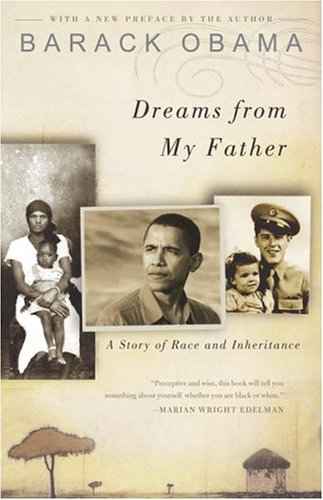
Can Obama organize a community for all Americans?
(OK. The October book club selection is really late, but this book has been hard to come by. Guess why? -ed.)
With Barack Obama seemingly on the verge of winning the Presidency, many observers -- both within the United States and otherwise -- may wonder precisely what it is that makes him tick.
Dreams From My Father actually makes it abundantly clear.
First off, one may wonder how many American liberals might be uncomfortable with the reality that Obama actually reflects a politically incorrect aspect of African American culture -- the unfortunate stereotype of the absentee father.
Obama spends the book equally divided between three different tasks: chronicling his experience growing up without his father, his experiences as a community organizer in Chicago, and his direct confrontation with his identity as an African American in Kenya.
Most interestingly, the path Obama seems to be following to the White House -- unless the numerous undecided voters still at stake in the 2008 Presidential election intercede -- seems to closely resemble that of Harold Washington, the first African American mayor of Chicago.
Interestingly, Obama's presidency may pose the same dilemma to young black leaders as Washington's mayoral reign posed to Obama. While trying to organize numerous iniatives for the betterment of Chicago's Altgeld neighbourhood Obama came face to face with the complacency of older, more entrenched black leaders who believed they had a "direct line to the mayor's office".
An Obama Presidency may fool many black leaders into a similar sense of complacency -- causing them to forgo community measures in favour of expected initiatives from higher on. In the end, it's possible that an Obama Presidency may serve to undermine community-level initiatives.
The other interesting element of Obama's personality that emerges is a wariness of his father's thwarted ambitions. Having studied in America -- in Hawaii and at Harvard -- Barack Obama Sr expected to become a prominent man in Kenya. Yet a seeming lack of political savvy wound up with Barack Sr falling out of favour with the Kenyan leadership resulted in the promises of such prominence vanishing before his very eyes.
Encounters with various family members in Kenya underscored an expectation that Obama will accomplish great things of Obama. That and intra-family rivalries may be serving to intensify the personal pressure on Obama to emerge victorious from this presidential campaign.
Dreams From My Father is a fascinating, thought-provoking read. It's well worth the time to finish before the election on November 4, if one can find the time.
Tuesday, September 09, 2008
September 2008 Book Club Selection: Hard Call, John McCain

McCain presents profiles in leadership
With three months remaining in the 2008 American Presidential Election, there's no time like the present to further acquaint oneself with the qualities of the candidates.
When considering which of the two candidates -- Republican John McCain and Democrat Barack Obama -- would be better suited to the oft-called leadership of the free world, it's useful to have a book such as Hard Call to look to.
Hard Call divides the art of making good decisions into six categories: awareness, foresight, timing, confidence, humility and inspiration.
As McCain explores these elements he profiles a diverse group of figures, from Gerald Ford to Wayne Gretzky, from Anwar Sedat and Menachim Begin to (predictably) Abraham Lincoln.
McCain even takes some time out to critique himself -- reserving the blame for his capture by North Vietnamese for himself alone.
The book chronicles great decisions made during the struggle for civil justice in Liberia, the space race and in various forms of business. Each and every one has some historical significance.
As President, McCain would be called upon to make many decisions with historical ramifications. Hard Call provides its readers with the very internal handbook McCain would use to make them.
Sunday, August 10, 2008
August 2008 Book Club Selection: Mediapolitik, Lee Edwards
Modern media revolutionizing politics
 With the eyes of the world now firmly on China as the Beijing 2008 Summer Olympic Games are officially underway, many people the world over are appraising how the Chinese state reacts to the extra attention the Olympics inevitably bring.
In particular, bans restricting the internet access of journalists covering the games have proven to be especially controversial -- and disturbing.
While Mediapolitik actually covers the ever-increasing influence of journalism on politics -- and inevitably vice versa -- on a global scale, Edwards' examination of China is particularly prescient as the Chinese state takes unprecedented steps to control the flow of information into and out of China during the Olympic games.
In particular, Edwards takes note of the Chinese efforts to control coverage of the Tiananmen Square massacre. In an age where it was increasingly being realized that most people around the world -- and within rapidly industrializing China -- often seemed to need to see an event on television before it was deemed to be real, China suppressed knowledge of the massacre simply by restricting media coverage of it within the country.
While still unable to control the international media to the extent that it's succeeded in the leadup to the Beijing games, Deng Xiaoping was able to minimize the internal damage to his regime by, at least for a time, transforming Tiananmen Square from a horrific event witnessed by the world at large into the stuff of rumour and urban legend within China.
Even where the massacre was recognized to have occurred, Xiaoping succeeded in writing it off as an incident provoked by malcontented subversives. What unfolded within China was a masterful act of media manipulation, even as Chinese efforts to discourage discussion of the event on the global stage unfolded as a masterful act of diplomatic manipulation.
The comparison between what is being accomplished in China now and Edwards' account of what was accomplished 20 years ago goes to show how sophisticated and masterful the Chinese have become in manipulating the news media.
With the eyes of the world now firmly on China as the Beijing 2008 Summer Olympic Games are officially underway, many people the world over are appraising how the Chinese state reacts to the extra attention the Olympics inevitably bring.In particular, bans restricting the internet access of journalists covering the games have proven to be especially controversial -- and disturbing.
While Mediapolitik actually covers the ever-increasing influence of journalism on politics -- and inevitably vice versa -- on a global scale, Edwards' examination of China is particularly prescient as the Chinese state takes unprecedented steps to control the flow of information into and out of China during the Olympic games.
In particular, Edwards takes note of the Chinese efforts to control coverage of the Tiananmen Square massacre. In an age where it was increasingly being realized that most people around the world -- and within rapidly industrializing China -- often seemed to need to see an event on television before it was deemed to be real, China suppressed knowledge of the massacre simply by restricting media coverage of it within the country.
While still unable to control the international media to the extent that it's succeeded in the leadup to the Beijing games, Deng Xiaoping was able to minimize the internal damage to his regime by, at least for a time, transforming Tiananmen Square from a horrific event witnessed by the world at large into the stuff of rumour and urban legend within China.
Even where the massacre was recognized to have occurred, Xiaoping succeeded in writing it off as an incident provoked by malcontented subversives. What unfolded within China was a masterful act of media manipulation, even as Chinese efforts to discourage discussion of the event on the global stage unfolded as a masterful act of diplomatic manipulation.
The comparison between what is being accomplished in China now and Edwards' account of what was accomplished 20 years ago goes to show how sophisticated and masterful the Chinese have become in manipulating the news media.
Friday, July 04, 2008
July 2008 Book Club Selection: The Best Country, Satya Das
Satya Das reminds Canadians of its generous nature, welcoming arms
When Satya Das arrived in Canada from India at age 12, one has to wonder if understood how much immigrating would change his life.
Throughout The Best Country, Das promotes Canada as a model for the rest of the world to follow. While certainly not without its flaws and challenges, Das argues that Canada is the country best positioned to lead the future.
Das insists this is largely the result of Canada's generous nature, multi-cultural make-up (he notes that Canada was multi-cultural long before it was ever made official, as he traces the ethnic origins of the 2002 Olympic Gold Medal winning men's hockey team all over the world), and even the structures of its own politics.
In an argument that would certainly infuriate those most determined to portray Western Canada as racist and bigoted, Das makes the argument that it is in Western Canada -- a land settled largely devoid of pre-existing French or British cultural paradigms -- that Canada's model of diversity and tolerance remains most profound.
Das recognizes incidents long past, but notes that his own experience as an immigrant has demonstrated incredible change in Western Canada within the past 40 years.
Das notes that Canadian politics are mostly demotic -- in the sense that an overwhelming majority of Canadians seem to agree on the kind of society we want to create, but we have different visions on how best to achieve it.
In fact, Das notes how remarkable it is that, in a society beset by so many competing ideas regarding how we can achieve our common vision, Canadians have en masse rejected hatred and violence and are more prone to talk their disagreements out.
If Canadians are in want of a good reason to encourage our government to be more active on the foreign stage, a quick read through The Best Country will provide a myriad of them.
Sunday, June 08, 2008
June 2008 Book Club Selection: The Audacity of Hope, Barack Obama
 Better know a would-be president vol 2: Barack Obama
Due to the concession of Hillary Clinton, the three-part "better know a would-be president" series will have to be amended into two parts.
Now that the Democratic presidential nominee has been decided, many people will finally be taking their first long, hard look at Barack Obama wondering what kind of President he would be.
Bringing equal parts optimism and idealism to the table, as well as a remarkable historical precedent, Obama is a candidate who will only continue to turn heads as he proceeds to campaign against John McCain.
The Audacity of Hope is Obama's second foray into the published word, following Dreams From My Father. It's equal parts personal memoir and political opus.
Obama tackles all the expected topics: his youth in Hawaii and Indonesia, race, and his encounters with the man he hopes to succeed as President of the United States -- who he alarmingly regards as rather likable, despite his unpopularity.
He offers harsh criticisms, not only to George W Bush and the Republicans, but also to his own party. The Republicans he denounces as divisive and alarmist (although he often uses similiarly macho language in terms of national security). He cautions the Democrats about their recent tendencies toward reactionary politics.
All throughout, Obama gives observers a unique window into his political mind. The deeply-rooted Monism of his political philosophy -- a trait he intriguingly shares with Canadian reformer Preston Manning -- gives one the impression of Obama as a president who would spend a great deal of time trying to turn the American people on to his agenda and his principles, and very little time seeking the kind of compromise that would allow him to actually impliment them.
Yet to describe Obama as rigid would be an obvious mistake. Such a trait is due less to stubbornness and more to his deeply-rooted sense of conviction -- the sense that the principles he holds are preeminent principles, and all that is necessary is for him to convince others of it.
The book also reveals a certain note of irony in Obama's nomination for President. His mastery of the Senate via mastery of its precedents would actually make him an ideal candidate for Vice President.
The Audacity of Hope presents an inspiring vision for the future of American politics. However, considerable doubt remains that Obama himself is actually the man to bring that vision to life.
Only time, November's election, and (potentially) the years to follow will tell.
Monday, May 05, 2008
May 2008 Book Club Selection: Worth the Fighting For, John McCain
 Better know a would-be President vol. 1: John McCain
With the 2008 United States Presidential election quickly approaching, time is becoming of the essence to start to get familiar with the candidates.
Although many Canadians like to imagine a degree of detachedness from American policy, the fact of the matter is that whomever gets elected President of the United States -- long considered the leader of the free world -- will have a real impact on people the world over.
This month's Nexus book club selection will be the first of a three-part series. In the vein of Stephen Colbert, we'll call it "Better Know a Would-Be President".
It's unlikely that a clear picture of who will be the Democrat nominee will emerge anytime soon, so it may be best to start with the presumptive Republican nominee, John McCain -- and perhaps best to at least start with his own words.
Worth the Fighting For is an illuminating look at McCain, his career, and the values that make him tick. Not only does the book deal with his military career and chronicle how it blossomed into a political career, but it also provides a deeper look into McCain himself, by continually profiling various individuals he has come to regard as a hero. (Yes, even those who consider themselves Presidential material have heroes.)
On the political side, McCain pays particular attention to his various cooperative efforts with Democrats (quite fittingly, for the man who has managed to garner himself a reputation as the most non-partisan of the partisans).
Not that he doesn't spend any time on any "outrages" perpetrated by Democrats -- the sordid John Tower affair garners particular attention. McCain very much is capable of partisanship.
Unlike many politicians, he's also capable of owning up to his own mistakes. He even goes out of his way to address his own flip-flopping over the Confederate Flag during the South Carolina primary -- one that certainly helped him lose the state when he contested the 2000 Republican presidential nomination.
If the observations of commentators like Warren Kinsella prove to be astute, John McCain may very soon be making many decisions -- trade-related, foreign-policy related and defense-related -- that will have very real impacts on the lives of ordinary Canadians.
The time to better know a would-be President is now. Worth the Fighting For provides a window into the deeper heart and mind of the man. It doesn't necessarily provide a complete picture -- autobiographies rarely do -- but it's an excellent start.
Wednesday, April 02, 2008
April 2008 Book Club Selection: The People's Machine, Joe Matthews
 Arnold Schwarzenegger ushering in a new era of politics
Arnold Schwarzenegger is, without a doubt, a marvel of modern politics. Moreover, he may be the first legitimate political pioneer politics has seen in decades.
Schwarzenegger's evolution in the public eye has been truly remarkable. From claiming the governorship of California with 48% of the popular vote (as one in a field of more than 100 candidates that also featured a porn star and a sumo wrestler) to inspiring public ridicule by calling on the people of California to be his "power lifters" to rebounding from a cataclysmic round of special initiative referendums to earn a glowing approval rating, Schwarzenegger has consistently shaken off low expectations to not only earn the respect of Democrats and Republicans alike, but defy stereotypes in such a way that he literally forced people worldwide to reimagine politics.
In The People's Machine: Arnold Schwarzenegger and the Rise of Blockbuster Politics, Joe Matthews follows the governator's career from its humble beginnings as an Austrian bodybuilder/immigrant to one of the world's most famous people, to the defeat of his 2005 round of special elections.
In the meantime, Matthews provides those interested with a new blueprint for political success. What Theodore White's The Making of the President has been to the past thirty year's worth of would-be political visionaries The People's Machine will be to the next generation of political hopefuls.
Of course, not all of them will be able to actually use it.
As one would expect, Schwarzenegger's tale essentially begins during his reign as one of Hollywood's top draws -- although fame is a big part of it, it doesn't end there. Schwarzenegger's greatest asset, it turns out, is the revolutionary style in which he marketed his movies. It was during his time marketing such films as Terminator 2 and True Lies that Schwarzenegger stepped out from his rule as movie star and became the fully-fledged pitchman with the ability to sell himself to the entire state of California.
When Schwarzenegger finally made the decision to jump into politics, the skills he learned doing this time -- his skill with a deft soundbite and mastery of the art of spectacle -- served him well.
Those able to master the glitzy and polished salesmanship that has become Schwarzenegger's trademark and mix it with a candidate enjoying a considerable degree of fame will almost certainly have a good deal of success.
To prove that, one needs look no further than the success Warren Beatty and his closest counterpart, former Minnesota governor Jesse "The Body" Ventura for proof of that.
It's suggested over and over in the book that today's movie stars will be tomorrow's politicians. Whether or not this constitutes what one would consider a favorable state of affairs, one has to consider how politically active movie stars -- and celebrities in general -- have become and wonder if maybe, just maybe, it's true.
Should that happen, Schwarzenegger's governorship will almost certainly be looked to as a pivotal point in political history. Matthews' book will, in turn, be elevated to significant historical importance.
Thursday, March 13, 2008
March 2008 Book Club Selection: The Politics of Moral Capital, John Kane
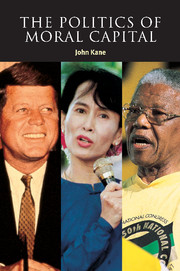 John Kane reveals how moral capital is key to political reform
In the immediate wake of scandals involving Elliott Spitzer and alleged bribery offers to Chuck Cadman, there's no better time to think about political moral capital than the present.
In The Politics of Moral Capital John Kane offers varying profiles of political reformers, including Abraham Lincoln, Charles de Gaulle and Nelson Mandella, and uncovers the importance of moral capital to politics.
Kane splits the use of moral capital down into three "phases". In the first phase, moral issues are used to legitimize a political movement by drawing attention to moral situations that affect -- or at least can be argued to affect -- the whole of the polity.
Once a movement is legitimized, support must be mobilized. For Kane, this is phase two. Demands are made that the moral issue be resolved, and a political program is promoted that offers a solution.
Kane's third phase the issue is used to highlight strategic opportunities. Current events are siezed upon as an opportunity for activism, which is then used to bolster political support.
Kane's book refines the use of moral capital into a fine art. His book esentially outlines a program by which political activism can be transformed into political capital. It often seems almost Machiavellian, until one considers that those who have most successfully harnessed moral capital for political gain have been those who had the most legitimate grievances, and who believed in their causes most deeply.
Kane also pays close attention to the American presidency, and uncovers the pivotal importance of moral capital to that particular office. Political offices, he notes, tend to come imbued with a certain amount of moral capital, which can either be enhanced by the office holder, or squandered for future office holders through poor conduct.
Moreover, Kane theorizes that the moral standing of the office of president -- as well as whomever may hold it at any particular time -- is crucial to a country's self-respect and morale.
Times when leaders fail to meet the moral standard their citizens expect of them tend to be very troubling for a polity, and it's at times like this that we need to reevaluate the moral cogency of our societies. Kane's theories can be helpful but ultimately it's up to individual citizens to decide whether or not they're satisfied with the moral standing of their society.
Subscribe to:
Posts (Atom)