
Showing posts with label InDePCisON '09. Show all posts

Sunday, June 28, 2009

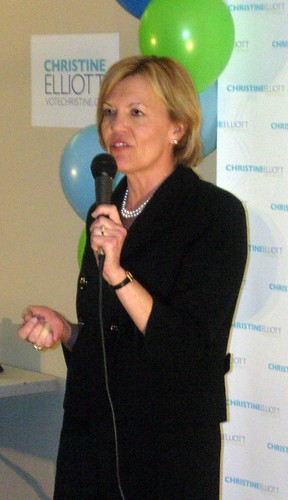
Christine Elliott and the (Alleged) Nadir of Red Toryism

Despite Elliott's leadership setback, red toryism will survive

If politics were merely about being nice, Christine Elliott probably would have won the Ontario Progressive Conservative leadership hands-down.

Conservative Senator Hugh Segal's endorsement of Elliott reinforces this. Segal has often focused on praising the humanity and civility of political leaders. To Seal, these are important values.

Of course, politics is not merely about being nice. Few Canadians, inside or outside of Ontario, would pretend that former Premier Mike Harris is an implicitly nice individual. Yet his endorsement of now-PC leader Tim Hudak certainly went a long way toward establishing his credentials as a "common sense conservative".

Mike Harris won two majority governments in Ontario. Hugh Segal wound up runner-up to former Prime Minister Joe Clark in the 1998 federal Progressive Conservative leadership contest.

Perhaps the lesson is that perhaps, in politics, nice guys really do finish last -- or at least that in politics, as in life, people who are too nice invariably finish last.
In the wake of Elliott's defeat in the Progressive Conservative leadership contest, many people -- like the Globe and Mail's Adam Radwanski --- are wondering if conservatism in Ontario, formerly a bastion of Canadian red toryism, has irrevocably taken what Brooke Jeffrey once referred to as a hard right turn.

(Jeffrey, for her own part, actually seemed perplexed by her inability to win election by labelling all of her would-be constituents in a riding she was parachuted into as racists, so maybe one should carefully consider the source.)

Hudak's ascension to the leadership of the Ontario Conservative party has many people wondering if perhaps speculation that harder forms of conservatism are needed to prevail in Ontario.

In recent years, the failures of leaders such as John Tory have largely spoken for themselves. There's a real question regarding whether or not red toryism can flourish in Ontario -- or Canada -- any longer, or if it's simply become too "Liberal-lite" to be palatable to conservative voters.

Yet those reputed to be red tories who have gotten closest to the Liberal party have shown their true political colours. In the case of Garth Turner, those colours turned out to be red. In the end however, it turned out that he wasn't a Tory.

When the former Halton MP joined the Liberal party in 2007, then-Liberal leader Stephane Dion crowed that "Tories were becoming Liberals".

Yet, as it turned out, Turner was far from a proper red tory. He lacked that key combination of fiscal conservatism and social principle that has forever properly characterized the red tory. When he finally got his first opportunity to campaign against the Harper Conservatives he chose to embrace divisive fear-based campaigning.

Prior to that, Turner attempted to divide Canadians by attempting to invent a separatist threat in Alberta.

Red toryism has forever held at its core an organic conceptualization of society -- one wherein social tradition is balanced against the public good.

Fear mongering and the creation of artificial -- and largely non-existent -- enemies is as great an insult to the principles of red toryism as one can possibly manage.

Turner had been preceded in joining the Liberal ranks by David Orchard, who had his nomination in a Saskatchewan riding overturned by Dion in favour of a hand-picked candidate who subsequently lost to Conservative Rob Clarke. When Orchard finally got his own turn in 2008, he lost as well -- and lost amidst his own fear-based attempts to campaign against the RCMP.

David Orchard, as many may recall, conceded the federal PC leadership to Peter MacKay only under the condition that MacKay wouldn't discuss unification of that party with the then-Canadian Alliance.

Orchard, for his own part, failed to recognize the value in allowing an organic political bond to develop between Canada's conservatives, and would have rather allowed the Liberal party to govern Canada in perpetuity than be caught dead dealing with the "wrong" conservatives.

If Canadian red toryism has truly reached its nadir it isn't in the defeat of Christine Elliott. Rather, it reached that nadir when those who consider themselves red tories failed to put their political principles ahead of their political vanity.

Whether or not Elliott will turn the tide of this unfortunate trend by working together with her party's new leader, and whether the hard conservatism of Tim Hudak and Mike Harris can lead the Ontario Progressive Conservative party to victory in the next election has yet to be seen.

If Hudak possesses the wisdom to make Elliott a part of his leadership plans for the party, and if Elliott can, in turn, soften the hard conservatism of Hudak and company also has yet to be seen. But it will be interesting to see.

Politics may not necessarily be merely about being nice. But it couldn't hurt to have a nice guy -- or gal -- on side, either.

Saturday, June 27, 2009

Tim Hudak Pulls Out Ontario Conservative Leadership

Debate over Human Rights Commissions should intensify with new Tory leader

The leadership of the Ontario Progressive Conservative party has been decided today, as Tim Hudak has emerged the winner.

The new leadership of the party began to take shape earlier this afternoon when Randy Hillier was eliminated from contention.

At that time Hudak had been leading, with Frank Klees in second place. Projected front runner Christine Elliott collected the third most first-choice ballots.

The principal issue in the leadership race turned out to be the Ontario Human Rights Commission.

Hudak and Hillier favour abolishing the OHRC. Elliott and Klees prefer to reform them.

Elliott and Klees were adamant that a call to abolish the OHRC would give the next election to the Dalton McGuinty Liberal party. Hudak had pulled no punches in denouncing such sentiments as "Liberal-lite".

"If you want to put the election on a platter for the Liberals, the best way to do so is to run from our conservative principles and try to be Liberal-lite," he told Klees during a debate. "If you take on McGuinty's position, then you're Liberal lite."

Klees, at the time, cautioned that wedge politics have been and would continue to be, disastrous for the party.

"I don't want to go back to those days when wedge issues were the flavour of the day, when we were picking fights with every stakeholder group in this province," he explained. "That's why we're not in government today."

Apparently, neither Elliott nor Klees, who had both denounced Hudak's plans to abolish the OHRC, considered the issue pivotal enough to bow out of the race in order to ensure the other reformist candidate a path to victory.

That may speak volumes about how seriously either of these candidates considered the OHRC. Both had come out in favour of reforming -- as opposed to abolishing -- the Commissions, although only Klees had actually outlined a program for reform.

Elliott may have also had any fiscal conservative credibility she wanted to lay claim to kneecapped by the deficits currently being run by her husband, federal Finance Minister Jim Flaherty. Regardless of whether or not these deficits are his fault -- and they aren't -- he will, nonetheless, have to wear them for a long time to come.

Perhaps his wife will as well.

One can only hope that Tim Hudak heeds Frank Klees' warning about wedge politics, and that Hudak finds a suitable place for Christine Elliott within the new party leadership.


Other bloggers writing about this topic:

Russ Campbell - "Tim Hudak Wins Ontario PC Leadership Race"

Dr Roy Eappen - "New Tory Leader in Ontario: Tim Hudak"

Brian Gardiner - "Hudak Wins"

Thursday, June 11, 2009

Progressive Conservatism Is Not "Standing for Nothing"

Randy Hillier embraces small tent conservatism

When the Ontario Progressive Conservative party leadership candidates locked horns in a leader's debate at the University of Ottawa, it couldn't have possibly become any clearer that the 2009 Ontario PC leadership race is a battle for the very heart and soul of the party.

The battle lines seem to be drawn: Tim Hudak and Randy Hillier firmly favouring the socons, and Christine Elliott and Frank Klees carrying the banner for procons.

Perhaps no one in the field has embraced this apparent internal culture war as Hillier, who told Elliott that "watered-down conservatism" will not lead the party to victory, and power.

"When we stand for nothing, we lose everything," Hillier insisted.

Elliott had previously described herself as a "compassionate" conservative.

Hillier seemed to be thinking in a similar vein as Tom Long, who recently gave a speech to the Manning Institute's Networking Conference in which he took note of the fact that, in recent history, hardline Mike Harris' fiscal conservatism has been more successful than its more progressive counterpart -- as recently represented in leadership by John Tory.

Such ideas stand in stark contrast to the widely-disseminated beliefs of Conservative Senator Hugh Segal, who continues to insist that building consensus between the various strains of conservatism -- usually defined in Canada as fiscal conservatism, social conservatism, democratic populism, progressive conservatism, British Toryism and libertarianism -- in order to be truly successful. Segal has often added that the best way to do so is within a "nation and enterprise" model in which government collaborates with society's various institutions in order to produce an environment in which free markets can provide for the needs of Canadians.

As Lloyd Mackey noted of David Orchard -- who ceded the leadership of the federal Progressive Conservative party to Peter MacKay only under the condition that he refused to merge the party with the stronger Canadian Alliance -- people like Hillier and Long represent a sense that their particular brand of conservatism is the only truly "pure" brand of conservatism. Consider the rhetorical implications of Long's description of his favoured strain of conservatism as "unhyphenated" conservatism.

Mackey brilliantly describes individuals with such small-tent notions of conservatism, such as Orchard and Hillier, as virtual mirror images of each other.

Hillier's particular brand of conservatism is best described as a fusion of fiscal conservatism with libertarianism -- a stark contrast to Elliott's mix of fiscal conservatism and progressive conservatism.

Whether Hillier agrees with it or not, Elliott's progressive conservatism is necessary to strike a balance with his particular brand of conservatism. Even though Long may disagree, the only conservatism that has ever proven sustainable in Ontario was a conservatism respectful of progressive values.

Though Long may not understand it, Mike Harris' hard fiscal conservative coalition was not sustainable without its progressive counterparts. If it had been, Ontario wouldn't be governed by the Dalton McGuinty Liberal party right now.

Randy Hillier's and Christine Elliott's strains of conservatism need each other. It's rather unfortunate that Hillier doesn't seem to have the wisdom to recognize this.


Other bloggers writing about this topic:

Lumpy, Grumpy and Frumpy - "Randy Hillier for Premier"

Monday, June 08, 2009

Charting a Tenuous Course for Human Rights Commissions

From Alberta and Ontario: different conservative visions for the CHRC

From across Canada, different courses are being proposed for the country's contentious Human Rights Commissions.

Some, like Ontario Progressive Conservative leadership candidates Tim Hudak and Randy Hillier, are proposing that such commissions should be abolished.

Others have proposed a radical new course for the HRCs -- a course that Alberta's Progressive Conservative government has chosen to follow with the passage of Bill 44.

Certainly, there are many practical issues with Bill 44. As some have noted, teachers could find themselves facing charges in an Alberta Human Rights Tribunal if a parent decides that they didn't receive sufficient warning about an upcoming lesson on almost anything. This is a serious problem with the legislation.

But as Lafleche notes, Bill 44 is only the most recent move in a political chess game over how Canada's Human Rights Commissions should function -- or if they should exist at all.

In Ontario, as Lafleche notes, the Ontario Human Rights Commission "has been all about the right not to be offended". In many cases it's been the same in Alberta. But in noting that Bill 44 seems to reinforce the "right to be a dullard", Lafleche misses one key point: the "right to be a dullard" seems not only to be about "the right not to be offended", but also about a parent's right to make decisions about their childrens' education.

Parents have long been lectured about the need to manage what their children are or are not exposed to. Disclaimers on television shows warning parents that "viewer discretion is advised", film rating schemes and parental advisory stickers on CDs have long been part of efforts to empower parents to control the extent to which their children are being exposed to violence, foul language or controversial subjects.

Now, for good or for ill, parents are being given an opportunity to make similar decisions in regard to their childrens' education.

Not all Canadians -- and certainly not all Albertans -- will empathize much with the religious conservative who pulls their children out of class because they insist that their children be given abstinence-only sex education. Nor should should they.

But many would agree that morality should not be taught in the classroom. If anyone has the right to teach morality to their children, most people would agree that a child's parents are the only ones who possess that right.

Yet many attempts have been made to smuggle left-wing morality lessons into the classroom. Most Canadians would almost certainly roll their eyes at a religious conservative's complaints regarding a tolerance-minded lesson plan that may try to teach children that homosexuality is normal. But it's impossible to overlook the fact that teaching children that homosexuality isn't immoral -- and in this author's opinion, it most certainly isn't -- is still teaching morality in the classroom.

Any parent uncomfortable with this -- whether most Canadians agree with their reasons or not -- has the right to blow the whistle on this.

But there is a flip side to the entire affair. Bill 44 could be used by parents in Catholic school divisions to pull their children from classrooms in Catholic Schools whenever they are taught that Catholic doctrine dictates that abortion is wrong -- certainly a right that one would expect moderate Catholics to exercise. The same parents could use Bill 44 to pull their children from any lessons in which homosexuality is said to be wrong. Similarly, atheist parents could use Bill 44 to pull their children from lessons related to religion.

Again, Bill 44, in its application, could turn out to be a stalemate, in reality favouring neither side of the so-called "culture war".

This is how it should be considering that liberal democratic governments have no business taking sides in social or cultural affairs.

For Hudak and Hillier, meanwhile, their proposal to abolish Ontario's Human Rights Commission has opened a fissure within their own party. Some, like Christine Elliott -- who is now leading the leadership race -- have insisted that the commissions should be maintained out of political considerations. Others have reminded Ontario Tories that it was a Progressive Conservative government that instituted the HRC in the first place.

Elliott has joined fellow PC leadership candidate Frank Klees in calling for reform of the OHRC. Elliott has yet to articulate any concrete proposals for that reform. Klees, meanwhile, has proposed repealing Section 13 and taking away the Commission's ability to effectively act as a censor, and allow it to focus on clear cases of discrimination.

Of those out to chart a new course for the HRCs, Elliott and Klees are certainly the least radical among them. Alberta's Bill 44 may have charted a course into a pragmatically-tenuous position, but at least the Alberta PCs haven't charted them a course to oblivion.


Other bloggers writing about this topic:

Richard Shih - "Alberta's Bill 44"

Four Strong Winds - "Why Alberta's Bill 44 Represents a Blow for Alberta's Democracy"

Wednesday, June 03, 2009

Simply Too Close to Call

No clear front-runner in Ontario PC leadership campaign

As Ontario Progressive Conservatives weigh their leadership candidates ahead of the leadership convention later this month, it seems that the jury is still out on the matter of leadership.

In a recent poll of Ontario Tories Tim Hudak narrowly leads the pack with 26% of decided voters, with Christine Elliott trailing by four points, at 22%. Frank Klees is sitting third with 17% and Frank Hillier trails the pack with 14%.

19% of Ontario's Progressive Conservatives remain undecided.

Considering that no one candidate has enough support to break the 50% barrier on the first ballot even if all undecided voters were to gravitate to their candidacy, second choices will become very important in this contest.

Christine Elliott is the top second choice with 17%, leading Hudak by a single point in this category. Klees follows by yet another single point at 15%, and Hillier again trails the pack as the second choice of 7% of decided Progressive Conservatives.

In the closest position that passes for front-runner status in this campaign, Hudak enjoys the benefit of an endorsement by Mike Harris, the last Progressive Conservative to lead his party to a majority government in Queen's Park -- even if the first of the two was an unlikely majority.

Yet the National Post's Dan Arnold notes that Hudak may be suffering the same affliction that Alberta PC leadership candidate Jim Dinning succumbed to. Dinning, along with Ted Morton, eventually compromised the campaign to Ed "Stalemate" Stelmach.

As the presumed frontrunner, Hudak's campaign has suffered from a lack of tangible policy. Hudak's policy centrepiece, a bid to abolish the Ontario Human Rights Commission, is believed to have driven support away from his campaign to that of Elliott, his presumed primary rival in this contest.

With these particular conditions, one can likely expect a stalemate to emerge at the June 27 PC leadership convention. Under those kinds of conditions, one may expect Frank Klees to replicate Ed Stelmach's feat, and emerge as a brokered leader.

This may not be such a bad thing. Stelmach went on to win one of the most dominant majority governments in the history of Alberta.

Then again, Ontario is an incredibly far cry from Alberta. As Tory leader Frank Klees may have to struggle to find life, let alone be assured a long tenure in the Premier's Office.

Thursday, May 21, 2009

(Still) Tripping Over Liberal Democracy

Human Rights Commission becomes central front in Ontario Tory leadership race

Those hoping for a lively Ontario Progressive Conservative leadership contest, with definitive matters of policy to debate, may finally have gotten their wish.

After many tranquil weeks Tim Hudak, one of the two individuals with a real opportunity to win this contest, has kicked off a political firestorm by mimicking Randy Hillier's pledge to abolish the Ontario Human Rights Commission.

Christine Elliott -- the other candidate with a realistic chance to win -- opposes the move.

“It would be a gift to the Liberals, one they would exploit as ruthlessly as they did with faith-based funding,” said Elliott. “Just like faith-based funding, this is a policy that was made with the short term goal of winning a leadership campaign. Why on earth would we want to expose ourselves by plunging recklessly into such a controversial issue?”

“If we’re going to beat the Liberals, we have to show better judgment than that.”

Of course, there are numerous good reasons to support the OHRC. Defeating the McGuinty Liberals isn't really one of them.

If anything, the OHRC is becoming a battlefront in this contest between centrist progressive conservatives, like Elliott, and fiscal and social conservatives, like Hudak and Hillier. In a party recently battered by John Tory's election pledge to provide funding to faith-based schools -- something that many Ontarians seem to forgot is actually constitutionally entrenched -- real questions lurk over whether or not the party can afford to embrace any other social conservative-leaning policies.

Elliott and fellow candidate Frank Klees firmly oppose Hudak and Hillier's intention to abolish the OHRC, instead preferring to reform the commission.

The battle lines within the Ontario Progressive Conservatives couldn't more obvious when one examines the prominent endorsements already handed out -- Elliott has collected an endorsement from Conservative Senator Hugh Segal, and Hudak has recieved an endorsement from former Ontario Premier Mike Harris.

Regardless of which side emerges victorious in this tussle over the party's policy in regards to the Ontario Human Rights Commission, the Ontario Tories will have taken a stance regarding the shape and form that Ontario's democracy will take -- one in which an institution arguably used to show state favour will be eliminated in the name of reinforcing the neutrality of the state, and one in which neutrality of the state may be, to some degree, compromised in favour of ensuring a more just society.

One way or the other, the party will have made a statement that won't be easily rescinded.


Other bloggers writing about this topic:

Russ Campbell - "Frank Klees 1, Christine Elliott 0"

Sunday, May 17, 2009

Tripping Over Liberal Democracy

Tim Hudak proposes abolishing Ontario Human Rights Commission

In a move that could either put him over the top with Ontarian conservatives or seriously harm his party's chances in the polls, Ontario Progressive Conservative leadership candidate Tim Hudak has proposed abolishing Ontario's Human Rights Commission.

Describing the commissions as a "tool for political advocacy", Hudak has proposed this abolition, possibly in an effort to preemptively undermine the leadership efforts of Randy Hillier, who is expected to perform poorly on the first ballot and be eliminated.

"The abolition of the Human Rights Tribunal has been a huge draw for us,” said Hulak's campaign manager, Tristan Emmanuel. Hillier's campaign has been supportive of the move as well. “Hopefully that means it will find a home in this party regardless of what happens.”

Those supportive of Hudak's promise to abolish the OHRC may echo the sentiments of Robert B Talisse, who notes that any institution that could be argued to show bias in favour of any particular political ideology is actually distinctly at odds with the very idea of liberal democracy -- political neutrality of the state is considered to be a key principle of liberal democracy.

Those who disagree with this promise -- including this author -- would remind such individuals that human rights commissions can serve an important role in fights against injustice, and that the real problem with these human rights commissions is the methods by which some of them operate.

The province of Ontario has proven to be particularly troublesome in this regard.

What is truly necessary is reform of human rights commissions that would obligate them to operate more in the manner that courts of law operate. Tim Hudak's promise would likely do more harm than good.


Other bloggers writing about this topic:

Matt Guerin - "Tim Hudak Shows Off His Political Immaturity"

The Liberal Scarf - "Tim Hudak's First Piece of Real Policy - Faith-Based Funding Part Two"