
Showing posts with label Parti Quebecois. Show all posts
Showing posts with label Parti Quebecois. Show all posts
Saturday, May 15, 2010
Reconquete La Conquete
Part two of The Champions deals with the famed 1970 October Crisis, and how the actions of the FLQ challenged both Pierre Trudeau and Rene Levesque on deep politically existential levels.
For Levesque, he had to confront the reality that individuals willing to engage in terrorism existed within the Quebec separatist movement he had built. (They may exist within that movement still.)
For Trudeau, his invokation of the war measures act challenged the values his party allegedly stood for. In the eyes of some, invoking the war measures act was the right move. After all, Canada was facing a terrorist threat, and the government had to do what was necessary to deal with it. In the eyes of others, invoking the war measures act was an unacceptable contravention of civil liberties.
Domestic terrorism poses a deep challenge to any country that must deal with it. The prospect of citizens who don't respect the rule of law in their political maneuvers is deeply troubling not only to those associating with those individuals -- even if unwillingly, as Levesque was -- and to those who have to deal with them.
One can sense how deeply shaken Levesque was when dealing with the prospect of such terrorists within his movement. One can even sense a slight discomfort for Pierre Trudeau as he dismisses the "bleeding hearts" who worry about the prospects of soldiers with guns in Quebec's cities (a deployment approved not by Stephen Harper, but by Pierre Trudeau).
No citizen wants to believe that they should fear their fellow citizens. Perhaps this is one of the reasons why so many countries avoid dealing with domestic terrorist groups. While it struggles to gain any semblence of credibility, groups like the Ku Klux Klan and the Aryan Guard continue t exist in Canada.
While the FLQ doesn't share a common place in the Canadian imagination as the KKK and the Aryan Guard, these organizations have far more in common than they are usually given credit for.
While Canadian law can often be quite eager to designate foreign groups as a terrorist group, that designation is used all too sparingly against domestic groups.
This could be said to at least partially explain how the FLQ was able to survive even after it had committed its earlier criminal acts.
It wasn't until Pierre LaPorte was murdered, and James Cross was kidnapped, that the Canadian government began to really take the FLQ's bid to "reconquer the conquest" as seriously as the threat it posed merited.


Tuesday, March 16, 2010
Attention Quebec Progressives: The PQ Doesn't Need You Anymore

Parti Quebecois ends preferential treatment of SPQ Libre
Once upon a time, Syndacalistes du Progessives du Quebec Libre had a very special relationship with the Parti Quebecois.
That is, until Pauline Marois tired of him. Now, the very special relationship -- replete with special memberships for the members of the SPQ Libre and special representation at party events -- is over.
According to SPQ Libre leader Marc Laviolette, it's apparently unmistakable: the PQ is shifting rightward.
“I think it’s obvious the PQ is turning to the right,” Laviolette insisted. “We’ve seen it with Mme. Marois’s declaration on the public sector demands and now this decision by the executive.”
Laviolette insists that Marois can broke no dissent within the party.
“There can be a minority point of view in a party. It should allow the expression of various points of view," Lavoliette continued. "Only Madame Marois doesn’t like it if you go against her point of view. I’m sure that if we’d said yes to everything we would have continued to be recognized as a political club.”
For her own part, Marois insists that the SPQ Libre's special status was alientating other members of the PQ.
But it's hard to overlook the timing of Marois' move: she's cutting the SPQ Libre off just as the Action Democratique du Quebec is reaching a point of critical weakness.
Should the ADQ manage to collapse entirely, that could leave significant portions of conservative voters in Quebec effectively up for grabs. It seems unlikely that a hardline separatist group like SPQ Libre would shift its allegiances to the federalist provincial Liberals (unless, of course, they believed they could sway the party to the cause of separatism).
Pauline Marois and the Parti Quebecois may even be content to let SPQ Libre break away entirely and form its own separatist party if the benefits it can accrue by attracting marooned members of the ADQ.
Of course, the Parti Quebecois has never legitimately been a progressive party -- the racist ideology the party was founded on seems to preclude true progressivism.
Pauline Marois and the PQ don't seem to need progressives like SPQ Libre anymore, and is ready to show it's true colours -- that of an extremist movement that is willing to do anything it needs to do in order to achieve its goal.
Monday, September 07, 2009
Free Stuff College Students May Not Want
Parti Quebecois membership give away may hit ethnic snag
Anyone who's ever been to college or university knows for certain that the favourite word of any post secondary student is "free".
The Parti Quebecois certainly does.
The PQ youth wing will be handing out free party memberships this fall in a bid to skirt the rules of campuses that forbid political parties from selling memberships there.
According to Quebec Intergovernmental Affairs Minister Claude, the initiative is just an effort to try to boost the PQ's sagging popularity.
"There are so few people following [Marois] that they have to give away memberships to fill events," Bechard said. "It demonstrates that their ideas are no longer finding traction."
But Alexandre Theriault-Marois, the Vice President of Political Affairs for the PQ youth wing, insisted Bechard's comments were "cheap".
"We have ideas and we want to enrich them," Theriault-Marois insisted.
But as the PQ attempts to swell its youth ranks with students, one may wonder how many immigrant students will be taking the bait.
Former PQ Quebec Premier Bernard Landry suggested Quebec needed to extend Bill 101's jurisdiction to Quebec's Colleges and Universities.
So as the Parti Quebecois hands out free memberships, one may wonder whether or not immigrant students would be willing to accept one -- even at the "bargain price" of gratis.
Saturday, September 05, 2009
Stay Classy Gilles, Pauline
PQ, BQ leaders to attend reading of FLQ Manifesto
Admittedly, the Canadian attitude toward history can often seem a little peculiar.
While in most countries, being seen at an event at which terrorist literature will be recited would be political suicide, in Canada is can be A-OK. So long as you're a Quebec separatist.
The Government of Quebec recently withdrew its support for "Le Moulin a Paroles", an outdoor poetry and spoken-word reading after a recital of the Front du Liberation du Quebec Manifesto was added to the program.
“Our government doesn’t want to have anything to do with this event. At first, it was supposed to be about poetry, but now with the FLQ manifesto, we are closer to bombs and assassinations,” said Employmen Minister Sam Hamad.
“This brings us back to the October Crisis and we don’t think it’s a good idea,” Hamad added.
This isn't to say that the October Crisis should never be commemorated, but the event in question is intended to commemorate the 250th anniversary of the Battle of the Plains of Abraham.
“Now it’s become a political issue more than an historical event,” Hamad concluded.
The addition of the Manifesto reading is simply an attempt by Pequistes to hijack the event in favour of their political cause -- no wonder Gilles Duceppe and Pauline Marois are so eager to attend!
Sadly, their attendance at this event will likely do very to harm their political fortunes, even if it only goes further to show the rest of Canada who, precisely, these Quebec separatists truly are -- self-interested demagogues, adhering to a racial ideology and sympathizing with yesteryear's terrorists.
Friday, September 04, 2009
Bernard Landry: The Gift that Keeps on Giving
Landry to immigrants: "Fuck you"
Much like Bloc Quebecois leader Gille Duceppes' message to non-Quebecois francophones, former Quebec Premier Bernard Landry has a message for immigrants in La Belle Province:
"Go fuck yourself."
That was esentially what Landry had to say to Quebec immigrants today -- much to the likely chagrin of PQ leader Pauline Marois -- when he insisted that immigrants to Quebec and the children of immigrants to Quebec needed to be provided the option of attending French-only Universities -- or no post-secondary education at all.
Today, Landry insisted that the ever-popular Bill 101 needed to be extended to the provinces Colleges and Universities -- which would essentially make it unlawful to teach in any language other than French.
This, naturally, presents two problems for Marois:
Problem number one is that it simply reminds Quebeckers of the racist and retrograde nature of the Parti Quebecois, and the Quebec separatist movement as a whole. Landry's comments were a response to recent news that more allophones than uni-lingual francophones have been enrolling in schools in Montreal.
Apparently, for Landry, the notion that Quebec students would speak both of Canada's official languages is threatening to the primacy of French in Quebec.
The second problem is related to the second -- namely, that to achieve future electoral successes (let alone an affirmative sovereignty vote) the PQ needs significant support from immigrant communities.
Which, naturally, won't happen so long as Bernard Landry tells them that they may be educated in French and only French -- essentially telling linguistic and ethnic minorities to go fuck themselves in the name of francophone primacy.
So far as unwise and racialized politics go, this is about as bad as it gets.
Thursday, June 25, 2009
You Say "Redneck" As If It's a Bad Thing
Gilles Duceppe helps rehabilitate an old slur
In the wake of Parti Quebecois leader Pauline Marois' recent four-point plan for Quebec sovereignty, only Bloc Quebecois leader Gilles Duceppe would dare criticize opponents of Quebec sovereignty for not agreeing to stick their heads in a noose.
As some may recall, one of Marois' plan points was to accrue extra power to Quebec over language policies.
Speaking at a St Jean Baptiste day event, Duceppe decried the Grit and Tory leaders' unwillingness to do precisely that by extending the powers of Bill 101 over federally-regulated industries in Quebec.
"They acted like rednecks," Duceppe complained.
"[Ignatieff and Harper], two leaders of the most important political parties in Canada, refused to admit that French should be the working language for institutions under the federal jurisdiction," he sniffed.
Of course, nothing could factually be further from the truth. In fact, Harper and Ignatieff have actually remembered what Duceppe has forgotten: that Canada has two official languages, French and English, from coast-to-coast, and that Quebec is no exception to this.
This is a point that likely isn't lost on Duceppe, but merely one that he chooses to overlook.
"They should take the example of the political leaders in Quebec who stand up for the rights instead of playing rednecks in Ottawa like they did a few days ago," Duceppe would later add.
Although Duceppe would decline to add what he really seems to be thinking -- that the federal government should decline to stand up for the rights of Canadians in Quebec if they should just so happen to be English-speaking Canadians.
Seriously, fuck them.
If standing up for the rights of all Qubeckers, French- and English-speaking alike, makes Stephen Harper and Michael Ignatieff rednecks, then Duceppe clearly has a skewed image of that stereotype: not of rednecks as ignorant or racist, but as individuals who don't pick and choose whose rights they stand up for. It's a label that they can wear with pride.
The racist ideology that lays at the heart of Duceppe's party, meanwhile, is a wart that he doesn't display with much pride, even on St Jean Baptiste Day. Unshockingly, Duceppe wants that to remain one of Quebec's better-kept secrets.
Other bloggers writing about this topic:
Chucker Canuck 2.0 - "Gilles Duceppe is a Sour, Old Geezer Who Needs the Pastures"
Friday, June 12, 2009
The True, Unforgettable Face of Quebec Separatism
Parti Quebecois forever awaiting the next crisis
Parti Quebecois leader Pauline Marois was forced to do some damage control yesterday, as she insisted that the Parti Quebecois would not make a move to provoke a national unity crisis in its bid to separate Quebec from the rest of Canada.
 This follows comments by Jacques Parizeau, the old warhorse of the Quebec sovereigntist movement, insisting that "to bring about sovereignty, there has to be a crisis. Clearly, a referendum on a specific subject can create a crisis."
These comments certainly don't bode well for Marois, whose recently-revealed four-point plan for Quebec sovereignty includes calling referendums on the repatriation of various from the federal government.
Quebec's Liberal Premier, Jean Charest, took full advantage of Parizeau's comments.
"The real intention of the Parti Québécois is to provoke a crisis, to harm Quebec," Charest insisted. "It is unacceptable. It would hurt Quebec. We will expose it."
Recent polls have suggested that a crisis would be necessary just to make sovereignty seem feasible to Quebeckers. A recent Angus-Reid poll determined that 74% of Quebeckers felt that Quebec's chances of attaining sovereignty were slim to none.
To make matters worse for Marois and Parizeau, only 28% of polled Quebeckers stated that they wanted independence for Quebec.
Perhaps of the two prayers for Quebec sovereigntism, increased autonomy (favoured by another 30% of Quebeckers) and a crisis, the former would be more fruitful than the latter. Marois seems to have a sense of this, with a sovereignty plan that would try to hedge increased autonomy into an increased fervour for independence.
That is what makes the Parti Quebecois more dangerous than ever -- that Pauline Marois has finally realized that it's the Quebec preference for autonomy and de-centralization that could get Quebeckers thinking about sovereignty again.
Jacques Parizeau may be good for reminding Quebeckers -- in fact, all Canadians -- about the true face of the Pari Quebecois.
The true face of the Parti Quebecois is not that of a progressive political party. It's that of a retrograde borderline-revolutionary party founded on a racial ideology.
Pauline Marois may want Quebeckers to forget this. Sadly for her, Jacques Parizeau could never allow them to.
Other bloggers writing about this topic:
Angry French Guy - "Could a People that Can't Build a Highway Ever Build a Country?"
Parti Quebecois leader Pauline Marois was forced to do some damage control yesterday, as she insisted that the Parti Quebecois would not make a move to provoke a national unity crisis in its bid to separate Quebec from the rest of Canada.
This follows comments by Jacques Parizeau, the old warhorse of the Quebec sovereigntist movement, insisting that "to bring about sovereignty, there has to be a crisis. Clearly, a referendum on a specific subject can create a crisis."These comments certainly don't bode well for Marois, whose recently-revealed four-point plan for Quebec sovereignty includes calling referendums on the repatriation of various from the federal government.
Quebec's Liberal Premier, Jean Charest, took full advantage of Parizeau's comments.
"The real intention of the Parti Québécois is to provoke a crisis, to harm Quebec," Charest insisted. "It is unacceptable. It would hurt Quebec. We will expose it."
Recent polls have suggested that a crisis would be necessary just to make sovereignty seem feasible to Quebeckers. A recent Angus-Reid poll determined that 74% of Quebeckers felt that Quebec's chances of attaining sovereignty were slim to none.
To make matters worse for Marois and Parizeau, only 28% of polled Quebeckers stated that they wanted independence for Quebec.
Perhaps of the two prayers for Quebec sovereigntism, increased autonomy (favoured by another 30% of Quebeckers) and a crisis, the former would be more fruitful than the latter. Marois seems to have a sense of this, with a sovereignty plan that would try to hedge increased autonomy into an increased fervour for independence.
That is what makes the Parti Quebecois more dangerous than ever -- that Pauline Marois has finally realized that it's the Quebec preference for autonomy and de-centralization that could get Quebeckers thinking about sovereignty again.
Jacques Parizeau may be good for reminding Quebeckers -- in fact, all Canadians -- about the true face of the Pari Quebecois.
The true face of the Parti Quebecois is not that of a progressive political party. It's that of a retrograde borderline-revolutionary party founded on a racial ideology.
Pauline Marois may want Quebeckers to forget this. Sadly for her, Jacques Parizeau could never allow them to.
Other bloggers writing about this topic:
Angry French Guy - "Could a People that Can't Build a Highway Ever Build a Country?"
Monday, June 08, 2009
A Newer, More Dangerous Parti Quebecois
"Incremental" separatism on PQ agenda
In its fight to cleave Quebec loose from the rest of Canada, the Bloc Quebecois and Parti Quebecois have often shot themselves in the foot by relentlessly pursuing the goal of separating from Canada in one fell swoop.
Quebeckers have proven themselves on two previous occasions -- in 1980 and again in 1995 -- unwilling to opt in to abruptly leaving the country.
After years of following an all-or-nothing approach, the Parti Quebecois has finally decided to pursue an incremental sovereigntist agenda.
PQ leader Pauline Marois outlined a four-point plan to incrementally pursue Quebec sovereignty. That plan called for minimalizing the federal government's involvement in areas of provincial jurisdiction -- such as education and health care -- exercising more authority over issues related to culture and language, extend the power of the French Language Charter, and continue to "encourage" immigrants to Quebec to speak French.
 "It shows our resolution to take up the fight and focus on Quebec sovereignty," Marois said of the plan. "We will use all of our abilities to advance the interests of Quebec."
"There are great things we can do right now," Marois added. "And I hope this dynamism will help revive the flame of sovereignty so we can hold a referendum as soon as possible."
Portions of this plan are already in play. Some may recall that Marlene Jennings, one of the Liberal negotiators of the Liberal-NDP-BQ coalition government -- had previously spilled the beans that strengthening Bill 101 to apply to federally-regulated firms in Quebec had been rejected in the course of those negotiations.
(Canadians still don't know what Jennings and her fellow Liberals had given the BQ in exchange for their support, but that is another matter entirely.)
Yet it seems that Bloc Quebecois leader Gilles Duceppe has not seen fit to let that particular issue go. Duceppe has been campaigning to strengthen Bill 101 so it will apply to industries regulated by federal labour laws in Quebec, something that the Liberal party has steadfastly refused to support.
"[Michael Ignatieff] said it would impede business," Duceppe complained. "There's no justification for him saying this. The fact [the Liberals] voted against Bill 101 being applied to the Canadian Labour Code is a clear illustration that recognizing Quebec as a nation is nothing more than a symbol."
The extent to which Ignatieff is embracing Quebec nationhood -- and one should add that recognizing Quebec as a nation is not the same as recognizing it as a nation-state -- aside, one thing Ignatieff is certainly doing is something that his predecessor wouldn't when it really mattered: fight separatists.
Rather, Stephane Dion was more than willing to hatch a secret deal with the Bloc when it would deliver him a government -- and certainly saw fit not to tell Canadians what he had given the Bloc in return.
Michael Ignatieff, at least, isn't playing into the hands of the PQ and BQ on their new four-point plan on Quebec sovereignty -- one that will certainly make for a more dangerous Parti Quebecois and Bloc Quebecois.
Quebeckers have proven unwilling to separate from Canada in a single spasm of nationalistic fervour. A slower, more deliberate process of seeking sovereignty will likely yield better results for Quebec's sovereigntist movement, and will require all Canadian federalists -- Liberal and Conservative alike -- to be much more careful in how they handle the issue of Quebec separatism.
In its fight to cleave Quebec loose from the rest of Canada, the Bloc Quebecois and Parti Quebecois have often shot themselves in the foot by relentlessly pursuing the goal of separating from Canada in one fell swoop.
Quebeckers have proven themselves on two previous occasions -- in 1980 and again in 1995 -- unwilling to opt in to abruptly leaving the country.
After years of following an all-or-nothing approach, the Parti Quebecois has finally decided to pursue an incremental sovereigntist agenda.
PQ leader Pauline Marois outlined a four-point plan to incrementally pursue Quebec sovereignty. That plan called for minimalizing the federal government's involvement in areas of provincial jurisdiction -- such as education and health care -- exercising more authority over issues related to culture and language, extend the power of the French Language Charter, and continue to "encourage" immigrants to Quebec to speak French.
"It shows our resolution to take up the fight and focus on Quebec sovereignty," Marois said of the plan. "We will use all of our abilities to advance the interests of Quebec.""There are great things we can do right now," Marois added. "And I hope this dynamism will help revive the flame of sovereignty so we can hold a referendum as soon as possible."
Portions of this plan are already in play. Some may recall that Marlene Jennings, one of the Liberal negotiators of the Liberal-NDP-BQ coalition government -- had previously spilled the beans that strengthening Bill 101 to apply to federally-regulated firms in Quebec had been rejected in the course of those negotiations.
(Canadians still don't know what Jennings and her fellow Liberals had given the BQ in exchange for their support, but that is another matter entirely.)
Yet it seems that Bloc Quebecois leader Gilles Duceppe has not seen fit to let that particular issue go. Duceppe has been campaigning to strengthen Bill 101 so it will apply to industries regulated by federal labour laws in Quebec, something that the Liberal party has steadfastly refused to support.
"[Michael Ignatieff] said it would impede business," Duceppe complained. "There's no justification for him saying this. The fact [the Liberals] voted against Bill 101 being applied to the Canadian Labour Code is a clear illustration that recognizing Quebec as a nation is nothing more than a symbol."
The extent to which Ignatieff is embracing Quebec nationhood -- and one should add that recognizing Quebec as a nation is not the same as recognizing it as a nation-state -- aside, one thing Ignatieff is certainly doing is something that his predecessor wouldn't when it really mattered: fight separatists.
Rather, Stephane Dion was more than willing to hatch a secret deal with the Bloc when it would deliver him a government -- and certainly saw fit not to tell Canadians what he had given the Bloc in return.
Michael Ignatieff, at least, isn't playing into the hands of the PQ and BQ on their new four-point plan on Quebec sovereignty -- one that will certainly make for a more dangerous Parti Quebecois and Bloc Quebecois.
Quebeckers have proven unwilling to separate from Canada in a single spasm of nationalistic fervour. A slower, more deliberate process of seeking sovereignty will likely yield better results for Quebec's sovereigntist movement, and will require all Canadian federalists -- Liberal and Conservative alike -- to be much more careful in how they handle the issue of Quebec separatism.
Monday, February 16, 2009
Like It Or Not, There's More to Canada Than Just Quebec
Nicolas Sarkozy stands by his pro-unity stance
Even in the wake of criticism from Bloc Quebecois leader Gilles Duceppe and Parti Quebecois leader Pauline Marois, Nicolas Sarkozy is standing his ground.
 Sarkozy has offered no apologies to Duceppe and Marois in the face of feined outrage at recent comments in which he denounced "sectarianism" and "self-confinement". Sarkozy reportedly did not mention Quebec separatists, but it's fairly clear what he meant.
In typical fashion, Marois and Duceppe responded with an angry letter to Sarkozy.
"Never has a head of state shown such a lack of respect towards the more than two million Quebecers who consider themselves sovereigntists," the two complained. "Would France agree to stay in a European Union that imposed a treaty that unilaterally reduces their sovereignty on questions of identity without even putting it to a referendum?"
Of course Duceppe and Marois may want to double check their definition of the word "unilateral". Their insistence that the Constitution was imposed unilaterally on Quebec treats the rest of Canada as a monolithic entity, as opposed to what it actually is -- 11 separate provinces.
 "We don't know where you got the idea that we detest Canada," they continued. "Despite our important differences, we respect this country, their values and their population. We think an independent Quebec will put to rest the bitterness and the exhaustive debate that has marked our history here in Canada."
Except that it won't. There remains marked division within Quebec around the separatist issue. As during the 1995 sovereignty referendum, a future referendum would inevitably bring the question regarding whether or not Quebec itself is divisible. Certainly, many federalist, aboriginal, anglophone and ethnic regions would hastily separate from Quebec given the option.
"We are not sectarian, we are not closed in on ourselves, we do not detest Canada," Marois would later elaborate. "We want to live in better harmony, and sovereignty would allow us to establish links and a better relationship with the rest of Canada."
Of course, however Marois believes Quebec could live in better harmony with Canada by leaving Canada is likely a matter for further quetioning.
Furthermore, one simply has to consider that there would be differing roles for separatists and federalists within a sovereign Quebec. No one expects the separatists to try to make another play for Quebec sovereignty until they firmly hold the reins of power and have reason to believe that they can expect to keep hold.
This is before one even considers the highly questionable relationship between the Quebec separatist movement and ethnic, anglophone, and aboriginal communities.
If Duceppe and Marois are truly so troubled by Sarkozy's remarks it's likely because they come too close to the truth for comfort.
Nicolas Sarkozy owes Quebec separatists no apologies.
Even in the wake of criticism from Bloc Quebecois leader Gilles Duceppe and Parti Quebecois leader Pauline Marois, Nicolas Sarkozy is standing his ground.
Sarkozy has offered no apologies to Duceppe and Marois in the face of feined outrage at recent comments in which he denounced "sectarianism" and "self-confinement". Sarkozy reportedly did not mention Quebec separatists, but it's fairly clear what he meant.In typical fashion, Marois and Duceppe responded with an angry letter to Sarkozy.
"Never has a head of state shown such a lack of respect towards the more than two million Quebecers who consider themselves sovereigntists," the two complained. "Would France agree to stay in a European Union that imposed a treaty that unilaterally reduces their sovereignty on questions of identity without even putting it to a referendum?"
Of course Duceppe and Marois may want to double check their definition of the word "unilateral". Their insistence that the Constitution was imposed unilaterally on Quebec treats the rest of Canada as a monolithic entity, as opposed to what it actually is -- 11 separate provinces.
"We don't know where you got the idea that we detest Canada," they continued. "Despite our important differences, we respect this country, their values and their population. We think an independent Quebec will put to rest the bitterness and the exhaustive debate that has marked our history here in Canada."Except that it won't. There remains marked division within Quebec around the separatist issue. As during the 1995 sovereignty referendum, a future referendum would inevitably bring the question regarding whether or not Quebec itself is divisible. Certainly, many federalist, aboriginal, anglophone and ethnic regions would hastily separate from Quebec given the option.
"We are not sectarian, we are not closed in on ourselves, we do not detest Canada," Marois would later elaborate. "We want to live in better harmony, and sovereignty would allow us to establish links and a better relationship with the rest of Canada."
Of course, however Marois believes Quebec could live in better harmony with Canada by leaving Canada is likely a matter for further quetioning.
Furthermore, one simply has to consider that there would be differing roles for separatists and federalists within a sovereign Quebec. No one expects the separatists to try to make another play for Quebec sovereignty until they firmly hold the reins of power and have reason to believe that they can expect to keep hold.
This is before one even considers the highly questionable relationship between the Quebec separatist movement and ethnic, anglophone, and aboriginal communities.
If Duceppe and Marois are truly so troubled by Sarkozy's remarks it's likely because they come too close to the truth for comfort.
Nicolas Sarkozy owes Quebec separatists no apologies.
Tuesday, December 02, 2008
Trudeau Feigns Ignorance
Justin Trudeau seems to have forgotten how his father dealt with separatists
There is one thing about being ignorant of your country's history. Some believe that in Canada we've refined this down to an art.
Apparently, Justin Trudeau has done likewise. But for a man like Trudeau to be ignorant of his family's history -- that is something else altogether.
In a Full Comment blog post, Graeme Hamilton insists that Pierre Trudeau would have been A-OK with the deal that the Liberal party has hatched with the Bloc Quebecois. And he isn't alone.
Justin Trudeau also insists that Trudeau's father would have welcomed the deal.
 “My father for years got along with [former Parti Québécois leader] René Lévesque before they were both in politics. My father had separatist friends. My father understood that the important thing for this country was to keep the country strong,” Trudeau insists.
And certainly, this is true. Trudeau, Levesque and Jean Marchand and Gerard Pelletier were all active within Quebec's labour movement during the Maurice Duplessis era.
When the four formally entered politics, it was as Liberals. Trudeau, Marchand and Pelletier joined the federal party. Rene Levesque found himself recruited into the provincial Liberals, where he served as Minister of Labour under Jean Lesage.
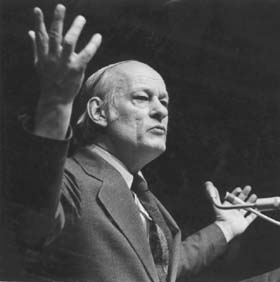 Levesque was always a nationalist. But his turn to separatism became public when he left the Liberal party in 1967. The party had refused to discuss Quebec sovereigntism at its convention. He formed the Mouvement Souveraineté-Association. In 1968 the MSA merged with Gilles Gregoire's Ralliement National to create the modern Parti Quebecois.
Levesque's ascension to the Office of Premier of Quebec in 1976 naturally brought tensions between the two to a head. These tensions would reach a pinnacle in 1980 during Levesque's referendum on Quebec sovereignty.
During the sovereignty campaign Trudeau promised to negotiate the repatriation of the Canadian Constitution. This promise helped the non side win the referendum with a decisive margin, and would set the table for Trudeau's most famous dealing with Levesque.
Dealings which Justin Trudeau seems to be ignorant of.
“What we got in this case was an assurance by Gilles Duceppe that he was going to keep all national-unity measures, confidence measures, off the table until June, 2010. That’s a better deal than anybody has gotten in years of working with the Bloc Québécois in the House,” Justin insists.
But he should know better. First off, Duceppe should not be trusted to keep promises he can't afford to keep.
Beyond this, Canadians remember how Pierre Trudeau dealt with separatists. During the negotiation of the 1982 Constitution, Trudeau, along with then-Minister of Justice Jean Chretien masterminded a deft end-run around Levesque in order to dismantle his "Gang of Eight" coalition of Provincial Premiers opposed to the Constitution.
In what has become known as "the night of the long knives", Chretien negotiated a "notwithstanding clause" into the Charter of Rights and Freedoms.
 The Gang of Eight acquiesced and the Constitution was settled.
For his own part, Levesque was infuriated. "We had been betrayed, in secret, by men who hadn’t hesitated to tear up their own signatures, and without their even taking the trouble to warn us," Levesque complained. On the flight back to Quebec City, Levesque is said to have said it rather differently.
"[Trudeau] fucked me," Levesque is said to have fumed.
For his own part, Justin Trudeau doesn't seem to be worried about the demands that Duceppe should be expected to make of this coalition government.
“We have a provincial election going on in Quebec and separatism is not one of the issues," Justin continued. "The fact that the Conservatives are spending so much time talking about national unity and bringing up all those old divisions, it’s just out of their playbook of divide, divide, divide.”
But Trudeau couldn't be further from the truth.
So long as the Bloc Quebecois and Parti Quebecois exist, separatism will always be an issue in Canadian politics -- unless, that is, both of these parties formally and finally renounce it.
In the absence of such a complete renunciation, the Libereal-led coalition is just another page out of the Liberal playbook of doing whatever it takes to get power, no matter what the consequences.
As for Trudeau, it's hard to believe that he would be this ignorant of his vaunted family history. It's significantly easier to believe that he would be disingenuous in the name of claiming political power.
Some other bloggers writing on this topic:
"The" Scott Ross - "The Liberal-NDP Coalition is Undemocratic
Sit, Think, Good Blog - "Marriage of Convenience"
Propter Hoc - "Of Separatists and Socialists (or, 'It's Very Simple Stupid')"
There is one thing about being ignorant of your country's history. Some believe that in Canada we've refined this down to an art.
Apparently, Justin Trudeau has done likewise. But for a man like Trudeau to be ignorant of his family's history -- that is something else altogether.
In a Full Comment blog post, Graeme Hamilton insists that Pierre Trudeau would have been A-OK with the deal that the Liberal party has hatched with the Bloc Quebecois. And he isn't alone.
Justin Trudeau also insists that Trudeau's father would have welcomed the deal.
“My father for years got along with [former Parti Québécois leader] René Lévesque before they were both in politics. My father had separatist friends. My father understood that the important thing for this country was to keep the country strong,” Trudeau insists.And certainly, this is true. Trudeau, Levesque and Jean Marchand and Gerard Pelletier were all active within Quebec's labour movement during the Maurice Duplessis era.
When the four formally entered politics, it was as Liberals. Trudeau, Marchand and Pelletier joined the federal party. Rene Levesque found himself recruited into the provincial Liberals, where he served as Minister of Labour under Jean Lesage.
Levesque was always a nationalist. But his turn to separatism became public when he left the Liberal party in 1967. The party had refused to discuss Quebec sovereigntism at its convention. He formed the Mouvement Souveraineté-Association. In 1968 the MSA merged with Gilles Gregoire's Ralliement National to create the modern Parti Quebecois.Levesque's ascension to the Office of Premier of Quebec in 1976 naturally brought tensions between the two to a head. These tensions would reach a pinnacle in 1980 during Levesque's referendum on Quebec sovereignty.
During the sovereignty campaign Trudeau promised to negotiate the repatriation of the Canadian Constitution. This promise helped the non side win the referendum with a decisive margin, and would set the table for Trudeau's most famous dealing with Levesque.
Dealings which Justin Trudeau seems to be ignorant of.
“What we got in this case was an assurance by Gilles Duceppe that he was going to keep all national-unity measures, confidence measures, off the table until June, 2010. That’s a better deal than anybody has gotten in years of working with the Bloc Québécois in the House,” Justin insists.
But he should know better. First off, Duceppe should not be trusted to keep promises he can't afford to keep.
Beyond this, Canadians remember how Pierre Trudeau dealt with separatists. During the negotiation of the 1982 Constitution, Trudeau, along with then-Minister of Justice Jean Chretien masterminded a deft end-run around Levesque in order to dismantle his "Gang of Eight" coalition of Provincial Premiers opposed to the Constitution.
In what has become known as "the night of the long knives", Chretien negotiated a "notwithstanding clause" into the Charter of Rights and Freedoms.
The Gang of Eight acquiesced and the Constitution was settled.For his own part, Levesque was infuriated. "We had been betrayed, in secret, by men who hadn’t hesitated to tear up their own signatures, and without their even taking the trouble to warn us," Levesque complained. On the flight back to Quebec City, Levesque is said to have said it rather differently.
"[Trudeau] fucked me," Levesque is said to have fumed.
For his own part, Justin Trudeau doesn't seem to be worried about the demands that Duceppe should be expected to make of this coalition government.
“We have a provincial election going on in Quebec and separatism is not one of the issues," Justin continued. "The fact that the Conservatives are spending so much time talking about national unity and bringing up all those old divisions, it’s just out of their playbook of divide, divide, divide.”
But Trudeau couldn't be further from the truth.
So long as the Bloc Quebecois and Parti Quebecois exist, separatism will always be an issue in Canadian politics -- unless, that is, both of these parties formally and finally renounce it.
In the absence of such a complete renunciation, the Libereal-led coalition is just another page out of the Liberal playbook of doing whatever it takes to get power, no matter what the consequences.
As for Trudeau, it's hard to believe that he would be this ignorant of his vaunted family history. It's significantly easier to believe that he would be disingenuous in the name of claiming political power.
Some other bloggers writing on this topic:
"The" Scott Ross - "The Liberal-NDP Coalition is Undemocratic
Sit, Think, Good Blog - "Marriage of Convenience"
Propter Hoc - "Of Separatists and Socialists (or, 'It's Very Simple Stupid')"
Thursday, November 13, 2008
Hopefully, Jean Charest Isn't a Poker Player
Charest gambles in Quebec election, and for what?
When Jean Charest left the federal Progressive Conservative party in 1998, it was widely accepted that he was doing so in order to advance the cause of national unity.
Public opinion polls of the time indicated that he was one of the few federalist Quebecers who could defeat then-Parti Quebecois Premier Lucien Bouchard in an election. Charest's change of venue from federal to provincial politics was not, it was assured, done to advance is own career.
Ten years later, it's Charest himself who has cast doubt on that claim with his call of a December election.
If current polls remain stable, this election should have two basic results:
First off, it would return Charest back to power with another minority government. Secondly, it would elevate Pauline Marois and her Parti Quebecois back into the role of the Official Opposition, at the expense of Mario Dumont and the ADQ.
The federalist ADQ.
After reaching the dizzying heights of Official Opposition status in the 2007 election, Dumont's ADQ has plummeted from the 31% of the popular vote they collected that night to 14% in recent polls.
Whether the ADQ's marked decline has more to do with an apparent re-disillusionment with conservative politics in Quebec or a decided improvement in the Parti Quebecois' leadership or disappointment with Dumont's performance as Opposition leader is a matter that will be open to a good deal of speculation in the coming weeks and months.
But there's simply no getting around the fact that Dumont, instead of taking full advantage of the electoral misfortune the Parti Quebecois suffered under Andre Boisclair, has instead called an election that will return them as the Official Opposition.
If Charest were well-situated to win a majority, that would be one thing. But current polls in Quebec have his party sitting at 41% public support. The Parti Quebecois trails with 31% -- a mere six-point difference in the polls.
Certainly, the party is tantalizingly close to a majority government, but could quite easily lose the election altogether. Marois and the PQ currently hold 39% support among Quebec's francophone voters. The Liberals trail them in this critical demographic with 34%.
Polling at the start of the election had the Liberals and PQ in a dead tie amongst francophones.
Not only did Charest not start the election in majority territory, but his party's support is slipping among the province's dominant demographic. All around, this election is not starting off well for Charest, and federalist Canadians, both inside and outside of Quebec, may be hoping in vain for a turn in his fortunes.
It leads one to question Charest's motivations in the first place. Either Charest's political judgment is highly suspect or this election was simply about trying to reclaim his dominant position on the federalist scene in Quebec.
In other words, Charest's jump to provincial politics may not have been about unity at all. Although a great many Canadians would like to think otherwise, Charest may have simply been out for himself.
Now, he's gambling with Canadian national unity. Hopefully, the hapless Charest Canadians are seeing right now is merely him wearing his poker face.
Saturday, October 18, 2008
Old Separatists Never Die, They Just Get Pissed Off At France
Jacques Parizeau hurt by Nicolas Sarkozy's pro-unity comments
If anything over the past few years has lulled the Quebec separatist movement into a false sense of security, it certainly hasn't been French president Nicolas Sarkozy.
Some comments Sarkozy made while in Canada on Friday have enraged Quebec separatists once again, when he questioned the role of Quebec separatism given the current state of the world.
 “It's something constant in my political life. If someone tries to tell me that the world today needs an additional division, then they don't have the same read of the world as me,” Sarkozy said. “I don't know why a fraternal love of Quebec would have to be nourished through defiance toward Canada.”
Jacques Parizeau, for his own part, was outraged at the comments.
 “What this implies is that it is a judgment that is very anti-Quebec sovereignty that says: ‘We do not agree with Quebec sovereignty, we do not want additional divisions," Parizeau sniffed. "We accept divisions everywhere in the world but not that one.'”
Parizeau also noted that he doesn't feel Sarkozy's comments should damage a sovereign Quebec's relations with France. “It isn't because a head of state says an outrageous remark that it should change our relations with the French people,” he added.
Perhaps it's natural that Parizeau would be upset. For years, Quebec's sovereingtist movement depended upon France's support following a vote to separate from Canada. French President Jacques Chirac had pledged his willingness to help a newly sovereign Quebec chart its way through the international community.
But one of Jean Chretien's many valuable accomplishments as Prime Minister of Canada was turning Chirac from a pro-Pequiste adversary into a pro-Canadian unity ally.
Ever since, Quebec separatists have had less and less reason to feel confident about French support for their cause.
Former Quebec Premier Bernard Landry also took it upon him to add his two cents.
 “I hope the President of the republic poorly expressed himself and that it is not the way he actually thinks,” Landry mused. “If the President of the French republic came and interfered in our affairs and took a position against the independence of Quebec, well then it is extremely serious.”
Of course, many Canadians -- French Canadians and otherwise, within Quebec and otherwise -- would likewise view pro-sovereignty comments by Sarkozy as interference in the matter of Canadian unity. Many certainly did when former French President Charles DeGaulle did so.
 "What I think is Mr. Sarkozy has maybe misunderstood our project," said current Parti Quebecois leader Pauline Marois. "Maybe he doesn't understand the sovereignty project of the Quebec people which, on the contrary, is a very inclusive project, open on the world, and modern. People for decades around the world have given themselves countries, and I think Mr. Sarkozy rejoiced."
Of course, very few of these ethnic groups felt the need to deceive their own people in order to accomplish this task, but one digresses.
"Some people have a - how would you say - blunter interpretation [of the remarks]," Marois said of Parizeau's comments. "It's clear, if Mr. Sarkozy's references about a divisive project refer to the sovereignty project, it is simply not the case."
So apparently, to Pauline Marois, Quebec sovereigntism isn't divisive despite the fact that so many Quebeckers don't want it, and in 1995 the PQ and Bloc Quebecois had to pose a perplexing question to Quebeckers in order to artificially inflate support for "sovereignty association".
For her own part, former PQ Minister of International Relations Louise Beaudoin doesn't regard this as a threat to a sovereign Quebec's potential recognition. "The day Quebecers decide to be sovereign, notwithstanding the Clarity Act, by 50 per cent plus one, I'm telling you, France will recognize Quebec. It seems so obvious to me. They recognized Kosovo and Bosnia-Herzegovina, Moldova and I don't know who else," she insisted. "Sarkozy is a very pragmatic man. He changes his mind."
If Sarkozy were ever put in a position where he had to change his mind regarding Quebec separatism, it's entirely possible that he might. But with even Quebec separatists continually putting off another referendum until the conditions are right -- a time that hasn't arrived in 13 years, and isn't likely to arrive soon -- Sarkozy is unlikely to ever have to face such a prospect.
In the meantime, Jacques Parizeau can get as angry about Nicolas Sarkozy as he wants. It isn't getting him any closer to a sovereign Quebec.
If anything over the past few years has lulled the Quebec separatist movement into a false sense of security, it certainly hasn't been French president Nicolas Sarkozy.
Some comments Sarkozy made while in Canada on Friday have enraged Quebec separatists once again, when he questioned the role of Quebec separatism given the current state of the world.
“It's something constant in my political life. If someone tries to tell me that the world today needs an additional division, then they don't have the same read of the world as me,” Sarkozy said. “I don't know why a fraternal love of Quebec would have to be nourished through defiance toward Canada.”Jacques Parizeau, for his own part, was outraged at the comments.
“What this implies is that it is a judgment that is very anti-Quebec sovereignty that says: ‘We do not agree with Quebec sovereignty, we do not want additional divisions," Parizeau sniffed. "We accept divisions everywhere in the world but not that one.'”Parizeau also noted that he doesn't feel Sarkozy's comments should damage a sovereign Quebec's relations with France. “It isn't because a head of state says an outrageous remark that it should change our relations with the French people,” he added.
Perhaps it's natural that Parizeau would be upset. For years, Quebec's sovereingtist movement depended upon France's support following a vote to separate from Canada. French President Jacques Chirac had pledged his willingness to help a newly sovereign Quebec chart its way through the international community.
But one of Jean Chretien's many valuable accomplishments as Prime Minister of Canada was turning Chirac from a pro-Pequiste adversary into a pro-Canadian unity ally.
Ever since, Quebec separatists have had less and less reason to feel confident about French support for their cause.
Former Quebec Premier Bernard Landry also took it upon him to add his two cents.
“I hope the President of the republic poorly expressed himself and that it is not the way he actually thinks,” Landry mused. “If the President of the French republic came and interfered in our affairs and took a position against the independence of Quebec, well then it is extremely serious.”Of course, many Canadians -- French Canadians and otherwise, within Quebec and otherwise -- would likewise view pro-sovereignty comments by Sarkozy as interference in the matter of Canadian unity. Many certainly did when former French President Charles DeGaulle did so.
"What I think is Mr. Sarkozy has maybe misunderstood our project," said current Parti Quebecois leader Pauline Marois. "Maybe he doesn't understand the sovereignty project of the Quebec people which, on the contrary, is a very inclusive project, open on the world, and modern. People for decades around the world have given themselves countries, and I think Mr. Sarkozy rejoiced."Of course, very few of these ethnic groups felt the need to deceive their own people in order to accomplish this task, but one digresses.
"Some people have a - how would you say - blunter interpretation [of the remarks]," Marois said of Parizeau's comments. "It's clear, if Mr. Sarkozy's references about a divisive project refer to the sovereignty project, it is simply not the case."
So apparently, to Pauline Marois, Quebec sovereigntism isn't divisive despite the fact that so many Quebeckers don't want it, and in 1995 the PQ and Bloc Quebecois had to pose a perplexing question to Quebeckers in order to artificially inflate support for "sovereignty association".
For her own part, former PQ Minister of International Relations Louise Beaudoin doesn't regard this as a threat to a sovereign Quebec's potential recognition. "The day Quebecers decide to be sovereign, notwithstanding the Clarity Act, by 50 per cent plus one, I'm telling you, France will recognize Quebec. It seems so obvious to me. They recognized Kosovo and Bosnia-Herzegovina, Moldova and I don't know who else," she insisted. "Sarkozy is a very pragmatic man. He changes his mind."
If Sarkozy were ever put in a position where he had to change his mind regarding Quebec separatism, it's entirely possible that he might. But with even Quebec separatists continually putting off another referendum until the conditions are right -- a time that hasn't arrived in 13 years, and isn't likely to arrive soon -- Sarkozy is unlikely to ever have to face such a prospect.
In the meantime, Jacques Parizeau can get as angry about Nicolas Sarkozy as he wants. It isn't getting him any closer to a sovereign Quebec.
Thursday, September 11, 2008
Separatism in ICU
Bloc Quebecois wounded by 'friendly fire'
Two days after criticizng the religious beliefs of a Conservative candidate as "out of touch with Quebec values", Gilles Duceppe is facing down a critical identity crisis within his party, as some senior Pequistes are wondering precisely what "Quebec values" really are.
 "The leftist, ideological bric-a-brac (state interventionism, egalitarianism, pacifism, environmentalism, anti-Americanism) transforms itself, as if by alchemy, into ‘Quebec values' that we must defend furiously," wrote Jacques Brassard, a former Parti Quebecois minister. "The Bloc has thus become the twin of the NDP, that archaic Canadian socialist party."
"Sovereignty has more or less been put on the back burner. It's not discussed any more. The circumstances aren't suitable. But the fact remains that that's why the Bloc exists," Brassard wrote. "I'm sorry, but this does not suit me. I don't recognize myself in this party."
For his own part, Duceppe naturally disagrees with Brassard's assertions. "In a democracy there are people who belong to a family who do not necessarily agree with what happens in that family," Duceppe replied.
However, with Conservative party support rising in Quebec, Conservative trade minister Michael Fortier naturally rushed to take advantage of the situation, pointing out the Bloc's dismal record in Ottawa.
"Mr Duceppe cannot mention in all honesty a single achievement, a single real gain for Quebecers, which is attributable to the Bloc," Fortier announced. "Any municipal council accomplishes more in one year than the Bloc has in 18 years."
The Bloc's poor record and effective abandonment of the sovereignty issue may be to blame for the party's decreasing support. In the January 2006 federal election, they claimed 42% of the Quebec vote. With the 2008 balloting just over a month away, the party is poised to claim a mere 30%.
 Brassard's comments come less than a month after an internal kerfuffle within the Bloc's provincial counterpart, the Parti Quebecois, as Francois Legault noted that the separatist cause in Quebec has suffered a significant setback.
All this being said, it would be premature to start writing off separatism as "dead", as Pierre Trudeau once did (to his own and nearly the entire country's chagrin), as University of Montreal political scientist Pierre Martin notes.
"All journalists should take the stories about the death of the Bloc and bury them. This is not going to happen as long as you have anywhere between a third and half of the electorate who claim to be 'sovereigntist' -- there will be a voice for that electorate," Martin said.
Separatism is far from dead. However, it's certainly in intensive care for at least the short term.
Two days after criticizng the religious beliefs of a Conservative candidate as "out of touch with Quebec values", Gilles Duceppe is facing down a critical identity crisis within his party, as some senior Pequistes are wondering precisely what "Quebec values" really are.
"The leftist, ideological bric-a-brac (state interventionism, egalitarianism, pacifism, environmentalism, anti-Americanism) transforms itself, as if by alchemy, into ‘Quebec values' that we must defend furiously," wrote Jacques Brassard, a former Parti Quebecois minister. "The Bloc has thus become the twin of the NDP, that archaic Canadian socialist party.""Sovereignty has more or less been put on the back burner. It's not discussed any more. The circumstances aren't suitable. But the fact remains that that's why the Bloc exists," Brassard wrote. "I'm sorry, but this does not suit me. I don't recognize myself in this party."
For his own part, Duceppe naturally disagrees with Brassard's assertions. "In a democracy there are people who belong to a family who do not necessarily agree with what happens in that family," Duceppe replied.
However, with Conservative party support rising in Quebec, Conservative trade minister Michael Fortier naturally rushed to take advantage of the situation, pointing out the Bloc's dismal record in Ottawa.
"Mr Duceppe cannot mention in all honesty a single achievement, a single real gain for Quebecers, which is attributable to the Bloc," Fortier announced. "Any municipal council accomplishes more in one year than the Bloc has in 18 years."
The Bloc's poor record and effective abandonment of the sovereignty issue may be to blame for the party's decreasing support. In the January 2006 federal election, they claimed 42% of the Quebec vote. With the 2008 balloting just over a month away, the party is poised to claim a mere 30%.
Brassard's comments come less than a month after an internal kerfuffle within the Bloc's provincial counterpart, the Parti Quebecois, as Francois Legault noted that the separatist cause in Quebec has suffered a significant setback.All this being said, it would be premature to start writing off separatism as "dead", as Pierre Trudeau once did (to his own and nearly the entire country's chagrin), as University of Montreal political scientist Pierre Martin notes.
"All journalists should take the stories about the death of the Bloc and bury them. This is not going to happen as long as you have anywhere between a third and half of the electorate who claim to be 'sovereigntist' -- there will be a voice for that electorate," Martin said.
Separatism is far from dead. However, it's certainly in intensive care for at least the short term.
Monday, August 25, 2008
Separatist Movement Continues to Splinter
Marois, Legault at odds over state of sovereigntist cause
In the year since the 2007 Quebec Provincial election, it has become increasingly evident that the Quebec sovereigntist movement is becoming increasingly splintered.
In the 2007 election, the Parti Quebecois was oustered from the seat of Official Opposition, replaced by Mario Dumont and the Action Democratique du Quebec. In the same year, the PQ lost their previous stronghold in Saguenay to a Conservative candidate.
Now, admidst piling electoral losses, the PQ are now facing dissention within their own ranks regarding the future of separatism.
 Veteran PQ MNA Francois Legault sewed some doubt about the prospects of a future referendum.
"You have to be realistic," Legault said, noting that Quebeckers are losing faith in politicians. "People are not ready to have collective projects proposed to them because they've lost confidence in politicians. If we want to be able to sell to people the importance of having one state, they have to have confidence in the state. Right now, I see a lot of cynicism."
For her own part, PQ leader Pauline Marois disagrees.
"I don't feel that there is that cynicism," Marois argues. "On the contrary, I feel people are searching for new challenges, they yearn to mobilize around new projects that will lift them up."
For his own part, Legault imagines a two-part solution to the conundrum being faced by the separatist movement. "There's a loss of confidence in all the political class so, unfortunately, we have to perhaps go in two stages: re-build confidence, propose an alternative as government to deal with health problems and better deal with the economic slowdown," he says.
But the most recent polls demonstrate sagging support for the PQ's federal counterpart, the Bloc Quebecois.
 As such, Mario Dumont may be spot-on when he notes that "It sounds like Francois Legault listened to Quebecers better than his colleagues over the summer. When he turns up at his caucus saying Quebecers don't want a referendum and for us (politicians) to work on other things, I think Francois Legault has made an accurate assessment of what Quebeckers expect today."
With the separatist movement in Quebec clearly splintering, now may be the perfect time for federalist politicians at all levels of power -- Stephen Harper and Stephane Dion federally and Jean Charest and Dumont provincially -- to go on the offense against separatism in Quebec.
In the year since the 2007 Quebec Provincial election, it has become increasingly evident that the Quebec sovereigntist movement is becoming increasingly splintered.
In the 2007 election, the Parti Quebecois was oustered from the seat of Official Opposition, replaced by Mario Dumont and the Action Democratique du Quebec. In the same year, the PQ lost their previous stronghold in Saguenay to a Conservative candidate.
Now, admidst piling electoral losses, the PQ are now facing dissention within their own ranks regarding the future of separatism.
Veteran PQ MNA Francois Legault sewed some doubt about the prospects of a future referendum."You have to be realistic," Legault said, noting that Quebeckers are losing faith in politicians. "People are not ready to have collective projects proposed to them because they've lost confidence in politicians. If we want to be able to sell to people the importance of having one state, they have to have confidence in the state. Right now, I see a lot of cynicism."
For her own part, PQ leader Pauline Marois disagrees.
"I don't feel that there is that cynicism," Marois argues. "On the contrary, I feel people are searching for new challenges, they yearn to mobilize around new projects that will lift them up."For his own part, Legault imagines a two-part solution to the conundrum being faced by the separatist movement. "There's a loss of confidence in all the political class so, unfortunately, we have to perhaps go in two stages: re-build confidence, propose an alternative as government to deal with health problems and better deal with the economic slowdown," he says.
But the most recent polls demonstrate sagging support for the PQ's federal counterpart, the Bloc Quebecois.
As such, Mario Dumont may be spot-on when he notes that "It sounds like Francois Legault listened to Quebecers better than his colleagues over the summer. When he turns up at his caucus saying Quebecers don't want a referendum and for us (politicians) to work on other things, I think Francois Legault has made an accurate assessment of what Quebeckers expect today."With the separatist movement in Quebec clearly splintering, now may be the perfect time for federalist politicians at all levels of power -- Stephen Harper and Stephane Dion federally and Jean Charest and Dumont provincially -- to go on the offense against separatism in Quebec.
Subscribe to:
Posts (Atom)