The left is still playing it
With the scope of dissent against US President Barack Obama continuing to intensify, the political elements that worked so hard to win his election have slowly, over time, awakened to the full extent of the nightmare that is confronting them.
On the domestic front, at least, Obama seems well on his way to becoming every bit as unpopular as George W Bush.
There's an irony in this. Many of those who campaigned on Obama's behalf went to some rather bizarre lengths to pretend that, in defeating Senator John McCain, the Republican nominee, that they were actually beating Bush. Now Obama is facing the same domestic political troubles that a political environment as polarized as that of the United States inevitably produces for any leader.
The results haven't been pretty.
To date, the definitive response of Obama's supporters has been to play a series of cards. The most prominent of these has been the race card, in which those opposing Obama have been accused of being racists, regardless of whether or not their words or actions actually justify the charge.
Another has been the "assassination card".
An interesting case in point has been that of Chris Broughton.
Broughton first began to flirt with international fame when he committed the inherently foolish act of showing up to an Arizona Town Hall meeting at which Obama would be speaking with an AR-15 assault rifle. It wasn't this act alone, however, which garnered him infamy.
It was, rather, the efforts of MSNBC's Contessa Brewer to use footage of him to suggest that an assassination attempt on the President may be imminent.
"There are questions about whether this has racial overtones," Brewer insisted. "I mean, here you have a man of color in the presidency and white people showing up with guns."
The ironic point was that Broughton is actually African American, and that the footage of him was very selectively edited to obscure this fact. This may have gone entirely undetected if not for the presence of CNN reporters at the same event, who interviewed Broughton.
But the left was unwilling to surrender the assassination card, even under the condition of discredit. So the left-wing machine went back to work, and they discovered that Broughton is a member of Reverend Steven Anderson's congregation.
Anderson will be remembered as the individual who delivered the contemptible "spiritual warfare" sermon in which he prayed for Obama's death.
Some left-wing commentators have claimed that the incident is evidence of how "conservative Christian hate speech" (evidently without considering that "Christian hate speech" is an oxymoron) could incite assassination attempts against the President.
Yet those individuals have clearly chosen to overlook the fact that, regardless of how contemptible Anderson's definitively un-Christian sermon is (and it most certainly is), Anderson also called for Obama to die of natural causes.
"I don't want him to be a martyr, we don't need another holiday," Anderson later explained. "I'd like to see him die, like Ted Kennedy, of brain cancer."
Broughton would later state that he "concurs" with Anderson's words.
Certainly, this confirms that race doesn't form the basis of the hatred Anderson worships.
One may recall that, to Contessa Brewer, race was initially supposed to be at the heart of the alleged assassination plots against Obama. Until it turned out that it wasn't race. Then, it was religion.
All of this without an assassination plot in the first place.
But this, it seems, may all be immaterial. What matters most to many of these activists isn't whether or not such claims are truthful, but whether or not they can use them to help demonize any conservative opposition whatsoever, regardless of whether that comes from extreme conservative elements -- like Reverend Steven Anderson -- or from more moderate conservative elements that are simply alarmed about the direction in which Barack Obama is trying to take their country.
The assassination card, as any rational individual knows, isn't about fear of an assassination. It's about fear of dissent, and about doing anything possible to marginalize it.

Sunday, December 27, 2009


"Decline", As the Self-Defeatists Define It
Andrew Cohen complains Canada "declining"
If there's anything Canada's far left seems to enjoy, it's wallowing ins self-defeat.
A recent op/ed column by Andrew Cohen provides an interesting case in point.
Amidst a column in which he complains about the failure of the Copenhagen conference and about recent allegations about the treatment of Afghan detainees (although he seems to put the latter in the proper context), Cohen complains that Canada is in a state of decline.
Yet some of Cohen's arguments spectacularly fail to hold water.
"They have ignored the United Nations, which is why they were late in launching a campaign for our traditional seat on the Security Council," Cohen complains. "They have appointed a new foreign minister, on average, every year and seriously cut funding for cultural and representational diplomacy. Moreover, they have abandoned the human security agenda of Lloyd Axworthy (landmines, small arms) which cost little but brought us influence."
Now if only this were actually so. In fact, it was not a previous Liberal government, but Stephen Harper's Conservative government that signed on to the International Cluster Bomb treaty, although not until after they had secured guarantees that Canadian soldiers and commanders will not be held responsible for the use of cluster bombs by allies that are not signatories to the treaty.
Moreover, the Conservative government has matched Axworty's doctrine-related accomplishments by sponsoring the process that produced the Will to Intervene doctrine, which is a definite improvement upon Axworthy's Responsibility to Protect doctrine.
And while it's true that the valuable work accomplished by Canada's foreign affairs department hasn't been the work of one full-time minister -- Peter MacKay, Maxime Bernier and Lawrence Cannon have held the post since the party came to power -- the value of this work is not only undeniable, but comparable to the work completed by Axworthy.
These kinds of factoids simply suck any semblence of credibility out of Cohen's closing complaint.
"We began this decade in decline under one government and we end it in decline under another," Andrew Cohen complains. "On our withdrawal from the world, we have reached a sad new consensus."
First off, it's clear that Canada has not withdrawn from the world, but has rather withdrawn from a conceptualization of the world favoured by the far left. Furthermore, a great many Canadians wouldn't agree that this represents "decline", but is rather, in itself, a positive development.
If there's anything Canada's far left seems to enjoy, it's wallowing ins self-defeat.
A recent op/ed column by Andrew Cohen provides an interesting case in point.
Amidst a column in which he complains about the failure of the Copenhagen conference and about recent allegations about the treatment of Afghan detainees (although he seems to put the latter in the proper context), Cohen complains that Canada is in a state of decline.
Yet some of Cohen's arguments spectacularly fail to hold water.
"They have ignored the United Nations, which is why they were late in launching a campaign for our traditional seat on the Security Council," Cohen complains. "They have appointed a new foreign minister, on average, every year and seriously cut funding for cultural and representational diplomacy. Moreover, they have abandoned the human security agenda of Lloyd Axworthy (landmines, small arms) which cost little but brought us influence."
Now if only this were actually so. In fact, it was not a previous Liberal government, but Stephen Harper's Conservative government that signed on to the International Cluster Bomb treaty, although not until after they had secured guarantees that Canadian soldiers and commanders will not be held responsible for the use of cluster bombs by allies that are not signatories to the treaty.
Moreover, the Conservative government has matched Axworty's doctrine-related accomplishments by sponsoring the process that produced the Will to Intervene doctrine, which is a definite improvement upon Axworthy's Responsibility to Protect doctrine.
And while it's true that the valuable work accomplished by Canada's foreign affairs department hasn't been the work of one full-time minister -- Peter MacKay, Maxime Bernier and Lawrence Cannon have held the post since the party came to power -- the value of this work is not only undeniable, but comparable to the work completed by Axworthy.
These kinds of factoids simply suck any semblence of credibility out of Cohen's closing complaint.
"We began this decade in decline under one government and we end it in decline under another," Andrew Cohen complains. "On our withdrawal from the world, we have reached a sad new consensus."
First off, it's clear that Canada has not withdrawn from the world, but has rather withdrawn from a conceptualization of the world favoured by the far left. Furthermore, a great many Canadians wouldn't agree that this represents "decline", but is rather, in itself, a positive development.
Saturday, December 26, 2009
It's Almost a Shame They Can't Get Along
Naomi Klein decries "limited" senses of possibility
As alluded to in some of the Hadley CRU emails the climate alarmists have scrambled so frantically to write off as "insignificant", sometimes the alarmists don't get along nearly as well as some would suspect.
Writing in an op/ed column for the Guardian, Natasha Chart reports on an encounter she had with arch-leftist Naomi Klein at the Copenhagen Conference, in which Klein objected to the very idea that they shouldn't use the word "reparations".
"You Americans want to hold us all to what's possible in DC, which is apparently nothing," Klein complained. "You have such a limited sense of the possible ...[and] ... give up before you even try."
Chart complains that it's the notion of reparations that have undermined US President Barack Obama's ability to act on the climate change crisis (as it were), and that a mere change in phrase would allow Obama to proceed with the kind of climate change program he really wants.
Klein, meanwhile, would reportedly have none of it.
Whether or not one disagrees with Chart, there is a golden notion at the heart of her article, one that individuals such as Klein seem to have gleefully thrown onto what they imagine is the ash heap of history.
That notion is that, when being urged to act on a global crisis -- the alleged scope of which Klein and company cannot make a decisive case for -- people have the right to consent. Accordingly, they also have the right to not consent.
Chart seems to understand the extent to which the notion of "reparations" will undermine the ability of climate alarmists to seek consent for these kinds of programmes.
Klein, meanwhile, seems to imagine that these kinds of programmes can be extracted from the world's wealthiest and most powerful countries without their consent. While Chart seems to see the optimal solution for climate change to be one wherein people are convinced of the threat and act on it voluntarily, Klein seems to see the optimal solution as one wherein people need not be convinced and are instead coerced.
Comparing the two, Chart certainly comes across as a preferable alternative to Klein's brand of demagoguery.
But there is one point on which Chart falls flat. She pretends that to anyone outside the United States, "reparation" is just another word. But for students of, say, German history, the fact of the matter would be very different indeed. The post-World War One reparations levied against Germany by the victorious powers -- the United States, Italy (after changing sides), and the remaining members of the Triple Entente -- were vindictive and vengeful acts, meant to punish Germany for its role in staring the war.
Moreover, the reparations could be judged to be part of a historical revisionist act. While the victorious powers attempted to make Germany carry the blame -- and pay the costs -- of the war, the First World War was one its participants had largely arrived at together.
The notion that two of the world's countries that not only lead the world in carbon emissions -- China, the world's number one emitter of greenhouse gases, and India, the world's number four emitter of greenhouse gases (and the emissions of each country are growing) -- would receive reparations under the programme Klein favours, the programme favoured by the far left would itself amount to a program of historical revision.
It's one of countless reasons why a programme designed to fight a global "crisis" that seems less and less like a crisis, conceptualized and promoted almost entirely by the global left, should be rejected outright.
As alluded to in some of the Hadley CRU emails the climate alarmists have scrambled so frantically to write off as "insignificant", sometimes the alarmists don't get along nearly as well as some would suspect.
Writing in an op/ed column for the Guardian, Natasha Chart reports on an encounter she had with arch-leftist Naomi Klein at the Copenhagen Conference, in which Klein objected to the very idea that they shouldn't use the word "reparations".
"You Americans want to hold us all to what's possible in DC, which is apparently nothing," Klein complained. "You have such a limited sense of the possible ...[and] ... give up before you even try."
Chart complains that it's the notion of reparations that have undermined US President Barack Obama's ability to act on the climate change crisis (as it were), and that a mere change in phrase would allow Obama to proceed with the kind of climate change program he really wants.
Klein, meanwhile, would reportedly have none of it.
Whether or not one disagrees with Chart, there is a golden notion at the heart of her article, one that individuals such as Klein seem to have gleefully thrown onto what they imagine is the ash heap of history.
That notion is that, when being urged to act on a global crisis -- the alleged scope of which Klein and company cannot make a decisive case for -- people have the right to consent. Accordingly, they also have the right to not consent.
Chart seems to understand the extent to which the notion of "reparations" will undermine the ability of climate alarmists to seek consent for these kinds of programmes.
Klein, meanwhile, seems to imagine that these kinds of programmes can be extracted from the world's wealthiest and most powerful countries without their consent. While Chart seems to see the optimal solution for climate change to be one wherein people are convinced of the threat and act on it voluntarily, Klein seems to see the optimal solution as one wherein people need not be convinced and are instead coerced.
Comparing the two, Chart certainly comes across as a preferable alternative to Klein's brand of demagoguery.
But there is one point on which Chart falls flat. She pretends that to anyone outside the United States, "reparation" is just another word. But for students of, say, German history, the fact of the matter would be very different indeed. The post-World War One reparations levied against Germany by the victorious powers -- the United States, Italy (after changing sides), and the remaining members of the Triple Entente -- were vindictive and vengeful acts, meant to punish Germany for its role in staring the war.
Moreover, the reparations could be judged to be part of a historical revisionist act. While the victorious powers attempted to make Germany carry the blame -- and pay the costs -- of the war, the First World War was one its participants had largely arrived at together.
The notion that two of the world's countries that not only lead the world in carbon emissions -- China, the world's number one emitter of greenhouse gases, and India, the world's number four emitter of greenhouse gases (and the emissions of each country are growing) -- would receive reparations under the programme Klein favours, the programme favoured by the far left would itself amount to a program of historical revision.
It's one of countless reasons why a programme designed to fight a global "crisis" that seems less and less like a crisis, conceptualized and promoted almost entirely by the global left, should be rejected outright.
Friday, December 25, 2009

Thursday, December 24, 2009
The Narrow View of Climate Alarmism
Regular readers of The Nexus may recall a recent post about the film The 11th Hour.
While some of the ideas in the film were actually largely constructive in nature, it's difficult to cover all the ideas discussed in the film that are actually destructive in nature.
Fortunately, a recent speech by Naomi Klein, featured on ForaTV, has given a second opportunity.
In the video, Kelin talks about some of the things that weren't discussed at the Copenhagen Conference. In particular, Klein was disillusioned that windfall taxes on the oil and gas industry weren't part of the final (non-binding) agreement reached at the conference.
After taking a brief time to complain about the Fort MacMurray oil sands, Klein accuses the oil industry and its corporate lobbyists of preventing a "fair climate deal".
In The 11th Hour, James Woolsey excitedly talks about the need for research in development into renewable energy technologies, which he describes as the "killer app to defeat big oil".
"Human greed", they insist, is bad. And so the greedy corporations that are "big oil" must be destroyed.
But what individuals like Klein and Woolsey fail to understand is that "big oil" and the "oil and gas industry" is actually an extremely ill-conceived concept. The "oil and gas industry" is actually the energy industry, and "big oil" companies are actually energy companies. Oil and gas are merely resources tapped for the provision of energy for profit.
And therein lies what Klein and Woolsey either don't understand, or fully understand and simply abhor.
The destruction of the energy industry as it exists today isn't necessary in order to develop renewable energy resources. Rather, providing the energy industry with an incentive to develop these energy resources by making them potentially profitable is the key.
The "windfall profits" that Klein so abhors the energy industry earning off the production and sale of oil actually resembles one of the largest and most reliable pools of liquid capital in the world today.
Not only would Klein and Woolsey's fantasy "solution" to the climate crisis -- insomuch that there actually is such a crisis, and this is now ever-increasingly in doubt -- be destructive to the livelihoods of those who earn their living producing oil and natural gas (energy), but it also threatens the livelihood of companies that would gladly invest in the research and development of alternative energy sources if only it were economically viable and profitable.
On the other side of the coin, taxing what Klein would deem to be "excessive" profits by large energy companies eliminates the incentive to produce at a level that would produce those profits.
The energy industry won't simply continue to produce at current levels regardless of the hand of government reaching deep into its pockets. Rather, it will simply decrease its level of production in order to stave off excess taxation.
Moreoever, the energy industry won't gladly absorb the additional costs of those taxes. Rather, the costs of those taxes will be handed down in the form of higher energy costs for consumers, lower wages for employees, decreased safety standards, and downgraded measures for environmental protection.
In other words, Klein's "miracle solution" to a crisis that continually looks less and less like a crisis, will create a surplus of of new externalities that will increase the economic, social, human and environmental costs of energy, without ever producing the windfall of revenue for alternative energy R&D that the energy industry could produce under current conditions.
To put it more succincly, Naomi Klein and James Woolsey would kill the goose that could lay the golden egg of renewable energy simply because they can't be bothered to convince the energy industry -- or "big oil", as they insist on reducing it to -- to invest in renewable energy and would rather coerce it.
All of this in the name of their own narrow view of climate alarmism.
Wednesday, December 23, 2009
This Day in Canadian History
December 23, 1944 - HCMS Clayoquot torpedoed by U-Boat
On December 23, 1944, a German U-Boat torpedoed the HCMS Cloyoquot, a Canadian Navy minesweeper.
 The ship was torpedoed by U-806, just outside the approaches to Halifax harbour. The ship's crew would struggle to save it for several hours before it finally sank. Eight Canadian sailors were lost. The remainder were eventually rescued by the HCMS Fennel.
The allied forces in Europe relied heavily on war materiel manufactured in Canada and the United States. As a result, the shipping lanes between Canada and Britain were of paramount importance, and a key factor in the winning of the European war were the efforts of the Canadian navy in staving off the menace of German U-Boats.
Strikes as far deep into Canadian waters as that which sunk the Cloyoquot were made possible by what today seems like an intuitive innovation -- that of the schnorkel, a tube that extended from the U-Boat up to the surface, which allowed it to take in oxygen and expel exhaust, allowing it to stay submerged for longer periods of time.
It seems surprising today that a snorkel was once considered so innovative.
But for such a simple innovation, it proved extremely effective. In some cases, U-Boats were able to embark upon extended voyages in which they remained submerged for up to 65% of the time.
Canadian ships had first encountered U-Boats during the First World War, and had proven unprepared for them. At the time Canada had only one cruiser, and was largely reliant on the British fleet. Broad portions of Canadian waters were designated as part of the Empire's North American and West Indies Station.
To make matters worse, Canada's lone cruiser was actually a relic of a bygone era, only serving to exacerbate Canada's dependence on British protection.
U-Boats operating in Canadian waters during that war were so successful that it was believed that Germany had actually established a secret submarine base somewhere on the Canadian coast.
Despite these successes -- and the hyesteria inspired by the notion of German bases and spies operating in Canada -- the threat of submarine warfare was underestimated, even as the spectre of war again began to stir in Europe.
During the early years of the war, the limited effective range of U-Boats allowed Canadian Frigates and Bangor-class minesweepers (like the Cloyoquot) to provide Canada with comparatively luxurious security against the U-Boat threat.
If the danger posed by the U-Boats wasn't firmly understood by Canadian military brass it was, if anything, possibly exaggerated by Canadian journalists, who made wartime icons of the Gillespie Children of Russel, Manitoba, who survived a U-Boat attack. They also made a martyr of Hamilton, Ontario's Margaret Hayworth, a child who did not. Seafaring Canadians would quickly begin to fear that they, too, could be victims of the heavily-moralized U-Boat threat.
As late as in 1939, it had been recognized that the Canadian navy had been remiss in declining to outfit Canadian ships with SONAR, and that it would have to quickly be acquired in the case of hostilities.
At this point, Canadian military brass had been aware of -- if not appreciative of -- the threat posed by U-Boats.
While Canadian sailors would fight valiantly -- and, in time, very effectively -- against U-Boats, the initial reluctance to recognize the threat cost Canada dearly in the early days of the war. It may not be unfair to posit that the failure of military and political leadership to respond to the U-Boat threat may have even extended the length of the war by months, or perhaps even years.
On December 23, 1944, a German U-Boat torpedoed the HCMS Cloyoquot, a Canadian Navy minesweeper.
The ship was torpedoed by U-806, just outside the approaches to Halifax harbour. The ship's crew would struggle to save it for several hours before it finally sank. Eight Canadian sailors were lost. The remainder were eventually rescued by the HCMS Fennel.The allied forces in Europe relied heavily on war materiel manufactured in Canada and the United States. As a result, the shipping lanes between Canada and Britain were of paramount importance, and a key factor in the winning of the European war were the efforts of the Canadian navy in staving off the menace of German U-Boats.
Strikes as far deep into Canadian waters as that which sunk the Cloyoquot were made possible by what today seems like an intuitive innovation -- that of the schnorkel, a tube that extended from the U-Boat up to the surface, which allowed it to take in oxygen and expel exhaust, allowing it to stay submerged for longer periods of time.
It seems surprising today that a snorkel was once considered so innovative.
But for such a simple innovation, it proved extremely effective. In some cases, U-Boats were able to embark upon extended voyages in which they remained submerged for up to 65% of the time.
Canadian ships had first encountered U-Boats during the First World War, and had proven unprepared for them. At the time Canada had only one cruiser, and was largely reliant on the British fleet. Broad portions of Canadian waters were designated as part of the Empire's North American and West Indies Station.
To make matters worse, Canada's lone cruiser was actually a relic of a bygone era, only serving to exacerbate Canada's dependence on British protection.
U-Boats operating in Canadian waters during that war were so successful that it was believed that Germany had actually established a secret submarine base somewhere on the Canadian coast.
Despite these successes -- and the hyesteria inspired by the notion of German bases and spies operating in Canada -- the threat of submarine warfare was underestimated, even as the spectre of war again began to stir in Europe.
During the early years of the war, the limited effective range of U-Boats allowed Canadian Frigates and Bangor-class minesweepers (like the Cloyoquot) to provide Canada with comparatively luxurious security against the U-Boat threat.
If the danger posed by the U-Boats wasn't firmly understood by Canadian military brass it was, if anything, possibly exaggerated by Canadian journalists, who made wartime icons of the Gillespie Children of Russel, Manitoba, who survived a U-Boat attack. They also made a martyr of Hamilton, Ontario's Margaret Hayworth, a child who did not. Seafaring Canadians would quickly begin to fear that they, too, could be victims of the heavily-moralized U-Boat threat.
As late as in 1939, it had been recognized that the Canadian navy had been remiss in declining to outfit Canadian ships with SONAR, and that it would have to quickly be acquired in the case of hostilities.
At this point, Canadian military brass had been aware of -- if not appreciative of -- the threat posed by U-Boats.
While Canadian sailors would fight valiantly -- and, in time, very effectively -- against U-Boats, the initial reluctance to recognize the threat cost Canada dearly in the early days of the war. It may not be unfair to posit that the failure of military and political leadership to respond to the U-Boat threat may have even extended the length of the war by months, or perhaps even years.
Tuesday, December 22, 2009
Finally, the Voice of Reason
Civil liberties lawyer to opposition: stop politicizing detainee abuse
For many Canadians, the ongoing controversy surrounding the treatment of Afghan detainees has been an irritating issue.
It shouldn't be said that there's no cause for any outrage. Proper-thinking Canadians of all political stripes recognize that torture is a barbarous act, and aren't prepared to tolerate it.
But by the same token, the issue -- alleging that Afghan detainees transferred to Afghan custody by Canadian soldiers were later tortured -- has, in many senses, proven to be utterly insipid.
Canada's opposition parties -- and various left-wing commentators and bloggers -- have attempted to use the issue to tar the Conservative government, and accuse them of being guilty of war crimes.
But to those Canadians who have seen this issue for what it really is, the matter at hand is utterly, crystal clear. This isn't really an issue about what Canadian soldiers have done, it's about what another country's soldiers have done.
It actually makes the drive to use the issue to portray Prime Minister Stephen Harper as George W Bush seem even more comical.
Bush was declared to be a war criminal because he had authorized the US military to use "coercive interrogation techniques" (torture) -- so, in point of fact, George W Bush is a war criminal.
But in the case of Stephen Harper, he's accused of war crimes because the soldiers of another country tortured detainees, after Canadian soldiers had transferred them under an agreement negotiated by his governmental predecessor.
In the rush to paint Stephen Harper as George W Bush, even as it pertains to torture, the best these people can do is to establish Harper as Bush-tres-lite.
But it's against the partisan abuse of the issue that Paul Champ, a lawyer for Amnesty International and the British Columbia Civil Liberties Association, has entered the fray. And he has a message for these people:
Stop politicizing the issue.
“My clients believe this is an issue that should be totally depoliticized,” Champ recently insisted, and noted that it's actually the lack of a standing military policy on detainee handling that is at the heart of this issue.
Champ notes that part of what led to this sorry state of affairs is a poor approach to the issue of detainee treatment in the first place, one that waited for proof as opposed to assessing risk.
“Basically [the politicians] are saying they want absolute proof in some way that someone has been tortured when it should be about what is the risk of torture,” Champ continued. “We think this has broader implications, not simply for the Afghan theatre but a judicial inquiry could provide guidance to the military for any future deployments that we’re engaged in.”
Champ will testify before a hastily-called meeting of Canada's special committee on the mission in Afghanistan, and plans to tell opposition MPs to stop trying to profit politically off the matter.
Paul Champ's stand on the matter is long overdue. So long as Canada's opposition parties continue to find any way to use this matter as a political club against the government, many of the answers will continue to be elusive.
Needless to say, there is no incentive for the government to help uncover facts that will unfairly be used to attack it. De-politicizing the issue will go a long way toward solving that problem.
For many Canadians, the ongoing controversy surrounding the treatment of Afghan detainees has been an irritating issue.
It shouldn't be said that there's no cause for any outrage. Proper-thinking Canadians of all political stripes recognize that torture is a barbarous act, and aren't prepared to tolerate it.
But by the same token, the issue -- alleging that Afghan detainees transferred to Afghan custody by Canadian soldiers were later tortured -- has, in many senses, proven to be utterly insipid.
Canada's opposition parties -- and various left-wing commentators and bloggers -- have attempted to use the issue to tar the Conservative government, and accuse them of being guilty of war crimes.
But to those Canadians who have seen this issue for what it really is, the matter at hand is utterly, crystal clear. This isn't really an issue about what Canadian soldiers have done, it's about what another country's soldiers have done.
It actually makes the drive to use the issue to portray Prime Minister Stephen Harper as George W Bush seem even more comical.
Bush was declared to be a war criminal because he had authorized the US military to use "coercive interrogation techniques" (torture) -- so, in point of fact, George W Bush is a war criminal.
But in the case of Stephen Harper, he's accused of war crimes because the soldiers of another country tortured detainees, after Canadian soldiers had transferred them under an agreement negotiated by his governmental predecessor.
In the rush to paint Stephen Harper as George W Bush, even as it pertains to torture, the best these people can do is to establish Harper as Bush-tres-lite.
But it's against the partisan abuse of the issue that Paul Champ, a lawyer for Amnesty International and the British Columbia Civil Liberties Association, has entered the fray. And he has a message for these people:
Stop politicizing the issue.
“My clients believe this is an issue that should be totally depoliticized,” Champ recently insisted, and noted that it's actually the lack of a standing military policy on detainee handling that is at the heart of this issue.
Champ notes that part of what led to this sorry state of affairs is a poor approach to the issue of detainee treatment in the first place, one that waited for proof as opposed to assessing risk.
“Basically [the politicians] are saying they want absolute proof in some way that someone has been tortured when it should be about what is the risk of torture,” Champ continued. “We think this has broader implications, not simply for the Afghan theatre but a judicial inquiry could provide guidance to the military for any future deployments that we’re engaged in.”
Champ will testify before a hastily-called meeting of Canada's special committee on the mission in Afghanistan, and plans to tell opposition MPs to stop trying to profit politically off the matter.
Paul Champ's stand on the matter is long overdue. So long as Canada's opposition parties continue to find any way to use this matter as a political club against the government, many of the answers will continue to be elusive.
Needless to say, there is no incentive for the government to help uncover facts that will unfairly be used to attack it. De-politicizing the issue will go a long way toward solving that problem.
Monday, December 21, 2009
They Perpetually Just Do Not Get It, Over and Over Again
Winnipeg Free Press columnist makes excuses for Joan Fraser
In October of this year, Liberal Senator Joan Fraser precipitated one of the most embarrassing episodes in the history of the Canadian Senate when she attempted to hold Manitoba Minister of Justice Dave Chomiak and Alberta Minister of Justice Alison Redford in contempt of Parliament.
Fraser claimed that Redford and Chomiak had misled the Senate when they attended a press conference with federal Justice Minister Rob Nicholson before going to the airport.
Eventually, less vengeful heads prevailed.
But a recent recap by Mia Rabson gives Fraser far more credit than she deserves:
Of course, the Liberal Senators were not being told "not to do their job". Rather the Liberal Senators in question were taking ideological liberties with a matter with which the House of Commons, Provincial Justice Ministers, and provincial governments, cumulatively representing all of Canada's political parties, supported the bill to abolish two-for-one sentencing provisions.
Rather, the Liberal Senate caucus was being told to do its job, and respect the judgment of Canada's elected officials -- not to hold up vital legislation on purely ideological grounds.
Moreover, Joan Fraser's attempt to punish Dave Chomiak and Alison Redford in front of the Senate had nothing to do with "misleading the Senate", and had everything to do with silence voices that were criticizing her caucus' stand on that issue.
Joan Fraser is only one of a number of Canadian politicians who simply don't understand the issue of crime for what it really is. But it seems like she isn't alone. It's fairly evident that Mia Robson doesn't get it either.
In October of this year, Liberal Senator Joan Fraser precipitated one of the most embarrassing episodes in the history of the Canadian Senate when she attempted to hold Manitoba Minister of Justice Dave Chomiak and Alberta Minister of Justice Alison Redford in contempt of Parliament.
Fraser claimed that Redford and Chomiak had misled the Senate when they attended a press conference with federal Justice Minister Rob Nicholson before going to the airport.
Eventually, less vengeful heads prevailed.
But a recent recap by Mia Rabson gives Fraser far more credit than she deserves:
"In October, Manitoba Justice Minister Dave Chomiak was lambasted by a Liberal senator for his appearance at a Senate committee.If only it were so simple.
Joan Fraser asked for Chomiak and Alberta Justice Minister Alison Redford to be admonished, even held in contempt of Parliament, for saying they had to leave before the hearing was finished to catch a plane.
It was true, but they went to a pre-planned press conference before they left for the airport, something they didn't mention to the committee and that, Fraser, alleged, was misleading and disrespected Parliament.
At the press conference, federal Justice Minister Rob Nicholson accused the Senate of delaying passage of a bill eliminating the use of two-for-one credit for convicted criminals for time served in jail before their trial. Chomiak and Redford were at the committee hearing pleading with senators to pass the bill unamended.
Contempt of Parliament is a rare but serious allegation, used when someone prevents Parliament from doing its work. It could carry a jail term, though most often those held in contempt are simply asked to apologize.
I felt Fraser's charge was an example of just how tense the situation is in the Senate these days. The Conservative government has repeatedly accused unelected Liberal senators of thwarting the will of the people by not simply passing legislation from the elected House, no questions asked.
Liberal senators are weary of being on the one hand accused of not working hard enough, and on the other of being told not to do their work and simply push through government bills without review. Having two provincial justice ministers getting into the act was more than Fraser and other senators were willing to tolerate.
Nevertheless, Chomiak was spared any time in Senate jail. Speaker Noel Kinsella ruled Fraser's point of privilege had no merit. He said the two ministers were there voluntarily, had been told they would testify for an hour, and had scheduled their day accordingly, Kinsella said.
'Once this premise is accepted, the subsequent events do not appear unreasonable,' he said in his ruling."
Of course, the Liberal Senators were not being told "not to do their job". Rather the Liberal Senators in question were taking ideological liberties with a matter with which the House of Commons, Provincial Justice Ministers, and provincial governments, cumulatively representing all of Canada's political parties, supported the bill to abolish two-for-one sentencing provisions.
Rather, the Liberal Senate caucus was being told to do its job, and respect the judgment of Canada's elected officials -- not to hold up vital legislation on purely ideological grounds.
Moreover, Joan Fraser's attempt to punish Dave Chomiak and Alison Redford in front of the Senate had nothing to do with "misleading the Senate", and had everything to do with silence voices that were criticizing her caucus' stand on that issue.
Joan Fraser is only one of a number of Canadian politicians who simply don't understand the issue of crime for what it really is. But it seems like she isn't alone. It's fairly evident that Mia Robson doesn't get it either.
Saturday, December 19, 2009
Is Hindsight 20/20 in the 11th Hour?
Released in 2007 and written/produced by Leonardo DiCaprio, the 11th Hour is essentially a follow-up to Al Gore's An Inconvenient Truth.
Like An Inconvenient Truth, the 11th Hour focuses mostly on fear-mongering, trotting out the same old litany of environmental abuses (many of them entirely valid) in order to terrify viewers into supporting the agenda of climate change lobbyists.
Amidst the apocalyptic fear-mongering, Leonardo DiCaprio offers a surprisingly intriguing thesis: that what his film insists is an impending environmental armageddon is actually an unintended consequence of the design humankind planned for the future ever since the human mind perceived the notion of the future.
The Eleventh Hour begs the question of, had humankind had 20/20 foresight at any point in its history, would we have done anything differently?
The obvious answer to this question is yes. If humankind could have together avoided the Cold War or the two World Wars, one would have to imagine it would.
But as it pertains to the environment, one has to imagine that humankind would like numerous missteps back as well. As DiCaprio notes, many environmental catastrophes are not isolated incidents, but very much consequences of how things were done by design.
The Exxon Valdez oil spill occurred as an unexpected consequence of oil producers preferring the speed and comparative low cost of transporting oil via tanker ships to the safety of a pipeline. Even pipelines can be subject to unexpected sabotage when they are run above ground and left vulnerable.
Even in terms of human ecology humankind likely would have rethought the use of materials such as asbestos or lead-based paint if humankind had only been blessed with 20/20 foresight -- consider it something of a "special sense" like David Suzuki speaks of.
Of course humankind has not been blessed with 20/20 foresight. In fact, humankind would be fortunate if its foresight was even 50/50.
A more prescient question is whether or not humankind has -- or can even be expected to have -- 20/20 hindsight on the eve of a predicted environmental apocalypse.
Even deeper questions linger about the extent to which the predicted apocalypse is being exaggerated. Such luminaries of the environmental movement as Al Gore have admitted that many of the claims in his Inconvenient Truth were exaggerated beyond whatever truths (however inconvenient) they could impart.
More recently, the Climategate emails leaked from East Anglia University's Hadley Climate Research Unit have demonstrated that not only have supporters of the man-made climate change hypothesis tailored the peer review process for their own benefit, but have also suppressed their own private doubts about the conclusiveness of their own science.
An illuminating comment comes from David Orr, who peddles the "tipping point" theory (not even the most clever bit of fear mongering devised by this crowd) and notes that humankind is "losing control of the climate".
The problem, of course, is that humanity has never controlled the climate. Such an act is literally incomprehensible.
But the truth of the film seems to be that these particular individuals aren't simply interesting in controlling climate, they're interested in controlling culture.
Many of the commentators in The 11th Hour raise the same old predictable left-wing complaints, and treat the fight against climate change as the means by which they'll culturally transform the world.
In other words, many of these commentators seem to be treating climate change as a weapon in a cultural war.
The ultimate solution, the film's talking heads insist, is to "fundamentally redesign the basis of human design".
This really isn't such a bad idea. But given the film's premise, these people also have to wake up to the reality that if human foresight needs to be fundamentally challenged, people have every right to ask these individuals if their specific vision for the future is the right one for humankind to follow.
Friday, December 18, 2009
Another Reason Why that Conservative Senate Majority Can't Come Fast Enough
Precisely what does Anne Cools think she needs to "think about"?
With the Conservative Party on the verge of a Senate majority -- following the upcoming retirement of a number of Senators, and the inevitable appointment of Conservatives to take their place -- Canadians should be asking them if such a Senate majority is necessary, or even desirable.
The truth is that, based on how the current Liberal majority tends to act, a Conservative majority is both necessary and desirable.
The recent ongoing episode regarding the Senate and Conservative MP Joy Smith's anti-human trafficking bill is a splendid example of this.
The bill is currently being held up in the Senate. The culprit seems to be independent Senator Anne Cools, backed by the Liberal caucus.
The bill, which seeks to set a five year mandatory minimum sentence for cases of human trafficking involving children, will be proclaimed before the Olympics, when human trafficking in Vancouver is expected to spike considerably.
 "We have to protect our children," Smith insisted. "These people in the Senate think they are the fountain of knowledge against all the experts."
But Senator Cools seems to think that there's actually something to think about regarding this bill.
"It's such an infantile statement it needs no answer." Cools retorted. "It stands on its own ignorance."
The truth of the matter is that the very notion that an anti-human trafficking bill needs to be subject to any amount of "investigation and thought" is itself infantile. It sends the message that Cools either doesn't understand how dangerous and immoral a crime like human trafficking is, or that she simply lacks the moral and ethical maturity to act against it.
As it turns out, Cools' objection to the bill is the same as that offered by NDP MP Libby Davies -- an ideological opposition to mandatory minimum sentences.
"I do not believe that mandatory minimum sentences will cure either the problems of the criminal justice system or the social problems that cause these offences," Cools insisted. "This is a deep matter, and these are deep questions that need serious attention from government and I would admit, deep study in this place."
It apparently just doesn't occur to Anne Cools that those who traffick other human beings simply belong in jail, for as long as it's possible to keep them there.
If Joy Smith's bill has any deficiency at all, it's that the mandatory minimum sentence is too lenient. The mandatory minimum should be life in prison.
It seems that the Conservative Party understands this, and that the current crop of Liberals in the Senate simply doesn't. The retirement of each and every one of them -- and a Conservative majority in that chamber, to be followed by reform -- cannot come soon enough.
Other bloggers writing about this topic:
Maria S Nunes - "Senator Anne Cools Needs to Know How a Connection is Made"
With the Conservative Party on the verge of a Senate majority -- following the upcoming retirement of a number of Senators, and the inevitable appointment of Conservatives to take their place -- Canadians should be asking them if such a Senate majority is necessary, or even desirable.
The truth is that, based on how the current Liberal majority tends to act, a Conservative majority is both necessary and desirable.
The recent ongoing episode regarding the Senate and Conservative MP Joy Smith's anti-human trafficking bill is a splendid example of this.
The bill is currently being held up in the Senate. The culprit seems to be independent Senator Anne Cools, backed by the Liberal caucus.
The bill, which seeks to set a five year mandatory minimum sentence for cases of human trafficking involving children, will be proclaimed before the Olympics, when human trafficking in Vancouver is expected to spike considerably.
"We have to protect our children," Smith insisted. "These people in the Senate think they are the fountain of knowledge against all the experts."But Senator Cools seems to think that there's actually something to think about regarding this bill.
"It's such an infantile statement it needs no answer." Cools retorted. "It stands on its own ignorance."
The truth of the matter is that the very notion that an anti-human trafficking bill needs to be subject to any amount of "investigation and thought" is itself infantile. It sends the message that Cools either doesn't understand how dangerous and immoral a crime like human trafficking is, or that she simply lacks the moral and ethical maturity to act against it.
As it turns out, Cools' objection to the bill is the same as that offered by NDP MP Libby Davies -- an ideological opposition to mandatory minimum sentences.
"I do not believe that mandatory minimum sentences will cure either the problems of the criminal justice system or the social problems that cause these offences," Cools insisted. "This is a deep matter, and these are deep questions that need serious attention from government and I would admit, deep study in this place."
It apparently just doesn't occur to Anne Cools that those who traffick other human beings simply belong in jail, for as long as it's possible to keep them there.
If Joy Smith's bill has any deficiency at all, it's that the mandatory minimum sentence is too lenient. The mandatory minimum should be life in prison.
It seems that the Conservative Party understands this, and that the current crop of Liberals in the Senate simply doesn't. The retirement of each and every one of them -- and a Conservative majority in that chamber, to be followed by reform -- cannot come soon enough.
Other bloggers writing about this topic:
Maria S Nunes - "Senator Anne Cools Needs to Know How a Connection is Made"
Thursday, December 17, 2009
This Day in Canadian History
December 17, 1953 - Vancouver's first TV station goes on the air
Television arrived in Vancouver in 1953 when CBUT Vancouver first went on the air.
The arrival of television in Canada would only serve to intensify the ongoing debate about the nature of broadcasting in Canada, and the role of government in the media.
The CBC had already been operating since 1932, when the government of Robert Bennet -- remembered best for the "Bennet Buggies", automobiles pulled by horses for lack of fuel, during the Great Depression -- enacted the recommendations of the Aird Commission. Originally formed as the Canadian Radio Broadcasting Commission, the CBC would operate under the pretenses of ensuring Canadian cultural content would be broadcasted in Canada.
The CRCB built its network out of a collection of radio stations operated by the Canadian National Railway.
In time -- in fact, in just over a decade -- television supplanted radio as the premier source of in-home entertainment for Canadian families. However, television proved to complicate the question of how Canadian cultural content would continue to be guaranteed, as economics and market forcers compelled Canadian broadcasters to begin importing more and more television programs from the United States.
This process would particularly accelerate after the introduction of private broadcasters, such as CTV, operating alongside the publicly-broadcasted CBC. In time, cable and satellite would accelerate this process even faster.
Whether Canadian culture remains sufficient justification for maintaining the CBC is a matter of some question. Private broadcasters, such as CTV, Showcase and Bravo, have trumped the CBC in recent years, producing notable Canadian content like Billable Hours, Corner Gas and Trailer Park Boys, while perhaps the best-known recent CBC production has been Little Mosque on the Prairie.
But even if ensuring that Canadian cultural content remains on the air isn't sufficient justification for continuing to operate the CBC, ensuring that remote communities continue to enjoy the benefit of broadcasting -- especially news and information -- certainly is.
Television arrived in Vancouver in 1953 when CBUT Vancouver first went on the air.
The arrival of television in Canada would only serve to intensify the ongoing debate about the nature of broadcasting in Canada, and the role of government in the media.
The CBC had already been operating since 1932, when the government of Robert Bennet -- remembered best for the "Bennet Buggies", automobiles pulled by horses for lack of fuel, during the Great Depression -- enacted the recommendations of the Aird Commission. Originally formed as the Canadian Radio Broadcasting Commission, the CBC would operate under the pretenses of ensuring Canadian cultural content would be broadcasted in Canada.
The CRCB built its network out of a collection of radio stations operated by the Canadian National Railway.
In time -- in fact, in just over a decade -- television supplanted radio as the premier source of in-home entertainment for Canadian families. However, television proved to complicate the question of how Canadian cultural content would continue to be guaranteed, as economics and market forcers compelled Canadian broadcasters to begin importing more and more television programs from the United States.
This process would particularly accelerate after the introduction of private broadcasters, such as CTV, operating alongside the publicly-broadcasted CBC. In time, cable and satellite would accelerate this process even faster.
Whether Canadian culture remains sufficient justification for maintaining the CBC is a matter of some question. Private broadcasters, such as CTV, Showcase and Bravo, have trumped the CBC in recent years, producing notable Canadian content like Billable Hours, Corner Gas and Trailer Park Boys, while perhaps the best-known recent CBC production has been Little Mosque on the Prairie.
But even if ensuring that Canadian cultural content remains on the air isn't sufficient justification for continuing to operate the CBC, ensuring that remote communities continue to enjoy the benefit of broadcasting -- especially news and information -- certainly is.
Wednesday, December 16, 2009
"Paper Holes", Not "Bullet Holes"
 Liberal Party response to photo controversy not a pretty picture
In some sectors of the Canadian media, the response to the outrage swirling around the Liberal Party's "Anywhere but Copenhagen" contest has been anything but torrid.
On the National Post's Full Comment blog, Jeff Jedras offered the same response as Warren Kinsella: the Stephen Harper-as-Lee Harvey Oswald photo was bad, but the Conservative party has been just as bad.
Jedras and Kinsella both pointed to an image that appeared ont the Conservative Party website during the 2008 election, in which Stephane Dion appears in front of a red background peppered with what they had described as "bullet holes".
That the bullet holes in question don't resemble bullet holes as most Canadians would recognize them is just one problem with this attempt at a diversion. As Tim Powers points out in the Globe and Mail, the second problem it is that simply has no basis in truth:
"Warren's prop today was a picture of Stéphane Dion surrounded by paper holes depicting his flawed policy initiatives - like the carbon tax - along with comments from Liberals. But according to the Liberals these were bullet holes and this was therefore a terrible thing - as offensive as their assassination photo.And to make matters worse, the "headshots of possible shooters" were actually the headshots of people who had been challenging and questioning Dion's Green Shift policy (poking holes in it, if you will -- perhaps even paper holes).
It was prepared by purchasing an iStockphoto image called 'Paper Holes.' That’s right, paper holes. The supplier (a Canadian company, by the way) describes the image as 'black hole [sic] in paper.' Check it out here."
Moreover, if one were to actually take time to read the text in question, they'll find this all makes perfect sense.

Of course, it's very unlikely that Jeff Jedras, Warren Kinsella, or anyone else from the Liberal Party will stop peddling their rhetoric even after it's shown to be demonstrably false.
Other bloggers writing about this:
Lord of the Universe - "Liberals and Fake Harper Assassination Pic: Idiots of the Day"
Kitchener Conservative - "Hey Libs, You Screwed Up... Just Admit It!"
Tuesday, December 15, 2009
Mixing Messages
 The Liberal Party has already drawn considerable fire for its "Anywhere but Copenhagen" contest.
But by displaying the contest entries on their webiste and using them for political purposes, the Party runs the risk of being embarrassed in more than simply the "whackos fantasize about assassinating Stephen Harper" department. They also run the risk of embarrassing themselves in the "can't keep the message straight" department.
A case in point is the above image, in which Harper's face is superimposed on an image of Kanye West interrupting Tailor Swift and the MTV Video Music Awards. The Spaceman award Swift just received is replaced by a picture of the Earth, and Harper/Kanye is saying "Yo Copenhagen, I'm really sorry about those GHGs, and I'mmma let you finish, but Canada-China relations are the worst of all time."
First off, Canada-China relations are currently not the worst of all time.
But even aside from that, the creator of this image seems to have forgotten that not only is China the world's top producer of Greenhouse gases, but that China's top three companies alone produce more greenhouse gases than Britain -- or Canada.
Moreover, China has yet to pledge to cut its emission of Greenhouse gases. It's actually only pledged to slow the growth of its production.
So, the creator of this particular image expects Stephen Harper to be "sorry about the GHGs". But he also expects Harper to be sorry about allegedly damaging relations with China. And if Canada succeeds in cutting greenhouse gas emissions by 65% by 2050 (very likely the commitment Canada will make at Copenhagen), and China's emissions continue to grow, what precisely will happen to Canada-China relations if Canada helps pursue sanctions against China?
This is why partisan ideologues shouldn't mix their messages. It simply doesn't hold up to scrutiny.
Other bloggers writing about this topic:
Christian Conservative - "Do Thoughts of Harper's Assassination Make Liberals Smile?"
James Morton - "It Was Right to Apologize"
Russ Campbell - "Dirty Tricks at Liberal-ville"
Hatrock's Cave - "Can Liberals Stoop Any Lower? Possibly"
Digging Up Old News...
 ...To the sound of chirping crickets.
It doesn't take much imagination to figure out the point that Enormous Thriving Plants proprietor Audrey is trying to make with this hiccup-lengthed screed, digging up a news story more than a year old for what can only be considered dubious purposes.
But considering that Audrey is more than willing to attempt hasty re-writes of evolutonary theory when it suits her purposes, it's simply impossible to take her seriously.
It shouldn't be pretended that the number of Albertans who reject such basic science as evolution isn't troubling. But dredge the matter out of the "old news" box for the sole purpose of stirring up hostility against an entire Province?
It should just remind us of the character of the people we're dealing with.
Sunday, December 13, 2009
Saturday, December 12, 2009
Ward Churchill and the Making of a Martyr
In 2001, University of Colorado Professor Ward Churchill sparked a firestorm of controversy when he wrote and published an essay in which he described the victims as "Little Eichmanns".
In the essay, he wrote:
When They Came For Ward Churchill is a carefully-planned film, in which Churchill and the film's producers attempt to lionize him and transform him into a martyr at the same time. For those satisifed by the film's treatment of the affair, it may seem as if they succeeded. For those willing to weigh the film against a broader sample of reality, the film's failure is nothing short of dismal.
Throughout the film, clips of a speech given to a sympathetic audience in which Churchill spoke with his voice dripping with outrage.
Irritatingly, the film tacitly avoids speaking to anyone critical of Churchill, his comments, or his work. So on this note Churchill's history of plagiarism and fabrication within his own academic works goes entirely unaddressed.
But there's other value in When They Came After Ward Churchill: as an exploration of the attempts of Churchill -- and many individuals like him -- to make himself into a martyr.
In the film, Churchill appears before a sympathetic audience, backed by a party from a nearby First Nations tribe, replete with drums. Their dress and demanour suspiciously resembles that of "war party" styled militant protesters.
Churchill -- widely known as a self-styled blowhard -- seems to be striving to create the impression of himself as an otherwise-helpless target of reactionary forces.
Churchill reiterates a litany of Chomsky-esque historical grievances against the United States -- many of which, in many ways, are entirely legitimate, even if in some cases stripped of their historical context (the nature of the warfare used against Imperial Japan during the Second World War is an atrocity by today's terms, but Churchill is reflecting on an entirely different era of total warfare).
But to use those acts as justification for the 9/11 attacks would be to artificially transplant many of those grievances into the motivations of Osama Bin Laden and Al Qaeda. As will shortly be elaborated on shortly, this is a grave conceptual and analytical error.
Russel Means, a lawyer appearing alongside Churchill in interviews, insists that the backlash against Churchill was simply racism. He chooses to overlook the fact that many other academics and commentators have provoked similar outrage, without the benefit of having the race card to play.
(Canada's own Kevin Potvin comes to mind.)
This kind of disengenuous allusions to race and racism are a convenient refuge for the demagogue desperate to artificially establish themselves as a martyr.
Furthermore, in order to classify the response to Churchill's essay as "anti-intellectual" is to overlook the dubiousness of the academic, analytical, and conceptual value of his essay.
Most intriguing about the film is Churchill's own -- again, unchallenged -- attempt to spin the academic review of his work into a crusade against him.
Churchill would later admit that the plagiarism did, in fact, take place, and admitted that he was directly involved in it through his role as an editor.
Interestingly enough, the allegations of plagiarism pre-dated Churchill's "Little Eichmann" comments. In 1997, Fay Cohen, a professor at Dalhousie University, complained that Churchill had plagiarized her.
Cohen would also report that Churchill placed a threatening late-night phone call to her.
Churchill also takes time to complain about the state of aboriginal policy in the United States. His complaints are every bit as valid in the United States as they would be in Canada.
But, again, the last thing on Osama Bin Laden's mind was the state of American aboriginals. It can't be used to justify 9/11, or Churchill's comments about 9/11.
It's remarkable how willing Churchill is to contradict his own argument. While Churchill insists that he didn't mean to declare that the children, police officers, firemen, and other "support workers" were legitimate targets, he also argues that in order to be considered "innocent" one also has to oppose what he describes as the oppressive system of global capitalism.
Thus unless each and every one of those individuals were opponents of the social order Churchill so despises, they would still be considered legitimate targets according to his own argument.
But at the end of the day, the most pertinent point is this: Ward Churchill's comments weren't merely inflammatory, but they were also academically bankrupt.
Churchill's suggestions that the sins of global capitalism -- real, imagined, and invented -- justified 9/11 and rendered the victims of 9/11 legitimate simply doesn't hold water when one considers that Osama Bin Laden, and those who carried out the attack, wouldn't agree with Churchill's analysis of the attack.
Osama Bin Laden and Khalid Sheik Mohammed didn't plan and execute the 9/11 attacks as a retaliation against global capitalism. They didn't even plan and execute the attack as a retaliation against American foreign policy.
Al Qaeda planned and executed 9/11 as an act intending to intimidate the Kingdom of Saudi Arabia into giving into their demands, and helping to reestablish the Caliphate.
Not only does Ward Churchill's feigned outrage distract from the general weakness of his thesis, but the public outrage at them served as a distraction as well. In this particular sense, the controversy -- though well-provoked by Churchill -- was actually a grave disservice to the discourse on the matter, both public and academic.
In the essay, he wrote:
"As for those in the World Trade Center … Well, really, let’s get a grip here, shall we? True enough, they were civilians of a sort. But innocent? Gimme a break. They formed a technocratic corps at the very heart of America’s global financial empire — the ‘mighty engine of profit’ to which the military dimension of U.S. policy has always been enslaved — and they did so both willingly and knowingly… If there was a better, more effective, or in fact any other way of visiting some penalty befitting their participation upon the little Eichmanns inhabiting the sterile sanctuary of the twin towers, I’d really be interested in hearing about it."Naturally, in the wake of an international outrage -- at least in the eyes of those not blinded by ideological fervour -- these comments were bound to provoke a great deal of animosity.
When They Came For Ward Churchill is a carefully-planned film, in which Churchill and the film's producers attempt to lionize him and transform him into a martyr at the same time. For those satisifed by the film's treatment of the affair, it may seem as if they succeeded. For those willing to weigh the film against a broader sample of reality, the film's failure is nothing short of dismal.
Throughout the film, clips of a speech given to a sympathetic audience in which Churchill spoke with his voice dripping with outrage.
Irritatingly, the film tacitly avoids speaking to anyone critical of Churchill, his comments, or his work. So on this note Churchill's history of plagiarism and fabrication within his own academic works goes entirely unaddressed.
But there's other value in When They Came After Ward Churchill: as an exploration of the attempts of Churchill -- and many individuals like him -- to make himself into a martyr.
In the film, Churchill appears before a sympathetic audience, backed by a party from a nearby First Nations tribe, replete with drums. Their dress and demanour suspiciously resembles that of "war party" styled militant protesters.
Churchill -- widely known as a self-styled blowhard -- seems to be striving to create the impression of himself as an otherwise-helpless target of reactionary forces.
Churchill reiterates a litany of Chomsky-esque historical grievances against the United States -- many of which, in many ways, are entirely legitimate, even if in some cases stripped of their historical context (the nature of the warfare used against Imperial Japan during the Second World War is an atrocity by today's terms, but Churchill is reflecting on an entirely different era of total warfare).
But to use those acts as justification for the 9/11 attacks would be to artificially transplant many of those grievances into the motivations of Osama Bin Laden and Al Qaeda. As will shortly be elaborated on shortly, this is a grave conceptual and analytical error.
Russel Means, a lawyer appearing alongside Churchill in interviews, insists that the backlash against Churchill was simply racism. He chooses to overlook the fact that many other academics and commentators have provoked similar outrage, without the benefit of having the race card to play.
(Canada's own Kevin Potvin comes to mind.)
This kind of disengenuous allusions to race and racism are a convenient refuge for the demagogue desperate to artificially establish themselves as a martyr.
Furthermore, in order to classify the response to Churchill's essay as "anti-intellectual" is to overlook the dubiousness of the academic, analytical, and conceptual value of his essay.
Most intriguing about the film is Churchill's own -- again, unchallenged -- attempt to spin the academic review of his work into a crusade against him.
Churchill would later admit that the plagiarism did, in fact, take place, and admitted that he was directly involved in it through his role as an editor.
Interestingly enough, the allegations of plagiarism pre-dated Churchill's "Little Eichmann" comments. In 1997, Fay Cohen, a professor at Dalhousie University, complained that Churchill had plagiarized her.
Cohen would also report that Churchill placed a threatening late-night phone call to her.
Churchill also takes time to complain about the state of aboriginal policy in the United States. His complaints are every bit as valid in the United States as they would be in Canada.
But, again, the last thing on Osama Bin Laden's mind was the state of American aboriginals. It can't be used to justify 9/11, or Churchill's comments about 9/11.
It's remarkable how willing Churchill is to contradict his own argument. While Churchill insists that he didn't mean to declare that the children, police officers, firemen, and other "support workers" were legitimate targets, he also argues that in order to be considered "innocent" one also has to oppose what he describes as the oppressive system of global capitalism.
Thus unless each and every one of those individuals were opponents of the social order Churchill so despises, they would still be considered legitimate targets according to his own argument.
But at the end of the day, the most pertinent point is this: Ward Churchill's comments weren't merely inflammatory, but they were also academically bankrupt.
Churchill's suggestions that the sins of global capitalism -- real, imagined, and invented -- justified 9/11 and rendered the victims of 9/11 legitimate simply doesn't hold water when one considers that Osama Bin Laden, and those who carried out the attack, wouldn't agree with Churchill's analysis of the attack.
Osama Bin Laden and Khalid Sheik Mohammed didn't plan and execute the 9/11 attacks as a retaliation against global capitalism. They didn't even plan and execute the attack as a retaliation against American foreign policy.
Al Qaeda planned and executed 9/11 as an act intending to intimidate the Kingdom of Saudi Arabia into giving into their demands, and helping to reestablish the Caliphate.
Not only does Ward Churchill's feigned outrage distract from the general weakness of his thesis, but the public outrage at them served as a distraction as well. In this particular sense, the controversy -- though well-provoked by Churchill -- was actually a grave disservice to the discourse on the matter, both public and academic.
Wednesday, December 09, 2009
Ontario Liberals Failing the Fight
 Ontario government needs an anti-human trafficking strategy
Of all the crimes currently being perpetrated by organized networks across the world, human trafficking is easily one of the most dangerous, and easily the most immoral.
So on that note, it should be considered shocking to find that any government in Canada is doing anything less than their absolute best to prevent this horrific crime -- in which women are addicted to drugs and horribly abused in order to maintain control over them.
According to University of British Columbia Professor Benjamin Perrin, the province of Ontario isn't pulling its weight. In particular, the province has failed to provide victims of this crime with the help necessary to get them off the street, keep them off the street, and protect them from their assailants.
"The Ontario government should be very well aware that they are responsible for providing victim services, they're not doing so and that needs to change," fumed Perrin. "That's a major gap."
When Conservative MPP Bob Runciman called upon the Minister of Community Safety, Rick Bartolucci, to commit to examining the strategies other provinces are using to combat human trafficking, Bartolucci's response was notably non-committal.
Bartolucci insisted the Liberal government in Ontario does this on an ongoing basis. But it clearly hasn't taken the matter deeply to heart, as the government has no program worthy of mention.
"Whether it's lack of interest or what it is, I just don't think [the Liberals] have been paying any attention to this issue and taking a look at how serious it is," Runciman noted. "There's really been no reaction from them at all."
"I am astounded that the province of Ontario still does not have a system in place to coordinate services for victims of human trafficking," Perrin said. "It is inexcusable, it is dangerous public policy and it is putting the safety and well-being of victims of human trafficking at risk."
One would expect that any Canadian government worthy of governing in this country would treat an issue like human trafficking with the seriousness it deserves. But considering how the Ontario government handled some other recent cases, one simply has to wonder.
The Liberal government of Ontario is failing to show up for the fight against human trafficking.
December 2009 Book Club Selection: The Conservative Soul, Andrew Sullivan
 Andrew Sullivan offers chicken soup for the conservative soul
It's no great secret that Andrew Sullivan really dislikes Sarah Palin. His aversion to Palin has proven to be extremely embarrassing for Sullivan himself -- he was one of the originators of the "Bristol Palin as mother of young Trig" travesty -- but even audiences that may be expected to approve of his critical attitude toward Palin have tired of it.
But reading The Conservative Soul, it isn't hard to figure out why Sullivan would so dislike and distrust Palin.
In the book, Sullivan writes a great deal about fundamentalists, and the negative impact they've had on conservative political thought. Sullivan defines fundamentalism as the belief that one knows absolute truths about the world and intends to act upon them.
Palin's recent unfunny encounter with the chronically-unfunny Mary Walsh gives a good example of Palin's political fundamentalism. She tells Walsh, appearing as Marg Delahunty, to "have faith that common sense conservatism can be plugged into Canadian politics".
Sullivan wisely warns conservatives that the true nature of conservatism is one that comes with a healthy element of doubt: the proper conservative doesn't believe they know all the truths about the world, and dedicates themselves to the search for the truth.
Likewise, Sullivan warns conservatives to beware of anyone -- conservative, liberal or otherwise -- who claims to have all the right answers. The historical record of such individuals is far, far from encouraging. When such individuals do not produce folly, they produce tyranny instead.
Andrew Sullivan's Palin-related antics aside (and, naturally, fully considered), The Conservative Soul should, nonetheless, be considered vital reading for any political thinker, especially conservatives.
Tuesday, December 08, 2009
Arguing Against the Flood
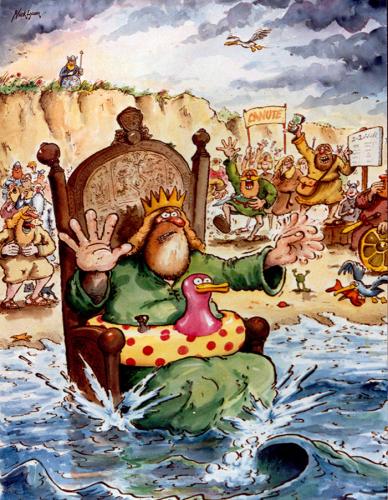 Baglow assumes role of King Canute in Climategate controversy
With John Baglow now taking a place among the writers of the National Post's Full Comment blog, one has to remember that stranger attempts at bringing ideological diversity to such an outlet have been tried before.
In a recent post there, Baglow helps demonstrate the futility of such exercises if they aren't built on a foundation of respect for the truth.
In the post, Baglow demonstrates that he simply has none.
In a post clearly intended to dispel some of the controversy surrounding the recent exposure of emails from East Anglia University's Hadley Climate Research Unit, Baglow takes on the allegorical role of King Canute, the Egyptian King who believed he could command the tide not to come in.
In Baglow's case, however, he's arguing against more than simply the tide. He's attempting to convince a flood to not breach the levies, and apparently thinks he can do so by arguing far less convincingly than even a historical demagogue like Canute would have dared.
In the post, Baglow attempts to argue against the conclusiveness of the leaked emails, but oddly enough makes no direct reference to any of the emails themselves.
"I grew up with scientists -- astronomers and physicists, mostly -- and they were about the most apolitical crowd I know. They were far too interested in what they were doing. I try to imagine sometimes how these gentle folk might have reacted had some discovery of theirs, and the documentation that accrued around it, led to sudden and savage public attacks from howling cranks and scientific illiterates, including threats, thefts and loony accusations.Of course, what Baglow declines to mention is that Galileo wasn't dealing with anything nearly so complex as attempting to delineate shifts in the Earth's temperature from tree ring data or ice cores. Galileo was dealing with something as fundamental, basic, and verifiable as the Earth orbiting the sun, as opposed to the other way around.
They wouldn't even have had the survival-schooling that Galileo had in the art of dancing carefully around the powers that be. A mis-step in those days could kill you. The bold man insisted on his views to the point that he was tried for heresy and spent the rest of his life under house arrest. But he still managed to keep friends in the Church: his books were not burned, and neither was he."
The conclusions offered by these scientists deal with claims that human activity is leading to an oncoming environmental apocalypse via a warming trend that they cannot irrefutably demonstrate. This inability to irrefutably support their hypotheses even, in time, led to the establishment of "climate change" as a fallback position from "global warming".
The simplicity of this truth is as glaring as the notion of the apolitical scientist. The political agendas attached to the climate change/global warming/whatever they plan to call it tomorrow issue have been as eagerly supported by a legion of activist scientists -- many of whom, like George Monbiot and David Suzuki, are not climatologists.
Yet in the wake of the release of the extremely-damning emails -- in which scientists discuss "tricks" used to "hide the decline" in global temperatures, plans to exclude dissenters from the peer review process, undermine scientific journals that publish dissenting papers, and even fantasize about committing violence against dissenters -- to the researchers in question merely being human.
"The embattled folks at the CRU in East Anglia, deluged with FOI requests, excoriated by denialists (few of whom are scientists, and even fewer, scientists in the field), reacted like human beings. In other words, they did not speak among themselves in that 'neutral' fashion that we have come, stereotypically, to expect of scientists. They called a spade a spade and a crank a crank, and their frustration showed. Now they're paying the price."What Baglow declines to mention is that they also refuse to cooperate with FOI requests and refused to share their data with other scientists. The emails also speak of the discounting of entire data sets that simply didn't support their theories, and the artificial bolstering of other data sets in order to (in the now-famous phrase) "hide the decline".
"After two weeks, the so-called mainstream media have joined in on the feeding frenzy already bloodying the blogosphere, and they're doing nearly as badly. I read Doug Saunders' piece in the Globe this morning, in which he uses phrases like 'dangerous bunker mentality' and 'data-fudging scandal' as though the first was unexpected and the second, established. He quotes an excitable scientist who claims the mass theft of emails has 'set the climate debate back 20 years.'"Indeed, the emails have set the climate debate back 20 years -- to when there was a debate, before activist scientists like those at East Anglia University worked so hard to shut the debate down.
On that note, setting back the debate 20 years has actually been a good thing, even if -- or especially because -- it imperils the political agendas swirling around the issue.
"On a political level, he says, the 'controversy has been catastrophic.' That, too, is grossly overstated, I think, but it is certainly the case that political denialists have not been slow to seize an opportunity and leverage it, as we saw just a few days ago in Australia, and then in Saudi Arabia, where it's all about oil. The latter, according to the breathless Saunders, 'will argue in Copenhagen that carbon-emissions controls are pointless because the CRU scandal has nullified any evidence of human-caused atmospheric temperature increase.'Leave it to a true believer like Baglow to continue pushing this increasingly ill-fitting analogy. Unlike the CRU emails, Galileo's diaries contain no revelations about Galileo deliberately tailoring his scientific method to produce the kind of astronomical data that would support his theory.
'Nullified?' Did the earth stop rotating around the sun because Galileo was indiscreet enough to insult the Pope in Dialogue Concerning the Two Chief World Systems?"
There are no such revelations in Galileo's journals because he, unlike the CRU researchers, did no such thing.
"Says a critical climate scientist from East Anglia, Mike Hulme, 'I think there is a serious problem with the way scientists are used, and they way they position themselves, in climate-policy debates. Wherever you look around climate change, people are bringing their ideologies, beliefs and values to bear on the science.'That's a rather odd admission from someone who had previously promoted the myth of the apolitical scientist. But no matter.
No kidding. Perhaps one positive thing that might emerge from this political tempest in a teapot is a public awareness that scientists are fallible, emotional, and anything but value-free--just like everyone else. Rather than having privileged access to some 'objective' realm denied to the rest of us, they are equipped with a well-tested and productive procedure. The only ethical question is how that procedure--observation, analysis of data, tests of replication, predictability and empirical adequacy, and so on--is administered."
Baglow goes on to claim that "thus far we simply have no smoking gun", despite the numerous emails that reveal the Hadley CRU's perversion of the very scientific methods Baglow speaks of here: observation, analysis of data, tests of replication, and empirical adequacy (at one point one of the researchers even decries their inability to produce data that supports their theories).
Baglow goes on to offer the same tired old denunciations of scientific dissenters at this point, even envoking the spectre of oil companies.
But odder still is that, even as Baglow dismisses the importance of the revelations offered by the Climategate emails without any reference to any of the emails themselves, Baglow goes on to state that he isn't very well versed in the science himself.
One supposes that his faith in climate research stems from him simply accepting the assurances of researchers like those at the now rightfully-discredited Hadley CRU that their science was unassailable, their conclusions irrefutable, and the debate settled.
Even as the flood of well-and-rightly-inspired skepticism washes over the climate debate, John Baglow seeks to stand at the levies so recently broken -- whether by computer hacker or by an internal whistle blower remains unknown -- like a modern-day King Canute and try to convince the flood not to burst forth.
But it's far, far too late for that. Whether Baglow likes it or not, the flood is now upon he and his contemporaries. It will take better arguments than the ones Baglow offers to convince the waters to recede.
Subscribe to:
Posts (Atom)