Showing posts with label Climate change. Show all posts

Friday, April 22, 2011

So How Seriously Does the Green Party Really Take Climate Change?

Throughout the 2011 election campaign -- and for years beforehand -- the Green Party has presented itself as the best party to fight climate change. Even when Green Party leader was partnering with the great do-nothing environment minister, then-Liberal Party leader Stephane Dion, in the "Red Green coalition", the Green Party has touted climate change as the most important reason to vote Green.

But how serious is the Green Party on fighting climate change? Perhaps not as seriously as one may think.

At 21:33 of the following video, May lays out the Green Party's policy on marijuana:


"When you look at the World Health Organization information on marijuana, from a health point of view compared to cigarettes or alcohol, you do not have as strong a case to ban marijuana as you do to ban cigarettes or alcohol.

Prohibition is not working, it's resulting in a distortion of our law-enforcement resources toward something that does not represent the health threat. But,\ it's fuelling organized crime. It's creating very dangerous grow-ops.

So by legalizing, taxing, regulating and encouraging Canadians not to get involved with marijuana the same way we say 'don't drink too much, don't smoke cigarettes'. It's a failed policy we're on now, and our approach is, frankly, very practical.
"
But how practical is the Green Party's approach to marijuana? Really? Especially as it pertains to their #1 priority of fighting climate change?

As it turns out, not very.

According to a study produced by Evan Mills, PhD entitled "Energy Up in Smoke", indoor marijuana production is actually one of the biggest unidentified contributors to climate change.

How big a contributor is it? When compared to the Alberta oil sands, indoor marijuana production in the state of California has half the carbon footprint of the oilsands. To make matters even more remarkable, California represents only 1/5 of the total indoor marijuana production in the United States.

It speaks for itself, especially when one considers that Canada's indoor marijuana grow-ops -- which are more energy-intensive due to the colder climate -- are not included in the figures.

So how serious is the Green Party about fighting climate change? If its policy on marijuana is any indication, the answer is: not serious enough to give up their reefer.

The oilsands they'd love to shut down, even if they don't publicly come out and say it. But the two-pounds-of-CO2-per-joint vice of the Canadians they desperately want to vote for them? Apparently, they'll take a pass on that.


Monday, April 04, 2011

Cap-and-Trade Bad For Saskatchewan, Bad For the West

Ignatieff's green plan could be Green Shift II

Looking back on the 2008 federal election, it becomes clear that then-Liberal leader Stephane Dion's vaunted green shift -- which would have re-designed Canada's tax system around a carbon tax -- was a millstone around the neck of the Liberal Party.

While Dion took the blame for that defeat, the carbon tax itself was actually an idea adopted from the current Liberal leader, Michael Ignatieff. With Ignatieff now proposing a cap-and-trade system in the place of that carbon tax, he's again provoking serious concerns regarding its effect on Canadian industry.

For his own part, Saskatchewan Premier Brad Wall has been trying to stay out of the 2011 federal election. But as the Premier of a province that would be hit hard by the proposed cap-and-trade scheme, Wall has been forced to start speaking out.

Cap-and-trade, he points out, would be bad not only for Saskatchewan, but for the west as a whole.

"There's already been speculation in the media that it could be very costly to the industry in Western Canada, to Alberta and Saskatchewan, not just to oilsands but to the fossil fuels industry," Wall explained.

Wall would be prepared to consider a cap-and-trade system if he could secure assurances that the funds accrued through the trading would remain in the province in which they are paid.

"We need assurances from all parties that if provinces are serious about dealing with the issue, and we are, that any proceeds from fines related to emissions stays in our province," Wall announced.

"Cap-and-trade is different," he declared. "Cap-and-trade is very much about a wealth transfer because it can't respect borders by definition. That's certainly the cap-and-trade that I understand. That's the one that some of the central Canadian provinces want."

It's also approximately what then-Liberal MP Ken Boshcoff said the Green Shift would do in 2008. Boshcoff was defeated by now-Conservative MP John Rafferty in the 2008 federal election, but is now running again.

"If it's different than that, that's what we need to know and we should know it soon," Wall insisted.

But if Michael Ignatieff approaches his Green Plan the same way Stephane Dion approached the Green Shift, Canadians should expect to not know precisely what this Green Plan entails. Dion evaded questions about how a Liberal government would replace falling revenue from a carbon tax. Until Ignatieff becomes more forthcoming, Canadians -- Brad Wall included -- shouldn't hold their breath waiting to hear the details.


Thursday, April 01, 2010

Remember When Cover-ups Were a Bad Thing?

Artificial exoneration of climate scientist means nothing

Certainly, most people will likely remember when cover-ups were a bad thing. It wasn't all that long ago.

Yet when a cover up benefits the progressive left, that changes so quickly that people like this guy can't seem to remember when cover-ups were bad. It must seem so long ago now.

Naturally, a great many will be waxing triumphally now that Dr Phil Jones, the director of the University of East Anglia's Hadley Climate Research Unit, has been formally cleared of any wrongdoing. It's important to note that Dr Jones has only formally been cleared of any wrongdoing, because as James Delingpole points out, something very foul is afoot.

As it turns out, the inquiry that has formally cleared Dr Jones has had something of a troubled history. One member of the panel resigned only after it was revealed that he had made his bias in favour of clearing the climategate scientists crystal clear.

He didn't decline to join the inquiry in the first place, which leads one to wonder precisely how many other members of the panel marched into it with their minds already made up.

As it turns out, East Anglia University's inquiry will be even worse. Lord Ronald Oxburgh, the chairman of that panel, has a wide enough variety of conflicts of interest that it should make one's head spin.

Oxburgh is a member of GLOBE (Global Legislators for a Balanced Environment). GLOBE is a well-funded organization that, despite the insistence that airplane travel is a leading cause of climate change, isn't shy about flying its members around the world on posh flights.

As it turns out, GLOBE is a rather obscure organization. While it has a website, it has no Wikipedia entry.

There is certainly due cause to suspect that is the work of the climate alarmists' resident Wikipedia censor, who was instrumental in not only covering over the Medieval Warming Period on Wikipedia, but numerous other topics as well.

Lord Ronald Oxburgh has declined to list GLOBE among the list of his benefactors -- effectively covering that up. And, as one can see, GLOBE itself has been hidden in plain sight.

But regardless of all these efforts, there is one thing that Lord Oxburgh and his fellows cannot do: they cannot cover over the climategate emails. The public has seen them, and the public knows the extent to which Dr Phil Jones and his cronies willfully perverted the scientific process to meet their ends.


Tuesday, March 02, 2010

Murray Dobbin Writes the Most Telling Paragraph in the History of the Global Warming Debate

Sometimes they let the mask slip

For years, those skeptical of climate change alarmism (however the alarmists may be defining the change) have been told that the debate over the matter was settled. Moreover, they were told that the alarmists were merely acting in the global pulbic interest, and that the skepticism of those skeptics was an obstacle to, quite literally, saving the world.

With the alarmist side of the climate change debate increasingly beset by the kind of scandal that can only come when they take the most generous of liberties with the very foundations of scientific discourse, it's simply impossible to put an overabundance of faith in those assertions.

After all, it turns out that the climate change debate may never have been about saving the world at all, only about changing it to the liking of climate change alarmists. The following paragraph from a recend op/ed penned by Murray Dobbin seems to make it rather clear:
"We need to keep reminding ourselves that if we want to inspire people to change the world we have to do more than scare the hell out of them. The issue of global warming is becoming less and less important to Americans (I haven't seen recent polling regarding Canadians) and the reason, according to a couple of prominent environmental analysts, is what they call apocalypse fatigue."
In other words, the arguments of climate alarmists have never been about "saving the world". They've merely been abotu implimenting a specific political agenda, one that encompassed Kyoto, then threatened to run entirely amok at Copenhagen.

Dobbin goes on to write about the decreasing levels of belief in the alleged oncoming apocalypse. He notes that numbers of those who bought into the panic were declining as recently as September 2009 -- before the damning Climategate emails.

But consider how much more revealling Dobbin's admission is if the first two paragraphs of his column are switched in place:
"The numbers are not encouraging. The major increase in public attention and concern brought about by Al Gore's Inconvenient Truth film, and his media blitz, seemed to promise a permanent change in attitude. But according to Ted Nordhaus and Michael Shellenberger that concern is rapidly decreasing. 'Belief that global warming is occurring had declined from 71 per cent in April of 2008 to 56 per cent in October [2009] -- an astonishing drop in just 18 months. The belief that global warming is human-caused declined from 47 per cent to 36 per cent.'

We need to keep reminding ourselves that if we want to inspire people to change the world we have to do more than scare the hell out of them. The issue of global warming is becoming less and less important to Americans (I haven't seen recent polling regarding Canadians) and the reason, according to a couple of prominent environmental analysts, is what they call apocalypse fatigue.
"
What climate alarmists seem to be learning right now is that they can't put the genie back in the bottle -- that they can't coverup their dishonest hubris once its been fully exposed to public scrutiny.

As Murray Dobbin makes clear, climate alarmism isn't about saving the world. It never has been. It's about fear-mongering and politics played to win. There isn't necessarily anything wrong with the latter in and of itself. But the former simply must not be tolerated.


Wednesday, January 20, 2010

In Defense of Rex

Murray Dobbin picking on Rex Murphy

As usual, Murray Dobbin has a bone to pick. And as usual, it's with someone whose worldview starkly deviates from his own, and someone who has found a position of prominence from which to express it.

Dobbin is evidently so threatened by Murphy that Rabble.ca has launched the "Not Rex Contest", looking for someone they feel can counter him -- somthing of an anti-Rex.

“We’re looking for someone who isn’t pompous, occasionally uses facts and reflects the values of the vast majority of Canadians,” Dobbin muses.

“Most commentators and columnists at least occasionally refer to some facts.”

Of course, Dobbin's problem with Murphy isn't that he never makes reference to any facts -- that would be untrue. Dobbin's problem with Murphy is that he makes reference to facts that Dobbin doesn't like, and would rather were ignored.

This becomes immediately evident as one considers the content of the contest's webpage.

"Only those who actually share the values and aspirations of the majority of Canadians; who trust that a genuine democracy would actually deliver what Canadians want, who don't think it's a good idea to give corporations almost unlimited and totally unregulated power and who - unlike Rex - understand that there is no serious scientific debate about humans' role in the climate crises, need apply or be nominated," the contest webpage insists.

First off, one may want to ask the editors of Rabble who they think they are to determine the "values and aspirations of the majority of Canadians". The very idea that a website that deliberately excludes vast swaths of Canadians from participation could do this is, quite frankly, a pompous notion.

Moreover, their insistence that the anti-Rex must "understand that there is no serious scientific debate about humans' role in the climate crisis" would have to presume that there is debate.

But whether the Rabblers like it or not, there very much is a debate, now more than ever before. After all, previous claims that there was no debate relied on the idea of "settled science". Now that the climategate emails have shown us the extent to which climate alarmists have engineered the peer review process to exclude dissent, this claim has been fundamentally undermined.

Without an open and honest peer review process, the climate alarmists have no scientific consensus.

Rex Murphy has been one of the Canadian mainstream media journalists to recognize this simple, inescapable fact. And for that the editors of Rabble.ca clearly resent him very deeply.

“When Rex denies climate change, that has an impact," Dobbin says. "But a lot of people are despairing over the state of the CBC, the National in particular, and in this case Rex is sort of symbolic.”

In other words, Rex Murphy is symbolic of the failure of Dobbin and his cohorts to banish any dissenting views from the public sphere -- regardless of how desperately they would like to.

There's no better reason why Murphy should continue to be at home on the CBC: the National desperately needs someone who is willing to call a spade a spade.


Saturday, December 26, 2009

It's Almost a Shame They Can't Get Along

Naomi Klein decries "limited" senses of possibility

As alluded to in some of the Hadley CRU emails the climate alarmists have scrambled so frantically to write off as "insignificant", sometimes the alarmists don't get along nearly as well as some would suspect.

Writing in an op/ed column for the Guardian, Natasha Chart reports on an encounter she had with arch-leftist Naomi Klein at the Copenhagen Conference, in which Klein objected to the very idea that they shouldn't use the word "reparations".

"You Americans want to hold us all to what's possible in DC, which is apparently nothing," Klein complained. "You have such a limited sense of the possible ...[and] ... give up before you even try."

Chart complains that it's the notion of reparations that have undermined US President Barack Obama's ability to act on the climate change crisis (as it were), and that a mere change in phrase would allow Obama to proceed with the kind of climate change program he really wants.

Klein, meanwhile, would reportedly have none of it.

Whether or not one disagrees with Chart, there is a golden notion at the heart of her article, one that individuals such as Klein seem to have gleefully thrown onto what they imagine is the ash heap of history.

That notion is that, when being urged to act on a global crisis -- the alleged scope of which Klein and company cannot make a decisive case for -- people have the right to consent. Accordingly, they also have the right to not consent.

Chart seems to understand the extent to which the notion of "reparations" will undermine the ability of climate alarmists to seek consent for these kinds of programmes.

Klein, meanwhile, seems to imagine that these kinds of programmes can be extracted from the world's wealthiest and most powerful countries without their consent. While Chart seems to see the optimal solution for climate change to be one wherein people are convinced of the threat and act on it voluntarily, Klein seems to see the optimal solution as one wherein people need not be convinced and are instead coerced.

Comparing the two, Chart certainly comes across as a preferable alternative to Klein's brand of demagoguery.

But there is one point on which Chart falls flat. She pretends that to anyone outside the United States, "reparation" is just another word. But for students of, say, German history, the fact of the matter would be very different indeed. The post-World War One reparations levied against Germany by the victorious powers -- the United States, Italy (after changing sides), and the remaining members of the Triple Entente -- were vindictive and vengeful acts, meant to punish Germany for its role in staring the war.

Moreover, the reparations could be judged to be part of a historical revisionist act. While the victorious powers attempted to make Germany carry the blame -- and pay the costs -- of the war, the First World War was one its participants had largely arrived at together.

The notion that two of the world's countries that not only lead the world in carbon emissions -- China, the world's number one emitter of greenhouse gases, and India, the world's number four emitter of greenhouse gases (and the emissions of each country are growing) -- would receive reparations under the programme Klein favours, the programme favoured by the far left would itself amount to a program of historical revision.

It's one of countless reasons why a programme designed to fight a global "crisis" that seems less and less like a crisis, conceptualized and promoted almost entirely by the global left, should be rejected outright.


Thursday, December 24, 2009

The Narrow View of Climate Alarmism


Regular readers of The Nexus may recall a recent post about the film The 11th Hour.

While some of the ideas in the film were actually largely constructive in nature, it's difficult to cover all the ideas discussed in the film that are actually destructive in nature.

Fortunately, a recent speech by Naomi Klein, featured on ForaTV, has given a second opportunity.

In the video, Kelin talks about some of the things that weren't discussed at the Copenhagen Conference. In particular, Klein was disillusioned that windfall taxes on the oil and gas industry weren't part of the final (non-binding) agreement reached at the conference.

After taking a brief time to complain about the Fort MacMurray oil sands, Klein accuses the oil industry and its corporate lobbyists of preventing a "fair climate deal".

In The 11th Hour, James Woolsey excitedly talks about the need for research in development into renewable energy technologies, which he describes as the "killer app to defeat big oil".

"Human greed", they insist, is bad. And so the greedy corporations that are "big oil" must be destroyed.

But what individuals like Klein and Woolsey fail to understand is that "big oil" and the "oil and gas industry" is actually an extremely ill-conceived concept. The "oil and gas industry" is actually the energy industry, and "big oil" companies are actually energy companies. Oil and gas are merely resources tapped for the provision of energy for profit.

And therein lies what Klein and Woolsey either don't understand, or fully understand and simply abhor.

The destruction of the energy industry as it exists today isn't necessary in order to develop renewable energy resources. Rather, providing the energy industry with an incentive to develop these energy resources by making them potentially profitable is the key.

The "windfall profits" that Klein so abhors the energy industry earning off the production and sale of oil actually resembles one of the largest and most reliable pools of liquid capital in the world today.

Not only would Klein and Woolsey's fantasy "solution" to the climate crisis -- insomuch that there actually is such a crisis, and this is now ever-increasingly in doubt -- be destructive to the livelihoods of those who earn their living producing oil and natural gas (energy), but it also threatens the livelihood of companies that would gladly invest in the research and development of alternative energy sources if only it were economically viable and profitable.

On the other side of the coin, taxing what Klein would deem to be "excessive" profits by large energy companies eliminates the incentive to produce at a level that would produce those profits.

The energy industry won't simply continue to produce at current levels regardless of the hand of government reaching deep into its pockets. Rather, it will simply decrease its level of production in order to stave off excess taxation.

Moreoever, the energy industry won't gladly absorb the additional costs of those taxes. Rather, the costs of those taxes will be handed down in the form of higher energy costs for consumers, lower wages for employees, decreased safety standards, and downgraded measures for environmental protection.

In other words, Klein's "miracle solution" to a crisis that continually looks less and less like a crisis, will create a surplus of of new externalities that will increase the economic, social, human and environmental costs of energy, without ever producing the windfall of revenue for alternative energy R&D that the energy industry could produce under current conditions.

To put it more succincly, Naomi Klein and James Woolsey would kill the goose that could lay the golden egg of renewable energy simply because they can't be bothered to convince the energy industry -- or "big oil", as they insist on reducing it to -- to invest in renewable energy and would rather coerce it.

All of this in the name of their own narrow view of climate alarmism.


Tuesday, December 15, 2009

Mixing Messages

The Liberal Party has already drawn considerable fire for its "Anywhere but Copenhagen" contest.

But by displaying the contest entries on their webiste and using them for political purposes, the Party runs the risk of being embarrassed in more than simply the "whackos fantasize about assassinating Stephen Harper" department. They also run the risk of embarrassing themselves in the "can't keep the message straight" department.

A case in point is the above image, in which Harper's face is superimposed on an image of Kanye West interrupting Tailor Swift and the MTV Video Music Awards. The Spaceman award Swift just received is replaced by a picture of the Earth, and Harper/Kanye is saying "Yo Copenhagen, I'm really sorry about those GHGs, and I'mmma let you finish, but Canada-China relations are the worst of all time."

First off, Canada-China relations are currently not the worst of all time.

But even aside from that, the creator of this image seems to have forgotten that not only is China the world's top producer of Greenhouse gases, but that China's top three companies alone produce more greenhouse gases than Britain -- or Canada.

Moreover, China has yet to pledge to cut its emission of Greenhouse gases. It's actually only pledged to slow the growth of its production.

So, the creator of this particular image expects Stephen Harper to be "sorry about the GHGs". But he also expects Harper to be sorry about allegedly damaging relations with China. And if Canada succeeds in cutting greenhouse gas emissions by 65% by 2050 (very likely the commitment Canada will make at Copenhagen), and China's emissions continue to grow, what precisely will happen to Canada-China relations if Canada helps pursue sanctions against China?

This is why partisan ideologues shouldn't mix their messages. It simply doesn't hold up to scrutiny.


Other bloggers writing about this topic:

Christian Conservative - "Do Thoughts of Harper's Assassination Make Liberals Smile?"

James Morton - "It Was Right to Apologize"

Russ Campbell - "Dirty Tricks at Liberal-ville"

Hatrock's Cave - "Can Liberals Stoop Any Lower? Possibly"


Tuesday, December 08, 2009

Arguing Against the Flood

Baglow assumes role of King Canute in Climategate controversy

With John Baglow now taking a place among the writers of the National Post's Full Comment blog, one has to remember that stranger attempts at bringing ideological diversity to such an outlet have been tried before.

In a recent post there, Baglow helps demonstrate the futility of such exercises if they aren't built on a foundation of respect for the truth.

In the post, Baglow demonstrates that he simply has none.

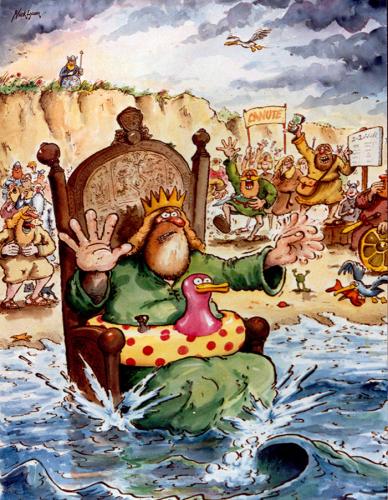
In a post clearly intended to dispel some of the controversy surrounding the recent exposure of emails from East Anglia University's Hadley Climate Research Unit, Baglow takes on the allegorical role of King Canute, the Egyptian King who believed he could command the tide not to come in.

In Baglow's case, however, he's arguing against more than simply the tide. He's attempting to convince a flood to not breach the levies, and apparently thinks he can do so by arguing far less convincingly than even a historical demagogue like Canute would have dared.

In the post, Baglow attempts to argue against the conclusiveness of the leaked emails, but oddly enough makes no direct reference to any of the emails themselves.
"I grew up with scientists -- astronomers and physicists, mostly -- and they were about the most apolitical crowd I know. They were far too interested in what they were doing. I try to imagine sometimes how these gentle folk might have reacted had some discovery of theirs, and the documentation that accrued around it, led to sudden and savage public attacks from howling cranks and scientific illiterates, including threats, thefts and loony accusations.

They wouldn't even have had the survival-schooling that Galileo had in the art of dancing carefully around the powers that be. A mis-step in those days could kill you. The bold man insisted on his views to the point that he was tried for heresy and spent the rest of his life under house arrest. But he still managed to keep friends in the Church: his books were not burned, and neither was he.
"
Of course, what Baglow declines to mention is that Galileo wasn't dealing with anything nearly so complex as attempting to delineate shifts in the Earth's temperature from tree ring data or ice cores. Galileo was dealing with something as fundamental, basic, and verifiable as the Earth orbiting the sun, as opposed to the other way around.

The conclusions offered by these scientists deal with claims that human activity is leading to an oncoming environmental apocalypse via a warming trend that they cannot irrefutably demonstrate. This inability to irrefutably support their hypotheses even, in time, led to the establishment of "climate change" as a fallback position from "global warming".

The simplicity of this truth is as glaring as the notion of the apolitical scientist. The political agendas attached to the climate change/global warming/whatever they plan to call it tomorrow issue have been as eagerly supported by a legion of activist scientists -- many of whom, like George Monbiot and David Suzuki, are not climatologists.

Yet in the wake of the release of the extremely-damning emails -- in which scientists discuss "tricks" used to "hide the decline" in global temperatures, plans to exclude dissenters from the peer review process, undermine scientific journals that publish dissenting papers, and even fantasize about committing violence against dissenters -- to the researchers in question merely being human.
"The embattled folks at the CRU in East Anglia, deluged with FOI requests, excoriated by denialists (few of whom are scientists, and even fewer, scientists in the field), reacted like human beings. In other words, they did not speak among themselves in that 'neutral' fashion that we have come, stereotypically, to expect of scientists. They called a spade a spade and a crank a crank, and their frustration showed. Now they're paying the price."
What Baglow declines to mention is that they also refuse to cooperate with FOI requests and refused to share their data with other scientists. The emails also speak of the discounting of entire data sets that simply didn't support their theories, and the artificial bolstering of other data sets in order to (in the now-famous phrase) "hide the decline".
"After two weeks, the so-called mainstream media have joined in on the feeding frenzy already bloodying the blogosphere, and they're doing nearly as badly. I read Doug Saunders' piece in the Globe this morning, in which he uses phrases like 'dangerous bunker mentality' and 'data-fudging scandal' as though the first was unexpected and the second, established. He quotes an excitable scientist who claims the mass theft of emails has 'set the climate debate back 20 years.'"
Indeed, the emails have set the climate debate back 20 years -- to when there was a debate, before activist scientists like those at East Anglia University worked so hard to shut the debate down.

On that note, setting back the debate 20 years has actually been a good thing, even if -- or especially because -- it imperils the political agendas swirling around the issue.
"On a political level, he says, the 'controversy has been catastrophic.' That, too, is grossly overstated, I think, but it is certainly the case that political denialists have not been slow to seize an opportunity and leverage it, as we saw just a few days ago in Australia, and then in Saudi Arabia, where it's all about oil. The latter, according to the breathless Saunders, 'will argue in Copenhagen that carbon-emissions controls are pointless because the CRU scandal has nullified any evidence of human-caused atmospheric temperature increase.'

'Nullified?' Did the earth stop rotating around the sun because Galileo was indiscreet enough to insult the Pope in Dialogue Concerning the Two Chief World Systems?
"
Leave it to a true believer like Baglow to continue pushing this increasingly ill-fitting analogy. Unlike the CRU emails, Galileo's diaries contain no revelations about Galileo deliberately tailoring his scientific method to produce the kind of astronomical data that would support his theory.

There are no such revelations in Galileo's journals because he, unlike the CRU researchers, did no such thing.
"Says a critical climate scientist from East Anglia, Mike Hulme, 'I think there is a serious problem with the way scientists are used, and they way they position themselves, in climate-policy debates. Wherever you look around climate change, people are bringing their ideologies, beliefs and values to bear on the science.'

No kidding. Perhaps one positive thing that might emerge from this political tempest in a teapot is a public awareness that scientists are fallible, emotional, and anything but value-free--just like everyone else. Rather than having privileged access to some 'objective' realm denied to the rest of us, they are equipped with a well-tested and productive procedure. The only ethical question is how that procedure--observation, analysis of data, tests of replication, predictability and empirical adequacy, and so on--is administered.
"
That's a rather odd admission from someone who had previously promoted the myth of the apolitical scientist. But no matter.

Baglow goes on to claim that "thus far we simply have no smoking gun", despite the numerous emails that reveal the Hadley CRU's perversion of the very scientific methods Baglow speaks of here: observation, analysis of data, tests of replication, and empirical adequacy (at one point one of the researchers even decries their inability to produce data that supports their theories).

Baglow goes on to offer the same tired old denunciations of scientific dissenters at this point, even envoking the spectre of oil companies.

But odder still is that, even as Baglow dismisses the importance of the revelations offered by the Climategate emails without any reference to any of the emails themselves, Baglow goes on to state that he isn't very well versed in the science himself.

One supposes that his faith in climate research stems from him simply accepting the assurances of researchers like those at the now rightfully-discredited Hadley CRU that their science was unassailable, their conclusions irrefutable, and the debate settled.

Even as the flood of well-and-rightly-inspired skepticism washes over the climate debate, John Baglow seeks to stand at the levies so recently broken -- whether by computer hacker or by an internal whistle blower remains unknown -- like a modern-day King Canute and try to convince the flood not to burst forth.

But it's far, far too late for that. Whether Baglow likes it or not, the flood is now upon he and his contemporaries. It will take better arguments than the ones Baglow offers to convince the waters to recede.


Monday, December 07, 2009

What's Your Motivation?

Climate activists have their own motivations -- and they aren't forthcoming about them

Ever since the emails demonstrating the extent to which researchers at East Anglia University's Hadley Climate Research Unit have put their desired results ahead of the actual science, the climate activists who have promoted the "scientific consensus" have been looking for any way they can spin the story to their benefit.

Recently, Greenpeace Canada accused those who leaked the CRU emails of being "politically motivated".

"People are going to look at the solid body of scientific evidence that is out there and realize that this is really a distraction and a politically motivated one," complained Greenpeace Canada Executive Director Bruce Cox. "I think there are probably vested interests out there that knew that this would harshly -- I don't want to say derail -- but would act as a distraction."

"Clearly it's a huge distraction from what needs to be done in Copenhagen," Cox concluded.

To which one can honestly only ask: what, precisely, is Greenpeace's motivation?

The argument, to date, has been that science clearly demonstrates that an environmental cataclysm is on the horizon. But the climategate emails clearly demonstrate that there is more afoot than simply science. In many cases, the emails reveal attempts by the Hadley Climate Research Unit to intentionally skew their own results to meet the conclusions they wanted.

In other words, the climategate emails cast serious doubt on the quality and veracity of the science that has been the foundation of climate activism.

It's perhaps for this reason more than any that individuals like Cox -- and Green Party leader Elizabeth May -- have been so desperate to spin the issue any which way they can.

For her own part, May wants to make the story not about the subversion of the scientific process made so evident by the CRU emails, but rather about the leak itself.

"Strange, isn’t it that media are not wondering about who hacked into the computers and who paid them?" May asked in a recent post on the DeSmog blog.

Not only is May more than willing to skip over all the emails that demonstrate the manner in which the members of the Hadley CRU threw out entire data sets that didn't support the findings they wanted, but she's also treating the internal investigation launched at East Anglia University as a potentially persuasive exhoneration.

"Certainly nothing in these emails suggests any problem with fundamental science," May insists. "Dr Phil Jones, who headed up the Climate Research Unit at East Anglia, has just stepped aside during the investigation. My money is on a full exoneration for him."

So May expects the East Anglia CRU to investigate itself, and naturally has no doubt that Jones will be exhonerated. For reasons that are self-evident.

And just as Elizabeth May has made her own motivation -- getting elected to Parliament -- self-evident, so have various other climate activists. Al Gore has profited handsomely from the controversy. George Monbiot imagines climate talks like the Copenhagen summit will eventually lead to the establishment of a World Parliament.

That, even amongst all of this, these people can find it in themselves to question the motivation of those blowing the whistle on them, even as the need for that whistle-blowing becomes perfectly evident, simply demonstrates the extent to which they expect people to overlook their questionable motivations.

More and more people are beginning to question the motivations of people like Brian Cox and Elizabeth May. Maybe if they were more forthcoming about their motivations, manipulations like those evident in the Climategate emails would have never been necessary.


Friday, December 04, 2009

Lying Season


Thursday, May 07, 2009

Al Gore and the Climate of Extremes


Featured on YouTube via TED Talks, former US Vice President Al Gore speaks about some alarming new signs of global warming.

In the video Gore talks about the alleged spread of oxygen-depleted "dead zones" in the oceans, and about methane emissions from lakes, including a video where some scientists set these methane emissions on fire. He then finishes up by debuting some campaign ads directed against clean coal technology.

Yet as it turns out, Al Gore is not at all a reliable source of information about global warming -- or as alarmists re-term it when challenged about the lack of a demonstrable warming trend, climate change.

Speaking via ForaTV, UN Inter-government Panel on Climate Change member Patrick Michaels demonstrates how quickly Gore's sensationalist rhetoric can be exposed for what it truly is.

It quickly undermines any faith in nearly anything that comes out of the former Vice President's mouth, and reminds viewers that while individuals like Gore want to insist climate change will be the end of the world, and that we should all be extremely terrified of it, there's more afoot than these alarmists would have us realize.

It's difficult to overlook the extent to which climate change alarmism is being treated as a pretext for various political programs.

In Canada, Liberal MP Ken Boschoff let a wealth-transferring agenda slip when talking about Stephane Dion (and Michael Ignatieff's) carbon tax.

George Monbiot has been amongst the most extreme of the alarmists, writing a book that insists that climate change will reach a "point of no return" if not stopped as immediately as possible. Monbiot, who is not a climatologist, had also previously spoken on CBC's Ideas radio program about the need for a global Parliament -- something that legally-binding climate treaties like the Kyoto protocol could arguably (but not necessarily) lead to.

On the other side of the coin there are those who deny climate change outright. As Gore rightly notes, many of them profit from oil and coal -- just as those who profit from oil and coal will rightly note that Gore has a political agenda that is served by climate change alarmism.

It would be foolish to deny that climate change is a problem. At the very least, it would be foolish to deny that there aren't countless other good reasons to reduce carbon emissions and other industrial emissions -- air quality being paramount among them.

But to allow Al Gore and his extremist cohorts to terrify people ignores both the tendency of these people to promote alarmism at the expense of scientific fact, and the political agendas they seek to promote.

Patrick Michaels is absolutely right. People need to stop feeding the climate of extremes.

Friday, September 26, 2008

Michael Byers Shows His Concern for the Working Class

Shut down the oilsands, says NDP candidate

Thank god for the NDP -- Canada's "working-class" political party. Always so full of concern for the working class.

...Or maybe not.

In a debate yesterday at the University of BC's School of Journalism, Byers made what have been described as controversial remarks. More than simply controversial, they make one wonder if the entire NDP isn't suffering from some kind of deeply-rooted identity crisis.

Lamenting that climate change may mean that his sons will never see a polar bear in its natural habitat, Myers remarked on the alleged urgency of the alleged crisis.

"We have to do something to address the climate change crisis, we need to do so now," Byers announced. "We need to go after the big polluters, we need to shut the tarsands down."

And all the working-class men and women whose livelihoods -- their ability to support themselves and their families -- depend on the Fort MacMurray oilsands?

"Yeah, fuck those guys," Byers remarked.

Well, not really. But he may as well have.

For her own part, Liberal incumbent Hedy Fry was truly shocked. "That's a headline," she said afterward. "It's quite a statement."

And it is. It's a statement on the true nature of the NDP.

For decades, the NDP has portrayed itself as the "conscience of the nation", as the party of the working class.

Yet the party remains notoriously weak in rural and suburban ridings where most working-class people actually live. Instead, the party finds the bulk of its strength from urban ridings in Vancouver and throughout Ontario.

Those of its ridings that do represent the abstract working class all come from within Ontario's "golden horseshoe". Meanwhile, the ridings that represent the working class throughout the rest of the country tend to find themselves in the hands of Conservative candidates.

If anything, the NDP is increasingly becoming the party of the urban elite. After all, Michael Byers' appeal to working-class individuals has likely just taken a rather significant dip in the wake of his comments, which demonstrate certainly a lack of concern, if not outright contempt for, working class individuals who happen to work in the "wrong" industry.

When one considers that all of those working class men and women whom Byers would so readily put out of work produce a product that is complementary to, and necessary for, that produced by so many of the NDP's constituents in Ontario, one has to wonder precisely where Byers' head and heart are at in this federal election.

Certainly not in Alberta, where he's just fucked his party royally. Edmonton-Strathcona candidate Linda Duncan, running neck-and-neck with Conservative incumbent Rahim Jaffer, may have just found her campaign complicated significantly by her colleague's unfortunate remarks.

Even what should otherwise be a bastion of strength for her campaign -- the University of Alberta, with its campus located within the riding she seeks -- may turn out to be significantly less so, as Engineering and Business students, counting on continuing prosperity from the tarsands projects Byers so desperately wants to kibosh, turn away from her campaign.

All of this for a policy point that runs contrary to that of his party -- NDP Jack Layton has called for a moritorium on tarsands development, not for a complete shutdown.

In the end, the damage Byers has done to his party may actually turn out to be minimal. The party is in contention for a single seat in Alberta. Not exactly difference-making stuff.

But the damage Byers has done to that working class vineer the party has traditionally spread over its very real inner shell of urban elitism may turn out to be more devastating in time.

At least for once the NDP will be able to be honest -- both with Canadians and with itself -- about from whom the party actually draws its support.

So, in that sense, thank god for the NDP and all the positive things that they've accomplished for this country. (Public health care is a wonderful thing, mr Douglas and we love you for it.)

But thank god for Michael Byers, as well. For shining a little light on the otherwise obscure shadows of the inner party.

Sunday, September 21, 2008

Dion Makes His Case as a Leader


Ever since his ascension as Liberal party leader, one of the Conservative party's criticisms of Stephane Dion is that he is "not a leader".

The Conservatives played and re-played footage of Dion's embarrassing breakdown onstage during the Liberal leadership contest when he complained that now-deputy leader Michael Ignatieff's criticisms of the Liberal party's performance vis a vis climate change -- and ergo Dion's as Environment Minister -- were "unfair".

With more than a year of these ads -- and necessary interventions by Bob Rae into the Liberal campaign -- erroding the Canadian public's perceptions of Dion as a leader, it's only natural that Dion needs to re-brand and re-assert his leadership qualities during the 2008 campaign.

Thus, the introduction of this new ad.

In it, the Liberals document Dion's leadership at the United Nations Climate Change Conference. As the spot claims, Dion's efforts, despite the incooperativeness of "one country" (guess who?), the Liberal leader secured an agreement among 182 countries to fight global warming.

It seems like an impressive accomplishment -- the very thing that should help to improve impressions of Dion's leadership skills.

Of course, the agreement reached at the UN Climate Change conference seem less impressive once one realizes that so little action was taken by Dion to satisfy Canada's obligations under the agreement afteward. To that end, it seems that Dion is able to assert leadership as it pertains to how other governments are supposed to act. Toward his own? That has, to a certain extent, already been seen.

The spot also plays to an anti-American constituency that the Liberals and NDP have each sought to harness on a regular basis over the past few decades, and particularly over the past eight years.

In noting the alleged incalcitrance of the American government, the ad seems to take on a dramatic note -- Stephane Dion standing up to the goliath of the global stage. But it hardly asserts fresh leadership to follow the same course so often tread by Liberal leaders ever since Pierre Trudeau made it fashionable.

As a further weakness, this ad is merely an election-time reworking of an ad ran by the Liberals in response to the "Not a Leader" ads run by the Tories.

It plays to the necessary frugality of the Liberal campaign -- such an ad can be produced fairly cheaply. But if such an ad failed to improve Canadian impressions of Dion's leadership skills before an election, one has to wonder if it will do so now.

In the end, such questions are largely irrelevant. After the sustained attacks on Dion's leadership abilities, re-branding was necessary one way or the other. Whether or not it succeeds will only be told in time.

Saturday, September 13, 2008

Free Trade Issues Enter the Counter-Branding Fray


In a new ad released yesterday, the Conservative party took advantage of a trade-related issue brought up by Stephane Dion.

Dion has suggested that the allgedly weak environmental policies of the Conservative government would imperil Canadian trade, as other countries impose punitive tariffs on countries judged to have taken insufficient action fighitng climate change.

"Other countries are considering slapping carbon tariffs on those who don't take action on climate change. As hard as it is to believe, for now, Canada is one of those countries," Dion recently said.

Dion's Green Shift plan promises to impose such "carbon tariffs" on other countries judged to be dragging their feet on climate change.

The ad itself seems to have been put together rather hastily. It features a different narrator than previous Conservative ads, and relies almost overwhelmingly on the analysis of a single expert -- Carlton University's Michael Hart. It features images of numerous Canadian trading partners being stamped with the word "tariff" as it progresses toward its logical conclusion: a map of the United States -- Canada's largest trading partner -- being stamped.

Perhaps it's inevitable that trade-related issues (in particular, Free Trade-related issues) were going to come up in the election campaign. In August, David Orchard, Canada's leading anti-free trader finally secured his opportunity to run for the Liberal party.

Perhaps it was only a matter of time before the Liberal party offered up some kind of Free Trade-related policy -- one that would inevitably require the abrogation of NAFTA -- in order to keep their newest star candidate in the fold.

Not so surprisingly, Dion's trade-related musings closely resemble musings by Barack Obama that he would try to renegotiate NAFTA in order to add environmental agreements. Considering Dion's poor performance on fighting climate change during his last go around, questions over whether or not Dion is, like Obama, merely bluffing remain lefitimate.

As such, the Conservative counter-branding effort in this case ironically tries to drive Dion closer to potentially unpopular policies of the man he would likely most like to emulate, even if Jack Layton is outdoing him on that particular front right now.

This subtext of the ad -- and reminders that many key details about Dion's Green Shift plan have been postponed in Campbellian fashion until after the election -- seem to be meant to work together to encourage voters to question Dion's genuinity and ponder the economic consequences of such a move.

The ad also represents a notable shift in the overall Conservative campaign -- moving away from tactics of ridicule and toward serious debate.

This particular ad is a bold move for the Conservative party. It will be interesting to see what kind of effect it has on the campaign.

Thursday, July 17, 2008

Yeah, What's Ten Years of Widespread Poverty Between Eco-Warriors?

Guess who's back and saying ridiculous things?

Well, OK.

To say that Kevin Potvin is "back" is like suggesting that Canadian Cynic's dementia-inducing case of neurosyphilis is "back" when it relapses. (Just a quick note here: Canadian Cynic probably doesn't have neurosyphilis. He just acts like he does. -Ed.) He's been there the whole while, maybe not quite saying things as stupid as he's accustomed to, he's been there all along. Not much unlike a case of neurosyphilis.

And so it would seem that Kevin Potvin is having a recurrence of general stupidity -- or could it be general stupidity having a recurrence of Kevin Potvin? Fuck, I get these things mixed up sometimes -- in the course of a recent opinion article in his vaunted Republic of East Vancouver in which he advocates the onset of a new Great Depression.

It starts out with Potvin taking issue with a recent article by Jacqueline Thorpe in the Financial Post:

"“But the best hope,” wrote Jacqueline Thorpe on the front page of The Financial Post section of The National Post, in a regular column entitled “The Big Picture,” “rests on at least a stabilization of oil prices.” The headline of this entry, appearing the past weekend, was “Teetering on the brink of global recession.”

It’s an astonishing statement, and so we see that in the space of just 18 months or less, the Canadian corporate sector’s communications organ, CanWest, or “corporavda” if you will, which owns
The National Post, has gone from paternalistic “sh-sh”s and “don’t worry”s all the way to thoroughly freaked out alarmism. Thorpe’s mental breakdown last weekend has become by no means an oddity. Her’s is but the theme at the corporate press lately.

“Hope for stabilized oil prices” is odd advice to the colonial-minded middle managers of Canada’s wholly foreign owned corporate sector who read
The National Post before the foreign head office calls for its daily chit-chat. To advise the nation’s decision makers that hope is their only choice now is to advise them to close their eyes, block their ears and stop whatever thinking they might have considered doing. The ride is going to get too frightening to behold."
Potvin almost has a point here. When staring down the business end of a recession very much induced by high energy prices, the best thing to do would be to prepare for it and make changes to try and avoid it, rather than simply "hope for a price break".

And while there are likely few things that can be done to deal with the exorbitantly high price of oil, it could be treated as an incentive to start investing more heavily in alternative energy sources.

Otherwise, there simply may be no escaping the economic apocalypse that Potvin is predicting (and, as we will see later, actually hoping for):

"The rapidly rising price of oil has certainly emerged as the key feature of the 21st Century. The Globe and Mail reported the same day on a poll showing the price of oil has now replaced all other concerns at the top of mind of Canadians in general. Rising oil prices promise to be the driver of history in our time. Any eyes not clouded by agendas, fear or subservience can quickly ascertain that oil prices will keep leaping up between short periods of steadying or occasionally dropping prices.

A debate about whether peak oil production has arrived or if it’s all just a ploy by Big Oil, is increasingly irrelevant. Whether by design or happenstance, oil prices will not stabilize or be stabilized at any level. If it’s by design of Big Oil or by the reality of production capacity leaves us equally unable to intervene in the trajectory.

So when the nation’s leading financial media is reduced to advising the sycophants of The Canadian Council of Chief Executive Officers to hope for stabilization of oil prices to avoid a serious global recession, it may as well throw in advice to buy lottery tickets for a retirement plan.
"
Now, with all this talk about the lunacy of simply hoping for a recession to somehow be averted instead of actually taking action to avoid it, one would think that Potvin would have some constructive ideas.

Instead, Potvin offers up a much more encouraging alternative: outright economic defeatism.

"It’s a fair question to ask why the advice columnists in the financial pages are not instead explaining why global recession is unavoidable (oil prices will keep rising is the simplest way of driving the message home), and how they might best operate their ships in the coming headwinds of the storm.

A big part of managing large national and internationally interconnected firms is pressuring and advising government ministries and influencing public opinion in line with that advice. Government policy-making especially in key economic ministries like industry and finance are now very much the purview of corporate boardrooms. The last three Canadian finance ministers both Liberal and Conservative made their first official appearances upon presuming office in the New York financial district, rather than before Canadian citizens.
"
Which would seem evidentiary of that old "Canada bowing to American imperialism" that Potvin favours.

Or, it could be interpreted as quite logical, considering that Wall Street very much remains the heart of the increasingly-globalizing economy.

"If the advice government ministers are receiving is to hope for stabilized oil prices instead of planning to manage global recessionary conditions, the aims of their policies will inevitably be thwarted, or worse, completely irrelevant.

The reason neither policy makers in government both on the bureaucratic and elected side, nor executives in corporate boardrooms, nor pundits in the financial press, can bring themselves to accept that certainly rising oil prices will certainly bring global recession is because they have spent decades telling each other within the closed confines of their social circles that recession is irredeemably bad and that it opens the door to an evil worse than war: depression.
"
And it's generally agreed, recession and depression are very bad things. People lose their livelihoods, their homes, even their families.

Very bad things indeed.

"These are assumptions at the core of all corporate and economic thought that have remained undisturbed by any queries at least since the famous depression of the 1930s. It would be heresy in the halls of ministries, boardrooms and editorial offices to even think about the received wisdom concerning the undeniability of the badness that is recession or depression."
And for good reason. Most people generally regard families losing their homes, individuals struggling to feed their families and bankrupt business people throwing themselves out of windows to be bad things.

Then again, this is Kevin Potvin we're talking about here. Most people generally considered 9/11 to be a bad thing, as well, but he did manage to find it in himself to disagree.

"But now is surely the time, before over-the-top fear produces rash counter-productive policies, to wonder whether recession or even depression are really so bad. After all, it wasn’t so long ago government forestry managers, harvesting companies and the public at large had no reason to doubt forest fires were unquestionably bad things, and look at how far that opinion has swung once the question was first posed.

While there has always been an argument available in favour of recession and depression, however dubious, an entirely different set of circumstances has arisen that makes the argument, whatever it is, far more powerful: the environment cannot absorb any more increases in human production of Co2, and in fact seems to require a drastic decline in human-produced Co2 to stabilize climate change. So dependent is all modern economic activity on energy, and so necessary is Co2 production in the expending of energy, that it is by now certain that the only chance we have of seeing the climate stabilized is through a significant decline in economic activity. That is, a long-term, perhaps even a constant economic depression, may be the only way a stabilized climate is restored.
"
So emerges some of the deepest, darkest, nuttiest thoughts bouncing around inside of Potvin's twisted little skull.

We're facing an environmental catastrophe, so don't bother trying to reduce emissions or impliment alternative energy sources. Shut everything down. And all those people who will suffer? Well, they won't be so bad off.

Potvin even has the revisionist history texts to prove it:

"Recession and its bad cousin Depression have very bad names. There has been 70 years or more of propaganda terrorizing the public about the prospect of a repeat of what is said to be the worst calamity to have ever befallen them—The Great Depression of the 1930s. But on examination, we find that most of the horrors of that time were due to corporate and state reaction to economic depression, not the conditions of depression in and of itself, and that the economic conditions by themselves, if one asks those who lived through it, coincided with a period of enriched community and individual experience producing what they report as general happiness.

People recall farming their back yards with neighbours, sharing food and lodging with passing strangers, and enjoying community dances, making simple music, and relaxing at home with games and books. That is not to say there wasn’t a lot of unemployment and poor conditions for those trapped in it. But using the same measuring techniques today that were used in the 1930s reveals unemployment then was not much higher that it has been at times in the last ten years. Certainly homelessness and desperation today is easily comparable to anything seen in 1932. Had there been ordinary unemployment insurance, welfare, subsidized housing and social programs in the 1930s to mitigate the worst conditions for those most badly affected, there is little doubt there would be today any of the horror the public associates with economic depression. Even in the absence of all these efforts, it still wasn’t nearly as bad as seven decades of corporavda has made it out to be.
"
Don't blame the economic conditions, Potvin seems to insist. Blame those evil corporations!

And even then, it wasn't so bad. Those 30 million people who were unemployed? Were just taking what we might refer to as a "vacation". (Potvin insists that roughly the same percentage of people are unemployed today as during the Depression, but fails to mention that these modern figures include Africa, whereas the Depression-era statistics did not.)

And amidst all of the joblessness, poverty and scarcity imposed by Depression, Potvin seems to actually think it was all quite quaint -- not much unlike the post-corporate peacenik utopian societies that Potvin and those who think like him tend to favour.

People farmed together in communes! People read books! Folk music was de rigeur!

People also stole watermelons from farmers (among other things) as property crime rates jumped.

So what if a few hundred thousand people lose their jobs, homes and life savings? To make an omlette, Potvin seems to imply, you have to break a few eggs -- or at least hope for a few to be broken.

Of course, it gets even more amusing than this. It would seem that Potvin can even find the upside in being occupied by a regime like Nazi Germany:

"We know, for example, that during the German occupation of France in the 1940s, when French industry was largely shut down, trees on the Champs Élysées that hadn’t blossomed before took full bloom in the cleaner air. It would be interesting to learn whether similar signs of rebirth were also evident when industry in North America was greatly reduced during The Great Depression."
Interesting, indeed.

It would also be interesting to know if a collaborationist government founded under alleged principles of pacifism would have exported any Jews to concentration camps, as Vichy France did under Marshall Phillipe Petain.

"Economic recession and depression in and of itself really only hurts the high rollers. But those high rollers own the corporate media and they have a huge interest in convincing Canadians depression is the worst thing imaginable, because that’s what it is for them."
Apparently, to Potvin, all the farmers who lost their farms to foreclosure during the Great Depression were "high rollers".

All those unemployed men who rode the rails across the United States and Canada in search of work? High rollers, one and all.

And only was the Great Depression "not so bad", according to an individual who never actually lived through it (yet contesting the historical record established by those who actually did), another one should not only be embraced, but actually encouraged:

"Especially given environmental reality, it may in fact be, for the rest of us anyway, the best thing imaginable. Our policy makers ought to be planning for it and finding ways to manage it and sustain it, rather than being advised to cross their fingers and hope it isn’t going to come, or believe, even, there is anything they can do to derail it. The public isn’t necessarily convinced it’s the worst thing that needs to be avoided at all costs."
First off, Potvin may want to prove that the public is A-OK with the idea of another Great Depression (good luck with that one, Kevin).

But it's just another example of the fact that Kevin Potvin just doesn't seem to live in the same world the rest of us do -- his insistence that everyone cheered a little when the World Trade Center was hit being another obvious example.

And it goes to show exactly how far people like Kevin Potvin are willing to go in order to prevent an environmental catastrophe, according to the whole of the science collected, may or may not actually be coming.

And finally, just another example of why this guy couldn't even make it amongst the ranks of the Green party.

Good fucking grief.

Monday, May 26, 2008

As Seen in the Toronto Star...

Hmmmm. Looks familiar...

From today's Toronto Star:

"Environmentalists say greenhouse gas emissions must be reduced by 50 per cent to 80 per cent by 2050 to stop global warming."

Wait: 50 to 80 percent? By 2050?

Where has that been seen before?

Oh, yeah. In the Conservative Party Clean Air Act:

""Every single Liberal leadership candidate who has proposed targets for greenhouse gas emissions had proposed that those targets will be met by 2050. The difference is this ... we are committing today, for the first time ever, to introduce meaningful, tough regulations to reduce greenhouse gas emissions by 65 per cent by 2050. We'll do far more than the Liberals ever did."

-Jason Kenney

65 percent? That seems right in that 50-80% that the Star's vaunted environmentalists insist is necessary to curb global warming.

But wait: didn't the Star insist that the Clean Air Act was bad? That it was "failing Canadians"?

Apparently, the environmentalists they interviewed for today's op/ed article must not think so.

This has been another "accuracy in reporting" moment.

Monday, January 07, 2008

DeSmog Blog Shows Its True Colours

DeSmog cannibalizes its contemporaries, gets indigestion

If there's anything climate alarmists have embraced as their top tool of intimidation, it's the awarding of "prizes" to prominent people who either disagree with them or don't quietly go along with their political agenda.

The DeSmog blog's SmogMaker awards have turned out to be a prime example.

Who won? Well, predictably, the Canadian government won in the governmental category for "environmental hypocrisy". The award organizers showed the restraint of criticizing the government's inaction as an institution, as opposed to slinging partisan mud, noting the failings of both the sitting Conservative government and the preceding Liberal government.

They should be applauded for that.

Toyota was named Industry's worst polluter. Again, this may be a fair assertion.

However, once one gets past these two justifiable awards, one gets a real idea of how the publishers of the DeSmog Blog think, and unfortunately, it isn't a very pretty picture.

In the media category, Rupert Murdoch was "honoured". Despite noting that Murdoch has recently expressed concern about climate change, DeSmog gave him the media award apparently for failing to fire Brit Hume and Steve Milloy, who runs the junkscience.com news aggregator.

Apparently, failing to correspond to the DeSmog publishers' belief that anyone who disagrees with them should be fired earned this particular award.

Two of the awards, however, demonstrate nothing less than the proclivity for some people who would probably describe themselves as progressives to cannibalize their own, and in the end prove themselves to be a good deal less than progressive.

In the "non-profit" category (quotation marks as original), the Copenhagen Consensus and its organizer, Bjorn Lomborg, were awarded for disagreeing with climate alarmists about whether or not Kyoto represented the best choice for spending money to help people. In fact, the Copenhagen Consensus ranked Kyoto as the worst choice, and spending money on fighting AIDs as the best choice.

They reached these conclusions via a cost-benefit analysis. Their conclusions have consistently been very damaging to the Kyoto protocol, so naturally DeSmog's publishers have been very annoyed -- to say the least.

Perhaps where the DeSmog publishers overreached the most, however, is in naming Barack Obama the SmogMaker of 2007.

This was the category where, quite frankly, the said publishers simply demonstrated that they aren't the smartest people, when they castigated him for treating climate change as a political issue. "Global warming is an environmental problem, not a political one. And people who try to ‘solve’ it with political or public relations spin are just making the problem worse,” said James Hoggan, DeSmogBlog co-founder.

This despite the fact that the DeSmog blog has been linked to David Suzuki who, despite the entirely benign intent of his lobbying, has very much treated climate change as a political issue (and rightfully so -- because regardless of whether or not one buys into the panic, it is a political issue). Also, despite the fact that the DeSmog blog is a prime supporter of the Kyoto protocol -- a political "solution" to an environmental problem.

They also hammered Obama for his support of the coal industry, despite the fact that coal can be used to produce the clean-burning fuels that climate alarmists should favour, even if they lack the mental acuity to recognize it. Obama is a strong supporter of developing such technologies.

Yet going after legitimate progressive and golden boy of the hour, the illegitimate progressives at the DeSmog blog must have found the resulting backlash simply too much to handle, as they fucked off, kissed ass, and apologized.

They made the claim that they were attempting to highlight the lack of attention given to climate change during the ongoing presidential campaign. Yet it seems much more likely that they were attempting to give a boost to the most likely alternative to Obama, Hillary Clinton, with whom DeSmog's golden boy, Al Gore, would most certainly hold the most sway.

The SmogMaker awards has rendered the DeSmog blug utterly transparent: no debate regarding climate change can be tolerated, even amongst those who agree on the science, and political preferences always trump the facts.

That isn't how real progressives would conduct themselves. To real progressives, debate is always welcome. To real progressives, the facts matter. To stifle debate or disregard the facts for political gain is actually regressive in nature.

The DeSmog blog's desperate need to stifle debate and disregard fact seems only to demonstrate that they feel whatever scientific advantage they felt they hold in the climate change debate -- and like it or not, children, there is and will be debate on the matter -- is slipping away.

The DeSmog blog's true colours may well be green, but it's a much darker shade of green than they would otherwise like to think.

Tuesday, January 01, 2008

Michael Byers and the Neo-Conservative Bogeyman

Bali, Bono, and Bush -- oh, my!

When Canadians want in-depth analysis from an intellectually lazy ideologue, they need look no further than Michael Byers.

In what appears like it could be a concentrated effort by the Toronto Star to rally public opinion in favour of defeating the sitting Conservative government, Byers does what Byers has done best -- twisting the facts to find fault with absolutely everything about Prime Minister Stephen Harper's government:

""So, how does it feel to be the citizen of a rogue state?"

The British professor asking the question was serious.

We were in Cambridge, England, and yet the words "Kyoto," "Bali" and "Canada" were on many lips.

For on the other side of the planet, Environment Minister John Baird was blocking an agreement that would have bound the world's wealthiest countries to specific targets for reducing their greenhouse gas emissions after 2012 – when the Kyoto Protocol expires.

Canada, traditionally a proponent of multilateral co-operation and environmental stewardship, was thumbing its nose at the UN Intergovernmental Panel on Climate Change, the 2,500-member scientific body that had recently warned that the planet faces "abrupt and irreversible" damage unless greenhouse gas emissions are stabilized by 2015.

Canada was also ignoring the pleas of Kevin Rudd, Australia's new prime minister, who explained that an agreement was necessary because "there is no plan B; there is no other planet any of us can escape to."
"
Yes, Michael. When the Prime Minister of Australia calls on us to sacrifice our economic future in the name of a panic-stricken pipe dream, we should reply "ready, aye, ready."

But, as he'll later allude, when the President of the United States calls on us to participate in the battle against terrorism -- as much a threat to Canada as any other country -- we should tell him to "fuck off" on principle alone.

Right.

"Instead, the Canadian delegation embraced the stubbornly unilateral, anti-environmental stance of U.S. President George W. Bush. They mimicked his demand – always intended as a deal breaker – that any specific binding targets include developing states."
And yet Byers never seems to want to explain why, precisely, requiring developing countries to contribute to the fight against climate change should be a deal-breaker. Or, rather, why it shouldn't.

Perhaps he'd like to overlook that most of the world's poorest countries also have the most lax environmental laws. Yet, in the name of staving off an "imminent environmental catastrophe" that is unproven to actually be imminent, he would issue such countries a free pass.

That is, fundamentally, the wrong approach by any regard.

"The move caught some foreign experts by surprise. Canada had previously shown the good sense not to join in Bush's most egregious mistakes, including the Iraq War.

But then Stephen Harper became prime minister, with views on foreign policy that parallel those of American neo-conservatives. Like them, Harper sees the Kyoto Protocol – arguably the most important treaty ever – as "essentially a socialist scheme to suck money out of wealth-producing nations."

Harper's Bush-like views extend beyond climate change. In July 2006, he described the far-reaching destruction of Lebanese infrastructure as a "measured" response to the abduction of an Israeli soldier, souring our relations with Arab states and precluding a diplomatic role for Canada in the Middle East.
"
Of course, Byers is conveniently ignoring the fact that Israel was also responding to rocket attacks perpetrated by Hezbollah against civilian targets -- a war crime by any regard. Then again, Byers' analysis, as usual, depends on ignoring key facts.

"He has also picked unnecessary quarrels with China over human rights, Russia over the Arctic and Iran over ambassadors, rather than seizing opportunities to constructively engage these increasingly important states."
One may wonder how it is that, in an opinion article stressing, in part, Canada's need to lead on human rights, why Byers would dismiss quarrels with China over that very issue to be unnecesssary? One may wonder why Byers would dismiss Canada's confrontation with Russia over arctic sovereignty, considering that he actually grudgingly admitted, during a speech in Edmonton, that the Harper government has been the best of Canada's recent governments in regards to this issue. One may wonder why Byers would want to condemn Harper for recalling Canada's ambassador to Iran in protest to the treatment of the Zahra Kazemi case while he simultaneously condemns the government for refusing to seek leniency for Canadians facing the death penalty abroad. There's also a little something to be said for how Iran treats its prisoners -- a point seemingly lost on Byers despite the amount of protest he's raised over alleged Canadian complicity in the torture of Afghan prisoners of war.

The answer, it turns out, is actually very simple: his misgivings have nothing to do with human rights, arctic sovereignty or diplomacy. They have everything to do with ideology.

Of course, when waging ideological warfare against conservatives in print, Byers clearly takes no shame in sinking to any and all depths in order to link Harper to the political left's favourite omnipresent bogeyman:

"In Afghanistan, Harper has stubbornly opposed negotiations with dissident groups, shown a casual disregard for the rights of detainees, and seems to view the mission mostly as a way of currying favour with the United States.

Why else would his defence minister, Peter MacKay, invite the U.S. ambassador along for a Christmas visit to Canada's troops in Kandahar?
"

Other than the fact that the United States and Canada are allies in the war in Afghanistan? We wouldn't know, mr Byers. Why don't you tell us.

"Closer to home, Harper has refused to repatriate Omar Khadr, a Canadian child soldier arbitrarily imprisoned at Guantánamo Bay. He has curtailed the practice of seeking clemency for all Canadians sentenced to death abroad. He's even sought to curtail the civil liberties of Canadians by extending our anti-terrorist laws – now, more than six years after 9/11."

But why does Byers have nothing to say about the fact that the anti-terrorist laws in question not only were enacted by a majority Liberal government, but also about the fact that the sunsetting of the laws in question has proven to have had a detrimental effect on the Air India inquiry -- the search for justice in the worst terrorist attack ever perpetrated upon Canadians.

Why does Byers have nothing to say about the fact that Khadr was, at 15 years old, a trained terrorist fighter who had already drawn blood in the battlefield? Faux-progressives like Byers may hold a good deal of disdain for the detention of enemy combatants in Guantanamo Bay, but they should not fail to recognize that , whether they like it or not, Omar Khadr is an enemy combatant. If Byers wants to go so far as to suggest that Khadr should be issued a "get out of jail free" card, he should remember the experience Algeria has had with released terrorists.

Furthermore, one may wonder what to make of his suggestion that Canada should try to impose its views regarding human rights vis a vis the death penalty on the United States when he's already suggested that confronting China over human rights is "unncessary".

Of course, Byers wouldn't be a proper ideologue if his arguments didn't range from the specious and hypocritical to the outright fickle, like so:

"In September 2003, the cover of The Economist showed a moose in shades under the banner Canada is `cool'. Can anyone imagine us earning the same accolade today?"

That's right. That's what Canadian foreign policy is all about. It's not about supporting the interests of Canadians abroad -- it's about making Canada cool.

Readers may roll their eyes at their own discretion.

"Thanks to Harper, Canada has become the pliant instrument of a failed U.S. presidency. We are now, for all intents and purposes, a vassal state."

Despite the fact that Harper has actually stood up to the United States on a number of issues, including Byers' beloved arctic sovereignty pet issue.

But Byers now gets to the point. We can find out what all of these various intentional half-truths and flip-flops are all about:

"But in the same way that Harper's government has hijacked our foreign policy, so could a new government bring us back on course."

Yet one wonders what to make of this claim when they consider the "hijacked" foreign policy isn't really all that different than that of the previous Liberal government: Afghanistan, leading in the establishment of climate change agreements abroad while taking precious little tangible action at home and funnelling billions of dollars in foreign aid through unaccountable international organizations.

Somehow, a new government will be completely different, even if mr Byers can't assure us as to how.

"Canada, with its large and resource-rich territory, robust economy, and diverse and internationalized population, could exercise a considerable and beneficial influence on the world stage.

On climate change, geography gives us the potential to be a leader in wind, solar, geothermal and tidal power. Let's change our tax system to favour sustainable energy sources, and stop the lunacy of unrestrained development in the Alberta oil sands. Let's recognize – as the Danes and Germans have – that those who make technological advances first, reap the greatest gains.

Instead of dragging our heels on emissions reduction targets, let's be bold and brave. Let's decide – as Norway has – to become a carbon neutral country by the middle of the century.
"

Yeah, Michael. We all know how successful Norway has been on meeting its Kyoto obligations.

"Binding targets are not the problem. The problem is the lack of political courage to speak straight to Canadians and to implement fundamental changes to the way we work and play."

No, Michael. The problem is that governments that claimed to be concerned with climate change spent the better part of a decade doing absolutely nothing about it, and now campaign rigorously on the very same issue they did absolutely nothing about, expecting Canadians to believe they will somehow do something other than absolutely nothing in future, while foreign policy "experts" like Michael Byers insist such a government would do something other than absolutely nothing, past performance to the contrary.

"In Afghanistan, it's time to move from a combat-oriented approach to one that focuses on negotiation, peacemaking and nation-building.

It's time to ensure that Canadian soldiers are never complicit in prisoner abuse by stopping detainee transfers until the Afghan prison system has been comprehensively reformed.
"
This seems like a novel approach, but one wonders what the alternatives are. Would Byers like to suggest that Canadian troops establish a prison to hold prisoners of war in Afghanistan, thereby usurping a function of the state?

Progressives used to agree that imperialism such as that was a bad thing. Real progressives probably still would. Byers and his cabal of faux-progressives? Not so much.

"It's time to move NATO troops out, and UN peacekeepers in.

And then, let's get serious about the "responsibility to protect" where it's needed most: in Africa.

Let's make sure the UN peacekeeping missions in Darfur and Congo succeed. Let's help bring peace to northern Uganda and a change of government in Zimbabwe. Let's ramp up our overseas development assistance to those countries burdened by drought and disease.
"
Once again, Byers engages in the pacifistic fantasy of leaving the war effort (war is such a dirty word) to embark on a peacekeeping mission in a country in which the government has decreed that UN peacekeepers would be treated as foreign invaders. China, with whom confrontation over human rights is "unnecessary", is also involved in Sudan.

To top it all off, Byers then indulges himself in pontificating on yesterday's issues:

"On the perennial problem of nuclear proliferation, let's show leadership by admitting the obvious and formally declare Canada to be a nuclear-weapons-free zone.

Let's use the UN Law of the Sea Convention and Arctic Council as opportunities to make the Far North a zone of co-operation. Let's work with the Russians, Americans and Danes on mapping the Arctic Ocean and ensuring that shipping and resource development there is safe and environmentally sound.
"
For once in this sad little excuse for an op/ed article, Byers actually has a decent idea. But then he goes right back to beating the Bush-as-bogeyman drum, suggesting that, somehow, it's Canada's responsibility to manage the United States economy.

"As for the United States, let's face up to the economic mess that Bush has created with his tax cuts for the rich and vast increases in military spending.

Instead of shrugging our shoulders in dismay or complacency, why not seize the moment to change the balance of rights and obligations in NAFTA? The renegotiation of international agreements is a normal consequence of shifts in relative power, a shift that in this case favours Canada.

We are the United States' largest trading partner and primary source of secure energy, making them as dependent on us as we are on them. And our economy is now outperforming theirs.

So, let's rid ourselves of the NAFTA provisions that mandate U.S. access to Canadian oil and gas and require that the prices charged for energy exports to the United States not exceed those charged to Canadians. Let's opt out of the mechanism that enables U.S. companies to initiate binding arbitration whenever their businesses can claim to have been detrimentally affected by Canadian laws – including laws designed to protect our health and environment.
"
One wonders who Byers imagines western Canada, in particular, will export oil and gas to, considering that it isn't economically feasible to export it overseas, or even to Eastern Canada.

"To suggest this is hardly anti-American. It is merely to advocate exactly what they would do were they in our position.

On all foreign policy issues, let's not be afraid to conduct our own analyses, to have our own national debates. In the end, we'll likely decide to work with the United States about 95 per cent of the time.
"
And yet, when the Harper government elects to work with the United States on initiatives actually started under Liberal governments, they're somehow "pandering to U.S. interests".

Sheesh.

"On the remaining 5 per cent, let's not be surprised when the U.S. government expresses displeasure or even makes threats. That's what good negotiators do, as they prepare for the next bargaining round.

It's what happens over the long term that matters. And it's in the long-term interests of everyone – including Americans – to have a strong, friendly, yet independent country to the north of the United States.
"

It certainly is. But how does one balance this particular assertion on Byers' part against past practices on behalf of the Canadian government -- which seem to represent a sort of "good ol' days" that Byers is eager to return to -- which actually made us weaker and less independent than the practices of the current government?

The dreamland that Byers lives in and reality as it actually exists never seem to fully resemble one another. But Byers only proves that in the conclusion of his article:

"Bono said it best: "The world needs more Canadas." But the Irish rock star meant a particular kind of Canada – a Canada that is sovereign, compassionate, committed to peace, willing to co-operate, yet also prepared to lead.

This year, let's elect a government that shares this vision. Let's shake the "rogue state" label – before it sticks.
"
Sovereign. Compassionate. Committed to peace. Willing to cooperate. Prepared to lead.

Ironically for Byers, that does sound an awful lot like Canada's current government to those who, unlike Byers, aren't twisting fact to ideological ends.

Canada has strengthened its sovereignty by strengthening its military -- which provides us with the ability to defend that sovereignty -- and by re-staking its claim to its arctic sovereignty. Canada has proven itself to be compassionate by resolving to prevent the Taliban from returning to power in Afghanistan. Likewise is its commitment to peace (vis a vis ridding the world of states that harbour terrorists) and its will to cooperate with the NATO coalition. Canada has proven its leadership not only in establishing a productive framework within which everyone will be required to contribute to the fight against climate change (which is a serious issue, if not the imminent catastrophe that Byers and his fellow panic-mongers insist), but also within the United Nations, NATO, the Francophonie and the Commonwealth.

And Canada has done all of this under a Conservative government.

If Byers wants to twist facts and spread half-truths in order to try to suggest the opposite, that's certainly up to him. But it certainly casts serious shadows of doubt on the credibility of the Toronto Star that they would print his article without even bothering to fact-check.

Then again, perhaps they, like Byers, are simply hoping that Canadians will be so ideologically fixated that they won't bother to check the facts.

But this does speak volumes about Byers and his claim to a progressive world view. A true progressive -- or so many of us are led to believe -- would never engage in such blatant misinformation in pursuit of their political agenda. Fostering a debate based on such factually ignorant dogma is actually quite a regressive act, not a progressive one.

When one recalls that Leo Strauss -- a prominent neoconservative thinker who is largely credited with establishing this school of political thought -- advocated in favour of "the noble lie", it seems that Byers and the neoconservative bogeyman that he seems to fear so much aren't that dissimilar at all.