
Showing posts with label China. Show all posts
Showing posts with label China. Show all posts
Tuesday, September 13, 2011
Whitewashing the Evils of the Cultural Revolution
Jason Unruhe has already demonstrated he doesn't understand the difference between "Islamicism" and "Islam". But that was just him getting warmed up. In a return engagement, Unruhe tries to whitewash the atrocities committed by Mao Tsetung during the Cultural Revolution.
He describes it as a "debate". Unbelievable.


Saturday, April 09, 2011
In China, Even Humanity Comes Separate to Power
The question of which society in human history has been the most totalitarian will forever be up for debate.
There is, however, little question about one thing: Communist China will rank close to the top of the list. China would likely be among the top five most totalitarian societies, if not the top three. If not number one.
The Communist Party of China has declared that every institution of the state essentially has one purpose: the perpetuation of the communist political order.
In the concluding chapter of BBC's China, some basic issues of legal equality and human rights are addressed. In the cases of religious freedom, political freedom, legal equality, and even the provision of basic medical care for AIDs victims, a startling fact becomes abundantly clear: in China, even basic, fundamental humanity comes separate to the aims of maintaining the power of the current regime.
Certainly, more and more Chinese are standing up and demanding their rights, and their freedom. But when the government is more concerned with maintaining its own power, this is too often for naught.
Saturday, April 02, 2011
The Deeper Perversity of Greenpeace China
In Ethical Oil, Ezra Levant finds the soft, vulnerable underbelly of a group that considers itself a world-class environmentalist rabble-rouser: Greenpeace China.
For a group that has prided itself on the ability to produce dramatic and stirring images -- small boats bobbing over calamitous waves while confronting gargantuan whaling ships, massive banners hung from flare stacks at Fort McMurray oilsands sites -- Greenpeace's relationship toward China has been remarkably docile.
As revealed by Levant -- well, perhaps Levant simply reminds readers more than revealing anything -- Greenpeace China, in order to simply exist at the mercy of an oppressive regime, must continually praise what it calls "progress" from China on environmental issues.
Yet, as part one of China reveals, China's environmental record is far from sparkling.
The rush to industrialize China at a rate faster than any previous in human history has led to environmental and human health disasters unimagined anywhere else in the world. In some places, toxic water has transformed cancer rates that were once believed to be one in 100,000 to one in 100 (although, to be entirely fair, some of the jump could be due to increased rates of detection as opposed to new cancers).
The images presented by Chinese activists in China are startling, and make anything produced by the most extreme anti-oilsands critics (such as "mutant fish" that are not actually mutated).
In fact, while China's environment brings cancer and death to so many of its citizens, Greenpeace China spends the bulk of its time complaining about recycling western celphones and disposable chopsticks.
To make matters worse, Chinese environmentalists who are not prepared to simply let these matters go out of deference to employment have very few resources available to them. Chinese law practically forbids suing the government, as lawyers are instructed that their prime goal is to ensure the continuation of the Communist Party political order... even if the communist economic order has long since been abandoned.
As badly as a lot of activists want to make the Fort McMurray oilsands the focus of the world's environmentalist rage, China is a much more dangerous polluter. As the film reveals, acid rain originating from sulphur dioxide emissions in China fall in Japan, Korea and probably Russia and India as well.
Yet Greenpeace refuses to drop the kid gloves with China.
Perhaps Ezra Levant is right: environmentalists love to pick on the oilsands because Canadians are so obliging as targets.
Tuesday, July 06, 2010
Michael Ignatieff's Sino-Cluelessness
Ignatieff fails to account for Chinese human rights record
Posting on the National Post's Full Comment blog, Ezra Levant has some choice words for Liberal leader Michaelf Ignatieff.
Ignatieff, Levant insists, has spoken "false praise to power".
In a speech delivered at China's Tsinghua University, Ignatieff embraced Jean Chretien's craven approach to China; all he needed to do to make it complete was swap the phrase "good governance and rule of law" for "human rights".
In fact, despite China's human rights record -- the Chinese Communist Party's legacy written in blood -- Ignatieff's greatest human rights-related barbs were reserved for Canada.
"I am a proud Canadian, proud of our Charter of Rights and Freedoms, the rights we accord religious and linguistic minorities, and the constitutional acknowledgement of our Aboriginal peoples," Ignatieff said. "I will defend these achievements everywhere, but I am not blind to the gap that exists between our ideals and reality for some of my fellow citizens. Indeed, I am in politics to narrow that gap."
Canada certainly hasn't always been perfect. But it's drawn the line at harvesting the organs of religious minorities to sell internationally, as China has done to practitioners of Falun Gong -- an abuse revealled internationally by Liberal Party icon Irwin Cotler.
In fact, Ignatieff spoke very softly about China's human rights record.
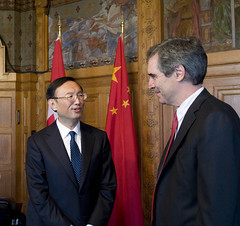 "In my classroom at Harvard, there were vigorous debates about China," Ignatieff continued. "My Chinese students did not always see eye to eye with other students on such issues as the death penalty, the rights of religious and ethnic minorities, access to the Internet and the largest issue of all, to what degree, to what extent, and at what level, economic liberalization should be followed by increased democratic rights."
"But I made it clear that the ultimate decision about these questions will be made, not by foreigners, but by the Chinese people themselves," he naively added.
Of course, the world remembers what happened the last time too many Chinese citizens tried to campaign for democratic freedoms in China. The state ran them down with tanks.
Many Chinese citizens today still do not know about the Tiananmen Square massacre. They are generally not taught that it took place, nor was it covered by the Chinese media of the day.
The farther away within China one lives from Beijing, the more unlikely one is to know about the events of June 4, 1989. Ignatieff, speaking just one month removed from the 20th anniversary of that atrocity, has no such excuse.
Perhaps some would see it as fitting that Michael Ignatieff, the grandson of a Russian diplomat who, by Ignatieff's own admission, once effectively bilked China out of some border provinces would try to make amends by so blatantly caving in to the Chinese phenomenon of "shame diplomacy" -- attempting to shame foreigners out of criticizing China's human rights policies.
An honest Canadian leader would broke no such pressure. Canadians who believe in human rights were rightly embarrassed by Jean Chretien's cowardly approach to this topic.
Michael Ignatieff has embarrassed us again -- but at least he hasn't embarrassed us as Prime Minister.
Posting on the National Post's Full Comment blog, Ezra Levant has some choice words for Liberal leader Michaelf Ignatieff.
Ignatieff, Levant insists, has spoken "false praise to power".
In a speech delivered at China's Tsinghua University, Ignatieff embraced Jean Chretien's craven approach to China; all he needed to do to make it complete was swap the phrase "good governance and rule of law" for "human rights".
In fact, despite China's human rights record -- the Chinese Communist Party's legacy written in blood -- Ignatieff's greatest human rights-related barbs were reserved for Canada.
"I am a proud Canadian, proud of our Charter of Rights and Freedoms, the rights we accord religious and linguistic minorities, and the constitutional acknowledgement of our Aboriginal peoples," Ignatieff said. "I will defend these achievements everywhere, but I am not blind to the gap that exists between our ideals and reality for some of my fellow citizens. Indeed, I am in politics to narrow that gap."
Canada certainly hasn't always been perfect. But it's drawn the line at harvesting the organs of religious minorities to sell internationally, as China has done to practitioners of Falun Gong -- an abuse revealled internationally by Liberal Party icon Irwin Cotler.
In fact, Ignatieff spoke very softly about China's human rights record.
"But I made it clear that the ultimate decision about these questions will be made, not by foreigners, but by the Chinese people themselves," he naively added.
Of course, the world remembers what happened the last time too many Chinese citizens tried to campaign for democratic freedoms in China. The state ran them down with tanks.
Many Chinese citizens today still do not know about the Tiananmen Square massacre. They are generally not taught that it took place, nor was it covered by the Chinese media of the day.
The farther away within China one lives from Beijing, the more unlikely one is to know about the events of June 4, 1989. Ignatieff, speaking just one month removed from the 20th anniversary of that atrocity, has no such excuse.
Perhaps some would see it as fitting that Michael Ignatieff, the grandson of a Russian diplomat who, by Ignatieff's own admission, once effectively bilked China out of some border provinces would try to make amends by so blatantly caving in to the Chinese phenomenon of "shame diplomacy" -- attempting to shame foreigners out of criticizing China's human rights policies.
An honest Canadian leader would broke no such pressure. Canadians who believe in human rights were rightly embarrassed by Jean Chretien's cowardly approach to this topic.
Michael Ignatieff has embarrassed us again -- but at least he hasn't embarrassed us as Prime Minister.
Saturday, June 26, 2010
Who Is The Tank Man?
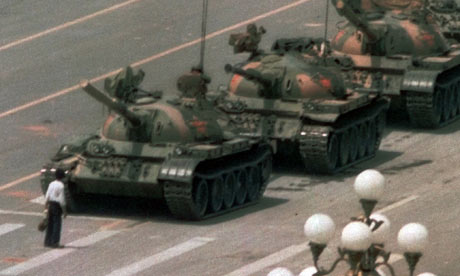
British journalist Alfred Lee identified the man as Wang Weilin -- an account that no other journalist has ever been able to verify.
To many, it's frustrating that we cannot identify the man who provided one of the most iconic images of not only the 20th century, but in time of all time.
The Chinese government has certainly expended a great deal of time and effort in destroying this image. No sooner had the photo been taken then Chinese security services attempted to sieze the film, Fortunately, the photographer was enterprising enough to successfully hide it.
Today, just as many Chinese students never been told about the Tienanmen Square massacre (the further within China's borders one lives from Beijing the less likely one is to know about it), they don't know the Tank Man image.
The Chinese state has built an elaborate infrastructure to the suppression of such information. In such, they have successfully stunted the growth of the democracy movement.
It may not be inconceivable to think that the rest of the world will not see democracy and freedom in China until as many Chinese people as possible know the iconic image of the Tank Man, even if they may never know his name.
Wednesday, April 14, 2010
The Limits of the Myth of Photographic Truth
Speaking via TED Talks, Jonathon Klein addresses the notion of the myth of photographic truth.
Put most simply, the myth of photographic truth infers that photographs -- noted to be worth a thousand words, and to provide an objective depication of reality -- are created through a variety of subjective processes, and thus do not really infer unquestionable truth.
Those who argue against this mytho of photographic truth note that the photographer makes myriad decisions in the course of taking -- or, as Klein notes, making -- a photograph. They choose the angle from which they will take the photograph, the lens with which they will take it, the time at which they will take it, and most importantly when they will take it.
Moreover, they argue that photographs have very specific meanings to people, and not everyone shares those meanings.
But, as Klein points out, there are some cases in which photographs capture an undeniable truth, and thus can be key to changing the world in crucial ways.
Consider, for example, the following photograph:

As the tanks rolled toward the Square, this brave man -- whose fate is ultimately unknown -- stops the column of tanks by standing in their path, and refusing to move. As video shows, when the tanks moved to roll around him, the man moves in front of them -- again stopping them in their tracks.
This photo serves as an undeniable reminder to anyone who views it of how the Chinese state handles political dissent: by deploying army tanks against unarmed students.
Photographic truth is indeed rarer than we give it credit for. But contrary to what those who dispute its existence insist, it does indeed exist.
Saturday, February 27, 2010
Frozen Diplomacy
In 1974, while Canada was embroiled in the second of a pair of intense Summit Series against the Soviet Union, the University of British Columbia Thunderbirds travelled to China on a national tour of their own, in the style of the many Soviet teams that would tour Canada during the 1970s and '80s.
Playing against a variety of club teams across communist China, the Thunderbirds would encounter a very different atmosphere than that confronted by Canada's teams playing in the Soviet Union. While Canadian players touring the Soviet Union were subjected to late night phone calls and stolen steak, Canadian players touring China were treated to friendship ceremonies and tours of hydroelectric dams.
In the years since the height of the Canada-Soviet rivalry in the 1980s, Soviet hockey became known for the intensity of their training regimens. Originally designed by Anatoli Tarasov and later obsessively perfected by Viktor Tikhonov, Soviet hockey players would be isolated from the outside world, and forced to live around their training schedules.
During the 1970s, the Chinese followed a training regimen even more intense than the Soviet schedule, in some cases being allowed a mere five days' break every two years.
But while the Soviet Union had fewer than 100 artificial ice rinks by the 1990s, China started even further behind, and the state of their hockey in the 1970s -- despite their emulation of Soviet methods -- clearly shows it.
Today, Chinese hockey has come a long way. In 2008, the same year that China hosted the World Women's Hockey Championships, the Chinese National Women's team managed to post a win over the traditionally-dominant University of Alberta Pandas. (In 2003, the tournament was scheduled to be held in Beijing, but was cancelled due to SARS.)
Thunderbirds in China is a stark reminder of the diplomatic power of sport, and a reminder that despite the euphoria of the Canadian wins over the Soviet Union in the 72 Summit Series, and in the 76, 84 and 87 Canada Cups, the greatest benefits of Canada's athetlic competitions with its adversaries have always been diplomatic benefits. (The famed 1987 punch-up in Piestany being a clear exemption.)
Tuesday, January 12, 2010
China: Destroying it's support one chunk at a time
Following their achievement in Copenhagen of being credited with stonewalling the conference, China has managed to now piss off Google.
After getting the agreement with Google that the company would censor it's searches for Chinese users, Google Announced it would be suspending it's policy of self censorship in China. Why would Google do this even though it knows this action could likely end it's contract in China. Because of consistent attacks by Chinese based hackers on the gmail accounts of Chinese Human Rights Activists.
For a while now, China has been scoring several important victories. It had managed to paint itself as a "Green Country" moving towards a non-carbon future. It had gotten Google to self-censor itself against anti-government material from China based users. Now it's own greed and need for control seem to be nixing these past victories.
After getting the agreement with Google that the company would censor it's searches for Chinese users, Google Announced it would be suspending it's policy of self censorship in China. Why would Google do this even though it knows this action could likely end it's contract in China. Because of consistent attacks by Chinese based hackers on the gmail accounts of Chinese Human Rights Activists.
For a while now, China has been scoring several important victories. It had managed to paint itself as a "Green Country" moving towards a non-carbon future. It had gotten Google to self-censor itself against anti-government material from China based users. Now it's own greed and need for control seem to be nixing these past victories.
Tuesday, December 15, 2009
Mixing Messages
 The Liberal Party has already drawn considerable fire for its "Anywhere but Copenhagen" contest.
But by displaying the contest entries on their webiste and using them for political purposes, the Party runs the risk of being embarrassed in more than simply the "whackos fantasize about assassinating Stephen Harper" department. They also run the risk of embarrassing themselves in the "can't keep the message straight" department.
A case in point is the above image, in which Harper's face is superimposed on an image of Kanye West interrupting Tailor Swift and the MTV Video Music Awards. The Spaceman award Swift just received is replaced by a picture of the Earth, and Harper/Kanye is saying "Yo Copenhagen, I'm really sorry about those GHGs, and I'mmma let you finish, but Canada-China relations are the worst of all time."
First off, Canada-China relations are currently not the worst of all time.
But even aside from that, the creator of this image seems to have forgotten that not only is China the world's top producer of Greenhouse gases, but that China's top three companies alone produce more greenhouse gases than Britain -- or Canada.
Moreover, China has yet to pledge to cut its emission of Greenhouse gases. It's actually only pledged to slow the growth of its production.
So, the creator of this particular image expects Stephen Harper to be "sorry about the GHGs". But he also expects Harper to be sorry about allegedly damaging relations with China. And if Canada succeeds in cutting greenhouse gas emissions by 65% by 2050 (very likely the commitment Canada will make at Copenhagen), and China's emissions continue to grow, what precisely will happen to Canada-China relations if Canada helps pursue sanctions against China?
This is why partisan ideologues shouldn't mix their messages. It simply doesn't hold up to scrutiny.
Other bloggers writing about this topic:
Christian Conservative - "Do Thoughts of Harper's Assassination Make Liberals Smile?"
James Morton - "It Was Right to Apologize"
Russ Campbell - "Dirty Tricks at Liberal-ville"
Hatrock's Cave - "Can Liberals Stoop Any Lower? Possibly"
Saturday, August 29, 2009
The Cure for Maoism
Globe and Mail scribe Jan Wong long ago discovered the cure for Maoism: actually traveling to communist China.
In Red China Blues, Wong chronicles her journey to China as a young communist-leaning student, and her later return as a Globe and Mail foreign correspondent.
As it turns out, if Wong's example holds true, that the cure for Maoism is actually seeing how Chinese society shaped up under Maoist principles, and watching how that particular ideology was rendered utterly meaningless by the communist state's paradoxical turn toward capitalism.
Even Wong's account of the student protests at Tienanmen Square reveals how much of the revolutionary fervour of Chinese society was adopted purely for show. Wong recounts for readers the contrast in the protesters' behaviour when the television cameras were on them as opposed to when they were not -- one protester atop a car, energetically waving a pro-democracy banner when the television cameras were on him, then slumped over the next.
Even the latter-day worship of chairman Mao has a hollow feel to it when one considers the extent to which leaders like Deng Xiaoping have led China away from Mao's ideology.
Friday, June 05, 2009
World Shouldn't Hold Its Breath Over Tiananmen Square
Lawrence Cannon calls for "public accounting"
In a statement on the eve of today's 20th anniversary of the Tiananmen Square massacre, Canadian Foreign Affairs Minister Lawrence Cannon joined the chorus of voices calling for a public accounting of the massacre.
"The 20th anniversary of the Tiananmen Square tragedy provides an opportunity for China to remember those who lost their lives at that time while calling for political and economic reforms in China," Cannon said. "Twenty years later, we hope that they will be able to examine these events in an open and transparent fashion -- including the public accounting of those killed, detained or missing."
Cannon shouldn't hold his breath -- nor should anyone else in the world.
The Communist Party regime in China will certainly not hold any kind of public accounting into Tiananmen Square unless they need to do so in order to hold on to power. As sad as it may be to realize this, they simply don't.
In Mediapolitik, Lee Edwards outlined how the Chinese government micro-managed coverage of the massacre. In 1989 China was a very different country than it is today. While today the amount of coverage that the massacre received in the international media -- partially through the efforts of Canada's own Jan Wong, who witnessed the massacre from the relative safety of her nearby hotel room -- would almost assure that Tiananmen Square would be common knowledge throughout China, the average Chinese citizen didn't have satellite television or the internet in 1989.
Instead, the Chinese government repressed coverage of Tiananmen Square within China's borders. Even today when many Chinese citizens learn about the massacre it's in the history books published in other countries.
Even when the Chinese government acknowledged -- on a very limited basis -- the occurrence of the massacre, they played it off as necessary to contain "violent militant anti-revolutionaries".
Yet Wong's own reflection of the event, as told in Red China Blues, tells a different story. Rather, much of the Chinese student movement's fervour was staged for international cameras. Wong recounts witnessing one student in particular furiously waving a pro-democracy banner when television cameras were on him, then slumping over and smoking a cigarette when they had moved on.
Whatever the Chinese student movement had planned to accomplish at Tiananmen Square, taking up arms against the communist government wasn't one of their goals.
To make matters worse, comparatively few foreign leaders are willing to hold the Chinese government responsible for what occurred at Tiananmen Square on June 5, 1989. When former Prime Minister Jean Chretien toured China in the 1990s he refused to so much as utter the words "human rights" and instead referred to "good governance and the rule of law".
When the rule of law allows the government to run over its citizens with tanks, there's little question that whatever governance exists in that country is not "good".
Yet even Cannon is willing to to echo similar statements when he refers to China's economic development -- achieved at the direct expense of more than 100 million Chinese citizens who were dislocated from their homes in order to serve as a mobile labour force -- as an advance for human rights.
Anyone expecting the Chinese government to suddenly be forthcoming about the events of June 5, 1989 shouldn't hold their breath.
In a statement on the eve of today's 20th anniversary of the Tiananmen Square massacre, Canadian Foreign Affairs Minister Lawrence Cannon joined the chorus of voices calling for a public accounting of the massacre.
"The 20th anniversary of the Tiananmen Square tragedy provides an opportunity for China to remember those who lost their lives at that time while calling for political and economic reforms in China," Cannon said. "Twenty years later, we hope that they will be able to examine these events in an open and transparent fashion -- including the public accounting of those killed, detained or missing."
Cannon shouldn't hold his breath -- nor should anyone else in the world.
The Communist Party regime in China will certainly not hold any kind of public accounting into Tiananmen Square unless they need to do so in order to hold on to power. As sad as it may be to realize this, they simply don't.
In Mediapolitik, Lee Edwards outlined how the Chinese government micro-managed coverage of the massacre. In 1989 China was a very different country than it is today. While today the amount of coverage that the massacre received in the international media -- partially through the efforts of Canada's own Jan Wong, who witnessed the massacre from the relative safety of her nearby hotel room -- would almost assure that Tiananmen Square would be common knowledge throughout China, the average Chinese citizen didn't have satellite television or the internet in 1989.
Instead, the Chinese government repressed coverage of Tiananmen Square within China's borders. Even today when many Chinese citizens learn about the massacre it's in the history books published in other countries.
Even when the Chinese government acknowledged -- on a very limited basis -- the occurrence of the massacre, they played it off as necessary to contain "violent militant anti-revolutionaries".
Yet Wong's own reflection of the event, as told in Red China Blues, tells a different story. Rather, much of the Chinese student movement's fervour was staged for international cameras. Wong recounts witnessing one student in particular furiously waving a pro-democracy banner when television cameras were on him, then slumping over and smoking a cigarette when they had moved on.
Whatever the Chinese student movement had planned to accomplish at Tiananmen Square, taking up arms against the communist government wasn't one of their goals.
To make matters worse, comparatively few foreign leaders are willing to hold the Chinese government responsible for what occurred at Tiananmen Square on June 5, 1989. When former Prime Minister Jean Chretien toured China in the 1990s he refused to so much as utter the words "human rights" and instead referred to "good governance and the rule of law".
When the rule of law allows the government to run over its citizens with tanks, there's little question that whatever governance exists in that country is not "good".
Yet even Cannon is willing to to echo similar statements when he refers to China's economic development -- achieved at the direct expense of more than 100 million Chinese citizens who were dislocated from their homes in order to serve as a mobile labour force -- as an advance for human rights.
Anyone expecting the Chinese government to suddenly be forthcoming about the events of June 5, 1989 shouldn't hold their breath.
Friday, May 22, 2009
Genocide Via Computer
Of all the Terminator films, Rise of the Machines was certainly the most disappointing.
Directed by Jonathon Mostow in place of James Cameron, Terminator 3 came across with all the gloss, polish and adrenaline of a Hollywood action film, and none of the grit and tension of Cameron's masterpieces.
But, interestingly enough, of the three Terminator films, Rise of the Machines may have been the best-situated out of the three in terms of its prescience.
In the film, John Connor (Nick Stahl) is living "off-the-grid", with nothing but the clothes of his back and his motorcycle. He works day jobs to subsist himself, and has no place of residence, credit cards, or cell phone -- nothing that would leave a record he could be traced by.
Even though he and his now-deceased mother, Sarah Connor, have been led to believe they had averted Judgment Day by destroying Skynet, Connor lives in terror of the future, and rightfully so.
The future isn't nearly as secure as he would like to believe.
An encounter with Kate Brewster (Claire Danes) brings John face-to-face with both the T-X -- played by Kristanna Loken, a Terminator sent back to the eve of Judgment Day to kill off Connor's someday lieutenants -- and with the T-800 sent back in time to protect her -- a role again reprised by Arnold Schwarzenegger.
As it turns out, the program that eventually leads to the creation of Skynet is still in operation. Brewster's father is the head of this project, and has his own concerns about removing human decision-making from defense planning. Meanwhile, an unstoppable computer virus is overwhelming the civilian internet, and is beginning to infiltrate defense networks.
The virus is Skynet. Whether it's been seeded in the past as seems to be happening in The Sarah Connor Chronicles or is created outside the defense program and merely infiltrates it remains unexplained.
As nuclear weapons cross the globe toward their targets, what is explained is that Skynet had presumably infiltrated millions of computers worldwide.
While one presumes that nothing as hyperbolic as a genocidal computer program plotting the wholesale destruction of humanity is currently occurring, it is a well known fact that many countries -- as well as private organizations and individuals -- have been investing in cyberwarfare capabilities that would allow them to strike at their opponents through their computer systems.
China has made its commitment to cyberwarfar technology a matter of public record. North Korea, India and other countries are also investing in cyberwar technologies at an alarming rate.
One particular cyberwarfare weapon, the zombie virus, uses infected computers to pass itself along to the next victim. It attaches itself to email and fax programs, and transmits itself through the user's own communications.
These programs can have purposes ranging from the theft of information to disruption of emergency services.
In Terminator 3, the virus' purpose was to facilitate the destruction of humankind.
Interestingly, the writers of Terminator 3 could be argued to accept the "inevitability thesis" of Andy Opel and Greg Elmer. But once again, one would have to counter by arguing that preemption is only as valuable as the amount of certainty with which it can be executed, and as the diligence used to ensure that the threat it is aimed at is actually destroyed.
Saturday, May 09, 2009
Harbinger of Democracy?
In Metal: A Headbanger's Journey, Canadian anthropoligist Sam Dunn traces the history of heavy metal music and compares its historical cultural overtones to the outrage expressed against it by those who consider themselves a cultural elite.
In Global Metal Dunn takes his studies to the rest of the world and uncovers a startling and intriguing motif: heavy metal as a force for democracy.
In Brazil, Carlos Lopes of Dorsal Atlantica provides an intriguing thesis -- of heavy metal as a sound of Brazilian democracy. He relates the tale of how Brazil emerged from under the dictatorship of Marshal Emilio Garrastazu Médici and embraced heavy metal as a symbol that Brazil had finally become a free country. He and others treat the staging of a massive heavy metal festival in Rio Di Janeiro featuring Iron Maiden helped symbolize the arrival of freedom and democracy there.
Like democracy, heavy metal can be a potent vehicle for mobilizing nationalisms. In Brazil, Sepultura has become "the flag of Brazilian heavy metal". They accomplished this partially by embracing tradition Brazilian culture within their music. On Roots, Sepultura incorporated tribal Brazilian drumming into their music, coagulating specifically Brazilian cultural passions within their fan base.
Just as politicians can endear themselves to voters by embracing tenets of traditionalized culture -- or, in the case of multicultural Canada, cultures -- musicians can endear themselves to their fans by embracing their traditional culture.
Few things are as democratic as an icon. By nature of the mass embrace of the populace, individuals can become larger than life, and begin to represent more than even their music may symbolize.
In Jamaica, Bob Marley is precisely such an icon. Marley was already beloved by the Jamaican populace before 1976 due to his strict adherence to Rastafarian culture. However, Marley ascended to icon status when he appeared at the Smile Jamaica concert even after having been shot by extremists who opposed an end to the violence between factions from Edward Seaga's Jamaican Labour Party and Michael Manley's People's National Party.
By agreeing to play the concert, factions from the JLP believed Marley was siding with the PNP in a forthcoming election Manley and the PNP would win. (However, in 1980 Seaga and the JLP would win government.)
Two days before the concert PNP gunmen attacked Marley at his home. Legend has it that Marley was shot in the chest and survived, giving rise to his iconic status. In actuality, a bullet grazed his chest, coming within inches of his heart. While Marley never in his life formally declared support for the PNP or any other political party -- he rejected politics as not part of Rastafarian culture -- many credit the Smile Jamaica concert with helping the PNP win the 1976 election.
Marley's true purpose in playing the Smile Jamaica concert was in uniting the Jamaican people. Marley succeeded in bringing Jamaica together, but the concert did not overhwelmingly unite the country under one political flag. The margin of victory for the PNP in the 1976 election was 13% -- far from a political single-mindedness.
The character of Marley's music certainly helps account for its power as a force of unity.
Sepultura has rarely addressed politics as part of its music, but one particular song - "Refuse/Resist" speaks distinctly about Brazil under the military regime, and cements it as a voice for democracy in Brazil.
In China, meanwhile, heavy metal represents an intriguing break toward broader democratization. In the film, the proprietors of a shop in China that sells heavy metal music and T-shirts explains that traditionally, Chinese people have a tendency to listen to what they are told. But heavy metal provides those who feel so inclined with an opportunity to actually speak.
Considering the central importance of freedom of speech to democracy, the democratic significance of heavy metal in China cannot be overlooked.
In Indonesia, a country formally governed by an Islamic theocracy, heavy metal serves to highlight many of the injustices of their society.
Former Sepultura lead singer Max Cavalera (now of Soulfly) remarks about the brutality of the Indonesian regime, and about how seeing it first-hand surprised even him -- someone who had lived under a military dictatorship.
At a Metallica concert in Jakarta, a riot broke out when police confronted heavy metal listeners, whom they denounced as "communists". The government would respond to the riot by banning all heavy metal concerts in Indonesia, judging them to be far too much like political rallies for their liking.
The denial of freedom of assembly -- even for something as mundane as a rock concert -- seems to underscore precisely how threatening the theocracy finds the music. Indonesian heavy metal bands sing about political and social issues.
Not all bands are explicitly critical of the theocracy.
One band, Tengkorak, criticizes capitalism and Indonesia's treatment by the rest of the world. They even play a song entitled "Destroy Zionism", in which they insist that the goal of the Jewish people is to destroy Islam, and so Zionism must be destroyed. Many Indonesian metalheads interviewed seem reluctant to embrace Tengkorak's message.
While this may seem to be at odds with the argued democratizing motifs of heavy metal, one has to also remember that the right to agree with the government -- even undemocratic governments -- is actually a democratic right.
In Israel, some heavy metal bands fuse traditional Jewish instruments with Muslim vocal stylings. According to one metal musician interviewed, this is intended to represent Israel -- and Jarusalem -- in terms of cultural harmony, even as the ongoing conflict between Israelis and Palestinians continues to rage around them.
Many Israeli metal musicians play their music as a refusal to conform to, and participate in, this ongoing conflict. They demand a peaceful resolution to the conflict -- the peaceful resolution of conflicts (wherever possible) is the ultimate democratic demand.
They can also challenge perceptions of what is and is not acceptable speech. Salem, an Israeli metal band, drew criticisms from a member of the Knesset because they played a song about the Holocaust, which that individual argued is "sacred", and so cannot be played about in a heavy metal song. Fortunately, a Knesset colleague disagreed, and appreciated heavy metal as a vehicle for teaching about the Holocaust.
The same band nearly received a mail bomb from Vark Vikernes -- the famed murderer and church burner in Norway -- took issue with Salem for playing a song about the Holocaust. Sadly, heavy metal can become a vehicle for undemocratic political violence as well as democracy. As Vikernes demonstrates, heavy metal can become a vehicle for bigotry as well.
Iran is another country where the democratic motifs of heavy metal has found itself at odds with a theocracy. The Iranian regime will not allow heavy metal CDs or T-shirts to be sold in the country. Even merely having long hair can attract the attention of police. In many cases, fans have to travel to places like Dubai and Turkey in order to listen to the music they enjoy.
As one listener notes, the Iranian regime considers heavy metal to be anti-moralistic -- the same charge levelled against the music by Tipper Gore and the PMRC.
Heavy metal isn't the only genre of music oppressed in Iran. All forms of western music are outlawed in Iran. Dubai, marketing itself as one of the world's top tourist destinations, has embraced heavy metal as a tourist industry. Through concerts in places like Dubai -- one place to which many Iranians are allowed to travel freely -- heavy metal is slowly seeping into Iran.
When considering that downloading is the only method of receiving heavy metal music in places like Iran, Metallica drummer Lars Ulrich actually becomes quite supportive. Downloading heavy metal in a country where it's forbidden is certainly an act of political resistance. Iranian fans find in metal an opportunity to speak out in a country that offers very few opportunities for them to do so.
One has to wonder how Iranian President Mahmoud Ahmadinejad would react to an Iranian metalhead listening to Salem.
Heavy music has brought together millions of people -- not just within countries, but internationally as well. Iron Maiden's Bruce Dickenson notes that he shouldn't be surprised at this, but admits to often being astonished at the ability of his music to unite diverse groups of people.
In an increasingly globalized work, using tools such as the internet and export music catalogues, heavy metal can disseminate its democratizing message across the world and across varying cultures.
Heavy metal may only be one sound of democracy, but it is rapidly becoming part of a global rumble toward this noble ideal. This, in defiance of the music's reputation of being "unsophisticated" and "stupid".
Sunday, January 04, 2009
Michael Ignatieff and China's New Colonialism
China becoming a global leader in African exploitation
With Michael Ignatieff set to lead the Liberal party into the new year, it's safe to say that foreign policy will find itself firmly entrenched in the Liberal party`s agenda.
Of particular interest should be Ignatieff`s stance on China. In 2006, Ignatieff criticized Stephen Harper for the Prime Minister`s criticism of China.
Among other things, Ignatieff hailed reductions in Chinese poverty as an erstwhile human rights triumph.
"You have to give them credit for a fact not enough Canadians, I think, recognize which is over the last 10 years, the most important human-rights advance in the world has been the hundreds of millions of Chinese lifted out of absolute poverty," he mused.
Yet one can`t help but wonder how Ignatieff might have reacted to some of China's activities abroad, particularly in Africa:
It seems China is turning back the clock on colonialism. The country that was once the most sought-after Colony among all European countries is all grown up, and ready to do some exploiting of its own.
Among raw materials, China is also pursuing African oil. The Beijing government is pursuing oil through a collection of exploration and development deals, and reciprocal trade deals coupled with foreign aid packages.
China`s efforts in Africa has them active in countries like Equitorial Guinea, Gabon, Angola, the Sudan and the Democratic Republic of Congo.
In the latter two cases -- one of which, Sudan, is currently the subject of considerable human rights-related outcry -- the Chinese are involved in countries with ongoing civil conflicts.
Inevitably, China's activities in the DRC will favour the Congolese government over the rebel National Congress for the Defense of the People. As in the Sudan, the Chinese are taking sides in a civil conflict.
If anything, China's activities in Africa -- energy-related and otherwise -- demonstrate that communism is all but officially dead in China. Now, it has learned to exploit the developing world just as stringently as western states and multinational corporations have.
The mess -- both in terms of environmental devestation and human suffering -- being left in China's wake poses a definite question mark on Ignatieff's insistence that reduction in Chinese poverty is a human rights triumph.
Especially when one considers the cost.
With Michael Ignatieff set to lead the Liberal party into the new year, it's safe to say that foreign policy will find itself firmly entrenched in the Liberal party`s agenda.
Of particular interest should be Ignatieff`s stance on China. In 2006, Ignatieff criticized Stephen Harper for the Prime Minister`s criticism of China.
Among other things, Ignatieff hailed reductions in Chinese poverty as an erstwhile human rights triumph.
"You have to give them credit for a fact not enough Canadians, I think, recognize which is over the last 10 years, the most important human-rights advance in the world has been the hundreds of millions of Chinese lifted out of absolute poverty," he mused.
Yet one can`t help but wonder how Ignatieff might have reacted to some of China's activities abroad, particularly in Africa:
It seems China is turning back the clock on colonialism. The country that was once the most sought-after Colony among all European countries is all grown up, and ready to do some exploiting of its own.
Among raw materials, China is also pursuing African oil. The Beijing government is pursuing oil through a collection of exploration and development deals, and reciprocal trade deals coupled with foreign aid packages.
China`s efforts in Africa has them active in countries like Equitorial Guinea, Gabon, Angola, the Sudan and the Democratic Republic of Congo.
In the latter two cases -- one of which, Sudan, is currently the subject of considerable human rights-related outcry -- the Chinese are involved in countries with ongoing civil conflicts.
Inevitably, China's activities in the DRC will favour the Congolese government over the rebel National Congress for the Defense of the People. As in the Sudan, the Chinese are taking sides in a civil conflict.
If anything, China's activities in Africa -- energy-related and otherwise -- demonstrate that communism is all but officially dead in China. Now, it has learned to exploit the developing world just as stringently as western states and multinational corporations have.
The mess -- both in terms of environmental devestation and human suffering -- being left in China's wake poses a definite question mark on Ignatieff's insistence that reduction in Chinese poverty is a human rights triumph.
Especially when one considers the cost.
Wednesday, December 10, 2008
China Settles Old Scores on Human Rights Day
Tienanmen Square activist arrested over Charter 08
60 years ago today, the Universal Declaration of Human Rights was adopted by the United Nations.
In the 60 years since, it's amazing how far some countries in the world haven't come.
In China today, Liu Xiaobo, a press freedom activist and a participant in the Tiananmen Square demonstration, was arrest for signing Charter 08, a pro-democracy manifesto. The charter reads:
Chinese prison is nothing new to Xiaobo. In 1996, Xiaobo's criticisms of the Chinese Communist Party resulted in him being sentenced to three years in a forced-labour camp.
Charter 08 is based on six important principles: freedom, human rights, equality, republicanism, democracy and constitutional rule.
Since its establishment in 1949, the People's Republic of China has been indistinguishable from its Communist Party government. For all intensive purposes, the party is the state.
The party has gone to certain lengths to ensure this remains to be the case. Its very legal system has been operated under these very pretenses, and has for the past few years been engaging in an exhaustive rejection of western legal principles, and oppression of Chinese lawyers who subscribe to these principles.
The arrests of Xiabo, Xi, and Youlian demonstrate that they have no intention of stopping any time soon.
Other bloggers writing on this topic:
Muchacho Enfermo's Politicophobia - "Human Rights Day"
CA Yeung - "Liu Xiaobo Detained on Suspicion of 'Inciting Subversion of State Power'">
60 years ago today, the Universal Declaration of Human Rights was adopted by the United Nations.
In the 60 years since, it's amazing how far some countries in the world haven't come.
In China today, Liu Xiaobo, a press freedom activist and a participant in the Tiananmen Square demonstration, was arrest for signing Charter 08, a pro-democracy manifesto. The charter reads:
"A hundred years have passed since the writing of China‘s first constitution. 2008 also marks the sixtieth anniversary of the promulgation of the Universal Declaration of Human Rights, the thirtieth anniversary of the appearance of Democracy Wall in Beijing, and the tenth of China’s signing of the International Covenant on Civil and Political Rights. We are approaching the twentieth anniversary of the 1989 Tiananmen massacre of pro-democracy student protesters. The Chinese people, who have endured human rights disasters and uncountable struggles across these same years, now include many who see clearly that freedom, equality, and human rights are universal values of humankind and that democracy and constitutional government are the fundamental framework for protecting these values.For signing this Charter Xiaobo, Chen Xi, and Shen Youlian have been arrested.
By departing from these values, the Chinese government's approach to“modernization” has proven disastrous. It has stripped people of their rights, destroyed their dignity, and corrupted normal human intercourse. So we ask: Where is China headed in the twenty-first century? Will it continue with “modernization” under authoritarian rule, or will it embrace universal human values, join the mainstream of civilized nations, and build a democratic system? There can be no avoiding these questions."
Chinese prison is nothing new to Xiaobo. In 1996, Xiaobo's criticisms of the Chinese Communist Party resulted in him being sentenced to three years in a forced-labour camp.
Charter 08 is based on six important principles: freedom, human rights, equality, republicanism, democracy and constitutional rule.
"Freedom. Freedom is at the core of universal human values. Freedom of speech, freedom of the press, freedom of assembly, freedom of association, freedom in where to live, and the freedoms to strike, to demonstrate, and to protest, among others, are the forms that freedom takes. Without freedom, China will always remain far from civilized ideals.The policies advocated by Charter 08 are a laundry list of the failures of the Chinese state:
Human rights. Human rights are not bestowed by a state. Every person is born with inherent rights to dignity and freedom. The government exists for the protection of the human rights of its citizens. The exercise of state power must be authorized by the people. The succession of political disasters in China‘s recent history is a direct consequence of the ruling regime’s disregard for human rights.
Equality. The integrity, dignity, and freedom of every person—regardless of social station, occupation, sex, economic condition, ethnicity, skin color, religion, or political belief—are the same as those of any other. Principles of equality before the law and equality of social, economic, cultural, civil, and political rights must be upheld.
Republicanism. Republicanism, which holds that power should be balanced among different branches of government and competing interests should be served, resembles the traditional Chinese political ideal of“fairness in all under heaven.”It allows different interest groups and social assemblies, and people with a variety of cultures and beliefs, to exercise democratic self-government and to deliberate in order to reach peaceful resolution of public questions on a basis of equal access to government and free and fair competition.
Democracy. The most fundamental principles of democracy are that the people are sovereign and the people select their government. Democracy has these characteristics: (1) Political power begins with the people and the legitimacy of a regime derives from the people. (2) Political power is exercised through choices that the people make. (3) The holders of major official posts in government at all levels are determined through periodic competitive elections. (4) While honoring the will of the majority, the fundamental dignity, freedom, and human rights of minorities are protected. In short, democracy is a modern means for achieving government truly“of the people, by the people, and for the people.”
Constitutional rule. Constitutional rule is rule through a legal system and legal regulations to implement principles that are spelled out in a constitution. It means protecting the freedom and the rights of citizens, limiting and defining the scope of legitimate government power, and providing the administrative apparatus necessary to serve these ends."
"1. A New Constitution. We should recast our present constitution, rescinding its provisions that contradict the principle that sovereignty resides with the people and turning it into a document that genuinely guarantees human rights, authorizes the exercise of public power, and serves as the legal underpinning of China‘s democratization. The constitution must be the highest law in the land, beyond violation by any individual, group, or political party.Of course, the world should not hold its breath waiting for these reforms to be implemented.
2. Separation of powers. We should construct a modern government in which the separation of legislative, judicial, and executive power is guaranteed. We need an Administrative Law that defines the scope of government responsibility and prevents abuse of administrative power. Government should be responsible to taxpayers. Division of power between provincial governments and the central government should adhere to the principle that central powers are only those specifically granted by the constitution and all other powers belong to the local governments.
3. Legislative democracy. Members of legislative bodies at all levels should be chosen by direct election, and legislative democracy should observe just and impartial principles.
4. An Independent Judiciary. The rule of law must be above the interests of any particular political party and judges must be independent. We need to establish a constitutional supreme court and institute procedures for constitutional review. As soon as possible, we should abolish all of the Committees on Political and Legal Affairs that now allow Communist Party officials at every level to decide politically-sensitive cases in advance and out of court. We should strictly forbid the use of public offices for private purposes.
5. Public Control of Public Servants. The military should be made answerable to the national government, not to a political party, and should be made more professional. Military personnel should swear allegiance to the constitution and remain nonpartisan. Political party organizations shall be prohibited in the military. All public officials including police should serve as nonpartisans, and the current practice of favoring one political party in the hiring of public servants must end.
6. Guarantee of Human Rights. There shall be strict guarantees of human rights and respect for human dignity. There should be a Human Rights Committee, responsible to the highest legislative body, that will prevent the government from abusing public power in violation of human rights. A democratic and constitutional China especially must guarantee the personal freedom of citizens. No one shall suffer illegal arrest, detention, arraignment, interrogation, or punishment. The system of“Reeducation through Labor”must be abolished.
7. Election of Public Officials. There shall be a comprehensive system of democratic elections based on“one person, one vote.”The direct election of administrative heads at the levels of county, city, province, and nation should be systematically implemented. The rights to hold periodic free elections and to participate in them as a citizen are inalienable.
8. Rural–Urban Equality. The two-tier household registry system must be abolished. This system favors urban residents and harms rural residents. We should establish instead a system that gives every citizen the same constitutional rights and the same freedom to choose where to live.
9. Freedom to Form Groups. The right of citizens to form groups must be guaranteed. The current system for registering nongovernment groups, which requires a group to be“approved,”should be replaced by a system in which a group simply registers itself. The formation of political parties should be governed by the constitution and the laws, which means that we must abolish the special privilege of one party to monopolize power and must guarantee principles of free and fair competition among political parties.
10. Freedom to Assemble. The constitution provides that peaceful assembly, demonstration, protest, and freedom of expression are fundamental rights of a citizen. The ruling party and the government must not be permitted to subject these to illegal interference or unconstitutional obstruction.
11. Freedom of Expression. We should make freedom of speech, freedom of the press, and academic freedom universal, thereby guaranteeing that citizens can be informed and can exercise their right of political supervision. These freedoms should be upheld by a Press Law that abolishes political restrictions on the press. The provision in the current Criminal Law that refers to“the crime of incitement to subvert state power”must be abolished. We should end the practice of viewing words as crimes.
12. Freedom of Religion. We must guarantee freedom of religion and belief and institute a separation of religion and state. There must be no governmental interference in peaceful religious activities. We should abolish any laws, regulations, or local rules that limit or suppress the religious freedom of citizens. We should abolish the current system that requires religious groups (and their places of worship) to get official approval in advance and substitute for it a system in which registry is optional and, for those who choose to register, automatic.
13. Civic Education. In our schools we should abolish political curriculums and examinations that are designed to indoctrinate students in state ideology and to instill support for the rule of one party. We should replace them with civic education that advances universal values and citizens‘rights, fosters civic consciousness, and promotes civic virtues that serve society.
14. Protection of Private Property. We should establish and protect the right to private property and promote an economic system of free and fair markets. We should do away with government monopolies in commerce and industry and guarantee the freedom to start new enterprises. We should establish a Committee on State-Owned Property, reporting to the national legislature, that will monitor the transfer of state-owned enterprises to private ownership in a fair, competitive, and orderly manner. We should institute a land reform that promotes private ownership of land, guarantees the right to buy and sell land, and allows the true value of private property to be adequately reflected in the market.
15. Financial and Tax Reform. We should establish a democratically regulated and accountable system of public finance that ensures the protection of taxpayer rights and that operates through legal procedures. We need a system by which public revenues that belong to a certain level of government—central, provincial, county or local—are controlled at that level. We need major tax reform that will abolish any unfair taxes, simplify the tax system, and spread the tax burden fairly. Government officials should not be able to raise taxes, or institute new ones, without public deliberation and the approval of a democratic assembly. We should reform the ownership system in order to encourage competition among a wider variety of market participants.
16. Social Security. We should establish a fair and adequate social security system that covers all citizens and ensures basic access to education, health care, retirement security, and employment.
17. Protection of the Environment. We need to protect the natural environment and to promote development in a way that is sustainable and responsible to our descendents and to the rest of humanity. This means insisting that the state and its officials at all levels not only do what they must do to achieve these goals, but also accept the supervision and participation of non-governmental organizations.
18. A Federated Republic. A democratic China should seek to act as a responsible major power contributing toward peace and development in the Asian Pacific region by approaching others in a spirit of equality and fairness. In Hong Kong and Macao, we should support the freedoms that already exist. With respect to Taiwan, we should declare our commitment to the principles of freedom and democracy and then, negotiating as equals, and ready to compromise, seek a formula for peaceful unification. We should approach disputes in the national-minority areas of China with an open mind, seeking ways to find a workable framework within which all ethnic and religious groups can flourish. We should aim ultimately at a federation of democratic communities of China.
19. Truth in Reconciliation. We should restore the reputations of all people, including their family members, who suffered political stigma in the political campaigns of the past or who have been labeled as criminals because of their thought, speech, or faith. The state should pay reparations to these people. All political prisoners and prisoners of conscience must be released. There should be a Truth Investigation Commission charged with finding the facts about past injustices and atrocities, determining responsibility for them, upholding justice, and, on these bases, seeking social reconciliation."
Since its establishment in 1949, the People's Republic of China has been indistinguishable from its Communist Party government. For all intensive purposes, the party is the state.
The party has gone to certain lengths to ensure this remains to be the case. Its very legal system has been operated under these very pretenses, and has for the past few years been engaging in an exhaustive rejection of western legal principles, and oppression of Chinese lawyers who subscribe to these principles.
The arrests of Xiabo, Xi, and Youlian demonstrate that they have no intention of stopping any time soon.
Other bloggers writing on this topic:
Muchacho Enfermo's Politicophobia - "Human Rights Day"
CA Yeung - "Liu Xiaobo Detained on Suspicion of 'Inciting Subversion of State Power'">
Sunday, October 05, 2008
Lobbing Softballs
Epoch Times declines to ask Michael Byers about his China dilemma
In the most recent issue of the Epoch Times Michael Byers, the NDP candidate in Vancouver Centre, is profiled.
Over the course of the interview, Byers is asked about his dedication to human rights. What transpires is as follows:
But some may find it very curious that the Epoch Times -- a publication that has shown its sympathies to the Falun Gong movement on countless occasions -- declined to ask Byers any specific questions regarding his views on human rights in China.
Frankly, Byers' bona fides in terms of human rights advocacy aren't as solid as he'd like people to believe. To start off with, Byers is willing to abandon the human rights issue entirely if those who advance them so much as belong to the "wrong" side of the ideological divide.
Few seasoned Byers watchers need to be reminded about his 1 January 2008 op-ed article in the Toronto Star in which Byers criticized Conservative Prime Minister Stephen Harper for his "unnecessary quarrels with China over human rights".
As Victoria, BC's Joan Quain would helpfully point out a few days later, Byers' advocacy of a strictly hands-off approach to human rights in China overwhelmingly ignores the scope of some of the abuses being perpetrated there.
Byers also criticized the Canadian government for not participating in a peacekeeping mission in the Sudan, while also overlooking the fact that oil hungry China is heavily involved in Darfur, both as an investor in the Darfur oilfields, as well as selling arms to the Khartoum regime.
In an earlier interview with Vancouver's Georgia Straight, Byers insists that "I don't think we should be silent when it comes to human rights in China, but you cannot influence a country of that size and that power by refusing to establish a relationship."
Never mind the fact that Canada has very much maintained its relationship with China, Byers doesn't explain how he would have the Canadian government advance the human rights cause with China when he so clearly disfavours confrontation with the current Beijing regime over the issue, and Jean Chretien's "good governance and the rule of law" advocacy accomplished absolutely nothing in Beijing aside from showing them how craven Canada's liberal politicians really are when it comes down to that issue.
Byers' stance on China is merely one reason why Canadians should be thankful that the prospects of Michael Byers becoming the Minister of Foreign Affairs are so remote. Not only is this an individual who would simply submit to the intimidating nature of Chinese diplomacy, but is an individual who believes that Iranian prison guards raping and beating a Canadian citizen to death (a la Zahra Kazemi) shouldn't result in so much as a hiccup in diplomatic relations with a country that sponsors and hosts holocaust denial conferences.
It's interesting that the Epoch Times -- a publication with alleged direct ties to the Falun Gong movement -- wouldn't ask Byers about his previously ambivalent position on China.
How would Canada help advance the cause of human rights in China -- vis a vis the Falun Gong movement and otherwise -- under the leadership of an individual who is so clearly terrified to confront China on that particular issue?
Canada wouldn't. Canada couldn't. One would think that a publication like the Epoch Times should have mustered the wisdom to at least ask him about it.
In the most recent issue of the Epoch Times Michael Byers, the NDP candidate in Vancouver Centre, is profiled.
Over the course of the interview, Byers is asked about his dedication to human rights. What transpires is as follows:
"Epoch Times - You’re known as a strong human rights advocate….And thus ends that.Michael Byers - Nationally and internationally, because I’ve spent most of my life working on international law, international politics, human rights elsewhere are very important to me. Obviously, we’re talking about the genocide in Darfur, in Sudan, for instance, or the repression that exists in Burma. Or the human rights questions in the People’s Republic of China. These are issues that matter to me. I don’t see them as simplistic, but I believe very strongly in the fundamental importance of human rights."
But some may find it very curious that the Epoch Times -- a publication that has shown its sympathies to the Falun Gong movement on countless occasions -- declined to ask Byers any specific questions regarding his views on human rights in China.
Frankly, Byers' bona fides in terms of human rights advocacy aren't as solid as he'd like people to believe. To start off with, Byers is willing to abandon the human rights issue entirely if those who advance them so much as belong to the "wrong" side of the ideological divide.
Few seasoned Byers watchers need to be reminded about his 1 January 2008 op-ed article in the Toronto Star in which Byers criticized Conservative Prime Minister Stephen Harper for his "unnecessary quarrels with China over human rights".
As Victoria, BC's Joan Quain would helpfully point out a few days later, Byers' advocacy of a strictly hands-off approach to human rights in China overwhelmingly ignores the scope of some of the abuses being perpetrated there.
Byers also criticized the Canadian government for not participating in a peacekeeping mission in the Sudan, while also overlooking the fact that oil hungry China is heavily involved in Darfur, both as an investor in the Darfur oilfields, as well as selling arms to the Khartoum regime.
In an earlier interview with Vancouver's Georgia Straight, Byers insists that "I don't think we should be silent when it comes to human rights in China, but you cannot influence a country of that size and that power by refusing to establish a relationship."
Never mind the fact that Canada has very much maintained its relationship with China, Byers doesn't explain how he would have the Canadian government advance the human rights cause with China when he so clearly disfavours confrontation with the current Beijing regime over the issue, and Jean Chretien's "good governance and the rule of law" advocacy accomplished absolutely nothing in Beijing aside from showing them how craven Canada's liberal politicians really are when it comes down to that issue.
Byers' stance on China is merely one reason why Canadians should be thankful that the prospects of Michael Byers becoming the Minister of Foreign Affairs are so remote. Not only is this an individual who would simply submit to the intimidating nature of Chinese diplomacy, but is an individual who believes that Iranian prison guards raping and beating a Canadian citizen to death (a la Zahra Kazemi) shouldn't result in so much as a hiccup in diplomatic relations with a country that sponsors and hosts holocaust denial conferences.
It's interesting that the Epoch Times -- a publication with alleged direct ties to the Falun Gong movement -- wouldn't ask Byers about his previously ambivalent position on China.
How would Canada help advance the cause of human rights in China -- vis a vis the Falun Gong movement and otherwise -- under the leadership of an individual who is so clearly terrified to confront China on that particular issue?
Canada wouldn't. Canada couldn't. One would think that a publication like the Epoch Times should have mustered the wisdom to at least ask him about it.
Thursday, August 21, 2008
Wednesday, August 20, 2008
International Olympic Committee Embraces "One China" Policy
No flag, anthem -- or even country name -- for Taiwanese Olympians
Those who have been paying close attention to the Beijing Olympics may have taken notice of a country that they otherwise may have been unaware exists.
Mostly because it doesn't.
As this Al Jazeera report notes, "Chinese Taipei" may seem like the name of some fledging new Asian state, but it isn't. Rather, "Chinese Taipei" is the name imposed by the IOC on Taiwan, whom China regards as a "renegade province". The IOC even took the liberty of giving the Taiwanese team a new -- distinctly non-Taiwanese -- flag for the duration of the 2008 games.
Countless events leading up to the 2008 games have put the lie to the IOC's insistence that hosting the games would help China improve its human rights record. Now, the IOC's treatment of Taiwan -- under pressure applied by the Chinese state -- has put the lie to the notion that hosting the Olympics will give China incentive to improve its foreign policy stance.
In this case, the policy imposing itself on the Olympic games is China's contentious "One China" policy. Of course, Taiwan has its own One China policy, in which its government insists that it is the legitimate government of China.
Historically, this goes all the way back to the struggle between the Communist Party of China, who succeeded in seizing control of mainland China, and the Kuomintang who, defeated in the Chinese Civil War, sought refuge on the island of Taiwan.
For the IOC to effectively take sides in the One China controversy -- telling Taiwanese athletes they aren't allowed to compete under their own flag, or hear their own anthem after a victory -- shows just how pervasive the effect of China's influence over the games has become. It's undermined one of the Olympics' most fundamental traditions -- competing in the name of one's country.
It's yet another black eye the IOC will have to find a way to erase.
Tuesday, August 19, 2008
Thanks for Calling, Jean...
 But we'll wait for someone with credibility to speak up
When considering relations between Canada and China, one has to wonder just how far Canadians would really agree with a man who couldn't even bring himself to say the words "human rights" to the Premier of China.
After all, Canada is a country that respects human rights. China? Not so much.
So when such a man -- a former Prime Minister of this country -- cannot bring himself to talk to Chinese leaders about their myriad human rights abuses, one has to wonder precisely how in touch with Canadian values he really is.
When that man is Jean Chretien, the very man who insisted on using the rather ambiguous phrase "good governance and the rule of law" in lieu of "human rights", it just so happens to say a lot about how deeply he shares the values of most Canadians, particularly when it comes to relations with China.
Recently, as the Beijing 2008 Olympic games are underway, Jean Chretien had a good deal to say about current Prime Minister Stephen Harper's absence at the games. None of it was good.
"Starting with Diefenbaker, Trudeau and all of us, we established very good relations, relatively speaking, with China," Chretien boasted. "And suddenly, you break the bridge. It would have been easy just to be there."
"Look at the speech by Sarkozy on China," Chretien said. "He had to swallow himself whole and he went there. The Chinese are like that. `OK, fine, you don't like us, we're not buying French food'."
Of course, Chretien has his own justification for his comments -- most of them economic.
"It is the second biggest economy in the world, and in 50 years it will be the biggest," Chretien insisted.
Chretien's attitude is that Canadians should simply swallow their pride in order to sell our products to China.
"Look at the speech by Sarkozy on China," Chretien said. "He had to swallow himself whole and he went there. The Chinese are like that. `OK, fine, you don't like us, we're not buying French food'."
Of course, wherever Chretien imagines China will get enough food to feed nearly 1.5 billion people if it stops trading with any country that criticizes it is probably best left unimagined -- in a perverse sense, it really isn't all that different from David Tsubouchi's insistence that Ontario's poor could feed themselves by buying dented cans of Tuna.
The fact is that an economy like China's -- currently growing faster than any other economy in the world -- is in desperate need of resources. It's not likely to hamper its ability to acquire those resources over some wounded pride. In modern China -- under a communist regime willing to skimp on the actual communism in order to assure its own survival -- pragmatism will prevail.
Chretien also insists that China has made progress on human rights.
Perhaps he should try telling that to John Ray, a British reporter who was arrested for merely covering a Free Tibet rally. Or Naomi Klein, who notes the shocking breadth of the police state China has built around the Beijing games.
Stephen Harper, for his part, insists that his absence at the games was merely due to a scheduling difficulty. Which, in and of itself, is rather unfortunate. One should hope that Canada's Prime Minister would stand up to China on human rights.
But Stephen Harper should take few lessons from Jean Chretien on how to deal with China. Chretien peddled his credibility away for a few measly trade agreements.

Tuesday, August 12, 2008
Beijing Olympics Helping to Snuff Out Torch of Human Freedom
"McCommunism" providing disturbing new model for authoritarian rule
In the many months leading up to the 2008 Summer Olympic games in Beijing, the Chinese state has made one thing perfectly clear:
China isn't going to put up with any shit.
The intention to take no shit was underscored decisively yesterday as several Canadian protesters were deported from China. Reportedly, Chinese officials took Steve Andersen's credit card from him in order to purchase his own plane ticket home.
Over the past several days, the Real News Network has been featuring a fascinating series of interviews with Naomi Klein, wherein she discusses precisely how this authoritarian regime -- which Klein dubs "Police State 2.0" has come to fruition:
Klein proposes an interesting thesis: that the record $12 billion expenditure on securing the Beijing Olympic games has been done in order to "advance the goals of global capitalism".
One may agree or disagree with this thesis. In fact, the very ostentatiousness of the opening ceremonies, in particular, seems intended to impress upon the world the grandeur of modern China -- a common attitude within China throughout history (urban legend continues to assert that chopsticks, in particular, were invented for the near-sole purpose of humiliating foreign diplomats).
On the other hand, there's no question that China -- with a population of nearly 1.5 billion people -- has been a tremendous benefactor of capitalism. Meanwhile, the Chinese Communist Party -- with a clear incentive to keep itself in power and clearly having learned the lessons of its former compatriots in Russia -- clearly benefits from the sheer vastness of the resources that eager capitalists have funnelled into populous China.
The bigger question is whether or not the Chinese state is intending to use all this security to create a "consumer cocoon" or whether China's Communist regime (although Communist only in name) has merely used the Olympics, coupled with the current national security culture that has swept the post-9/11 world, as a pretext to give itself the means to sustain itself in power indefinitely.
In Shock Doctrine, Klein argues that post-WWII capitalism has used various disasters -- of one form or another -- to advance itself throughout the world.
In the post-9/11 world, Klein argues, the threat of terrorism has become this disaster -- or rather, potential disaster -- that capitalism has used to promote itself.
Klein notes, however, that a particular threat has long menaced Chinese society -- that of overpopulation. This, coupled with a government-mandated policies limiting the number of children married couples are allowed to have, has given rise to a natural surveillance culture within China. Klein argues that the unparalleled security measures put in place in advance of the 2008 games are simply a "technological upgrade" of this surveillance culture.
Klein notes that the number of migrant Chinese (130 million at most recent count) has posed a challenge to the natural surveillance culture. As such, the "technological upgrade" was necessary just for Beijing to maintain its oppressive grip.
Klein notes that we see many such surveillance systems in western culture, particularly in airports -- although there is a big difference between such surveillance being present in an airport and being present on a public city street.
Klein notes that the Olympics have been a fantastic loophole for China to get its hands on security tools barred from export to China after the Tiananmen Square massacre. This is being done in the name of securing the games for international spectators, athletes and VIPs.
One has to think that Chinese organizers were well aware of this when submitting their bid for the 2008 Olympic games.
There is no question that Democracy has not followed Rupert Murdoch's introduction of Satellite Television into China.
Murdoch likely never contended with the will of western telecommunications firms to do whatever is necessary to gain access to the Chinese market. Klein astutely notes that many of these firms have been complicit in the construction of the police state infrastructure in China.
However, China's bending of the global capitalist economy to its will -- rather than vice versa -- undermines Klein's original thesis.
When the Olympics were awarded to China, it was expected that western civilization would be able to export its ideals into China.
For Naomi Klein, however, the trend has allegedly been the reverse: instead, Chinese-style repression is exporting itself into western society. The arguing points for this remain fairly obvious ones: the widespread legislation of various anti-terror acts that allow governments to curtail civil liberties when they feel it to be necessary.
However, it took 9/11, 7/7 and more than twenty years of terrorist attacks (including Canada's own Air India bombing) for such legislation to even become viable in western civizilation. China, meanwhile, has maintained its current brand of totalitarianism for one year shy of six decades.
And while its interesting to note how Chinese communism has evolved over these 59 years -- for example, Maoism enshrined ruralism, whereas modern China has, as Klein notes, made use of 130 million displaced rural Chinese in order to build its modren prestige cityscapes -- the authoritarian nature of its regime has not changed.
The 1989 Tiananmen Square massacre only underscored the regime's intent to never change any more than necessary.
If anything, the 2008 Beijing games risks fomenting tolerance for the authoritarian tendencies of the Chinese state.
The Olympics once stood for something better. The Olympics were once argued to promote peace and acceptance amongst differing countries and cultures. The Olympic Torch was argued to represent human nobility. The spirit of international competition was intended to promote freedom and human rights.
Instead, China has taken up the Olympic Torch as a pretext to impose an ever more oppressive grip on its society.
The 2008 Beijing games will remain a black eye on the face of the Olympic movement. Its legacy will be the further oppression of the citizenry of its host nation, the the fire of the Olympic torch will remain forever diminished.
But not in the name of capitalism, as Naomi Klein insists. Rather, it will be in the name of totalitarianism for the sake of totalitarianism.
In the many months leading up to the 2008 Summer Olympic games in Beijing, the Chinese state has made one thing perfectly clear:
China isn't going to put up with any shit.
The intention to take no shit was underscored decisively yesterday as several Canadian protesters were deported from China. Reportedly, Chinese officials took Steve Andersen's credit card from him in order to purchase his own plane ticket home.
Over the past several days, the Real News Network has been featuring a fascinating series of interviews with Naomi Klein, wherein she discusses precisely how this authoritarian regime -- which Klein dubs "Police State 2.0" has come to fruition:
Klein proposes an interesting thesis: that the record $12 billion expenditure on securing the Beijing Olympic games has been done in order to "advance the goals of global capitalism".
One may agree or disagree with this thesis. In fact, the very ostentatiousness of the opening ceremonies, in particular, seems intended to impress upon the world the grandeur of modern China -- a common attitude within China throughout history (urban legend continues to assert that chopsticks, in particular, were invented for the near-sole purpose of humiliating foreign diplomats).
On the other hand, there's no question that China -- with a population of nearly 1.5 billion people -- has been a tremendous benefactor of capitalism. Meanwhile, the Chinese Communist Party -- with a clear incentive to keep itself in power and clearly having learned the lessons of its former compatriots in Russia -- clearly benefits from the sheer vastness of the resources that eager capitalists have funnelled into populous China.
The bigger question is whether or not the Chinese state is intending to use all this security to create a "consumer cocoon" or whether China's Communist regime (although Communist only in name) has merely used the Olympics, coupled with the current national security culture that has swept the post-9/11 world, as a pretext to give itself the means to sustain itself in power indefinitely.
In Shock Doctrine, Klein argues that post-WWII capitalism has used various disasters -- of one form or another -- to advance itself throughout the world.
In the post-9/11 world, Klein argues, the threat of terrorism has become this disaster -- or rather, potential disaster -- that capitalism has used to promote itself.
Klein notes, however, that a particular threat has long menaced Chinese society -- that of overpopulation. This, coupled with a government-mandated policies limiting the number of children married couples are allowed to have, has given rise to a natural surveillance culture within China. Klein argues that the unparalleled security measures put in place in advance of the 2008 games are simply a "technological upgrade" of this surveillance culture.
Klein notes that the number of migrant Chinese (130 million at most recent count) has posed a challenge to the natural surveillance culture. As such, the "technological upgrade" was necessary just for Beijing to maintain its oppressive grip.
Klein notes that we see many such surveillance systems in western culture, particularly in airports -- although there is a big difference between such surveillance being present in an airport and being present on a public city street.
Klein notes that the Olympics have been a fantastic loophole for China to get its hands on security tools barred from export to China after the Tiananmen Square massacre. This is being done in the name of securing the games for international spectators, athletes and VIPs.
One has to think that Chinese organizers were well aware of this when submitting their bid for the 2008 Olympic games.
There is no question that Democracy has not followed Rupert Murdoch's introduction of Satellite Television into China.
Murdoch likely never contended with the will of western telecommunications firms to do whatever is necessary to gain access to the Chinese market. Klein astutely notes that many of these firms have been complicit in the construction of the police state infrastructure in China.
However, China's bending of the global capitalist economy to its will -- rather than vice versa -- undermines Klein's original thesis.
When the Olympics were awarded to China, it was expected that western civilization would be able to export its ideals into China.
For Naomi Klein, however, the trend has allegedly been the reverse: instead, Chinese-style repression is exporting itself into western society. The arguing points for this remain fairly obvious ones: the widespread legislation of various anti-terror acts that allow governments to curtail civil liberties when they feel it to be necessary.
However, it took 9/11, 7/7 and more than twenty years of terrorist attacks (including Canada's own Air India bombing) for such legislation to even become viable in western civizilation. China, meanwhile, has maintained its current brand of totalitarianism for one year shy of six decades.
And while its interesting to note how Chinese communism has evolved over these 59 years -- for example, Maoism enshrined ruralism, whereas modern China has, as Klein notes, made use of 130 million displaced rural Chinese in order to build its modren prestige cityscapes -- the authoritarian nature of its regime has not changed.
The 1989 Tiananmen Square massacre only underscored the regime's intent to never change any more than necessary.
If anything, the 2008 Beijing games risks fomenting tolerance for the authoritarian tendencies of the Chinese state.
The Olympics once stood for something better. The Olympics were once argued to promote peace and acceptance amongst differing countries and cultures. The Olympic Torch was argued to represent human nobility. The spirit of international competition was intended to promote freedom and human rights.
Instead, China has taken up the Olympic Torch as a pretext to impose an ever more oppressive grip on its society.
The 2008 Beijing games will remain a black eye on the face of the Olympic movement. Its legacy will be the further oppression of the citizenry of its host nation, the the fire of the Olympic torch will remain forever diminished.
But not in the name of capitalism, as Naomi Klein insists. Rather, it will be in the name of totalitarianism for the sake of totalitarianism.
Subscribe to:
Posts (Atom)