Democratic National Convention under way with pomp & grandeur -- but are they ready for business?
It's about to become official.
As the 2008 Democratic National Convention gets underway, Barack Obama is about to make the formal transformation from presumptive nominee into the real deal.
But as a noted rock concert atmosphere settles into Denver's Pepsi Centre, all the pomp and grandeur expected of an American political convention is underway. But one question must still be asked: are the Democrats ready to govern again?
As the 2008 DNC gets underway, there seems to be a cognizance of the need for the Democrats to pose a real alternative to government by their Republican rivals.
"America realizes we can't four more years of the same ineffective governing," announced party chairman Howard Dean.
In order for the Democrats to end the Republicans' eight-year reign, they'll need to put away any and all dissention within their ranks -- something that will reportedly be accomplished by the party allowing a few States to vote in favour of Hillary Clinton as the Democrat nominee before asking the remaining states to unanimously support Obama.
Among the other featured events of the Convention will be a well-deserved tribute to Edward Kennedy (who may also try to address the Convention), an address by former President Jimmy Carter, and a keynote address from Michelle Obama outlining what kind of first lady she would like to be.
For the Democrats, the success of this convention will determine whether or not they're viewed as being capable of governing.

Showing posts with label Howard Dean. Show all posts
Showing posts with label Howard Dean. Show all posts
Monday, August 25, 2008


Thursday, January 24, 2008
Why Doesn't the United States Have a Stable, Viable Social Democratic Party?
An unlikely source provides the answer
If there is one great unanswered question about American politics, it's probably "who really killed JFK?"
At least, if you're a nutbar.
If, like the rest of us, you aren't a conspiracy-peddling, Manitoba-cigarettes-smoking weirdo, that question is probably "why doesn't the United States have a viable, stable social democratic party?
A passage from Al Franken's The Truth (With Jokes) ironically provides an answer -- and it's an answer that "progressives" like Franken probably won't like.
Starting on page 119, and continuing onto page 120:

Right?
Hold that phone.
Well, that is important. But, at the same time, there are numerous questions. What about the right of Pastors to express their opinions (politically or otherwise), alternately known as free speach? What about the right of religious congregations to organize as they see fit (again, politically or otherwise)?
Of course, these are important questions, but not necessarily pertinent for our purposes here. For that, we have to turn to the development of Canada's social democratic party, the New Democratic Party. (While the Bloc Quebecois often claims to be a social democratic party, they don't count because they are founded almost entirely on an exclusionary racial ideology.)
 The NDP was formed in 1961 as a political merger of the CCF (Cooperative Commonwealth Foundation) and the Canadian Labour Congress. The annointed leader, Tommy Douglas (quite possibly one of the three best Prime Ministers Canada never had) was actually an ordained Baptist minister. (That's right, you read it -- Baptist.)
Both the CCF and the NDP after it were based almost entirely on the Protestant Social Gospel. The Social Gospel advocated that Christian values demanded a more generous and inclusive society (aforementioned by Al Franken as social justice).
It probably helped that in Canada churches were allowed to hold and express political opinion. An obsession with politically marginalizing religion certainly isn't anything that has never manifested itself in Canada (see: modern NDP), but it has yet to establish the stranglehold on religion that exists in the United States.
Comparing the two case studies, one can't help but draw the conclusion that the failure of the United States to produce a relevant social democratic party is at least partially due to its legal muzzling of religious movements.
Of course other factors, such as an obsessive, fearful suspicion of communism (although suspicion certainly was warranted, at least on a limited basis -- read: not McCarthy-esque) certainly played a role, one has to wonder what would exist today.
Maybe -- just maybe -- a stable, viable social democratic party.
(If you're reading this, Ralph Nader, you don't count. And it certainly was a shame that Howard Dean -- whom history may recognize as one the best Presidents the United States never had -- was judged to be too scary by Democrats.)
Naturally, the blending of politics and religion can go too far, and George W Bush is a fairly decent example of that (although most of the Republican party's intractable opponents find Mike Huckabee even more threatening). But one should also keep in mind that a liberal mixing of politics and religion can also have positive results.
Canadian public health care is, without a doubt, history's greatest example of this.
But before the specific values of the Social Gospel can take root, as they have north of the 49th parallel, religious organizations have to be allowed to at least knock at the door. It's ironic that some of those who most decry the lack of social democrats in the United States are the ones most determined to see that this is never allowed.
If there is one great unanswered question about American politics, it's probably "who really killed JFK?"
At least, if you're a nutbar.
If, like the rest of us, you aren't a conspiracy-peddling, Manitoba-cigarettes-smoking weirdo, that question is probably "why doesn't the United States have a viable, stable social democratic party?
A passage from Al Franken's The Truth (With Jokes) ironically provides an answer -- and it's an answer that "progressives" like Franken probably won't like.
Starting on page 119, and continuing onto page 120:
"It is actually illegal for tax-exempt religious organizations to engage in partisan political activity. But that didn't stop the Bush-Cheney campaign from encouraging clergy in battleground states to do their civic duty. In Pennsylvania, for example, recieved this e-mail from a Bush-Cheney staffer:Oooh! Those dastardly Republicans, right?"Subject: Lead your congregation for President BushJesus Christ! And this from a Bernstein?!
The Bush-Cheney '04 national headquarters in Virginia has asked us to identify 1600 "Friendly Congregations" in Pennsylvania where voters friendly to President Bush may gather on a regular basis. In each of these friendly congregations, we would like to identify a volunteer coordinator who can help distribute general informatinon to other supporters. If you are interested, please email Luke Bernstein at LBernstein@GeorgeWBush.com your name, address, phone number and place of worship.
Thanks,
-Luke
Paid for by Bush-Cheney '04, Inc
Look. Churches are always going to be involved in social justice issues, on one side or the other. Just as Dr. Martin Luther King (for) or Dr. Jerry Falwell (against). ANd some congregations certainly have a political bent, such as Our Lady of Gun Control in Bayside, Queens. But this was ridiculous. Even the campaign's allies thought the White House had gone too far, considering the state of the law at the time.
There was only one solution. Change the law."
Right?
Hold that phone.
"In early June 2004, Republicans in the House Ways and Means committee added an ammendment to H.R. 4520, the American Job Creation Act of 2004 (which cut corporate taxes, thereby creating jobs for people who gild bathroom fixtures), that would allow churches to commit three (count 'em, three) "unintentional violations" of legal restrictions on political activites each year without losing their tax-exepmpt status. I call that the "four strikes and you're out" law. Even more exciting, clergy would now be allowed to endorse candidates, as long as they made it clear they were acting as individuals and not on behalf of religious organizations.Hooray! A victory for the separation of church and state, right? Right?
Thankfully, when even the Southern Baptist Convention said the Republicans were getting a little too cute, the "Safe Harbor for Churches" amendment died a quiet death."
Well, that is important. But, at the same time, there are numerous questions. What about the right of Pastors to express their opinions (politically or otherwise), alternately known as free speach? What about the right of religious congregations to organize as they see fit (again, politically or otherwise)?
Of course, these are important questions, but not necessarily pertinent for our purposes here. For that, we have to turn to the development of Canada's social democratic party, the New Democratic Party. (While the Bloc Quebecois often claims to be a social democratic party, they don't count because they are founded almost entirely on an exclusionary racial ideology.)
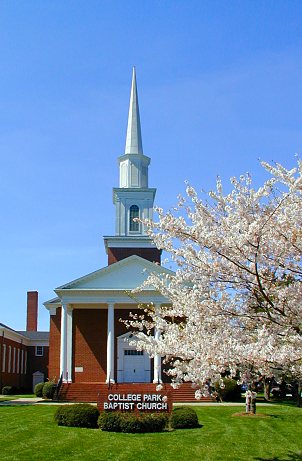
 The NDP was formed in 1961 as a political merger of the CCF (Cooperative Commonwealth Foundation) and the Canadian Labour Congress. The annointed leader, Tommy Douglas (quite possibly one of the three best Prime Ministers Canada never had) was actually an ordained Baptist minister. (That's right, you read it -- Baptist.)
Both the CCF and the NDP after it were based almost entirely on the Protestant Social Gospel. The Social Gospel advocated that Christian values demanded a more generous and inclusive society (aforementioned by Al Franken as social justice).
It probably helped that in Canada churches were allowed to hold and express political opinion. An obsession with politically marginalizing religion certainly isn't anything that has never manifested itself in Canada (see: modern NDP), but it has yet to establish the stranglehold on religion that exists in the United States.
Comparing the two case studies, one can't help but draw the conclusion that the failure of the United States to produce a relevant social democratic party is at least partially due to its legal muzzling of religious movements.
Of course other factors, such as an obsessive, fearful suspicion of communism (although suspicion certainly was warranted, at least on a limited basis -- read: not McCarthy-esque) certainly played a role, one has to wonder what would exist today.
Maybe -- just maybe -- a stable, viable social democratic party.
(If you're reading this, Ralph Nader, you don't count. And it certainly was a shame that Howard Dean -- whom history may recognize as one the best Presidents the United States never had -- was judged to be too scary by Democrats.)
Naturally, the blending of politics and religion can go too far, and George W Bush is a fairly decent example of that (although most of the Republican party's intractable opponents find Mike Huckabee even more threatening). But one should also keep in mind that a liberal mixing of politics and religion can also have positive results.
Canadian public health care is, without a doubt, history's greatest example of this.
But before the specific values of the Social Gospel can take root, as they have north of the 49th parallel, religious organizations have to be allowed to at least knock at the door. It's ironic that some of those who most decry the lack of social democrats in the United States are the ones most determined to see that this is never allowed.
Saturday, October 06, 2007
United they Stand?
Unity '08 campaign seeks to do away with divisive presidential politics

Although the kickoff of American presidential primaries is still at least three months away, speculation regarding who will contest the 2008 presidential election is already in high gear.
The general consensus among those doing the speculating is that the Democrats will field a Hillary Clinton/Barak Obama combination (although the actual president/vice-president ordering is clearly undetermined), while the most recent polls cast former mayor of New York City Rudy Giulliani as the Republicans' front runner, with Fred Thomson running a fairly close second. Speculation suggests that Giuliani's running mate could be anyone ranging from one of his opponents to his wife, Judi.
A Obama/Clinton campaign alone would make the 2008 presidential campaign a compelling one, regardless of who the Republicans select as their candidates. But the die is far from cast yet, and the Unity '08 campaign wants to make things a little more interesting.
Citing an an op-ed article co-penned by Democrat Mario Kuomo and Republican Tom Kean, the Unity '08 campaign believes that never before has the United States faced a political landscape so rife with conflict.
They believe that the answer is to field a combined Democrat/Republican presidential ticket in the 2008 election, and they've promised to select just such a ticket through an "online convention".
Clearly, a major strength of the Unity '08 campaign is its ability to attract compelling celebrity spokespeople. Perennial character actor Sam Watterson has long been acting as a front man for the group, and 84% of respondants to an online poll has suggested Stephen Colbert should run for president.
But Unity '08 promises other benefits as well.
While some dismiss the Unity '08 movement as one that will nominate "sad sack politicians who couldn't make it through the primaries", Unity '08 will certainly serve as an opportunity, for at least two politicians, to overcome some of the political roadblocks that have stood between them and a presidential ticket.
There are a good number of promising presidential candidates who have, in the past, been unable to secure a nomination due to a lack of funding. The primary system the Democrats and Republicans use to choose their presidential candidates clearly benefits the candidates with the most money to spend.
Candidates can also find themselves kneecapped by elites and special interest groups within either party.
An unfortunate reality of modern politics is that the best candidate is not necessarily the candidate that is elected -- or in this case, even nominated. In the hands of the right candidates, Unity '08 could turn out to be the dream second opportunity for one of these candidates to actually get their chance to be elected president.
This, however, begs an important question: which two candidates would make the best Unity ticket for 2008?
There are two individuals who fit the bill of an ideal Unity candidate: intelligent, promising and, most importantly, willing to overcome partisan divides.
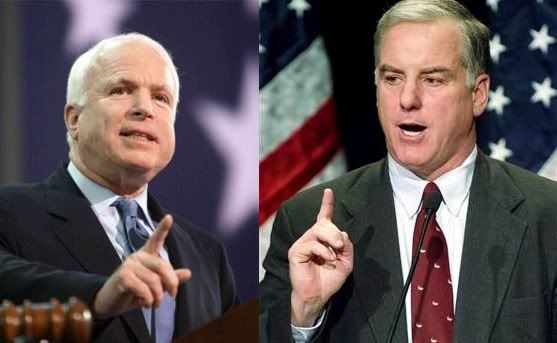
These two men are John McCain and Howard Dean.
Both have, in the past, stood a very good chance of winning a presidential candidacy. Both men have proven they can make compelling candidates, although the lustre of each has worn off at the polls somewhat.
Both have previously fallen victim to the slings and arrows of outrageous politics. Although McCain was able to win a few primaries (in New Hampshire, Michigan, Conneticutt, Massachusetts, Rhode Island, Vermont, and Arizona), he was eventually forced to withdraw his candidacy due to lack of funding.
On the other side of the coin, Howard Dean led all Democratic presidential nominees in fundraising, but fell short in the race itself, winning only in Vermont and the District of Columbia.
Each candidate also fell victim to some dirty attacks. Howard Dean fell victim to some ill-advised (and, as Joe Trippi suggests, formulated by Democratic party brass) attack ads launched by General Wesley Clark, while McCain fell victim to some rather vicious tactics suggesting he had fathered an illegitimate black child.
Although, in fairness it should also be remembered that each candidate had a hand in their own defeat, as John McCain waffled regarding his opinion of the Confederate flag, and Howard Dean managed to embarrass himself with an oft-lampooned rallying cry following his defeat in the Iowa primary.
Of course, the compatability of McCain and Dean can only really be determined by their policies on the issues of the day.
While there are many differences, they could find a good deal of common ground.
The two can find common ground on a good number of issues: for example, both McCain and Dean favour actual fiscal conservatism, as opposed to certain American administrations that have campaigned on fiscal conservatism, then abandoned it. Both support abortion rights (although they differ on how deeply abortion rights should be legally entrenched), and both support stem cell research. Both have taken strong stands regarding campaign finance reform. Both favour reforms to military spending.
Each man also holds policies that could be considered complementary to the other: Howard Dean prefers prosecuting dealers to prosecuting users, while McCain's drug policies are geared toward cracking down on import and sales of drugs. Dean favours increased education spending, while McCain's policies are geared toward ensuring competency of teachers and streamlining education spending.
The two would also find a few policy matters on which they would have to find a compromise: for example, Howard Dean favours environmental provisions in free trade agreements, McCain doesn't. McCain is a good deal more hawkish (or perhaps owlish) in his foreign policy outlook than is Dean. Dean favours immediate further integration of China within the international system: McCain feels they should be granted entry into organizations such as the World Trade Organization depending upon what human rights concessions they're willing to make.
There are also some important issues on which Americans could expect little movement from these two, universal healthcare being perhaps the highest-profile among them (neither of them fully support it).
It shouldn't be said that McCain and Dean would be able to work together in perfect unison: to suggest so would be approaching the very idea of a Unity '08 ticket from a very naive point of view. McCain, for his part, would probably have a much easier time working with John Kerry -- a fellow war veteran with whom he has also worked in the past.
But if the idea of a Unity '08 ticket is to unite Americans by ensuring the administration represents a wider variety of Americans' views, then McCain and Dean, should they find themselves so disposed, may well be the two best men for the job.
Most importantly, Dean's fundraising acumen, combined with McCain's demonstrated electoral appeal, could be the answer to what could otherwise be an acrimoniously partisan electoral showdown over the war in Iraq.
If the Green party were to field a Ralph Nader/Jell-O Biafra ticket, the upcoming presidential election could prove to be even more interesting.
...But that's an article for another time.
Although the kickoff of American presidential primaries is still at least three months away, speculation regarding who will contest the 2008 presidential election is already in high gear.
The general consensus among those doing the speculating is that the Democrats will field a Hillary Clinton/Barak Obama combination (although the actual president/vice-president ordering is clearly undetermined), while the most recent polls cast former mayor of New York City Rudy Giulliani as the Republicans' front runner, with Fred Thomson running a fairly close second. Speculation suggests that Giuliani's running mate could be anyone ranging from one of his opponents to his wife, Judi.
A Obama/Clinton campaign alone would make the 2008 presidential campaign a compelling one, regardless of who the Republicans select as their candidates. But the die is far from cast yet, and the Unity '08 campaign wants to make things a little more interesting.
Citing an an op-ed article co-penned by Democrat Mario Kuomo and Republican Tom Kean, the Unity '08 campaign believes that never before has the United States faced a political landscape so rife with conflict.
They believe that the answer is to field a combined Democrat/Republican presidential ticket in the 2008 election, and they've promised to select just such a ticket through an "online convention".
Clearly, a major strength of the Unity '08 campaign is its ability to attract compelling celebrity spokespeople. Perennial character actor Sam Watterson has long been acting as a front man for the group, and 84% of respondants to an online poll has suggested Stephen Colbert should run for president.
But Unity '08 promises other benefits as well.
While some dismiss the Unity '08 movement as one that will nominate "sad sack politicians who couldn't make it through the primaries", Unity '08 will certainly serve as an opportunity, for at least two politicians, to overcome some of the political roadblocks that have stood between them and a presidential ticket.
There are a good number of promising presidential candidates who have, in the past, been unable to secure a nomination due to a lack of funding. The primary system the Democrats and Republicans use to choose their presidential candidates clearly benefits the candidates with the most money to spend.
Candidates can also find themselves kneecapped by elites and special interest groups within either party.
An unfortunate reality of modern politics is that the best candidate is not necessarily the candidate that is elected -- or in this case, even nominated. In the hands of the right candidates, Unity '08 could turn out to be the dream second opportunity for one of these candidates to actually get their chance to be elected president.
This, however, begs an important question: which two candidates would make the best Unity ticket for 2008?
There are two individuals who fit the bill of an ideal Unity candidate: intelligent, promising and, most importantly, willing to overcome partisan divides.
These two men are John McCain and Howard Dean.
Both have, in the past, stood a very good chance of winning a presidential candidacy. Both men have proven they can make compelling candidates, although the lustre of each has worn off at the polls somewhat.
Both have previously fallen victim to the slings and arrows of outrageous politics. Although McCain was able to win a few primaries (in New Hampshire, Michigan, Conneticutt, Massachusetts, Rhode Island, Vermont, and Arizona), he was eventually forced to withdraw his candidacy due to lack of funding.
On the other side of the coin, Howard Dean led all Democratic presidential nominees in fundraising, but fell short in the race itself, winning only in Vermont and the District of Columbia.
Each candidate also fell victim to some dirty attacks. Howard Dean fell victim to some ill-advised (and, as Joe Trippi suggests, formulated by Democratic party brass) attack ads launched by General Wesley Clark, while McCain fell victim to some rather vicious tactics suggesting he had fathered an illegitimate black child.
Although, in fairness it should also be remembered that each candidate had a hand in their own defeat, as John McCain waffled regarding his opinion of the Confederate flag, and Howard Dean managed to embarrass himself with an oft-lampooned rallying cry following his defeat in the Iowa primary.
Of course, the compatability of McCain and Dean can only really be determined by their policies on the issues of the day.
While there are many differences, they could find a good deal of common ground.
The two can find common ground on a good number of issues: for example, both McCain and Dean favour actual fiscal conservatism, as opposed to certain American administrations that have campaigned on fiscal conservatism, then abandoned it. Both support abortion rights (although they differ on how deeply abortion rights should be legally entrenched), and both support stem cell research. Both have taken strong stands regarding campaign finance reform. Both favour reforms to military spending.
Each man also holds policies that could be considered complementary to the other: Howard Dean prefers prosecuting dealers to prosecuting users, while McCain's drug policies are geared toward cracking down on import and sales of drugs. Dean favours increased education spending, while McCain's policies are geared toward ensuring competency of teachers and streamlining education spending.
The two would also find a few policy matters on which they would have to find a compromise: for example, Howard Dean favours environmental provisions in free trade agreements, McCain doesn't. McCain is a good deal more hawkish (or perhaps owlish) in his foreign policy outlook than is Dean. Dean favours immediate further integration of China within the international system: McCain feels they should be granted entry into organizations such as the World Trade Organization depending upon what human rights concessions they're willing to make.
There are also some important issues on which Americans could expect little movement from these two, universal healthcare being perhaps the highest-profile among them (neither of them fully support it).
It shouldn't be said that McCain and Dean would be able to work together in perfect unison: to suggest so would be approaching the very idea of a Unity '08 ticket from a very naive point of view. McCain, for his part, would probably have a much easier time working with John Kerry -- a fellow war veteran with whom he has also worked in the past.
But if the idea of a Unity '08 ticket is to unite Americans by ensuring the administration represents a wider variety of Americans' views, then McCain and Dean, should they find themselves so disposed, may well be the two best men for the job.
Most importantly, Dean's fundraising acumen, combined with McCain's demonstrated electoral appeal, could be the answer to what could otherwise be an acrimoniously partisan electoral showdown over the war in Iraq.
If the Green party were to field a Ralph Nader/Jell-O Biafra ticket, the upcoming presidential election could prove to be even more interesting.
...But that's an article for another time.
Tuesday, July 31, 2007
Digital Democracy, Participatory Democracy and Consumer Democracy: An Uneasy Balance
Jihad vs. McWorld offers a unique perspective on digital democracy
Howard Dean could have been president. In the eyes of many, Howard Dean should have been president.
If the 2004 American presidential election had been conducted exclusively on the internet, Howard Dean probably would have been president.
Unfortunately, the election wasn't conducted exclusively on the internet, and Howard Dean may never be president. But those who overlook Dean's performance in the 2003 presidential primaries also overlook the incredible blow that he managed to strike in favour of participatory democracy, particularly digital democracy.
By way of blogs, messaging boards and youtube videos, 2007's slate of would-be presidents has clearly taken notice of the near-miracle pulled off by Dean and his campaign manager, Joe Trippi. And for good reason.
It's a winning formula, one built upon a formula that is constantly refreshed by the utter indifference of all too many politicians.
In many ways, digital democracy is an internet-specific version of classical participatory democracy, wherein it is concieved that every man and woman of voting age (or at least old enough to be politically active) has a right (and a responsibility) to be engaged in the political process. Digital democracy is only a slight variant: through it, every man and woman of voting age (or, again, at least old enough to be politically active) has the power to participate through the many tools the internet offers.
Most western democracies haven't been participatory in decades. The traditional style of democracy has seemingly been replaced by consumer democracies, wherein political ideas have been reduced from something that the average person engages with personally, to something that is merely produced, packaged and marketed by politicians and bought by voters.
Voters are disempowered in consumer democracies. Instead of telling politicians what their interests are and what they expect, they are instead told what their interests should be and what they should expect. What eventually emerges is a democracy wherein voters are offered fewer real choices.
Periodically throughout history, political movements are catalyzed around dissatisfaction with this brand of consumer democracy, often based around populist ideals (in Canada, the Reform party was only the most recent among a historical lineage of such movements).
When examined from the point of view offered by Benjamin Barber's Jihad vs. McWorld model, demands for digital democracy represent a very deep and, at times, gutteral reaction to the dominant model of consumer democracy.
According to Barber "jihad" movements often emerge out of identity politics, while the "McWorld" institutions they oppose emerge out of globalism and consumerism. Populism, favoured by many digital democracy advocates, tends to have deep roots in identity politics, although the identity it refers to tends to be a broader "big tent" concept. The "McWorld" institutions are often mired in elitism (itself a form of identity politics), but promote themselves stringently.
For many, the first impulse while examining phenomenae according to the Jihad vs. McWorld model is to villainize or demonize one side or another. Yet, a good deal of villainy is perpetrated both by "jihadist" movements and by "McWorld" institutions. The watering-down of political discourse under consumer democracy should probably be considered such an act of villainy. It disempowers ordinary voters to the benefit of political elites, undermining the kind of citizenship engagement necessary for a healthy democracy.
On the other hand, neither side is excusively villainous, either. The horrific violence perpetrated by the 9/11 hijackers constrasts very differently with civil rights activists, as does the heartless profiteering by irresponsible corporations with the philantrophy of the United Way.
The "jihadist" agitations of digital democracy advocates tends to come out overall as positive.
In regards to participatory and digital democracy, the "jihadist" movements are not necessarily universally positive. Often, such movements can tend to run hand-in-hand with other "jihadist" movements that don't necessarily have the noblest intentions. Consider, for example, the Reform party's experience with attempted subversion by racist organizations (which are solidly grounded in identity politics). Likewise, the "McWorld" institutions are not universally negative. Canada's hate crime laws have helped to stem the tide of racial propaganda spread by such groups.
Sometimes, such "jihadist" movements even achieve their goals by subverting "McWorld" institutions. Consider the irony of Pierre Trudeau's promise of participatory democracy against the fact that he has, both pre- and post-humously, been one of the world's most mass-marketed politicians. The two concepts really don't seem to be very compatible.
However, throughout Trudeau's early years, he was clearly a "jihadist" (he was actually an avowed Quebecois separatist, actually to a militant degree). In his case, however, he was eventually subdued by the "McWorld" institutions, which he actually served to increase the power of.
Digital democracy is slowly starting to worm its way into the dominant model of consumer democracy. However, those who champion it must steadfastly guard it against potential subversion from the "McWorld" institutions, lest it become simply another tool of consumer democracy to manipulate the electorate to the service of elites.
Sadly, Howard Dean will probably never be president. But if the liberating power of digital democracy can be preserved, perhaps someone will be able to take over where he left off, and strike another blow for participatory democracy.
Howard Dean could have been president. In the eyes of many, Howard Dean should have been president.
If the 2004 American presidential election had been conducted exclusively on the internet, Howard Dean probably would have been president.
Unfortunately, the election wasn't conducted exclusively on the internet, and Howard Dean may never be president. But those who overlook Dean's performance in the 2003 presidential primaries also overlook the incredible blow that he managed to strike in favour of participatory democracy, particularly digital democracy.
By way of blogs, messaging boards and youtube videos, 2007's slate of would-be presidents has clearly taken notice of the near-miracle pulled off by Dean and his campaign manager, Joe Trippi. And for good reason.
It's a winning formula, one built upon a formula that is constantly refreshed by the utter indifference of all too many politicians.
In many ways, digital democracy is an internet-specific version of classical participatory democracy, wherein it is concieved that every man and woman of voting age (or at least old enough to be politically active) has a right (and a responsibility) to be engaged in the political process. Digital democracy is only a slight variant: through it, every man and woman of voting age (or, again, at least old enough to be politically active) has the power to participate through the many tools the internet offers.
Most western democracies haven't been participatory in decades. The traditional style of democracy has seemingly been replaced by consumer democracies, wherein political ideas have been reduced from something that the average person engages with personally, to something that is merely produced, packaged and marketed by politicians and bought by voters.
Voters are disempowered in consumer democracies. Instead of telling politicians what their interests are and what they expect, they are instead told what their interests should be and what they should expect. What eventually emerges is a democracy wherein voters are offered fewer real choices.
Periodically throughout history, political movements are catalyzed around dissatisfaction with this brand of consumer democracy, often based around populist ideals (in Canada, the Reform party was only the most recent among a historical lineage of such movements).
When examined from the point of view offered by Benjamin Barber's Jihad vs. McWorld model, demands for digital democracy represent a very deep and, at times, gutteral reaction to the dominant model of consumer democracy.
According to Barber "jihad" movements often emerge out of identity politics, while the "McWorld" institutions they oppose emerge out of globalism and consumerism. Populism, favoured by many digital democracy advocates, tends to have deep roots in identity politics, although the identity it refers to tends to be a broader "big tent" concept. The "McWorld" institutions are often mired in elitism (itself a form of identity politics), but promote themselves stringently.
For many, the first impulse while examining phenomenae according to the Jihad vs. McWorld model is to villainize or demonize one side or another. Yet, a good deal of villainy is perpetrated both by "jihadist" movements and by "McWorld" institutions. The watering-down of political discourse under consumer democracy should probably be considered such an act of villainy. It disempowers ordinary voters to the benefit of political elites, undermining the kind of citizenship engagement necessary for a healthy democracy.
On the other hand, neither side is excusively villainous, either. The horrific violence perpetrated by the 9/11 hijackers constrasts very differently with civil rights activists, as does the heartless profiteering by irresponsible corporations with the philantrophy of the United Way.
The "jihadist" agitations of digital democracy advocates tends to come out overall as positive.
In regards to participatory and digital democracy, the "jihadist" movements are not necessarily universally positive. Often, such movements can tend to run hand-in-hand with other "jihadist" movements that don't necessarily have the noblest intentions. Consider, for example, the Reform party's experience with attempted subversion by racist organizations (which are solidly grounded in identity politics). Likewise, the "McWorld" institutions are not universally negative. Canada's hate crime laws have helped to stem the tide of racial propaganda spread by such groups.
Sometimes, such "jihadist" movements even achieve their goals by subverting "McWorld" institutions. Consider the irony of Pierre Trudeau's promise of participatory democracy against the fact that he has, both pre- and post-humously, been one of the world's most mass-marketed politicians. The two concepts really don't seem to be very compatible.
However, throughout Trudeau's early years, he was clearly a "jihadist" (he was actually an avowed Quebecois separatist, actually to a militant degree). In his case, however, he was eventually subdued by the "McWorld" institutions, which he actually served to increase the power of.
Digital democracy is slowly starting to worm its way into the dominant model of consumer democracy. However, those who champion it must steadfastly guard it against potential subversion from the "McWorld" institutions, lest it become simply another tool of consumer democracy to manipulate the electorate to the service of elites.
Sadly, Howard Dean will probably never be president. But if the liberating power of digital democracy can be preserved, perhaps someone will be able to take over where he left off, and strike another blow for participatory democracy.
Subscribe to:
Posts (Atom)