As Joan Fraser and the Liberal party's senate caucus plot their next move regarding their controversial ammendments to a bill that would abolish 2-for-1 sentencing provisions, they may want to consider a joint press release written by he Premiers of BC, Alberta and Saskatchewan.
In the press release Alberta's Ed Stelmach, Saskatchewan's Brad Wall and BC's Gordon Campbell reiterate their support for the bill to abolish these sentencing provisions. They add their voice to Manitoba Premier Gary Doer, who had previously voiced his displeasure over the matter.
“Our provinces all agree that eliminating the two-for-one credit would help our provinces fight organized crime and keep our communities safe,” said Wall.
“Albertans expect a system that represents their values and instills confidence,” added Stelmach. “Double credit for time served doesn't work for Alberta."
“Criminals should not be able to manipulate the justice system to their advantage by getting extra credit for time in remand,” Campbell said. “The amendments proposed by this unelected Senate water down the strength of Bill C-25."
"We believe the Senate should be abolished — and if we ever saw a case for the Senate being abolished, we just saw it last [Wednesday] evening," Doer fumed. "Elected people in the legislatures of the country, elected people in ... Parliament should be making decisions."
As noted previously, support for Bill C-25 came from across Canada, from across partisan boundaries. Stelmach governs Alberta as the leader of the Progressive Conservative party. Wall governs Saskatchewan as the leader of the Saskatchewan party -- Sasktachewan's primary conservative party (a Progressive Conservative party remains registered but doesn't field candidates in elections). Campbell governs BC as a Liberal, and Doer is the outgoing NDP Premier of Manitoba.
If Canadians needed any further indication of precisely how unresponsive an institution the Senate has become, this particular issue certainly presents it.
With its current Liberal majority, the Senate doesn't seem to care what the people of Canada, their elected representatives, or the provincial governments of Canada have to say on this issue.
They plan to go their own way, and drag the rest of the country along with them. They just aren't listening.
Gary Doer predictably toed the (rather frightening) NDP party line on abolishing the Senate. Canadians clearly don't favour this option -- numerous polls have demonstrated the Canadian preference for an elected Senate.
But in the absence of an elected Senate, perhaps other reforms should be considered. Legislation allowing provincial governments to summon their Senators before the legislature could at least improve the responsiveness of Senators to the constituents they're expected to represent.
Better still would be legislation allowing provincial legislatures to dismiss Senators deemed to have insufficiently represented their constituents -- perhaps with a 75% vote.
Such reforms could at least force Canada's Senate to listen to the people they're expected to represent. As recent episodes have shown, Senators like Joan Fraser simply aren't listening.
From across Canada, different courses are being proposed for the country's contentious Human Rights Commissions.
Some, like Ontario Progressive Conservative leadership candidates Tim Hudak and Randy Hillier, are proposing that such commissions should be abolished.
Others have proposed a radical new course for the HRCs -- a course that Alberta's Progressive Conservative government has chosen to follow with the passage of Bill 44.
Certainly, there are many practical issues with Bill 44. As some have noted, teachers could find themselves facing charges in an Alberta Human Rights Tribunal if a parent decides that they didn't receive sufficient warning about an upcoming lesson on almost anything. This is a serious problem with the legislation.
But as Lafleche notes, Bill 44 is only the most recent move in a political chess game over how Canada's Human Rights Commissions should function -- or if they should exist at all.
In Ontario, as Lafleche notes, the Ontario Human Rights Commission "has been all about the right not to be offended". In many cases it's been the same in Alberta. But in noting that Bill 44 seems to reinforce the "right to be a dullard", Lafleche misses one key point: the "right to be a dullard" seems not only to be about "the right not to be offended", but also about a parent's right to make decisions about their childrens' education.
Parents have long been lectured about the need to manage what their children are or are not exposed to. Disclaimers on television shows warning parents that "viewer discretion is advised", film rating schemes and parental advisory stickers on CDs have long been part of efforts to empower parents to control the extent to which their children are being exposed to violence, foul language or controversial subjects.
Now, for good or for ill, parents are being given an opportunity to make similar decisions in regard to their childrens' education.
Not all Canadians -- and certainly not all Albertans -- will empathize much with the religious conservative who pulls their children out of class because they insist that their children be given abstinence-only sex education. Nor should should they.
But many would agree that morality should not be taught in the classroom. If anyone has the right to teach morality to their children, most people would agree that a child's parents are the only ones who possess that right.
Yet many attempts have been made to smuggle left-wing morality lessons into the classroom. Most Canadians would almost certainly roll their eyes at a religious conservative's complaints regarding a tolerance-minded lesson plan that may try to teach children that homosexuality is normal. But it's impossible to overlook the fact that teaching children that homosexuality isn't immoral -- and in this author's opinion, it most certainly isn't -- is still teaching morality in the classroom.
Any parent uncomfortable with this -- whether most Canadians agree with their reasons or not -- has the right to blow the whistle on this.
But there is a flip side to the entire affair. Bill 44 could be used by parents in Catholic school divisions to pull their children from classrooms in Catholic Schools whenever they are taught that Catholic doctrine dictates that abortion is wrong -- certainly a right that one would expect moderate Catholics to exercise. The same parents could use Bill 44 to pull their children from any lessons in which homosexuality is said to be wrong. Similarly, atheist parents could use Bill 44 to pull their children from lessons related to religion.
Again, Bill 44, in its application, could turn out to be a stalemate, in reality favouring neither side of the so-called "culture war".
This is how it should be considering that liberal democratic governments have no business taking sides in social or cultural affairs.
Elliott has joined fellow PC leadership candidate Frank Klees in calling for reform of the OHRC. Elliott has yet to articulate any concrete proposals for that reform. Klees, meanwhile, has proposed repealing Section 13 and taking away the Commission's ability to effectively act as a censor, and allow it to focus on clear cases of discrimination.
Of those out to chart a new course for the HRCs, Elliott and Klees are certainly the least radical among them. Alberta's Bill 44 may have charted a course into a pragmatically-tenuous position, but at least the Alberta PCs haven't charted them a course to oblivion.
As Ontario Progressive Conservatives weigh their leadership candidates ahead of the leadership convention later this month, it seems that the jury is still out on the matter of leadership.
In a recent poll of Ontario Tories Tim Hudak narrowly leads the pack with 26% of decided voters, with Christine Elliott trailing by four points, at 22%. Frank Klees is sitting third with 17% and Frank Hillier trails the pack with 14%.
19% of Ontario's Progressive Conservatives remain undecided.
Considering that no one candidate has enough support to break the 50% barrier on the first ballot even if all undecided voters were to gravitate to their candidacy, second choices will become very important in this contest.
Christine Elliott is the top second choice with 17%, leading Hudak by a single point in this category. Klees follows by yet another single point at 15%, and Hillier again trails the pack as the second choice of 7% of decided Progressive Conservatives.
In the closest position that passes for front-runner status in this campaign, Hudak enjoys the benefit of an endorsement by Mike Harris, the last Progressive Conservative to lead his party to a majority government in Queen's Park -- even if the first of the two was an unlikely majority.
As the presumed frontrunner, Hudak's campaign has suffered from a lack of tangible policy. Hudak's policy centrepiece, a bid to abolish the Ontario Human Rights Commission, is believed to have driven support away from his campaign to that of Elliott, his presumed primary rival in this contest.
With these particular conditions, one can likely expect a stalemate to emerge at the June 27 PC leadership convention. Under those kinds of conditions, one may expect Frank Klees to replicate Ed Stelmach's feat, and emerge as a brokered leader.
This may not be such a bad thing. Stelmach went on to win one of the most dominant majority governments in the history of Alberta.
Then again, Ontario is an incredibly far cry from Alberta. As Tory leader Frank Klees may have to struggle to find life, let alone be assured a long tenure in the Premier's Office.
When Ralph Klein stepped down as Premier of Alberta and leader of the Conservative Party of Alberta, I thought to myself “Thank god, that drunken asshole of a leader is finally gone.” Two years later I find myself thinking “Wow at least under Klein things were fun."
It’s difficult to admit that Klein is a better leader then Stemach. I mean, looking back on his history the honorable Klein had these gems under his belt.
-Barging into an Edmonton Homeless shelter, then telling homeless man, Mark Shea, to “get a job” while throwing money at him. It turned out Shea had a job, but was unable to afford a home in the Edmonton Area.
-Throwing a book at legislative paige Jennifer Huygen while yelling the immoral phrase “I don’t need this crap”. This incident becomes 100 times worse when people meet Huygen and realize that she is possibly the nicest person on the planet.
-Showing off a paper from a communications class in the legislature and bragged about the grade he received. Later people found out that Klein copied and pasted important sections of the paper from various sources. Since then Albertan students have had to deal with stricter anti-plagiarism laws.
Any one of these incidents would have ended most political careers, so it’s not surprising that Premier Stelmach acts as if Albertans will continue to vote for the Conservative Party till the end of time. However, Stelmach doesn’t seem to understand this simple truth about Albertans – they are a pragmatic people.
So long as his the books were balanced, cash continued to flow, jobs were created— Albertan’s would continue to support the Conservative Party. Klein could have sacrificed Jennifer Huygen to Satan on national television, then throw Mark Shea into a tailings pond and so long as he doled out another “Prosperity Bonus Check” he would have gained another majority government.
The thing when King Ralph began to indicate certain controversial political views such as private healthcare or banning gay marriage – he would eventually back down. He understood that while Albertans would support him on the managing of the economy, if he ever acted on his right wing rhetoric, he’d find a revolution on his hands. Ed Stelmach doesn’t seem to understand this fact. Since he has taken the reigns he’s managed to redo the royalty system in such a way that he’s managed to anger corporations that felt the increase was unfair AND people that wanted an increase in royalty rates in the first place. Instead of convincing Albertans that nuclear power is safe and emphasizing the economic benefits of it, it feels like the government is ramming it down Albertans' throats. And then there is Bill 44, a bill that is an embarrassment to the Albertan Education system.
The recently passed Bill makes it possible for parents to withdraw their children from classes if a “controversial subject” is brought up— sending fears down everyone’s spine that it will be used to allow parents to pull their children out of class when subjects like evolution, homosexuality, and others are brought up with the justification of protection “human rights”.
Environmentalists, The Teachers' Union, Gay Rights Activists, Athiests, The Oil Industry, all are amazingly being systematically infuriated by the Stelmach Government. And while an election is still years away, legislation like Bill 44 will only serve to rally people against their government.
The article, written by Murray Mandryk and published in the Saskatoon Star Phoenix and Regina-Leader Post, asks an interesting question: how did Alberta and Saskatchewan become so cozy in the first place?
"Here's one of the more intriguing "chicken or the egg" type of argument you'll hear on coffee row:
"Did this province elect a Saskatchewan Party government because we were already becoming more like Alberta, or has the election of a Saskatchewan Party government made this province more like Alberta?"
Regardless of which side of he debate you support, what's indisputable is the premise is that Saskatchewan has become more like Alberta."
Some residents of Saskatchewan may find the very premise to be alarming. In the same vein as Canadians who cry foul every time Canada inches too close to our southern neighbours for their liking, many of those who feel Saskatchewan's unique character -- as it were -- is threatened by too closely associating with the cowboys west of Lloydminster, they'll insist that too closely associating with Alberta somehow diminishes Saskatchewan.
Of course, there are some traits that Saskatchewan shouldn't be so eager to share with Alberta.
"More like it, mind you. Not exactly alike.
The outcome of elections in Saskatchewan, after all, are still not a foregone conclusion and will remain so for some time. This province also still has significantly deeper agricultural and small-town roots and significantly less urban pull than does Alberta (or any other province, for that matter)."
Indeed, democracy in Saskatchewan is much healthier than in Alberta.
During the 2007 provincial election, 76% of eligible voters reported to the polls, compared to the absolutely dismal figure of 41% in Alberta's 2008 election.
Saskatchewan does maintain a largely rural character, but a newfound determination to develop the province's considerable energy resources -- including oil sand reserves that may rival those in Alberta will inevitably change that. The kind of building projects necessary to support such development will require increased manufacturing capacity throughout Saskatchewan, particularly in the urban centers.
"Most significantly, Saskatchewan is the birthplace of the CCF-NDP and its social democratic influence isn't about to disappear anytime soon. Even at one of its historically low ebbs, the NDP still has 20 seats in the legislature and something close to 40 per cent of public support.
But it's also telling that on the very week that the NDP is celebrating the 75th anniversary of the Regina Manifesto, which urged the eradication of capitalism, the most exciting speculation within New Democratic ranks is the possibility of the return of a conservative-minded capitalist such as Dwain Lingenfelter to lead the party."
Certainly, being defeated after 16 years in power must certainly be deflating for the provincial NDP. Likewise, the party's federal prospects in the province are less than encouraging.
"That Saskatchewan's affinity for Alberta actually might have started under an NDP administration is more than a little ironic.
It was under former NDP premier Roy Romanow that deficit control, a curtailing of public investments and even income tax cuts really began. Romanow's successor as NDP leader and premier, Lorne Calvert, extended this agenda with cuts to the province's sales, business and corporate taxes."
Certainly, this would seem ironic if it weren't entirely in line with the political trends of the time.
Consider that Jean Chretien, one considered a stalwart of the liberal wing of the Liberal party, led a government that reduced the country's deficit drastically, and posted some of the only surpluses of the day in the Western World.
Chretien was responding to pressures being exerted upon his government by Preston Manning's Reform party, just as Roy Romanow -- and Lorne Calvert after him -- were responding to pressure being exerted by the upstart Saskatchewan party.
"This change under NDP governance happened at the same time that Saskatchewan's economic interests became more closely tied to the oil economy. The prospect of oil at nearly $100 a barrel was something that even an NDP government from this province could share eagerly with the Progressive Conservative government in Alberta.
It can be argued that Saskatchewan grew that much closer to Alberta with each dollar that a barrel of oil increased in price over the past four years. What's been bad for everyone else's economy has been great for ours, especially since the Saskatchewan Party's election win last November that has coincided with the price hike in a barrel of oil by $50."
It should be considered only natural that Saskatchewan and Alberta would grow closer considering the number of interests they hold in common. Both economies have constantly strengthened with the increasing value of oil and gas. Thus, as goes oil and gas will go the economies of Alberta and Saskatchewan -- although with some creative government and appropriate investment, this need not always be so -- and as goes the economy of Alberta or Saskatchewan will almost inevitably go the other.
"That said, Saskatchewan and Alberta today appear to be as closely bonded by political ties as economic ones. At least that's what some recent developments suggest.
The first ministers meeting in Quebec last week, where Premier Brad Wall and Alberta Premier Ed Stelmach found themselves at odds with their counterparts who were promoting cap-and-trade system on carbon emissions, was only the latest evidence of this emerging alliance.
We saw pretty much the same reaction from the two provinces to federal Liberal Leader Stephane Dion' Green Shift strategy, which takes square aim at Alberta and Saskatchewan's energy resources.
Stuck in the same foxhole and dodging bullets from eastern critics eager to portray Alberta and Saskatchewan as greedy, selfish and environmentally irresponsible, it's only natural that the two provinces would become that much closer.
That said, it's highly unlikely that an NDP government in Saskatchewan would have jumped into that same foxhole on the Green Shift or perhaps even on a cap-and-trade scheme."
Of course not.
It's easy to get along with your neighbours when you see eye-to-eye. And it would simply be less than reasonable to expect a Progressive Conservative government -- particularly one led by an individual like Ralph Klein -- to see eye-to-eye with an NDP government.
Likewise, there's nothing like an external threat -- say, that posed by a federal party with a history of confiscatory tax policies and a habit of breaking its promises -- to bring two provinces even closer together.
"The latest evidence of the bi-provincial political link came Monday with the Saskatchewan Party government signing on to Pacific North West Economic Region (PNWER) -- something the New Democrats of this province not only wouldn't do but would vigorously oppose, because they see it as precursor to joining the Trade and Investment Mobility Agreement reached by Alberta and British Columbia."
Then again, considering the vehemence of the NDP's opposition to NAFTA, it should be considered unsurprising that the NDP would decline to join an organization such as PNWER.
It's also less than surprising that a Saskatchewan party government -- considering that the Saskatchewan party was founded out of a coalition Progressive Conservatives and conservative-minded Liberals -- would be so eager to join.
It's also less than surprising that Alberta -- looking for any dance partner it can find in an effort to resist a potential replay of the infamous National Energy Policy -- would be so eager to get Saskatchewan on board.
"Lest there be any doubt about this newfound closeness, consider what deputy Alberta premier Ron Stevens said about sponsoring Saskatchewan's application to join the private-sector organization his province helped to create:
"I can tell you, as a neighbouring sister province, (Alberta has) seen under Premier Wall a change in attitude," Stevens said during Monday's PNWER press conference.
"The province now has a outward looking, engaging, active attitude and I think that Saskatchewan is going to be a robust, full member of this organization. We are all going to be beneficiaries of that."
Maybe the close bond with Alberta wasn't forged quite overnight. But make no mistake that Alberta and Saskatchewan have become closer than they've been in decades."
Certainly, Alberta and Saskatchewan have grown closer -- more than simply economically or politically.
Numerous residents of either province have migrated to the other over the past numerous years. In particular, there has been a strong trend of Albertans moving to Saskatchewan. And anywhere Albertans are moving in such numbers is almost inevitably due for a conservative resurgence.
In other words, it's no surprise that Alberta and Saskatchewan have become so cozy. Furthermore, it's about time.
Every so often, the editorial staff of the Toronto Star likes to toss a few stones westward, as was the case with an op/ed article, written by former Calgary Herald managing editor Gillian Steward, published today.
In the article, Steward -- oft-time writer and researcher for the Parkland institute and some-time compatriot of provincial Liberal leader Kevin Taft -- alleges that oil money has undermined democracy in Alberta. It starts by noting that, by golly, things are real good for the Alberta government:
"The Alberta government tabled a $37 billion budget last week that featured per capita spending three times the average level of other provinces.
Not that many Albertans are likely to notice. After all, only 41 per cent of eligible voters cast a ballot in the recent provincial election. If elections don't catch most people's attention, it's hard to imagine that the day-to-day dealings of the government will."
Alberta's (frankly) disgustingly low voter turnout is often pointed to as evidence that, galldurnnit (galldurnnit isn't a word - ed) Albertans just don't believe in democracy.
Of course, one might have suspected that maybe, just maybe, the Star's editorial staff might have thought twice about where Steward is going with this. After all, Alberta isn't the only province that just endured a historically low voter turnout. In the 2008 Ontario provincial election, only 52.6% of eligible voters cast ballots.
Admittedly, it's a full 11 percent better than Alberta's turnout. But Ontario and Alberta aren't the only jurisdictions to experience declining voter turnout. The country, as a whole, has experienced a nine% decline in voter turnout since Confederation in 1867 -- although the 64.7% turnout in the 2006 federal election was a nearly 4% improvement over 2004's turnout.
In Ontario's particular case, however, the province doesn't have any oil money to blame for their decline. So one wonders what else could be responsible?
There is an answer to this. But first, back to Steward:
"Premier Ed Stelmach's Conservatives won 72 of 83 seats, which left the opposition – nine Liberals and two New Democrats – reduced to a tiny island surrounded by a sea of gloating government members.
That the opposition is practically dead on its feet is no exaggeration. They have just endured a draining election campaign and are now expected to take on one of the most powerful governments in the country. They have so few people and resources, not to mention money, that they will barely be able to keep up with the government's agenda."
They may not have much money, resources, or many people, but they certainly have plenty of excuses:
"This is not the first time there has been such a lopsided election result. In 1982, Peter Lougheed's Conservatives won 75 of 79 seats. In 2001, Ralph Klein won 74 of 83. But at least then most people turned out to vote. After this election, some are wondering if Alberta has become North America's first post-democratic state; a well-educated, wealthy jurisdiction where most people don't give a fig about democracy.
Peter McCormick, a political science professor at the University of Lethbridge, says Albertans seem to believe that democracy is obsolete and elections irrelevant. Another political-science prof told me that Alberta is proof that the Chinese are right: you can have capitalism without democracy. He was joking, but not entirely."
Which of course, is musing a little on the hysterical side.
In fact, Albertans do turn out to the polls when there's an actual contest, as was the case during the 2006 federal election, when 55% of Albertans turned out to vote. Still not exactly numbers to be proud of (nor are the federal numbers), but more significant still.
"The drift from a one-party state to almost complete apathy has been going on for some time. But in the West this disaffection with democracy is purely an Alberta phenomenon. British Columbia had a 60 per cent turnout during its last provincial election and is also the first province to establish a working citizens' assembly to explore alternatives to the first-past-the-post electoral system. In 2005, British Columbians were asked in a referendum if they wanted to change the way they elected their political representatives."
If only the issue really were the issue in the decreasing voter turnout in Albertan elections and the increasing marginalization of what passes for an opposition here.
Historically, whenever the Albertan government has been replaced, it's been done by either an entirely new party (as was the case with the United Farmers of Alberta and Social Credit party) or by a new incarnation of an old party (which was the case with the Progressive Conservatives).
One explanation for this is especially intriguing: that, as a party continues to try to defeat the government and, in successive elections, continues to fail, Albertans come to judge that particular party as unfit and unable to govern. As time draws on, the opposition parties become increasingly irrelevant, and often reinforce this themselves by offering platforms of policies that simply don't appeal to Albertans, and don't reflect Albertans' interests as viewed by them.
One thing can be said about Albertans' low voter turnout: the landslide victories it tends to produce certainly does suggest an implicit approval of the government and its policies. To assume this would be folly, but it's hard not to give the idea serious consideration.
Then there is, of course, the other elephant in this particular room: Ontarians, in the course of the very election that drew the lowest voter turnout in their history, voted down Mixed Member Proportional plurality in a referendum. Whatever the problems in Ontario -- that other province experiencing historically low turnout -- it clearly has little to do with the first past the post electoral system. Those Ontarians who do vote seem to like it just fine.
"Saskatchewan residents are fiercely political. In the 2007 provincial election, which saw the NDP turfed in favour of the right-wing Saskatchewan party, 75 per cent of eligible voters cast a ballot. Manitoba had a 57 per cent turnout in 2007."
Of course, the prospect of electing a new government -- as Saskatchewan did in 2007, and Manitoba was expected to do (but didn't) -- may have had more than a little to do with the increased voter turnout.
"Stelmach said after the election that Albertans are "just happy with life, most of them." Could it be that with oil at almost $120 a barrel, more jobs than people to fill them, and relatively low taxes, Albertans believe there is nothing more for the government to do?
That was certainly Klein's vision. He often talked about wanting "the province to be on autopilot ... capable of running itself." That brings to mind a well-oiled machine, which of course describes Alberta in more ways than one."
If $120/barrel oil really is what Albertans think is "as good as it gets", it certainly wouldn't be out-of-line to be a little bit disappointed in the lack of political vision in the province.
But Albertan politics have always had a distinctly conservative, small-government flavour -- not one that all of Alberta's governments have embodied them.
But Ralph Klein isn't alone in favouring small-government models wherein things largely run themselves and citizens govern themselves. In fact, such principles are at the very heart of "strong democracy" models that are at the basis of demands for things such as proportional representation -- a demand that Steward scarcely masks here.
"It's well-oiled because petroleum taxes, royalties, permits and land leases account for a third of all government revenues and all those multi-billion surpluses. With a source of income like that, the government doesn't need to worry so much about keeping voters, particularly taxpayers, on side."
Except at election time. And of those voters who actually choose to cast ballots in Canada, the current government has been overwhelmingly chosen.
"So the money will flow, for the next year at least, and there will be very few objections. And why would the government listen anyway when it knows most Albertans are too busy, or too happy, to notice much of what it does?"
Except that Albertans seem to be extremely happy with the siting government -- after all, they keep returning it with overwhelming landslides.
Even those who support the government will quickly admit that, no, not everything in Alberta is perfect. But none of it is as bad as the province's minority left-wing opposition insists it is.
Democracy isn't what's irrelevant in Alberta -- the opposition is. The sooner that it recognizes this and adjusts in order to produce a relevant option for Albertans, the sooner its irrelevance will end.
In the wake of the opposition's further decimation at the hands of Ed Stelmach and his provincial Progressive Conservative party (not that they were a very strong opposition to begin with), various opposition supporters have been kicking around a few rhetorical footballs trying to figure out just how to get themselves out of this mess.
Many of the answers come down to two things: proportional representation and uniting the left.
If one treats the election results of a microcosm of all eligible voters (although with only 41% of eligible voters bothering to show up, who honestly could?) in the province, then one would also assume (again, not necessarily correctly) that the 53% of the popular vote that the Tories captured would have been good for 53% of the seats. It may be an uncomfortably slim majority, but a majority nonetheless.
Instead, the Tories, with that 53% (actually 52.7%, but we'll round it up for simplicity's sake) won them 87% of the seats. The Liberal party's 26% of the popular vote won them 11% of the seats, and the NDP's 8% of the popular vote won them 2% of the seats. The Wildrose alliance, with 7% of the popular vote, won 0% of the seats.
Proponents of proportional representation argue that something simply must be wrong with this.
But they're missing the point.
The popular vote is an indication of total support for a political party. As such, it's a measure of how much support that particular party has across (in this case) the province's 83 ridings. As such, it's little surprise that the Wildrose alliance's 7% of voters situated in 83 different ridings wouldn't warrant them any seats. It doesn't amount to enough support to win a riding.
In a parliamentary system, there's really only two ways to make proportional representation work: either abolish ridings outright or implement some kind of system in which representatives are simply assigned to a riding.
While the latter could almost be done amicably by assigning them to ridings where the popular vote reflected strong support for their party, it would be inevitable that some riding -- likely numerous ridings -- would be summarily assigned a representative that they did not support.
An alternative model, naturally, is to abolish ridings altogether. Of course, this would deprive citizens of representation -- or at least of the security of knowing they have a representative who is obligated to hear their concerns, regardless of whether or not they voted for them.
The favoured model, as promoted in a recent referendum in Ontario, is MMP -- mixed member proportional represention -- in which a portion of the legislature is elected riding by riding, and another block of MLAs is elected proportionally.
Of course, one can debate the value of electing a portion of representatives who are accountable to nobody other than their party whip. It really just doesn't add up.
The other option for Alberta's opposition parties is actually one that is much, much more viable -- especially here in Alberta where they literally have nothing to lose: that is, uniting the left.
Of course, there have been suggestions that uniting the left on a federal level would equal permanent super-happy-fun-time for the entire country. This, naturally, ignores the fact that the Liberals, NDP and Bloc (the last of which is actually an extreme right-wing party pretending to be a left-wing party) are all viable parties on their own. They can maintain official party status, and even form the government or official opposition.
In Alberta, neither of the main opposition parties can. One of them can form the official opposition on a largely ongoing basis, but it's such a meager and pathetic opposition that it barely warrants the label of "official".
Uniting the two parties would serve two crucial purposes: first off, to renew hope amongst those who would consider voting for a new government if only they had the opportunity, and secondly, creating a new party with a new lease on life.
Traditionally in Alberta, governments are only defeated by the emergence of new parties -- or at least new incarnations of old parties, such as with the Progressive Conservatives.
As an alternative, the Alberta Liberals and NDP could at least agree not to run candidates against each other, cutting down on the vote-splitting that has cost them numerous urban ridings in the past. But don't count on it. While NDP leader Brian Mason is permanently irrelevant and at least seems to understand this, Liberal leader Kevin Taft is still flirting with delusions of adequacy despite the fact that his leadership has been the exact polar opposite of that.
But uniting the Liberal and NDP parties in Alberta -- as the Canadian Alliance and federal Progressive Conservatives did to form the Conservative Party of Canada -- could give them the opportunity to show Albertans they can provide an alternative to the governing Progressive Conservatives, and force Albertans to give them a second look.
What's more, they may not have a choice. It's desperation time for the left, and desperate times call for desperate measures.
In a recent post at his new blog, Bruce Stewart seems to have formulated what is at least a partial explanation for why so few voters (41% in 2008) bother reporting to the ballot box.
"All the incessant posturing, pre-electioneering, shouting, etc. that is modern politics in the age of the twenty-four hour news cycle, the spinmeisters, political consultants, and so on — all of which is focused on hard, fast, negative sound-bites — has alienated the electorate. The parallel to this, for those of us who have worked in and around the computer industry, was the late 1980s, when then “no one ever got fired for buying” giant IBM was almost universally disliked, mistrusted, yet (when a decision needed to be made) rewarded, for lack of an alternative. Alternatives are not a substitution of one company for another; they are a shift in the paradigm of use. When it came — with LANs, Windows 3.1, and the client/server computing model in and around 1992 — an earthquake occurred. IBM was rocked and spent years reinventing itself. (There are those who think this is about to happen to Microsoft in turn. We shall see.)
What this means is that the problem with politics has practically nothing to do with who the leaders are! The Liberals, for instance, will see no real gain by dumping Stéphane Dion for another leadership choice. Alberta PCs may be led by a less than stellar leader in Ed Stelmach — I expect the negative comments about him and his actions to begin again immediately — but that’s not the point.When the problem is the way we handle politics in the public arena, leaders are irrelevant."
While it seems counter-intuitive (in fact, Canadian politics seem to be obsessed with party leaders) a quick overview of recent Canadian political history actually demonstrates precisely the opposite.
Consider, in particular, the federal Conservative party. Then consider the criticisms directed at Preston Manning when he was leader of the Reform party, and Stockwell Day when he was leader of the Canadian Alliance. The criticisms directed against the three are essentially the same: "too right-wing, too religious, racist, sexist, homophobic, anti-French and will dismantle our cherished social programs".
This despite the fact that Harper and Day both speak fluent French, all three led the most diverse caucuses in Parliament of their time, and Preston Manning once paid for an African immigrant's wedding -- after helping him find his plane to Edmonton (he almost accidentally boarded a plane to Winnipeg instead).
Yet none of that mattered. Racism, sexism, homophobia and religion (there are still a number of ideologues about who throw a shit fit if Stephen Harper so much as says "god bless Canada") remain the tired old predictable epithets hurled at conservative leaders in Canada.
During this week's elections in Alberta, the predictable negative campaigning model was predictably at the forefront.
Albertan opposition groups have refined negative campaigning down to an art. Consider the following ads:
The idea, apparently, is that the now-defunct Albertans for Change spoke to every Albertan in the province, and found that none of them trust Ed Stelmach.
And if you believe that, the same people probably have a house in Fort McMurray they'd like to sell you -- a real bargain, too.
Likewise, it's funny that a group calling itself "Albertans for Change" would criticize Stelmach's plan for wanting to change too much. They really should have called themselves "Albertans for Change... not so much".
Previous ads for the group (seemingly no longer available via YouTube) actually went a step even further and seemed to suggest that oil and gas royalties were not merely uncollected, but had "gone missing" (read: were stolen).
Add all of this to the ludicrous episode in which a former U of A Student's Union executive misappropriated Stelmach's name in order to promote his blog, and the prevalence of negative political campaigning and political stunting in Alberta becomes prevalent.
But then compare that to the criticisms of Stelmach's predecessor, Ralph Klein: he, too, was accused of having no plan.
Different leaders, same criticism. Then again, having invested so much time and effort in formulating these criticisms in the first place, why would these individuals want to go back to the drawing board?
But the inherent laziness of these individuals does more than simply save them the trouble of matching a new criticism to a new leader. It also results in stale politics, wherein the same old, same old campaign is continually trotted out, just with some new window dressing.
Maybe Albertans aren't voting out of sheer boredom with the process.
Clearly, something new is needed. Bruce Stewart elaborates:
"I sometimes think the Green Party has it precisely backward (and I speak of them here because Green is as much a movement beyond normal politics as it is an attempt to enter the fray in the chambers of government). It’s not that we need another party. Instead we need a new politics. Part of the mania for Barack Obama that we see south of the border — and the original Tony Blair in Britain — and recently, Nicholas Sarkozy in France — and ever (malheursement) Pierre Trudeau in 1968 — is that they didn’t need to campaign from the sound-bite, negative, “my opponent est un gros enmerdement” point of view. They could strike out positively and say nothing about their opponents. (”Vote for us because of a, b & c” is so much more appealing than “Vote for us because we’re not those lying, cheating, stealing cretins”. So is treating the electorate as thinking, rational adults who are capable of responding to a sense of history, of vision and of direction rather than scaring them into taking action to avoid their fate.) That’s not to say that at various points in the campaign the experts didn’t create negative views, and the sniping didn’t begin — clearly it has — nor that the public is fooled with the leader keeping to high road while his or her entourage gets down in the mud (it is not; merde can be smelled even when the front-man’s shoes don’t stink)."
Of course, a lot of this helps dispel a myth regarding politics: that once upon a time politics was about ideas, and that voters were treated as adults. Politicians campaigned based on ideas, principles and policy, and refrained from smearing their opponents.
The old politics, however, are often mythologized as more refined and more mature, and the new politics as dirty, vicious affairs wrought with muckraking.
So what it turns out that what we really have is a bizarre vicious cycle in which the old politics masquerading as the new politics, making us long idealistically for the old politics.
Stewart is precisely right: what we really need is newer politics which, ironically, would finally be the new politics.
Politicians who deliver us this new political paradigm should almost certainly be rewarded -- if the electorate still cares enough to reward them when they finally come along.
And in Canada, we need this rather badly. The Alberta election may just turn out to be the greatest evidence of we have seen of this in a long time:
"Periodically institutions need reform. This is because, as Thomas Langan showed in his book Tradition and Authenticity in the Search for Ecumenic Wisdom, the institution takes on a life of its own separate from the tradition that gave it life. The faith yields the Church, and by so doing people in charge of the churches have interests in their roles separate from those required of them by the faith. The desire for societal self-government yields parliaments and assemblies, and those who sit in them have interests (for their factions, as the first American President, George Washington, noted) that diverge from what the process of governance requires of them. So it goes, everywhere.
Our political institutions are in advanced decay. They have been subordinated to parties, and those who cling to the apron-strings of power these represent.
What this electorate — and I care little whether we speak of your municipal government, your provincial government or institutional Ottawa — is most waiting for is the person who will come to politics to reform the system. Reform, in this sense, need not mean “a new political faction”: it could come just as easily by working within an existing party. But it would be a reform, indeed, of how politics is conducted. They would take the Kinsellas with their “ass-kicking”, and the Carvilles and Morrises with their “triangulation” and “it’s (just) the economy, stupids”, and others of their kind and boot them overboard. They would stop playing to the polls, or even worrying about them — pollsters need not apply for work here. They would treat their counter-parts with respect and speak firmly but quietly about matters of import rather than seizing upon the “issue of the day” or seek to blow up the scandal du jour (really, what’s the difference between that and the pumping and dumping which our Securities Laws say is illegal around the stock market?) in their place. They would assume in everything they do that their potential voters are capable of following complex issues with complex argumentation and rational (i.e. not simplistic) solutions on offer.
They would, in other words, offer an adult in place of the schoolyard bullies we must listen to today."
Unfortunately, even those who have the acumen to offer us such change can all too often go astray. As, sadly, was the case with Preston Manning:
"Would they win at first? Oh, heavens, no! — for staying the course is part of proving that this is reform and not merely a dash of lipstick on the same old street-walking. But there comes a tipping point, and then the whole structure from before comes tumbling down. When they do, it will wipe much of the past out of existence.
This is what Preston Manning didn’t know and lost sight of (and why I could not support his Reform Party). This is what is yet to be born. This is why Albertans told pollsters they wanted change and then voted for more of the same. This is why Federal politics remains deadlocked; why BC’s politics are frozen almost to the point where Gordon Campbell could do anything and not fear returning to the other side of the House; why Dalton McGuinty exists in the face of Caledonia, incredibly bad economic management and the destruction of a province and why, in the face of everything, Vancouver will probably return Sam Sullivan and Toronto David Miller to continue their reigns of error."
Manning, with his demotic political philosophy -- the belief that all disagreements can be amicably resolved if only the common sense of the common people is trusted -- was willing to offer a bridge between left-wing and right-wing ideologies in Canada. He offered precisely the kind of alternative that Canadian politics desperately needs.
But in time, the carrot and stick of Canadian politics, power, and the ability to enact his agenda turned Manning away from this path. At the end of the day, Manning all too often appeared to be an ordinary run-of-the-mill politician.
Bruce Stewart is precisely right: when Canadians are finally provided an alternative to the old-as-new politics, the results will be undeniable.
Alberta could prove to be an ideal testing ground for such an alternative, but the question remains: is anybody willing to take the risk of offering it?
If one believed the poll numbers, the vocally disgruntled Progressive Conservative voters, the opposition parties and the labour unions, one would have thought that, yesterday, Ed Stelmach's governing Tories were in for an unpleasant surprise.
Instead, it was the allegedly growing legions of opponents of the government that got the surprise, as Ed Stelmach and the PCs claimed a stunning 73-seat majority government.
The provincial Liberal party -- who made a point of repeatedly announcing that they were out to win -- found themselves reduced from 16 seats to nine. The NDP fared even more poorly, winning a mere two seats in the legislature.
With the polls favouring them, another PC government is no big surprise. However, with the political momentum being clearly against them, such an overwhelming majority (one seat short of Ralph Klein's biggest majority) absolutely should not have been in the cards.
So what happened?
Well, first off, the Liberals and NDP, collectively, ran the same-old same-old campaign. While rolling out a few promising policies, they focused mainly on negative campaigning, whether on their own or through proxies.
Collectively, their campaign fell just short in terms of sanctimony of the "Ralph Klein is the devil" campaign they essentially ran in 2004.
Beyond that, it stands as support that Alberta's opposition parties just don't learn, and they've internalized their inability to learn on very deep levels.
When Kevin Taft lost the 2004 election, he essentially responded by writing Democracy Derailed, which accused the provincial Tories of undermining democracy in the province. That's why the Liberals can't win in Alberta. Not because their ideas and policies don't appeal to the Albertan electorate, but rather because democracy has been undermined. By the villainous Tories. Right.
While a few aspects of Alberta's democratic system certainly are in need of a tune-up (the selection of returning officers to name just one example), for Taft to scapegoat the system for his inability to win is simply way too far off the mark.
Of course, there is one other factor, and it's an important one.
Alberta's positively depressing voter turnout seems to have reared its ugly head again. Early estimates suggest that perhaps as few as 40% of registered voters actually showed up to cast ballots.
One can't help but wonder how many Liberal, New Democrat and Wildrose Alliance voters decided to stay home out of the hopelessness deeply ingrained in so many opposition voters. If they had shown up, one can only wonder what could have happened.
Perhaps yesterday's Alberta election could have been the starting point for long-term change in the province.
Perhaps Alberta's opposition parties will have to search for a new way to make that happen.
In the meantime, Stelmach's landslide victory has left a lot of people scratching their heads, wondering, "what the fuck just happened?"
If one were to ask former University of Alberta Students' Union Vice President External Dave Cournoyer, being a 24 year-old university student entitles one to do certain things.
Including, apparently, misappropriate the name of another individual in order to boost traffic to his blog.
Kids.
Yep, if you haven't already read it elsewhere, you're reading it here. "24 year-old university student" Dave Cournoyer checked last year to see if Alberta premier Ed Stelmach had registered his name as an internet domain name. Discovering that he hadn't, Cournoyer decided to help himself to it.
Cournoyer set the address to forward to his blog.
Shortly before Christmas, Cournoyer recieved a letter from Tyler Shandro, a lawyer representing Stelmach, instructing him to stop using the address to forward traffic to his blog (which reportedly had actually already done a mere week previous to recieving the letter) and surrender ownership of the domain name to Stelmach.
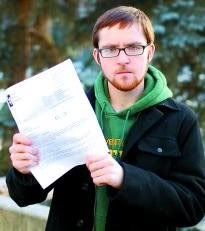
Now, one may think that a "debt-ridden University of Alberta student" would take the letter as an opportunity to avoid doing himself further financial harm. Instead, Cournoyer is basking in all the fickle glory offered by the attention this has gotten him. Just look at him there, to the left, holding that letter and scowling. My oh my, he certainly means business.
"I think this thing is pretty bizarre and pretty ridiculous, but I am taking it seriously," Cournoyer said. "It’s a pretty threatening letter."
It might even be easy to forget that Cournoyer is actually entirely in the wrong. By using Stelmach's name to funnel web traffic to his blog, Cournoyer was, in fact, misappropriating Stelmach's identity in order to garner more attention for himself and his opinions.
Given that Cournoyer's website is so often critical of the "36-year-old Progressive Conservative governement", it's pretty safe to conclude that Cournoyer's views certainly don't represent Stelmach's.
So here the situation lies: Cournoyer, the person who has actually done something wrong, accusing the government of bullying him because Ed Stelmach -- as an individual -- has gone out and hired a lawyer to right the situation. Meanwhile, Cournoyer, as Executive Director of PC Alberta Jim Campbell notes, is trying to provoke a controversy. "As I understand it, the letter provides Mr Cournoyer a number of options to avoid litigation. Those options are still open to him," Campbell said.
Not only has Cournoyer had his opportunity to comply with Stelmach's requests, but he has an opportunity to do it still.
If he doesn't, well, he doesn't stand a snowball's chance in hell of winning this case, having no legal legs to stand on. He may provoke a short-term and minor political controversy that will simmer in the minds of Alberta Liberals and New Democrats, but being an entirely irrelevant figure in Alberta politics (the peak of his career, to date, has been his aforementioned astoundingly ineffectual tenure as U of A SU VP External), it's almost entirely certain he won't get anything concrete -- political or otherwise -- out of the matter.
The Liberal love of politicians who spend their tenure accomplishing absolutely nothing aside, he certainly won't be able to use it to launch a political career -- at least not a successful one.
Cournoyer is marching this dispute over a domain name that he himself misused entirely voluntarily, and when whatever damages a court may decide to assess swell his debt load, he'll have no one to blame but himself, scowling pictures and all.
This past week's First Ministers conference became the scene of a political grudgematch, as Alberta Progressive Conservative premier Ed "the Stomper" Stelmach locked up with Ontario Liberal premier Dalton "Flying" McGuinty over the issue of climate change.
The battle pretty much shaped up as such: Stelmach refused to accept any hard caps on industrial emssions, so McGuinty refused to accept California emissions standards for cars produced in Ontario.
"If we were to have in place (cap and trade) by 2020 we will reduce our greenhouse gases by 90 megatonnes," McGuinty insisted. "If all we do is put in place California emissions standards by 2020 we will reduce our ghg's (greenhouse gases ) by eight megatonnes. We can do 10 times more by way of reduction of greenhouse gases if all of us adopt (cap and trade)."
On the other hand, if McGuinty had kept his promise to shut down Ontario's coal-fired power plants, Ontario would be 70% closer to its share of Canada's Kyoto targets.
One may remember what was said about "he who has no sin..."
In the midst of all this, one may remember that both Dalton and his brother in federal politics, David, have both fallen firmly on the side of the eco-egos, due to their embarrassing exploitation of the climate change issue for political capital. Stelmach, however, has not been evaluated.
To this regard, Stelmach certainly isn't any hero. He also exploits the climate change issue for political capital, to the extent that he can't seem to admit the obvious: that the greenhouse gas emissions generated by Alberta's oil industry do have an effect on climate change, and as such, it is only wise to start eliminating them.
This doesn't necessarily have to entail the industry suffering under a crushing regulatory regime. Stelmach would better serve the citizens of his province by negotiating a reasonable time frame, and perhaps a deal in which the other provinces -- particularly those like Ontario and Quebec who are so concerned about climate change -- help out on the funding end by accepting smaller transfer payments from Alberta.
McGuinty actually says is pretty well when he insists, "this is a national challenge. It requires a national response, not an Ontario response alone."
Then again, McGuinty would better serve the citizens of his province by doing something at all about climate change. Not only has he already racked up a litany of broken climate change-related promises, but he's actually re-made the promises in the leadup to the coming provincial election so he can re-break them if he wins.
Canada will be closer to a national response when the provinces and activists who stress the need for action most actually do something, as opposed to talking, then doing nothing.
McGuinty is a would-be environmental visionary who won't pull his weight. Stelmach, on the other hand, is the premier of an oil-rich province that can afford to invest heavily in the green technologies necessary to supplant fossil fuels as the world's primary source of energy. While this would, by necessity, also supplant the oil and gas industry that makes Alberta so prosperous, such investment into renewable energy could make Alberta a global industry leader.
Yet such investment could be interpreted as threatening to the oil and gas industry that employ so many of his constituents. Furthermore, transforming Alberta into a green energy hotbed doesn't guarantee the abundance of work available for unskilled labourers and tradespeople that oil and gas provides.
Transforming Alberta into a renewable energy giant would be risky; Stelmach would very much be risking losing face with his political supporters, both within and outside of the Progressive Conservative party.
Stelmach's reluctance could be viewed as out of obligation to his party -- it's his responsibility to keep the party strong. It could, alternatively, be viewed as out of a desire to not be the man who managed to lose Alberta -- Canada's strongest bastion of Conservative support.
Either way, Stelmach has to be seeded right alongside Dalton McGuinty, with the eco-egos.
Then again, with McGuinty facing an election and clearly emulating Saskatchewan premier Lorne Calvert by campaigning against a seemingly more vulnerable proxy than their provincial opponent, McGuinty comes off as just plain disengenuous.
Climate change may not be the inevitable catastrophic threat that many of the activists insist it is, and the impact of human activity on it may not be as pronounced. That being said, eliminating the impact of human activity on climate change is only the wise and prudent thing to do.
It's to this end that when the eco-egos refuse to make any meaningful attempt at reaching a compromise, it doesn't really matter which of them wins. In the end, it's the rest of us who stand to lose most.

 Liberal Senators draw ire of prairie Premiers