Showing posts with label Saskatchewan party. Show all posts

Monday, November 07, 2011

The Scandal Machine Backfires: Sask NDP Admits to Electioneering on Voting Day

When the NDP issued this press release, one can imagine the reaction they hoped to elicit was one of outrage.

Instead, they've drawn attention to what seems like a potential violation of Elections law. The press release, which claims that Saskatchewan Party staffers, including Deputy Chief of Staff to Premier Brad Wall Terri Harris, was issued on November 7, 2011. It claimed that the staffers had been spotted removing NDP door-hangers mere moments after they had been placed:
"The Sask Party operatives were removing NDP literature which helped the senior renters know where and when to vote, and offering rides to voters in the bad weather.

'I think she’s seen me,' said Rogochewsky upon being spotted by NDP team members, who had already noticed that literature seemed to be disappearing from doorknobs minutes after it was placed there.
"
The problem for the NDP is obvious. It's illegal to campaign on election day, and if they're in a seniors' apartment complex anywhere in the province hanging partisan material on door knobs, they're in violation of the elections act.

Certainly, it's awfully nice of them to offer rides to seniors. They can quite easily do that without leaving partisan material behind.

Any Saskatchewan Party staffers encountering the NDP leaving such material behind are certainly not obligated to allow the NDP to break the rules to the Saskatchewan Party's disadvantage. This is, of course, presuming that what the NDP claims is happening at all.

Considering that the NDP were already lying to the people of Saskatchewan before the writ was even dropped, they'll need some evidence. There's no reason to simply take their word for it.


Thursday, October 20, 2011

NDP Response to Saskatchewan Party Ad "Childish"?


Prior to the beginning of the 2011 Saskatchewan election, the NDP released an ad that featured a fabricated quote, portrayed as from Saskatchewan Party leader (and Premier) Brad Wall.

When challenged over the blatantly deceitful ad, NDP House Leader Kevin Yates dismissed the Saskatchewan Party's complaints over the ad as "childish".

Now, the Saskatchewan Party is running an ad the NDP insists is untrue.

The ad notes that Nexen, the oil company NDP leader Dwain Lingenfelter worked for, moved its head office to Calgary, and insists Lingenfelter did it.

Then-Nexen CEO Charlie Fischer insists that Lingenfelter didn't make the decision to move Nexen's head office to Calgary. But as it turns out, Lingenfelter was still involved.

To move the Nexen head office to Calgary required repeal of the Wascana Act, which stipulated that the head office of the company had to remain located in Saskatchewan. Wascana Energy had formerly been known as SaskOil.

Lingenfelter lobbied Kindersley MLA Bill Boyd to support the repeal of the Wascana Act. (Boyd isn't clear on whether or not ne actually supported the repeal.)

Dwain Lingenfelter's involvement in the reloaction of Nexen's head office, however, is undeniable. The NDP's response to this ad is childish and over the top. After all, unlike the NDP, they didn't lie.


Monday, September 12, 2011

A Confusing Brand to Embrace


When going into an election, one would expect that there is an incentive for politicians to be on their best behaviour.

The Saskatchewan NDP, however, has not been on their best behaviour. They've been closer to their worst. The party got itself into hot water in July when it released a radio ad featured a heavily-edited quote. The quote was not merely heavily-edited -- the new favourite defense of the far-left when they are caught red-handed behaving poorly -- it was heavily-edited to the point of sheer dishonesty.

A comment made in response to a question about the tactics used by a public service union during a strike was presented as a comment about how Premier Brad Wall and the Saskatchewan Party feel about helping working families confront higher cost of living.

"I don't really care. We're not going to do it, and they're coming back to work."

When considers the extent of the warping and twisting of context in the presentation of this quote, there's really only one reasonable conclusion: the NDP lied. They made a decision to lie to the people of Saskatchewan, and turned out to be not all that good at it.


In response to the revelation that the NDP took Wall's comments bizarrely out of context and then altered them, the NDP is refusing to budge. They insist that the comments accurately reflect Wall's attitude toward working families.

They have nothing to support those claims, but they make them nonetheless. It's just what they do.

Now the Saskatchewan Party has released an ad highlighting the NDP's blatant attempt to deceive the people of Saskatchewan. The intent of the ad is very clear: they're seeking to brand the NDP as liars.

Bizarrely, the NDP has not only chosen to embrace that brand, they've sought to counter-brand the Saskatchewan party as childish for objecting to the NDP's lies. Naturally, they say nothing at all about their own childishness in lying in the first place.

Polling numbers indicate that the NDP is going to get creamed in the 2011 provincial election. There will be no orange crush. Instead, the orange will be crushed. Considering they have a leader who owes the people of Saskatchewan his resignation for approving this ad in the first place, they deserve much, much worse.


Tuesday, June 07, 2011

Over to You, Larry Hubich

Saskatchewan Federation of Labour President Larry Hubich likes Brigette DePape. He also seems to like Michael Moore.

So it seems entirely fair to wonder what he would think of Moore's job offer to DePape, considering his record as a bad boss.

As reported by -- of all outlets -- The New Yorker and Mother Jones:
"...as the staff of Mother Jones [a magazine that had fired Moore for being toxic in the office] had discovered, Moore wasn’t the ideal boss. Little by little, he began to alienate people. He disliked sharing credit with his writers. He would often come in late. He didn’t yell at people: if someone said something he didn’t like, he wouldn’t argue; he would simply not invite that person to the next meeting, or the person would be fired. … One day during production on the first season of the show, Moore called two of his writers into his office. It was, for both of them, their first job in television, and they had been hired with the title of associate producer. They were not members of the Writers’ Guild, the powerful union for writers in movies and TV, and thus were not receiving health benefits, and would not qualify later for a percentage of video and rerun sales. 'Michael said, ‘I’m getting a lot of heat from the union to call you guys writers and pay you under the union rules,’' Eric Zicklin, one of the associate producers, says. ‘I don’t have the budget for that. But if they keep coming down on me that’ll mean I’ll only be able to afford one of you and the other one’s gotta go.’

… One by one, his employees stopped believing in the Cause. The job became just a job, and Moore became just another boss in a business that had an almost limitless tolerance for bad behavior. But, because they had once believed in him, their disappointment was painful.
"
Particularly intriguing is Moore's speculation that he would have to fire one of his associate producers if he had to pay them Writers' Guild-mandated wages.

This becomes especially interesting when one considers Hubich's astoundingly-dishonest take on comments by Saskatchewan Premier Brad Wall, whom he does not like.

Wall publicly speculated that, if Saskatchewan agreed to a contract with its teachers' union similiar to the one Alberta teachers have, his government would liklely be forced to lay teachers off, as has been happening in Alberta.

Hubich had a different take. He claimed -- quite falsely -- that Wall had threatened to fire teachers over negotiations.

Judged according to Hubich's rhetorical standard, Michael Moore's threat to his associate producers is very different. They weren't involved in any kind of negotiations with Moore (one can only imagine how Moore would have reacted if they'd even mused about unionizing). Moore's "threat" -- according to the Hubich standard -- was that one of the associate producers would be fired if the Writers' Guild (of which neither was a member) didn't get off his back.

Yet Larry Hubich seems to rather like Michael Moore, but dislikes Brad Wall to a rather comical degree, despite the fact that the people of Saskatchewan simply do not agree with him.

But Wall's 59% approval rating -- which Hubich seems to be having a hard time coping with -- is besides the point. Perhaps he could be troubled to tell Canadians how he feels about the prospect of Brigette DePape being offered employment by such a notoriously horrible boss.

After all, he threatened to fire his associate producers. By the Hubich standard, that is.


Monday, April 04, 2011

Cap-and-Trade Bad For Saskatchewan, Bad For the West

Ignatieff's green plan could be Green Shift II

Looking back on the 2008 federal election, it becomes clear that then-Liberal leader Stephane Dion's vaunted green shift -- which would have re-designed Canada's tax system around a carbon tax -- was a millstone around the neck of the Liberal Party.

While Dion took the blame for that defeat, the carbon tax itself was actually an idea adopted from the current Liberal leader, Michael Ignatieff. With Ignatieff now proposing a cap-and-trade system in the place of that carbon tax, he's again provoking serious concerns regarding its effect on Canadian industry.

For his own part, Saskatchewan Premier Brad Wall has been trying to stay out of the 2011 federal election. But as the Premier of a province that would be hit hard by the proposed cap-and-trade scheme, Wall has been forced to start speaking out.

Cap-and-trade, he points out, would be bad not only for Saskatchewan, but for the west as a whole.

"There's already been speculation in the media that it could be very costly to the industry in Western Canada, to Alberta and Saskatchewan, not just to oilsands but to the fossil fuels industry," Wall explained.

Wall would be prepared to consider a cap-and-trade system if he could secure assurances that the funds accrued through the trading would remain in the province in which they are paid.

"We need assurances from all parties that if provinces are serious about dealing with the issue, and we are, that any proceeds from fines related to emissions stays in our province," Wall announced.

"Cap-and-trade is different," he declared. "Cap-and-trade is very much about a wealth transfer because it can't respect borders by definition. That's certainly the cap-and-trade that I understand. That's the one that some of the central Canadian provinces want."

It's also approximately what then-Liberal MP Ken Boshcoff said the Green Shift would do in 2008. Boshcoff was defeated by now-Conservative MP John Rafferty in the 2008 federal election, but is now running again.

"If it's different than that, that's what we need to know and we should know it soon," Wall insisted.

But if Michael Ignatieff approaches his Green Plan the same way Stephane Dion approached the Green Shift, Canadians should expect to not know precisely what this Green Plan entails. Dion evaded questions about how a Liberal government would replace falling revenue from a carbon tax. Until Ignatieff becomes more forthcoming, Canadians -- Brad Wall included -- shouldn't hold their breath waiting to hear the details.


Wednesday, May 12, 2010

"The Little Thief From Swift Current"

Dwain Lingenfelter clearly frustrated

In the Saskatchewan Legislature, NDP leader Dwain Lingenfelter recently slip the frustration that he -- and a limited number of Saskatchewan's citizens -- have been feeling with Premier Brad Wall and the Saskatchewan Party government.

In an unparliamentary outburst, Lingenfelter harrangued Wall as "the little thief from Swift Current".

It makes one wonder: precisely what did Wall steal?

Perhaps in Lingenfelter's mind, it's government. And popularity.

In fact, a recent poll indicates that 68% of Saskatchewan's citizens approve of the job Wall has been doing as Premier of Saskatchewan, and that 58% would vote for the Saskatchewan Party in a future election.

That leaves Dwain Lingenfelter and the NDP in a very bad way -- facing the prospect of relegation to the opposition benches for a good, long while.

If one were to believe certain idiots, the Brad Wall government has been an unmitigated disaster for the people of Saskatchewan. The problem is that the people clearly don't agree with that assessment.

Whether Lingenfelter, his party and their assorted harpies care to admit it or not, it seems that the party's over in Saskatchewan for their particular brand of socialism.

Citizens of Saskatchewan have caught on to the fact that something had to be seriously remiss for one of the world's wealthiest regions in terms of per-capita resources to have lagged so far behind its neighbours in terms of economic development.

A study prepared by 49North Resources offers some answers that the NDP and their harpies may not want to hear.

Saskatchewan lagged behind its neighbours in locally-raised capital, as NDP governments introduced disincentives to local investment, then objected when the Grant Devine government acted to remove them.
While Lorne Calvert's NDP government began to exploit policy advantages over competing jurisdictions -- recognizing far too late the limitations of centrally-planned socialism -- these policy advantages have been expanded under the Wall government, and the process accelerated. The advantages speak for themselves:
These policy advantages speak for themselves to anyone well-schooled in the kind of economic doctrines produced by socialists. Faced by the compounding failures of their socialist policies, the NDP themselves cleared the way for freer market success, now to be pursued by genuine free marketeers.

What has emerged is a repudiation of the long-failed economic doctrines of the NDP -- beginning with Tommy Douglas' plans to nationalize Saskatchewan's oil industry under a co-operative model that failed to materialize due to the disincentives coupled with his plan.

(Of course, Douglas' socialism is one that would seem oddly alien to the modern-day acolytes of socialism -- it featured healthy doses of workfare.)

But with the economic failures of the NDP recognized by the party itself, there's no sign that the citizens of Saskatchewan are prepared to turn back to the authors of Saskatchewan's economic under-development any time soon.


Thursday, April 15, 2010

Saskatchewan Set to Lead on Human Rights Commissions

Saskatchewan to consider scrapping Human Rights Tribunal

In Saskatchewan, changes may be coming for the province's Human Rights Commission.

Notably, the Saskatchewan Human Rights Tribunal may shut down.

Justice David Arnot, Saskatchewan's Human Rights Commissioner, has recommended that Saskatchewan's Human Rights Tribunal be discontinued.

"Currently human rights law, I think it's fair to say, is evolving," Arnot said. "It's becoming more and more complex and the Human Rights Commission believes that judges are best placed to deal with those complexities rather than an administrative tribunal that really doesn't have any dedicated officers or assigned staff and has really little infrastructure."

Saskatchewan Justice Minister Don Morgan has suggested that, if the tribunal is scrapped, that its cases will be forwarded to the Saskatchewan Court of Queen's Bench.

"This is a recommendation that's come forward and is a recommendation that, in fact, may have some merit. There are criticisms that the Saskatchewan Human Rights Tribunal may be seen as too close to the Saskatchewan Human Rights Commission," Morgan explained.

Yet NDP MLA Frank Quennell decided to overlook the recommendation from Arnot, suggesting this all may be politically motivated.

"I think there are supporters of the Saskatchewan Party (government) who aren't happy with decisions of human rights tribunals over the years and that is part of the motivation here," Quennell grumbled.

Yet whether Quennell cares to admit to it or not, Canada's Human Rights Commissions and their Tribunals have been a matter of significant contention in Canada. Saskatchewan has been no different than any other province.

Saskatchewan is hardly known as a national leader on conservative issues. Should the province decide to scuttle its Human Rights Tribunal, it will have taken leadership the the rest of the country will not be able to help but consider.

Thursday, January 07, 2010

Senate Reform or Busted

Stephen Harper must act to restore faith in Senate reform

With Prime Minister Stephen Harper set to appoint five new Conservative Senators before the beginning of March -- thus finally attaining his much-sought-after Senate majority -- many Canadians are very justifiably beginning to wonder if he's serious about Senate reform at all.

Among those who seem to be beginning to doubt Harper's commitment to Senate reform is Saskatchewan Premier Brad Wall.

After passing the Senate Nominee Election Act, which would allow for the nomination of Senators-in-waiting during provincial or federal elections. But now Wall is beginning to doubt whether Saskatchewan electing Senators will make a difference.


"We can elect all of the senators from Alberta and Saskatchewan that we wanted, but if we're the only ones and Senate reform is never going to happen ... where are we?" Wall asked.

Wall seemed to closely share Harper's previously-voiced conviction that if the Senate can't be reformed due to fierce opposition, perhaps it should be abolished.

"Are we pushing a rope uphill here in Saskatchewan?" he asked. "Maybe the time has come for everyone to realize, if [the Senate] can't be fixed, is it useful?"

It would be unfortunate for Wall to be dissuaded from electing a slate of Senators-in-waiting. Considering that an elected Senate -- even if not necessarily along the lines of the Triple-E (Elected, Equal, Effective) format -- seems to be part of Harper's favoured agenda, this would be quite a loss for Harper.

If Harper doesn't want to have to face up to this loss, there's only one thing he can do: act decisively on Senate reform as soon as he has his Senate majority.

Harper has promised to act promptly on Senate reform, and expressed frustration at the blocking of his to-date efforts. “I thought we'd get at least something,” Harper said in a recent interview. “We're not there yet. What the Senate is blocking isn't just government crime legislation, it's blocking Senate reform legislation.”

Marjory LeBreton, the leader of the government in Senate, has publicly promised that Senate reform will be among the government's plans once it has its vaunted majority.

“Senate reform will definitely be back as part of the government agenda,” she insisted.

Unfortunately, the extent of reform won't be uniform across all of Canada's provinces. While BC still has a Senate election act on the books, it has yet to elect any Senators. Moreover, Ontario Conservative MPP Bob Runciman has had his efforts to institute such legislation there thwarted on what are actually rather inexplicable terms.

With Pamela Wallin ready to stand for election as a Senator in Saskatchewan, it would be a shame if the Senate Reform agenda came off the rails as a result of Stephen Harper's inaction.

Prime Minister Harper will need to act decisively on Senate reform at his next opportunity. If he doesn't, Canadians will know for certain that he was never serious in the first place.


Monday, December 28, 2009

Saskatchewan Party Not Doing Enough to Address Labour Law Violations...

...In the eyes of the hopelessly partisan

Brad Wall and the Saskatchewan Party have rightly been proud of their record pursuing the perpetrators of labour law violations, and prosecuting them.

And while some twits insist on toeing an ideological line on the issue, they customarily say very little about it. There's good reason for this -- because when they do attempt to say something about it, they make themselves look extremely foolish.

During 2009, the government of Saskatchewan prosecuted eleven businesses for violations of labour law -- the most in 20 years.

"We're paying more attention to this activity. We're having the Ministry of Justice more engaged in helping us out in prosecuting," explained Laverne Moskal.

But Saskatchewan Federation of Labour President Larry Hubich said the Saskatchewan Party's record in pursuing labour law violations is actually no big deal, and certainly isn't worthy of applause.

"Eleven prosecutions in this province aren't something they should be bragging about," Hubich insisted. "It's hardly scratching the surface."

But, then again, Hubich has an excessively poor record in dealing with stories that aren't beneficial to his particular ideological camp.

For example, Hubich responded to the allegations -- which quickly became evidently factual -- circling around ACORN very poorly.

Considering that Hubich is widely known as a schill for the NDP, and is a fixture at their conventions, it's not shocking to find that the Wall government would be denied credit where credit is clearly due.

After all, perhaps there should be more than eleven prosecutions for labour law violations in Saskatchewan. But, at the same time, if the eleven secured this year is more than in any year of the past 20 in Saskatchewan, then that would mean that the Wall government has outperformed Hubich's NDP on this particular issue.

But that -- just as with the scope of the fraud being perpetrated by ACORN -- would be just another inconvenient detail for Larry Hubich, and those who choose to echo him.


Friday, October 23, 2009

Dwain Lingenfelter and the Politics of Ambition

Saskatchewan NDP leader accused of undermining predecessor

When Dwain Lingenfelter was elected leader of the Saskatchewan NDP, many hailed his coming as trouble for Brad Wall and the Saskatchewan Party.

Lingenfelter was pegged as a political brawler -- as someone who would get down and dirty with the government.

But it was Lingenfelter himself who stumbled away from the Legislature with a black eye, as Wall dropped what could be seen as a political atom bomb on the NDP leader, when he told the Legislature about a phone call he received from Lingenfelter in 2003.

"He phoned me at my home before the '04 election to give me advice on how to beat the former leader of the NDP," Wall announced. "It was just towards the end of summer and he was saying, 'You know [Lorne Calvert] has this summer tour every year.'"

Wall would later correct himself by explaining he was speaking about the 2003 election.

Wall insists that Lingenfelter suggest the Saskatchewan party "be a little bit more aggressive" with Calvert and organize protests on each stop of his annual summer tour.

Wall says Lingenfelter shared the NDP playbook used against Grant Devine.

"He was telling me about the tactics they'd used in the 1980s against Mr Devine," Wall added.

If Lingenfelter's goal in making the alleged phone call -- he insists he "doesn't recall" making it -- was to engineer Calvert's defeat and clear the way for Lingenfelter to replace him, it didn't quite work out like that.

The NDP held onto a slim two seat majority in the Legislature, as the Liberal party who had propped up Calvert's government after the 1999 election (in which the NDP won half the seats in the Legislature plus retaining the Speaker of the House) was utterly wiped out. They haven't elected a member since.

The 2003 election didn't result in the replacement of Lorne Calvert, but it was the last election contested with Elwin Hermanson at the helm of the Saskatchewan Party. Wall replaced him and went on to defeat the NDP in the 2007 election.

For his own part, Lingenfelter insists that Wall is just using the tactics of distraction.

"He tried to change the channel yesterday to something other than finance, and today he's trying to change it so the press run off in a different direction and talk about other things," Lingenfelter said. "The issue here is finance and the fiscal state of the province, and this is what I'm hearing from the public."

Lingenfelter's motives in making such a phone call would be a matter of speculation. He was considered a lock to replace Roy Romanow as the leader of the NDP before he left to work in the private sector in 2000.

Having lost an acrimonious leadership contest to Calvert would have made his actions make a little more sense. In the absence of this, one has to assume that either Lingenfelter didn't approve of Calvert's actions as Premier, or that he may not have made the call.

Minister of Energy and Natural Resources Bill Boyd, however, with whom Lingenfelter is said to maintain a friendship, has noted that Lingenfelter has frequently given him advice.

Whether Lingenfelter's alleged phone call was made out of his love for fostering a good political scrap or in support of his own political ambitions is knowledge that only one individual -- Dwain Lingenfelter himself -- is privy to.

He likely has some 'splainin' to do within his own caucus.


Thursday, October 22, 2009

Canadian Conservatism's Troubled Symmetry

Two provinces, two parties, two different directions, and one big problem for Canadian Conservatives

While Alberta's Wildrose Alliance was meeting this past weekend to elect Danielle Smith the new leader of the party, another provincial conservative party was meeting to elect its leader.

The Action Democratique du Quebec met and elected Gilles Taillon as its new leader -- only the second in its entire history.

There are many similarities between the circumstances faced by the two parties, and each leader.

Each party has few seats in the provincial legislature, and each faces the monumental task of building its organization. Unfortunately for the ADQ, this is where the similarities stop.

The Wildrose Alliance is coming off of an exciting and vibrant leadership campaign in which ideas were strongly contested between the two competitors: namely, whether the party would proceed in a libertarian or social conservative direction (the party chose the course of libertarianism).

The ADQ, meanwhile, is stumbling out of a leadership contest in which personal animosity and smear politics seemed to be the order of the day.

While the Alliance leadership campaign attracted national attention, the ADQ contest was largely invisible on the national stage.

If Smith's election as the leader of the Alliance is truly one of the most exciting developments in the history of Canadian conservatism, the election of Taillon as the ADQ leader was purely underwhelming. This is unfortunate not only for the ADQ, but for Canadian conservatism as a whole.

In Daifallah's estimation, Taillon's prospects as the leader of the ADQ are sorely limited by a number of factors.

"Taillon is well-known, but he’s an uninspiring choice for a party looking to renew. He’s the oldest of the three major Quebec party leaders, questions about his health abound and he lost his seat in the National Assembly in the last election," Daifallah notes. "His politics are decidedly centrist. If he has his way, there will likely be little difference between the ADQ and the Parti Québécois. A number of prominent conservative ADQ members have already quit since Sunday."

"Taillon’s centrist approach is particularly unfortunate given that more and more Quebecers are coming to realize the unsustainability of their massive welfare programs and statist business model," Daifallah continues. "The prospects in Quebec for a party advocating smaller government and more personal responsibility should improve in the coming years."

The problem is that, unless Taillon steers his party back away from the centre, Quebec will have no such party to take advantage of such an ideological shift in the province.

Quebec is one of two provinces in Canada with no active provincial Conservative party. In Saskatchewan the banner of conservative politics is being carried by Brad Wall's Saskatchewan party. Although a provincial Progressive Conservative party remains registered, it doesn't run candidates.

If one considers provinces where a provincial Conservative party remains active but is politically marginal, the case of British Columbia stands out as well.

Likewise, the decimation of the New Brunswick PCs -- a ship since righted by Bernard Lord -- by the Confederation of Regions party isn't as far in past as many New Brunswick Tories would like to pretend.

If Danielle Smith and the Wildrose Alliance are successful, Alberta could soon be added to this list. Historically when Albertans have changed governments they practically erase the preceding government. Social Credit and the United Farmers of Alberta were once mighty political forces. Today Social Credit is entirely peripheral to Albertan politics.

The problem that quickly emerges is not for Canadian conservatives, but rather for Canadian Conservatives. While cross-party cooperation in matters of federal politics is far from ruled out, it can be politically perilous for conservative politicians -- particularly in Saskatchewan, and possibly soon in Alberta -- to be seen working too closely with the federal incarnation of a party they have either worked so hard to depose (as would be the case in Alberta) or has a troubled history (as is the case in Saskatchewan).

It can be particularly unseemingly in terms of the recruitment of federal candidates out of provincial ranks. While such a transition is far from unheard of -- in particular, federal Conservative MP Tom Lukiwski was formerly the General Manager of the Saskatchewan party.

By comparison, however, the Liberal party and NDP each have provincial parties in every province in Canada. While the Liberal party isn't particularly strong in Alberta, or especially in Saskatchewan, it can freely shuttle candidates back and forth between provincial and federal parties. A clear example is Dr Eric Hoskins, who was an unsuccessful federal candidate before running for the McGuinty Liberals in St Paul's.

In Quebec and Saskatchewan the Tories may get occasional help from the Saskatchewan party or the ADQ, but it has to do the bulk of its organizing and recruitment entirely on its own.

Provincial parties also offer the potential advantage -- or disadvantage -- of having another party to help build the brand image. If there is a shift underway the likes of which Daifallah suggests, the Conservative party currently has no provincial party there to help them take advantage of this shift.

It's on this note that it would perhaps be partially irrelevant if Quebec had a conservative leader like Danielle Smith -- at least for capital-C Conservatives. For small-c conservatives, it would be like a dream.

But like any political movement, conservatives fare best when they work together. Anything that impedes that kind of cooperation should properly be viewed as an impediment -- even if an impediment that some conservatives will view as a necessary evil.

It's long been past time for Canadian conservatives to learn to moderate themselves from within their provincial parties, as opposed to having to build entire vote- and activist-splitting alternative parties.
Wednesday, August 05, 2009

Navigating Canada's Way Out of Recession (And Beyond)

Brad Wall calls for post-recession plan

Speaking in advance of the First Ministers' Conference, Saskatchewan Premier Brad Wall has called upon his counterparts to help establish a coordinated post-recession plan.

“We need to talk about the future. How does Canada emerge from this recession?” Wall asked. “Are we going to focus on the knowledge economy, on an innovation agenda that can create jobs for the longer term?”

Speaking about each Province's and each jurisdiction's "innovation strengths", Wall suggested that, “Maybe we identify what those strengths [in each province] are so there can be a co-ordinated approach."

Wall certainly isn't in a hurry to declare the recession to be over. Not only is it not true, but it would certainly come with demonstrable political consequences.

“I think everybody is really hesitant to say, ‘Hey, the recession is over,’" Wall admitted. "As long as somebody is not working today, because they’ve lost their job in the recession, how would they feel [about that statement].”

“There’s positive signs ... but I think all the premiers and the government of Canada needs to be vigilant about getting us firmly on that road to recovery,” he added.

Of course, despite the unsurprising enthusiasm of certain individuals for central planning, Wall's proposed coordinated post-recession plan shouldn't be mistaken for central planning.

While such individuals may want to condescend their way out of admitting it, the most fundamental weakness of central planning is that it ignores the specific and individual needs of specific and individual regions and industries.

While certain individuals are almost certain to not understand this, Brad Wall clearly does, as do his fellow Premiers.

"I’ve heard the premiers of Central Canada say pretty clearly that they understand that each province has a different challenge and each province has a different approach,” Wall explained.

To expect a central plan to be able to adequately balance the needs of Alberta's oil-based economy, Saskatchewan's burgeoning oilpatch or Ontario's manufacturing-based economy would be foolish. Thankfully, Canada's Premiers understand this, even if others do not.

Another measure to emerge out of the First Ministers' Conference could be Harmonized Sales Taxes in Saskatchewan, Manitoba and Prince Edward Island.

Federal Finance Minister Jim Flaherty has offered federal funds to help facilitate the harmonization of the three provinces' Provincial Sales Tax with the GST -- a deal Ontario and British Columbia have already taken advantage of.

"We'll see what their governments decide to do," Flaherty said. "But the same proposal -- in terms of transition funding -- that we made with the province of Ontario followed by the province of British Columbia is available to those provinces as well."

"This is solid economic policy in the long run for Canadian businesses and therefore for Canadian jobs and for growth of the Canadian economy," he added.

Whatever the results of the First Ministers' Conference may be, one thing is certain: if each Province's Premier returns from the conference with a better idea of how Canada can move forward out of the recession, and beyond, the value of this will far outstrip their efforts.

Monday, March 09, 2009

Definitely For the Best

Brad Wall cancels out-of-province fundraiser for SK Party

It doesn't take much of a stretch of the intellect to realize that a provincial political party is not the same as a federal political party.

Considering that provincial parties, by their very nature, focus their efforts and concerns on matters of provincial scope -- exempting, of course, times of extraordinary political crisis and matters of inter-provincial cooperation -- it only stands to reason that they cannot fundraise the way a federal party does.

A general maxim in politics is that political parties raise funds from amongst their expected beneficiaries.

So it's on that note that it's for the best that Saskatchewan Premier Brad Wall has cancelled a Calgary fundraiser for his party.

The Saskatchewan party has had such dinners many, many times before, dating back to the tenure of Elwin Hermanson, the founder of the party. Now that the party is in government, however, Brad Wall seems things very differently.

"I think we're just going to take a different approach. We're a party now fortunate enough to be in government, so we're just taking a different approach more sort of consistent with that," Wall explained. "It is different. It is. ...I can't have a leader's dinner outside the province anymore, even if we call it that. It's a Premier's dinner and every province has their own Premier."

That's a decent enough reason to discontinue the dinners, but the best reason comes down to a matter of principle.

When provincial political parties fundraise out-of-province, it raises questions about who, precisely, the party is working in the interests of.

For example, currently acting leader of the Saskatchewan NDP notes that these dinners -- which primarily cater to the energy sector in Alberta -- raise questions about who sets the agenda for the Saskatchewan party, particularly as it pertains to energy and environmental policy.

"When you are responsible for managing the (energy) sector, for governing the sector, for regulating it and taxing it and then essentially going to the sector and saying, 'We're looking for your support.' ...The optic here is, at best, poor," Calvert noted.

In politics, the appearance of a conflict of interest is just as troubling as an actual conflict of interest.

The Saskatchewan party needs to make it unequivocally obvious that they represent the people of Saskatchewan, and that their agenda is set inside the province.

That is the best reason to not only cancel the annual leader's dinner in Alberta, but discontinue all of the party's out-of-province fundraising efforts.

Monday, September 15, 2008

Can the Tories Sweep Saskatchewan?

Green Shift plan not playing well in Saskatchewan

As observers look ahead to the results of the 14 October federal election, two questions loom large.

First: will the Conservatives sweep Alberta again?

Second: can the Conservatives sweep Saskatchewan?

In Alberta, the prospects of another smothering Conservative victory remain strong. Although Rahim Jaffer could be upset in Edmonton-Strathcona and Laurie Hawn will have to work hard to hold Edmonton Centre, the Tories still have a solid provincial victory earlier in the year giving them the momentum they need to maintain their lock on Alberta.

In Saskatchewan, meanwhile, Wascana MP Ralph Goodale remains the only Liberal awash in a sea of blue.

He was one of two non-Conservative MPs in the province until Desnethe-Missinippi-Churchill River MP Gary Merasty resigned his seat. In a by-election he was replaced by Conservative Rob Clarke, who defeated Liberal Joan Beatty. Beatty had been hand-chosen by Stephane Dion over current candidate David Orchard, who had been chosen by the party's riding association.

Orchard has already called for Dion to soften the Green Shift's inevitable impact on farmers.

Orchard has, against Dion's inclinations, been cast into a star candidate role in Saskatchewan. But that isn't where Liberal troubles end in the province. Not by a longshot.

Just as in Alberta, conservatives in Saskatchewan have an election victory -- this one by Brad Wall's Saskatchewan party -- to provide them with momentum.

Wall has come out and criticized Liberal leader Stephane Dion's Green Shift plan. Wall noted that the Green Shift plan would result in a loss of $500 million per annum for Saskatchewan and a 41% increase in electricity costs by 2012.

For his own part, Goodale denounced Wall's claims as "crock of unmitigated horsefeathers."

Unfortunately for Goodale, horses don't have feathers, and Scott Brison, one of the masterminds of the Green Shift plan, has already admitted that the plan will result in higher electicity costs.

"Their arithmetic is just completely wrong, mistaken and false," Goodale insisted, noting that corporate tax cuts accompanying carbon taxation should make up for the extra costs. In theory.

"This is the old Conservative tactic of throw enough mud against the fan and hope everyone gets splattered," Goodale added.

According to political scientist Ken Rasmussen, Wall's comments likely won't have much effect on the election in Saskatchewan. "This is a province that the Tories have, I wouldn't say sewn up, but they're probably going to be quite effective in retaining their seats," he noted.

University of Saskatchewan political scientist David McGrane thinks otherwise. "The fact that Premier Wall has been so outspoken in saying that the Green Shift is harmful for Saskatchewan, that's definitely going to play in favour of the Conservatives," he predicted.

Meanwhile, David Orchard may be stepping on the wrong toes in Desnethe-Missinippi-Churchill River by opposing uranium mining. This in a rural riding where the Green Shift will almost certainly prove to be anathema. “The proposed carbon tax will spell economic doom for the north, in forestry, exploration, farming. Orchard is against uranium mining and oil development,” Rob Clarke noted. “The carbon tax is going to increase fuels costs and raise costs on all household items. Being in government, I will prevent that from happening."

Stephen Harper has offered solid support of his candidate in Wascana, Michelle Hunter.

Clearly, Harper understands the value of unseating Goodale, a former Finance Minister.

For his own part, Goodale insists that the Liberal Green Shift plan would be less costly than the Conservative plan. "They are going to impose costs by imposing their regulations and the target they're aiming at is 35 per cent more severe than Mr Dion's plan. But the crucial difference is that the Dion plan has across-the-board income tax cuts for every family, every individual, every business in the country that will add up to the biggest reduction in income tax in Canadian history," Goodale insisted.

So, while Goodale admits that, by the measuring stick that most environmentalists are measuring climate change policy, Harper's plan is better, Goodale wants to insist that, well, the Liberal plan will at least be cheaper.

Goodale and the Liberals can't even seem to play straight with the environmental lobby.

All the while many Canadians remain concerned about Dion's plans for potential carbon tariffs and seeming lack of a post-Green Shift vision, particularly vis a vis the recovery of lost revenue once carbon tax revenues decline with greenhouse gas emissions.

The Liberals have their work cut out for them in Saskatchewan. Come October 14, Saskatchewan could be joing Alberta adorned in Tory blue.

Wednesday, July 23, 2008

So Cozy...

Alberta and Saskatchewawn natural bedfellows

When Alberta premier Ed Stelmach and Saskatchewan premier Brad Wall teamed up to oppose a proposed inter-provincial cap-and-trade scheme on greenhouse gas emissions it became apparent that a potent new political coalition had been formed.

The article, written by Murray Mandryk and published in the Saskatoon Star Phoenix and Regina-Leader Post, asks an interesting question: how did Alberta and Saskatchewan become so cozy in the first place?

"Here's one of the more intriguing "chicken or the egg" type of argument you'll hear on coffee row:

"Did this province elect a Saskatchewan Party government because we were already becoming more like Alberta, or has the election of a Saskatchewan Party government made this province more like Alberta?"

Regardless of which side of he debate you support, what's indisputable is the premise is that Saskatchewan has become more like Alberta.
"
Some residents of Saskatchewan may find the very premise to be alarming. In the same vein as Canadians who cry foul every time Canada inches too close to our southern neighbours for their liking, many of those who feel Saskatchewan's unique character -- as it were -- is threatened by too closely associating with the cowboys west of Lloydminster, they'll insist that too closely associating with Alberta somehow diminishes Saskatchewan.

Of course, there are some traits that Saskatchewan shouldn't be so eager to share with Alberta.

"More like it, mind you. Not exactly alike.

The outcome of elections in Saskatchewan, after all, are still not a foregone conclusion and will remain so for some time. This province also still has significantly deeper agricultural and small-town roots and significantly less urban pull than does Alberta (or any other province, for that matter).
"
Indeed, democracy in Saskatchewan is much healthier than in Alberta.

During the 2007 provincial election, 76% of eligible voters reported to the polls, compared to the absolutely dismal figure of 41% in Alberta's 2008 election.

Saskatchewan does maintain a largely rural character, but a newfound determination to develop the province's considerable energy resources -- including oil sand reserves that may rival those in Alberta will inevitably change that. The kind of building projects necessary to support such development will require increased manufacturing capacity throughout Saskatchewan, particularly in the urban centers.

"Most significantly, Saskatchewan is the birthplace of the CCF-NDP and its social democratic influence isn't about to disappear anytime soon. Even at one of its historically low ebbs, the NDP still has 20 seats in the legislature and something close to 40 per cent of public support.

But it's also telling that on the very week that the NDP is celebrating the 75th anniversary of the Regina Manifesto, which urged the eradication of capitalism, the most exciting speculation within New Democratic ranks is the possibility of the return of a conservative-minded capitalist such as Dwain Lingenfelter to lead the party.
"
Certainly, being defeated after 16 years in power must certainly be deflating for the provincial NDP. Likewise, the party's federal prospects in the province are less than encouraging.

"That Saskatchewan's affinity for Alberta actually might have started under an NDP administration is more than a little ironic.

It was under former NDP premier Roy Romanow that deficit control, a curtailing of public investments and even income tax cuts really began. Romanow's successor as NDP leader and premier, Lorne Calvert, extended this agenda with cuts to the province's sales, business and corporate taxes.
"
Certainly, this would seem ironic if it weren't entirely in line with the political trends of the time.

Consider that Jean Chretien, one considered a stalwart of the liberal wing of the Liberal party, led a government that reduced the country's deficit drastically, and posted some of the only surpluses of the day in the Western World.

Chretien was responding to pressures being exerted upon his government by Preston Manning's Reform party, just as Roy Romanow -- and Lorne Calvert after him -- were responding to pressure being exerted by the upstart Saskatchewan party.

"This change under NDP governance happened at the same time that Saskatchewan's economic interests became more closely tied to the oil economy. The prospect of oil at nearly $100 a barrel was something that even an NDP government from this province could share eagerly with the Progressive Conservative government in Alberta.

It can be argued that Saskatchewan grew that much closer to Alberta with each dollar that a barrel of oil increased in price over the past four years. What's been bad for everyone else's economy has been great for ours, especially since the Saskatchewan Party's election win last November that has coincided with the price hike in a barrel of oil by $50.
"
It should be considered only natural that Saskatchewan and Alberta would grow closer considering the number of interests they hold in common. Both economies have constantly strengthened with the increasing value of oil and gas. Thus, as goes oil and gas will go the economies of Alberta and Saskatchewan -- although with some creative government and appropriate investment, this need not always be so -- and as goes the economy of Alberta or Saskatchewan will almost inevitably go the other.

"That said, Saskatchewan and Alberta today appear to be as closely bonded by political ties as economic ones. At least that's what some recent developments suggest.

The first ministers meeting in Quebec last week, where Premier Brad Wall and Alberta Premier Ed Stelmach found themselves at odds with their counterparts who were promoting cap-and-trade system on carbon emissions, was only the latest evidence of this emerging alliance.

We saw pretty much the same reaction from the two provinces to federal Liberal Leader Stephane Dion' Green Shift strategy, which takes square aim at Alberta and Saskatchewan's energy resources.

Stuck in the same foxhole and dodging bullets from eastern critics eager to portray Alberta and Saskatchewan as greedy, selfish and environmentally irresponsible, it's only natural that the two provinces would become that much closer.

That said, it's highly unlikely that an NDP government in Saskatchewan would have jumped into that same foxhole on the Green Shift or perhaps even on a cap-and-trade scheme.
"
Of course not.

It's easy to get along with your neighbours when you see eye-to-eye. And it would simply be less than reasonable to expect a Progressive Conservative government -- particularly one led by an individual like Ralph Klein -- to see eye-to-eye with an NDP government.

Likewise, there's nothing like an external threat -- say, that posed by a federal party with a history of confiscatory tax policies and a habit of breaking its promises -- to bring two provinces even closer together.

"The latest evidence of the bi-provincial political link came Monday with the Saskatchewan Party government signing on to Pacific North West Economic Region (PNWER) -- something the New Democrats of this province not only wouldn't do but would vigorously oppose, because they see it as precursor to joining the Trade and Investment Mobility Agreement reached by Alberta and British Columbia."
Then again, considering the vehemence of the NDP's opposition to NAFTA, it should be considered unsurprising that the NDP would decline to join an organization such as PNWER.

It's also less than surprising that a Saskatchewan party government -- considering that the Saskatchewan party was founded out of a coalition Progressive Conservatives and conservative-minded Liberals -- would be so eager to join.

It's also less than surprising that Alberta -- looking for any dance partner it can find in an effort to resist a potential replay of the infamous National Energy Policy -- would be so eager to get Saskatchewan on board.

"Lest there be any doubt about this newfound closeness, consider what deputy Alberta premier Ron Stevens said about sponsoring Saskatchewan's application to join the private-sector organization his province helped to create:

"I can tell you, as a neighbouring sister province, (Alberta has) seen under Premier Wall a change in attitude," Stevens said during Monday's PNWER press conference.

"The province now has a outward looking, engaging, active attitude and I think that Saskatchewan is going to be a robust, full member of this organization. We are all going to be beneficiaries of that."

Maybe the close bond with Alberta wasn't forged quite overnight. But make no mistake that Alberta and Saskatchewan have become closer than they've been in decades.
"
Certainly, Alberta and Saskatchewan have grown closer -- more than simply economically or politically.

Numerous residents of either province have migrated to the other over the past numerous years. In particular, there has been a strong trend of Albertans moving to Saskatchewan. And anywhere Albertans are moving in such numbers is almost inevitably due for a conservative resurgence.

In other words, it's no surprise that Alberta and Saskatchewan have become so cozy. Furthermore, it's about time.

Thursday, November 22, 2007

Saskatchewan Party Already Savng Province's Hash

Fiscal mismanagement by NDP cut off at the pass

Mere weeks after taking office, Saskatchewan premier Brad Wall is already getting set to fix an emerging leak in the province's finances.

"We are going to have to make some decisions to get things under control on the spending side," Wall announced. "What the previous government has left behind financially is fairly stark and will need to be dealt with in the long term," he continued. "There's a reason why we didn't get a four-year projection on the budget this spring and we found that out early on in the transition."

According to Saskatchewan's new Finance Minister Rod Gantofoer, the NDP may have made it's long-term spending plans based on short-term revenues.

"If the implication of that is that the long-term state of the affairs of the provincial economy are not very good, then that's a grave concern," he said. "We will then have to systematically and responsibly and professionally deal with the issues."

Of course, this is nothing new. The province's outgoing NDP government actually forwarded a budget for the 2007-08 fiscal year in which a withdrawal from the provinces Sustainability Fund was necessary in order to call the budget a "surplus".

Which would actually mean the province was spending more money than it was recieving in revenues, intentionally borrowing against its own savings, and actually incurring a deficit.

The slings and arrows of realpolitik aside, there are some who remain less-than-convinced. "Can you explain, Mr. Gantefoer, how we're suddenly in a financial crisis at $95-a-barrel oil and with the Loonie soaring above the U.S. Greenback?" asks Murray Mandryk, a columnist for the Regina Leader-Post.

Of course, with oil prices proving to be a good deal more volatile than Mandryk is clearly giving them credit for, one might actually forgive Gantefoer for declining to plan a four-year spending spree based on a single quarter's oil prices.

In the meantime, the Saskatchewan party is already well on its way to getting the province of Saskatchewan back in ship shape.

Wednesday, November 07, 2007

Saskatchewan Chooses Change


Saskatchewan Party wins majority government

The NDP was unbeaten for 16 years.

That was eventually going to come to an end. It was inevitable.

7 November 2007 will now be recorded as the day the inevitable occurred, as the Saskatchewan party captured 37 seats to the NDP's 21 and the Liberal party's zero.

Brad Wall, Saskatchewan's new premier-designate, commented on the spirit of change expressed in the vote. "And now for something completely different!" he exclaimed.

"Thank you for the confidence you've placed in me," he said. "I'm going to work very hard not to let you down."

Even with up to 30% of Saskatchewan's voters undecided heading into election day, the writing, as it seems, really was on the Wall for Lorne Calvert, who didn't find his ballot box bonus.

In retrospect, however, perhaps the seeds for Calvert's defeat were planted as early as 2006, when the Conservative party -- arguably the Saskatchewan party's federal political counterpart -- claimed 12 of the province's ridings. The Liberals won two. The NDP failed to win a single seat.

When a federal party fails to win a single seat in a province its provincial wing governs, an alarm should sound for the province's incumbent government.

Calvert may have heard these alarms -- although perhaps a tad late -- when he chose to pick a fight with Stephen Harper equalization. With an election looming, Calvert continued to press his battle with Harper, even testifying before a Senate committee while feeding the Senators and media present a constant stream of "fairness for Saskatchewan rhetoric".

It could be argued that Lorne Calvert forgot about the individual who would be his principle opponent, Brad Wall. However, he did find some time to engage in some preelection campaigning against Wall, when he unveiled his party's "Wolf in sheep's clothing" campaign.

Yet, when he finally called the election, Calvert (despite his party's head-start in the campaign), quickly found popular support slipping away, as the Saskatchewan party transformed a 40+ share of popular support into a 54% share.

It certainly couldn't have helped when Jeff Potts, Wall's opponent in Swift Current, was caught lying about not only Wall himself, but about Wall's father as well. Public reaction was decisive, forcing Potts to bow out in disgrace.

When Dan Harder withdrew as a candidate, most of the attention was still directed at Potts.

Meanwhile, Wall himself was able to run a solid campaign.

With public sentiment quickly aligning in favour of the Saskatchewan party and no gaffes appearing on the horizon, the election rolled out pretty much as planned.

Unfortunately for Lorne Calvert, it was Brad Wall's plan.

Now, Saskatchewan has embraced change. How mucn Wall and the Saskatchewan party has yet to be seen.

Decision Day in Saskatchewan

Citizens of Saskatchewan cast their ballots today

The winds of change just might be blowing through Saskatchewan -- but citizens of that province will have to wait until later tonight to see if that particular weather forecast holds true.

In the closing hours of an election considered by all too many to be a largely foregone conclusion -- the latest polls suggest the Saskatchewan party holds the support of 54.2% of decided voters -- Lorne Calvert wisely reminded reporters that the fat lady isn't singing yet.

"The final poll comes tonight," he announced, shortly after voting.

Calvert's NDP polled at 33.7%.

While polls can often be misleading (although the polls have remained remarkably consistent, despite the employment of two different polling firms -- Environics and Sigma Analytics), it's important to remember that the only poll that really counts is the ballot box.

Of particular concern for the Saskatchewan party is that the bulk of their support comes from rural ridings, although various commentators expect that the Saskatchewan party may pick up the necessary urban seats to win this election. Should that happen, the NDP will need to win an offsetting number of rural seats, but given that the NDP has written off rural Saskatchewan, that's a highly unlikely scenario.

This sudden upturn in the Saskatchewan party's fortunes in urban Saskatchewan

Some last-minute fear campaigning by CUPE, however, suggests that these urban ridings may not go down so easily. Despite the disappearance of the issue from its platform, enough privatization-related paranoia may resurface to potentially sink the party's prospects in the province's cities.

For his own part, Calvert has echoed a similar paranoia in his final remarks. "It's been our challenge in the campaign to point out that change just for the sake of change brings with it a fair risk," Calvert said. "It's a challenge. We're not finished yet. We still have a few hours."

Yet Saskatchewan party leader Brad Wall takes a very different outlook on the promise of potential change.

"I think in play in this election very much is the question, how do we ensure that the current momentum can translate into a lasting prosperity," Wall said. "That goes to vision, it goes to economic plans, ideas in the campaign. And we have worked hard on our economic plan for the province. I think it's resonating with voters."

The election will not be decided according to the polls. Any Saskatchewan party supporters who are planning any premature celebrations may want to keep in mind that the election isn't over until the last ballot is counted.

This time tomorrow, Saskatchewan just may have a new premier-designate.

The work toward that end is finished. The campaign is over.

Now all Saskatchewan can do is vote, then wait.

Wednesday, October 31, 2007

Bloodsport Politics and the Monkey in the Middle

David Karwacki prevents Calvert/Wall showdown

Generally speaking, there is a generally-accepted wisdom for third-party leaders in the middle of an election they won't win: when it comes time to debate, be obnoxious and loud.

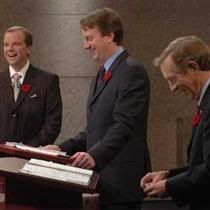
That was precisely the tactic that Saskatchewan Liberal leader David Karwacki took last night, launching zingers, and interrupting his competition, NDP leader and incumbent premier Lorne Calvert and Saskatchewan party leader Brad Wall.

In a night in which everyone was expecting a grudge match between Calvert and Wall, Karwacki kept himself active enough to keep the two apart, and keep things interesting.

Karwacki, whose party currently holds zero seats in the Saskatchewan legislature, announced that Calvert needed "a $15 prescription for truth serum", and predicted that his party would make up the official opposition following the election. "Thankfully I'm going to be holding Mr. Wall accountable on this particular issue because I don't believe that you're going to form the next government," he told Calvert.

Of course, Karwacki would actually need seats in the legislature before he'll be leader of the opposition.

Furthermore, he has a significant bridge to cross, as only 10% of decided voters in Saskatchewan intend to vote for his party, as opposed to 35% for the NDP. That's a big gap to close.

Fortunately for Karwacki, however, there is an opportunity. 31% of those polled were either undecided or unwilling to participate.

The experience of past leaders, however, may give Karwacki pause. During televised debate in the course of Ontario's 1995 provincial election, then-Liberal leader Lyn McLeod was considered to have significantly harmed her party's chances in that particular election with her disruptive debating tactics.

Ironically, in that particular case, the election was expected to be primarily fought between McLeod's Liberals and Bob Rae's NDP -- in this particular case McLeod allowed the Mike Harris Tories, powered by their Common Sense Revolution electoral platform, to come up the middle and form a majority government.

In the end adopting a disruptive approach to televised leaders' debates may seem promising to many political leaders, but it's extremely risky in the sense that it very seldom works. It may bring attention to a leader and their party, but it's rarely the right kind of attention.

All too often, such tactics turn the electorate off from that leader and their party.

As for Calvert and Wall, they butted heads throughout the night over numerous issues, particularly each party's prescription drug plan -- the NDP's would cap prescription drug costs at $15 for every resident of Saskatchewan, whereas the Saskatchewan party's plan would do so only for children, seniors, and those below a certain income bracket.

"This is a pretty competitive blood sport and they weren't about to back down," said Ken Rasmussen, a political scientist at the University of Regina.

If Karwacki's interjections accomplished much of anything, he at least forced his opponents to conduct themselves with more civility than they otherwise may have. Brad Wall, for one, had his particular axe to grind.

"I wanted to deal squarely with some of the fear tactics we have seen and I think we were able to do that as well and hold the government accountable -- they have a record," Wall said after the debate. Certainly, he may have gotten some of his points across, but likely not as much as he would have liked to.

By not allowing his opponents to savage one another, however, and by calling the election in favour of the Saskatchewan party, Karwacki has ruled out the possibility of coming up the middle to form a government. If he's able to swing any significant portion of the province's undecided voters, he might be able to determine who will govern and who will sit in opposition, but he's likely cost himself the opportunity to contend.

In Saskatchewan's realm of bloodsport politics, David Karwacki has settled for being the monkey in the middle.

Tuesday, October 23, 2007

Reality to Jeff Potts: Karma's a Bitch, Ain't It?

NDP candidate caught in some of the most vicious lies in Canadian political history

In politics, as in life, one simply has to get dirty if they want to play in the mud.

This certainly turned out to be the case for now-disavowed Saskatchewan NDP candidate Jeff Potts, when some blatantly libellous comments came back to haunt him during the ongoing Saskatchewan provincial election.

On 15 October, Potts posted a message on the left-wing message board rabble.ca, wherein he claimed that John Wall, father of Saskatchewan Party leader Brad Wall, had posted Saskatchewan party campaign signs on various low-rent properties that he owns in Swift Current, where he also sits as a city councillor.

A few hours later, Potts took his slander a step further. "Further to my previous point, there is a Brad Wall sign [rental property] on a known crack house."

This is really only one among a number of colourful, libellous, vicious, and what can really only further be described as hateful accusations on the part of Potts. In previous posts on the site, Potts had previously accused Wall of stealing $15,000 worth of liquor from the provincial liquor board in order to entertain guests at his wedding in 1991. At the time, he was the assistant to the minister in charge of the liquor board.

Wall has actually been quite gracious in addressing these accusations. "When I ran for politics back in 1999, I accepted the fact that I had to deal with this sort of thing as the person whose name is on the ballot. But it is profoundly disappointing to think that my family would have to, either my wife in the case of what's talked about in terms of our wedding day, or my dad," he stated.

If Jeff Potts had any sense of personal shame, the Wall family never would have had to endure this.

Unfortunately, Potts doesn't, and has offered perhaps the most pathetic excuse in defense of one of the most vicious lies ever uttered in Canadian political history. "I did not allege that it was Mr. Wall's property ... I did not say they had any knowledge of what was going on in this house. What I am saying is they are more concerned about putting up the sign than they are about the people living in the house. They should check, before putting up the signs on the rental properties, maybe they should check with the people who are renting them," said Potts. Which, by the way, is just a little more lying to top off his already-impressive repetoire of willful mistruths.

Most comicly of all, it turns out that John Wall doesn't own any rental properties. Potts has since tried to claim he didn't know that, despite the fact that he levied the accusation in the first place.

To say that Jeff Potts is a pathetic liar would be accurate with or without the word "liar".

"When I reviewed it, I believed it to be inaccurate and inappropriate," said Saskatchewan NDP leader Lorne Calvert. "I recommended that Mr. Potts withdraw from the race, withdraw as our candidate."

Yet, this is a public embarrassment that Calvert really has called upon both himself and his party. When the NDP decided to launch the "wolf in sheep's clothing" ad campaign against the Saskatchewan party (actually beginning weeks before the election call), Calvert had to have known that some of his more vicious and unscrupulous candidates were going to pull something like this.

This is a man who, with his party 18 points behind his principal opposition, even resorted to naming his campaign RV after the battle of Jericho, a biblical chapter in which a Jewish army, led by Joshua, laid waste to the city of Jericho and slaughtered its inhabitants because of religious differences.

When a party leader insinuates that he has god on his side by naming his RV after a biblical battle in which the victors won because they had god on their side, it shouldn't come as a great surprise when someone like Potts is willing to do something as incredibly immoral as he's done.

And his allegedly voluntary withdrawal aside, one shouldn't think Potts feels bad about what he's done. In fact, he's complaining about the injustice of it all. "What I've been told is that they will not muzzle their candidates. Their candidates are free to speak, this is a democracy and the last time I checked personally, people have the right to speak freely," said Potts, probably unaware that the freedom of speech doesn't apply to malicious lies. "As long as I can provide source material for what I've said, they'll back me up."

But Potts has yet to produce such source information. Which is probably appropriate, because it probably doesn't exist.