 Just keep pretending. After all, as long as your base buys the disingenuous "criticism of Barack Obama is racism" angle, it doesn't matter if it's actually true, does it?

Showing posts with label Nobel Peace Prize. Show all posts
Showing posts with label Nobel Peace Prize. Show all posts
Tuesday, October 20, 2009
Even if You Never, Ever Succeed
Just keep pretending. After all, as long as your base buys the disingenuous "criticism of Barack Obama is racism" angle, it doesn't matter if it's actually true, does it?


Friday, October 16, 2009
Obama's Best Option: Earn It
 Obama's Nobel Peace Prize a burden and an opportunity
Amidst the competing bombast from either side of the stark ideological divide, it can actually be difficult to decide just what, precisely, the reasonable position on Barack Obama's Nobel Peace Prize may actually be.
As McGill History Professor Gil Troy notes in a column in the Globe and Mail, it may indeed be simply too early too tell:
"As liberals rejoice in Barack Obama's Nobel Peace Prize and conservatives grumble, let's be honest: It is too early too tell. Awarding this prize either may be prescient or premature. Regardless, the award reflects the noble aspirations of the award committee and the prize winner.If an argument such as this were to hold true, perhaps the entire United States -- not just its President. But that may be beyond the point.
The committee beautifully described Mr. Obama's greatest accomplishment thus far. 'Only very rarely has a person to the same extent as Obama captured the world's attention and given its people hope for a better future,' the citation says. The fact that despite its racist past, despite the stains of slavery and Jim Crow, the United States sent a black man to the White House was a modern miracle. That this President was only 47 when elected, and had, by his own description, a 'funny name,' is even more amazing especially following 9/11."
As Troy notes, Obama's Presidency and his Nobel Peace Prize were both born out of the noblest of intentions. But the greatest test of noble intentions is how well they can be applied in the real world, with all its dark blemishes:
"Alas, even with Mr Obama in office, the world is menaced by ignoble characters who disdain his noble aspirations. The jury is still out whether Mr Obama's politics of hope and diplomacy of engagement can work in a world of al-Qaeda killers, North Korean dictators, Iranian madmen, Iraqi insurgents, Taliban fanatics, Afghan warlords, Pakistani generals, Russian strongmen, Saudi Sheiks, Sudanese slaughterers, Guinean rapists and Hamas terrorists.It should go without saying that this will be the greatest test of Obama's Presidency.
So far, there have been no major disasters on Mr Obama's watch – but no major successes either. North Korea and Iran continue to develop nuclear power: North Korea launched missiles on July 4 to defy Mr Obama, while Iran's Mahmoud Ahmadinejad stole an election and cracked down on democratic forces with barely a peep from the US President. Mr Obama has kept pressing Al Qaeda with drone attacks, the Taliban with talk of more troops, Iraqi anarchists by refusing to withdraw precipitously.
But the Russians seem to think he can be pushed around, horrific crimes like the mass murder in Darfur and the mass military rapes of opposition protesters in Guinea continue to occur (inevitably, alas). And in a striking, but characteristic contrast from the Middle East, this week, Professor Ada Yonath won Israel's ninth Nobel prize – and the first chemistry Nobel for a woman since 1964 – even as Hamas and other Palestinian agitators called for violence in Jerusalem.
The contrast between noble societies that invest in science and ignoble societies addicted to terror, between noble political cultures that produce hope-generators like Barack Obama and ignoble political cultures that produce mass killers, remains stunning – and daunting."
But, as many Canadians will draw upon the life and experiences of former Prime Minister Leaster Pearson when discussing Obama's Nobel Peace Prize, it's interesting to note the key difference between tne experience of Obama at the time of his award and those of Pearson.
By the time Pearson won the Nobel Peace Prize he had already earned it by skilfully defusing the Suez Canal Crisis.
Pearson was thus already pre-committed to the path of diplomacy in all things. In cases where diplomacy was ineffective or inapplicable, Pearson was left with very few options. Far too often this rendered Pearson all too silent on key international issues -- such as the Vietnam war.
Obama, however, has essentially received the Nobel Peace Prize with his good intentions as a deposit. But his actions haven't precommitted him to any particular course. Obama can still earn his Nobel Peace Prize, and even has the luxury of winning it with a realist foreign policy.
Many members of the so-called "peace" movement may consider it to be anathema to win the Nobel Peace Prize by militarily securing Afghanistan -- and thus helping to secure Pakistan -- from government by terrorist-harbouring religious fundamentalists.
But when one considers the stake of stabilizing Afghanistan -- which will help, in turn, stabilize Pakistan -- could be as high as preventing nuclear war between Pakistan and India and preventing nuclear terrorism abroad, the Nobel Peace Prize committee should be able to forgive Obama if he's willing to help contain and defeat one of the most tyrannical governments of the 20th century (deposed in the 21st) with military force.
Judging by the conclusion of Gil Troy's article, he may or may not understand this:
"Good people throughout the world should unite in hoping that the aspirations embedded in this award to a rookie President quickly transform into impressive achievements. Thus far, Mr Obama has dazzled the world with his poetry. Let us hope that when we look back on this moment, his Nobel prize will be a milestone in his ability to turn his transcendent poetry into workable, governable prose, the hopes into feats, and, nations' swords into plowshares."
There are, naturally, few better ways to ensure peace than to defeat forces like the Taliban who only thwart it.
The Nobel Peace Prize isn't an award typically associated with wartime leaders. If Obama can successfully help contain and defeat the Taliban, however, that Nobel Peace Prize may have been earned.
Moreover, it may be earned in a manner that fuses Barack Obama's noble intentions with the means to make them reality.
Wednesday, October 14, 2009
The Nobel No Prize
Nobel Peace Prize as much a burden as an honour for US President
As various leftist sychophants continue to preen over US President Barack Obama recently being awarded the Nobel Peace Prize, the lion's share of the commentary over the matter seems to revolve around whether or not Obama actually deserves the prize.
Almost certainly, he doesn't -- not yet, not even by the specious line of reasoning used by Rachel Maddow.
But even under the questionable reasons given for awarding the prize to Obama -- encouraging him to embrace diplomacy over American force -- the award committee hasn't truly done Obama any favours. In fact, as Andrew Cohen posits, the "promisary note" award may actually prove to be a millstone around Obama's neck.
In many ways, it turned out to be precisely that for Lester Pearson, who received his Nobel Peace Prize before ever becoming leader of the Liberal party, let alone Prime Minister:
For Barack Obama, the problems of living up to the expectations set for him by a Nobel Peace Prize are obvious. They are the same as the problems of living up to the expectations set for him by the progressive movement that so deftly delivered him to power in the first place.
If Obama continues -- as he must -- to prosecute either of the two wars his country is currently engaged in (and abandoning Afghanistan is simply not an option for him) he will certainly disappoint many members of the global "peace" movement who believe his Nobel Peace Prize should provide the impetus for retirement from the field of battle.
Obama is almost certain to disappoint and anger a great number of people no matter what he does from here on out.
At the very least, however, the Rachel Maddows of the world, suffering from the sycophantic strain of Derangement Syndrome, will still applaud no matter what.
As various leftist sychophants continue to preen over US President Barack Obama recently being awarded the Nobel Peace Prize, the lion's share of the commentary over the matter seems to revolve around whether or not Obama actually deserves the prize.
Almost certainly, he doesn't -- not yet, not even by the specious line of reasoning used by Rachel Maddow.
But even under the questionable reasons given for awarding the prize to Obama -- encouraging him to embrace diplomacy over American force -- the award committee hasn't truly done Obama any favours. In fact, as Andrew Cohen posits, the "promisary note" award may actually prove to be a millstone around Obama's neck.
In many ways, it turned out to be precisely that for Lester Pearson, who received his Nobel Peace Prize before ever becoming leader of the Liberal party, let alone Prime Minister:
"...The prize may have been the worst thing that ever happened to Mike Pearson. To many it turned him into a peacemaker and a pacifist. It conjured up an enduring image of a toga-clad high priest atop a stony mountain, uttering mystical mantras into the winds.Pearson's experience demonstrates that the kind of expectations produced by a Nobel Peace Prize win can create expectations that would, if satisfied, permanently divorce that individual from realism. Moreover, observing diplomacy just for the sake of diplomacy can often paint a leader into a corner in which they can't criticize the actions of another country for fear of offending them.
Pearson was just embarking on a feverish decade as Leader of the Opposition and Prime Minister. Twice, in both roles, the prize would come to haunt him.
In 1963, Pearson reversed his party's stand and agreed to accept the deployment of US nuclear weapons in Canada. It was a political master-stroke that helped split John Diefenbaker's Conservatives and propel the Liberals to power that spring.
But Pearson angered his party's left wing. His critics couldn't believe that a Nobel laureate could countenance nuclear weapons. An angry Pierre Trudeau famously called him 'the defrocked prince of peace' and refused to run as a Liberal that year.
In 1965, as prime minister, Pearson came under pressure to urge Lyndon Johnson to end the bombing of Vietnam. The question arose: how could our poster boy of peace remain silent during the greatest aerial bombardment in history?
Once again, Pearson acted as a conscientious, practical politician, not as a pacifist. He had long tried to contain 'thermo-nuclear weapons,' as he called them, but believed that Canada had to honour its commitment to accept them as a member of NATO, which he had helped conceive and shape in 1949.
He opposed the war in Vietnam and gave a contentious speech in Philadelphia proposing a halt in the bombing. For his trouble he was picked up and dressed down by LBJ the next day. Ever the pragmatist, Pearson then went silent in public, worried about damaging relations between the two countries."
For Barack Obama, the problems of living up to the expectations set for him by a Nobel Peace Prize are obvious. They are the same as the problems of living up to the expectations set for him by the progressive movement that so deftly delivered him to power in the first place.
If Obama continues -- as he must -- to prosecute either of the two wars his country is currently engaged in (and abandoning Afghanistan is simply not an option for him) he will certainly disappoint many members of the global "peace" movement who believe his Nobel Peace Prize should provide the impetus for retirement from the field of battle.
Obama is almost certain to disappoint and anger a great number of people no matter what he does from here on out.
At the very least, however, the Rachel Maddows of the world, suffering from the sycophantic strain of Derangement Syndrome, will still applaud no matter what.
Tuesday, July 01, 2008
Five Reasons to Be Proud This Canada Day
Canada's top five cultural icons, according to myself
Today, Canadians across the country are celebrating 141 years of Canada.
To help determine what Canadians think of as our identity, the Dominion Institute and Citizenship and Immigration Canada have been conducting a survey of Canada's cultural icons.
As of the time of this writing, the top five consisted of the Maple Leaf, Vimy Ridge, Hockey, Queen Elizabeth and the Canadian Flag.
Like any other Canadian, we here at The Nexus, we all have our own ideas on Canadian identity. The following are my own personal top five Canadian icons, and explanations as to why:
 1. Terry Fox - No one in Canada's history has ever embodied the spirit of our country quite the same way Terry Fox does.
When diagnosed with osteogenic sarcoma -- bone cancer -- at the age of 18, many people would resign themselves to a long, hard illness with little chance of recovery. But not Terry Fox.
Even after the cancer took his leg, Terry took to the Highways of Canada, running across the country to raise money for cancer research. As every Canadian knows, he didn't make it past Thunder Bay, when his cancer reappeared.
He would pass away on June 28, 1981, but would leave behind him a legacy that eventually blossomed into the Terry Fox run, taking his legendary Marathon of Hope worldwide.
Terry Fox represents everything good about Canada: dedication, generosity, self-sacrifice and, through his memory, global leadership.
 2. Ottawa - Canadians have long accepted the reality of Canada as a country made up of at least two solitudes, in the phrase coined by author Hugh MacLennan.
Those Canadians with a firmer grasp on Canadian history would likely amend that to three solitudes -- the first two being English and French Canada, and the third being our aboriginal community -- but even then, Ottawa remains a symbol of the disjointed unity that may permanently elude and challenge us.
Built upon the foundations laid generations before the arrival of Europeans to North America, Ottawa straddles Ontario and Quebec where the Odawa First Nations had maintained a village named Kanata (a village that, like Ottawa has grown over time to become part of the Ottawa Metropolitan Area).
Besides remaining the seat of Canadian government, Ottawa is where the three most dominant strains of Canadian culture -- British, French and Aboriginal -- intercede most dramatically.
So long as there is a Canada, Ottawa will remain the strongest reminder of our three-pronged historical heritage.
 3. Lester Pearson's Nobel Peace Prize - In 1957 Lester Bowles Pearson -- or "Mike" as he was dubbed by his Air Force instructors, a nickname that stuck with him throughout the remainder of his life -- won the Nobel Peace Prize.
In doing so, he put Canada on the map in terms of global leadership that his varying successors would try to emulate, but never quite equal.
Pearson was awarded the Prize for his work in establishing the United Nations Emergency Force that helped ensure a (at least temporarily) peaceful resolution to the Suez Crisis of 1956.
He would eventually parlay the award into the Leadership of the Liberal Party and the Prime Ministership of Canada.
Pearson's award remains a vital symbol of Canadian leadership on the global stage, and a reminder that Canada needs to remain committed to leadership as such.
 4. The Royal Canadian Mounted Police - Many Canadians would likely name "freedom" as one of the most important reasons to be proud to be Canadian.
But the simple fact of the matter is that freedom only exists where order and justice are maintained.
Originally established in 1873 as the North West Mounted Police, the Mounties have safeguarded law and order in Canada for nearly as long as there has been a Canada.
The Mounties are known the world over as one of the top law enforcement agencies in the entire world, and they remain ambassadors for law and order the world over. Not only do they serve in Canada, ensuring our own safety and security, but they have also volunteered in wartime and peacekeeping operations overseas.
While many a controversy has been stirred over several progressive modernizations of the force, the very freedom that so many Canadians pride themselves on could never exist if not for the men and women who have pledged their lives to upholding it day in and day out.
 5. Hockey - While it may seem like a cliche, there is simply no denying it: Canadians live and breathe by hockey.
Hockey Night in Canada remains one of Canada's top-rated television programs, and when it comes to international competitions like the World Junior Championships, Olympics and World Cup, Canadians practically demand victory from their teams.
Like the other items on this list, hockey represents virtually everything it means to be Canadian: energy, dedication, toughness, and a solid work ethic.
Certainly, not all Canadians will agree with everything on this list. But that's the magic of being Canadian: that we've drilled diversity so deeply into our national identity that what it means to be Canadian can mean different things to different people.
This is only partially what Canada means to me.
On that note, I bid you a temporary adieu and a happy Canada Day.
Today, Canadians across the country are celebrating 141 years of Canada.
To help determine what Canadians think of as our identity, the Dominion Institute and Citizenship and Immigration Canada have been conducting a survey of Canada's cultural icons.
As of the time of this writing, the top five consisted of the Maple Leaf, Vimy Ridge, Hockey, Queen Elizabeth and the Canadian Flag.
Like any other Canadian, we here at The Nexus, we all have our own ideas on Canadian identity. The following are my own personal top five Canadian icons, and explanations as to why:
 1. Terry Fox - No one in Canada's history has ever embodied the spirit of our country quite the same way Terry Fox does.
When diagnosed with osteogenic sarcoma -- bone cancer -- at the age of 18, many people would resign themselves to a long, hard illness with little chance of recovery. But not Terry Fox.
Even after the cancer took his leg, Terry took to the Highways of Canada, running across the country to raise money for cancer research. As every Canadian knows, he didn't make it past Thunder Bay, when his cancer reappeared.
He would pass away on June 28, 1981, but would leave behind him a legacy that eventually blossomed into the Terry Fox run, taking his legendary Marathon of Hope worldwide.
Terry Fox represents everything good about Canada: dedication, generosity, self-sacrifice and, through his memory, global leadership.
 2. Ottawa - Canadians have long accepted the reality of Canada as a country made up of at least two solitudes, in the phrase coined by author Hugh MacLennan.
Those Canadians with a firmer grasp on Canadian history would likely amend that to three solitudes -- the first two being English and French Canada, and the third being our aboriginal community -- but even then, Ottawa remains a symbol of the disjointed unity that may permanently elude and challenge us.
Built upon the foundations laid generations before the arrival of Europeans to North America, Ottawa straddles Ontario and Quebec where the Odawa First Nations had maintained a village named Kanata (a village that, like Ottawa has grown over time to become part of the Ottawa Metropolitan Area).
Besides remaining the seat of Canadian government, Ottawa is where the three most dominant strains of Canadian culture -- British, French and Aboriginal -- intercede most dramatically.
So long as there is a Canada, Ottawa will remain the strongest reminder of our three-pronged historical heritage.
 3. Lester Pearson's Nobel Peace Prize - In 1957 Lester Bowles Pearson -- or "Mike" as he was dubbed by his Air Force instructors, a nickname that stuck with him throughout the remainder of his life -- won the Nobel Peace Prize.
In doing so, he put Canada on the map in terms of global leadership that his varying successors would try to emulate, but never quite equal.
Pearson was awarded the Prize for his work in establishing the United Nations Emergency Force that helped ensure a (at least temporarily) peaceful resolution to the Suez Crisis of 1956.
He would eventually parlay the award into the Leadership of the Liberal Party and the Prime Ministership of Canada.
Pearson's award remains a vital symbol of Canadian leadership on the global stage, and a reminder that Canada needs to remain committed to leadership as such.
 4. The Royal Canadian Mounted Police - Many Canadians would likely name "freedom" as one of the most important reasons to be proud to be Canadian.
But the simple fact of the matter is that freedom only exists where order and justice are maintained.
Originally established in 1873 as the North West Mounted Police, the Mounties have safeguarded law and order in Canada for nearly as long as there has been a Canada.
The Mounties are known the world over as one of the top law enforcement agencies in the entire world, and they remain ambassadors for law and order the world over. Not only do they serve in Canada, ensuring our own safety and security, but they have also volunteered in wartime and peacekeeping operations overseas.
While many a controversy has been stirred over several progressive modernizations of the force, the very freedom that so many Canadians pride themselves on could never exist if not for the men and women who have pledged their lives to upholding it day in and day out.
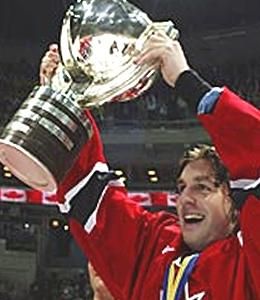 5. Hockey - While it may seem like a cliche, there is simply no denying it: Canadians live and breathe by hockey.
Hockey Night in Canada remains one of Canada's top-rated television programs, and when it comes to international competitions like the World Junior Championships, Olympics and World Cup, Canadians practically demand victory from their teams.
Like the other items on this list, hockey represents virtually everything it means to be Canadian: energy, dedication, toughness, and a solid work ethic.
Certainly, not all Canadians will agree with everything on this list. But that's the magic of being Canadian: that we've drilled diversity so deeply into our national identity that what it means to be Canadian can mean different things to different people.
This is only partially what Canada means to me.
On that note, I bid you a temporary adieu and a happy Canada Day.
Subscribe to:
Posts (Atom)