Showing posts with label John Tory. Show all posts

Thursday, July 09, 2009

Canadian Conservatism Needs to Save Itself

Adam Daifallah annoints Tim Hudak as conservative saviour

Writing in a blog post on the National Post's Full Comment blog, Adam Daifallah all but annoints Tim Hudak as the saviour of conservatism not only in Ontario, but perhaps in all of Canada:
"Tim Hudak's ascension to the leadership of the Progressive Conservative Party of Ontario is an important development in the Canadian conservative movement for several reasons. Most importantly, it represents a clean break from the rudderless and inept leadership that has guided the party for more than five years. Let's not mince words: Ernie Eves and John Tory were unmitigated disasters as leaders. Hudak represents a clear return to the conviction-based politics that vaulted the Tories to power -- and kept them there -- in the 1990s."
It would be unreasonable to suggest that Tory and Eves, as leaders, could not have done more.

That being said, it's unreasonable to overlook the fact that, as leaders, Tory and Eves had to work with what Harris had left behind him when he resigned as leader. It wasn't a pretty sight.

Mike Harris left behind him an extremely unpopular incumbent party, which had failed to deliver on its espoused fiscally conservative principles, had made controversial moves in relation to education and relations with municipal governments, and had often stirred up a wasp's nest of public protest against it.

To saddle Tory and Eves firmly with the failure of the Ontario Tories to retain power -- or win it back from Dalton McGuinty in the years since -- is partially unfair. While one cannot overlook their own failures as leaders, one also has to remember the position Harris had left them in.

Yet Daifallah seems to believe that only a leader practically hand-picked by Harris can deliver the Ontario Tories from the ignominous position they currently find themselves in.
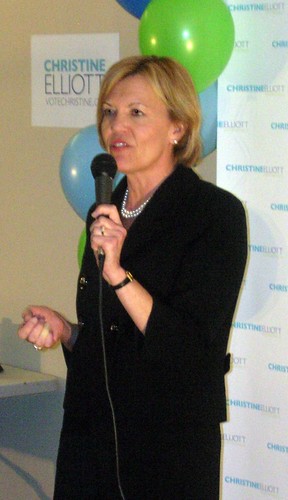
"For the first time in recent memory, during the course of the leadership race no candidate ran on an explicitly centre-left platform. Hudak, runner-up Frank Klees and maverick Randy Hillier all staked out clear conservative ground. Christine Elliott ran a formidable campaign and was essentially forced into positioning herself as the centrist candidate due to crowding on the right. (Frequent cheerleading from the Toronto Star also helped burnish her image in that regard.)"
Daifallah seems to do everything but label Elliott Liberal-lite.
"Elliott miscalculated in making the policy of abolishing the Ontario Human Rights Commission -- a cause championed by Hudak and Hiller -- a wedge issue. This didn't sit well with Hudak's and Hillier's supporters, whose second-choice votes she needed to gain in the preferential ballot voting system. Her announcement that she would implement a flat tax if elected -- effectively outflanking Hudak on the right -- sent an electroshock through the other camps. In the end, Elliott proved to be a master of the air war, but lacked the ground game necessary to mount a serious challenge."
But Daifallah would be foolish to insist that the policy of abolishing the Ontario Human Rights Commission was not, in and of itself, designed to be a wedge issue.

Hudak used that policy as a method to determine those who were, allegedly, true conservatives from those who were simply "Liberal lite" -- a label he applied to both Elliott and Klees.
"The significance of the Hudak victory should not be downplayed. The Ontario Tories now have a leader who, unlike his predecessor, won't shy away from drawing clear distinctions between himself and the McGuinty Liberals. Hudak believes in ideas -- he won't be afraid of making bold proposals going forward. His mandate of presenting policies that respect conservative principles yet recognize the current difficult economic context will neutralize Liberal attempts to paint him as a reincarnation of Mike Harris."
And yet Hudak's branding of himself as a "common sense conservative" has already done so much to accomplish this very act.

Distancing himself from Harris will be a difficult act for someone who enjoyed such fervent support from Harris to do. And, really, one may wonder what reason Hudak would have to want to distance himself from who has proven to be his most valuable supporter.
"The McGuinty government is vulnerable on almost every important issue: Ontario's economy is in shambles, taxes are up, spending has soared with no correlative improvement in service quality, unemployment is skyrocketing and the deficit and debt have ballooned. Admittedly, not all of these problems are Dalton McGuinty's own fault, but in politics, the party in power wears the good news and the bad, regardless of its cause.

The next provincial election is still more than two years away. Anything can happen in that time, and it is still unknown whether McGuinty will run for a third term. But if he does, he will be ripe for defeat as an out-of-touch, tired leader who bungled the economy. In the meantime, the way Hudak conducts himself as opposition leader will have important ramifications far beyond Ontario politics.
"
Hudak has yet to accomplish anything during his (to date short) audition to be Premier of Ontario.

Yet Daifallah already seems to have Hudak pegged as a successor to Stephen Harper's leadership of Canadian conservatism, particularly fiscal conservatism:
"Small-c conservatives across the country are disheartened by the Harper government's numerous capitulations on a whole host of red-meat issues. They are desperately looking for a new champion for the conservative cause. If Hudak can make conservative policies stick and bring the Ontario Tories up in the polls -- and, in the unlikely event that the 2011 election occurs before the next federal campaign, win a government -- it will give great comfort to principled conservatives to know that their ideas still have traction. It would also discredit the Harper government's calculation that the public is only interested in statist solutions to the current economic situation."
Yet Daifallah seems to be overlooking what the historical trend in Canadian politics has tended to be.

That is, when Liberal governments reign in Ottawa, Conservatives tend to win power in Provincial elections. When Conservative governments are in power in Ottawa, Liberals and the NDP tend to win in the provinces.

While the Saskatchewan party claimed victory in the first post-Harper election in the Land of Living Skies and Danny Williams' Progressive Conservatives won in Newfoundland, it's worth noting that Rodney MacDonald's Conservatives were defeated by the NDP, Gordon Campbell's Liberals retained power in British Columbia and Gary Doer's NDP won the 2007 vote in Manitoba.

To expect that Hudak alone will be enough to buck this trend in Ontario and deliver salvation to the federal Tories is, in and of itself, a bit of a pipe dream. Hudak has to be up to the task, and we have yet to see if he actually is.
"Tim Hudak as Canadian conservatism's saviour? Someone needs to assume the role, and I know he would relish it."
Not only does Daifallah's analysis of Hudak's emerging role within Canadian conservatism seem overly Wagnerian, it's also deftly out of touch with the roots of the conservative movement in Canada.

Lloyd Mackey provides a reasonable list of the differing philosophical strains on conservatism. He classifies them as following:

1. Fiscal conservatism - This is the strain of conservatism that prefers controls on government taxation and spending. This is also the very strain of conservatism that Daifallah seems to appeal to most in this article.

2. Social conservatism - Social conservatives prefer family-friendly policies and government regulation -- if not outright prohibition -- of abortion. This particular strain of conservatism has found itself at odds with Human Rights Commissions as many of its most vociferous proponents find themselves paraded before them on an ongoing basis.

3. Democratic populism - Democratic populism insists that the spirit of democracy is found in the will of the people. It favours the "common sense of common people", and has been most strongly represented nationally by Preston Manning.

4. Progressive Conservatism - Progressive conservatism, as embodied by leaders such as Joe Clark, John Diefenbaker and the late Robert Stanfield, advocates using conservatism to moderate political and social change.

5. British Toryism - Proponents of British Toryism favour the preservation of existing institutions, including current parliamentary structures and offices such as Canada's various vice-regal offices such as the Governor General and Lieutenant Governors.

6. Libertarianism - Libertarians prefer that government stay out of the lives of its citizens as much as possible. Libertarians favour as much freedom as possible for citizens, and tend to be the strongest voices in favour of small government.

Of Mackey's six strains of Canadian conservatism, only one -- British Toryism -- arguably sets the table to favour the salvation of Canadian conservatism by a single leader.

Where the other strains of conservatism -- notably libertarianism and democratic populism -- weigh in on this topic, they weigh in against such an option.

Where Daifallah would argue that Tim Hudak is the one man who can save conservatism in Canada, democratic populists would rebel against the notion of any single leader leading Canadian conservatism without a strong consensus to back his direction. That was the act that Preston Manning accomplished so masterfully as leader of the Reform party.

Libertarians would point out the sheer scope of the power, influence and authority conservatives would have to grant such an individual upon being annointed as a conservative "messiah". Libertarians would reject such a notion outright.

Small-p, small-c progressive conservatives would find the urge to reject Hudak as a conservative saviour almost irresistable. To such individuals, Hudak represents the kind of ideologically-isolated neoconservatism that is utterly offensive to their particular values, even as fiscal and social conservatives would likely react favourably to Hudak in such a role.

Contrary to whatever Adam Daifallah may like to believe about Tim Hudak, no one man can save conservatism. Not in Ontario, and not in the rest of Canada. Rather, conservatives must save conservatism together by maintaining the common bonds between its varying -- although often over-simplified, by Lloyd Mackey's own admission -- strains.

Conservatism must save itself.

Sunday, June 28, 2009

Christine Elliott and the (Alleged) Nadir of Red Toryism

Despite Elliott's leadership setback, red toryism will survive

If politics were merely about being nice, Christine Elliott probably would have won the Ontario Progressive Conservative leadership hands-down.

Conservative Senator Hugh Segal's endorsement of Elliott reinforces this. Segal has often focused on praising the humanity and civility of political leaders. To Seal, these are important values.

Of course, politics is not merely about being nice. Few Canadians, inside or outside of Ontario, would pretend that former Premier Mike Harris is an implicitly nice individual. Yet his endorsement of now-PC leader Tim Hudak certainly went a long way toward establishing his credentials as a "common sense conservative".

Mike Harris won two majority governments in Ontario. Hugh Segal wound up runner-up to former Prime Minister Joe Clark in the 1998 federal Progressive Conservative leadership contest.

Perhaps the lesson is that perhaps, in politics, nice guys really do finish last -- or at least that in politics, as in life, people who are too nice invariably finish last.

In the wake of Elliott's defeat in the Progressive Conservative leadership contest, many people -- like the Globe and Mail's Adam Radwanski --- are wondering if conservatism in Ontario, formerly a bastion of Canadian red toryism, has irrevocably taken what Brooke Jeffrey once referred to as a hard right turn.

(Jeffrey, for her own part, actually seemed perplexed by her inability to win election by labelling all of her would-be constituents in a riding she was parachuted into as racists, so maybe one should carefully consider the source.)

Hudak's ascension to the leadership of the Ontario Conservative party has many people wondering if perhaps speculation that harder forms of conservatism are needed to prevail in Ontario.

In recent years, the failures of leaders such as John Tory have largely spoken for themselves. There's a real question regarding whether or not red toryism can flourish in Ontario -- or Canada -- any longer, or if it's simply become too "Liberal-lite" to be palatable to conservative voters.

Yet those reputed to be red tories who have gotten closest to the Liberal party have shown their true political colours. In the case of Garth Turner, those colours turned out to be red. In the end however, it turned out that he wasn't a Tory.

When the former Halton MP joined the Liberal party in 2007, then-Liberal leader Stephane Dion crowed that "Tories were becoming Liberals".

Yet, as it turned out, Turner was far from a proper red tory. He lacked that key combination of fiscal conservatism and social principle that has forever properly characterized the red tory. When he finally got his first opportunity to campaign against the Harper Conservatives he chose to embrace divisive fear-based campaigning.

Prior to that, Turner attempted to divide Canadians by attempting to invent a separatist threat in Alberta.

Red toryism has forever held at its core an organic conceptualization of society -- one wherein social tradition is balanced against the public good.

Fear mongering and the creation of artificial -- and largely non-existent -- enemies is as great an insult to the principles of red toryism as one can possibly manage.

Turner had been preceded in joining the Liberal ranks by David Orchard, who had his nomination in a Saskatchewan riding overturned by Dion in favour of a hand-picked candidate who subsequently lost to Conservative Rob Clarke. When Orchard finally got his own turn in 2008, he lost as well -- and lost amidst his own fear-based attempts to campaign against the RCMP.

David Orchard, as many may recall, conceded the federal PC leadership to Peter MacKay only under the condition that MacKay wouldn't discuss unification of that party with the then-Canadian Alliance.

Orchard, for his own part, failed to recognize the value in allowing an organic political bond to develop between Canada's conservatives, and would have rather allowed the Liberal party to govern Canada in perpetuity than be caught dead dealing with the "wrong" conservatives.

If Canadian red toryism has truly reached its nadir it isn't in the defeat of Christine Elliott. Rather, it reached that nadir when those who consider themselves red tories failed to put their political principles ahead of their political vanity.

Whether or not Elliott will turn the tide of this unfortunate trend by working together with her party's new leader, and whether the hard conservatism of Tim Hudak and Mike Harris can lead the Ontario Progressive Conservative party to victory in the next election has yet to be seen.

If Hudak possesses the wisdom to make Elliott a part of his leadership plans for the party, and if Elliott can, in turn, soften the hard conservatism of Hudak and company also has yet to be seen. But it will be interesting to see.

Politics may not necessarily be merely about being nice. But it couldn't hurt to have a nice guy -- or gal -- on side, either.

Friday, March 06, 2009

Curtains for John Tory

It's the end of the road for Ontario PC leader

When John Tory lost his seat during the 2007 Ontario general election, he had to know how badly he needed to win in a by-election.

Last night he failed to do that.

Liberal candidate Rick Johnson won the the Haliburton-Kawartha Lakes-Brock by-election by a margin of 2.5% of the vote. His 43.7% of the electorate narrowly trumped Tory's 41.2%.

"I'm very disappointed in the results of the election, as we all are, but the voters can never be wrong in what they decide, and I respect their decision," Tory announced while conceding the by-election.


Tory's loss represents something of a double defeat for the Ontario PCs. The seat he lost last night was one held by the Tories after the 2007 election. Laurie Scott won the seat against Johnson in 2007, then resigned so Tory could seek election.

With no seat in Queen's Park, there's nothing left for Tory to do but resign as the leader of the Progressive Conservative party of Ontario.

To date, Tory hasn't commented on whether or not he'll do so.

"As for me, I will have more to say about my plans tomorrow," he announced. "For now, I will only say that I gave this campaign my very best."

He can't expect to lead his party from the press gallery. The Ontario Conservatives need a Tory leader in the legislature, not Tory in the press box.


Other bloggers writing about this topic:

John LaForet - "Good Night and Good Luck John Tory"

Authur Kong - "Local Values Trump John Tory Ambitions"

Vlad Gebov - "John Tory Defeated by Rick Johnson"

Thursday, January 15, 2009

Ontario Reform Party: Not-So-Giant Killers?

Ontario Reform party targeting John Tory in by-election

After the Ontario Provincial election of 2007, Ontario Progressive Conservative leader John Tory has been weighing his political options for more than a year.

In that election, Tory lost in his riding of Don Valley West. Now, more than a year later, Tory has decided to seek election in a by-election in Haliburton-Kawartha Lakes-Brock, a contest in which Premier Dalton McGuinty has (wisely) opted to delay in order for other parties to nominate candidates.

The Ontario Liberals -- who in 2005 contested the last by-election Tory won -- have yet to announce whether or not they'll contest this riding.

The Reform party of Ontario, however, has announced they'll be running a candidate against Tory. They just haven't announced who.

"We were going to run a candidate wherever John Tory was going run," announced Reform party leader Brad Harness.

That being said, one shouldn't underestimate the Reform party's desire to defeat Tory. Harness has referred to Tory as an "urbanite", and as a member of "the Canadian establishment, the moneyed establishment".

Certainly, there may be more to Harness' focus on defeating John Tory than simply that.

The Reform party of Ontario attempts to fuse Preston Manning's focus on populism with former Ontario Premier Mike Harris' fiscal conservatism. The official party doctrine appears to be a combination between Manning's "new Canada" and Harris' "common sense revolution".

Targeting John Tory is, similarly, a combination of two pages out of Preston Manning's old political playbook.

When the federal Reform party contested their first election in 1984, Manning himself attempted to defeat Clark in his riding of Yellowhead. Among the memorable events of that election was a horseback posse formed to confront Clark about his policies at the dedication of a railway museum in the riding -- a dedication that Clark wound up skipping.

The media stunt was staged complete with wanted posters accusing Clark of failing to represent the interests of his constituents.

The other strategy Harness is emulating here is in allowing a candidate nominated from within the riding to contest the by-election against Tory. Preston Manning did this when he declined to run in a 1989 by-election in Beaver River. Instead Deborah Grey -- the Reform party's first ever MP -- ran in that election and won.

It's hard to believe that Brad Harness didn't closely consider these two examples before making the decision to attempt to defeat Tory in Haliburton-Kawartha Lakes-Brock.

The idea is clearly to try to establish himself as an anti-establishment figure, taking on the province's established political leaders while also establishing himself as a leader with deep faith in the grassroots of his party.

But considering the chilly reception the federal Reform party received in Ontario, it will be far more difficult for Harness to establish such credentials for himself in Ontario than it was for Preston Manning and the federal Reformers to do so in Alberta.

To make Harness' strategy further dubious is the fact that John Tory isn't nearly the political giant in Ontario that Joe Clark had established himself as in Alberta -- at least at the time. There's a difference between taking on a federal Minister and former Prime Minister and taking on a Progressive Conservative leader who can't even win his own seat.

In other words, John Tory isn't so giant, and the Ontario Reform party may not be able to 'kill' him.

Thursday, April 10, 2008

Dear Wanks: Stephane Dion Has Your "Separation of Church and State" Right Here

Are anti-religious protesters equal-opportunity protesters?

It seems like a silly thing, but there were people in Canada who shit kittens the second Prime Minister Stephen Harper started saying "god bless Canada".

"Is it just me or does anyone else find it ominous that Harper says 'God bless Canada'?" asked Linda McQuaig in a column at Rabble.ca.

"Stephen Harper is a radical neocon theocrat [and] the media is too even-handed," insisted Jeff Monaghan, who would eventually be arrested for leaking confidential documents during his employment at Environment Canada.

"God Bless Canada is an obvious aping of American politicians finishing their speeches with 'Thank you. God bless America'," wrote one frantic (and unidentifiable) demagogue. "'God Bless Canada' does not mean 'I love Canada'. I am honestly please. At best, it means 'I love Alberta'. Harper hates Canada."

When Ontario Progressive Conservative leader John Tory suggested the Ontario government should fund all religious schools, as opposed only to Catholic schools, Toronto Star readers sounded off repeatedly about the "separation of church and state".

Now, Liberal leader Stephane Dion has announced he'd like to provide a $75 million fund to help places of worship targeted for vandalism by varying bigots protect their property.

Which, although laudable, naturally makes a lot less sense than providing religious organizations with tax dollars in order to fund education.

The fact is that Dion's proposal is actually quite benign. As was John Tory's plan to fund faith-based schools, and as is Stephen Harper saying "god bless Canada".

Will those who protested Harper and Tory in the name of separation of church and state now protest Stephane Dion?

One severely doubts it, but only time will tell.

Thursday, July 19, 2007

What Is It With Warren Kinsella and Racism?

Kinsella falls back on old standby in campaign against John Tory

If there's any accusation against conservative political candidates that has become predictable in Canada over the last 15 years, its racism.

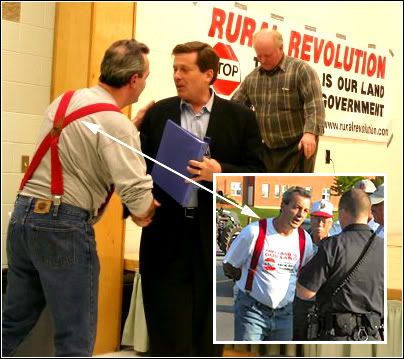
All one need do is consider a recent accusation levied against Ontario Progressive Conservative leader John Tory by Canada's king of the hatchet job, Warren Kinsella. In an 18 July post, Kinsella posts a picture of Tory meeting PC candidate Randy Hillier, who Kinsella describes as "anti-gay, anti-native, anti-urban".

Gotcha.

We said we’d get a photo of anti-gay, anti-native, anti-urban Randy Hillier with his leader, John Tory. And we did.

(And check out the sign. That's Tory about to speak to, or having just spoken to, a rabidly far-right-wing group. It means these two have been pals for a long time. Interesting, no?)


Reproduced here, for the readers' benefit is the photograph in question.


Now, the fact that the photo seems to feature the back of Hillier's alleged head notwithstanding (the individual presumed to be Hillier is wearing red suspenders, just as in the other photo), the banner that Kinsella refers to actually promotes the Ontario Landowner's Association, a group that promotes property rights.

While indulging themselves in gloomy talk about all sorts of injustices ,whether real or imagined, ("Throughout human History there are eras when every society experiences the darkness of injustice and the long shadows of oppression blanket the landscape...") the allegedly "rabidly far-right-wing group" is really nothing more than a group of farmers standing up for their own interests, many of which are directly linked to the land on which they earn their living, and depend upon for their livelihood.

What is most intriguing is Kinsella's accusations of racism, particularly Hillier being allegedly "anti-native". Yet, Hillier's actual comments on natives are much more revealing:

"The owner or direct user is the one who knows best on how to take care of their property, land and how to solve a problem.

Example... An example is our native North Americans, who have for over 5000 years trapped and fished as a way of surviving. Then some bureaucrats in Ottawa or Toronto suggest that they knew better, and imposed rules and regulations as to hunting and trapping without consequence to the bureaucrats but certainly to the aboriginals.

The aboriginal who hunts and fishes everyday to survive is a far more knowledgeable than a bureaucrat who does not.
"

Seems much more pro-native and anti-bureaucrat than anything.

Yet, accusations of racism have been very typical of Kinsella.

Consider, for example, his very worthwhile book, Web of Hate. While mostly a very valuable source of information about racial extremists in Canada, Kinsella often goes out of his way to use the book to lob accusations of racism at the then-premier opposition to the then-governing Liberal party, the Reform party.

P.243 Along with an anti-Semitic column by former Texas KKK Grand Dragon Louis Beam Jr., the August 1992 issue [of Up Front] carried a lengthy account of Wolfgang Droege's involvement with the Reform party. In late February 1991, Bill Dunphy exposed in the Sun the fact that Droege and four other Heritage Front activists maintained memberships in Toronto-area riding associations. Immediately after, Reform leader Preston Manning ordered the group expelled. (The following year, Manning also expelled Northern Foundation president Ann Hartmann for her racist views.) Two of the racists had been appointed to the executive of the party's Beaches-Woodbine riding association; one of these, Alan Overfield, had acted as security at various Heritage Front rallies and--as police learned in November 1992 when they raided his home--maintained a huge stockpile of weapons. ...Overfield had hired Droege to act as bodyguard for Manning at at least two Reform Party rallies in Toronto. Also involved in the riding association were Heritage Front members James Dawson and Nicola Polinuk, Don Andrews' estranged wife.

The expulsions enraged the Heritage Front, which saw the Reform Party's policies as very similar to, if not indistinguishable from, its own. How could a party that went on record opposing immigration policies that "radically alter" Canada's ethnic make-up turn around and shun a group like the Heritage Front, Droege asked, when the Heritage Front supports the very same approach?

...In a lengthy article about the Reform Party controversy,
Up Front stated that Manning and his followers were a pro-white organization that lacked the courage of its convictions. 'The Heritage Front threatened the cozy power position of the establishment which Preston Manning and his sycophants now enjoy.' The article featured a cartoon of a smiling Droege beating Preston Manning in a boxing ring."

Kinsella's loaded musings in this passage ignore a number of fundamental facts. Consider the following passage, from Preston Manning's The New Canada, referring to the resolutions reached by the party's April 1991 Assembly:

P. 273 (The New Canada):"The party had already committed itself to a "balanced and positive immigration policy," which rejected the use of racial criteria designed to maintain a French-English ethnic balance in Canada. At Saskatoon, delegates made clear their disapproval of any appeal to race or creed in setting immigration policy. They also declared their support of a policy "accepting the settlement of genuine refugees who find their way to Canada. (A "genuine refugee" was defined as "one who has a well-founded fear of persecution and qualifies under the requirements of the United Nations Convention.")

It should be noted that the racial immigration policies the party rejected were actually originally drafted by Kinsella's own party, by the pen of Clifford Sifton.

However the Heritage Front could have drawn the conclusions they claimed to have drawn should be beyond anyone familiar with Reform party policy (actual Reform party policy, not the fictional Reform party policy hysterically concocted by its critics).

Yet, Web of Hate's commentary took an absurd turn in the book's conclusion:

P. 351 "Also joining the ranks of haters are a few members of ostensibly mainstream political organizations such as the Reform Party, some of whose activists are inreasingly associated with extreme expressions of bigotry and intolerance. To his credit, Reform Party leader Preston Manning expels these individuals whenever the media bring their existence to his attention. But the question Manning has yet to answer, of course, is this: if this party is not racist, why are so many racists attracted to it?"

Kinsella works very hard to turn this passage of the book addressing Manning's efforts to rid the Reform party of racism into a partisan attack. Kinsella refuses to allow Manning's efforts to demonstrate a lack of tolerance for racism.

It's a simple credo for Kinsella: the opposition can do no right, no matter what.

While not only overlooking his own party's many instances of racism--Sifton's being the best historical example--Kinsella overlooks the fact that subverting new political organizations has always been a key tactic of far-right racists. Whether or not the Reform party held any direct appeal for racists, racists would have tried to hijack the party nonetheless. Kinsella's accusations of racism are not so well founded, and are merely partisan.

Which is unsurprising, considering that he devoted an entire section in his book Kicking Ass in Canadian Politics to narcissitically grading his fellow media commentators, giving those who best criticized opponents of the Liberal party As, and those who criticized the Liberals poor grades.

Kinsella has refined the accusation of racism into a mere political tactic. By reducing it so, he only degrades the import of racism to all Canadians. Kinsella should remember that, as all of Canada's political parties have produced racist incidents, racism is not a political issue--it's a social issue.

If Kinsella were really so concerned about racism, he wouldn't work so hard to use a political party leader meeting one of his candidates--how unthinkable!--as ill-defined proof of racism that doesn't seem to really exist.

Monday, May 08, 2006

Stephen Harper and John Tory to Shake in Boots

Liberal boys making big noise -- but over what?

One almost has to feel sorry for the federal Liberal party. With the business of governing the country firmly out of their hands, they've largely turned their attentions to provincial politics in order to keep themselves amused.

Last week, Prime Minister Stephen Harper (the federal leader of the Conservative party) endorsed Ontario Conservative leader John Tory as " the next premier of Ontario. A strong Canada needs a strong Ontario... John Tory is a nation-builder."
This sparked a litany of complaints from all levels of the Liberal party. A ballroom full of Liberal party members at a fundraiser for incumbent Ontario premier Dalton McGuinty chanted "shame, shame" (though to whom, it cannot be said -- Harper was not present). Even Liberal party leadership candidate Bob Rae added his two cents, noting " What Mr. Harper and his entourage are doing is injecting a totally partisan approach to the entire enterprise of being prime minister."

It should be noted that just as McGuinty hopes to hold his ground against John Tory, Bob Rae hopes to be the man to attempt to unseat Stephen Harper in the next federal election.

Despite Harper and McGuinty having had what the Ontario premier described as "a good get-together" less than an hour previous, Rae said of the prime minister: " Clearly, he's insulting the premier of the province and it's not an accident. It's intended to give the back of the hand to [the] province."

Naturally, as many Liberals often do (if one can honestly consider Rae a Liberal -- he is a failed NDP premier of Ontario, who was lambasted in James Laxer's In Search of a New Left -- a book considered by many to be the unofficial NDP membership handbook -- for betraying New Democratic Party ideals) Rae has forgotten that the Ontario Liberal party is not Ontario, and Stephen Harper doing his job as Conservative party leader is not an insult to Ontario. Underscoring this is the fact that in January's federal election, 40 of Ontario's seats went to the Conservatives, 54 went to the Liberal party, while 10 Ontario ridings elected NDP Members of Parliament -- the Liberal party is hardly synonymous with Ontario.

Embittered Jean Chretienite Warren Kinsella has tackled this subject with no small amount of glee, stating: "As one young partisan said to me, 'John Tory has put his party's interests ahead of Ontario's. He's finished.'" ...Uh, yeah, Warren. They're called "partisans" for a reason. Furthermore, when one considers Harper's promise to address the fiscal imbalance that McGuinty has complained about for years, one that Liberal prime ministers Chretien and Paul Martin wouldn't even acknowledge...
Back to the whining and grandstanding. " Is it appropriate for the prime minister of this country to hide his meeting with Ontario's premier, the elected representative of our province, while publicly courting [Quebec premier] Jean Charest and playing politics with John Tory?" asked current federal Liberal stand-in John Graham.

Somehow, making complaints regarding the unjust partisanship of Harper's move in this context falls flat on its face. Graham may want to confer with his handlers, who would doubtlessly remind him that Charest is also a Liberal, before saying such things.

Enough dilly-dallying. It's time to get to the point. Is Harper's move partisan? You bet it is. It's also his job.

As the leader of the federal Conservative party, it is Harper's right to endorse any provincial Conservative leader as fit to lead. It's also his responsibility to do so. It's also his responsibility to ensure that anyone he gives his endorsement to is befitting of it. If John Tory is fit to govern, then it is Harper's right to endorse him as such.

It's no question that the Liberals are feeling vulnerable. They currently find themselves out of power for the first time in fourteen years. Their Ontario stronghold is not only under siege from two parties, but it appears to be slipping out of their grasp. And the great duplicitous David Emerson has defected, proving that they are not the only ones capable of poaching MPs from opposition parties (at least the Conservatives are capable of poaching MPs with some degree of competence).

Suggesting that trifling with the Liberal party of Ontario will have grave political consequences for Harper (potentially even graver than trifling with the fedeal Liberal party) only reveals this party's position of utter weakness. The Liberals currently resemble that kid on the schoolyard who mouths off at their nemesis from behind the biggest kid in school -- only they're too blind to notice that the support of their traditional muscle is far from absolute.

At this rate John Graham, Dalton McGuinty and Bob Rae may all be in for a shock in Ontario's upcoming election. The change of Conservative party fortunes in Ontario was considered by many to be key in delivering the Conservative party to victory in the federal election, all this sabre-rattling over such a minor matter will certainly send Ontario voters the wrong message.