Opposition to Flanagan visit calmed with constructive dialogue
On University Campuses across North America, a disturbing number of vocal minorities have often learned that they can quiet viewpoints they don't want to be heard on campus if they just make enough noise.
Many of those who value free speech have long decried these incidents.
But in an episode that deserves every bit of attention it can possibly get, a recent visit by Tom Flanagan to the University of Manitoba -- which at first provoked a loud protest by groups that objected to Flanagan's stance on aboriginal affairs -- in the end wound up proceeding when the objecting groups were granted a public forum with Flanagan, wherein they could question him and comment on his ideas.
A greater victory for freedom of speech -- and for the intellectual climate of university campuses -- would be difficult to find.
Commending on the matter in the Winnipeg Free Press, Carson Jerema writes that "Scholarly relevance is the only criterion that should determine whether or not a speaker is suitable for a university audience."
"It has nothing to do with political appropriateness, as campus censors sometimes like to think," he continued. "Nor does it have anything to do with the lofty ideals of free expression that are so often, and erroneously, conflated with the business of teaching and learning."
"Universities are concerned with academic worth, not with ensuring an inclusive environment, or with providing a forum for everyone, as if universities were no different from street corners," he concluded.
He couldn't have been more right about that.
Sadly, not all of Canada's Universities are as enlightened. At various universities across Canada, speeches by Jose Ruba comparing abortion to the Holocaust are frequently disrupted by pro-abortion groups, who refuse him the opportunity to speak.
These protesters tend to categorically refuse to even hear Ruba's ideas. Certainly, anyone is entitled to take offense to the character of Ruba's ideas or to the interpretations that he draws. But that is not to say that such individuals have the right to silence someone based on that offense.
So even as those at the University of Manitoba who disagree with Tom Flanagan dealt with their disagreement in a calm, mature and constructive fashion by participating in a public debate, not everyone has come to share their wisdom.
Canada's Universities will all be much better off when they do.

Tuesday, December 08, 2009


Monday, December 07, 2009
Karma is a bitch for Joe Lieberman
Remember back in the 2006 election, when Joe Liberman was running as an independent and he formed the Connecticut for Lieberman Party to get himself on the ballot? Welp, looks like he has a major rebellion in it's ranks.
This T.V. ad is now airing throughout Connecticut
It's like watching a modern interpretation of the story "The Gollem of Prague.
This T.V. ad is now airing throughout Connecticut
It's like watching a modern interpretation of the story "The Gollem of Prague.
What's Your Motivation?
Climate activists have their own motivations -- and they aren't forthcoming about them
Ever since the emails demonstrating the extent to which researchers at East Anglia University's Hadley Climate Research Unit have put their desired results ahead of the actual science, the climate activists who have promoted the "scientific consensus" have been looking for any way they can spin the story to their benefit.
Recently, Greenpeace Canada accused those who leaked the CRU emails of being "politically motivated".
"People are going to look at the solid body of scientific evidence that is out there and realize that this is really a distraction and a politically motivated one," complained Greenpeace Canada Executive Director Bruce Cox. "I think there are probably vested interests out there that knew that this would harshly -- I don't want to say derail -- but would act as a distraction."
"Clearly it's a huge distraction from what needs to be done in Copenhagen," Cox concluded.
To which one can honestly only ask: what, precisely, is Greenpeace's motivation?
The argument, to date, has been that science clearly demonstrates that an environmental cataclysm is on the horizon. But the climategate emails clearly demonstrate that there is more afoot than simply science. In many cases, the emails reveal attempts by the Hadley Climate Research Unit to intentionally skew their own results to meet the conclusions they wanted.
In other words, the climategate emails cast serious doubt on the quality and veracity of the science that has been the foundation of climate activism.
It's perhaps for this reason more than any that individuals like Cox -- and Green Party leader Elizabeth May -- have been so desperate to spin the issue any which way they can.
For her own part, May wants to make the story not about the subversion of the scientific process made so evident by the CRU emails, but rather about the leak itself.
"Strange, isn’t it that media are not wondering about who hacked into the computers and who paid them?" May asked in a recent post on the DeSmog blog.
Not only is May more than willing to skip over all the emails that demonstrate the manner in which the members of the Hadley CRU threw out entire data sets that didn't support the findings they wanted, but she's also treating the internal investigation launched at East Anglia University as a potentially persuasive exhoneration.
"Certainly nothing in these emails suggests any problem with fundamental science," May insists. "Dr Phil Jones, who headed up the Climate Research Unit at East Anglia, has just stepped aside during the investigation. My money is on a full exoneration for him."
So May expects the East Anglia CRU to investigate itself, and naturally has no doubt that Jones will be exhonerated. For reasons that are self-evident.
And just as Elizabeth May has made her own motivation -- getting elected to Parliament -- self-evident, so have various other climate activists. Al Gore has profited handsomely from the controversy. George Monbiot imagines climate talks like the Copenhagen summit will eventually lead to the establishment of a World Parliament.
That, even amongst all of this, these people can find it in themselves to question the motivation of those blowing the whistle on them, even as the need for that whistle-blowing becomes perfectly evident, simply demonstrates the extent to which they expect people to overlook their questionable motivations.
More and more people are beginning to question the motivations of people like Brian Cox and Elizabeth May. Maybe if they were more forthcoming about their motivations, manipulations like those evident in the Climategate emails would have never been necessary.
Ever since the emails demonstrating the extent to which researchers at East Anglia University's Hadley Climate Research Unit have put their desired results ahead of the actual science, the climate activists who have promoted the "scientific consensus" have been looking for any way they can spin the story to their benefit.
Recently, Greenpeace Canada accused those who leaked the CRU emails of being "politically motivated".
"People are going to look at the solid body of scientific evidence that is out there and realize that this is really a distraction and a politically motivated one," complained Greenpeace Canada Executive Director Bruce Cox. "I think there are probably vested interests out there that knew that this would harshly -- I don't want to say derail -- but would act as a distraction."
"Clearly it's a huge distraction from what needs to be done in Copenhagen," Cox concluded.
To which one can honestly only ask: what, precisely, is Greenpeace's motivation?
The argument, to date, has been that science clearly demonstrates that an environmental cataclysm is on the horizon. But the climategate emails clearly demonstrate that there is more afoot than simply science. In many cases, the emails reveal attempts by the Hadley Climate Research Unit to intentionally skew their own results to meet the conclusions they wanted.
In other words, the climategate emails cast serious doubt on the quality and veracity of the science that has been the foundation of climate activism.
It's perhaps for this reason more than any that individuals like Cox -- and Green Party leader Elizabeth May -- have been so desperate to spin the issue any which way they can.
For her own part, May wants to make the story not about the subversion of the scientific process made so evident by the CRU emails, but rather about the leak itself.
"Strange, isn’t it that media are not wondering about who hacked into the computers and who paid them?" May asked in a recent post on the DeSmog blog.
Not only is May more than willing to skip over all the emails that demonstrate the manner in which the members of the Hadley CRU threw out entire data sets that didn't support the findings they wanted, but she's also treating the internal investigation launched at East Anglia University as a potentially persuasive exhoneration.
"Certainly nothing in these emails suggests any problem with fundamental science," May insists. "Dr Phil Jones, who headed up the Climate Research Unit at East Anglia, has just stepped aside during the investigation. My money is on a full exoneration for him."
So May expects the East Anglia CRU to investigate itself, and naturally has no doubt that Jones will be exhonerated. For reasons that are self-evident.
And just as Elizabeth May has made her own motivation -- getting elected to Parliament -- self-evident, so have various other climate activists. Al Gore has profited handsomely from the controversy. George Monbiot imagines climate talks like the Copenhagen summit will eventually lead to the establishment of a World Parliament.
That, even amongst all of this, these people can find it in themselves to question the motivation of those blowing the whistle on them, even as the need for that whistle-blowing becomes perfectly evident, simply demonstrates the extent to which they expect people to overlook their questionable motivations.
More and more people are beginning to question the motivations of people like Brian Cox and Elizabeth May. Maybe if they were more forthcoming about their motivations, manipulations like those evident in the Climategate emails would have never been necessary.
Gordon Brown: Class Warrior
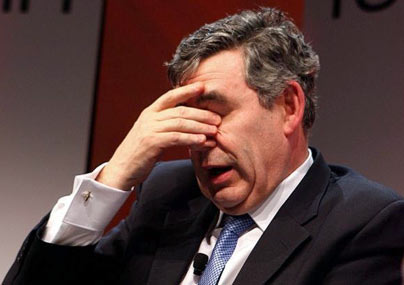 British Prime Minister criticizes David Cameron over schooling
As the old saying tells us, only two things in life are certain: death and taxes. While controversial in separate, the two topics couldn't help but be doubly controversial in combination.
Likewise, class is a particularly controversial topic.
British Prime Minister Gordon Brown recently stumbled upon a way to combine all three topics while commenting on British Conservative Party leader David Cameron's plans to reform the inheritance tax, which currently accounts for 0.8% of the British government's revenue.
Insisting that Cameron's plans to reform the tax would cost the treasury two billion pounds, Brown also took the opportunity to needle Cameron about where he and his advisor went to school.
"I have to say, that with you and Mr [Zach] Goldsmith your inheritance tax policy seems to have been dreamed up on the playing fields of Eton," Brown told the House of Commons.
Cameron, for his own part, is having none of it.
"My view is very simple," Cameron later explained. "What people are interested in is not where you come from but where you're going to, what you've got to offer, what you've got to offer the country."
"Now if Gordon Brown and Mandelson and the rest, if they want to fight a class war, fine, go for it," he continued. "It doesn't work."
Brown's comments may reflect frustrations with his current predicament. With his governing Labour Party continuing to trail the British Tories in the polls and the Prime Minister's influence within his own country waning, class tensions may be one of the few wedge issues Brown has to exploit.
"It's a petty, spiteful, stupid thing to do but if that's what they want to do, you know, go ahead," Cameron said.
"Frankly I think the country is more interested in who are these people, are they any good, have they got the right ideas, will they take the country forward, have they got the energy and vigour and dynamism that we so badly need?" he continued. "And the answer to those questions I believe is yes. But the best way to test it, you know what? Have an election."
At this particular point the election ball is entirely in Brown's court. He must call an election no later than June 3rd, 2010. When he does, he will dribble the ball out to face a veritable gauntlet.
Expectations are that Cameron will win a majority government, if not a dominant majority.
Brown's class-based ruminations certainly won't help.
None of this is to say that Cameron's plans for the inheritance tax couldn't stand to be improved. Cutting taxes on inheritances of less than one million pounds would leave more money in the hands of average Britons while not depriving the state of revenue from wealthy estates.
But even then, some of the provisions of the inheritance tax -- such as taxing any gifts the deceased made during the seven years years prior to their death -- are, frankly, draconian and ought to be done away with in no uncertain terms.
But Gordon Brown isn't doing himself any favours with these recent antics.
Saturday, December 05, 2009
How to Play to Your Base (At The Expense of Truth and Logic)
Antonia Zerbisias recycles discredited rhetoric
If there's anything that Canadians can learn from observing the most fervently ideological amongst its media personalities, it's that virtually anything can be treated as true, so long as it's repeated often and insistently enough.
The most recent case in point has been the exaggerated controversy over the Conservative Party's move to -- with the support of MPs from the Liberal Party and the NDP -- abolish the federal long gun registry.
Antonia Zerbisias has gone particularly ape shit over the matter. Zerbisias, along with Heather Mallick and a few public activists, has pretended that the issue is actually one of gender politics, not one of an ineffectual public safety policy being committed to its rightful place on the ash heap of history.
In a column recently published in the Toronto Star, Zerbisias practically labels Minister for the Status of Women Helena Guergis and Candice Hoeppner as traitors to their gender:
There is simply no way that Zerbisias and her compatriots don't know full well that what they are making here is a correlational argument, and that correlation itself is not causation.
The decrease in these homicides could be just as easily linked to anything else that took place in the years since 1995, when the federal Firearms Act was passed. Such as the other measures passed at the same time.
One of the things that Zerbisias and her compatriots tend to omit when discussing the long gun registry is the institution of what was then harsher penalties for crimes involving guns, and the institution of Possession and Acquisition Licenses, that put further requirements in place for gun ownership, and made it more possible to keep guns out of the hands of dangerous individuals.
The gun registry merely kept a record of who could own guns. It did nothing to prevent an unbalanced individual from pointing their gun at a human being -- male or female -- and pulling the trigger.
This became painfully evident on September 13, 2006 when Kimveer Gill stormed Montreal's Dawson College and shot 19 people, one of whom died. Gill perpetrated that shooting with a registered gun.
Oddly enough, Neville voted against a bill that would have toughened the penalties for gun crime even further.
One shouldn't expect these little factoids to appear to Zerbisias. She's too busy using the memories of those killed in the L'Ecole Polytechnique massacre to promote the long gun registry as a matter of gender politics.
Antonia Zerbisias would have invented herself an enemy, one way or another. It just helps that there are some women willing to reject Zerbisias' absurd concept of gender politics.
If there's anything that Canadians can learn from observing the most fervently ideological amongst its media personalities, it's that virtually anything can be treated as true, so long as it's repeated often and insistently enough.
The most recent case in point has been the exaggerated controversy over the Conservative Party's move to -- with the support of MPs from the Liberal Party and the NDP -- abolish the federal long gun registry.
Antonia Zerbisias has gone particularly ape shit over the matter. Zerbisias, along with Heather Mallick and a few public activists, has pretended that the issue is actually one of gender politics, not one of an ineffectual public safety policy being committed to its rightful place on the ash heap of history.
In a column recently published in the Toronto Star, Zerbisias practically labels Minister for the Status of Women Helena Guergis and Candice Hoeppner as traitors to their gender:
"If it weren't so hypocritical, it would be hysterical.For Zerbisias, this almost certainly isn't bad enough. It's just one sign of Guergis, Hoeppner and the Conservative Party rejecting the colonization of government policy by gender/identity politics.
On Wednesday, at a Parliament Hill ceremony marking the 20th anniversary of the Dec. 6 massacre at Montreal's L'École Polytechnique, Conservative MP Candice Hoeppner co-starred in Status of Women minister Helena Guergis's show of sympathy.
Bad enough that, last month, Guergis voted for Bill C-391, the legislation that aims to kill the long-gun registry and Hoeppner was the one to introduce it in the House."
"No wonder that Status of Women committee members Anita Neville (L-Winnipeg South Centre), Irene Mathyssen (NDP-London- Fanshawe) and the Bloc's warrior queen of women's rights, Nicole Demers (Laval), boycotted the ceremony.And of course if Anita Neville says it, it simply must be true! After all, it isn't as if the Liberal Party critic for the Status of Women has anything to gain politically from criticizing the Conservative government, even on something as fundamental as a memorial service.
As Neville told me Wednesday, 'The Conservatives' record on women has just been abominable.'"
"Never mind that, since the registry was introduced in the mid-'90s, the number of women killed by their rifle-wielding partners has dropped significantly. But, even with the registry, Statistics Canada reports, one out of three femicide victims is still killed by a rifle-wielding partner."At this point, there is simply no way that Zerbisias and her compatriots don't know full well that they can demonstrate no causal link between the long gun registry and this decrease in homicides involving guns.
There is simply no way that Zerbisias and her compatriots don't know full well that what they are making here is a correlational argument, and that correlation itself is not causation.
The decrease in these homicides could be just as easily linked to anything else that took place in the years since 1995, when the federal Firearms Act was passed. Such as the other measures passed at the same time.
One of the things that Zerbisias and her compatriots tend to omit when discussing the long gun registry is the institution of what was then harsher penalties for crimes involving guns, and the institution of Possession and Acquisition Licenses, that put further requirements in place for gun ownership, and made it more possible to keep guns out of the hands of dangerous individuals.
The gun registry merely kept a record of who could own guns. It did nothing to prevent an unbalanced individual from pointing their gun at a human being -- male or female -- and pulling the trigger.
This became painfully evident on September 13, 2006 when Kimveer Gill stormed Montreal's Dawson College and shot 19 people, one of whom died. Gill perpetrated that shooting with a registered gun.
Oddly enough, Neville voted against a bill that would have toughened the penalties for gun crime even further.
One shouldn't expect these little factoids to appear to Zerbisias. She's too busy using the memories of those killed in the L'Ecole Polytechnique massacre to promote the long gun registry as a matter of gender politics.
"For a frigid few days, I followed the panel around rural Quebec, where it heard horror stories from women whose partners took advantage of their isolation to terrorize and torture them.Once again, this is the kind of thing the long gun registry has done nothing to prevent. Although putting more police officers on Canadian streets certainly could.
There were testimonies from local social services groups recounting terrible murders. Meanwhile, back in the Montreal area, women were being picked off at an alarming rate by former spouses, even those served with restraining orders."
"One of the things that many of the gun nuts espouse is more guns – for women. As they say, "You can't rape a .38.''This is easily the most provocative statement Zerbisias makes in the course of this column. She neglects to mention that such an act would quickly (and rightly) be ruled to have been committed in self-defense. No proper-thinking judge or jury in the country would dare convict. (Unless that judge was liberal supporter. Thankfully, they don't appoint people that stupid to the bench. -ed)
That may be true if you're walking your dog or coming home from work late at night, but it's going to land you a murder charge if you pull the trigger while being 'date raped.'"
"n any case, it's pretty tough to be packing, say, in an aerobics class, especially when the assassin sneaks in, turns off the lights and starts firing – which is what happened in Pittsburgh this summer when three women were killed and many others injured.Zerbisias also neglects to mention -- or simply fails to understand -- that women in social housing, or on welfare, are not economically independent. But that's only one of the failures in basic logic Zerbisias commits in her column.
What's more, there's no guarantee that an abused wife could actually get a gun, or not get it used against her.
Research shows that the determining factor in preventing most violence against women is helping them to be economically independent, through secure employment with appropriate benefits and fair wages, or decent rates of welfare, adequate social housing and daycare."
"Little of which is forthcoming from the Conservative government."On the contrary, the Conservative government put far more of these things in place, when they shifted the Status of Women's mandate away from reasearch and advocacy and toward providing actual services -- like job training -- to women in their communities.
"That said, it has bumped up funding to some shelters this year. But that does nothing to head off violence."Neither does the long gun registry.
"In fact, according to Neville, 'Their whole focus on violence against women is what one colleague refers to as `after the gavel.' That means putting more people in jail, harsher sentences, mandatory minimums, that kind of thing.'"This is still a superior approach than the preceding approach, which largely focused on using cosmetic legislation as a bullwark around which they could build an ideological program -- one that even some of the most fervent supporters of the long gun registry admit is purely symbolic.
"Or as Hoeppner recently said in committee: 'The best thing we can do to protect women is to make sure that people who commit crimes against them go to jail and stay there for as long as they need to.' Which, not only closes the slammer door after the deed has been done, it does nothing to get women out of dangerous situations and into self-sufficient lives."Interestingly enough, neither do social housing or welfare. Once again, what Zerbisias makes up for in ideology, she lacks in basic reasoning skills.
"As for Guergis, well, although her resumé includes many years of volunteering at Barrie's Rape Crisis Centre, she just tiptoes the party line.Maybe the answer to this question doesn't truly matter. Ideologues specialize in attracting and inventing enemies.
With girlfriends like these, who needs enemies?"
Antonia Zerbisias would have invented herself an enemy, one way or another. It just helps that there are some women willing to reject Zerbisias' absurd concept of gender politics.
Got Beef?
As politics becomes more and more acrimonious, it becomes alarming how intensely personal political differences can become.
While some countries -- like, famously, Japan -- Parliamentary politics has crossed that boundary between verbal and physical violence, there are few cultural spheres in which words can translate into violence as quickly as in hip hop music.
Fortunately, Canadian parliaments haven't devolved into violence -- although at least one party leader, Richard Coliver of the Saskatchewan Progressive Conservative Party, has been beaten up by a political opponent (according to certain accounts, he may have actually deserved it).
While in politics the matter of contention is expected to be issues and ideas, the matter of contention in hip hop -- particularly in gangsta rap -- tends to be matters of status and dominance. Whoever can insult their opponent better -- or just threaten them more harshly -- tends to be considered the winner.
Like in politics, the key to victory in a rap beef is not necessarily in getting the last word, but in getting the definitive word. But one shouldn't confuse the definitive word within one's particular camp with a decisive victory. One can get what one's own camp considers to be the definitve word, but when one steps outside of that particular group, find a very different reality.
Although, one hopes that politics never becomes quite that personal.
Friday, December 04, 2009
Panic! Panic! Panic, Panic, Panic!
 Murray Dobbin: Stephen Harper = Ronald Reagan
In a recent column published on Rabble.ca, Murray Dobbin produces what seems to be the result of many a cold-sweat soaked night, in which Dobbin has dreamed visions of Stephen Harper as Ronald Reagan, and suffered nightmares of the ignominity of Harper refuting Dobbin's ideological vision for the country.
"As I watch with alarm Stephen Harper's lead over the Liberals solidify, even as he displays contempt for climate change efforts, and disdain for parliament, I am reminded of Ronald Reagan. What I remember is this: on almost every major issue on which he took a strong public stand, he was opposed by a majority of Americans. But that did not stop them from supporting him, giving him high ratings as President -- and re-electing him."As in so many cases, Dobbin's memory is clearly extremely selective. A perusal of Ronald Reagan's approval ratings -- the best indicator of how much the American people supported him -- there were only two times at which a majority of Americans opposed him: during the high unemployment of January, 1983 (42% approval) and during the Iran-Contra affair (44% approval).
During the remainder of his Presidency, Reagan's approval numbers never dropped below 64%. His disapproval rating would never climb above 28%.
Likewise, Harper's polling lead in leadership categories only continues to grow. Dobbin insists that a majority of Canadians oppose him. Unfortunately for his thesis, the majority of Canadians have yet to back him up.
"What explains the contradiction?"Perhaps that the contradiction doesn't exist?
No, that can't be good enough for Dobbin.
"Americans saw in Reagan a man who, specific policies aside, believed strongly in what he was doing. And conversely, they saw in the Democrats a party of shameless opportunists who would claim to believe in anything if it got them a few extra votes. They were tired of trying to decipher the complexities of the issues, tired of the spin, distrustful of government and the media. Their default position was to go with the guy who seemed to say what he meant and mean what he said. They were looking for someone with principles -- and apparently any principles would do."Of course, Dobbin seems to overlook the fact that Reagan governed during the 1980s -- the time of the famed "me generation".
The 1980s were known as a time of self-centred materialism in the United States. The truth is that Americans very likely appreciated Reagan's principles at the time. A socialiist as committed as Dobbin should be looking at this as a flaw of the United States of the day, not ignoring it for the purpose of making an ill-fitting argument.
If Dobbin wants to (mistakenly) equate the United States of the 1980s with the Canada of today, he at least seems to appreciate the significance of the principles of deficit some of Canada's political leaders.
"If Stephen Harper is Ronald Reagan then Michael Ignatieff seems destined to play the role of Hubert Humphrey or Bill Clinton or Al Gore -- Democrats with infinitely flexible principles and an ethical relativism that has degraded democratic politics in the US. The Liberal Party of Canada is the classic party of opportunism whose century of success as the natural governing party was predicated on running from the left with progressive policies, and then governing from the right, with policies designed to favour Bay Street. It worked so long as it was well-executed, and the party maintained internal unity and self discipline.Moreover, Canadians would be forgiven for not fully understanding where the Liberal party stands on a great number of issues. The federal Liberal Party opposed the HST before they were tenuously in favour of it. They were prepared to support the government before they wanted to defeat it. Ignatieff was in favour of tax cuts before he was opposed to them.
But now the Liberals are neither united nor disciplined. Paul Martin's ruthless ten year assault on his own party in aid of becoming its leader is still itself playing out in new incarnations of backstabbing and public disputes. So divided by the trench warfare between the two camps that no one within the ranks of party could lead it without being immediately assassinated, they went to the US recruit an outsider with no battle-baggage.
But what they got was a postmodern academic with no convictions that couldn't be trumped by particular circumstance. A human rights advocate who okays torture; a leader whose philosophy dictates that he can't feel strongly about anything -- for whom right and wrong are so intertwined he just can't be sure which is which."
And so on.
"Such a leader may well be incapable of fighting the pitbull ruthlessness of Stephen Harper whose passion for dismantling Canada knows no bounds. Ignatieff's persona is that of the effete snob personally offended by a man who refuses to play by the rules. But he can't adjust and recognize that it is Harper who is now making the rules and thus defining the landscape on which the battle takes place."But as Dobbin as previously indulged himself in forgetting, it wasn't Harper who made the new rules. It was actually Jean Chretien and Warren Kinsella.
Hell, Kinsella even wrote two whole books about it. (For fuck's sake, Murray! -ed)
More over, the pure ideological nature of Dobbin's panic shines through his bombast. Stephen Harper doesn't have a "passion for dismantling Canada". He has a competing vision for Canada which an increasing number of Canadians share. His vision challenges Dobbin's vision of Canada as an ideological left-wing construct. But this isn't a bad thing.
It's actually a good thing.
It's only natural that the scant praise Dobbin has for Ignatieff are on the occasions in which Ignatieff echoed Dobbin's vision of Canada as a left-wing ideological construct: as a high-tax state with a deeply embedded nany state, with arms of the government devoted to promoting the official state ideology.
"To his credit, Ignatieff has had some promising moments in the past few months -- as when he mused aloud about the necessity of (ultimately) raising taxes to deal with the structural deficit. But he didn't have the courage to stick to it and the media and his own party smacked him so hard he almost forgot he'd ever said it. And his messaging on Harper was dead on. He attacked him on the tax issue: 'We pay taxes, Mr Harper, because we're all in this together. It costs us something, but it makes Canada the place it is: a place where we look out for each other.' And he revealed the theme on which he should fight the next election: 'Stephen Harper ...believes that the only good government is no government at all.' He topped it off, at about the time he was going to force an election, with 'We can do better' which sounds a bit like 'A better world is possible,' the theme of the World Social Forums.The problem is that the Liberal Party and the NDP teamed up to wage this campaign three times before. On one occasion, they succeeded in preventing Harper from forming a government -- although the Liberals were able to win only a minority government.
Combine these themes -- and all the sub-themes they harbour -- with a campaign using Liberal veterans to tag Harper with all the frightening, anti-Canada statements he has made in the past, and Ignatieff would begin to claw back the ground he has lost in the past two months. And most importantly, he could claw it back from the radical libertarians how running the show, and not the NDP. But these gems come in fits and starts and there is no momentum."
On the next two tries, the Liberals were beaten.
It's been five years since the last federal election campaign in which fear-mongering was a successful tactic. Only an ideologue as foolish and boorish as Dobbin would actually advocate for political fear-mongering -- so long as it's directed at the "right" target.
"As for the NDP, it, too, is operating well below its potential. The longer Jack Layton is in Ottawa the more trapped he seems to become in the daily obsession with tactics. The NDP will never form the government (Quebec ensures this) and its strength therefore is squandered in this endless search for the perfect tactical maneuver. That game makes sense for the two contending parties but the NDP's strength is its vision (it's got to be there, probably locked up in a back room so it won't provoke anyone).And, of course, who cares if such tax cuts could help create jobs and bring the country closer to the NDP's laudable traditional goal of full employment?
The NDP has no coherent vision that it is willing to boast about, just a series of disconnected policies, some of them admittedly very good but all of them harnessed to the singular strategy of replacing the Liberals. This is the critical weakness of the NDP -- it has decided that it will present itself as the real government in waiting with Jack Layton as prime minister. This strategy all but destroys any possibility of appealing to Canadians on the basis of a hopeful vision of what the country could be. Inadvertently, the NDP hobbles itself in the contest for hearts and minds.
Instead of boldly contrasting itself with Harper's dystopic vision of the country and the ruination of Canada's international reputation, the NDP attacks the Liberals, acquiesces to policies such as Harper's draconian crime bills, and allows free votes on the long gun registry. Then there is Layton's personal musing about eliminating income taxes for small business (lost revenue: $5 billion a year)."
Clearly, not Dobbin. What really matters to Dobbin is all of the often-superfluous government programming the government could fund with that revenue, regardless of the fact that the job-creating stimulus of those tax cuts would help alleviate human poverty in the first place.
"The NDP seems so caught in the minutiae of tactical maneuvering that it cannot see the forest for the trees. The constant opportunist calculations are reducing the NDP to the ethical equivalent of the US Democratic Party (one party fundraiser even referred to the party as the Democratic Party even though the suggested name change was never debated at the party's convention). Their strategy of slowly replacing the Liberals is like slow suicide -- at the end of the process they will of necessity become the Liberals."It's on this note that Dobbin actually raises a worthy point.
Canada needs the NDP to serve as a credible alternative to the Liberal Party. But it will be nothing of the sort if it simply emulates the Liberal Party as closely as possible.
"Does being bold entail risks? Of course. Could the NDP lose seats in the next election? Yes, but they might anyway -- as they certainly would have done had there been a fall election. Wouldn't it be better to risks seats by being bold and visionary, inspiring Canadians to think big, rather than risk them racing to the bottom with the Liberals assuming Canadians are too dull and unimaginative to reclaim their country?Of course, so few Canadians are aware that their country is in such peril!
If neither the Liberals nor the NDP find the courage to present a vision to the country and redefine the political discourse, it is virtually certain that Stephen Harper will be prime minister after the next election. But if even one of them manages, they could save the country."
How could this be?
Oh, right. That's because the country is not in peril. Murray Dobbin and Michael Byers' vision of Canada as a left-wing ideological construct very much is in peril, but that's actually a good thing.
At far-left websites like Rabble, however, the sense of panic is absolutely palpable. Murray Dobbin seems to think it's his responsibility to spread that panic so he can advocate a "stop Stephen Harper at all costs" crusade.
The problem for Dobbin is that as long as the Conservative Party's poll numbers continue to climb, it seems that fewer and fewer Canadians want Harper to be stopped, or even to stop.
In the meantime, the only option Dobbin seems to have is to try to spread anti-conservative panic, even if fewer and fewer Canadians are listening.
Thursday, December 03, 2009
Antonia Zerbisias and the Anti-Abortion Bogeyman
Zerbisias weaves anti-abortion conspiracy theory
If there's any one issue that spins Canada's Lunatic Left into a frenzy, it's the abortion issue.
Writing in her column at the Toronto Star, Antonia Zerbisias suggests that the Conservative Party has concocted an elaborate conspiracy to conceal its true stance on the issue of abortion.
Despite the fact that Prime Minister Stephen Harper intervened to derail Bill C-484 -- the Unborn Victims of Crime Bill, a bill that had nothing to do with abortion but was still deemed unacceptable by Canada's pro-abortion movement -- Zerbisias insists that Harper is secretly plotting against a woman's right to choose.
"I don't believe him when he talks about reopening the abortion debate," Zerbisias writes. "Not that it has ever really been closed."
The evidence Zerbisias offers? That some members of the Conservative caucus have their own opinion on the matter of abortion; opinions that conflict with her own.
"His credibility isn't helped by Conservative caucus members who constantly harp on the subject by introducing private member's bills, making speeches, attending pro-life rallies and putting out news releases," Zerbisias writes, as if Harper ought to be whipping his MPs into not making such speeches or attending such events.
(What she thinks Opposition leaders should do with MPs who attend pro-abortion rallies and make pro-abortion speeches goes unstated, yet remains perfectly obvious.)
In particular, Zerbisias takes exception to Saskatoon-Wanuskewin MP Maurice Vellacott.
"Vellacott stepped in it once again last month when he put out a release commending local doctors for 'reducing the availability of abortion in our city,'" Zerbisias fumes. "It came in response to news that Saskatoon women had to leave town to terminate their pregnancies."
What Zerbisias declines to mention is that it's the doctors themselves that are exercising some restraint in regards to late-term abortion. (Of course, the matter of the doctor's right to choose has been a difficult matter for the "pro-choice" movement. They generally tend to oppose it.)
Zerbisias also fumes at the notion that Vellacott would even mention studies that have suggested that abortion may pose health problems for women later in life.
"As if this weren't unsympathetic enough to the plight of scared teenagers and desperate women, Vellacott added that 'a growing body of research reveals significant health problems caused by abortion, including a greater risk of breast cancer, cervical lacerations and injury, uterine perforations, hemorrhage, and serious infection,'" Zerbisias writes. "This is not only incorrect, it's pure propaganda espoused by those who would rather that pregnant women act as walking incubators for all those couples on adoption waiting lists."
Not only does Zerbisias draw a lunatic conclusion, but as it turns out she's wrong.
Chinese studies, where abortion isn't stigmatized like in North America and so is more likely to be self-reported in the course of such studies, have suggested at least a higher correlation between abortion and breast cancer later in life.
At best, Vellacott is mistaking correlation for causation. Further study would be necessary to determine a causational relationship -- studies which the pro-abortion movement have, oddly enough, also tended to oppose.
Despite these studies, Zerbisias seems to insist that Harper ought to force Vellacott to apologize. Failing that, Zerbisias seems to think that either Harper himself or Helena Guergis should apologize for Vellacott's opinion.
And as eager as Zerbisias is to criticize Vellacott for what turns out to actually be accurate statements, Zerbisias is more than willing to twist or dismiss any factoids that don't support her particular point of view.
"Coincidentally, or not, all this happened just as the Ottawa-based 'educational' LifeCanada issued its survey on attitudes toward abortion. 'For the ninth year in a row, a majority of Canadians have rejected the status quo on abortion in this country,' its statement said. 'Over half say there should be legal protection for human life before birth and over two-thirds say abortions should only be paid for by taxpayers in medical emergencies or in cases of rape or incest,'" Zerbisias writes. "But a closer look at the numbers reveals that only 30 per cent of us feel there should be no abortion rights. The rest say that abortion should be available only up to various trimesters."
Which is still a rejection of the current abortion status quo, which Zerbisias' fellows in the pro-abortion movement support. That is, unless, they can shift matters even further toward their own particular desires.
And it's still in line with Maurice Vellacott's approval of the self-adopted abortion constraints in Saskatoon.
As to what Zerbisias thinks should be done about those constraints, that goes unstated in her column. It would certainly be interesting to know.
But beyond that, Antonia Zerbisias is trying to ascribe a position on abortion to Stephen Harper based on opinions that other people hold, and based on comments that other people have made.
Her hunt for an anti-abortion bogeyman may appeal to her base readership, but it's far less compelling to anyone with a rational mind.
From the archives:
November 25, 2009 - "The Philosophical Dilemma of 'Pro-Choice'"
September 25, 2009 - "Eeek! It's Christians! And They're Praying!"
If there's any one issue that spins Canada's Lunatic Left into a frenzy, it's the abortion issue.
Writing in her column at the Toronto Star, Antonia Zerbisias suggests that the Conservative Party has concocted an elaborate conspiracy to conceal its true stance on the issue of abortion.
Despite the fact that Prime Minister Stephen Harper intervened to derail Bill C-484 -- the Unborn Victims of Crime Bill, a bill that had nothing to do with abortion but was still deemed unacceptable by Canada's pro-abortion movement -- Zerbisias insists that Harper is secretly plotting against a woman's right to choose.
"I don't believe him when he talks about reopening the abortion debate," Zerbisias writes. "Not that it has ever really been closed."
The evidence Zerbisias offers? That some members of the Conservative caucus have their own opinion on the matter of abortion; opinions that conflict with her own.
"His credibility isn't helped by Conservative caucus members who constantly harp on the subject by introducing private member's bills, making speeches, attending pro-life rallies and putting out news releases," Zerbisias writes, as if Harper ought to be whipping his MPs into not making such speeches or attending such events.
(What she thinks Opposition leaders should do with MPs who attend pro-abortion rallies and make pro-abortion speeches goes unstated, yet remains perfectly obvious.)
In particular, Zerbisias takes exception to Saskatoon-Wanuskewin MP Maurice Vellacott.
"Vellacott stepped in it once again last month when he put out a release commending local doctors for 'reducing the availability of abortion in our city,'" Zerbisias fumes. "It came in response to news that Saskatoon women had to leave town to terminate their pregnancies."
What Zerbisias declines to mention is that it's the doctors themselves that are exercising some restraint in regards to late-term abortion. (Of course, the matter of the doctor's right to choose has been a difficult matter for the "pro-choice" movement. They generally tend to oppose it.)
Zerbisias also fumes at the notion that Vellacott would even mention studies that have suggested that abortion may pose health problems for women later in life.
"As if this weren't unsympathetic enough to the plight of scared teenagers and desperate women, Vellacott added that 'a growing body of research reveals significant health problems caused by abortion, including a greater risk of breast cancer, cervical lacerations and injury, uterine perforations, hemorrhage, and serious infection,'" Zerbisias writes. "This is not only incorrect, it's pure propaganda espoused by those who would rather that pregnant women act as walking incubators for all those couples on adoption waiting lists."
Not only does Zerbisias draw a lunatic conclusion, but as it turns out she's wrong.
Chinese studies, where abortion isn't stigmatized like in North America and so is more likely to be self-reported in the course of such studies, have suggested at least a higher correlation between abortion and breast cancer later in life.
At best, Vellacott is mistaking correlation for causation. Further study would be necessary to determine a causational relationship -- studies which the pro-abortion movement have, oddly enough, also tended to oppose.
Despite these studies, Zerbisias seems to insist that Harper ought to force Vellacott to apologize. Failing that, Zerbisias seems to think that either Harper himself or Helena Guergis should apologize for Vellacott's opinion.
And as eager as Zerbisias is to criticize Vellacott for what turns out to actually be accurate statements, Zerbisias is more than willing to twist or dismiss any factoids that don't support her particular point of view.
"Coincidentally, or not, all this happened just as the Ottawa-based 'educational' LifeCanada issued its survey on attitudes toward abortion. 'For the ninth year in a row, a majority of Canadians have rejected the status quo on abortion in this country,' its statement said. 'Over half say there should be legal protection for human life before birth and over two-thirds say abortions should only be paid for by taxpayers in medical emergencies or in cases of rape or incest,'" Zerbisias writes. "But a closer look at the numbers reveals that only 30 per cent of us feel there should be no abortion rights. The rest say that abortion should be available only up to various trimesters."
Which is still a rejection of the current abortion status quo, which Zerbisias' fellows in the pro-abortion movement support. That is, unless, they can shift matters even further toward their own particular desires.
And it's still in line with Maurice Vellacott's approval of the self-adopted abortion constraints in Saskatoon.
As to what Zerbisias thinks should be done about those constraints, that goes unstated in her column. It would certainly be interesting to know.
But beyond that, Antonia Zerbisias is trying to ascribe a position on abortion to Stephen Harper based on opinions that other people hold, and based on comments that other people have made.
Her hunt for an anti-abortion bogeyman may appeal to her base readership, but it's far less compelling to anyone with a rational mind.
From the archives:
November 25, 2009 - "The Philosophical Dilemma of 'Pro-Choice'"
September 25, 2009 - "Eeek! It's Christians! And They're Praying!"
Wednesday, December 02, 2009
L'Ecole Polytechnique: Martyrs To An Embedded Ideology?
Opposition MPs boycott remembrance ceremony
One would expect that any of Canada's MPs would be eager to take any opportunity to respect the memory of the 14 women killed by Marc Lepine during the 1989 L'Ecole Polytechnique shootings.
But apparently, not so much. Numerous female MPs from the NDP, Liberal Party and Bloc Quebecois opted to skip a recent non-partisan memorial for the victims of the shooting over their outrage at the Conservative Party eliminating various ideological elements of Canadian policy.
The Conservative Party eliminated the Court Challenges Program, shifted the mandate of the Status Of Women away from research and advocacy (and toward providing actual services for women), and recently passed legislation -- with the help of numerous Liberal and NDP MPs -- to abolish the long gun registry.
The missing MPs excused their absence by citing their outrage at these moves.
 "We consider this a hypocritical gesture because her government has shown itself from the beginning to be hostile to all women's demands," complained Bloc MP Nicole Demers.
"I find it difficult to stand beside a minister who chooses not to advocate for women, who chooses to follow the party line, who chooses to endorse the elimination of the long-gun registry." added Liberal MP Anita Neville.
Of course, what Demers declines to consider is that the demands of the groups funded by the Status of Women hardly represent the desires of all women, and what Neville declines to consider is that the long-gun registry has failed to keep guns out of the hands of unstable individuals like Kimveer Gill, who perpetrated the Dawson College shooting.
It couldn't have kept the hunting rifle out of the hands of Marc Lepine. Because it isn't gun control.
The Harper government's moves outrage individuals like Demers and Neville because it was a refutation of the ideology that lies at the core of what Barry Cooper describes as the embedded state, and with the character of the politics of public virtue that it entails.
Individuals like Demers and Neville seem to feel entitled to government organs designed to advance their particular ideology. But the role of government is not to advance any particular ideology.
In refusing to attend a remembrance ceremony based on these things, Demers, Neville and their fellow absentee MPs have expressed their intent to use the victims of the L'Ecole Polytechnique shootings as martyrs for what they believe should be the embedded ideology of the Canadian state.
That's an excessively poor use for the memory of a national tragedy.
One would expect that any of Canada's MPs would be eager to take any opportunity to respect the memory of the 14 women killed by Marc Lepine during the 1989 L'Ecole Polytechnique shootings.
But apparently, not so much. Numerous female MPs from the NDP, Liberal Party and Bloc Quebecois opted to skip a recent non-partisan memorial for the victims of the shooting over their outrage at the Conservative Party eliminating various ideological elements of Canadian policy.
The Conservative Party eliminated the Court Challenges Program, shifted the mandate of the Status Of Women away from research and advocacy (and toward providing actual services for women), and recently passed legislation -- with the help of numerous Liberal and NDP MPs -- to abolish the long gun registry.
The missing MPs excused their absence by citing their outrage at these moves.
"We consider this a hypocritical gesture because her government has shown itself from the beginning to be hostile to all women's demands," complained Bloc MP Nicole Demers."I find it difficult to stand beside a minister who chooses not to advocate for women, who chooses to follow the party line, who chooses to endorse the elimination of the long-gun registry." added Liberal MP Anita Neville.
Of course, what Demers declines to consider is that the demands of the groups funded by the Status of Women hardly represent the desires of all women, and what Neville declines to consider is that the long-gun registry has failed to keep guns out of the hands of unstable individuals like Kimveer Gill, who perpetrated the Dawson College shooting.
It couldn't have kept the hunting rifle out of the hands of Marc Lepine. Because it isn't gun control.
The Harper government's moves outrage individuals like Demers and Neville because it was a refutation of the ideology that lies at the core of what Barry Cooper describes as the embedded state, and with the character of the politics of public virtue that it entails.
Individuals like Demers and Neville seem to feel entitled to government organs designed to advance their particular ideology. But the role of government is not to advance any particular ideology.
In refusing to attend a remembrance ceremony based on these things, Demers, Neville and their fellow absentee MPs have expressed their intent to use the victims of the L'Ecole Polytechnique shootings as martyrs for what they believe should be the embedded ideology of the Canadian state.
That's an excessively poor use for the memory of a national tragedy.
Tuesday, December 01, 2009
No, It Doesn't -- And It Isn't About Gender
Heather Mallick has a bizarre & inflated sense of gun registry's effectiveness
As the 20th anniversary of the 1989 L'Ecole Polytechnique, the ideological stalwarts of Canada's left wing are milking it for as much as the memory of the 14 killed are worth.
In the case of Heather Mallick, her cause is the long gun registry. In her most recent column published at the CBC website -- which seems to break the moritorium on allowing her to publish there on serious matters following her Mighty Wind debacle -- Mallick reminds readers that Marc Lepine, the perpetrator of the shooting, used a hunting rifle to kill his victims.
"Lépine used a Ruger Mini-14, the kind of gun normally used by hunters to kill gophers, groundhogs and rabbits," Mallick recounts. "It's a comfortable gun, lightweight with little recoil, and it's semi-automatic, which means it fires without complications every time you pull the trigger (especially effective with a larger magazine of 20 bullets). It's very accurate to begin with, but in a classroom, experts say, you couldn't miss if you tried. And Lépine, a hater of all women, especially police officers and prominent successful women, did not."
Mallick's sense of gender self-importance cuts not only to the core of her feelings about L'Ecole Polytechnique (this would be only natural). But her feelings of gender self-importance also seem to cut to the core of the gun registry itself, as she seems to imagine that support for the long gun registry is rooted in machismo.
"The registry requires only this: If you buy or own a gun — and this includes rifles used by farmers and hunters, firing range enthusiasts, etc — it must be registered," Mallick writes. "It won't be confiscated, but law enforcement officials will know you have it. Is this so damaging to one's own personal notion of one's manhood?"
Right. Support for the abolition of the gun registry isn't based on not wanting to see the government continue to waste money on programs, masquerading as gun control, that do absolutely nothing to accomplish their goal, but on male preoccupation with their own masculinity.
Or, there's the matter of shame.
"There's no reason to be ashamed of owning a rifle if you live rurally and make rural excursions, and no reason to object to registering your gun the same way you register your car, house, boat, dog and cat," Mallick continues. "You often register major purchases in case they turn out to be faulty. The city inspects your house to make sure it's reliably built, your life insurer knows your health status, your home insurer prowls around, and doctors regularly probe your cavities and press your tender areas for signs of cancer."
Of course, we don't do any of these things under the false impression that doing so will protect us from crime, or protect others from us. As a matter of fact, the people who Canadians need protection from simply don't register their weapons.
Mallick evidently knows the gun issue as poorly as she knows gun owners.
When appeals to emotion aren't sufficient for Mallick, however, she falls back on twisting or distorting the facts.
"In 2009, police made an average 10,800 calls a day to find out registry information," Mallick writes.
Except, Mallick doesn't mention that police are logged onto the gun registry every time they log onto their onboard computer systems. So while some of the calls to the gun registry may well be to get information about particular guns, calls in which the express purpose of the call number far, far fewer than the nearly 11,000 Mallick claims.
When Mallick fails to impress with her razor-thin emotion-based appeals, she simply shows her contempt for the teeming rural masses.
"As Stephen Hume wrote this month in the Vancouver Sun, the loud, endlessly complaining rural minority doesn't understand the facts about gun deaths," Mallick writes.
But Mallick would be mistaken in suggesting that the gun registry is opposed only by a "rural minority". In fact, only in Quebec do a majority of Canadians favour maintaining the registry.
In fact, as it turns out, it's the pro-registry minority that are loud. And far more often than necessary, they're pretending that the long gun registry is a matter of gender politics.
It's not about gender politics. And individuals like Heather Mallick need to learn that it isn't all about them.
As the 20th anniversary of the 1989 L'Ecole Polytechnique, the ideological stalwarts of Canada's left wing are milking it for as much as the memory of the 14 killed are worth.
In the case of Heather Mallick, her cause is the long gun registry. In her most recent column published at the CBC website -- which seems to break the moritorium on allowing her to publish there on serious matters following her Mighty Wind debacle -- Mallick reminds readers that Marc Lepine, the perpetrator of the shooting, used a hunting rifle to kill his victims.
"Lépine used a Ruger Mini-14, the kind of gun normally used by hunters to kill gophers, groundhogs and rabbits," Mallick recounts. "It's a comfortable gun, lightweight with little recoil, and it's semi-automatic, which means it fires without complications every time you pull the trigger (especially effective with a larger magazine of 20 bullets). It's very accurate to begin with, but in a classroom, experts say, you couldn't miss if you tried. And Lépine, a hater of all women, especially police officers and prominent successful women, did not."
Mallick's sense of gender self-importance cuts not only to the core of her feelings about L'Ecole Polytechnique (this would be only natural). But her feelings of gender self-importance also seem to cut to the core of the gun registry itself, as she seems to imagine that support for the long gun registry is rooted in machismo.
"The registry requires only this: If you buy or own a gun — and this includes rifles used by farmers and hunters, firing range enthusiasts, etc — it must be registered," Mallick writes. "It won't be confiscated, but law enforcement officials will know you have it. Is this so damaging to one's own personal notion of one's manhood?"
Right. Support for the abolition of the gun registry isn't based on not wanting to see the government continue to waste money on programs, masquerading as gun control, that do absolutely nothing to accomplish their goal, but on male preoccupation with their own masculinity.
Or, there's the matter of shame.
"There's no reason to be ashamed of owning a rifle if you live rurally and make rural excursions, and no reason to object to registering your gun the same way you register your car, house, boat, dog and cat," Mallick continues. "You often register major purchases in case they turn out to be faulty. The city inspects your house to make sure it's reliably built, your life insurer knows your health status, your home insurer prowls around, and doctors regularly probe your cavities and press your tender areas for signs of cancer."
Of course, we don't do any of these things under the false impression that doing so will protect us from crime, or protect others from us. As a matter of fact, the people who Canadians need protection from simply don't register their weapons.
Mallick evidently knows the gun issue as poorly as she knows gun owners.
When appeals to emotion aren't sufficient for Mallick, however, she falls back on twisting or distorting the facts.
"In 2009, police made an average 10,800 calls a day to find out registry information," Mallick writes.
Except, Mallick doesn't mention that police are logged onto the gun registry every time they log onto their onboard computer systems. So while some of the calls to the gun registry may well be to get information about particular guns, calls in which the express purpose of the call number far, far fewer than the nearly 11,000 Mallick claims.
When Mallick fails to impress with her razor-thin emotion-based appeals, she simply shows her contempt for the teeming rural masses.
"As Stephen Hume wrote this month in the Vancouver Sun, the loud, endlessly complaining rural minority doesn't understand the facts about gun deaths," Mallick writes.
But Mallick would be mistaken in suggesting that the gun registry is opposed only by a "rural minority". In fact, only in Quebec do a majority of Canadians favour maintaining the registry.
In fact, as it turns out, it's the pro-registry minority that are loud. And far more often than necessary, they're pretending that the long gun registry is a matter of gender politics.
It's not about gender politics. And individuals like Heather Mallick need to learn that it isn't all about them.
Monday, November 30, 2009
Are They Protesting Because They're Women, or Because They're Civil Servants?
Public Servant Alliance protests abolition of long gun registry
There's something about the long gun registry that renders Canada's left wing entirely irrational.
This was prominently on display recently, as the Public Servant Alliance of Canada protested at the office of Sackville-Eastern Shore MP Peter Stoffer (NDP), who recently voted in favour of abolishing the long gun registry.
The problem is that the small crowd of 25 women -- chanting "we will not be silent," -- pretended they were protesting Stoffer's vote under the pretenses of feminism.
"To think that a woman's life might be worth less than being able to bag a deer easily is unreal and it's a sad state of affairs that we're in this year marking the 20th anniversary of the Montreal massacre by abolishing the long-gun registry," complained Lori Walton, who is also planning a commemorative vigil for the victims of the L'Ecole Polytechnique shooting.
Walton and the PSAC aren't the only ones to try to make this argument. Antonia Zerbisias recently attempted the same feat, less than a month after a column in which she fibbed about the weapons used to kill the Mayerthorpe four.
Zerbisias argued that "Poll after poll has shown that women, including rural women, overwhelmingly supported the long-gun registry."
But polls have also shown that the majority of Canadians favour abolishing the registry. Only in Quebec did a majority favour maintaining it.
And just while only in the minds of Zerbisias and her followers do the various insular activist groups who purport to speak for all Canadian women actually represent all of Canada's women, only in the mind of Zerbisias should a majority of women count for more than the majority of all Canadians.
But even while the protesters at Stoffer's office pretended that they were there as women and not as public servants, they made their true motivations perfectly evident -- all while pretending that the gun registry is actually a tool of gun control.
"Dangerous people are refused their guns, which is what we should be doing. So yes, she does tell me a lot about the good that's coming out of it," said Anne Faban-Wood.
Of course, the fact that the gun registry doesn't keep guns out of the hands of dangerous people -- the perpetrator of the Dawson College shooting perpetrated the act with a registered weapon -- seems entirely lost on these people. But even in the face of this inconsistency, people like Faban-Wood make themelves entirely transparent.
The "she" Wood talks about is actually her sister, who works on the registry.
Which is really what the long gun registry is about to the Public Service Alliance of Canada.
While, to people like Antonia Zerbisias, the long gun registry is a program of left-wing ideological welfare, to the PSAC it's simply a matter of bureaucratic welfare.
There's something about the long gun registry that renders Canada's left wing entirely irrational.
This was prominently on display recently, as the Public Servant Alliance of Canada protested at the office of Sackville-Eastern Shore MP Peter Stoffer (NDP), who recently voted in favour of abolishing the long gun registry.
The problem is that the small crowd of 25 women -- chanting "we will not be silent," -- pretended they were protesting Stoffer's vote under the pretenses of feminism.
"To think that a woman's life might be worth less than being able to bag a deer easily is unreal and it's a sad state of affairs that we're in this year marking the 20th anniversary of the Montreal massacre by abolishing the long-gun registry," complained Lori Walton, who is also planning a commemorative vigil for the victims of the L'Ecole Polytechnique shooting.
Walton and the PSAC aren't the only ones to try to make this argument. Antonia Zerbisias recently attempted the same feat, less than a month after a column in which she fibbed about the weapons used to kill the Mayerthorpe four.
Zerbisias argued that "Poll after poll has shown that women, including rural women, overwhelmingly supported the long-gun registry."
But polls have also shown that the majority of Canadians favour abolishing the registry. Only in Quebec did a majority favour maintaining it.
And just while only in the minds of Zerbisias and her followers do the various insular activist groups who purport to speak for all Canadian women actually represent all of Canada's women, only in the mind of Zerbisias should a majority of women count for more than the majority of all Canadians.
But even while the protesters at Stoffer's office pretended that they were there as women and not as public servants, they made their true motivations perfectly evident -- all while pretending that the gun registry is actually a tool of gun control.
"Dangerous people are refused their guns, which is what we should be doing. So yes, she does tell me a lot about the good that's coming out of it," said Anne Faban-Wood.
Of course, the fact that the gun registry doesn't keep guns out of the hands of dangerous people -- the perpetrator of the Dawson College shooting perpetrated the act with a registered weapon -- seems entirely lost on these people. But even in the face of this inconsistency, people like Faban-Wood make themelves entirely transparent.
The "she" Wood talks about is actually her sister, who works on the registry.
Which is really what the long gun registry is about to the Public Service Alliance of Canada.
While, to people like Antonia Zerbisias, the long gun registry is a program of left-wing ideological welfare, to the PSAC it's simply a matter of bureaucratic welfare.
Sunday, November 29, 2009
Dalton McGuinty Tightening the Screws on Government
 HST would eliminate options for an incoming government
A frequent criticism of Stephen Harper's government in Ottawa has been accusations that they're "tightening the screws" on government.
These were actually
the words of Tom Flanagan, who argued that the Conservative Party's tax cuts would limit the ability of future governments to start new programs.
Now, with Dalton McGuinty's Liberal government about to harmonize their provincial sales tax with the federal Goods and Services Tax -- with the help of Harper's federal government -- the Ontario Progressive Conservative Party, led by Tim Hudak, is opposing the move.
McGuinty seems to have found what he thinks will be his answer to the matter: challenge the Hudak Conservatives to commit to overturning the Harmonized Sales Tax should they form the government after Ontario's next election.
"I think Ontarians would be interested in knowing why it is that the leader of the Official Opposition is not prepared to repeal the HST," McGuinty recently told Queen's Park.
Of course, what McGuinty isn't giving the HST issue credit for is that, if implemented, it represents a negotiated tax agreement between the federal and provincial government. Each government receives a share.
Because the tax represents an agreement between the two government, it hampers the ability of either government to make reductions in that tax.
So, in its own sense, the passage of the HST -- whether it's a sound econcomic policy or not -- represents a tightening of the screws on government, committing the provincee to a particular taxation regime.
There's a very good reason why Tim Hudak and the Progressive Conservatives can't commit to abolishing the HST -- it's because the collaborative nature of the tax limits the options to do so.
Saturday, November 28, 2009
Friday, November 27, 2009
Take a Fucking Chill Pill, Buddy
Murray Dobbin doth protest far too much
In a recent column published on the ideologically parochial Rabble.ca, Murray Dobbin decries the "Republicanization of Canadian politics".
He claims that recent efforts by the Conservative Party to minimalize the increasingly-suspect testimony of Richard Colvin and recent mailings by the Conservative Party accusing the Liberal party as anti-Semitic are the signs of an unprecedented level of nastiness in Canadian politics:
The truth is that there's far more afoot on either one of these issues than Dobbin would like to let on. Just like any good ideological fundamentalist, he's more than happy to omit any little facts or details that don't support his worldview.
Most obvious about Dobbin's rantings is the absurdity of opposition parties trying to tar the Conservative Party with torture allegations in the first place. Individuals like Dobbin expect Canadians to conveniently forget that it was the Liberal Party who had negotiated the prisoner transfer agreement under which these abuses were allegedly taking place. ("Allegedly" being the key word.)
Dobbin is much closer to a justifiable argument on the anti-Semitism issue. Michael Ignatieff and Bob Rae are both known as good international friends of Israel. Irwin Cotler's efforts in support of Israel, as well as in support of the effort to bring Nazi War Criminals hiding in Canada to justice, are well-known and well-documented. To accuse the Liberal Party of being institutionally anti-Semitic simply stretches credulity.
But, then again, many of Dobbin's contemporaries have delighted in accusing the Reform Party -- one of the predecessors of the modern Conservative Party -- of being instituionally racist. They did this despite the fact that the Reform Party consistently presented the most racially-diverse caucus in the House of Commons, and did so without any kind of nomination quotas.
This particular fact didn't stop Gordon Laird, one of Dobbin's premier contemporaries, of fictionalizing racist incidents in his book Slumming It at the Rodeo.
In fact, accusations of racism have often proven to be very effective bread-and-butter issues for critics and opponents of the Conservative Party. To date, Dobbin's objection to this have been slim and none.
Perhaps Dobbin considers anti-Semitism to be a special and privileged breed of racism, of which no one may be accused if those accusations cannot be justified. Or perhaps he's simply content to smile wistfully to himself while similar accusations -- which are similarly unjustified -- are flung at his ideological rivals.
One of the leading purveyors of racial outrage for political benefit has been Warren Kinsella. Kinsella has specialized in an "even if they can show they aren't racist we can still peddle innuendo" argument.
Furthermore, Kinsella has written not one, but two books -- Kicking Ass in Canadian Politics and The War Room -- bragging about his role in bringing US-style attack politics to Canada.
Kinsella was also willing to dabble in a form of bigotry that Dobbin himself was extremely eager to engage in -- anti-religious bigotry.
For Kinsella, the target was Stockwell Day. For Dobbin, it was Preston Manning.
To pretend that the Conservative Party has never indulged in attack politics current Conservative Senator and former Party President Doug Finley is perfectly willing to admit to this.
"We built our brand while trying to damage theirs," Finley recently said. "Stephane Dion was a candidate from heaven. I would say our brand has gone from 17% (core support) to 30%. In other words, that percentage of voters will wake up in the morning and say they will vote Conservative. The Liberal brand has fallen from the mid-30s (core support) to about the mid-20s. As you can see, we have successfully branded Michael Ignatieff as out of touch and in it for himself. We have stopped him right in his tracks. And he hasn't helped himself with some of the gaffes he has made. He's a typical academic. He puts his nose up and talks without really thinking of the consequences of his words. I don't think they did due diligence on this guy."
But considering the depths to which Dobbin and his contemporaries on Canada's far left -- and among the campaign teams of Canada's mainstream left -- are willing to stoop, it's impossible to take him seriously.
After all, it's definitely wrong to baselessly accuse one's political opponents of being anti-Semitic. But it's also wrong to baselessly accuse one's political opponents of plotting to transform Canada into a military police state.
Dobbin's response to that? Again, slim and none.
Fortunately, the ad proved to be the death knell for the 2006 Liberal campaign. But previously, Canadians had swallowed this particular bit of fear mongering.
These facts made Gerard Kennedy's accusations that the Conservative party was campaigning based on fear purely laughable. And they make the next portion of Dobbin's rant seem even more so:
The truth is that the political thuggery that often characterizes Canadian politics already has been emulated by its former victims -- its former victims being the Conservative Party, both prior to and after the merger of the Progressive Conservative Party and the Canadian Alliance.
Certainly, that doesn't excuse the Conservative Party from following the same path. But, then again, there's a big difference between pointing out the lack of leadership skills of a Party leader (Stephane Dion) and impugning the citizenship of another (Michael Ignatieff). The latter is certainly far worse than the former.
But, by the same token, there's a bigger difference still between impugning the citizenship of a political leader and insinuating that one is planning to implement a military police state. Whether or not the latter is worse is a matter of some debate.
In a recent column published on the ideologically parochial Rabble.ca, Murray Dobbin decries the "Republicanization of Canadian politics".
He claims that recent efforts by the Conservative Party to minimalize the increasingly-suspect testimony of Richard Colvin and recent mailings by the Conservative Party accusing the Liberal party as anti-Semitic are the signs of an unprecedented level of nastiness in Canadian politics:
"Watching the sickening performances of the Harperites in the House of Commons this week -- out right lying, bullying, slander, contempt for the public and parliament, and a stunning disregard for the public good -- brings home a hard reality: we are witnessing the Republicanization of our political culture. And it's not just the torture issue -- it's the Conservative labeling of Liberals as anti-Semitic -- a kind of shit-house rat politics virtually unknown in Canadian political history. It wouldn't surprise me to find that Karl Rove is on the PMO's payroll; his disciples certainly are."But the truth is that Dobbin, like any good ideological fundamentalist, doth protest way too fucking much.
The truth is that there's far more afoot on either one of these issues than Dobbin would like to let on. Just like any good ideological fundamentalist, he's more than happy to omit any little facts or details that don't support his worldview.
Most obvious about Dobbin's rantings is the absurdity of opposition parties trying to tar the Conservative Party with torture allegations in the first place. Individuals like Dobbin expect Canadians to conveniently forget that it was the Liberal Party who had negotiated the prisoner transfer agreement under which these abuses were allegedly taking place. ("Allegedly" being the key word.)
Dobbin is much closer to a justifiable argument on the anti-Semitism issue. Michael Ignatieff and Bob Rae are both known as good international friends of Israel. Irwin Cotler's efforts in support of Israel, as well as in support of the effort to bring Nazi War Criminals hiding in Canada to justice, are well-known and well-documented. To accuse the Liberal Party of being institutionally anti-Semitic simply stretches credulity.
But, then again, many of Dobbin's contemporaries have delighted in accusing the Reform Party -- one of the predecessors of the modern Conservative Party -- of being instituionally racist. They did this despite the fact that the Reform Party consistently presented the most racially-diverse caucus in the House of Commons, and did so without any kind of nomination quotas.
This particular fact didn't stop Gordon Laird, one of Dobbin's premier contemporaries, of fictionalizing racist incidents in his book Slumming It at the Rodeo.
In fact, accusations of racism have often proven to be very effective bread-and-butter issues for critics and opponents of the Conservative Party. To date, Dobbin's objection to this have been slim and none.
Perhaps Dobbin considers anti-Semitism to be a special and privileged breed of racism, of which no one may be accused if those accusations cannot be justified. Or perhaps he's simply content to smile wistfully to himself while similar accusations -- which are similarly unjustified -- are flung at his ideological rivals.
One of the leading purveyors of racial outrage for political benefit has been Warren Kinsella. Kinsella has specialized in an "even if they can show they aren't racist we can still peddle innuendo" argument.
Furthermore, Kinsella has written not one, but two books -- Kicking Ass in Canadian Politics and The War Room -- bragging about his role in bringing US-style attack politics to Canada.
Kinsella was also willing to dabble in a form of bigotry that Dobbin himself was extremely eager to engage in -- anti-religious bigotry.
For Kinsella, the target was Stockwell Day. For Dobbin, it was Preston Manning.
To pretend that the Conservative Party has never indulged in attack politics current Conservative Senator and former Party President Doug Finley is perfectly willing to admit to this.
"We built our brand while trying to damage theirs," Finley recently said. "Stephane Dion was a candidate from heaven. I would say our brand has gone from 17% (core support) to 30%. In other words, that percentage of voters will wake up in the morning and say they will vote Conservative. The Liberal brand has fallen from the mid-30s (core support) to about the mid-20s. As you can see, we have successfully branded Michael Ignatieff as out of touch and in it for himself. We have stopped him right in his tracks. And he hasn't helped himself with some of the gaffes he has made. He's a typical academic. He puts his nose up and talks without really thinking of the consequences of his words. I don't think they did due diligence on this guy."
But considering the depths to which Dobbin and his contemporaries on Canada's far left -- and among the campaign teams of Canada's mainstream left -- are willing to stoop, it's impossible to take him seriously.
After all, it's definitely wrong to baselessly accuse one's political opponents of being anti-Semitic. But it's also wrong to baselessly accuse one's political opponents of plotting to transform Canada into a military police state.
Dobbin's response to that? Again, slim and none.
Fortunately, the ad proved to be the death knell for the 2006 Liberal campaign. But previously, Canadians had swallowed this particular bit of fear mongering.
These facts made Gerard Kennedy's accusations that the Conservative party was campaigning based on fear purely laughable. And they make the next portion of Dobbin's rant seem even more so:
"There is no obvious way to deal with overt and unapologetic political thuggery. Fighting back in the same manner actually plays into the thugs' hands because part of their broader objective is to poison the well of public discourse. The ferocious partisanship of the Harper Conservatives -- who should really be called the Libertarian Party as there is nothing conservative about them -- is designed to drive ordinary citizens away from politics. I can barely stand to watch and listen to the vitriol and lies and I have spent my whole life observing and analyzing politics. I try to imagine what people who have very limited for it must think when they see this performance. But there is no question that it partly explains the fact that 42% of Canadians didn't vote in 2008 -- a huge advantage for the Libertarians."It takes a special kind of demagogue to pass off that kind of incoherent nonsense as high-minded commentary. Not to mention the fact that Dobbin has to omit huge swaths of recent Canadian political history in order to make that argument.
The truth is that the political thuggery that often characterizes Canadian politics already has been emulated by its former victims -- its former victims being the Conservative Party, both prior to and after the merger of the Progressive Conservative Party and the Canadian Alliance.
Certainly, that doesn't excuse the Conservative Party from following the same path. But, then again, there's a big difference between pointing out the lack of leadership skills of a Party leader (Stephane Dion) and impugning the citizenship of another (Michael Ignatieff). The latter is certainly far worse than the former.
But, by the same token, there's a bigger difference still between impugning the citizenship of a political leader and insinuating that one is planning to implement a military police state. Whether or not the latter is worse is a matter of some debate.
Thursday, November 26, 2009
Wednesday, November 25, 2009
Thank You For Your Advice, Sarah...
...But Canadians will make our own decisions about health care
Ever since she was vaulted into the international spotlight during the 2008 Presidential Election, Sarah Palin has made a bad habit of coming out on the wrong end of interactions between herself and various comedic pranksters.
In November, 2008, Palin was pranked by a Montreal radio host.
Just over a year later, Palin has now been burned by Mary Wash, also known as This Hour Has 22 Minutes' Marg Delahunty, who solicited some health care-related advice from Palin.
"We told her we're from Canada, and we're just looking for a few words of encouragement for the Canadian conservatives who have worked so tirelessly to destroy the socialized medicare that we have," Wash later recounted.
Palin's answer was frank.
 "Canada needs to dismantle its public health-care system and allow private enterprise to get involved and turn a profit," Palin replied during a later encounter (the first one was ended by the intervention of security).
"Basically, she said government should stop doing the work that private enterprise should do," Walsh added.
But even as Canadians' attitude toward private health care has apparently softened -- a recent survey indicated that 56% of Canadians support increasing the number of private health clinics in Canada, so long as they operate alongside -- and do not adversely affect -- public health care.
And while many Canadians may forget that Canadians were initially as resistent to the introduction of socialized health care as the United States has been -- then-Premier Woodrow Lloyd and then-former-Premier Tommy Douglas were burned in effigy during the health care debates in Saskatchewan -- Canadians have embraced public health care very deeply.
Many Canadians are in favour of reforms -- and sadly, Canada seems to be wasting this goden opportunity to discuss the options -- but abolishing public health care is on the agenda of very, very few, even among conservatives.
And while the very idea of Mary Walsh speaking on behalf of conservatives is perverse and laughable, that is, in its own sense, the purpose of comedy.
(It's also worth reminding people like Walsh that it was the Liberal Party, not the Conservative Party, who last slashed billions of dollars from public healthcare.)
Outside of the world of comedy, Walsh would have no such place. Just like Sarah Palin has no place telling Canadians what we shoud do with our health care.
Other bloggers writing about this topic:
The Intrepid - "Sarah Palin Tells 22 Minutes' Marg Delahunty That 'Canada Needs to Dismantle Its Public Healthcare System'"
Dan Shields - "FunnierThanGerryDeeNotAsFunnyAsCancer"
Ever since she was vaulted into the international spotlight during the 2008 Presidential Election, Sarah Palin has made a bad habit of coming out on the wrong end of interactions between herself and various comedic pranksters.
In November, 2008, Palin was pranked by a Montreal radio host.
Just over a year later, Palin has now been burned by Mary Wash, also known as This Hour Has 22 Minutes' Marg Delahunty, who solicited some health care-related advice from Palin.
"We told her we're from Canada, and we're just looking for a few words of encouragement for the Canadian conservatives who have worked so tirelessly to destroy the socialized medicare that we have," Wash later recounted.
Palin's answer was frank.
"Canada needs to dismantle its public health-care system and allow private enterprise to get involved and turn a profit," Palin replied during a later encounter (the first one was ended by the intervention of security)."Basically, she said government should stop doing the work that private enterprise should do," Walsh added.
But even as Canadians' attitude toward private health care has apparently softened -- a recent survey indicated that 56% of Canadians support increasing the number of private health clinics in Canada, so long as they operate alongside -- and do not adversely affect -- public health care.
And while many Canadians may forget that Canadians were initially as resistent to the introduction of socialized health care as the United States has been -- then-Premier Woodrow Lloyd and then-former-Premier Tommy Douglas were burned in effigy during the health care debates in Saskatchewan -- Canadians have embraced public health care very deeply.
Many Canadians are in favour of reforms -- and sadly, Canada seems to be wasting this goden opportunity to discuss the options -- but abolishing public health care is on the agenda of very, very few, even among conservatives.
And while the very idea of Mary Walsh speaking on behalf of conservatives is perverse and laughable, that is, in its own sense, the purpose of comedy.
(It's also worth reminding people like Walsh that it was the Liberal Party, not the Conservative Party, who last slashed billions of dollars from public healthcare.)
Outside of the world of comedy, Walsh would have no such place. Just like Sarah Palin has no place telling Canadians what we shoud do with our health care.
Other bloggers writing about this topic:
The Intrepid - "Sarah Palin Tells 22 Minutes' Marg Delahunty That 'Canada Needs to Dismantle Its Public Healthcare System'"
Dan Shields - "FunnierThanGerryDeeNotAsFunnyAsCancer"
The Philosophical Dilemma of "Pro-Choice"
"Pro-choice" movement decries doctor's right to choose
While the topic of abortion has proven to be a matter of intense interest for a great many Canadians, the topic of the rhetoric surrounding the debate can prove much more interesting still.
The people most emotionally invested in the issue have divided themselves up into opposing camps, calling themselves "pro-choice" (those favouring legalized abortion) and "pro-life" (those who oppose it). Conversely, each lables their opponents as "anti-choice" or "anti-life".
Each label is designed to give its camp a rhetorical advantage. The "pro-choice" movement insists that what they are really is in favour of is freedom, and their opponents reject it. The "pro-life" movement insists that what they are really in favour of the preservation of human life, and that their opponents are inhuman nihilists.
Each label is, in its own small way, a canard.
For example, the "pro-choice" movement isn't always fully in favour of choice and freedom. While they favour women's freedom to seek an abortion and the ability to legally receive one, they don't always necessarily favour freedom on this topic. For example, they tend, oddly enough, to not favour doctors having the right to choose whether or not they'll administer abortions, or whether or not they'll administer any particular abortion.
In the city of Saskatoon, in particular, many doctors have placed a 12-week limit on abortions, after which most doctors will decline to perform the procedure.
Naturally, some members of the "pro-choice" movement don't like that.
"I speak to women on a weekly basis who pass the cut-off and have to go out of the city," explained Evelyn Reisner, the executive director of Saskatoon's Sexual Health Centre.
"It can be quite a problem for low-income women," Reisner continued. "The reality of the situation is that it becomes a scramble. If a women needs an abortion, she'll make it happen ... often in an unsafe or illegal manner."
And while many members of the "pro-choice" movement refuse to support the notion that a doctor should have their right to choose protected. Moreover, they've often suggested actions -- such as entrenching the "right" to an abortion in the Charter of Rights and Freedoms -- that would make protecting a doctor's right to choose not to perform an abortion they consider to be unethical, or otherwise objectionable.
Fortunately, not all members of the "pro-choice" lobby are so resistant to other people's right to choose. For her own part, Evelyn Reisner seems to believe that the solution to the effect of these 12-week limits on abortion is for more doctors to choose to extend it.
"More pro-choice doctors need to consider making [abortion services] a part of their practice," Reisner suggested.
Which would seemingly make Reisner something of a rarity -- an actual, honest-to-God, pro-choice activist -- as opposed to those who would selfishly strip doctors of their right to choice, who could be described as pro-abortion at best.
While the topic of abortion has proven to be a matter of intense interest for a great many Canadians, the topic of the rhetoric surrounding the debate can prove much more interesting still.
The people most emotionally invested in the issue have divided themselves up into opposing camps, calling themselves "pro-choice" (those favouring legalized abortion) and "pro-life" (those who oppose it). Conversely, each lables their opponents as "anti-choice" or "anti-life".
Each label is designed to give its camp a rhetorical advantage. The "pro-choice" movement insists that what they are really is in favour of is freedom, and their opponents reject it. The "pro-life" movement insists that what they are really in favour of the preservation of human life, and that their opponents are inhuman nihilists.
Each label is, in its own small way, a canard.
For example, the "pro-choice" movement isn't always fully in favour of choice and freedom. While they favour women's freedom to seek an abortion and the ability to legally receive one, they don't always necessarily favour freedom on this topic. For example, they tend, oddly enough, to not favour doctors having the right to choose whether or not they'll administer abortions, or whether or not they'll administer any particular abortion.
In the city of Saskatoon, in particular, many doctors have placed a 12-week limit on abortions, after which most doctors will decline to perform the procedure.
Naturally, some members of the "pro-choice" movement don't like that.
"I speak to women on a weekly basis who pass the cut-off and have to go out of the city," explained Evelyn Reisner, the executive director of Saskatoon's Sexual Health Centre.
"It can be quite a problem for low-income women," Reisner continued. "The reality of the situation is that it becomes a scramble. If a women needs an abortion, she'll make it happen ... often in an unsafe or illegal manner."
And while many members of the "pro-choice" movement refuse to support the notion that a doctor should have their right to choose protected. Moreover, they've often suggested actions -- such as entrenching the "right" to an abortion in the Charter of Rights and Freedoms -- that would make protecting a doctor's right to choose not to perform an abortion they consider to be unethical, or otherwise objectionable.
Fortunately, not all members of the "pro-choice" lobby are so resistant to other people's right to choose. For her own part, Evelyn Reisner seems to believe that the solution to the effect of these 12-week limits on abortion is for more doctors to choose to extend it.
"More pro-choice doctors need to consider making [abortion services] a part of their practice," Reisner suggested.
Which would seemingly make Reisner something of a rarity -- an actual, honest-to-God, pro-choice activist -- as opposed to those who would selfishly strip doctors of their right to choice, who could be described as pro-abortion at best.
Tuesday, November 24, 2009
Canada's Ideological Divide, In a Nutshell
In Canada, it can be amazing how quickly a basic issue can quickly become clouded in the eyes of the common ideologue.
Sad as it may seem, the Conservative Party's recently-announced anti-child porn legislation is one of those examples.
But issues like this are also an opportunity for Canadians to examine Canada's ideological divide for precisely what it is. In this case, one has the opportunity to examine where each particular ideological camp has situated themselves.
Naturally, both CTV and CBC have reported on the matter. But what's even more interesting than the story itself are some of the reactions to it.
Some Canadians, bizarrely enough, are somehow opposed to these efforts to curb child pornography. The comments section of the story offered by both CTV and CBC have offered not only these individuals an opportunity to voice their opinion on the matter, but through a thumbs up/thumbs down system, have allowed other readers to give an opinion on each readers comments.
Consider the following comment from the story, as posted on the CBC website: It isn't hard to begin unraveling some of the problems with this particular reader's comments.
First off, there's only a certain extent to which proxies and encryptions can protect any particular individual from identification. And while an wifi connection could certainly be hijacked for the purpose of locating and downloading child pornography, an accused individual could quite quickly be cleared through something so simple as an examination of their computer's hard drive.
(There are, naturally, privacy concerns related to police searches of a computer hard drive that may not be sufficiently covered by current legislation, and may require further legislation. That, by its own merit, is actually a rather fair argument.)
As anyone can see, this particular comment was given 22 "thumbs up" (individuals agreeing with the comment), compared to only two "tumbs down" (individuals disagreeing with the comment).
So on that note, it's interesting to see how a dissenting opinion is treated by CBC readers: Certainly, no one is obligated to agree with this particular reader. But it's worth noting that very few Canadians have anything to hide in this particular matter.
The legislation in question isn't an attempt to restrict the civil liberties of Canadians. It's an effort to shut down criminal activity that, by its very nature, preys upon children.
Not that commenters like this one, from CTV, will understand this: Surely, almost all Canadians recognize that child pornography is not a matter of "artistic expression", and that the exploitation of children has no "artistic merit".
That is a basic, fundamental truth that simply requires no explanation. This comment was treated with the amount of merit it deserves -- it received 100 "thumbs down" votes to an inexplicable seven "thumbs up" votes.
Closer to the mark is this reader, who simply pointed out that child pornography is actually a non-partisan (if not a non-ideological) issue: This comment received 44 "thumbs up" votes to a mere three votes down.
Sadly, not everyone will agree that this is a non-partisan issue. The Conservative Party's 2004 attack on Paul Martin is frankly hard to forget.
It will certainly be interesting to see how the House of Commons votes on this issue. To anyone with an ounce of sense, it isn't hard to figure out that this is a bill that should pass unanimously (with fools like Libby Davies in the Commons, it's hard to say if it will).
Whether or not Canadians can put petty politics aside long enough for the bill to pass is another matter entirely.
Sad as it may seem, the Conservative Party's recently-announced anti-child porn legislation is one of those examples.
But issues like this are also an opportunity for Canadians to examine Canada's ideological divide for precisely what it is. In this case, one has the opportunity to examine where each particular ideological camp has situated themselves.
Naturally, both CTV and CBC have reported on the matter. But what's even more interesting than the story itself are some of the reactions to it.
Some Canadians, bizarrely enough, are somehow opposed to these efforts to curb child pornography. The comments section of the story offered by both CTV and CBC have offered not only these individuals an opportunity to voice their opinion on the matter, but through a thumbs up/thumbs down system, have allowed other readers to give an opinion on each readers comments.
Consider the following comment from the story, as posted on the CBC website:
 It isn't hard to begin unraveling some of the problems with this particular reader's comments.
First off, there's only a certain extent to which proxies and encryptions can protect any particular individual from identification. And while an wifi connection could certainly be hijacked for the purpose of locating and downloading child pornography, an accused individual could quite quickly be cleared through something so simple as an examination of their computer's hard drive.
(There are, naturally, privacy concerns related to police searches of a computer hard drive that may not be sufficiently covered by current legislation, and may require further legislation. That, by its own merit, is actually a rather fair argument.)
As anyone can see, this particular comment was given 22 "thumbs up" (individuals agreeing with the comment), compared to only two "tumbs down" (individuals disagreeing with the comment).
So on that note, it's interesting to see how a dissenting opinion is treated by CBC readers:
 Certainly, no one is obligated to agree with this particular reader. But it's worth noting that very few Canadians have anything to hide in this particular matter.
The legislation in question isn't an attempt to restrict the civil liberties of Canadians. It's an effort to shut down criminal activity that, by its very nature, preys upon children.
Not that commenters like this one, from CTV, will understand this:
 Surely, almost all Canadians recognize that child pornography is not a matter of "artistic expression", and that the exploitation of children has no "artistic merit".
That is a basic, fundamental truth that simply requires no explanation. This comment was treated with the amount of merit it deserves -- it received 100 "thumbs down" votes to an inexplicable seven "thumbs up" votes.
Closer to the mark is this reader, who simply pointed out that child pornography is actually a non-partisan (if not a non-ideological) issue:
 This comment received 44 "thumbs up" votes to a mere three votes down.
Sadly, not everyone will agree that this is a non-partisan issue. The Conservative Party's 2004 attack on Paul Martin is frankly hard to forget.
It will certainly be interesting to see how the House of Commons votes on this issue. To anyone with an ounce of sense, it isn't hard to figure out that this is a bill that should pass unanimously (with fools like Libby Davies in the Commons, it's hard to say if it will).
Whether or not Canadians can put petty politics aside long enough for the bill to pass is another matter entirely.
Sunday, November 22, 2009
Stupid, Stupid University Professors
This is what happens when wishful thinking trumps reality
University Students across Canada -- except, perhaps, at Laval -- ought to be very thankful today as they read the Facebook note recently written (and deleted) by Janine Krieber, the wife of Stephane Dion.
Krieber, who teaches political science at Laval University, wrote a leter insisting that the Liberal Party simply didn't comprehend the "political genius" that is her husband.
 "If the Toronto elites had been more in tune, humble and realist, Stéphane would have been willing to take all the time and absorb all the hits needed to rebuild the party," Krieber wrote. "But they couldn't swallow the 26%, and now we are at 23%."
"The Liberal Party is falling apart, and will not recover," Krieber fumed. "Like all liberal parties in Europe, it will become a weakling at the mercy of ephemeral coalitions. By refusing the historic coalition that would have placed it at the helm of the left, it will be punished by history."
Yet when one looks back at the brief episode that was the Liberal/NDP/Bloc coalition, this merely reveals precisely how out-of-touch Krieber is with reality.
Not only did Canadians vehemently reject the notion of a Liberal/NDP coalition, but that coalition -- involving a party that has, as its goal, the separation of Quebec from Canada -- could never have survived.
The trouble with the Liberal/NDP/BQ coaliton (and, despite the dishonest objections of the pro-coaltion crowd, the Bloc Quebecois very much was part of the coalition) was that its greatest weakness -- the national unity issue -- was a wedge built directly into the coalition.
All it would take is a single unity-related issue -- such as a confidence vote on the government's ability to enforce the Clarity Act -- to reveal the extent to which the Liberal/NDP/Bloc coalition would have been an absolute betrayal of Canada. Some would likely suggest that the introduction of such an issue by a Conservative Party looking to break that coalition would be irresponsible. By point of fact, when faced by a government mortgaged to a separatist party, it would actually be the only responsible thing to do.
Yet Krieber insists that the party should have continued to support that coalition -- which would have quickly ended in an absolute disaster -- out of mere ideology.
Ironically, Krieber writes that "I will not give my voice to a party that will end up in the trashcan of history."
Yet it's her husband's ill-conceived coalition -- which she herself endorses in her note -- that would have committed the Liberal party to the ashcan of history.
Not that Michael Ignatieff has done any better. He accepted the Party leadership after the party aborted a critically necessary leadership convention in lieu of a comprehensive rebuilding process.
But at least it's possible that the Party will survive -- and possibly even succeed, in time -- under Michael Ignatieff. Under Stephane Dion, the Liberals would have been finished long, long ago.
The ideological-at-the-expense-of-reality musings of Janine Krieber, in their own way, help to confirm this.
Other bloggers writing about this topic:
David Climenhaga - "Has Dion's Wife 'Gone Rogue'? Gone Rouge, More Like It!"
Canadian Thinker - "Mrs and Mrs Krieber-Dion"
Accidental Deliberations - "Real Reason to Smile"
Yappa Ding Ding - "Response to Janine Krieber"
University Students across Canada -- except, perhaps, at Laval -- ought to be very thankful today as they read the Facebook note recently written (and deleted) by Janine Krieber, the wife of Stephane Dion.
Krieber, who teaches political science at Laval University, wrote a leter insisting that the Liberal Party simply didn't comprehend the "political genius" that is her husband.
"If the Toronto elites had been more in tune, humble and realist, Stéphane would have been willing to take all the time and absorb all the hits needed to rebuild the party," Krieber wrote. "But they couldn't swallow the 26%, and now we are at 23%.""The Liberal Party is falling apart, and will not recover," Krieber fumed. "Like all liberal parties in Europe, it will become a weakling at the mercy of ephemeral coalitions. By refusing the historic coalition that would have placed it at the helm of the left, it will be punished by history."
Yet when one looks back at the brief episode that was the Liberal/NDP/Bloc coalition, this merely reveals precisely how out-of-touch Krieber is with reality.
Not only did Canadians vehemently reject the notion of a Liberal/NDP coalition, but that coalition -- involving a party that has, as its goal, the separation of Quebec from Canada -- could never have survived.
The trouble with the Liberal/NDP/BQ coaliton (and, despite the dishonest objections of the pro-coaltion crowd, the Bloc Quebecois very much was part of the coalition) was that its greatest weakness -- the national unity issue -- was a wedge built directly into the coalition.
All it would take is a single unity-related issue -- such as a confidence vote on the government's ability to enforce the Clarity Act -- to reveal the extent to which the Liberal/NDP/Bloc coalition would have been an absolute betrayal of Canada. Some would likely suggest that the introduction of such an issue by a Conservative Party looking to break that coalition would be irresponsible. By point of fact, when faced by a government mortgaged to a separatist party, it would actually be the only responsible thing to do.
Yet Krieber insists that the party should have continued to support that coalition -- which would have quickly ended in an absolute disaster -- out of mere ideology.
Ironically, Krieber writes that "I will not give my voice to a party that will end up in the trashcan of history."
Yet it's her husband's ill-conceived coalition -- which she herself endorses in her note -- that would have committed the Liberal party to the ashcan of history.
Not that Michael Ignatieff has done any better. He accepted the Party leadership after the party aborted a critically necessary leadership convention in lieu of a comprehensive rebuilding process.
But at least it's possible that the Party will survive -- and possibly even succeed, in time -- under Michael Ignatieff. Under Stephane Dion, the Liberals would have been finished long, long ago.
The ideological-at-the-expense-of-reality musings of Janine Krieber, in their own way, help to confirm this.
Other bloggers writing about this topic:
David Climenhaga - "Has Dion's Wife 'Gone Rogue'? Gone Rouge, More Like It!"
Canadian Thinker - "Mrs and Mrs Krieber-Dion"
Accidental Deliberations - "Real Reason to Smile"
Yappa Ding Ding - "Response to Janine Krieber"
Subscribe to:
Posts (Atom)