
Showing posts with label Child Abuse. Show all posts
Showing posts with label Child Abuse. Show all posts
Thursday, November 26, 2009


Tuesday, November 24, 2009
Canada's Ideological Divide, In a Nutshell
In Canada, it can be amazing how quickly a basic issue can quickly become clouded in the eyes of the common ideologue.
Sad as it may seem, the Conservative Party's recently-announced anti-child porn legislation is one of those examples.
But issues like this are also an opportunity for Canadians to examine Canada's ideological divide for precisely what it is. In this case, one has the opportunity to examine where each particular ideological camp has situated themselves.
Naturally, both CTV and CBC have reported on the matter. But what's even more interesting than the story itself are some of the reactions to it.
Some Canadians, bizarrely enough, are somehow opposed to these efforts to curb child pornography. The comments section of the story offered by both CTV and CBC have offered not only these individuals an opportunity to voice their opinion on the matter, but through a thumbs up/thumbs down system, have allowed other readers to give an opinion on each readers comments.
Consider the following comment from the story, as posted on the CBC website: It isn't hard to begin unraveling some of the problems with this particular reader's comments.
First off, there's only a certain extent to which proxies and encryptions can protect any particular individual from identification. And while an wifi connection could certainly be hijacked for the purpose of locating and downloading child pornography, an accused individual could quite quickly be cleared through something so simple as an examination of their computer's hard drive.
(There are, naturally, privacy concerns related to police searches of a computer hard drive that may not be sufficiently covered by current legislation, and may require further legislation. That, by its own merit, is actually a rather fair argument.)
As anyone can see, this particular comment was given 22 "thumbs up" (individuals agreeing with the comment), compared to only two "tumbs down" (individuals disagreeing with the comment).
So on that note, it's interesting to see how a dissenting opinion is treated by CBC readers: Certainly, no one is obligated to agree with this particular reader. But it's worth noting that very few Canadians have anything to hide in this particular matter.
The legislation in question isn't an attempt to restrict the civil liberties of Canadians. It's an effort to shut down criminal activity that, by its very nature, preys upon children.
Not that commenters like this one, from CTV, will understand this: Surely, almost all Canadians recognize that child pornography is not a matter of "artistic expression", and that the exploitation of children has no "artistic merit".
That is a basic, fundamental truth that simply requires no explanation. This comment was treated with the amount of merit it deserves -- it received 100 "thumbs down" votes to an inexplicable seven "thumbs up" votes.
Closer to the mark is this reader, who simply pointed out that child pornography is actually a non-partisan (if not a non-ideological) issue: This comment received 44 "thumbs up" votes to a mere three votes down.
Sadly, not everyone will agree that this is a non-partisan issue. The Conservative Party's 2004 attack on Paul Martin is frankly hard to forget.
It will certainly be interesting to see how the House of Commons votes on this issue. To anyone with an ounce of sense, it isn't hard to figure out that this is a bill that should pass unanimously (with fools like Libby Davies in the Commons, it's hard to say if it will).
Whether or not Canadians can put petty politics aside long enough for the bill to pass is another matter entirely.
Sad as it may seem, the Conservative Party's recently-announced anti-child porn legislation is one of those examples.
But issues like this are also an opportunity for Canadians to examine Canada's ideological divide for precisely what it is. In this case, one has the opportunity to examine where each particular ideological camp has situated themselves.
Naturally, both CTV and CBC have reported on the matter. But what's even more interesting than the story itself are some of the reactions to it.
Some Canadians, bizarrely enough, are somehow opposed to these efforts to curb child pornography. The comments section of the story offered by both CTV and CBC have offered not only these individuals an opportunity to voice their opinion on the matter, but through a thumbs up/thumbs down system, have allowed other readers to give an opinion on each readers comments.
Consider the following comment from the story, as posted on the CBC website:
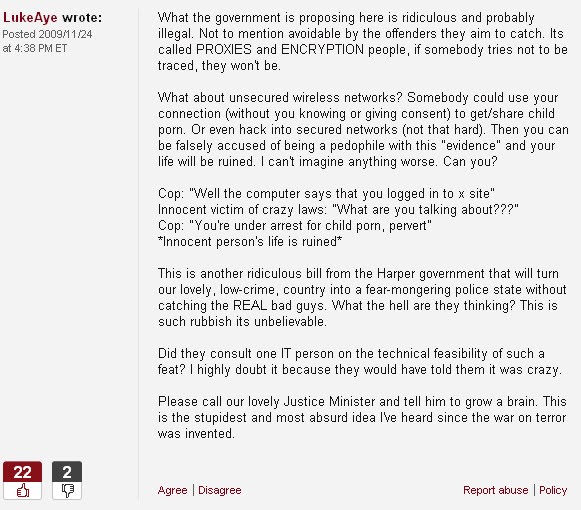 It isn't hard to begin unraveling some of the problems with this particular reader's comments.
First off, there's only a certain extent to which proxies and encryptions can protect any particular individual from identification. And while an wifi connection could certainly be hijacked for the purpose of locating and downloading child pornography, an accused individual could quite quickly be cleared through something so simple as an examination of their computer's hard drive.
(There are, naturally, privacy concerns related to police searches of a computer hard drive that may not be sufficiently covered by current legislation, and may require further legislation. That, by its own merit, is actually a rather fair argument.)
As anyone can see, this particular comment was given 22 "thumbs up" (individuals agreeing with the comment), compared to only two "tumbs down" (individuals disagreeing with the comment).
So on that note, it's interesting to see how a dissenting opinion is treated by CBC readers:
 Certainly, no one is obligated to agree with this particular reader. But it's worth noting that very few Canadians have anything to hide in this particular matter.
The legislation in question isn't an attempt to restrict the civil liberties of Canadians. It's an effort to shut down criminal activity that, by its very nature, preys upon children.
Not that commenters like this one, from CTV, will understand this:
 Surely, almost all Canadians recognize that child pornography is not a matter of "artistic expression", and that the exploitation of children has no "artistic merit".
That is a basic, fundamental truth that simply requires no explanation. This comment was treated with the amount of merit it deserves -- it received 100 "thumbs down" votes to an inexplicable seven "thumbs up" votes.
Closer to the mark is this reader, who simply pointed out that child pornography is actually a non-partisan (if not a non-ideological) issue:
 This comment received 44 "thumbs up" votes to a mere three votes down.
Sadly, not everyone will agree that this is a non-partisan issue. The Conservative Party's 2004 attack on Paul Martin is frankly hard to forget.
It will certainly be interesting to see how the House of Commons votes on this issue. To anyone with an ounce of sense, it isn't hard to figure out that this is a bill that should pass unanimously (with fools like Libby Davies in the Commons, it's hard to say if it will).
Whether or not Canadians can put petty politics aside long enough for the bill to pass is another matter entirely.
Sunday, April 26, 2009
The Forgotten Phelps
Nate Phelps continues to speak out against the Westboro Baptist Church
When speaking about the Phelps family and the Westboro Baptist Church, it can become all too easy to conclude that each and every member of the Phelps family is nothing more than a homophobic bigot.
Watching Louis Theroux's Most Hated Family in America, one certainly gets that impression.
But there's more to the story that is so often overlooked: the members of the Phelps family who have denounced their father, his church, and the hateful premises on which it was founded.
Nate Phelps is one of three Phelps family members who has done precisely this. Of the three, he is the most active, speaking about his family and their church on a regular basis.
The picture paints is, unsurprisingly, a very, very ugly one.
"At the age of 7, I could recite all 66 books of the Bible in 19 seconds," Phelps explains. "My father insisted on this because he was frustrated at waiting as his children flipped back and forth trying to find the verses he was preaching from. Afterwards, if one of us took to long my father would stop in the middle of his preaching, cast a gimlet eye on the offender and demand that, 'Somebody smack that kid!'"
"For me, the story of Fred Phelps and the Westboro Baptist Church is a very long and painful one," Phelps continues. "But the first time that the wider community became aware of them was in 1991, when my father led his church in Topeka, Kansas to stage a protest against gays at a local city park."
"The community reacted with outrage at the mean-spirited and hateful nature of the protest, and sentiments on both sides escalated quickly," Phelps explains. "However, far from discouraging my father, this incited him to much greater efforts at publicly protesting all that he decided was wrong."
More than merely base hatred, Phelps is motivated by a tangible sense of megalomania.
"The church was soon staging dozens of protests every week, against local politicians, businesses, and citizens who dared to speak out against him and his church," Phelps says. "But public protests weren’t enough. My father equipped his church with a bank of fax machines, and daily sent faxes to hundreds of machines across the city and state, filled with invective and diatribes against anyone who had offended him."
Having lived within the Phelps household, Nate has a unique perspective on the actions of the WBC, and can place them fully within their horrific context -- a context soaked in the blood and tears of Nate and his family.
"Most people, coming in contact with them for the first time stare in stunned amazement," Phelps acknowledges. "But for me, it is a natural and almost inevitable progression, from the things I was taught and experienced in the Phelps household as a child, to the circumstances we find today."
"On the first anniversary of my father’s suspension, I returned home from school to find my mother weeping in the church vestibule," Phelps says. "My older brother, Mark, was trying to comfort her. She turned to him, her eyes red and swollen, her voice choked with rage. She yanked the stocking cap off her head, revealing that her long dark hair has been coarsely chopped off. 'He cut my hair off', she cried. Looking closer, I could see that in some places her white scalp has been exposed."
"I think everyone here can understand the trauma of such violence, the feeling of violation and abuse. But for my mother, and for our family, there was more to it than that," Phelps explains. "My father had a fascination with 1 Corinthians 11, in which Paul teaches the hierarchal authority from god, to Christ, to Man, to Woman. A sign of a woman’s submission, he argues, is her wearing her hair long. Fred took quite literally the instructions that women should have long hair; and more than that, he determined that the Greek word translated as 'long' in the bible would be more properly translated as 'uncut'. Thus, no woman in the church was allowed to put scissors to her hair. Nor were they allowed to present themselves in church without their heads properly covered."
Witness and subject to Phelps' brutal temper, Nate looked forward to his opportunity to escape. "My 18th birthday is very important, even central to my planning. My brother left after he was 18, and he was successful," he explains. But not all of Phelps' children were so fortunate.
"My oldest sister Kathy, on the other hand, tried to leave before she was 18," Phelps says. "My father tracked her down, and I watched as he physically forced her to return home. The physical and emotional damage that he inflicted on her in those last few months took a terrible toll on her. She was never the same, her spirit was broken."
Ironically, Fred Phelps' incessant demands for rigid adherence to a religious doctrine stripped from its ultimate context -- the love of the creator and a message of compassion and goodwill to humankind -- ruined Nate's ability to partake in any kind of religious observance.
"The next five years marked a struggle for a sense of who I was, while carefully avoiding anything to do with religion," Phelps explains. "In 1981 I moved to southern California to work with my brother Mark in the printing business. From time to time, at the sincere urging of friends, I would attend a church service. But it all seemed so plain and feeble. When they taught about God’s love, I’d hear my father’s voice condemning them for their namby-pamby fag-enabling beliefs."
The doubts originally implanted by his father's horiffic abuses eventually led to Nate embracing atheism. But Phelps notes that he still may have began to doubt religion even without his father's abuse.
The scores upon scores of people who embrace atheism without being subjected to that standard of abuse prove that he is correct. And even though Phelps has embraced the extreme and virulent brand of atheism promoted by Richard Dawkins and Christopher Hitchens (among others), Phelps continues to retain a healthy respect for the positive aspects of religious belief.
"Certainly there are many aspects to Christianity that are good and desirable," Phelp acknowledges. "But I began to think in terms of those aspects existing outside the framework of God. Why can’t the mosaic code exist outside the notion of a god?"
There certainly is no reason why they can't. The belief in God -- especially in the conventional sense -- is nothing more than a belief regarding the origin of creation. It is not in itself a moral belief.
As Phelps himelf notes, his journey certainly isn't complete. No one -- not even Phelps himself -- knows what the future will hold for him or any of the other forgotten Phelps.
Subscribe to:
Posts (Atom)