
Showing posts with label Pierre Trudeau. Show all posts
Showing posts with label Pierre Trudeau. Show all posts
Friday, August 27, 2010
How the Canadian Left Waged Inception Against the Public
In Inception, Dom Cobb (Leonardo DiCaprio) is an extractor. With the use of specialized equipment, he can slip into the mind of another individual and steal their secrets.
With a little more work, he can even plant ideas within the minds of his subjects.
The Canadian left has managed just such a feat within the minds of Canadians. But unlike Cobb, who uses a sleep-induction/mind-link machine, the "specialized equipment" of the Canadian left is the state itself.
The Canadian left long ago stumbled upon a subtle means on inception -- quietly installing their agenda as public policy, then allowing the Canadian public to justify it to themselves after the fact.
They accomplished this through a combination of expansion in the size of government and the subversion of civil society in order to meet specific ideological ends.
Barry Cooper refers to this as the "embedded state" - state organs dedicated to increasing the reach and influence of government throughout Canadian life.
Through a variety of QUANGOs -- quasi-autonomous non governmental organizations -- the Canadian left has embedded their own ideology within this embedded state.
They've used Canada's Secretary of State -- a rarely-scrutinized office empowered to disperse funding to civil society organizations -- to accomplish this end.
This began during the Prime Ministerial tenure of Pierre Elliot Trudeau. As Prime Minister, Trudeau directed the Secretary of State to fund and, if necessary, create NGOs.
This had two consequences. It eliminated the need for sivil society organizations to appeal to private citizens for financial support, and allowed the government to make choices that would ideologically benefit the governing party.
A key example is the public funding of pro-abortion organizations while denying funding to their anti-abortion opponents.
The result has been a status quo on abortion where Canada has no abortion law whatsoever. Abortion Rights Coalition of Canada national director Joyce Arthur suggests that groups that plan to change this should not only be denied public funding, but should also be denied the ability to raise funds as charitable organizations, while pro-abortion organizations should be allowed these privileges because their goals are "not political" because they reflect the view of "mainstream Canadians".
But according to a recent poll on the topic of abortion, that mainstream may be much smaller than Arthur believes.
A recent poll concluded that only 21% of Canadians are even aware that Canada has no abortion law.
According to that poll, sampled Canadians believed:
-41% of Canadians believed that abortions are only available within the first trimester.
-15% of Canadians believed that abortions are only available within the first trimester if a woman's life is at risk, if she was raped, or if her unborn child will be born with serious complications.
-10% of Canadians believed that abortions are only permissable if a woman's life is at risk, if she was raped, or if her unborn child will be born with serious complications.
Only 27% of those polled favoured the status quo.
Conversely, Arthur believes that abortion should be formally legalized within Canadian law, but that no restrictions should be placed upon it. She declares that restrictions on abortion would be "unnecessary, cruel, and discriminatory".
Clearly, 73% of Canadians disagree with her -- which would mean that, according to Arthur's bizarre definition of "mainstream" Canada, only 27% of Canadians are within that mainstream.
When polled, Canadians do voice their support for the status quo. The problem is that they don't know what that status quo is.
Arthur further insists that anti-abortion groups cannot justify charitable status based on their educational efforts. She declares them to be deceptive; propaganda. Yet, it seems that the "educational" efforts of groups like the ARCC are a good deal more deceptive.
The National Action Committee on the Status of Women funded many pro-abortion groups who have helped foster this particular rhetorical environment.
It's no wonder that so many Canadians seem to think they share what are actually the ARCC's extremist views on abortion: groups nestled close to the core of Canada's embedded state have spent a long time convincing them that they do.
That the Canadian government has been providing funding to such organizations created an artificial sense of respectability for them -- and considering the iron-fistedly censorious nature of Arthur and the ARCC (they've been involved in efforts to ban anti-abortion groups from University campuses), any respectability afforded is purely artificial.
The Canadian left resorted to these tactics because they must not have known that they couldn't achieve their agenda without monopolizing support from the state.
After 40 years of this kind of subtle manipulation, it's no wonder that the left has managed to convince Canadians that they share their agenda -- even when they apparently aren't fully aware of what that agenda really is.
As Stephen Harper continues to tighten the screws on this kind of ideological self-indulgence, Canada's left will have to begin to find its own resources, and start forging its own reputation as opposed to piggy-backing their message on the back of the government.


Monday, May 24, 2010
Segal Out of Place as Head of Anti-Terror Committee
Hugh Segal elected to chair Senate committee on anti-terror laws
Conservative Senator Hugh Segal has been elected to chair a special Senate committee on anti-terror laws. The committee will examine two anti-terror bills, including Bill C-17, which will restore anti-terror laws that sunsetted in 2007.
"It was an act to amend the Criminal Code with respect to investigative hearings," Segal explained. "Whether somebody could be held because there was a suspicion that they had either been involved in a terrorist act, or had information about a coming terrorist act, and what were their rights in that process, and what were the rights of the Crown."
In order to make decisions regarding the legislation, the committee will investigate the overall terrorism situation in Canada.
"We're going to be working on an update of what is the state of the terrorist threat in Canada (and) how has that threat changed in the last five years," Segal explained.
Segal has proven to be an adept thinker on numerous policy issues. But terrorism-related issues isn't one of his strengths.
Pierre Trudeau's decision to invoke the War Measures Act during the October Crisis of 1970 has been a controversial one in Canadian history. Segal, who was a student at the University of Ottawa at the time, has been an outspoken critic of that decision.
The limitation of civil rights is not a matter to be taken lightly at any time. But the kidnapping of British Trade Commissioner James Cross and Pierre Laporte, a Quebec cabinet Minister, limited Trudeau's options in responding to the crisis.
Invoking the War Measures Act was a necessary part of the response to the threat posed by the FLQ. It introduced a crucial element of control into the situation, allowing the government to account for the activities of FLQ sympathizers who may have aided the terrorists.
The crus of the matter was, of course, that the Trudeau government had, through its own negligence, allowed the situation to grow out of control.
Unless Segal's views on the October Crisis have changed drastically in short order, it may not be unreasonable to suggest that Segal isn't up to the task of making decisions in regards to terrorism -- particularly when Segal himself seems to understand that the nature of current terrorist threats represents a more fractious, less centralized structure.
"We now face a threat that is more diffuse, in other words it's not somebody in a cave sending instructions to cells around the world," Segal said. "But rather self-identifying cells of individuals deciding they are frustrated with this, that or other, and they want to use terrorism as a means of making their point."
In his favaour, Segal seems to understand that the government cannot afford to repeat the preemptive failures of the Trudeau government.
"When you have individuals who [are] more than prepared to die, then that of course provides a preventative challenge," Segal declared. "So it changes the dynamic of the challenge and makes it more complex, all the more reason to make sure we're doing it in the best possible way."
But while Hugh Segal may be more than willing to do what is necessary to prevent terrorist attacks, he needs to show concerned parties that he's willing to do what is necessary if those preventative measures fail.
Otherwise, his chairing the Senate committee on anti-terrorism is a mistake.
Conservative Senator Hugh Segal has been elected to chair a special Senate committee on anti-terror laws. The committee will examine two anti-terror bills, including Bill C-17, which will restore anti-terror laws that sunsetted in 2007.
"It was an act to amend the Criminal Code with respect to investigative hearings," Segal explained. "Whether somebody could be held because there was a suspicion that they had either been involved in a terrorist act, or had information about a coming terrorist act, and what were their rights in that process, and what were the rights of the Crown."
In order to make decisions regarding the legislation, the committee will investigate the overall terrorism situation in Canada.
"We're going to be working on an update of what is the state of the terrorist threat in Canada (and) how has that threat changed in the last five years," Segal explained.
Segal has proven to be an adept thinker on numerous policy issues. But terrorism-related issues isn't one of his strengths.
Pierre Trudeau's decision to invoke the War Measures Act during the October Crisis of 1970 has been a controversial one in Canadian history. Segal, who was a student at the University of Ottawa at the time, has been an outspoken critic of that decision.
The limitation of civil rights is not a matter to be taken lightly at any time. But the kidnapping of British Trade Commissioner James Cross and Pierre Laporte, a Quebec cabinet Minister, limited Trudeau's options in responding to the crisis.
Invoking the War Measures Act was a necessary part of the response to the threat posed by the FLQ. It introduced a crucial element of control into the situation, allowing the government to account for the activities of FLQ sympathizers who may have aided the terrorists.
The crus of the matter was, of course, that the Trudeau government had, through its own negligence, allowed the situation to grow out of control.
Unless Segal's views on the October Crisis have changed drastically in short order, it may not be unreasonable to suggest that Segal isn't up to the task of making decisions in regards to terrorism -- particularly when Segal himself seems to understand that the nature of current terrorist threats represents a more fractious, less centralized structure.
"We now face a threat that is more diffuse, in other words it's not somebody in a cave sending instructions to cells around the world," Segal said. "But rather self-identifying cells of individuals deciding they are frustrated with this, that or other, and they want to use terrorism as a means of making their point."
In his favaour, Segal seems to understand that the government cannot afford to repeat the preemptive failures of the Trudeau government.
"When you have individuals who [are] more than prepared to die, then that of course provides a preventative challenge," Segal declared. "So it changes the dynamic of the challenge and makes it more complex, all the more reason to make sure we're doing it in the best possible way."
But while Hugh Segal may be more than willing to do what is necessary to prevent terrorist attacks, he needs to show concerned parties that he's willing to do what is necessary if those preventative measures fail.
Otherwise, his chairing the Senate committee on anti-terrorism is a mistake.
Saturday, May 22, 2010
A Question of Clarity
In part three of The Champions, Pierre Trudeau's temporary retirement from, and sudden return to, politics quickly gives way to discussion regarding the question that would be asked during the 1980 referendum.
In the end, the question that emerged was not one explicitly about separation, but rather one that asked for a mandate to negotiate sovereignty accompanied by political and economic "association" with the rest of Canada. What emerged was not a notion of sovereignty, but rather the nebulous term of "sovereignty association".
Moreoever, the 1980 referendum promised a second one to ratify whatever agreement Rene Levesque's government could reach with the rest of Canada.
The necessity of such a referendum at all was questioned by many, and with good reason. Quebec's government already had the authority to negotiate nearly anything that it liked with the federal goernment, and with Canada's other provinces.
Pierre Trudeau, who had previously declared Quebec separatism to be dead, didn't intervene until late into the referendum campaign, when it became apparent that Quebec Liberal leader Claude Ryan proved incapable of leading the fight.
Ryan's rejection of political polling was particularly troubling, and led to future Prime Minister Jean Chretien -- who had experience in both federal and provincial politics -- was dispatched to attempt to save the day.
But the absense of Trudeau and his government from the matter of the referendum question was as much a tactical error as entrusting the campaign to Ryan, or Chretien's decision to stay out of the 1995 referendum campaign until late in the contest.
Allowing the referendum question to be decided largely without input from the federal government produced two very problematic questions, one that left many Quebeckers unsure of what they were voting on, and many more deceived.
Eventually, Stephane Dion, under Chretien's leadership, produced the Clarity Act in 1999 -- four years after an ambigious question nearly dismembered Canada during the 1995 referendum, and nearly twenty years after the government should have been involved in the first place.
Moreoever, even in passing the Clarity Act, the Liberals were too late even to that topic. The central ideas of the Clarity Act were effectively lifted out of a previous bill, defeated by the Liberals, introduced by then-Reform Party MP and now Prime Minister Stephen Harper.
While the Liberal Party has long awarded themselves credit for the defeat of the two referendums, they have long evaded the blame for how their complacency on the matter nearly destroyed Canada.
The clarity question could have decided the question of Quebec separatism long before it grew into a decisive theat to Canada.
Saturday, May 15, 2010
Reconquete La Conquete
Part two of The Champions deals with the famed 1970 October Crisis, and how the actions of the FLQ challenged both Pierre Trudeau and Rene Levesque on deep politically existential levels.
For Levesque, he had to confront the reality that individuals willing to engage in terrorism existed within the Quebec separatist movement he had built. (They may exist within that movement still.)
For Trudeau, his invokation of the war measures act challenged the values his party allegedly stood for. In the eyes of some, invoking the war measures act was the right move. After all, Canada was facing a terrorist threat, and the government had to do what was necessary to deal with it. In the eyes of others, invoking the war measures act was an unacceptable contravention of civil liberties.
Domestic terrorism poses a deep challenge to any country that must deal with it. The prospect of citizens who don't respect the rule of law in their political maneuvers is deeply troubling not only to those associating with those individuals -- even if unwillingly, as Levesque was -- and to those who have to deal with them.
One can sense how deeply shaken Levesque was when dealing with the prospect of such terrorists within his movement. One can even sense a slight discomfort for Pierre Trudeau as he dismisses the "bleeding hearts" who worry about the prospects of soldiers with guns in Quebec's cities (a deployment approved not by Stephen Harper, but by Pierre Trudeau).
No citizen wants to believe that they should fear their fellow citizens. Perhaps this is one of the reasons why so many countries avoid dealing with domestic terrorist groups. While it struggles to gain any semblence of credibility, groups like the Ku Klux Klan and the Aryan Guard continue t exist in Canada.
While the FLQ doesn't share a common place in the Canadian imagination as the KKK and the Aryan Guard, these organizations have far more in common than they are usually given credit for.
While Canadian law can often be quite eager to designate foreign groups as a terrorist group, that designation is used all too sparingly against domestic groups.
This could be said to at least partially explain how the FLQ was able to survive even after it had committed its earlier criminal acts.
It wasn't until Pierre LaPorte was murdered, and James Cross was kidnapped, that the Canadian government began to really take the FLQ's bid to "reconquer the conquest" as seriously as the threat it posed merited.
Saturday, May 08, 2010
Trudeau, Levesque, and the Spectre of Fascism
The Champions presets the story of Pierre Trudeau and Rene Levesque, and of the paths that led them to their epic historical confrontation over the future of Quebec within Canada.
While Trudeau's and Levesque's paths periodically diverged and converged, each man had a common ideological denominator: early bruahes with European fascism.
As Max and Monique Nemni note in Young Trudeau, Trudeau wasn't always a federalist. In fact, he grew up admiring fascist leaders like Benito Mussolini and Phillipe Petain. His admiration for fascism was more than merely a passing appreciation of the uniforms, as The Champions seems to suggest.
According to the Nemnis, as a youth Trudeau favoured the creation of Quebec as a decentralized corporatist French-language Roman Catholic state. He even imagined himself returning to Quebec to lead a revolution in its favour.
A great many of the Canadians who have subscribed to the Trudeau political mythology can be quite resentful of this inconvenient truth -- that Canada's prototypical liberal would ever entertain fascist ideas. (One can expect that resentment to be particularly pronounced in certain individuals who loathe Jonah Goldberg's Liberal Fascism, despite not actually understanding it.)
But, as the film points out, Trudeau's flirtation with fascist ideas may have been the fancies of a youth who did not fully understand those ideas. As The Champions points out, his experiences in wartime Europe turned him off from the ideas of nationalism and corporatism -- ideas that had so captivated him in his youth.
Rene Levesque had his own run-in with European fascism. When Mussolini was hung in Milan, Levesque witnessed the dying gasps of Italian fascism.
It's on this note that it should be unsurprising that Trudeau and Levesque were brought together in the struggle against Maurice Duplessis' Union Nationale government -- the closest thing to fascism Canada has ever seen.
Trudeau and Levesque took differing paths in their struggle against Duplessis' government. They both started off using their legal skills in support of labour activism. Following that, Trudeau helped found Cite Libre and Levesque joined the Quebec Liberal Party.
Just as their methods of fighting Duplessis' government diverged, so did their views on Quebec's role within Canada. While Trudeau -- who had since run for and won election to the House of Commons -- chose the path of federalism, Levesque chose the path of separatism and nationalism.
Levesque's decision helped give birth to the modern form of Quebec separatism which has traversed a very thin line between democratic legitimacy and nationalist fascism.
Tuesday, April 13, 2010
The British Conservative Party: The Party of the People?

Typically, nearly a week is a long time to wait for a political leader to set the tone for their party's election campaign.
Five days into the 2010 British General election, David Cameron has done just that.
The Tories' election maifesto is entitled "An Invitation to Join the Government of Britain". It sets a populist tone for the Conservative Party's campaign, one reminiscent of that offered by the late former Canadian Prime Minister Pierre Trudeau.
"Real change comes not from government alone," Cameron declared. "Real change comes when the people are inspired and mobilised, when millions of us are fired up to play a part in the nation's future."
Cameron suggsted that government is actually powerless without the support of the citizenry. Therefore, the British people must be invovled in government as much as possible.
"Yes this is ambitious," he admitted. "Yes it is optimistic. But in the end all the acts of Parliament, all the new measures, all the new policy initiatives, are just politicians' words without you and your involvement."
"So my invitation today is this: join us, to form a new kind of government for Britain," Cameron said.
Saying this is one thing -- and certainly a great number of Britons will appreciate this message. However, delivering on this promise is another thing altogether.
Trudeau alienated a great number of his supporters when he failed to deliver on his promise of "parliamentary democracy". In the end, it became apparent that "parliamentary democracy" merely reflected privileged access of Liberal Party members to information about the decisions that Trudeau and his cabinet made.
The breaking of that promise -- closely tied to his promises of a "Just society" -- eventually led to a public perception of Trudeau as a disingenuous and self-interested politician.
Britons will have to wait and see if David Cameron actually delivers on this promise. He certainly couldn't do any worse than Pierre Trudeau.
Wednesday, March 03, 2010
Justin Trudeau to Stephen Harper: Don't Govern the Way My Dad Did
Trudeau family avoiding a painful inward journey
Writing in an op/ed published in The Mark, Justin Trudeau offers some advice to Prime Minister Stephen Harper that partisan Liberals would likely delight in reading:
Trudeau campaigned on the promise of "participatory democracy", only to backtrack and insist that "participatory democracy" simply entailed the privilege of Liberal Party members to advance knowledge of the government's plans. He campaigned on the promise of a "just society", only to backtrack and insist that Jesus Christ had promised it first (which, indeed he had; the trouble being that Jesus Christ didn't make that promise while campaigning to become the Prime Minister of Canada).
Trudeau also mercilessly trampled the jurisdiction of the provinces at every opportunity, and centralized power within the Prime Minister's office at every opportunity that presented itself. To top it all off, when Trudeau finally delivered on his promise to patriate Canada's constitution, he insisted on doing so at a time when a separatist government -- that would have never agreed to sign the Constitution -- was in power, opening the door to decades of endless separatist wranglings.
So, whatever else one may make of Justin Trudeau's advice to Stephen Harper, it ultimately boils down to this:
Don't govern the way Pierre Trudeau did.
Done and done.
Writing in an op/ed published in The Mark, Justin Trudeau offers some advice to Prime Minister Stephen Harper that partisan Liberals would likely delight in reading:
"Even though it makes my job as a member of the Official Opposition a little easier, I am genuinely disappointed that this Conservative government didn’t hold true to the principles that brought it to power.Which is all rather amusing coming from the son of a man who alienated Canadians so much that his party actually hid him away during elections -- he had so inspired the disdain of enough Canadians that his party was better off campaigning without him.
And I’m not even talking about their abject failure to be fiscally responsible or their enthusiasm for patronage and pork. I’m referring to the basic premise of the old Reform Party, the call for a government that is open, accountable, and respectful of democratic values and the rights of its citizens.
Instead, over the past four years, Stephen Harper has carefully nurtured and encouraged a level of cynicism about politics and politicians heretofore unseen in Canada. Instead of championing the conservative principle of less government, he made people believe less in government.
He started by selling us policies that were simple and catchy, but had little real impact (think GST cuts instead of income-tax cuts, or $100 child-care cheques instead of actual child-care spaces). Add to that his propensity to launch vicious personal attacks on anyone – politician or citizen – with the temerity to disagree with them, and his tried and true Bush-era tactic of loudly repeating semi-truths and falsehoods often enough for them to take hold, and it’s no wonder that a weary populace has been turning away from the goings-on in Ottawa.
The fact that Stephen Harper didn't anticipate the strength of the prorogation outrage is proof that he overestimated the effectiveness of his campaign of induced cynicism. And, yet again, underestimated Canadians' faith in our democracy. Because for all the undeniable short-term partisan advantages of wedge issues, attack ads, and the politics of division, Canadians resist because we know that we deserve better.
We are a people of differences, in languages, religions, backgrounds, histories, cultures, and colours, but we are a people bound together by values that run deeper. We are open, compassionate, and generous. We seek justice, liberty, and opportunities for all. But above everything, we respect each other, and demand that respect in return.
And that’s why Stephen Harper’s strategies of secrecy, small-mindedness, and cynicism will ultimately fail, because simply put: Canadians will never trust a government that does not trust Canadians."
Trudeau campaigned on the promise of "participatory democracy", only to backtrack and insist that "participatory democracy" simply entailed the privilege of Liberal Party members to advance knowledge of the government's plans. He campaigned on the promise of a "just society", only to backtrack and insist that Jesus Christ had promised it first (which, indeed he had; the trouble being that Jesus Christ didn't make that promise while campaigning to become the Prime Minister of Canada).
Trudeau also mercilessly trampled the jurisdiction of the provinces at every opportunity, and centralized power within the Prime Minister's office at every opportunity that presented itself. To top it all off, when Trudeau finally delivered on his promise to patriate Canada's constitution, he insisted on doing so at a time when a separatist government -- that would have never agreed to sign the Constitution -- was in power, opening the door to decades of endless separatist wranglings.
So, whatever else one may make of Justin Trudeau's advice to Stephen Harper, it ultimately boils down to this:
Don't govern the way Pierre Trudeau did.
Done and done.
Saturday, May 02, 2009
Oh Dear God, He Thinks He's Trudeau
Michael Ignatieff pulls most predictable Liberal card
In a speech at the Liberal party convention, Michael Ignatieff has taken to comparing himself to Pierre Trudeau.
Quelle Suprise.
The comparison of the Liberal leader of the day to the prototypical Liberal political myth has become so utterly predictable that one has to wonder if Canadians ever bother to take notice anymore.
 "You have to indulge an old guy like me, but this is the feeling that I felt in 1968 at the great convention that chose Pierre Elliott Trudeau as our prime minister," Ignatieff crowed to an under-attended Liberal convention. "I had a feeling for the first time in my life that I wasn't a spectator, that I wasn't a bystander, that I was there, in my tiny way, making the history of my country. And this is what the Liberal party offers you, that sense, that belief, that faith, that together we make the history of this great country."
Funny that Michael Ignatieff would feel like more than a spectator at the Liberal convention at which he became leader. But the thousands of Liberals across Canada who just witnessed Ignatieff get amalgamated as leader without anything other than the preliminary pretences of a leadership campaign, it's likely that fewer Liberals share his sentiments than he would like Canadians to believe.
Ignatieff seems rather quick to overlook the fact that, unlike himself, Pierre Trudeau had to win the Liberal leadership. The 1968 convention he alludes to required no fewer than four ballots to elect Trudeau leader. Trudeau's leaderhsip was actually the most contested in Liberal party history.
Trudeau overcame Mitchell Sharp, Paul Hellyer, Robert Winters, Allan MacEachern, and Ernst Zundel (yes, that Ernst Zundel) to win the Liberal leadership.
Ignatieff's ascension to the leadership of the party, meanwhile, was abetted by the withdrawal of Bob Rae and Dominic LeBlanc from the leadership contest.
There's a world of difference between the two.
Even with the Liberal embrace of the one-member-one-vote system, Liberal leadership races will mean absolutely nothing in the absence of actual competition.
Ignatieff also falls far short of Trudeau on one other key count: Trudeau was unafraid to run and govern based on big ideas. As The Economist has previously noted Ignatieff has yet to take a stand on any particular issue that suggests that he stands for anything -- not even his own ideas.
It's far from shocking that Ignatieff would be so eager to hoist himself up to Trudeau's status. Trudeau's legacy -- for good or ill -- has been the Liberal party's most successful election tactic. The number of Liberals gutsy enough to try to identify Ignatieff as "the father of Canada" is equal parts bemusing and befuddling -- apparently they've entirely forgotten about a man by the name of Sir John A MacDonald.
Mythology has been the strong point of the Liberal party for decades. It's unsurprising that Ignatieff would ignore historical context to try to appeal to it now.
In a speech at the Liberal party convention, Michael Ignatieff has taken to comparing himself to Pierre Trudeau.
Quelle Suprise.
The comparison of the Liberal leader of the day to the prototypical Liberal political myth has become so utterly predictable that one has to wonder if Canadians ever bother to take notice anymore.
"You have to indulge an old guy like me, but this is the feeling that I felt in 1968 at the great convention that chose Pierre Elliott Trudeau as our prime minister," Ignatieff crowed to an under-attended Liberal convention. "I had a feeling for the first time in my life that I wasn't a spectator, that I wasn't a bystander, that I was there, in my tiny way, making the history of my country. And this is what the Liberal party offers you, that sense, that belief, that faith, that together we make the history of this great country."Funny that Michael Ignatieff would feel like more than a spectator at the Liberal convention at which he became leader. But the thousands of Liberals across Canada who just witnessed Ignatieff get amalgamated as leader without anything other than the preliminary pretences of a leadership campaign, it's likely that fewer Liberals share his sentiments than he would like Canadians to believe.
Ignatieff seems rather quick to overlook the fact that, unlike himself, Pierre Trudeau had to win the Liberal leadership. The 1968 convention he alludes to required no fewer than four ballots to elect Trudeau leader. Trudeau's leaderhsip was actually the most contested in Liberal party history.
Trudeau overcame Mitchell Sharp, Paul Hellyer, Robert Winters, Allan MacEachern, and Ernst Zundel (yes, that Ernst Zundel) to win the Liberal leadership.
Ignatieff's ascension to the leadership of the party, meanwhile, was abetted by the withdrawal of Bob Rae and Dominic LeBlanc from the leadership contest.
There's a world of difference between the two.
Even with the Liberal embrace of the one-member-one-vote system, Liberal leadership races will mean absolutely nothing in the absence of actual competition.
Ignatieff also falls far short of Trudeau on one other key count: Trudeau was unafraid to run and govern based on big ideas. As The Economist has previously noted Ignatieff has yet to take a stand on any particular issue that suggests that he stands for anything -- not even his own ideas.
It's far from shocking that Ignatieff would be so eager to hoist himself up to Trudeau's status. Trudeau's legacy -- for good or ill -- has been the Liberal party's most successful election tactic. The number of Liberals gutsy enough to try to identify Ignatieff as "the father of Canada" is equal parts bemusing and befuddling -- apparently they've entirely forgotten about a man by the name of Sir John A MacDonald.
Mythology has been the strong point of the Liberal party for decades. It's unsurprising that Ignatieff would ignore historical context to try to appeal to it now.
Thursday, March 26, 2009
Closing The Books on Petro-Canada
20 years later, Petro-Canada goes away quietly
The recent announcement of a merger between Petro-Canada and Suncor made news internationally.
More than simply a monster merger in the energy industry, the merger also marks the final closure on a long chapter of Canadian history.
Petro-Canada was founded in 1975 as part of Pierre Trudeau's scheme to partially nationalize the Canadian oil industry. It was founded in 1973 as a response to the quadrupling of world oil prices. Working in close cooperation with the NDP -- who actually tabled the bill to create the company -- the Liberals created the company, and placed more stringent controls on it than was usual for a crown corporation. The goal was to use the company as a policy tool.
The company was also the beneficiary of a surcharge at all the country's gas pumps, which was used to finance Petro-Canada buyouts of foreign-owned oil companies.
When Joe Clark arrived in office in 1979, his first goal was to eliminate this surcharge -- a goal he attempted to achieve in his ill-fated first budget. However, Clark also proposed an 18% tax on gasoline as a deficit-fighting measure. The Liberal party officially insisted that they defeated Clark's government over this fuel tax hike.
But Trudeau had also warned Clark against dismantling Petro-Canada. His proposed elimination of the Petro-Canada surcharge seemed to be a prelude to dismantling the company.
When Trudeau, returned to government, introduced the National Energy Program in 1980, Petro-Canada was used to administer it, making the company even more unpopular in Western Canada -- particularly in Alberta.
In 1991 Brian Mulroney finally began to privatize the company. Now, only a regulatory approval by Stephen Harper's government stands between Petro-Canada and its absorption into Suncor.
It's taken 20 years and the efforts of three different Prime Ministers to finally ferry Petro-Canada into the turning pages of history, but the task has finally been finished.
The recent announcement of a merger between Petro-Canada and Suncor made news internationally.
More than simply a monster merger in the energy industry, the merger also marks the final closure on a long chapter of Canadian history.
Petro-Canada was founded in 1975 as part of Pierre Trudeau's scheme to partially nationalize the Canadian oil industry. It was founded in 1973 as a response to the quadrupling of world oil prices. Working in close cooperation with the NDP -- who actually tabled the bill to create the company -- the Liberals created the company, and placed more stringent controls on it than was usual for a crown corporation. The goal was to use the company as a policy tool.
The company was also the beneficiary of a surcharge at all the country's gas pumps, which was used to finance Petro-Canada buyouts of foreign-owned oil companies.
When Joe Clark arrived in office in 1979, his first goal was to eliminate this surcharge -- a goal he attempted to achieve in his ill-fated first budget. However, Clark also proposed an 18% tax on gasoline as a deficit-fighting measure. The Liberal party officially insisted that they defeated Clark's government over this fuel tax hike.
But Trudeau had also warned Clark against dismantling Petro-Canada. His proposed elimination of the Petro-Canada surcharge seemed to be a prelude to dismantling the company.
When Trudeau, returned to government, introduced the National Energy Program in 1980, Petro-Canada was used to administer it, making the company even more unpopular in Western Canada -- particularly in Alberta.
In 1991 Brian Mulroney finally began to privatize the company. Now, only a regulatory approval by Stephen Harper's government stands between Petro-Canada and its absorption into Suncor.
It's taken 20 years and the efforts of three different Prime Ministers to finally ferry Petro-Canada into the turning pages of history, but the task has finally been finished.
Monday, February 16, 2009
Forget Thee Not
Michael Ignatieff underestimates the memory of Western Canadians
During a current swing through Western Canada, Liberal leader has some sincere words for western Canadians.
We fucked up! Sorry!
 "God knows this party has made mistakes out in Western Canada and I know them," Ignatieff admitted during a speech in Regina. "We have to be honest enough with our neighbours and citizens to say 'We didn't always get it right. We didn't always listen with respect. We didn't always understand what had to be done.'"
There are numerous examples of the Liberal party's careless approach to western Canada. Pierre Trudeau's National Energy Program is merely the foremost among them.
It's likely in this vein that the Liberal party was utterly foolish to come west and try to peddle what essentially amounted to NEP II -- Stephane Dion's proposed Green Shift program.
Except that Stephane Dion's Green Shift was actually Michael Ignatieff's Green Shift -- and he seems to expect that western Canadians are somehow going to forget.
Canadians -- and, especially, western Canadians -- will remember that a carbon tax was central to Dion's Green Shift. The problem for Ignatieff was that he proposed the carbon tax first and probably even pushed Dion behind the scenes to implement it as part of the Liberal party's platform.
Ignatieff at least seems to understand the utter folly of trying to run on something like a Carbon tax in Western Canada.
"The dumbest thing you can do is run against Western Canada," Ignatieff noted. "The dumbest thing you can do is run against the energy sectors in Western Canada."
The Green Shift policy, regardless of any corporate or personal tax reductions, would have reaked havoc on the energy industry, resulting in higher energy prices for every Canadian.
Western Canadians, being not nearly as naive or foolish as the average Liberal party strategist has always imagined them to be, knew this. Even the calls for a softening of the policy by western Liberal candidates like David Orchard went largely unheeded, and the Green Shift led to a decisive Liberal defeat in the west.
"The retail politics of this were pretty tough for us," he mused. Yet Ignatieff wants to continue his dabbling in energy policy.
"We want to bring energy policy and environmental policy together around a simple goal, which is to make Canada the most efficient user of energy and the most efficient developer of sustainable energy on the planet," he said. "When we elaborate those policies in detail, I think it'll be a vote winner out west."
This is a fine idea. But Ignatieff has proven adept at bungling energy policy so badly as to have his ideas absolutely clobbered in the realm of retail politics.
Ignatieff thought he had a winner before. He and his party insisted that the tax would be revenue neutral (despite the fact that there really is no such thing as a revenue neutral tax).
Regardless of whatever Michael Ignatieff may think, western Canadians don't have a short memory. When he comes back to Western Canada to address the issue of energy policy, he'd better have something a far sight better than NEP III.
Otherwise, Ignatieff will join Trudeau and Dion amongst the Liberal leaders who fucked up in regards to Western Canada.
Other bloggers writing on this topic:
Far and Wide - "Busy Guy"
Kristian Klima - "Conquering West or conquering rural Canada?"
During a current swing through Western Canada, Liberal leader has some sincere words for western Canadians.
We fucked up! Sorry!
"God knows this party has made mistakes out in Western Canada and I know them," Ignatieff admitted during a speech in Regina. "We have to be honest enough with our neighbours and citizens to say 'We didn't always get it right. We didn't always listen with respect. We didn't always understand what had to be done.'"There are numerous examples of the Liberal party's careless approach to western Canada. Pierre Trudeau's National Energy Program is merely the foremost among them.
It's likely in this vein that the Liberal party was utterly foolish to come west and try to peddle what essentially amounted to NEP II -- Stephane Dion's proposed Green Shift program.
Except that Stephane Dion's Green Shift was actually Michael Ignatieff's Green Shift -- and he seems to expect that western Canadians are somehow going to forget.
Canadians -- and, especially, western Canadians -- will remember that a carbon tax was central to Dion's Green Shift. The problem for Ignatieff was that he proposed the carbon tax first and probably even pushed Dion behind the scenes to implement it as part of the Liberal party's platform.
Ignatieff at least seems to understand the utter folly of trying to run on something like a Carbon tax in Western Canada.
"The dumbest thing you can do is run against Western Canada," Ignatieff noted. "The dumbest thing you can do is run against the energy sectors in Western Canada."
The Green Shift policy, regardless of any corporate or personal tax reductions, would have reaked havoc on the energy industry, resulting in higher energy prices for every Canadian.
Western Canadians, being not nearly as naive or foolish as the average Liberal party strategist has always imagined them to be, knew this. Even the calls for a softening of the policy by western Liberal candidates like David Orchard went largely unheeded, and the Green Shift led to a decisive Liberal defeat in the west.
"The retail politics of this were pretty tough for us," he mused. Yet Ignatieff wants to continue his dabbling in energy policy.
"We want to bring energy policy and environmental policy together around a simple goal, which is to make Canada the most efficient user of energy and the most efficient developer of sustainable energy on the planet," he said. "When we elaborate those policies in detail, I think it'll be a vote winner out west."
This is a fine idea. But Ignatieff has proven adept at bungling energy policy so badly as to have his ideas absolutely clobbered in the realm of retail politics.
Ignatieff thought he had a winner before. He and his party insisted that the tax would be revenue neutral (despite the fact that there really is no such thing as a revenue neutral tax).
Regardless of whatever Michael Ignatieff may think, western Canadians don't have a short memory. When he comes back to Western Canada to address the issue of energy policy, he'd better have something a far sight better than NEP III.
Otherwise, Ignatieff will join Trudeau and Dion amongst the Liberal leaders who fucked up in regards to Western Canada.
Other bloggers writing on this topic:
Far and Wide - "Busy Guy"
Kristian Klima - "Conquering West or conquering rural Canada?"
Tuesday, December 02, 2008
Trudeau Feigns Ignorance
Justin Trudeau seems to have forgotten how his father dealt with separatists
There is one thing about being ignorant of your country's history. Some believe that in Canada we've refined this down to an art.
Apparently, Justin Trudeau has done likewise. But for a man like Trudeau to be ignorant of his family's history -- that is something else altogether.
In a Full Comment blog post, Graeme Hamilton insists that Pierre Trudeau would have been A-OK with the deal that the Liberal party has hatched with the Bloc Quebecois. And he isn't alone.
Justin Trudeau also insists that Trudeau's father would have welcomed the deal.
 “My father for years got along with [former Parti Québécois leader] René Lévesque before they were both in politics. My father had separatist friends. My father understood that the important thing for this country was to keep the country strong,” Trudeau insists.
And certainly, this is true. Trudeau, Levesque and Jean Marchand and Gerard Pelletier were all active within Quebec's labour movement during the Maurice Duplessis era.
When the four formally entered politics, it was as Liberals. Trudeau, Marchand and Pelletier joined the federal party. Rene Levesque found himself recruited into the provincial Liberals, where he served as Minister of Labour under Jean Lesage.
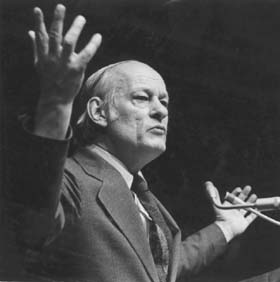 Levesque was always a nationalist. But his turn to separatism became public when he left the Liberal party in 1967. The party had refused to discuss Quebec sovereigntism at its convention. He formed the Mouvement Souveraineté-Association. In 1968 the MSA merged with Gilles Gregoire's Ralliement National to create the modern Parti Quebecois.
Levesque's ascension to the Office of Premier of Quebec in 1976 naturally brought tensions between the two to a head. These tensions would reach a pinnacle in 1980 during Levesque's referendum on Quebec sovereignty.
During the sovereignty campaign Trudeau promised to negotiate the repatriation of the Canadian Constitution. This promise helped the non side win the referendum with a decisive margin, and would set the table for Trudeau's most famous dealing with Levesque.
Dealings which Justin Trudeau seems to be ignorant of.
“What we got in this case was an assurance by Gilles Duceppe that he was going to keep all national-unity measures, confidence measures, off the table until June, 2010. That’s a better deal than anybody has gotten in years of working with the Bloc Québécois in the House,” Justin insists.
But he should know better. First off, Duceppe should not be trusted to keep promises he can't afford to keep.
Beyond this, Canadians remember how Pierre Trudeau dealt with separatists. During the negotiation of the 1982 Constitution, Trudeau, along with then-Minister of Justice Jean Chretien masterminded a deft end-run around Levesque in order to dismantle his "Gang of Eight" coalition of Provincial Premiers opposed to the Constitution.
In what has become known as "the night of the long knives", Chretien negotiated a "notwithstanding clause" into the Charter of Rights and Freedoms.
 The Gang of Eight acquiesced and the Constitution was settled.
For his own part, Levesque was infuriated. "We had been betrayed, in secret, by men who hadn’t hesitated to tear up their own signatures, and without their even taking the trouble to warn us," Levesque complained. On the flight back to Quebec City, Levesque is said to have said it rather differently.
"[Trudeau] fucked me," Levesque is said to have fumed.
For his own part, Justin Trudeau doesn't seem to be worried about the demands that Duceppe should be expected to make of this coalition government.
“We have a provincial election going on in Quebec and separatism is not one of the issues," Justin continued. "The fact that the Conservatives are spending so much time talking about national unity and bringing up all those old divisions, it’s just out of their playbook of divide, divide, divide.”
But Trudeau couldn't be further from the truth.
So long as the Bloc Quebecois and Parti Quebecois exist, separatism will always be an issue in Canadian politics -- unless, that is, both of these parties formally and finally renounce it.
In the absence of such a complete renunciation, the Libereal-led coalition is just another page out of the Liberal playbook of doing whatever it takes to get power, no matter what the consequences.
As for Trudeau, it's hard to believe that he would be this ignorant of his vaunted family history. It's significantly easier to believe that he would be disingenuous in the name of claiming political power.
Some other bloggers writing on this topic:
"The" Scott Ross - "The Liberal-NDP Coalition is Undemocratic
Sit, Think, Good Blog - "Marriage of Convenience"
Propter Hoc - "Of Separatists and Socialists (or, 'It's Very Simple Stupid')"
There is one thing about being ignorant of your country's history. Some believe that in Canada we've refined this down to an art.
Apparently, Justin Trudeau has done likewise. But for a man like Trudeau to be ignorant of his family's history -- that is something else altogether.
In a Full Comment blog post, Graeme Hamilton insists that Pierre Trudeau would have been A-OK with the deal that the Liberal party has hatched with the Bloc Quebecois. And he isn't alone.
Justin Trudeau also insists that Trudeau's father would have welcomed the deal.
“My father for years got along with [former Parti Québécois leader] René Lévesque before they were both in politics. My father had separatist friends. My father understood that the important thing for this country was to keep the country strong,” Trudeau insists.And certainly, this is true. Trudeau, Levesque and Jean Marchand and Gerard Pelletier were all active within Quebec's labour movement during the Maurice Duplessis era.
When the four formally entered politics, it was as Liberals. Trudeau, Marchand and Pelletier joined the federal party. Rene Levesque found himself recruited into the provincial Liberals, where he served as Minister of Labour under Jean Lesage.
Levesque was always a nationalist. But his turn to separatism became public when he left the Liberal party in 1967. The party had refused to discuss Quebec sovereigntism at its convention. He formed the Mouvement Souveraineté-Association. In 1968 the MSA merged with Gilles Gregoire's Ralliement National to create the modern Parti Quebecois.Levesque's ascension to the Office of Premier of Quebec in 1976 naturally brought tensions between the two to a head. These tensions would reach a pinnacle in 1980 during Levesque's referendum on Quebec sovereignty.
During the sovereignty campaign Trudeau promised to negotiate the repatriation of the Canadian Constitution. This promise helped the non side win the referendum with a decisive margin, and would set the table for Trudeau's most famous dealing with Levesque.
Dealings which Justin Trudeau seems to be ignorant of.
“What we got in this case was an assurance by Gilles Duceppe that he was going to keep all national-unity measures, confidence measures, off the table until June, 2010. That’s a better deal than anybody has gotten in years of working with the Bloc Québécois in the House,” Justin insists.
But he should know better. First off, Duceppe should not be trusted to keep promises he can't afford to keep.
Beyond this, Canadians remember how Pierre Trudeau dealt with separatists. During the negotiation of the 1982 Constitution, Trudeau, along with then-Minister of Justice Jean Chretien masterminded a deft end-run around Levesque in order to dismantle his "Gang of Eight" coalition of Provincial Premiers opposed to the Constitution.
In what has become known as "the night of the long knives", Chretien negotiated a "notwithstanding clause" into the Charter of Rights and Freedoms.
The Gang of Eight acquiesced and the Constitution was settled.For his own part, Levesque was infuriated. "We had been betrayed, in secret, by men who hadn’t hesitated to tear up their own signatures, and without their even taking the trouble to warn us," Levesque complained. On the flight back to Quebec City, Levesque is said to have said it rather differently.
"[Trudeau] fucked me," Levesque is said to have fumed.
For his own part, Justin Trudeau doesn't seem to be worried about the demands that Duceppe should be expected to make of this coalition government.
“We have a provincial election going on in Quebec and separatism is not one of the issues," Justin continued. "The fact that the Conservatives are spending so much time talking about national unity and bringing up all those old divisions, it’s just out of their playbook of divide, divide, divide.”
But Trudeau couldn't be further from the truth.
So long as the Bloc Quebecois and Parti Quebecois exist, separatism will always be an issue in Canadian politics -- unless, that is, both of these parties formally and finally renounce it.
In the absence of such a complete renunciation, the Libereal-led coalition is just another page out of the Liberal playbook of doing whatever it takes to get power, no matter what the consequences.
As for Trudeau, it's hard to believe that he would be this ignorant of his vaunted family history. It's significantly easier to believe that he would be disingenuous in the name of claiming political power.
Some other bloggers writing on this topic:
"The" Scott Ross - "The Liberal-NDP Coalition is Undemocratic
Sit, Think, Good Blog - "Marriage of Convenience"
Propter Hoc - "Of Separatists and Socialists (or, 'It's Very Simple Stupid')"
Separatist Fighter No More
Pierre Trudeau to spin in grave as Stephane Dion embraces separatists
Once upon a time, Liberal leader Stephane Dion was a committed separatist fighter. The most committed separatist fighter in all the land, as the Liberal party would have Canadians believe.
A separatist fighter in the tradition of Pierre Trudeau and Claude Ryan.
Yet now, with political power seemingly within his grasp, Dion is doing things that Trudeau would have never done, as he's forged a coalition government with the help of the Bloc.
One very legitimate question on many Canadians' minds is this: precisely how far is Stephane Dion willing to in order to preserve this Coalition?
Canadians have every reason to wonder.
During the 2008 federal election, the Liberal party promoted the Clarity Act as one of the best reasons to support Stephane Dion. They even promoted a YouTube video insisting as much. They insisted that he literally saved the country.
Now, he's set to embark upon a Coalition government which will depend on the Bloc Quebecois for its survival.
The Bloc has never supported the Clarity Act, and for obvious reasons. With the Bloc seemingly having a place at the table of government, its supporters would view it as nothing short of an absolute betrayal if they didn't seek a legislative repeal of the Clarity Act.
Interestingly, this could give the Conservative party grounds to call a quick confidence vote in the government: a confidence motion calling on this Coalition government to reaffirm its commitment to the terms and conditions laid out in the Clarity Act.
Never mind that Dion can't claim sole credit for the Clarity Act -- Stephen Harper himself proposed the Quebec Contingency Act.
The Quebec Contingency Act would have required the federal government to hold a parallel referendum on the same day as any Quebec sovereignty referendum posing an ambiguous question. It also would have required Canada's other provinces to authorize -- via referendum -- the federal government to negotiate Quebec's secession. Unsurprisingly, the act was defeated.
And while Canadians have every right to know just how far Stephen Harper would go vis a vis the Clarity act to preserve his proposed coalition with the Bloc Quebecois, this issue seems much more pertinent now that a formal coalition agreement is on paper and signed.
One simply has to wonder what Pierre Trudeau would have to say if he were alive to see this today.
Some other bloggers writing on this topic:
Angry French Guy - "The Biggest Loser: Gilles Duceppe"
Once upon a time, Liberal leader Stephane Dion was a committed separatist fighter. The most committed separatist fighter in all the land, as the Liberal party would have Canadians believe.
A separatist fighter in the tradition of Pierre Trudeau and Claude Ryan.
Yet now, with political power seemingly within his grasp, Dion is doing things that Trudeau would have never done, as he's forged a coalition government with the help of the Bloc.
One very legitimate question on many Canadians' minds is this: precisely how far is Stephane Dion willing to in order to preserve this Coalition?
Canadians have every reason to wonder.
During the 2008 federal election, the Liberal party promoted the Clarity Act as one of the best reasons to support Stephane Dion. They even promoted a YouTube video insisting as much. They insisted that he literally saved the country.
Now, he's set to embark upon a Coalition government which will depend on the Bloc Quebecois for its survival.
The Bloc has never supported the Clarity Act, and for obvious reasons. With the Bloc seemingly having a place at the table of government, its supporters would view it as nothing short of an absolute betrayal if they didn't seek a legislative repeal of the Clarity Act.
Interestingly, this could give the Conservative party grounds to call a quick confidence vote in the government: a confidence motion calling on this Coalition government to reaffirm its commitment to the terms and conditions laid out in the Clarity Act.
Never mind that Dion can't claim sole credit for the Clarity Act -- Stephen Harper himself proposed the Quebec Contingency Act.
The Quebec Contingency Act would have required the federal government to hold a parallel referendum on the same day as any Quebec sovereignty referendum posing an ambiguous question. It also would have required Canada's other provinces to authorize -- via referendum -- the federal government to negotiate Quebec's secession. Unsurprisingly, the act was defeated.
And while Canadians have every right to know just how far Stephen Harper would go vis a vis the Clarity act to preserve his proposed coalition with the Bloc Quebecois, this issue seems much more pertinent now that a formal coalition agreement is on paper and signed.
One simply has to wonder what Pierre Trudeau would have to say if he were alive to see this today.
Some other bloggers writing on this topic:
Angry French Guy - "The Biggest Loser: Gilles Duceppe"
Monday, November 24, 2008
This Day in Canadian History
November 24, 1968 - FLQ terrorists bomb Montreal Eaton's store
In 1968, Pierre Trudeau assumed the office of Prime Minister of Canada when he succeeded Lester Pearson as the leader of the Liberal party.
 In an election held on June 25 of that year Trudeaumania swept Trudeau and his Liberals into power with a majority government.
But not everyone was so pleased. In Trudeau's home province of Quebec dark clouds were beginning to coalesce over Canadian unity.
The day before the election Trudeau attended the St Jean Baptiste Day parade in Montreal. Enraged at his presence, Quebec separatists began to riot and barraged his grandstand with bottles and rocks. While the other officials seated on the grandstand took cover Trudeau stood his ground. A Canadian legend took shape that day -- that of Pierre Trudeau the fearless separatist fighter, facing down the separatists with little regard for his own safety.
It's become a potent element of the political mythology many Canadians -- especially Liberal partisans and those like-minded -- have built around Trudeau.
However, the bottles and rocks hurled at Trudeau that day paled in comparison to the coming storm.
On November 24, 1968, a bomb exploded in an Eaton's store in downtown Montreal. The Front de Liberation du Quebec, also known as the FLQ, quickly took responsibility for the act. Domestic terrorism had officially arrived in Canada.
The FLQ had been active prior to 1968. On April 20, 1963, Wilfred Vincent O'Neil became the FLQ's first victim. O'Neil, a security guard at a Canadian Army recruiting centre was killed by an FLQ bomb.
A year later, in 1964, Leslie McWilliams was killed in the course of an FLQ robbery of a gun store he managed.
In 1965, FLQ explosives intervened in a labour dispute between La Grande shoes and a Quebecois labour union when Therese Moran, a secretary, was killed.
Throughout 1968 and 1969, bombings became more and more frequent leading up to the 1970 October crisis when FLQ terrorists kidnapped British Trade Commissioner James Cross and Quebec Minister of Labour Pierre Laporte.
 Unfortunately, it took an international incident for the FLQ to be decisively dealt with. The pre-1970 victims of the FLQ included not only those killed, but numerous wounded. The most blatant act of unremitting terrorism, conducted according to a manifesto entitled "Revolutionary Strategy and the Role of the Avant-Garde", occurred in 1969 when the FLQ bombed the Montreal Stock Exchange. 27 people were wounded in that attack.
In today's age of preoccupation with international terrorism -- and a disproportionate focus on Islamic Militants in particular -- the events of November 24, 1968 stand as a stark reminder of the threat of domestic terrorism, one that has remained much more omnipresent throughout Canadian history than many Canadians would care to admit.
From violence directed at Canadian abortion clinics to the activities of various racial groups, domestic terrorism has often been largely ignored in Canada.
One can only hope that taking the opportunity to reflect on such episodes will lead to a realization of how deeply such terrorist acts can rend Canada's national fabric, and to a commitment by Canadians of all walks of life to take the issue of domestic terrorism seriously.
In 1968, Pierre Trudeau assumed the office of Prime Minister of Canada when he succeeded Lester Pearson as the leader of the Liberal party.
In an election held on June 25 of that year Trudeaumania swept Trudeau and his Liberals into power with a majority government.But not everyone was so pleased. In Trudeau's home province of Quebec dark clouds were beginning to coalesce over Canadian unity.
The day before the election Trudeau attended the St Jean Baptiste Day parade in Montreal. Enraged at his presence, Quebec separatists began to riot and barraged his grandstand with bottles and rocks. While the other officials seated on the grandstand took cover Trudeau stood his ground. A Canadian legend took shape that day -- that of Pierre Trudeau the fearless separatist fighter, facing down the separatists with little regard for his own safety.
It's become a potent element of the political mythology many Canadians -- especially Liberal partisans and those like-minded -- have built around Trudeau.
However, the bottles and rocks hurled at Trudeau that day paled in comparison to the coming storm.
On November 24, 1968, a bomb exploded in an Eaton's store in downtown Montreal. The Front de Liberation du Quebec, also known as the FLQ, quickly took responsibility for the act. Domestic terrorism had officially arrived in Canada.
The FLQ had been active prior to 1968. On April 20, 1963, Wilfred Vincent O'Neil became the FLQ's first victim. O'Neil, a security guard at a Canadian Army recruiting centre was killed by an FLQ bomb.
A year later, in 1964, Leslie McWilliams was killed in the course of an FLQ robbery of a gun store he managed.
In 1965, FLQ explosives intervened in a labour dispute between La Grande shoes and a Quebecois labour union when Therese Moran, a secretary, was killed.
Throughout 1968 and 1969, bombings became more and more frequent leading up to the 1970 October crisis when FLQ terrorists kidnapped British Trade Commissioner James Cross and Quebec Minister of Labour Pierre Laporte.
Unfortunately, it took an international incident for the FLQ to be decisively dealt with. The pre-1970 victims of the FLQ included not only those killed, but numerous wounded. The most blatant act of unremitting terrorism, conducted according to a manifesto entitled "Revolutionary Strategy and the Role of the Avant-Garde", occurred in 1969 when the FLQ bombed the Montreal Stock Exchange. 27 people were wounded in that attack.In today's age of preoccupation with international terrorism -- and a disproportionate focus on Islamic Militants in particular -- the events of November 24, 1968 stand as a stark reminder of the threat of domestic terrorism, one that has remained much more omnipresent throughout Canadian history than many Canadians would care to admit.
From violence directed at Canadian abortion clinics to the activities of various racial groups, domestic terrorism has often been largely ignored in Canada.
One can only hope that taking the opportunity to reflect on such episodes will lead to a realization of how deeply such terrorist acts can rend Canada's national fabric, and to a commitment by Canadians of all walks of life to take the issue of domestic terrorism seriously.
Monday, November 17, 2008
Justin Trudeau Calls for a Generational Shift in Canadian Politics
Son of Trudeau calls for more youth involvement in politics
If Justin Trudeau was unaware of one particular fact about Canadian politics, he's likely to learn it very quickly.
When your name is Trudeau, it isn't hard to get someone to come out to hear you speak.
In Charlottetown, Prince Edward Island, Trudeau drew a crowd of 1,000 people to a party fundraiser where he talked about the need to get Canada's youth involved in politics -- or at least in the Liberal party.
 “The challenge that we face as a political organization at all levels, both federal and provincial, is the idea of mobilizing our young people,” Trudeau announced. “We need to reach out to young people as more than just campaign volunteers who lick envelopes and put up posters, but as those who actually have input and are valued for their idealism, their energy and the way of thinking they bring in, which is a lot more long-term.”
Trudeau noted that too many Canadians are being drawn into one-issue political movements. Youth especially so.
Trudeau's musings seem to closely resemble leadership candidate Dominic LeBlanc's recent calls for a generational shift within the Liberal party.
And by that he doesn't simply mean selecting himself -- at 41, the youngest of the officially declared candidates -- for the leadership.
"It's not enough to change the head, you have to renew the whole and that's done with a new generation of leadership that springs the party forward," LeBlanc insists.
Some may have to wonder if Trudeau embracing LeBlanc's "generational shift" idea is a prelude to an endorsement of LeBlanc. But if "like father, like son" can be considered a rule of Canadian politics, one may also question the extent of Trudeau's commitment to any such generational shift.
Trudeau's father, Pierre Elliott Trudeau, first got himself elected Prime Minister using two broad promises: that of the "Just Society" and that of making Canadian politics more participatory.
In the end, the vague Just Society promised was abandoned entirely. And Trudeau's "participatory democracy" was ultimately meant only for those who were members of the Liberal party -- regardless of whether they had voted for the Liberals or not.
For the most part, Justin Trudeau, like his father, is making a positive impression on the Canadian political scene. But sometimes these impressions are hard to keep up, and Trudeau would be wise to remember that the polish can wear off a politician quickly if he's found to be too flexible in regard to his promises.
Trudeau should remember one other lesson his father's example teaches: always back a winner. Most analysts consider the prospects for an "up the middle" victory for the Liberal leadership to be rather faint.
He would be much better off backing either of the two main contenders.
If Justin Trudeau was unaware of one particular fact about Canadian politics, he's likely to learn it very quickly.
When your name is Trudeau, it isn't hard to get someone to come out to hear you speak.
In Charlottetown, Prince Edward Island, Trudeau drew a crowd of 1,000 people to a party fundraiser where he talked about the need to get Canada's youth involved in politics -- or at least in the Liberal party.
“The challenge that we face as a political organization at all levels, both federal and provincial, is the idea of mobilizing our young people,” Trudeau announced. “We need to reach out to young people as more than just campaign volunteers who lick envelopes and put up posters, but as those who actually have input and are valued for their idealism, their energy and the way of thinking they bring in, which is a lot more long-term.”Trudeau noted that too many Canadians are being drawn into one-issue political movements. Youth especially so.
Trudeau's musings seem to closely resemble leadership candidate Dominic LeBlanc's recent calls for a generational shift within the Liberal party.
And by that he doesn't simply mean selecting himself -- at 41, the youngest of the officially declared candidates -- for the leadership.
"It's not enough to change the head, you have to renew the whole and that's done with a new generation of leadership that springs the party forward," LeBlanc insists.
Some may have to wonder if Trudeau embracing LeBlanc's "generational shift" idea is a prelude to an endorsement of LeBlanc. But if "like father, like son" can be considered a rule of Canadian politics, one may also question the extent of Trudeau's commitment to any such generational shift.
Trudeau's father, Pierre Elliott Trudeau, first got himself elected Prime Minister using two broad promises: that of the "Just Society" and that of making Canadian politics more participatory.
In the end, the vague Just Society promised was abandoned entirely. And Trudeau's "participatory democracy" was ultimately meant only for those who were members of the Liberal party -- regardless of whether they had voted for the Liberals or not.
For the most part, Justin Trudeau, like his father, is making a positive impression on the Canadian political scene. But sometimes these impressions are hard to keep up, and Trudeau would be wise to remember that the polish can wear off a politician quickly if he's found to be too flexible in regard to his promises.
Trudeau should remember one other lesson his father's example teaches: always back a winner. Most analysts consider the prospects for an "up the middle" victory for the Liberal leadership to be rather faint.
He would be much better off backing either of the two main contenders.
Monday, October 20, 2008
And Another One Bites the Dust
No free ride for Tories as Dion will continue as leader until after convention
It's said that bad things happen in threes. But in the case of Stephane Dion and the Liberal it all depends on perspective.
After being defeated in the third federal election in four years, Stephane Dion has called the third Liberal leadership convention in five years.
 "I have informed the president of the Liberal Party of Canada and the president of the national caucus that I will stay as leader until a new leader is chosen at a leadership convention that I have asked to be organized," Dion announced today.
In finally announcing his intentions after nearly a week of silence and reflection, Dion seems poised to neither fully accept nor question the judgment of Canadian voters.
"I still think that if we would have been equipped to explain why I'm fighting for my country, what kind of leader I would have been, what kind of prime minister I would have been and what kind of policy we're proposing, we would have won this election and we would have today a much better government than the one we have," Dion added.
Although he's hardly proven to be a wise leader, or gracious in defeat, Dion seems to have looked to the past for inspiration regarding his decision to continue to serve until replaced. In 1979, Pierre Trudeau resigned as Liberal leader in the wake of an electoral defeat at the hands of the Joe Clark Progressive Conservatives, but left himself available to return in the event of Clark's defeat.
In Trudeau's place, Clark's fall didn't take long to occur. And while he may have asked "the sovereign" to "ask on bended knee three times" before returning, the result speaks for itself. Clark's government was replaced with a Liberal majority.
What all this means is that there will be no free ride for Prime Minister Stephen Harper and his Conservative government. Even if the Liberals aren't fully confident in Dion's ability to contest another election, they need not be hesitant to topple the government if the opportunity should arise.
With Dion -- the principle pillar in the "Red Green alliance" -- having resigned, it isn't at all unfair to continue speculating on the leadership prospects of the Green party's Elizabeth May.
 Having hitched both her own and her party's electoral prospects to Dion and the Liberals, May has to face up to the reality that her gambit failed in both of its objectives: defeating the Conservative government and electing Green party MPs.
Many Greens are demanding May's resignation over a last-minute attempt to sway Green party voters to vote strategically against the Conservatives -- but not necessarily in favour of the Greens.
Whether May joins Dion among the ranks of defeated former leaders has yet to be seen.
Clearly the next task for the Liberals will be choosing their next leader. Numerous candidates -- John McCallum, Frank McKenna, John Manley, Ujjal Dosanjh, Bob Rae and Michael Ignatieff -- have already started lining up for the job. Others -- Justin Trudeau, Ralph Goodale -- have already sworn off any interest in the coming campaign.
“We must learn quickly from this experience and move on," Dion noted. "The search for a new Liberal leader will be part of a process of renewing our party, but clearly will not in itself be sufficient.”
One way or the other, the coming months will be crucial ones for both Canada and for its official opposition.
For left-wing Canadians, the defeat of Paul Martin's government may not have been such a good thing. Nor would the reelection of the Harper government have been. For Liberals, the ouster of three-time majority winning Jean Chretien turned out to be a bad thing -- as was the selection of his next two successors. For Liberals, Dion's resignation may or may not be a good thing (depending upon the perspective of the individual). But many Conservatives across Canada will be all smiles today.
Stephane Dion has formally bitten the dust.
It's said that bad things happen in threes. But in the case of Stephane Dion and the Liberal it all depends on perspective.
After being defeated in the third federal election in four years, Stephane Dion has called the third Liberal leadership convention in five years.
"I have informed the president of the Liberal Party of Canada and the president of the national caucus that I will stay as leader until a new leader is chosen at a leadership convention that I have asked to be organized," Dion announced today.In finally announcing his intentions after nearly a week of silence and reflection, Dion seems poised to neither fully accept nor question the judgment of Canadian voters.
"I still think that if we would have been equipped to explain why I'm fighting for my country, what kind of leader I would have been, what kind of prime minister I would have been and what kind of policy we're proposing, we would have won this election and we would have today a much better government than the one we have," Dion added.
Although he's hardly proven to be a wise leader, or gracious in defeat, Dion seems to have looked to the past for inspiration regarding his decision to continue to serve until replaced. In 1979, Pierre Trudeau resigned as Liberal leader in the wake of an electoral defeat at the hands of the Joe Clark Progressive Conservatives, but left himself available to return in the event of Clark's defeat.
In Trudeau's place, Clark's fall didn't take long to occur. And while he may have asked "the sovereign" to "ask on bended knee three times" before returning, the result speaks for itself. Clark's government was replaced with a Liberal majority.
What all this means is that there will be no free ride for Prime Minister Stephen Harper and his Conservative government. Even if the Liberals aren't fully confident in Dion's ability to contest another election, they need not be hesitant to topple the government if the opportunity should arise.
With Dion -- the principle pillar in the "Red Green alliance" -- having resigned, it isn't at all unfair to continue speculating on the leadership prospects of the Green party's Elizabeth May.
Having hitched both her own and her party's electoral prospects to Dion and the Liberals, May has to face up to the reality that her gambit failed in both of its objectives: defeating the Conservative government and electing Green party MPs.Many Greens are demanding May's resignation over a last-minute attempt to sway Green party voters to vote strategically against the Conservatives -- but not necessarily in favour of the Greens.
Whether May joins Dion among the ranks of defeated former leaders has yet to be seen.
Clearly the next task for the Liberals will be choosing their next leader. Numerous candidates -- John McCallum, Frank McKenna, John Manley, Ujjal Dosanjh, Bob Rae and Michael Ignatieff -- have already started lining up for the job. Others -- Justin Trudeau, Ralph Goodale -- have already sworn off any interest in the coming campaign.
“We must learn quickly from this experience and move on," Dion noted. "The search for a new Liberal leader will be part of a process of renewing our party, but clearly will not in itself be sufficient.”
One way or the other, the coming months will be crucial ones for both Canada and for its official opposition.
For left-wing Canadians, the defeat of Paul Martin's government may not have been such a good thing. Nor would the reelection of the Harper government have been. For Liberals, the ouster of three-time majority winning Jean Chretien turned out to be a bad thing -- as was the selection of his next two successors. For Liberals, Dion's resignation may or may not be a good thing (depending upon the perspective of the individual). But many Conservatives across Canada will be all smiles today.
Stephane Dion has formally bitten the dust.
Friday, September 26, 2008
A Debate To Be Remembered
Even if the leaders aren't up to snuff, the stakes in the 2008 federal election are historic in nature
Stephen Harper is no John Diefenbaker. Nor is he even Joe Clark.
Stephane Dion is no Lester Pearson, and he certainly isn't Pierre Trudeau.
Diefenbaker possessed the ability to rail vocally against outrage and injustice in a manner so intensely that he could make believers out of even cold-hearted listeners.
Lester Pearson, for his notorious lack of oratorical skills, always tended to know a good idea when he saw it. If one were to ask Diefenbaker himself, peacekeeping was one of those very ideas, deftly snatched by the Chief by Pearson.
Joe Clark had a broad-sweeping vision for Canada: his decentralized "communitiy of communities" that was so idyllic that it was almost utopian.
Pierre Trudeau was a mericless debater and oratorical master without compare. For his own part, he didn't merely adopt the great ideas of others. He also came up with a few of his own, evenif he could never be bothered to actually implement them.
Diefenbaker vs. Pearson and Clark vs. Trudeau stand among Canada's most historical and defining electoral contests. In each case, each man exchanged electoral victories over the issues that defined their times.
For Pearson and Diefenbaker it was Canada's role in the Cold War vis a vis nuclear weapons. For Trudeau and Clark, it was Canada's economic course in a post-OPEC petro-economy.
Harper is no Diefenbaker. His speeches may be elctrifying to the most partisan of his supporters, but they still fail to impress his political opponents. Nor is he a Joe Clark. Whether Conservative voters are comfortable enough to admit it or not, he has no grand vision for Canada. He barely has a vision at all, aside from "tightening the screws" of government via budget and tax cuts.
Dion is no Pearson. His Green Shift economic policy, as championed by Scott Brison and Green party leader Elizabeth May, is so ill-concieved that it can't seem to drive voters away from his party quickly enough. Nor is he a Trudeau. The man seems like he couldn't muster a believable ounce of passion is his life depended on it, nor is he resolute enough to stand by his policies no matter how unpopular they may seem. Pierre Trudeau would never have been caught dead tailoring a policy like the Green Shift to the likes of farmers. Not only were they too far out of the urban elite circle he prided himself on travelling in, but they were unlikely to vote for him regardless.
Yet Harper and Dion, like Trudeau and Clark and Diefenbaker and Pearson before them, do have a historical matter that will be decided in the course of this federal election: namely, the issue of climate change.
Canadians have a historical choice before them: a choice between the frugal, cautious economic environmentalism of Stephen Harper, sprinkled with a healthy dose of skepticism, or the risky approach of Stephane Dion, tearing up Canada's taxation regime in the name of leftist apocalypticism.
Harper's approach, stretching reductions in greenhouse gas emissions over a period longer than 40 years, or Stephane Dion's imaginings that, given what he feels is the proper economic incentive, Canada's biggest polluters will pull off the feat in time to comply with the Kyoto protocol.
As was the case with Trudeau/Clark and Diefenbaker/Pearson, the outcome of this election likely won't be up to the contestants alone. While the Presidential election in the United States may keep individuals such as Al Gore and Barack Obama too busy to attempt an intervention in the Canadian campaign, the individual gaffes offered up by each campaign -- there have already been many, and there will likely be many more still -- may yet prove to be decisive by the time this election concludes.
Then, of course, there's always the NDP. The "conscience of the nation", as it were, may yet prove to tip the scales in this election. Jack Layton holds a very powerful position in the country right now, as did Tommy Douglas and Ed Broadbent before him.
And as with Trudeau/Clark and Diefenbaker/Pearson, the next 20 years of Canadian history may be charted by the outcome of this election.
One way or another, this federal election will be one for Canadians to remember. Canadians may remember the outcome -- and, no matter how one slices it, the potential consequences -- for longer still.
Stephen Harper is no John Diefenbaker. Nor is he even Joe Clark.
Stephane Dion is no Lester Pearson, and he certainly isn't Pierre Trudeau.
Diefenbaker possessed the ability to rail vocally against outrage and injustice in a manner so intensely that he could make believers out of even cold-hearted listeners.
Lester Pearson, for his notorious lack of oratorical skills, always tended to know a good idea when he saw it. If one were to ask Diefenbaker himself, peacekeeping was one of those very ideas, deftly snatched by the Chief by Pearson.
Joe Clark had a broad-sweeping vision for Canada: his decentralized "communitiy of communities" that was so idyllic that it was almost utopian.
Pierre Trudeau was a mericless debater and oratorical master without compare. For his own part, he didn't merely adopt the great ideas of others. He also came up with a few of his own, evenif he could never be bothered to actually implement them.
Diefenbaker vs. Pearson and Clark vs. Trudeau stand among Canada's most historical and defining electoral contests. In each case, each man exchanged electoral victories over the issues that defined their times.
For Pearson and Diefenbaker it was Canada's role in the Cold War vis a vis nuclear weapons. For Trudeau and Clark, it was Canada's economic course in a post-OPEC petro-economy.
Harper is no Diefenbaker. His speeches may be elctrifying to the most partisan of his supporters, but they still fail to impress his political opponents. Nor is he a Joe Clark. Whether Conservative voters are comfortable enough to admit it or not, he has no grand vision for Canada. He barely has a vision at all, aside from "tightening the screws" of government via budget and tax cuts.
Dion is no Pearson. His Green Shift economic policy, as championed by Scott Brison and Green party leader Elizabeth May, is so ill-concieved that it can't seem to drive voters away from his party quickly enough. Nor is he a Trudeau. The man seems like he couldn't muster a believable ounce of passion is his life depended on it, nor is he resolute enough to stand by his policies no matter how unpopular they may seem. Pierre Trudeau would never have been caught dead tailoring a policy like the Green Shift to the likes of farmers. Not only were they too far out of the urban elite circle he prided himself on travelling in, but they were unlikely to vote for him regardless.
Yet Harper and Dion, like Trudeau and Clark and Diefenbaker and Pearson before them, do have a historical matter that will be decided in the course of this federal election: namely, the issue of climate change.
Canadians have a historical choice before them: a choice between the frugal, cautious economic environmentalism of Stephen Harper, sprinkled with a healthy dose of skepticism, or the risky approach of Stephane Dion, tearing up Canada's taxation regime in the name of leftist apocalypticism.
Harper's approach, stretching reductions in greenhouse gas emissions over a period longer than 40 years, or Stephane Dion's imaginings that, given what he feels is the proper economic incentive, Canada's biggest polluters will pull off the feat in time to comply with the Kyoto protocol.
As was the case with Trudeau/Clark and Diefenbaker/Pearson, the outcome of this election likely won't be up to the contestants alone. While the Presidential election in the United States may keep individuals such as Al Gore and Barack Obama too busy to attempt an intervention in the Canadian campaign, the individual gaffes offered up by each campaign -- there have already been many, and there will likely be many more still -- may yet prove to be decisive by the time this election concludes.
Then, of course, there's always the NDP. The "conscience of the nation", as it were, may yet prove to tip the scales in this election. Jack Layton holds a very powerful position in the country right now, as did Tommy Douglas and Ed Broadbent before him.
And as with Trudeau/Clark and Diefenbaker/Pearson, the next 20 years of Canadian history may be charted by the outcome of this election.
One way or another, this federal election will be one for Canadians to remember. Canadians may remember the outcome -- and, no matter how one slices it, the potential consequences -- for longer still.
Thursday, September 25, 2008
One Good Reason to Vote for Justin Trudeau
These douchebags don't like him
There are plenty of good reasons not to vote for Justin Trudeau.
His party leader's policies are clearly one. The real (read: not mythical) legacy of his father is another. The risk of passing the Trudeau political mythology along to another generation is another still.
But in the course of a move clearly meant to embarrass Trudeau, running for the first time in the riding of Papineau, Les Jeunes Patriotes du Quebec gave voters a good reason to vote for him -- he really pisses off separatists.
"[Justin Trudeau] long refused to recognize Quebec as a nation," Francois Gendron, a spokesman for the group, announced. "We are a people and we are a nation."
"If he's going to play rock star he has to deal with the consequences. We're giving his campaign a little colour."
There's little question that, as the 2008 federal election progresses, Justin Trudeau very much has been cast into the role of the rock star. The news that he and his wife are expecting a second child garnered considerable attention on Canada's celebrity talk show circuit.
As the natural heir to the aforementioned Pierre Trudeau political mythology -- one that casts him into the role of national saviour, yet somehow overlooks that Trudeau made the at best boneheaded decision to negotiate the patriation of the constitution while a separatist government was in power in Quebec (just think about that) -- Trudeau has already inherited the mantle of unofficial leadership in the Liberal party. If Stephane Dion is the brains of the party and Bob Rae (who attented Trudeau's campaign launch) is the heart, then Trudeau is certainly the spirit of the party.
His father's role in the decisive defeat of separatist forces in the 1980 referendum made Trudeau a natural target for the separatists.
Normally, it should be considered fickle to support a political candidate simply because one particular group of people doesn't like him. But in Trudeau's case, the contempt separatists hold for him is actually quite the boon for federalist forces in Quebec.
When individuals like Gendron denounce Trudeau for his support of bilingualism -- apparently insisting that Quebec should be unilingually French and the Anglo-Quebeckers who've lived in the province for generations should go to hell -- it really underscores separatists for the bigots so many of them really are.
This is separatism at its worst, and a reminder to Quebeckers who may flirt with their organizations for other reasons to think twice about doing so.
There are plenty of good reasons not to vote for Justin Trudeau.
His party leader's policies are clearly one. The real (read: not mythical) legacy of his father is another. The risk of passing the Trudeau political mythology along to another generation is another still.
But in the course of a move clearly meant to embarrass Trudeau, running for the first time in the riding of Papineau, Les Jeunes Patriotes du Quebec gave voters a good reason to vote for him -- he really pisses off separatists."[Justin Trudeau] long refused to recognize Quebec as a nation," Francois Gendron, a spokesman for the group, announced. "We are a people and we are a nation."
"If he's going to play rock star he has to deal with the consequences. We're giving his campaign a little colour."
There's little question that, as the 2008 federal election progresses, Justin Trudeau very much has been cast into the role of the rock star. The news that he and his wife are expecting a second child garnered considerable attention on Canada's celebrity talk show circuit.
As the natural heir to the aforementioned Pierre Trudeau political mythology -- one that casts him into the role of national saviour, yet somehow overlooks that Trudeau made the at best boneheaded decision to negotiate the patriation of the constitution while a separatist government was in power in Quebec (just think about that) -- Trudeau has already inherited the mantle of unofficial leadership in the Liberal party. If Stephane Dion is the brains of the party and Bob Rae (who attented Trudeau's campaign launch) is the heart, then Trudeau is certainly the spirit of the party.
His father's role in the decisive defeat of separatist forces in the 1980 referendum made Trudeau a natural target for the separatists.
Normally, it should be considered fickle to support a political candidate simply because one particular group of people doesn't like him. But in Trudeau's case, the contempt separatists hold for him is actually quite the boon for federalist forces in Quebec.
When individuals like Gendron denounce Trudeau for his support of bilingualism -- apparently insisting that Quebec should be unilingually French and the Anglo-Quebeckers who've lived in the province for generations should go to hell -- it really underscores separatists for the bigots so many of them really are.
This is separatism at its worst, and a reminder to Quebeckers who may flirt with their organizations for other reasons to think twice about doing so.
Monday, July 21, 2008
Stephen Harper at the Fulcrum of Canadian History
The 1995 "Sovereignty Association" referendum marked a significant turning point in Canadian history.
There had always been anxiety concerning whether or not Canada would survive.
Upon Confederation in 1867, two overwhelming anxieties predominated: the fear of civil war -- such as that which had just embroiled the United States -- and the fear of the United States itself, and its expressed ideology of manifest destiny. These two anxieties pushed Canadian politics in two directions: the accomodation, management, and containment of regional conflagurations, and a race westward to incorporate British Columbia, Rupert's Land and the Northwest Territories into Confederation.
Once Canada as we know it was territorially secure, economics became the primary source of this anxiety. Reciprocity and its not-so-distant cousin, Free Trade, effectively became political footballs kicked back and forth by the Conservative and Liberal parties, as each agonized over the emerging behemoth to the south.
Canadians across Canada clung to Britain in order to stave off the pressures to become too closely aligned with the United States. Even those (notably Quebecois) politicians who, like Wilfred Laurier and Henri Bourassa, sought to eke out and preserve as much independence as possible for Canada embraced Britain wholeheartedly, and considered themselves British subjects.
While occasional internal conflagurations -- such as the Riel rebellion, naval controversy, and conscription crisis (one and two) often threatened to grow into broader threats to national unity, an overwhelming focus on external threats to Canadian unity is hard to overlook.
These conflicts were not only partisan in nature, but also pan-partisan. Factions led by Walter Gordon (nationalist) and Mitchell Sharp (realist) would face off over economic nationalism within the Liberal party (with future Prime Minister Jean Chretien coming to favour the Sharp camp). David Orchard would lead a small but determined rebellion within the Mulroney-era Progressive Conservative party over both the Canada-US Free Trade agreement and the broader North American Free Trade Agreement.
Meanwhile, in Quebec, something was bubbling. It had exploded twice before, with terroristic fury -- during the 1970 October crisis -- and impotence -- during the 1980 Quebec sovereignty referendum when the federalist "non" side defeated the sovereigntist "oui" side with nearly 60% of the vote.
Pierre Trudeau went so far as to declare Quebec separatism officially "dead". And while Brian Mulroney -- likely as a virtue of his relationship with future Bloc Quebecois and Parti Quebecois leader Lucien Bouchard -- surely percieved enough of a threat from Quebec separatism to attempt his Meech Lake and Charlottetown constitutional efforts, one could almost forgive Trudeau for believing separatism in Quebec decisively defeated.
One must say "almost" because in order to hold this belief, Trudeau would have had to overlook the 1981 reelection of the Rene Levesque PQ with an additional nine seats in the National Assembly and an additional 8% of the popular vote.
In 1985, the PQ would be defeated by the Robert Bourassa-led Liberal party. Daniel Johnson Jr would take over from the retiring Bourassa in 1994 and would lead his party to defeat less than a year later, when Jacques Parizeau led the PQ back into power, and eventually within half a percentile of "sovereignty association".
Doubtlessly, there were numerous historical grievances that led to this stunning reversal of the sovereingtist movement's fortunes -- the PQ had elected only 29 members in the 1989 election, but returned with 77 in 1994. The largest of which was almost certainly the collapse of the Meech Lake Accord.
Quebec's disillusionment over the rejection of Meech Lake even resulted in a wholesale rejection of the Charlottetown Accord in Quebec, where 56.7% voted against it in the 1992 referendum on the matter -- a rejection second only to the 60% who voted "no" in Alberta.
Beyond a shadow of doubt, the October 30, 1995 Referendum is the fulcrum of Canadian history -- the definitive sign that the greatest threat to Canada's survival will emerge not from outside the country, but from within.
When a country so narrowly avoids being torn apart from within, it leads people to question what could be so fundamentally wrong at the very foundations of that country that its own citizens would so nearly destroy it.
In the case of Canada, the conventional explanation is basically that of a French Canadian -- more specifically, Quebecois -- nationalism that feels so thwarted that it must collapse the country in order to avenge a centuries-passed conquest.
But upon watching the CBC's referendum-night panel one may wonder if perhaps Stephen Harper's explanation may be the most cogent:
"What has to happen, what people have to do tomorrow is -- and I think a lot of people will want to do it in Quebec and elsewhere -- is pressure their governments to govern and get on with addressing their practical, economic, fiscal and social concerns.As one examines Canadian history, it becomes apparent that Canada is a country that was built upon "grand visions".
Tonight there's been all this attention to the federal government -- what's the federal government going to do? But one of the big questions is: what is the Quebec government going to do? It has used the last two years to prepare for this vote.
Now, is it going to get on with governing itself and improving the lives of the province of Quebec?
There is a tremendous healing that has to be done. But frankly there's a lot of people who have to climb down off their grand visions and start addressing some real concerns because I think people are more sick of that than anything."
The founder of the country, sir John A MacDonald, had a grand vision of a country stretching from the Atlantic Ocean to the Pacific. John Diefenbaker had a grand vision of a more equal federation. Lester Pearson imagined Canada leading on the international stage. Pierre Trudeau had a grand (if vague) vision of a "just society".
Perhaps more than anything else, however, the 1995 referendum result was born out of three visions: Trudeau's vision of a repatriated Constitution (with, conveniently, his own signature adorning it), Mulroney's failed vision of himself as the saviour of Canada via Constitutional reform and the combined visions of Rene Levesque, Jacques Parizeau and Lucien Bouchard of a sovereign Quebec -- one that so nearly came to pass.
Of course, one cannot discount the roll of history in the matter either: the resurgence of Quebecois nationalism and the construction of a sovereigntist movement intersected dramatically with the de-colonization of Africa and the various parts of Asia that had had been incorporated within the British, French and other European empires. The ideas of national self-determination that underscored de-colonization resonated dramatically within Quebecois culture.
The post-1990 strengthening of the Quebecois sovereigntist movement also intersected dramatically with the end of the cold war. As Adam Curtis notes in The Power of Nightmares, the end of the Cold War outdated traditional ideologies, leaving many people in search of alternatives.
In 1981, the drastic post-referendum strengthening of the Parti Quebecois was aided in part by the utter collapse of the Union Nationale, a party that under long-time leader Maurice Duplessis had justified its often-authoritarian streak under the guise of fighting communism.
And while the Berlin wall would not fall for another eight years, many around the world were already smelling the stench of death on the Soviet regime providing the backbone for Eastern European communism.
The strong nationalist elements of the Union Nationale would also be set free by the impending end of the Cold War, and as the nationalists within the Union Nationale felt less threatened by communism, they turned their attentions to Daniel Johnson Sr's call for "Equalite ou Independance", to the direct benefit of the Parti Quebecois.
In time, Separatism became an ideology that appealed to many of those witnessing the end of the threat Maurice Duplessis had once used to maintain control over the province. What many Quebeckers viewed as a rebuked attempt to attain equality turned them instead to seek independance.
It became a new "grand vision" to replace the old vision that had been pushed into obselescence. For those in search of such a vision -- those dissatisfied with the emerging model of the politician as a manager of public affairs -- it clearly became rather attractive, at least in the short term.
The memory of how close Canada came to being torn apart on October 30, 1995 will remain with Canadians for a long time. So long as their remains a Bloc Quebecois or Parti Quebecois to pursue the separatist cause -- whether under the guise of "sovereignty association" or more honest terms -- the fear that we could lose our country will always remain.
It may not be enough for federal politicians to simply tend to the affairs of the country and allow the matter of national unity to tend to itself. But Stephen Harper was right to emphasize the risk of focusing too much on grand visions, and too little on the business of running the country.
A vision of a united Canada will always remain necessary to stave off the threat of Quebecois separatism. But we must always remember there are risks that come with trying to implement such a grand vision.
In 1995, we learned that the hard way.
Saturday, April 26, 2008
What the FLQ Has Been Reduced To
38 years of pouting turns ugly
Whatever one may think about Pierre Trudeau, one has to hand it to him: when a small band of Quebecois separatists crossed the line, he knew exactly what to do.
 When Canada was facing a domestic terror threat, he battened down the hatches and dealt with it. While his evoking the War Measures Act has remained one of the great historical controversies in Canadian history -- some insist it was necessary to deal with the FLQ, others point to the number of innocent FLQ sympathizers summarily rounded up under the Act -- one almost has to feel sorry for what the FLQ has become.
 Once, they were big, brave little men -- kidnapping British Trade Commissioner James Cross and kidnapping (and later killing) Quebec Minister of Labour Pierre Laporte.
Now, they're reduced to spray-painting "traitor" and "FLQ" on his grave.
Although they did allegedly circulate a letter threatening attacks in Montreal last year, those attacks never took place. It seems that vandalizing graves is as ambitious as the all-new, all-bitter FLQ gets these days.
Seems like this is one bogeyman of Canadian history that may not have gone quietly into the good night. But all the same, they've clearly seen better days.
Whatever one may think about Pierre Trudeau, one has to hand it to him: when a small band of Quebecois separatists crossed the line, he knew exactly what to do.
When Canada was facing a domestic terror threat, he battened down the hatches and dealt with it. While his evoking the War Measures Act has remained one of the great historical controversies in Canadian history -- some insist it was necessary to deal with the FLQ, others point to the number of innocent FLQ sympathizers summarily rounded up under the Act -- one almost has to feel sorry for what the FLQ has become.Once, they were big, brave little men -- kidnapping British Trade Commissioner James Cross and kidnapping (and later killing) Quebec Minister of Labour Pierre Laporte.Now, they're reduced to spray-painting "traitor" and "FLQ" on his grave.
Although they did allegedly circulate a letter threatening attacks in Montreal last year, those attacks never took place. It seems that vandalizing graves is as ambitious as the all-new, all-bitter FLQ gets these days.
Seems like this is one bogeyman of Canadian history that may not have gone quietly into the good night. But all the same, they've clearly seen better days.
Friday, October 19, 2007
Yep, That's Just What We Need...
...Not
If there's anything members of the Liberal party can be said to almost universally love, it's Pierre Trudeau.
 One could be forgiven for being unsurprised, then, to learn that Mario Silva, the Liberal MP for Davenport, has tabled a private member's bill that would recognize every October 18th, the anniversary of Pierre Trudeau's birthday, as "Pierre Trudeau day".
"Trudeau was a symbol of Canada at its best and as Prime Minister he moved Canada forward into later part of the 20th century with vigor, innovation and daring," Silva insists.
Yet, while Silva notes that Trudeau's accomplishments include "the patriation of Canada’s Constitution, the introduction of the Charter of Rights and Freedoms, enshrining both our nation's official languages in law and establishing multiculturalism as an official policy of the Government of Canada," his portrayal of Trudeau falls a little flat once one considers the broader facts of the matter.
 Trudeau's Constitution, patriated without Quebec's support, has left the door open to an eventual secession of Quebec from Confederation. His Charter of Rights and Freedoms can be ignored by any provincial government by envoking a clause within the Charter itself. (Ironically, more legislation has been passed "notwithstanding the Charter of Rights and Freedoms" than was notwithstanding John Diefenbaker's Bill of Rights.) While enshrining French and English as official languages sounds good in Quebec, the enshrinement of these two languages has actually come at the expense of Canada's many other linguist groups -- the Constitution defines Canada as bilingual, when in fact Canada is multilingual. Of Trudeau's accomplishments, perhaps official multiculturalism (as contentious as it may often be) and his omnibus bill stand alone as largely unassailable.
Yet when one consider's Silva's list of Trudeau's accomplishments (Silva didn't list the state-has-no-place-in-the-bedrooms-of-the-nation omnibus bill), as flawed as they are, constitute the near entirety of Trudeau's accomplishments.
For a man who spent nearly 18 years in power, that's a very short list.
So, we may ask, what of Trudeau's other promises? What about his so-called "just society"? He merely noted that Jesus had promised it first (though, at the time of the asking, was not alive to answer for it, while Trudeau certainly was). What about his "participatory democracy"? One had better have bought a Liberal party membership if they wanted to benefit from that. What about his "war on deflation"? That was a bit of a disaster.
The Liberal party love of Pierre Trudeau aside, this really is little more than an attempt by mr Silva (at least) to further the myth of Pierre Trudeau that has reigned in Canada for decades, and especially since his passing.
It isn't as if there aren't other Canadian Prime Ministers whose accomplishments eclipse Trudeau's and deserve the recognition much more.
Trudeau's predecessor, Lester Pearson, won the Nobel Peace Prize, one of the highest honours western society at large affords to anyone.
Sir John A MacDonald served as Canada's very first Prime Minister, having founded the country. Surely he deserves a holiday more than Trudeau.
William Lyon MacKenzie King, despite all of his bizarre occult antics, led Canada through one of the darkest chapters of history, the Second World War. As for Trudeau? He oppposed that war.
Whereas Trudeau can count among his accomplishments a happy shiny vision of Canada and a law that allows Canadians to hump blissfully as they may. While these are both laudable contributiosn (although only one of them offering any practical benefit), they aren't enough to justify either the Trudeau myth, or a holiday that would entrench it.
Fortunately, the "Trudeau day" private member's bill will almost certainly suffer the same fate as the attempt to rename Logan's Peak after Trudeau.
If there's anything members of the Liberal party can be said to almost universally love, it's Pierre Trudeau.
One could be forgiven for being unsurprised, then, to learn that Mario Silva, the Liberal MP for Davenport, has tabled a private member's bill that would recognize every October 18th, the anniversary of Pierre Trudeau's birthday, as "Pierre Trudeau day"."Trudeau was a symbol of Canada at its best and as Prime Minister he moved Canada forward into later part of the 20th century with vigor, innovation and daring," Silva insists.
Yet, while Silva notes that Trudeau's accomplishments include "the patriation of Canada’s Constitution, the introduction of the Charter of Rights and Freedoms, enshrining both our nation's official languages in law and establishing multiculturalism as an official policy of the Government of Canada," his portrayal of Trudeau falls a little flat once one considers the broader facts of the matter.
Yet when one consider's Silva's list of Trudeau's accomplishments (Silva didn't list the state-has-no-place-in-the-bedrooms-of-the-nation omnibus bill), as flawed as they are, constitute the near entirety of Trudeau's accomplishments.
For a man who spent nearly 18 years in power, that's a very short list.
So, we may ask, what of Trudeau's other promises? What about his so-called "just society"? He merely noted that Jesus had promised it first (though, at the time of the asking, was not alive to answer for it, while Trudeau certainly was). What about his "participatory democracy"? One had better have bought a Liberal party membership if they wanted to benefit from that. What about his "war on deflation"? That was a bit of a disaster.
The Liberal party love of Pierre Trudeau aside, this really is little more than an attempt by mr Silva (at least) to further the myth of Pierre Trudeau that has reigned in Canada for decades, and especially since his passing.
It isn't as if there aren't other Canadian Prime Ministers whose accomplishments eclipse Trudeau's and deserve the recognition much more.
Trudeau's predecessor, Lester Pearson, won the Nobel Peace Prize, one of the highest honours western society at large affords to anyone.
Sir John A MacDonald served as Canada's very first Prime Minister, having founded the country. Surely he deserves a holiday more than Trudeau.
William Lyon MacKenzie King, despite all of his bizarre occult antics, led Canada through one of the darkest chapters of history, the Second World War. As for Trudeau? He oppposed that war.
Whereas Trudeau can count among his accomplishments a happy shiny vision of Canada and a law that allows Canadians to hump blissfully as they may. While these are both laudable contributiosn (although only one of them offering any practical benefit), they aren't enough to justify either the Trudeau myth, or a holiday that would entrench it.
Fortunately, the "Trudeau day" private member's bill will almost certainly suffer the same fate as the attempt to rename Logan's Peak after Trudeau.
Subscribe to:
Posts (Atom)