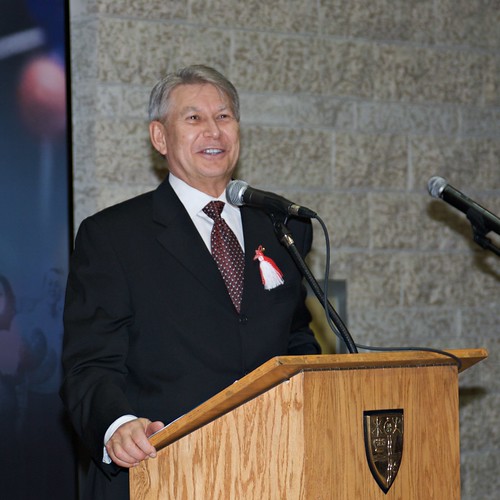
During a current swing through Western Canada, Liberal leader has some sincere words for western Canadians.
We fucked up! Sorry!
"God knows this party has made mistakes out in Western Canada and I know them," Ignatieff admitted during a speech in Regina. "We have to be honest enough with our neighbours and citizens to say 'We didn't always get it right. We didn't always listen with respect. We didn't always understand what had to be done.'"
There are numerous examples of the Liberal party's careless approach to western Canada. Pierre Trudeau's National Energy Program is merely the foremost among them.
It's likely in this vein that the Liberal party was utterly foolish to come west and try to peddle what essentially amounted to NEP II -- Stephane Dion's proposed Green Shift program.
Except that Stephane Dion's Green Shift was actually Michael Ignatieff's Green Shift -- and he seems to expect that western Canadians are somehow going to forget.
Canadians -- and, especially, western Canadians -- will remember that a carbon tax was central to Dion's Green Shift. The problem for Ignatieff was that he proposed the carbon tax first and probably even pushed Dion behind the scenes to implement it as part of the Liberal party's platform.
Ignatieff at least seems to understand the utter folly of trying to run on something like a Carbon tax in Western Canada.
"The dumbest thing you can do is run against Western Canada," Ignatieff noted. "The dumbest thing you can do is run against the energy sectors in Western Canada."
The Green Shift policy, regardless of any corporate or personal tax reductions, would have reaked havoc on the energy industry, resulting in higher energy prices for every Canadian.
Western Canadians, being not nearly as naive or foolish as the average Liberal party strategist has always imagined them to be, knew this. Even the calls for a softening of the policy by western Liberal candidates like David Orchard went largely unheeded, and the Green Shift led to a decisive Liberal defeat in the west.
"The retail politics of this were pretty tough for us," he mused. Yet Ignatieff wants to continue his dabbling in energy policy.
"We want to bring energy policy and environmental policy together around a simple goal, which is to make Canada the most efficient user of energy and the most efficient developer of sustainable energy on the planet," he said. "When we elaborate those policies in detail, I think it'll be a vote winner out west."
This is a fine idea. But Ignatieff has proven adept at bungling energy policy so badly as to have his ideas absolutely clobbered in the realm of retail politics.
Ignatieff thought he had a winner before. He and his party insisted that the tax would be revenue neutral (despite the fact that there really is no such thing as a revenue neutral tax).
Regardless of whatever Michael Ignatieff may think, western Canadians don't have a short memory. When he comes back to Western Canada to address the issue of energy policy, he'd better have something a far sight better than NEP III.
Otherwise, Ignatieff will join Trudeau and Dion amongst the Liberal leaders who fucked up in regards to Western Canada.
Speaking at a recent conference at Calgary's Rocky Mountain College, Preston Manning sent a message to Albertan Christians:
He wants them to get involved in the environmental debate.
Manning seems to think that the environmental debate -- up to and including the purported "climate crisis" -- could benefit from having a distinct Christian voice join the debate.
"We've got a window of time now to reflect on how we should be responsibly developing our resources," Manning mused. "And we as Christians can bring a distinctive approach to acting as mediators which is rooted in our faith."
But Manning reminds Christians that they don't have the option of attempting to remain neutral in the debate.
"Jesus communicates constantly between God and man. As a mediator, He sacrifices His own interests to bring the parties together. He's not an aloof third party weighing the arguments of both sides," he continued.
Manning's model -- one could think of it as a form of theological enivronmentalism -- involves two principles: "creation care" and responsible energy development.
Manning's notion of "creation care" is a fairly simple one: Christians, who believe that the Earth is God's creation, have a responsibility to ensure that the Earth is well taken care of.
This comes a long way from Ann Coulter's "Earth is yours. Here, take it. Rape it. It's yours."
The other principle of Manning's theological environmentalism embodies considerably more detail. Developing energy responsibly must go far beyond the development of existing resources. It must also mandate the improvement of energy efficiency, as well as the development of alternative -- renewable -- energy sources.
Intriguingly, Manning seems to have endorsed a policy similar to Stephane Dion's Green shift carbon tax.
"Don't call it a tax, call it a price and don't tell people that it's revenue-neutral," Manning warned. "Be honest. Tell people it's going to cost you, but then convince them that putting a value on clean air and clean water is worth it."
In other words, Manning, like many economists, favours putting a price on carbon emissions, although he seems to draw the line short of rearranging Canada's tax structure around such a notion, and would remind any politicians willing to champion such an initiative to be prepared to take the inevitable political risk of being honest about it -- something Stephane Dion and the Liberal party declined to do.
Manning has also drawn attention to a significant generation gap in those who understand the importance of mediating between the environment and the economy.
"In boardrooms and cabinet rooms, those under 35 already have the environment and the economy integrated," Manning concluded. "The older generation has a lot of difficulty grasping that reality. We have to encourage and support our children as they start to lead the way."
Which makes a certain amount of sense. Considering the argument that each generation only holds the Earth in trust for the next generation, it only makes sense for people younger and younger to lead this debate.
In the aftermath on an election in which Stephane Dion staked his party's fortunes on his Green Shift plan and lost, it was only a matter of time before the Liberal party left it in the pages of history's footnotes.
As such, it's back to the drawing board for the Liberal party.
"You go back to the drawing board on how do you get to where we want to get to in a way that's going to be eminently practical and a way that's going to raise the interest and the passion of Canadians," Rae said. "It's not like cod liver oil. You've got to make sure that what we're providing for people is something that they actually want."
"The voters have told us to come back and think again about how to reconcile environmental sustainability and economic progress," added Ignatieff.
For Ignatieff, his casual abandonment of the Green Shift could become more ammunition for his opponents to use against him. After all, in 2006 he ran for the Liberal leadership on the strength of a carbon tax plan. Stephane Dion adopted a carbon tax and suffered one of the worst losses in the Liberal party's history.
Many Liberals will likely be forgiven if they come to suspect that Ignatieff's next big idea will be a comparably bad one.
Dominic LeBlanc has also confirmed that the Green Shift won't be part of his platform.
Bob Rae, at the very least, seems to have learned a lesson from the entire Green Shift debacle.
"You don't start with a theory," Rae said. "You start with the hard bedrock of the experience of Canadians in all walks of life. If you lose sight of that you can have an interesting life, but it won't be a successful political one."
Now, the only question that remains is thus: will the three candidates in the Liberal leadership race approach Liberals -- and, later, Canadians -- with a pragmatic -- even if ambitious -- program for running the country, or will they resort back to Liberal hallmark gimmickry?
When Liberal leader Stephane Dion made what seemed to be an abrupt about-face on the issue of the carbon tax, some commentators dismissed it as a common, run of the mill flip-flop.
Those familiar to the game of politics know better. Dion's reconsideration of the carbon tax -- and the incorporation of the controversial measure into his vaunted Green Shift plan -- is a classic case of brokerage politics. In order to keep Michael Ignatieff -- who first floated the idea of a "revenue neutral" carbon tax -- firmly on board, Dion adopted Ignatieff's flagship policy plank.
But now that the carbon tax has effectively handcuffed the Liberals in the 2008 federal election campaign -- at one point pushing the party to the brink of third-party status, although it seems to have recovered -- there remain two ways to look at the implications for Michael Ignatieff.
In one sense, to those willing to overlook his proposal of the carbon tax, Ignatieff will remain very much in the game to decide who will succeed Stephane Dion as the next Liberal leader.
On the other hand, however, the unpopularity of the carbon tax proposal could be enough to erase the 5,000 vote margin by which he won Etobicoke-Lakeshore in 2006.
The similarity of Ignatieff and his Conservative opponent, Patrick Boyer, may even help sway some soft Liberal voters in the riding. Boyer has been described as "not too conservative" and Ignatieff as "not too liberal".
Boyer, meanwhile not only has experience representing the riding for the Tories, but also seniority -- he served out two terms under Brian Mulroney, whereas Ignatieff has two and a half years incumbency.
Boyer also enjoys one other advantage: he lives in the riding, whereas Ignatieff parachuted into the riding in 2006. "I know this riding. I live here," Boyer notes. "I'm not a drop-in candidate like the Liberal."
"I live 15 minutes from this riding. I come in by subway," Ignatieff responded.
A Boyer victory seems a real possibility as election day approaches.
Should Ignatieff go down in defeat in Etobicoke-Lakeshore, the carbon tax will be far from the only reason it happens. However, it will certainly be a factor, and it will be hard to look at an Ignatieff defeat as anything other than a verdict on the carbon tax.
With the Liberal campaign continuing to sag (yet somehow the Toronto Star figures it's "firing on all cylinders" -- Quelle surprise!), the common wisdom seems to be that Stephane Dion needs to stop talking about the Green Shift plan.
Because most Canadians are clearly more concerned about the economy, they argue, Dion should instead be talking about that.
Unfortunately for Dion, Dion's plan for the environment -- the Green Shift -- is also his plan for the economy.
And it only gets worse from there. As Conservative strategist Tim Powers points out in today's Globe and Mail, Bob Rae carries all kind of economic baggage with him from his days as the Premier of Ontario. Rae also managed to almost entirely alienate his former NDP followers -- the same followers the Liberal party will need to woo in order to stave off a third-place finish in this election, let alone win.
But Stephane Dion's environmental problem has become his campaign problem. And with little else of substance to campaign on, Dion may have no way out of this one -- and little hope of even holding on to the keys of Stornoway, let alone upgrading to 24 Sussex Drive.
In only their second English-language ad released during this election campaign, the Liberal party has finally deployed its first English-language counter-branding spot against Stephen Harper.
For some political parties, a week would be a long time to wait. For the cash-strapped Liberal party, maybe not so much.
That being said, the ad begins by pushing Harper's image closer to that of an unpopular American president. In a marginally creative shift, however, that president isn't George W Bush, although it is a Republican.
Instead, it's Ronald Regan, as the spot substitutes Harper's name into the "Reganomics" label so often used to describe Regan's trickle-down economic policies.
The spot also points out some of Conservative Finance Minister Jim Flaherty's comments about Ontario last year, wherein he questioned whether or not the province needed to cut corporate taxes in order to make investment in the province more viable.
The ad also notes the number of programs -- 66 in total according to the ad -- and accuses Harper of "divide and conquer politics".
This overlooks the fact that it's traditionally been the Liberals who have indulged themselves in "divide and conquer politics", pandering to Quebec and Ontario while largely ignoring the rest of the country. Only after the rise of the Bloc Quebecois have the Liberals been required to win seats across the country in order to form governments.
It's intriguing to see the Liberals, in the course of their counter-branding effort, trying to brand the Conservatives with a fault that has traditionally been their own.
Whether or not it works will be another story entirely.
The ad concludes by welcoming Canadians to "turn the page" with the Liberal Green Shift plan. The drab black-and-white images played during the "Harpernomics" portion of the ad is then substituted for colour images of promised environmentally-friendly prosperity under the Green Shift.
However, with the release of this ad -- their second ad promoting their vaunted Green Shift plan -- the Liberals are at risk of becoming a single-issue party.
Meanwhile, the Conservatives have released ads concerning immigration, foreign policy, trade policy, and child care. While none of these ads tell the viewer very much about the related Conservative policies, they make the Conservative platform seem a good deal more comprehensive than the Liberal alternative.
Meanwhile, the ad also has a pivotal weakness: it's certain to remind voters who don't like Harper why they dislike him, but they're unlikely to convince many undecided voters against him, nor do they make any real specific appeal for NDP or Green party voters to switch to the Liberals.
At least one thing can be said for certain: with their first anti-Harper ad on the air in English Canada, the Liberal campaign's gloves have effectively come off.
The second round of this election has officially begun.
In Saskatchewan, meanwhile, Wascana MP Ralph Goodale remains the only Liberal awash in a sea of blue.
He was one of two non-Conservative MPs in the province until Desnethe-Missinippi-Churchill River MP Gary Merasty resigned his seat. In a by-election he was replaced by Conservative Rob Clarke, who defeated Liberal Joan Beatty. Beatty had been hand-chosen by Stephane Dion over current candidate David Orchard, who had been chosen by the party's riding association.
Orchard has, against Dion's inclinations, been cast into a star candidate role in Saskatchewan. But that isn't where Liberal troubles end in the province. Not by a longshot.
Just as in Alberta, conservatives in Saskatchewan have an election victory -- this one by Brad Wall's Saskatchewan party -- to provide them with momentum.
Wall has come out and criticized Liberal leader Stephane Dion's Green Shift plan. Wall noted that the Green Shift plan would result in a loss of $500 million per annum for Saskatchewan and a 41% increase in electricity costs by 2012.
For his own part, Goodale denounced Wall's claims as "crock of unmitigated horsefeathers."
"Their arithmetic is just completely wrong, mistaken and false," Goodale insisted, noting that corporate tax cuts accompanying carbon taxation should make up for the extra costs. In theory.
"This is the old Conservative tactic of throw enough mud against the fan and hope everyone gets splattered," Goodale added.
According to political scientist Ken Rasmussen, Wall's comments likely won't have much effect on the election in Saskatchewan. "This is a province that the Tories have, I wouldn't say sewn up, but they're probably going to be quite effective in retaining their seats," he noted.
University of Saskatchewan political scientist David McGrane thinks otherwise. "The fact that Premier Wall has been so outspoken in saying that the Green Shift is harmful for Saskatchewan, that's definitely going to play in favour of the Conservatives," he predicted.
Meanwhile, David Orchard may be stepping on the wrong toes in Desnethe-Missinippi-Churchill River by opposing uranium mining. This in a rural riding where the Green Shift will almost certainly prove to be anathema. “The proposed carbon tax will spell economic doom for the north, in forestry, exploration, farming. Orchard is against uranium mining and oil development,” Rob Clarke noted. “The carbon tax is going to increase fuels costs and raise costs on all household items. Being in government, I will prevent that from happening."
Clearly, Harper understands the value of unseating Goodale, a former Finance Minister.
For his own part, Goodale insists that the Liberal Green Shift plan would be less costly than the Conservative plan. "They are going to impose costs by imposing their regulations and the target they're aiming at is 35 per cent more severe than Mr Dion's plan. But the crucial difference is that the Dion plan has across-the-board income tax cuts for every family, every individual, every business in the country that will add up to the biggest reduction in income tax in Canadian history," Goodale insisted.
So, while Goodale admits that, by the measuring stick that most environmentalists are measuring climate change policy, Harper's plan is better, Goodale wants to insist that, well, the Liberal plan will at least be cheaper.
Goodale and the Liberals can't even seem to play straight with the environmental lobby.
All the while many Canadians remain concerned about Dion's plans for potential carbon tariffs and seeming lack of a post-Green Shift vision, particularly vis a vis the recovery of lost revenue once carbon tax revenues decline with greenhouse gas emissions.
The Liberals have their work cut out for them in Saskatchewan. Come October 14, Saskatchewan could be joing Alberta adorned in Tory blue.
As the 2008 federal election progresses, one can't really help but wonder if Stephane Dion is regretting not intervening (again) in the nomination process in Desnethe-Missinippi-Churchill River.
Even after lightening his vaunted Green Shift plan, Stephane Dion is being called upon by David Orchard (his candidate in Desenethe-Missinippi-Churchill River) to lighten it some more.
"I don't want to see farmers or fisherman or northerners penalized for using fuels for which there is no option, they have no alternative," Orchard pronounced.
Orchard insists that he has no shortage of confidence in Dion's leadership, despite his previous interference in Orchard's electoral ambitions. "I would have no trouble working for Stéphane Dion and I'm working hard to help him win power," he insists.
Calling upon Dion to once again change his policy -- this time in the middle of an election campaign -- probably isn't as helpful as Orchard would like to believe.
To help like this, Stephane Dion may need to say "thanks, but no thanks."
Dion has suggested that the allgedly weak environmental policies of the Conservative government would imperil Canadian trade, as other countries impose punitive tariffs on countries judged to have taken insufficient action fighitng climate change.
"Other countries are considering slapping carbon tariffs on those who don't take action on climate change. As hard as it is to believe, for now, Canada is one of those countries," Dion recently said.
Dion's Green Shift plan promises to impose such "carbon tariffs" on other countries judged to be dragging their feet on climate change.
The ad itself seems to have been put together rather hastily. It features a different narrator than previous Conservative ads, and relies almost overwhelmingly on the analysis of a single expert -- Carlton University'sMichael Hart. It features images of numerous Canadian trading partners being stamped with the word "tariff" as it progresses toward its logical conclusion: a map of the United States -- Canada's largest trading partner -- being stamped.
Perhaps it was only a matter of time before the Liberal party offered up some kind of Free Trade-related policy -- one that would inevitably require the abrogation of NAFTA -- in order to keep their newest star candidate in the fold.
As such, the Conservative counter-branding effort in this case ironically tries to drive Dion closer to potentially unpopular policies of the man he would likely most like to emulate, even if Jack Layton is outdoing him on that particular front right now.
This subtext of the ad -- and reminders that many key details about Dion's Green Shift plan have been postponed in Campbellian fashion until after the election -- seem to be meant to work together to encourage voters to question Dion's genuinity and ponder the economic consequences of such a move.
The ad also represents a notable shift in the overall Conservative campaign -- moving away from tactics of ridicule and toward serious debate.
This particular ad is a bold move for the Conservative party. It will be interesting to see what kind of effect it has on the campaign.
Today, Prime Minister Stephen Harper promised to cut the excise tax on diesel fuel.
Michael Ignatieff took the opportunity to claim the plan "drives a truck through their environmental credibility."
"This is just a gimmick that will make no real difference for Canadians, while actually undermining the country's ability to switch to cleaner renewable sources of energy," Ignatieff insisted. "When it comes to facing the challenge of the climate change crisis, Mr. Harper is going in the opposite direction from the international community and every responsible leader."
It's rather ironic for the Liberals to be raging about the environmental impact of Harper's diesel tax cut considering that the election hadn't even begun before the Liberals started running away from their own policies.
"His approach will do nothing to help Canadians who want to end their reliance on fossil fuels and it will do nothing to help the Canadian economy which is the worst performing economy in the G7," Ignatieff insisted.
Of course, what Ignatieff is leaving out is that the Liberal Green Shift Lite -- complete with exemptions for farmers and truckers -- won't do anything to help Canadians end reliance on fossil fuels, and won't do anything to help the Canadian economy. In fact, the Liberal Green Shift Lite plan will most likely do the exact opposite.
Meanwhile, Stephane Dion insisted that Harper's diesel tax cut as evidence that he doesn't govern for the future -- merely for the next election.
For "Jack Layton and the NDP" (as he and his colleagues are often so eager to put it), "change" is the Obama-esque theme of their election campaign.
But that's territory they're going to have to fight for, as the Liberal party is promising sweeping changes to the country's tax structure that could very well change the country at a fundamental level.
The first Liberal campaign spot, released yesterday, doesn't quite go so far in promising their Green Shift plan as that kind of fundamental change, but certainly implies as much in the subtext.
The ad is, like the opening batch of Conservative spots, an enthusiasm-themed ad. Promising to "make the environment and economy work together" and "make polluters pay", the spot in question plays to a growing impression of Stephane Dion as a man of vision.
How far that vision extends, and whether or not Canadians favour it are different matters entirely.
Regardless, the ad seems to explain why the producers of the infamous Liberal attack ads of 2005/06 was available to go to work on the NDP's advertising -- instead of the stark, somewhat frightening tone of past Liberal ads (particularly those under Paul Martin's leadership reign), this ad speaks to a positive, optimistic space in Canadian politics.
The imagery in the ad is almost exclusively light and cheerful (with the obvious exception of smog-clouded smokestacks when the ad promises to "make polluters pay").
This may also mark the first time in a number of federal campaigns in which the Liberals have declined to go negative first -- this time, allowing the NDP to get their hands dirty first (unless one counts the "not a leader" and "oil splotch" ads released by the Conservatives).
One thing this ad certainly represents is the Liberals getting back to traditional business. Branding has always been an important element of any Liberal campaign, and with the NDP set to largely ignore the Liberals in favour of attacking the Conservatives, the Liberals may not need to stage a counter-branding campaign against the Conservatives at all.
By not moving to counter-brand against the Conservatives first, however, the Liberals have clearly put the ball in the Tories' court. What happens next in terms of campaign advertising will remain very much up to Stephen Harper.
(Unfortuantely, the embeddable player programmed by the Liberal party webmasters and obtained from their website is a little screwed up. Then again, this is the party that waited until 10 minutes before Stephane Dion's University of Alberta speech was scheduled to start to set up their Audio/Visual equipment.
Thanks again, organizational prowess of the Liberal party! -Ed)
Yesterday, Liberal leader Stephane Dion kicked off his party's national campaign at the University of Alberta.
His speech (which will be covered in detail here at The Nexus) was followed by a Q-and-A townhall-style meeting, in which he answered a variety of questions. Some questions -- obvious softballs -- were handled fairly effectively and predictably.
Some weren't -- including a question asked about hypothetical post-Green Shift Canada, which envoked a rather perplexing non-answer:
First, the question:
"If your Green Shift plan is implimented, and is successful, inevitably what we're going to see is a decrease in the taxable greenhouse gas emissions. What I'm wondering is what would a Liberal government do to make up that lost revenue?"
And the distinct non-answer:
"If we decrease the level of emissions, then the revenue of the tax will go down.
I pray it will happen!
And at that time, you know what? We'll have our revenues coming from the green economy we'll have created. Good taxpayers and good companies that will not exist in a small number. They'll be everywhere in the country.
I will give you an example: Denmark.
Denmark at first it suffered a shock. They were closing the country on weekends. I mean that you had to drive elsewhere on Saturday and Sunday. They decided to come to tax on fuel. And increase the tax on fuel. It was controversial. At that time they were 99% dependent on oil. Today, they have 0% dependence on oil. They have full employment, and this small country is exporting to the world a third of its windmills. If it's possible there, why not here?
I hope that the carbon tax one day will not exist because we'll have so few greenhouse gas emissions. It's not for tomorrow. Today, we are the worst among the world for greenhouse comissions.
We have a lot to do and it's not possible to do effectively if you don't put a price on greenhouse gas emissions. We come with good programs, good incentives, with education.
For a significant rsult, you put the price greehouse gas emissions and reduce the tax on your income, your investments, your savings and, if you're in business, your profit."
So essentially, one of two things can be taken away from Stephane Dion in this distinct non-answer:
Either Stephane Dion has no plan for the future -- no post-Green Shift plan to restore the inevitable lost revenue due to decreased taxable greenhouse gas emissions -- or he imagines that all this lost revenue will essentially be made up by exporting windmills. Somehow.
If Stephane Dion indeed has no post-Green Shift plan, one could at least applaud his honesty if he were to clearly and openly admit so.
But the alternative explanation, sadly, does not hold water. After all, even if Canada does experience the Green industry boom that Stephane Dion imagines, one has to remember that, under his Green shift tax plan, the profits of such companies -- and the incomes of their employees -- will be taxed at a lower level. The likelihood of such revenues making up for the lost revenue from decreased greenhouse gas emissions isn't terribly likely. It simply isn't mathematically feasible.
Considering that Dion's post-Green Shift numbers just don't seem to add up (at least not in any realistic fashion) the only real alternative seems to be a post-Green Shift tax grab -- increasing tax rates (even if only to 2006 rates) in order to recover the lost revenue.
After all, Stephane Dion is the individual who has spent the last 18 months decrying the lost revenue from the Conservative government's tax cuts.
Someone in the Liberal party needs to remind Stephane Dion that it will take more than prayer to make his Green Shift plan successful. It will take an eye to the future.
If Stephane Dion really has no post-Green Shift plan, big questions remain about whether or not Canadians can trust him to impliment it.
One of the key promises surrounding the Liberal party's "Green Shift" carbon tax plan is that it will not levy additional taxes on energy.
Yet Liberal leader Stephane Dion and Scott Brison (one of the architects of the Green Shift) seem to have differing opinions on the matter.
As reported by the Halifax Chronicle Herald, in June Brison told the paper's editorial board that the Liberal party carbon tax would lead to higher electricity costs for Nova Scotians because of the additional costs a carbon tax would impose on the production and purchase of coal.
"A Dion government would sit down with the provincial government and engage both the government of Nova Scotia and Nova Scotia Power in a constructive discussion on how to help Nova Scotia (make the) green shift, and we would invest in it," Brison promised.
However, since then Dion has helpfully assisted mr Brison in doing an abrupt about-face on the matter: there will be no side deals with provinces.
Of course, Brison's admission to the Chronicle Herald editorial board raises some rather important questions about the proposed Liberal policy.
Namely, if the Green Shift will lead to higher electricity prices due to the increased cost of coal, how can we expect that the Green Shift won't lead to higher gasoline prices due to the increased cost of oil?
Of course it will. And while the Liberals can insist their plan won't apply a new tax directly to gasoline, it certainly would inflate the cost of gasoline by applying additional costs (or, as the Liberals describe it, "shift the tax burden") to the production of fossil fuels).
The companies producing and refining petroleum certainly won't absorb all of that additional tax without passing the cost along to the consumer. Unfortuantely for the consumer, to do so these companies would be breaching their responsibility to the their shareholders. The lost profit could actually result in these companies being sued by their shareholders.
Considering that the largest portion of investment capital in the world today is controlled by various retirment funds, for these companies to breach their responsibility to their shareholders would hurt many, many average Canadians.
In other words, Canadians would pay for the Green Shift, one way or the other.
Of course, the less said by Scott Brison about these shortcomings of the Green Shift, the better -- at least if you're Stephane Dion. It's better for Brison not to talk about the inevitable higher costs of energy (and, through it, the higher costs of everything else) at all than to talk about solutions to such a problem.
Thus the about face -- one not terribly atypical of Brison.
"This is really what I would call quite predictable from Mr. Brison. He states a position; then it changes, he pouts and then he goes personal and attacks people as he’s doing now with the premier," remarked deputy Prime Minister Peter MacKay.
These are the questions the Liberal party has to answer about the so-called Green Shift: will the Liberal party admit that it will lead to higher energy costs -- costs that will find their way to consumers -- or won't they?
With Liberal leader Stephane Dion just having finished a tour of the west trying to sell his carbon tax plan, yet another Liberal MP has made that task significantly harder.
"The Liberal Party’s Green Shift announced on June 19th marked the most aggressive anti-poverty program in 40 years. The ‘shift’ will transfer wealth from rich to poor, from the oil patch to the rest of the country, and from the coffers of big business to the pockets of low-income Canadians."
Not only does Boshcoff insist that the "green shift" plan will do all this, he even has a pretty good idea as to how:
"Roughly $9 billion of the $15.3 billion expected to be collected annually in carbon tax revenues would be returned to Canadians earning less than $40,000 annually. This would be done through a combination of income tax cuts and benefits targeted at children, low wage earners, rural residents, and individuals with disabilities."
All of this with the revenue being transferred from "the oil patch to the rest of the country".
Considering that Alberta, Saskatchewan, British Columbia, Manitoba, Newfoundland and Nova Scotia are Canada's leading oil producers, it's hard to interpret their comments as anything other than Liberal party intent to transfer wealth out of these provinces to Ontario and Quebec.
"Ken Boschoff is a mild and caring guy, as far as I can tell. He’s my colleague from the Thunder Bay area, and an extremely effective communicator in his riding. That may be why, since his chief political opposition there is the NDP, he chose to write a piece the other day stressing the social aspects of the Dion Green Shift.
...
So, yeah, I know what Ken wrote. I also know why, and what he meant. I can also tell everyone reading this that not a single time, not once, has the notion of (a) screwing the West, (b) finding a new NEP, (c) transferring wealth from Big Oil to Toronto, (d) funding lavish new social programs or (e) dreaming up a plan to secure the Eastern vote, been discussed in national Liberal caucus. But I have heard Dion tell a room full of MPs, none of whom were from Alberta, that his plan will help diversify that oil-dependent economy and lead to a better life for every person living there."
But it's hard to decide what Dion would be saying to an Albertan MP, considering that he doesn't have any in his caucus.
Beyond that, while he again mischaracterizes reactions to Boshcoff's comments -- be they candid or otherwise -- as evidence of Alberta's allegedly bubbling separatism, Garth overlooks a very important fact:
There's a reason why Albertans don't trust the Liberal party. And yes, it does have a lot to do with the National Energy Program. And rightfully so.
The unconstitutionality of the NEP -- intervening in a policy sphere constitutionally ceded to provincial jurisdiction -- has long been established. The irreversable and irrecoverable damage done to the Albertan economy has long been established.
But the biggest slight -- the one that provokes the greatest amount of anger and resentment -- is the Liberal insistence that the damaging results of the National Energy Program should simply be dismissed to the pages of history.
All too often, this is insisted by individuals who lost nothing in the course of the NEP. And Albertans -- who, yes, do have a long memory -- remember these things quite vividly. And, no, Albertans do not believe those losses have beome irrelevant. And they certainly don't believe those losses are "yesterday's news".
Meanwhile, the Liberal party promises the carbon tax won't hurt our economy, and promise it won't result in any additional taxes. Yet the Liberal party has made such promises before, and broken them before.
Mr Boshcoff, Mr Turner: there is a reason westerners -- and Albertans in particular -- don't trust the Liberal party. And to figure out precisely what that reason is, all you need do is take a good, hard look at your own comments... and in a mirror.
As one continues to evaluate the emerging picture around the Green Shift Inc lawsuit, one wonders how seriously one should take an individual like Martin Rayner, who recently suggested that if he wants to lie by mischaracterizing the services offered by Green Shift Inc, he should be allowed to without being challenged on it.
But one wonders what to make of his most recent post on the entire affair, wherein he insists that, because the Green Shift Inc trademark was approved on June 27 of this year (though, oddly enough, "formalized" in 2005), and because there are rumours that the Conservative party that there is some sort of conspiracy afoot.
Rayner also points to the presence of Michael Krauss, a communications consultant who once worked for Brian Mulroney, as some kind of smoking gun. But considering that Krauss has no affiliation with the current government or even with the Conservative party, this claim is more than just a little dubious.
Rayner can impotently fire his weapons of character assassination into the air at his leisure. But he may want to keep in mind that, if no money has been accepted and no one with an affiliation with the government or the CPC has gotten involved, claims of a conspiracy stretch credulity beyond recognition.
Then again, it isn't as if that's anything new for Martin Rayner.
Stephane Dion insists that his "Green Shift" carbon-tax plan could provide the genesis for an emerging "green industry".
Yet, as it was revealed earlier today, Dion's use of "Green Shift" as the moniker of his plan has violated the trademark of a Toronto-based consulting firm -- one of the very companies that would be part of the "green economy" that Dion imagines.
One may wonder, however, what Dion would think of the treatment Green Shift Inc has been recieving from some of his adherents.
In a post on his new blog today, Martin Rayner (aka the misnomer "Red Tory") has taken aim at Green Shift Inc and its proprietor, Jennifer Wright, with some rather typical weapons of character assassination.
What emerges is an amusing mish-mash of disinformation.
In fact, CIPO offers a fairly detailed account of the progress of Green Shift's application from creation, to approval, to formalization, and various different formal changes.
CIPO offers some more intriguing information: namely, a list of some of the services offered by Green Shift.
More than simply "toilet paper and coffee cups", it also lists organic coffee, various paper products (including copy paper), soil reclamation products, degreasers, and various forms of consultation, among other things.
To put it lightly, Kady O'Malley's portrayal of Wright in the course of her press conference does some damage to her credibility. She seems less like a seasoned professional business person and more like a rube who barely knows how to manage her own intellectual property.
In other words: more environmental idealist than seasoned business person. Which is pretty much par the present-day "green industry".
But her obvious inexperience does not entitle the Liberal party to trample her and her business, particularly when it wants Canadians to believe that it's working so hard to build that industry into a powerhouse global contender.
Then there's the simple fact of trademark law: jurisdictions such as Canada, which operate according to common law principles, often afford trademark protection even in cases where such trademarks aren't officially registered.
One can't help but wonder why Martin Rayner wants to villainize Jennifer Wright and Green Shift Inc so badly. If anything, one would expect anyone legitimately concerned about environmental issues to criticize the Liberal party for cutting the throats of its alleged compatriots.
That quote from Cool Hand Luke would seem to embody the experience of Liberal leader Stephane Dion this week, as he faces litigation over his party's "Green Shift" carbon-tax plan.
Whether to chalk it up to Dion's excessively poor english or general obtuseness is hard to decide upon, but it's certainly yet another strike against Dion's ability to manage himself in the midst of prime time politics.
"Some men you just can't reach. So you get what we had here [this] week."
It isn't as if Dion wasn't warned, either. Jennifer Wright, the owner of Green Shift Incorporated, a consulting firm that helps companies adopt more Earth-friendly practices, had already warned Dion not to violate her company's trademark.
For some Liberals, however, the $8.5 million lawsuit is simply another opportunity to allege some sort of insidious conspiracy against the party.
Flying McGuinty brother and federal MP David McGuinty claimed he had been using the phrase "green shift" throughout the 1990s, and insisted its in common usage throughout the environmental movement. "It's a bit mysterious -- in fact, puzzling -- why (the suit) is being launched now," McGuinty said.
Yet a Google search not unlike the very one he suggests reveals the website for Green Shift Inc, another website that notes it is not affiliated with Green Shift Inc, and a number of news stories about Stephane Dion's "green shift".
Dion's appropriation of the phrase certainly does pose a number of problems for the company, including questions about its ownership status. "We've been contending with phone calls asking if we have been taken over by the Liberal party," Wright reports
The search also reveals a website for an American company of the same name, whom Wright says she has given up legal actions against on account of "costs and geography".
The implications of this trademark violation aren't limited to the party, either.
(One of the videos in question proved particularly embarrassing for the Liberal party, as it caught them preventing documents, touted as "misplaced" by the Conservative party, from being delivered to their proper destination.)
In this light, one wonders what Jason Cheriak would have to say about the party's misappropration of the Green Shift trademark.
To date, however, Cherniak has yet to comment on this. So it would seem that the answer to that question, as of the time of this posting, is "not much".
If we at the Nexus have learned anything, it's that as far as being a political commentator or historian goes, Lindsay Stewart makes a really bad actor (presumably a decent enough waiter, though).
A few days ago (while we were otherwise indisposed) Stewart decided to take aim at the recent "Stephane Dion's tax trick" ads being offered by the Conservative party:
"The Stephen Harper Party of New Canada is set to launch yet more attack ads in their permanent and constant election campaign. We've grown used to seeing the shrugging visage of hapless Liberal person-that-is-supposed-to-be-in-charge, Stephane Dion in the Con's endless efforts to blame the state of their nation on the other guys. This time the Cons have targeted the gas pump. Their new ads will be a brightly coloured blamefest, designed to take advantage of consumer anger at the spiraling price of fuel.
All of this trouser dampening and fear mongering is aimed at Dion's terrifying carbon tax proposal. You know, nothing says Conservative quite like the reek of stale urine, well, except for estrangement from the truth.
"However, Jane Taber and Craig Oliver, co-hosts of CTV's Question Period, noted that the Liberal tax -- which hasn't been formally presented yet -- rules out an additional tax on gasoline."
Details, bitches. Let loose your bladders and join the widdling chorus of Conservative he-men and women. What ever you do, don't pay any attention to the fact that it is during Conservative rule that those fearsome prices have gathered. That the Harper Conservatives are at the helm as auto sector jobs vanish and food prices sky-rocket, that means nothing. Shiny thing ADSCAM shiny thing."
One wonders precisely where to start.
Stewart wants to draw the readers' attention toward various "facts" and impel them draw some extremely dubious conclusions regarding them.
Namely, that if gas prices rise, auto sector jobs disappear and food prices rise while the Conservative party is in power, then, by golly, they simply must be to blame!
Pay no attention to the fact that the coming cuts in auto manufacturing actually have more to do with ever-increasing market competition between North American, European and Asian car makers, as well as recent dips in demand for uneconomical makes and models of cars being produced in Ontario plants. And certainly don't blame Ontario's McGuinty government for being "at the helm" in Ontario while job losses menace the population. They surely have nothing at all to do with it.
(Also pay no attention that the most striking food shortage in the world today is a shortage of rice -- which virtually no one is using for biofuels.)
Pay no attention to these facts.
"Oh yes, fellow Canadians, cower in fear before the tax and spend Liberals. Dread the party that balanced the federal budget. Fear the wicked men and women that brought us the sinister and awful budget surplus. Take solace in the doughy embrace of the bold Conservatives who have cut some taxes and presided over the decimation of the terrible surplus. Rejoice friends, soon with Conservative governance, diligence and care, we will return to the comfort and security of deficits and the slashing of ever more social programs. Infrastructure is for pussies. Why, Dion wants to tax something and all taxes are tools of the devil. He wants to take your money and give it foreign talking atheist abortion lesbians that are married.
"In addition, the carbon tax is supposed to be "revenue neutral" -- meaning revenue raised by the carbon tax is to be offset by accompanying cuts in income and other taxes, Taber said."
Don't pay any mind to the facts. We can't change tack, not now, not ever. Trust Stephen, he is large."
Ignore the fact that the Liberal party balanced the federal budget by slashing and burning public healthcare and education. Ignore the fact that the Liberal party built huge surpluses off of high taxes and the exporting benefits of a devalued Canadian dollar.
Ignore the fact that Liberals diverted billions of dollars away from gas taxes intended to help the provinces maintain infrastructure to fund their own pet projects and left provincial governments holding the bag for the maintenance of streets and highways (who, in turn, increasingly left municipalities holding the bag).
Pay no attention to these facts.
"He knows that doing anything to hamper the strip mining and carbon spewing filthy habits of his backers will destroy the economy. ADSCAM. Working cleaner, living smarter, why that's commie talk. Innovation and change will mean the end of everything as Stephen Harper knows it, the way he likes it and the way he wants to keep it. Fuck the fucking climate, screw the stupid rivers, lakes and waterways. There is money in them thar poisoned hills and ain't nothing more important than harvesting money for corporate profit. In this era, to be Conservative is divorced from conservation, let's call it unreconcilable differences shall we. Tomorrow is just a lie that keeps us from the rapture and Stephen and Stockwell are always at the ready to saddle up their dinosaurs and ride us off the cliff into the pretty, poisoned sunset."
Ignore the fact that the promise of a "revenue neutral" carbon tax (as Stewart constantly alludes to but never quite gets around to actually addressing) is far from innovative, and when one examines some basic political history, it's quite similar to promises we've heard before.
The idea is that the Liberal party will cut income taxes and "other taxes" in order to offset the cost of a carbon tax and prevent the necessity of additonal taxes on fuel.
We've heard similar promises from the Liberals before: namely, in the leadup to the 1993 federal election, when Jean Chretien promised the Liberals would abolish the critically-unpopular Goods and Services Tax. Liberal deputy leader Sheila Copps even promised to resign if the Liberals failed to do so.
As those who are familiar with Canadian political history will recall, the Liberals failed to do so, and Copps resigned -- only to immediately seek reelection in a by-election in a Liberal stronghold riding.
Flash forward 15 years in the future, and Liberal leader Stephane Dion -- the very same man who's promising a "revenue neutral" carbon tax -- has become a strident defender of the GST, not only opposing an abolition of the tax, but also opposing any cuts to it, decrying the very same "lost revenue" that Stewart laments.
Then one remembers the promised structure of the so-called "revenue neutral carbon tax" -- wherein taxes would be shifted away from income tax, and Canadians would instead be taxed for their carbon emissions -- taxes they could theoretically reduce by reducing their carbon emissions.
It would be a brilliant proposal if Canadians could actually trust the Liberals to keep such promises.
Yet as Canadians cut their emissions, reducing their tax burden, the government would eventually face billions and billions of dollars in lost revenue, facing a potential Liberal government with the very same cash flow problems they claim the Conservatives are causing for the country.
How to deal with that? Simple: shift tax receipts increasingly back toward income tax, slowly wiping out the carbon tax savings of Canadians with increased income taxes.
It's a clever tax trick, but it remains just that: a trick.
Beyond that, there's a huge question of who, precisely, will bear the burden of the carbon tax. Will it be shared equally by citizens and business, and by all sectors of the Canadian economy?
Not bloody likely. Anyone who honestly believes that the party of corporate Canada will impose an equal carbon tax burden on sectors such as the Ontario manufacturing sector need to give their head a shake. There's very little question that the Liberals very much miss the support of their corporate friends, and are eager to find a way back into their good books.
Which almost certainly means that citizens will bear a disproportionate share of this tax burden, and will likely see this manifest itself at the fuel pump, which will inevitably manifest itself in increasing costs -- and thus prices -- for everything.
Lindsay Stewart believes he can obscure the issue by never really addressing it, then dressing it up with various empty ruminations about how simply awful he believes the Harper government is.
What he doesn't seem to want to address is the fact that, when it comes down to tax-related promises, Canadians have precisely zero reason to trust the Liberal party, given the litany of their previously-broken promises.
We've also seen what they do with our tax dollars: when they aren't stealing them, wasting them on various pet projects.
Elizabeth May continued to fill the roll of unofficial deputy leader of the Liberal party yesterday on CTV's Question Period when she went after Jack Layton for his opposition to Stephane Dion's carbon tax.
"We need to act on the climate crisis, and a carbon tax is a litmus test of whether a party is serious about it or not," May -- allegedly the leader of the Green Party but looking increasingly more and more like a Dion lackey -- insisted.
She also insisted that Layton's opposition "is not part of the global social democratic approach."
Fair enough. Supporting politicians who do nothing at all about climate change when given the opportunity and charged with the responsibility is probably "not part of the global social democratic approach", either.
(Certainly, Al Gore didn't do anything to curb global warming. But unlike Stephane Dion, he never really had a mandate to.)
But there are countless other reasons why May's comments are a sad statement on the current state of the Green Party of Canada. Other than Elizabeth May going on national television and simply emulating Chris Crocker.
For example, how about a little consistency in cross-referencing the issue? Consider the following: the CTV story tells us that the Liberals have apparently decided to make the carbon tax "revenue neutral" by cutting income tax and applying the rest of that tax in the form of carbon tax.
Which actually doesn't seem like the worst idea at base level: taxpayers would have an incentive to reduce their carbon consumption, and many conservative-minded Canadians would get the tax cuts they perpetually yearn for.
Yet GreenParty.ca blogger Douglas Neil was among those who criticized the current government for its tax cuts, as did Stephane Dion who, as we recall, threatened to topple the government over a tax-cutting mini-budget, and has harped day and night about lost tax revenue and forecasted a federal budgetary deficit.
Yet if a carbon tax proved to be a successful incentive for Canadians to reduce their carbon consumption, the government would be out that amount of revenue. Certainly, Dion could devise some sort of a "gotcha, sucka" claw back to reclaim such revenue as income tax, but that would be rather disingenuous considering that tax savings are supposed to be a reward for reducing carbon consumption.
At the end of the day, what turns out to be the principle difference between Stephen Harper's tax cuts and Stephane Dion's carbon tax on federal coffers? Not a whole lot.
Jack Layton -- who also opposed the tax cuts -- seems wise enough to recognize that, and wise enough to not make a hypocrite out of himself by jumping behind an initiative that would reduce the revenue available to fund the social programs that the NDP has always unflappably supported, and the Liberals have long pretended to.
At least Layton's "cap and trade" system would actually produce revenue for the government to invest in carbon-reducing initiatives -- although May and her compatriots will almost certainly turn on "cap and trade" policies John McCain (a Republican) is proposing one.
Yet, in the face of the carbon tax's inconsistency with their own previous stances, Elizabeth May really has little to say other than criticizing Jack Layton for not jumping in line behind her as a Stephane Dion lacky.
All Dion wants to do is hurt the Liberal party, she insists. "He's a human!!!"
In fact, Elizabeth May probably considers us all rather unfortunate that Dion even continues to come up with ideas for us bastards.
Jack Layton had better leave Stephane Dion alone. Elizabeth May means it.
According to the National Post's Terence Corcoran, Stephane Dion's proposed carbon tax is a huge, ill-conceived gamble.
And it is. It plays to the general Liberal strength of putting together a good-sounding idea, making it look good on paper, then worrying about the planning after they get the votes.
But the carbon tax may be the first sign that Dion is ready to put his money where his mouth is, take some risks, and play big game politics. And if he plays his hand right, this is one idea that he very much could parlay into a tenancy at 24 Sussex Drive.
It isn't that the carbon tax is such a fantastic idea.
It won't do anything to curb carbon emissions -- economic research shows us that unless they're extravagantly high, taxes do little to provide an incentive to stop consuming a product, be it gasoline, tobacco or alcohol, and often in fact make a person feel entitled to continue consuming guilt-free.
It will absolutely never be revenue-neutral -- taxes, by their very definition, aren't ("revenue neutral" is an obfuscatory phrase).
Last, but not least, knowing the record of Liberal governments in Canada, we don't even have any guarantee that the revenue accrued under a carbon tax will be spent as Dion insists it would be -- in helping to offset carbon production with energy efficiency and carbon-capture projects.
But Dion's willingness to promote a carbon tax attacks what has become a structural weakness in Canadian politics.
Dion himself slipped three points in the vision category. Jack Layton lost four points and Elizabeth May shed two. Harper, however, stood pat from previous findings.
Instead, an increasing number of Canadians are becoming unsure as to who is offering Canadians the best vision. According to Nanos' findings, a whopping 35% had no preference.
There's good reason for this, and it comes back to the very real sense among Canadians that our politicians have foregone any sense of vision.
And while the carbon tax's inevitable effect on fuel prices could make the vision that Dion is promoting potentially hazardous, one can't underestimate the potential drawing power of a politician with a vision.
After having spent so long without politicians with any demonstrable vision -- aside from Preston Manning, Brian Mulroney has been the only federal leader to give voice to any kind of vision at all, let alone one that Canadians are prepared to buy into.
There's also a lot to be said about a politician who's willing to take a risk. If Dion truly sticks to his guns on this one, he could see a lot more Canadians to take a long second look at the Liberal party. While there's no guarantee that they'll be willing to give him the political capital necessary to place his bet on a carbon tax, his chances to do that should improve significantly.
Then again, quite a few Canadians are likely not very eager to support a politician in gambling on Canada's future.
At the end of the day, Dion may find himself placing this bet all on his lonesome. But only time -- and lady luck -- will tell.

 "God knows this party has made mistakes out in Western Canada and I know them," Ignatieff admitted during a speech in Regina. "We have to be honest enough with our neighbours and citizens to say 'We didn't always get it right. We didn't always listen with respect. We didn't always understand what had to be done.'"