
Showing posts with label Jason Kenney. Show all posts
Tuesday, November 08, 2011
Dan Gardner, the Media Party, and the Disintegration of Modern Journalism
Some Nexus readers may recall a Byline segment from early October wherein Brian Lilley commented on a segment of Canadian journalism he refers to as "the media party".
In the segment, Lilley actually names a few journalists he considers to be members of the media party. Chief among them is "author, journalist and lecturer" Dan Gardner.
Last night, Gardner witnessed Minister of Citizenship, Immigration and Multiculturalism Jason Kenney refer to unreported crime in explaining and defending the Conservative government's omnibus crime bill. Garner couldn't hold back his objection -- nor, necessarily, should he -- and took to Twitter to voice his objection.
Gardner, who Tweets under @DGardner decided to respond to Kenney's comments by first selectively citing data from the study, then by dismissing unreported crime as "trivial":
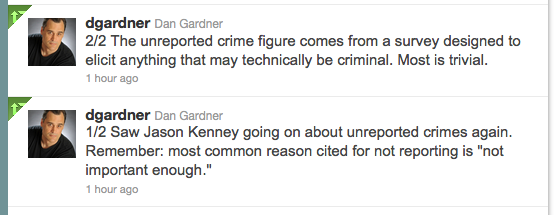
Your not-so-humble scribe couldn't resist the opportunity to ask Gardner a few questions about the assumptions he was making. Gardner's ultimate response was that he ultimately would not consider any other data points:
In other words, Gardner refused to talk about any weaknesses in the assumptions he was offering, or even any other information. If it was going to be discussed, it would have to be discussed with other people, because he won't.
There's good reason for this. The survey as a whole says far more than Gardner says it does, and the data points he himself is offering don't necessarily support his claims about it.
There are obvious problems with a response that begins and ends with "not important enough", and it has to do with the respondent's perception of the meaning of that phrase. The question of who the incident in question is perceived to be "not important enough to" is a very real question.
To blithely assume that this means that the victim of the crime in general didn't consider it important enough to report is to also assume that all respondents perceived the meaning of that phrase in a uniform manner. This would be a mistake.
When a response begins and ends with "not important enough", it's every bit as likely that the respondent could conclude that the crime in question was not important enough to the police as not important enough to them personally. In lieu of a better-defined response, either conclusion is equally likely, and it's much more reasonable -- and responsible -- to allow for the probability that those who submitted that response had either of these in mind. Some likely concluded the former, and some likely concluded the latter.
Yet to ask Dan Gardner if the conclusion he reached -- that this response indicates that most of Canada's unreported crime is trivial -- is reasonable considering the ambiguous nature of this data is apparently to precipitate a meltdown on his behalf. If last night's events are any indication, he simply can't cope with that idea.
To ask him about the second-ranked response -- "police could not do anything about it" -- is apparently to make it worse. Gardner's response was that this was a worthy point to be discussed, but that he personally wouldn't. (That the second-ranked response trailed the first-ranked response by less than ten percentage points apparently did nothing to boost the worthiness of this data point in Gardner's eyes.)
It becomes difficult to avoid reaching the conclusion that, in the canon of the far-left media, these are forbidden questions. "Does the data actually indicate what you're saying it does?" That question is forbidden. "Isn't the second-ranked response also worthy of consideration?" That question is also forbidden.
What seems to emerge, in Dan Gardner's case, is that of a man who has not embraced journalism as a means with which to provide people with information or even ideas. Rather, he's embraced the journalistic enterprise purely as a means of political advocacy. Nothing else.
It's hard to escape the conclusion that Gardner is simply a card-carrying member of the media party. The media party has an agenda, and in this case it's in preserving the soft-on-crime, hug-a-thug policies that they claim have reduced crime in Canada, but in reality have not. The Stats Can study itself states that in no uncertain terms -- victimization in Canada has remained stable.
In support of that agenda, Gardner sets out to turn public attention away from specific data points that do not support that agenda, and toward data points that seem to support it only if they go unexamined.
It's one thing to insist that Canadians aren't reporting specific crimes because they're "not important enough", whatever that might mean to the individuals who offered that response.
To insist that the unreported crimes are trivial is remarkably obtuse when one considers what those unreported crimes are:
Of the crimes unreported in Canada, the number one is break and enter. That is not a trivial crime. The second is motor vehicle or parts theft. That is not a trivial crime. The third is robbery. That is not a trivial crime. The fifth is physical assault. That is not a trivial crime.
The fourth was vandalism. That could be a trivial crime, but not necessarily. The sixth and seventh were theft, or personal property and household property respectively. That, too, could be a trivial crime, but not necessarily.
It's not up to Dan Gardner to decide if the unreported victimization of Canadians is trivial. It's up to each individual victim to decide that for themselves and admittedly, many of them might reach that conclusion. Many might not.
But this is how the media party operates: they assume that they speak for Canadians as a whole, then they pretend to.
In the end, Dan Gardner's impotent response to the questions he was asked was to label your not-so-humble scribe a "troll". Basically it amounts to an accusation that the questions over whether or not Gardner has given ample consideration to the meaning of the data points he offers is "inflammatory, extraneous, or off-topic", as Wikipedia would have it.
The questions over whether or not Gardner is accurately interpreting the data offered by this survey are very clearly on-topic. It's simply a question that he considers forbidden: it's entirely reasonable to ask in the face of ambiguous data with a wide berth of potential meanings, but it seems to be Gardner's belief that no one is allowed to ask that question.
To this end, Dan Gardner is wrong. People have the right to ask these questions, and if Gardner, demanding merit in the public eye, refuses to discuss them, then it's he who has abandoned the lofty aspirations of journalism.
It's not what one would expect from a journalist. But it's precisely what one would expect from a member of the media party.
Labels:
Brian Lilley,
Conservative party,
Crime,
Dan Gardner,
Jason Kenney,
Twitter
Wednesday, April 27, 2011
Ruby Dhalla Outhustled, Complains About It
Dhalla objects to Tory candidate helping immigrants
According to Liberal MP Ruby Dhalla, something rotten is afoot in Brampton-Springdale; it's Conservative candidate Parm Gill.
Dhalla is upset that Gill has been extending his help to local immigrant families, helping them fill out the applications necessary to help their family members move to Canada.
"In those cases the families have been called before even I was notified, that had they had been accepted and approved by the minister's office and they were called by Parm Gill," Dhalla complained.
She alleges that her constituents are unwilling to come forward because of some form of intimidation. (Which seems strangely at odds with what the facts seem to be. Helping people get their family into Canada is an odd form of intimidation.)
For Jason Kenney's part, he suggests Dhalla is largely fabricating her concerns.
"That's completely ridiculous, you know, she's a Liberal MP who's under a lot of pressure, and of course she's going to make unfounded and ridiculous accusations," Kenney declared. He also suggests Dhalla does a poor job of serving her constituents.
"It's because they can't get any service from their member of Parliament and that's one of the reasons why I think Parm Gill should be elected member of Parliament for Brampton-Springdale," Kenney declared.
"Mr Gill has every right as a private citizen to provide volunteer unpaid advice," Kenney continued. "I understand he has taken no payment for that. He has never claimed to represent the government or me, but he's just providing a volunteer service and that's totally legitimate."
It's not over in Brampton yet. Dhalla -- who was also the MP behind a ludicrously-irresponsible bill that would have granted pension benefits to immigrants after they'd been in Canada for only three years -- has spent a great deal of time pandering to the immigrant community in her riding. Even if she's done a poor job of serving her constituents, she may yet be able to win reelection based on that pandering.
So even though Ruby Dhalla got outhustled in her own riding, she may yet outrun her principal opponent.
According to Liberal MP Ruby Dhalla, something rotten is afoot in Brampton-Springdale; it's Conservative candidate Parm Gill.
Dhalla is upset that Gill has been extending his help to local immigrant families, helping them fill out the applications necessary to help their family members move to Canada.
"In those cases the families have been called before even I was notified, that had they had been accepted and approved by the minister's office and they were called by Parm Gill," Dhalla complained.
She alleges that her constituents are unwilling to come forward because of some form of intimidation. (Which seems strangely at odds with what the facts seem to be. Helping people get their family into Canada is an odd form of intimidation.)
For Jason Kenney's part, he suggests Dhalla is largely fabricating her concerns.
"That's completely ridiculous, you know, she's a Liberal MP who's under a lot of pressure, and of course she's going to make unfounded and ridiculous accusations," Kenney declared. He also suggests Dhalla does a poor job of serving her constituents.
"It's because they can't get any service from their member of Parliament and that's one of the reasons why I think Parm Gill should be elected member of Parliament for Brampton-Springdale," Kenney declared.
"Mr Gill has every right as a private citizen to provide volunteer unpaid advice," Kenney continued. "I understand he has taken no payment for that. He has never claimed to represent the government or me, but he's just providing a volunteer service and that's totally legitimate."
It's not over in Brampton yet. Dhalla -- who was also the MP behind a ludicrously-irresponsible bill that would have granted pension benefits to immigrants after they'd been in Canada for only three years -- has spent a great deal of time pandering to the immigrant community in her riding. Even if she's done a poor job of serving her constituents, she may yet be able to win reelection based on that pandering.
So even though Ruby Dhalla got outhustled in her own riding, she may yet outrun her principal opponent.
Sunday, April 10, 2011
THE Great Idea Whose Time Has Come
Tories pledge to take a stand on global religious freedom
Who says that Canadian political parties don't talk about foreign policy at election time?
Surely, they don't do it nearly enough. But sometimes, it happens. This was the case very recently, as the Conservative Party announced they would create an Office of Religious Freedom within the Department of Foreign Affairs.
"We think there's a need to put a particular focus on this," announced Minister of Citizenship and Immigration Jason Kenney. "This is something the United States did more than a decade ago through the creation of the Office for International Religious Freedom in the State Department."
"You'd be looking at things, in part, from a religious freedom prism," he continued. "As a champion of human rights around the world we should be entirely comfortable with focusing on the rights of vulnerable religious minorities."
For his own part, Liberal Foreign Affairs Critic Bob Rae was not convinced, and seemingly not amused. He accused the Tories of naked political opportunism.
"It has much more to do with Canadian domestic politics than it has to do with the necessity of having a coherent strategy for the promotion of democracy and human rights," Rae complained. "It's more a domestic strategy than a foreign affairs strategy."
In his own rush to find something in the policy to criticize, David McGuinty complained about separation of church and state. He also suggested that an office promoting religious freedom abroad is not necessary.
"We have a document in this country that does that, it's called the Charter of Rights," McGuinty mused.
In this, McGuinty has missed the point. In countries like Saudi Arabia, China, Iran, and (yes) Afghanistan there are no such documents. They have no such freedoms. Moreover, the office would also allow Canada to take a stronger stand against the Organization of the Islamic Conference, who annually introduce their anti-blasphemy resolutions at the UN.
Canadians believe religious freedom to be a global good. Canada would be remiss not to promote it abroad.
This is an idea that the Liberal Party should enthusiastically support. If anything, their greatest criticism of the Conservatives should be that they didn't create such an office years ago.
Their lack of enthusiasm about this idea indicates that the Liberal Party has taken a step away from Canadian values. In their assumption that they define Canadian values just by virtue of existing, the Liberal Party has lost touch.
Jason Kenney seems to have little time for those opposing this idea.
"Perhaps there are some rabid secularists out there who don't understand there are a lot of vulnerable religious minorities under attack around the world," Kenney remarked. "To those people who would challenge it because they are uncomfortable with religious faith, I would say, 'Get over it'. We're talking about fundamental rights here."
If this initiative wins more votes from ethnic Canadians, it will be for good reason: because they understand the importance of this issue, and they know that the Conservative Party shares that understanding.
Who says that Canadian political parties don't talk about foreign policy at election time?
Surely, they don't do it nearly enough. But sometimes, it happens. This was the case very recently, as the Conservative Party announced they would create an Office of Religious Freedom within the Department of Foreign Affairs.
"We think there's a need to put a particular focus on this," announced Minister of Citizenship and Immigration Jason Kenney. "This is something the United States did more than a decade ago through the creation of the Office for International Religious Freedom in the State Department."
"You'd be looking at things, in part, from a religious freedom prism," he continued. "As a champion of human rights around the world we should be entirely comfortable with focusing on the rights of vulnerable religious minorities."
For his own part, Liberal Foreign Affairs Critic Bob Rae was not convinced, and seemingly not amused. He accused the Tories of naked political opportunism.
"It has much more to do with Canadian domestic politics than it has to do with the necessity of having a coherent strategy for the promotion of democracy and human rights," Rae complained. "It's more a domestic strategy than a foreign affairs strategy."
In his own rush to find something in the policy to criticize, David McGuinty complained about separation of church and state. He also suggested that an office promoting religious freedom abroad is not necessary.
"We have a document in this country that does that, it's called the Charter of Rights," McGuinty mused.
In this, McGuinty has missed the point. In countries like Saudi Arabia, China, Iran, and (yes) Afghanistan there are no such documents. They have no such freedoms. Moreover, the office would also allow Canada to take a stronger stand against the Organization of the Islamic Conference, who annually introduce their anti-blasphemy resolutions at the UN.
Canadians believe religious freedom to be a global good. Canada would be remiss not to promote it abroad.
This is an idea that the Liberal Party should enthusiastically support. If anything, their greatest criticism of the Conservatives should be that they didn't create such an office years ago.
Their lack of enthusiasm about this idea indicates that the Liberal Party has taken a step away from Canadian values. In their assumption that they define Canadian values just by virtue of existing, the Liberal Party has lost touch.
Jason Kenney seems to have little time for those opposing this idea.
"Perhaps there are some rabid secularists out there who don't understand there are a lot of vulnerable religious minorities under attack around the world," Kenney remarked. "To those people who would challenge it because they are uncomfortable with religious faith, I would say, 'Get over it'. We're talking about fundamental rights here."
If this initiative wins more votes from ethnic Canadians, it will be for good reason: because they understand the importance of this issue, and they know that the Conservative Party shares that understanding.
Thursday, March 31, 2011
Jason Kenney's Refugee Legacy Not So Troubling
Kenney filling in gaps in immigration policy
With Jason Kenney's governmental responsibilities as the Minister of Citizenship and Immigration intersecting neatly with his party responsibilities as the pointman for outreach to ethnic communities, it was only a matter of time before someone popped up to take some shots at him.
It turns out one of the first is Jim Creskey. Writing in Embassy Magazine, Creskey outlines what he considers to be Kenney's "troubling" record as the Minister of Immigration. In some regards, it reads like a screed from an extremist organization like No One is Illegal.
Creskey's complaints circle around Bill C-49, an anti-human smuggling bill. Authored with help from Public Safety Minister Vic Toews, allows immigration officials to temporarily detain a refugee who arrives by irregular means, and to reevaluate them after five years to determine whether or not they are at risk if they return to their country of origin.
Creskey suggests that Kenney, Toews and Prime Minister Stephen Harper fabricated the idea that Canada has been "overrun" by illegal immigrants. If Creskey is attempting to claim that there is no problem with migrants illegally on Canadian soil, he is simply wrong.
Bill C-49 would be one thing if it were targetted at legitimate refugees who belong in Canada. But that isn't the case. Bill C-49 is targetted at refugees who lack a founded claim. In particular, its aimed at denying foreign terrorists entry into Canada, and deporting them promptly if they are already here.
Individuals linked to the Tamil Tigers have spent years terrorizing law-abiding Tamil communities in Canada, often demanding funds while making threats against any family they may have at home in Sri Lanka. They also commit comparatively petty crimes in Canada, including debit card fraud rings.
This on top of attempts to form a Tamil Tiger government-in-exile in Canada.
For years, a policy aimed at using refugee status as a gateway to citizenship has biased immigration policy into letting many of these so-called "refugees" roam free. When one of them is identified as having links to a terrorist or criminal organization, they simply vanish. There is an incomprehensible number of such individuals currently evading deportation orders in Canada.
This isn't to say that Creskey is entirely wrong about the immigration issue. In an earlier Embassy column, Creskey relates the tales of numerous refugee claimants, with entirely legitimate claims, who simply get lost in the system.
It's a sad fact that sometimes, in Canada's refugee system, people get lost in the cracks. Occasionally, Citizenship and Immigration bureaucrats even hand down some poor decisions, such as the decision to deport a blind man back to Algeria. Fortunately, the decision was overturned with the help of considerable public pressure.
Kreskey does the country a service by raising these concerns. But to complain so hyperbolically about Jason Kenney's moves to fill in key gaps in Canada's immigration policy does the country a profound disservice.
Jim Creskey too often sounds far too little like a reasoned, educated thinker on immigration policy, and too frequently like one of the demagogues at No One is Illegal.
With Jason Kenney's governmental responsibilities as the Minister of Citizenship and Immigration intersecting neatly with his party responsibilities as the pointman for outreach to ethnic communities, it was only a matter of time before someone popped up to take some shots at him.
It turns out one of the first is Jim Creskey. Writing in Embassy Magazine, Creskey outlines what he considers to be Kenney's "troubling" record as the Minister of Immigration. In some regards, it reads like a screed from an extremist organization like No One is Illegal.
Creskey's complaints circle around Bill C-49, an anti-human smuggling bill. Authored with help from Public Safety Minister Vic Toews, allows immigration officials to temporarily detain a refugee who arrives by irregular means, and to reevaluate them after five years to determine whether or not they are at risk if they return to their country of origin.
Creskey suggests that Kenney, Toews and Prime Minister Stephen Harper fabricated the idea that Canada has been "overrun" by illegal immigrants. If Creskey is attempting to claim that there is no problem with migrants illegally on Canadian soil, he is simply wrong.
Bill C-49 would be one thing if it were targetted at legitimate refugees who belong in Canada. But that isn't the case. Bill C-49 is targetted at refugees who lack a founded claim. In particular, its aimed at denying foreign terrorists entry into Canada, and deporting them promptly if they are already here.
Individuals linked to the Tamil Tigers have spent years terrorizing law-abiding Tamil communities in Canada, often demanding funds while making threats against any family they may have at home in Sri Lanka. They also commit comparatively petty crimes in Canada, including debit card fraud rings.
This on top of attempts to form a Tamil Tiger government-in-exile in Canada.
For years, a policy aimed at using refugee status as a gateway to citizenship has biased immigration policy into letting many of these so-called "refugees" roam free. When one of them is identified as having links to a terrorist or criminal organization, they simply vanish. There is an incomprehensible number of such individuals currently evading deportation orders in Canada.
This isn't to say that Creskey is entirely wrong about the immigration issue. In an earlier Embassy column, Creskey relates the tales of numerous refugee claimants, with entirely legitimate claims, who simply get lost in the system.
It's a sad fact that sometimes, in Canada's refugee system, people get lost in the cracks. Occasionally, Citizenship and Immigration bureaucrats even hand down some poor decisions, such as the decision to deport a blind man back to Algeria. Fortunately, the decision was overturned with the help of considerable public pressure.
Kreskey does the country a service by raising these concerns. But to complain so hyperbolically about Jason Kenney's moves to fill in key gaps in Canada's immigration policy does the country a profound disservice.
Jim Creskey too often sounds far too little like a reasoned, educated thinker on immigration policy, and too frequently like one of the demagogues at No One is Illegal.
Tuesday, October 26, 2010
Conservative Immigration Bill Must Stand
Tories responsible, will opposition be?
In the wake of a controversy regarding Tamil migrants -- many of them suspected to be affiliated with the Tamil Tigers -- the Conservative government is moving to introduce new legislation that would make it easier to detain migrants who arrive on Canadian territory illegally.
"We're absolutely certain that this meets our international and domestic legal obligations, as well as our humanitarian obligation to provide protection for people who might face persecution," Kenney explained. "We would in fact provide protection and would not send back people, even illegal smuggled migrants, if they are able to demonstrate, in our legal system, that they would face persecution."
"We are confident that this complies with the Charter and our domestic and international legal obligations," he continued.
Immigration policy seems mysterious and technocratic to many people not deeply-versed in its legalities. But, in reality, the ultimate purpose of such legislation is very simple: let the people who belong in Canada in, and keep the ones who don't belong in Canada out.
Very simple.
Canada isn't the only country whose government examined the passengers of the Sun Sea and think twice about admitting them. Britain considered some of those on board the vessel and turned them down.
In Kenney's view, those Tamils who boarded the Sun Sea after being turned down in the course of a lawful application to the UK have simply jumped the queue.
"This unlawful behaviour is nothing more than jumping the immigration queue, taking up space and resources in our immigration and refugee system that should be focused on those who are legitimate and lawfully waiting their turn to come to Canada," Kenney insisted.
In terms of immigration, Kenney gets it: those who should be in, in. Those who shouldn't, out.
There are stark consequences if Canada forgets about this very simple idea.
Of course, not everyone is in favour of such legislation. Wanda Yamamoto, President of the Canadian Council for Refugees, objects. Particularly to the detention of irregular claimants.
"Measures keeping some refugees longer in detention, denying them family reunification and restricting their freedom of movement are likely in violation of the Canadian Charter and of international human rights obligations," Yamamoto complained. "People who are forced to flee for their lives need to be offered asylum and a warm welcome, not punished."
Yamamoto may want to point to any portion of the Canadian Charter of Rights and Freedoms that allows foreigners to illegally enter Canadian territory with near-complete impunity. But she can't, because it doesn't exist.
If challenged based on its constitutionality, the choice for any court hearing the case is a very stark one: will Canada's immigration laws be decided by Parliament, or by special interest groups with a vested interest in maintaining a substandard and porous immigration policy.
Plugging these holes in Canada's immigration policy is important not only to repairing Canada's Extended Refugee System, but also to addressing security issues like terrorism, and criminal issues such as human trafficking.
The Conservative Party is doing the responsible thing with this legislation -- a point only underscored by the repeated arrival of vessels such as the Sun Sea.
"Since the last vessel arrived we saw a significant drop in Canadian public support for immigration in general and refugee protection in particular," Kenney said. "Our government cannot allow these exploitative criminal networks to continue to violate our immigration laws, undermine the fairness of our immigration system and undermine public support and confidence in that system."
What remains to be seen is whether the opposition is prepared to match the Conservative's responsible approach to this matter; or whether the special interest groups who stand to benefit from blocking a responsible immigration policy.
In the wake of a controversy regarding Tamil migrants -- many of them suspected to be affiliated with the Tamil Tigers -- the Conservative government is moving to introduce new legislation that would make it easier to detain migrants who arrive on Canadian territory illegally.
"We're absolutely certain that this meets our international and domestic legal obligations, as well as our humanitarian obligation to provide protection for people who might face persecution," Kenney explained. "We would in fact provide protection and would not send back people, even illegal smuggled migrants, if they are able to demonstrate, in our legal system, that they would face persecution."
"We are confident that this complies with the Charter and our domestic and international legal obligations," he continued.
Immigration policy seems mysterious and technocratic to many people not deeply-versed in its legalities. But, in reality, the ultimate purpose of such legislation is very simple: let the people who belong in Canada in, and keep the ones who don't belong in Canada out.
Very simple.
Canada isn't the only country whose government examined the passengers of the Sun Sea and think twice about admitting them. Britain considered some of those on board the vessel and turned them down.
In Kenney's view, those Tamils who boarded the Sun Sea after being turned down in the course of a lawful application to the UK have simply jumped the queue.
"This unlawful behaviour is nothing more than jumping the immigration queue, taking up space and resources in our immigration and refugee system that should be focused on those who are legitimate and lawfully waiting their turn to come to Canada," Kenney insisted.
In terms of immigration, Kenney gets it: those who should be in, in. Those who shouldn't, out.
There are stark consequences if Canada forgets about this very simple idea.
Of course, not everyone is in favour of such legislation. Wanda Yamamoto, President of the Canadian Council for Refugees, objects. Particularly to the detention of irregular claimants.
"Measures keeping some refugees longer in detention, denying them family reunification and restricting their freedom of movement are likely in violation of the Canadian Charter and of international human rights obligations," Yamamoto complained. "People who are forced to flee for their lives need to be offered asylum and a warm welcome, not punished."
Yamamoto may want to point to any portion of the Canadian Charter of Rights and Freedoms that allows foreigners to illegally enter Canadian territory with near-complete impunity. But she can't, because it doesn't exist.
If challenged based on its constitutionality, the choice for any court hearing the case is a very stark one: will Canada's immigration laws be decided by Parliament, or by special interest groups with a vested interest in maintaining a substandard and porous immigration policy.
Plugging these holes in Canada's immigration policy is important not only to repairing Canada's Extended Refugee System, but also to addressing security issues like terrorism, and criminal issues such as human trafficking.
The Conservative Party is doing the responsible thing with this legislation -- a point only underscored by the repeated arrival of vessels such as the Sun Sea.
"Since the last vessel arrived we saw a significant drop in Canadian public support for immigration in general and refugee protection in particular," Kenney said. "Our government cannot allow these exploitative criminal networks to continue to violate our immigration laws, undermine the fairness of our immigration system and undermine public support and confidence in that system."
What remains to be seen is whether the opposition is prepared to match the Conservative's responsible approach to this matter; or whether the special interest groups who stand to benefit from blocking a responsible immigration policy.
Labels:
CCR,
Conservative party,
Immigration,
Jason Kenney
Monday, October 04, 2010
The Sheer Comedy of George Galloway
Galloway no threat to Jason Kenney
George Galloway unequivocally shouldn't have been allowed into Canada.
Yet oddly enough, now that the blatant judicial activism of "Justice" Richard Mosley has resulted in Galloway's entry, Canada should keep him here for as long as possible.
This is because Galloway has pledged himself to ending the career of Citizenship and Immigration Minister Jason Kenney. Considering that Galloway is in no way, shape or form a threat to Kenney's career, this would actually be a welcome use of Galloway's time -- it prevents him from using his time even less productively as a despicable propagandist for various Islamofascist elements, including the President of Iran.
Galloway announced that he will sue the federal government -- a suit that will fall flat on its face in light of the detail that he did, in fact, provide material support to Hamas.
Aside from this doomed ambition, Galloway has another doomed ambition -- taking on Jason Kenney.
"Jason Kenney, I'm challenging you to a public debate anywhere, anytime, in any venue you choose," Galloway declared.
One wonders how Galloway would address questions about providing thousands of Pounds Sterling directly to Hamas -- recognized as a terrorist organization in Canada. Fortunately, the media don't seem to be asking him that question, allowing him to tell lies such as the following:
"Let me make this clear, I am not, nor have I ever been a terrorist or a supporter of terrorism or any kind of security threat to Canada," he lied. "But I think I am a threat to Jason Kenney's political career, and I intend to continue to be so until he's gone."
It's an incredible whopper of a statement. One half of it easily confirmed as mendacious, the other half simply untrue.
After all, Galloway is no threat, whatsoever, to Jason Kenney.
In the 2008 election, Jason Kenney received 44,987 votes. His nearest challenger received 6,193. All three candidates who opposed him received 14,853 votes in total.
There is literally nothing George Galloway could do to harm Jason Kenney's chances of reelection, and that includes standing outside of his Calgary Southeast riding office day and night.
In fact, when one considers how George Galloway has been spending his time, this would be a far better use of his time.
Seed Newsvine
George Galloway unequivocally shouldn't have been allowed into Canada.
Yet oddly enough, now that the blatant judicial activism of "Justice" Richard Mosley has resulted in Galloway's entry, Canada should keep him here for as long as possible.
This is because Galloway has pledged himself to ending the career of Citizenship and Immigration Minister Jason Kenney. Considering that Galloway is in no way, shape or form a threat to Kenney's career, this would actually be a welcome use of Galloway's time -- it prevents him from using his time even less productively as a despicable propagandist for various Islamofascist elements, including the President of Iran.
Galloway announced that he will sue the federal government -- a suit that will fall flat on its face in light of the detail that he did, in fact, provide material support to Hamas.
Aside from this doomed ambition, Galloway has another doomed ambition -- taking on Jason Kenney.
"Jason Kenney, I'm challenging you to a public debate anywhere, anytime, in any venue you choose," Galloway declared.
One wonders how Galloway would address questions about providing thousands of Pounds Sterling directly to Hamas -- recognized as a terrorist organization in Canada. Fortunately, the media don't seem to be asking him that question, allowing him to tell lies such as the following:
"Let me make this clear, I am not, nor have I ever been a terrorist or a supporter of terrorism or any kind of security threat to Canada," he lied. "But I think I am a threat to Jason Kenney's political career, and I intend to continue to be so until he's gone."
It's an incredible whopper of a statement. One half of it easily confirmed as mendacious, the other half simply untrue.
After all, Galloway is no threat, whatsoever, to Jason Kenney.
In the 2008 election, Jason Kenney received 44,987 votes. His nearest challenger received 6,193. All three candidates who opposed him received 14,853 votes in total.
There is literally nothing George Galloway could do to harm Jason Kenney's chances of reelection, and that includes standing outside of his Calgary Southeast riding office day and night.
In fact, when one considers how George Galloway has been spending his time, this would be a far better use of his time.
Labels:
Conservative party,
George Galloway,
Jason Kenney
Thursday, September 30, 2010
Let's Give Them Something to Cry About
Turn George Galloway away at the border
Following an extremely suspect ruling suggesting that political interference was involved in a decision to declare former British MP George Galloway inadmissable to Canada, Galloway has declared his intention to come to Toronto this weekend to deliver his planned-2009 speech.
Galloway clearly aims this directly at Citizenship and Immigration Minister Jason Kenney.
"I'm coming to get you with my arguments, Mr Kenney," Galloway crowed. "I'm going to establish either that you're a fool or that you're a knave -- in any case, that the people of Canada deserve better than you."
This is amusing coming from someone whose own constituents judged him to be a fool, a knave, and scum (quite literally chanting at him as such) and decided that they deserve better than him.
And they do.
Speaking in advance of his visit, Galloway continued his personal practice of mendacity.
"I am not now, nor have I ever been, a terrorist or a security threat to Canada or anywhere else," Galloway insisted.
If only it were so. When George Galloway handed over more than 20,000 Pounds Sterling to then-(and now) no-longer Gaza Prime Minister Ismail Haniyeh, he gave those funds (including a portion he described as his own personal money before the British Charity Commission), he gave that money directly to a terrorist organization.
That's a threat to the security of Gaza, and unlawful in Canada.
Moreover, questionss about why he didn't donate these funds to the Red Cross, Red Crescent, Doctors Without Borders or any other internationally-recognized and transparent organization were answered rather immediately when Galloway crowed that his contribution wasn't about charity -- it was all politics.
It's these facts alone that render the recent decision by Justice Richard Mosley counter to law, and should be simply disregarded by the government.
Mosley ruled that no decision to refuse to admit Galloway had never actually been made, as Galloway did not present himself for admission. However, he did claim that the government had alledgedly made a decision directing customs officials to turn Galloway away based on political criteria.
In other words, Mosley disregarded the role of the judiciary -- to judge the law based on objective criteria -- in favour of making a subjective judgement.
When George Galloway presents himself for admission, the Canadian government should promptly put him on a plane back to Britain -- right after collecting Mosley's resignation -- and let Galloway's supporters cry Canadians a river.
Following an extremely suspect ruling suggesting that political interference was involved in a decision to declare former British MP George Galloway inadmissable to Canada, Galloway has declared his intention to come to Toronto this weekend to deliver his planned-2009 speech.
Galloway clearly aims this directly at Citizenship and Immigration Minister Jason Kenney.
"I'm coming to get you with my arguments, Mr Kenney," Galloway crowed. "I'm going to establish either that you're a fool or that you're a knave -- in any case, that the people of Canada deserve better than you."
This is amusing coming from someone whose own constituents judged him to be a fool, a knave, and scum (quite literally chanting at him as such) and decided that they deserve better than him.
And they do.
Speaking in advance of his visit, Galloway continued his personal practice of mendacity.
"I am not now, nor have I ever been, a terrorist or a security threat to Canada or anywhere else," Galloway insisted.
If only it were so. When George Galloway handed over more than 20,000 Pounds Sterling to then-(and now) no-longer Gaza Prime Minister Ismail Haniyeh, he gave those funds (including a portion he described as his own personal money before the British Charity Commission), he gave that money directly to a terrorist organization.
That's a threat to the security of Gaza, and unlawful in Canada.
Moreover, questionss about why he didn't donate these funds to the Red Cross, Red Crescent, Doctors Without Borders or any other internationally-recognized and transparent organization were answered rather immediately when Galloway crowed that his contribution wasn't about charity -- it was all politics.
It's these facts alone that render the recent decision by Justice Richard Mosley counter to law, and should be simply disregarded by the government.
Mosley ruled that no decision to refuse to admit Galloway had never actually been made, as Galloway did not present himself for admission. However, he did claim that the government had alledgedly made a decision directing customs officials to turn Galloway away based on political criteria.
In other words, Mosley disregarded the role of the judiciary -- to judge the law based on objective criteria -- in favour of making a subjective judgement.
When George Galloway presents himself for admission, the Canadian government should promptly put him on a plane back to Britain -- right after collecting Mosley's resignation -- and let Galloway's supporters cry Canadians a river.
Labels:
Conservative party,
George Galloway,
Jason Kenney,
Terrorism
Monday, May 31, 2010
Note to Vancouver Radicals...
...When you're complaining that the police are manhandling you, don't show people what you did to make it necessary.
"Jason Kenney you're not welcome here!" But we won't let you leave, either.
Wednesday, May 12, 2010
Oh Theocracy, Where Art Thee?
Eeeek! It's Christians! And They're Praying!
To hear Canada's far left describe it, one would think that Prime Minister Stephen Harper and the Conservative Party have transformed Canada into a theocracy.
Murray Dobbin is quite keen to insist as much. As is Antonia Zerbisias.
Sometimes the evidence offered for their panic-mongering is rather thin. For example, Zerbisias points at the National Prayer Breakfast, where denizens of Parliament Hill meet to pray over some pancakes (or something).
The problem for Zerbisias is that there has been 44 such breakfasts prior to 2010. Yet only in 2010 does this render Canada into a theocratic state.
She points also to the other thin gruel offered by she and her fellow panic-mongerers: Conservative reluctance to include abortion in a maternal health care plan for the developing world (contrary to Zerbisias' report, family planning has been included in the plan), the de-funding of a collection of over-political and under-productive women's activist groups, and the de-funding of various other things she likes and the funding of some things she doesn't like (like Bible schools).
Zerbisias is apparently a rather big fan of Marci McDonald and her upcoming book The Armageddon Factor: the Rise of Christian Nationalism in Canada.
Like so many of the arguments raised by Canada's far left, the book seems to be an attempt to transplant the panicky arguments the American far left deployed against George W Bush into Canada.
Originality? They're not big on it. Overrated, perhaps.
“All my worries about having to prove my case that this government is intent on cultivating the social conservative constituency in this country were nothing to worry about," McDonald says. "They were doing it so openly that you could hardly keep up with the headlines.”
“This was not a polemic I wrote; I do not reveal that Stephen Harper has a secret altar in his basement," McDonald continues. "But I did try to connect the dots because everybody was telling me this isn’t happening here, not in nice, tolerant, moderate Canada.”
Nice, tolerant, moderate Canada. Where everything's OK until politicians stop refusing to be seen in the same room as an Evangelical Christian. Then it's panic time.
Likewise if they stop obligingly advancing the political agenda of the far left.
Apparently, even something so basic as the cancellation of the Martin government's promised national daycare scheme is evidence of theocratic intentions.
“That showed the canniness of Harper’s strategy," McDonald says. "Most people saw it as, ‘Oh yes the neocons don’t like government-funded social policies.’ What they didn’t realize was that he was also pandering to social conservatives who don’t believe that the government should have any role in child-rearing, who believe that mothers should be at home bringing up their children or who send their children to religious daycares and schools. It was one of those policies that cut across both of his constituencies, economic and social. That would characterize most of his policies.”
What McDonald doesn't seem to appreciate is that, whether she likes it or not, Canadian parents have the right to raise their children as they see fit. If they choose to send their children to a religious daycare, that's their right. They shouldn't have to pay twice for child care.
But this is the bizarre thinking of Canada's far left: if you believe that government has no role in raising children, apparently you're a theocrat.
McDonald also offers up a number of private members' bills on abortion as evidence that Stephen Harper has a theocratic agenda. (Naturally, she omits the fact that it was Harper who killed these bills. Once again, accuracy isn't at a premium with these people.)
“I just want people to know the facts," McDonald insists. (Although, clearly, she doesn't want people to know all the facts.) "It is the connections, the depth of the organizational roots, that these organizations have put down in Ottawa. These are not known. Four years ago, they were not being catered to, they weren’t being invited to VIP receptions, they weren’t being asked for special election events, they weren’t having special letters read out their rallies, they weren’t getting (security) passes to Parliament Hill."
The problem for McDonald, Zerbisias, Dobbin and company is that given how loudly they parrot their claims, few Canadians could not know about the facts.
It's just clear that Canadians don't share their panic about Stephen Harper and Evangelical Christians.
And for good reason. Not only do they treat what is actually a diverse category of Canadian Christians as monolithic, but it's clear that Canadians can do the math much better than these shrill, panicky denizens of the far left.
Two plus two, after all, doesn't equal five.
But even if the math doesn't add up, it seems that Zerbisias, McDonald and Dobbin seem to think there's plenty of reason to panic.
“I think we should be vigilant,” McDonald says. “We have to decide what kind of a country we want to live in. We have to stay on top of these issues because this is a government wedded to secrecy."
“This government has chosen a strategy that risks changing the Canada that most of us have agreed we want to live in and the tolerance that we have built, faulty as it is," she concludes.
Marci McDonald shouldn't pretend to speak for most Canadians.
Apparently, she and her fellows on the far left decided they want to live in a country that is hostile to Christians, and exists basically as a far left ideological construct.
Prime Minister Stephen Harper has fostered a country that is more respectful and accepting of Christians -- Evangelical and otherwise -- and has begun to dismantle the organs that have facilitated the institutionalization of the far left ideology.
And Canadians continue to not be outraged.
Antonia Zerbisias, Murray Dobbin and Marci McDonald just cannot seem to take the clue. If this is theocracy, it seems that more more Canadians are comfortable with it.
It isn't, but if Zerbisias, Dobbin and McDonald want to continue panicking, that's their prerogative. It's just time for them to stop pretending that the rest of Canada should join them.
To hear Canada's far left describe it, one would think that Prime Minister Stephen Harper and the Conservative Party have transformed Canada into a theocracy.
Murray Dobbin is quite keen to insist as much. As is Antonia Zerbisias.
Sometimes the evidence offered for their panic-mongering is rather thin. For example, Zerbisias points at the National Prayer Breakfast, where denizens of Parliament Hill meet to pray over some pancakes (or something).
The problem for Zerbisias is that there has been 44 such breakfasts prior to 2010. Yet only in 2010 does this render Canada into a theocratic state.
She points also to the other thin gruel offered by she and her fellow panic-mongerers: Conservative reluctance to include abortion in a maternal health care plan for the developing world (contrary to Zerbisias' report, family planning has been included in the plan), the de-funding of a collection of over-political and under-productive women's activist groups, and the de-funding of various other things she likes and the funding of some things she doesn't like (like Bible schools).
Zerbisias is apparently a rather big fan of Marci McDonald and her upcoming book The Armageddon Factor: the Rise of Christian Nationalism in Canada.
Like so many of the arguments raised by Canada's far left, the book seems to be an attempt to transplant the panicky arguments the American far left deployed against George W Bush into Canada.
Originality? They're not big on it. Overrated, perhaps.
“All my worries about having to prove my case that this government is intent on cultivating the social conservative constituency in this country were nothing to worry about," McDonald says. "They were doing it so openly that you could hardly keep up with the headlines.”
“This was not a polemic I wrote; I do not reveal that Stephen Harper has a secret altar in his basement," McDonald continues. "But I did try to connect the dots because everybody was telling me this isn’t happening here, not in nice, tolerant, moderate Canada.”
Nice, tolerant, moderate Canada. Where everything's OK until politicians stop refusing to be seen in the same room as an Evangelical Christian. Then it's panic time.
Likewise if they stop obligingly advancing the political agenda of the far left.
Apparently, even something so basic as the cancellation of the Martin government's promised national daycare scheme is evidence of theocratic intentions.
“That showed the canniness of Harper’s strategy," McDonald says. "Most people saw it as, ‘Oh yes the neocons don’t like government-funded social policies.’ What they didn’t realize was that he was also pandering to social conservatives who don’t believe that the government should have any role in child-rearing, who believe that mothers should be at home bringing up their children or who send their children to religious daycares and schools. It was one of those policies that cut across both of his constituencies, economic and social. That would characterize most of his policies.”
What McDonald doesn't seem to appreciate is that, whether she likes it or not, Canadian parents have the right to raise their children as they see fit. If they choose to send their children to a religious daycare, that's their right. They shouldn't have to pay twice for child care.
But this is the bizarre thinking of Canada's far left: if you believe that government has no role in raising children, apparently you're a theocrat.
McDonald also offers up a number of private members' bills on abortion as evidence that Stephen Harper has a theocratic agenda. (Naturally, she omits the fact that it was Harper who killed these bills. Once again, accuracy isn't at a premium with these people.)
“I just want people to know the facts," McDonald insists. (Although, clearly, she doesn't want people to know all the facts.) "It is the connections, the depth of the organizational roots, that these organizations have put down in Ottawa. These are not known. Four years ago, they were not being catered to, they weren’t being invited to VIP receptions, they weren’t being asked for special election events, they weren’t having special letters read out their rallies, they weren’t getting (security) passes to Parliament Hill."
The problem for McDonald, Zerbisias, Dobbin and company is that given how loudly they parrot their claims, few Canadians could not know about the facts.
It's just clear that Canadians don't share their panic about Stephen Harper and Evangelical Christians.
And for good reason. Not only do they treat what is actually a diverse category of Canadian Christians as monolithic, but it's clear that Canadians can do the math much better than these shrill, panicky denizens of the far left.
Two plus two, after all, doesn't equal five.
But even if the math doesn't add up, it seems that Zerbisias, McDonald and Dobbin seem to think there's plenty of reason to panic.
“I think we should be vigilant,” McDonald says. “We have to decide what kind of a country we want to live in. We have to stay on top of these issues because this is a government wedded to secrecy."
“This government has chosen a strategy that risks changing the Canada that most of us have agreed we want to live in and the tolerance that we have built, faulty as it is," she concludes.
Marci McDonald shouldn't pretend to speak for most Canadians.
Apparently, she and her fellows on the far left decided they want to live in a country that is hostile to Christians, and exists basically as a far left ideological construct.
Prime Minister Stephen Harper has fostered a country that is more respectful and accepting of Christians -- Evangelical and otherwise -- and has begun to dismantle the organs that have facilitated the institutionalization of the far left ideology.
And Canadians continue to not be outraged.
Antonia Zerbisias, Murray Dobbin and Marci McDonald just cannot seem to take the clue. If this is theocracy, it seems that more more Canadians are comfortable with it.
It isn't, but if Zerbisias, Dobbin and McDonald want to continue panicking, that's their prerogative. It's just time for them to stop pretending that the rest of Canada should join them.
Tuesday, April 27, 2010
The Government Took 102 Minutes to Do What I Could Do in 12
Terrorist-funding George Galloway inadmissable to Canada
A recent report by the Globe and Mail maintains that Citizenship and Immigration Canada took less than two hours to rule that British MP George Galloway was inadmissable to enter Canada to give a series of speeches.
Many Canadians, knowing the facts of the case, would have taken less than two hours to make such a decision.
The story alleges that Citizenship and Immigration Minister Jason Kenney was involved in the decision, via an email sent by his communications director to bureaucrats at the ministry.
The report will almost certainly help those predisposed to argue that Galloway was ruled inadmissable due to political reasons snowball this story into a freedom of speech outrage.
And the truth be told, they may be right about whether or not politics played a role in his inadmissability. Sorta.
As Terry Glavin points out, Galloway has been far less than truthful about his decision to donate 25,000 pounds sterling to Hamas.
More recently, Galloway has claimed the money was given to the Gazan ministry of health. It seems that doctors salaries had been going unpaid until Galloway's intervention.
"I didn’t give any money to Hamas, I gave it to the ministry of health in Gaza to pay for the salaries of the doctors and nurses who hadn’t been paid," Galloway insisted. "By the way, we’re talking about 20 odd thousand pounds, not millions. It’s a symbolic donation. I gave it to the ministry of health in Gaza and I’m proud to have done so."
The problem is that Galloway was lying.
When Galloway actually made the donation, he portrayed it rather differently.
I, now, here, on behalf of myself, my sister Yvonne Ridley, and the two Respect councillors – Muhammad Ishtiaq and Naim Khan – are giving three cars and 25,000 pounds in cash to Prime Minister Ismail Haniyeh," Galloway announced in a televised address. "Here is the money. This is not charity. This is politics."
Considering that Hamas is a banned terrorist organization in Canada, providing them with 25,000 pounds violates both the letter and spirit of the law.
Moreover, Haniyeh was not the Prime Minister at the time when he accepted that money from Galloway. He had been fired as PM by Gaza President Mahmoud Abbas, and has been unlawfully occupying that office ever since.
At the time of Haniyeh's dismissal, Hamas was known to be torturing and murdering Fatah members that had been scapegoated for the 2007 setback experienced by Palestinian militants when Israel responded to a number of rocket attacks with military incursions into the Gaza strip.
(For their own part, Fatah wasn't any better during the conflict.)
But as it stands, it turns out that it very much was politics that influenced the decision to rule George Galloway inadmissable to Canada. Trick is that it was Gallowya's own politics, as he himself defined them, not Jason Kenney's.
It shouldn't have taken nearly 102 minutes for Citizenship and Immigration Canada to rule George Galloway inadmissable. It should have taken approximately 12 minutes -- maybe even less.
A recent report by the Globe and Mail maintains that Citizenship and Immigration Canada took less than two hours to rule that British MP George Galloway was inadmissable to enter Canada to give a series of speeches.
Many Canadians, knowing the facts of the case, would have taken less than two hours to make such a decision.
The story alleges that Citizenship and Immigration Minister Jason Kenney was involved in the decision, via an email sent by his communications director to bureaucrats at the ministry.
The report will almost certainly help those predisposed to argue that Galloway was ruled inadmissable due to political reasons snowball this story into a freedom of speech outrage.
And the truth be told, they may be right about whether or not politics played a role in his inadmissability. Sorta.
As Terry Glavin points out, Galloway has been far less than truthful about his decision to donate 25,000 pounds sterling to Hamas.
More recently, Galloway has claimed the money was given to the Gazan ministry of health. It seems that doctors salaries had been going unpaid until Galloway's intervention.
"I didn’t give any money to Hamas, I gave it to the ministry of health in Gaza to pay for the salaries of the doctors and nurses who hadn’t been paid," Galloway insisted. "By the way, we’re talking about 20 odd thousand pounds, not millions. It’s a symbolic donation. I gave it to the ministry of health in Gaza and I’m proud to have done so."
The problem is that Galloway was lying.
When Galloway actually made the donation, he portrayed it rather differently.
I, now, here, on behalf of myself, my sister Yvonne Ridley, and the two Respect councillors – Muhammad Ishtiaq and Naim Khan – are giving three cars and 25,000 pounds in cash to Prime Minister Ismail Haniyeh," Galloway announced in a televised address. "Here is the money. This is not charity. This is politics."
Considering that Hamas is a banned terrorist organization in Canada, providing them with 25,000 pounds violates both the letter and spirit of the law.
Moreover, Haniyeh was not the Prime Minister at the time when he accepted that money from Galloway. He had been fired as PM by Gaza President Mahmoud Abbas, and has been unlawfully occupying that office ever since.
At the time of Haniyeh's dismissal, Hamas was known to be torturing and murdering Fatah members that had been scapegoated for the 2007 setback experienced by Palestinian militants when Israel responded to a number of rocket attacks with military incursions into the Gaza strip.
(For their own part, Fatah wasn't any better during the conflict.)
But as it stands, it turns out that it very much was politics that influenced the decision to rule George Galloway inadmissable to Canada. Trick is that it was Gallowya's own politics, as he himself defined them, not Jason Kenney's.
It shouldn't have taken nearly 102 minutes for Citizenship and Immigration Canada to rule George Galloway inadmissable. It should have taken approximately 12 minutes -- maybe even less.
Labels:
Conservative party,
George Galloway,
Hamas,
Haniyeh,
Jason Kenney,
Terrorism
Friday, March 20, 2009
Not Much of a Threat
George Galloway not much of a security risk
It seems that members of Canada's "peace" movement attending Monday's Resisting War from Gaza to Kandahar conference in Toronto will be disappointed. One of their star speakers, British RESPECT unity coalition MP George Galloway won't be admitted into Canada for the event.
According to Immigration and Citizenship Canada -- the department headed by Jason Kenney -- Galloway has been ruled inadmissable due to his sympathy for the Taliban and for financially supporting Hamas, which appears on Canada's black list of terrorist organizations.
Clearly, the latter issue is of much greater import than his sympathies for the Taliban. While his financial support of a terrorist organization does and should give one pause, it's also believed by a vast majority of Canadians that our country stopped holding one's sympathies against them when the Cold War passed into the pages of history.
George Galloway is an outspoken critic of the war in Afghanistan. This is no secret. He's also famous for insisting that Taliban are not his enemy.
If he has any reservations about what the Taliban did when they were in control of Afghanistan -- oppressing women, ethnically cleansing portions of the country and destroying other culture's religious iconography -- or the things they would do if allowed to return to power, he's certainly kept them to himself.
But in Canada, our Charter of Rights and Freedoms supports one's right to freedom of conscience and belief. Our government is expected not to bar people from entering the country based on their beliefs unless it poses a threat to the country.
Galloway has donated thousands of British pounds to Hamas. This makes barring him from the country more palatable on legal grounds, but it really doesn't make him much of a threat.
"This decision, gazetted in Rupert Murdoch's Sun, is a very sad day for the Canada we have known and loved – a bastion of the freedoms that supporters of the occupation of Afghanistan claim to be defending," Galloway insisted. "This has further vindicated the anti-war movement's contention that unjust wars abroad will end up consuming the very liberties that make us who we are."
"This may be a rather desperate election ploy by a conservative government reaching the end of line, or by a minister who has not cottoned on to the fact that the George Bush era is over," he continued. "All right-thinking Canadians, whether they agree with me over the wisdom of sending troops to Afghanistan or not, will oppose this outrageous decision."
Many Canadians will certainly oppose this decision, and they won't be wrong to do so.
Then again, there are some who will argue that someone who financially supports terrorists should be barred from entering the Country.
That being said, Galloway doesn't pose much of a threat to Canada. While barring him sends a strong message to those who financially support terrorism, it does little to make Canada more or less secure.
George Galloway is not much of a threat to Canada.
It seems that members of Canada's "peace" movement attending Monday's Resisting War from Gaza to Kandahar conference in Toronto will be disappointed. One of their star speakers, British RESPECT unity coalition MP George Galloway won't be admitted into Canada for the event.
According to Immigration and Citizenship Canada -- the department headed by Jason Kenney -- Galloway has been ruled inadmissable due to his sympathy for the Taliban and for financially supporting Hamas, which appears on Canada's black list of terrorist organizations.
Clearly, the latter issue is of much greater import than his sympathies for the Taliban. While his financial support of a terrorist organization does and should give one pause, it's also believed by a vast majority of Canadians that our country stopped holding one's sympathies against them when the Cold War passed into the pages of history.
George Galloway is an outspoken critic of the war in Afghanistan. This is no secret. He's also famous for insisting that Taliban are not his enemy.
If he has any reservations about what the Taliban did when they were in control of Afghanistan -- oppressing women, ethnically cleansing portions of the country and destroying other culture's religious iconography -- or the things they would do if allowed to return to power, he's certainly kept them to himself.
But in Canada, our Charter of Rights and Freedoms supports one's right to freedom of conscience and belief. Our government is expected not to bar people from entering the country based on their beliefs unless it poses a threat to the country.
Galloway has donated thousands of British pounds to Hamas. This makes barring him from the country more palatable on legal grounds, but it really doesn't make him much of a threat.
"This decision, gazetted in Rupert Murdoch's Sun, is a very sad day for the Canada we have known and loved – a bastion of the freedoms that supporters of the occupation of Afghanistan claim to be defending," Galloway insisted. "This has further vindicated the anti-war movement's contention that unjust wars abroad will end up consuming the very liberties that make us who we are."
"This may be a rather desperate election ploy by a conservative government reaching the end of line, or by a minister who has not cottoned on to the fact that the George Bush era is over," he continued. "All right-thinking Canadians, whether they agree with me over the wisdom of sending troops to Afghanistan or not, will oppose this outrageous decision."
Many Canadians will certainly oppose this decision, and they won't be wrong to do so.
Then again, there are some who will argue that someone who financially supports terrorists should be barred from entering the Country.
That being said, Galloway doesn't pose much of a threat to Canada. While barring him sends a strong message to those who financially support terrorism, it does little to make Canada more or less secure.
George Galloway is not much of a threat to Canada.
Tuesday, March 10, 2009
More to Immigration Than Importing Labour
Small-minded views on immigration threaten Canadian identity
Of the many things Canadians take in pride in about their country, multiculturalism is generally one of them.
Naturally, not everyone agrees with multicultural policy. In particular, many conservative-minded Canadians oppose multiculturalism because they feel it undermines the traditional Canadian identity -- one these particular individuals view as predominantly European and white.
Meanwhile for many Canadians multiculturalism seems to be largely irrelevant. Instead, they view immigration simply as an economic tool -- one in which they can find extra bodies to fill jobs.
Speaking alongside Leon Benoit in Lloydminster, Jason Kenney notes that he expects the current economic climate in Canada to reduce levels of immigration. Regardless of this expectation, the Conservative government is working on ways to streamline the immigration process in order to admit more workers to Canada.
Kenney and Benoit were in Lloydminster to discuss precisely that initiative.
"It’s a chance to meet people who are key in the community and figure out what the federal government can do to help them make sure the economy stays strong in this region," Kenney said. "Across Western Canada, we’re talking about tens of thousands of jobs that would go unfilled, businesses that would go down and bankrupt if they could not find temporary workers."
"Immigration is the sort of thing you just don’t want to do a short term knee-jerk reaction, you want to plan for the medium term, and that’s what we’re doing," Kenney explained. "We consulted industry and all of the provinces just a couple months ago and they all said we should probably keep levels about where they’re at now."
Of course, there's a serious problem with treating immigration mainly as an economic tool.
While it is a reality that immigration needs to be economically sustainable, acting recklessly upon some of the other preferences reportedly expressed -- toughening refugee policies and reducing government funding for groups serving minority communities -- would imperil multiculturalism in Canada.
Toughening refugee policies too much could result in refugees who deserve to be allowed into Canada based on merit being turned away. Reducing the funding for groups that serve minority communities would make it harder for new arrivals to adjust to Canadian society -- ironically, one of the concerns Kenney raised while in Lloydminster.
Reducing immigration to a mere economic tool is a formula for a more insular, parochial Canadian society -- one of the absolute last things Canada needs.
It seems that Jason Kenney and Leon Benoit may not fully understand this.
"People were asking about serious issues … and problems that need to be solved," Benoit added. "We have accomplished a high percentage of things that I recommended as critic, things I saw were wrong."
"Does that mean there’s nothing to do? Well you heard tonight: there is."
While Canadian immigration policies are far from perfect, the government needs to be very careful regarding which reforms it chooses to pursue.
Of the many things Canadians take in pride in about their country, multiculturalism is generally one of them.
Naturally, not everyone agrees with multicultural policy. In particular, many conservative-minded Canadians oppose multiculturalism because they feel it undermines the traditional Canadian identity -- one these particular individuals view as predominantly European and white.
Meanwhile for many Canadians multiculturalism seems to be largely irrelevant. Instead, they view immigration simply as an economic tool -- one in which they can find extra bodies to fill jobs.
Speaking alongside Leon Benoit in Lloydminster, Jason Kenney notes that he expects the current economic climate in Canada to reduce levels of immigration. Regardless of this expectation, the Conservative government is working on ways to streamline the immigration process in order to admit more workers to Canada.
Kenney and Benoit were in Lloydminster to discuss precisely that initiative.
"It’s a chance to meet people who are key in the community and figure out what the federal government can do to help them make sure the economy stays strong in this region," Kenney said. "Across Western Canada, we’re talking about tens of thousands of jobs that would go unfilled, businesses that would go down and bankrupt if they could not find temporary workers."
"Immigration is the sort of thing you just don’t want to do a short term knee-jerk reaction, you want to plan for the medium term, and that’s what we’re doing," Kenney explained. "We consulted industry and all of the provinces just a couple months ago and they all said we should probably keep levels about where they’re at now."
Of course, there's a serious problem with treating immigration mainly as an economic tool.
While it is a reality that immigration needs to be economically sustainable, acting recklessly upon some of the other preferences reportedly expressed -- toughening refugee policies and reducing government funding for groups serving minority communities -- would imperil multiculturalism in Canada.
Toughening refugee policies too much could result in refugees who deserve to be allowed into Canada based on merit being turned away. Reducing the funding for groups that serve minority communities would make it harder for new arrivals to adjust to Canadian society -- ironically, one of the concerns Kenney raised while in Lloydminster.
Reducing immigration to a mere economic tool is a formula for a more insular, parochial Canadian society -- one of the absolute last things Canada needs.
It seems that Jason Kenney and Leon Benoit may not fully understand this.
"People were asking about serious issues … and problems that need to be solved," Benoit added. "We have accomplished a high percentage of things that I recommended as critic, things I saw were wrong."
"Does that mean there’s nothing to do? Well you heard tonight: there is."
While Canadian immigration policies are far from perfect, the government needs to be very careful regarding which reforms it chooses to pursue.
Saturday, March 07, 2009
What's Good for the Goose...
...Must Be Good for the Gander
Many Canadians concerned with the recent lionization of the Tamil Tigers and demonization of the Sri Lankan government's attempts to defeat them have taken note of Liberal MP Gurbax Singh Malhi's appearance at a pro-Tiger rally in Toronto.
Raphael Alexander has picked this ball up. In a post on the National Post's Full Comment blog Alexander writes:

But then one also has to remember that a similar episode happened to Conservative MP Jason Kenney, who in 2006 addressed rally supporting the National Council of Resistance of Iran.
The NCRI is the political arm of the Mujahidin-i-Khalq. This group has been on the list of terrorist groups prohibited from operating in Canada. It was added to that list in 2005.
Like Malhi, Kenney claimed he was just passing the rally and decided to join in spontaneously.
"Canadian people would stand in solidarity with the Iranian people in their wish for respect for human dignity and human rights and democracy," Kenney told the 2006 rally. Not that different from Malhi's comments to the Tiger rally.
Moreover, Kenney would later claim that he had pursued due diligence in regards to the matter, contradicting his earlier claims of ignorance in regards to the matter.
Kenney, a Parliamentary Secretary at the time, continued to serve after the incident. After enduring a brief Liberal barrage in Parliament, Kenney moved on to eventually become Minister of Immigration, Citizenship and Multiculturalism -- a marked promotion from the lower echelons of cabinet.
Alexander isn't unreasonable to expect that Malhi should have considered the civilian deaths caused by both sides of the Sri Lankan conflict. But Mujahidin-i-Khalq has caused civilian deaths as well.
To demand an extraordinary act of repentance from Malhi would be unreasonable. If Kenney can walk away from his mistake and become a cabinet minister, Malhi can walk away free as well.
Other bloggers writing about this topic:
Dust My Broom - "Video: Liberal MP Speaks at Tamil Tiger Rally"
Many Canadians concerned with the recent lionization of the Tamil Tigers and demonization of the Sri Lankan government's attempts to defeat them have taken note of Liberal MP Gurbax Singh Malhi's appearance at a pro-Tiger rally in Toronto.
Raphael Alexander has picked this ball up. In a post on the National Post's Full Comment blog Alexander writes:

"By appearing at a rally on Parliament Hill surrounded by militant terrorist flags of the LTTE, Mr. Malhi has taken a stand shoulder-to-shoulder with an organization that is officially banned in Canada as a terrorist group. In a speech made before the crowd, the Liberal MP has compromised the priorities of a Canadian Parliamentarian by saying that the Tamils are fighting 'for a right cause'. Apparently the decision to address the crowd was impromptu; Mr. Malhi says he was just 'passing by' when he spotted the rally and decided to join in. Perhaps Mr. Malhi would be wise to recall that civilians have been killed in both sides of this struggle, and that by defending the actions of a terrorist organization he gives undue validity to them, however unintentional on his part."Alexander's commentary wouldn't seem terribly unreasonable.
But then one also has to remember that a similar episode happened to Conservative MP Jason Kenney, who in 2006 addressed rally supporting the National Council of Resistance of Iran.
The NCRI is the political arm of the Mujahidin-i-Khalq. This group has been on the list of terrorist groups prohibited from operating in Canada. It was added to that list in 2005.
Like Malhi, Kenney claimed he was just passing the rally and decided to join in spontaneously.
"Canadian people would stand in solidarity with the Iranian people in their wish for respect for human dignity and human rights and democracy," Kenney told the 2006 rally. Not that different from Malhi's comments to the Tiger rally.Moreover, Kenney would later claim that he had pursued due diligence in regards to the matter, contradicting his earlier claims of ignorance in regards to the matter.
Kenney, a Parliamentary Secretary at the time, continued to serve after the incident. After enduring a brief Liberal barrage in Parliament, Kenney moved on to eventually become Minister of Immigration, Citizenship and Multiculturalism -- a marked promotion from the lower echelons of cabinet.
Alexander isn't unreasonable to expect that Malhi should have considered the civilian deaths caused by both sides of the Sri Lankan conflict. But Mujahidin-i-Khalq has caused civilian deaths as well.
To demand an extraordinary act of repentance from Malhi would be unreasonable. If Kenney can walk away from his mistake and become a cabinet minister, Malhi can walk away free as well.
Other bloggers writing about this topic:
Dust My Broom - "Video: Liberal MP Speaks at Tamil Tiger Rally"
Wednesday, February 18, 2009
Of Professional Hatemongers and Professional Whores
Kenney and Arab Groups face off over funding
In a country where people can be haouled in front of a Human Rights Commission for saying this that others believe express hatred or contempt, it only seems logical that the government would deny funding to groups that express hatred or contempt.
Interestingly enough, some individuals have a problem with such a move.
Among them is Khaled Mouammar, who accused Kenney of being a "professional whore" for Israel.
Kenney recently identified the Canadian Arab Federation, a group in which Mouammar serves as President and the Canadian Islamic Congress as groups which promote hatred for Jews.
"There are organizations in Canada, as in Britain, that receive their share of media attention and public notoriety, but who at the same time as expressing hateful sentiments, expect to be treated as respectable interlocutors in the public discourse," Kenney explained. "These and other organizations are free within the confines of our law and consistent with our traditions of freedom of expression, to speak their mind, but they should not expect to receive resources from the state, support from taxpayers or any other form of official respect from the government or the organs of our state."
"I would encourage all other governments to take a similar approach to organizations that either excuse violence against Jews or express essentially anti-Semitic sentiments," Kenney continued.
"We do see the growth of a new anti-Semitism, the anti-Semitism predicated on the notion that the Jews alone have no right to a homeland," Kenney explained. "The argument is with those whose premise is that Israel itself is an abomination, and that the Jews alone have no right to a homeland. And in that sense anti-Zionism is anti-Semitism."
Of course, what Kenney really should have said is that this particular brand of anti-Zionism is< anti-Semitism. It would be foolish to heap those who object to the conduct of the Israeli state in with those who believe that it has no right to exist in the first place.
For his own part, NDP Finance Critic Thomas Mulcair seems to agree with the principle behind the decision. "I agree that people shouldn't get money from the federal government if they say hurtful things about any group," Mulcair said.
However, one also has to keep in mind that organizations such as the Canadian Arab Federation often provide services to immigrants that aren't only valuable to themselves, but to society as a whole. In particular, Kenney's move would deny the CAF $447,297 for language training and assistance with job searches.
If the CAF is to be denied this funding, the federal government will have to take responsibility for providing those services.
But even then, the government providing such services direclty is infitely preferable to providing funding to groups that can be said to violate -- ironically groups that often seek to exploit -- Canada's hate speech laws.
Other bloggers writing on this topic:
Peace, Order and Good Government Eh? - "Be Nice to Jason Kenney. Or Else."
Yaya Canada - "Political Whore Kenney Won't Put Out"
Calgary Rants - "Excellent Work by MP Jason Kenney"
In a country where people can be haouled in front of a Human Rights Commission for saying this that others believe express hatred or contempt, it only seems logical that the government would deny funding to groups that express hatred or contempt.
Interestingly enough, some individuals have a problem with such a move.
Among them is Khaled Mouammar, who accused Kenney of being a "professional whore" for Israel.
Kenney recently identified the Canadian Arab Federation, a group in which Mouammar serves as President and the Canadian Islamic Congress as groups which promote hatred for Jews.
"There are organizations in Canada, as in Britain, that receive their share of media attention and public notoriety, but who at the same time as expressing hateful sentiments, expect to be treated as respectable interlocutors in the public discourse," Kenney explained. "These and other organizations are free within the confines of our law and consistent with our traditions of freedom of expression, to speak their mind, but they should not expect to receive resources from the state, support from taxpayers or any other form of official respect from the government or the organs of our state.""I would encourage all other governments to take a similar approach to organizations that either excuse violence against Jews or express essentially anti-Semitic sentiments," Kenney continued.
"We do see the growth of a new anti-Semitism, the anti-Semitism predicated on the notion that the Jews alone have no right to a homeland," Kenney explained. "The argument is with those whose premise is that Israel itself is an abomination, and that the Jews alone have no right to a homeland. And in that sense anti-Zionism is anti-Semitism."
Of course, what Kenney really should have said is that this particular brand of anti-Zionism is< anti-Semitism. It would be foolish to heap those who object to the conduct of the Israeli state in with those who believe that it has no right to exist in the first place.
For his own part, NDP Finance Critic Thomas Mulcair seems to agree with the principle behind the decision. "I agree that people shouldn't get money from the federal government if they say hurtful things about any group," Mulcair said.
However, one also has to keep in mind that organizations such as the Canadian Arab Federation often provide services to immigrants that aren't only valuable to themselves, but to society as a whole. In particular, Kenney's move would deny the CAF $447,297 for language training and assistance with job searches.
If the CAF is to be denied this funding, the federal government will have to take responsibility for providing those services.
But even then, the government providing such services direclty is infitely preferable to providing funding to groups that can be said to violate -- ironically groups that often seek to exploit -- Canada's hate speech laws.
Other bloggers writing on this topic:
Peace, Order and Good Government Eh? - "Be Nice to Jason Kenney. Or Else."
Yaya Canada - "Political Whore Kenney Won't Put Out"
Calgary Rants - "Excellent Work by MP Jason Kenney"
Labels:
Anti-semitism,
CAF,
Conservative party,
Immigration,
Jason Kenney,
Thomas Mulcair
Tuesday, May 13, 2008
Tough Questions Regarding Omar Khadr
Child soldier, terrorist, or a little of both?
The controversy surrounding Omar Khadr came to a head during a hearing of the foreign affairs committee on international human rights, as Lt Gen (ret) Romeo Dallaire and Parliamentary Secretary Jason Kenney came to odds of Khadr's treatment.
Today, Dallaire compared Canada unfavourably to Al Qaeda for not treating Khadr as a child soldier.
"The minute you start playing with human rights, with conventions, with civil liberties in order to say you are doing it to protect yourself … you are no better than the guy who doesn't believe in them at all," said Dallaire. "We are slipping down the slope of going down that same route."
For his part, Kenney took exception.
"Is it your testimony that al-Qaeda strapping up a 14-year-old girl with Down Syndrome and sending her into a pet market to be remotely detonated is the moral equivalent to Canada's not making extraordinary political efforts for a transfer of Omar Khadr to this country?" Kenney asked.
Dallaire was typically resolute in his answer.
"If you want a black and white [response] … I am only too prepared to give it to you: absolutely," Dallaire replied. "You are either with the law or you are against the law. You're either a child soldier or you're not. You're either guilty or you're not."
The dramatic nature of Dallaire's response aside -- that is certainly one thing that Dallaire excels at -- the issue really is not that simple, regardless of what Khadr's advocates may claim.
The Khadr affair has taken on some degree of partisanship, as the Liberal party's Dominic LeBlanc, NDP's Joe Comartin and Bloc Quebecois' Vivian Barbot have been quite vocal on his behalf.
For his own part, general Dallaire has proven to have little use for partisanship. As an individual with extensive experience dealing with child soldiers, his concerns are certainly genuine.
The confrontation really underscores a key dilemma as it regards Omar Khadr: notably, whether to treat him as a child soldier or a terrorist.
Certainly, the age at which Khadr was taken prisoner by US soldiers -- 15 years -- is of issue. There is absolutely no question Omar Khadr was a child soldier. However, there is a larger question about whether or not Khadr should be treated as a terrorist.
Dallaire insists that Khadr should be released almost immediately. But the experiences some other countries have had releasing terrorists should give Canadians cause to think twice.
Considering the experience Algeria has had with its clemency program -- in which terrorists surrendered peacefully in return for a full pardon, only to continue to plot and carry out attacks such as the various bombings this past year.
Of more concern still are the activities of Khadr's family. In particular, Abdullah Khadr, Omar's older brother, was arrested in Pakistan for buying weapons for Al Qaeda.
While Khadr's tender and impressionable age certainly warrant consideration, one must certainly consider that Abdullah Khadr -- 25 years old at the time of his arrest -- serves as an example that the militant ideology taught to them by Ahmed Said Khadr has taken root very deeply indeed.
If Omar Khadr is simply released into Canadian society, we must realize that we are taking a tremendous risk. Upon release, he very well could be a ticking time bomb.
It's important to note that Khadr's US military lawyer, Lt Cmndr William Keubler, has assessed Khadr very differently.
"The Omar Khadr they describe does not exist," Kuebler previously testified. "He is not one of our enemies in the war on terror, he is a fellow victim of those enemies."
Keubler's assessment of Khadr could very well be accurate. But Canadian officials had better be certain before releasing Khadr into the general public. The stakes are simply too high to take any unnecessary risks.
Some of Dallaire's other criticisms were spot on. The highly questionable legality of the legal proceedings -- not to mention the torture -- at Guantanamo Bay are clearly of concern to any country whose citizens are being held there.
The question is not really if the Canadian government should be seeking Khadr's release into their custody. Certainly they should. The question is what Canada should do with Khadr after taking him into custody.
It's a very contentious question, one that will continue to provoke a good deal of controversy yet. But one thing is for certain. Canada needs to bring Khadr home. His brother Abdullah's criminal responsibility is much more certain, and even he has been in Canadian custody since 2005.
"The way to sort it out is you get the prime minister of this country to call the president and say 'I want my boy out and we’ll fill out the paperwork after.' And that's it," Dallaire insisted.
Likewise, what to ultimately do with Khadr is something better left until after he's back in Canadian custody.
The controversy surrounding Omar Khadr came to a head during a hearing of the foreign affairs committee on international human rights, as Lt Gen (ret) Romeo Dallaire and Parliamentary Secretary Jason Kenney came to odds of Khadr's treatment.
Today, Dallaire compared Canada unfavourably to Al Qaeda for not treating Khadr as a child soldier."The minute you start playing with human rights, with conventions, with civil liberties in order to say you are doing it to protect yourself … you are no better than the guy who doesn't believe in them at all," said Dallaire. "We are slipping down the slope of going down that same route."
For his part, Kenney took exception.
"Is it your testimony that al-Qaeda strapping up a 14-year-old girl with Down Syndrome and sending her into a pet market to be remotely detonated is the moral equivalent to Canada's not making extraordinary political efforts for a transfer of Omar Khadr to this country?" Kenney asked.Dallaire was typically resolute in his answer.
"If you want a black and white [response] … I am only too prepared to give it to you: absolutely," Dallaire replied. "You are either with the law or you are against the law. You're either a child soldier or you're not. You're either guilty or you're not."
The dramatic nature of Dallaire's response aside -- that is certainly one thing that Dallaire excels at -- the issue really is not that simple, regardless of what Khadr's advocates may claim.
The Khadr affair has taken on some degree of partisanship, as the Liberal party's Dominic LeBlanc, NDP's Joe Comartin and Bloc Quebecois' Vivian Barbot have been quite vocal on his behalf.
For his own part, general Dallaire has proven to have little use for partisanship. As an individual with extensive experience dealing with child soldiers, his concerns are certainly genuine.
The confrontation really underscores a key dilemma as it regards Omar Khadr: notably, whether to treat him as a child soldier or a terrorist.
Certainly, the age at which Khadr was taken prisoner by US soldiers -- 15 years -- is of issue. There is absolutely no question Omar Khadr was a child soldier. However, there is a larger question about whether or not Khadr should be treated as a terrorist.Dallaire insists that Khadr should be released almost immediately. But the experiences some other countries have had releasing terrorists should give Canadians cause to think twice.
Considering the experience Algeria has had with its clemency program -- in which terrorists surrendered peacefully in return for a full pardon, only to continue to plot and carry out attacks such as the various bombings this past year.
Of more concern still are the activities of Khadr's family. In particular, Abdullah Khadr, Omar's older brother, was arrested in Pakistan for buying weapons for Al Qaeda.While Khadr's tender and impressionable age certainly warrant consideration, one must certainly consider that Abdullah Khadr -- 25 years old at the time of his arrest -- serves as an example that the militant ideology taught to them by Ahmed Said Khadr has taken root very deeply indeed.
If Omar Khadr is simply released into Canadian society, we must realize that we are taking a tremendous risk. Upon release, he very well could be a ticking time bomb.
It's important to note that Khadr's US military lawyer, Lt Cmndr William Keubler, has assessed Khadr very differently."The Omar Khadr they describe does not exist," Kuebler previously testified. "He is not one of our enemies in the war on terror, he is a fellow victim of those enemies."
Keubler's assessment of Khadr could very well be accurate. But Canadian officials had better be certain before releasing Khadr into the general public. The stakes are simply too high to take any unnecessary risks.
Some of Dallaire's other criticisms were spot on. The highly questionable legality of the legal proceedings -- not to mention the torture -- at Guantanamo Bay are clearly of concern to any country whose citizens are being held there.The question is not really if the Canadian government should be seeking Khadr's release into their custody. Certainly they should. The question is what Canada should do with Khadr after taking him into custody.
It's a very contentious question, one that will continue to provoke a good deal of controversy yet. But one thing is for certain. Canada needs to bring Khadr home. His brother Abdullah's criminal responsibility is much more certain, and even he has been in Canadian custody since 2005.
"The way to sort it out is you get the prime minister of this country to call the president and say 'I want my boy out and we’ll fill out the paperwork after.' And that's it," Dallaire insisted.
Likewise, what to ultimately do with Khadr is something better left until after he's back in Canadian custody.
Labels:
Child Soldiers,
Jason Kenney,
Omar Khadr,
Romeo Dallaire,
Terrorism
Wednesday, April 23, 2008
Will Martin's Release Finally End the Media Circus?
Or will the government's efforts be rebuked again?
If recent history has taught us anything, it's that Canadians in legal trouble can bail themselves out by attracting a large enough media circus.
Recent history has also shown us that they need not always be honest about their situation, either. Brenda Martin and her supporters politicized her predicament by claiming the government had "abandoned" her and not done enough to help her -- claims that were proven to be false.
Now, the Brenda Martin case has come to a sad conclusion a Mexican court has found her guilty of knowingly accepting fraudulently-obtained funds, despite an alleged lack of evidence (her lawyer, Guillermo Cruz, says as much).
Regardless of whether or not Martin is guilty of her alleged crime -- and given the equally-sad state of Mexican "justice", there's an excellent chance she is innocent, and merely being hung out to dry so the system can save face -- there is little question that she and the terminally dishonest Liberal party hacks who have been milking her story for all the political gain they can manage are guilty of concocting a media circus around false pretenses.
Now Secretary of State for Multiculturalism Jason Kenney is riding off to Mexico to prod the release of Martin into the custody of the Canadian justice system along, and now another Canadian family has decided to try their luck at the media circus game, too.
This particular case swirls around Jimmy Chen Jian Yuan, who is currently imprisoned in China while being tried on a four-year-old $2 million fraud case.
Predictably, Chen's family is insisting that the government hasn't done enough to help him, despite the fact that, unlike Martin, he has been formally charged in China, has been tried, and is now awaiting a verdict.
Given the way in which details trickled out of the Martin case painfully slowly (and all too often were simply disregarded once it became apparent they didn't fit the standard politicized narrative), judgment will be reserved on the Chen case here.
Chen may be as innocent as his family insists, and as abandoned by the Canadian government. Or, as with Brenda Martin, there may be more to the story. Only time will reveal the details of this particular case.
However, one has yet to see if Brenda Martin's return to Canada -- and inevitably almost immediate release from Canadian custody -- will put an end to the partisan media circus that has surrounded the entire sorry affair.
One thing remains certain: only the in hands of a pack of unrepentantly dishonest Liberal spin doctors could the Conservative government -- which had done almost everything possible to ensure Martin's fair treatment -- be cast as the villain in this case over the irredeemably corrupt Mexican justice system.
Will Martin's return to Canada end the media circus? Only time will tell. But with the real masterminds of the media circus apparent -- Liberal MP Dan McTeague and former Prime Minister Paul Martin -- one has to suspect that will be rather unlikely.
If recent history has taught us anything, it's that Canadians in legal trouble can bail themselves out by attracting a large enough media circus.
Recent history has also shown us that they need not always be honest about their situation, either. Brenda Martin and her supporters politicized her predicament by claiming the government had "abandoned" her and not done enough to help her -- claims that were proven to be false.
Now, the Brenda Martin case has come to a sad conclusion a Mexican court has found her guilty of knowingly accepting fraudulently-obtained funds, despite an alleged lack of evidence (her lawyer, Guillermo Cruz, says as much).Regardless of whether or not Martin is guilty of her alleged crime -- and given the equally-sad state of Mexican "justice", there's an excellent chance she is innocent, and merely being hung out to dry so the system can save face -- there is little question that she and the terminally dishonest Liberal party hacks who have been milking her story for all the political gain they can manage are guilty of concocting a media circus around false pretenses.
Now Secretary of State for Multiculturalism Jason Kenney is riding off to Mexico to prod the release of Martin into the custody of the Canadian justice system along, and now another Canadian family has decided to try their luck at the media circus game, too.
This particular case swirls around Jimmy Chen Jian Yuan, who is currently imprisoned in China while being tried on a four-year-old $2 million fraud case.
Predictably, Chen's family is insisting that the government hasn't done enough to help him, despite the fact that, unlike Martin, he has been formally charged in China, has been tried, and is now awaiting a verdict.
Given the way in which details trickled out of the Martin case painfully slowly (and all too often were simply disregarded once it became apparent they didn't fit the standard politicized narrative), judgment will be reserved on the Chen case here.
Chen may be as innocent as his family insists, and as abandoned by the Canadian government. Or, as with Brenda Martin, there may be more to the story. Only time will reveal the details of this particular case.
However, one has yet to see if Brenda Martin's return to Canada -- and inevitably almost immediate release from Canadian custody -- will put an end to the partisan media circus that has surrounded the entire sorry affair.
One thing remains certain: only the in hands of a pack of unrepentantly dishonest Liberal spin doctors could the Conservative government -- which had done almost everything possible to ensure Martin's fair treatment -- be cast as the villain in this case over the irredeemably corrupt Mexican justice system.Will Martin's return to Canada end the media circus? Only time will tell. But with the real masterminds of the media circus apparent -- Liberal MP Dan McTeague and former Prime Minister Paul Martin -- one has to suspect that will be rather unlikely.
Tuesday, October 02, 2007
Jamie Carroll Controversy Takes Acrimonous Twist
Carroll to be sacrificed to power struggle?
That black rain cloud that has been following Stephane Dion around lately has apparently elected to throw yet another lightning bolt his way, as Pierre-Luc Bellerose, the Liberal candidate for Joliette has elected to leave the Liberal party in response to “poor leadership”, and over the Jamie Carroll controversy.
Carroll, who is reportedly imminently to be fired, provoked a good deal of controversy in past months when he publicly complained about Stephane Dion’s leadership opponents continuing to campaign against him in secret.
In Against the Current, Carroll is reported to have lived “in fear of an all-out drive against Dion” by his leadership opponents. “What they do in public doesn't bother me. It's the shit they do behind the scenes -- which I may not know they're doing -- that keeps me up at night,” Carroll reportedly said.
Numerous Liberals, including Michael Ignatieff and Denis Coderre, called for Caroll’s firing.
They saw their stated desires come closer to fruition recently as Carroll was accused of making anti-Quebec comments in a meeting.
Caroll reportedly responded to complaints about the lack of Quebeckers in Dion’s entourage by noting that “if Dion hired more Quebeckers, he’d have to hire more Chinese.”
Many Liberals have since added their voices to those demanding Dion sack Carroll, including Pablo Rodriguez and Robert Fragasso, who informed Liberal party president Marie Poulin that he would be demanding Carroll’s resignation.
"I called party headquarters to tell them we can't tolerate that in this party," Rodriguez announced. "I don't see how Mr. Carroll could remain in his role with comments like that."
Ironically, despite the alleged anti-Quebec nature of Carroll’s comments, many Quebeckers have asked Dion to keep him as the party director, leading to Bellerose’s resignation. For his part, Dion insists Carroll's comments were misinterpreted.
Predictably, the Conservatives have also moved to make political hay out of this internal Liberal party feud. “Carroll made some really bizarre, eye-raising remarks. Apparently Liberals themselves find them, at best, distasteful," said Conservative parliamentary secretary Jason Kenney. “He seems to be insulting two different groups at the same time, showing terribly bad judgment. This doesn't reflect well on Stephane Dion, who should hold this guy accountable."
Yet, this is one time the Conservatives would actually be better served to keep their mouths shut.
After all, for a party that has publicly prided itself on not acquiescing to special interests, criticizing Jamie Carroll for refusing to give into special interests comes across as hypocritical. Regardless of whether or not Carroll’s comments can be considered offensive to Quebeckers or Chinese-Canadians, Carroll’s refuting of special interests should actually be viewed as an encouraging sign.
Yet, in the meantime, the controversy poses quite the quandry for Dion's leadership. "At some point, you can't be too self-absorbed. You have to think of the whole party and I think that Mr. Dion better leave," Bellerose insisted.
No matter what decision Dion makes, he stands to lose. The power struggle within the Liberal party is clearly becoming a good deal more acrimonious, and when political parties become embroiled in such struggles, the leader stands to lose most.
In the meantime, Stephane Dion may want to invest in a good umbrella.
That black rain cloud that has been following Stephane Dion around lately has apparently elected to throw yet another lightning bolt his way, as Pierre-Luc Bellerose, the Liberal candidate for Joliette has elected to leave the Liberal party in response to “poor leadership”, and over the Jamie Carroll controversy.
Carroll, who is reportedly imminently to be fired, provoked a good deal of controversy in past months when he publicly complained about Stephane Dion’s leadership opponents continuing to campaign against him in secret.In Against the Current, Carroll is reported to have lived “in fear of an all-out drive against Dion” by his leadership opponents. “What they do in public doesn't bother me. It's the shit they do behind the scenes -- which I may not know they're doing -- that keeps me up at night,” Carroll reportedly said.
Numerous Liberals, including Michael Ignatieff and Denis Coderre, called for Caroll’s firing.
They saw their stated desires come closer to fruition recently as Carroll was accused of making anti-Quebec comments in a meeting.
Caroll reportedly responded to complaints about the lack of Quebeckers in Dion’s entourage by noting that “if Dion hired more Quebeckers, he’d have to hire more Chinese.”
Many Liberals have since added their voices to those demanding Dion sack Carroll, including Pablo Rodriguez and Robert Fragasso, who informed Liberal party president Marie Poulin that he would be demanding Carroll’s resignation.
"I called party headquarters to tell them we can't tolerate that in this party," Rodriguez announced. "I don't see how Mr. Carroll could remain in his role with comments like that."
Ironically, despite the alleged anti-Quebec nature of Carroll’s comments, many Quebeckers have asked Dion to keep him as the party director, leading to Bellerose’s resignation. For his part, Dion insists Carroll's comments were misinterpreted.Predictably, the Conservatives have also moved to make political hay out of this internal Liberal party feud. “Carroll made some really bizarre, eye-raising remarks. Apparently Liberals themselves find them, at best, distasteful," said Conservative parliamentary secretary Jason Kenney. “He seems to be insulting two different groups at the same time, showing terribly bad judgment. This doesn't reflect well on Stephane Dion, who should hold this guy accountable."
Yet, this is one time the Conservatives would actually be better served to keep their mouths shut.
After all, for a party that has publicly prided itself on not acquiescing to special interests, criticizing Jamie Carroll for refusing to give into special interests comes across as hypocritical. Regardless of whether or not Carroll’s comments can be considered offensive to Quebeckers or Chinese-Canadians, Carroll’s refuting of special interests should actually be viewed as an encouraging sign.
Yet, in the meantime, the controversy poses quite the quandry for Dion's leadership. "At some point, you can't be too self-absorbed. You have to think of the whole party and I think that Mr. Dion better leave," Bellerose insisted.
No matter what decision Dion makes, he stands to lose. The power struggle within the Liberal party is clearly becoming a good deal more acrimonious, and when political parties become embroiled in such struggles, the leader stands to lose most.
In the meantime, Stephane Dion may want to invest in a good umbrella.
Subscribe to:
Posts (Atom)