Showing posts with label Lord Andrew Adonis. Show all posts

Sunday, April 18, 2010

Panic Under Pressure

Labour feeling pressure from Lib Dems, not quite sure how to handle it

A few days ago, the Nexus asked the question of whether or not the Labour Party was feeling the pressure being applied by the Liberal Democratic Party.

As it turns out, they are feeling the pressure, as the most recent polls have the Liberal Democrats inching closer to contending for power on May 6.

The problem for Labour is that they don't seem to know how they're going to cope with that pressure.

Lord Andrew Adonis, the current Secretary of Transportation, has called on Lib Dem voters to vote strategically to prevent a Tory government, and has reportedly been working toward the establishment of a post-election agreement.

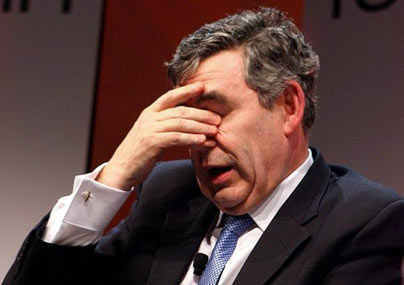
Prime Minister Gordon Brown reportedly sanctioned Adonis' efforts.

Then, he promptly went on the attack, doing whatever he can to try to sour that particular well.

"The Liberal Democrats have got to be exposed," Brown recently announced. "I think they have made a mistake in their economic policy. Why do they want to cut child tax credits? I think that is unfair. Why do they want to cut child trust funds?"

This, of course, should deliver something of a death blow to Lord Adonis' claims that the Liberal Democratic platform is "just like Labour’s." While Lord Adonis insists that the two party's platforms are similar in the sense that they're both social democratic documents, it seems that Brown thinks of this election as far less of a "two against one contest" than does his Transport Secretary.

If Gordon Brown does intend to negotiate a post-election deal with the Lib Dems to keep power, one has to imagine how, precisely, he will do it after having attacked their platform during the election.

Perhaps proving himself to be a true political heavyweight is more important to Brown than maintaining a coherent front with his Labour fellows.

But then perhaps the idea of a deal isn't off the table at all. As Canadians can attest, political parties can try some awfully strange things when the prospect of keeping power -- or gaining it -- is on the table.

Saturday, April 10, 2010

Labour Feeling the Pressure As Election Begins

Lord Andrew Adonis begs for Lib Dem help ahead of May 6 vote

As the 2010 British General Election begins with David Cameron and the Conservative Party polling in majority government territory, observers of this election need to ask themselves an important question:

Is the Labour Party desperate? And, if so, how desperate?

Apparently, Transport Secretary Lord Andrew Adonis is viewing this election with a desperate plea to British voters: don't split the left-of-centre vote. In an op-ed appearing in the Independent, Adonis writes begins by noting that, unlike the Liberal Democrats, Labour could actually govern, and insists that the Lib Dems could help:
"Nick Clegg will spend the next month attempting to cast a 'plague on both your houses'. The truth is that the Lib Dems, for all their local opportunism, have national policy that is similar to Labour's. The difference is that Labour can implement its programme. The Lib Dems have no realistic chance to implement theirs without a Labour government. In Labour-Tory marginals, a vote for the Lib Dems is a vote which helps the Tories against progressive policies. And in Labour-Lib Dem marginals every Labour MP returned is a seat in the Commons more likely to put Labour ahead of the Tories and therefore better placed to form a government."
But even if this were the case, Adonis' argument absolutely begs a pivotal question:

Would the Liberal Democrats want Labour to govern?

Adonis seems to think that they should. In fact, as Adonis points out, Labour has a history of taking the Liberal Democrats' best ideas and implimenting them.
"Philosophically it is a nonsense to pretend that the Lib Dems – or the 'Social and Liberal Democrats' to give the party its original name – are equidistant between left and right, or Labour and Tory. The Liberal party of Gladstone, Asquith and Lloyd George fought the Tories relentlessly to introduce democracy and social rights. Keynes and Beveridge – Liberals both – produced the rationale and the blueprint for the modern welfare state enacted by Attlee's Labour government after 1945."
But Adonis' argument fails on one central point: the reason Labour implimented the Lib Dems' policy proposals is because they perceived the party as a threat.

And depending upon whatever poll one consults, the Liberal Democrats may be as big a threat to Labour as ever -- particularly with British voters expecting a "hung Parliament" (known in Canada as a minority government).

But many Liberal Democrat voters would be more than justified in asking themselves an important question: if we're expecting a hung Parliament, what would make us more powerful: giving our votes to Labour candidates in order to stave off a Conservative government, or as a large and powerful caucus holding the balance of power?

It's a question that Adonis declines to answer, although he does remind Liberal Democrats that the last government in which their party cooperated with the Tories was replaced by the Labour Party.

As the third party in any poll, however, it's clear that the Liberal Democrats will very likely not govern -- barring a miracle. So the standing question becomes this:

What would make the Liberal Democrats more powerful and influential? Electing a strong Lib Dem caucus on May 6 so they can play kingmaker in a hung parliament, or simply giving up the crown well in advance?

Lord Andrew Adonis has offered his answer, but it's a predictably partisan answer. Whether Liberal Democrat voters reach the same conclusion won't be seen until the voting concludes.

Tuesday, September 29, 2009

A Newer (Better) Blairism?

Tory leader emulating Labour PM

If David Cameron is the Tony Blair of the Conservative party, he certainly seems to relish the role.

"He was the future once," he once famously told Blair. "I want to talk about the future."

David Cameron has so effectively claimed Blair's mantle as the "future of Britain" that many consider his victory in the 2010 general election to be all but assured -- just as Blair's victory over John Major was considered assured.

According to Lord Andrew Adonis, the Labour party's Transport Secretary, there is more than a passing resemblence between Cameron's and Blair's style. That resemblence may be more than coincidental -- it may be by design.

"Cameron is trying to offer a better Blairism when he’s trying to be sunny," Lord Adonis remarked, although noting that Cameron's rhetoric can also have a dark side. "Then when he’s not, it’s the age of austerity and broken Britain."

If Cameron has mixed his upbeat rhetoric with some gloominess, he certainly isn't alone.

Many Labour party supporters and boosters -- as well as Prime Minister Gordon Brown himself -- continue to insist that their party is still very much in the running to win the 2010 election. Yet the prognosis offered by polls and various experts is far less than promising for them.

Compass, a left-wing British think tank, has predicted the end of the Labour party altogether if Cameron wins the next election.

They predict that, aside from whatever defeat Labour may absorb in 2010, a Conservative government increases the chance of Scotland opting to secede from the United Kingdom, taking a bastion of Labour strength with them.

Compass insists that a referendum on abandoning Britain's "first past the post" electoral system could gain the party desperately-needed ground against the Tories.

Gordon Brown has yet to fully embrace this issue as a "game changer", but has reportedly taken it under consideration.

Meanwhile, Lord Adonis doesn't believe that all is yet lost to Cameron and the Tories.

"We shouldn’t take the view that we’re in a situation like 1979 or 1997 and should be fatalistic and Cameron has found the new middle ground," Adonis insisted. "I don’t think that’s the case."

For Gordon Brown, defeating Tony Blair (they are well known to have been rivals) is a prospect that has long faded from view. But if anything substantial is to be taken away from Lord Adonis' commentary, it's that defeating David Cameron may be just as good.

That, of course, is provided that Brown can save his (and Labour's) skin in 2010.