Tories addressing wrong issue in polygamy ban
As controversy surrounding the Winston Blackmore case continues it heat up, it seems that the governing Conservative party may envoke the notwithstanding clause in order to maintain polygamy as a criminal offense in Canada.
Blackmore's lawyer has publicly announced that he'll cite the religious freedoms guaranteed by the Canadian Charter of Rights and Freedoms -- and through it the constitution -- in order to defend Blackmore and his co-accused, Jim Oler.
Memos obtained through the Access to Information Act suggest that the Tories will not allow this to happen.
"Canadians of all backgrounds share some basic values, like a belief in human dignity, equality between men and women and the rule of law. It is these values that unite us as Canadians," states one of the memos prepared for Justice Minister Rob Nicholson. "The practice of polygamy represents a clear challenge to those unifying values."
Ironically, many were fearful that the Conservative party would envoke the notwithstanding clause to outlaw same-sex marriage. They didn't. But Blackwell's lawyer, Blair Suffredine, actually envoked same-sex marriage as a reason for polygamy's acceptability.
"It's pretty hard to justify why gay marriage is OK and polygamy's not," Suffredine mused.
And while many social conservatives will point to Suffredine's rationale as evidence that same-sex marriage does indeed undermine traditional marriage in Canada, the hysteria is at lest partially just that: hysteria.
Frankly, there's nothing wrong with polygamy when it's practiced between consenting adults. Polygamy itself isn't the problem.
The problems with polygamy surface in cases where underage girls or non consensual.
The state really doesn't have much business intervening in polygamist marriages unless either of these two conditions is present.
In focusing on polygamy itself, the Conservatives have missed the real problem. Unless a polygamist man's wives are underage or not consensually married to him, cracking down on polygamists very much is religious intolerance.

Showing posts with label Justice. Show all posts
Showing posts with label Justice. Show all posts
Wednesday, March 25, 2009


Tuesday, August 26, 2008
Ken Epp Stands His Ground
And he won't back down
With an election call seemingly only days away and spurious opposition to Bill C-484 -- the Unborn Victirms of Crime bill -- stubbornly refusing to abate, the Conservative government is moving to try to disperse what it seems to fear is a coming storm.
"We've heard criticism from across the country, including representatives from the medical community, that Mr. Epp's bill, as it is presently drafted, could be interpreted as instilling fetal rights," announced Justice Minister Rob Nicholson. "Our government will not reopen the debate on abortion."
Bill C-484 would, indeed, introduce fetal rights. However, because of the fact that the bill contains an explicit clause forbidding its use in cases of abortion or against any act (of commission or omission) of the mother, those rights would not supercede a preggnant woman's right to choose an abortion. The fetal reights recognized by Bill C-484 would begin and end with an unborn child's right to be protected from crime.
Naturally, the fundamentally intellectually-dishonest pro-abortion lobby refuses to acknowledge this.
Nicholson has promised new legislation that would require judges to consider a woman's pregnancy during the course of sentencing. Right now judges can, and often do, but law still cannot recognize the tendency of many offenders -- such as Jared Baker and Gary Bourgeois -- to target unborn children intentionally.
Fortunately, however, Bill C-484 is not a government bill. Rather, it's Elk Island MP Ken Epp's private member's bill. He isn't obligated to withdraw it, and it's the last thing he plans to do.
"I definitely will not be withdrawing my bill," Epp announced. "They're quite different. I don't intend to let up."
If Nicholson is looking for an easy way out, he isn't going to find it. His government will either have to stay the course with Bill C-484 and endure the (actually very necessary) debate over abortion, or defeat its own member's bill, as it did with Leon Benoit's Bill C-291.
Ken Epp is well within his rights to stand his ground will Bill C-484 and not allow the government to introduce a watered-down bill protecting the unborn. This bill has passed two readings already -- in a parliament devoid of ideologically-grounded party discipline, this bill very much could pass.
Yet the Conservative government seems to be intent on ducking the abortion/fetal rights debate in the name of winning an election it isn't supposed to be calling in the first place.
Fortunately, Ken Epp isn't backing down. Nor are the other supporters of Bill C-484.
With an election call seemingly only days away and spurious opposition to Bill C-484 -- the Unborn Victirms of Crime bill -- stubbornly refusing to abate, the Conservative government is moving to try to disperse what it seems to fear is a coming storm.
"We've heard criticism from across the country, including representatives from the medical community, that Mr. Epp's bill, as it is presently drafted, could be interpreted as instilling fetal rights," announced Justice Minister Rob Nicholson. "Our government will not reopen the debate on abortion."
Bill C-484 would, indeed, introduce fetal rights. However, because of the fact that the bill contains an explicit clause forbidding its use in cases of abortion or against any act (of commission or omission) of the mother, those rights would not supercede a preggnant woman's right to choose an abortion. The fetal reights recognized by Bill C-484 would begin and end with an unborn child's right to be protected from crime.
Naturally, the fundamentally intellectually-dishonest pro-abortion lobby refuses to acknowledge this.
Nicholson has promised new legislation that would require judges to consider a woman's pregnancy during the course of sentencing. Right now judges can, and often do, but law still cannot recognize the tendency of many offenders -- such as Jared Baker and Gary Bourgeois -- to target unborn children intentionally.
Fortunately, however, Bill C-484 is not a government bill. Rather, it's Elk Island MP Ken Epp's private member's bill. He isn't obligated to withdraw it, and it's the last thing he plans to do.
"I definitely will not be withdrawing my bill," Epp announced. "They're quite different. I don't intend to let up."
If Nicholson is looking for an easy way out, he isn't going to find it. His government will either have to stay the course with Bill C-484 and endure the (actually very necessary) debate over abortion, or defeat its own member's bill, as it did with Leon Benoit's Bill C-291.
Ken Epp is well within his rights to stand his ground will Bill C-484 and not allow the government to introduce a watered-down bill protecting the unborn. This bill has passed two readings already -- in a parliament devoid of ideologically-grounded party discipline, this bill very much could pass.
Yet the Conservative government seems to be intent on ducking the abortion/fetal rights debate in the name of winning an election it isn't supposed to be calling in the first place.
Fortunately, Ken Epp isn't backing down. Nor are the other supporters of Bill C-484.
Friday, August 22, 2008
If We're Doing This For the Kids...
Then we have to do this for the kids
The recent deaths of three Canadian soldiers in Afghanistan has greatly saddened all Canadians.
The remarks of one of these men, in particular, however, has reverberated through the public consciousness.
Corporal Dustin "Wozzy" Wasden was known for his love of working with children, and was said by his colleagues as having asked on numerous occasions, "Are we not doing it for the kids?"
Certainly, a Democratic post-war Afghanistan will be better for the children of Afghanistan than a Taliban theocracy.
But if we're in Afghanistan -- even partially -- to help its children, then Canadian troops are simply going to have to do that. That means doing a number of things that might make them unpopular amongst some of their allies.
Such as preventing the sexual abuse of Afghan children, something that Canadian soldiers have reportedly refused to do.
The sexual abuses perpetrated against Afghan children has been anything but a secret to many of those familiar to the mission. In fact, Canadian soldiers in Afghanistan have an adage: "in Khandahar, women are for procreation, children are for recreation."
Standing up to Afghan soldiers, in particular, may make Canadian soldiers unpopular amongst some of our Afghan allies there. But there are some things that Canadians simply cannot tolerate, and the sexual abuse of children by our allies is one of them.
The best way to honour the memory of Cpl Wadsel is to ensure that Canadian troops put a stop to this atrocity, just as they should have been doing consistently for the last seven years.
Sometimes, what is right must be substituted for what is pragmatic. This is one of those times.
The recent deaths of three Canadian soldiers in Afghanistan has greatly saddened all Canadians.
The remarks of one of these men, in particular, however, has reverberated through the public consciousness.
Corporal Dustin "Wozzy" Wasden was known for his love of working with children, and was said by his colleagues as having asked on numerous occasions, "Are we not doing it for the kids?"
Certainly, a Democratic post-war Afghanistan will be better for the children of Afghanistan than a Taliban theocracy.
But if we're in Afghanistan -- even partially -- to help its children, then Canadian troops are simply going to have to do that. That means doing a number of things that might make them unpopular amongst some of their allies.
Such as preventing the sexual abuse of Afghan children, something that Canadian soldiers have reportedly refused to do.
The sexual abuses perpetrated against Afghan children has been anything but a secret to many of those familiar to the mission. In fact, Canadian soldiers in Afghanistan have an adage: "in Khandahar, women are for procreation, children are for recreation."
Standing up to Afghan soldiers, in particular, may make Canadian soldiers unpopular amongst some of our Afghan allies there. But there are some things that Canadians simply cannot tolerate, and the sexual abuse of children by our allies is one of them.
The best way to honour the memory of Cpl Wadsel is to ensure that Canadian troops put a stop to this atrocity, just as they should have been doing consistently for the last seven years.
Sometimes, what is right must be substituted for what is pragmatic. This is one of those times.
Saturday, July 19, 2008
Thank God He's a Fictional Character
Ideology handcuffs psychology, criminal justice
What is almost certainly the most anticipated movie of the past three years opened in theatres world wide yesterday, and has left audiences absolutely stunned.
Audiences turned out in record numbers yesterday to see the superhero opus.
What has people talking most is the beyond spectacular performance turned in by Heath Ledger as the Clown Prince of Crime, the Joker. Ledger's take on the villain is unsettling on a deep psychological level, as he takes the character deeper than he's ever been taken before, on the silver screen or off.
Ledger's Joker is a cold, calculating, sadistic, self-styled anarchist determined to show all the "planners" of Gotham -- from District Attorney Harvey Dent (Aaron Eckhart) to the city's "silent protector" himself, Batman (Christian Bale) -- how futile their efforts really are.
Which is, in a sense, ironic. The film opens with a bank heist so meticulously planned that the Joker is ultimately able to blend in with rush hour traffic in a manner that renders him absolutely untracable (specific details withheld for obvious reasons).
The Joker that emerges is the most realistic version of the character offered: an individual carrying psychological trauma embedded so deeply in his personality that he is willing to do absolutely anything, and feels absolutely no remorse.
Human language has a word for such individuals: we call them psychopaths. It should then be interesting to note that our criminal justice system has no such word.
In 1980, University of British Columbia psychologist Bob Hare developed a diagnostic tool known as the Psychopathy Checklist. Five years later it would be revised into the PCL-R.
Upon being presented with the PCL-R, one of the first things Corrections Canada did was shelve it. It was deemed politically incorrect to suggest that any criminal should be considered beyond rehabilitation. It offended the sensibilities of the authorities of the day to suggest that an individual could be considered irredeemable, and it still does.
In other words, if an individual like Heath Ledger's Joker -- a psychopathic criminal with an extreme gift for planning and a predisposition toward terrorist tactics -- ever emerged in Canadian society, our law enforcement and correctional systems would be utterly handcuffed.
On this note, two caveats must be affixed: first off, the character portrayed by Ledger must be treated as hyperbolic beyond all credulity. Secondly, Hare notes that the vast majority of psychopaths are what he terms "subclinical" psychopaths -- an individual who leaves behind them a trail of abuse and personal destruction, but who acts almost entirely within the law -- even if only barely.
As such, the PCL-R would not only provide a useful tool for law enforcement and corrections, but also for family therapists and child protective services -- if only the political will existed to actually make use of it.
There is, of course, a dark flip side to the PCL-R. In many cases -- particularly in the United States -- the PCL-R has been combined with a myriad of political values in order to render an assessment of psychopathy where one would otherwise be unsuitable.
This is a reality that Hare has long realized, and has spurred him to spend his retirement years travelling to various conferences -- on topics ranging from psychology to law enforcement -- to clarif the purposes of the PCL-R. "I'm protecting it from erosion, from distortion. It could easily be compromised," Hare says.
Which is important to remember. Any diagnostic tool can be abused, and often will be. While that necessitates a certain level of vigilance in the use of it, however, it's insufficient reason to discard it altogether.
Ledger's Joker will prove to be as iconic a performance as Brandon Lee's in The Crow -- not least of which because of his untimely demise.
The performance will haunt filmgoers and challenge other actors for years to come.
Hopefully, the film will also challenge some of our law enforcement and correctional authorities to give the PCL-R a second thought as well.
Wednesday, July 16, 2008
Khadr Case Reaches Definitive Turning Point
Guantanamo interrogation tapes having a profound effect
On The Root of All Evil, Lewis Black ruled that YouTube is, in fact, the root of all evil.
In a show comparing YouTube to pornography, Black determined that YouTube has had such a decisively negative impact on western civilization -- transforming us into the words of advocate Patton Oswalt into a "country of Caligulas".
But if YouTube has really had such a negative impact on civilization, it's hard to overlook some of the good it's done as well. When Robert Dzienkaski succumbed to his injuries after being excessively and mercilessly tasered by airport security, it was YouTube that ultimately brought the outrage to the world's attention. When University of Florida student Andrew Meyer was tasered for asking Senator John Kerry a question that somebody didn't like, it was YouTube that prevented the story from being swept under a carpet.
Now, it's YouTube that has brought the severe psychological stress being experiened by Omar Khadr unignorably to the world's attention. And, just as with these and countless other previous cases, YouTube has had an abrupt effect on the case.
Such is the case with a recent National Post editorial in which Jonathon Kay has finally come around to the thinking of those who agree Omar Khadr should be repatriated to Canada:
"As I write this, at 1 p. m. on Tuesday, piteous video images from Omar Khadr's interrogation at Guantanamo Bay are not only the #1 news item on the National Post Web site, but also the lead item on BBC News and USA Today. Millions of people are now wondering why Canada's government has acquiesced-- and as the video shows, even participated -- in the unconscionable treatment of a blubbering boy-soldier.Naturally, those who disgustingly insist Khadr should be "waterboarded until he stops crying" will consider Jonathon Kay way off the reservation on this one.
As someone who otherwise considers himself one of the War on Terror's noisiest Canadian cheerleaders, I submit that the bleeding hearts are right on this one: Omar Khadr needs to come home.
Here's why:
Omar Khadr was a child soldier
During the carnage that gripped Sierra Leone in the 1990s, the most terrifying crimes often were committed by gangs of children who'd been abducted by the Revolutionary United Front (RUF). Isolated from their families, and stripped of any sort of moral compass, these child brigades were renowned for such monstrous acts as hacking off the legs and arms of defenceless villagers. When the RUF's war with the government ended, many of these children were assimilated back into civilized society. No one -- in the West, at least -- blamed them for what they had done. As in Sri Lanka, Congo and other parts of the world where children are abducted and forced into combat, it is universally recognized that child soldiers are not morally culpable for their actions in the same way as adults. That's why the Sierra Leone war crimes tribunal didn't prosecute child soldiers -- it prosecuted the monsters who exploited them. Can someone please tell me why this principle has not been applied to Omar Khadr, who was all of 15 when he allegedly threw the grenade that killed Sergeant Christopher Speer of Delta Force in 2002?
What makes the case for Khadr especially strong is that he was essentially recruited into combat from birth--by his own flesh-and-blood, no less. The true monster in the Khadr narrative is not Omar, but his father, Ahmed Said Khadr, an al-Qaeda lieutenant who moved his whole family from Canada to central Asia so they could share in the glory of jihad.
As a nine-year-old, Omar drank in his father's Islamist propaganda -- spending months by his father's bed as the jihadi patriarch lay hunger-striking against Pakistani authorities, who'd arrested him on terrorism charges in 1995. Following 9/11, Ahmed (who, thankfully, was dispatched to his celestial virgins in 2003) enlisted his son as a sort of sidekick and maidservant to a jihadi cell hiding out in the Afghan outback. It was in this capacity that Omar tagged along with the pack of terrorists who would eventually meet their maker in the June 27, 2002, firefight that claimed the life of Sergeant Speer.
I have been reading a lot of tough talk on the blogs about how Khadr should be "waterboarded until he stops crying" and such. I wonder if those same hard hearts could tell me how they would have turned out if they'd been told --literally, since birth--about the necessity of jihad and the beauty of martyrdom; if, since their early days, they'd been propagandized into believing that the West was waging a genocidal war against Muslims; and that military resistance was the only path of survival. Are we to expect some sort of inborn moral sense to activate -- to tell us that everything being told to us by our own parents is wrong -- even before one is old enough to shave?
I know about 20,000 former child soldiers in Sierra Leone who could tell you the answer to that question. And unlike Khadr, not one of them stands accused of "Violation of the Law of War."
We don't know that Omar Khadr killed anyone
The U.S. government's line on the events of June 27, 2002 -- reported uncritically, for the most part, by the Canadian media -- is that a cowardly Khadr popped up from the rubble in the aftermath of a firefight in the Afghan hinterland, killing a U. S. medic who was looking to treat wounded survivors. In fact, the grenade that killed Speer (who was fighting, by necessity, as a solider, whatever his training as a medic) was thrown when the four-hour long battle was still hot. And it is far from clear who threw it: Contrary to initial accounts, there was a second jihadi still alive when the fatal grenade was thrown -- and since Khadr was badly wounded at the time, the second militant (who later died) is the more promising suspect.
(We might also dispense with the idea that Speer was on a mission of mercy: Post-battle testimony from his battlefield companions suggests they were -- quite understandably --more interested in shooting the wounded than healing them.)
My own view is that Speer may well have been killed by a grenade thrown by one of his comrades. (Reports from the battle suggest that grenades were flying thick and fast from both sides.) As the Pat Tillman scandal shows, the U. S. military sometimes goes to extraordinary lengths to cover up friendly-fire deaths. And in the Khadr case, his U. S. Department of Defense attorney claims, there is at least one instance in which a lieutenant-colonel retroactively amended and backdated a battlefield report to buttress the case against Khadr.
Even if Khadr did kill Sergeant Speer, he did so as a soldier, not a terrorist
There's little doubt that Ahmed Khadr was training his sons to be terrorists -- the sort of people who blow up buses and restaurants, or who wear civilian clothing as they lie in wait to detonate explosives under vehicle convoys. But what Omar Khadr did on June 27, 2002, wasn't terrorism. It was participation in a military engagement -- a fact that can't be changed merely by slapping a label like "unlawful combatant" on him.
Moreover, it was a military engagement fought on American terms: After U. S. soldiers sealed off the village encampment housing Khadr's cell, they prosecuted the siege with about 100 troops, some of them Special Forces, as well as Apache helicopters, F-18 Hornets and A-10 Warthogs. You can say that Khadr was fighting in an evil cause when he was captured, but you can't say that he was preying on the defenceless.
Even if you don't buy anything I've written above, Khadr's treatment still ranks as abominable
Let us assume that Omar Khadr actually threw the grenade that killed Sergeant Speer, that he did so as a cold-blooded killer, not as a soldier, and that his status as a child combatant is irrelevant -- in short, that Omar Khadr is a murderer. Well then, how do we treat murderers in Western countries? Answer: We put them in jail. We don't beat them, or move them from cell to cell every three hours, or terrify them with threats of pedophilic rape, or deny them appropriate medical care -- all punishments that Khadr has endured -- a litany of abuse so traumatic that, according to one piteous detail among many, he took to falling asleep at Guantanamo desperately hugging a Mickey Mouse book brought to him as a gift.
In the space of six years of incarceration, Khadr has endured more brutality than any ordinary jailbird would endure in 60. And if he had any intelligence value to his American captors, it surely has been exhausted. Please bring Omar Khadr home. If he is to face justice, let it be in Canada."
But he's right. Whether it's to be put on trial for his alleged crimes or reassimilated back into society (but absolutely not before his demobilization can be assured, Omar Khadr must be repatriated back to Canada.
Which makes the government's insistence that they can do no such thing all the more unacceptable. In time, as the Khadr tapes continue to make their rounds via the mainstream media and YouTube, this position will become utternly untenable.
Even the alleged arch-conservatives at the National Post are beginning to see that.
Thursday, May 15, 2008
Partisans With Short Memories
Omar Khadr affair has serious implications for Liberal party
There's little question that the ongoing Omar Khadr affair poses a significant dilemma for Canada, one that, by necessity will eventually have to be addressed by the sitting Conservative government.
Yet as the issue continues to gather steam as a partisan issue, the Omar Khadr case has also taken on some very serious implications for the Liberal party -- implications that Romeo Dallaire and Stephane Dion don't really seem to comprehend.
"Canada is alone among Western nations in not having secured the release from Guantanamo of one of its nationals. Prime Minister Harper must finally ensure Mr. Khadr receives the same consular support that any other Canadian -- detainee or not -- would receive," Dion lectured in September 2007.
Dallaire first publicly announced his intention to agitate on Khadr's behalf on May 1 of this year.
"I'm going to be a pain. Every time I stand up in the Senate, the leader of the government knows I'm coming at her and every time she gives the same answer, she is losing more and more feathers," Dallaire said.
"There is no depth of logic in [the government's position]," Dallaire added. "There is a real smell of short-term political fiddling. There's no doubt that's influencing the decisions. It's setting up Canada to lose enormous credibility when it's being tested on one of its own people."
Of course, the problem for Dallaire -- and for the entire Liberal party -- is this: where was Romeo Dallaire before May 1, 2008?
Where was Stephane Dion and the Liberal party in July of 2002 when he was first arrested by US troops in Afghanistan?
The answer: in power.
Where was Stephane Dion and the the Liberal party on September 19, 2004 when Omar Khadr turned 18 years old?
The answer: in power. Romeo Dallaire would be appointed to the Senate the very next year.
And what did the Liberal party do to help Omar Khadr? Not a damn thing up until their ouster from office in January 2006.
This party that now wants to agitate on Khadr's behalf, and take up the mantle of human rights and clemency for child soldiers, didn't do a damn thing on Khadr's behalf when they were in power and had the ability to do so.
It's a reality regarding this affair that only serves to undermine them politically. While both men may well be legitimately concerned for Khadr's well-being -- and Dallaire's previous tragic experience with child soldiers arms him with particular credibility to this end -- their previous inaction only serves to discredit them.
As each man seeks to lecture the government from the opposition benches of their respective House, their sudden show of concern is starkly contrasted by their previous silence while sitting on the other side of the aisle.
There is a serious issue underlying the Khadr case that must be resolved.
But in order to contribute constructively, Dion and Dallaire need to cool their partisan fires, think back to all the things they didn't do when they had the opportunity, and accept their share of the responsibility for the current state of affairs vis a vis Omar Khadr.
Then we'll be one step closer to recognizing the Khadr affair for what it is: a non-partisan political issue that demands resolution.
There's little question that the ongoing Omar Khadr affair poses a significant dilemma for Canada, one that, by necessity will eventually have to be addressed by the sitting Conservative government.
Yet as the issue continues to gather steam as a partisan issue, the Omar Khadr case has also taken on some very serious implications for the Liberal party -- implications that Romeo Dallaire and Stephane Dion don't really seem to comprehend.
"Canada is alone among Western nations in not having secured the release from Guantanamo of one of its nationals. Prime Minister Harper must finally ensure Mr. Khadr receives the same consular support that any other Canadian -- detainee or not -- would receive," Dion lectured in September 2007.
Dallaire first publicly announced his intention to agitate on Khadr's behalf on May 1 of this year.
"I'm going to be a pain. Every time I stand up in the Senate, the leader of the government knows I'm coming at her and every time she gives the same answer, she is losing more and more feathers," Dallaire said.
"There is no depth of logic in [the government's position]," Dallaire added. "There is a real smell of short-term political fiddling. There's no doubt that's influencing the decisions. It's setting up Canada to lose enormous credibility when it's being tested on one of its own people."
Of course, the problem for Dallaire -- and for the entire Liberal party -- is this: where was Romeo Dallaire before May 1, 2008?
Where was Stephane Dion and the Liberal party in July of 2002 when he was first arrested by US troops in Afghanistan?
The answer: in power.
Where was Stephane Dion and the the Liberal party on September 19, 2004 when Omar Khadr turned 18 years old?
The answer: in power. Romeo Dallaire would be appointed to the Senate the very next year.
And what did the Liberal party do to help Omar Khadr? Not a damn thing up until their ouster from office in January 2006.
This party that now wants to agitate on Khadr's behalf, and take up the mantle of human rights and clemency for child soldiers, didn't do a damn thing on Khadr's behalf when they were in power and had the ability to do so.
It's a reality regarding this affair that only serves to undermine them politically. While both men may well be legitimately concerned for Khadr's well-being -- and Dallaire's previous tragic experience with child soldiers arms him with particular credibility to this end -- their previous inaction only serves to discredit them.
As each man seeks to lecture the government from the opposition benches of their respective House, their sudden show of concern is starkly contrasted by their previous silence while sitting on the other side of the aisle.
There is a serious issue underlying the Khadr case that must be resolved.
But in order to contribute constructively, Dion and Dallaire need to cool their partisan fires, think back to all the things they didn't do when they had the opportunity, and accept their share of the responsibility for the current state of affairs vis a vis Omar Khadr.
Then we'll be one step closer to recognizing the Khadr affair for what it is: a non-partisan political issue that demands resolution.
Wednesday, April 23, 2008
Will Martin's Release Finally End the Media Circus?
Or will the government's efforts be rebuked again?
If recent history has taught us anything, it's that Canadians in legal trouble can bail themselves out by attracting a large enough media circus.
Recent history has also shown us that they need not always be honest about their situation, either. Brenda Martin and her supporters politicized her predicament by claiming the government had "abandoned" her and not done enough to help her -- claims that were proven to be false.
 Now, the Brenda Martin case has come to a sad conclusion a Mexican court has found her guilty of knowingly accepting fraudulently-obtained funds, despite an alleged lack of evidence (her lawyer, Guillermo Cruz, says as much).
Regardless of whether or not Martin is guilty of her alleged crime -- and given the equally-sad state of Mexican "justice", there's an excellent chance she is innocent, and merely being hung out to dry so the system can save face -- there is little question that she and the terminally dishonest Liberal party hacks who have been milking her story for all the political gain they can manage are guilty of concocting a media circus around false pretenses.
Now Secretary of State for Multiculturalism Jason Kenney is riding off to Mexico to prod the release of Martin into the custody of the Canadian justice system along, and now another Canadian family has decided to try their luck at the media circus game, too.
This particular case swirls around Jimmy Chen Jian Yuan, who is currently imprisoned in China while being tried on a four-year-old $2 million fraud case.
Predictably, Chen's family is insisting that the government hasn't done enough to help him, despite the fact that, unlike Martin, he has been formally charged in China, has been tried, and is now awaiting a verdict.
Given the way in which details trickled out of the Martin case painfully slowly (and all too often were simply disregarded once it became apparent they didn't fit the standard politicized narrative), judgment will be reserved on the Chen case here.
Chen may be as innocent as his family insists, and as abandoned by the Canadian government. Or, as with Brenda Martin, there may be more to the story. Only time will reveal the details of this particular case.
However, one has yet to see if Brenda Martin's return to Canada -- and inevitably almost immediate release from Canadian custody -- will put an end to the partisan media circus that has surrounded the entire sorry affair.
 One thing remains certain: only the in hands of a pack of unrepentantly dishonest Liberal spin doctors could the Conservative government -- which had done almost everything possible to ensure Martin's fair treatment -- be cast as the villain in this case over the irredeemably corrupt Mexican justice system.
Will Martin's return to Canada end the media circus? Only time will tell. But with the real masterminds of the media circus apparent -- Liberal MP Dan McTeague and former Prime Minister Paul Martin -- one has to suspect that will be rather unlikely.
If recent history has taught us anything, it's that Canadians in legal trouble can bail themselves out by attracting a large enough media circus.
Recent history has also shown us that they need not always be honest about their situation, either. Brenda Martin and her supporters politicized her predicament by claiming the government had "abandoned" her and not done enough to help her -- claims that were proven to be false.
 Now, the Brenda Martin case has come to a sad conclusion a Mexican court has found her guilty of knowingly accepting fraudulently-obtained funds, despite an alleged lack of evidence (her lawyer, Guillermo Cruz, says as much).
Regardless of whether or not Martin is guilty of her alleged crime -- and given the equally-sad state of Mexican "justice", there's an excellent chance she is innocent, and merely being hung out to dry so the system can save face -- there is little question that she and the terminally dishonest Liberal party hacks who have been milking her story for all the political gain they can manage are guilty of concocting a media circus around false pretenses.
Now Secretary of State for Multiculturalism Jason Kenney is riding off to Mexico to prod the release of Martin into the custody of the Canadian justice system along, and now another Canadian family has decided to try their luck at the media circus game, too.
This particular case swirls around Jimmy Chen Jian Yuan, who is currently imprisoned in China while being tried on a four-year-old $2 million fraud case.
Predictably, Chen's family is insisting that the government hasn't done enough to help him, despite the fact that, unlike Martin, he has been formally charged in China, has been tried, and is now awaiting a verdict.
Given the way in which details trickled out of the Martin case painfully slowly (and all too often were simply disregarded once it became apparent they didn't fit the standard politicized narrative), judgment will be reserved on the Chen case here.
Chen may be as innocent as his family insists, and as abandoned by the Canadian government. Or, as with Brenda Martin, there may be more to the story. Only time will reveal the details of this particular case.
However, one has yet to see if Brenda Martin's return to Canada -- and inevitably almost immediate release from Canadian custody -- will put an end to the partisan media circus that has surrounded the entire sorry affair.
 One thing remains certain: only the in hands of a pack of unrepentantly dishonest Liberal spin doctors could the Conservative government -- which had done almost everything possible to ensure Martin's fair treatment -- be cast as the villain in this case over the irredeemably corrupt Mexican justice system.
Will Martin's return to Canada end the media circus? Only time will tell. But with the real masterminds of the media circus apparent -- Liberal MP Dan McTeague and former Prime Minister Paul Martin -- one has to suspect that will be rather unlikely.
Friday, March 28, 2008
What Brenda Martin Didn't Want Canadians To Know
Martin not as abandoned as she would like Canadians to believe
Sometimes, being injudiciously detained in a foreign prison means you never have to admit you were wrong.
 This would seem to be the case for Brenda Martin, who, it was recently revealed, recieved regular visits and calls from Canadian officials ever since the beginning of her injudicious detainment. On some occasions, she was called multiple times a day.
Martin, who claimed the Canadian government wasn't doing enough to help her, and dismissed the most recent attempts to help as "a dog and pony show", has come up with a rather novel defence.
"I find it horrendous that my privacy would be breached in an attempt to smear my name," Martin insists.
She blames the leak on Conservative MP Helena Guergis, who, it was recently revealed didn't visit Martin during a recent visit to Mexico.
Naturally, Liberal MP Dan McTeague, who, along with various internet douchebags has been at the forefront of milking this particular story for partisan gain, agrees.
"There has been a serious breach in the privacy act," McTeague announced. "This is not only a smokescreen, it's... breaking the law."
What McTeague and Martin are overlooking, however, is that Martin's case is -- and has been -- the subject of foreign relations between the government of Canada and the government of Mexico. The document released -- "leaked" as Martin insists -- is actually a summary of the activities of Canadian diplomats on the Brenda Martin file.
It is not subject to privacy law.
Given that this document is not subject to privacy law, one has to wonder where the smokescreen is really being used: by Canadian consular officials defending their reputation by revealing how much work they've done? Or by Brenda Martin, who wanted to conceal that? The answer is obvious.
Keep in mind that this doesn't change the fact that there simply hasn't been enough work put in on this file by Canada's elected officials -- although our public servants in Mexico have been doing their job admirably.
And the real important question regarding this most recent revelation regarding the Martin affair is: what does this change?
Actually, absolutely nothing. The Canadian government still needs to do more to help Brenda Martin -- Foreign Affairs minister Maxime Bernier, in particular, needs to do much, much more.
But Brenda Martin herself needs to be honest as well. Blaming Canadian officials for revealing information she didn't want revealed is little more than a classic bully's defence: it's not her fault for being deceptive, it's the Canadian government's fault for revealing her deception.
If we don't accept that from five-year-olds, we absolutely should not accept it from grown adults.
Sometimes, being injudiciously detained in a foreign prison means you never have to admit you were wrong.
 This would seem to be the case for Brenda Martin, who, it was recently revealed, recieved regular visits and calls from Canadian officials ever since the beginning of her injudicious detainment. On some occasions, she was called multiple times a day.
Martin, who claimed the Canadian government wasn't doing enough to help her, and dismissed the most recent attempts to help as "a dog and pony show", has come up with a rather novel defence.
"I find it horrendous that my privacy would be breached in an attempt to smear my name," Martin insists.
She blames the leak on Conservative MP Helena Guergis, who, it was recently revealed didn't visit Martin during a recent visit to Mexico.
Naturally, Liberal MP Dan McTeague, who, along with various internet douchebags has been at the forefront of milking this particular story for partisan gain, agrees.
"There has been a serious breach in the privacy act," McTeague announced. "This is not only a smokescreen, it's... breaking the law."What McTeague and Martin are overlooking, however, is that Martin's case is -- and has been -- the subject of foreign relations between the government of Canada and the government of Mexico. The document released -- "leaked" as Martin insists -- is actually a summary of the activities of Canadian diplomats on the Brenda Martin file.
It is not subject to privacy law.
Given that this document is not subject to privacy law, one has to wonder where the smokescreen is really being used: by Canadian consular officials defending their reputation by revealing how much work they've done? Or by Brenda Martin, who wanted to conceal that? The answer is obvious.
Keep in mind that this doesn't change the fact that there simply hasn't been enough work put in on this file by Canada's elected officials -- although our public servants in Mexico have been doing their job admirably.
And the real important question regarding this most recent revelation regarding the Martin affair is: what does this change?
Actually, absolutely nothing. The Canadian government still needs to do more to help Brenda Martin -- Foreign Affairs minister Maxime Bernier, in particular, needs to do much, much more.
But Brenda Martin herself needs to be honest as well. Blaming Canadian officials for revealing information she didn't want revealed is little more than a classic bully's defence: it's not her fault for being deceptive, it's the Canadian government's fault for revealing her deception.
If we don't accept that from five-year-olds, we absolutely should not accept it from grown adults.
Thursday, March 27, 2008
Toronto Terror: Trial by Media?
Trial for Toronto 18 Begins
The trial for the 18 individuals charged for a summer 2006 bomb plot targeting Parliament Hill and the Toronto Stock Exchange, amongst other targets, formally got underway today.
Of course, some insist that was has unfolded since the 2 June, 2006 arrest has been a "trial by media".
On that note, it becomes very interesting to notice that between Canada's two preeminent media outlets, one seems intent to play the role of the prosecution, by focusing on the case laid against the Toronto 18, while the other seems intent on playing the role of the defence.
This is quite unfortunate. For Canadians to fully understand the trial of the Toronto 18 and the key issues of law, order, and civil liberties underlaying such a case, they need to understand both cases.
So, first, from the prosecution:
The prosecution also alleges that the accused trained at two terrorist training camps -- one near Washago, Ontario, and the other near Guelph.
Although CTV does recognize that the accused are innocent until proven guilty, although their story contains little mention of the defence council's claims.
And on that note, now for the defence:
Instead of participating in training, the defence insists, the defendant was merely being screened for suitability for Islamic militancy.
Moreover, the defence denies that there are any audio or video recordings incriminating the accused, and that the only evidence the crown can offer is the testimony of the undercover officer.
The defence also insists that a publication ban would harm his client by not allowing him to be disassociated from the alleged details of the case. But as the Youth Criminal Justice Act forbids identifying the defendant, it's important to note that his name hasn't been associated with the alleged details of the case in the first place.
With national security -- and the means by which we preserve it -- very much at stake in these proceedings, it's very important for Canadians to understand this case. One-sided representations of the arguments in this case don't serve this purpose, and should be considered alarming to Canadians.
That being said, if the Toronto 18 truly are being tried in the media, it's at least comforting that both sides at least are being represented, even if only separately.
It may be up to the Canadian people to play the role of the judge and jury. The only question is: how many will take the time to learn the whole story?
The trial for the 18 individuals charged for a summer 2006 bomb plot targeting Parliament Hill and the Toronto Stock Exchange, amongst other targets, formally got underway today.
Of course, some insist that was has unfolded since the 2 June, 2006 arrest has been a "trial by media".
On that note, it becomes very interesting to notice that between Canada's two preeminent media outlets, one seems intent to play the role of the prosecution, by focusing on the case laid against the Toronto 18, while the other seems intent on playing the role of the defence.
This is quite unfortunate. For Canadians to fully understand the trial of the Toronto 18 and the key issues of law, order, and civil liberties underlaying such a case, they need to understand both cases.
So, first, from the prosecution:
Crown lawyers expect to present evidence against the Toronto-area terror suspects that show some of the accused planned to commit attacks more deadly than the London subway bombings, according to documents filed in court containing anticipated evidence.According to the factum filed today, prosecutors have audio and video evidence detailing the planning sessions for the attack. They allude directly to the London 7/7 Tube bombings, planning to eclipse them in the public mind.
New details contained in the Crown factum that was filed at the trial of the only remaining youth charged allege prosecutors have audio tapes and video tape evidence of some of the suspects plotting several explosions.
The factum contains transcripts of alleged conversations between suspects, including one where one of the accused speaks about the group's violent ambitions.
"They're probably expecting what happened in London or something," the man is quoted as saying. "... Some bombing in a subway kills 10 people and everybody gets deported.
"We're not doing that. ... So our thing it's, it's much, much greater on a scale ... you do it once and you make sure they can never recover again."
The July 2005 bombings in London, carried out by four suicide bombers, claimed the lives of 52 commuters.
One video allegedly shows the Toronto-area suspects at a wooded area in rural Ontario. A passionate speaker is heard saying the men have to "wage war against Rome" -- the Western powers including Canada, the United States, Britain and France.
"Our mission's greater, whether we get arrested, whether we get killed .... Rome has to be defeated. And we have to be the ones that do it," the speaker allegedly says.
The Crown alleges the accused attended two so-called training camps -- one near the town of Washago and the other at the Rockwood Conservation Area near Guelph. The suspects are accused of taking part in military-style exercises in camouflage gear and firearms training with a 9-mm firearm.
The group is accused of planning to storm the Parliament buildings in Ottawa, taking politicians (including the prime minister) hostage and beheading them.
The Crown's filing also alleges that the men planned to construct a radio frequency remote-controlled detonator.
None of these allegations have been proven or tested in court.
The 18 suspects of the alleged al Qaeda-inspired cell were arrested in July 2006. Fourteen men, four of whom are free on bail, are charged with various terrorism-related offences.
Four teens were initially charged, however, charges against three of the youths have been stayed.
The Crown is asking the judge to impose a publication ban to prevent the media from linking evidence at the trial to any of the other adult suspects by name, saying the evidence is "prejudicial" and could destroy any chances of the other suspects getting a fair trial.
The youth's trial has begun with numerous pretrial motions. Evidence is not expected to be heard until mid-to-late May.
Lawyers have said the trials for the adults could be months or even years away.
The prosecution also alleges that the accused trained at two terrorist training camps -- one near Washago, Ontario, and the other near Guelph.
Although CTV does recognize that the accused are innocent until proven guilty, although their story contains little mention of the defence council's claims.
And on that note, now for the defence:
A defence lawyer in the alleged Toronto-area bomb plot case filed a court document Wednesday attacking the Crown's case as fanciful and based largely on the unsubstantiated allegations of an unreliable police informant.In short, the factum filed on behalf of this particular defendant concedes that there was, in fact, a terrorist training camp in Ontario. However, it insists that only two of the accused were aware of the true purpose of the camp, and rest were unfortunate dupes.
The defence factum, a summary of the case that lawyers will argue during the trial, takes on some of the more dramatic allegations made in Crown documents submitted on Tuesday.
The factum was filed on behalf of one of the adult accused whose case has yet to go to trial.
The trial began this week of another defendant, who was 18 at the time of his arrest and cannot be named under the terms of the Youth Criminal Justice Act.
The factum says the defence lawyer will show that a so-called "jihadist" training camp run by some of the accused was nothing more than a screening exercise for possible recruits to Islamic militancy, and few of the participants in training at the camp — near the southern Ontario town of Orillia — knew what they were involved in.
Two of the other defendants who have yet to go on trial ran the camp, the factum says, and concealed its purpose from other participants. Trainees took part in winter camping activities but were so ill-equipped for the cold weather that they spent much of their time in a nearby Tim Hortons coffee shop.
Informant brought bullets: lawyer
The document acknowledges that some firearms training took place, but it alleges that the only person to bring live ammunition to the camp was a police informant. That same informant was the person who actually conducted the gun exercises, the factum says.
In addition, the document alleges that the only source of information about what was happening at the Orillia camp was the police informant. There was no "real time" police surveillance, it says.
Responding to transcripts of audio tapes of a police wiretap that the Crown claims were "damning and disturbing" proof of a militant Islamist bomb plot, the factum filed Wednesday said the defendant was not present at the time that other accused were talking about attacking Parliament and the headquarters of CSIS and the CBC.
The factum concludes with an argument against the Crown's request for a publication ban on the names of the defendants, or any evidence that might help identify them.
The document says police and government officials have already taken part in "orgiastic and self congratulatory press gathering[s] … during which evermore private details and 'investigative gossip' were revealed to inflame and misinform the public."
No witnesses until May
"Restricting the publication of evidence at a trial is the sharp edge of a slippery slope," the factum states, "which … results in 'Star Chamber' or military commission [-style] trials where the public's right to know is supplanted by the government desire to withhold."
The document says the defendant would suffer unduly from a publication ban because he wouldn't be disassociated from some of the worst allegations being made in the case.
In all, 18 suspects were originally charged with offences related to supporting terrorism, but three have had charges against them stayed.
None of the evidence detailed in the Crown review has been tested in court.
Although the trial officially began Tuesday, the first witnesses are not expected to be called until May 27.
Instead of participating in training, the defence insists, the defendant was merely being screened for suitability for Islamic militancy.
Moreover, the defence denies that there are any audio or video recordings incriminating the accused, and that the only evidence the crown can offer is the testimony of the undercover officer.
The defence also insists that a publication ban would harm his client by not allowing him to be disassociated from the alleged details of the case. But as the Youth Criminal Justice Act forbids identifying the defendant, it's important to note that his name hasn't been associated with the alleged details of the case in the first place.
With national security -- and the means by which we preserve it -- very much at stake in these proceedings, it's very important for Canadians to understand this case. One-sided representations of the arguments in this case don't serve this purpose, and should be considered alarming to Canadians.
That being said, if the Toronto 18 truly are being tried in the media, it's at least comforting that both sides at least are being represented, even if only separately.
It may be up to the Canadian people to play the role of the judge and jury. The only question is: how many will take the time to learn the whole story?
Monday, March 10, 2008
Like It or Not, Unborn Victims Of Crime Are Victims
Mary Talbot offers even more reason to support Bill C-484
If one were to believe the pro-abortion lobby, Bill C-484 is simply a "back-door" attempt to re-criminalize abortion.
They've gone to protracted lengths to try and argue this, including arguing that, because an unborn child (or fetus, as they prefer) is not legally a person, it cannot be considered a victim. Yet, they seem to ignore the fact that, in the course of a crime, a fetus an be targeted quite deliberately.
Take, for example, the case of Olivia Talbot, an Edmonton-area woman who was murdered by a friend of hers who not only murdered her, but also deliberately targeted Lane Talbot Jr, her already-named-yet-unborn child, "to get the baby," as he testified at his trial.
Yet, despite the fact that one of the intended targets of the murder was the unborn child, the pro-abortion lobby wants to insist that it can't possibly be the victim.
 Mary Talbot, Olivia's mother and Lane's grandmother, knows differently -- and she wants to help the criminal justice system recognize that victimizations of the unborn should be addressed. "[Ken Epp] is an MP who is doing something to fight criminal violence, to help protect women and babies, to change the law so that no other grandmother in the future has to go through the grief and insult of being told that the murder of her grandson - that the murder of my darling Olivia's beloved baby, Lane Jr. -- doesn't even register a blip in our criminal justice system."
Mary Talbot isn't alone, either. Consider the case of Gary Bourgeois, a 46-year-old man who slipped his girlfriend a toxic drug through her vagina.
She miscarried her child.
Bourgeois admitted in court that the woman was never his target. His crime was directed at his girlfriend's unborn child. "Many men face an unwanted or unplanned pregnancy, and the message must be clear that they can't take into their hands the destiny of their girlfriends or their babies," said prosecutor Anne Gauvin.
While Gauvin argued that the sentence fit the crime -- many would disagree -- the Bourgeois case, in particular, was a case in which the offender may have known he was going to go to jail, but knew that he wouldn't go to jail for murder.
If it had, he may have considered his premeditated act.
Bourgeois murdered his unborn child. But he was merely charged with aggravated assault and administering a toxic substance and sentenced to a grand total of one year in prison.
The punishment does not fit the crime. While the law may not permit this charge to be laid, the crime was murder.
The pro-abortion lobby argues that the proper way to address situations like this would be to toughen penalties for domestic assault. But if individuals like Bourgeois had to worry about facing charges related to crimes against two victims, the deterrent would be that much stronger.
What, after all, would make a stronger deterrent: a few extra years in jail for crimes against a single victim? Or (providing that consecutive sentencing is instituted) 26 years for crimes against two victims?
This isn't rocket surgery.
Preventing an assault against an unborn child would, by definition, also deter crimes from being perpetrated against the mother.
So for the pro-abortion lobby to argue that Bill C-484 provides no protection to women is nothing more or less than a pure logical fallacy. This is another one of their arguments, and yet another one that they can't support with any evidence.
"It’s bad enough that people would attack a woman, or anybody, but a pregnant woman? They’re so vulnerable," Mary Talbot said. "If it’s known out there that this is even worse, then maybe people will stop and think before they do such stupid, insane things."
So long as it prevents the murder of even a single unborn child, Bill C-484 will have been a success.
As for the pro-abortion lobby? Let them keep forgetting who the victims of these crimes are. 72% of Canadians know better.
If one were to believe the pro-abortion lobby, Bill C-484 is simply a "back-door" attempt to re-criminalize abortion.
They've gone to protracted lengths to try and argue this, including arguing that, because an unborn child (or fetus, as they prefer) is not legally a person, it cannot be considered a victim. Yet, they seem to ignore the fact that, in the course of a crime, a fetus an be targeted quite deliberately.
Take, for example, the case of Olivia Talbot, an Edmonton-area woman who was murdered by a friend of hers who not only murdered her, but also deliberately targeted Lane Talbot Jr, her already-named-yet-unborn child, "to get the baby," as he testified at his trial.
Yet, despite the fact that one of the intended targets of the murder was the unborn child, the pro-abortion lobby wants to insist that it can't possibly be the victim.
 Mary Talbot, Olivia's mother and Lane's grandmother, knows differently -- and she wants to help the criminal justice system recognize that victimizations of the unborn should be addressed. "[Ken Epp] is an MP who is doing something to fight criminal violence, to help protect women and babies, to change the law so that no other grandmother in the future has to go through the grief and insult of being told that the murder of her grandson - that the murder of my darling Olivia's beloved baby, Lane Jr. -- doesn't even register a blip in our criminal justice system."
Mary Talbot isn't alone, either. Consider the case of Gary Bourgeois, a 46-year-old man who slipped his girlfriend a toxic drug through her vagina.
She miscarried her child.
Bourgeois admitted in court that the woman was never his target. His crime was directed at his girlfriend's unborn child. "Many men face an unwanted or unplanned pregnancy, and the message must be clear that they can't take into their hands the destiny of their girlfriends or their babies," said prosecutor Anne Gauvin.
While Gauvin argued that the sentence fit the crime -- many would disagree -- the Bourgeois case, in particular, was a case in which the offender may have known he was going to go to jail, but knew that he wouldn't go to jail for murder.
If it had, he may have considered his premeditated act.
Bourgeois murdered his unborn child. But he was merely charged with aggravated assault and administering a toxic substance and sentenced to a grand total of one year in prison.
The punishment does not fit the crime. While the law may not permit this charge to be laid, the crime was murder.
The pro-abortion lobby argues that the proper way to address situations like this would be to toughen penalties for domestic assault. But if individuals like Bourgeois had to worry about facing charges related to crimes against two victims, the deterrent would be that much stronger.
What, after all, would make a stronger deterrent: a few extra years in jail for crimes against a single victim? Or (providing that consecutive sentencing is instituted) 26 years for crimes against two victims?
This isn't rocket surgery.
Preventing an assault against an unborn child would, by definition, also deter crimes from being perpetrated against the mother.
So for the pro-abortion lobby to argue that Bill C-484 provides no protection to women is nothing more or less than a pure logical fallacy. This is another one of their arguments, and yet another one that they can't support with any evidence.
"It’s bad enough that people would attack a woman, or anybody, but a pregnant woman? They’re so vulnerable," Mary Talbot said. "If it’s known out there that this is even worse, then maybe people will stop and think before they do such stupid, insane things."
So long as it prevents the murder of even a single unborn child, Bill C-484 will have been a success.
As for the pro-abortion lobby? Let them keep forgetting who the victims of these crimes are. 72% of Canadians know better.
Tuesday, March 04, 2008
The Orwellian Logic of the Pro-Abortion Lobby
"Please pay no attention to the facts behind the curtain"
As the rescheduled debate regarding Bill C-484 (the Unborn Victims of Crime Bill) approaches, there seems to be a last-minute panic spreading through the pro-abortion lobby that are so determined to defeat the bill, as they seem to recognize that their talking points simply aren't up to snuff.
In the latest attempt to convince people to oppose the bill, the argument seems to be that the bill would somehow result in convicted offenders serving shorter sentences.
Unfortunately for the pro-abortion lobby, however, this particular assertion simply isn't true.
In the most bizarre example of the counter-factual nonsense being forwarded one particular blogger suggests that a recent suggestion by Conservative MP Tom Lukiwiski that consecutive sentencing be reinstituted alongside Bill C-484 as evidence that the bill isn't really about justice, and is merely an attempt to recriminalize abortion (despite the fact that the bill only applies to criminal offenses, and doesn't introduce any new crimes).
But do these people really understand the difference between consecutive sentencing and concurrent sentencing? Obviously not.
Even under concurrent sentencing, it turns out that this latest talking point from the pro-abortion lobby turns out to be flagrantly false. The Public Safety Canada website turns out to be very educational.
Under Bill C-484, the crown would retain the option of charging an offender separately for the crime committed against a pregnant woman and the harm done to her unborn child.
Under concurrent sentencing, convicted offenders serve both sentences at the same time. However, if sentenced for two offenses on which they were tried separately, the second sentence doesn't take effect until the date of the conviction.
The case study offers an example of an offender convicted for one offense, receiving a three-year sentence, then is convicted of another offense two years later, extending their sentence thusly:

As such in this particular case the offender would wind up serving a five-year sentence as opposed to merely a three-year sentence:

Note that this is a longer, not shorter, sentence.
In the case, specifically, of consecutive sentencing, the case turns out much differently:

The second sentence doesn't begin until after the first has expired, guaranteeing a much longer sentence regardless of how soon the offender was tried and convicted:

As such, not only is the most recent talking point from the pro-abortion lobby counter-factual, it's also a phantom of straw man arguments from days gone by, when it was suggested that instituting consecutive sentencing would increase support for capital punishment, when all the evidence suggests that consecutive sentencing decreases support for capital punishment.
But thus is the Orwellian logic of the Canadian pro-abortion lobby. Why would Bill C-484 result in shorter sentences for convicted offenders? Because the pro-abortion lobby says so, regardless of whether or not that's actually true.
Just as with the rather peculiar claim that the suggestion that Canada institute consecutive sentencing provisions in the criminal code is somehow proof that Bill C-484 is about abortion rather than justice, or with claims that pregnant women in the US have been charged under fetal homicide acts despite the fact that this has never happened. Why is it so? Because they say so.
It's rather characteristic of those who, in true Orwellian fashion, bank on the ignorance of the public.
Hopefully, the Canadian public will turn out to be a good deal less ignorant than the pro-abortion lobby is banking on.
As the rescheduled debate regarding Bill C-484 (the Unborn Victims of Crime Bill) approaches, there seems to be a last-minute panic spreading through the pro-abortion lobby that are so determined to defeat the bill, as they seem to recognize that their talking points simply aren't up to snuff.
In the latest attempt to convince people to oppose the bill, the argument seems to be that the bill would somehow result in convicted offenders serving shorter sentences.
Unfortunately for the pro-abortion lobby, however, this particular assertion simply isn't true.
In the most bizarre example of the counter-factual nonsense being forwarded one particular blogger suggests that a recent suggestion by Conservative MP Tom Lukiwiski that consecutive sentencing be reinstituted alongside Bill C-484 as evidence that the bill isn't really about justice, and is merely an attempt to recriminalize abortion (despite the fact that the bill only applies to criminal offenses, and doesn't introduce any new crimes).
But do these people really understand the difference between consecutive sentencing and concurrent sentencing? Obviously not.
Even under concurrent sentencing, it turns out that this latest talking point from the pro-abortion lobby turns out to be flagrantly false. The Public Safety Canada website turns out to be very educational.
Under Bill C-484, the crown would retain the option of charging an offender separately for the crime committed against a pregnant woman and the harm done to her unborn child.
Under concurrent sentencing, convicted offenders serve both sentences at the same time. However, if sentenced for two offenses on which they were tried separately, the second sentence doesn't take effect until the date of the conviction.
The case study offers an example of an offender convicted for one offense, receiving a three-year sentence, then is convicted of another offense two years later, extending their sentence thusly:
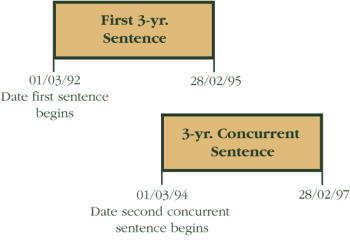
As such in this particular case the offender would wind up serving a five-year sentence as opposed to merely a three-year sentence:

Note that this is a longer, not shorter, sentence.
In the case, specifically, of consecutive sentencing, the case turns out much differently:
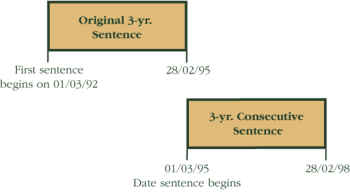
The second sentence doesn't begin until after the first has expired, guaranteeing a much longer sentence regardless of how soon the offender was tried and convicted:

As such, not only is the most recent talking point from the pro-abortion lobby counter-factual, it's also a phantom of straw man arguments from days gone by, when it was suggested that instituting consecutive sentencing would increase support for capital punishment, when all the evidence suggests that consecutive sentencing decreases support for capital punishment.
But thus is the Orwellian logic of the Canadian pro-abortion lobby. Why would Bill C-484 result in shorter sentences for convicted offenders? Because the pro-abortion lobby says so, regardless of whether or not that's actually true.
Just as with the rather peculiar claim that the suggestion that Canada institute consecutive sentencing provisions in the criminal code is somehow proof that Bill C-484 is about abortion rather than justice, or with claims that pregnant women in the US have been charged under fetal homicide acts despite the fact that this has never happened. Why is it so? Because they say so.
It's rather characteristic of those who, in true Orwellian fashion, bank on the ignorance of the public.
Hopefully, the Canadian public will turn out to be a good deal less ignorant than the pro-abortion lobby is banking on.
Friday, November 30, 2007
Karlheinz Schreiber Totally Worth All This Trouble
...Not
The Mulroney-Schreiber affair took an expected turn today, as Karlheinz Schreiber was granted a temorary stay of extradition, pending a Supreme Court decision on whether or not it will hear an appeal of his extradition to Germany.
Reportedly, he'll now be seeking bail.
The handling of Schreiber has essentially become a no-win situation for the government. Deport Schreiber immediately, and the opposition will complain that he's being suppressed. Allow him to stay, and he's apparently hell bent on monopolizing as much time in the Canadian courts as he possibly can.
Most ironically, however, Schreiber, who had promised incredible revelations regarding his relationship with Brian Mulroney has reportedly admitted that Mulroney did nothing criminal in the course of their relationship. Furthermore, he noted that Mulroney didn't lobby any government on Schreiber's behalf.
In fact, the greatest revelation he's offered to date is that he had arranged to pay Brian Mulroney as much as $500,000, but notes that he had only paid $300,000 by the time he decided that Mulroney wasn't holding up his side of the bargain.
Interestingly, a former Mulroney aid revealled that Mulroney instructed him to get cost analysis of Schreiber's Bear Head project done. The Schreiber-fronted Thyssen industries project would have built an arms factory in Nova Scotia.
When it turned out however, that the project -- which Mulroney had been promised wouldn't cost Canadian taxpayers a dime -- would have cost the government $100 million, Mulroney is said to have remarked, "In that case, the project is dead."
When was all this? 1990.
Certainly, it's impossible to applaud Mulroney's judgement in this regard. Privy Council clerk Paul Tellier had previously ejected Schreiber from his office. Alberta premier Peter Lougheed, in regards to another matter, had instructed his cabinet ministers to "have nothing to do with this guy."
While Mulroney's judgement in regards to his relationship with Schreiber is demonstarbly poor, it seems, to date, that is all Mulroney is guilty of.
Thus, we bring ourselves back to the ultimate perversity of the Schreiber-Mulroney affair. Schreiber admits that Mulroney is guilty of no crime. Yet, Canada is withholding Schreiber from Germany, where he has been charged with fraud, bribery, and tax evasion.
Actual crimes.
Karlheinz Schreiber is wasting Canada's time at the direct expense of our diplomatic relationship with Germany.
Enough is enough. While Schreiber's extradition may have been delayed, he certainly shouldn't be granted bail.
He should be reserved a seat on the next plane back to Germany.
The Mulroney-Schreiber affair took an expected turn today, as Karlheinz Schreiber was granted a temorary stay of extradition, pending a Supreme Court decision on whether or not it will hear an appeal of his extradition to Germany.
Reportedly, he'll now be seeking bail.
The handling of Schreiber has essentially become a no-win situation for the government. Deport Schreiber immediately, and the opposition will complain that he's being suppressed. Allow him to stay, and he's apparently hell bent on monopolizing as much time in the Canadian courts as he possibly can.
Most ironically, however, Schreiber, who had promised incredible revelations regarding his relationship with Brian Mulroney has reportedly admitted that Mulroney did nothing criminal in the course of their relationship. Furthermore, he noted that Mulroney didn't lobby any government on Schreiber's behalf.
In fact, the greatest revelation he's offered to date is that he had arranged to pay Brian Mulroney as much as $500,000, but notes that he had only paid $300,000 by the time he decided that Mulroney wasn't holding up his side of the bargain.
Interestingly, a former Mulroney aid revealled that Mulroney instructed him to get cost analysis of Schreiber's Bear Head project done. The Schreiber-fronted Thyssen industries project would have built an arms factory in Nova Scotia.
When it turned out however, that the project -- which Mulroney had been promised wouldn't cost Canadian taxpayers a dime -- would have cost the government $100 million, Mulroney is said to have remarked, "In that case, the project is dead."
When was all this? 1990.
Certainly, it's impossible to applaud Mulroney's judgement in this regard. Privy Council clerk Paul Tellier had previously ejected Schreiber from his office. Alberta premier Peter Lougheed, in regards to another matter, had instructed his cabinet ministers to "have nothing to do with this guy."
While Mulroney's judgement in regards to his relationship with Schreiber is demonstarbly poor, it seems, to date, that is all Mulroney is guilty of.
Thus, we bring ourselves back to the ultimate perversity of the Schreiber-Mulroney affair. Schreiber admits that Mulroney is guilty of no crime. Yet, Canada is withholding Schreiber from Germany, where he has been charged with fraud, bribery, and tax evasion.
Actual crimes.
Karlheinz Schreiber is wasting Canada's time at the direct expense of our diplomatic relationship with Germany.
Enough is enough. While Schreiber's extradition may have been delayed, he certainly shouldn't be granted bail.
He should be reserved a seat on the next plane back to Germany.
Thursday, November 29, 2007
Surprise, Surprise: Schreiber Doesn't Talk
Expected moment of truth ironically prescient
The sad, sad farce that is the Karlheinz Schreiber affair descended even further into the realm of the farcical today, as Schreiber, as expected, refused to testify before a House of Commons committee.
Issued a historical summons to appear before the Commons Committee on Access to Information, Privacy and Ethics, Shreiber told the committee he's be "delighted" to testify -- then didn't testify.
As expected, Schreiber announced he won't testify unless he's allowed to stay in Canada. He was scheduled to be extradited to Germany on December 1, but faces a Court of Appeal tomorrow. Justice Canada has decided to let the court decide whether or not Schreiber will be granted a reprieve from extradition.
"Until that time I will not speak to or answer any questions of this committee," Schreiber announced.
This would be odd behaviour from someone who insists that he isn't trying to escape justice in Germany, and who, as CTV's Bob Fife says, "wanted an opportunity to tell the truth."
Schreiber has had various opportunities to tell the truth, and, to date, has declined them all. In a country where the integrity of our legal system were deemed more important than petty partisan politics, Schreiber would already be on his way out of the country -- handcuffs, orange jumpsuit, and all.
Unfortunately, with the opposition desperate to try and make something out of this embarrassing debacle, German officials will have to wait longer still to get their hands on Schreiber.
While the opposition forces the government to dance to the tune of a known fraudster, based on claims that contradict Schreiber's earlier contentions, German justice -- matters regarding to actual crimes -- is delayed.
Most unfortunately, Canadian delays in handing Schreiber over to the Germans could porentially imperil future extraditions from Germany to Canada. Not only are the opposition parties willing to sacrifice the integrity of Canada's justice system in order to try and score cheap political points, but they're also willing to sacrifice Canada's legal relationship with a foreign country.
Karlheinz Schreiber is not worth the effort currently being expended on him. His lies (and he is, indeed, demonstrably a liar) most certainly aren't.
The sad, sad farce that is the Karlheinz Schreiber affair descended even further into the realm of the farcical today, as Schreiber, as expected, refused to testify before a House of Commons committee.
Issued a historical summons to appear before the Commons Committee on Access to Information, Privacy and Ethics, Shreiber told the committee he's be "delighted" to testify -- then didn't testify.
As expected, Schreiber announced he won't testify unless he's allowed to stay in Canada. He was scheduled to be extradited to Germany on December 1, but faces a Court of Appeal tomorrow. Justice Canada has decided to let the court decide whether or not Schreiber will be granted a reprieve from extradition.
"Until that time I will not speak to or answer any questions of this committee," Schreiber announced.
This would be odd behaviour from someone who insists that he isn't trying to escape justice in Germany, and who, as CTV's Bob Fife says, "wanted an opportunity to tell the truth."
Schreiber has had various opportunities to tell the truth, and, to date, has declined them all. In a country where the integrity of our legal system were deemed more important than petty partisan politics, Schreiber would already be on his way out of the country -- handcuffs, orange jumpsuit, and all.
Unfortunately, with the opposition desperate to try and make something out of this embarrassing debacle, German officials will have to wait longer still to get their hands on Schreiber.
While the opposition forces the government to dance to the tune of a known fraudster, based on claims that contradict Schreiber's earlier contentions, German justice -- matters regarding to actual crimes -- is delayed.
Most unfortunately, Canadian delays in handing Schreiber over to the Germans could porentially imperil future extraditions from Germany to Canada. Not only are the opposition parties willing to sacrifice the integrity of Canada's justice system in order to try and score cheap political points, but they're also willing to sacrifice Canada's legal relationship with a foreign country.
Karlheinz Schreiber is not worth the effort currently being expended on him. His lies (and he is, indeed, demonstrably a liar) most certainly aren't.
Tuesday, November 20, 2007
Tories Getting Tough on Drugs?
Not really
If one were to believe the voices of the hapless left, they would believe that Prime Minister Stephen Harper is fighting some sort of ill-advised war on drugs.
And he is. But not in the way they think.
The most recent bill proposed by the Conservative party will make use of mandatory minimum sentences for those involved in dealing and producing drugs.
Of course, various groups have decried this as a carbon-copy of the badly failing American anti-drug laws. It isn't, and they know it (but more on this later).
First off, the clear majority of the new Tory plan falls in line with what these people claim to want. in which 2/3 of new funding (approximately $42 million) would be addressed toward prevention and treatment.
Among other things, the program would fund an anti-drug campaign, modernize treatment services, develop new treatment methods, expand the treatment programs available to young addicts, provide provinces with new funding for expanding existing services, and more funding for a youth intervention program.
Of course, none of this is what opponents of the proposed bill want to focus on. Instead, they want to focus on (and distort) the enforcement portion of the proposed bill.
Today, the Conservatives rolled out this portion of the bill.
Those caught and convicted of selling marijuana as part of a criminal operation, or using a weapon, will recieve a mandatory minimum sentence of one year. Two years for selling drugs in the vicinity of a school. Two years for anyone operating an illegal marijuana grow-op of 300 plants or more. Two years for selling hard drugs.
Despite what those who oppose this bill what have you believe, the proposed mandatory minimum sentences actually aren't strong enough. Only in one case, the doubling of the maximum penalty for marijuana production from 7 to 14 years, did the proposed sentencing changes actually go too far.
If these groups want to argue that anyone caught selling drugs to school children shouldn't go to jail, a good number of Canadians would like to hear them try.
Opponents of these changes would like people to believe that this is merely a transplanting of American drug laws into Canada. But it isn't, and they know it.
The problem with mandatory minimum sentencing in the United States is that it's all too often directed merely at users. American prisons are overfilled with users sentenced to life for mere possession under the US' three-strikes laws.
That won't be the case under the Tory proposal, which focuses on treatment for users and punishment for dealers, whereas the American system focuses on punishment for both.
The Tory version, less the weak sentencing prescriptions, is how it should be.
While the party's opponents in this matter can at least safely argue that Canadian law is woefully restrictive toward medical marijuana, they'll only conitnue to fail to make that point if they insist on continuing to lie to Canadians about drug policy.
In the meantime, if the Conservatives want to get tough on drugs, they'd better go ahead and do it.
If one were to believe the voices of the hapless left, they would believe that Prime Minister Stephen Harper is fighting some sort of ill-advised war on drugs.
And he is. But not in the way they think.
The most recent bill proposed by the Conservative party will make use of mandatory minimum sentences for those involved in dealing and producing drugs.
Of course, various groups have decried this as a carbon-copy of the badly failing American anti-drug laws. It isn't, and they know it (but more on this later).
First off, the clear majority of the new Tory plan falls in line with what these people claim to want. in which 2/3 of new funding (approximately $42 million) would be addressed toward prevention and treatment.
Among other things, the program would fund an anti-drug campaign, modernize treatment services, develop new treatment methods, expand the treatment programs available to young addicts, provide provinces with new funding for expanding existing services, and more funding for a youth intervention program.
Of course, none of this is what opponents of the proposed bill want to focus on. Instead, they want to focus on (and distort) the enforcement portion of the proposed bill.
Today, the Conservatives rolled out this portion of the bill.
Those caught and convicted of selling marijuana as part of a criminal operation, or using a weapon, will recieve a mandatory minimum sentence of one year. Two years for selling drugs in the vicinity of a school. Two years for anyone operating an illegal marijuana grow-op of 300 plants or more. Two years for selling hard drugs.
Despite what those who oppose this bill what have you believe, the proposed mandatory minimum sentences actually aren't strong enough. Only in one case, the doubling of the maximum penalty for marijuana production from 7 to 14 years, did the proposed sentencing changes actually go too far.
If these groups want to argue that anyone caught selling drugs to school children shouldn't go to jail, a good number of Canadians would like to hear them try.
Opponents of these changes would like people to believe that this is merely a transplanting of American drug laws into Canada. But it isn't, and they know it.
The problem with mandatory minimum sentencing in the United States is that it's all too often directed merely at users. American prisons are overfilled with users sentenced to life for mere possession under the US' three-strikes laws.
That won't be the case under the Tory proposal, which focuses on treatment for users and punishment for dealers, whereas the American system focuses on punishment for both.
The Tory version, less the weak sentencing prescriptions, is how it should be.
While the party's opponents in this matter can at least safely argue that Canadian law is woefully restrictive toward medical marijuana, they'll only conitnue to fail to make that point if they insist on continuing to lie to Canadians about drug policy.
In the meantime, if the Conservatives want to get tough on drugs, they'd better go ahead and do it.
Saturday, November 17, 2007
Suddenly, He's Not So Eager to Talk
But the opposition is awfully eager to hear him
In the newly-revived and ongoing Mulroney-Schreiber affair, things took a turn for the even more acrimonious recently when Schreiber stated he wouldn't cooperate with the inquiry were he extradited to Germany.
Following a statement issued by German Justice officials stating they would allow Schreiber to be interrogated by Canadian investigators while in German custody, Schreiber has promised "not a fucking word would I speak".
In other words, Karlheinz Schreiber, the would-be victim of a conspiracy theory, a man more maligned than Maher Arar and disappointed in the Harper government's efforts to clean up Ottawa, has now resorted to attempting to blackmail the government of Canada.
And the opposition, desperate to score whatever political points thay can from the affair, are all too eager to cave in to him.
At some point, the writing on the wall simply becomes all too obvious. Karlheinz Schreiber is desperately trying to delay his extradition to Germany, and he's willing to say absolutely anything to do it.
Meanwhile, the opposition parties and the media, recognizing Brian Mulroney as a slam-dunk case in the court of public opinion, has jumped all over this story, Karlheinz Schreiber, and his most recent non-revelations.
Among those non-revelations, Schreiber states, "The whole thing is much broader than only Airbus and it starts already at the beginning, in the early '80s, when the situation was that Brian Mulroney intended to become the prime minister and needed help."
More humorously, "There are other revelations I intend to make in front of an inquiry which really made me very nervous when I heard about them," Schreiber notes (emphasis added). "You will understand that I want to leave quite a few important things for the inquiry."
What most people understand about the Mulroney-Schreiber affair is that it deals primarily with Mulroney's dealings with Schreiber. So why is Schreiber only hearing such details about his own dealings with Mulroney now? Unless he wants to implicate other people in this tale, in which case the proof would certainly be in the pudding.
Schreiber is desperately trying to write a new lease on his life in Canada, and he's desperate enough to regurgitate old news, rumours, innuendos, and very likely outright lies (let's not forget who we're dealing with here) in order to do it.
That the opposition wants Canada to deny German officials the opportunity to deliver Schreiber to justice there on this basis is actually quite shameful. Moreover, it could imperil future Canadian attempts to extradite criminals from Germany. On this note, it's double-shameful.
If Schreiber doesn't want to talk if extradited to Germany, so be it. If he were really so concerned about justice as he would like us to believe, he would speak regardless.
It will be a truly dark day when the government of Canada bends over backward just to hear the words of a known fraud.
In the newly-revived and ongoing Mulroney-Schreiber affair, things took a turn for the even more acrimonious recently when Schreiber stated he wouldn't cooperate with the inquiry were he extradited to Germany.
Following a statement issued by German Justice officials stating they would allow Schreiber to be interrogated by Canadian investigators while in German custody, Schreiber has promised "not a fucking word would I speak".
In other words, Karlheinz Schreiber, the would-be victim of a conspiracy theory, a man more maligned than Maher Arar and disappointed in the Harper government's efforts to clean up Ottawa, has now resorted to attempting to blackmail the government of Canada.
And the opposition, desperate to score whatever political points thay can from the affair, are all too eager to cave in to him.
At some point, the writing on the wall simply becomes all too obvious. Karlheinz Schreiber is desperately trying to delay his extradition to Germany, and he's willing to say absolutely anything to do it.
Meanwhile, the opposition parties and the media, recognizing Brian Mulroney as a slam-dunk case in the court of public opinion, has jumped all over this story, Karlheinz Schreiber, and his most recent non-revelations.
Among those non-revelations, Schreiber states, "The whole thing is much broader than only Airbus and it starts already at the beginning, in the early '80s, when the situation was that Brian Mulroney intended to become the prime minister and needed help."
More humorously, "There are other revelations I intend to make in front of an inquiry which really made me very nervous when I heard about them," Schreiber notes (emphasis added). "You will understand that I want to leave quite a few important things for the inquiry."
What most people understand about the Mulroney-Schreiber affair is that it deals primarily with Mulroney's dealings with Schreiber. So why is Schreiber only hearing such details about his own dealings with Mulroney now? Unless he wants to implicate other people in this tale, in which case the proof would certainly be in the pudding.
Schreiber is desperately trying to write a new lease on his life in Canada, and he's desperate enough to regurgitate old news, rumours, innuendos, and very likely outright lies (let's not forget who we're dealing with here) in order to do it.
That the opposition wants Canada to deny German officials the opportunity to deliver Schreiber to justice there on this basis is actually quite shameful. Moreover, it could imperil future Canadian attempts to extradite criminals from Germany. On this note, it's double-shameful.
If Schreiber doesn't want to talk if extradited to Germany, so be it. If he were really so concerned about justice as he would like us to believe, he would speak regardless.
It will be a truly dark day when the government of Canada bends over backward just to hear the words of a known fraud.
Friday, November 09, 2007
Like it or Not, a Clear Case for Consideration of the Death Penalty
Medicine Hat murder accomplice just might fit the bill
A recent decision by the governing Conservative party to not attempt to intervene in the cases of Canadians sentenced to death in foreign countries has brought a good deal of predictable responses, most of them consisting of contempt and revulsion.
There's actually good reason for this. However, many of these individuals have taken it upon themselves to try to push the issue into a larger debate about the validity of the death penalty itself.
In this, they're wrong.
For proof, one needs look no further than the recent media blizzard surrounding the sentencing in regards to the murders of Marc and Debra Richardson, and their eight-year-old son.
On April 23, 2006, the Richardsons were stabbed to death by their 12-year-old daughter and by Jeremy Allan Steinke, then 23 years old, who had been romantically involved with her.
During the subsequent trial, a number of facts emerged. First off, it turned out that the girl herself was severely mentally ill, suffering from both conduct disorder and oppositional defiance disorder.
The girl's sentence, a meagre 4-year term what will be split between prison and a psychiatric hospital, followed by 4 1/2 years of supervised community living, certainly doesn't fit the bill. However, while it's very unlikely she'll successfully rehabilitate so long as she refuses to accept moral or criminal responsibility for her actions, her mental illness just may turn out to be treatable with the proper therapy and medication. The young age of the convicted, furthermore, obligates society to at least give her the opportunity.
But the defense for Steinke isn't nearly so clear.
While the girl's case contains varying mitigating factors, Steinke's case contains the polar opposite.
First off, not only is mr Steinke a murderer, but he's also a sex offender -- a 23-year-old (now 24) having sex with a 12-year-old. The revulsion associated with this act aside, Steinke reportedly joined with her in the murders she planned for two reasons: first, because it was the only way she would accept a marriage proposal from him, and secondly, because she had allegedly cut him off from sex.
Steinke, a grown man, was willing to engage in the act of murder in order to maintain his sexual relationship with someone who was (at the time) 11 years his junior.
Naturally, this is a very disconcerting fact, and for obvious reasons.
This is not actually to say that Steinke should be put to death. Far from it. However, in a case such as Steinke's, the state should have the death penalty on the books for consideration, even if it remains unused.
Those who steadfastly oppose the death penalty all too often forget that the justice system is actually meant to have four purposes, not merely two. Pierre Trudeau himself did this, when he abolished the death penalty, citing that it had dubious merits in terms of either rehabilitation or deterrence.
Aside from rehabilitation and deterrence, the justice system is also meant to embody two other purposes: punishment and, most importantly, the protection of society.
In terms of punishement, the death penalty should be considered inapplicable. For these particular purposes, the death penalty would appear to be too much like state-inflicted revenge. Revenge is not justice. The desire for revenge stems from an emotional response -- our legal system is supposed to be devoid of emotional response.
The protection of society, however, is a quite different matter altogether. In the case of Steinke, the crown should consider how likely Steinke is to reoffend in a similar manner. If they decide he is, the state is left with two options: imprison Steinke for the rest of his life (actually endangering his inmates), or execution.
Although those who oppose the death penalty most stringently may loathe to admit this, the death penalty is actually the more humane of the two options.
Now, all this being said, a reinstated death penalty would require a myriad of restrictions, many of which may result in its disuse altogether.
First off, should an accused's very life be at stake in criminal proceedings, the burden of evidence simply must be tantamount to this reality. Proof of guilt must be absolute, and objectively and scientifically unassailable.
Secondly, the death penalty would always need to remain the punishment of absolute last resort, and only be applied in cases where the accused is not only nearly certain to reoffend, but also certainly irredeemable. (Considering the political pressures that have shelved a psychological diagnostic test for determining whether or not an individual is psychopathic, this would be a doubly hard condition to meet).
Finally, were the death penalty reinstated in Canada, it would be of absolute necessity to guarantee at least one appeal, in order to be absolutely sure that the death penalty fits.
In otherwords, the criteria necessary to execute an individual should be so strict as to almost prevent its use. The death penalty isn't necessarily something that should ever actually be used. However, it's an option that should remain open to Canada's justice system for those cases in which the convicted is simply such an imminent threat to society that they are guaranteed to reoffend in a similar fashion.
This would pretty much restrict those elligible for the death penalty to serial murderers and unrepentant pedophiles. If anyone believes that serial murders and unrepentant pedophiles can safely be released back into general public, they seriously need to give their head a shake.
Whether or not Jeremy Allan Steinke would actually fit the necessary criteria is a matter for debate.
But Canadian courts should be able to consider the death penalty as an option for individuals like Steinke, even if it never actually gets used.
A recent decision by the governing Conservative party to not attempt to intervene in the cases of Canadians sentenced to death in foreign countries has brought a good deal of predictable responses, most of them consisting of contempt and revulsion.
There's actually good reason for this. However, many of these individuals have taken it upon themselves to try to push the issue into a larger debate about the validity of the death penalty itself.
In this, they're wrong.
For proof, one needs look no further than the recent media blizzard surrounding the sentencing in regards to the murders of Marc and Debra Richardson, and their eight-year-old son.
On April 23, 2006, the Richardsons were stabbed to death by their 12-year-old daughter and by Jeremy Allan Steinke, then 23 years old, who had been romantically involved with her.
During the subsequent trial, a number of facts emerged. First off, it turned out that the girl herself was severely mentally ill, suffering from both conduct disorder and oppositional defiance disorder.
The girl's sentence, a meagre 4-year term what will be split between prison and a psychiatric hospital, followed by 4 1/2 years of supervised community living, certainly doesn't fit the bill. However, while it's very unlikely she'll successfully rehabilitate so long as she refuses to accept moral or criminal responsibility for her actions, her mental illness just may turn out to be treatable with the proper therapy and medication. The young age of the convicted, furthermore, obligates society to at least give her the opportunity.
But the defense for Steinke isn't nearly so clear.
While the girl's case contains varying mitigating factors, Steinke's case contains the polar opposite.
First off, not only is mr Steinke a murderer, but he's also a sex offender -- a 23-year-old (now 24) having sex with a 12-year-old. The revulsion associated with this act aside, Steinke reportedly joined with her in the murders she planned for two reasons: first, because it was the only way she would accept a marriage proposal from him, and secondly, because she had allegedly cut him off from sex.
Steinke, a grown man, was willing to engage in the act of murder in order to maintain his sexual relationship with someone who was (at the time) 11 years his junior.
Naturally, this is a very disconcerting fact, and for obvious reasons.
This is not actually to say that Steinke should be put to death. Far from it. However, in a case such as Steinke's, the state should have the death penalty on the books for consideration, even if it remains unused.
Those who steadfastly oppose the death penalty all too often forget that the justice system is actually meant to have four purposes, not merely two. Pierre Trudeau himself did this, when he abolished the death penalty, citing that it had dubious merits in terms of either rehabilitation or deterrence.
Aside from rehabilitation and deterrence, the justice system is also meant to embody two other purposes: punishment and, most importantly, the protection of society.
In terms of punishement, the death penalty should be considered inapplicable. For these particular purposes, the death penalty would appear to be too much like state-inflicted revenge. Revenge is not justice. The desire for revenge stems from an emotional response -- our legal system is supposed to be devoid of emotional response.
The protection of society, however, is a quite different matter altogether. In the case of Steinke, the crown should consider how likely Steinke is to reoffend in a similar manner. If they decide he is, the state is left with two options: imprison Steinke for the rest of his life (actually endangering his inmates), or execution.
Although those who oppose the death penalty most stringently may loathe to admit this, the death penalty is actually the more humane of the two options.
Now, all this being said, a reinstated death penalty would require a myriad of restrictions, many of which may result in its disuse altogether.
First off, should an accused's very life be at stake in criminal proceedings, the burden of evidence simply must be tantamount to this reality. Proof of guilt must be absolute, and objectively and scientifically unassailable.
Secondly, the death penalty would always need to remain the punishment of absolute last resort, and only be applied in cases where the accused is not only nearly certain to reoffend, but also certainly irredeemable. (Considering the political pressures that have shelved a psychological diagnostic test for determining whether or not an individual is psychopathic, this would be a doubly hard condition to meet).
Finally, were the death penalty reinstated in Canada, it would be of absolute necessity to guarantee at least one appeal, in order to be absolutely sure that the death penalty fits.
In otherwords, the criteria necessary to execute an individual should be so strict as to almost prevent its use. The death penalty isn't necessarily something that should ever actually be used. However, it's an option that should remain open to Canada's justice system for those cases in which the convicted is simply such an imminent threat to society that they are guaranteed to reoffend in a similar fashion.
This would pretty much restrict those elligible for the death penalty to serial murderers and unrepentant pedophiles. If anyone believes that serial murders and unrepentant pedophiles can safely be released back into general public, they seriously need to give their head a shake.
Whether or not Jeremy Allan Steinke would actually fit the necessary criteria is a matter for debate.
But Canadian courts should be able to consider the death penalty as an option for individuals like Steinke, even if it never actually gets used.
Friday, August 24, 2007
Undercover Police Officers, Clearly. Agents du Provacateurs? Hardly.
Still much ado over nothing
After two days of controversy, the Surete du Quebec have admitted that the alleged protesters taken into custody in this video were, in fact, undercover police officers.
But they maintain that the undercover officers were not agents provocateurs.
“At no time did the Quebec provincial police officers act as agents provocateurs or commit criminal acts," insisted a statement released by the force. "It is not part of the policy of the police force nor is it part of its strategy to act in this manner. At all times, the officers responded to their mandate to maintain law and order."
At the end of the day, those who are decrying the injustice of it all have nothing to rely on aside from one officer holding a rock in his hand.
Which actually provides the riot police on scene with a pretext to stage an arrest of the men in the name of withdrawing them from cover, particularly when they are at risk of being “made”. In fact, “busting” undercover police officers is a common practice:
“Undercover officers are often "busted" to give a progress report and let management know if they need more or less supervision.”
The assumption that undercover officers at a protest must be agents provocateurs stems from a fundamental misunderstanding of what undercover police work entails. Consider the claims that the use of undercover officers to bust a terrorist ring in suburban Toronto last year entailed “entrapment”.
Yet undercover police work is entirely legal, and is often used to build cases against organized crime cartels, although it clearly also has its uses in terms of monitoring the situation at a protest, which are known to often turn violent.
So in the end, what does the scandal ultimately boil down to? The use of undercover police officers to help control potentially riotous crowds, a tactic that has been found to be effective in the past.
Of course, there are lines that can be crossed. The various cases of American protest groups being actively infiltrated by undercover officers is particularly troubling.
With no evidence, however, of any such attempts by Canadian police forces (at least in cases where no criminal acts are yet being committed), the actions of the undercover officers in Montebello appear to be nothing more than an earnest attempt to monitor and manage a very volatile environment – a tricky task indeed, even using the most refined psychological tactics available.
Hiccups like the outing of the officers in question are bound to happen.
In the end, it is true that some of accusations turned out to be well-founded. The officers were, indeed, wearing the same brand and model of boot (this has eventually been confirmed through photographic evidence, although early enhancements of the photographs in question were very poor). It turned out that, by the admission of the Surete du Quebec, the individuals in question were police officers.
Fair enough.
But the biggest, most serious accusation of all – that they were acting as agents provocateurs – has yet to be proven, and is still being based on circumstantial evidence. It stems, however, from a tendency to assume the worst about our men and women in uniform.
Whether it’s assuming that Canadian soldiers are knowingly and willingly handing Taliban prisoners over to torturers or assuming that Canadian police officers undercover at protests are there to incite riots, the suspicion of our uniformed men and women really stems from a fanatical desire to find the worst in any accusation.
At best, it’s politically-motivated hysterics. At worst, it’s a meager attempt to transplant an American scandal north of the 49th parallel.
This is because it’s well known that political protests can turn violent and cause thousands of dollars in property damage. It’s also well known that the Al Qaida training manual instructs terrorists to lie about torture.
Yet when politics are on the line, neither of these facts matter. Many of these people choose to assume the worst, because it’s politically convenient to do so.
It gets to the point where one assumes that those portraying the proactive law and peace enforcement activities of our men and women in uniform as the acts of totalitarian police states are opposed to allowing terrorists to strike on Canadian aoil and are against rioters causing thousands of dollars in property damage to people who really have little or nothing to do with the summits they protest, but who can be sure? Most of them aren't so vocal on that particular point.
Long story short, it can now (and only now) be accepted as fact that the individuals in question at the Montebello protest were police officers. That’s far from proving they were agents provocateurs.
After two days of controversy, the Surete du Quebec have admitted that the alleged protesters taken into custody in this video were, in fact, undercover police officers.
But they maintain that the undercover officers were not agents provocateurs.
“At no time did the Quebec provincial police officers act as agents provocateurs or commit criminal acts," insisted a statement released by the force. "It is not part of the policy of the police force nor is it part of its strategy to act in this manner. At all times, the officers responded to their mandate to maintain law and order."
At the end of the day, those who are decrying the injustice of it all have nothing to rely on aside from one officer holding a rock in his hand.
Which actually provides the riot police on scene with a pretext to stage an arrest of the men in the name of withdrawing them from cover, particularly when they are at risk of being “made”. In fact, “busting” undercover police officers is a common practice:
“Undercover officers are often "busted" to give a progress report and let management know if they need more or less supervision.”
The assumption that undercover officers at a protest must be agents provocateurs stems from a fundamental misunderstanding of what undercover police work entails. Consider the claims that the use of undercover officers to bust a terrorist ring in suburban Toronto last year entailed “entrapment”.
Yet undercover police work is entirely legal, and is often used to build cases against organized crime cartels, although it clearly also has its uses in terms of monitoring the situation at a protest, which are known to often turn violent.
So in the end, what does the scandal ultimately boil down to? The use of undercover police officers to help control potentially riotous crowds, a tactic that has been found to be effective in the past.
Of course, there are lines that can be crossed. The various cases of American protest groups being actively infiltrated by undercover officers is particularly troubling.
With no evidence, however, of any such attempts by Canadian police forces (at least in cases where no criminal acts are yet being committed), the actions of the undercover officers in Montebello appear to be nothing more than an earnest attempt to monitor and manage a very volatile environment – a tricky task indeed, even using the most refined psychological tactics available.
Hiccups like the outing of the officers in question are bound to happen.
In the end, it is true that some of accusations turned out to be well-founded. The officers were, indeed, wearing the same brand and model of boot (this has eventually been confirmed through photographic evidence, although early enhancements of the photographs in question were very poor). It turned out that, by the admission of the Surete du Quebec, the individuals in question were police officers.
Fair enough.
But the biggest, most serious accusation of all – that they were acting as agents provocateurs – has yet to be proven, and is still being based on circumstantial evidence. It stems, however, from a tendency to assume the worst about our men and women in uniform.
Whether it’s assuming that Canadian soldiers are knowingly and willingly handing Taliban prisoners over to torturers or assuming that Canadian police officers undercover at protests are there to incite riots, the suspicion of our uniformed men and women really stems from a fanatical desire to find the worst in any accusation.
At best, it’s politically-motivated hysterics. At worst, it’s a meager attempt to transplant an American scandal north of the 49th parallel.
This is because it’s well known that political protests can turn violent and cause thousands of dollars in property damage. It’s also well known that the Al Qaida training manual instructs terrorists to lie about torture.
Yet when politics are on the line, neither of these facts matter. Many of these people choose to assume the worst, because it’s politically convenient to do so.
It gets to the point where one assumes that those portraying the proactive law and peace enforcement activities of our men and women in uniform as the acts of totalitarian police states are opposed to allowing terrorists to strike on Canadian aoil and are against rioters causing thousands of dollars in property damage to people who really have little or nothing to do with the summits they protest, but who can be sure? Most of them aren't so vocal on that particular point.
Long story short, it can now (and only now) be accepted as fact that the individuals in question at the Montebello protest were police officers. That’s far from proving they were agents provocateurs.
Thursday, August 16, 2007
No Appeal Court Victory Lane for Street Racer
Drag-racing Edmontonian hits red light in his race for an appeal
When The Fast and the Furious was released in 2001, it had an immediate affect on pop culture.
One of them was to convince lead-foot-wannabes that a Honda Civic is actually a really cool car (it isn't). Another was the popularization of street racing.
Street racing has begun to take a toll on our city streets, claiming lives across Canada, as street racers fan out in search of their thrill of choice.
Fortunately, a line has recently been drawn in the sand, as the Supreme Court of Canada has declined to hear the appeal of Edmonton's Rick Richardson, who was convicted of dangerous driving causing death when his Corvette mowed down Irene Nicholson (she was on the sidewalk when she was hit).
Witnesses report that Richardson pulled his Corvette up beside another Corvette at a traffic light, then raced him from the green light. He lost control of his car during the acceleration and wiped out Nicholson, who was a mere two blocks from her home.
Richardson has insisted that the computer chip that governs his car's traction management system malfunctioned.
Of course, those of us with any sense in our heads know different: it was Richardson's brain that malfunctioned.
Regardless of whatever malfunctions may have occurred in Richardson's car (and he would have to prove this), his car didn't choose the rate of acceleration for him -- he did. Richardson's car didn't choose to race -- he did.
Richardson's appeal simply would have been a waste of time.
Cases such as this, however, merely underscore the need to legislate against street racing so that it can be dealt with directly in criminal courts, not merely as cases tried under other statutes. All of Canada's provinces would do well to emulate the Dalton McGuinty Ontario government's approach. A $10,000 fine will probably smarten up most of the 2 Fast 2 Furious crowd.
And smartening is something they could definitely use.
The federal government also attempted to address street racing would impose stronger punishments on convicted street racers.Yet, according to the Library of Parliament Bill C-65 hasn't yet passed its third reading, despite having been before parliament for a year.
The courts have made an uncharacteristic stand in this particular case, and it's time for the federal government to do the same, stop dragging its feed on bill C-65, and get the job done.
As far as movies concerned, Universal Studios would be doing the public a tremendous favour by simply letting this film series die a merciful death. It wouldn't only be striking a blow against the popularity of street racing, it would also be striking a blow against lousy movies.
Besides: Paul Walker's career is over anyway.
When The Fast and the Furious was released in 2001, it had an immediate affect on pop culture.
One of them was to convince lead-foot-wannabes that a Honda Civic is actually a really cool car (it isn't). Another was the popularization of street racing.
Street racing has begun to take a toll on our city streets, claiming lives across Canada, as street racers fan out in search of their thrill of choice.
Fortunately, a line has recently been drawn in the sand, as the Supreme Court of Canada has declined to hear the appeal of Edmonton's Rick Richardson, who was convicted of dangerous driving causing death when his Corvette mowed down Irene Nicholson (she was on the sidewalk when she was hit).
Witnesses report that Richardson pulled his Corvette up beside another Corvette at a traffic light, then raced him from the green light. He lost control of his car during the acceleration and wiped out Nicholson, who was a mere two blocks from her home.
Richardson has insisted that the computer chip that governs his car's traction management system malfunctioned.
Of course, those of us with any sense in our heads know different: it was Richardson's brain that malfunctioned.
Regardless of whatever malfunctions may have occurred in Richardson's car (and he would have to prove this), his car didn't choose the rate of acceleration for him -- he did. Richardson's car didn't choose to race -- he did.
Richardson's appeal simply would have been a waste of time.
Cases such as this, however, merely underscore the need to legislate against street racing so that it can be dealt with directly in criminal courts, not merely as cases tried under other statutes. All of Canada's provinces would do well to emulate the Dalton McGuinty Ontario government's approach. A $10,000 fine will probably smarten up most of the 2 Fast 2 Furious crowd.
And smartening is something they could definitely use.
The federal government also attempted to address street racing would impose stronger punishments on convicted street racers.Yet, according to the Library of Parliament Bill C-65 hasn't yet passed its third reading, despite having been before parliament for a year.
The courts have made an uncharacteristic stand in this particular case, and it's time for the federal government to do the same, stop dragging its feed on bill C-65, and get the job done.
As far as movies concerned, Universal Studios would be doing the public a tremendous favour by simply letting this film series die a merciful death. It wouldn't only be striking a blow against the popularity of street racing, it would also be striking a blow against lousy movies.
Besides: Paul Walker's career is over anyway.
Tuesday, August 14, 2007
Panhandlers Are Not the Problem
Focus on aggressive panhandlers overlooks bigger issue
Following a number of violent incidents involving panhandlers, many people are calling for tougher laws to address the apparent scourge of aggressive panhandling.
Talk about treating the symptom over the cause.
While two recent incidents are alarming -- one in which an elderly Vancouver man was mugged after giving money to a panhandler on a fifth consecutive day, and another in which a pack of panhandlers mobbed a Toronto man, stabbing him to death -- one can easily mistake what the issue at stake is: whether or not aggressive panhandlers should be targeted by tougher laws, or whether these individuals should have to be panhandling in the first place.
First, however, a caveat: it is true that not all panhandlers are made equal. Among the many panhandlers who are legitimately homeless and unable to otherwise fend for themselves, there are plenty of able-bodied panhandlers who resort to panhandling because they do not want to work. They have their reasons, from base laziness, to some who subscribe to a set of counter-cultural beliefs that essentially forbid them from working, paying taxes, and supporting "the system".
For most panhandlers, however, the issue is very different. They are forced to panhandle because they are homeless, and for a variety of reasons. Mental illness, for example, accounts for between 20 and 25% of all single homeless adults. Drug addiction and alcoholism can be identified in 65-85% of single homeless adults. In Canada, in particular, aboriginal people are more likely to be homeless.
To describe these people as "victims of the system" would clearly be passe. Many of them are homeless because of bad choices that they themselves made. However, it is obvious that once they become homeless, society doesn't care for them very well.
Many people regard panhandlers as a "social nuisance", and demand tougher laws to regulate their behaviour, including loitering laws to prevent them from hanging out on the street.
Unfortunately for the homeless people in question, they have no where else to go. In many Canadian cities, there is a shortage of available shelter space.
If homelessness were merely a private problem, that would be one thing. Yet the public inconveniences (as minor as they may be) caused by the homeless veer directly into the realm of the public problem. While relying on philantropy to help homeless people may seem like a convenient solution, there is only so much the private good can do in addressing a public problem.
A renewed commitment to mental health facilities alone could cut the ranks of Canada's homeless by as much as the aforementioned 20-25%. While this directly contradicts the principle of the "new institutionalism" (the idea that the mentally ill are best treated while living among the public, rather than in closed facilities), it's really only contradicting something that hasn't fully worked. Even if Canada's mentally ill homeless were only offered optional instutionalization, at least that's more choice than they have now.
For the rest of Canada's homeless, more shelter space is necessary, and not just during times of inclement weather. Searching for a job tends to require a fixed address, and ability to get in contact with prospective employers. A homeless shelter may not be the most pleasant place to live, and may actually be a fairly expensive operation for the public purse, but it certainly gives homeless people a better opportunity at getting employed and getting off the streets.
Which is basically what the problem with demanding tougher laws against panhandlers entails. We as a society need to be getting homeless people off the streets, not sending them off to jail. For those of them who break the law and assault, steal and kill, that's what we have criminal justice for.
But there is no law against being homeless. Perhaps what we need is a law against allowing people to remain homeless.
That, however, would entail an indictment of our entire society.
Following a number of violent incidents involving panhandlers, many people are calling for tougher laws to address the apparent scourge of aggressive panhandling.
Talk about treating the symptom over the cause.
While two recent incidents are alarming -- one in which an elderly Vancouver man was mugged after giving money to a panhandler on a fifth consecutive day, and another in which a pack of panhandlers mobbed a Toronto man, stabbing him to death -- one can easily mistake what the issue at stake is: whether or not aggressive panhandlers should be targeted by tougher laws, or whether these individuals should have to be panhandling in the first place.
First, however, a caveat: it is true that not all panhandlers are made equal. Among the many panhandlers who are legitimately homeless and unable to otherwise fend for themselves, there are plenty of able-bodied panhandlers who resort to panhandling because they do not want to work. They have their reasons, from base laziness, to some who subscribe to a set of counter-cultural beliefs that essentially forbid them from working, paying taxes, and supporting "the system".
For most panhandlers, however, the issue is very different. They are forced to panhandle because they are homeless, and for a variety of reasons. Mental illness, for example, accounts for between 20 and 25% of all single homeless adults. Drug addiction and alcoholism can be identified in 65-85% of single homeless adults. In Canada, in particular, aboriginal people are more likely to be homeless.
To describe these people as "victims of the system" would clearly be passe. Many of them are homeless because of bad choices that they themselves made. However, it is obvious that once they become homeless, society doesn't care for them very well.
Many people regard panhandlers as a "social nuisance", and demand tougher laws to regulate their behaviour, including loitering laws to prevent them from hanging out on the street.
Unfortunately for the homeless people in question, they have no where else to go. In many Canadian cities, there is a shortage of available shelter space.
If homelessness were merely a private problem, that would be one thing. Yet the public inconveniences (as minor as they may be) caused by the homeless veer directly into the realm of the public problem. While relying on philantropy to help homeless people may seem like a convenient solution, there is only so much the private good can do in addressing a public problem.
A renewed commitment to mental health facilities alone could cut the ranks of Canada's homeless by as much as the aforementioned 20-25%. While this directly contradicts the principle of the "new institutionalism" (the idea that the mentally ill are best treated while living among the public, rather than in closed facilities), it's really only contradicting something that hasn't fully worked. Even if Canada's mentally ill homeless were only offered optional instutionalization, at least that's more choice than they have now.
For the rest of Canada's homeless, more shelter space is necessary, and not just during times of inclement weather. Searching for a job tends to require a fixed address, and ability to get in contact with prospective employers. A homeless shelter may not be the most pleasant place to live, and may actually be a fairly expensive operation for the public purse, but it certainly gives homeless people a better opportunity at getting employed and getting off the streets.
Which is basically what the problem with demanding tougher laws against panhandlers entails. We as a society need to be getting homeless people off the streets, not sending them off to jail. For those of them who break the law and assault, steal and kill, that's what we have criminal justice for.
But there is no law against being homeless. Perhaps what we need is a law against allowing people to remain homeless.
That, however, would entail an indictment of our entire society.
Friday, June 08, 2007
Breaking News: Life Unfair to Paris Hilton
Cries to Her Mommy On the Way Back to Jail
Poor Paris Hilton. Life is rough when you're a 26 year-old filthy rich celebrity hotel heiress.
On Thursday, Paris must have been certain she had managed to weasle her way out of her 45-day sentence citing some sort of undisclosed medical difficulty that allegedly led the Los Angeles County Sheriff to deem that prison was a dangerous place for her.
No dice, says Superior Court Judge Michael T Sauer, who ordered her back to jail to await a hearing he had scheduled in order to determine the nature of her medical condition. In the meantime, Hilton certainly must have provoked his ire when she suggested that she would not appear for the hearing, claiming that a telephone hearing had been scheduled -- which it hadn't.
For her own part, Hilton disapproves. "It's not right!" she was reported as complaining as she was led from the courtroom in a soggy, sobbing mess. "Mom!"
...Her mom was standing nearby. Apparently, she didn't intercede on Paris' behalf. Poor thing.
Yep, life sure is unfair for Paris Hilton. While the average person will likely agree with LA City Attorney Rocky Delgadillo when he remarked, "this decision sends the message that no individual -- no matter how wealthy or powerful -- is above the law. Today, justice was served."
Indeed, justice was served with a steaming hot side of "awwwww, muffin."
Now, all Los Angeles county needs is a new Sheriff.
Poor Paris Hilton. Life is rough when you're a 26 year-old filthy rich celebrity hotel heiress.
On Thursday, Paris must have been certain she had managed to weasle her way out of her 45-day sentence citing some sort of undisclosed medical difficulty that allegedly led the Los Angeles County Sheriff to deem that prison was a dangerous place for her.
No dice, says Superior Court Judge Michael T Sauer, who ordered her back to jail to await a hearing he had scheduled in order to determine the nature of her medical condition. In the meantime, Hilton certainly must have provoked his ire when she suggested that she would not appear for the hearing, claiming that a telephone hearing had been scheduled -- which it hadn't.
For her own part, Hilton disapproves. "It's not right!" she was reported as complaining as she was led from the courtroom in a soggy, sobbing mess. "Mom!"
...Her mom was standing nearby. Apparently, she didn't intercede on Paris' behalf. Poor thing.
Yep, life sure is unfair for Paris Hilton. While the average person will likely agree with LA City Attorney Rocky Delgadillo when he remarked, "this decision sends the message that no individual -- no matter how wealthy or powerful -- is above the law. Today, justice was served."
Indeed, justice was served with a steaming hot side of "awwwww, muffin."
Now, all Los Angeles county needs is a new Sheriff.
Subscribe to:
Posts (Atom)