Showing posts with label Brian Lilley. Show all posts

Tuesday, November 08, 2011

Dan Gardner, the Media Party, and the Disintegration of Modern Journalism


Some Nexus readers may recall a Byline segment from early October wherein Brian Lilley commented on a segment of Canadian journalism he refers to as "the media party".

In the segment, Lilley actually names a few journalists he considers to be members of the media party. Chief among them is "author, journalist and lecturer" Dan Gardner.

Last night, Gardner witnessed Minister of Citizenship, Immigration and Multiculturalism Jason Kenney refer to unreported crime in explaining and defending the Conservative government's omnibus crime bill. Garner couldn't hold back his objection -- nor, necessarily, should he -- and took to Twitter to voice his objection.

Gardner, who Tweets under @DGardner decided to respond to Kenney's comments by first selectively citing data from the study, then by dismissing unreported crime as "trivial":
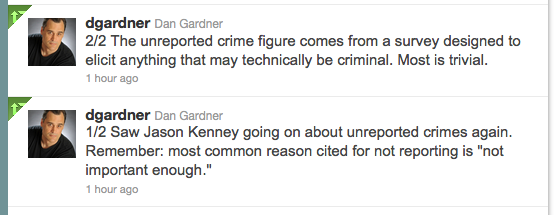
Your not-so-humble scribe couldn't resist the opportunity to ask Gardner a few questions about the assumptions he was making. Gardner's ultimate response was that he ultimately would not consider any other data points:
In other words, Gardner refused to talk about any weaknesses in the assumptions he was offering, or even any other information. If it was going to be discussed, it would have to be discussed with other people, because he won't.

There's good reason for this. The survey as a whole says far more than Gardner says it does, and the data points he himself is offering don't necessarily support his claims about it.
There are obvious problems with a response that begins and ends with "not important enough", and it has to do with the respondent's perception of the meaning of that phrase. The question of who the incident in question is perceived to be "not important enough to" is a very real question.

To blithely assume that this means that the victim of the crime in general didn't consider it important enough to report is to also assume that all respondents perceived the meaning of that phrase in a uniform manner. This would be a mistake.

When a response begins and ends with "not important enough", it's every bit as likely that the respondent could conclude that the crime in question was not important enough to the police as not important enough to them personally. In lieu of a better-defined response, either conclusion is equally likely, and it's much more reasonable -- and responsible -- to allow for the probability that those who submitted that response had either of these in mind. Some likely concluded the former, and some likely concluded the latter.

Yet to ask Dan Gardner if the conclusion he reached -- that this response indicates that most of Canada's unreported crime is trivial -- is reasonable considering the ambiguous nature of this data is apparently to precipitate a meltdown on his behalf. If last night's events are any indication, he simply can't cope with that idea.

To ask him about the second-ranked response -- "police could not do anything about it" -- is apparently to make it worse. Gardner's response was that this was a worthy point to be discussed, but that he personally wouldn't. (That the second-ranked response trailed the first-ranked response by less than ten percentage points apparently did nothing to boost the worthiness of this data point in Gardner's eyes.)

It becomes difficult to avoid reaching the conclusion that, in the canon of the far-left media, these are forbidden questions. "Does the data actually indicate what you're saying it does?" That question is forbidden. "Isn't the second-ranked response also worthy of consideration?" That question is also forbidden.

What seems to emerge, in Dan Gardner's case, is that of a man who has not embraced journalism as a means with which to provide people with information or even ideas. Rather, he's embraced the journalistic enterprise purely as a means of political advocacy. Nothing else.

It's hard to escape the conclusion that Gardner is simply a card-carrying member of the media party. The media party has an agenda, and in this case it's in preserving the soft-on-crime, hug-a-thug policies that they claim have reduced crime in Canada, but in reality have not. The Stats Can study itself states that in no uncertain terms -- victimization in Canada has remained stable.

In support of that agenda, Gardner sets out to turn public attention away from specific data points that do not support that agenda, and toward data points that seem to support it only if they go unexamined.

It's one thing to insist that Canadians aren't reporting specific crimes because they're "not important enough", whatever that might mean to the individuals who offered that response.

To insist that the unreported crimes are trivial is remarkably obtuse when one considers what those unreported crimes are:
Of the crimes unreported in Canada, the number one is break and enter. That is not a trivial crime. The second is motor vehicle or parts theft. That is not a trivial crime. The third is robbery. That is not a trivial crime. The fifth is physical assault. That is not a trivial crime.

The fourth was vandalism. That could be a trivial crime, but not necessarily. The sixth and seventh were theft, or personal property and household property respectively. That, too, could be a trivial crime, but not necessarily.

It's not up to Dan Gardner to decide if the unreported victimization of Canadians is trivial. It's up to each individual victim to decide that for themselves and admittedly, many of them might reach that conclusion. Many might not.

But this is how the media party operates: they assume that they speak for Canadians as a whole, then they pretend to.

In the end, Dan Gardner's impotent response to the questions he was asked was to label your not-so-humble scribe a "troll". Basically it amounts to an accusation that the questions over whether or not Gardner has given ample consideration to the meaning of the data points he offers is "inflammatory, extraneous, or off-topic", as Wikipedia would have it.

The questions over whether or not Gardner is accurately interpreting the data offered by this survey are very clearly on-topic. It's simply a question that he considers forbidden: it's entirely reasonable to ask in the face of ambiguous data with a wide berth of potential meanings, but it seems to be Gardner's belief that no one is allowed to ask that question.

To this end, Dan Gardner is wrong. People have the right to ask these questions, and if Gardner, demanding merit in the public eye, refuses to discuss them, then it's he who has abandoned the lofty aspirations of journalism.

It's not what one would expect from a journalist. But it's precisely what one would expect from a member of the media party.


Monday, November 07, 2011

When Does a Single Interview Cancellation Constitute a Ban?

The attention-hungry continue to falsely martyr themselves

There's no martyr like a self-made martyr. Over the last year, Canadians have seen far more self-made martyrs than anyone really needs.

Now Margie Gillis, Franke James and Brigette DePape have some strange company among them: Fog of War author Mark Bourrie.

According to Bourrie, he'd been scheduled to appear on Michael Coren's show on the Sun News Network. Later on, that interview was cancelled.

Quickly following the cancellation of his interview, Bourrie wrote a blog post for Ottawa magazine claiming he had been banned.

"Well, that’s it. I’m banned," Bourrie claimed. "I am lower than low, mere scrapings from the bottom of the dog walker’s boot. Yes, I’m not fit to be on the Sun News Network."

"My publicist booked me on Michael Coren’s show a couple of weeks ago. Last Wednesday, I got an e-mail saying the interview had been cancelled by Sun TV," Bourrie continued. "It wasn’t Coren or Coren’s producer who made the decision. Someone higher up had killed the booking and banned me from Sun TV."

The evidence Bourrie offers? Precisely none.

This author hasn't yet had access to Bourrie's book to give it a fair consideration of its merits. So your not-so-humble scribe won't automatically lump Mr Bourrie with mediocre self-made-martyrs like DePape, James or Gillis.

But Bourrie's martyrdom seems no less self-made.

Simply put, one interview cancellation does not a ban make. Bourrie's planned interview on Sun News could have been cancelled for any number of good reasons. Here's a very good one, and a very plausible one: perhaps the topic of episode on which Bourrie was scheduled to appear was changed.

This author doesn't know this to be the case. Nor does this author have any evidence to support it. However, under the evidence already offered -- Bourrie's complaint that his interview was cancelled -- this explanation is no more and no less plausible than Bourrie's.

The obvious difference is that Bourrie's explanation simultaneously lionizes himself while portraying himself as a victim. Bourrie's explanation unfortunately precludes any other possibility that doesn't require Sun News to be the bad guy of the story.

If Mark Bourrie wants to know what a real media ban looks like, this author has a story for him. Unfortunately for Bourrie, it doesn't make him out to be the martyr he seemingly wants to be so desperately, so he may not be interested.


Thursday, September 08, 2011

The Sheer Comedy of Margie Gillis

"Iconic" interpretive dancer wants news network taken off the air

In the wake of the fevered response to Krista Erickson's June interview with "iconic" interpretive dancer Margie Gillis, an interesting subtext has emerged.

Canada's arts community -- despite enjoying millions of dollars in federal subsidies on an annual basis -- have convinced themselves that they are an oppressed group. And, like all self-imagined oppressed groups, they are now eager to re-invent themselves as the oppressor.

In a recent interview, Gillis -- who self-organized a boycott of Sun News Network's advertisers that has very clearly failed comically -- has suggested another "solution" to the Sun News Network "problem". She wants it taken off the air.

This is actually a more extreme position than her previous position, in which she and her cronies merely suggested that Sun News Network be ordered removed from basic
cable packages. Now she's calling for it to be removed entirely.

"I think the station should be taken off until they can prove that they represent Canadian values," Gillis declared in an interview with the Vancouver Observer.

Naturally, one would expect that Gillis would describe "Canadian values" within a very narrow set of far-left values. And it shouldn't be considered even remotely surprising that Gillis and her cronies would want to silence anyone who disagrees with them.

Amidst a plethora of Orwellian messages to her followers telling them to "be compassionate" and "stay human", Gillis has held her bruised ego up as a rallying point for all the emotionally-unbalanced artsy types who are enraged that she wasn't treated with what they consider the proper deference.

In order to keep that rage alive, Gillis is still pretending she's some sort of victim.

“It was just an attack,” Gillis said. “She just didn't care what I was saying … I've never done an interview where they don't come back on to say thank you very much. I sat there in this little room. Nobody came in, nobody came out and I sat there for about 10 minutes just going: wow, that was an attack.”

Then again, perhaps Sun News Network staff had already had their fill of Gillis by the 8:50 mark of the interview, when Gillis very obnoxiously began to speak over Erickson, reciting self-scripted remarks even as Erickson asks her to stop talking over her.

Gillis and her cronies continue to pretend that Erickson "constantly" spoke over her. Erickson had indeed spoken over Erickson in the interview -- to self-correct an error she had made. Comically, Gillis objected to Erickson correcting herself.

Ever since, GIllis has been using the interview, in which both interviewer and interviewee did their fair share of the dirty work in turning the entire affair awry, as a lightning rod for every Canadian artist who feels they're being oppressed if they can't live as well as a doctor or lawyer off of their work.

Now Margie Gillis wants to take up the role of oppressor for herself. It would be frightening if it weren't merely comical.


Thursday, June 30, 2011

More From the Relentlessly-Whiny Canadian Left

When the Canadian Broadcast Standards Council waved a red flag in the face of thousands of rabidly-censorious Canadian left-wingers, Charlie Smith of the Georgia Strait interpreted it as a red flag in the face of a raging bull.

And he's the bull. In so many ways.

Smith, of course, is among thos outraged that Sun News Network personality Krista Erickson asked "iconic" interpretive dancer Margie Gillis some challenging questions about her funding.

Smith is outraged that the CBSC has called for a halt to the complaints. Gillis' self-organized campaign to complain to the council has amassed so many that it can't process them all. So he recommends that, instead, the implacably-censorious left go directly to the CRTC.

In going to the CRTC, Gillis' cronies would be scrambling for an even bigger fly swatter than the CBSC; one that cannot be ingored.

And the CSBC very much can be ignored.

As Ezra Levant and Brian Lilley recently alluded to, it was the CBSC that, based on a single complainant, attempted to direct all radio stations in Canada to air an edited version of "Money For Nothing" by Dire Straits.

Radio stations decided to ignore the ruling. The CRTC directed the CBSC to revisit their deicision, and they backed down.

The CRTC, however, cannot be ignored. If they decided to give in to the demands being made by Charlie Smith and the rest of the mice following Margie Gillis in her pied paper act, they could pull the Sun News Networks' broadcast license.

There should be no doubt that those expressing contrived, sanctimonious and generally false outrage at Gillis being asked some tough questions are prepared to accept nothing less than that. They're already demanding it.


Friday, June 24, 2011

Herman Cain Warns Of Socialism By Stealth

Cain plans to stop "encroaching socialism"

In a previous post, this author noted that Herman Cain's speeches seemed to indicate that he might be paying attention to Canadian conservatives.

It should be no great surprise. After all, the Republican Party rooted its "contract with America" of the 1990s in many of the populist ideas being promoted by Preston Manning and the Reform Party.

As Republican Presidential Candidate Herman Cain winds his way through small-town America looking for votes, one may wonder if he's somehow acquired himself a Sun News Network subscription -- or if he's at least watching some of the coverage online.

In Marshalltown, Iowa, Cain delivered a speech warning of "enroaching socialism". In many respects it sounded similar to Brian Lilley's missives on the NDP's "socialism by stealth".

"The nation is at a critical turning point. It is currently heading down the track of socialism. And I said it," Cain declared. "The good news is it's not too late to get it back on the right track."

Cain pointed to President Barack Obama's health care reform package and a controversial National Labour Relations Board ruling regarding a facility Boeing was planning to build.

Cain noted that over-regulation was harming the American economy, and even leading to a situation in which natural resources -- as well as other factors of production -- are going unused, seemingly by government missive.

"I'm not anti regulation," Cain noted. "I'm just anti too much regulation. [But] It's as if this administration doesn't want to use all of our resources."

Of course, stringent management of economic production -- including such ideas as "supply control" -- are central to the practice of socialism. As Lilley notes, it's been seen in Canada already, and there are far-left elements of the NDP who want to take it even further.

Cain seems to be becoming more and more worried that these practices are seeping deeper and deeper into the crevices of the American government. He believes that he has the skills to put a stop to it, and he intends to do so as President.

A big part of that will revolve around taking so-called "problem solving" powers and responsibilities away from the government, and delegating it back to citizens.

"The people closest to the problem are the ones who can solve the problem," Cain insisted.

As President, Herman Cain's goal would be to seek to solve only the problems that government can be expected to be able to solve. He's confident he has the skills to do just that.

"My business problem-solving skills can help this nation," he announced. "America cannot wait."


Friday, May 20, 2011

More Evidence No One is Illegal Couldn't Carry An Idea In a Bucket


Appearing on a recent edition of Brian Lilley's Byline program on SUN TV, No One is Illegal tried to put a good face on what is otherwise a very disturbed organization.

Appearing for NOII, Luam Kidane attempted to do everything but answer some very simple questions about what it is NOII (describing themselves as a "migrant justice" organization) stands for.

Questions about whether or not NOII advocates purely open borders was met by a barrage of "clarifying question", as Kidane attempted to reach "an understanding" on the terminology she and Lilley would use to discuss the issue.

The clear intent on Kidane's part was to attempt to portray the organization as holding a particular philosophical vigour that simply isn't there.

It's hard to get clear answers out of anyone from NOII. But one thing that comes up repeatedly are two basic ideas that are entirely at odds. One is that "people have the right to migrate". The other is that "Canada is occupied Turtle Island".

It sounds like complete gibberish, but some aboriginal groups describe all of North America as "occupied Turtle Island". But once detail is established and set aside, it becomes clear that the denziens of No One is Illegal haven't really thought out their ideas. Not a whit.

Simply put, if people have the right to migrate, than European settlers had the right to migrate to North America.

Another talking point of No One is Illegal is that no one is obligated to be a "good immigrant" by integrating into the culture and society of the land to which they migrate.

Simply put, people can settle down in any territory they choose to move to and then live however they choose. They have no obligation to become part of "the community" that exists there. In fact, they have no obligation to join that community at all. (Which makes it all the more comical that Kidane justifies her enjoyment of services provided by a state she doesn't recognize as legitimate because "members of the community provide the services".)

Naturally, this does not actually entail the right of a migrant group to dominate an indigenous group. There are plenty of legitimate criticisms NOII could offer about how the Canadian state has treated aboriginals in the past, even as Canadians bend over backwards to make it right today.

But to declare Canada to be an "occupied" territory suggests that non-aboriginal Canadians have no right to be here. Intriguingly, that includes Kidane herself.

Until one considers that No One is Illegal has declared that people have the right to migrate. One would assume that this applies to all people equally, unless it doesn't. Unless there really is some kind of racial bias to NOII's "right to migrate".

In all truth, however, Luam Kidane's appearance on Byline is actually entirely uncharacteristic of No One is Illegal. After all, any group that teaches children to punch Citizenship and Immigration Minister Jason Kenney in effigy could hardly be considered civil, even if some of their members can adopt a veneer of civility when given the opportunity to play Socrates (badly) on national TV.


Sunday, April 25, 2010

Keep These People As Far Away From Abortion Policy as Possible

In the most recent dispatch from Sister Sage's Musings, CK reminds us of why she and her cohorts should be kept as far away from abortion policy as humanly possible.
One would scarcely believe it if they hadn't read it with their own two eyes -- mostly because the pro-abortion lobby, if asked whether or not women have ever procured abortions for fickle reasons, tends to freak the fuck out over it.

And yet there it is, on one of the most feverishly incoherent pro-abortion blogs on the internet:

"Being pregnant would have been a huge embarrassment," the woman writes. "The other alternatives of keeping the baby and getting married, or giving the baby up for adoption did not appeal to me in the least."

This is a woman who had an abortion because pregnancy would have been too embarrassing for her. Allowing her child to live with an adopted family, or raising the kid within a marriage? Just not appealing. And this is who pro-abortion activists like CK want as the spokesperson of their movement.

It certainly isn't right that this woman was arrested for procuring an abortion. And while there are numerous good reasons for abortion to remain legal, providing women with a convenient out for avoiding having to admit the "embarrassment" of irresponsible sexual behaviour (perhaps using a condom just wasn't appealing) just isn't one of them.

Of course, abortion is a topic that really gives lunatics of various political stripes their time to shine. And when that time comes, CK tends to shine on like a crazy diamond.

Consider this particular post, a seething pseudo-rebuttal to an Examiner.com article wherein Brian Liley considers data from four separate abortion-related polls.

CK accuses Liley of being a sucky news reporter, and a sucky statistician.

Her argument is that she doesn't like Mike Duffy, Ezra Levant, Shona Holmes, Afghanistan, 10 percenters and corporate welfare. Ergo, Brian Liley sucks.

And yet Liley's conclusions from examining four different polls on abortion likely sound far more like the opinions of most Canadians on abortion than CK is likely comfortable with:
"If we put all four polls together what we find is that Canadians likely find abortion to be morally wrong, something they think should be restricted at some point before birth, something that should receive limited public financing, something that should remain legal and a true hot button issue as to whether Canada should fund abortions overseas."
That may sound far more like the opinion of most Canadians on abortion than anything that has ever been produced at Sister Sage's Musings, or by CK's fellow Chickenwankers at Unrepentant Old Hippie or Dammit Janet. So CK's apparent response is to scream "I hate all of these things, ergo you suck!" at any journalist who draws any conclusion other than "Canadians think abortion is nifty".

It's frightening to think of where Canada would be if individuals like CK got their wish and the abortion debate were reduced to this kind of level -- one where in journalists are forbidden from exploring the nuances of Canadian attitudes on the issue, simply because it doesn't advance the pro-abortion lobby's extreme ideological agenda.

Fortunately, a great many Canadians aren't prepared to simply allow the erstwhile "cultural warriors" of the far left to have their way on this issue: no matter how much they may demand it.

Sunday, September 20, 2009

Tracking Canada's Evangelical Vote

Evangelical Christians flock to Tories, NDP from Liberals

For the casual follower of Canadian politics, one may think it's safe to assume that the Conservative party has the votes of Canada's Evangelical Christians essentially locked down, and always have.

But that assumption is really only half-true.

The Evangelical Fellowship of Canada recently released a report on the voting habits of Evangelical Christians. They concluded that Canadian Evangelicals are turning away from the Liberal party. Two-thirds of the Evangelicals are moving to support the Conservative party. The other third are supporting the NDP.

Few Canadians would intuitively equate the Liberal party with Evangelical Christianity.

This has increasingly been the case over the past 12 years. As the Examiner's Brian Lilley notes, in 1996 -- in the midst of the Reform party's heyday -- Evangelical votes were well predicted by regional preferences. In Western Canada 33% of Evangelical voters supported the Reform party (30% supported the Liberals). In Ontario, 44% of Evangelical Christians supported the Liberal party (an anemic 15% supported Reform).

But by 2008 the preference of Evangelicals have tipped inexorably away from the Liberals. Only 11% of Canada's Evangelical Christians continue to support the Grits. In 1996 the figure was 44%.

Senator David Smith attributes the loss in the Liberal share of the Evangelical vote to Liberal party stances on issues such as same-sex marriage and abortion.

"These have been polarizing issues. I would hope that with the work [Toronto Liberal MP] John McKay is doing, (many former Liberal voters) will come back," Smith said.

Indeed, John McKay has been at the head of efforts to solidify Liberal party inroads to religious communities. McKay has been working not only with Evangelical Christians, but but also with Catholics.

“I am hoping that this initiative will free up some political space for faith leaders to speak into the marketplace of ideas and not feel that they will end up battered and bruised and run out of town on a rail,” McKay said.

McKay believes -- hopefully rightly -- that more reasonable debates on moral issues can be fostered if only enough people cared to try.

"I think from time to time the Liberal party has edged into the areas of being disagreeable," he explained. "And I don’t think that’s right or respectful. It doesn’t allow for a fruitful, mature, intelligent dialogue on both differences and commonality."

"The Liberal Party is a big tent," he concluded. "I would hope that all things being equal that Evangelical and active Catholics would feel very comfortable in that tent."

Evangelicals concerned about same-sex marriage and abortion are clearly turning toward the Conservative party. Even if Conservative policy declines to substantively address either one of those issues, their views still tend to find a more receptive audience amongst the Tories.

According to former NDP MP Bill Blaikie, many young Evangelicals are moving toward the NDP. Blaikie argues that these Evangelicals have "moved beyond the culture wars and see their commitment to be acting out the gospel, preserving the environment and fighting AIDS."

These Evangelicals have clearly subscribed to the Tommy Douglas brand of the social gospel -- it can be easy for many Canadians to forget that Douglas was an ordained Baptist minister.

Blaikie notes that Evangelicals are "principled voters", and will vote with whatever party pays the most attention to their particular principles.

The EFC paper also notes that "the growing evangelical support for the Conservatives had more to do with the Conservative' offering a viable alternative to the Liberals, whom many perceived as corrupt and hostile, than with a hope for potential policy gains."

As those Canadians who pay close attention to Canadian politics can easily conclude, the Liberals have rarely been a viable alternative to the NDP. Their commitment to issues of social justice have constantly be proven to be far too flexible for anyone who embraces social justice as a tenet of their religious beliefs.

Various Liberal electoral tactics -- including 2004 push polls that concerned the Conservative party's association with Evangelical circles -- have also served to distance the Liberals from Evangelical voters.

The Liberals once had one significant portion of Canada's Evangelical vote essentially sewed up. In Like Father, Like Son (a book about Earnest and Preston Manning) Mackey notes that Ethnic Evangelicals -- one of several subcategories of Canadian Evangelical Christianity, which also includes the Pentacostal, Charismatic, Holy, Reformed and Evangelicals in Mainline Churches, as well as "Mainstream" Evangelicals -- often tended to support the Liberal party (mostly, by his reckoning, because the Liberals happened to be in power when they arrived).

As Brian Lilley notes, Canadian Evangelicals are not nearly so frightening as some observers of Canadian politics would want Canadians to believe -- the EFC's study seems to bear this to be true. The Liberal party's loss of faith (so to speak) amongst the Evangelical vote has certainly contributed to its downfall. Arresting its declining poll numbers among Evangelicals may be a crucial step in reversing its general electoral fortunes.