Desperate, pathetic McGuinty cries 'hidden agenda'
The Toronto Star calls it "feisty". Anyone with a memory of what transpired in Canadian politics over the past 20 years will recognize it for precisely what it is: pathetic.
Of course, Ontario Premier Dalton McGuinty must expect that Ontarians have a short memory. How else to explain his desperate "hidden agenda" gambit?
Canadians are very familar with the "hidden agenda" gambit. It was a fear tactic, invoked by former Prime Minister Paul Martin, suggesting current Prime Minister Stephen Harper had a "hidden agenda".
How did the story end? The train wreck of corruption that was the Liberal Party became unigorable in the eyes of Canadians, Martin's government was rightly found wanting, his desperation recognized, and Martin was rightly sent packing, never to return.
Four years later, another embattled Liberal -- McGuinty -- has resorted to this pathetic and transparent gambit, just as his opposition seems poised to relegate him to the opposition benches.
This time it's Ontario Progressive Conservative leader Tim Hudak, and it comes as Hudak points to the increasing burden McGuinty's government has become to the citizens of Ontario.
“After seven years it has become very clear Premier McGuinty believes in his heart that Ontario families have an infinite capacity to pay for every idea that your team dreams up,” Hudak announced. “They can’t keep up with your hydro bills, they can’t keep up with your HST increase, they can’t keep up with your eco taxes. Families need a break.”
For his own part, McGuinty predictably wanted to change the subject -- to health care.
“Ontario families better ask themselves what’s their secret agenda when it comes to health care," McGuinty announced. "What’s going to happen to their hospitals, their nurses and doctors?”
Of course, the switch to health care wasn't by any means a random change of topic. It was deliberate. Nothing so frightens Canadians as the prospect of deep cuts to health care -- even as health care becomes more and more unsustainable, as governments such as McGuinty's continue to allow it to slide.
“We have a broader, and I think more intelligent understanding of what Ontario families’ concerns are," McGuinty preened. "Yes they’re concerned about their expenses ... levels of taxation.”
“But we will not take our eye off the ball of those other concerns families have,” he continued.
Yet it seems that as support for the Progressive Conservative Party strengthens, and support for the Liberal Party erodes, more and more Ontarians are questioning the broadness or the intelligence of McGuinty's purported understanding of their concerns.
So the Ontario Liberal Party's option of choice is to rewind to yesterday -- regurgitate the "hidden agenda". Run against Mike Harris rather than against Tim Hudak.
It won't work any better for Dalton McGuinty than it did for Paul Martin.
While the Toronto Star may applaud it as "feisty", Ontarians will surely recognize it for what it really is: desperate and pathetic.

Showing posts with label Hidden Agenda. Show all posts
Showing posts with label Hidden Agenda. Show all posts
Wednesday, September 15, 2010


Monday, August 24, 2009
A Recipe For Unsustainable Health Care
Cameron's proposed NHS policy uncharacteristic and foolish
In the midst of a controversy surrounding a Tory MP's criticisms of the National Health Service, British Conservative party leader has managed to provoke a controversy within his own caucus.
In response to scathing criticisms stemming from Daniel Hannan's recent voicing of criticisms of the NHS on Fox News, Cameron has proposed to commit to annually increasing government spending on the NHS at a rate exceeding inflation.
Naturally, this has created a division within his party caucus. What he may not have expected is that his caucus would so firmly align against his proposal.
Only 29% of Cameron's caucus agreed with his plan. 62% of his MPs disagreed.
Furthermore, only 33% agreed that the current funding model for the NHS would be sustainable for another period of 60 years. 62% didn't.
The same poll of Cameron's MPs found that they wanted the introduction of a broader role for private health insurance.
Former Conservative Health Secretary Ann Widdecombe has called for wealthy Britons to use private health care in order to relieve undue strain on the public system -- something that would likely require a greater role for private health care.
 "We urgently need the debate -- I think politicians of all parties have shied away from it for too long," she said. "We should look without prejudice at a range of options."
And while there's certainly nothing wrong with Widdecombe's call for a greater debate, one can certainly expect the Labour party -- which has been so utterly ham-fisted over Daniel Hannan's remarks -- to take full advantage of both her comments and the results of this particular poll.
Perhaps the greater problem for Cameron, however, is that his MPs are perfectly justified in opposing his proposal.
Allowing the funding of any government program -- even one as integral as health care -- to increase at a rate greater than inflation is a recipe for an absolute fiscal disaster.
If the funding for the National Health Service increased at a rate greater than inflation, it would be unsustainable well within the 60 year window the ComRes poll uses as its frame of reference.
Certainly, David Cameron cannot allow the Labour party to have a free hand in painting his party with the "secret agenda" tar brush that so successfully managed to mar his party's Canadian counterpart.
But Cameron needs to focus on responsible policies, and make sure that any policy he proposes can be sustainable. He should be more than happy to leave the politics of irresponsibility to his opponents.
In the midst of a controversy surrounding a Tory MP's criticisms of the National Health Service, British Conservative party leader has managed to provoke a controversy within his own caucus.
In response to scathing criticisms stemming from Daniel Hannan's recent voicing of criticisms of the NHS on Fox News, Cameron has proposed to commit to annually increasing government spending on the NHS at a rate exceeding inflation.
Naturally, this has created a division within his party caucus. What he may not have expected is that his caucus would so firmly align against his proposal.
Only 29% of Cameron's caucus agreed with his plan. 62% of his MPs disagreed.
Furthermore, only 33% agreed that the current funding model for the NHS would be sustainable for another period of 60 years. 62% didn't.
The same poll of Cameron's MPs found that they wanted the introduction of a broader role for private health insurance.
Former Conservative Health Secretary Ann Widdecombe has called for wealthy Britons to use private health care in order to relieve undue strain on the public system -- something that would likely require a greater role for private health care.
"We urgently need the debate -- I think politicians of all parties have shied away from it for too long," she said. "We should look without prejudice at a range of options."And while there's certainly nothing wrong with Widdecombe's call for a greater debate, one can certainly expect the Labour party -- which has been so utterly ham-fisted over Daniel Hannan's remarks -- to take full advantage of both her comments and the results of this particular poll.
Perhaps the greater problem for Cameron, however, is that his MPs are perfectly justified in opposing his proposal.
Allowing the funding of any government program -- even one as integral as health care -- to increase at a rate greater than inflation is a recipe for an absolute fiscal disaster.
If the funding for the National Health Service increased at a rate greater than inflation, it would be unsustainable well within the 60 year window the ComRes poll uses as its frame of reference.
Certainly, David Cameron cannot allow the Labour party to have a free hand in painting his party with the "secret agenda" tar brush that so successfully managed to mar his party's Canadian counterpart.
But Cameron needs to focus on responsible policies, and make sure that any policy he proposes can be sustainable. He should be more than happy to leave the politics of irresponsibility to his opponents.
Friday, August 14, 2009
Fucked If you Do, Fucked If You Don't
Stephen Harper can't talk about health care, and he can't not talk about health care
For those unfamiliar with the Harper Index, it's an online publication run by the Golden Lake Institute.
The Golden Lake Institute, in turn, is an organization that professes itself to be "a group of individuals and organizations who see themselves on the political Left."
"They feel the Left needs to find new ways to think and talk, and encourage others to think and talk about its political project," their website explains. "We agree with George Lakoff and others who argue that the heart of political strategy is the ability to successfully 'frame' issues in ways that appeal to people's deepest values and understandings."
In other words, the Golden Lake Institute are less a public think tank, as they'd like to portray themselves, and more committed ideological spin doctors.
Like many of the committed ideological spin doctors of Canada's political left, the GLI seem to believe they've created the ulimate political catch .22 for Prime Minister Stephen Harper:
You're damned if you do talk about health care, and you're damned if you don't. But especially if you don't.
Writing in an article appearing on the Harper Index, Eric Mang insists that Harper declining to participate in the American health care debate is part of a secret conspiracy among Conservatives to not talk about health care because they secretly despise it.
Which is ironic. Because when most conservatives in Canada talk about health care they're accused of doing so because they despise it.
It isn't hard to see the pattern that quickly emerges.
In the article, Mang laments Harper's decision not to engage in a full-hearted defense of Canadian health care in an interview on ABC.
Mang insists that Harper's comments in the interview "were revealing, as much for what they did not say as what they did."
In that interview, here is what Harper had to say about health care:
"He downplayed the federal government's role in health care, despite our system being a single national plan through the Canada Health Act," Mang fumed. Mang went on to suggest that Harper had done this when he (quite factually) noted that the Provinces are ultimately responsible for heath care in Canada.
Various constitutional legal studies have been very clear on this matter. Yet somehow, in the eyes of the Golden Lake Institute, Harper can't even state that simple fact without it being treated as evidence of some kind of Conservative party anti-health care conspiracy.
Mang goes on to engage in some very distinct oversimplification of his own.
Mang notes polls that suggest that 70% of Canadians believed that Canadian health care was "working well", and that 82% preferred the Canadian health care model to the American model (and rightly so). Mang also cites a Nanos poll that suggests 86% of Canadians favour "public solutions" to health care and prefer public health care to for-profit health care.
Yet more detailed polling information can reveal a very different story.
For example, in 2003, a more detailed examination of health care-related polling revealled that 17% of Canadians were "very dissatisfied" with the availability of health care, 24% of Canadians were "somewhat dissatisfied", 41% were "somewhat satisfied", and only 16% of Canadians were "very satisfied".
The same study found 44%, 28%, 19% and 6% results for the same issues in the United States.
The same study found that 22% of Canadians were "very dissatisfied" with the quality of health care, 26% were "somewhat dissatisfied", 39% were "somewhat satisfied" and 13% were "very satisfied".
Respectively, the same study found 26%, 24%, 31% and 17% margins in the United States.
Those numbers are not nearly so resounding as the numbers that Mang cites, finding that only six years ago, and with no extremely public American debate to frame these issues against, up to 48% of Canadians were dissatisfied with the quality of their health care, and 41% were dissatisfied with the availability of that health care.
Once again, the comparisons to the American system -- 72% of Americans were dissatisfied with the availability of health care, and 50% were dissatisfied with its quality -- are flattering. But perhaps that's the reason why individuals such as Mang insist that the American health care system be treated as the only alternative model to Canada's.
The French and German health care systems are being discussed as alternative to Canadian-style health care in the United States -- this aside from the fact that Barack Obama's proposed reforms are actually very different from the Canadian system.
If Americans are willing to look away from the 49th parallel as their basis of comparison for health care models, why is it that Eric Mang and the Golden Lake Institute -- and so many of their cohorts -- cannot?
It's also very worth discussing that the allegedly-damaging examples of dissent on the health care issue uttered by Stephen Harper were spoken in 2000 and 2002. Times when the Gallup poll cited here revealed that there were some very real problems with Canadian health care -- and the experiences of Shona Holmes (who, despite Mang's mendacious insistence that her claims have been "largely debunked", had every reason to believe the growth in her brain may take her life) are merely one example of why such discontent was detectable at the time.
Even now, the overwhelming contentment that Mang alludes to is best addressed as a comparative contentment. And while it's clear that Canadians have many reasons to be contented with their health care system in comparison to the American model, it's clear that many of the problems that led to this discontent remain.
Eric Mang would certainly like to pretend that he and the Golden Lake Institute are merely acting in the best public interest of Canadians. But the truth is rather different.
It's Mang and individuals like him who have done so much to discourage open and honest debate about health care in Canada. Now that some conservative leaders have decided they would like to spare themselves the aggravation of opening themselves up to attack in a foreign country, they still want to use this as evidence of some kind of "hidden agenda" on health care.
What they forget to mention to anyone -- or likely simply choose not to -- is that "hidden agenda" arguments enjoy the advantage of not needing any evidence in order to support them. In fact, any lack of evidence is seen as in and of itself, evidence.
In other words, Stephen Harper was fucked if he spoke out on health care, and he's still fucked if he doesn't.
Individuals like Eric Mang rather enjoy this particular rhetorical luxury they've afforded themselves. Unfortunately, it suppresses debate on a crucial issue, and is very much contradictory to the public interest.
For those unfamiliar with the Harper Index, it's an online publication run by the Golden Lake Institute.
The Golden Lake Institute, in turn, is an organization that professes itself to be "a group of individuals and organizations who see themselves on the political Left."
"They feel the Left needs to find new ways to think and talk, and encourage others to think and talk about its political project," their website explains. "We agree with George Lakoff and others who argue that the heart of political strategy is the ability to successfully 'frame' issues in ways that appeal to people's deepest values and understandings."
In other words, the Golden Lake Institute are less a public think tank, as they'd like to portray themselves, and more committed ideological spin doctors.
Like many of the committed ideological spin doctors of Canada's political left, the GLI seem to believe they've created the ulimate political catch .22 for Prime Minister Stephen Harper:
You're damned if you do talk about health care, and you're damned if you don't. But especially if you don't.
Writing in an article appearing on the Harper Index, Eric Mang insists that Harper declining to participate in the American health care debate is part of a secret conspiracy among Conservatives to not talk about health care because they secretly despise it.
Which is ironic. Because when most conservatives in Canada talk about health care they're accused of doing so because they despise it.
It isn't hard to see the pattern that quickly emerges.
In the article, Mang laments Harper's decision not to engage in a full-hearted defense of Canadian health care in an interview on ABC.
Mang insists that Harper's comments in the interview "were revealing, as much for what they did not say as what they did."
In that interview, here is what Harper had to say about health care:
"First of all, I am not going to get involved in the health care debate in the United States. I know that this is a – I know from our own health care debates historically in Canada that this is a very difficult, very tricky issue.Apparently, judging from his comments, Mang is most outraged with Harper for siding with the Constitution over Mang's interpretation of the Canada Health Act.
All across the world, health care systems of all kinds of different shapes and sizes have significant – have significant challenges. And, obviously, I can’t comment specifically on a Canadian woman who may have had one type of experience with our health care system, with the American health care system.
In Canada, health care is principally the responsibility of our provincial government. The federal government provides some transfers. We do some of the drug regulation, a number of other activities.
But it is principally a system run by our provincial government. So first of all, I don’t feel qualified to intervene in the debate. And it is a very complex debate. And as President Obama said, 'there is a unique American health care system that’s evolved in a different way.' And I think that the American public themselves has to arrive at its own solutions for reform."
"He downplayed the federal government's role in health care, despite our system being a single national plan through the Canada Health Act," Mang fumed. Mang went on to suggest that Harper had done this when he (quite factually) noted that the Provinces are ultimately responsible for heath care in Canada.
Various constitutional legal studies have been very clear on this matter. Yet somehow, in the eyes of the Golden Lake Institute, Harper can't even state that simple fact without it being treated as evidence of some kind of Conservative party anti-health care conspiracy.
Mang goes on to engage in some very distinct oversimplification of his own.
Mang notes polls that suggest that 70% of Canadians believed that Canadian health care was "working well", and that 82% preferred the Canadian health care model to the American model (and rightly so). Mang also cites a Nanos poll that suggests 86% of Canadians favour "public solutions" to health care and prefer public health care to for-profit health care.
Yet more detailed polling information can reveal a very different story.
For example, in 2003, a more detailed examination of health care-related polling revealled that 17% of Canadians were "very dissatisfied" with the availability of health care, 24% of Canadians were "somewhat dissatisfied", 41% were "somewhat satisfied", and only 16% of Canadians were "very satisfied".
The same study found 44%, 28%, 19% and 6% results for the same issues in the United States.
The same study found that 22% of Canadians were "very dissatisfied" with the quality of health care, 26% were "somewhat dissatisfied", 39% were "somewhat satisfied" and 13% were "very satisfied".
Respectively, the same study found 26%, 24%, 31% and 17% margins in the United States.
Those numbers are not nearly so resounding as the numbers that Mang cites, finding that only six years ago, and with no extremely public American debate to frame these issues against, up to 48% of Canadians were dissatisfied with the quality of their health care, and 41% were dissatisfied with the availability of that health care.
Once again, the comparisons to the American system -- 72% of Americans were dissatisfied with the availability of health care, and 50% were dissatisfied with its quality -- are flattering. But perhaps that's the reason why individuals such as Mang insist that the American health care system be treated as the only alternative model to Canada's.
The French and German health care systems are being discussed as alternative to Canadian-style health care in the United States -- this aside from the fact that Barack Obama's proposed reforms are actually very different from the Canadian system.
If Americans are willing to look away from the 49th parallel as their basis of comparison for health care models, why is it that Eric Mang and the Golden Lake Institute -- and so many of their cohorts -- cannot?
It's also very worth discussing that the allegedly-damaging examples of dissent on the health care issue uttered by Stephen Harper were spoken in 2000 and 2002. Times when the Gallup poll cited here revealed that there were some very real problems with Canadian health care -- and the experiences of Shona Holmes (who, despite Mang's mendacious insistence that her claims have been "largely debunked", had every reason to believe the growth in her brain may take her life) are merely one example of why such discontent was detectable at the time.
Even now, the overwhelming contentment that Mang alludes to is best addressed as a comparative contentment. And while it's clear that Canadians have many reasons to be contented with their health care system in comparison to the American model, it's clear that many of the problems that led to this discontent remain.
Eric Mang would certainly like to pretend that he and the Golden Lake Institute are merely acting in the best public interest of Canadians. But the truth is rather different.
It's Mang and individuals like him who have done so much to discourage open and honest debate about health care in Canada. Now that some conservative leaders have decided they would like to spare themselves the aggravation of opening themselves up to attack in a foreign country, they still want to use this as evidence of some kind of "hidden agenda" on health care.
What they forget to mention to anyone -- or likely simply choose not to -- is that "hidden agenda" arguments enjoy the advantage of not needing any evidence in order to support them. In fact, any lack of evidence is seen as in and of itself, evidence.
In other words, Stephen Harper was fucked if he spoke out on health care, and he's still fucked if he doesn't.
Individuals like Eric Mang rather enjoy this particular rhetorical luxury they've afforded themselves. Unfortunately, it suppresses debate on a crucial issue, and is very much contradictory to the public interest.
Thursday, June 04, 2009
The Perils of the Politics of Patriotism
Stephen Harper, Frances Russell demonstrate dangers at the heart of politicized patriotism
There's something extremely shameful about the spectacle that too often surrounds the politics of patriotism.
Various political figures and commentators can often be seen spinning fervently about, trying like hell to rip the flag off the shoulders of their opponents while they try to wrap themselves in it.
That spectacle is at the very heart -- in any number of ways -- of an op/ed column written by the Winnipeg Free Press' Frances Russell, in which she suggests that Stephen Harper and the Conservative party have "nothing to teach on patriotism".
Russell begins by reflecting on the shameful and irresponsible "Just Visiting" ads the Harper Conservatives have been airing against Michael Ignatieff.
Russell notes that, on the eve of the release of Ignatieff's most recent book, True Patriot Love, the Harper Conservatives attempted to counter-brand Ignatieff as unpatriotic at best (and at worst impugned his citizenship in an extremely irresponsible fashion):
Oddly enough, Michael Ignatieff himself has previously noted that there's nothing hidden about the Harper agenda, noting that the Harper agenda is as simple as changing Canada's course in a more conservative direction (which, apparently, only Ignatieff and Russell seem truly shocked at -- a conservative party wanting a more conservative Canada? Quelle Suprise!).
This, naturally, has led the Harper government in the direction of tax cuts -- in this case the GST and Income Tax cuts that Russell insists have led to a structural deficit, but declines to mention that this "structural deficit" is actually only present under conditions in which the government spends lavishly on whatever pet projects it may decide to pursue -- such as a superfluous long gun registry that runs billions of dollars over budget.
First off, if any political party pioneered the state of permanent campaign in Canadian politics, it was the Liberal party. It was the Liberal party who spent the better part of their 13 years in government -- and the three years since -- taking any opportunity to portray their opponents as extreme, dangerous, and "un-Canadian".
Secondly, Canada's provinces are not a creation of the federal government. Rather, confederation -- and with it, the federal government -- is a creation of the provinces. As such, provinces very much do have rights. As a matter of fact, those rights are clearly outlined in the Canadian Constitution, a document that previous Liberal governments never hesitated to shred just a little whenever they had eyed a matter of provincial jurisdiction they wanted to tread upon -- such as natural resources, as they did with the National Energy Program (for just one example).
Furthermore, as deeply personal as the current Conservative attack ads are, they barely hold a candle to Liberal ads that suggested Harper would declare martial law over Canadian cities if elected Prime Minister.
Last but not least, Canadians have expressed their support for both fixed election dates and an elected Senate. (Sadly, Stephen Harper declined to stick by his guns on either issue, calling an election well ahead of his fixed election date law, and appointing 18 Senators when it appeared that he might lose government to an ill-conceived and undemocratic Liberal/NDP/Bloc coalition government.)
It's on this last note that one may question the patriotism of Russell herself -- after all, how patriotic could someone who clearly has so much contempt for the opinions of her fellow citizens possibly be?
While one may question the patriotism of Russell, however, one shouldn't.
Patriotism, most simply defined, is simply love for and devotion to one's country. This doesn't necessarily mean that one will spend their entire life living in their country, or that they will always guarantee with the direction of their country.
In fact, one would argue that time abroad -- even as long a period as 32 years -- should strengthen the patriotism of anyone who truly loves their country. In fact, one should argue that a patriotic individual should wish to correct the course of their country if they feel it has gone awry.
A patriotic citizen should never be completely satisfied with their country. Their love of their country should continually drive them to seek ways to improve it. If a citizen believes that adopting certain features of another country's political system within their own would benefit their country, a patriotic citizen should prefer to have tiny-minded individuals like Frances Russell call them unpatriotic than to see their country proceed without that benefit.
To tell a citizen or a leader that whatever improvements they want to make to their country must fall within a specific ideological boundary under penalty of being branded unpatriotic is nothing less than the act of a selfish demagogue -- one who is unwilling to compromise on their narrow vision of the country so that it may grow and improve.
While the Conservative party's "Just Visiting" ads very much are incredibly irresponsible, so is Russell's rhetoric. She, no more than any other Canadian, has the right to impugn the patriotism of any Canadian who would seek to make Canada a better place.
It's Frances Russell who has nothing to teach Canadians about patriotism.
There's something extremely shameful about the spectacle that too often surrounds the politics of patriotism.
Various political figures and commentators can often be seen spinning fervently about, trying like hell to rip the flag off the shoulders of their opponents while they try to wrap themselves in it.
That spectacle is at the very heart -- in any number of ways -- of an op/ed column written by the Winnipeg Free Press' Frances Russell, in which she suggests that Stephen Harper and the Conservative party have "nothing to teach on patriotism".
Russell begins by reflecting on the shameful and irresponsible "Just Visiting" ads the Harper Conservatives have been airing against Michael Ignatieff.
Russell notes that, on the eve of the release of Ignatieff's most recent book, True Patriot Love, the Harper Conservatives attempted to counter-brand Ignatieff as unpatriotic at best (and at worst impugned his citizenship in an extremely irresponsible fashion):
"The Conservatives' attack ads seek to 'frame' Ignatieff before he has a chance to do so himself. They're claiming he's unpatriotic because he repeatedly led people to believe he was an American during his years at Harvard University teaching, writing and broadcasting.Yet, as it turns out, Russell herself isn't above the politics of patriotism either, as she seems to define Canadian patriotism as strict adherence to a very narrow ideological view:
Toronto author and columnist Rick Salutin says Ignatieff owes Canadians an explanation, and he's right. If Ignatieff is smart, he'll provide one. Salutin suggests he admit 'it was immature and dishonest but I thought it would help me get ahead in the U.S.'"
"But the ads are almost as risky for the Harper Conservatives. Canadians may well ask themselves who is more unpatriotic: Ignatieff, for passing himself off as a American citizen while living and working in a country that doesn't much like or listen to foreigners; or Harper, for his determination to jettison Canada's societal, political and governmental institutions and adopt those of the US?"This particular passage is nothing more or less than the old "hidden agenda" smear again trotted out for deployment against Canadian conservative leaders.
Oddly enough, Michael Ignatieff himself has previously noted that there's nothing hidden about the Harper agenda, noting that the Harper agenda is as simple as changing Canada's course in a more conservative direction (which, apparently, only Ignatieff and Russell seem truly shocked at -- a conservative party wanting a more conservative Canada? Quelle Suprise!).
This, naturally, has led the Harper government in the direction of tax cuts -- in this case the GST and Income Tax cuts that Russell insists have led to a structural deficit, but declines to mention that this "structural deficit" is actually only present under conditions in which the government spends lavishly on whatever pet projects it may decide to pursue -- such as a superfluous long gun registry that runs billions of dollars over budget.
"With a system of government that has fixed elections every two (Congress), four (White House) and six (Senate) years, the US invented the perpetual election campaign and its ugly offspring, perpetual attack ads.In her fervour to denounce Harper as "un-Canadian" for finding anything of value in the American political system, Russell overlooks numerous facts.
Animated by their Reform party base, Harper's 'Republican' Conservatives have never hidden their contempt for Canada's parliamentary democracy or stopped trying to twist its institutions beyond recognition to fit American forms: fixed election dates; elected senators; state (provincial) rights; perpetual campaigns: personal attack ads rather than debates on issues; the embrace, during last winter's parliamentary crisis, of American populist ideas about direct democracy with a strong (presidential) leader orchestrating and responding to spasms of popular will; the adoption of the American right's agenda of law and order, guns, social and religious conservatism, militarism."
First off, if any political party pioneered the state of permanent campaign in Canadian politics, it was the Liberal party. It was the Liberal party who spent the better part of their 13 years in government -- and the three years since -- taking any opportunity to portray their opponents as extreme, dangerous, and "un-Canadian".
Secondly, Canada's provinces are not a creation of the federal government. Rather, confederation -- and with it, the federal government -- is a creation of the provinces. As such, provinces very much do have rights. As a matter of fact, those rights are clearly outlined in the Canadian Constitution, a document that previous Liberal governments never hesitated to shred just a little whenever they had eyed a matter of provincial jurisdiction they wanted to tread upon -- such as natural resources, as they did with the National Energy Program (for just one example).
Furthermore, as deeply personal as the current Conservative attack ads are, they barely hold a candle to Liberal ads that suggested Harper would declare martial law over Canadian cities if elected Prime Minister.
Last but not least, Canadians have expressed their support for both fixed election dates and an elected Senate. (Sadly, Stephen Harper declined to stick by his guns on either issue, calling an election well ahead of his fixed election date law, and appointing 18 Senators when it appeared that he might lose government to an ill-conceived and undemocratic Liberal/NDP/Bloc coalition government.)
It's on this last note that one may question the patriotism of Russell herself -- after all, how patriotic could someone who clearly has so much contempt for the opinions of her fellow citizens possibly be?
While one may question the patriotism of Russell, however, one shouldn't.
Patriotism, most simply defined, is simply love for and devotion to one's country. This doesn't necessarily mean that one will spend their entire life living in their country, or that they will always guarantee with the direction of their country.
In fact, one would argue that time abroad -- even as long a period as 32 years -- should strengthen the patriotism of anyone who truly loves their country. In fact, one should argue that a patriotic individual should wish to correct the course of their country if they feel it has gone awry.
A patriotic citizen should never be completely satisfied with their country. Their love of their country should continually drive them to seek ways to improve it. If a citizen believes that adopting certain features of another country's political system within their own would benefit their country, a patriotic citizen should prefer to have tiny-minded individuals like Frances Russell call them unpatriotic than to see their country proceed without that benefit.
To tell a citizen or a leader that whatever improvements they want to make to their country must fall within a specific ideological boundary under penalty of being branded unpatriotic is nothing less than the act of a selfish demagogue -- one who is unwilling to compromise on their narrow vision of the country so that it may grow and improve.
While the Conservative party's "Just Visiting" ads very much are incredibly irresponsible, so is Russell's rhetoric. She, no more than any other Canadian, has the right to impugn the patriotism of any Canadian who would seek to make Canada a better place.
It's Frances Russell who has nothing to teach Canadians about patriotism.
Monday, January 26, 2009
It's Because They Lie. All. The. Time.
The pro-abortion lobby just won't be honest, no matter what
As far as online meltdowns go, the one currently being experienced by Unrepentant Old Hippie's JJ is certainly one for the ages.
As it stands at the current moment, JJ just can't seem to keep her story straight. If one were to believe what she'd like people to believe, one would think that JJ is in favour of the abolition of all abortion laws, anywhere. She's claimed as much.
But for those paying close enough attention to JJ and her furious flag-waving in favour of the pro-abortion movement (she refers to it as "pro-choice", yet stridently opposes protecting a doctor's right to choose to refuse to perform an abortion they deem unethical) will notice that JJ isn't being quite as forthcoming with her agenda as she'd like people to believe.
Recent slips on her part have revealed precisely how much of that agenda she's tried to keep hidden.
The most recent big slip on JJ's part is her pledged support for the freedom of choice act, a piece of American legislation that would protect a woman's right to terminate a pregnancy before fetal viability, and protect her right to terminate a pregnancy after fetal viability in cases of medical necessity.
This would naturally seem to contradict JJ's publicly-stated "the only good abortion law is no abortion law" position. After all, passing FOCA would be putting in place an abortion law -- even though one of JJ's equally-intellectually dishonest cohorts somehow thinks passing an abortion law somehow moves the United States in the direction of no abortion law -- however this makes sense is probably understood by Mike alone.
JJ insists that it's all about the context, insisting that she's only in favour of FOCA because it would be "an improvement" on the status quo in the United States:
But then there's the matter of JJ's support for not only passing an abortion law in Canada, but one that would entrench abortion rights in the highest law in the land, to the direct detriment of the rights of doctors.
It's clear that JJ is anything but opposed to the idea of an abortion law. She just wants one where her beloved pro-abortion lobby is holding all of the cards.
One really can't help but wonder: why is it really that JJ is in favour of legislation like FOCA in the United States, but not in Canada? Why is it that, for Canada, she would oppose legislation that would protect a woman's right to choose to have an abortion? Why is it that JJ and Mike would denounce FOCA as a bad bill because it regulates something that, according to their insistence, couldn't harm a woman's right to choose (seeing as how they insist that medically unnecessary late-term abortions don't happen in Canada)?
There's something missing in all of this: the same thing that has been missing all along. The truth.
They say they're opposed to abortion laws, then back ideas that would entrench abortion rights in the highest law of the land. They say they're opposed to abortion laws, then support them in foreign countries.
Either they just can't be consistent with their position, or just won't be honest about what their agenda really is.
As far as online meltdowns go, the one currently being experienced by Unrepentant Old Hippie's JJ is certainly one for the ages.
As it stands at the current moment, JJ just can't seem to keep her story straight. If one were to believe what she'd like people to believe, one would think that JJ is in favour of the abolition of all abortion laws, anywhere. She's claimed as much.
But for those paying close enough attention to JJ and her furious flag-waving in favour of the pro-abortion movement (she refers to it as "pro-choice", yet stridently opposes protecting a doctor's right to choose to refuse to perform an abortion they deem unethical) will notice that JJ isn't being quite as forthcoming with her agenda as she'd like people to believe.
Recent slips on her part have revealed precisely how much of that agenda she's tried to keep hidden.
The most recent big slip on JJ's part is her pledged support for the freedom of choice act, a piece of American legislation that would protect a woman's right to terminate a pregnancy before fetal viability, and protect her right to terminate a pregnancy after fetal viability in cases of medical necessity.
This would naturally seem to contradict JJ's publicly-stated "the only good abortion law is no abortion law" position. After all, passing FOCA would be putting in place an abortion law -- even though one of JJ's equally-intellectually dishonest cohorts somehow thinks passing an abortion law somehow moves the United States in the direction of no abortion law -- however this makes sense is probably understood by Mike alone.
JJ insists that it's all about the context, insisting that she's only in favour of FOCA because it would be "an improvement" on the status quo in the United States:
"Of course I support FOCA, in the context of what is happening to abortion access in the US right now. (I shouldn't have to add that qualifier since it should be obvious to anyone with half a brain, but there it is for the cerebrally-deprived.) FOCA is protective legislation that would put a stop to all the nitpicking legal challenges and stupid ballot initiatives currently being used to attack abortion rights.Certainly, JJ would probably like to have people believe this.
I never said FOCA wasn't flawed legislation, and Mike is correct when he says FOCA is wrong in some ways. But in the context of the status quo in the USA, it's an improvement. Thus my support for it. OBVIOUSLY the situation in Canada (no law) is far superior."
But then there's the matter of JJ's support for not only passing an abortion law in Canada, but one that would entrench abortion rights in the highest law in the land, to the direct detriment of the rights of doctors.
It's clear that JJ is anything but opposed to the idea of an abortion law. She just wants one where her beloved pro-abortion lobby is holding all of the cards.
One really can't help but wonder: why is it really that JJ is in favour of legislation like FOCA in the United States, but not in Canada? Why is it that, for Canada, she would oppose legislation that would protect a woman's right to choose to have an abortion? Why is it that JJ and Mike would denounce FOCA as a bad bill because it regulates something that, according to their insistence, couldn't harm a woman's right to choose (seeing as how they insist that medically unnecessary late-term abortions don't happen in Canada)?
There's something missing in all of this: the same thing that has been missing all along. The truth.
They say they're opposed to abortion laws, then back ideas that would entrench abortion rights in the highest law of the land. They say they're opposed to abortion laws, then support them in foreign countries.
Either they just can't be consistent with their position, or just won't be honest about what their agenda really is.
Sunday, January 18, 2009
And Now, Finally, Some Answers

Some Nexus readers may recall a pair of "bring it" challenges issued by Unrepentant Old Hippie JJ.
Readers may also remember that, despite at least on one occasion agreeing to answer the questions posed to her as a response to her "bring it" challenge, JJ has yet to respond.
That is, at least, until now.
Responding to one of the questions asked -- the question over whether or not doctors in Canada should have their right to perform an abortion they judge to be unethical protected -- JJ has finally seen fit to answer:
"And I've answered it on multiple occasions, Patrick, but once more for the road: doctors are not *forced* to do any procedure they don't want to. In one of several previous answers (At what point here did JJ forget that she refused to answer the question on one occasion, and just plain didn't on another? -ed) to this same question from you, I cited the example of my own pro-life GP, who rather than specialize in gynecology (because it would involve doing abortions) chose to specialize in pediatrics. That's the path most doctors would choose.This would seem like a satisfactory argument.
That may not be the answer you want, but it's not going to change no matter how many times you ask me the same question."
Except that, as it turns out, JJ herself isn't really in favour of things staying this way.
Take, for example, the following comment from known anti-semite Robert McClelland over at JJ's own blog:
"We should have the debate but it shouldn’t be the debate the fetus fetishists want. The debate we should be having is whether or not to enshrine women’s reproductive rights in the Charter of Rights and Freedoms."To be fair, this wasn't really JJ's idea. But then again:
"Robert - Right on! That’s one debate I hope we can have very soon, with the outcome of having reproductive rights protected in a way that’s untouchable."The problem with this, of course, is that entrenching abortion "rights" in the Charter of Rights and Freedoms would actually enable women to litigate against doctors who refuse to perform abortions.
As the pro-abortion lobby will insist at length, Dr Henry Morgentaler himself had admirable ethical reservations about late-term abortions, and refused to perform them.
Yet if Robert McClelland had his way, women would have an unquestionable right to abortions -- likely under any circumstances. Thus, doctors such as Henry Morgentaler could actually face legal action in civil court or before a human rights commission.
In other words, JJ is opposed to legislation protecting a doctor's right to choose to refuse to perform an abortion they deem to be unethical. Even as she is doing this, she's advocating for a course of action that would erase a physician's right to choose. If this had been done prior to Dr Morgentaler's retirement, Morgentaler himself would almost certainly be subjected to legal action for refusing to perform an unethical late-term abortion.
If she and her pro-abortion cohorts were successful to this end, not only would legislative protection for doctors become necessary, but it would also be unattainable. The only way for the government to protect doctors the pro-abortion lobby would be trying to punish for their sense of ethics would be to either entrench that protection in the Charter, or invoke the notwithstanding clause.
Invoking the notwithstanding clause on any issue even remotely related to abortion is almost certainly something the pro-abortion lobby would never tolerate.
It's hard to overlook the obvious overtones of a pro-abortion hidden agenda here. The pro-abortion lobby would insist that their advocacy is merely in favour of choice. Yet while they insist that protection for a doctor's right to choose is unnecessary, they on the other hand call for a course of action that would permanently and "untouchably" deny doctors their right to choose.
It's just another example of the two-faced nature of the pro-abortion lobby: pretending to be moderate in public, then plotting their extreme agenda when they think no one's looking.
Monday, November 05, 2007
Speaking of Scary...
Jack Layton wants a referendum on Senate abolition: Who really has a hidden agenda?
Jack Layon and the NDP want to abolish Canada's Senate. This is not a secret.
However, the impetus behind their desire to abolish it, as well as Layton's recent suggestion that a referendum be held on Senate abolition, just may have something to do with the best-unkept secret in Canadian politics.
 "It's a 19th-century institution that has no place in a modern democracy in the 21st century," Layton announced. "It's undemocratic because [senators] are appointed by prime ministers who then are turfed out of office. But these senators end up leaving a long shadow of their continued presence in the legislative context."
Which is all true. But there are plenty of proposals on the board -- virtually all them posited by either the Conservative party under Stephen Harper, or by the Reform party under Preston Manning -- that would address precisely these concerns. The NDP could help fix these problems by supporting Senate reform.
So why abolish the Senate?
For Layton, a good deal of this comes down to his support for proportional representation -- which ironically was recently rejected via referendum in Ontario.
"Mr. Harper shows no interest in compromise with any other party," Layon says. "Certainly not ours. We were successful in getting language into the speech from the throne saying there would be continued work towards democratic reform, in particular, proportional representation. But the moment the speech was finished being read that was the last we heard of it. We've continued to press the government to take action but they've shown zero interest."
"We believe that on a piecemeal basis, electing senators while leaving a whole bunch of appointed senators there for however many more years makes no sense whatsoever. In fact it gives more potential legitimacy to an illegitimate entity from two centuries ago."
"What we should do is bring in proportional representation that allows every vote to count," Layton insists. That will also mean that the need for more representation "from British Columbia- given its growth in population- can be honored, and it doesn't have to be at the expense of Prince Edward Island. Nobody's saying they have to have fewer seats."
It has long been speculated that proportional representation would alter the Canadian political landscape by virtually eliminating the possibility of majority governments (not necessarily the greatest loss) and nearly guarantee a governing hegemon of left-leaning political parties. Such commentators point toward the proclivity of most Canadians to vote in favour of either outright left-wing parties (the NDP), left-leaning parties (the Liberal party), or allegedly left-wing parties (the Bloc Quebecois).
Given the extreme unlikelihood that any potential governing party would ever get into bed with a party that primarily wants to break the country up, this scenario virtually guarantees the NDP the perks that come with continually playing the role of the kingmaker. No wonder they're so excited about proportional representation.
This being said, one has to wonder why Jack Layton and the NDP are so eager to do away with Canada's "house of sober second thought".
Frankly, it makes one suspect that maybe, just maybe, there are some unpleasant surprises stuffed into the NDP's vision for Canada, just outside the party's platform, and away from public view.
Not only does the NDP support an electoral system that would potentially allow them to ram such a hidden agenda through, but they also support the abolition of anyone who could stand in their way.
Throughout its history, the NDP has been in favour the nationalization of various industries, and the withdrawal of Canada from various military alliances and mutual defense agreements, like NATO and NORAD. If given a free hand to try and force the government to withdraw from these arrangements, and slash-and-burn several free trade agreements, the NDP could drastically change Canada's position on the world stage -- and not for the better.
Especially if there were no one or nothing to stand in their way.
And these are merely things that we know the party supports. An NDP empowered to govern Canada through proportional representation could prove an excellent platform for varying extremist groups known to exist within the NDP to carry out their programs of social engineering, with almost certainly destructive results.
And no one to stop them.
 However, such are the risks of adopting a unicameral legislature, a feature that typically exists only in small, ethnically heterogenous democracies such as New Zealand and Greece.
Layton also overlooks the protection the Senate is meant to provide to regional groups.
"One of the most important roles of the second chamber, in all countries with bicameral legislatures, is to provide regional representation and genuine protection for minorities, thus minimizing the risk of what can be called the tyranny of the majority," writes Progressive Conservative senator Serge Joyal.
Naturally, this has broken down before, as was the case with Pierre Trudeau's National Energy Program. But one also has to wonder what kind of plans Jack Layton would have for traditionally-Conservative-voting Alberta if all he needed to do was outvote the opposition in parliament.
Last but not least, considering that the Senate would actually be the preferable venue for proportional representation (as is the case in France), Layton's insistence that it should be abolished becomes very suspcious, indeed.
There is more to Jack Layton and the NDP's desire to abolish the senate than contempt for so-called "obselete" institutions of governance.
There's something he isn't telling us, and it just might have something to do with the pack of left-wing extremists just barely contained behind the NDP's back curtain.
Jack Layon and the NDP want to abolish Canada's Senate. This is not a secret.
However, the impetus behind their desire to abolish it, as well as Layton's recent suggestion that a referendum be held on Senate abolition, just may have something to do with the best-unkept secret in Canadian politics.
"It's a 19th-century institution that has no place in a modern democracy in the 21st century," Layton announced. "It's undemocratic because [senators] are appointed by prime ministers who then are turfed out of office. But these senators end up leaving a long shadow of their continued presence in the legislative context." Which is all true. But there are plenty of proposals on the board -- virtually all them posited by either the Conservative party under Stephen Harper, or by the Reform party under Preston Manning -- that would address precisely these concerns. The NDP could help fix these problems by supporting Senate reform.
So why abolish the Senate?
For Layton, a good deal of this comes down to his support for proportional representation -- which ironically was recently rejected via referendum in Ontario.
"Mr. Harper shows no interest in compromise with any other party," Layon says. "Certainly not ours. We were successful in getting language into the speech from the throne saying there would be continued work towards democratic reform, in particular, proportional representation. But the moment the speech was finished being read that was the last we heard of it. We've continued to press the government to take action but they've shown zero interest."
"We believe that on a piecemeal basis, electing senators while leaving a whole bunch of appointed senators there for however many more years makes no sense whatsoever. In fact it gives more potential legitimacy to an illegitimate entity from two centuries ago."
"What we should do is bring in proportional representation that allows every vote to count," Layton insists. That will also mean that the need for more representation "from British Columbia- given its growth in population- can be honored, and it doesn't have to be at the expense of Prince Edward Island. Nobody's saying they have to have fewer seats."
It has long been speculated that proportional representation would alter the Canadian political landscape by virtually eliminating the possibility of majority governments (not necessarily the greatest loss) and nearly guarantee a governing hegemon of left-leaning political parties. Such commentators point toward the proclivity of most Canadians to vote in favour of either outright left-wing parties (the NDP), left-leaning parties (the Liberal party), or allegedly left-wing parties (the Bloc Quebecois).
Given the extreme unlikelihood that any potential governing party would ever get into bed with a party that primarily wants to break the country up, this scenario virtually guarantees the NDP the perks that come with continually playing the role of the kingmaker. No wonder they're so excited about proportional representation.
This being said, one has to wonder why Jack Layton and the NDP are so eager to do away with Canada's "house of sober second thought".
Frankly, it makes one suspect that maybe, just maybe, there are some unpleasant surprises stuffed into the NDP's vision for Canada, just outside the party's platform, and away from public view.
Not only does the NDP support an electoral system that would potentially allow them to ram such a hidden agenda through, but they also support the abolition of anyone who could stand in their way.
Throughout its history, the NDP has been in favour the nationalization of various industries, and the withdrawal of Canada from various military alliances and mutual defense agreements, like NATO and NORAD. If given a free hand to try and force the government to withdraw from these arrangements, and slash-and-burn several free trade agreements, the NDP could drastically change Canada's position on the world stage -- and not for the better.
Especially if there were no one or nothing to stand in their way.
And these are merely things that we know the party supports. An NDP empowered to govern Canada through proportional representation could prove an excellent platform for varying extremist groups known to exist within the NDP to carry out their programs of social engineering, with almost certainly destructive results.
And no one to stop them.
However, such are the risks of adopting a unicameral legislature, a feature that typically exists only in small, ethnically heterogenous democracies such as New Zealand and Greece.Layton also overlooks the protection the Senate is meant to provide to regional groups.
"One of the most important roles of the second chamber, in all countries with bicameral legislatures, is to provide regional representation and genuine protection for minorities, thus minimizing the risk of what can be called the tyranny of the majority," writes Progressive Conservative senator Serge Joyal.
Naturally, this has broken down before, as was the case with Pierre Trudeau's National Energy Program. But one also has to wonder what kind of plans Jack Layton would have for traditionally-Conservative-voting Alberta if all he needed to do was outvote the opposition in parliament.
Last but not least, considering that the Senate would actually be the preferable venue for proportional representation (as is the case in France), Layton's insistence that it should be abolished becomes very suspcious, indeed.
There is more to Jack Layton and the NDP's desire to abolish the senate than contempt for so-called "obselete" institutions of governance.
There's something he isn't telling us, and it just might have something to do with the pack of left-wing extremists just barely contained behind the NDP's back curtain.
Tuesday, August 28, 2007
Strange Things Afoot in NDP Advertising?
NDP claims “Saskatchewan Party Stands For PTORN”
Politics and pornography generally make for strange bedfellows.
If the claims made by Saskatchewan Party MLA Nancy Heppner turn out to be true, that would make these strange days, indeed.
Nancy Heppner, the MLA for Martensville, has raised a complaint about a recent NDP ad which accuses the Saskatchewan party of having a “hidden agenda”.
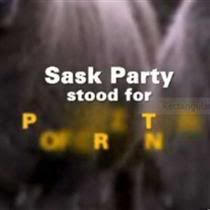 In the ad, numerous phrases are displayed on screen, all of which relate to an NDP claim about the Saskatchewan party’s policies. Each one slowly fades out, letter by letter. At one point, the phrase “Sask Party stood for Privatization of Crowns” fades out. Before the letters disappear completely, the word “porn” can faintly be seen.
The suggestion has been made that the NDP ad represents a lowest-common-denominator attempt at subliminal advertising.
“If it was done on purpose I think it's reprehensible, and if it's done accidentally it needs to be fixed,” Heppner insisted. “Either way it needs to be fixed because I think that it's taking campaign politics and campaigning to a new low and I don't think it's something Saskatchewan people are going to stand for."
Of course, there are problems with Heppner’s claims.
First off, when one examines the screen shot, it doesn’t really seem to read “PORN”. It actually seems to read “PTORN”. Aside from that minor point, there is a larger issue regarding subliminal advertising.
That is, it doesn’t work.
Subliminal messaging theories rely heavily on the theories offered by Gestalt psychology, wherein it is argued that perceptions of the world are essentially broken down into pieces, interpreted by different parts of the brain, then reassembled in the brain.
The process of disassembly, analysis and reassembly theoretically allow such messages to be perceived unconsciously by the mind’s autonomic processes.
Claims regarding the alleged prowess of subliminal advertising were originally made by James Vicary, a man who claimed subliminal messaging had successfully been used to hock coca-cola and popcorn in a Fort Lee, New Jersey movie theatre. Further experiments into subliminal advertising yielded no supportive results, and Vicary finally admitted in 1962 that he had falsified his original claims.
In fact, the alleged power of subliminal advertising has never been proven emperically.
If Heppner’s claims turn out to be true, then it would seem that the NDP is hitching their wagon to a horse that has been proven to be lame – or at least hasn’t been proven to be effective.
Given that the “message” doesn’t really distinctly spell “PORN”, it’s more likely that the “message” Heppner has detected is entirely coincidental.
Stranger things have happened.
Politics and pornography generally make for strange bedfellows.
If the claims made by Saskatchewan Party MLA Nancy Heppner turn out to be true, that would make these strange days, indeed.
Nancy Heppner, the MLA for Martensville, has raised a complaint about a recent NDP ad which accuses the Saskatchewan party of having a “hidden agenda”.
In the ad, numerous phrases are displayed on screen, all of which relate to an NDP claim about the Saskatchewan party’s policies. Each one slowly fades out, letter by letter. At one point, the phrase “Sask Party stood for Privatization of Crowns” fades out. Before the letters disappear completely, the word “porn” can faintly be seen.The suggestion has been made that the NDP ad represents a lowest-common-denominator attempt at subliminal advertising.
“If it was done on purpose I think it's reprehensible, and if it's done accidentally it needs to be fixed,” Heppner insisted. “Either way it needs to be fixed because I think that it's taking campaign politics and campaigning to a new low and I don't think it's something Saskatchewan people are going to stand for."
Of course, there are problems with Heppner’s claims.
First off, when one examines the screen shot, it doesn’t really seem to read “PORN”. It actually seems to read “PTORN”. Aside from that minor point, there is a larger issue regarding subliminal advertising.
That is, it doesn’t work.
Subliminal messaging theories rely heavily on the theories offered by Gestalt psychology, wherein it is argued that perceptions of the world are essentially broken down into pieces, interpreted by different parts of the brain, then reassembled in the brain.
The process of disassembly, analysis and reassembly theoretically allow such messages to be perceived unconsciously by the mind’s autonomic processes.
Claims regarding the alleged prowess of subliminal advertising were originally made by James Vicary, a man who claimed subliminal messaging had successfully been used to hock coca-cola and popcorn in a Fort Lee, New Jersey movie theatre. Further experiments into subliminal advertising yielded no supportive results, and Vicary finally admitted in 1962 that he had falsified his original claims.
In fact, the alleged power of subliminal advertising has never been proven emperically.
If Heppner’s claims turn out to be true, then it would seem that the NDP is hitching their wagon to a horse that has been proven to be lame – or at least hasn’t been proven to be effective.
Given that the “message” doesn’t really distinctly spell “PORN”, it’s more likely that the “message” Heppner has detected is entirely coincidental.
Stranger things have happened.
Wednesday, August 22, 2007
Saskatchewan NDP Looks to Light a Fire With Hidden Agenda Ploy
Lorne Calvert rolls out the “hidden agenda” fallacy for an encore
With a provincial election looming on the horizon, one had to expect the Saskatchewan political scene to heat up.
With the leak of some of the governing NDP’s campaign material, the political winds have begun to shift, and it spells trouble for Brad Wall and the Saskatchewan party.
"We're saying to Saskatchewan voters, what lies behind this friendly new image, beware of," says Saskatchewan deputy Premier Clay Serby.
The pamphlet accuses the Saskatchewan party of being “inexperienced and reckless”, and insinuates that the party is obfuscating its policies on health care and Saskatchewan’s many crown corporations.
"This is about saying to Mr. Wall and the Saskatchewan Party, come clean with your polices. Make your policies available to Saskatchewan people today so that we can debate them," Serby announced.
Yet Serby’s claims aren’t consistent with the Saskatchewan party’s legislative record.
For example, Wall explained, "We have voted for the NDP legislation to keep public ownership of the Crowns.”
Unfortunately, Brad Wall doesn’t seem to realize the futility in branding these claims as “a pack of lies.” The federal Liberal party found, much to its apparent delight, that the real beauty of a “hidden agenda” claim is that you don’t have to prove it. The invisibility of such an agenda almost becomes proof that it exists.
The hidden agenda tactic also exploits weaknesses in the party it’s directed against by exploiting a not-well-rounded image. Poorly-defined policy stances can suddenly take on shades of “calculated ambiguity”, and fuel the “hidden agenda” fire all of their own.
When the target rushes to put out the fire, their arsonist antagonists simply continue to fan the flames. The efforts of the target eventually become a sort of evidence in and of itself. Where there’s smoke, there’s fire and in this sense the hidden agenda tactic actually works best when it monopolizes the target’s time and effort.
Does the NDP believe the Saskatchewan party really has a hidden agenda? Probably not. But they know the tactic works, and even if the “hidden agenda” isn’t the most honest tactic, it’s politically effective.
The pamphlet also predictably targets the federal Conservative party, describing Wall and the Saskatchewan party as “Stephen Harper apologists”.
When a party is investing so much effort in campaigning against a proxy opponent, it only makes sense to utilize tactics that have been effective against that proxy. When Lorne Calvert appeared before a Senate committee crusading for “fairness for Saskatchewan”, it sounded a good deal like election rhetoric for a reason. In all odds, it was intentional.
Dragging out the hidden agenda fallacy -- and it is a fallacy, based entirely on a refusal to debate actual policy in favour of hypothetical policy – the Saskatchewan NDP has found a way to force the Saskatchewan electorate to equate Wall with Prime Minister Harper as closely as possible, if not treat him as second fiddle altogether.
From this point out, Brad Wall and the Saskatchewan party need to avoid any sparks. Lorne Calvert, Clay Serby and the NDP have doused the pile with gasoline, and the Saskatchewan party’s own ill-defined policy package has provided the kindling.
What ensues could prove to be a fire that will burn Brad Wall alive before he manages to put it out.
Thursday, December 01, 2005
Deconstructing the Hidden Agenda
Welcome to Ottawa, where telling the truth, it seems, has become strictly verboten.
Conservative Party leader Stephen Harper was sent a letter of warning last week by the legal representatives of the Liberal Party. The subject of the warning? Harper’s assertation that Adscam demonstrates connections between the Liberal party and organized crime. The letter insisted that should Harper, or any member of the Conservative party repeat the comments outside of the House of Commons, the Liberal party would sue.
Which would probably be all fine and dandy… if it wasn’t true. The Sponsorship Scandal reflects practices common in much of white collar crime… which is, by its very nature, premeditated and organized. In other words, organized crime.
To the Globe and Mail, this affair apparently qualified as front page news, as they reported “Liberals Threaten to Sue Over Harper’s Rhetoric.” Which is what Harper’s assertations may well have been… if they weren’t, you know… true. This also came on a day when the rest of the national media was focusing on the Liberal party’s steadily dropping polls, and the backlash against the party’s proposed bribery of Canadian voters. So, if one suggests that the Globe and Mail is manipulating the news to the benefit of the Liberal party, they probably are not all that far from the truth.
In fact, they’re probably spot-on. It’s no secret that the Liberal party practically owns many of Canada’s high-profile media personalities (Rick Mercer, anyone?). The only question that remains is thus: did Jean Chretien pay cash or credit when he bought these people? And has Paul Martin been keeping up with the bills? Evidently so.
With today’s calling of a January 23rd election, one can expect some of Canada’s more unscrupulous “journalists” to begin lining up to take shots at any opponents of the corrupt Liberal regime. We can expect to hear the same old rhetoric (actual rhetoric, not demonstrated truth dismissed as rhetoric) over and over again.
Including that same propaganda lie fed to the Canadian public over and over again: the Hidden Agenda.
The idea of the Hidden Agenda has been a reliable lie for supporters of the Liberal party, used to counter virtually everything the Conservative party has ever proposed. “End corporate welfare”… HIDDEN AGENDA!!! “Tax relief”… HIDDEN AGENDA!!! “Gomery Inquiry”… HIDDEN AGENDA!!!
Unfortunately for these liars (or, perhaps, unfortunately for the Conservative Party), the Conservative Party has no hidden agenda. The Liberal party, however, does have such a hidden agenda, and they have shown us this time and time again.
Through various state endowments, the Liberal party has repeatedly laid the frame work for an ideological brainwashing of Canadians. The country’s most prominent think tanks are all Liberal party-friendly, and have all consistently worked toward entrenching the values allegedly espoused by the Liberal party as “Canadian values”. Meanwhile, a monopoly on political power has made the Liberal party increasingly corrupt. Even as the air is cleared from the last major scandal (Shawinigate?), the next scandal emerges, painting a picture of a political party that has brainwashed the country so thoroughly that it doesn’t matter what the truth is: the federal Liberals have, in effect, issued themselves a license to be as corrupt as they wish: and they’ve invented the perfect lie to make it possible.
Perhaps the most telling fact regarding the hidden agenda is the fact that those screaming it at the top of their lungs can’t seem to agree on what it is. Depending on which pro-Liberal drone you ask, it amounts to almost anything, from turning Canada into a puppet state under U.S. control to legalizing discrimination against gays and other minorities, to even “a Canada ruled by rednecks”.
Which is all fairly interesting, especially when considering that the Conservative party has, election in and election out, sent forth the most ethnically and racially diverse range of candidates out of any of Canada’s political parties. Oops.
Those responsible for spreading the “hidden agenda” lie have often grasped at any straw they can find. For example, the nomination of three candidates with links to Christian activist groups led to the pronouncement that “religious zealots are hijacking the Conservative party”. Those spreading this particular bit of propaganda all took care to bury the pertinent facts – the mere three out of more than 200 candidates nominated by the Conservatives – as deeply in their respective “journalistic articles” as they could.
In another case, an article exploring the “anti-abortion” hidden agenda of the Conservative party alleged that 20 anti-abortion MPs attended a “March for Life” rally in Ottawa. The article noted that “most of them” were Conservative MPs – then failed to mention how many of them were, or how many of them were from other parties – or who, or which.
If ever forced to produce concrete proof – not rhetoric – those supporting the hidden agenda lie would be unable to produce it. But this is not something they are meant to support – it’s a propaganda tool, designed for one purpose: spreading hysteria for the purpose of demonizing political alternatives, essentially turning Canada into a one-party state.
Take one look at Nazi Germany, the Soviet Union, or Communist China. It isn’t hard to figure out what the ultimate consequences for establishing a one-party state are.
Unfortunately, there are those in Canada who are simultaneously so ambitious and so unscrupulous that they are willing to stop at nothing in order to do this.
Subscribe to:
Posts (Atom)