
Showing posts with label Bill Clinton. Show all posts

Thursday, August 06, 2009

ETP Joins the Wrong About Everything Club

John Bolton is pure evil according to blogger

If one were to accept the claims of Enormous Thriving Plants' Audrey at face value, one would believe that Audrey has always been implicitly logical and reasonable with her political arguments.

One would be led to believe that her critics are merely bending at windmills over matters that are factually apparent.

Unfortunately for Audrey, this is pure fiction. The truth is rather different.

In fact, it seems that the arguments that Audrey often raises fall far short of the "implicitly logical and reasonable" benchmark, and instead veer way off into the margins of a vast ideological intellectual morass, from which for ideologues as dedicated as Audrey, there may truly be no way out.

One needs look no further than Audrey's recent rantings about former American Ambassador to the United Nations John Bolton, who recently had something to say about Bill Clinton's recent trip to North Korea to negotiate the release of two imprisoned American journalists.

Before one gets into what Bolton actually had to say about it, let's examine what Audrey had to say:
"A mere hours after his Washington Post column calling Bill Clinton's trip to North Korea "kneejerk" / "an act of obeisance" was published, North Korea pardons the American journalists it had imprisoned.

If the former (Bush appointed) UN ambassador had had his way, Laura Ling and Euna Lee would still be sitting in a North Korean labour camp, simply to satiate his PNAC fantasy of American-strength-through-non-diplomacy.

...Another Neocon joins the Kristol/Perle "Wrong about everything" club.
"
While it is true that Bolton's comments on Clinton's efforts to secure the release of the captured journalists are less than flattering for the former President, Audrey draws a rather peculiar conclusion -- that because Bolton criticizes Clinton's actions that he wanted to see Ling and Lee remain in prison.

Yet Bolton's own comments contradict that statement.

"The reporters' arrest, show trial and subsequent imprisonment (twelve years hard labor) was hostage taking, essentially an act of state terrorism," Bolton wrote. To any rational individual, that hardly seems like the words of someone who favours the injudicious arrest, incarceration and enslavement of American citizens.

But Audrey's comments that Bolton would rather see Ling and Lee remain in captivity "simply to satiate his PNAC fantasy of American-strength-through-non-diplomacy" is actually a very revelatory remark.

It demonstrates that Audrey clearly doesn't understand the recent history of diplomatic efforts with North Korea, and the tendency of the Kim Jong Il regime to throw these diplomatic efforts back into the face of the western world. Oddly enough, Bolton refers to such an episode in his column:
"In some ways the trip is a flashback to the unfortunate 1994 journey of former president Jimmy Carter, who disrupted the Clinton administration's nuclear negotiations with North Korea and led directly to the misbegotten 'Agreed Framework.' By supplying both political legitimacy and tangible economic resources to Pyongyang, the Agreed Framework provided the North and other rogue states a roadmap for maximizing the benefits of illicit nuclear programs. North Korea violated the framework almost from the outset but nonetheless enticed the Bush administration into negotiations (the six-party talks) to discuss yet again ending its nuclear program in exchange for even more political and economic benefits. This history is of the United States rewarding dangerous and unacceptable behavior, a lesson well learned by other would-be nuclear proliferators."
As anyone who has paid attention to the issue of North Korean nuclear proliferation would know, Kim Jong Il's regime had gone back on this deal -- which Hans Blix was dissatisfied with in the first place -- by resuming missile tests under the guise of launching satellites.

Bill Clinton isn't the only US President to try and fail to reach a diplomatic resolution with North Korea. George W Bush tried (and failed) to reach such a resolution, offering aid packages to North Korea as part of a multi-lateral deal. A more substantive deal was eventually reached in which North Korea would shut down its nuclear program in exchange for the unfreezing of accounts in American banks.

By 2008, North Korea had again reneged on the deal, declining to report its nuclear activities. By May of 2009 North Korea had restarted its nuclear reactor and threatened to attack South Korea.

The history of North Korea's renunciation of diplomatic efforts -- often demanding broad concessions before talks could even begin -- now spans three American Presidents. To pretend that North Korea is engaging in diplomatic negotiations over its nuclear program in good faith would, at this point, be a sham.

There is also, as Bolton muses, the risk of emboldening criminal regimes like Kim Jong Il's by legitimizing their effectively taking foreign citizens hostage:
"While the United States is properly concerned whenever its citizens are abused or held hostage, efforts to protect them should not create potentially greater risks for other Americans in the future. Yet that is exactly the consequence of visits by former presidents or other dignitaries as a form of political ransom to obtain their release. Iran and other autocracies are presumably closely watching the scenario in North Korea. With three American hikers freshly in Tehran's captivity, will Clinton be packing his bags again for another act of obeisance? And, looking ahead, what American hostages will not be sufficiently important to merit the presidential treatment? What about Roxana Saberi and other Americans previously held in Tehran? What was it about them that made them unworthy of a presidential visit? These are the consequences of poorly thought-out gesture politics, however well-intentioned or compassionately motivated. Indeed, the release of the two reporters -- welcome news -- doesn't mitigate the future risks entailed."
These risks are especially pronounced when one considers how these deals will be accepted by a regime that so routinely violates its diplomatic agreements.

Against the backdrop of North Korea's malfeasance in regards to diplomacy, it takes a special kind of ideologue to use the fact that an individual was appointed as Ambassador to the UN by George W Bush -- who himself tried and failed to reach a diplomatic accommodation with Kim Jong Il -- as evidence that they would rather see American journalists enslaved in a North Korean prison.

Particularly when that very same ideologue seems to go to such lengths to overlook entirely the manner in which the North Korean regime has approached diplomacy in the first place.

Of course, when it comes to Audrey, one should never, ever be surprised.

Monday, May 25, 2009

Loners, Losers and Canadian Multiculturalism


Speaking via ForaTv, former US President Bill Clinton explains how the adoption of the principle of majority rules in more and more countries around the world has a potential dark side -- the oppression of those who may not readily be considered part of that majority.

Clinton describes them bascially as "losers" and "loners", and says that the litmus test for any true democracy is whether or not a citizen has enough individual rights that they can potentially lose -- politically, economically, socially, culturally or otherwise -- and still be safe from oppression.

At its basest level, there does seem to be a key dilemma between majority rule and respect for the rights of minorities. As we see in many countries less enlightened than our own, in systems wherein majority rule is considered absolute minorities tend to not have many rights.

Multicultural societies should likely be considered less prone to this kind of absolutism. As Satya Das notes, because of the broad cultural variety of Canadian society Canadians have had to set aside our differences and respect the rights of groups that, if judged by a standard of ethnic -- as opposed to civil -- nationalism would themselves be minorities.

If Canadians continued to discriminate against groups such as Icelandic, Ukrainian or Irish Canadians there would be no shortage of people for those prone to such behaviour to discriminate against. What there would end up being a shortage of is Canadians among the so-called "majority".

This is one of the best reasons for Canadians who may not yet have come around to the idea of multiculturalism to acclimate themselves to it. Within the next thirty years caucasian Canadians will be a numeric minority in Canada. Those accustomed to enjoying a privileged position within Canada on account of being part of this so-called majority will find themselves in a rather uncomfortable position at that point.

But one also has to remember that there can also be a dark side to the group rights promoted by multiculturalism as well. As Benjamin Barber points out group rights -- particularly within minority groups -- can lead to a communitarian ethos in which minority groups demand absolute solidarity from its members, to the extent that members are forced to surrender individual rights in order to remain part of their community what eventually emerges is not a society that is more democratic, but in fact less.

Mixing the notions of majority rule with an overwhelmingly communitarian ethos leads to situations were people are not free, to the extent to which they are very literally enslaved by their communities.

Canada has, for the most part, passed the test of protecting minorities from the tyranny of the majority. Whether Canada has succeeded in protecting the majority from what Preston Manning termed "the tyranny of the minority" is another matter entirely.

Some would argue that legalizing same-sex marriage over what they deemed to be the opposition of the majority -- which was actually the agreement of a minority coupled with the comparable indifference of the majority of Canadians -- empowered same-sex couples at the expense of the majority of Canadians. Many Canadians -- including this author -- would disagree with them, but this case is nonetheless argued.

The case that individuals are subjected to the tyranny of community is much stronger. Consider the case of aboriginal women denied rights granted by the Charter of Rights and Freedoms -- and, through it, Canada's Constitution -- because political elites within the aboriginal community oppose it.

These are merely two examples in which Canadian democracy has either failed, or is argued to fail, to amply balance the rights of majorities and minorities, and communities and individuals.

Although Canada has performed this balancing act better than many other countries, it's certainly been far from perfect, and there are many improvements that could be made.

Saturday, April 11, 2009

Markets or Voters?


In part one of The Trap, Adam Curtis argued that the libertarian shift against bureaucratic authority led to society placing a premium on the elimination of human decision making.

The push to remove human judgement and decision making from important societal institutions -- including psychiatry -- have instead led to a society in which many decisions better left to human judgement have been turned entirely over to bureaucratic stringentness and, often, computers.

In part two, entitled "The Lonely Robot", Curtis addresses the manner in which this has been applied to democratic politics on a broader scale.

In Britain, it was John Major who embraced game theory in order to further prod along what eventually became known as the "bureaucracy bashing revolution". This revolution was intended to free government agencies to pursue their performance targets however they saw fit. Instead, what was eventually thrust upon them was a market-driven model that framed decision making within the so-called invisible hand of the market.

Yet the invisible hand of the market is known to be far from invisible. The market is very visible in the operations of banks, stock traders, and regulatory agencies. All of these organizations are guided by human agency, and are often riddled with bureaucratic structures.

When Bill Clinton arrived in office with a laundry list of promises to fulfil, he was quickly dissuaded by individuals such as Robert Rubin to instead follow the free market consensus that had emerged during the Ronald Reagan Presidency, and been sustained during the administration of George HW Bush.

Clinton had promised to use the power of the President's office to pull the country out of an economic resession.

The market, it was argued, was better able to predict and fulfill the needs and desires of citizens. The free market was regarded by these individuals as superior to democracy.

Yet these particular individuals overlooked -- or, likely, simply omitted -- the fact that the market does not function on a one person, one vote basis. Instead, the market treats citizens unequally based on the resources they have at their disposal -- in other words, what they can buy.

An individual who has no resources has no vote in the market. Likewise, those who don't want to partake in what the market has placed on offer have been given no choice.

Likewise, those who are very weathy, under the Rubin model of democracy, were granted extremely disproportionate influence. Likewise, those who want -- or are even indifferent to -- the choices they are offered enjoy an advantageous position. It doesn't help that any public preference for certain government policies is actually exaggerated by the influence of the wealthiest citizens.

It was, ironically, Irving Kristol -- considered to be one of the god fathers of neoconservatism -- who insisted that, if the market wants to be the primary force in any society, it must accept responsibility for eliminating poverty.

Yet in the absence of democracy -- wherein it is purported and, optimally, demanded that all citizens be treated as equal -- there is no real impetus for the market to tackle poverty. Certainly, the incentive is sorely lacking.

Freedom, as Curtis notes, was cast narrowly in the form of positive freedoms. Citizens had the freedom to consume whatever they wanted. The libertarian focus on negative freedoms -- in this case, freedom from the market -- seemed to have been forgotten.

Game theory meshed with theories such as Richard Dawkins' "selfish gene" to undermine notions of human agency. Within this conceptual frame, human beings were reduced to calculating creatures, constantly seeking personal advantage at the behest of one's genes.

Society, in the musings of such individuals, was reduced to the level of sophistification of the most primitive tribal societies -- societies wherein little coherent social order seems to exist.

What was absent from this model was the notion of human choice -- that humans didn't choose to support their friends and families, and that they only did so in return for help surviving. What people would otherwise regard as a complex societal order built on the notion of a collection of social contracts was reduced to base survivalism.

This cynicism is a stark contrast to the optimism on which democracies are ideally based. Democracy teaches us that diverse groups of people, with diverse interests, can forge a mutual societal order based on consensus, even if agreement is never universal.

It's cynicism that leads to a government-by-numbers model that casts aspersions upon human judgement and demand that it be removed from public administration as much as possible.

This kind of mentality, naturally, fell right into the hands of bureaucrats. The "bureaucrat bashing revolution" had instead made bureaucrats more powerful than they ever were.

The medicalization of human emotional states and the introduction of anti-depressent drugs cast a sinister shadow across the issue. Important questions linger about the extent to which modern psychiatry treats ordinary emotional distress as a mental illness best addressed with medication rather than the result of ordinary problems.

Taking the judgement of psychiatrists out of the decision-making process has only made this more distinct. If symptoms were examined to determine their root cause, as opposed to examined based on the mere existence of the symptom, it's extremely likely that many people diagnosed as clinically depressed may be treated otherwise.

Once again, the efforts to detect misdiagnoses within psychiatry instead intensified the problem, and has led to as many misdiagnoses as ever.

By setting performance targets, Tony Blair's Labour Government had subordinated government to this emerging tyranny of numbers. In many cases, indices were designed to measure things that, in many cases, defy numerical measurement.

Bureaucrats aren't given the option of refusing a target. And in cases where targets may have been unattainable by ordinary means, perverse methods of artificually meeting them were used.

Societies that tolerate artificial solutions to their problems are certainly not headed in a positive or progressive direction. Because it relies on numbers, a market number can be fooled with numbers, especially when the ordinary citizens' methods of demanding that societal problems be substantively addressed are being undermined.

The market also gives the wealthiest the opportunity to go outside of the public system to meet their needs. Wealthy people who find it difficult to receive medical aid through public systems artificially meeting their performance targets can receive treatement in private clinics. Wealthy people who are being victimized by crime because their police departments are artificially lowering crime rates can build gated communities and hire their own security.

Instead of brining people together in a manner superior to that democracy can accomplish, these models instead drive people further apart, usually at society's own expense.

When people are driven apart, they are never driven apart at random. They're driven together as they're driven apart -- herded into groups based on ethnicity, religion, language and any number of other tratis, but moreover than any of them, wealth.

The marketization of democracy not only empowers the wealthy at the expense of everyone else, it also separates them from everyone else. They cease to live in the same social reality as their fellow citizens, and instead live in a social reality all their own.

The trap that has emerged out of the removal of human judgement from public management can be overcome, but it requires a more hopeful, more democratic, view of society and the way it should operate.

Thursday, January 01, 2009

It's Time to Demand Economic Democracy

In the previous two segments of The Commanding Heights, the shortcomings of the two dominant economic orthodoxies of our time -- market economics and Keynesianism -- were explored at length.

In the third installment, "The New Rules of the Game", The Commanading Heights explores the current nature of the global economy, and examines its underlying conflicts.


Some of the points in the film seem facetious knowing what one knows now. For example, Robert Rubin, the co-chairman of Goldman Sachs during the 1992 Presidential election, talks about a meeting with then-Presidential candidate Bill Clinton, wherein he and several other corporate executives impressed upon him the need for renewed fiscal discipline in the United States.

Yet Rubin, as the current director of Citigroup Incorporated, collected more than $17 million in salary and bonuses from that company over the last year.

Especially at a time of economic crisis, that in itself is an awfully curious definition of "fiscal discipline".

While Clinton himself would prove to be a rather undisciplined individual, Clinton did manage to impress some fiscal discipline on the United States. With a then-debt of $4 trillion, it was badly needed.

But what Clinton -- what political leaders in general, in most of the countries in the world -- have failed to do is impress upon multinational corporations the need for fiscal discipline within their own organizations.

Corporate executives paying themselves multi-million dollar compensation packages while those funds could be used preparing for -- or preventing -- economic disasters is comparatively unconscionable.

However, there are answers to many of the the serious problems with the global economy. The most important of them is a democratization of the global economy.

In Jihad vs McWorld, Benjamin Barber writes about two global forces emerging as a result of globalization: "McWorld", representing market-driven consumerism and its accompanying cultural nihilism, and "Jihad", representing reactionary identity politics and its accompanying moral nihilism.

The corporations that control the lion's share of the global economy conduct their business in a disctinctly undemocratic manner. Their decisions are typically made by a very small group of people who certainly do not adequately represent the various stakeholders in their companies.

"Jihad", on the other hand, is democratic -- but only to a certain extent. The forces of "Jihad" are organized around communitarian principles. While each individual "jihadist" movement represents a broad group of people, there is little room for individual freedom within those particular groups. They demand significant personal concessions and unconditional personal loyalties as a condition of group membership.

There is often significant overlap between the forces of "Jihad" and "McWorld". Each often organize themselves and operate according to very similar principles.

But on their own, neither "Jihad" nor "McWorld" offer a tenable alternative to the other, just as the economic history of the past forty years has shown that neither market economics nor Keynesianism are truly tenable alternatives to each other.

What is needed is a "third way". In order for that third way to be created, people need to be able to exert democratic influence on both the corporations that account for so much of the global economy and the various regulatory agencies that operate them.

At least at national scale, the latter is relatively simple. Democratic countries allow for periodic referendums on the policies of these agencies -- at least so much that citizens can throw out the politicians we choose to operate them.

At the international level the matter is much more complex. Organizations such as the World Bank and the World Trade Organization function in distinctly undemocratic manners. Furthermore, there is actually only one method that can reform such institutions: it requires significant international cooperation.

Such organizations can be brought to heel, as was done in 1999 at the famed Battle of Seattle. While the organizers of trade summits have made use of methods to manage political protest and insulate themselves from it -- often banishing political protest from within miles of the meetings themselves -- civil society organizations have increasingly found themselves a seat at the table.

In a process political scientist Nicanor Perlas defines as "threefolding", government, business and civil society can more firmly establish their particular realms of interest. Each can be empowered to defend their particular areas of interest, and cooperate with others when areas of interest overlap.

At first, Perlas notes, such interaction has to be forced. In Seattle, protesters did so by creating an unprecedented ruckus and making themselves unignorable. Other individuals, such as Ralph Nader, have done so using courts of law.

In time, the expectation is that such processes will occur increasingly naturally, and on an increasingly formal basis.

Still, it cannot happen overnight. The prominence that global civil society won at the Battle of Seattle has been at constant risk of evaporation -- let alone decline -- ever since. It requires time and diligence on behalf of those who have concerns about how the global economy is developing. In democratic countries, they have the right to voice such concerns, no matter how hard the task of being heard is becoming.

Democratizing the operations of multinational corporations seems like a daunting task as well. Fortunately, there remains an important back door into the board rooms of the corporate world.

As the film notes, millions of people around the world invest in the market through RRSPs and mutual funds. As such, there are millions of people who, according to Steven Davis, Jon Lukomnik, David Pitt-Watson, control one of the largest pools of mobile capital in the world.

After the repeated stock market crashes of the past months, there is little question that this pool of capital isn't worth nearly as much as it so recently did.

But the economy's reliance on these pools of capital -- and once the economy recovers, it will be as reliant on this capital as it ever was -- makes those who control it very powerful indeed.

If those investing in various pension funds were to start democratically exercising their power, the corporate world would have no choice but to listen. This requires that the "citizen investors" that Davis, Lukomnik and Pitt-Watson learn to use this power.

Just as Ralph Nader took up numerous lawsuits in the name of consumer advocacy, the current economic crisis has shown that it's just as important that dedicated individuals take up the mantle of investor advocacy. Just as our economic elites are concerning themselves with consumer confidence, they must certainly concern themselves with investor confidence as well.

Naturally, the power held by citizen investors will favour those comparative few who enjoy the wealth to invest in the first place.

For those not blessed with such wealth, civil society -- activists, advocacy groups, and labour unions (among others) -- will be an important outlet to democratically exert their influence on the economy. Perlas' three-folding model must be applied as it has never been applied before.

For those imagining, however, that they will cordon off their individual countries or communities, there is little ahead but disappointment.

Telecommunications technology, the media, and trade have rendered globalization a foregone conclusion. It's becoming increasingly difficult to pretend that globalization -- and its accompanying free trade policies -- has forever been inevitable.

The answer now is not to turn back the clock to a time past, and old economic realities that are now unattainable. The answer is to look ahead, and democratize the global economy.

And the time to do it is now, before the world's alternating bands of revolutionaries concoct the next global crisis.

Thursday, August 28, 2008

Biden's Speech to the DNC


Biden takes moment in the spotlight as an opportunity to fade into the background

Of the numerous speeches being delivered at the Democratic National Convention, that of newly-nominated Vice Presidential hopeful Joe Biden was almost certainly one of the most anticipated.

In delivering the speech, Biden had his work cut out for him: former President Bill Clinton delivered a barnburning speech, complete with his traditional campaign song ("Don't Stop Thinking About Tomorrow" by Fleetwood Mac) and a trip to "a place called hope".

In the course of his speech, Biden hit on all the basic themes: the disappearing American middle class, the war on terror, loss of international trust in the United States, and the fading of the American dream.

But instead of making his case to be Vice President of the United States, Joe Biden instead took the opportunity to denounce "his friend" John McCain and cheerlead for Barack Obama.

Which is rather unfortunate. Many of Biden's policies (including his support for the wars in Afghanistan and Iraq) have posed serious philosophical challenges for the Democratic ticket.

Biden certainly couldn't have helped his reception amongst the anti-war movement when he referred to American military personnel as "the bravest warriors in the world".

Nor would his story about his mother telling him to "bloody the nose" of neighbourhood bullies be likely to win them over. After all, a hawkish mother would almost certainly be expected to raise a hawkish son -- at least in the perception of the anti-war movement.

These are questions the Obama/Biden ticket will need to answer if it expects to continue benefiting from the "progressive infrastructure" previously described by Naomi Klein.

Which is unfortunate. There's a general belief that the Vice Presidential candidate on a ticket tends to be unimportant during a Presidential Election. Yet when a President is rendered unable to continue in office, the Vice President takes over as President.

Joe Biden may prove to be a rather disconcerting figure for the anti-war movement should any misfortune ever befall Barack Obama. And unfortunately, one plot against Obama's life has already been uncovered.

In the end, the only way Biden could top Clinton's speech is with a "surprise" appearance by Barack Obama -- one that had been speculated on hours in advance.

Friday, May 16, 2008

Clinton's Foreign Policy Casts Shadow Over Potential Superticket

Bill Clinton's legacy of lax foreign policy poses dilemma for Obama/Hillary ticket

With the Democrat Presidential nomination pretty much decided -- the prospects of a Hillary Clinton comeback are very dim indeed -- the biggest question on many people's minds is: who will Barack Obama's running mate be?

Although one has cause to wonder whether or not the intensity of the ill will between the Clinton and Obama camps will prevent it, many people have been speculating on the appeal of an Obama/Clinton superticket -- among them Fidel Castro.

But considering the challenges facing the United States at this time (in particular, the war on terror), an Obama/Clinton superticket would have one key -- possibly insurmountable -- weakness: foreign policy.

While it's extremely difficult to find a US President who doesn't compare favourably to the current President in foreign policy, Bill Clinton is actually only barely one of them. Bill Clinton's foreign policy legacy will certainly not be what Clinton wants to be remembered for.

To pretend that Bill Clinton wouldn't be a fixture in any administration his wife is involved with smacks of naivete. And that is why Clinton's foreign policy record will be so troublesome for a potential superticket.

Some key episodes in Bill Clinton's foreign policy record include withdrawing US troops from the Peacekeeping mission in Somalia, ineffectual responses to Al Qaeda terrorist attacks (although one would be remiss to fail to mention that Clinton made Osama Bin Laden a top priority for US intelligence services), failing to respond to genocide in Rwanda, credibility-demolishing flip flops in regards to Bosnia-Herzegovina and rejected Haitian refugees after a coup d'etat in that country.

Clinton also failed to submit the Kyoto protocol to the Senate for ratification -- a move that is devastating to his credibility vis a vis climate change.

Clinton did have some successes. He manged to bring Slobodan Milosevic's ethnic cleansing of Kosovars to a halt, effectively contained Saddam Hussein in Iraq and fostered some key peace agreements in the Middle East.

But if Clinton's foreign policy record looks strong compared to that of George W Bush, it's only because he's being compared to George W Bush.

Of the lowlights of Clinton's foreign policy record, the most damning is his response to US casualties in the battle of Mogadishu. When public opinion in the US turned against the peacekeeping mission in Somalia, Clinton withdrew American troops from Somalia, posing the UN mission with a serious credibility issue.

It would later be discovered that the militants who perpetrated the ambush that set off the incident had been trained by Al Qaeda. Though Clinton certainly took Al Qaeda seriously enough later in his Presidency, his early failures cast a shadow over his entire presidency.

Clinton demonstrated he is not willing to pay a political price in order to support his country's interests abroad, or even to do the right thing. He would confirm it when genocide broke out in Rwanda, when American officials insisted that 100,000 Rwandans would have to die in order to justify risking a single American life.

Given the particular foreign policy challenges the United States faces today, Bill Clinton's foreign policy record will pose a lot of uncomfortable questions in the -- admittedly unlikely -- event that Hillary Clinton is named Obama's Vice Presidential nominee.

John McCain will certainly continue to face uncomfortable questions of his own. But at least he can offer a consistent answer to those questions: something that neither Obama nor Hillary Clinton have done.

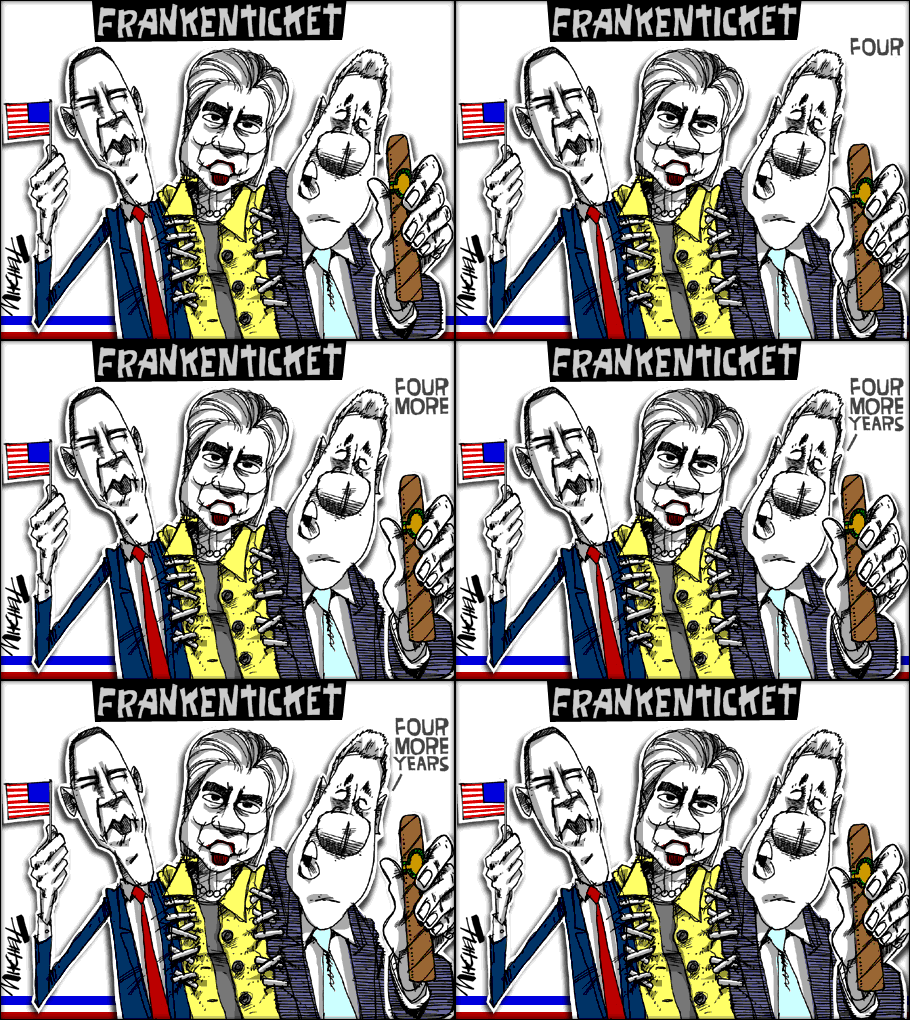
This is perhaps only one more reason why the superticket -- or "Frankenticket" -- may not come to pass.

Thursday, November 08, 2007

Need a VP? Barack's The Man For the Job

Obama's mastery of Senate precedents a key skill for Vice President

If one takes polls at face value, there's little question about it: Hillary Clinton is going to be the Democrats' presidential nominee.

She leads her nearest competitor, Barack Obama, by a margin of 44 to 25 percent.

As such, it's probably unsurprising that Clinton has begun searching for a running mate. However, she's had less luck than a politician in her situation should have finding one: her ascendency to presidential candidate is almost assured, and she's almost guaranteed a massive advantage over whomever her Republican opponent would be.

Yet, Senator Joe Biden has, surprisingly, turned Clinton down.

"If I don't win the nomination, the likely nominee is going to be Hillary," Biden, a fellow presidential nominee, said. "And I love Bill Clinton, but can you imagine being vice president?"

Biden currently polls at 3%. Call him brave, call him optimistic, just don't call him opportunistic.

Beyond that, Biden has said he would prefer to continue serving as the chairman of the Senate Foreign Relations Committee. Biden has also noted that Bill Clinton would likely be an omnipresent, overpowering influence in a Hillary Clinton White House (insert sexist who-wears-the-pants-in-the-family joke here). Not to mention Al Gore creeping around every other corner. Perhaps not the most secure position for a Vice President.

This, of course, leaves Hillary Clinton in search of a new running mate, and she shouldn't look any further than her most immediate (however remote) threat -- Massachusetts Senator Barack Obama.

There are many reasons why Obama would make an excellent Vice President (perhaps even a better VP than President).

First off, the buzz surrounding Clinton and Obama would be positively huge. Hell, even Fidel Castro says he has goosebumps at the very thought of it.

Historically, a Democrat's choice for Vice President has turned out to be more important than a Republican's, as a Democrat Vice President has proven more likely (at least in more recent history) to have to take over the Presidency. To this end, the Democratic party would be better off to have its number-two contender serve in the role. If he were forced to assume the presidency, Obama could continue to capture the imagination of Americans in the same vital way he and Clinton do.

Most importantly, however, one of the Vice President's most important jobs is to preside over the Senate.

Obama has spent a good deal of his Senatorial career familiarizing himself with Senate precedents -- which one senior Democratic senator once described to him as "the keys to the kingdom". That alone would make him a force to be reckoned with as Vice President.

There is, of course, the argument that having Obama as a running mate would hurt her ability to attract voters from fickle conservative voters who prefer to vote for white males. This in itself is a silly argument, and for obvious reasons. Not only are the Democrats unlikely to attract these voters, but Clinton herself doubly so.

By running with a black man as her running mate, however, Clinton could reap the benefits of having the force of history as a "third running mate". There would be vast appeal to many voters knowing that not only could they elect America's first woman president, but also its first black vice president.

Of course, this argument is no less fickle than the previous. The difference for Clinton, however, is that it remains pertinent.

In the face of an ongoing campaign, Clinton may not yet be ready to admit that she needs Barack Obama. But she does.

Of course, the greater challenge may be convincing Obama to quit his campaign prematurely; something he would be doing no matter how unlikely the prospects of him closing a 19-point gap between himself and Clinton are.

In other words, both candidates would need to swallow their pride a little bit. The benefits of doing so are very tangible inded.

The greater question is whether or not the're willing to do it.