...Unless he's the one doing the indoctrination
One of the interesting things about fundamentalist atheism is their tendency to accept the pontifications of hypocritical people at face value.
Richard Dawkins is a brilliant example of this. His vaunted "lying for Jesus" argument has become a central weapon in the rhetorical aresenals of many fundamentalist atheists despite the fact that he's been caught being dishonest using it.
Likewise, Dawkins' argument that children shouldn't be indoctrinated into religion has gained some evident traction amongst fundamentalist atheists. Why, even ABBA member Bjorn Ulvaes thinks so.
So indoctrinating children into religion is bad.
...Oh, unless it's Dawkins' and Ulvaes' religion. Then it's A-OK.
Aside from starting work on a children's book, Dawkins has sponsored a summer camp for atheists.
Dawkins says that the camps are intended to "encourage children to think for themselves sceptically and rationally."
But interestingly enough, Dawkins has made it plainly evident that, to him, thinking for oneself "sceptically and rationally" entails thinking exactly what Dawkins wants them to.
Naturally, Dawkins and company are going to pretend that the camps in question aren't about atheism, but rather merely about secularism.
"There is very little that attacks religion, we are not a rival to religious camps," says camp organizer Samantha Stein. "We exist as a secular alternative open to children from parents of all faiths and none."
So says "atheist rock star" Samantha Stein.
One wonders if Dawkins and Stein realize the extent to which the entire matter defies credulity. An "atheist rock star" accepting funds from Richard Dawkins attacking religion? Apparently we're supposed to perish the thought.
Of course, all of this is aside from the point. There's nothing wrong with parents sending their children to Dawkins' and Stein's camp if they are intent upon raising their children as atheists -- or perhaps even legitimate free-thinkers.
There's nothing wrong with teaching children about evolution or leading them in sing-alongs of "Imagine". In fact both of these -- teaching kids about science and about great music -- can be very good things.
But the least Richard Dawkins could do is stop pretending that he isn't indoctrinating these children in his religion -- atheism, which people like himself have very much transformed to a religion.
Just imagine that kind of honesty from someone who so enjoys vacuously accusing his opponents of "lying for Jesus".

Tuesday, June 30, 2009


The Pipe Dream is (Almost) Over for Lizzie May
Green leader concedes she can't win in Central Nova
In competing with former Liberal party leader Stephane Dion for the title of Canadian politics' greatest flip-flopper, Elizabeth May might finally have found the edge.
The leader of Canada's Green party has recently advised that she probably won't run against Conservative party deputy leader Peter MacKay in the next election. Despite previously stating she'd never run anywhere but Central Nova, May seems ready to move on to what she imagines may be greener pastures (pun intended).
It isn't as if it's any great shock. Not only has May already long been looking for another riding to run in, she had previously run in a by-election in London, Ontario.
It makes her insistence that she'd never, ever, eeeeeeever run anywhere other than Central Nova seem rather meaningless.
"I’m never running anywhere but Central Nova," May had insisted. "This is where I live and where I will always run."
Of course, this general meaninglessness is nothing new for Elizabeth May. The famed Red-Green coalition that May hatched with then-Liberal leader Stephane Dion wasn't based on any great principle. It was based on meaningless partisanship.
Certainly, May publicly espoused a desire to run against MacKay based on his party's environmental record. But considering that she was forming an alliance with a party and a leader with a worse environmental record than the Conservative party, it was impossible to take her seriously.
Even her claims to pretext were utterly meaningless.
Even May's decision to finally get (somewhat) realistic and look for a more potentially-fruitful riding to run in reflects her previous meaningless insistence that she's her party's greatest asset.
"The decision has been made that, for the next campaign, electing the leader is the top priority," May wrote to supporters. "I have agreed to run where the party decides the potential Green support is the strongest."
Even that May, as Green party leader, would decide that getting her elected is her party's top priority, is in itself utterly meaningless.
In the end, it isn't likely to manage much. Elizabeth May's dream of finding a riding in Canada where she can be elected is little more than a pipe dream. Nowhere in Canada is May likely to find a plurality of citizens willing to vote for a fringe political leader who so often insults the intelligence of Canadians.
It's simply a shame that the Green party -- an organization that very well could find a place of value within Canadian politics -- remains, and seemingly will remain, stuck with such a valueless and meaningless leader.
Other bloggers writing about this topic:
Calgary Grit - You May Be Seated
Mark Taylor - "There is Only One True Option"
In competing with former Liberal party leader Stephane Dion for the title of Canadian politics' greatest flip-flopper, Elizabeth May might finally have found the edge.
The leader of Canada's Green party has recently advised that she probably won't run against Conservative party deputy leader Peter MacKay in the next election. Despite previously stating she'd never run anywhere but Central Nova, May seems ready to move on to what she imagines may be greener pastures (pun intended).
It isn't as if it's any great shock. Not only has May already long been looking for another riding to run in, she had previously run in a by-election in London, Ontario.
It makes her insistence that she'd never, ever, eeeeeeever run anywhere other than Central Nova seem rather meaningless.
"I’m never running anywhere but Central Nova," May had insisted. "This is where I live and where I will always run."
Of course, this general meaninglessness is nothing new for Elizabeth May. The famed Red-Green coalition that May hatched with then-Liberal leader Stephane Dion wasn't based on any great principle. It was based on meaningless partisanship.
Certainly, May publicly espoused a desire to run against MacKay based on his party's environmental record. But considering that she was forming an alliance with a party and a leader with a worse environmental record than the Conservative party, it was impossible to take her seriously.
Even her claims to pretext were utterly meaningless.
Even May's decision to finally get (somewhat) realistic and look for a more potentially-fruitful riding to run in reflects her previous meaningless insistence that she's her party's greatest asset.
"The decision has been made that, for the next campaign, electing the leader is the top priority," May wrote to supporters. "I have agreed to run where the party decides the potential Green support is the strongest."
Even that May, as Green party leader, would decide that getting her elected is her party's top priority, is in itself utterly meaningless.
In the end, it isn't likely to manage much. Elizabeth May's dream of finding a riding in Canada where she can be elected is little more than a pipe dream. Nowhere in Canada is May likely to find a plurality of citizens willing to vote for a fringe political leader who so often insults the intelligence of Canadians.
It's simply a shame that the Green party -- an organization that very well could find a place of value within Canadian politics -- remains, and seemingly will remain, stuck with such a valueless and meaningless leader.
Other bloggers writing about this topic:
Calgary Grit - You May Be Seated
Mark Taylor - "There is Only One True Option"
Monday, June 29, 2009
The Not-So-Fine Art of Keeping Your Fucking Story Straight, For Fuck's Sake
Pro-abortion zealots can't seem to stick to one reason to try to label all anti-abortion activists as terrorists
The sad, sad story to emerge out of the assassination of Dr George Tiller only continues to unfold. Perhaps this man's martyrdom will continue into perpetuity.
In the immediate aftermath of Dr Tiller's assassination, various pro-abortion bloggers tried to pin it as squarely on the anti-abortion movement as a whole as they possibly could.
Their argument at the time was that the "abortion is murder" rhetoric employed by so many members of the anti-abortion lobby was responsible for encouraging -- perhaps even mandating -- Dr Tiller's murder.
Consider this particular passage from Mike from (ir)Rational Reasons:
But for Mike, it didn't matter. Suzanne Fortin had, in the past, argued in the "abortion is murder" vein, and so was responsible for Dr Tiller's murder.
JJ from Unrepentant Old Hippie, at the time, echoed those sentiments.
Yet when one considers a post from Unrepentant Old Hippie today, one has to recognize the extent to which their story has changed. Now, the anti-abortion lobby isn't responsible for Dr Tiller's murder as a result of "abortion is murder" rhetoric. Now, they're being held responsible because not enough anti-abortion activists have denounced the act:
As with prior incidents of violence perpetrated against anti-abortion activists, JJ herself has failed to condemn this act.
In fact, it's much, much worse than that. Compare what actually happened:
So herein lies the problem with JJ's particular line of argument: if the anti-abortion movement is responsible for the murder of Dr Tiller because too few of its members denounced the violence, how can it be that JJ and her cohorts would expect to argue that they aren't at least partially responsible for the violence against James Canfield?
They've not only failed, but refused to denounce that kind of violence in the past. They attempt to minimize it terms that are nothing less than absolutely shameful -- imagine their outrage if some anti-abortion dingus had suggested that the bullet that killed Dr Tiller had just "passed too close to his general vicinity".
But therein lies the rub. The outrage over abortion-centred violence seems extremely selective to this particular crowd. If the violence is being perpetrated against them, they milk it for maximum rhetorical advantage.
If the violence is being perpetrated against their opponents, they cheer it.
The saddest part of all is that they can't even keep their fucking story straight while they're doing it.
The sad, sad story to emerge out of the assassination of Dr George Tiller only continues to unfold. Perhaps this man's martyrdom will continue into perpetuity.
In the immediate aftermath of Dr Tiller's assassination, various pro-abortion bloggers tried to pin it as squarely on the anti-abortion movement as a whole as they possibly could.
Their argument at the time was that the "abortion is murder" rhetoric employed by so many members of the anti-abortion lobby was responsible for encouraging -- perhaps even mandating -- Dr Tiller's murder.
Consider this particular passage from Mike from (ir)Rational Reasons:
"I cannot express in words the rage I am feeling right now.Interestingly enough at least one of the individuals Mike points his spiteful finger at denounced Dr Tiller's murder in no uncertain terms.
Not just at the fact that Dr. George Tiller, an abortion provider specializing in medically-necessary late-term abortions, was murdered today. No, I am enraged by those who whipped the hatred against this man, who did everything to encourage his murder, are suddenly pretending they had nothing to do with it.
Damn them all. All of them.
Randall Terry. SUZANNE. The Catholic Church. The Army of God.
All of them. They are the same. They purposely espouse violent rhetoric, celebrate past perpetrators of violence and murderers as 'martyrs' and try to create false moral equivalence with a medial procedure and a planned premeditated murder of a 67-year-old professional, father and grandfather."
But for Mike, it didn't matter. Suzanne Fortin had, in the past, argued in the "abortion is murder" vein, and so was responsible for Dr Tiller's murder.
JJ from Unrepentant Old Hippie, at the time, echoed those sentiments.
Yet when one considers a post from Unrepentant Old Hippie today, one has to recognize the extent to which their story has changed. Now, the anti-abortion lobby isn't responsible for Dr Tiller's murder as a result of "abortion is murder" rhetoric. Now, they're being held responsible because not enough anti-abortion activists have denounced the act:
"While it would be oversimplification to suggest they’re all terrorists, there’s no doubt that the anti-abortion movement harbours a disproportionately high number of them, and too few who unequivocally condemn the violence and actively work to marginalize such people. Some call that 'giving safe haven'. I call it 'being onside'."Naturally, that brings one to the recent case of the vehicular assault on James Canfield.
As with prior incidents of violence perpetrated against anti-abortion activists, JJ herself has failed to condemn this act.
In fact, it's much, much worse than that. Compare what actually happened:
"According to witness statements gathered by police, Haver allegedly tried to strike 60-year-old protestor James Canfield with a 1991 GMC sports utility vehicle at the Planned Parenthood office on Vallombrosa Avenue. "With JJ's description of it:
"Following in the footsteps of the infamous Ed Snell, a couple of days ago in Chico California yet another old fetus fetishizing fart, writhing in the throes of an indignance high in front of the local Planned Parenthood he was harassing, was uninjured but shaken after an SUV passed in his general vicinity."Apparently, not only will JJ not condemn the violence against Canfield, but she won't even discuss the incident honestly for what it was.
So herein lies the problem with JJ's particular line of argument: if the anti-abortion movement is responsible for the murder of Dr Tiller because too few of its members denounced the violence, how can it be that JJ and her cohorts would expect to argue that they aren't at least partially responsible for the violence against James Canfield?
They've not only failed, but refused to denounce that kind of violence in the past. They attempt to minimize it terms that are nothing less than absolutely shameful -- imagine their outrage if some anti-abortion dingus had suggested that the bullet that killed Dr Tiller had just "passed too close to his general vicinity".
But therein lies the rub. The outrage over abortion-centred violence seems extremely selective to this particular crowd. If the violence is being perpetrated against them, they milk it for maximum rhetorical advantage.
If the violence is being perpetrated against their opponents, they cheer it.
The saddest part of all is that they can't even keep their fucking story straight while they're doing it.
Sunday, June 28, 2009
Christine Elliott and the (Alleged) Nadir of Red Toryism
Despite Elliott's leadership setback, red toryism will survive
If politics were merely about being nice, Christine Elliott probably would have won the Ontario Progressive Conservative leadership hands-down.
Conservative Senator Hugh Segal's endorsement of Elliott reinforces this. Segal has often focused on praising the humanity and civility of political leaders. To Seal, these are important values.
Of course, politics is not merely about being nice. Few Canadians, inside or outside of Ontario, would pretend that former Premier Mike Harris is an implicitly nice individual. Yet his endorsement of now-PC leader Tim Hudak certainly went a long way toward establishing his credentials as a "common sense conservative".
Mike Harris won two majority governments in Ontario. Hugh Segal wound up runner-up to former Prime Minister Joe Clark in the 1998 federal Progressive Conservative leadership contest.
Perhaps the lesson is that perhaps, in politics, nice guys really do finish last -- or at least that in politics, as in life, people who are too nice invariably finish last.
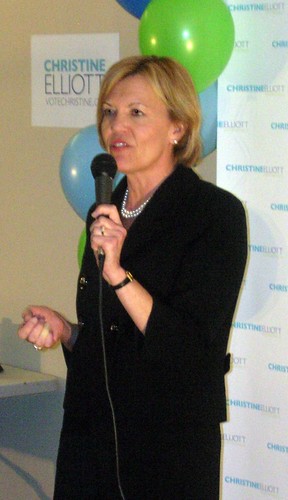 In the wake of Elliott's defeat in the Progressive Conservative leadership contest, many people -- like the Globe and Mail's Adam Radwanski --- are wondering if conservatism in Ontario, formerly a bastion of Canadian red toryism, has irrevocably taken what Brooke Jeffrey once referred to as a hard right turn.
(Jeffrey, for her own part, actually seemed perplexed by her inability to win election by labelling all of her would-be constituents in a riding she was parachuted into as racists, so maybe one should carefully consider the source.)
Hudak's ascension to the leadership of the Ontario Conservative party has many people wondering if perhaps speculation that harder forms of conservatism are needed to prevail in Ontario.
In recent years, the failures of leaders such as John Tory have largely spoken for themselves. There's a real question regarding whether or not red toryism can flourish in Ontario -- or Canada -- any longer, or if it's simply become too "Liberal-lite" to be palatable to conservative voters.
Yet those reputed to be red tories who have gotten closest to the Liberal party have shown their true political colours. In the case of Garth Turner, those colours turned out to be red. In the end however, it turned out that he wasn't a Tory.
When the former Halton MP joined the Liberal party in 2007, then-Liberal leader Stephane Dion crowed that "Tories were becoming Liberals".
Yet, as it turned out, Turner was far from a proper red tory. He lacked that key combination of fiscal conservatism and social principle that has forever properly characterized the red tory. When he finally got his first opportunity to campaign against the Harper Conservatives he chose to embrace divisive fear-based campaigning.
Prior to that, Turner attempted to divide Canadians by attempting to invent a separatist threat in Alberta.
Red toryism has forever held at its core an organic conceptualization of society -- one wherein social tradition is balanced against the public good.
Fear mongering and the creation of artificial -- and largely non-existent -- enemies is as great an insult to the principles of red toryism as one can possibly manage.
Turner had been preceded in joining the Liberal ranks by David Orchard, who had his nomination in a Saskatchewan riding overturned by Dion in favour of a hand-picked candidate who subsequently lost to Conservative Rob Clarke. When Orchard finally got his own turn in 2008, he lost as well -- and lost amidst his own fear-based attempts to campaign against the RCMP.
David Orchard, as many may recall, conceded the federal PC leadership to Peter MacKay only under the condition that MacKay wouldn't discuss unification of that party with the then-Canadian Alliance.
Orchard, for his own part, failed to recognize the value in allowing an organic political bond to develop between Canada's conservatives, and would have rather allowed the Liberal party to govern Canada in perpetuity than be caught dead dealing with the "wrong" conservatives.
If Canadian red toryism has truly reached its nadir it isn't in the defeat of Christine Elliott. Rather, it reached that nadir when those who consider themselves red tories failed to put their political principles ahead of their political vanity.
Whether or not Elliott will turn the tide of this unfortunate trend by working together with her party's new leader, and whether the hard conservatism of Tim Hudak and Mike Harris can lead the Ontario Progressive Conservative party to victory in the next election has yet to be seen.
If Hudak possesses the wisdom to make Elliott a part of his leadership plans for the party, and if Elliott can, in turn, soften the hard conservatism of Hudak and company also has yet to be seen. But it will be interesting to see.
Politics may not necessarily be merely about being nice. But it couldn't hurt to have a nice guy -- or gal -- on side, either.
If politics were merely about being nice, Christine Elliott probably would have won the Ontario Progressive Conservative leadership hands-down.
Conservative Senator Hugh Segal's endorsement of Elliott reinforces this. Segal has often focused on praising the humanity and civility of political leaders. To Seal, these are important values.
Of course, politics is not merely about being nice. Few Canadians, inside or outside of Ontario, would pretend that former Premier Mike Harris is an implicitly nice individual. Yet his endorsement of now-PC leader Tim Hudak certainly went a long way toward establishing his credentials as a "common sense conservative".
Mike Harris won two majority governments in Ontario. Hugh Segal wound up runner-up to former Prime Minister Joe Clark in the 1998 federal Progressive Conservative leadership contest.
Perhaps the lesson is that perhaps, in politics, nice guys really do finish last -- or at least that in politics, as in life, people who are too nice invariably finish last.
In the wake of Elliott's defeat in the Progressive Conservative leadership contest, many people -- like the Globe and Mail's Adam Radwanski --- are wondering if conservatism in Ontario, formerly a bastion of Canadian red toryism, has irrevocably taken what Brooke Jeffrey once referred to as a hard right turn.(Jeffrey, for her own part, actually seemed perplexed by her inability to win election by labelling all of her would-be constituents in a riding she was parachuted into as racists, so maybe one should carefully consider the source.)
Hudak's ascension to the leadership of the Ontario Conservative party has many people wondering if perhaps speculation that harder forms of conservatism are needed to prevail in Ontario.
In recent years, the failures of leaders such as John Tory have largely spoken for themselves. There's a real question regarding whether or not red toryism can flourish in Ontario -- or Canada -- any longer, or if it's simply become too "Liberal-lite" to be palatable to conservative voters.
Yet those reputed to be red tories who have gotten closest to the Liberal party have shown their true political colours. In the case of Garth Turner, those colours turned out to be red. In the end however, it turned out that he wasn't a Tory.
When the former Halton MP joined the Liberal party in 2007, then-Liberal leader Stephane Dion crowed that "Tories were becoming Liberals".
Yet, as it turned out, Turner was far from a proper red tory. He lacked that key combination of fiscal conservatism and social principle that has forever properly characterized the red tory. When he finally got his first opportunity to campaign against the Harper Conservatives he chose to embrace divisive fear-based campaigning.
Prior to that, Turner attempted to divide Canadians by attempting to invent a separatist threat in Alberta.
Red toryism has forever held at its core an organic conceptualization of society -- one wherein social tradition is balanced against the public good.
Fear mongering and the creation of artificial -- and largely non-existent -- enemies is as great an insult to the principles of red toryism as one can possibly manage.
Turner had been preceded in joining the Liberal ranks by David Orchard, who had his nomination in a Saskatchewan riding overturned by Dion in favour of a hand-picked candidate who subsequently lost to Conservative Rob Clarke. When Orchard finally got his own turn in 2008, he lost as well -- and lost amidst his own fear-based attempts to campaign against the RCMP.
David Orchard, as many may recall, conceded the federal PC leadership to Peter MacKay only under the condition that MacKay wouldn't discuss unification of that party with the then-Canadian Alliance.
Orchard, for his own part, failed to recognize the value in allowing an organic political bond to develop between Canada's conservatives, and would have rather allowed the Liberal party to govern Canada in perpetuity than be caught dead dealing with the "wrong" conservatives.
If Canadian red toryism has truly reached its nadir it isn't in the defeat of Christine Elliott. Rather, it reached that nadir when those who consider themselves red tories failed to put their political principles ahead of their political vanity.
Whether or not Elliott will turn the tide of this unfortunate trend by working together with her party's new leader, and whether the hard conservatism of Tim Hudak and Mike Harris can lead the Ontario Progressive Conservative party to victory in the next election has yet to be seen.
If Hudak possesses the wisdom to make Elliott a part of his leadership plans for the party, and if Elliott can, in turn, soften the hard conservatism of Hudak and company also has yet to be seen. But it will be interesting to see.
Politics may not necessarily be merely about being nice. But it couldn't hurt to have a nice guy -- or gal -- on side, either.
Sizing Up Conservatism's Challenges
Conservatives in Canada, US and UK face very different challenges
In a blog post on the National Post's Full Comment blog, Hugh Segal makes the case that the challenges to conservative parties being posed by elections are largely immaterial compared to the challenges being posed by the current economic times.
At a time when even conservative administrations are instituting lavish Kenyesian economic policies, it's easy for fiscal conservatives to wonder precisely what this means for conservatism and the free market:
While the election of Barak Obama as US President is being viewed by many as the nadir of conservatism, perhaps not even merely in the United States, it's important to note that other left-of-centre parties are not enjoying the same level of success.
In Britain, David Cameron isn't expected to have to fight an election against Gordon Brown and the Labour party until 2010, but the expectation is that he may win a Tony Blair-style majority government.
What remains to be seen for Harper is whether or not he can keep is majority government alive at all, let alone manage to win a majority. For Davoid Cameron, the test will be whether or not he can successfully defeat the Labour party during what is expected to be a time of economic recovery.
In the United States, meanwhile, Republicans are facing an althogether different challenge -- the challenge of not shooting themselves in the foot:
If one subscribes to a far more nuanced definition of conservatism, one still has to realize the scope of the challenge that government ownership of financial and industrial industry poses.
One way or the other, conservatives will have to address the issue of this ownership. Privatization of these industries would be a simple solution for conservatives to pursue.
Yet when government privatizes public assets or enterprises one thing that is undeniably part of the transaction is a depreciated return on the public's investment. Privatized government assets have proven to be a bargain for many private buyers for this very reason.
But considering the scope of the public investment in ownership of these industries, government has the responsibility to recover the maximum value of that investment. As Benjamin Barber pointed out to Tim Geithner, the public has absorbed a great deal of risk in helping these companies effectively "start over" (something that has made GMs batch of PR ads on this very topic very much insufferable). The public has the right to expect a return on that risky investment.
For some conservatives, this may seem far too much like government reaping profits better left for private investors. This is market conservatism ad extremis -- one that denies the reality of this particular matter to the extent of being nearly self-destructive.
Conservatives the world over, meanwhile, should be as lucky as the British Conservative party's David Cameron:
For one thing, the Canadian Liberal party hasn't managed to burn nearly as many bridges as the British Labour party. And, as Barry Cooper points out, the Conservative party isn't nearly as adept at exploiting bureaucratic survival instincts for its own political advantage as the Liberals have been.
Even beyond this particular disadvantage, that the Canadian Conservative party has embraced stimulus economics with a fervour that seems to put the lie to fiscal conservatism, many of the challenges the Tories will face will be a result of their own emergency economic policy:
What the party has not produced is a solid roadmap for its own return to the fiscal conservative principles its expected to embody. This is certainly a problem, as it leads to a glut of policy deficiencies on numerous issues:
It's easy for conservative political parties to be at their best during times of economic prosperity. They can move ahead on fiscally conservative programs without seeming callous or careless.
When times are bad, however, is when left-of-centre political parties tend to shine brightest. Canada's Conservative party hasn't led the country on any kind of a national project since sir John A MacDonald's ambitious railroad building project. This is a real problem for the party, as it leaves these opportunities to its left-of-centre opponents, who have led Canadians on national projects such as public health care.
Sadly, something in the conservative imagination tells conservatives that national projects are, in and of themselves, left-wing social engineering projects that undermine conservative values.
Yet an ambitious national project conceptualized and completed under the public-private partnership model embraces the principles of conservatives such as Segal. Such a project could be nation and enterprise at its best -- if only Canadian conservatives can muster the courage to attempt it.
There could even be opportunities to attempt such projects on an international scale:
Jeffrey Sachs will certainly be first in line to attempt to re-start his (mostly) failed policies in the developing world. But conservative governments in countries such as Canada and (by then) Britain could -- and should -- quite easily bypass individuals such as Sachs and employ the wisdom of economists such as William Easterly, whose proposed policies vis a vis foreign aid call simply scream out for the P3 model.
The various industrial and financial firms that governments now find themselves owning significant portions of could even be offered the opportunity to work off their debt to the state by investing in these kinds of programs, allowing people in developing countries to shape aid programs through market forces and helping themselves out of poverty, as opposed to waiting to be saved.
It's on this note that one must remember something that Hugh Segal would certainly want Canadian conservatives to recognize: the current political and economic climate poses serious challenges to conservatives. But with difficult challenges come fantastic opportunities.
Conservatives, in Canada and elsewhere, can benefit greatly from these challenges if they can only prove able to grow into them.
In a blog post on the National Post's Full Comment blog, Hugh Segal makes the case that the challenges to conservative parties being posed by elections are largely immaterial compared to the challenges being posed by the current economic times.
At a time when even conservative administrations are instituting lavish Kenyesian economic policies, it's easy for fiscal conservatives to wonder precisely what this means for conservatism and the free market:
"Imminent elections focus the mind. But the global intellectual challenge to those of us who consider belief in free markets an integral part of our conservatism is larger than the next or last election.Segal is making an important point by noting this.
The fact that parties of the left and centre left did not do well in recent European elections is a hint that voters do not see either an ideological culprit for the collapse of over-engineered credit structures or an ideological saviour from anti-free market apostles. What is apparent is that balance and fairness do matter and are not outside the conservative political realm."
While the election of Barak Obama as US President is being viewed by many as the nadir of conservatism, perhaps not even merely in the United States, it's important to note that other left-of-centre parties are not enjoying the same level of success.
"The political geography of each of the UK, US and Canada is vastly different. Americans have just come off two terms of Republican prominence. The UK is at the point where a Labour Finance Minister who managed during good times finds special challenges managing in different times. In Canada, what is still a fledgling Tory minority faces a more competitive Liberal opposition. So the short-term challenges for conservatives are genuine but not insurmountable. The American Republicans must be credible and engaged by the mid-terms in less than two years. Both David Cameron in the UK and Prime Minister Harper here face more pressing moments of truth."In Canada, Stephen Harper may be facing a fall election opposing a strengthened and (at least temporarily) re-engergized Liberal party led by Michael Ignatieff.
In Britain, David Cameron isn't expected to have to fight an election against Gordon Brown and the Labour party until 2010, but the expectation is that he may win a Tony Blair-style majority government.
What remains to be seen for Harper is whether or not he can keep is majority government alive at all, let alone manage to win a majority. For Davoid Cameron, the test will be whether or not he can successfully defeat the Labour party during what is expected to be a time of economic recovery.
In the United States, meanwhile, Republicans are facing an althogether different challenge -- the challenge of not shooting themselves in the foot:
"In the United States, the Obama presidency, while not flawless, is sophisticated in ways the United States has not seen before. Some conservatives, doing themselves and the Republican Party's mid-term election prospects absolutely no good, have chosen an arch ideological scream over reasoned and thoughtful engagement. With the US government now owning large chunks of the financial and industrial United States, the intellectual challenge for Republican conservatives is defining the new balance between social and economic opportunity, necessary stability and the market freedom vital to rebuild the US economy."If one reduces conservatism to the preservation of the status quo, one has to realize that government ownership of formerly private enterprise -- General Motors clearly being the most prominent example -- will have become part of that status quo.
If one subscribes to a far more nuanced definition of conservatism, one still has to realize the scope of the challenge that government ownership of financial and industrial industry poses.
One way or the other, conservatives will have to address the issue of this ownership. Privatization of these industries would be a simple solution for conservatives to pursue.
Yet when government privatizes public assets or enterprises one thing that is undeniably part of the transaction is a depreciated return on the public's investment. Privatized government assets have proven to be a bargain for many private buyers for this very reason.
But considering the scope of the public investment in ownership of these industries, government has the responsibility to recover the maximum value of that investment. As Benjamin Barber pointed out to Tim Geithner, the public has absorbed a great deal of risk in helping these companies effectively "start over" (something that has made GMs batch of PR ads on this very topic very much insufferable). The public has the right to expect a return on that risky investment.
For some conservatives, this may seem far too much like government reaping profits better left for private investors. This is market conservatism ad extremis -- one that denies the reality of this particular matter to the extent of being nearly self-destructive.
Conservatives the world over, meanwhile, should be as lucky as the British Conservative party's David Cameron:
"In the UK, Tory leader David Cameron, in embracing decentralization and more popular restraint on government excess, is true to both the Thatcherite and 'wet' side of Britain's Tory spectrum and the core centralizing myopia of 'big Government' Labour party approaches. The fact that this is done with a strong tilt to 'compassionate conservatism' provides both a spectrum-broadening base and intellectual frame for an eventual victory. But the intellectual challenge for British conservatism is being embraced head on.In facing the strengthening federal Liberal party, Stephen Harper will face a very different challenge than Cameron's.
At home, the universal kudos among critical international bodies like the OECD and World Bank for Canada's handling of the credit meltdown and US prime mortgage collapse speaking well of how Stephen Harper has managed to date. But the conservative intellectual challenge will also have to be met during the next election."
For one thing, the Canadian Liberal party hasn't managed to burn nearly as many bridges as the British Labour party. And, as Barry Cooper points out, the Conservative party isn't nearly as adept at exploiting bureaucratic survival instincts for its own political advantage as the Liberals have been.
Even beyond this particular disadvantage, that the Canadian Conservative party has embraced stimulus economics with a fervour that seems to put the lie to fiscal conservatism, many of the challenges the Tories will face will be a result of their own emergency economic policy:
"That challenge might best be described this way. If stimulus and corporate stability investments have, along with economic downturn and tax cuts, produced a short-term deficit, what are the values Tories want to sustain through this for which they seek a mandate? This is not about what any government is doing or seeks to do in the future. This is about why we want to do it."The Conservative party has provided a solid roadmap out of the current economic crisis for the country at large.
What the party has not produced is a solid roadmap for its own return to the fiscal conservative principles its expected to embody. This is certainly a problem, as it leads to a glut of policy deficiencies on numerous issues:
"National security is about domestic social and economic opportunity as well as a robust foreign and highly deployable defence capacity. It is about market freedom as an instrument of economic expansion and environmental competence. Ceding any of this ground to other parties weakens the Tory claim to a new mandate. Embracing it with clarity and intellectual integrity is what Canadians have the right to expect; it is what Conservatives under Prime Minister Harper have done when at their best. The argument to do it again has never been more compelling."Of course, therein lies the rub.
It's easy for conservative political parties to be at their best during times of economic prosperity. They can move ahead on fiscally conservative programs without seeming callous or careless.
When times are bad, however, is when left-of-centre political parties tend to shine brightest. Canada's Conservative party hasn't led the country on any kind of a national project since sir John A MacDonald's ambitious railroad building project. This is a real problem for the party, as it leaves these opportunities to its left-of-centre opponents, who have led Canadians on national projects such as public health care.
Sadly, something in the conservative imagination tells conservatives that national projects are, in and of themselves, left-wing social engineering projects that undermine conservative values.
Yet an ambitious national project conceptualized and completed under the public-private partnership model embraces the principles of conservatives such as Segal. Such a project could be nation and enterprise at its best -- if only Canadian conservatives can muster the courage to attempt it.
There could even be opportunities to attempt such projects on an international scale:
"Kamalesh Sharma, the Commonwealth Secretary-General, recently called for an economic and social contract to ensure that the recovery does not make things worse for developing countries. In every country, the way out of the recession will be bracketed by concerns about market freedom and social justice. The challenge for Tories in the anglosphere is the same--a coherent plan for the way ahead that embraces both pillars underlying successful societies, market freedom and genuine equality of opportunity. Deserting either of these is not a rational way ahead in any industrialized country, and certainly not appropriate for conservatives of any variety."As the world navigates its course out of the current economic crisis and its accompanying recession, we will also be confronted with opportunities to change the way we have approached policy issues such as foreign aid.
Jeffrey Sachs will certainly be first in line to attempt to re-start his (mostly) failed policies in the developing world. But conservative governments in countries such as Canada and (by then) Britain could -- and should -- quite easily bypass individuals such as Sachs and employ the wisdom of economists such as William Easterly, whose proposed policies vis a vis foreign aid call simply scream out for the P3 model.
The various industrial and financial firms that governments now find themselves owning significant portions of could even be offered the opportunity to work off their debt to the state by investing in these kinds of programs, allowing people in developing countries to shape aid programs through market forces and helping themselves out of poverty, as opposed to waiting to be saved.
It's on this note that one must remember something that Hugh Segal would certainly want Canadian conservatives to recognize: the current political and economic climate poses serious challenges to conservatives. But with difficult challenges come fantastic opportunities.
Conservatives, in Canada and elsewhere, can benefit greatly from these challenges if they can only prove able to grow into them.
Saturday, June 27, 2009
Tim Hudak Pulls Out Ontario Conservative Leadership
Debate over Human Rights Commissions should intensify with new Tory leader
The leadership of the Ontario Progressive Conservative party has been decided today, as Tim Hudak has emerged the winner.
The new leadership of the party began to take shape earlier this afternoon when Randy Hillier was eliminated from contention.
At that time Hudak had been leading, with Frank Klees in second place. Projected front runner Christine Elliott collected the third most first-choice ballots.
The principal issue in the leadership race turned out to be the Ontario Human Rights Commission.
Hudak and Hillier favour abolishing the OHRC. Elliott and Klees prefer to reform them.
Elliott and Klees were adamant that a call to abolish the OHRC would give the next election to the Dalton McGuinty Liberal party. Hudak had pulled no punches in denouncing such sentiments as "Liberal-lite".
 "If you want to put the election on a platter for the Liberals, the best way to do so is to run from our conservative principles and try to be Liberal-lite," he told Klees during a debate. "If you take on McGuinty's position, then you're Liberal lite."
Klees, at the time, cautioned that wedge politics have been and would continue to be, disastrous for the party.
"I don't want to go back to those days when wedge issues were the flavour of the day, when we were picking fights with every stakeholder group in this province," he explained. "That's why we're not in government today."
Apparently, neither Elliott nor Klees, who had both denounced Hudak's plans to abolish the OHRC, considered the issue pivotal enough to bow out of the race in order to ensure the other reformist candidate a path to victory.
That may speak volumes about how seriously either of these candidates considered the OHRC. Both had come out in favour of reforming -- as opposed to abolishing -- the Commissions, although only Klees had actually outlined a program for reform.
Elliott may have also had any fiscal conservative credibility she wanted to lay claim to kneecapped by the deficits currently being run by her husband, federal Finance Minister Jim Flaherty. Regardless of whether or not these deficits are his fault -- and they aren't -- he will, nonetheless, have to wear them for a long time to come.
Perhaps his wife will as well.
One can only hope that Tim Hudak heeds Frank Klees' warning about wedge politics, and that Hudak finds a suitable place for Christine Elliott within the new party leadership.
Other bloggers writing about this topic:
Russ Campbell - "Tim Hudak Wins Ontario PC Leadership Race"
Dr Roy Eappen - "New Tory Leader in Ontario: Tim Hudak"
Brian Gardiner - "Hudak Wins"
The leadership of the Ontario Progressive Conservative party has been decided today, as Tim Hudak has emerged the winner.
The new leadership of the party began to take shape earlier this afternoon when Randy Hillier was eliminated from contention.
At that time Hudak had been leading, with Frank Klees in second place. Projected front runner Christine Elliott collected the third most first-choice ballots.
The principal issue in the leadership race turned out to be the Ontario Human Rights Commission.
Hudak and Hillier favour abolishing the OHRC. Elliott and Klees prefer to reform them.
Elliott and Klees were adamant that a call to abolish the OHRC would give the next election to the Dalton McGuinty Liberal party. Hudak had pulled no punches in denouncing such sentiments as "Liberal-lite".
"If you want to put the election on a platter for the Liberals, the best way to do so is to run from our conservative principles and try to be Liberal-lite," he told Klees during a debate. "If you take on McGuinty's position, then you're Liberal lite."Klees, at the time, cautioned that wedge politics have been and would continue to be, disastrous for the party.
"I don't want to go back to those days when wedge issues were the flavour of the day, when we were picking fights with every stakeholder group in this province," he explained. "That's why we're not in government today."
Apparently, neither Elliott nor Klees, who had both denounced Hudak's plans to abolish the OHRC, considered the issue pivotal enough to bow out of the race in order to ensure the other reformist candidate a path to victory.
That may speak volumes about how seriously either of these candidates considered the OHRC. Both had come out in favour of reforming -- as opposed to abolishing -- the Commissions, although only Klees had actually outlined a program for reform.
Elliott may have also had any fiscal conservative credibility she wanted to lay claim to kneecapped by the deficits currently being run by her husband, federal Finance Minister Jim Flaherty. Regardless of whether or not these deficits are his fault -- and they aren't -- he will, nonetheless, have to wear them for a long time to come.
Perhaps his wife will as well.
One can only hope that Tim Hudak heeds Frank Klees' warning about wedge politics, and that Hudak finds a suitable place for Christine Elliott within the new party leadership.
Other bloggers writing about this topic:
Russ Campbell - "Tim Hudak Wins Ontario PC Leadership Race"
Dr Roy Eappen - "New Tory Leader in Ontario: Tim Hudak"
Brian Gardiner - "Hudak Wins"
Winning The Greed Game
Presented in a style similar to Lifestyles of the Rich and Famous, Super Rich: The Greed Game chronicles the methods by which the super rich have become super richer.
According to BBC documentary maker Robert Preston, the secret to this has been leveraging -- the act of borrowing in order to invest. Leveraging allows individuals and businesses to quickly flip their investments for quick profit, allowing individuals and businesses to generate a tremendous amount of profit off of comparatively small amounts of money.
Preston offers as his test case the example of buying a house. If an individual pays 10,000 pounds sterling down on a house that costs 100,000 pounds, he can effectively double his money by selling the house if it increases in value by only 10%. Clearly, the more money one has to invest in this process -- and clearly, possessing more money brings with it additional borrowing power -- the more one can profit. Leveraged investments of thousands of pounds offers the prospect of thousands of pounds. Leveraged investments of millions of pounds offers the prospect of millions of pounds in profit. If one has the ability to borrow billions, this process quickly begins to speak for itself.
By paying off the loans taken out for these leveraged investments quickly, these investors pay a minimum of interest on those loans. Leveraging allows investors who otherwise wouldn't be able to invest so lavishly to maximize the profitability of investing comparatively small amounts of money.
The eagerness of exporting countries to loan their money led to an environment in which cheap credit could quickly be obtained to invest in increasingly expensive commodities.
With credit flowing so freely, debt quickly accumulated. Low interest rates set by Alan Greenspan at the US Federal Reserve enticed many otherwise cautious investors to play their hands more liberally.
The same pressure applied by the most zealous supporters of market economics on Bill Clinton in order to get him to scrap his promised reforms was applied to the British Labour Party's Gordon Brown. Brown, who had once promised tax reforms to shift tax burden toward the super rich (which, one should keep in mind, is a comparatively tiny fraction of any country's population) instead embraced policies that have favoured the super rich.
There is, of course, an economic risk that comes with adopting tax policies that provide a country's wealthiest citizens with an incentive to leave for countries with more favourable policies. That being said, however, it's important to keep in mind that the wealthy primarily have a single rule: invest where profit can be made.
Tax policies that no longer favour the super rich as stringently as before do little to change the mean economic value of any particular country. So long as a country remains prosperous and its economy vibrant, the incentive for the wealthy to invest will remain. After all, not even the super rich can increase their rich if they decline to invest where profit can be made.
In many cases, leveraged investments produce little in the way of new wealth. In many ways, leveraged investment is a predatory practice that simply takes advantage of immediate opportunities.
One perverse element of leveraged investments is the transfer of risk from investors to lenders. An investor who gambles and loses may seek refuge in bankruptcy, which will significantly reduce a creditor's ability to collect that debt.
Low interest rates didn't merely make leveraged investing more attractive. It also reduced to incentive to save money -- after all, saved money accumulates interest at the same rate that borrowed money increases. With little money being saved, the subprime loan scheme was introduced in which loans and mortgages were extended to people with few borrowing prospects -- sometimes using predatory practices -- then sold off to other investors for profit.
In many cases, these deals were structured in ways that only one or two investors would see any return on their investment. This has become known as the derivatives market. Only under the best-case scenario would all of these investors recieve a return on their investment. In most cases, someone was bound to take a loss. In the worst-case scenario, however -- the one that eventually emerged -- everyone loses, except for the initial lender.
It's hard to feel sorry for many of these individuals. Any informed investor buying in to mortgage derivatives should know full well the magnitude of the risk they're accepting. Then again, considering the deceptive and predatory practices of many subprime lenders, it's questionable how many details many of these investors were privy to.
Manipulation of investment rating systems -- which could be better described as willful negligence -- contributed to the deception of many investors. Investments that due to their very nature were extremely risky were instead promoted as risk-free.
The costs to investors has been fairly minimal compared to the costs to the borrowers who were enticed into taking out these subprime loans. Many subprime borrowers have given up hope of things as comparatively simple as home ownership.
In the wake of an economic collapse precipitated by these practices, it's perhaps insulting to realize that the luxury goods market hasn't been affected by the recession. The super rich enjoy spectacular degrees of security because the scale of their investment renders them "too big to fail" (in the increasingly unpopular parlance), legislators are obligated to issue bailouts in order to avoid a complete economic evaporation.
To add insult to injury, many of the same investors who have helped precipitate the current recession are actually in a position to profit from it. The need to correct a regulatory deficit in the global economy is beyond evident.
Friday, June 26, 2009
Michael Ignatieff Gets It
Michael Byers probably never will
As the world is momentarily distracted from the events occuring in Iran by the death of Michael Jackson, Liberal leader Michael Ignatieff took some time to address a rally in support of the Iranian protesters and protesting the Iranian theocracy's treatment of them.
"The Iranian regime did not anticipate you," Ignatieff told the assembled crowd.
"They thought they could suppress democratic rights and bully, beat and intimidate the people of Iran and the world would not care, the world would not watch," he continued. "They did not anticipate you."
"I'm proud of Canadians who understand that when others cannot stand up we must stand up for them, and when they cannot speak we have to speak for them."
"Canada has known for a long time this was a regime with which we could not have normal relations," Ignatieff announced.
"This is a regime that allowed Zahra Kazemi to be beaten to death in prison. This is a regime that has denied the reality of the Holocaust, that's attempted to develop nuclear weapons, Long before the election we knew this was a regime with which we could not have normal relations."
Ignatieff spoke volumes about the wisdom of Canadians. Indeed, Canadians have long known that we cannot afford our full respect to the Iranian regime.
Well, not all Canadians know this. University of British Columbia Political Scientist and erstwhile NDP candidate Michael Byers doesn't know this.
Some may recall Byers' January 1, 2008 op/ed article in the Toronto Star, in which he criticized Prime Minister Stephen Harper for recalling Canada's ambassador to Iran.
The reason for the recall was Iran's incredibly malfeasant handling of the Kazemi case. Zahra Kazemi, as many Canadians will recall, as a Canadian-Iranian dual citizen who was beaten and raped to death in an Iranian prison for the grievous crime of photographing a political protest.
Michael Ignatieff gets it. He knows that Canada cannot have a regular diplomatic relationship with this country.
But Michael Byers doesn't. Michael Byers believes Iran should be able to rape and beat Canadian citizens to death, develop nuclear weapons for the purpose of threatening its neighbours, hold Holocaust denial conferences, whip homosexuals while insisting they don't exist, and brutally stamp out political dissent without so much as a hiccup in diplomatic relations between our two countries.
Michael Ignatieff knows better. Michael Ignatieff gets it. Michael Byers probably never will.
As the world is momentarily distracted from the events occuring in Iran by the death of Michael Jackson, Liberal leader Michael Ignatieff took some time to address a rally in support of the Iranian protesters and protesting the Iranian theocracy's treatment of them.
"The Iranian regime did not anticipate you," Ignatieff told the assembled crowd.
"They thought they could suppress democratic rights and bully, beat and intimidate the people of Iran and the world would not care, the world would not watch," he continued. "They did not anticipate you."
"I'm proud of Canadians who understand that when others cannot stand up we must stand up for them, and when they cannot speak we have to speak for them."
"Canada has known for a long time this was a regime with which we could not have normal relations," Ignatieff announced.
"This is a regime that allowed Zahra Kazemi to be beaten to death in prison. This is a regime that has denied the reality of the Holocaust, that's attempted to develop nuclear weapons, Long before the election we knew this was a regime with which we could not have normal relations."
Ignatieff spoke volumes about the wisdom of Canadians. Indeed, Canadians have long known that we cannot afford our full respect to the Iranian regime.
Well, not all Canadians know this. University of British Columbia Political Scientist and erstwhile NDP candidate Michael Byers doesn't know this.
Some may recall Byers' January 1, 2008 op/ed article in the Toronto Star, in which he criticized Prime Minister Stephen Harper for recalling Canada's ambassador to Iran.
The reason for the recall was Iran's incredibly malfeasant handling of the Kazemi case. Zahra Kazemi, as many Canadians will recall, as a Canadian-Iranian dual citizen who was beaten and raped to death in an Iranian prison for the grievous crime of photographing a political protest.
Michael Ignatieff gets it. He knows that Canada cannot have a regular diplomatic relationship with this country.
But Michael Byers doesn't. Michael Byers believes Iran should be able to rape and beat Canadian citizens to death, develop nuclear weapons for the purpose of threatening its neighbours, hold Holocaust denial conferences, whip homosexuals while insisting they don't exist, and brutally stamp out political dissent without so much as a hiccup in diplomatic relations between our two countries.
Michael Ignatieff knows better. Michael Ignatieff gets it. Michael Byers probably never will.
Thursday, June 25, 2009
You Say "Redneck" As If It's a Bad Thing
Gilles Duceppe helps rehabilitate an old slur
In the wake of Parti Quebecois leader Pauline Marois' recent four-point plan for Quebec sovereignty, only Bloc Quebecois leader Gilles Duceppe would dare criticize opponents of Quebec sovereignty for not agreeing to stick their heads in a noose.
As some may recall, one of Marois' plan points was to accrue extra power to Quebec over language policies.
Speaking at a St Jean Baptiste day event, Duceppe decried the Grit and Tory leaders' unwillingness to do precisely that by extending the powers of Bill 101 over federally-regulated industries in Quebec.
"They acted like rednecks," Duceppe complained.
"[Ignatieff and Harper], two leaders of the most important political parties in Canada, refused to admit that French should be the working language for institutions under the federal jurisdiction," he sniffed.
Of course, nothing could factually be further from the truth. In fact, Harper and Ignatieff have actually remembered what Duceppe has forgotten: that Canada has two official languages, French and English, from coast-to-coast, and that Quebec is no exception to this.
This is a point that likely isn't lost on Duceppe, but merely one that he chooses to overlook.
"They should take the example of the political leaders in Quebec who stand up for the rights instead of playing rednecks in Ottawa like they did a few days ago," Duceppe would later add.
Although Duceppe would decline to add what he really seems to be thinking -- that the federal government should decline to stand up for the rights of Canadians in Quebec if they should just so happen to be English-speaking Canadians.
Seriously, fuck them.
If standing up for the rights of all Qubeckers, French- and English-speaking alike, makes Stephen Harper and Michael Ignatieff rednecks, then Duceppe clearly has a skewed image of that stereotype: not of rednecks as ignorant or racist, but as individuals who don't pick and choose whose rights they stand up for. It's a label that they can wear with pride.
The racist ideology that lays at the heart of Duceppe's party, meanwhile, is a wart that he doesn't display with much pride, even on St Jean Baptiste Day. Unshockingly, Duceppe wants that to remain one of Quebec's better-kept secrets.
Other bloggers writing about this topic:
Chucker Canuck 2.0 - "Gilles Duceppe is a Sour, Old Geezer Who Needs the Pastures"
In the wake of Parti Quebecois leader Pauline Marois' recent four-point plan for Quebec sovereignty, only Bloc Quebecois leader Gilles Duceppe would dare criticize opponents of Quebec sovereignty for not agreeing to stick their heads in a noose.
As some may recall, one of Marois' plan points was to accrue extra power to Quebec over language policies.
Speaking at a St Jean Baptiste day event, Duceppe decried the Grit and Tory leaders' unwillingness to do precisely that by extending the powers of Bill 101 over federally-regulated industries in Quebec.
"They acted like rednecks," Duceppe complained.
"[Ignatieff and Harper], two leaders of the most important political parties in Canada, refused to admit that French should be the working language for institutions under the federal jurisdiction," he sniffed.
Of course, nothing could factually be further from the truth. In fact, Harper and Ignatieff have actually remembered what Duceppe has forgotten: that Canada has two official languages, French and English, from coast-to-coast, and that Quebec is no exception to this.
This is a point that likely isn't lost on Duceppe, but merely one that he chooses to overlook.
"They should take the example of the political leaders in Quebec who stand up for the rights instead of playing rednecks in Ottawa like they did a few days ago," Duceppe would later add.
Although Duceppe would decline to add what he really seems to be thinking -- that the federal government should decline to stand up for the rights of Canadians in Quebec if they should just so happen to be English-speaking Canadians.
Seriously, fuck them.
If standing up for the rights of all Qubeckers, French- and English-speaking alike, makes Stephen Harper and Michael Ignatieff rednecks, then Duceppe clearly has a skewed image of that stereotype: not of rednecks as ignorant or racist, but as individuals who don't pick and choose whose rights they stand up for. It's a label that they can wear with pride.
The racist ideology that lays at the heart of Duceppe's party, meanwhile, is a wart that he doesn't display with much pride, even on St Jean Baptiste Day. Unshockingly, Duceppe wants that to remain one of Quebec's better-kept secrets.
Other bloggers writing about this topic:
Chucker Canuck 2.0 - "Gilles Duceppe is a Sour, Old Geezer Who Needs the Pastures"
Tuesday, June 23, 2009
The Complex Puzzle of Canadian Federalism
Daifallah suggests more "sex" is the answer for federalism
Writing an op/ed on the National Post's Full Comment blog, Adam Daifallah hits on what amounts to a key observation about the continuing battle between separatism and federalism in Quebec:
Federalism, he concludes, simply isn't glamour enough to compete with separatism on an emotional level:
Earlier this year, Ken Dryden gave a series stirring speeches during a speaking tour in which he urged Canadians to be ambitious.
But that Canadians would need to be urged to be ambitious at all is, in itself, a troubling prospect. Canadians have been raised being told about the innumerous accomplishments of their country: in wartime, in science and technology, in art, and just in the act of building a country in one of the most inhospitable climates in the world.
Of all the things Canadians may lack, ambition shouldn't be one of them. But if federalists outside of Quebec can't muster that level of ambition, one cannot fault federalists within Quebec for failing to aspire to the same standard.
That conservatism, especially in the post-Duplessis era of the province, has been transformed into a fervour for separatism. The Bloc Quebecois and Parti Quebecois have earned their bread and butter by assembling a fragile electoral coalition of socialist progressives and cultural conservatives with nationalism acting as a glue to bind them. They've managed to seduce each with disturbing ease.
But even more disturbing is the blatant partisanship of many federalist organizations in Quebec. The director of one pro-Liberal federalist group recently lauded the decline in Conservative polling numbers as a good thing -- even though the Bloc Quebecois has made gains at the Tories' expense.
Somehow, partisanship between Canada's two political contenders has somehow come to mean more than fighting separatists -- otherwise, such individuals would be plenty content to combine forces with the Tories and fight the Bloc together.
But this would forget that many Quebeckers consider themselves Quebeckers first, and Canadians second:
Federalist Quebeckers left themselves vulnerable to charges that Canada was simply an economic relationship between the various provinces. As Lucien Bouchard and Jacques Parizeau seemed to suggest in 1995, such a relationship could be reestablished with something so simple as admitting Quebec into NAFTA -- even if they simplified the ease with which Quebec could be admitted.
Only when it became apparent that the Referendum campaign was sliding disastrously in the direction of the separatists did federalists -- from across the country -- appeal to the emotions of Quebeckers with a massive rally in Montreal.
Daifallah clearly makes the case that in the complex puzzle of Canadian federalism, one key piece -- emotion -- is clearly missing.
In order to put Canada's separatist demons to bed for good, Canadians have to find the will to be a little more emotional about their country -- at least at a few times when an international hockey championship isn't on the line.
Writing an op/ed on the National Post's Full Comment blog, Adam Daifallah hits on what amounts to a key observation about the continuing battle between separatism and federalism in Quebec:
Federalism, he concludes, simply isn't glamour enough to compete with separatism on an emotional level:
"With apologies to Lisa Raitt, the biggest problem with federalism in Quebec is that the arguments in its favour are inherently unsexy. Who isn't at least mildly intrigued by the idea of founding a new country? It conjures up all sorts of romantic notions and fuzzy feelings. Defending federalism is defending the status quo -- which is almost always more difficult.Sadly, the appeal to "how great things could be" may not only be lacking in federalists in Quebec.
In the debate over Quebec's place in Canada, federalist forces will always be starting a few steps behind. In politics, emotion moves people, not ideas. Federalism is the greatest system of organizing government the world has seen. Yet Quebec federalists have continually failed to put forward an emotionally compelling alternative case to compete with the idealistic discourse of the sovereignists. 'Look how great things are' can't compete with 'Think of how great things could be.'"
Earlier this year, Ken Dryden gave a series stirring speeches during a speaking tour in which he urged Canadians to be ambitious.
But that Canadians would need to be urged to be ambitious at all is, in itself, a troubling prospect. Canadians have been raised being told about the innumerous accomplishments of their country: in wartime, in science and technology, in art, and just in the act of building a country in one of the most inhospitable climates in the world.
Of all the things Canadians may lack, ambition shouldn't be one of them. But if federalists outside of Quebec can't muster that level of ambition, one cannot fault federalists within Quebec for failing to aspire to the same standard.
"I attended law school in Quebec City for three years. Part of my reason for doing so was to better understand Quebec and its political dynamic. I had been told that in order to truly appreciate Quebec politics, one must recognize that it is really two provinces: Montreal, and everywhere else. This proved to be true.But one also has to keep in mind that the conservatism of Quebec City and its locales has been badly perverted.
Quebec City is an ethnically homogeneous, culturally conservative city that sees itself as the epicentre of francophone North America -- and it is. It is confident in itself and in the status of the French language; there are so few English speakers that the Anglo 'menace' is not apparent. I'm convinced this fact is partly the source of its conservatism."
That conservatism, especially in the post-Duplessis era of the province, has been transformed into a fervour for separatism. The Bloc Quebecois and Parti Quebecois have earned their bread and butter by assembling a fragile electoral coalition of socialist progressives and cultural conservatives with nationalism acting as a glue to bind them. They've managed to seduce each with disturbing ease.
But even more disturbing is the blatant partisanship of many federalist organizations in Quebec. The director of one pro-Liberal federalist group recently lauded the decline in Conservative polling numbers as a good thing -- even though the Bloc Quebecois has made gains at the Tories' expense.
Somehow, partisanship between Canada's two political contenders has somehow come to mean more than fighting separatists -- otherwise, such individuals would be plenty content to combine forces with the Tories and fight the Bloc together.
But this would forget that many Quebeckers consider themselves Quebeckers first, and Canadians second:
"The francophone students I encountered at law school were generally confident, proud people who, while firmly attached to Quebec, were not strongly motivated by the sovereignist cause. It would be inaccurate to say they felt a strong attachment to Canada. Their loyalty first and foremost was to Quebec and likely always will be. But I never got the impression that there was a burning desire to forge ahead with the sovereignist project and hours of discussions confirmed this. Indeed, I only encountered one student who openly admitted he would take up arms and was willing to die for Quebec sovereignty.Yet, while the conditions that may spark cultural agitation between Quebec and English Canada remain low, Daifallah notes that the risk of such agitation is almost always present:
These young people didn't grow up knowing Rene Levesque and don't hold grudges toward English Canada. Like many young people today, they are less attached to borders and the concept of nationality in general. With the rise of the Internet and social networking websites, the link between language and culture and territory has been broken. One can correspond, watch and read news and live in French just about anywhere now, not just on Quebec territory."
"In theory, then, all this should be good news for federalism. However, support for sovereignty in the polls remains constantly at 40% and above. Linguistic and political tensions have been low for at least the past decade. But the next time there is any sort of provocation or crisis, that number could easily grow to over 50% again. Why?Simply put, federalists in Quebec spend far too much time appealing to the rational intellects of Quebeckers -- not in and of itself a bad idea -- and not enough time appealing to emotion.
The reasons are many. Nationalist sentiment in Quebec will never completely die. Respect for the federal and provincial division of powers can keep passions at a low ebb. But the federalist camp has never made a serious and gripping case for Canada in Quebec. They have been too timid, too lazy or unwilling to tackle the sovereignist storyline head-on. Until this changes, there will never be a serious dent in support for sovereignty. The intensity of the passion for the sovereignist cause may be dissipating, but sovereignty continues to be the default option for disgruntled Quebecers. Making Quebecers realize that both federalism as a form of government and Canada as a country are sexy -- in part due to Quebec's being a part of it -- is the only way to change that."
Federalist Quebeckers left themselves vulnerable to charges that Canada was simply an economic relationship between the various provinces. As Lucien Bouchard and Jacques Parizeau seemed to suggest in 1995, such a relationship could be reestablished with something so simple as admitting Quebec into NAFTA -- even if they simplified the ease with which Quebec could be admitted.
Only when it became apparent that the Referendum campaign was sliding disastrously in the direction of the separatists did federalists -- from across the country -- appeal to the emotions of Quebeckers with a massive rally in Montreal.
Daifallah clearly makes the case that in the complex puzzle of Canadian federalism, one key piece -- emotion -- is clearly missing.
In order to put Canada's separatist demons to bed for good, Canadians have to find the will to be a little more emotional about their country -- at least at a few times when an international hockey championship isn't on the line.
Monday, June 22, 2009
And They Wonder Why No One Takes Them Seriously
PETA promoting "revolutionary veganism" with Guevara's granddaughter
When an organization is as cozy with domestic terrorists as People for the Ethical Treatment of Animals has been, one shouldn't be shocked when they cozy up to the grand daughter of one of history's most infamous terrorists.
 In one of the most recent examples of how radical an organization it really is, PETA has tapped Lydia Guevara, the granddaughter of Che Guevara -- of T-shirt fame -- to pose semi-nude in an ad campaign promoting a "vegetarian revolution".
One may be tempted to suspect that PETA is just another bunch of hucksters seeking to profit Guevara's revolutionary legacy without really knowing anything about it.
But considering the organization's past, the likelihood is that they know exactly what Che Guevara was about, and simply doesn't care.
The innumerous atrocities perpetrated by Guevara are well known by those who haven't been seduced by a romanticized version of the man. When Guevara died in 1967 he died with the blood of hundreds of people on his hands. He summarily executed 156 Cuban officials upon the overthow of the Batista regime. He was known for jailing and murdering homosexuals. He ordered rock music banned in Cuba, and opposed free elections under any circumstances whatsoever.
(He, like Fidel Castro, knew he and his ideological cohorts would lose.)
A historical record like that would dissuade almost any self-respecting organization from appealing to his image.
PETA, however, has never been an organization that respects itself. Nor have they ever shied way from supporting terrorists themselves.
Anyone who has ever seen the PETA episode Bullshit! knows all about the story of Rodney Coronado, an individual who has been involved in many incidents of violent protest. PETA donated nearly $50,000 to Coronado's defense fund, an amount that amounts to nothing less than complete condonation of his activities.
PETA either tacitly approves of the tactics that Guevara used to help establish communism in Cuba, or is simply naive enough to buy into his image.
One expects that kind of naivete from Lydia Guevara. She certainly didn't fail to deliver.
“I talked about it with my family before hand," Guevara says. "The name of my grandfather means I can fight for worthwhile causes which I believe in.”
Which apparently includes appearing in a PETA ad wearing nothing but camouflage fatigues, a red beret and a bandolier of carrots. She's attractive enough to pull off the look, but one would wonder how Guevara would feel about her raised fist in the ad if she stopped to think about the intimidation tactics Guevara used against those amongst his own relatives who didn't share his revolutionary fervour.
Oops.
Not that one would expect PETA to have retained any capacity for shame at this point, but the tragedy of 24 years of Lydia Guevara's brainwashing is absolutely palpable.
When an organization is as cozy with domestic terrorists as People for the Ethical Treatment of Animals has been, one shouldn't be shocked when they cozy up to the grand daughter of one of history's most infamous terrorists.
In one of the most recent examples of how radical an organization it really is, PETA has tapped Lydia Guevara, the granddaughter of Che Guevara -- of T-shirt fame -- to pose semi-nude in an ad campaign promoting a "vegetarian revolution".One may be tempted to suspect that PETA is just another bunch of hucksters seeking to profit Guevara's revolutionary legacy without really knowing anything about it.
But considering the organization's past, the likelihood is that they know exactly what Che Guevara was about, and simply doesn't care.
The innumerous atrocities perpetrated by Guevara are well known by those who haven't been seduced by a romanticized version of the man. When Guevara died in 1967 he died with the blood of hundreds of people on his hands. He summarily executed 156 Cuban officials upon the overthow of the Batista regime. He was known for jailing and murdering homosexuals. He ordered rock music banned in Cuba, and opposed free elections under any circumstances whatsoever.
(He, like Fidel Castro, knew he and his ideological cohorts would lose.)
A historical record like that would dissuade almost any self-respecting organization from appealing to his image.
PETA, however, has never been an organization that respects itself. Nor have they ever shied way from supporting terrorists themselves.
Anyone who has ever seen the PETA episode Bullshit! knows all about the story of Rodney Coronado, an individual who has been involved in many incidents of violent protest. PETA donated nearly $50,000 to Coronado's defense fund, an amount that amounts to nothing less than complete condonation of his activities.
PETA either tacitly approves of the tactics that Guevara used to help establish communism in Cuba, or is simply naive enough to buy into his image.
One expects that kind of naivete from Lydia Guevara. She certainly didn't fail to deliver.
“I talked about it with my family before hand," Guevara says. "The name of my grandfather means I can fight for worthwhile causes which I believe in.”
Which apparently includes appearing in a PETA ad wearing nothing but camouflage fatigues, a red beret and a bandolier of carrots. She's attractive enough to pull off the look, but one would wonder how Guevara would feel about her raised fist in the ad if she stopped to think about the intimidation tactics Guevara used against those amongst his own relatives who didn't share his revolutionary fervour.
Oops.
Not that one would expect PETA to have retained any capacity for shame at this point, but the tragedy of 24 years of Lydia Guevara's brainwashing is absolutely palpable.
The Whininess of Whiners And Their Enablers
Liberal party unwillingness to accept responsibility for its own defeat reinforced by "experts"
One of the disappointing institutional character traits to emerge out of the Liberal party's christening of itself as "Canada's natural governing party" has been an unwillingness on the party's part to accept responsibility for its own defeats.
Over the past three years, the Liberal party and its supporters have rarely hesitated to blame its last two electoral defeats on something other than itself -- anything other than itself.
They blamed the NDP for competing against them and winning seats that would otherwise be won by Liberals. They blamed the RCMP for announcing an investigation into a leak involving a taxation decision on income trusts. They blamed CTV for airing an interview which revealed Stephane Dion's inability to use the English language functionally.
But an opinion article appearing in the Victoria Times Colonist written by Carleton University's Andrew Cohen reveals a disturbing tendency by partisan "experts" to peddle these excuses under the guise of their expertise.
Cohen's article is a feverish mish-mash of what-ifs, ands, or buts, suggesting that Dion may have won the election if not for that dastardly Mike Duffy, just as Paul Martin may have won the 2005/06 campaign if not for the dastardly RCMP:
Cohen seems to overlook the fact that Paul Martin and Ralph Goodale had declined to launch an inquiry into the allegations. When one considers that criminal charges were laid in the affair, Goodale and Martin's decision was grossly irresponsible. It took the NDP's Finance Critic, Judy Wasylycia-Leis, writing a letter of complaint to the RCMP to get the investigation launched.
If Goodale and Martin had done the responsible thing and launched a probe before the election, the RCMP investigation would have likely already been underway by the time the election began.
In other words, even if the RCMP investigation was the Liberal party's undoing, it was their own doing in the first place.
This is before one even mentions the fact that the Liberal party was already extremely vulnerable to charges of corruption after the ground-shaking revelations of the Gomery Inquiry into the Sponsorship Scandal. They knew it well enough to threaten then-Opposition Leader Stephen Harper with a lawsuit for so much as speaking about the implications of the scandal for the Liberal party.
Harper wisely told the Liberal party to stuff a sock in it.
Likewise, Cohen seems to overlook the fact that, as it pertains to Dion's language issues, Canadians -- citizens of an officially bilingual country, and Cohen may want to remember that -- had a right to know. When the matter was discussed a few days later on Mike Duffy Live, the story was Dion's language issues.
Cohen, himself a Journalism professor, would know full well that if the false starts were the story, the rest of the interview is not part of that story and would be discussed later, if at all.
Cohen goes on to lob accusations that Duffy received his Senate seat as a reward for the allegedly-scandalous Dion segment -- Green party Elizabeth May, herself no stranger to self-indulgent whining, has also suggested that Duffy received his seat as a reward for a media hit job on her. He tries to bolster his case by noting that Duffy has been particularly partisan since being appointed, attending various party fundraisers, and noting that Pamela Wallin hasn't done the same.
Yet Cohen would also be overlooking the fact that Duffy realistically showed no such fervour for partisanship during his career as a journalist, although he was often accused of partisanship by each side of Canada's partisan divide.
It isn't at all as if Mike Duffy ever wrote an op/ed column making excuses for the Conservative party's electoral defeats -- which is more than can be said for certain journalism professors.
One of the disappointing institutional character traits to emerge out of the Liberal party's christening of itself as "Canada's natural governing party" has been an unwillingness on the party's part to accept responsibility for its own defeats.
Over the past three years, the Liberal party and its supporters have rarely hesitated to blame its last two electoral defeats on something other than itself -- anything other than itself.
They blamed the NDP for competing against them and winning seats that would otherwise be won by Liberals. They blamed the RCMP for announcing an investigation into a leak involving a taxation decision on income trusts. They blamed CTV for airing an interview which revealed Stephane Dion's inability to use the English language functionally.
But an opinion article appearing in the Victoria Times Colonist written by Carleton University's Andrew Cohen reveals a disturbing tendency by partisan "experts" to peddle these excuses under the guise of their expertise.
Cohen's article is a feverish mish-mash of what-ifs, ands, or buts, suggesting that Dion may have won the election if not for that dastardly Mike Duffy, just as Paul Martin may have won the 2005/06 campaign if not for the dastardly RCMP:
"The Canadian Broadcast Standards Council conducted a review. The council is a self-regulatory body comprising more than 720 Canadian radio and television stations. It administers the industry's broadcast code of conduct.The fact that millions of other Canadians understood Steve Murphy's question to Dion perfectly well seems to be lost on Cohen. As does the fact that if one of the political leaders running to be Canada's Prime Minister is severely hampered in his ability to use of one Canada's official languages, the public has the right to know about this.
Its two reports, which were released recently and largely ignored by the media, criticized CTV for breaching the code, a finding CTV strenuously rejected. That was revealing.
But what's more revealing is what this little saga tells us about how things are done in this country. It's about politics, ethics and maybe ambition, too.
On CTV Atlantic, the council concluded that Murphy asked a question that was 'confusing, and not only to a person whose first language is other than English.' It said that Murphy mixed tenses (past and present) and moods (subjunctive and indicative). In other words, Dion was justifiably puzzled.
In light of the badly worded question, which Murphy could have clarified, the panel called the restarts "a courtesy" to Dion. It also said repeating questions isn't unusual in broadcasting and particularly justified here, given Murphy's convoluted question.
Moreover, because Murphy never refused Dion's requests to restart the interview, Dion had reason to believe that the embarrassing footage would not be used.
On Duffy's broadcast, the council's judgment was harsher. It called his performance unfair and unbalanced. It said that Duffy misrepresented the views of one of his guests, Liberal MP Geoff Regan. In the end, Duffy breached the industry's code of ethics.
Is all this a grammarian's revenge, Miss Thistlebottom in full flight? A silly parsing of sentences? A regulator's punctilious dressing down on decorum? Does it really matter how Dion was treated by CTV, particularly by Mike Duffy?
Actually, yes, particularly in a country where the RCMP might well have determined the outcome of the 2006 election, when it announced an investigation, in mid-campaign, into allegations of irregularities on the part of finance minister Ralph Goodale. It caused a sensation. The Liberals lost that election; no charges materialized.
Last October, polls suggested the Liberal party's ascent stalled after the interview. While we cannot say if Dion's momentum would have brought his party victory, it isn't impossible.
In other words, CTV may have thrown the election to the Conservatives. In running the embarrassing outtakes, it reinforced an image of Dion as incomprehensible and indecisive."
Cohen seems to overlook the fact that Paul Martin and Ralph Goodale had declined to launch an inquiry into the allegations. When one considers that criminal charges were laid in the affair, Goodale and Martin's decision was grossly irresponsible. It took the NDP's Finance Critic, Judy Wasylycia-Leis, writing a letter of complaint to the RCMP to get the investigation launched.
If Goodale and Martin had done the responsible thing and launched a probe before the election, the RCMP investigation would have likely already been underway by the time the election began.
In other words, even if the RCMP investigation was the Liberal party's undoing, it was their own doing in the first place.
This is before one even mentions the fact that the Liberal party was already extremely vulnerable to charges of corruption after the ground-shaking revelations of the Gomery Inquiry into the Sponsorship Scandal. They knew it well enough to threaten then-Opposition Leader Stephen Harper with a lawsuit for so much as speaking about the implications of the scandal for the Liberal party.
Harper wisely told the Liberal party to stuff a sock in it.
Likewise, Cohen seems to overlook the fact that, as it pertains to Dion's language issues, Canadians -- citizens of an officially bilingual country, and Cohen may want to remember that -- had a right to know. When the matter was discussed a few days later on Mike Duffy Live, the story was Dion's language issues.
Cohen, himself a Journalism professor, would know full well that if the false starts were the story, the rest of the interview is not part of that story and would be discussed later, if at all.
Cohen goes on to lob accusations that Duffy received his Senate seat as a reward for the allegedly-scandalous Dion segment -- Green party Elizabeth May, herself no stranger to self-indulgent whining, has also suggested that Duffy received his seat as a reward for a media hit job on her. He tries to bolster his case by noting that Duffy has been particularly partisan since being appointed, attending various party fundraisers, and noting that Pamela Wallin hasn't done the same.
Yet Cohen would also be overlooking the fact that Duffy realistically showed no such fervour for partisanship during his career as a journalist, although he was often accused of partisanship by each side of Canada's partisan divide.
It isn't at all as if Mike Duffy ever wrote an op/ed column making excuses for the Conservative party's electoral defeats -- which is more than can be said for certain journalism professors.
Saturday, June 20, 2009
The Inherent Contradiction of the French Foreign Legion
The French Foreign Legion is one of the great dilemmas of the military world.
The Foreign Legion is considered an elite force, yet it's made up of various misfits and adventurers from around the world. Made up of would-be adventurers and various individuals seeking a second chance at life, the Foreign Legion is the ultimate military luxury: a highly-skilled, highly-trained force that, for all intensive political purposes, is entirely expendable.
Friday, June 19, 2009
Ralph Klein Should Shut Up
Klein's criticism of Ignatieff contradicted by fact
Speaking recently in Calgary, former Alberta Premier Ralph Klein had some words for Liberal leader Michael Ignatieff:
Kindly shut up.
 "Ignatieff, I think he's playing a game," Klein speculated. "He says all the right things, especially when he's in Alberta and in British Columbia, he says whatever the population desires.
"So what I think he should do is keep his mouth shut," he added.
Klein insists that Ignatieff is talking out of opposite sides of his mouth on opposite sides of the country -- particularly as it relates to the Alberta oilsands.
"For instance, [in the West] he says the oilsands are a good thing," Klein later continued. "In Ottawa he says something different."
Yet when one examines Michael Ignatieff's actual statements regarding the oil sands, one finds a very different trend.
On January 22 of this year, Ignatieff spoke about the oilsands in Montreal, defending them to a Quebec audience.
"The stupidest thing you can do (is) to run against an industry that is providing employment for hundreds of thousands of Canadians, and not just in Alberta, but right across the country," Ignatieff said.
Ignatieff went on to explain the amount of influence the oilsands give us with our closest neighbour. "We provide more oil to the United States than Saudi Arabia. That changes everything," he mused. "It means that when the Prime Minister of Canada goes into the White House, he gets listened to, in ways that Canadian Prime Ministers have not been listened to before."
Before Ralph Klein starts denouncing Michael Ignatieff as duplicitous on the issue of the oilsands, the least he could do is actually get acquainted with what Ignatieff actually has to say on the issue.
Speaking recently in Calgary, former Alberta Premier Ralph Klein had some words for Liberal leader Michael Ignatieff:
Kindly shut up.
"Ignatieff, I think he's playing a game," Klein speculated. "He says all the right things, especially when he's in Alberta and in British Columbia, he says whatever the population desires. "So what I think he should do is keep his mouth shut," he added.
Klein insists that Ignatieff is talking out of opposite sides of his mouth on opposite sides of the country -- particularly as it relates to the Alberta oilsands.
"For instance, [in the West] he says the oilsands are a good thing," Klein later continued. "In Ottawa he says something different."
Yet when one examines Michael Ignatieff's actual statements regarding the oil sands, one finds a very different trend.
On January 22 of this year, Ignatieff spoke about the oilsands in Montreal, defending them to a Quebec audience.
"The stupidest thing you can do (is) to run against an industry that is providing employment for hundreds of thousands of Canadians, and not just in Alberta, but right across the country," Ignatieff said.
Ignatieff went on to explain the amount of influence the oilsands give us with our closest neighbour. "We provide more oil to the United States than Saudi Arabia. That changes everything," he mused. "It means that when the Prime Minister of Canada goes into the White House, he gets listened to, in ways that Canadian Prime Ministers have not been listened to before."
Before Ralph Klein starts denouncing Michael Ignatieff as duplicitous on the issue of the oilsands, the least he could do is actually get acquainted with what Ignatieff actually has to say on the issue.
Wednesday, June 17, 2009
Joyce Arthur Says the Anti-Abortion Movement is Drinking Champagne...
...Yet she's the one making a toast
Let it never be said that Joyce Arthur doesn't have a gift for arriving late to the party.
This evening in Vancouver, Arthur's Abortion Rights Coalition of Canada will join with numerous other pro-abortion groups in order to rally in the memory of the assassinated Dr George Tiller -- only a mere three weeks after he was killed, and 12 days after his funeral.
But the protest isn't merely about Dr Tiller's death. It's also about promoting the opening of more facilities that will offer late-term abortion in Canada.
“It’s a scandal that women are forced to travel to Kansas for these procedures,” Arthur says.
Arthur insists that the idea that late-term abortions are ever performed on healthy fetuses is a misconception. “People think there are women out there who are having late abortions so they can fit into their prom dresses,” she says.
One would expect -- one would certainly hope -- that there aren't any women making the decision regarding late-term abortion frivolously. But one would also wonder if individuals like Arthur would be in favour of placing legal restrictions on late-term abortion.
You know, just to make sure these women aren't just in it for the prom.
But, as anyone who has followed the abortion debate in Canada knows, this is apparently a non-starter. Joyce Arthur and her fellows in the pro-abortion movement would never accept any law in regards to abortion.
Oddly enough, not only do Arthur and her cohorts oppose setting any kind of legal limit on late-term abortions, but they also oppose legally protecting a doctor's right to refuse to perform abortions they deem unethical. They do this even as they propose measures that would make that protection necessary.
But there's a deeper issue underlying the Vancouver rally aside from just Arthur and her cohort's unwillingness to accept legislation that they insist would actually change nothing.
Arthur has joined a chorus of crazed voices -- including this tool -- who blame the entire anti-abortion movement for Dr Tiller's murder.
“We thought it was import to honour [Dr Tiller] here because it’s not just an American issue. We had shootings here in the 1990s. We see similar hateful rhetoric here," Arthur insists. “They might be condemning the murder in public, but privately they’re drinking champagne. There’s a lot of that sentiment around that he deserved what he got.”
Yet interestingly enough, though Arthur insists that it's the anti-abortion movement who are drinking champagne to Dr Tiller's death, it seems that Joyce Arthur is proposing a toast to his memory.
There's nothing wrong with that.
But one has to wonder if Arthur is also secretly proposing a toast to the rhetorical club the pro-abortion movement wants to transform his death into.
Let it never be said that Joyce Arthur doesn't have a gift for arriving late to the party.
This evening in Vancouver, Arthur's Abortion Rights Coalition of Canada will join with numerous other pro-abortion groups in order to rally in the memory of the assassinated Dr George Tiller -- only a mere three weeks after he was killed, and 12 days after his funeral.
But the protest isn't merely about Dr Tiller's death. It's also about promoting the opening of more facilities that will offer late-term abortion in Canada.
“It’s a scandal that women are forced to travel to Kansas for these procedures,” Arthur says.
Arthur insists that the idea that late-term abortions are ever performed on healthy fetuses is a misconception. “People think there are women out there who are having late abortions so they can fit into their prom dresses,” she says.
One would expect -- one would certainly hope -- that there aren't any women making the decision regarding late-term abortion frivolously. But one would also wonder if individuals like Arthur would be in favour of placing legal restrictions on late-term abortion.
You know, just to make sure these women aren't just in it for the prom.
But, as anyone who has followed the abortion debate in Canada knows, this is apparently a non-starter. Joyce Arthur and her fellows in the pro-abortion movement would never accept any law in regards to abortion.
Oddly enough, not only do Arthur and her cohorts oppose setting any kind of legal limit on late-term abortions, but they also oppose legally protecting a doctor's right to refuse to perform abortions they deem unethical. They do this even as they propose measures that would make that protection necessary.
But there's a deeper issue underlying the Vancouver rally aside from just Arthur and her cohort's unwillingness to accept legislation that they insist would actually change nothing.
Arthur has joined a chorus of crazed voices -- including this tool -- who blame the entire anti-abortion movement for Dr Tiller's murder.
“We thought it was import to honour [Dr Tiller] here because it’s not just an American issue. We had shootings here in the 1990s. We see similar hateful rhetoric here," Arthur insists. “They might be condemning the murder in public, but privately they’re drinking champagne. There’s a lot of that sentiment around that he deserved what he got.”
Yet interestingly enough, though Arthur insists that it's the anti-abortion movement who are drinking champagne to Dr Tiller's death, it seems that Joyce Arthur is proposing a toast to his memory.
There's nothing wrong with that.
But one has to wonder if Arthur is also secretly proposing a toast to the rhetorical club the pro-abortion movement wants to transform his death into.
Tuesday, June 16, 2009
Once Again, the Difference Between Correlation and Causality
Many Canadian atheists don't seem to understand the difference
Writing in an op-ed article appearing in a recent-ish issue of the National Post -- a position that oddly enough certain individuals would insist is reserved for recpients of "wingnut welfare" -- Center For Inquiry Executive Director Justin Trottier writes about the recent work of the University of Lethbridge's Reginald Bibby and attempts to link key attitudinal changes in teenagers to a rise in atheism among that same age group.
Unfortunately, Trottier makes the same error that many of his atheist compatriots made when they fell head over heels with a study that alleged that regions ranking high in religious belief also ranked higher on indices for various social ills.
Namely, he mistakes correlation for causality.
The article starts out simply enough, with Trottier asking an age-old question.
Many, many atheists live perfectly moral lives. Many, many atheists are excellent people. This question essentially answers itself.
Of course, this isn't enough for Trottier. He'd rather ask if atheism actually makes people morally better. And as many people have managed before him, Trottier manages to find more or less precisely what he so wants to find:
But Trottier is clearly mistaking correlation for causality -- one of the most basic mistakes anyone makes in interpreting any phenomena.
These numbers could be placed in greater context by examining any number of the other things that have changed in the same period of time, from the increase of expendable income for teenagers to the ever-increasing spread of consumer electronics.
Not to mention that in the time period in which Trottier specifically alludes -- post-1984, there have been a lot of other social changes in the world. Teenagers during this period were growing up in an era in which AIDs was becoming a global pandemic.
Nancy Reagan's "Just Say No" anti-drug program became something of a standard of anti-drug education.
It shouldn't be said that atheism absolutely cannot or is not a factor in the changes that Trottier and Bibby are referring to. But it certainly isn't the sole factor, and to attribute causality to it is hasty in the extreme.
Less permissive attitudes toward sex, drugs and alcohol have historically been associated with religious conservatism. In many cases -- such as 1920s prohibition -- these were a reflection of regressive attitudes amongst those who promoted these policies.
Making alcohol illegal was looked at by some as a method of clamping down on the feminist "flapper" movement of the roaring '20s. That particular brand of feminism may seem quaint and even anti-feminist by today's standards, but there['s little question that the religious conservatives of the day were extremely troubled by this new breed of woman who drank and had sex casually.
These don't seem like the kind of values that a secularist movement would want to embrace. One has to expect that Trottier almost certainly wouldn't. This is mostly because of the nature of the values he describes as "secular values":
We also know that many atheists, both today and throughout history, would not.
For example, would Joseph Stalin have scored high on these values? Absolutely not. Many atheists continue to sputter in outrage every time Stalin and his atheism are mentioned within the confines of the same sentence, even at the expense of historical fact.
Furthermore, to describe "social justice, equality, freedom of expression, accountability and commitment to democracy" as secular values -- a thinly-veiled attempt to appropriate these values to atheism -- over looks the historical context of action in favour of these values.
Tommy Douglas was a Baptist Minister for whom the foundation of his political action was the Protestant Social Gospel.
Dr Martin Luther King Jr -- apparently unbeknownst to atheist rapper Greydon Square -- was also Pastor Martin Luther King Jr. Dr King used religiously-inspired prophetic language in his campaign to win civil rights for African Americans.
Benazir Bhutto insisted that democracy was divinely mandated by God in the religion of Islam.
If individuals such as Douglas, King Jr and Bhutto -- each in excellent company to say the least -- can find inspiration for these values within their religion, to describe them as "secular" values is more than just a little bit of a fallacy. These are values that virtually all but the most extreme people on either side of the modern ideological divide value. They are neither inherently religious or inherently secular values.
But although Trottier stumbles over the conclusions of Bibby's work, there is little question that his ultimate conclusion is both sound and admirable:
It's clear that many people are finding that their own spiritual needs are not being met by traditional religions. This doesn't change the fact that they have spiritual needs, but rather reflects the fact that their own spiritual needs are different from those of Christians, Muslims, Jews or members of any other religion.
Justin Trottier may not firmly understand the difference between correlation and causality -- or at least seems to have properly applied it to the phenomena he discusses here -- but when it comes down to one of the most important secular values -- the equal treatment of all religions, as well as nonbelievers, before the law -- he certainly is on the right track.
Writing in an op-ed article appearing in a recent-ish issue of the National Post -- a position that oddly enough certain individuals would insist is reserved for recpients of "wingnut welfare" -- Center For Inquiry Executive Director Justin Trottier writes about the recent work of the University of Lethbridge's Reginald Bibby and attempts to link key attitudinal changes in teenagers to a rise in atheism among that same age group.
Unfortunately, Trottier makes the same error that many of his atheist compatriots made when they fell head over heels with a study that alleged that regions ranking high in religious belief also ranked higher on indices for various social ills.
Namely, he mistakes correlation for causality.
The article starts out simply enough, with Trottier asking an age-old question.
"Can we be good without god?"This is an easy enough question to answer.
Many, many atheists live perfectly moral lives. Many, many atheists are excellent people. This question essentially answers itself.
Of course, this isn't enough for Trottier. He'd rather ask if atheism actually makes people morally better. And as many people have managed before him, Trottier manages to find more or less precisely what he so wants to find:
"This may become a defining question for our time. University of Lethbridge sociologist Reginald Bibby has written a new book, The Emerging Millennials, which, while clear on the unprecedented rise of atheism, seems to suggest two irreconcilable answers to this fundamental question.Trottier seems awfully quick to suggest that these changes in values are due to increasing levels of atheism.
Bibby polled Canadians on the significance they placed on certain key values, and found that believers rated as more important values like forgiveness, patience and trust. But at the same time, he found that teenagers — the demographic group that has witnessed the highest rise in non-belief since 1984, from 12% to 32% – are increasingly less permissive and more mature regarding issues like alcohol and drug use, smoking or sex."
But Trottier is clearly mistaking correlation for causality -- one of the most basic mistakes anyone makes in interpreting any phenomena.
These numbers could be placed in greater context by examining any number of the other things that have changed in the same period of time, from the increase of expendable income for teenagers to the ever-increasing spread of consumer electronics.
Not to mention that in the time period in which Trottier specifically alludes -- post-1984, there have been a lot of other social changes in the world. Teenagers during this period were growing up in an era in which AIDs was becoming a global pandemic.
Nancy Reagan's "Just Say No" anti-drug program became something of a standard of anti-drug education.
It shouldn't be said that atheism absolutely cannot or is not a factor in the changes that Trottier and Bibby are referring to. But it certainly isn't the sole factor, and to attribute causality to it is hasty in the extreme.
"The question then becomes: Is the rise of atheism among youngsters going to lead to civil anarchy, or are we actually improving? As Bibby himself said: 'The thing that really surprised me were the positive results that point to the fact that we're making a lot of progress with teens.'To top that off, one wonders if the values of which Bibby and Trottier speak are even values that Trottier wants to attribute to atheism or secularism.
To reconcile these two patterns, let me suggest that actions speak louder than words. As unlikely as it sounds, perhaps those polled do not live up to their own high standards. A person can claim to be any number of things; televangelists, for example, would certainly score high on Prof Bibby’s test of values."
Less permissive attitudes toward sex, drugs and alcohol have historically been associated with religious conservatism. In many cases -- such as 1920s prohibition -- these were a reflection of regressive attitudes amongst those who promoted these policies.
Making alcohol illegal was looked at by some as a method of clamping down on the feminist "flapper" movement of the roaring '20s. That particular brand of feminism may seem quaint and even anti-feminist by today's standards, but there['s little question that the religious conservatives of the day were extremely troubled by this new breed of woman who drank and had sex casually.
These don't seem like the kind of values that a secularist movement would want to embrace. One has to expect that Trottier almost certainly wouldn't. This is mostly because of the nature of the values he describes as "secular values":
"When comparing the values of an atheist to those of a believer, one must bear in mind just which values we are talking about. Many, including Bibby, who claim religious upbringing is necessary to guarantee social values consistently choose exclusively biblical values on which to base their statements."But it's amazing how quickly Trottier actually fails this particular test:
"Kindness, politeness and courtesy are important, but so are social justice, equality, freedom of expression, accountability and commitment to democracy. These are the sorts of secular values I would wager atheists would score high on. But they are rarely used for such comparisons."Certainly, many atheists would score high on these values. There is simply no question about that.
We also know that many atheists, both today and throughout history, would not.
For example, would Joseph Stalin have scored high on these values? Absolutely not. Many atheists continue to sputter in outrage every time Stalin and his atheism are mentioned within the confines of the same sentence, even at the expense of historical fact.
Furthermore, to describe "social justice, equality, freedom of expression, accountability and commitment to democracy" as secular values -- a thinly-veiled attempt to appropriate these values to atheism -- over looks the historical context of action in favour of these values.
Tommy Douglas was a Baptist Minister for whom the foundation of his political action was the Protestant Social Gospel.
Dr Martin Luther King Jr -- apparently unbeknownst to atheist rapper Greydon Square -- was also Pastor Martin Luther King Jr. Dr King used religiously-inspired prophetic language in his campaign to win civil rights for African Americans.
Benazir Bhutto insisted that democracy was divinely mandated by God in the religion of Islam.
If individuals such as Douglas, King Jr and Bhutto -- each in excellent company to say the least -- can find inspiration for these values within their religion, to describe them as "secular" values is more than just a little bit of a fallacy. These are values that virtually all but the most extreme people on either side of the modern ideological divide value. They are neither inherently religious or inherently secular values.
But although Trottier stumbles over the conclusions of Bibby's work, there is little question that his ultimate conclusion is both sound and admirable:
"Instead of wondering where society would find its ethical moorings in the absence of religion, the more interesting question is where our youth are already finding such alternatives and how they can be encouraged. As church membership fades, society should grant the same funding opportunities to secular and humanistic community groups who can fill the void in a way that ignores religious differences."Those distressed by the rise of atheism -- whether cloaked as secularism or otherwise -- don't seem to understand that those who are increasingly turning to atheism are doing so for a very good reason.
It's clear that many people are finding that their own spiritual needs are not being met by traditional religions. This doesn't change the fact that they have spiritual needs, but rather reflects the fact that their own spiritual needs are different from those of Christians, Muslims, Jews or members of any other religion.
"Let us also not forget that many atheists do not need a building with a partisan logo on the front to engage in building strong communities. Many parents sit on school councils, coach sports teams or form community groups at animal shelters, blood clinics or food banks, and in other countless ways atheists blend anonymously into the secular volunteer community. Atheists have always found ways to improve society while passing on civic virtues to the next generation. It’s time those researching society’s trends figured out how to measure that."If secularist organizations are going to provide the same level of community service as religious organizations -- and the Centre for Inquiry very much does, providing services such as substance abuse programs specially-tailored to atheists, they very much should receive the same treatment as religious organizations under Canadian tax law.
Justin Trottier may not firmly understand the difference between correlation and causality -- or at least seems to have properly applied it to the phenomena he discusses here -- but when it comes down to one of the most important secular values -- the equal treatment of all religions, as well as nonbelievers, before the law -- he certainly is on the right track.
The Faceplant of the Week
The hateful left refuses to relinquish Tiller-bomb
The sad tale of the pro-abortion lobby's efforts to transform the murder of Dr George Tiller into a permanent rhetorical advantage seemed to have slowed recently, but sadly, some members of the radical pro-abortion lobby insist on continuing the effort.
Their argument has been, more or less, that the anti-abortion lobby is complicit in the Tiller murder by virtue of the numerous anti-abortion extremists who describe abortion as "murder".
Even in the face of the actual positions of their opponents, the hateful left simply refuses to relinquish the death of Dr Tiller as a club with which they can beat anyone who dares disagree with them on the topic of abortion.
One merely has to consider the sheer depth of the effort that the most recent would-be scion of the Temple of Sychophantic Groupthink, Audrey II, went to in a recent post at her blog, Enormous Thriving Plants to attempt to delete Suzanne Fortin's denunciation of Tiller's murder:
Many Canadians -- particularly those on the far-left -- would insist that Mohamed Elmasry of the Canadian Islamic Congress is unequivocally not a terrorist, and not complicit in terrorist attacks.
Yet it was Elmasry who, during an appearance on the Michael Coren show, declared that any Israeli over the age of 18 is a legitimate target for attack.
While many of those who insist upon casting Elmasry as a moderate would note that each non-Arab Israeli citizen is required to complete a mandatory period of military service, although they forget that exceptions are understandably made under physical, psychological or religious grounds.
Of course this doesn't hold up under virtually any of the criteria most people use to designate a legitimate or illegitimate target. Under the Just War principle, those who are not a threat are generally deemed to not be a legitimate target. This would eliminate the elderly, the infirm, or pregnant women as legitimate targets. As well, any conscientious objectors killed by rocket attacks or suicide bombers would most certainly not be legitimate targets.
As such, Elmasry's remarks are certainly not those of a moderate. Yet Elmasry himself denounced 9/11 and has written articles condluding that the Quoran doesn't sanction violence (although it does sanction violence in self-defense).
It's only fair to mention that Audrey hasn't written anything about Muhammad Elmasry, so it would be unfair to insist that she thinks of him as a moderate.
But regardless of her views on Elmasry, she's wrong about the extent to which Muslim moderates believe in the notion of Divine Command.
Benazir Bhutto, for example, fought for democracy in Pakistan -- at the terrible expense of her eternally-promising life -- because she firmly believed that democracy in the Islamic world was ordained by God's divine command.
It isn't at all that Muslim moderates don't believe in divine command. Rather, they draw different conclusions about what, precisely, that divine command entails.
Naturally, this does lead one to the question of whether or not one would consider Fortin herself to legitimately be a moderate. But the facts of this particular comparison speak for themselves.
If Mohammad Elmasry is a moderate, then Suzanne Fortin is no less moderate, and Fortin's comparison of herself to various Muslim moderates much less unreasonable.
Even if Audrey doesn't consider Elmasry to be moderate, she must still come face-to-face with the fact that some of her compatriots do.
But by the same token, one simply doesn't expect the apparentness of these facts to hold in the mind of those who are bound and determined to hold the entire anti-abortion movement culpable for the murder of Dr Tiller -- and, yes, his murder very much was a terrorist act.
It isn't that they cared deeply about Dr George Tiller. Rather, it's that they simply recognize a rhetorical advantage they can gain from exploiting his murder.
The sad tale of the pro-abortion lobby's efforts to transform the murder of Dr George Tiller into a permanent rhetorical advantage seemed to have slowed recently, but sadly, some members of the radical pro-abortion lobby insist on continuing the effort.
Their argument has been, more or less, that the anti-abortion lobby is complicit in the Tiller murder by virtue of the numerous anti-abortion extremists who describe abortion as "murder".
Even in the face of the actual positions of their opponents, the hateful left simply refuses to relinquish the death of Dr Tiller as a club with which they can beat anyone who dares disagree with them on the topic of abortion.
One merely has to consider the sheer depth of the effort that the most recent would-be scion of the Temple of Sychophantic Groupthink, Audrey II, went to in a recent post at her blog, Enormous Thriving Plants to attempt to delete Suzanne Fortin's denunciation of Tiller's murder:
"Facepalm of the week goes out to SUZANNE FORTIN of "Big Blue Wave". While her defense of Muslims suffering post 9/11 discrimination is certainly admirable, it's not really a reasonable analogy. The moderates that she (and Flowers) laughably compare themselves to don't similarly spew the same violent, wide-eyed, hysteric, extremist filth that Bin Laden and his band of zealots do, nor do they subscribe to the same set of premises. The same cannot be said for the relationship between Roeder's positions on abortion and the violent, inflammatory word-choice of a goodly lot of the anti-choice movement. In addition, most religious moderates overwhelmingly reject the Divine Command subscription of devout fanatics that holds that any action can be potentially be morally justified as long as some sky-being demands it.Now, if only this were so.
Since SUZANNE and Flowers have adopted the comparison, it begs correction: A whole lot of radical religious zealots "did not kill" anyone on 9/11. That alone does not absolve many of them from the culpability of their rhetoric and the part it played in contributing to the massacre. Words matter."
Many Canadians -- particularly those on the far-left -- would insist that Mohamed Elmasry of the Canadian Islamic Congress is unequivocally not a terrorist, and not complicit in terrorist attacks.
Yet it was Elmasry who, during an appearance on the Michael Coren show, declared that any Israeli over the age of 18 is a legitimate target for attack.
While many of those who insist upon casting Elmasry as a moderate would note that each non-Arab Israeli citizen is required to complete a mandatory period of military service, although they forget that exceptions are understandably made under physical, psychological or religious grounds.
Of course this doesn't hold up under virtually any of the criteria most people use to designate a legitimate or illegitimate target. Under the Just War principle, those who are not a threat are generally deemed to not be a legitimate target. This would eliminate the elderly, the infirm, or pregnant women as legitimate targets. As well, any conscientious objectors killed by rocket attacks or suicide bombers would most certainly not be legitimate targets.
As such, Elmasry's remarks are certainly not those of a moderate. Yet Elmasry himself denounced 9/11 and has written articles condluding that the Quoran doesn't sanction violence (although it does sanction violence in self-defense).
It's only fair to mention that Audrey hasn't written anything about Muhammad Elmasry, so it would be unfair to insist that she thinks of him as a moderate.
But regardless of her views on Elmasry, she's wrong about the extent to which Muslim moderates believe in the notion of Divine Command.
Benazir Bhutto, for example, fought for democracy in Pakistan -- at the terrible expense of her eternally-promising life -- because she firmly believed that democracy in the Islamic world was ordained by God's divine command.
It isn't at all that Muslim moderates don't believe in divine command. Rather, they draw different conclusions about what, precisely, that divine command entails.
Naturally, this does lead one to the question of whether or not one would consider Fortin herself to legitimately be a moderate. But the facts of this particular comparison speak for themselves.
If Mohammad Elmasry is a moderate, then Suzanne Fortin is no less moderate, and Fortin's comparison of herself to various Muslim moderates much less unreasonable.
Even if Audrey doesn't consider Elmasry to be moderate, she must still come face-to-face with the fact that some of her compatriots do.
But by the same token, one simply doesn't expect the apparentness of these facts to hold in the mind of those who are bound and determined to hold the entire anti-abortion movement culpable for the murder of Dr Tiller -- and, yes, his murder very much was a terrorist act.
It isn't that they cared deeply about Dr George Tiller. Rather, it's that they simply recognize a rhetorical advantage they can gain from exploiting his murder.
Monday, June 15, 2009
Hope For Iran
The desire for democracy is Iran's best-kept secret
If one were to believe the tone of some of the coverage of the protests against Iranian President Mahmould Ahmadinejad's disputed re-election, one may think that a second Iranian revolution is underway.
Today hundreds of thousands of Iranians protested against what they insist was a corrupted election, one fixed so that Ahmadinejad could win.
Challenger Mir Hossein Mousavi promised to "pay any cost" today, even though he fully expects that his challenge to the results of the election will fail.
When compared to the number killed when Chinese troops crushed a student pro-democracy rally in Tiananmen Square, the single protester killed doesn't seem inconsequential. Many critics of the Iranian theocratic regime will still seize upon it as proof that the regime there is horribly repressive.
And it is.
But when critics of Ahmadinejad and his regime focus on events such as the killing of this protester, or on the censorship of music, or on beating of women's rights activists one can quickly overlook the true significance of these events.
It's incredibly significant that Iran has such a powerful pro-democracy movement that it can mobilize hundreds of thousands in opposition to what Mousavi rightly describes as the "selection" of Ahmadinejad as President. It's incredibly significant that there is a heavy metal scene in Iran for the government to ban. It's incredibly significant that Iran has a women's rights movement that is perceived as threatening enough that Iranian police would beat them.
In focusing on these images -- as deplorable as they are -- we overlook the signs of hope in Iran. And as dark as things may seem in Iran, those clouds have a democratic silver lining.
One way or the other, democracy is coming to Iran. The Iranian people's thirst for it may not be quenched by anything less.
If one were to believe the tone of some of the coverage of the protests against Iranian President Mahmould Ahmadinejad's disputed re-election, one may think that a second Iranian revolution is underway.
Today hundreds of thousands of Iranians protested against what they insist was a corrupted election, one fixed so that Ahmadinejad could win.
Challenger Mir Hossein Mousavi promised to "pay any cost" today, even though he fully expects that his challenge to the results of the election will fail.
When compared to the number killed when Chinese troops crushed a student pro-democracy rally in Tiananmen Square, the single protester killed doesn't seem inconsequential. Many critics of the Iranian theocratic regime will still seize upon it as proof that the regime there is horribly repressive.
And it is.
But when critics of Ahmadinejad and his regime focus on events such as the killing of this protester, or on the censorship of music, or on beating of women's rights activists one can quickly overlook the true significance of these events.
It's incredibly significant that Iran has such a powerful pro-democracy movement that it can mobilize hundreds of thousands in opposition to what Mousavi rightly describes as the "selection" of Ahmadinejad as President. It's incredibly significant that there is a heavy metal scene in Iran for the government to ban. It's incredibly significant that Iran has a women's rights movement that is perceived as threatening enough that Iranian police would beat them.
In focusing on these images -- as deplorable as they are -- we overlook the signs of hope in Iran. And as dark as things may seem in Iran, those clouds have a democratic silver lining.
One way or the other, democracy is coming to Iran. The Iranian people's thirst for it may not be quenched by anything less.
Sunday, June 14, 2009
The Slow Rebuilding of Stephen Harper's Reputation
Harper rides to Obama's defense
Writing in an update of Harper's Team, Tom Flanagan makes some interesting points regarding Stephen Harper's actions which -- at least according to the arguments of opposition leaders -- precipitated the move to defeat his government and replace it with a Liberal-NDP-Bloc Quebecois coalition government.
In November of 2008, Harper moved to strike subsidies for political parties from the federal budget. The result was a Constitutional Crisis of potentially-monumental proportions.
“Before the fall fiasco, [Mr. Harper] wasn't exactly loved by the public, but he was widely respected by political observers as a competent manager and shrewd strategist. After his misadventure with the political subsidy issue, many are saying that his strategic sense has been overrated,” Flanagan writes. “This is a dangerous development, for if you are not to be loved you must at least be respected.”
Flanagan also notes that many of Harper's reversals of policy -- fixed election dates and Senate reform being obvious examples -- have significantly tattered Harper's image.
“This is a major loss for a political leader ... once seen as a man of conviction," he continues. "How long will voters continue to support someone who is thought to be mainly a cunning tactician, especially if a run of mistakes makes him seem not even particularly cunning?”
As it regarded his (actually sensible) move to eliminate subsidies for political parties, Harper was said to be "playing silly political games" (by Liberal Gerard Kennedy), and attempting to destroy the opposition.
While the many Canadians who question whether or not the government should prop up political parties that can't raise their own funds may reject this particular treatment, there's little question that the optics of the situation lend themselves to that.
So it's against the backdrop of a need to rehabilitate his image that Stephen Harper took a calculated political risk while appearing on FOX News.
Harper defended US President Barack Obama -- an individual that many Candians expected to treat as a cross-border political opponent -- during an interview on the FOX Business News.
Harper not only refused to condemn Obama's stimulus spending, but he defended it. "We need stimulus spending now, and I say that as a conservative," Harper said.
"When the house is on fire ... you have to bring the hoses and spray water all over it, you can't worry about the basement," he continued. "The reality is, the fiscal situation in the United States is very worrisome, but that said, President Obama came into office with a deep structural deficit position, at a time when fiscal stimulus is actually required economically."
"There are a lot of similarities between what we're doing in Canada with stimulus [and] what President Obama is doing, what many other countries are doing," he added.
"In relative terms in the G7, we are actually able to have the biggest stimulus package and we're actually in the best position to return to surplus with the recession is over."
Harper certainly is taking a risk in defending Obama on FOX News.
The treatment of many of the United States' most fervent right-wing commentators at anyone who dares flirt with any sort of defense of Obama has been well documented.
Although the Canadian version of conservatism is generally far more moderate and restrained than its American counterpart, an unfortunate number of Canadian conservatives seem to hang on the every word of individuals such as Rush Limbaugh and Ann Coulter.
Should individuals like these decide to attack Harper for not joining in an obligatory right-wing dog pile on Obama, the rupture within the Canadian conservative movement may not be catastrophic, but it will be noticeable.
Whether Stephen Harper's defense of Barack Obama was actually calculated as an attempt to try to reach back to moderate Canadian voters or was sincere will almost certainly be the matter of significant speculation, but in the end will ultimately be known only by Harper himself.
In the meantime, the efforts to rehabilitate Harper's image are obviously underway.
Writing in an update of Harper's Team, Tom Flanagan makes some interesting points regarding Stephen Harper's actions which -- at least according to the arguments of opposition leaders -- precipitated the move to defeat his government and replace it with a Liberal-NDP-Bloc Quebecois coalition government.
In November of 2008, Harper moved to strike subsidies for political parties from the federal budget. The result was a Constitutional Crisis of potentially-monumental proportions.
“Before the fall fiasco, [Mr. Harper] wasn't exactly loved by the public, but he was widely respected by political observers as a competent manager and shrewd strategist. After his misadventure with the political subsidy issue, many are saying that his strategic sense has been overrated,” Flanagan writes. “This is a dangerous development, for if you are not to be loved you must at least be respected.”
Flanagan also notes that many of Harper's reversals of policy -- fixed election dates and Senate reform being obvious examples -- have significantly tattered Harper's image.
“This is a major loss for a political leader ... once seen as a man of conviction," he continues. "How long will voters continue to support someone who is thought to be mainly a cunning tactician, especially if a run of mistakes makes him seem not even particularly cunning?”
As it regarded his (actually sensible) move to eliminate subsidies for political parties, Harper was said to be "playing silly political games" (by Liberal Gerard Kennedy), and attempting to destroy the opposition.
While the many Canadians who question whether or not the government should prop up political parties that can't raise their own funds may reject this particular treatment, there's little question that the optics of the situation lend themselves to that.
So it's against the backdrop of a need to rehabilitate his image that Stephen Harper took a calculated political risk while appearing on FOX News.
Harper defended US President Barack Obama -- an individual that many Candians expected to treat as a cross-border political opponent -- during an interview on the FOX Business News.
Harper not only refused to condemn Obama's stimulus spending, but he defended it. "We need stimulus spending now, and I say that as a conservative," Harper said.
"When the house is on fire ... you have to bring the hoses and spray water all over it, you can't worry about the basement," he continued. "The reality is, the fiscal situation in the United States is very worrisome, but that said, President Obama came into office with a deep structural deficit position, at a time when fiscal stimulus is actually required economically."
"There are a lot of similarities between what we're doing in Canada with stimulus [and] what President Obama is doing, what many other countries are doing," he added.
"In relative terms in the G7, we are actually able to have the biggest stimulus package and we're actually in the best position to return to surplus with the recession is over."
Harper certainly is taking a risk in defending Obama on FOX News.
The treatment of many of the United States' most fervent right-wing commentators at anyone who dares flirt with any sort of defense of Obama has been well documented.
Although the Canadian version of conservatism is generally far more moderate and restrained than its American counterpart, an unfortunate number of Canadian conservatives seem to hang on the every word of individuals such as Rush Limbaugh and Ann Coulter.
Should individuals like these decide to attack Harper for not joining in an obligatory right-wing dog pile on Obama, the rupture within the Canadian conservative movement may not be catastrophic, but it will be noticeable.
Whether Stephen Harper's defense of Barack Obama was actually calculated as an attempt to try to reach back to moderate Canadian voters or was sincere will almost certainly be the matter of significant speculation, but in the end will ultimately be known only by Harper himself.
In the meantime, the efforts to rehabilitate Harper's image are obviously underway.
Saturday, June 13, 2009
Moving Beyond Tolerance
Mere tolerance is not enough
When Kevin Smith directed Chasing Amy in 1997, his career had fallen on hard times.
His first movie, Clerks, had become a critically-acclaimed indie-cult hit. But the follow-up, Mallrats recieved a tepid response from critics, tickets sold poorly at the box-office, and it would take years for his film to find its audience.
If not for the presence of the iconic Jay (Jason Mewes) and Silent Bob (Smith himself), it may never have had.
But Chasing Amy did more than simply revive Smith's flagging career. It imparted an important message for those preoccupied with the nature of the identity politics at the heart of relations between heterosexuals and homosexuals.
In the film, Holden McNeil (Ben Affleck) is a rising star in the comic book industry, courtesy of his popular Adventures of Bluntman and Chronic series. HIs partner in crime is Banky Edwards (Jason Lee), a spastic inker resentful of those who look down on his profession as "tracing".
McNeil has a tenuous relationship with the women in his life. When he meets Alyssa Jones (Joey Lauren Adams) he becomes instantly smitten with her. But this is a problem.
Alyssa, as it turns out, is a lesbian. Or at the very least bisexual.
McNeil embarks upon an awkward friendship with Alyssa in which he hammers out his own attitudes toward not merely homosexuality, but human sexuality in general. The relationship eventually blossoms into a romance, but eventually crashes and burns on the revelation that Alyssa had participated in some extremely "interesting" sex acts during high school.
The film eventually concludes that McNeil may not have really known and loved Alyssa for who -- or what -- she truly is. He sought out to change her, and then, having accomplished this task, became insensed when the illusory Alyssa he thought he had created turned out to be just that: an illusion.
McNeil was prepared to accept Alyssa's bisexuality, but never really accepted it. And therein lies the rub.
Many Canadians believe they can prove their tolerance for homosexuals by supporting token political causes like same-sex marriage. But tolerance alone isn't enough.
First off, the notion of tolerance has a dark undertone to it: that something may be wrong (in the numerous senses of the word) and should merely be tolerated or endured. It doesn't translate into any deeper acceptance of the individuals whom one is tolerating.
When many cities hold their annual Gay Pride festivities -- as Edmonton did today -- one can draw the distinction between acceptance and tolerance. Those who accept gays, lesbians, bisexuals and trannsexuals for who they are can be seen at these events (at the very least at the parade). Those who don't fully accept homosexuals are likely at home, merely tolerating them.
Perhaps they tolerate the presence of the LGBT crowd in their community. But given the opportunity, perhaps they would want to change them.
That is not acceptance. It's barely even tolerance. In producing a just society for Canada's LGBT community, Canadians must move beyond mere tolerance and accept the LGBT community for who they are.
It doesn't necessarily mean that one should show up to their local gay pride events. But it's a good symbolic start.
Subscribe to:
Posts (Atom)