In the legendary story of Terry Fox and his Marathon of Hope, a name forgotten all too often is Steve Fonyo.
On March 31, 1984 Fonyo, who had also lost a leg to cancer, started re-tracing Terry Fox's path across Canada by dipping his prosthetic leg in the harbour at St John's, Newfoundland.
Fox had passed away just under three years previous. A year before his passing Fox had been forced to abandon his Marathon.
On May 29, 1985 Fonyo concluded his run in Victoria, BC. The beach on which he concluded his ride is now named after him -- as are numerous other landmarks across the country.
Fonyo succeeded in raising $13 for Cancer Research, and was named to the Order of Canada within a year of completing his run. Sadly, Fonyo's father, Steve Fonyo sr, would die of lung cancer later in that year.
Fonyo would repeat his incredible feat by running across Britain in 1986 and '87.
Unfortunately, in 1997, Fonyo's life would tumble from the inspiring heights he had achieved when he was charged with assault with a deadly weapon, a firearms offense, theft, and fraud. He would recieve a suspended sentence of 18 months.
Fonyo would eventually go on to earn a helicopter pilot's license.
Fonyo evidently didn't possess all the qualities Canadians continue to righly credit to Terry Fox. But one thing he evidently did share with Fox was the determination to make a difference.
Even putting his repeated announcements that he isn't pursuing the job aside, MacKay's chances of winning seemed dim after Anders Fogh Rasmussen, the Prime Minister of Denmark, was rejected by Turkey.
Polish Foreign Minister Radoslaw Sikorski, the strongest candidate aside from MacKay, also dropped out of the race recently.
Like Sikorski, however, MacKay's potential ascension to the office of Secretary General may be complicated by recent antagonisms with Russia.
All of this continues to rely on whether or not MacKay is seeking the office at all. MacKay may simply wait for other candidates to draw criticism from their potential rivals. Then again, at this point, only MacKay himself really knows.
Normally, it would be considered an honour to be asked a question by one of the world's top academics.
That is, unless the question isn't really a question at all, but rather a thinly-veiled criticism. That was the case at a recent Council of Foreign Relations conference in New York, as Benjamin Barber addressed a question to US Secretary of the Treasury Tim Geithner regarding who will profit from the publicly-funded bailouts being assembled for various large companies.
At a time when public funds are so clearly being misappropriated for private profit, one can count on Barber -- one of the world's top democratic thinkers, who has offered cogent criticisms on capitalism's effect on democracy -- to take a stand on the issue.
"I'm a political theorist, not an economist," Barber begins. "When I teach the theory of capitalism it suggests that profit is the reward for risk."
"What seems to have happened recently is that whenever someone talks about nationalizing the banks people scream 'socialism' but the current administration seems to be wanting to socialize risk but keep profits private," Barber explains. "That seems to be the new capitalism in the United States, where the taxpayers take a lot of the risk but the market continues to enjoy profit should there be any. The real question is whether there are mechanisms to allow, if taxpayers are going to take the risk, for them to enjoy all, not some of, the profits rather than a system in which you're trying to revive the markets on the taxpayer's back."
Geithner explains that, whenever markets are unwilling to take risks, the government is obligated to do so in order to help repair the damage.
Geithner also rejects the idea that the government should accept all the risks, and suffer all the losses, forthcoming from such an effort. But to Geithner, it seems that the reward for accepting these risks is what he describes as a "firmer foundation for repair".
It's easy to fall into the trap of thinking of profit merely in monetary terms. There are important other ways in which the public could profit from these bailouts, particularly in terms of economic and job security.
One would expect that, in a capitalist economy, the government wouldn't have to use a potential bailout as leverage in order to prevent business executives from making stupid decisions. One of the most important conditions for a bailout of any industry -- particularly the automotive industry -- is that the continuing exodus of jobs overseas has to be halted.
For the average business executive, this shouldn't be a difficult concept to understand. Certainly, an automotive company that ships its jobs to markets in the developing world reduces its cost of production.
But it does leave behind, on a continuing basis, thousands upon thousands of people who can no longer afford to purchase their product. When one slowly decimates their own market in the quest for lower and lower production costs -- and higher and higher profits -- the business model has clearly committed itself to a self-destructive cycle.
Stopping that exodus of jobs overseas may require autoworkers' unions to renegotiate the extremely generous collective agreements they've negotiated with carmakers over the past several years. Some concessions have been made already, but the restructuring effort hasn't gone far enough.
It's important to remember that the automakers themselves aren't the only private interest involved in bailing out automakers. Unions often disguise themselves as public interests very effectively, but at the end of the day each and every individual union represents a comparatively small and limited group of people.
Unions must also share in the risk that, if they make concessions, conditions may never improve to the point where those concessions can be profitably reciprocated.
By the same token, however, the government must ensure that it legally obligates carmakers to reciprocate any concessions made by unions should their companies ever return to profitable status.
Episodes in which unions make concessions to companies who later unilaterally refuse to reciprocate them cannot be tolerated. An undeniable role of any government is to ensure that they cannot do such things with impunity.
Once again, such behaviour becomes a problem for companies that, in the future, may have to go back to their unions in search of further concessions. With the memory of past screwjobs firmly in memory, such companies shouldn't expect concessions.
As before, no one should expect that the government would have to legislate in order to prevent such companies from shooting themselves in the foot. Then again, there is too often a massive difference in life between what should be and what actually is.
As it regards the potential nationalization of banks, those in favour of such a move must recognize the fact that if the government nationalizes significant portions of the financial sector it will have to accept all the risk related to those sectors.
While the public should be able to reap all the rewards, it would also have to absorb all the losses.
This is one of the best reasons to keep government and commerce as far apart as efficiently regulated markets and industries will allow.
A news story emerging out of Britain today paints a not-so-rosy picture of PETA's operations in that country.
According to figures released today, People for the Ethical Treatment of Animals has collected up to five animals per day at its offices, and subsequently helped find homes for a grand total of seven of them. In a full year.
The rest of these animals -- 2,124 of them -- were put down.
This means that PETA has a %0.003 success rate in sparing the lives of animals turned over to it.
As it turns out, despite the fact that it collects 25 million Pounds Sterling in donations a year, PETA doesn't run a single adoption shelter in Britain. Nor does it operate one anywhere else in the world. Not one.
It's long been known precisely how disingenuous and hypocritical PETA really is.
They continue to slaughter animals at an unconscionable rate, making no effort whatsoever to spare them, but god forbid that someone, somewhere in the world eats a hamburger.
For many years, many Canadians have feared a crisis of vision in Canadian politics.
Canada has come a long way since the heady days in which men like Pierre Trudeau, Lester Pearson and John Diefenbaker spun glorious visions for Canada. Over the past 30 years Canadian politics has largely been reduced to ruminations over competing economic programs. Commerce has come to embody the visions Canada's leaders offer Canadians.
Liberal MP Ken Dryden, for one, has become wary of the acquiesence of all too many Canadians to a small vision for their country.
“We are more, so much more, than we are willing to see and know,” Dryden recently mused. “That bothers me because this understanding hammers into place in our country’s life a ceiling that is so limiting, so beneath what we can do and be.”
Dryden seems to think that this stems from what has emerged as an educational tradition in this country: teaching Canadians that their country is, by historical standards, a small country that has settled for a supporting role, second to larger and more powerful countries like the United States and Britain.
Yet Canadians have led on the global stage in many ways, and on many occasions -- something that Canadians all too often forget.
“If you have the wrong story, you get the wrong answer,” Dryden explained. “It’s time for a new story, because none of us can do the jobs the way they should be done without it.”
“Emerging out of World War II, the US was a country of greatness realized on the way to something greater," he continued. "Canada was a country of greatness imagined and greatness imaginable.”
Giving a voice to this kind of optimistic hope is something the Liberal party has long done much better than their premiere rivals, the Conservative party. This isn't to say that the Tories lack this belief in Canada.
Stephen Harper's great love of and faith in Canada is evident to those who actually listen to his words. These qualities are obscured by Harper's undeniably stuffy nature and by those who vacuously accuse him of wanting to transform Canada into the United States.
Most Liberal politicians clearly possess greater talents in terms of expressing an optimistic vision of Canada's future.
Ken Dryden is evidently no exception to this fact.
Moreover, he's right.
Canadians have fostered a vision of their country as one of the world's supporting countries. For too long Canadians have imagined their country as one that follows, as opposed to one that leads.
But Stephen Harper's words -- which all too often ring short of inspiring -- provide us with many reasons why Canadians should think of their country in grander terms.
Canada is an energy superpower. Between the oilfields of Western Canada and Nova Scotia, the hydroelectric resources of Quebec and British Columbia, and Saskatchewan's uranium, Canada can produce enough energy -- much of it renewable energy -- poises Canada to be uniquely influential in the global order. Candians only dare be bold enough to exert that influence.
Canadian researchers continue to lead in fields such as robotics and stem cell research -- both fields which will be increasingly important in future.
As a member of the G8, Canada has one of the largest and most productive economies in the world. The institutional infrastructure of Canada's economy has received high praise in the midst of the ongoing global economic crisis, meaning that Canada has partially insulated itself against the pitfalls that continue to suck other countries deeper and deeper into the ongoing calamity.
Even in the midst of the ongoing crisis Canada has an excellent base on which to continue building its future.
But mesmerized by an image of their country as a global bit-player, Canadians seem reluctant to imagine the kind of grand visions a country like Canada can embody.
This is something that needs to change. Canadians need to be taught that their country is more than a mere middle power. Canadians need to start thinking of themselves as a middle power with superpower amibitions, even if -- and especially if -- this doesn't embody becoming a military superpower.
One of Real Time host Bill Maher's greatest talents is consistently getting the last word on any particular topic.
Like comedians, rappers also thrive on getting the last word. Appearing on a recent installment of Real Time, renowned and revered battle rapper Mos Def managed to walk away with the last word on the topic of education.
Mos Def can often seem more than a little radical. On the topic of Osama Bin Laden he suggested that Bin Laden has become a mythical character, and while the deeper implications of his comments -- that Bin Laden isn't worth pursuing -- should be firmly rejected, he may nonetheless be right about Bin Laden's new-found mythological qualities. He approaches many topics with a wisdom that exceeds that generally credited to rappers.
At one point of the discussion, Mos Def notes the number of school teachers who are currently being fired in the United States, and suggests -- again, quite rightly -- that this is a much bigger problem than Osama Bin Laden.
Maher responds by insisting that "sometimes the way to fix the educational system is to fire bad teachers."
As Jean Scheid notes, Maher couldn't be expected to know which teachers have been fired and how good they were at their jobs. It's likely that many good teachers have been laid off under current economic conditions, and because most school systems are unionized it's likely that many bad teachers have kept their jobs based on seniority.
Even under ideal conditions Maher only has it half right. Bad teachers shouldn't merely be fired, as he insists. Rather, they should be replaced with good teachers.
Benjamin Barber has often insisted that education is one of the most important tasks of any democratic state, as education is one of the most important tools of any fully-engaged citizen.
Good education makes for good citizens. Likewise, poor education makes for poor citizens -- in more ways than one.
For any country wishing to maintain a high quality of life, as well as a high quality of democracy, education has to be priority number one. As one looks further down the list of things the United States should consider a priority, capturing Osama Bin Laden appears further away from the top of that list as it's ever been.
This doesn't mean that the United States shouldn't pursue Osama Bin Laden or fight terrorism. It must continue to do both.
But it must also keep its priorities in order. The United States cannot afford to pursue Osama Bin Laden or right terrorism if it's at the direct expense of its most important functions.
Mos Def seems to get this. Unfortunately for the Real Time host, Bill Maher doesn't seem to.
For nearly 50 years after the conclusion of World War II, the world lived in fear of nuclear holocaust.
It was at the very height of this fear -- in 1964 -- that Stanley Kubrick produced Dr Strangelove: Or How I Learned to Stop Worrying and Love the Bomb.
In this classic film, Kubrick made the case that the terrors inspired by nuclear weapons were minor compared to the fear that should have been inspired by the human frailty, stupidity and greed of those in control of the world's nuclear arsenals.
The film begins auspiciously, as orders to attack the Soviet Union are issued to American bombers circling at their advance staging points.
When told to issue attack orders Captain Lionel Mandrake (played by the incomparable Peter Sellers) is immediately skeptical. When he's told orders to go to condition red are not an exercise, he seems perplexed by the very idea. Later in the film he insists that the orders simply must be an exercise.
His suspicions that General Ripper (Sterling Hayden) isn't on the level eventually lead him to confront him. When he deduces that Ripper is acting under his own prerogative Mandrake insists on calling the bombers back under his own authority.
Ripper has prevented this, but Mandrake displays what may -- in its own way -- be the only sane response to the prospect of nuclear war. Disbelief is the only sane response to the prospect of initiating nuclear warfare with its inevitable promise of mutual annhiliation.
There's certainly something both unsettling and contradictory about the notion of "nuclear combat", as expressed by Major TJ "King" Kong (Slim Pickens).
Nuclear war promised little resembling combat, instead merely offering a mutual exchange of overwhelming firepower.
In the situation room at the Pentagon, General "Buck" Turgidson (George C Scott) seems to buckle under the weight of the stupidity inherent in the system's design. In an effort to take human judgement out of the realm of decision making in regards to nuclear war the chiefs of staff have left themselves entirely unable to recall the bombers. Having sacrificed command in control ironically in the name of command and control, they've rendered themselves almost entirely impotent in the face of impending disaster.
The idea that a pair of doomsday weapons could actually be less destabilizing than common human frailty and stupidity is an unsettling (if amusing) idea, but that is precisely the idea Kubrick puts forth with Dr Strangelove.
When confronted over the United States' own doomsday device by Soviet Ambassador Alexi de Sadesky (Peter Bull), President Muffley seems to legitimately believe there is no such device. Hilariously, Sadesky says his source was the New York Times.
Then again, after the long and arduous ordeal that was the George W Bush Presidency, it seems far less than implausible that a newspaper would know more about that's going on in the United States than the President.
More humourously yet, the Soviet doomsday weapon is designed to detonate not if anyone activates it, but if someone attempts to deactivate it. The idea seems rather simple -- that, left unimpeded, doomsday devices would provide a stabilizing influence over nuclear affairs. In fact, the attempts to contravene nuclear holocaust lead instead to an increasing threat level.
As Freeman Dyson has noted, efforts to contravene nuclear holocaust through projects such as the Strategic Defense Initiative had not the stabilizing influence its designers would have hoped, but rather a destabilizing influence -- leaving Soviet leaders with few viable alternatives other than to build enough missiles to overwhelm SDI in order to eliminate the possibility of a retaliation-proof American attack.
(It's important to remember that American nuclear doctrine allowed for first use of nuclear weapons, while Soviet doctrine did not.)
SDI clearly wasn't a doomsday weapon. However, like a doomsday machine, SDI reveals the shortcomings of the notion of deterrence. Deterrence, as described by Dr Strangelove (Sellers again) is the production of fear in the minds of the enemy -- making them too afraid of retaliation to even dare a first strike.
Making the enemy too fearful only spurs them to create new weapons in order to reestablish a balance of power -- or even to re-tip the balance of power in their favour.
In the end, this kind of fear leads to a state of affairs in which annhiliation is nearly inevitable.
The same vein of thinking applied to the construction of nuclear arsenals can also be applied to the post-war environment, just as Dr Strangelove does when he dreams up a plan in which survivors of a nuclear war would take refuge in mineshafts, under conditions in which women would drastically outnumber men, and be encouraged to breed vigorously.
In the end, President Muffey and his administration simply allow the weapon to detonate, revealing another factor that led to a destabilization of the global nuclear order -- the belief that one could establish a favourable post-holocaust order, even one beneficial to oneself.
In Dr Strangelove, Stanley Kubrick reminds us that the only thing more terrifying than nuclear weapons are the people who were given control of them.
A recent bid by Donna Kennedy-Glans to challenge Anders for his nomination has, unfortunately, hit a snag as the Conservative party national council issued a rule change requiring a two-thirds affirmative vote by the members of a riding association's membership in order to have a nomination challenge.
In Calgary, Anders must be breathing a sigh of relief.
But in Vegreville-Lloydminster, where local MP Leon Benoit is at no risk of a nomination challenge, Conservative riding association Danny Hozack doesn't like the change. Despite the fact that his MP is beyond secure in his nomination, Hozack has his concerns about the change.
“Imagine if the equivalent happened at a federal election,” he mused. “We just want to make sure everyone gets out and votes.”
“We spend a lot of time convincing people to become involved,” he added. “At least before they felt included, some might find the change offensive.”
If one accepts the rationale of Conservative party President Don Plett, the move was simply to keep Tory MP's attention focused on the current economic crisis.
“If we don’t do something like this then the incumbent doesn’t know whether he or she will be challenged and so they have to spend an unbelievable amount of time in the riding securing their own job if you will and not doing the work they were elected to do,” explained Plett. “We had nominations less than a year ago in many of our ridings across the country.”
“At a time like this when we are focusing so much and working hard with a serious financial crisis, it’s hardly time to take our attention away to fight nominations,” Benoit agreed. “I know the Prime Minister was very concerned that MPs [would] have their focus taken away from the business at hand."
"[My last nomination] a little more than two years ago was a very clear decision," Benoit added. "I’ve had five nomination races in my 15 years and none of them have been really heavily contested lets just say.”
All of this is well and fine for someone like Benoit who has served his constituents honourably.
But as it regards an individual like Anders, who has embarrassed Canadians on numerous occasions -- including denouncing Nelson Mandela as a terrorist -- this move may prove unwelcome to his constituents.
While Don Martin continues to hold out hope that Conservatives in Calgary West may yet get to Anders by throwing out the riding association board of directors that supports him, a two-thirds affirmative vote to challenge his nomination may be difficult to muster. A simple majority may not be.
If the Conservative party were really prepared to live up to the populist credentials its roots in the Reform party would otherwise demand it would scrub rule changes such as this and allow members of riding associations to make their decisions unencumbered by the fiat of the party's national council.
Some may recall the witch hunt that ensued even after Canadian Minister of State for Science Gary Goodyear affirmed his belief in evolution.
Various ridiculous excuses have been offered for the continuing witch hunt well after such hysteria may have been warranted. Some attempted to argue that because Goodyear spoke about adaptation he wasn't talking about evolution -- some of those individuals ahve been forced to eat their words after admitting that not only is adaptation central to the process of evolution, but that the specific examples cited by Goodyear fit squarely within that context.
Another, particularly insipid, argument is that Goodyear merely accepts adaptation but not the common ancestry of species. This argument basically amounts to the argument that, because Goodyear didn't speak about common ancestry, he's a secret creationist.
But the most humourous argument raised was put forth by Wingnutterer and general Sycophantic Groupthink worshipper Zorpheous:
"One does not believe in Evolution, one either accepts it as the a Scientific fact, or at least as the best Scientific theory, or you don't. 'belief' is for the sky fairies.
I do not believe in Newton's Laws of Motion, I accept them as being fact and true (with in a Newtonian frame of reference). I accept The Laws of Thermodynamics as fact, no belief is required.
Also Goodyear's clarification demonstrates that he doesn't have a freaking clue about macro and micro evolution, and most like doesn't even under either and their place in complete Evolutionary Model.
In short, Goodyear only confirmed his ignorance."
The overwhelming stupidity of Zorpheous' argument is apparent almost immediately, the instant that one considers the meaning of the word believe.
It's amusing to hear someone who devotes so much of his time trying to label the entire conservative wing of the blogosphere as stupid insisting that one cannot "have confidence or faith in the truth" of a fact, or that one cannot accept a fact as "true or real".
Writing in an op/ed article in today's Globe and Mail Lawrence Martin has some poignant words about the Harper government's foreign policy.
He doesn't like it.
In Martin's opinion the Harper government's foreign policy has been much too confrontational, not committed enough to environmental issues, and too grounded in the present:
"Stephen Harper has been taking a lot of flack from his right-wing base. The red-meat eaters say he's a lousy excuse for a conservative. But, on this one, the base is off-base. On fiscal matters, the Prime Minister may have demonstrated a liberal side. In these tottering times, most every leader is doing that.
But look at the other indicators. Check the law-and-order fixation, the leisurely approach to the green file. And look at the record on foreign policy – Mr Harper has surely earned his hard-line stripes. Previous Conservative governments showed some progressive strains abroad. Not these Regressive Conservatives. With Russia, with China, in the Middle East, they harbour old confrontational attitudes. There's no new outreach as there is in Washington, no new thinking for new times."
Interestingly enough, as one continues to trudge their way through Martin's column one quickly notices how much Martin's new thinking is like the old thinking of Martin's beloved Chretien-era Liberal party.
"A month ago, there was that soft-sounding summit with President Barack Obama. It was barely over before the Conservatives tried to get Cold War juices flowing, accusing Moscow of encroaching on Canadian airspace with their bombers. Since the flights were in international airspace, the anti-Red rhetoric fizzled.
Mr Obama is trying a more reasoned approach with Moscow, as he is with Tehran. In Iran's case, he has opened the doors to dialogue and diplomacy. Not so Team Harper."
This, naturally, would depend on how one defines "reasoned".
One may ask Martin how "reasoned" it is to allow Russian bombers to skirt Canadian airspace, or how "reasoned" it is to allow Iranian prison guards to rape and beat Canadian citizens to death without so much as a hiccup in diplomatic relations between the two countries (the latter of the two propositions appears to be a core belief of the Michael Byers school of international relations).
For any country that values its national sovereignty, or expects foreign countries to respect its passports, neither of these propositions comes even remotely close to qualifying as a "reasoned" foreign policy.
"With regard to the hellhole at Guantanamo, Washington is moving to shut its doors. Conservatives in Canada – witness the case of Omar Khadr – have hardly had a bad word to say about the place."
Martin could perhaps also be troubled to note how few Conservatives have anything positive to say about Guantanamo Bay.
Beyond that, Martin should also keep in mind that the United States has some serious national security issues at stake in the trial of various detainees at Guantanamo Bay and elsewhere.
The Harper government has been waiting for the Obama administration to decide how it wants to proceed on the matter of these detainees, and waiting for the Obama administration to ask it to take Khadr off of their hands.
If anything, Obama has been dragging its feet on the Khadr case -- which will ultimately decide whether or not individuals like Khadr should be treated as child soldiers are terrorists -- Martin's complaint rings hollow in the echo of his high words for Obama.
"Traditionally, Canadian governments pursue disarmament. A good question is whether there's ever been such silence on nuclear proliferation and arms stockpiling as we've had from Team Harper. It's like it's not a problem."
Meanwhile, Martin may want to take note of the fact that the Cold War -- and the looming threat of nuclear holocaust -- is over. And it was Martin's favoured Liberal party that was in charge while Pakistan and India were developing and testing nuclear weapons.
"Much has been written about our exceedingly slow boat to China. The PM can't seem to shake off old attitudes. He has yet to even visit the Middle Kingdom, despite its gigantic stature in the world economy."
While Harper's to-date failure to visit China is absolutely free game for criticism, one also has to remember that Harper's approach to China has proven superior than that of his predecessors, Jean Chretien or Paul Martin.
Harper hasn't allowed economic concerns to dissuade him from addressing China's atrocious human rights record. Chretien was notorious for being unable to even utter the words "human rights" in regards to China.
"In the Middle East, Ottawa has often taken a commendable pro-Israeli tilt. But our government has never been entirely one-sided. The Harper Conservatives have ended that tradition, becoming practically more pro-Israeli than Israel. They make no effort to bridge the Middle East divide. In the House of Commons this week, Foreign Affairs Minister Lawrence Cannon sneered at Liberal critic Bob Rae for making a stopover in Syria on a recent trip. Mr Rae, a supporter of Israel, was trying to gain an understanding of other points of view. Mr Cannon should try it some time. Couldn't hurt."
At the same time, however, if one is looking for fresh perspective on Israel and its treatment of the Palestinians, one may want to look somewhere other than Syria, with its own incredibly questionable record regarding the treatment of Palestinians.
"In their most recent Jurassic Park vignette, the government barred George Galloway, the gadfly British MP, from entering Canada. This move found even some of the PM's most ardent supporters opposed. It followed an entry ban in January issued against William Ayers, an American advocate of violence in the 1960s who has since become a distinguished professor of education sought after by dissertation committees at Canadian universities. The Harper government continues to deport American conscientious objectors to the Iraq war."
George Galloway is a strange hill for any left-wing thinker to choose to die on.
Does he really want someone who accepts money from Saddam Hussein admitted to Canada? How about someone who donates money to Hamas? In the casea of Bill Ayers, how about someone who plots terrorist activities against his own government -- a government that is, by the way, Canada's most important ally.
Martin may also want to keep in mind that the conscientious objectors being deported back to the United States are not draftees, as was the case during the Vietnam war, and that many of them enlisted after the Iraq war began. Last but not least, current Liberal leader Michael Ignatieff has already ruled out supporting American war resisters in their bid to remain in Canada.
"On Afghanistan, the PM is showing some well-advised flexibility, and Defence Minister Peter MacKay has earned some plaudits. But, by and large, Ottawa is ignoring causes for which it would usually be engaged. Africa is largely forgotten. In Darfur, the International Criminal Court is pursuing a sitting head of state in connection with genocide. But as former justice minister Irwin Cotler points out, Canada – a force in creating the ICC – has shown little interest. The same, he says, is the case in Rwanda, where our foreign assistance for the indemnification of the horrors of 15 years ago has been cut."
The Sudan is an important situation for Canada to address.
But at the same time, Canada cannot be everywhere at once. Canada's foreign policy must focus on places where it has concrete interests -- be it security, economic or otherwise -- at stake. With few of those interests at play in Darfur and Canada fully engaged in Afghanistan, Canada has very few resources to devote.
"The Conservatives are in the midst of slashing the foreign affairs budget by $639-million from 2007 levels, while increasing spending on the military by $2.4-billion. If their creed is that guns trump diplomacy, it is being well-heeded."
Diplomacy remains as important as it ever was.
But Martin needs to remember that there are many things that diplomacy simply cannot accomplish. Whether he likes it or not, guns are sometimes very necessary.
"Criticism comes not only from opposition parties but from the likes of a former Conservative foreign minister, David Emerson, who cites our failures to appreciate and exploit Canada's place in the world. While other Conservative governments, particularly that of Brian Mulroney, showed a more open-minded side, today's government keeps its eyes wide shut.
On fiscal matters, it may be that our PM has become more moderate. But as for world affairs, there's clearly no need for his party's hard-liners to be rolling over in their caves."
Lawrence Martin has evidently chosen to take a very limited view to Canada's foreign policy, it's international interests, and how best to achieve them.
More than simply a monster merger in the energy industry, the merger also marks the final closure on a long chapter of Canadian history.
Petro-Canada was founded in 1975 as part of Pierre Trudeau's scheme to partially nationalize the Canadian oil industry. It was founded in 1973 as a response to the quadrupling of world oil prices. Working in close cooperation with the NDP -- who actually tabled the bill to create the company -- the Liberals created the company, and placed more stringent controls on it than was usual for a crown corporation. The goal was to use the company as a policy tool.
The company was also the beneficiary of a surcharge at all the country's gas pumps, which was used to finance Petro-Canada buyouts of foreign-owned oil companies.
When Joe Clark arrived in office in 1979, his first goal was to eliminate this surcharge -- a goal he attempted to achieve in his ill-fated first budget. However, Clark also proposed an 18% tax on gasoline as a deficit-fighting measure. The Liberal party officially insisted that they defeated Clark's government over this fuel tax hike.
But Trudeau had also warned Clark against dismantling Petro-Canada. His proposed elimination of the Petro-Canada surcharge seemed to be a prelude to dismantling the company.
When Trudeau, returned to government, introduced the National Energy Program in 1980, Petro-Canada was used to administer it, making the company even more unpopular in Western Canada -- particularly in Alberta.
In 1991 Brian Mulroney finally began to privatize the company. Now, only a regulatory approval by Stephen Harper's government stands between Petro-Canada and its absorption into Suncor.
It's taken 20 years and the efforts of three different Prime Ministers to finally ferry Petro-Canada into the turning pages of history, but the task has finally been finished.
Many Canadians shit a brick when they heard about the extremely crass and outrageous remarks made on Greg Gutfeld's Red Eye show on Fox News.
And rightfully so.
Some, meanwhile, didn't. In a blog post on Small Dead Animals, Kate MacMillan shrugged off the Red Eye comments as not terribly out of the ordinary.
Unshockingly, certain individuals seem to think they've found a real winner in these comments, and are feigning outrage at the inability of some conservative bloggers to get angry over the affair.
While these individuals' lack of care is disturbing, one has to wonder how Enormous Thriving Plants' Audrey would react if someone were to lash out at the family of a dead soldier for political purposes.
We already know how the extreme left wing of Canada's blogosphere reacted to Canadian Cynic and his attacks on Wanda Watkins, who called for public support of Canada's mission in Afghanistan in the wake of her son's death there. But one might wonder how Audrey, harping at Kate MacMillan's lack of outrage at Greg Gutfeld, might view Wanda Watkins' attacker.
"Only the kind of idiot that is incapable of discerning between support for the troops and agreement with the mission they've been sent on would find hypocrisy between simultaneously being critical of the Afghan mission and the Redeye garbage."
Yep. That was Enormous Thriving Plants' Audrey II trying to spin Cynic's comments out of a vicious attack on Wanda Watkins and into a mere voicing of disagreement with the mission.
But as we so often have, and likely so often will, let's take a closer look at Cynic's commentary there:
"With all due respect, Wanda, fuck you and your grief. It's not the job of the rest of Canada to continue to let its soldiers die just so you can sleep better at night. At this point, I don't give a rat's ass about making you feel better for your loss now that I know that the price is other peoples' lives. Fuck you and the politically-motivated, neo-con propaganda train you rode in on."
It doesn't take a rocket scientist to recognize how far outside a mere disagreement with the war in Afghanistan these particular remarks fall. It never has, and it never will.
If Cynic wished merely to voice his disagreement with Watkins over the war in Afghanistan, there are plenty of ways he could have done this. Even -- perish the thought -- civil ways he could have done it.
But instead, Cynic chose to lash out at Watkins with a savageness and severity that has left him permanently tainted in the Canadian blogosphere -- although clung to by small-minded individuals like Audrey who continue to support him out of ad hominem reasoning.
In the wake of her attempt to spin the malice and hatefulness out of Cynic's comments it's impossible to continue taking Audrey -- or Cynic himself -- seriously when they talk about Gutfeld and the shit show that unfolded on Red Eye.
These hypocrites don't really care about what was said. They're just faking it.
As controversy surrounding the Winston Blackmore case continues it heat up, it seems that the governing Conservative party may envoke the notwithstanding clause in order to maintain polygamy as a criminal offense in Canada.
Blackmore's lawyer has publicly announced that he'll cite the religious freedoms guaranteed by the Canadian Charter of Rights and Freedoms -- and through it the constitution -- in order to defend Blackmore and his co-accused, Jim Oler.
Memos obtained through the Access to Information Act suggest that the Tories will not allow this to happen.
"Canadians of all backgrounds share some basic values, like a belief in human dignity, equality between men and women and the rule of law. It is these values that unite us as Canadians," states one of the memos prepared for Justice Minister Rob Nicholson. "The practice of polygamy represents a clear challenge to those unifying values."
Ironically, many were fearful that the Conservative party would envoke the notwithstanding clause to outlaw same-sex marriage. They didn't. But Blackwell's lawyer, Blair Suffredine, actually envoked same-sex marriage as a reason for polygamy's acceptability.
"It's pretty hard to justify why gay marriage is OK and polygamy's not," Suffredine mused.
And while many social conservatives will point to Suffredine's rationale as evidence that same-sex marriage does indeed undermine traditional marriage in Canada, the hysteria is at lest partially just that: hysteria.
Frankly, there's nothing wrong with polygamy when it's practiced between consenting adults. Polygamy itself isn't the problem.
The state really doesn't have much business intervening in polygamist marriages unless either of these two conditions is present.
In focusing on polygamy itself, the Conservatives have missed the real problem. Unless a polygamist man's wives are underage or not consensually married to him, cracking down on polygamists very much is religious intolerance.
When Doug Benson -- allegedly a comedian -- appeared on Greg Gutfeld's Red Eye, he must have imagined he would crack a couple of jokes and collect a quick paycheque for his troubles.
Instead, Gutfeld made some extremely unfunny remarks and embarrassed himself.
Today, Benson followed in Gutfeld's footsteps and issued an apology. Unlike Gutfeld's, his seemed a little more heart-felt.
"I just want to say that I meant no disrespect to Canadians or to the Canadian military when I made those comments," Benson said from the safety of Los Angeles. "My comments were just meant to be silly and [were] absolutely misinformed -- I wasn't pretending to know what I was talking about, I'm not a political pundit."
"I'm sorry that I upset people, I'm a comedian, I want to make people laugh."
Certainly, no one was laughing when he made his outrageous remarks. And as nice as the apology may be, it isn't nearly good enough.
Benson's show in Edmonton was recently cancelled amidst angry phone calls and threatening emails. It seems that the owners of the Comic Strip decided to save themselves the trouble of having a performer drilled in the face while on stage.
And while physical violence against Benson probably would have been inevitable, even if extremely regrettable, it's hard to look at the cancellation of his show as much more than the loss of an opportunity for him to apologize to Canadians in person.
In fact Benson, Gutfeld and fellow panel members Bill Schultz and Monica Crowley should be toured around Canada, apologizing in person to the friends and families of Canada's Afghan war dead (they should be joined on that tour by this worthless sack of hypocritical horseshit, who apparently thinks he gets to feign outrage at this even after his infamous "Fuck you Wanda Watkins" remarks). That tour should be financed by Fox News for airing this shit show in the first fucking place.
It would be hard to feel sorry for any of them who had to explain themselves to any number of Canadian soldiers in person. Then again, at least some of them have the class to apologize and seem to truly mean it.
There's certainly something ironic about being told the Conservative party "is not your grandfather's party" by someone old enough to be almost anyone's grandfather.
Yet that was the scene at a recent Conservative party fundraiser in Wendover, Ontario when Conservative Senator Mike Duffy promoted his party as the party of the future.
“The Conservative Party is not your grandfather’s party, it is the party that will take Canada into the future," Duffy announced. "You have many achievements to be proud of.”
Duffy alluded to a few specifically: Canada's first Muslim MP, Canada's first black MP, Canada's first female Cabinet Minister, and the first French-Canadian Governor General.
It's true that the Conservative party has accomplished far more than it tends to get credit for. Progressive Conservative Prime Minister John Diefenbaker eliminated racial criteria from Canadian immigration policies. Fellow Progressive Conservative Prime Minister Brian Mulroney was instrumental in leading the international charge against South African apartheid.
Yet Duffy's insistence that the Conservatives are the party of tomorrow falls fairly hollow when one considers that the party doesn't have a youth wing.
It does have various campus organizations at Universities across the country, but there's little question that the party is neglecting to develop the talents of its youngest members and supporters.
Certainly Preston Manning's Manning Centre for Building Democracy does a lot of valuable work in this regard for Canadian conservatism in general. Furthermore, the Tories do have a number of rising young stars in their caucus, both in the House of Commons and the Senate.
But if the Conservative party wants to be the party of tomorrow, it needs to start building for tomorrow today. A national organization would allow young Conservatives to gain valuable experience in the party and begin the arduous climb up the party ranks.
The Liberal party and NDP both have youth organizations to build for the future. In not having such an organization the Tories have placed themselves at a distinct disadvantage.
If the Conservative party wants to escape the fate of being the Grandfather's party of Canada it needs to start incorporating its grandsons and granddaughters into its organizations.
The establishment of a youth wing would be a pivotal start.
If there's anything everyone knows about Fox News personalities, it's that they know how to keep things classy.
When they aren't berating their guests and cutting off their microphones, they tend to indulge themselves in the kinds of shit shows seen on Greg Gutfeld's Red Eye recently, wherein Gutfeld and his guests mocked the Canadiam armed forces.
While Canadians mourned the loss of another four soldiers killed in Afghanistan, Gutfeld and his guests took to poking fun at the idea that the Canadian forces may need to take an operation sabbatical from the region.
"Once their Afghan mission winds down sometime in 2011, certain members of the Canadian military are looking to take a much-deserved break. And by certain members I mean all of them," Gutfeld said. "Meaning, the Canadian military wants to take a breather to do some yoga, paint landscapes, run on the beach in gorgeous white Capri pants."
North of the border, no one has found Gutfeld and his ignorant cohorts funny. And rightfully so.
"It's crass, it's insensitive, it's in fact disgusting given the timing where Canada is just receiving back four fallen heroes here at CFB Trenton," MacKay fumed. "There should be an apology -- to the families in particular, and to the Canadian Forces and to Canada generally -- given the sacrifice and the commitment that we've demonstrated in Afghanistan."
"What could anybody with common sense say about his kind of trash? It's ignorant, it's inappropriate, it's insulting," added Conservative strategist Geoff Norquay. "It's insulting to the 116 Canadian troops who have given their lives and paid the supreme sacrifice while we've been in Afghanistan."
Gutfeld has responded by issuing a less-than-heartfelt apology.
"I realize that my words may have been misunderstood," he wrote in a statement. "It was not my intent to disrespect the brave men, women and families of the Canadian military, and for that I apologize. Red Eye is a satirical take on the news, in which all topics are addressed in a lighthearted, humorous and ridiculous manner."
This follows an earlier twitter in which Gutfeld mused "My apologies to the Canadian military, they probably could at least beat the Belgians."
Gutfeld's apology has gotten a lukewarm response from some Canadians.
"I think it's very nice and all that they did apologize. It just goes to show you that they were just a bit reckless, I guess," said Jim Davis, the father of slain soldier Corporal Paul Davis, and a man who has worked tirelessly to help drum up support for the mission.
"It's a very solemn moment," Davis said of the arrival of Canada's most recent fallen. "When you look at the seriousness of that moment, and you look at the foolishness of those comedians, well, what a difference."
"It was total ignorance, poor taste and wasn't funny at all," Davis said about the comments themselves.
Getting an apology -- even a rather disengenuous one -- out of a Fox News personality is no short order. Canadians should feel at least some measure of satisfaction, although it's only a matter of time until some other idiot at Fox opens their mouth and says something stupid again.
Instead, it seems that the move may have been a prelude to some smaller reforms.
Among some of the reforms being considered include a proposal to abolish the $4,000 property ownership requirement, as suggested by Liberal Senator Tommy Banks. Conservative Senator Hugh Segal believes Senate proceedings should be televised. Bert Brown and David Oliver are suggesting reforms to the Senate committee system and possibly even abolishing question period in the Senate (certainly a questionable move).
With 18 new Senators in the ranks, however, Harper and the Conservatives certainly have renewed strength in the Senate to help push through their reform agenda.
But if renewing efforts to institute Senate elections and term limits isn't on the Harper government's immediate agenda, they'd better get on with it.
Alberta's senators in waiting Link Byfield and Betty Unger have been touring the country urging provincial leaders to choose their recommendations for future Senators before any future appointments can be made -- or before the Tories lose office.
Being suspended from the Canadian Senate has proven to be quite lucrative for formerly Liberal Senator Raymond Lavigne.
Over the last two years Lavigne, who was expelled from the Liberal caucus over accusations of using Senate resources for personal gain and later placed on a pseudo-suspension after being charged by the RCMP, has collected his his total salary of $130,400 a year.
The charges stem from an incident in which Lavigne was accused of using a Senate staffer to cut down trees on his property in Lakefield, Quebec.
Since then Lavigne has been under an informal suspension. He was asked to not report for work in the Senate. His absences have been credited as "public business" (which one presumes involves mowing his own damned lawn), and as such is attendance record in the Senate is actually being treated as perfect.
If the proper penalty for his absence were applied a penalty of $250 per day would have been applied after 21 days of absence. (Interestingly, if non-sitting days were counted, a full year's absence would still leave Lavigne collecting nearly $40,000 per annum.)
"This guy is a disgrace," said Canadian Taxpayers Federation federal director Kevin Gaudet. "[He] is a poster child of the need for elected senators and accountability in politics."
Liberal Senataor Joan Fraser disagrees. "In this country you are presumed innocent until proven otherwise," she explains, objecting that it wouldn't have been fair to deny pay to a Senator not yet convicted of a criminal offence.
What Fraser is seemingly forgetting is that a June 2006 Senate committee determined that Lavigne had, indeed, misused Senate resources, and ordered him to repay $23,666. The committee itself referred the matter to the RCMP for further investigation.
If the Senate was able to determine that evidence was sufficient enough to order Lavigne to repay the funds it doesn't take a significant leap of the imagination to consider that Lavigne should have been suspended outright for his actions and denied his pay.
Raymond Lavigne should have been outright suspended from the Senate when the RCMP pressed crominal charges against him. If the rules regarding the suspension of Senators was prohibitive, as Conservative Senator Consiglio Di Nino suggests, then these rules are simply another example of the reform so desperately needed in the upper chamber.
Warning: the following post contains significant spoilers about the film The Watchmen. Those still interested in seeing this film should consider themselves forewarned.
As time passes since the end of the Cold War, nuclear weapons have drifted further and further from the human imagination.
Since the prospect of nuclear holocaust has become a thing of the past the perceived relevance of nuclear weapons to international affairs has diminished.
The recent release of The Watchmen -- originally written by Alan Moore during the Cold War -- may inspire the reemergence of nuclear weapons back into the human imagination.
The ticking of the doomsday clock hangs heavily over The Watchmen. Woven immaculately in with the film's plot against the hunt for a hero killer is a plot about an alternate history Cold War in which the fate of the world hangs over jockeying between the United States and the Soviet Union over Afghanistan.
In this history, Richard Nixon has been elected President for three consecutive terms -- despite the unconstitutionality of the proposition -- the United States won the war in Vietnam, and Dr Manhattan (Billy Crudup) keeps a protective vigil over the world, wielding powers that conceivably allow him to avert a nuclear war.
Dr Manhattan essentially represents the ultimate Doomsday weapon. Throughout the film, he is credited with preventing the Soviet Union from carrying out the full extent of its ambitions for fear of the United States launching a nuclear reprisal with near impunity.
To emulate the language used in Dr Strangelove -- and reiterated by Freeman Dyson in Weapons and Hope -- Dr Manhattan presents both a doomsday gap and a superhuman gap which the Soviet Union cannot fill. The United States even uses him to win the Vietnam war -- many of the Viet Cong insist on surrendering to him personally, believing him to be a god.
This sentiment is echoed by a nuclear scientist in the film who insists that "...'God exists and he's American'."
However, he takes that sentiment to a logical conclusion when he adds, "If that statement starts to chill you after a couple of moments' consideration, then don't be alarmed. A feeling of intense and crushing religious terror at the concept indicates only that you are still sane."
In many ways, the existence of an interventionist God could -- and maybe even should -- terrify even the most faithful religious believer. The notion of God as a citizen or even partisan of any particular country should be considered even more terrifying.
The film presents Dr Manhattan as humanity's only hope -- the one thing that prevents the two most powerful forces on the planet from unleashing nuclear armageddon upon the planet. Dr Manhattan replaces the doctrine of MAD -- Mutually Assured Destruction -- with a doctrine of Unilaterally Assured Protection.
Yet the principle of Unilaterally Assured Protection does nothing to avert nuclear proliferation. If anything, UAP encourages further proliferation. As a fictional version of Eleanor Clift notes at the start of the film the idea that Dr Manhattan will prevent nuclear holocaust provides both Cold War beligerents with the motivation to make an open-ended commitment to nuclear proliferation.
The United States can do so secure in the notion that, if a nuclear war were to occur, they could expect Dr Manhattan to protect them first. The Soviet Union can be expected to do so out of fear -- hoping that they can build enough bombs to overwhelm Manhattan and the United States in a preemptive strike and destroy the entire American nuclear arsenal before it can be launched in retaliation.
(Although it's imporant to note that the nuclear doctrine of each country -- Soviet doctrine allowing for first strike but not first use of nuclear weapons and American doctrine allowing for first use of nuclear weapons but not first strike -- could have been expected to prevent such an outcome, provided they do not change.)
Even under Manhattan's protection, as Adrian Veidt (Matthew Goode) notes, there are no guarantees. Even if Dr Manhattan stops 99% of the bombs, the remaining 1% would still kill every living thing on Earth.
It's worth noting that Dr Manhattan's promise of Unilaterally Assured Protection renders him akin to the Strategic Defense Initative -- the United States' proposed anti-nuclear missile shield. Freeman Dyson noted that techologies such as SDI led to three possible futures: an arms control future, a technical follies future, and a "live and let live" future.
In the real world, American commitment to the SDI led to enhanced tensions between the United States and Soviet Union that led to renewed commitment to anti-proliferation and arms reduction treaties.
In Watchmen, however, Dr Manhattan -- the god-like missile shield in human form -- upsets the delicate balance of power maintained in the real-world Cold War. Yet what emerges isn't an arms control future, a technical follies future (the extent of Dr Manhattan's power renders him immune to technical folly) nor a "live and let live" future.
Instead, Dr Manhattan's existence leads to a desperate future in which each side measures their ability to sneak enough atom bombs through the protective shield to annhiliate the other side.
The existence of the ultimate deterrent -- Unilaterally Assured Protection -- does nothing to reduce tensions.
But protection which is unilaterally assured can also be unilaterally withdrawn. Resultingly, humanity would be faced by a continuing need to ensure that Dr Manhattan continues to care about humanity. But there is no guarantee that anything that powerful would continue to care. It most certainly wouldn't need to.
When Dr Manhattan and Silk Spectre (Malin Ackerman) split up, Manhattan retreats to Mars where he indulges himself in the watch building exploits of his past.
With his last human link to the world severed, Dr Manhattan seems to feel no more motivation to protect the world. The protection he once unilaterally assured is now unilaterally withdrawn.
In the absence of the ultimate deterrent, the Soviet Union makes their move on Afghanistan. In response Nixon sets a two-day deadline for Dr Manhattan's return -- something considered akin to setting a deadline for God's intervention -- after which Nixon will give the order to launch a nuclear barrage of the Soviet Union.
In the end, Adrian Veidt seems to conclude that the only way out of the dilemma is to convince both sides to become united in their terror of Dr Manhattan -- something akin to uniting rival believers in terror of God. Oddly enough, Dr Manhattan reaches agreement with him. One could only wonder if an interventionist God would be so generous.
It seems that members of Canada's "peace" movement attending Monday's Resisting War from Gaza to Kandahar conference in Toronto will be disappointed. One of their star speakers, British RESPECT unity coalition MP George Galloway won't be admitted into Canada for the event.
According to Immigration and Citizenship Canada -- the department headed by Jason Kenney -- Galloway has been ruled inadmissable due to his sympathy for the Taliban and for financially supporting Hamas, which appears on Canada's black list of terrorist organizations.
Clearly, the latter issue is of much greater import than his sympathies for the Taliban. While his financial support of a terrorist organization does and should give one pause, it's also believed by a vast majority of Canadians that our country stopped holding one's sympathies against them when the Cold War passed into the pages of history.
If he has any reservations about what the Taliban did when they were in control of Afghanistan -- oppressing women, ethnically cleansing portions of the country and destroying other culture's religious iconography -- or the things they would do if allowed to return to power, he's certainly kept them to himself.
But in Canada, our Charter of Rights and Freedoms supports one's right to freedom of conscience and belief. Our government is expected not to bar people from entering the country based on their beliefs unless it poses a threat to the country.
Galloway has donated thousands of British pounds to Hamas. This makes barring him from the country more palatable on legal grounds, but it really doesn't make him much of a threat.
"This decision, gazetted in Rupert Murdoch's Sun, is a very sad day for the Canada we have known and loved – a bastion of the freedoms that supporters of the occupation of Afghanistan claim to be defending," Galloway insisted. "This has further vindicated the anti-war movement's contention that unjust wars abroad will end up consuming the very liberties that make us who we are."
"This may be a rather desperate election ploy by a conservative government reaching the end of line, or by a minister who has not cottoned on to the fact that the George Bush era is over," he continued. "All right-thinking Canadians, whether they agree with me over the wisdom of sending troops to Afghanistan or not, will oppose this outrageous decision."
Many Canadians will certainly oppose this decision, and they won't be wrong to do so.
Then again, there are some who will argue that someone who financially supports terrorists should be barred from entering the Country.
That being said, Galloway doesn't pose much of a threat to Canada. While barring him sends a strong message to those who financially support terrorism, it does little to make Canada more or less secure.
George Galloway is not much of a threat to Canada.
Of all the conservative leaders staring down the barrel of a deepening economic crisis, few have more reason to sweat than California Governor Arnold Schwarzenegger.
When Schwarzenegger won the 2003 recall election replacing then-incumbent Governor Gray Davis he did so with widespread public support for two ballot propositions. One, Proposition 57, authorized the government to borrow $15 billion to pay off operating deficits. The other, Proposition 58, required the government of California to run balanced budgets.
Schwarzenegger has already had to address significant challenges in his tenure. Perhaps the most threatening was a confrontation with California teachers wherein circumstances forced him to abandon a deal he had struck with teacher's unions.
The deal allowed Schwarzenegger to cut $2 billion from the state's education budget in order to make up for shortfalls in state revenues related to an economic downturn. In exchange, Schwarzenegger promised not to challenge a law guaranteeing annually increasing funding for kindergarten through grade 12 and to restore the money in the next year's budget.
California's economy failed to improve, forcing him to abandon his promise under peril of running a deeper deficit.
The episode led to confrontations with nurses' and firefighters' unions and halved Schwarzenegger's approval ratings.
Schwarzenegger found his political capital depleted and was unable to successfully front several other ballot measures, although he still managed to get reelected with a greater portion of the popular vote in 2006 (it helped that he didn't have to compete against another Republican).
Now, Schwarzenegger is pushing six ballot initiatives that would help him deal with California's deficit. Among other things, the initiatives would cap state spending based on the state's revenue between 1998 and 2008, institute a new rainy-day fund, and borrow against various state programs, including state lottery earnings.
Schwarzenegger is facing opposition from state legislators who worry that his measures would handcuff the state of California in addressing future needs. They also worry about the risk inherent in borrowing against future lottery earnings, considering that there are no guarantees that lottery earnings will match Schwarzenegger's borrowing.
Schwarzenegger is pushing the initiatives as part of a broad approach to balancing the budget.
"Those who say we could have balanced the budget through spending cuts alone are guilty of political cynicism at its worst. Those are not serious people," Schwarzenegger recently said. "Those who say we could balance the budget through tax increases alone reveal their total economic ignorance and lack of math skills. Their grasp of economics must come from living on a hippie commune or something like that".
Schwarzenegger's approach to balancing his state budget is a delicate balancing act, but one that keeps in mind that economic health depends on long-term balanced budgets, even if that has to be accomplished at the expense of short-term deficits.
Schwarzenegger has always proven to be a flexible conservative, carefully bridging pragmatic fiscal policies with socially liberal policies such as support for stem cell research.
Schwarzenegger feels optimistic about his opportunities for success.
"Sacramento may be an immovable object, but together we can be an irresistible force," Schwarzenegger mused. "With this reform, we can regain control over our budget."
If Schwarzenegger can indeed get a handle on California's economic situation he could supplant Ronald Regan as North America's model conservative, and conservatism would be the better for it.
"I'm not going to answer that question. I am a Christian, and I don't think anybody asking a question about my religion is appropriate," Goodyear explained.
"I do believe that just because you can't see it under a microscope doesn't mean it doesn't exist. It could mean we don't have a powerful enough microscope yet. So I'm not fussy on this business that we already know everything. I think we need to recognize that we don't know," Goodyear later added -- a comment that some individuals have jumped upon as apparent proof that Goodyear believes in creationism.
"I didn't answer the question because it's not relevant to the portfolio, it's not relevant to what we have to do, [to] what Canadians are worried about," Goodyear explained on CTV. "It's unfortunate a reporter has chosen to take this as something of interest when in fact the focus should be on ...creating jobs and securing our economic future."
"The interview was about our science and tech strategy, which is strong," Goodyear added.
When asked in that interview whether or not he believes in evolution, Goodyear confirmed his belief.
"Of course, I do," he said. "We are evolving every year, every decade. That's a fact, whether it's to the intensity of the sun ...or to the effects of walking on concrete. Of course, we are evolving to our environment. But that's not relevant."
Many of the most intellectually dishonest among those who are out for Goodyear's head are insisting that Goodyear's latter comments reflect an understanding of adaptation, not evolution.
Unshockingly, theusualsuspects think they have a real winner on their hands.
As usual, they'll ignore facts -- and apparently even bastardize the theory of evolution -- in order to enjoy a hollow triumph.
Canadians who aren't indulging themselves in willful ignorance will recognize Goodyear's comments for precisely what they are: affirmation of his belief in evolution.
With a provincial election just around the corner, the Canadian Office and Professional Employees union is gearing up to take a serious run at Liberal BC Premier Gordon Campbell.
Their message for BCers is actually a simple one: Gordon Campbell may possibly hate you.
In an ad recently uploaded to YouTube, COPE seems to poke fun at some of bombastic messages of amateur political ads. An obnoxiously-loud voice asks "did you know", then lists off a litany of imaginary Campbell offenses -- trying to "kill your grandma", "is fighting a secret war against wild salmon and river otters", and "eats children" while a more moderate and evidently skeptical voice questions the assertions, although noting that Campbell has closed down hospitals, approved hydro-electric development and ignored child poverty.
A myriad of poorly-photoshopped images flash by on the screen, including one of Campell firing a gun off into the air while flames engulf fish and otters.
Yet at the end of the ad, the one assertion that seems reasonable is that "Gordon Campbell hates you".
"Hmmmm," the narrator's seemingly-more moderate foil muses. "That actually seems reasonable, based on everything he's done so far."
"Maybe everyone should be asking 'does Gordon Campbell hate you?'" he concludes.
While it clearly has an amusing edge to it, the ad's conclusion clearly falls well short of its evident goal of parodying childish political rhetoric. When the ad concludes that all BCers should wonder if Campbell hates them, the ad's attempt to counter-brand Gordon Campbell as antithetical to the ads' evident targets values instead embraces that childish rhetoric.
The ad is reminiscent of the Albertans for change ads -- which were bankrolled by Alberta unions -- in which some "ordinary Albertans" were shown professing distrust for Premier Ed Stelmach with smiles on their faces.
The ads were a flop, as Stelmach was reelected with a dominant majority government.
COPE's ironically petulant anti-Campbell ad could turn out having the same effect. This, along with CUPE's recent anti-Israel debacles and then-CAW President Buzz Hargrove's 2006 self-humiliation, is just another reason why labour unions should leave political campaigning to those who know how to do it.
Hilarious addendum - It's amazing what can turn up in the "related videos" section:
As Canadians look ahead to the 2011 withdrawal from Aghanistan, Conservative Senator Hugh Segal is looking ahead to a potential influx of Afghan immigrants to Canada.
Segal is calling on the government of Canada -- whoever that may be in 2011 -- to give Afghans who have helped Canadian forces preferential treatment when considering applications for immmigration.
"It is important for us to signal as a country ...that we understand that a lot of Afghans have taken a lot of risks to help our forces," Segal mused. "It's very important they know we have no intention of leaving them behind."
Segal is reportedly preparing a motion calling on the government to "develop and implement a program to facilitate the settlement in Canada of Afghan nationals who have helped Canada during our engagement in Afghanistan."
Which isn't a bad idea, but it does have two problems with it.
First off, 2011 remains two years off. If a purported American surge in Afghanistan has the same overall positive effects as it had in Iraq, Canada may yet be able to leave a stable Afghanistan behind when if leaves, with little need to absorb a mass of refugees.
Secondly, it's well known that there are, indeed, unsavoury elements in the Afghan government. Afghans who have been involved with former warlords could attempt to use such policies in order to enter Canada. Any Afghans who've been deeply involved with the Afghan heroin trade, for one thing, should certainly be refused entry to Canada under any circumstances.
But for those law-abiding Afghans who've helped Canadian forces and wish to come to Canada at any point in the near future -- not merely post-2011 -- preferential immigration policies aren't merely a good idea, but they're very much in order.
Such policies could even encourage other Afghans to support Canadian efforts in Afghanistan.
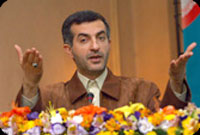
So when Iran's Vice President, Esfandiar Rahim Mashaie recently suggested that Canada's role in Afghanistan is hurting its international reputation, one could be forgiven for not taking him seriously.
Ironically, Mashaie offered the sentiment during an unofficial visit to Ottawa meant to improve relations between the two countries.
Indeed, Canada is in Afghanistan refusing to allow the Taliban to return to power so it can oppress women, ethnically cleanse and harbour terrorists. And that hurts our international reputation.
Right.
"It's good news that Canada is leaving in 2011 and we welcome that," Mashaie noted.
Given the amount of material support Iran has provided the Taliban with, there's little question that Iran would prefer that Canada leave the country. Little more question that they would rather have an Islamic fundamentalist government in power in Afghanistan than a democratic regime friendly (or at the very least not hostile) to the west.
For his own part, Foreign Affairs Minister Lawrence Cannon notes the internationalism of the mission, and how it reflects on Canada's positive role in that country. "Our engagement has earned the praise of international partners, most recently from [U.S.] President [Barack] Obama," Cannon notes. "The people of Iran stand to benefit greatly from a secure and stable Afghanistan. We will continue to encourage the government of the Islamic Republic of Iran to play a constructive role in the affairs of neighbouring countries. Canada has urged the government of Iran to take appropriate measures to ensure that no support is provided to any insurgent group in Afghanistan."
Mashaie also complained about some comments that Prime Minister Stephen Harper recently made about Iran.
"It concerns me that we have a regime ]in Tehran] with an ideology that is obviously evil," Harper mused. "My government is a very strong supporter of the state of Israel and considers the Iranian threats to be absolutely unacceptable and beyond the pale."
"Anti-Semitism is a pernicious evil that must be exposed, that must be confronted, that must be repudiated, whenever and wherever it appears," Harper continued. "Under our government, Canada will remain an unyielding defender of Jewish religious freedom, a forceful opponent of anti-Semitism in all of its forms and a staunch supporter of a secure and democratic state of Israel."
Mashaie complained that Harper's suggestion that Iran's government is "evil" were evidence of "weakness".
While Harper's comments certainly exaggerate the Iranian state's comparative malevolence, who could possibly think a country that beats and rapes the citizens of a foreign country to death, brutally whips homosexuals (then denies their very existence), and sends police to brutalize womens' rights protesters could possibly be evil?
One can only wonder if the Iranian administration actually wonders why no one takes them seriously.
One of the best ways to deal with hatemongers effectively is to refuse to take them seriously.
That was the scene at the University of Chicago this past week, as protesters from the Westboro Baptist Church were met not with the usual derision and outrage, but rather with revelry.
Among their reception at the University of Chicago was a bake sale raising funds for a GLBT charity, and members of the Alpha Delta Phi fraternity, who danced in their underwhere to "I'm Coming Out" by Diana Ross while flying a "no tolerance for intolerance" banner from their house.
Ever the faux-optimist, Shirley Phelps Roper tried to put the best face on their reception. "It is so awesome when you juxtapose this little group of servants of God with this restless mob of humanity. The little girly boys up there with their clothes half off gyrating around--they might as well flip off their God."
First off, the Westboro Baptist Church aren't servants of God -- they're slaves to their own hatred.
But secondly, when a college fraternity -- organizations that have a reputation for homophobic behaviour -- has the moral wherewithal to oppose Phelps and the WBC's promotion of intolerance, one knows that times are changing.
To those familiar with college fraternities this is far less surprising. The homophobic stereotype of fraternities is one that has slowly ceased to fit, as fraternities have quietly been initiating gay men into their ranks for years.
It must be disappointing for Roper to find that an organization she must have expected to be a natural ally for her and her hate cult instead opposes her so vociferously.
As one continues to assess the current state of the American Republican Party, one can't help but think that some honest, heart-felt criticism is certainly in order.
The Republicans have lost the White House and lost control of both Congressional houses. To make matters worse, far-right ideologue Rush Limbaugh seems to have seized control of the party's public image.
At a time like this, when times are so dark for the Republican party, Justified Right's Tommy de Seno wants to drive some of the party's most concerned supporters out.
John and Meghan McCain are in de Seno's sights. Their unforgivable sin is purported to be criticizing the American conservative movement and working with the enemy.
"I grew tired of McCain fighting our agenda, voting against tax cuts, bowing to global warming loons, insulting Christian leaders, ganging against us with his liberal 'Gang of 14' and passing useless laws with liberals like Senator Russ Feingold. — Not to mention snubbing CPAC," de Seno writes.
"The press rewarded McCain’s behavior by labelling him a “maverick” for bashing the Republican Party (if a Democrat bucks his party, like Lieberman, the press paints him as a traitor, not a maverick)," he continues.
De Seno then goes on to address Meghan McCain, who recently took on Ann Coulter in the press.
"Now comes his daughter Meghan McCain, proving the old adage that the poop doesn’t fall far from the pig’s rear end, Meghan has joined her father in the Republican bashing business," de Seno writes.
"Writing on The Daily Beast, an Internet blog, she takes on author Ann Coulter," he continues. "She says she 'straight up doesn’t understand' Coulter (probably all those big words Ann uses). She labels Ann’s followers part of a 'cult' (Meghan must be reading the papers — that’s how media refers to our whole party!). She takes a swing at CPAC, too (chip off the old block, that Meghan)."
"It’s painfully clear she has crossed the threshold of her half life," Moore writes. "Her mantra that liberals are pitiable, conniving, traitorous losers and that conservatives are valorous, patriotic administrative geniuses plays poorly against the backdrop of the hand-over from George W Bush to Barack Obama. Imagine penning a panegyric to dirigible travel while crossing the Atlantic on the Hindenburg."
Yet de Seno seems to think that criticizing Coulter -- who, along with Limbaugh, currently remains one of the best reasons not to support the GOP -- should be considered off-limits for Republicans.
Quite the contrary. What the Republican party needs more than anything is a critical voice from within the party to remind it that people such as Limbaugh, Coulter and de Seno are leading the Republican party too far into the political fringes for it to even possibly remain viable.
In the world of politics, some times one's worst critic is their best friend. Sadly, individuals like Tommy de Seno are all to eager to push any critical voice out of the Republican party.
Shooting the messengers will not solve the Republican party's problems. Unfortunately, individuals such as de Seno are afflicted with itchy trigger fingers.
If speculation that Defense Minister Peter MacKay was gunning for the soon to be elected position of NATO Secretary General were based merely on rumours, MacKay seemed intent to lay them to rest this week.
"Rumours are just that," MacKay insists. "I have a tremendous amount of work on my plate right now as Canada’s defence minister."
"I’m focused on my role as minister of defence in Canada and building our capacity, which is something that we’ve worked very hard at."
"We have a 20-year predictable Canada-first defence strategy that is going to replace all of our core capabilities and grow the size of our infrastructure and improve upon our operational capacity. All of these things are very live files," MacKay explained.
"We have a tremendous number of procurements complete but more of them in the pipeline. That’s my focus right now, and obviously getting the equipment into our theatre of operations and protecting our men and women in uniform as they carry out their important work in Afghanistan."
MacKay's insistence that he isn't campaigning to be NATO's new Secretary General may seem to defy other recent comments made on the matter.
Then again, it's important to remember that former Liberal Foreign Affairs Minister John Manley has also been rumoured as a potential candidate of the job. While direct speculation about Manley seeking the job has been scant, it's important to remember that he's come close before. Manley narrowly lost out to current Secretary General Jaap de Hoop Scheffer in 2004.
And while MacKay is passing on a tremendous opportunity -- both to further establish himself as a future Conservative leader and Prime Minister and to solidify his party's internationalist credentials -- Manley would also represent Canada with distinction as NATO Secretary General.
Then again in politics it's remarkable how quickly things dismissed as mere rumours can blossom into reality. Politicians as savvy as MacKay has proven to be rarely turn down opportunities on the magnitude of the one that currently seems to have presented itself.
With the question of whether or not Guantanamo Bay detainees should have their rights respected hanging thick in the air, FOX News' Sean Hannity invited Meghan McCain, amongst a panel of other commentators, on his show to discuss the issue.
Hannity -- along with most of the panel -- is stringently opposed to "granting" the rights of Guantanamo detainees.
"They declared war on us and we're fighting a war and we know there is about 60-some odd detainees that have gone back to the battlefield. Why for the first time ever would we give rights to enemy combatants?" Hannity asked.
"What competent person thinks this is a good idea?" McCain asked. "Literally when I think of my brother and his people and his platoon, the people I know over there fighting for this so we can let them go so they can attack us again? It's insane."
However, the topic of discussion wasn't merely about the notion that these men could be released. It was also about whether or not those detained should have any rights.
Since the United States began taking prisoners in the War on Terror, the "enemy combatant" designation has been used liberally as an excuse to avoid designating them as criminals or as prisoners of war.
If charged as criminals, those detained at Guantanamo Bay would be subject to Habeus Corpus and would enjoy a collection of civil rights that would rule out the treatment they've received at Camp X-Ray, including torture.
If declared to be prisoners of war, these detainees would be subject to the full range of rights laid out under the Geneva Conventions. Once again, torture would have been strictly forbidden.
Wether as criminals charged under US law or as prisoners of war, these individuals will finally enjoy the rights mandated under law -- be it domestic or international -- and will finally be subject to some manner of justice worthy of the name.
As previously mentioned, one of these rights is the right to not be subjected to torture -- something that Hannity apparently thinks is acceptable even as a Christian.
McCain, for her own part, disagrees.
"I think it's what separates us from the terrorists," McCain explained. "My father could never lift me up as a child because he can't move his arm. He can't ride a bike because he can't bend his knee because he was tortured. I think he knows better."
There's also a serious issue at stake in pretending that the United States would be "giving" these individuals rights. In fact, the rights of these individuals are established within both US and international law.
Although McCain's approach to the issue of rights leaves much to be desired, her denunciation of torture is as effective, prescient and welcome is any. With the issue of how Guantanamo Bay detainees should be designated soon to be resolved, the voice of anyone with an understanding of the nature of torture is dearly needed.
At issue is Kyon Kis Liye (which translates into Why? And For Whom?), a film about a Hamilton-area murder in which a man poisoned his wife in order to enjoy the proceeds from her life insurance policy. Dhalla starred in this low-budget film in 2003.
Dhalla insists that some of the promotional material for the film's DVD features pictures were doctored -- essentially that her face was photoshopped over another woman's body.
"I have worked extremely hard to get to where I am and will not be exploited by individuals," Dhalla says in a statement. "I have taken and will continue to take all necessary legal action to stop this opportunism, defamation, slander and exploitation by the producers."
Charanjit Sihra, the film's producer, vehemently denies this. "That is her. That is her body. That is her face," he insists. "She doesn't want the movie to be released. The pictures are from the movie."
"We want to see this movie go to homes. This film took a lot of work. She is the one causing nonsense because she is holding a politician's job. Indian people feel if someone works in a movie they should not be a politician," he continues. "But we feel that she did good work on the film and should be proud to show the people."
In other news, Calgary West MP Rob Anders is preparing legal action over a newly-disovered tape of him performing a duet of "It's Raining Men" with William Shatner.
Speaking to the Manning Centre Conference -- something of a CPAC north -- Preston Manning sought to sooth the jittery nerves of many Canadian conservatives by insisting that conservatism isn't dead in Canada.
"Conservatism took a hit in the United States. They lost the election, and you could argue the Republicans lost their way," noted Manning. "In Canada, they won the election — not with a majority, but with a strong minority."
Of course, there is a difference between a conservative party governing -- as currently remains the case in Canada -- and an actual conservative government.
Manning, for one, is under no delusion regarding the debate between market intervention and free market principles taking place within Canadian conservative circles right now, although he believes that Canada will emerge from the current economic crisis favouring less government.
But Manning, for one, also knows that having a conservative party in power doesn't necessarily mean conservative governance. After all, he was able to build his Reform party out of (primarily) western Canadians who judged the then-governing Progressive Conservative party as not conservative enough.
Canadian Alliance party founder and Mike Harris right-hand man Tom Long seem to invoke the political lesson of the 1993 PC collapse when he noted the inherent danger in the Conservative party attempting to push policies that are too far removed from the beliefs of the party faithful.
"Conservatives are often their own worst enemies. We have an internal debate going on in our heads, where we basically self-censor," Long said. "We've tried going out and selling things we don't believe in. How's that working?"
Long, it would seem, is much closer to Terence Corcoran's line of thought -- that the Conservative party needs to pull further to the political right -- as opposed to Hugh Segal's call for moderation, which is actually the camp that Preston Manning has historically fallen into.
That the Manning conference could even manage to put together a conference such as this, and attract speakers from as far off as the British Conservative party, is itself testament to the fact that conservatism, as a political philosophy, is not dead in Canada.
But Canadian conservatives need to re-imagine the ties that bind their diverse movement together. Debates such as the Segal-Manning/Corcoran-Long debate currently unfolding at the conference are going to be important steps toward that.
As the Action Democratique du Quebec looks anxiously toward its future -- a future without the only leader it has ever known -- some continue to speculate on former leader Mario Dumont's future.
Westmount Examiner columnist is being a little more cautious in his predictions. He expects that Dumont will be back, he just won't say how or when.
"Mario Dumont is a hero in his home town — the local lad who defied all odds to become the leader of a third political force in Quebec," Laresen writes. "He not only put Rivière-du-Loup on the map, he also served as an inspiration to many young rural Quebecers, showing them that Algeresque success is possible, given the right circumstances."
Larsen holds up two previous small-town Quebeckers -- Jean Chretien and Brian Mulroney, both former Prime Ministers -- as proof that there may be something to the mystique of small-town Quebecois leaders.
"Jean Chretien has always liked to refer to himself as the scrappy kid from Shawinigan, while Brian Mulroney proudly professes to be Baie-Comeau’s political wunderkind," Larsen notes. "Both claims are perfectly true, suggesting that any backwoods Quebec town can spawn a savvy, charismatic leader who has what it takes to rise to high political office."
It's worth noting, however, that both Chretien and Mulroney suffered ignominious fates in Canadian politics. Brian Mulroney backed out the back door before the Canadian people delivered his successor, Kim Campbell, a humiliating and crushing defeat.
Chretien left the Liberal party after his welcome had effectively been worn out, and with a major party-breaking scandal on the horizon. Like Mulroney, Chretien left his predecessor to face defeat, even if a decade of political fear mongering allowed the party to reduce both the scope and the immediacy of their defeat.
Yet the stories of Dumont, Chretien and Mulroney couldn't be more dissimilar in an important regard. As Larsen notes, Dumont built the ADQ from scratch, went on to win his seat in the National Assembly, and eventually transformed his party -- ever so briefly -- into a force to be reckoned with in Quebec politics.
By contrast, Chretien and Mulroney assumed the leadership of established political parties that were already on their way to governing -- a luxury that Dumont has never had.
Then again, few political leaders have ever come back from as complete a defeat as Dumont absorbed in Quebec's 2008 provincial election.
Larsen may be being overly optimistic about Dumont's chances.
"Dumont’s early retirement from political life certainly does not mean we’ll never see his name on a ballot again," Larsen surmises. "He most likely will return one day, probably when 'favourable conditions' prevail. This means he may still be the premier of Quebec one day, or even end up in Ottawa."
At Dumont's age one would be foolish to rule out a return to politics for the man formerly known as Super Mario.
But it won't happen any time soon. Furthermore, the how, when and why of his return can only be in the hands of Dumont himself.
Coming from Penn Jillette's Pennsays Youtube channel is the tale of Penn (of Bullshit! fame) and a video sent to him by the daughter of the late, great George Carlin.
Jillette then relates the story about a scene in The One and Only in which a "little person" (otherwise known as a midget) wrestler asks "why do we always want the assholes to love us?"
Jillette describes the scene as "profound", and something that he looks back on whenever he receives hate mail as a result of his work on Bullshit!.
It's a worthy mentality, one that I personally can relate to.
Individuals like Fred Phelps are marked by an extreme inability to deal with people who disagree with them. It isn't an uncommon trait. While somepeople are content to label people who disagree with them as merely "stupid", Phelps is clearly an even more extreme case. To Phelps, anyone who disagrees with him is destined for hell.
Here at The Nexus and elsewhere, I get enjoy infrequent interactions with people who insist that the blog is "aptly named". On each and every one of these occasions, this stems from a matter of disagreement, and someone who cannot tolerate it.
Whether it's someone who disagrees that the mother of a dead soldier shouldn't be considered fair game for political attack, or someone who can't understand the idea that "pro-choice" advocates who won't protect the freedom of choice of people who disagree with them are clearly more in favour of abortion than choice, there is no shortage of people in the world who can't tolerate a difference in opinion and are eager to attribute all manners of moral failure to it.
There's little question that political extremism blends fairly effectively with what Phil Neisser considers "anti-disagreement thinking", and less question yet how such thinking can appeal so much to people who are so extreme in their own views that they can consider no recourse other than to label anyone who disagrees with them -- regardless of how moderate their views actually are -- as an "asshole".
Then, unshockingly enough, many of these people seem confused and irritated when they realize how few people actually care whether or not they like them.
Unshockingly, most sensible people don't want the assholes to love them. That might seem a little surprising coming from a blog entitled The Nexus of Assholery, but then again, those who don't understand this are the ones who never understood the point in the first place.
There are few valid reasons to care what hateful people like Fred Phelps or Canadian Cynic think, and fewer yet to care who they like and who they don't.
If Russian President Vladimir Putin is paying any attention to the international exploits of his chief political rival, he may well feel just as uncomfortable as former Pakistani President Pervez Musharraf did recently.
Speaking alongside General Musharraf at a conference in New Delhi, Kasparov asked him a question that made him noticably skittish.
In the question, Kasparov likened terrorism to a problematic tree. He noted that when dealing with such a tree -- perhaps one whose roots threaten to grow through the foundation of a house -- the best strategy wasn't to periodically trim the leaves, but rather to deprive it of its water source.
Reportedly, Musharraf attempted to avoid answering the question, insisting that the Pakistani government doesn't provide support to terrorists, and insisting that it was the Afghan drug trade that was supplying terrorists.
Kasparov's terror tree has recieved support from Pakistan's military, mainly from the Inter-Intelligence Service (ISI). While Pakistan's official policy -- both under Musharraf's regime and under the current Pakistani People's Party government -- is to oppose terrorists, it hasn't always done a convincing job of doing this in practice.
Of course, it's another thing if the tree proves to be somewhat useful. Islamic militancy and terrorism has certainly been a fruit-bearing tree for Musharraf -- it's helped him justify coup d'etats in Pakistan.
The ISI has been known to provide material support to terrorists. Whether its out of sympathy for their aims or because the Pakistani military has found them useful -- justifying ever-higher annual expenditures on miliary spending -- is a bit more a complex matter.
Even if Musharraf's administration never directly provided material support to terrorist organizations his half-hearted attempts to control them have certainly proven to be a form of support all their own.
It's important to note that the administration of current Pakistani President Asif Ali Zardari and Prime Minister Yousaf Raza Gilani hasn't done any better. Their practical hand over of the Swat region to the Taliban will provide shelter to Taliban and other Islamic Militants that will strengthen their operations throughout both Pakistan and Afghanistan.
General Pervez Musharraf could have cut off the water supply to the tree of terrorism long ago -- if only by controlling the Pakistani border.
Sadly, Gary Kasparov seems to be one of the few leaders willing to stand up and tell him as much. Vladimir Putin must be a little worried to see that his unelected rival is a stronger international leader than he is.
Writing in an op/ed in today's Globe and Mail, Conservative Senator Hugh Segal suggests that the Conservative Party of Canada is immune to the identity crisis plaguing many conservatives -- particularly in the United States -- by virtue of its history:
"While some on the left and in the punditocracy assume conservatives have been put under water by Wall Street's collapse and the seeming core incompetence or dishonesty of American financial market players, the opposing truth is that Canadian conservatives have a heritage much richer and more diverse than simple free-market devotion."
Certainly, this may be true.
But it's one thing to have such a heritage. It's entirely another to remain true to it. Segal effectively articulates the nature of that heritage:
The problem, unfortunately, is that the Conservative party has failed to maintain that heritage.
Canadians may find it interesting to remember that John A MacDonald -- the father of Canadian Confederation, and long considered the prototypical Canadian conservative -- built the country on the basis of a railroad-building project.
Meanwhile, the Conservative party has never since taken on a national project of the scope of MacDonald's rail-building enterprise. Instead, most of Canada's great national projects -- our healthcare system being foremost among them -- have been undertaken instead by the Liberal party, with the support of the NDP.
While the Conservative party has proven extremely reluctant to follow in MacDonald's footsteps, it has proven itself quite eager to abort other parties' national projects -- such as the Liberal/NDP national daycare program.
What Canadian conservatives have long forgotten is that these national projects don't merely serve the interests of utopian socialism. National projects reinforce these very bleu conservative principles of communitarianism. They unite people and remind them what can be accomplished when an entire country buys in to an initiative and works together to accomplish it.
"That supports, as a foundation does a home, the social outreach, however belated, of R. B. Bennett in response to the Depression; George Drew's progressive social and economic development in Ontario; and the post-Depression social humanity and pro-working people and seniors reforms of prairie populists such 'Bible' Bill Aberhart, Ernest Manning, John Bracken and John Diefenbaker. Leaders such as Bob Stanfield, Joe Clark, Peter Lougheed, Preston Manning, Bill Davis or Richard Hatfield made a series of progressive and populist changes and proposals on income security, human rights, education, lifting seniors out of poverty, workplace safety and agricultural support that enrich the Tory part of the Conservative Party of today."
Many conservatives had high hopes that the merger of the Progressive Conservative and Canadian Alliance parties to form the modern Conservative Pary of Canada would merge the institutions of the PCs with the populism on which the Reform party was founded.
Instead, what has emerged has been very different. No one who witnessed Bill Casey's expulsion from the Conservative caucus as retaliation for him voting against the Conservative budget -- an act he considered to be in the best interests of his constituents -- could believe that Preston Manning's vision of Canadian politics, conservative or otherwise, is alive and will within the Conservative party.
"And that Tory base is actually strengthened by the anti-establishment Reform tradition of enhanced accountability.
Only for the hard-bitten left ideologue is the credit meltdown an indictment of Tory principles around thrift, prudence, informed risk-taking and earned profit."
Indeed, despite the magnitude of the Conservatives' planned stimulus package, thrift, prudence and informed risk-taking very much do remain at the heart of the plan.
Liberal and NDP politicians would likely be rushing to roll out billions of dollars in grants and loans to the automotive sector, for example, as opposed to requiring them to look in-house for potential solutions and reengineer their business model before recieving any government aid.
But the planned stimulus package has yet to offer anything in terms of a cohesive vision. The kind of deficit spending the government will embark upon over the next couple of years (at least) provides the Conservative party with a splendid opportunity to lead the Canadian people on another national project.
"The fact that our economy is taking on water because a reckless American speedboat produced a 90-foot wave and a hugely destabilizing wake, forcing Canada to take emergency action, neither discredits nor diminishes the solid Tory balance between a private economy that generates employment and wealth for hardworking farmers and business people, along with support for social and public programs, and a coherent elected public authority that pursues an enlightened and modest role for government."
Certainly, this is true.
But few of those taking pleasure in the Conservative party's misfortune -- governing at a time of an externally-caused recession -- are ever going to admit that the source of this recession lies below the 49th parallel. The most dishonest among them will even insist that the American policies that led to this economic collapse are Prime Minister Stephen Harper's own policies despite the lack of mass deregulation of financial markets in Canada.
It doesn't help that the Conservative party is lacking the balance that Segal insists is its greatest virtue. Even if the Conservative party hasn't wholeheartedly embraced the American conservative movement's economic policies, it certainly has embraced economics as the uniting element of conservative philosophies, just as the American conservative movement did.
"This balance is part of our Canadian Tory history. It embraces tradition, supports social and economic progress that is mutually reinforcing and builds legitimacy around the core value of equality of opportunity. Keeping this latter mission front and centre when tackling unemployment, poverty, economic growth and prosperity is not only the right Conservative mission, but the right course for Canada.
Tories are anxious about rapid-fire government intervention that seems more slapdash than well-considered. Moderation, even in the face of crisis, is a Tory virtue. Consulting with cities and provinces before dispatching funds for job-creating projects, as is now being done, makes sense."
It certainly does make sense to consult with provinces, cities and municipalities does make sense.
But the government must be certain to design a stimulus program that refutes parochial interests and embraces initiatives that will bring Canadians closer together.
Upgrading Canada's communication or transportation infrastructure could be just such a project. Public/private partnerships to extend DSL internet into remote parts of the country or start building high-speed rail -- a long-neglected initiative in all of North America -- would make an excellent conservative national project.
"After Bennett's famous radio address in 1935 announcing a series of radical measures to help the poor and the dispossessed, Arthur Meighen, a signal personality of Tory rectitude and continuity, commented that while he was untroubled by the content of the message, he worried that the urgency of radio and its use might itself be unsettling to the public in unsettling times.
Stability and 'steady as you go' determined government, with a tilt toward the practical, humane and visionary, has always typified the Tory brand at its most successful. It is this legacy option that is still very much available to all conservatives - whether they seek to manage an energy-rich province, a national government facing gargantuan pressures or even to retake government in the next Ontario election."
If the Conservative party wants to successfully do any of these things, it will need to embrace the very balance that Segal alludes to, look beyond narrow economic ideology and do what no party in Canada has bothered to do for more than 20 years: formulate a coherent, inspiring vision for the future.
Segal should not count on notions of historical "balance" to see his party through the tough times -- for both itself and the country -- ahead.
When the Conservative party was elected in 2006, it was viewed by many Canadians as a good option amongst poor alternatives. Now it's increasingly being seen as the least worst option amoung uninspiring alternatives.
Under the leadership of Michael Ignatieff, the Liberal party will recieve a second look from many Canadians. Many of them will like what they see.
If Hugh Segal and the Conservative party want to continue governing federally -- let alone defeat the Dalton McGuinty Liberals in Ontario -- they need to come up with a vision that Canadians will be inspired by and buy into.
The "historic balance" of the Conservative party will not be enough.
It's amaing the kind of things a dominant majority government can pass when its citizens aren't looking.
In Alberta, Bill 18 -- the Film and Video Classification Act -- is set to establish a provincial film czar to classify or reclassify films within the boundaries of Alberta.
The film czar would also have the power to hire inspectors who would go to movie theatres and rental stores and ensure that children under the age of 14 aren't being admitted to or allowed to rent movies rated 18A or higher.
Any video rental clerk or usher allowing children under 14 to rent or see such films would be eligible for a $10,000 fine, even if accompanied by a parent.
Few people would suggest that children have any business watching movies such as Sin City or Watchmen. Then again, to establish a provincial office to dictate whether or not parents may allow their children to watch them or not is an unacceptable invasion of a parent's rights and responsibilities.
Bill 18 is merely a proclaimation away from being law.
But with word finally getting out about Bill 18, the government may find itself in a much less tenable position, but only if Albertans remain confident enough in their democratic ability to stand up and put a stop to it.
In the wake of the Republican party's electoral meltdown, some rather curious icons are beginning to take dominate centre stage in the Republican Party.
In the wake of any strong leadership in the Republican party, American conservative icons like Rush Limbaugh and Ann Coulter are quickly becoming the face of the party as well.
American centrist conservatives have plenty of reason to be alarmed.
Few people seem to understand this more than Meghan McCain, the daughter of John McCain. Recently McCain denounced Coulter in no uncertain terms.
According to McCain, Coulter is “offensive, radical, insulting and confusing all at the same time. If figureheads like Ann Coulter are turning me off, then they are definitely turning off other members of my generation as well.”
“I love the Republican Party, I spent two years campaigning with my father and I completely fell in love with the Republican Party, and I think it’s hard for me to explain to my friends that are in their 20s when these icons of the party say radical things,” McCain explained. “I have a friend that’s Jewish – she made anti-Semitic comments. It’s hard to defend that.”
“I just wish for more centrist icons in the Republican Party,” she concluded.
Oddly enough, McCain herself has every bit of the potential necessary to supplant Coulter as an icon of the party, and particularly of American Conservative women.
Even as a recent convert to the Republican party McCain's centrist credentials are solid. McCain is known to hold liberal views on social issues, including support of same-sex marriage and stem cell research.
McCain has even interned on Saturday Night Live. With the exception of the various fictions that many people are intent on peddling about her father, there's very little not to like about McCain.
Meanwhile, Ann Coulter's attitudes and behaviours speak for themselves. Those conservatives Coulter doesn't alienate she reveals for precisely what they are -- extremists every bit as radical as she is.
Meghan McCain would, at the very least, put a younger, prettier, much more moderate face on the American conservative movement.
For their own sake, one hopes that American conservatives recognize this.
Of the many things Canadians take in pride in about their country, multiculturalism is generally one of them.
Naturally, not everyone agrees with multicultural policy. In particular, many conservative-minded Canadians oppose multiculturalism because they feel it undermines the traditional Canadian identity -- one these particular individuals view as predominantly European and white.
Meanwhile for many Canadians multiculturalism seems to be largely irrelevant. Instead, they view immigration simply as an economic tool -- one in which they can find extra bodies to fill jobs.
Speaking alongside Leon Benoit in Lloydminster, Jason Kenney notes that he expects the current economic climate in Canada to reduce levels of immigration. Regardless of this expectation, the Conservative government is working on ways to streamline the immigration process in order to admit more workers to Canada.
Kenney and Benoit were in Lloydminster to discuss precisely that initiative.
"It’s a chance to meet people who are key in the community and figure out what the federal government can do to help them make sure the economy stays strong in this region," Kenney said. "Across Western Canada, we’re talking about tens of thousands of jobs that would go unfilled, businesses that would go down and bankrupt if they could not find temporary workers."
"Immigration is the sort of thing you just don’t want to do a short term knee-jerk reaction, you want to plan for the medium term, and that’s what we’re doing," Kenney explained. "We consulted industry and all of the provinces just a couple months ago and they all said we should probably keep levels about where they’re at now."
Of course, there's a serious problem with treating immigration mainly as an economic tool.
While it is a reality that immigration needs to be economically sustainable, acting recklessly upon some of the other preferences reportedly expressed -- toughening refugee policies and reducing government funding for groups serving minority communities -- would imperil multiculturalism in Canada.
Toughening refugee policies too much could result in refugees who deserve to be allowed into Canada based on merit being turned away. Reducing the funding for groups that serve minority communities would make it harder for new arrivals to adjust to Canadian society -- ironically, one of the concerns Kenney raised while in Lloydminster.
Reducing immigration to a mere economic tool is a formula for a more insular, parochial Canadian society -- one of the absolute last things Canada needs.
It seems that Jason Kenney and Leon Benoit may not fully understand this.
"People were asking about serious issues … and problems that need to be solved," Benoit added. "We have accomplished a high percentage of things that I recommended as critic, things I saw were wrong."
"Does that mean there’s nothing to do? Well you heard tonight: there is."
While Canadian immigration policies are far from perfect, the government needs to be very careful regarding which reforms it chooses to pursue.
With the election of the replacement for NATO Secretary General Jaap de Hoof Scheffer slowly approaching, a breakthrough that would allow Canadian Defense Minister Peter MacKay to win the job seems to be on the horizon.
“I don't think that traditions, in the sense of geography, should be a restriction on any position with NATO,” MacKay has recently said.
An unofficial NATO tradition is that a European will hold the office of Secretary General, while American commanders will maintain control of various military commands throughout the alliance.
American Vice President Joe Biden has reportedly offered a compromise to European leaders that may finally put this tradition to rest. Under Biden's compromise French commanders would assume control of several NATO commands in exchange for MacKay being elected Secretary General.
The likelihood that Biden's offer could be accepted is enhanced by the lack of a consensus amongst Europeans about which European candidate should be elected.
Polish Defense Minister Radoslaw Sikorski appears to be the strongest of the European candidates, but agitation between himself and Russia may undermine his candidacy.
MacKay has never lobbied Biden for his support. “I've never had a discussion with Vice-President Biden about this,” MacKay explained. “What I can tell you is that there is growing appreciation and I would even go so far as to say renewed respect for the role that Canada plays in NATO, not just in Afghanistan, but the fact that we have been an active participant and a founding nation for NATO in its 60 year history.”
Not to mention the direct leadership role Canada took in the creation of NATO.
With Biden's support -- knowing that Barack Obama isn't that far removed -- MacKay's candidacy for the job is far from a done deal, but it's become solidly within the realm of possibility.
When someone who uses science and rationality as the backbone of his cause is found to be far more out of touch with science and rationalism than his allegedly irrational and superstitious opposition, one simply knows that individual is in trouble.
This is the dilemma that crusading Atheist Richard Dawkins finds himself in recently, as the Catholic Church, of all places, has cast some serious doubt on some of the conclusions Dawkins has reached and the obvious absence of the scientific method therein.
Richard Dawkins has been known to insist that the theory of evolution decisively proves that "God almost certainly does not exist".
At a five-day conference commemorating the 150th anniversary of On the Origin of the Species, Vatican theologians discussed the theory of evolution with biologists, molecular geneticists, paleontologists and philosophers. They noted that while Christians still accept God as the divine creative force behind they universe, the Catholic Church "does not stand in the way of scientific realities".
Pontifical Council for Culture head Monsignor Gianfranco Ravasi noted that there is no a priori incompatibility between the Bible and evolutionary theory.
Of course, Darwinian evolution and the creation account in Genesis may not be entirely compatible... if you take the word of the Bible literally. Such views are more generally described as fundamentalism.
Oddly enough, Cardinal William Levada offered his criticism of "those who have a fundamentalist interpretation of the Bible which they want to see taught to their children in the schools alongside evolution or instead of it."
Yet interestingly enough Richard Dawkins has to insist on a fundamentalist interpretation of the creation story as related in Genesis in order to argue that the theory of evolution decisively disproves the existence of God. If one acquiesces to the more widely-held view that the Bible is written predominantly in allegory and metaphor, Dawkins' claim becomes much harder to justify.
If Dawkins' claim that evolution proves "god almost certainly doesn't exist" relies so heavily on a fundamentalist interpretation of the Bible, it becomes very difficult to regard Dawkins himself as anything other than a fundamentalist.
Dawkins and his ilk have far too long been allowed to canonize science and hold it up to be the scripture which disproves religious scripture.
But if those who are allegedly most predisposed toward the fundamentalism that would validate such an argument instead reject fundamentalism, this is an argument without any kind of a future.
The best way to de-canonize science was for religious authority to accept it. Now that this has been done individuals like Richard Dawkins are going to need to find themselves a new scripture for atheism.
Those principles set the Campbell government's criteria for treaty negotiations. They stipulated the following:
-Private property rights should be respected, and that treaty settlements shouldn't involve the expropriation of property. -Land use terms and licenses should be respected, and anyone whose commercial interests are disrupted should be compensated. -The use of Crown land should be reserved for all British Columbians, including for hunting, fishing and recreation. -Provincial parks should be reserved for the use of all British Columbians. -Resource management and environmental protection standards shoulda apply province-wide. -Aboriginal government should be modelled on local government. All powers delegated by the federal and provincial governments should apply. -Harmonization of land use planning should be entrenched within treaties. -Tax examptions for aboriginals should be phased out.
Even with the government's criteria for an agreement mandated by the citiens of BC negotiation of those treaties have proven very difficult. With more than 200 separate aboriginal groups in BC, reaching an agreement would prove nearly impossible.
A recent piece of legislation introduced by the government of BC would allow aboriginal groups to amalgamate, reducing the number of separate groups to a number as small as 25.
The legislation will also recognize the title rights of BC aboriginals as the original inhabitants of the province.
"We heard the B.C. minister of aboriginal relations and reconciliation say that it is up to the First Nations to determine what their political structure is going to be -- and it might well be 203 First Nations or it might be 30 or it might be 100. We just don't know how that's logically going to play out," said Chief Judith Sayers of the Hupacasath First Nation. "People have to ask questions because I don't want to be forced into working with First Nations that we might not get along with or it doesn't make a natural fit."
By amalgamating their groups not only will aboriginal treaty negotiations with the BC government go smoother, they will also have stronger, more unified voices to speak with.
That's why the Member of the First Nations Summit's decision to support the legislation put forth by BC Minister of Aboriginal Affairs and Reconciliation Mike de Jong is so important.
It could even provide a better model for Aboriginal self-government for the rest of the country.
It doesn't take much of a stretch of the intellect to realize that a provincial political party is not the same as a federal political party.
Considering that provincial parties, by their very nature, focus their efforts and concerns on matters of provincial scope -- exempting, of course, times of extraordinary political crisis and matters of inter-provincial cooperation -- it only stands to reason that they cannot fundraise the way a federal party does.
A general maxim in politics is that political parties raise funds from amongst their expected beneficiaries.
So it's on that note that it's for the best that Saskatchewan Premier Brad Wall has cancelled a Calgary fundraiser for his party.
The Saskatchewan party has had such dinners many, many times before, dating back to the tenure of Elwin Hermanson, the founder of the party. Now that the party is in government, however, Brad Wall seems things very differently.
"I think we're just going to take a different approach. We're a party now fortunate enough to be in government, so we're just taking a different approach more sort of consistent with that," Wall explained. "It is different. It is. ...I can't have a leader's dinner outside the province anymore, even if we call it that. It's a Premier's dinner and every province has their own Premier."
That's a decent enough reason to discontinue the dinners, but the best reason comes down to a matter of principle.
When provincial political parties fundraise out-of-province, it raises questions about who, precisely, the party is working in the interests of.
For example, currently acting leader of the Saskatchewan NDP notes that these dinners -- which primarily cater to the energy sector in Alberta -- raise questions about who sets the agenda for the Saskatchewan party, particularly as it pertains to energy and environmental policy.
"When you are responsible for managing the (energy) sector, for governing the sector, for regulating it and taxing it and then essentially going to the sector and saying, 'We're looking for your support.' ...The optic here is, at best, poor," Calvert noted.
In politics, the appearance of a conflict of interest is just as troubling as an actual conflict of interest.
The Saskatchewan party needs to make it unequivocally obvious that they represent the people of Saskatchewan, and that their agenda is set inside the province.
That is the best reason to not only cancel the annual leader's dinner in Alberta, but discontinue all of the party's out-of-province fundraising efforts.
Ever since Canadian troops began the fight against the Taliban in Afghanistan, the notion of negotiating with the Taliban has been a controversial topic.
Today Afghan President Hamid Karzai made public his approval with this development.
Considering that it's only a matter of time until certain individuals begin to harp on the subject, it's important to understand precisely what is actually being proposed by this.
While Taliban as become a pervasive blanket term for the entire insurgency in Afghanistan, it's important to understand that there are actually numerous groups that together make up the Taliban.
One of those groups is Hisb-I-Islami, a group led by Gulbuddin Hekmatyar.
While Hekmatyar is currently an ally of the Taliban he has, in the past, also been an opponent of the Taliban.
Hekmatyar founded Hisb-I-Islami in 1977 in cooperation with Mulavi Younas Khalis. The group opposed the communist-leaning policies of Hafiullah Amin. Hekmatyar himself had long been involved in the continuing conflict within the country between Islamic and communist thinkers. In 1972 Hekmatyar was accused of murdering a Maoist student and imprisoned for two years.
Hekmatyar first rose to prominence during the Afghan-Soviet war. With support from the CIA, Saudi Arabia and Pakistan Hekmatyar led thousands of Mujahideen against the Soviet Union. However, Hisb-I-Islami had split into two factions at this point, with Khalis leaving to form a rival group.
After the formerly Soviet-backed Kabul government began to collapse in 1992 Hekmatyar attracted the support of most of the People's Democratic Party of Afghanistan. He then seized control of Afghanistan until he and Hisb-I-Islami were driven out.
In 1993 Hekmatyar was invited to be Prime Minister under President Burhanuddin Rabbani. In 1994, however, Hekmatyar left the government and aligned with Abdul Rashid Dostum. An impassed ensued in which Hekmatyar's forces got bogged down outside of Kabul and in frustration shelled the city.
The bitter civil war continued until 1996, when Hekmatyar and Rabbani again agreed to form a government together. Hekmatyar was to be Prime Minister.
The Taliban would sieze control of much of Afghanistan later in 1996. Hekmatyar would flee to Iran, then later return to fight the Taliban.
Hekmatyar has proven a strangely reliable track record in which he continually demonstrates that he is reliably unreliable as an ally. Basically, he fights with any one particular group until another offers him a better deal, then he switches sides.
The deal the Karzai government is offering Hekmatyar right now would offer him an opportunity to go into asylum in Saudi Arabia, then later return to Afghanistan to join the government.
Whether or not this is a better deal than the one Hekmatyar currently has with the Taliban is essentially best known by Hekmatyar and the Taliban.
But one thing is nearly certain: which ever side Hekmatyar decides to align with he will wind up fighting them sooner or later -- much likely more sooner than later. His previous record has shown this.
That being said, having Hekmatyar as part of the government would at least take him off the field of battle for a span of anywhere from a couple of months to a couple of years. One can only imagine what Afghan and NATO troops could do with Hekmatyar's Hisb-I-Islami off of their radar screens for that period of time.
Anyone who pays close attention to Fred Phelps and his hateful Westboro Baptist Church have likely noticed they're having a lot less fun these days.
Even as they're denied entry into foreign countries -- both Canada and Britain have turned them away -- their pickets of slain American soldiers' funerals are dwindling.
This can be credited at least in part to individuals like Sam Cottle, Jim Boland, and the more than 150,000 Americans who make up the Patriot Guard Riders, an organization that, since 2005, has protected the funerals of American soldiers from the WBC's demonstrations of hatred.
The Patriot Guard Riders have sought and recieved invitations to many such funerals, where they stand shoulder to shoulder with American flags and block out the WBC's protests. Never have they raised a hand in violence against the WBC (regardless of how much the WBC deserves it), even though they've been spit at by frustrated WBC protesters.
"We don't react to it," says pastor Tom Cottle.
Like many members of the Patriotic Guard Riders, Cottle is a Christian pastor fed up with Fred Phelps' and the WBCs' pollution of Christianity.
Others are simply fed up with the WBC's attempts to turn what should be a solemn day for the friends and families of deceased soldiers into a forum for their hatred.
Certainly, Jim Boland has a great many friends now. Not merely among the Patriot Guard Riders, and not even merely among the friends and family of dead soldiers. Jim Boland and those courageous enough to stand with him have made a great many friends among anyone who opposes hatred, anywhere.
The actions of the Patriot Guard Riders are much more than an act of patriotism. Their actions are a triumph of the human spirit and of human compassion over vicious, inhumane, hateful, and evil people.
Their actions have taken a common reaction to the WBC and their theology of hate and transformed it into an act of simple, compassionate heroism.
One thing that a person learns very quickly about dealing with Canadian Cynic is that he's willing to lie in order to try to claim something he can trumpet as a victory.
The next thing that one learns about dealing with Cynic is that having a pack of sycophantic hyenas who either equal or exceed his dishonesty helps him get away with it. There's nothing like the preening agreement of the like-minded to comfort the small-minded, and minds don't come much smaller than Canadian Cynic's.
As Cynic continues to fish for a triumph in the sad, sad democratic debacle surrounding the Norm Coleman/Al Franken senatorial contest in Minnesota for a triumph, is would likely be unduly generous to pretend that Cynic doesn't understand the nature of the concerns raised here at the Nexus.
Over at the Temple of Sycophantic Groupthink, Cynic pretends that the concerns in the contest are objections to Franken himself:
"Once upon a time, our favourite cyberstalking mullethead was all about the Franken-Coleman dustup in Minnesota, and how the Franken camp was LOL ROTFL stupid and moronic and criminals and stealing that election and everything."
Aside from that, anyone who actually pays attention to the written record, however, knows that truth is very different.
The concerns raised about the contest far exceed the "LOL ROTFL stupid and moronic" narrative that Cynic wants to sell. In fact, the treatment given to Franken has been fairly conciliatory, if anything.
"It's hard to fault Franken for his own self-interest, even if the means by which he's pursuing those interests risks giving American democracy another black eye. If anything, it's merely confirmation that Franken's transformation from an extradorinary entertainer to a run-of-the-mill politician."
"Franken's talents have clearly been well-suited to the role of poliitical opposition. Even if he's often proven to be little more than a left-wing counterpart of Ann Coulter -- so it's unsurprising that one should note his level of disdain for Coulter -- one think that Franken has done successfully is keep a wide variety of right-wing commentators on their toes.
As a Democratic Senator, one can expect Franken to be little more than a loud mouthpiece for the Democrats and their sitting President."
"[A Franken victory would] certainly be a sad day for comedy. But then again, American voters can likely still count on Franken to crack a joke or two on Capitol Hill."
By contrast, the concerns raised have had nothing at all to do with Franken, and everything to do with democracy:
"As with most of the discrepancies undermining the legitimacy of this election result, it actually doesn't matter -- not one iota -- who actually won. What is important is that the discrepancies are resolved."
"If the numerous discrepancies in the recount are resolved and Al Franken remains the winner, so be it. It will be a good day for American democracy when these discrepancies are investigated and resolved accordingly."
"The question is not whether or not one believes Al Franken should be the Senator from Minnesota. It's a matter of whether or not he actually won."
Meanwhile, Cynic hilariously overlooks the irony of relying almost solely on Talking Points Memo even as they insist that the credibility of any witness who expresses sympathy for Norm Coleman is undermined, even if their testimony has merit.
Partisan hackery generally makes for extremely poor journalism.
Beyond that hilarity, however, is the base reality of the matter: people, like Canadian Cynic, who are too cowardly to have any principles of their own are often prepared to mock -- or, preferably, ignore -- the principles of those who do have them.
To them all that matters is winning or losing, by any means or at any cost. So if American democracy gets trampled a little further in the rush to contravene Minnesota state election law and seat Al Franken before Norm Coleman's legal challenges are resolved, so be it.
And farbeit that someone as small-minded as Cynic understand that when the discrepancies surrounding the contest are examined and resolved, we here at the Nexus will have gotten precisely what he wanted: a democratically legiitimate Junior Senator for the state of Minnesota, regardless of who it is.
In the mean time, if Canadian Cynic wants to enjoy a hollow triumph, God knows that the truth won't prevent him from doing it.
Very typically, all he had to do was lie and not give a shit about democracy.
Many Canadians concerned with the recent lionization of the Tamil Tigers and demonization of the Sri Lankan government's attempts to defeat them have taken note of Liberal MP Gurbax Singh Malhi's appearance at a pro-Tiger rally in Toronto.
Raphael Alexander has picked this ball up. In a post on the National Post's Full Comment blog Alexander writes:
"By appearing at a rally on Parliament Hill surrounded by militant terrorist flags of the LTTE, Mr. Malhi has taken a stand shoulder-to-shoulder with an organization that is officially banned in Canada as a terrorist group. In a speech made before the crowd, the Liberal MP has compromised the priorities of a Canadian Parliamentarian by saying that the Tamils are fighting 'for a right cause'. Apparently the decision to address the crowd was impromptu; Mr. Malhi says he was just 'passing by' when he spotted the rally and decided to join in. Perhaps Mr. Malhi would be wise to recall that civilians have been killed in both sides of this struggle, and that by defending the actions of a terrorist organization he gives undue validity to them, however unintentional on his part."
The NCRI is the political arm of the Mujahidin-i-Khalq. This group has been on the list of terrorist groups prohibited from operating in Canada. It was added to that list in 2005.
Like Malhi, Kenney claimed he was just passing the rally and decided to join in spontaneously.
"Canadian people would stand in solidarity with the Iranian people in their wish for respect for human dignity and human rights and democracy," Kenney told the 2006 rally. Not that different from Malhi's comments to the Tiger rally.
Moreover, Kenney would later claim that he had pursued due diligence in regards to the matter, contradicting his earlier claims of ignorance in regards to the matter.
Kenney, a Parliamentary Secretary at the time, continued to serve after the incident. After enduring a brief Liberal barrage in Parliament, Kenney moved on to eventually become Minister of Immigration, Citizenship and Multiculturalism -- a marked promotion from the lower echelons of cabinet.
Alexander isn't unreasonable to expect that Malhi should have considered the civilian deaths caused by both sides of the Sri Lankan conflict. But Mujahidin-i-Khalq has caused civilian deaths as well.
To demand an extraordinary act of repentance from Malhi would be unreasonable. If Kenney can walk away from his mistake and become a cabinet minister, Malhi can walk away free as well.
When John Tory lost his seat during the 2007 Ontario general election, he had to know how badly he needed to win in a by-election.
Last night he failed to do that.
Liberal candidate Rick Johnson won the the Haliburton-Kawartha Lakes-Brock by-election by a margin of 2.5% of the vote. His 43.7% of the electorate narrowly trumped Tory's 41.2%.
"I'm very disappointed in the results of the election, as we all are, but the voters can never be wrong in what they decide, and I respect their decision," Tory announced while conceding the by-election.
Tory's loss represents something of a double defeat for the Ontario PCs. The seat he lost last night was one held by the Tories after the 2007 election. Laurie Scott won the seat against Johnson in 2007, then resigned so Tory could seek election.
With no seat in Queen's Park, there's nothing left for Tory to do but resign as the leader of the Progressive Conservative party of Ontario.
To date, Tory hasn't commented on whether or not he'll do so.
"As for me, I will have more to say about my plans tomorrow," he announced. "For now, I will only say that I gave this campaign my very best."
He can't expect to lead his party from the press gallery. The Ontario Conservatives need a Tory leader in the legislature, not Tory in the press box.
To suggest that the financial crisis currently facing the global economy is a disaster may be something of a hyperbole, although such things usually tend to feel like crises when in the midst of them.
With Barack Obama elected president in the United States and the Conservative government in Canada tabling a budget that half-heartedly embraces Keynesianism, many have mused that conservatism in Canada is dead.
As the Telegraph Journal's Charles Moore notes, Maclean's blogger Andrew Coyne has insisted that the Tory budget "put an end to conservatism in Canada — as a philosophy, as a movement".
Certainly, conservatism in Canada -- as elsewhere -- is in a time of crisis. It's impossible to pretend otherwise.
Conservatism has slid a long way in a short time since David Frum penned Comeback: Conservatism That Can Win Again. (Interestingly, Comeback was published in 2007, George W Bush had been in office for seven years.)
Some are looking upon conservatism's crisis quite triumphally. Liberal leader Michaell Ignatieff has mused that the current state of affairs "throws the conservative movement in Canada into a certain form of deep ideological confusion - from which I sincerely hope it never recovers."
This says something very telling about Ignatieff's lack of imagination. To hope that conservatism never recovers its sense of purpose is to imagine that conservatism has nothing to offer. While the most fervent ideological hacks will certainly be eager to leap to agreement with such a sentiment, they'd be every bit as wrong as Ignatieff.
Those folks -- Ignatieff, Coyne, and those rushing to affirm their conclusions -- have forgotten one of philosophy's most popular axioms.
The chinese word for crisis consists of two distinct characters. One represents danger. The other represents opportunity.
While conservatism is clearly facing danger in the midst of this crisis, it's important to remember that there's opportunity as well.
This is an opportunity to reevaluate what conservatism stands for, and what its principles are and what its purpose is.
During the neo-conservative era of the past 30 years it's been insisted that conservatism is founded first and foremosst in economics. Thinkers such as William F Buckley argued that capitalism was essentially the glue that bound social conservatism, libertarianism and free market conservatism together. In many ways conservatism got wrapped up in the struggle between capitalism and communism.
Even after the dissolution of the Soviet Union, the breakdown of its sphere of influence and China's turn toward capitalism -- the events definitively marking the end of communism as a global ideological force -- many segments of the conservative movement have yet to grow beyond this long-retired conflict.
It was the ideological rigidity that demanded the artificial continuation of this conflict that treated any state intervention in the economy, including regulation, as communism. It was this ideological rigidity that allowed the greed of unscrupulous business people to precipitate the current global economic crisis.
Interestingly enough, this ideological rigidity conflicted with the law-and-order imperatives so often equated with conservatism. Even well-regulated economies are now facing the consequences of this under-regulation as a deep recession in the United States -- among the most under-regulated economies in the world -- precipitates economic hardship in many other countries.
Economic regulation -- in this case, regulation of financial markets -- is simply part of a necessary law-and-order program which protects consumers and investors alike.
One thing that the economic program espoused by conservatives has proven particularly inept at is handling economic crisis. The current crisis provides conservatives with an opportunity to innovate their outlook on economics.
While the left-wing alternatives have a similarly dismal record in dealing with such crises, conservatives can learn from the failures of both their own projects and those of their ideological opponents in order to provide more pragmatic solutions.
Conservatives have to be willing do what many of their ideological opponents will not. First, they need to understand that economies are cyclical. Governments -- particularly individual governments -- are limited in their ability to influence such things.
Conservatives need to learn to balance their belief that economies must perpetually grow with the knowledge that economies must grow into something. Conservative policies should funnel economic growth toward the formation of a healthy economy -- one that reflects the wants and needs of the country in question.
Strident free market conservatives will certainly insist that an unhibited, minimally regulated market will provide such growth. But they forget that many people also want easy wealth and profit. The current economic crisis is a perfect example of what happens when unscrupulous individuals are allowed nearly unlimited means to achieve it.
Economics cannot be the sole bind between the varying intellectual strands of conservatism.
Whatever that bind would be it needs to respect individual and economic freedoms while still allowing room for law and order. It needs to value traditional values that work while remaining flexible enough to change those that don't work. It needs to balance freedoms with a sense of responsibility.
Most importantly, however, conservatism must be willing to adapt and evolve to political and social conditions in order to survive. No static philosophy can possibly survive in a dynamic and constantly-changing world.
Individuals such as Michael Ignatieff, meanwhile, should be very careful before they wish the conservative movement to effective oblivion. Not very long ago, liberalism was every bit as confused and disjoined as conservatism is now -- George W Bush was in the White House for the longhaul, the Republican party was firmly in control of political power in Washington DC and Canada's Liberal party wasn't nearly liberal enough for the tastes of many.
Right now, the conservative movement must learn to find opportunity in crisis. But inevitably liberalism will have to do so again some day.
In comments made on a St John's radio station, Liberal Senator George Baker has managed to set off what could become a major political controversy.
While speaking about the budget -- and, more specifically, $1.7 billion that some Newfoundlanders believe they're been bilked out of -- Baker mused that federal neglect of Newfoundland could lead to the formation of a separatist party in Newfoundland.
"When you talk about young people, you may see in the future a new political party on the horizon that represents Newfoundlanders just like the Bloc Quebecois represents the people of Quebec better than any other political party," Baker said.
The $1.7 billion represents 20% of Newfoundland's budget, and is only the most recent in a litany of fiscal grievances the province holds not only with the Stephen Harper Conservatives, but with the federal government in general.
"If this continues for [Harper's] term ...then what you are going to see is a completely different party," Baker later told CTV. "There's going to be a political party that says, 'We are going to stand up for Newfoundland and Labrador.'"
"It's gotta be stopped, if its not stopped in the House of Commons, they are going to be facing ...a new party in Newfoundland that would be comparable to the Bloc [Quebecois]."
"This should be reason enough to have a Bloc Newfoundland and Labrador running in the next federal election if this keeps up, and a real campaign to get them all elected," Baker added.
Naturally, the Conservative party from trying to take advantage of his comments, somewhat disingenuously.
"I think [the comments] are very concerning. [You've] got a member of the Liberal caucus calling on the creation of a 'Bloc Newfoundland'," said Stephen Harper spokesperson Kory Teneycke. "He's talking on the most glowing terms imaginable about the Bloc Quebecois and what they've been able to achieve. Clearly, this is beyond the pale and Sen. Baker should be removed from the Liberal caucus."
Conservative Senator Mike Duffy expressed deep concerns about the sentiment. "George Baker's a great Canadian, or he used to be," Duffy mused. "I can't wait to hear what he has to say about it, because it's certainly not the old George that I know and love."
"I'd probably consider it," Baker mused when asked if he would lead such a party. "But I'm a bit too old."
Interestingly, separatism has a long but quiet history in Newfoundland -- a province which had to vote in a referendum twice before joining Canada.
Michael Ignatieff should remove George Baker from his caucus. To disagree with the government's fiscal treatment of Newfoundland is one thing -- Newfoundlanders do, indeed, have a strong case to argue.
But to pretend that disagreements over money is reason enough to seccede from Canada is, indeed, beyond the pale.
Now, the Organization of Islam Congress, a 57-member coalition of states, seems to think they've found the solution to their problems. They want to push an Anti-Blasphemy Resolution through the United Nations in order to blind member states to pass anti-blasphemy laws in their countries.
They're coming uncomfortably close after passing their resolution in an important committee in the General Assembly.
Atheist activist Christopher Hitchens blamed lack of criticism by religious figures for the Anti-Blasphemy resolution.
"When Salman Rushdie was sentenced to death by a senile theocrat in Iran for writing a novel the Archbishop of Canterbury, his holiness the Pope, the Sepharddic chief Rabbi of Israel and many other religious figures joined with [Ayatollah] Khomeni not in endorsing the fatwah, but saying the problem was blasphemy," Hitchens noted. "They agreed with the Ayotollah to this extent, that the problem was not the destruction of free speech and free expression, but the hurt feelings of the religious."
Those who suspect that a formal adoption of the anti-blasphemy resolution could pose significant challenges to secular democracy may not be as paranoid as one would otherwise like to think. A law regulating what can and cannot be said about any religion would essentially obliterate the separation of church and state. The anti-blasphemy resolution may well be a precursor for such a law.
"It provides international cover for domestic anti-blasphemy laws, and there are a number of people who are in prison today because they have been accused of committing blasphemy," says the Beckett Fund's Bennett Graham. “Those arrests are made legitimate by the UN body’s [effective] stamp of approval.”
It's an obvious point. Considered the arbiter of what is and is not considered a human right, UN acceptance of arrests for "blasphemy" (however one may define it) would undermine the ability of human rights-oriented organiations to denounce them.
Even more troublesome is the fact that the Anti-Blasphemy resolution was pushed hard by the Organization of the Islamic Conference. The OIC includes among its membership countries like Iran, Syria and Saudi Arabia -- countries with some of the worst human rights records in the world.
The Anti-Blasphemy Resolution could be used to silence criticism of human rights abuses perpetrated in the name of Islam, however improper such an act may actually be.
This is especially sobering when one consdiers that, as Hitchens himself notes, OIC member Saudi Arabia has refused to sign the International Declaration of Human Rights. Not only has this country definitively rejected the notion of human rights but it's also taking part in a movement that would serve to roll back many of the freedoms contained in the Declaration.
The Anti-Blasphemy Resolution could also be used to silence critism of human rights abuses perpetrated in the name of any other religion.
The best way to make anything oppressive is to raise it above scrutiny or criticism. History has shown countless examples of what happens when political power is considered unassailable, and has also shown countless examples of what happens when the same feat is applied to religion.
The Anti-Blasphemy Resolution must not be allowed to progress any further.
This past week an anti-abortion ad rejected by both NBC and CNN turned up on YouTube.
The ad is interesting for several reasons.
The first is immediately obvious. The ad shows an ultrasound video of a fetus and provides a hypothetical description of it. "This child's future is a broken home," the ad says. "He will be abandoned by his father. His single mother will struggle to raise him."
"Despite the hardships he will endure this child will become the first African American President."
The ad presents Barack Obama as an example of why a woman considering an abortion should think twice. The ad implores the viewer to "consider the potential".
It's interesting that this ad, produced by the Catholic Fidelis Center, would choose Barack Obama as a poster boy for the anti-abortion movement. Obama's policies on abortion alarm most anti-abortion advocates to the extent that many of the most crazed religious spokespeople refer to Obama as the anti-Christ (at least those who don't refer to him as Hitler).
Secondly, the ad is factually wrong.
It is true that Obama was born to a single mother and that, even by his own account, his father abandoned him.
But to suggest that his mother struggled to raise him is an exaggeration. According to his own account in Dreams From my Father, Obama's mother didn't raise him alone.
Indeed, Obama's Hawaiian grandparents were very active in his upbringing, and helped his mother raise him.
Branding Obama as a poster boy for the anti-abortion movement is an intriguing move, but mischaracterizing his childhood undermines the credibility of the inventive ad. Not to mention the fact that Obama's own pro-abortion policies provide built-in re-branding.
When Fred Phelps announced that he and his Westboro Baptist Church were going to picket a staging of The Laramie Project he must have imagined that he and his congregation would fly to Bassingstoke, wave around some inflammatory signs, provoke international outrage and maybe get some fish and chips... good times, by his standard.
Instead, Phelps was denied the privilege of setting foot on British soil and helped make the play a rousing success, complete with a sold-out performance.
The Laramie Project is a play about the aftermath of the murder of Matthew Shepard, and was written with the aid of interviews with the residents of Laramie, Wyoming where Sheppard's grisly murder took place.
Considering that Shepard is the object of a particularly simmering hatred on behalf of the WBC and the Phelps clan, it was only natural that they would plan to protest at the performance.
"It is the first actual picket. We have been preaching by so many means to the UK for years," Shirley Phelps-Roper told the Telegraph. "The arm of the Lord our God is not shortened by oceans and things, all of which he created, and all of which he knew about when he considered these last hours of the very last days of all."
Phelps' plans were curtailed by Maria Miller, the Conservative MP for Bassingstoke, who contacted the British Home Secretary to prevent the WBC from getting onto the ground in Britain.
"The most important thing is that a production that is trying to promote tolerance goes ahead and that's what I'm focusing on achieving," she pronounced.
Even though Phelps and the WBC were denied the opportunity to press ahead with their vile protest, representatives of several British GLBT organizations showed up to wish the producers well and take in the performance.
The performance the WBC were planning to protest -- the closing performance -- sold out in the wake of Phelps' announcement.
Whatever Phelps intended to accomplish by protesting the performance, it's evident that he didn't want the play to succeed. Any number of would-be spectators Phelps could dissuade from attending the performance would have to be viewed as a victory for the WBC.
Instead, Fred Phelps and the Westboro Baptist Church became the engineers of their own defeat.
Fred Phelps really is his own worst enemy. Frankly, he and his hopelessly wretched reputaiton deserve one another.