Intellectual dishonesty at the very heart of push to "secularize" U of A convocation ceremony
On Monday, October 27th, the University of Alberta General Faculties Council held a special meeting regarding recent demands by a number of U of A-affiliated atheists to remove the a reference to God from the U of A's convocation ceremony.
In the convocation speech, graduates are directed to use their degrees "for the glory of God and the honour of your country."
The line has endured for 100 years since the University's establishment. Now, in the University's centenary year, a small group of atheists wants to purge the line from the speech. This group insists that they're doing so in the name of secularism, rationalism, and diversity.
The truth is very different.
Sadly, there's very little rational thought at the core of this campaign, and more than their fair share of intellectual dishonesty.
“I would feel unwelcome at the current convocation ceremonies,” complained Ian Bushfield, the president of the University of Alberta Atheists and Agnostics. “By charging me to use my degree to the glory of God, I feel that my belief system, which does not include beliefs in any form of deity, is being ignored by this University’s administration.”
“If the argument for tradition is to be held over all rational discourse, then this University shall never achieve its goal of becoming a top 20 university by 2020,” Bushfield insisted.
Which is a rather bizarre claim. If a passing reference to God in a convocation speech is enough to be a millstone around the University's neck in terms of University rankings, then there is something severely wrong with those rankings.
Of course, Bushfield's rhetoric barely holds a candle to that of John Crookshanks, a political science student who is also working to push the UAAA's agenda.
“This is a public, non-creedal university with a diverse, multicultural student, faculty, and staff community, and so appeals to the will of the religious majority are misleading. They, like many others, believe that for the University to be arbiter of what is the correct faith for all students is completely inappropriate,” added Crookshanks.
Readers may cue rolling eyes at their leisure. After all, a ceremonial charge falls significantly short of instructing graduates on what their religion should be. For Crooksthank, however, the irrational ravings only get better.
“This is a public university, whose mission statements, goals, and even the 'Dare to Deliver' plan have no religious mandate. Convocation then is neither the place nor the time to invoke any one religion to the exclusion of all others,” he continued.
Of course, Bushfield may want to rethink that last claim. After all, the God reference in the convocation speech doesn't merely apply to one religion. Considering that Christians, Jews and Muslims all worship the same god -- merely disagreeing on the subject of Messiahs and prophecy -- this god charge actually refers to no less than three separate religions. Adding Sikhism, this can easily be expanded to four religions when one considers the ambiguity of the God reference in the speech.
For Crookshank, however, a clear strategy is at play here: there is no secrets that Christians have, increasingly, become politically vulnerable. A broad portion of Canadian society, recognizing that Christians still remain the majority in Canada, don't consider it politically incorrect to attack Christians.
Crookshank's particular attitude seems very self-explanatory: it's OK to screw with religious people so long as it looks as if you're only screwing with Christians.
Sadly, the reality underlying the issue is very different. Crookshank's use of the notion of the U of A being a public University as a rationale for this campaign is also a little more than alarming.
As Benjamin Barber notes, while individual religious beliefs very much are a largely private matter, religion itself is actually a public good. The vast majority of places of worship remain public places. To try and displace religion from the public sphere into the private sphere, individuals like Busfhield, Crookshank and their compatriots would compromise the ability of religious believers to congregate in communities of belief.
Not to mention that it's impossible to believe that the University of Alberta Atheists and Agnostics,whose membership numbers 180 members -- accounting for nearly the entirety of the 189 signatures on their petition -- are merely doing this in the name of secularism.
Rather, they're doing it in the name of atheism. As such, all their petition would really accomplish is displacing no less than three other religions from the convocation speech in favour of their own religion -- atheism -- by default.
That's an odd definition of "inclusiveness".

Friday, October 31, 2008


Thursday, October 30, 2008
Xenophobia Trumps Multiculturalism in Quebec
Quebec extends Herouxville Declaration province-wide
In 2007, a town in Quebec made national headlines when it issued the Herouxville declaration, a controversial code issued to immigrants to the Quebec town.
At its basest level, the Herouxville declaration merely represented a warning to immigrants -- seemingly Muslims in particular -- that the town wouldn't tolerate misogynistic practices including (but not limited to) stoning women, burning them alive, or forcing them to wear headscarves.
"We want the whole world to understand we are no kind of racist," insisted Andre Drouin, who wrote the declaration.
The specific demands laid out by the declaration are, in themselves, far from unreasonable. No Canadian should be willing to tolerate the burning of women with acid or honour killings.
But there's a big difference between an unwillingness to tolerate offenses that are, for the most part, already prohibited by Canadian law.
Which makes one wonder precisely what was going through the mind of Quebec Immigration Minister Yolande James when she announced what amounts to a province-wide adoption of the Herouxville declaration.
"Quebeckers have said yes to immigration, but they said yes to immigration on the condition that these immigrants integrate into our society," James announced, adding that immigration into Quebec is "is a privilege not a right."
Certainly, immigration into any country is a privilege. But there is something ironic about the province of Quebec -- which has, with good reason, historically rejected efforts to assimilate it into the rest of Canada -- demanding that immigrants assimilate into their society, to the extent that they're forced to sign a formal repudiation of a fundamentalist Muslim stereotype.
Furthermore, it isn't as if the kinds of behaviours denounced in the Herouxville declaration have been endemic in Quebec, or anywhere else in Canada.
As such, Quebec's wide-scale adoption of the Herouxville declaration is nothing more than submitting to hysteria: it's being offered up as a solution to a problem that doesn't really exist.
In 2007, a town in Quebec made national headlines when it issued the Herouxville declaration, a controversial code issued to immigrants to the Quebec town.
At its basest level, the Herouxville declaration merely represented a warning to immigrants -- seemingly Muslims in particular -- that the town wouldn't tolerate misogynistic practices including (but not limited to) stoning women, burning them alive, or forcing them to wear headscarves.
"We want the whole world to understand we are no kind of racist," insisted Andre Drouin, who wrote the declaration.
The specific demands laid out by the declaration are, in themselves, far from unreasonable. No Canadian should be willing to tolerate the burning of women with acid or honour killings.
But there's a big difference between an unwillingness to tolerate offenses that are, for the most part, already prohibited by Canadian law.
Which makes one wonder precisely what was going through the mind of Quebec Immigration Minister Yolande James when she announced what amounts to a province-wide adoption of the Herouxville declaration.
"Quebeckers have said yes to immigration, but they said yes to immigration on the condition that these immigrants integrate into our society," James announced, adding that immigration into Quebec is "is a privilege not a right."
Certainly, immigration into any country is a privilege. But there is something ironic about the province of Quebec -- which has, with good reason, historically rejected efforts to assimilate it into the rest of Canada -- demanding that immigrants assimilate into their society, to the extent that they're forced to sign a formal repudiation of a fundamentalist Muslim stereotype.
Furthermore, it isn't as if the kinds of behaviours denounced in the Herouxville declaration have been endemic in Quebec, or anywhere else in Canada.
As such, Quebec's wide-scale adoption of the Herouxville declaration is nothing more than submitting to hysteria: it's being offered up as a solution to a problem that doesn't really exist.
Wednesday, October 29, 2008
LeBlanc Is In, McKenna Is Out
First Hat in the Liberal Leadership Ring
If the Liberal leadership were decided right now, at this very moment, the party would have a new leader.
Not Bob Rae, Michael Ignatieff or even Frank McKenna. Rather, it would be Dominic LeBlanc, the first Liberal to officially declare his candidacy in the Liberal Leadership contest.
In terms of party renewal, LeBlanc has his share of ideas on what has gone wrong, and how to fix the problem.
 “Perhaps, in recent campaigns, we have drifted from that pragmatic centre of Canadian politics and we haven't given some of the traditional Liberal voting blocs an enthusiastic reason to support us," LeBlanc announced.
"I think that the Liberal party needs to return to a pragmatic, centrist approach to policy and to politics," he added. "I think that we need to regain our position as a voice for the middle-class and working Canadians, anglophones and francophones and for younger people."
With LeBlanc declared for the race, one might have expected the campaign to be set to heat up. Not so.
An individual expected to have been a front-runner in the campaign, former New Brunswick Premier Frank McKenna has decided not to join the contest.
"The challenge of winning the leadership, restoring the health of the Liberal Party and returning a Liberal majority government requires a longer time commitment than I am prepared to make," McKenna announced. "There will be an ample number of well-qualified candidates to do this important work."
Certainly, Rae and Ignatieff -- both expected to declare for the race -- must be breathing a sigh of relief with another potential front runner deciding to forgo an attempt at the leadership.
But as Ujjal Dosanjh and John Manley continue to consider running, each will face significant competition for their respective target demographics, as their potential supporters consider holding out for a better deal from competing camps.
But right now Dominic LeBlanc is the only candidate in the race. Until a few more candidates actually come out and declare, there isn't much to talk about in concrete terms -- the entire Liberal leadership race remains largely hypothetical.
If the Liberal leadership were decided right now, at this very moment, the party would have a new leader.
Not Bob Rae, Michael Ignatieff or even Frank McKenna. Rather, it would be Dominic LeBlanc, the first Liberal to officially declare his candidacy in the Liberal Leadership contest.
In terms of party renewal, LeBlanc has his share of ideas on what has gone wrong, and how to fix the problem.
“Perhaps, in recent campaigns, we have drifted from that pragmatic centre of Canadian politics and we haven't given some of the traditional Liberal voting blocs an enthusiastic reason to support us," LeBlanc announced."I think that the Liberal party needs to return to a pragmatic, centrist approach to policy and to politics," he added. "I think that we need to regain our position as a voice for the middle-class and working Canadians, anglophones and francophones and for younger people."
With LeBlanc declared for the race, one might have expected the campaign to be set to heat up. Not so.
An individual expected to have been a front-runner in the campaign, former New Brunswick Premier Frank McKenna has decided not to join the contest.
"The challenge of winning the leadership, restoring the health of the Liberal Party and returning a Liberal majority government requires a longer time commitment than I am prepared to make," McKenna announced. "There will be an ample number of well-qualified candidates to do this important work."
Certainly, Rae and Ignatieff -- both expected to declare for the race -- must be breathing a sigh of relief with another potential front runner deciding to forgo an attempt at the leadership.
But as Ujjal Dosanjh and John Manley continue to consider running, each will face significant competition for their respective target demographics, as their potential supporters consider holding out for a better deal from competing camps.
But right now Dominic LeBlanc is the only candidate in the race. Until a few more candidates actually come out and declare, there isn't much to talk about in concrete terms -- the entire Liberal leadership race remains largely hypothetical.
Old Fantasies Never Die
They're just reimagined when Stephen Harper wins elections
When Stephen Harper managed to defeat the incumbent Liberals in the 2005/06 federal election, it didn't take very long for speculation of a left-of-centre coalition to defeat him and ensure that the Conservatives could never govern again.
Less than two days after the election, the Real News Network featured Murray Dobbin musing on the possibility of an immediate left of centre coalition to govern in Harper's stead.
"There's real pressure on [Stephane] Dion personally to try and figure out a way to force Harper's hand and have a vote of confidence," Dobbin insisted. "Defeat Harper, and then form a government with support from the NDP and the Bloc [Quebecois]."
"That is still a possibility," an optimistic-sounding Dobbin mused.
In the Ottawa Citizen, Lloyd Axworthy offers a similar sentiment. In an op/ed column in which he muses that "More than 60 per cent of those who cast ballots in the last election did not support the Harper government."
Furthermore, Axworthy's crystal ball has suggested to him that all those Canadians who didn't vote were going to vote against Harper, too. If you count in all those who did not participate out of choice or indifference then you likely have a much larger cohort of Canadians who are not in favour of the agenda espoused by this government," Axworthy supposes.
"the opposition parties must begin immediately to have direct conversations about the forthcoming parliamentary session. They must discuss how to combine and co-operate to ensure that Stephen Harper does not take advantage of both a split opposition and an imminent Liberal leadership race to force through measures that reflect his particular ideology, which is clearly very conservative," Axworthy writes. "This de facto parliamentary alliance, while troublesome for partisans, is a must and is clearly mandated by their electors who were asked to vote Liberal, New Democrat, Green or Bloc to stop Mr. Harper. To return to the gamesmanship of the last Parliament would be a repudiation of those election vows."
Of course, as Steve Janke notes that if more than 60% of Canadians voted against Stephen Harper, then many more Canadians voted against Stephane Dion, Jack Layton and Gilles Duceppe.
This particular reality aside -- not to mention that even if Stephane Dion were to have won a majority government with the largest margin ever won by Jean Chretien, he would only have captured 41$ of the vote -- the emerging "unite the left" movement simply has no basis in reality.
For one thing, neither the Liberals nor the NDP have enough seats between them to govern the country. The Bloc Quebecois would be necessary to make such a feat possible.
Murray Dobbin has followed Canadian politics for many, many years. Lloyd Axworthy is a second-generation politician who himself was deeply involved -- including an extended period as a Cabinet minister -- in politics for many years.
So some may wonder how it is that both of these men cannot understand the particular role of the Bloc Quebecois in Canada and how neither party could realistically be expected to contribute to a left-of-centre governing coalition.
Of course, the Bloc Quebecois exists for one reason and one reason alone: to separate Quebec from Canada, thus dismembering the country. Even at times when a sovereignty referendum is not immediately on the agenda, the Bloc Quebecois is a protest bloc.
As such, the Bloc Quebecois could not participate in any such coalition government. The very philosophy of the Bloc Quebecois insists that Quebec is culturally and spiritually separate from Canada, and must become politically separate as well.
Thus, the Bloc Quebecois caucus is precisely that: a bloc of MPs who may, from time to time, cooperate in the governance of the country, but at the end of the day (theoretically) represent a group of people who consider themselves separate from Canada all but officially.
The "united left" coalition is nothing more than a pure fantasy.
One can only wonder when Lloyd Axworthy and Murray Dobbin might wake up from that particular dream.
Tuesday, October 28, 2008
Jean Charest Playing With Fire?
Quebec Premier needs to consider perils of an election
The most recent rumblings out of La Belle Province are that Premier Jean Charest is going to have the National Assembly dissolved in favour of an 8 December election.
"It was quite clear from statements made by the ADQ and Parti Quebecois that they're not in a mood to co-operate with the government," Charest recently announced.
Of course, Charest insists that an election isn't necessarily his option of first choice.
"We think the only responsible thing for the this government -- and for this premier -- at this time is not to call an election, but to look for solutions to the crisis," he insisted.
Quebeckers -- and Canadians at large -- may be forgiven if that sounds familiar. It sounds remarkably similar to Stephen Harper's comments prior to dissolving Parliament and calling the recent election that won him a strengthened minority government.
With the provincial Liberal party approaching 38% public support in recent polls, Charest may have the opportunity to win a majority government.
Or, with the separatist Parti Quebecois holding a 21% lead over the current Official Opposition, the Mario Dumont-led Action Democratique du Quebec, Charest may find himself in a more uncomfortable position after the election -- in a minority government, facing a Pequiste Official Opposition.
Or, worse yet, an election that many view as unnecessary and launched only for partisan gain could swing enough support to the Parti Quebecois to help them regain power in the National Assembly -- and put a separation referendum back on the agenda.
As Chantale Hebert notes, "Before precipitating an election to achieve his dream of reducing Mario Dumont's ADQ to third place in the National Assembly, Jean Charest should ask himself whether a campaign that even some of his closest advisers think is unnecessary is worth the risk of finding himself, afterwards, on the opposition side of the legislature next to Mr Dumont.”
It's a very real possibility. A recent poll has shown that 70% of Quebeckers don't want an election -- and certainly not one this soon after a federal election that, in the eyes of many, still seems inconclusive.
Aside from this, time may seem right for Charest to call an election. His party caucus was recently bolstered by the defection of two ADQ members, Andre Riedl and Michel Auger to the Quebec Liberals.
It would also likely strengthen Charest's claims to definitive leadership of the federalist cause in Quebec, deflating the electoral fortunes of the ADQ -- even if it winds up weakening federalism overall by vaulting Parti Quebecois leader Pauline Marois into the office of the Official Opposition Leader.
If Jean Charest insists on playing with fire and calling an election, he may, like Stephen Harper, come away from it with a stronger mandate. But if he gets burned, he won't suffer alone.
Canada will surely get burned right alongside him -- or may simply get burned in his stead.
The most recent rumblings out of La Belle Province are that Premier Jean Charest is going to have the National Assembly dissolved in favour of an 8 December election.
"It was quite clear from statements made by the ADQ and Parti Quebecois that they're not in a mood to co-operate with the government," Charest recently announced.
Of course, Charest insists that an election isn't necessarily his option of first choice.
"We think the only responsible thing for the this government -- and for this premier -- at this time is not to call an election, but to look for solutions to the crisis," he insisted.
Quebeckers -- and Canadians at large -- may be forgiven if that sounds familiar. It sounds remarkably similar to Stephen Harper's comments prior to dissolving Parliament and calling the recent election that won him a strengthened minority government.
With the provincial Liberal party approaching 38% public support in recent polls, Charest may have the opportunity to win a majority government.
Or, with the separatist Parti Quebecois holding a 21% lead over the current Official Opposition, the Mario Dumont-led Action Democratique du Quebec, Charest may find himself in a more uncomfortable position after the election -- in a minority government, facing a Pequiste Official Opposition.
Or, worse yet, an election that many view as unnecessary and launched only for partisan gain could swing enough support to the Parti Quebecois to help them regain power in the National Assembly -- and put a separation referendum back on the agenda.
As Chantale Hebert notes, "Before precipitating an election to achieve his dream of reducing Mario Dumont's ADQ to third place in the National Assembly, Jean Charest should ask himself whether a campaign that even some of his closest advisers think is unnecessary is worth the risk of finding himself, afterwards, on the opposition side of the legislature next to Mr Dumont.”
It's a very real possibility. A recent poll has shown that 70% of Quebeckers don't want an election -- and certainly not one this soon after a federal election that, in the eyes of many, still seems inconclusive.
Aside from this, time may seem right for Charest to call an election. His party caucus was recently bolstered by the defection of two ADQ members, Andre Riedl and Michel Auger to the Quebec Liberals.
It would also likely strengthen Charest's claims to definitive leadership of the federalist cause in Quebec, deflating the electoral fortunes of the ADQ -- even if it winds up weakening federalism overall by vaulting Parti Quebecois leader Pauline Marois into the office of the Official Opposition Leader.
If Jean Charest insists on playing with fire and calling an election, he may, like Stephen Harper, come away from it with a stronger mandate. But if he gets burned, he won't suffer alone.
Canada will surely get burned right alongside him -- or may simply get burned in his stead.
Crazy Enough to Work
A Pinball recruitment would play to typically shallow edge of Liberal politics
If the Liberal party has proven to be adept at anything, it's at catching the wave of a political trend.
 In the case of a recent suggestion, it seems that Liberal Senator Jerry Grafstein is taking a good hard look at Michael "Pinball" Clemons and seeing a future Liberal star candidate, if not a future Liberal leader.
"He's made a couple of extraordinary speeches to large audiences and people have been mesmerized by him," Grafstein says. "There's a thousand people there, after 10 o'clock at night. This was a sophisticated group of people who had heard a lot of speeches and you could've heard a pin drop. I was all set to go home, but I sat glued to my seat. His is the politics of hope."
It's not to hard to figure out hos Grafestein imagines Clemons: as a Barack Obama-figure-in-waiting, complete with his own take on the Audacity of Hope.
It wouldn't be the first time that the Liberals recruited a former professional athlete into the realm of politics. The Grits managed to attract Ken Dryden into their partisan fold, and he has, to date, been fairly successful. Then again, it would likely be harder for the former Montreal Canadiens great to lose an election, even if he were actually trying to do so.
Grafstein isn't the only individual with his eyes on Clemons' political services. Richard Morris, the City of Toronto's energy efficiency office manager, has him pegged for a future Mayor of Toronto.
"His influence is global. This guy could ... listen, Barack Obama has nothing on Mike Clemons, as far as I am concerned," says Morris. Of course, Morris doesn't rule out higher office yet for Clemons. "Mike's about hope, just like Obama. He needs some federal office to lead us to a broader horizon."
Clemons himself, currently the CEO of the Toronto Argonauts, isn't quite so eager just yet. For one thing, he's still in the process of getting his Canadian citizenship.
For another, he isn't always so eager to voice his opinions. That doesn't mean, however, that he doesn't have any.
"I was always a more serious person than I was represented as," says Clemons. "I'm jovial and smile all the time; I take things lightly so people think you're a lightweight. People who don't know me don't know that I have an opinion. Everything is not okay with me."
As a championship-winning professional -- as an athlete and a coach -- Clemons knows how to be successful. He knows how to win.
While the world of politics features its own specific pitfalls -- which Dryden wasn't quite able to master during his run at the Liberal party leadership -- "Pinball" Clemons has all the necessary components to be an Obama-like figure.
The Liberal talent for studying the marketing methods of American Democrats -- the Liberals closely studied the methodology used to build the political mythology around John F Kennedy and applied them to both Lester Pearson and Pierre Trudeau -- could quite easily transform Mike Clemons into a political powerhouse.
Canadians shouldn't be surprised to one day see "Pinball" appear in the realm of Canadian politics. The answer that has yet to be answered is: which team will he be playing for?
If the Liberal party has proven to be adept at anything, it's at catching the wave of a political trend.
 In the case of a recent suggestion, it seems that Liberal Senator Jerry Grafstein is taking a good hard look at Michael "Pinball" Clemons and seeing a future Liberal star candidate, if not a future Liberal leader.
"He's made a couple of extraordinary speeches to large audiences and people have been mesmerized by him," Grafstein says. "There's a thousand people there, after 10 o'clock at night. This was a sophisticated group of people who had heard a lot of speeches and you could've heard a pin drop. I was all set to go home, but I sat glued to my seat. His is the politics of hope."
It's not to hard to figure out hos Grafestein imagines Clemons: as a Barack Obama-figure-in-waiting, complete with his own take on the Audacity of Hope.
It wouldn't be the first time that the Liberals recruited a former professional athlete into the realm of politics. The Grits managed to attract Ken Dryden into their partisan fold, and he has, to date, been fairly successful. Then again, it would likely be harder for the former Montreal Canadiens great to lose an election, even if he were actually trying to do so.
Grafstein isn't the only individual with his eyes on Clemons' political services. Richard Morris, the City of Toronto's energy efficiency office manager, has him pegged for a future Mayor of Toronto.
"His influence is global. This guy could ... listen, Barack Obama has nothing on Mike Clemons, as far as I am concerned," says Morris. Of course, Morris doesn't rule out higher office yet for Clemons. "Mike's about hope, just like Obama. He needs some federal office to lead us to a broader horizon."
Clemons himself, currently the CEO of the Toronto Argonauts, isn't quite so eager just yet. For one thing, he's still in the process of getting his Canadian citizenship.
For another, he isn't always so eager to voice his opinions. That doesn't mean, however, that he doesn't have any.
"I was always a more serious person than I was represented as," says Clemons. "I'm jovial and smile all the time; I take things lightly so people think you're a lightweight. People who don't know me don't know that I have an opinion. Everything is not okay with me."
As a championship-winning professional -- as an athlete and a coach -- Clemons knows how to be successful. He knows how to win.
While the world of politics features its own specific pitfalls -- which Dryden wasn't quite able to master during his run at the Liberal party leadership -- "Pinball" Clemons has all the necessary components to be an Obama-like figure.
The Liberal talent for studying the marketing methods of American Democrats -- the Liberals closely studied the methodology used to build the political mythology around John F Kennedy and applied them to both Lester Pearson and Pierre Trudeau -- could quite easily transform Mike Clemons into a political powerhouse.
Canadians shouldn't be surprised to one day see "Pinball" appear in the realm of Canadian politics. The answer that has yet to be answered is: which team will he be playing for?
Monday, October 27, 2008
...It's OK When We Do It

Over at the Canadian Cynic Temple of Sycophantic Group Think, there's no question that they really, really hate "freepers".
Unless, of course, it's them doing the freeping. Then, it's all hunky dory.
This time, the idea actually isn't theirs. In fact, it actually turns out to be the brainchild of "EZ" PZ Myers.
The entire affair revolves around Ian Bushfield and the University of Alberta's Atheists and Agnostics' Associations' demands that references to God be removed from the U of A convocation ceremony.
The Edmonton Sun offered up a poll asking readers whether or not they agreed.
As it turns out, things were not going the way Myers, Cynic and their ilk would have hoped. In fact, before Myers chose to intercede in the poll, 67% of those who had answered preferred to keep references to God in the ceremony.
"Will that have changed when I wake up in the morning, I wonder…?" Myers asked, seemingly hypothetically. Considering that the title of his post was "Canadian Poll to Crash", he had to have known full well that his flock of mindless sheep were going to do precisely that.
In the end, the Myers'-inflated poll result produced a 91% margin of victory for himself and his atheist sheep.
Unsurprisingly, Cynic feels quite triumphant over this result. Of course, it this had been, oh say... the Canadian Blog Awards, they would have whined to high heaven.
Fortunately, the Edmonton Sun poll in question is and remains entirely meaningless. The defeat incurred by Cynic and his coterie of mindless douchebags when they failed to deliver the Galloping Beaver a blog award (via freeping) is certainly much less so -- it represents a wholesale rejection of Cynic's imagined influence in the Canadian blogosphere.
Still, Cynic and his cronies at the Groupthink Temple simply wouldn't feel like themselves if they weren't proving themselves to be the utter apex of intellectual dishonesty, cowardice and hypocrisy in the Canadian blogosphere.
There's something very special about becoming everything one claims to hate -- something that generally only the most intractable ideologues can fail to appreciate.
Richard Dawkins Needs a (Real) Hobby
Dick Dawkins set to start a moral panic over Harry Potter
As Richard Dawkins continues to make a very profitable public intellectual spectacle of himself, it's actually quite amusing to watch him transverse the very narrow divide between skeptic and outright curmudgeon.
As it turns out, he's also learned the golden law of religious proselytizing - "hook 'em while they're young" (at least as George Carlin says in Dogma).
Dawkins, the author of the best selling book The God Delusion, has apparently decided to take a crack at the world of children's literature. His inspiration? Is none other than Harry Potter.
Not that he's actually read any of Potter creator JK Rowling's books.
 "I haven't read Harry Potter," Dawkins confessed. "I have read Pullman who is the other leading children's author that one might mention and I love his books. I don't know what to think about magic and fairy tales."
"I think it is anti-scientific – whether that has a pernicious effect, I don't know," he added.
"I think looking back to my own childhood, the fact that so many of the stories I read allowed the possibility of frogs turning into princes, whether that has a sort of insidious affect on rationality, I'm not sure," Dawkins continued. "Perhaps it's something for research."
So Richard Dawkins is concerned about potentially harmful effects of fairy tales on children. So, in his never-ending quest to "demolish the Judeo-Christian myth", he's taking aim at children's literature.
The moral panic Dawkins is on the verge of fostering here is nothing unfamiliar to comic book readers, in particular.
In the immediate post-war years comic books -- in particular, crime comics -- were accused of contributing to the rise of juvenile delinquency. Despite having served as useful propaganda tools during the war -- Captain America, Namor, The Invaders and Superman all fought the Nazis in their periodical titles -- comics had long been judged as non-contributory to a war effort that demanded contributions from all members of society.
Throughout the remaining years of the 1940s and 50s -- which had been marked by a rise of concern over juvenile delinquency, partially due to families being disrupted by the war -- comic books were viewed with continuing suspicion. The apex of the moral panic arrived in 1954 when Dr Fredric Wertham published Seduction of the Innocent, a book postulating that comic books were:
Which sounds an awful lot like Richard Dawkins and his atheist cabal's take on religion: anything that can be wrong with religion is wrong with religion, and they're out to make you believe it by wrapping their prejudices around a protracted adaption of the Batman-Superman argument, wherein Batman (religion) is judged to be inferior to Superman (atheism) not because of any particular virtue of Superman, but because Batman doesn't possess any of Superman's powers.
Religion is irrational, insists Dawkins. Ergo religious people are inherently irrational. Religion can't be proven through the scientific method, and so is inherently inferior to rationalism. Religion inhibits rational thought, they insist.
Of course, all of this is rather shallow rhetoric, and does nothing to demonstrate any superiority of atheism over religion. Being religious certainly doesn't mean that a person cannot think rationally. After all, the number of great scientists who were religious largely speaks for itself. And while religion certainly cannot be proven through the scientific method, neither can atheism.
Furthermore, just because the questions that religion asks may not be entirely rational, they deal with issues central to human consciousness. It may not be rational to wonder what happens to human consciousness after death, but the question is central to the human condition. Humans are afraid of death at a deeply primal level, not merely because it embodies the prospect of a definitive end but because most people cannot imagine what it's like to simply not exist.
To refuse to ask such questions because the questions themselves are judged irrational isn't in and of itself an answer to the question. Unanswered, the question remains.
Fairy tales represent somewhat childish answers to these same questions about the human condition. While Richard Dawkins may begrudge children for having many questions about a world that so often seems beyond the understanding of grown adults, let alone children, it doesn't change anything. Attempting to dispel the questions at the root of most fairy tales doesn't answer them. Unanswered, these questions remain.
Dawkins seems to suspect that he'll dispel these questions by dispelling the myths built to offer an answer for them.
"I plan to look at mythical accounts of various things and also the scientific account of the same thing," Dawkins said. "And the mythical account that I look at will be several different myths, of which the Judeo-Christian one will just be one of many."
"And the scientific one will be substantiated, but appeal to children to think for themselves; to look at the evidence," he added. "Always look at the evidence."
How many six-, seven- or even ten- or eleven-year-olds will choose to accept Dawkins' invitation, only he can imagine.
On some level, it seems that Dawkins would like to frame his book as educational. But that ignores the underlying motive behind everything that Dawkins has done over the past several years -- the promotion of atheism.
"It is evil to describe a child as a Muslim child or a Christian child," Dawkins insists. "I think labelling children is child abuse and I think there is a very heavy issue, for example, about teaching about hell and torturing their minds with hell. It's a form of child abuse, even worse than physical child abuse. I wouldn't want to teach a young child, a terrifyingly young child, about hell when he dies, as it's as bad as many forms of physical abuse."
On this note, it's quite ironic that Dawkins would want so badly to proselytize rationalism to children, considering that he fervently believes it will lead them to atheism -- his religion.
In order to write his children's book, Dawkins is quitting his job at Oxford University. Atheism was once a nice little hobby for Dawkins. His job was science -- researching ambiogenesis, a scientific hypothesis that would have to be accepted on purely faith-based terms, as it could never be proven through scientific observation.
Now atheism is Richard Dawkins' job, and he needs a new hobby. Maybe he'll take up knitting or something.
As Richard Dawkins continues to make a very profitable public intellectual spectacle of himself, it's actually quite amusing to watch him transverse the very narrow divide between skeptic and outright curmudgeon.
As it turns out, he's also learned the golden law of religious proselytizing - "hook 'em while they're young" (at least as George Carlin says in Dogma).
Dawkins, the author of the best selling book The God Delusion, has apparently decided to take a crack at the world of children's literature. His inspiration? Is none other than Harry Potter.
Not that he's actually read any of Potter creator JK Rowling's books.
"I haven't read Harry Potter," Dawkins confessed. "I have read Pullman who is the other leading children's author that one might mention and I love his books. I don't know what to think about magic and fairy tales.""I think it is anti-scientific – whether that has a pernicious effect, I don't know," he added.
"I think looking back to my own childhood, the fact that so many of the stories I read allowed the possibility of frogs turning into princes, whether that has a sort of insidious affect on rationality, I'm not sure," Dawkins continued. "Perhaps it's something for research."
So Richard Dawkins is concerned about potentially harmful effects of fairy tales on children. So, in his never-ending quest to "demolish the Judeo-Christian myth", he's taking aim at children's literature.
The moral panic Dawkins is on the verge of fostering here is nothing unfamiliar to comic book readers, in particular.
In the immediate post-war years comic books -- in particular, crime comics -- were accused of contributing to the rise of juvenile delinquency. Despite having served as useful propaganda tools during the war -- Captain America, Namor, The Invaders and Superman all fought the Nazis in their periodical titles -- comics had long been judged as non-contributory to a war effort that demanded contributions from all members of society.
Throughout the remaining years of the 1940s and 50s -- which had been marked by a rise of concern over juvenile delinquency, partially due to families being disrupted by the war -- comic books were viewed with continuing suspicion. The apex of the moral panic arrived in 1954 when Dr Fredric Wertham published Seduction of the Innocent, a book postulating that comic books were:
"Badly drawn, badly written, and badly printed - a strain on the young eyes and young nervous systems - the effects of these pulp-paper nightmares is that of a violent stimulant. Their crude blacks and reds spoils a child's natural sense of colour; their hypodermic injection of sex and murder make the child impatient with better, though quieter, stories. Unless we want a coming generation even more ferocious than the present one, parents and teachers throughout America must band together to break the `comic' magazine."In short, Wertham insisted that anything that could be wrong with comic books was wrong with comic books.
Which sounds an awful lot like Richard Dawkins and his atheist cabal's take on religion: anything that can be wrong with religion is wrong with religion, and they're out to make you believe it by wrapping their prejudices around a protracted adaption of the Batman-Superman argument, wherein Batman (religion) is judged to be inferior to Superman (atheism) not because of any particular virtue of Superman, but because Batman doesn't possess any of Superman's powers.
Religion is irrational, insists Dawkins. Ergo religious people are inherently irrational. Religion can't be proven through the scientific method, and so is inherently inferior to rationalism. Religion inhibits rational thought, they insist.
Of course, all of this is rather shallow rhetoric, and does nothing to demonstrate any superiority of atheism over religion. Being religious certainly doesn't mean that a person cannot think rationally. After all, the number of great scientists who were religious largely speaks for itself. And while religion certainly cannot be proven through the scientific method, neither can atheism.
Furthermore, just because the questions that religion asks may not be entirely rational, they deal with issues central to human consciousness. It may not be rational to wonder what happens to human consciousness after death, but the question is central to the human condition. Humans are afraid of death at a deeply primal level, not merely because it embodies the prospect of a definitive end but because most people cannot imagine what it's like to simply not exist.
To refuse to ask such questions because the questions themselves are judged irrational isn't in and of itself an answer to the question. Unanswered, the question remains.
Fairy tales represent somewhat childish answers to these same questions about the human condition. While Richard Dawkins may begrudge children for having many questions about a world that so often seems beyond the understanding of grown adults, let alone children, it doesn't change anything. Attempting to dispel the questions at the root of most fairy tales doesn't answer them. Unanswered, these questions remain.
Dawkins seems to suspect that he'll dispel these questions by dispelling the myths built to offer an answer for them.
"I plan to look at mythical accounts of various things and also the scientific account of the same thing," Dawkins said. "And the mythical account that I look at will be several different myths, of which the Judeo-Christian one will just be one of many."
"And the scientific one will be substantiated, but appeal to children to think for themselves; to look at the evidence," he added. "Always look at the evidence."
How many six-, seven- or even ten- or eleven-year-olds will choose to accept Dawkins' invitation, only he can imagine.
On some level, it seems that Dawkins would like to frame his book as educational. But that ignores the underlying motive behind everything that Dawkins has done over the past several years -- the promotion of atheism.
"It is evil to describe a child as a Muslim child or a Christian child," Dawkins insists. "I think labelling children is child abuse and I think there is a very heavy issue, for example, about teaching about hell and torturing their minds with hell. It's a form of child abuse, even worse than physical child abuse. I wouldn't want to teach a young child, a terrifyingly young child, about hell when he dies, as it's as bad as many forms of physical abuse."
On this note, it's quite ironic that Dawkins would want so badly to proselytize rationalism to children, considering that he fervently believes it will lead them to atheism -- his religion.
In order to write his children's book, Dawkins is quitting his job at Oxford University. Atheism was once a nice little hobby for Dawkins. His job was science -- researching ambiogenesis, a scientific hypothesis that would have to be accepted on purely faith-based terms, as it could never be proven through scientific observation.
Now atheism is Richard Dawkins' job, and he needs a new hobby. Maybe he'll take up knitting or something.
Sunday, October 26, 2008
Fact, Fiction, or Simply Partisan?
Oliver Stone flick blurrs lines between history and partisanship
Oliver Stone has a history of producing historical films. Between the big screen and the small screen, Stone's films include Nixon (1995), JFK (1991), The Last Days of Kennedy and King (1998) and The Day Reagan Was Shot (2001).
In W, Stone turns his attention to George W Bush before his Presidency has actually concluded and before his successor has actually been elected.
Josh Brolin portrays George W Bush as a man utterly lost in life -- torn between his carefree tendencies and the stern expectations of his father George HW Bush (James Cromwell) -- until an anxiety attack leads him to seek solace as a born again Christian.
Brolin deftly disappears into the role. At times Brolin's delivery of some of Bush's more famous speeches could nearly be mistaken for the man himself.
But for the other roles, one frankly wonders if Stone cast the worst actor possible. In particular, the role of General (ret) Colin Powell; Jeffrey Wright bumbles his way through a rather curmudeonish performance as Bush's oft-ignored Secretary of State.
While some of the casting choices -- Rob Corrdry as Ari Fleischer -- were a good deal more inspired, the often-cartoonish performances delivered often defy credulity. It almost seems as if Stone is intending to produce bad cinema, yet producing a watchable film despite his best (or, depending on how you look at it, worst) efforts.
The movie often blurs the line between known truth (Bush's cabinet/prayer meetings) transplanted truth (some of Bush's famous publicly butchered language displaced into private settings) and outright fiction (in particular, the scenes in which Bush and company plan the invasion of Iraq).
Yet even throughout the scenes depicting the planning of Iraq and Bush's struggles with the immediate aftermath, Bush's attitude seems to be not one of malfeasance, but one of assurance -- he seems to literally believe he is doing not only the right thing, but precisely the very thing his father should have done before him.
The contrast between HW Bush and W Bush's approach to Iraq couldn't be clearer. Bush Sr is shown congratulating his defense staff -- including Powell -- for concluding the war so quickly. W Bush instead celebrates what he believes to be a definitive triumph without having considered the consequences of the coming occupation, while Dick Cheney (Richard Dreyfuss) gloats to Powell.
Brolin's depiction of George W Bush concludes as it began -- with a man hopelessly overwhelmed by the circumstances he finds himself in.
The generally-accepted expectation is that Stone's flick was intended to ridicule Bush, if not outright villify him. As such, there's no question that the release of the film toward the conclusion of a Presidential election is clearly intended to influence the outcome of this election.
With more and more people falling all over themselves to identify John McCain with George W Bush as closely as possible, there's little question over whether or not the film is actually trying to influence the election.
As such, W is unquestionably a highly political film. While still a biographical film, it will, by necessity, have to be rejected as a historical film.
The film is still tremendously entertaining, and some speculation holds that it may serve to make Bush seem more likable by focusing on the struggles and foibles of his life rather than attempting to outright villainize him.
One way or the other, W will remain the subject of a great deal of controversy for a long, long time.
Friday, October 24, 2008
Thinking, Thinking...
Whatever would Richard Dawkins think of this?
With British atheists set to launch a bus-bound atheist advertising campaign, it's unsurprising that some of the usual suspects are involved.
Richard Dawkins, the atheist heavyweight who so recently doubled as Ben Stein's punching bag, has supported the campaign with 5,500 Pounds Sterling of his own funds.
"Religion is accustomed to getting a free ride - automatic tax breaks, unearned respect and the right not to be offended, the right to brainwash children," Dawkins mused. "Even on the buses, nobody thinks twice when they see a religious slogan plastered across the side."
"This campaign to put alternative slogans on London buses will make people think - and thinking is anathema to religion," Dawkins concluded.
However, as it turns out, the campaign is being supported, in part, by Theos, a think tank backed by Dr Rowan Williams, the Archbishop of Canterbury, who explained they were supporting the campaign in order to encourage people to think about religion.
"We thought it was a great opportunity for people to think about faith and God, so we decided to support it," explained Theos director Paul Woolley. "It would be hard to come up with a more self-centred message than this. Stunts like this demonstrate how militant atheists are often great adverts for Christianity."
Some might wonder if the revelation that a religious think tank would be as interested in getting people to think about religion would temper some of Dawkins' arrogant bluster.
Then again, this is Richard Dawkins. So that probably isn't very likely.
With British atheists set to launch a bus-bound atheist advertising campaign, it's unsurprising that some of the usual suspects are involved.
Richard Dawkins, the atheist heavyweight who so recently doubled as Ben Stein's punching bag, has supported the campaign with 5,500 Pounds Sterling of his own funds.
"Religion is accustomed to getting a free ride - automatic tax breaks, unearned respect and the right not to be offended, the right to brainwash children," Dawkins mused. "Even on the buses, nobody thinks twice when they see a religious slogan plastered across the side."
"This campaign to put alternative slogans on London buses will make people think - and thinking is anathema to religion," Dawkins concluded.
However, as it turns out, the campaign is being supported, in part, by Theos, a think tank backed by Dr Rowan Williams, the Archbishop of Canterbury, who explained they were supporting the campaign in order to encourage people to think about religion.
"We thought it was a great opportunity for people to think about faith and God, so we decided to support it," explained Theos director Paul Woolley. "It would be hard to come up with a more self-centred message than this. Stunts like this demonstrate how militant atheists are often great adverts for Christianity."
Some might wonder if the revelation that a religious think tank would be as interested in getting people to think about religion would temper some of Dawkins' arrogant bluster.
Then again, this is Richard Dawkins. So that probably isn't very likely.
Stephane Dion: Victim of Machiavellian Karma?
"Stephane Dion, patron saint of political victimhood" ill-fitting label
When Stephane Dion announced he would resign as Liberal leader, he wasn't nearly as much at odds to explain his electoral defeat as some people would have expected.
At least in part, Dion blamed his defeat on Conservative attack ads.
The Conservatives had released numerous negative-themed ads -- but no outright attack ads -- during the campaign. Shortly after Dion's election as the leader of the Liberal party, the Tories had fielded the now-infamous "Not a Leader" attack ads against Dion.
The Liberals eventually did try to counter the image of Dion portrayed by the Conservatives.
"Canadians did not know this Stephane Dion. They knew another one ...they believed that (the other) character was real," Dion complained. "I want to see that the next leader is not as vulnerable to the low propaganda that was directed against me."
In terms of branding and counter-branding, Dion clearly knew what brand he wanted to build for himself -- that of a forward-thinking world leader. He clearly wanted his brand centred around optimism and enthusiasm; he evidently wanted his counter brand of Stephen Harper to be one of dishonesty and cynicism. His parting shot at his victorious (if not quite triumphant) rival bear this out.
They also fit neatly into the brand Bob Rae and Elizabeth May wanted to affix to Harper -- which National Post columnist Kelly McParkland described as "immoral, unethical, duplicitous, dishonest, cold-hearted, manipulative, disrespectful, incompetent, congenitally secretive, undemocratic, partisan, a cheap-shot artist who regularly resorts to low blows, insensitive, out of touch and unCanadian.
Oh, and a disgrace."
Yet the collaborative Liberal/Green outrage over the Conservatives' advertising antics may be a little more hypocritical than they would like Canadians to realize. As Ottawa's Ron Gaudet notes, the Liberal party has proven themselves in the past to be quite adept at the art of character assassination.
The label with which they branded Preston Manning was overwhelmingly that of a racist. Largely benign immigration policies were distorted into something sinister, and any evidence of a racist wing of the party -- such as the presence of Heritage Front members at Reform party rallies -- were seized upon to create this image.
Even when racists were expunged from the party, Liberal party activists such as Warren Kinsella sought to minimize the credit due to Manning for his efforts.
In Gaudet's analysis, the anomaly is Stockwell Day. Day created the image of a religious fundamentalist yahoo for himself by giving ill-advised comments regarding creationism to a Red Deer College seminar. He also staged an ill-advised press conference featuring a jet ski and refused to admit numerous mistakes throughout his tenure as leader of the Canadian Alliance party.
For Stephen Harper, who eventually emerged as the leader of a unified Conservative party of Canada, the Liberal party gave no quarter. They released the most vicious attack ads in Canadian history against Harper, in the 2004 election:
And the 2006 election:
In fact, for a 13-year span of its recent history, the Liberal party's very bread and butter was the art of political character assassination. And they were so very, very good at it.
Only in the waning days of the 2008 election, with Dion's best (but meager) attempt at an upbeat, optimistic election campaign falling into utter ruin did the Liberals attempt a last-minute Hail Mary attack ploy. And it nearly worked. Some may be eager to attest the Conservative party's tumble back from the brink of a majority government with protest over the cuts to art and culture funding, but the correlation with the Liberals' "Harper on the war in Iraq", "Harper, Howard and Bush" and Harpernomics and Bush ads should not be overlooked.
The Liberal party played hard, fast and Machiavellian with Preston Manning, Stockwell Day and Stephen Harper. And it's interesting to note that the "low propaganda" Dion accuses the Conservatives of airing against him came no where near the depths of the propaganda deployed against Harper in particular.
At the end of the day, it's hard to feel sorry for Stephane Dion. He had to run the Liberal campaign his way, and it failed. Now that he wants to complain about the injustice of the Conservative campaign against him, it's hard for many Canadians to take him seriously.
When Stephane Dion announced he would resign as Liberal leader, he wasn't nearly as much at odds to explain his electoral defeat as some people would have expected.
At least in part, Dion blamed his defeat on Conservative attack ads.
The Conservatives had released numerous negative-themed ads -- but no outright attack ads -- during the campaign. Shortly after Dion's election as the leader of the Liberal party, the Tories had fielded the now-infamous "Not a Leader" attack ads against Dion.
The Liberals eventually did try to counter the image of Dion portrayed by the Conservatives.
"Canadians did not know this Stephane Dion. They knew another one ...they believed that (the other) character was real," Dion complained. "I want to see that the next leader is not as vulnerable to the low propaganda that was directed against me."
In terms of branding and counter-branding, Dion clearly knew what brand he wanted to build for himself -- that of a forward-thinking world leader. He clearly wanted his brand centred around optimism and enthusiasm; he evidently wanted his counter brand of Stephen Harper to be one of dishonesty and cynicism. His parting shot at his victorious (if not quite triumphant) rival bear this out.
They also fit neatly into the brand Bob Rae and Elizabeth May wanted to affix to Harper -- which National Post columnist Kelly McParkland described as "immoral, unethical, duplicitous, dishonest, cold-hearted, manipulative, disrespectful, incompetent, congenitally secretive, undemocratic, partisan, a cheap-shot artist who regularly resorts to low blows, insensitive, out of touch and unCanadian.
Oh, and a disgrace."
Yet the collaborative Liberal/Green outrage over the Conservatives' advertising antics may be a little more hypocritical than they would like Canadians to realize. As Ottawa's Ron Gaudet notes, the Liberal party has proven themselves in the past to be quite adept at the art of character assassination.
The label with which they branded Preston Manning was overwhelmingly that of a racist. Largely benign immigration policies were distorted into something sinister, and any evidence of a racist wing of the party -- such as the presence of Heritage Front members at Reform party rallies -- were seized upon to create this image.
Even when racists were expunged from the party, Liberal party activists such as Warren Kinsella sought to minimize the credit due to Manning for his efforts.
In Gaudet's analysis, the anomaly is Stockwell Day. Day created the image of a religious fundamentalist yahoo for himself by giving ill-advised comments regarding creationism to a Red Deer College seminar. He also staged an ill-advised press conference featuring a jet ski and refused to admit numerous mistakes throughout his tenure as leader of the Canadian Alliance party.
For Stephen Harper, who eventually emerged as the leader of a unified Conservative party of Canada, the Liberal party gave no quarter. They released the most vicious attack ads in Canadian history against Harper, in the 2004 election:
And the 2006 election:
In fact, for a 13-year span of its recent history, the Liberal party's very bread and butter was the art of political character assassination. And they were so very, very good at it.
Only in the waning days of the 2008 election, with Dion's best (but meager) attempt at an upbeat, optimistic election campaign falling into utter ruin did the Liberals attempt a last-minute Hail Mary attack ploy. And it nearly worked. Some may be eager to attest the Conservative party's tumble back from the brink of a majority government with protest over the cuts to art and culture funding, but the correlation with the Liberals' "Harper on the war in Iraq", "Harper, Howard and Bush" and Harpernomics and Bush ads should not be overlooked.
The Liberal party played hard, fast and Machiavellian with Preston Manning, Stockwell Day and Stephen Harper. And it's interesting to note that the "low propaganda" Dion accuses the Conservatives of airing against him came no where near the depths of the propaganda deployed against Harper in particular.
At the end of the day, it's hard to feel sorry for Stephane Dion. He had to run the Liberal campaign his way, and it failed. Now that he wants to complain about the injustice of the Conservative campaign against him, it's hard for many Canadians to take him seriously.
Thursday, October 23, 2008
October 2008 Book Club Selection: Dreams From My Father, Barack Obama
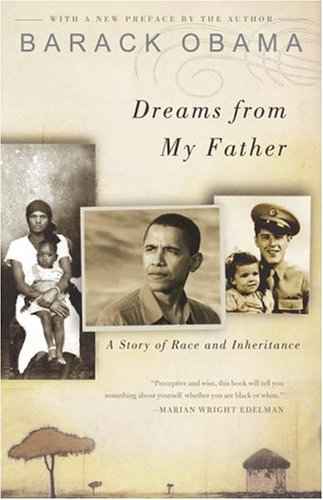
Can Obama organize a community for all Americans?
(OK. The October book club selection is really late, but this book has been hard to come by. Guess why? -ed.)
With Barack Obama seemingly on the verge of winning the Presidency, many observers -- both within the United States and otherwise -- may wonder precisely what it is that makes him tick.
Dreams From My Father actually makes it abundantly clear.
First off, one may wonder how many American liberals might be uncomfortable with the reality that Obama actually reflects a politically incorrect aspect of African American culture -- the unfortunate stereotype of the absentee father.
Obama spends the book equally divided between three different tasks: chronicling his experience growing up without his father, his experiences as a community organizer in Chicago, and his direct confrontation with his identity as an African American in Kenya.
Most interestingly, the path Obama seems to be following to the White House -- unless the numerous undecided voters still at stake in the 2008 Presidential election intercede -- seems to closely resemble that of Harold Washington, the first African American mayor of Chicago.
Interestingly, Obama's presidency may pose the same dilemma to young black leaders as Washington's mayoral reign posed to Obama. While trying to organize numerous iniatives for the betterment of Chicago's Altgeld neighbourhood Obama came face to face with the complacency of older, more entrenched black leaders who believed they had a "direct line to the mayor's office".
An Obama Presidency may fool many black leaders into a similar sense of complacency -- causing them to forgo community measures in favour of expected initiatives from higher on. In the end, it's possible that an Obama Presidency may serve to undermine community-level initiatives.
The other interesting element of Obama's personality that emerges is a wariness of his father's thwarted ambitions. Having studied in America -- in Hawaii and at Harvard -- Barack Obama Sr expected to become a prominent man in Kenya. Yet a seeming lack of political savvy wound up with Barack Sr falling out of favour with the Kenyan leadership resulted in the promises of such prominence vanishing before his very eyes.
Encounters with various family members in Kenya underscored an expectation that Obama will accomplish great things of Obama. That and intra-family rivalries may be serving to intensify the personal pressure on Obama to emerge victorious from this presidential campaign.
Dreams From My Father is a fascinating, thought-provoking read. It's well worth the time to finish before the election on November 4, if one can find the time.
The New-Age Political Dilemma: Leadership or Management?
Canada needs to correct historical leadership deficit
If one were to ask Canadians, there would be little question: Canadians want to lead the world.
Paradoxically, if one were to ask Canadians, they may receive a contradictory answer: Canadians feel as if their country has failed to ascend to a position of leadership in the world, and has instead been relegated into the ranks of the followers.
For one, Lieutenant General (ret) Romeo Dallaire would wistfully agree. And as disappointing as this state of affairs may be for many Canadians, those many Canadians may also have to agree with Dallaire when he points out that we may ultimately only have ourselves to blame: Canada's failure to lead on the global stage may have come about as a result of a deficit of leadership at home.
"We have been a very well-managed country, but we have not been well led," Dallaire recently told an audience in Peterborough, Ontario. "We are within the power structure of the world, what are we going to do with it?"
"We've got to move to change the future," he added.
Anyone who has ever been privileged enough to hear Dallaire, who continues to serve his country as a Liberal Senator, speak understands the depth of his faith in Canadians. This is a man who not only fervently believes that Canadians can lead on the global stage, but rather knows we can.
He's done it himself. In 1994, he sacrificed too much of himself trying to avert the genocide that took place in Rwanda, where Hutu militia slaughtered nearly 1,000,000 Tutsis and moderate Hutus.
Dallaire and his UNAMIR peacekeeping force struggled against the superior numbers of the Hutu militia, insufficient supplies and ammunition, and scarcity of even the most basic necessities while waiting for the world to wake up to what was taking place in Rwanda.
 By the time the civil conflict in Rwanda began to wound down and a reinforced UNAMIR 2 mission began to deploy, Dallaire was utterly spent. Suffering from the Post Traumatic Stress Syndrome that would frame the next few years of his life.
Both Dallaire's message and his example are crystal clear: leadership on the world stage isn't a right -- it's a privilege that must be earned. Furthermore, it comes with a price.
Sadly, it seems that all too often either Canadian leaders, or Canadians in general, aren't willing to pay the price for leadership on the world stage. Global leadership comes with various costs: financial, political, personal, and human.
Throughout much of the postwar period, Canada's political leaders proved unwilling to pay the financial cost of global leadership. Under Pearson, Trudeau, Mulroney and Chretien, funding of Canada's armed forces continually declined until after 9/11, when security-related pressures forced the Chretien government to start to take the issue seriously.
But by the time the 1994 conflict in Rwanda rolled around, Canada's military was approaching dire straights. While many other countries came to admire Canada's armed forces, it was largely because they were accomplishing tremendously impressive feats with tremendously sub-par equipment.
The argument could be raised that even if Chretien's government cared enough about what was happening in Rwanda, it was still unable to respond due to the neglected state of Canada's military.
Yet remarkably many of those who would have been most eager to send a significant contingent of Canadian troops into Rwanda have actually decried recent military spending that, once upon a time, would have made such a rescue operation possible.
It's hard to fault blinkered ideologues such as Linda McQuaig for such an inconsistency. They literally have no understanding of what most modern peacekeeping missions actually entail.
Even those who may otherwise profit politically from denouncing the Harper government's military spending understand why it's so crucial. As Michael Ignatieff notes:
Even when one considers the current situation in Afghanistan and the often-idealized alternative mission in the Sudan, one encounters serious shortages of realistic thinking on the part of such ideologues. Once again, from Ignatieff:
Warfare, on the other hand, is seen quite differently, even when the cause being fought for is in line with Canadian interests and values. Even when a withdrawal from the theatre of conflict would result in the ascension of a regime -- such as the Taliban -- so antithetical to Canadian values.
Even when the potential triumph or defeat of Canadian values -- so often claimed by individuals such as McQuaig as their values -- is at stake, these are people who are unwilling to pay a political price for them.
Sadly, sometimes even those Canadians who claim to support missions such as that in Afghanistan are unwilling to pay a political price for it. Little else remains to be said about Stephen Harper's recent decision to end the mission altogether in 2011, whether the mission is accomplished or not.
Sometimes leadership on the global stage carries a tremendous personal cost. As previously mentioned, Dallaire himself has paid that personal cost in spades -- and paid not only his own share, but that of an entire country.
It's only natural, however, that many people would be reluctant to pay the human cost of global leadership. No one enjoys the prospect of sending troops overseas to die. When they are sent, every prayer is uttered that they'll return home safely.
But even as those who would end up paying that human cost with their lives or health continue to support their mission despite the loss of their comrades, it serves a reminder: our service men and women volunteer knowing that the price of global leadership may be their lives.
This does nothing to undermine the responsibility of political leaders to ensure that the lives of our service men and women are risked only when necessary. But it should also remind them that such risks are truly inevitable, regardless of the anxiety that accompanies making decisions that may very well turn out to be matters of life and death.
Dallaire understands this. The current road of global leadership is not an easy one to traverse. "We are in a new era and it's not necessarily the easiest era," Dallaire said. "If you are a leader, part of your job is to anticipate the future. We are in a time of revolutions and not in an era of change."
The challenge for Canadians will be to decide whether they want their leaders to lead, or to settle for "leaders" who promote themselves more as public managers.
If Canadians want to lead on the global stage, we'll need to understand that such leadership has to start at home. And it has to begin with both leaders and citizens who are willing to pay that price.
If one were to ask Canadians, there would be little question: Canadians want to lead the world.
Paradoxically, if one were to ask Canadians, they may receive a contradictory answer: Canadians feel as if their country has failed to ascend to a position of leadership in the world, and has instead been relegated into the ranks of the followers.
For one, Lieutenant General (ret) Romeo Dallaire would wistfully agree. And as disappointing as this state of affairs may be for many Canadians, those many Canadians may also have to agree with Dallaire when he points out that we may ultimately only have ourselves to blame: Canada's failure to lead on the global stage may have come about as a result of a deficit of leadership at home.
"We have been a very well-managed country, but we have not been well led," Dallaire recently told an audience in Peterborough, Ontario. "We are within the power structure of the world, what are we going to do with it?"
"We've got to move to change the future," he added.
Anyone who has ever been privileged enough to hear Dallaire, who continues to serve his country as a Liberal Senator, speak understands the depth of his faith in Canadians. This is a man who not only fervently believes that Canadians can lead on the global stage, but rather knows we can.
He's done it himself. In 1994, he sacrificed too much of himself trying to avert the genocide that took place in Rwanda, where Hutu militia slaughtered nearly 1,000,000 Tutsis and moderate Hutus.
Dallaire and his UNAMIR peacekeeping force struggled against the superior numbers of the Hutu militia, insufficient supplies and ammunition, and scarcity of even the most basic necessities while waiting for the world to wake up to what was taking place in Rwanda.
By the time the civil conflict in Rwanda began to wound down and a reinforced UNAMIR 2 mission began to deploy, Dallaire was utterly spent. Suffering from the Post Traumatic Stress Syndrome that would frame the next few years of his life.Both Dallaire's message and his example are crystal clear: leadership on the world stage isn't a right -- it's a privilege that must be earned. Furthermore, it comes with a price.
Sadly, it seems that all too often either Canadian leaders, or Canadians in general, aren't willing to pay the price for leadership on the world stage. Global leadership comes with various costs: financial, political, personal, and human.
Throughout much of the postwar period, Canada's political leaders proved unwilling to pay the financial cost of global leadership. Under Pearson, Trudeau, Mulroney and Chretien, funding of Canada's armed forces continually declined until after 9/11, when security-related pressures forced the Chretien government to start to take the issue seriously.
But by the time the 1994 conflict in Rwanda rolled around, Canada's military was approaching dire straights. While many other countries came to admire Canada's armed forces, it was largely because they were accomplishing tremendously impressive feats with tremendously sub-par equipment.
The argument could be raised that even if Chretien's government cared enough about what was happening in Rwanda, it was still unable to respond due to the neglected state of Canada's military.
Yet remarkably many of those who would have been most eager to send a significant contingent of Canadian troops into Rwanda have actually decried recent military spending that, once upon a time, would have made such a rescue operation possible.
It's hard to fault blinkered ideologues such as Linda McQuaig for such an inconsistency. They literally have no understanding of what most modern peacekeeping missions actually entail.
Even those who may otherwise profit politically from denouncing the Harper government's military spending understand why it's so crucial. As Michael Ignatieff notes:
"One of the things I have learned in 15 years out there in the killing fields of Africa and the Balkans, is that you can't protect human beings with blue berets and a sidearm. I'm fiercely proud of our peacekeeping tradition. Where peacekeeping of the traditional Pearsonian sort can be practiced we must practice it. But in a lot of cases now, in situations where you want to protect human beings, you want to prevent them from being ethnically cleansed or massacred because of their race, religion or ethnicity, you've got to have bulked up capabilities. You gotta go in there with flak jackets, you've got to have armour, you've gotta protect them."What individuals such as Linda McQuaig -- in fact, the entire core of writers publishing via Global Research have willfully overlooked is the nature of modern conflict. The days of the idealized Pearsonian blue beret have long passed.
Even when one considers the current situation in Afghanistan and the often-idealized alternative mission in the Sudan, one encounters serious shortages of realistic thinking on the part of such ideologues. Once again, from Ignatieff:
"The problems in Darfur, however, are extremely serious. Sometimes people can say that "if I can just go there. Why Afghanistan? Why not Darfur?". The only thing to bear in mind when you say that is just think about what a deployment of Canadians in Darfur would look like.But there's a reason why McQuaig and her contemporaries prefer peacekeeping missions such as the one they imagine in Darfur to the less pleasant business of conducting warfare -- peacekeeping comes with virtually no political price for them. Unless peacekeepers are killed in a Mogadishu-style ambush, peacekeeping is considered to be a politically nonthreatening activity -- generally considered to be a noble cause.
It's 55 degrees centigrade. There's no cover anywhere. Do you think the Janjaweed are going to get off their camels and walk up when they see a Canadian flag and shake our hand? No. It's a combat mission."
Warfare, on the other hand, is seen quite differently, even when the cause being fought for is in line with Canadian interests and values. Even when a withdrawal from the theatre of conflict would result in the ascension of a regime -- such as the Taliban -- so antithetical to Canadian values.
Even when the potential triumph or defeat of Canadian values -- so often claimed by individuals such as McQuaig as their values -- is at stake, these are people who are unwilling to pay a political price for them.
Sadly, sometimes even those Canadians who claim to support missions such as that in Afghanistan are unwilling to pay a political price for it. Little else remains to be said about Stephen Harper's recent decision to end the mission altogether in 2011, whether the mission is accomplished or not.
Sometimes leadership on the global stage carries a tremendous personal cost. As previously mentioned, Dallaire himself has paid that personal cost in spades -- and paid not only his own share, but that of an entire country.
It's only natural, however, that many people would be reluctant to pay the human cost of global leadership. No one enjoys the prospect of sending troops overseas to die. When they are sent, every prayer is uttered that they'll return home safely.
But even as those who would end up paying that human cost with their lives or health continue to support their mission despite the loss of their comrades, it serves a reminder: our service men and women volunteer knowing that the price of global leadership may be their lives.
This does nothing to undermine the responsibility of political leaders to ensure that the lives of our service men and women are risked only when necessary. But it should also remind them that such risks are truly inevitable, regardless of the anxiety that accompanies making decisions that may very well turn out to be matters of life and death.
Dallaire understands this. The current road of global leadership is not an easy one to traverse. "We are in a new era and it's not necessarily the easiest era," Dallaire said. "If you are a leader, part of your job is to anticipate the future. We are in a time of revolutions and not in an era of change."
The challenge for Canadians will be to decide whether they want their leaders to lead, or to settle for "leaders" who promote themselves more as public managers.
If Canadians want to lead on the global stage, we'll need to understand that such leadership has to start at home. And it has to begin with both leaders and citizens who are willing to pay that price.
Wednesday, October 22, 2008
If "Ifs" and "Buts" Were Candy And Nuts...
...Will Wilkinson would still be fucking clueless
In the wake of the 2008 federal election, many Canadians are concerned about the lowest rate of voter turnout in the history of Canadian confederation.
For the first time in Canadian history, voter turnout dropped below 60&. 13.8 million out of 23.4 million voters reported to cast ballots in the election, which returned Stephen Harper's Conservative government for a second term. Sadly, this is down a full million from the 2006 election.
Sad, that is, unless you're Will Wilkinson. Writing in the Ottawa Citizen, Wilkinson muses "no voters, no problem!"
But those who pay attention know quite different: that a failure to participate in what is actually the easiest way to participate in the political process is a failure to care.
Those who don't plan to vote certainly aren't attending political rallies or candidate debates. And if they read about the election at all, it's more likely than not that it's simply en rote to the Sunshine Girl.
The notion that voter non-participation reflects higher rates of civic trust seems to rest on the notion that voters cannot find a preference amongst the various offered alternatives. But this would suggest a significant portion of the Canadian electorate -- 40% + -- that would need to be utterly devoid of personal values.
No one is devoid of personal values.
A more likely alternative yet is that voters aren't finding candidates who embody their values. Even this underlies a deeply-rooted problem within the political system: a lack of options in the Canadian political system.
Furthermore, Wilkinson actually suggests that a refusal to vote is a vote for the status quo. Simply not so. After all, the notion that declining to vote is a vote for the status quo would depend on the status quo being assured.
In the 2008 federal election, the status quo was far from assured. In fact, the status quo is never assured.
The numerous recounts ordered after the election show how close this election was in many ridings -- some in which the incumbent was defeated.
In such cases, only a few more ballots in favour of the incumbent -- in favour of the status quo -- could have made the difference.
Not voting is not a vote for the status quo. Not voting is a vote for nothing.
But it's hard to imagine who, in this country, could not have the time or opportunity to inform themselves during election time. Election news dominates television, radio and newsprint during a campaign. The internet is inevitably abound with news about virtually any candidate or party one could wish to inform themselves about.
In order to not have the opportunity to inform oneself on an election, one would have to either be blind and deaf, or living in a uni-bomber style shack.
Frankly, Wilkinson may be right about one thing: any voter unwilling to turn off the new Metallica CD long enough to listen to news radio on the way to or from work may be doing their country a service by not voting. But that individual would still do their country a greater service by casting an informed vote on election day.
But one need not know the ins-and-outs of running a Parliamentary committee in order to judge a candidate's ideas and qualifications.
Even if non-voters have no opinion regarding the public good, it would be remiss to pretend that, in itself, is not a problem.
This isn't a bad idea. After all, as Benjamin Barber would remind us, if disagreement is the language of democracy, education provides us with the syntax. Each reasonable excuse for voter non-participation offered by Wilkinson could easily be remedied by better education in various subjects, including history and basic civics.
Twelve million voters declining to cast ballots could, in a sense, almost be argued to be a sign that more and more Canadians are embracing the most basic element of Barber's model of strong democracy -- increased self-government in the public realm.
Yet in order for this to be the case, one would expect to have witnessed a dramatic surge in membership in Civil Society Organizations -- the realm in which self-government most often occurs. Yet membership in most CSOs continues to remain restricted mostly to those most committed to their causes -- ranging from organizations like Amnesty International to the Salvation Army Church.
Many of these people are already amongst any country's most politically active citizens.
Self-government via civil society offers no remedy to non-voter anxiety.
But only the most fervent libertarian could look at declining voter turnout and see a victory for conservatism or the public good.
After all, declining to participate in the "ritual symbolic warfare" Wilkinson envisions essentially abandons the field of such battle to those with ideas that may prove anathema to the average libertarian.
All it would take for a few seats that would otherwise be won by pro-small government candidates to go to their statist adversaries would be for just a few too many voters accepting Wilkinson's invitation to theoretically vote for the status quo by not voting at all.
Under such circumstances, the non-vote for the status quo was actually a vote for bigger government, and -- in the wrong hands -- less of the individual freedom that the Cato Institute favours.
One wonders if Wilkinson would be willing to stand by this column if that actually turned out to be the case.
In the wake of the 2008 federal election, many Canadians are concerned about the lowest rate of voter turnout in the history of Canadian confederation.
For the first time in Canadian history, voter turnout dropped below 60&. 13.8 million out of 23.4 million voters reported to cast ballots in the election, which returned Stephen Harper's Conservative government for a second term. Sadly, this is down a full million from the 2006 election.
Sad, that is, unless you're Will Wilkinson. Writing in the Ottawa Citizen, Wilkinson muses "no voters, no problem!"
"Last week's federal election was decided with the lowest levels of voter turnout in Canadian history -- about 59 per cent. But public-spirited citizens should not therefore wring their hands about the sorry state of Canadian democracy. Contrary to the folklore of democratic health, low turnout can signal social solidarity, reflect real civic virtue, and even make democracy work better."This is, of course, nonsense. Wilkinson's justification for this absurd statement relies heavily on "if" and "but" reasoning.
"We humans are adversarial beings, easily riled by us-versus-them conflict. (Even Canadians!) Democratic politics is a wonderful way to peacefully channel social antagonism into ritual symbolic warfare. High voter turnout is as likely to reflect angry social division as it is to augur the reign of Kumbaya social cohesion.Wilkinson actually suggests that lower voter turnout reflects higher rates of social trust. If one is actively seeking a means by which they can alleviate anxiety over low voter participation, this would almost seem adequate.
Indeed, lower levels of turnout may suggest that voters actually trust each other more -- that fewer feel an urgent need to vote defensively, to guard against competing interests or ideologies. Is it really all that bad if a broad swath of voters, relatively happy with the status quo, sit it out from a decided lack of pique?"
But those who pay attention know quite different: that a failure to participate in what is actually the easiest way to participate in the political process is a failure to care.
Those who don't plan to vote certainly aren't attending political rallies or candidate debates. And if they read about the election at all, it's more likely than not that it's simply en rote to the Sunshine Girl.
The notion that voter non-participation reflects higher rates of civic trust seems to rest on the notion that voters cannot find a preference amongst the various offered alternatives. But this would suggest a significant portion of the Canadian electorate -- 40% + -- that would need to be utterly devoid of personal values.
No one is devoid of personal values.
A more likely alternative yet is that voters aren't finding candidates who embody their values. Even this underlies a deeply-rooted problem within the political system: a lack of options in the Canadian political system.
Furthermore, Wilkinson actually suggests that a refusal to vote is a vote for the status quo. Simply not so. After all, the notion that declining to vote is a vote for the status quo would depend on the status quo being assured.
In the 2008 federal election, the status quo was far from assured. In fact, the status quo is never assured.
The numerous recounts ordered after the election show how close this election was in many ridings -- some in which the incumbent was defeated.
In such cases, only a few more ballots in favour of the incumbent -- in favour of the status quo -- could have made the difference.
Not voting is not a vote for the status quo. Not voting is a vote for nothing.
"Moreover, if you want to be civic-minded, your duty isn't to fill in ballots just to fill in ballots. You shouldn't do it in ignorance, out of emotion, or to win approval from your political friends. Your duty is to vote well -- to participate in a way that, at the very least, makes the outcome no worse.Certainly, an informed voter is much better than an uninformed voter. An informed voter will make a wiser decision ten times out of ten.
Everybody has an incontestable and absolute right to his or her vote, but that doesn't mean it's always right to vote. Abstaining can be a way of looking after the public good, too. Not all of us have the energy, inclination, or opportunity to learn what we need to know in order to vote well. And that's OK. There's more to public-spiritedness than showing up at the polls. You can run a small business or coach a kids' hockey team with the common good in mind. That's an expression of civic virtue, too.
The virtue of opting out is especially clear once you grasp that more voting isn't necessarily better voting. Specialists in public opinion have exhaustively documented the average voter's shocking ignorance about the main issues of the day, the names of their local candidates for office, or the policies the candidates support."
But it's hard to imagine who, in this country, could not have the time or opportunity to inform themselves during election time. Election news dominates television, radio and newsprint during a campaign. The internet is inevitably abound with news about virtually any candidate or party one could wish to inform themselves about.
In order to not have the opportunity to inform oneself on an election, one would have to either be blind and deaf, or living in a uni-bomber style shack.
Frankly, Wilkinson may be right about one thing: any voter unwilling to turn off the new Metallica CD long enough to listen to news radio on the way to or from work may be doing their country a service by not voting. But that individual would still do their country a greater service by casting an informed vote on election day.
"The flakiest voters -- the ones least motivated to show up at the polls year in and year out -- also tend to be most poorly informed. So when turnout drops, it tends to leave the pool of remaining voters with an improved average level of political knowledge and policy know-how. If well-informed voters have a better picture of the candidate or party most likely to promote the general welfare, then especially high turnout can actually tilt an election away from the better choice, leaving everyone a bit worse off. And that's not very civic-minded."This is an argument that also leads directly into the realm of elite rule. The argument raised is that, in order to make a valid political decision, one should know how government works.
But one need not know the ins-and-outs of running a Parliamentary committee in order to judge a candidate's ideas and qualifications.
"At this point in the argument, some readers will have become pretty upset. The "best informed" voters tend to be the best-educated, and therefore tend to be relatively wealthy. Doesn't this line of thinking suggest that relatively disadvantaged citizens would do us all a favour -- would do themselves a favour -- by staying home on election day? But then who will stand up for them? Who will promote their interests?True enough. But not voting doesn't support any notion of the public good. Once again, a ballot not cast is a ballot for nothing.
It's an excellent question, but it's based on one disproven and one unlikely assumption. The disproven assumption is that economic self-interest predicts voter behaviour. The consensus finding of political scientists is that voters -- lettered and unlettered, rich and poor -- tend to vote in good faith to promote what they see as the public good. That's good news. The unlikely assumption is that the voters who know least about politics and public policy have the means to make good decisions about which candidates and policies will best promote their interests. That doesn't compute."
Even if non-voters have no opinion regarding the public good, it would be remiss to pretend that, in itself, is not a problem.
"But everyone should have the means to make informed and effective democratic decisions. And that's really the issue, isn't it? It would be ideal were each and every citizen to have the income and education typical of well-informed, motivated voters. But to get there, we need policies that will actually work to promote broader prosperity and a fuller realization of basic human capacities. A better-informed pool of voters is more likely to deliver those policies."In other words, in order to increase voter turnout, Wilkinson argues, we would need to increase the level of education.
This isn't a bad idea. After all, as Benjamin Barber would remind us, if disagreement is the language of democracy, education provides us with the syntax. Each reasonable excuse for voter non-participation offered by Wilkinson could easily be remedied by better education in various subjects, including history and basic civics.
Twelve million voters declining to cast ballots could, in a sense, almost be argued to be a sign that more and more Canadians are embracing the most basic element of Barber's model of strong democracy -- increased self-government in the public realm.
Yet in order for this to be the case, one would expect to have witnessed a dramatic surge in membership in Civil Society Organizations -- the realm in which self-government most often occurs. Yet membership in most CSOs continues to remain restricted mostly to those most committed to their causes -- ranging from organizations like Amnesty International to the Salvation Army Church.
Many of these people are already amongst any country's most politically active citizens.
Self-government via civil society offers no remedy to non-voter anxiety.
"And so we are left with the Zen riddle of democracy: the closer a non-ideal democracy comes to maximum democratic participation, the less likely it is to adopt the means to ideal democratic participation. Lower voter turnout sets the stage for better democracy.Wilkinson is a researcher for the Cato Institute in Washington, DC. The Cato Institute is think tank that favours individual liberty, free markets and small government.
So, on behalf of our cherished ideals of democratic equality, let me be the first to say: well done, Canadian abstainers."
But only the most fervent libertarian could look at declining voter turnout and see a victory for conservatism or the public good.
After all, declining to participate in the "ritual symbolic warfare" Wilkinson envisions essentially abandons the field of such battle to those with ideas that may prove anathema to the average libertarian.
All it would take for a few seats that would otherwise be won by pro-small government candidates to go to their statist adversaries would be for just a few too many voters accepting Wilkinson's invitation to theoretically vote for the status quo by not voting at all.
Under such circumstances, the non-vote for the status quo was actually a vote for bigger government, and -- in the wrong hands -- less of the individual freedom that the Cato Institute favours.
One wonders if Wilkinson would be willing to stand by this column if that actually turned out to be the case.
Tuesday, October 21, 2008
Angels and Demons Can Be As Real As We Perceive
Warning: the following post contains significant spoilers about the movie Max Payne. Those still interested in seeing this film should consider themselves forewarned.
Drugs and religion are a devastating combination
Those who have seen the trailers for Max Payne may suspect the movie to be a supernatural thriller -- something of a Constantine without Keanu Reeves.
However, Max Payne is actually quite different than the uninitiated -- those who haven't played the video game -- may otherwise suspect. The fire and brimstone images in the film turn out to be not the result of supernatural forces, but rather the hallucinations caused by a powerful drug.
Max Payne (Mark Wahlberg) is, by day, an emotionally shattered widower working the cold cases desk at the police department and, by night, a brooding hunter, seeking to uncover the identity of his wife and child's last escaped murderer.
In the course of a fateful evening he's drawn into the cumulative intrigue of drug culture, religious zealotry and corporate misdeeds that leads him to the very heart of his family's murder.
With the help of Mona Sax (Mila Kunis), an assassin whose sister's murder Payne is suspected of, Payne uncovers the trail of Jack Lupino.
Amaury Nolasco plays Lupino, a War on Terror veteran -- the theatre of conflict in which he serves is unspecified -- on whom Aesir tests their drug. As it turns out, Valkyr has, at best a 1% success rate. The rest of the test subjects go insane amid hallucinations of angels and demons.
Valkyr is also tremendously addictive -- more addictive in fact, than anything pharmaceutical executive Jason Colvin (Chris O'Donnel) has ever encountered. In time, even Lupino succumbs to its neurosis-inducing effects, and builds a Norse-themed religion around the drug. His most fervent followers join the gang assembled by BB Hensley -- Beau Bridges, playing the former partner of Payne's father, himself a cop -- and Aesir to peddle Valkyr for profit as a designer drug.
Lupino and his gang take on the identity of the Norse berserker -- believing they must die violently in order to ascend to heaven. In time, even the casual users of Valkyr are drawn into Lupino's twisted faith. They're identified by their wing tattoos, symbolic of the Valkyries they believe watch over them in order to choose the worthy dead -- those who draw first blood -- to Valhalla.
Hensley has used the addiction afflicted upon Lupino and his followers in order to control them and use them to his own ends. One of those ends was the murder of Michelle Payne, who had uncovered Valkyr as an employee of Aesir pharmaceuticals.
The utmost sinister edge of Valkyr's use as a religious sacrament is that it empowers ordinary, infallible humans with the spiritual status and authority of a god.
"Max Payne is looking for something that god wants to stay hidden," the underused Lincoln DeNeuf (Jamie Hector) intones during the film. The remark is very telling indeed.
If Jesus Christ himself is considered symbolically to be the source of the wine and bread used in Roman Catholic sacrament, then surely the creator of Valkyr -- Aesir pharmaceuticals -- would have to be Lupino's god.
Yet Hensey is a very corrupt man. He ordered the murder of Michelle Payne just to ensure Valkyr remains covered up, then began to sell this extremely volatile and dangerous drug for profit.
As alarming as the combination of drugs and religion in Max Payne is, the real-life implications of mixing drugs and religion can be just as alarming, especially when if effects the young and impressionable.
In particular, raves are known as a place where impressionable youths are exposed to drugs and drug culture. Once upon a time, this revolved around recreational drugs that were (mostly) harmless. But as rave culture has gone more and more mainstream, the prospect of easy drug-related profits has attracted harder and more dangerous drugs to the rave scene. In particular, crystal meth has become more and more prominent in BC's rave scene.
Most often the drug is mixed with ecstasy. In such cases, many of the ravers using the drug don't even know what they're taking.
Like crystal meth, ecstasy is a hallucinogen. It normally heightens the brain's sensitivity to textile stimuli. Continued use of ecstasy can result in permanent changes to the brain's chemical balance, sometimes resulting in disturbed sleep patterns.
Crystal meth, meanwhile, is highly addictive. A single dose can result in confusion and violent behaviour. Delusional psychosis can set in over time.
When such delusions begin to take on religious overtones, the effects can be disastrous for a great many people.
Intriguingly -- and disturbingly -- such religious overtones can be found in the typical rave environment.
Drugs such as ecstasy and GHB are used at raves in order to help invoke what many ravers refer to as a spiritual experience.
The dangers of drug addiction -- more and more often to drugs such as meth and GHB -- make the raver's spiritual journey a perilous one. And while it shouldn't be said that there's anything illegitimate about pursuing spirituality through a rave -- spirituality is best followed on an individual basis, as the seeker sees fit -- those following this path need to be aware of the dangers that linger there.
Also of interest is Santo Daime, a religion followed mostly in the Amazon region of South America, but is slowly spreading to places such as Britain.
Santo Daime mixes Christianity with African animism and South American shamanism. Its holy sacrament is dimethyltryptamine, also known as DMT.
DMT, normally a hallucinogen, is used in Santo Daime to incur psychedelic experiences.
The use of DMT in Santo Daime, however, has sinister potential. When used in moderation, DMT is not addictive and has few negative effects. However, DMT binds itself to neuroreceptors normally sensitive to Serotonin. Overuse of DMT could result in a chemical imbalance, as the brain starts underproducing Serotonin in response to the presence of a convenient substitute.
This actually provides the leadership of a Santo Daime Church with a shocking amount of power. Withdrawing their sacrament would also withdraw the Serotonin substitute that the brain has begun to depend on. The resulting Serotonin deficiency has been linked to conditions such as bulimia, anorexia, migraines, obsessive compulsive disorders, social phobias, schizophrenia and depression.
This should be considered far from unsurprising. DMT has been promoted by some doctors as a potential treatment for many of these conditions. Introducing excessive amounts of DMT into a chemically normal brain, however, can have potentially disturbing effects. Withdrawing the DMT thereafter can make these effects devastating.
The results of incurring a depression speak for themselves. Statistics hold that 15% of individuals hospitalized for depression will either commit or attempt suicide.
A scene in Max Payne could be considered a parable for such depression: one in which a man, about to be brutally killed by Lupino, desires a vial of Valkyr more strongly than he fears death. He desperately laps the contents of a vial off of a floor while Lupino proceeds to mercilessly behead the man.
In all fairness, it must be mentioned that few credible examples of DMT being used to hold leverage over a Santo Daime worshipper have been documented. The potential for unscrupulous individuals seeking leadership within the Church to take advantage of their followers, however, clearly does exist.
Drugs and religion tend to make a dangerous combination. And while Max Payne is clearly a hyperbolic depiction of such possibilities, it's difficult to ignore the potential that already exists.
Drugs and religion are a devastating combination
Those who have seen the trailers for Max Payne may suspect the movie to be a supernatural thriller -- something of a Constantine without Keanu Reeves.
However, Max Payne is actually quite different than the uninitiated -- those who haven't played the video game -- may otherwise suspect. The fire and brimstone images in the film turn out to be not the result of supernatural forces, but rather the hallucinations caused by a powerful drug.
Max Payne (Mark Wahlberg) is, by day, an emotionally shattered widower working the cold cases desk at the police department and, by night, a brooding hunter, seeking to uncover the identity of his wife and child's last escaped murderer.
In the course of a fateful evening he's drawn into the cumulative intrigue of drug culture, religious zealotry and corporate misdeeds that leads him to the very heart of his family's murder.
With the help of Mona Sax (Mila Kunis), an assassin whose sister's murder Payne is suspected of, Payne uncovers the trail of Jack Lupino.
Amaury Nolasco plays Lupino, a War on Terror veteran -- the theatre of conflict in which he serves is unspecified -- on whom Aesir tests their drug. As it turns out, Valkyr has, at best a 1% success rate. The rest of the test subjects go insane amid hallucinations of angels and demons.
Valkyr is also tremendously addictive -- more addictive in fact, than anything pharmaceutical executive Jason Colvin (Chris O'Donnel) has ever encountered. In time, even Lupino succumbs to its neurosis-inducing effects, and builds a Norse-themed religion around the drug. His most fervent followers join the gang assembled by BB Hensley -- Beau Bridges, playing the former partner of Payne's father, himself a cop -- and Aesir to peddle Valkyr for profit as a designer drug.
Lupino and his gang take on the identity of the Norse berserker -- believing they must die violently in order to ascend to heaven. In time, even the casual users of Valkyr are drawn into Lupino's twisted faith. They're identified by their wing tattoos, symbolic of the Valkyries they believe watch over them in order to choose the worthy dead -- those who draw first blood -- to Valhalla.
Hensley has used the addiction afflicted upon Lupino and his followers in order to control them and use them to his own ends. One of those ends was the murder of Michelle Payne, who had uncovered Valkyr as an employee of Aesir pharmaceuticals.
The utmost sinister edge of Valkyr's use as a religious sacrament is that it empowers ordinary, infallible humans with the spiritual status and authority of a god.
"Max Payne is looking for something that god wants to stay hidden," the underused Lincoln DeNeuf (Jamie Hector) intones during the film. The remark is very telling indeed.
If Jesus Christ himself is considered symbolically to be the source of the wine and bread used in Roman Catholic sacrament, then surely the creator of Valkyr -- Aesir pharmaceuticals -- would have to be Lupino's god.
Yet Hensey is a very corrupt man. He ordered the murder of Michelle Payne just to ensure Valkyr remains covered up, then began to sell this extremely volatile and dangerous drug for profit.
As alarming as the combination of drugs and religion in Max Payne is, the real-life implications of mixing drugs and religion can be just as alarming, especially when if effects the young and impressionable.
In particular, raves are known as a place where impressionable youths are exposed to drugs and drug culture. Once upon a time, this revolved around recreational drugs that were (mostly) harmless. But as rave culture has gone more and more mainstream, the prospect of easy drug-related profits has attracted harder and more dangerous drugs to the rave scene. In particular, crystal meth has become more and more prominent in BC's rave scene.
Most often the drug is mixed with ecstasy. In such cases, many of the ravers using the drug don't even know what they're taking.
Like crystal meth, ecstasy is a hallucinogen. It normally heightens the brain's sensitivity to textile stimuli. Continued use of ecstasy can result in permanent changes to the brain's chemical balance, sometimes resulting in disturbed sleep patterns.
Crystal meth, meanwhile, is highly addictive. A single dose can result in confusion and violent behaviour. Delusional psychosis can set in over time.
When such delusions begin to take on religious overtones, the effects can be disastrous for a great many people.
Intriguingly -- and disturbingly -- such religious overtones can be found in the typical rave environment.
Drugs such as ecstasy and GHB are used at raves in order to help invoke what many ravers refer to as a spiritual experience.
The dangers of drug addiction -- more and more often to drugs such as meth and GHB -- make the raver's spiritual journey a perilous one. And while it shouldn't be said that there's anything illegitimate about pursuing spirituality through a rave -- spirituality is best followed on an individual basis, as the seeker sees fit -- those following this path need to be aware of the dangers that linger there.
Also of interest is Santo Daime, a religion followed mostly in the Amazon region of South America, but is slowly spreading to places such as Britain.
Santo Daime mixes Christianity with African animism and South American shamanism. Its holy sacrament is dimethyltryptamine, also known as DMT.
DMT, normally a hallucinogen, is used in Santo Daime to incur psychedelic experiences.
The use of DMT in Santo Daime, however, has sinister potential. When used in moderation, DMT is not addictive and has few negative effects. However, DMT binds itself to neuroreceptors normally sensitive to Serotonin. Overuse of DMT could result in a chemical imbalance, as the brain starts underproducing Serotonin in response to the presence of a convenient substitute.
This actually provides the leadership of a Santo Daime Church with a shocking amount of power. Withdrawing their sacrament would also withdraw the Serotonin substitute that the brain has begun to depend on. The resulting Serotonin deficiency has been linked to conditions such as bulimia, anorexia, migraines, obsessive compulsive disorders, social phobias, schizophrenia and depression.
This should be considered far from unsurprising. DMT has been promoted by some doctors as a potential treatment for many of these conditions. Introducing excessive amounts of DMT into a chemically normal brain, however, can have potentially disturbing effects. Withdrawing the DMT thereafter can make these effects devastating.
The results of incurring a depression speak for themselves. Statistics hold that 15% of individuals hospitalized for depression will either commit or attempt suicide.
A scene in Max Payne could be considered a parable for such depression: one in which a man, about to be brutally killed by Lupino, desires a vial of Valkyr more strongly than he fears death. He desperately laps the contents of a vial off of a floor while Lupino proceeds to mercilessly behead the man.
In all fairness, it must be mentioned that few credible examples of DMT being used to hold leverage over a Santo Daime worshipper have been documented. The potential for unscrupulous individuals seeking leadership within the Church to take advantage of their followers, however, clearly does exist.
Drugs and religion tend to make a dangerous combination. And while Max Payne is clearly a hyperbolic depiction of such possibilities, it's difficult to ignore the potential that already exists.
Monday, October 20, 2008
And Another One Bites the Dust
No free ride for Tories as Dion will continue as leader until after convention
It's said that bad things happen in threes. But in the case of Stephane Dion and the Liberal it all depends on perspective.
After being defeated in the third federal election in four years, Stephane Dion has called the third Liberal leadership convention in five years.
 "I have informed the president of the Liberal Party of Canada and the president of the national caucus that I will stay as leader until a new leader is chosen at a leadership convention that I have asked to be organized," Dion announced today.
In finally announcing his intentions after nearly a week of silence and reflection, Dion seems poised to neither fully accept nor question the judgment of Canadian voters.
"I still think that if we would have been equipped to explain why I'm fighting for my country, what kind of leader I would have been, what kind of prime minister I would have been and what kind of policy we're proposing, we would have won this election and we would have today a much better government than the one we have," Dion added.
Although he's hardly proven to be a wise leader, or gracious in defeat, Dion seems to have looked to the past for inspiration regarding his decision to continue to serve until replaced. In 1979, Pierre Trudeau resigned as Liberal leader in the wake of an electoral defeat at the hands of the Joe Clark Progressive Conservatives, but left himself available to return in the event of Clark's defeat.
In Trudeau's place, Clark's fall didn't take long to occur. And while he may have asked "the sovereign" to "ask on bended knee three times" before returning, the result speaks for itself. Clark's government was replaced with a Liberal majority.
What all this means is that there will be no free ride for Prime Minister Stephen Harper and his Conservative government. Even if the Liberals aren't fully confident in Dion's ability to contest another election, they need not be hesitant to topple the government if the opportunity should arise.
With Dion -- the principle pillar in the "Red Green alliance" -- having resigned, it isn't at all unfair to continue speculating on the leadership prospects of the Green party's Elizabeth May.
 Having hitched both her own and her party's electoral prospects to Dion and the Liberals, May has to face up to the reality that her gambit failed in both of its objectives: defeating the Conservative government and electing Green party MPs.
Many Greens are demanding May's resignation over a last-minute attempt to sway Green party voters to vote strategically against the Conservatives -- but not necessarily in favour of the Greens.
Whether May joins Dion among the ranks of defeated former leaders has yet to be seen.
Clearly the next task for the Liberals will be choosing their next leader. Numerous candidates -- John McCallum, Frank McKenna, John Manley, Ujjal Dosanjh, Bob Rae and Michael Ignatieff -- have already started lining up for the job. Others -- Justin Trudeau, Ralph Goodale -- have already sworn off any interest in the coming campaign.
“We must learn quickly from this experience and move on," Dion noted. "The search for a new Liberal leader will be part of a process of renewing our party, but clearly will not in itself be sufficient.”
One way or the other, the coming months will be crucial ones for both Canada and for its official opposition.
For left-wing Canadians, the defeat of Paul Martin's government may not have been such a good thing. Nor would the reelection of the Harper government have been. For Liberals, the ouster of three-time majority winning Jean Chretien turned out to be a bad thing -- as was the selection of his next two successors. For Liberals, Dion's resignation may or may not be a good thing (depending upon the perspective of the individual). But many Conservatives across Canada will be all smiles today.
Stephane Dion has formally bitten the dust.
It's said that bad things happen in threes. But in the case of Stephane Dion and the Liberal it all depends on perspective.
After being defeated in the third federal election in four years, Stephane Dion has called the third Liberal leadership convention in five years.
"I have informed the president of the Liberal Party of Canada and the president of the national caucus that I will stay as leader until a new leader is chosen at a leadership convention that I have asked to be organized," Dion announced today.In finally announcing his intentions after nearly a week of silence and reflection, Dion seems poised to neither fully accept nor question the judgment of Canadian voters.
"I still think that if we would have been equipped to explain why I'm fighting for my country, what kind of leader I would have been, what kind of prime minister I would have been and what kind of policy we're proposing, we would have won this election and we would have today a much better government than the one we have," Dion added.
Although he's hardly proven to be a wise leader, or gracious in defeat, Dion seems to have looked to the past for inspiration regarding his decision to continue to serve until replaced. In 1979, Pierre Trudeau resigned as Liberal leader in the wake of an electoral defeat at the hands of the Joe Clark Progressive Conservatives, but left himself available to return in the event of Clark's defeat.
In Trudeau's place, Clark's fall didn't take long to occur. And while he may have asked "the sovereign" to "ask on bended knee three times" before returning, the result speaks for itself. Clark's government was replaced with a Liberal majority.
What all this means is that there will be no free ride for Prime Minister Stephen Harper and his Conservative government. Even if the Liberals aren't fully confident in Dion's ability to contest another election, they need not be hesitant to topple the government if the opportunity should arise.
With Dion -- the principle pillar in the "Red Green alliance" -- having resigned, it isn't at all unfair to continue speculating on the leadership prospects of the Green party's Elizabeth May.
Having hitched both her own and her party's electoral prospects to Dion and the Liberals, May has to face up to the reality that her gambit failed in both of its objectives: defeating the Conservative government and electing Green party MPs.Many Greens are demanding May's resignation over a last-minute attempt to sway Green party voters to vote strategically against the Conservatives -- but not necessarily in favour of the Greens.
Whether May joins Dion among the ranks of defeated former leaders has yet to be seen.
Clearly the next task for the Liberals will be choosing their next leader. Numerous candidates -- John McCallum, Frank McKenna, John Manley, Ujjal Dosanjh, Bob Rae and Michael Ignatieff -- have already started lining up for the job. Others -- Justin Trudeau, Ralph Goodale -- have already sworn off any interest in the coming campaign.
“We must learn quickly from this experience and move on," Dion noted. "The search for a new Liberal leader will be part of a process of renewing our party, but clearly will not in itself be sufficient.”
One way or the other, the coming months will be crucial ones for both Canada and for its official opposition.
For left-wing Canadians, the defeat of Paul Martin's government may not have been such a good thing. Nor would the reelection of the Harper government have been. For Liberals, the ouster of three-time majority winning Jean Chretien turned out to be a bad thing -- as was the selection of his next two successors. For Liberals, Dion's resignation may or may not be a good thing (depending upon the perspective of the individual). But many Conservatives across Canada will be all smiles today.
Stephane Dion has formally bitten the dust.
Sunday, October 19, 2008
Adnan Oktar: Turkey's Richard Warman
Turkish creationist leading suppression of evolution in Turkey
Since successfully convincing a Turkish court to block access to Richard Dawkins' website, it would seem he's been a very busy man.
This week Oktar was successful in getting the website of the Vatan newspaper blocked in Turkey.
Once again, Oktar cited personal abuse and defamation as his reason for seeking the ban. "The reason for this block is a court decision sought by Adnan Oktar due to reader comments on an article printed on our site about his 'community'," Vatan explained.
Once again, Canada's pro-Human Rights Commission crowd has been eerily silent on Oktar's use of the notions of "defamation" and the "encouragement of hatred" to silence critics of his writings.
Some of the more intellectually impoverished members of the pro-HRC crowd have offered characteristically worthless commentary on the topic.
But this predominating silence is so eery because Canada has its own equivalent to Oktar -- Richard Warman, a multiple-time litigant under the Canadian Human Rights Commission, who has sought to silence many of his critics via legal action.
Of course, Warman himself has had his conduct scrutinized and been found wanting. In a country like Turkey, where the notion of free speech seems to carry so little influence with leaders, one has to wonder how likely it is that Oktar's conduct in his pro-censorship quest will receive the same scrutiny.
Not terribly likely.
Ironically, one would think that Canada's pro-HRC crowd would have a little more to say about this. After all, Oktar's targets, to date, have been Richard Dawkins, beloved atheist du jour and a liberal Turkish newspaper.
Then again, to deal with the issues being raised by Oktar's litigious nature would only shed additional light on their own warts -- and that is something that all too many of them simply could not bear.
Since successfully convincing a Turkish court to block access to Richard Dawkins' website, it would seem he's been a very busy man.
This week Oktar was successful in getting the website of the Vatan newspaper blocked in Turkey.
Once again, Oktar cited personal abuse and defamation as his reason for seeking the ban. "The reason for this block is a court decision sought by Adnan Oktar due to reader comments on an article printed on our site about his 'community'," Vatan explained.
Once again, Canada's pro-Human Rights Commission crowd has been eerily silent on Oktar's use of the notions of "defamation" and the "encouragement of hatred" to silence critics of his writings.
Some of the more intellectually impoverished members of the pro-HRC crowd have offered characteristically worthless commentary on the topic.
But this predominating silence is so eery because Canada has its own equivalent to Oktar -- Richard Warman, a multiple-time litigant under the Canadian Human Rights Commission, who has sought to silence many of his critics via legal action.
Of course, Warman himself has had his conduct scrutinized and been found wanting. In a country like Turkey, where the notion of free speech seems to carry so little influence with leaders, one has to wonder how likely it is that Oktar's conduct in his pro-censorship quest will receive the same scrutiny.
Not terribly likely.
Ironically, one would think that Canada's pro-HRC crowd would have a little more to say about this. After all, Oktar's targets, to date, have been Richard Dawkins, beloved atheist du jour and a liberal Turkish newspaper.
Then again, to deal with the issues being raised by Oktar's litigious nature would only shed additional light on their own warts -- and that is something that all too many of them simply could not bear.
Saturday, October 18, 2008
Old Separatists Never Die, They Just Get Pissed Off At France
Jacques Parizeau hurt by Nicolas Sarkozy's pro-unity comments
If anything over the past few years has lulled the Quebec separatist movement into a false sense of security, it certainly hasn't been French president Nicolas Sarkozy.
Some comments Sarkozy made while in Canada on Friday have enraged Quebec separatists once again, when he questioned the role of Quebec separatism given the current state of the world.
 “It's something constant in my political life. If someone tries to tell me that the world today needs an additional division, then they don't have the same read of the world as me,” Sarkozy said. “I don't know why a fraternal love of Quebec would have to be nourished through defiance toward Canada.”
Jacques Parizeau, for his own part, was outraged at the comments.
 “What this implies is that it is a judgment that is very anti-Quebec sovereignty that says: ‘We do not agree with Quebec sovereignty, we do not want additional divisions," Parizeau sniffed. "We accept divisions everywhere in the world but not that one.'”
Parizeau also noted that he doesn't feel Sarkozy's comments should damage a sovereign Quebec's relations with France. “It isn't because a head of state says an outrageous remark that it should change our relations with the French people,” he added.
Perhaps it's natural that Parizeau would be upset. For years, Quebec's sovereingtist movement depended upon France's support following a vote to separate from Canada. French President Jacques Chirac had pledged his willingness to help a newly sovereign Quebec chart its way through the international community.
But one of Jean Chretien's many valuable accomplishments as Prime Minister of Canada was turning Chirac from a pro-Pequiste adversary into a pro-Canadian unity ally.
Ever since, Quebec separatists have had less and less reason to feel confident about French support for their cause.
Former Quebec Premier Bernard Landry also took it upon him to add his two cents.
 “I hope the President of the republic poorly expressed himself and that it is not the way he actually thinks,” Landry mused. “If the President of the French republic came and interfered in our affairs and took a position against the independence of Quebec, well then it is extremely serious.”
Of course, many Canadians -- French Canadians and otherwise, within Quebec and otherwise -- would likewise view pro-sovereignty comments by Sarkozy as interference in the matter of Canadian unity. Many certainly did when former French President Charles DeGaulle did so.
 "What I think is Mr. Sarkozy has maybe misunderstood our project," said current Parti Quebecois leader Pauline Marois. "Maybe he doesn't understand the sovereignty project of the Quebec people which, on the contrary, is a very inclusive project, open on the world, and modern. People for decades around the world have given themselves countries, and I think Mr. Sarkozy rejoiced."
Of course, very few of these ethnic groups felt the need to deceive their own people in order to accomplish this task, but one digresses.
"Some people have a - how would you say - blunter interpretation [of the remarks]," Marois said of Parizeau's comments. "It's clear, if Mr. Sarkozy's references about a divisive project refer to the sovereignty project, it is simply not the case."
So apparently, to Pauline Marois, Quebec sovereigntism isn't divisive despite the fact that so many Quebeckers don't want it, and in 1995 the PQ and Bloc Quebecois had to pose a perplexing question to Quebeckers in order to artificially inflate support for "sovereignty association".
For her own part, former PQ Minister of International Relations Louise Beaudoin doesn't regard this as a threat to a sovereign Quebec's potential recognition. "The day Quebecers decide to be sovereign, notwithstanding the Clarity Act, by 50 per cent plus one, I'm telling you, France will recognize Quebec. It seems so obvious to me. They recognized Kosovo and Bosnia-Herzegovina, Moldova and I don't know who else," she insisted. "Sarkozy is a very pragmatic man. He changes his mind."
If Sarkozy were ever put in a position where he had to change his mind regarding Quebec separatism, it's entirely possible that he might. But with even Quebec separatists continually putting off another referendum until the conditions are right -- a time that hasn't arrived in 13 years, and isn't likely to arrive soon -- Sarkozy is unlikely to ever have to face such a prospect.
In the meantime, Jacques Parizeau can get as angry about Nicolas Sarkozy as he wants. It isn't getting him any closer to a sovereign Quebec.
If anything over the past few years has lulled the Quebec separatist movement into a false sense of security, it certainly hasn't been French president Nicolas Sarkozy.
Some comments Sarkozy made while in Canada on Friday have enraged Quebec separatists once again, when he questioned the role of Quebec separatism given the current state of the world.
“It's something constant in my political life. If someone tries to tell me that the world today needs an additional division, then they don't have the same read of the world as me,” Sarkozy said. “I don't know why a fraternal love of Quebec would have to be nourished through defiance toward Canada.”Jacques Parizeau, for his own part, was outraged at the comments.
“What this implies is that it is a judgment that is very anti-Quebec sovereignty that says: ‘We do not agree with Quebec sovereignty, we do not want additional divisions," Parizeau sniffed. "We accept divisions everywhere in the world but not that one.'”Parizeau also noted that he doesn't feel Sarkozy's comments should damage a sovereign Quebec's relations with France. “It isn't because a head of state says an outrageous remark that it should change our relations with the French people,” he added.
Perhaps it's natural that Parizeau would be upset. For years, Quebec's sovereingtist movement depended upon France's support following a vote to separate from Canada. French President Jacques Chirac had pledged his willingness to help a newly sovereign Quebec chart its way through the international community.
But one of Jean Chretien's many valuable accomplishments as Prime Minister of Canada was turning Chirac from a pro-Pequiste adversary into a pro-Canadian unity ally.
Ever since, Quebec separatists have had less and less reason to feel confident about French support for their cause.
Former Quebec Premier Bernard Landry also took it upon him to add his two cents.
“I hope the President of the republic poorly expressed himself and that it is not the way he actually thinks,” Landry mused. “If the President of the French republic came and interfered in our affairs and took a position against the independence of Quebec, well then it is extremely serious.”Of course, many Canadians -- French Canadians and otherwise, within Quebec and otherwise -- would likewise view pro-sovereignty comments by Sarkozy as interference in the matter of Canadian unity. Many certainly did when former French President Charles DeGaulle did so.
"What I think is Mr. Sarkozy has maybe misunderstood our project," said current Parti Quebecois leader Pauline Marois. "Maybe he doesn't understand the sovereignty project of the Quebec people which, on the contrary, is a very inclusive project, open on the world, and modern. People for decades around the world have given themselves countries, and I think Mr. Sarkozy rejoiced."Of course, very few of these ethnic groups felt the need to deceive their own people in order to accomplish this task, but one digresses.
"Some people have a - how would you say - blunter interpretation [of the remarks]," Marois said of Parizeau's comments. "It's clear, if Mr. Sarkozy's references about a divisive project refer to the sovereignty project, it is simply not the case."
So apparently, to Pauline Marois, Quebec sovereigntism isn't divisive despite the fact that so many Quebeckers don't want it, and in 1995 the PQ and Bloc Quebecois had to pose a perplexing question to Quebeckers in order to artificially inflate support for "sovereignty association".
For her own part, former PQ Minister of International Relations Louise Beaudoin doesn't regard this as a threat to a sovereign Quebec's potential recognition. "The day Quebecers decide to be sovereign, notwithstanding the Clarity Act, by 50 per cent plus one, I'm telling you, France will recognize Quebec. It seems so obvious to me. They recognized Kosovo and Bosnia-Herzegovina, Moldova and I don't know who else," she insisted. "Sarkozy is a very pragmatic man. He changes his mind."
If Sarkozy were ever put in a position where he had to change his mind regarding Quebec separatism, it's entirely possible that he might. But with even Quebec separatists continually putting off another referendum until the conditions are right -- a time that hasn't arrived in 13 years, and isn't likely to arrive soon -- Sarkozy is unlikely to ever have to face such a prospect.
In the meantime, Jacques Parizeau can get as angry about Nicolas Sarkozy as he wants. It isn't getting him any closer to a sovereign Quebec.
Defining the Role of the Fringe
"Fringe" parties can play a vital role in Canadian politics
In an op/ed article appearing in the Winnipeg Sun, Paul Rutherford has a message for Canada's fringe political players:
Go away.
In the course of the column, Rutherford describes Bloc Quebecois leader Gilles Duceppe, Green Party leader Elizabeth May and Reform party founder Preston Manning as "the worst thing to happen to Canadian politics in the last 20 years".
Rutherford accuses these parties of stealing votes from "legitimate parties" and insists that "they play no role in the democratic health of our country".
Unfortunately for Rutherford, he couldn't possibly be further from the truth.
The truth is that not only are fringe parties necessary, but sometimes they're inevitable, even when one would, as Rutherford, just as soon not even have them.
Manning's Reform party and Lucien Bouchard's Bloc Quebecois may well be the greatest example of each of these two scenarios.
A common grievance held by many members of the former Progressive Conservative party elite -- among them Joe Clark -- is that the Reform party undermined conservative politics in Canada by undermining the Progressive Conservative party. Not only did the party supplant the PCs in the west, but vote-splitting between Reform and PC candidates in Eastern Canada robbed the PCs of Parliamentary seats, and allowing the Jean Chretien Liberals to come up the middle in dozens of ridings on route to forming a majority government.
If Preston Manning had never founded the Reform party, many of them reason, Kim Campbell could have fended off near annihilation, and possibly even won.
This would almost seem reasonable. One very well could assume that the 19% of Canadian voters who supported the Reform party would support the Progressive Conservatives over the Liberals. But that would be making a fatal assumption in assuming that those voters -- particularly in the west -- would have been willing to continue supporting the PCs.
Many of them would just have likely stayed home on election day.
Many western voters had long tired of holding their noses and voting for a party that, all too often, didn't represent their interests. The 1984 election of Brian Mulroney via what Chantale Hebert describes as an Alberta-Quebec coalition turned out to be a rude awakening for many western conservatives.
Disillusioned with numerous episodes of the Mulroney government -- most notably the Meech Lake Accord, Charlottetown Accord and the F-18 Maintenance Contract fiasco -- western conservatives were ready to support a new option. They held on just long enough to help Brian Mulroney secure a victory in the 1988 election (on the strength of their desire to see NAFTA negotiated), then promptly elected a Reform candidate -- Beaver River MP Deborah Grey -- at their next opportunity.
The lesson for politicians was a simple one, but one that many politicians did not understand: voters expect their elected representatives to represent them. It's the same lesson re-played in the recent reelection of former Conservative MP Bill Casey.
The leadership of the Progressive Conservative party had lost sight of a political tradition in western Canada: the tradition of populism. Particularly on the prairies, populism was at the root of nearly every political movement to emerge out of western Canada: Social Credit, Tommy Douglas' CCF (later the NDP), the Progressives and Preston Manning's Reform party were all born out of this tradition.
The PC leadership, meanwhile, had turned their back on this tradition when they attempted twice to ram through constitutional special treatment for Quebec that western Canadians overwhelmingly opposed.
With the rise of the Reform party in the 1993 election and the crash of the Progressive Conservative party, Brian Mulroney's chickens came home to roost. Unfortunately, Mulroney himself had vacated the party leadership, and never had to fully face up to the consequences of his actions.
Western Canadians weren't prepared to support the PCs any longer. Whether one dismisses the Reform party as a protest party or not, the Reform party forced the PCs to eventually get back in touch with that forgotten tradition -- the tradition previously honoured by leaders such as John Diefenbaker.
Until the PCs did so -- which they did, via a merger with the Canadian Alliance, the successor party to Reform, which had been forged out of a coalition with provincial Progressive Conservative parties in Alberta and Ontario -- it was not, and could not be, whole.
In merging with the Canadian Alliance, the Conservative party finally reconciled its party elite with grassroots conservatism.
Some accuse Preston Manning of destroying Canadian conservatism for 11 years. The truth is quite different. Canadian conservatism had already long been on a course toward its own self-destruction. If anything, Preston Manning put Canadian conservatism on the road to what it needed most desperately -- renewal.
And just as fringe political parties can be instrumental to such political renewal within a party, they can be instrumental renewal across Canadian politics as a whole.
Sometimes, the development of a fringe party reminds us of the breadth and depth of a political problem. Such was the case with the Bloc Quebecois.
Formed as a party intent on serving the cause of Quebec sovereingtism at the federal level, the Bloc has been equally a Quebecois protest party and a disruptive force in Canadian politics (how else could one legitimately regard a party formed with the intention of separating a region of the country from within that country's own federal legislature?).
The Bloc, like the Reform party, emerged out of disillusionment over the Mulroney government's constitutional misadventures. The Bloc, however, emerged out of protest of the rejection of the Meech Lake Accord -- a feat accomplished very narrowly through the noncompliance of Manitoba MLA Elijah Harper and Newfoundland Premier Clyde Wells.
Many Quebeckers interpreted the rejection of the Meech Lake Accord as a rejection of Quebec itself. This perceived rejection would lend strength to the sovereigntist movement for the next 20 years.
Bouchard himself had actually left Mulroney's government -- in which he had served as Minister of the Environment -- after a commission chaired by Jean Charest suggested changes to the accord that Bouchard couldn't accept.
The rise of the Bloc Quebecois, and its continuing existence, should only continue to remind to remind Canadians that the puzzle of Quebec's place in confederation has yet to be solved. Until it is solved, Canada's leaders cannot be content to rest on the laurels of two referendum victories.
Some commentators argue that the days of the Bloc Quebecois -- and its provincial counterpart, the Parti Quebecois -- are numbered. They frequently cite the rapidly diversifying Quebec population, the aging of the pure laine Quebecois population, and strengthening sentiments in favour of Canada as evidence that the BQ is already on its way into the long night.
They point to Stephane Dion's Clarity Act as having handcuffed the Pequiste leadership from posing the sovereignty question to Quebeckers under deceptive terms.
This may well be so. But it doesn't solve the problems underlying Quebec separatism, and the existence of the Bloc Quebecois stands as a reminder that, despite the near cataclysm that resulted from Mulroney's attempts to renegotiate the Constitution, some Canadian leader will eventually need to be brave enough to try once more.
The very existence of fringe parties speaks to us, if we listen closely enough. These parties are all too often riding the edge of a wave of pervasive discontents. Ignoring such discontents does a disservice to Canadians everywhere, as it allows these problems to fester.
Once, ignorance of these problems destroyed one of Canada's traditional political parties. On another occasion, it almost destroyed the country.
Paul Rutherford may be content so simply wish these problems away by wishing away their political representatives.
Those of us with an eye on the bigger picture, however, know much, much better.
In an op/ed article appearing in the Winnipeg Sun, Paul Rutherford has a message for Canada's fringe political players:
Go away.
In the course of the column, Rutherford describes Bloc Quebecois leader Gilles Duceppe, Green Party leader Elizabeth May and Reform party founder Preston Manning as "the worst thing to happen to Canadian politics in the last 20 years".
Rutherford accuses these parties of stealing votes from "legitimate parties" and insists that "they play no role in the democratic health of our country".
Unfortunately for Rutherford, he couldn't possibly be further from the truth.
The truth is that not only are fringe parties necessary, but sometimes they're inevitable, even when one would, as Rutherford, just as soon not even have them.
Manning's Reform party and Lucien Bouchard's Bloc Quebecois may well be the greatest example of each of these two scenarios.
A common grievance held by many members of the former Progressive Conservative party elite -- among them Joe Clark -- is that the Reform party undermined conservative politics in Canada by undermining the Progressive Conservative party. Not only did the party supplant the PCs in the west, but vote-splitting between Reform and PC candidates in Eastern Canada robbed the PCs of Parliamentary seats, and allowing the Jean Chretien Liberals to come up the middle in dozens of ridings on route to forming a majority government.
If Preston Manning had never founded the Reform party, many of them reason, Kim Campbell could have fended off near annihilation, and possibly even won.
This would almost seem reasonable. One very well could assume that the 19% of Canadian voters who supported the Reform party would support the Progressive Conservatives over the Liberals. But that would be making a fatal assumption in assuming that those voters -- particularly in the west -- would have been willing to continue supporting the PCs.
Many of them would just have likely stayed home on election day.
Many western voters had long tired of holding their noses and voting for a party that, all too often, didn't represent their interests. The 1984 election of Brian Mulroney via what Chantale Hebert describes as an Alberta-Quebec coalition turned out to be a rude awakening for many western conservatives.
Disillusioned with numerous episodes of the Mulroney government -- most notably the Meech Lake Accord, Charlottetown Accord and the F-18 Maintenance Contract fiasco -- western conservatives were ready to support a new option. They held on just long enough to help Brian Mulroney secure a victory in the 1988 election (on the strength of their desire to see NAFTA negotiated), then promptly elected a Reform candidate -- Beaver River MP Deborah Grey -- at their next opportunity.
The lesson for politicians was a simple one, but one that many politicians did not understand: voters expect their elected representatives to represent them. It's the same lesson re-played in the recent reelection of former Conservative MP Bill Casey.
The leadership of the Progressive Conservative party had lost sight of a political tradition in western Canada: the tradition of populism. Particularly on the prairies, populism was at the root of nearly every political movement to emerge out of western Canada: Social Credit, Tommy Douglas' CCF (later the NDP), the Progressives and Preston Manning's Reform party were all born out of this tradition.
The PC leadership, meanwhile, had turned their back on this tradition when they attempted twice to ram through constitutional special treatment for Quebec that western Canadians overwhelmingly opposed.
With the rise of the Reform party in the 1993 election and the crash of the Progressive Conservative party, Brian Mulroney's chickens came home to roost. Unfortunately, Mulroney himself had vacated the party leadership, and never had to fully face up to the consequences of his actions.
Western Canadians weren't prepared to support the PCs any longer. Whether one dismisses the Reform party as a protest party or not, the Reform party forced the PCs to eventually get back in touch with that forgotten tradition -- the tradition previously honoured by leaders such as John Diefenbaker.
Until the PCs did so -- which they did, via a merger with the Canadian Alliance, the successor party to Reform, which had been forged out of a coalition with provincial Progressive Conservative parties in Alberta and Ontario -- it was not, and could not be, whole.
In merging with the Canadian Alliance, the Conservative party finally reconciled its party elite with grassroots conservatism.
Some accuse Preston Manning of destroying Canadian conservatism for 11 years. The truth is quite different. Canadian conservatism had already long been on a course toward its own self-destruction. If anything, Preston Manning put Canadian conservatism on the road to what it needed most desperately -- renewal.
And just as fringe political parties can be instrumental to such political renewal within a party, they can be instrumental renewal across Canadian politics as a whole.
Sometimes, the development of a fringe party reminds us of the breadth and depth of a political problem. Such was the case with the Bloc Quebecois.
Formed as a party intent on serving the cause of Quebec sovereingtism at the federal level, the Bloc has been equally a Quebecois protest party and a disruptive force in Canadian politics (how else could one legitimately regard a party formed with the intention of separating a region of the country from within that country's own federal legislature?).
The Bloc, like the Reform party, emerged out of disillusionment over the Mulroney government's constitutional misadventures. The Bloc, however, emerged out of protest of the rejection of the Meech Lake Accord -- a feat accomplished very narrowly through the noncompliance of Manitoba MLA Elijah Harper and Newfoundland Premier Clyde Wells.
Many Quebeckers interpreted the rejection of the Meech Lake Accord as a rejection of Quebec itself. This perceived rejection would lend strength to the sovereigntist movement for the next 20 years.
Bouchard himself had actually left Mulroney's government -- in which he had served as Minister of the Environment -- after a commission chaired by Jean Charest suggested changes to the accord that Bouchard couldn't accept.
The rise of the Bloc Quebecois, and its continuing existence, should only continue to remind to remind Canadians that the puzzle of Quebec's place in confederation has yet to be solved. Until it is solved, Canada's leaders cannot be content to rest on the laurels of two referendum victories.
Some commentators argue that the days of the Bloc Quebecois -- and its provincial counterpart, the Parti Quebecois -- are numbered. They frequently cite the rapidly diversifying Quebec population, the aging of the pure laine Quebecois population, and strengthening sentiments in favour of Canada as evidence that the BQ is already on its way into the long night.
They point to Stephane Dion's Clarity Act as having handcuffed the Pequiste leadership from posing the sovereignty question to Quebeckers under deceptive terms.
This may well be so. But it doesn't solve the problems underlying Quebec separatism, and the existence of the Bloc Quebecois stands as a reminder that, despite the near cataclysm that resulted from Mulroney's attempts to renegotiate the Constitution, some Canadian leader will eventually need to be brave enough to try once more.
The very existence of fringe parties speaks to us, if we listen closely enough. These parties are all too often riding the edge of a wave of pervasive discontents. Ignoring such discontents does a disservice to Canadians everywhere, as it allows these problems to fester.
Once, ignorance of these problems destroyed one of Canada's traditional political parties. On another occasion, it almost destroyed the country.
Paul Rutherford may be content so simply wish these problems away by wishing away their political representatives.
Those of us with an eye on the bigger picture, however, know much, much better.
Subscribe to:
Posts (Atom)